• Trade
  • Markets
  • Copy
  • Contests
  • News
  • 24/7
  • Calendar
  • Q&A
  • Chats
Trending
Screeners
SYMBOL
LAST
BID
ASK
HIGH
LOW
NET CHG.
%CHG.
SPREAD
SPX
S&P 500 Index
6827.42
6827.42
6827.42
6899.86
6801.80
-73.58
-1.07%
--
DJI
Dow Jones Industrial Average
48458.04
48458.04
48458.04
48886.86
48334.10
-245.98
-0.51%
--
IXIC
NASDAQ Composite Index
23195.16
23195.16
23195.16
23554.89
23094.51
-398.69
-1.69%
--
USDX
US Dollar Index
97.950
98.030
97.950
98.500
97.950
-0.370
-0.38%
--
EURUSD
Euro / US Dollar
1.17394
1.17409
1.17394
1.17496
1.17192
+0.00011
+ 0.01%
--
GBPUSD
Pound Sterling / US Dollar
1.33707
1.33732
1.33707
1.33997
1.33419
-0.00148
-0.11%
--
XAUUSD
Gold / US Dollar
4299.39
4299.39
4299.39
4353.41
4257.10
+20.10
+ 0.47%
--
WTI
Light Sweet Crude Oil
57.233
57.485
57.233
58.011
56.969
-0.408
-0.71%
--

Community Accounts

Signal Accounts
--
Profit Accounts
--
Loss Accounts
--
View More

Become a signal provider

Sell trading signals to earn additional income

View More

Guide to Copy Trading

Get started with ease and confidence

View More

Signal Accounts for Members

All Signal Accounts

Best Return
  • Best Return
  • Best P/L
  • Best MDD
Past 1W
  • Past 1W
  • Past 1M
  • Past 1Y

All Contests

  • All
  • Trump Updates
  • Recommend
  • Stocks
  • Cryptocurrencies
  • Central Banks
  • Featured News
Top News Only
Share

US Envoy Coale Says Belarus President Lukashenko Agreed To Do All He Can To Stop Weather Balloons Flying Into Lithuania

Share

Ukraine Says Russian Drone Attack Hit Civilian Turkish Vessel

Share

Islamic State Attacker In Syria Was Lone Gunman, Who Was Killed -USA Central Command

Share

US Envoy John Coale Says Around 1000 Remaining Political Prisoners In Belarus Could Be Released In Coming Months

Share

US Defense Secretary Hegseth: Attacker Was Killed By Partner Forces

Share

Pentagon Says Two USA Army Soldiers And One Civilian USA Interpreter Were Killed, And Three Were Wounded In Syria

Share

Israel Says It Kills Senior Hamas Commander Raed Saed In Gaza

Share

Ukraine's Navy Says Russian Drone Attack Hit Civilian Turkish Vessel Carrying Sunflower Oil To Egypt On Saturday

Share

Israeli Military Says It Put Planned Strike On South Lebanon Site On Hold After Lebanese Army Requested Access

Share

Norwegian Nobel Committee: Calls On The Belarusian Authorities To Release All Political Prisoners

Share

Norwegian Nobel Committee: His Freedom Is A Deeply Welcome And Long-Awaited Moment

Share

Ukraine Says It Received 114 Prisoners From Belarus

Share

USA Embassy In Lithuania: Maria Kalesnikava Is Not Going To Vilnius

Share

USA Embassy In Lithuania: Other Prisoners Are Being Sent From Belarus To Ukraine

Share

Ukraine President Zelenskiy: Five Ukrainians Released By Belarus In US-Brokered Deal

Share

USA Vilnius Embassy: USA Stands Ready For "Additional Engagement With Belarus That Advances USA Interests"

Share

USA Vilnius Embassy: Belarus, USA, Other Citizens Among The Prisoners Released Into Lithuania

Share

USA Vilnius Embassy: USA Will Continue Diplomatic Efforts To Free The Remaining Political Prisoners In Belarus

Share

USA Vilnius Embassy: Belarus Releases 123 Prisoners Following Meeting Of President Trump's Envoy Coale And Belarus President Lukashenko

Share

USA Vilnius Embassy: Masatoshi Nakanishi, Aliaksandr Syrytsa Are Among The Prisoners Released By Belarus

TIME
ACT
FCST
PREV
U.K. Trade Balance Non-EU (SA) (Oct)

A:--

F: --

P: --

U.K. Trade Balance (Oct)

A:--

F: --

P: --

U.K. Services Index MoM

A:--

F: --

P: --

U.K. Construction Output MoM (SA) (Oct)

A:--

F: --

P: --

U.K. Industrial Output YoY (Oct)

A:--

F: --

P: --

U.K. Trade Balance (SA) (Oct)

A:--

F: --

P: --

U.K. Trade Balance EU (SA) (Oct)

A:--

F: --

P: --

U.K. Manufacturing Output YoY (Oct)

A:--

F: --

P: --

U.K. GDP MoM (Oct)

A:--

F: --

P: --

U.K. GDP YoY (SA) (Oct)

A:--

F: --

P: --

U.K. Industrial Output MoM (Oct)

A:--

F: --

P: --

U.K. Construction Output YoY (Oct)

A:--

F: --

P: --

France HICP Final MoM (Nov)

A:--

F: --

P: --

China, Mainland Outstanding Loans Growth YoY (Nov)

A:--

F: --

P: --

China, Mainland M2 Money Supply YoY (Nov)

A:--

F: --

P: --

China, Mainland M0 Money Supply YoY (Nov)

A:--

F: --

P: --

China, Mainland M1 Money Supply YoY (Nov)

A:--

F: --

P: --

India CPI YoY (Nov)

A:--

F: --

P: --

India Deposit Gowth YoY

A:--

F: --

P: --

Brazil Services Growth YoY (Oct)

A:--

F: --

P: --

Mexico Industrial Output YoY (Oct)

A:--

F: --

P: --

Russia Trade Balance (Oct)

A:--

F: --

P: --

Philadelphia Fed President Henry Paulson delivers a speech
Canada Building Permits MoM (SA) (Oct)

A:--

F: --

P: --

Canada Wholesale Sales YoY (Oct)

A:--

F: --

P: --

Canada Wholesale Inventory MoM (Oct)

A:--

F: --

P: --

Canada Wholesale Inventory YoY (Oct)

A:--

F: --

P: --

Canada Wholesale Sales MoM (SA) (Oct)

A:--

F: --

P: --

Germany Current Account (Not SA) (Oct)

A:--

F: --

P: --

U.S. Weekly Total Rig Count

A:--

F: --

P: --

U.S. Weekly Total Oil Rig Count

A:--

F: --

P: --

Japan Tankan Large Non-Manufacturing Diffusion Index (Q4)

--

F: --

P: --

Japan Tankan Small Manufacturing Outlook Index (Q4)

--

F: --

P: --

Japan Tankan Large Non-Manufacturing Outlook Index (Q4)

--

F: --

P: --

Japan Tankan Large Manufacturing Outlook Index (Q4)

--

F: --

P: --

Japan Tankan Small Manufacturing Diffusion Index (Q4)

--

F: --

P: --

Japan Tankan Large Manufacturing Diffusion Index (Q4)

--

F: --

P: --

Japan Tankan Large-Enterprise Capital Expenditure YoY (Q4)

--

F: --

P: --

U.K. Rightmove House Price Index YoY (Dec)

--

F: --

P: --

China, Mainland Industrial Output YoY (YTD) (Nov)

--

F: --

P: --

China, Mainland Urban Area Unemployment Rate (Nov)

--

F: --

P: --

Saudi Arabia CPI YoY (Nov)

--

F: --

P: --

Euro Zone Industrial Output YoY (Oct)

--

F: --

P: --

Euro Zone Industrial Output MoM (Oct)

--

F: --

P: --

Canada Existing Home Sales MoM (Nov)

--

F: --

P: --

Euro Zone Total Reserve Assets (Nov)

--

F: --

P: --

U.K. Inflation Rate Expectations

--

F: --

P: --

Canada National Economic Confidence Index

--

F: --

P: --

Canada New Housing Starts (Nov)

--

F: --

P: --

U.S. NY Fed Manufacturing Employment Index (Dec)

--

F: --

P: --

U.S. NY Fed Manufacturing Index (Dec)

--

F: --

P: --

Canada Core CPI YoY (Nov)

--

F: --

P: --

Canada Manufacturing Unfilled Orders MoM (Oct)

--

F: --

P: --

Canada Manufacturing New Orders MoM (Oct)

--

F: --

P: --

Canada Core CPI MoM (Nov)

--

F: --

P: --

Canada Manufacturing Inventory MoM (Oct)

--

F: --

P: --

Canada CPI YoY (Nov)

--

F: --

P: --

Canada CPI MoM (Nov)

--

F: --

P: --

Canada CPI YoY (SA) (Nov)

--

F: --

P: --

Canada Core CPI MoM (SA) (Nov)

--

F: --

P: --

Q&A with Experts
    • All
    • Chatrooms
    • Groups
    • Friends
    Connecting
    .
    .
    .
    Type here...
    Add Symbol or Code

      No matching data

      All
      Trump Updates
      Recommend
      Stocks
      Cryptocurrencies
      Central Banks
      Featured News
      • All
      • Russia-Ukraine Conflict
      • Middle East Flashpoint
      • All
      • Russia-Ukraine Conflict
      • Middle East Flashpoint
      Search
      Products

      Charts Free Forever

      Chats Q&A with Experts
      Screeners Economic Calendar Data Tools
      Membership Features
      Data Warehouse Market Trends Institutional Data Policy Rates Macro

      Market Trends

      Market Sentiment Order Book Forex Correlations

      Top Indicators

      Charts Free Forever
      Markets

      News

      News Analysis 24/7 Columns Education
      From Institutions From Analysts
      Topics Columnists

      Latest Views

      Latest Views

      Trending Topics

      Top Columnists

      Latest Update

      Signals

      Copy Rankings Latest Signals Become a signal provider AI Rating
      Contests
      Brokers

      Overview Brokers Assessment Rankings Regulators News Claims
      Broker listing Forex Brokers Comparison Tool Live Spread Comparison Scam
      Q&A Complaint Scam Alert Videos Tips to Detect Scam
      More

      Business
      Events
      Careers About Us Advertising Help Center

      White Label

      Data API

      Web Plug-ins

      Affiliate Program

      Awards Institution Evaluation IB Seminar Salon Event Exhibition
      Vietnam Thailand Singapore Dubai
      Fans Party Investment Sharing Session
      FastBull Summit BrokersView Expo
      Recent Searches
        Top Searches
          Markets
          News
          Analysis
          User
          24/7
          Economic Calendar
          Education
          Data
          • Names
          • Latest
          • Prev

          View All

          No data

          Scan to Download

          Faster Charts, Chat Faster!

          Download App
          English
          • English
          • Español
          • العربية
          • Bahasa Indonesia
          • Bahasa Melayu
          • Tiếng Việt
          • ภาษาไทย
          • Français
          • Italiano
          • Türkçe
          • Русский язык
          • 简中
          • 繁中
          Open Account
          Search
          Products
          Charts Free Forever
          Markets
          News
          Signals

          Copy Rankings Latest Signals Become a signal provider AI Rating
          Contests
          Brokers

          Overview Brokers Assessment Rankings Regulators News Claims
          Broker listing Forex Brokers Comparison Tool Live Spread Comparison Scam
          Q&A Complaint Scam Alert Videos Tips to Detect Scam
          More

          Business
          Events
          Careers About Us Advertising Help Center

          White Label

          Data API

          Web Plug-ins

          Affiliate Program

          Awards Institution Evaluation IB Seminar Salon Event Exhibition
          Vietnam Thailand Singapore Dubai
          Fans Party Investment Sharing Session
          FastBull Summit BrokersView Expo

          Oil Swings Near Lowest Since October With Surplus in Focus

          Manuel

          Commodity

          Summary:

          Diesel futures, which were down about 0.7%, lagged the oil complex on Friday, while a selloff in US stocks dragged global gauges from the brink of record highs.
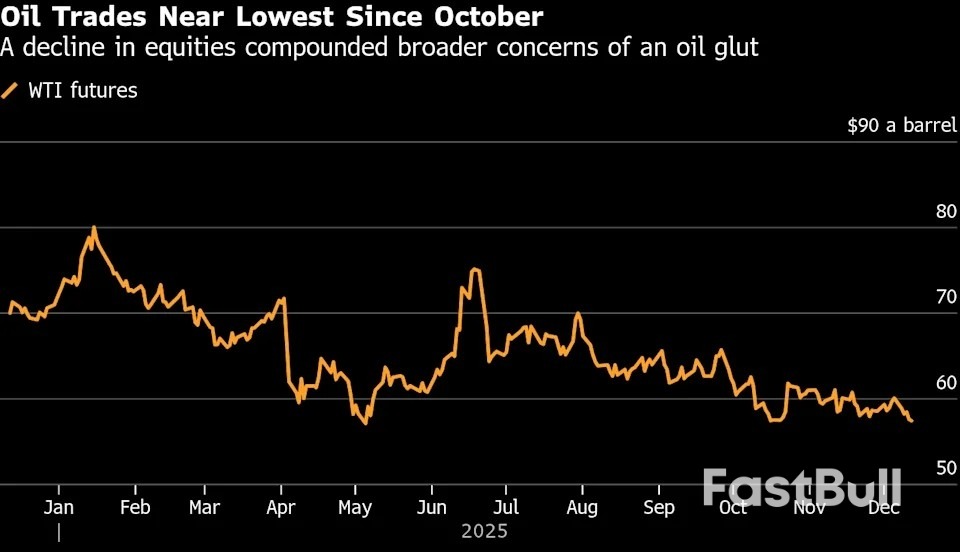

          Oil prices fluctuated, hovering above the lowest levels in about two months as weakness in US equities markets added to bearish sentiment about oversupply.
          West Texas Intermediate traded above $57 a barrel, while Brent traded above $61 a barrel in thin trading. Diesel futures, which were down about 0.7%, lagged the oil complex on Friday, while a selloff in US stocks dragged global gauges from the brink of record highs.
          Concerns about oversupply have helped to push crude toward the lower end of a band it has traded in since mid-October, with Brent futures slowly trending toward $60 a barrel. Prices have not dipped below the key psychological level since May.Oil Swings Near Lowest Since October With Surplus in Focus_1
          The International Energy Agency on Thursday reiterated its prediction for an unprecedented surplus — although slightly below its forecast last month — and said global inventories have swollen to a four-year high.
          Geopolitical tensions may add some support to oil prices. President Donald Trump announced new sanctions on three of Venezuelan counterpart Nicolas Maduro’s nephews as well as six oil tankers, after the US seized a supertanker off the coast of the Latin American nation on Wednesday.
          The ship seizure was just the beginning of a new phase in the Trump administration’s ramped-up pressure campaign against the Venezuelan president, according to people familiar with the operation. The act of economic statecraft is designed to deny Maduro a lifeline of oil revenue and force him to relinquish power, the people said.
          And a murky outlook for a peace deal to end Russia’s war in Ukraine — which could lower prices by eliminating sanctions on Russian crude — is also helping to support oil.
          “Ukraine also seems to keep targeting Russian oil assets even as negotiations for peace are in the works which seems to be keeping a psychological floor in crude,” said Dennis Kissler, senior vice president for trading at BOK Financial Securities Inc.

          Source: Bloomberg

          Risk Warnings and Disclaimers
          You understand and acknowledge that there is a high degree of risk involved in trading. Following any strategies or investment methods may lead to potential losses. The content on the site is provided by our contributors and analysts for information purposes only. You are solely responsible for determining whether any trading assets, securities, strategy, or any other product is suitable for investing based on your own investment objectives and financial situation.
          Add to Favorites
          Share

          Thai PM Says No Ceasefire Yet In Cambodia Conflict After Phone Call With Trump

          Justin

          Political

          Thailand's Prime Minister Anutin Charnvirakul looks on ahead of making offerings to monks, on the day he speaks to members of the media to announce the dissolution of parliament at the Government House in Bangkok, Thailand, December 12, 2025. REUTERS/Chalinee Thirasupa

          BANGKOK, Dec 12 (Reuters) - Thai Prime Minister Anutin Charnvirakul confirmed on Friday that there was no ceasefire yet with Cambodia and said he had spoken by telephone with U.S. President Donald Trump and told him Bangkok was not the aggressor in the conflict with its neighbour.

          Anutin said Trump told him he wanted the two countries to return to a ceasefire first agreed in July. He added that the U.S. president had not indicated that trade tariffs would be used as part of his efforts to end the fighting.

          Anutin's remarks came as heavy border clashes between the two countries continued for a fifth day.

          "He (Trump) wanted a ceasefire. I told him to ask our friends - don't just say a ceasefire but to tell the world that Cambodia will cease fire, withdraw its troops, remove all mines it has planted, and show them that they must stop everything first," Anutin told reporters.

          "Right now, there is no ceasefire yet, the fighting is still ongoing," he said.

          Thailand and Cambodia have been exchanging rockets and artillery at multiple locations along their disputed 817-km (508-mile) frontier in some of the most intense clashes since a five-day battle in July, which Trump stopped with calls to both leaders to halt their worst conflict in recent history.

          Trump is keen to intervene again to salvage the truce he brokered. He met Anutin and Cambodian Prime Minister Hun Manet in Malaysia in October, where they signed an expanded ceasefire agreement.

          Trump, who has repeatedly said he deserves the Nobel Peace Prize, lauded himself on Thursday as a global peacemaker and had on Thursday expressed confidence he would get the truce "back on track".

          This week's clashes have killed at least 20 people, with more than 260 wounded, according to tallies by both countries, which have blamed each other for reigniting the conflict.

          It was not immediately clear if Trump had spoken also to Cambodian Prime Minister Hun Manet.

          Cambodian government spokesperson Pen Bona earlier on Friday said he was not aware a call had been scheduled between Hun Manet and Trump, adding "but normally, our PM is always ready to talk".

          Hun Manet in August nominated Trump for the Nobel Peace Prize.
          Source: Reuters

          Risk Warnings and Disclaimers
          You understand and acknowledge that there is a high degree of risk involved in trading. Following any strategies or investment methods may lead to potential losses. The content on the site is provided by our contributors and analysts for information purposes only. You are solely responsible for determining whether any trading assets, securities, strategy, or any other product is suitable for investing based on your own investment objectives and financial situation.
          Add to Favorites
          Share

          Deutsche Bank, Goldman See Fed Cuts Rekindling Dollar’s Slide

          Adam

          Forex

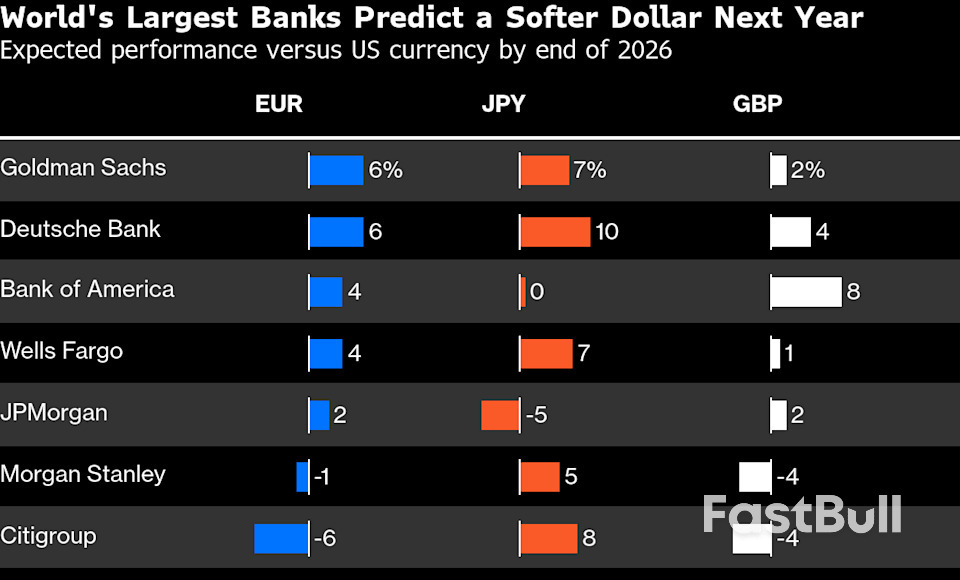
          Deutsche Bank AG, Goldman Sachs Group Inc. and other Wall Street banks are forecasting that the US dollar will resume its slide next year as the Federal Reserve keeps nudging down interest rates.
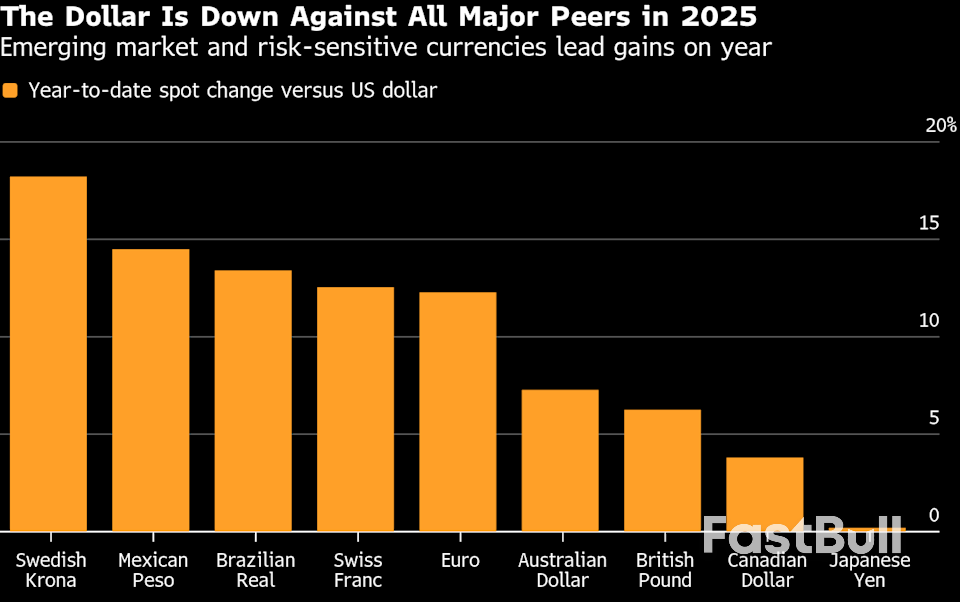
          The currency has stabilized over the past six months after tumbling by the most since the early 1970s during the first half of the year when President Donald Trump’s trade war unleashed havoc in global markets.
          But strategists expect the greenback to weaken again in 2026 as the US central bank continues to ease monetary policy just as others hold steady or move closer toward raising rates. That rift would give investors an incentive to sell US debt and shift the cash to countries where payouts are higher.
          As a result, forecasters at more than half a dozen major investment banks are largely predicting that the dollar will slip against major counterparts like the yen, euro and pound. According to the consensus estimates compiled by Bloomberg, a widely tracked index of the dollar will weaken some 3% by the end of 2026.
          “There is ample room for markets to price in a deeper cutting cycle,” said David Adams, head of G-10 foreign-exchange strategy at Morgan Stanley, which expects the dollar to drop 5% in the first half of the year. “That leaves plenty of capacity for further dollar weakness.”
          Deutsche Bank, Goldman See Fed Cuts Rekindling Dollar’s Slide_1
          The dollar’s decline is expected to be more muted and not as broad as it was this year, when it lost ground against all of the major currencies, leaving the the Bloomberg Dollar Spot Index down nearly 8% in its deepest annual drop since 2017. And the outlook hinges on anticipation that the US job market will continue to weaken — which remains uncertain, given the surprising resilience of the post-pandemic economy.
          Currency forecasting is also particularly vexing. When the dollar was surging late last year as investors piled into the so-called Trump trade, betting his policies would spur growth, strategists expected the the rally would reverse by mid-2025, only to get caught off guard by the scale of the drop during the first half of the year.
          But strategists see the broad contours heading into the new year as a recipe for a weaker dollar. Traders are pricing in two more quarter-point Fed rate cuts next year, and it’s possible that whoever Trump picks to replace Chair Jerome Powell may give in to White House pressure to lower rates even more. Meanwhile, the European Central Bank is expected to hold rates steady while the Bank of Japan nudges them upward.
          “We see risks stacked more against the dollar than in favor of the dollar,” Luis Oganes, London-based head of global macro research at JPMorgan, said at a news conference on Tuesday.
          A weaker dollar would have ripple effects in the broader economy by pushing up the cost of imports, increasing the value of corporate profits from overseas, and boosting exports — which would likely be welcomed by a Trump administration that’s complained about the US trade deficit. It could also extend rallies in emerging markets as investors shift cash there to seize on higher interest rates.
          That movement propelled emerging-market carry trades — which entail borrowing in low-rate countries and investing where yields are higher — to the biggest returns since 2009. JPMorgan and Bank of America Corp. both see potential for additional gains, flagging the Brazilian real and a handful Asian currencies — like the South Korean won and Chinese yuan — respectively.
          At Goldman Sachs, analysts led by Kamakshya Trivedi this month also noted that the market is starting to price a more optimistic economic outlook into other G-10 currencies — like Canada’s and Australia’s — following stronger-than-expected data. They noted the dollar’s “tendency to depreciate when the rest of the world is doing well.”
          Deutsche Bank, Goldman See Fed Cuts Rekindling Dollar’s Slide_2
          The contrarians who expect the dollar to gain against some other major currencies point primarily to the robust US economy. That growth, powered by the artificial-intelligence boom, will lure investment flows into the country that drive up the value of the dollar, analysts at Citigroup Inc. and Standard Chartered said.
          “We see strong potential for a dollar cycle recovery in 2026,” the Citigroup team led by Daniel Tobon wrote in their annual outlook.
          The prospect of stronger-than-expected growth was underscored Wednesday, when Fed policymakers marked up their projections for 2026. Yet they still cut interest rates by a quarter point and continued to pencil in one more such move next year. Powell also allayed any concern that the Fed could pivot to raising rates, saying the debate now is whether to continue cutting — or wait — as it’s tugged between a weakening job market and still above-target inflation.
          His comments were met with relief in the markets, where some traders had worried that the Fed would deliver a more hawkish message. As Treasury yields dropped, the Bloomberg dollar index slid 0.7% on Wednesday and Thursday, its biggest two-day drop since mid-September, when traders were positioning for the Fed to resume its rate-cutting cycle.
          In an annual outlook note to clients late last month, Deutsche Bank’s George Saravelos, the global head of foreign exchange research in London, and Tim Baker, his New York colleague, said the dollar has benefited from a “remarkably resilient” economy and the run-up in US stock prices. Yet they said the dollar is overvalued and predicted it will fall against its major counterparts next year as growth — and equity returns — pick up elsewhere.
          “If these forecasts materialize, they will confirm that this decade’s unusually long dollar bull cycle is over,” they wrote.

          Source: Bloomberg

          Risk Warnings and Disclaimers
          You understand and acknowledge that there is a high degree of risk involved in trading. Following any strategies or investment methods may lead to potential losses. The content on the site is provided by our contributors and analysts for information purposes only. You are solely responsible for determining whether any trading assets, securities, strategy, or any other product is suitable for investing based on your own investment objectives and financial situation.
          Add to Favorites
          Share

          Analysts flag risks for Strategy at Nasdaq 100 index reshuffle

          Adam

          Economic

          Bitcoin hoarding giant Strategy (MSTR.O) may be at risk of being removed from the Nasdaq 100 index (.NDX) at its annual reshuffle on Friday, amid questions over its business model that have weighed on its share price, some analysts flagged this week.
          After a sizzling rally that pushed its market capitalization to a peak of $128 billion earlier this year, Strategy - which started out as software company MicroStrategy but pivoted to bitcoin investing in 2020 - was included last December under the index's technology sub-category.
          That decision was questioned by some market-watchers who argued that the pioneering business model, which has spawned dozens of copycats, more closely resembles an investment fund.
          Strategy reported a net profit of $2.78 billion for the three months ended September 30, compared with a loss of $340.2 million a year earlier, mostly driven by an accounting change that allowed it to book gains on its bitcoin holdings. The Virginia-based company's revenue from the legacy software business, meanwhile, stood at just $128.7 million.
          "If MSTR is deemed to be a holding company or a cryptocurrency company rather than its legacy business as a software company, then it is susceptible to removal," said Steve Sosnick, chief market analyst at Interactive Brokers.
          The exchange operator, whose Nasdaq 100 index tracks the largest non-financial companies by market capitalization, declined to comment ahead of the announcement on Friday.
          The Information reported , opens new tab in September that Nasdaq has been tightening requirements for digital asset treasury companies it lists. It has not generally commented on the inclusion of those firms in its indices.
          Strategy did not respond to a request for comment.
          Analysts flag risks for Strategy at Nasdaq 100 index reshuffle_1

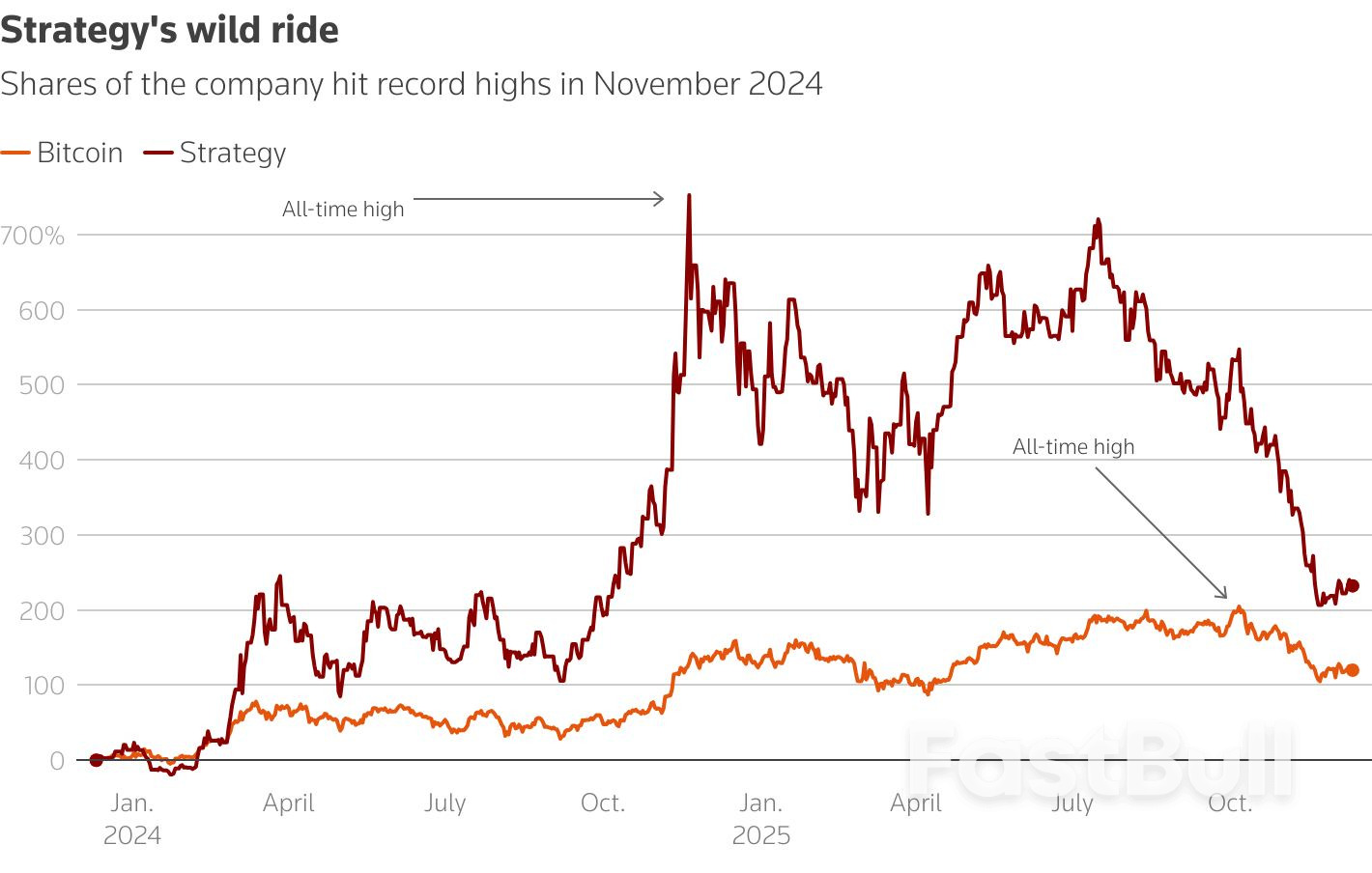
          A line chart showing Strategy and bitcoin's performance over the last two years

          Index reshuffles are closely watched, since they dictate which companies benefit from billions of passive investor flows. Saylor, though, has generally dismissed worries over potential index exclusion, and some other analysts said they did not expect Nasdaq to delete Strategy on Friday.
          DIGITAL ASSET TREASURY QUESTIONS
          Concerns have grown over the sustainability of crypto treasury companies, whose shares have proved extremely sensitive to bitcoin's gyrations. Strategy shares are down 65% from their 2024 peak and 36% year-to-date, compared with a 3.6% drop in bitcoin this year.
          Strategy's market value has fallen to $52.7 billion as of Thursday, while its bitcoin holdings are worth more than $61 billion, according to Reuters calculations.
          While that isn't enough to exclude Strategy on market capitalization grounds, Mike O'Rourke, chief market strategist at JonesTrading, argued in a note this week that Strategy had been included on a technicality and that Friday was a "perfect opportunity for Nasdaq to correct last year's mistake."
          If Nasdaq removes Strategy, the company could experience passive fund outflows of about $1.6 billion, according to estimates by Kaasha Saini, head of index strategy at Jefferies.
          Global index provider MSCI (MSCI.N) has raised concerns about the presence of digital asset treasury companies in its benchmarks. MSCI is due to decide in January on whether to exclude Strategy and similar companies.
          Saylor told Reuters this month that Strategy was engaging with MSCI, but that if it was excluded it wouldn't matter.
          Some analysts believe that Strategy is safe because its market value is still relatively high. H.C. Wainwright analyst Mike Colonnese doubted Strategy would be removed, since it is "larger than about 30 other companies in the Nasdaq 100."
          Beyond Strategy, Jefferies estimates drugmaker Biogen (BIIB.O) , IT solutions provider CDW (CDW.O) and four other stocks could depart from the Nasdaq 100. The six companies currently have the lowest market cap among the 100 members, according to data compiled by LSEG.
          Jefferies expects that retail giant Walmart , which has a market capitalization of $932.7 billion, is not eligible to be included this time, because its effective first day of trading (December 8) on the Nasdaq was after the exchange's November 28 reference date for the rebalancing.
          Nasdaq's announcement is expected after the market close on Friday, with changes effective December 22.

          Source: reuters

          To stay updated on all economic events of today, please check out our Economic calendar
          Risk Warnings and Disclaimers
          You understand and acknowledge that there is a high degree of risk involved in trading. Following any strategies or investment methods may lead to potential losses. The content on the site is provided by our contributors and analysts for information purposes only. You are solely responsible for determining whether any trading assets, securities, strategy, or any other product is suitable for investing based on your own investment objectives and financial situation.
          Add to Favorites
          Share

          Fed Officials Split Over Bigger Risk For Economy Going Into 2026

          Justin

          Central Bank

          Federal Reserve officials — including two who will become voters in 2026 — offered strongly opposing views Friday on what to do with interest rates, continuing a debate that will grip the US central bank into the new year.

          Three policymakers focused in their comments on inflation risks, though one of them suggested he was advocating only a temporary pause to rate cuts to confirm inflation is subsiding. A fourth emphasized risks to the labor market as the bigger concern.

          The remarks were the first since Wednesday, when the Fed cut its benchmark rate by a quarter percentage point for a third consecutive meeting in response to rising unemployment. Dissenting votes against the decision indicated the string of cuts has become increasingly contentious amid lingering inflation, and projections showed the median official only expects one reduction in 2026.

          Two officials — Chicago Fed President Austan Goolsbee and his Kansas City counterpart, Jeff Schmid — issued statements Friday outlining the rationale for their dissents against Wednesday's rate cut. It was Goolsbee's first dissenting vote since joining the Fed in 2023, while Schmid's followed a dissent against the previous rate reduction in October.

          The Chicago Fed chief said in his statement he "felt the more prudent course would have been to wait for more information" before cutting rates again after a government shutdown delayed several key economic reports in October and November, given some "concerning" data on inflation prior to the shutdown.

          Speaking later in the morning on CNBC, Goolsbee added that he projected more rate cuts in 2026 than most of his colleagues: "I'm one of the most optimistic folks about how rates can go down in the coming year," he said.

          Schmid was less equivocal.

          "Inflation remains too high, the economy shows continued momentum and the labor market — though cooling — remains largely in balance," he said in his statement. "I view the current stance of monetary policy as being only modestly, if at all, restrictive."

          The Chicago and Kansas City Fed presidents will rotate off the Fed's voting panel in 2026. Two of their incoming replacements also spoke Friday — one emphasizing concerns about inflation and the other warning of risks to the labor market.

          Cleveland Fed President Beth Hammack, at an event in Cincinnati, said the central bank should keep rates high enough to continue putting downward pressure on inflation.

          "Right now, we've got policy that's right around neutral," she said. "I would prefer to be on a slightly more restrictive stance."

          In projections published Wednesday alongside the rate decision, six of 19 policymakers indicated they would have left the benchmark rate where it was before this week's cut to close out 2025.

          Since only 12 of the 19 vote on the rate-setting Federal Open Market Committee each year, and only two of the 12 with votes dissented in favor of higher rates, some analysts dubbed the plethora of elevated rate projections "silent dissents."

          Philadelphia Fed President Anna Paulson, who with Hammack will rotate into the FOMC's voting ranks next year, was the only one of the four officials speaking Friday who emphasized ongoing risks to the labor market despite the central bank's recent efforts to adjust rates toward a more neutral setting.

          "On net, I am still a little more concerned about labor market weakness than about upside risks to inflation," Paulson said Friday at an event hosted by the Delaware State Chamber of Commerce. "That's partly because I see a decent chance that inflation will come down as we go through next year."
          Source: Bloomberg Europe

          Risk Warnings and Disclaimers
          You understand and acknowledge that there is a high degree of risk involved in trading. Following any strategies or investment methods may lead to potential losses. The content on the site is provided by our contributors and analysts for information purposes only. You are solely responsible for determining whether any trading assets, securities, strategy, or any other product is suitable for investing based on your own investment objectives and financial situation.
          Add to Favorites
          Share

          S&P 500: When 0DTE Options Meet the AI Unwind Trade

          Adam

          Stocks

          Economic

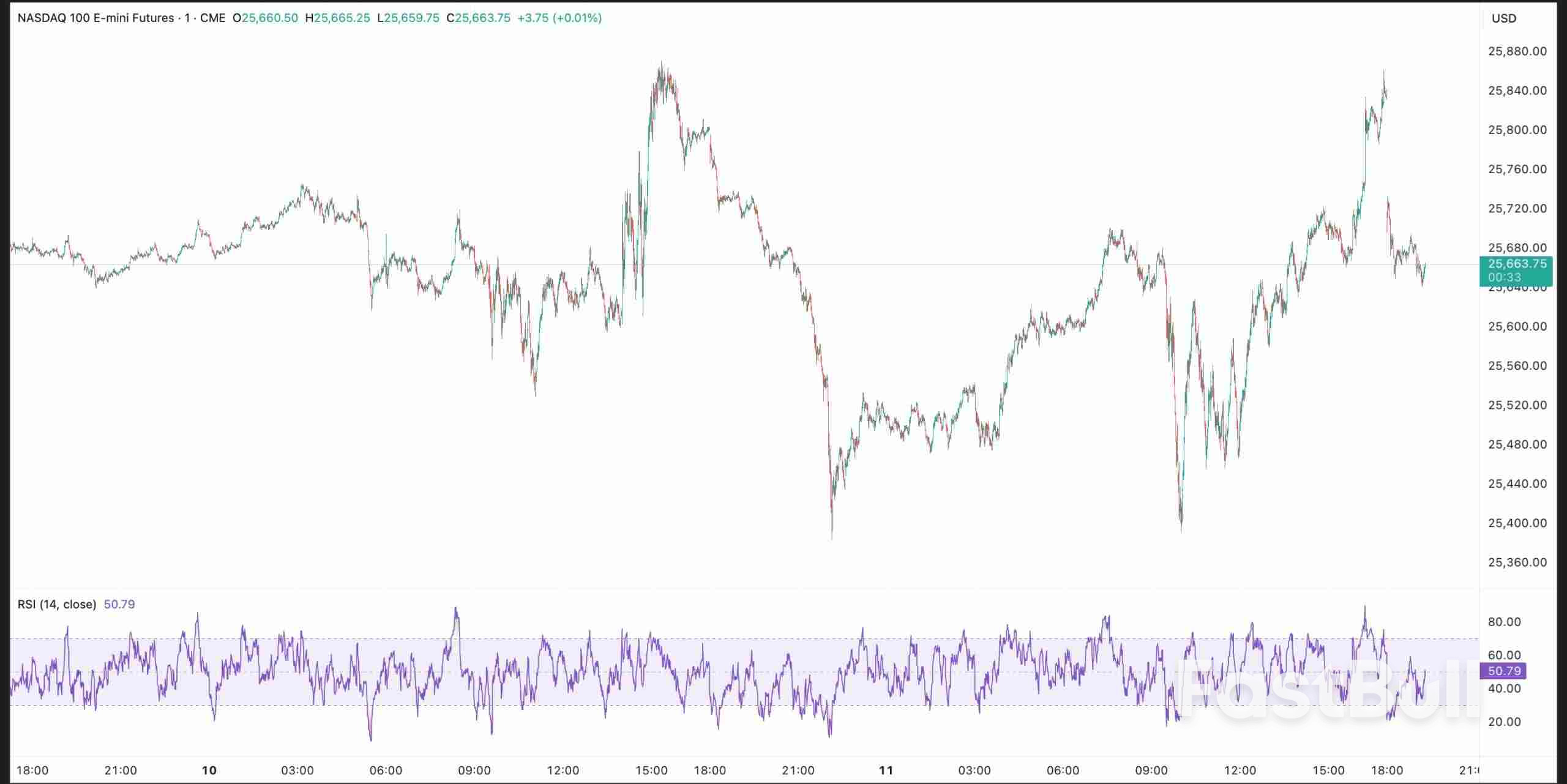
          What a strange day. Overnight futures were sharply lower, with the Nasdaq down more than 1.5% at one point and clear signs of nervousness in global markets. Yet all of that anxiety disappeared almost immediately once the cash session opened. The S&P 500 erased an overnight decline of roughly 1% and finished the day higher by about 20 basis points.
          S&P 500: When 0DTE Options Meet the AI Unwind Trade_1
          Those cheap 6,900-strike call options may have been too tempting for the 0DTE crowd to ignore. Still, it remains a frustrating environment. It is becoming increasingly clear—at least to me—that the options market is exerting a growing influence on the S&P 500’s day-to-day price action. In many ways, it seems as though the index is being constrained and held in place, and it is difficult to know how much longer that dynamic can persist, perhaps through quad witching next week.
          What stands out most is that the heaviest S&P 500 option activity was concentrated at the 6,900 strike for expiration on Thursday, and the index ultimately closed at 6,901. That coincidence strongly suggests that options-related flows drove a significant portion of the intraday price action.
          Unfortunately, intraday transparency in the options market is limited. It is difficult to determine in real time whether traders are buying or selling calls, since changes in open interest are not available until the following day. With 0DTE options, that information is effectively unavailable altogether—at least with the data I can access. This makes it challenging to develop a precise mechanical understanding of what is occurring beneath the surface.
          A trade printing at the ask does not necessarily imply a buyer, just as a trade at the bid does not automatically indicate a seller. Execution mechanics and hedging flows complicate the picture. As a result, interpreting intraday options activity with certainty is extremely difficult.
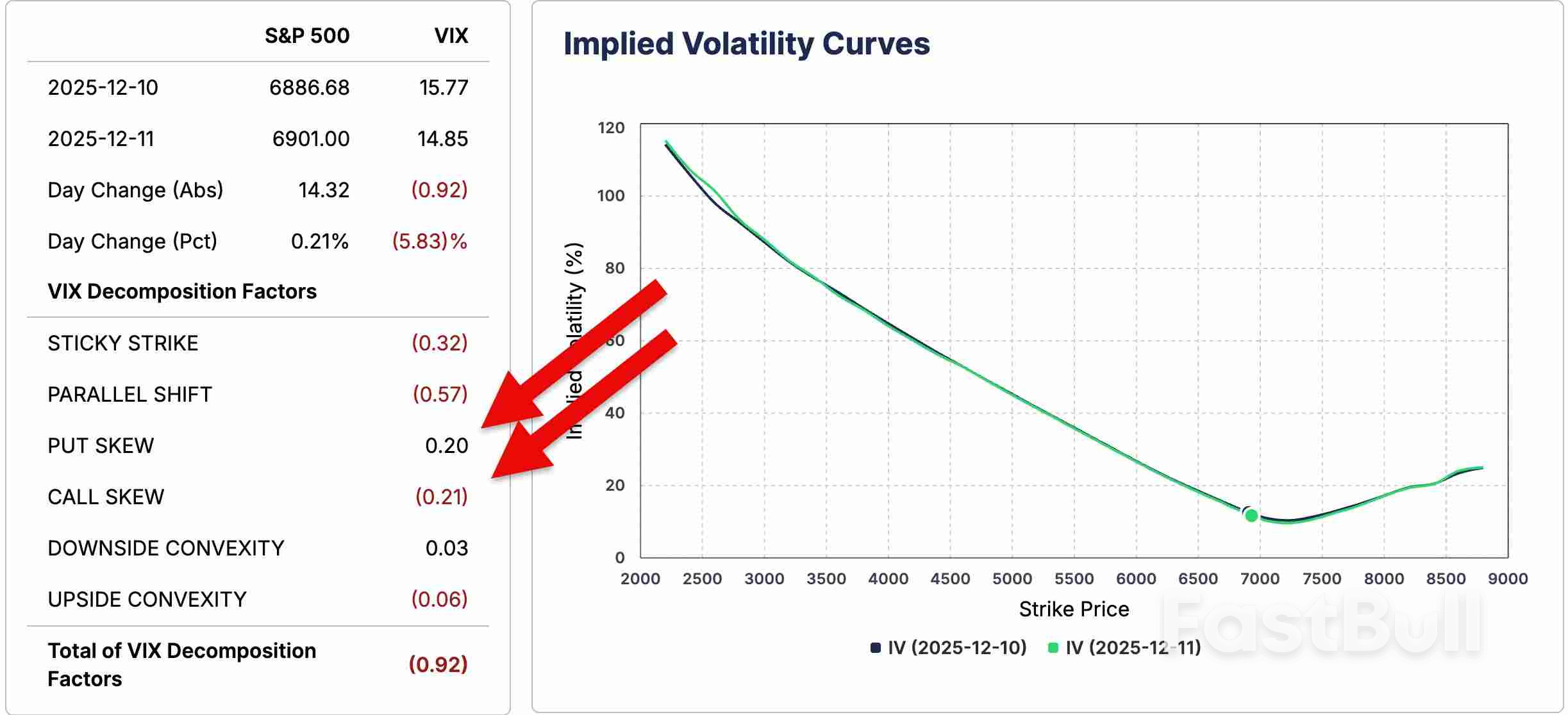
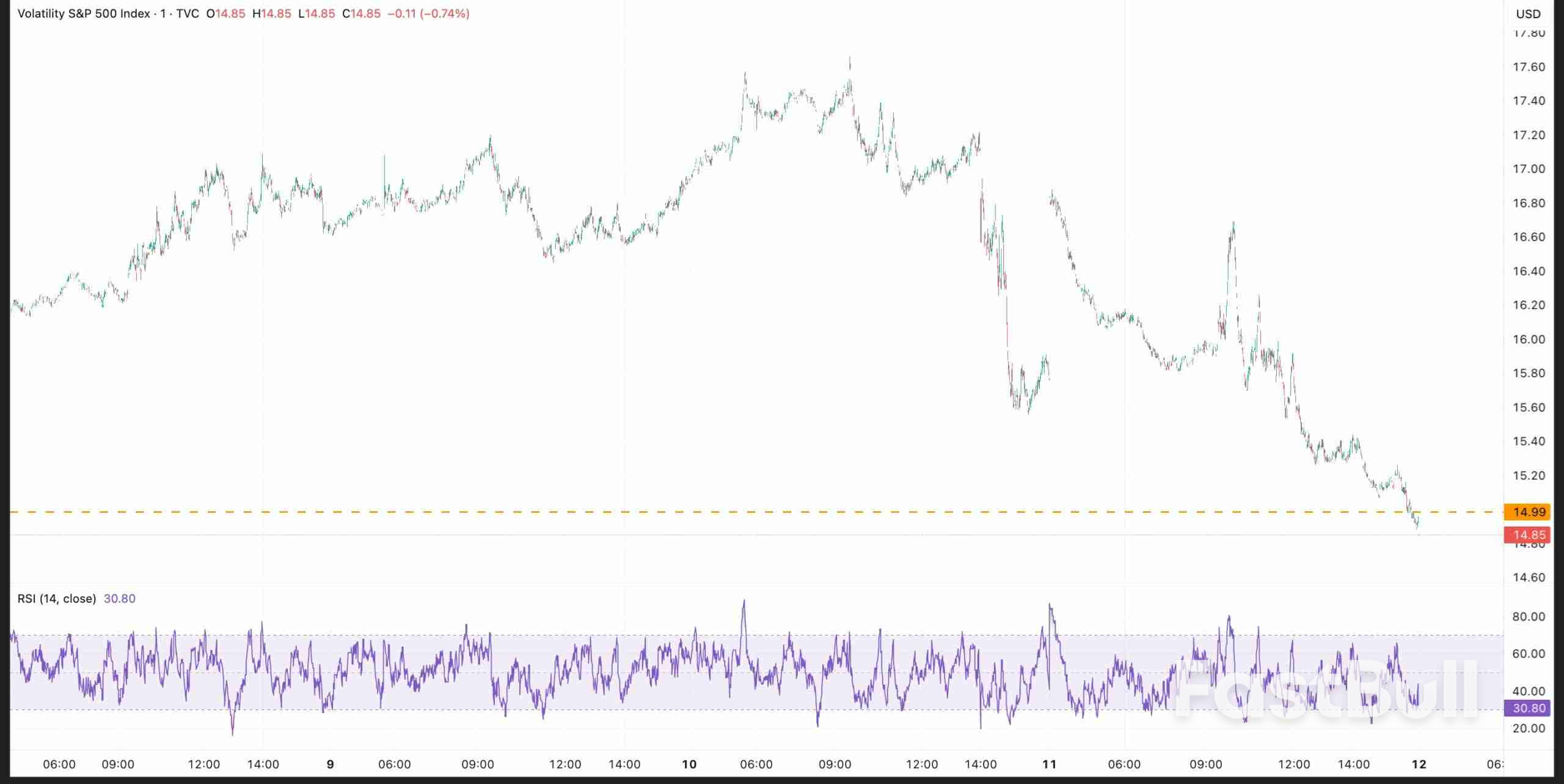
          That said, Thursday followed a fairly classic pattern. The VIX traded overnight around 17, opened the cash session around 16, and then declined steadily to close near 15. A move like that typically reflects one of two dynamics: traders closing out put positions or traders selling calls.
          S&P 500: When 0DTE Options Meet the AI Unwind Trade_2
          What is perhaps most interesting is that the VIX decomposition shows call skew falling while put skew rose. That combination suggests that ATM put implied volatility fell faster than OTM put implied volatility within the VIX index, which is not what you would normally expect to see on a day.
          Under more typical circumstances, volatility would be crushed across puts as hedges are closed. Instead, the action suggests that near-money puts were closed out—likely during the morning selloff—while OTM and longer-dated downside protection remained elevated.
          S&P 500: When 0DTE Options Meet the AI Unwind Trade_3
          It is almost as if the options market didn’t believe in the snap-back rally, and perhaps there is a viable and good reason for that.
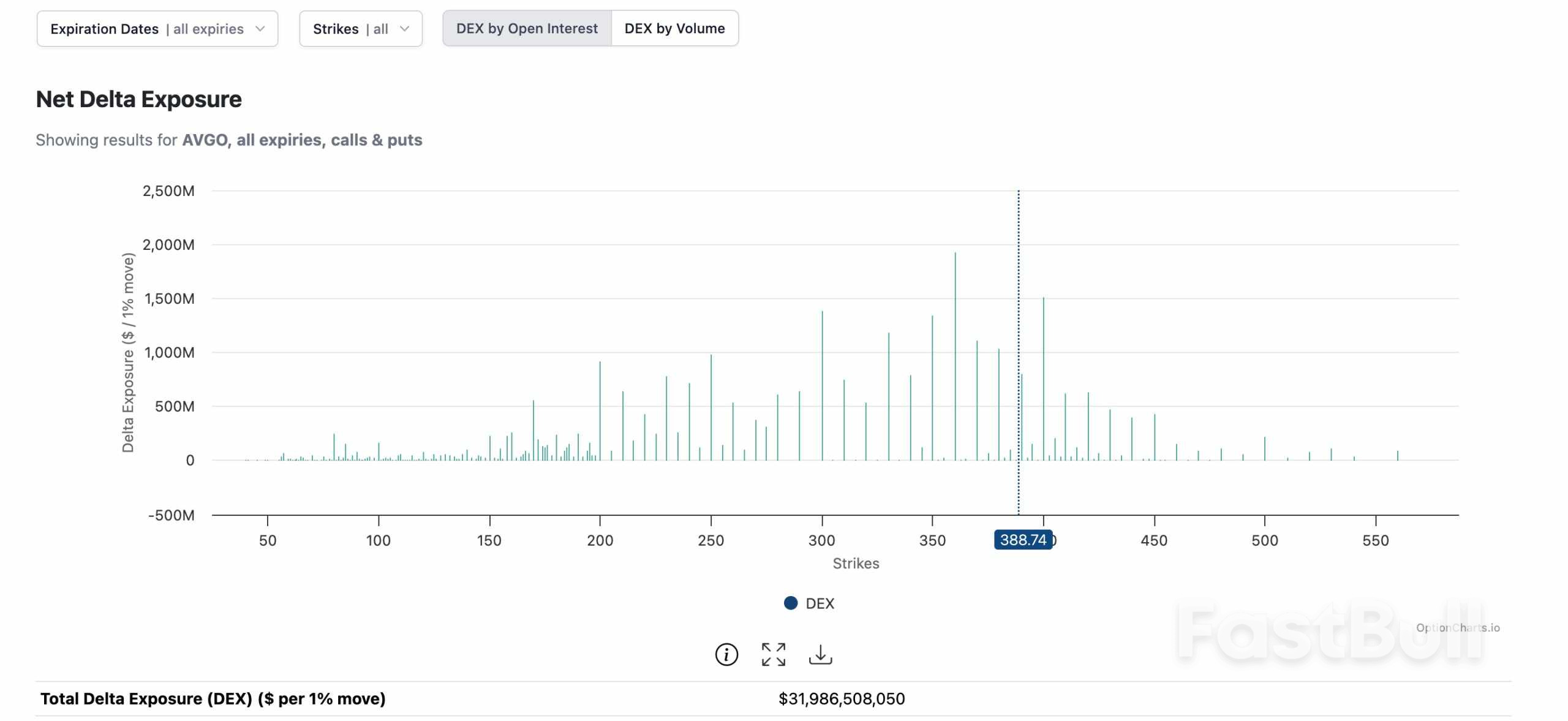
          How the market will respond to the second AI company failing to rally following its earnings results is a good question. Oracle (NYSE:ORCL) declined, and Broadcom (NASDAQ:AVGO) fell approximately 5% after its report tonight. Seems that selling AI “chips” doesn’t deliver a good gross margin in comparison to the other “chips” they sell.
          At least that is what I thought I heard them say. The stock is likely to have a hard time rising today, given there are many calls to sell if the stock can’t get over $400.
          S&P 500: When 0DTE Options Meet the AI Unwind Trade_4

          Source:investing

          To stay updated on all economic events of today, please check out our Economic calendar
          Risk Warnings and Disclaimers
          You understand and acknowledge that there is a high degree of risk involved in trading. Following any strategies or investment methods may lead to potential losses. The content on the site is provided by our contributors and analysts for information purposes only. You are solely responsible for determining whether any trading assets, securities, strategy, or any other product is suitable for investing based on your own investment objectives and financial situation.
          Add to Favorites
          Share

          India’s Inflation Ticks Up as Food and Fuel Prices Stabilize, Pressuring RBI’s Growth-Focused Policy

          Gerik

          Economic

          Inflation Rises But Remains Low in Historical Terms

          India’s consumer price index (CPI) inflation rose to 0.71% in November, up from 0.25% in October, according to official data released Friday. Though this marks a modest rebound, inflation still remains exceptionally low by India’s historical standards.
          The increase aligns with Reuters’ median forecast of 0.70%, and was attributed to rising prices of vegetables, eggs, meat, fish, spices, and fuel. Notably, fuel and light prices rose 2.32%, up from 1.98% in October, reversing the cooling trend seen earlier.
          Both urban and rural inflation posted increases, although Kerala and Tamil Nadu maintained the lowest state-level inflation rates.

          Policy Outlook: RBI Focuses on Growth

          The Reserve Bank of India (RBI) recently cut its policy rate by 25 basis points, citing the benign inflation outlook and slowing economic momentum. The central bank now forecasts FY2025–26 inflation at 2.0%, down from 2.6% in October, while predicting a gradual rise to 4.0% by Q3 2026.
          RBI Governor Sanjay Malhotra emphasized that the central bank remains “growth supportive” and will continue meeting “productive requirements of the economy in a proactive manner.” Analysts are divided on whether the latest cut marks the end of the easing cycle, though many, including HSBC Research, argue that further cuts may be needed in 2026 as fiscal constraints and global weakness persist.

          Trade Headwinds Weigh on Growth Prospects

          India’s external sector faces increasing strain. In August, the U.S. imposed a 25% tariff on a range of Indian goods including textiles, gems, and marine products bringing total duties up to 50%, among the highest levied on a U.S. trading partner.
          This hit labor-intensive exports hard. October data showed U.S.-bound exports declined 8.5% YoY to $6.3 billion, while overall exports fell 11.8% to $34.38 billion.
          To stimulate demand amid these external shocks, the Indian government implemented GST cuts in September across consumer goods, vehicles, and farm products aiming to support consumption during the festive season.
          While domestic demand improved slightly, the Indian rupee has continued to weaken, falling below the ₹90/USD threshold on Friday raising import costs and complicating monetary policymaking.

          Growth Stimulus Faces Inflation Risk

          Although India’s inflation remains low, the slight uptick in November signals waning deflationary momentum in food and energy. Combined with trade disruptions from U.S. tariffs and a sliding rupee, the RBI’s task of balancing growth support and inflation control may become more challenging in early 2026.
          Unless exports recover or the rupee stabilizes, further rate cuts may be warranted but not without risk. The RBI’s current strategy hinges on gradual inflation normalization and domestic consumption strength both of which now face mounting external and currency pressures.

          Source: CNBC

          To stay updated on all economic events of today, please check out our Economic calendar
          Risk Warnings and Disclaimers
          You understand and acknowledge that there is a high degree of risk involved in trading. Following any strategies or investment methods may lead to potential losses. The content on the site is provided by our contributors and analysts for information purposes only. You are solely responsible for determining whether any trading assets, securities, strategy, or any other product is suitable for investing based on your own investment objectives and financial situation.
          Add to Favorites
          Share
          FastBull
          Copyright © 2025 FastBull Ltd

          728 RM B 7/F GEE LOK IND BLDG NO 34 HUNG TO RD KWUN TONG KLN HONG KONG

          TelegramInstagramTwitterfacebooklinkedin
          App Store Google Play Google Play
          Products
          Charts

          Chats

          Q&A with Experts
          Screeners
          Economic Calendar
          Data
          Tools
          Membership
          Features
          Function
          Markets
          Copy Trading
          Latest Signals
          Contests
          News
          Analysis
          24/7
          Columns
          Education
          Company
          Careers
          About Us
          Contact Us
          Advertising
          Help Center
          Feedback
          User Agreement
          Privacy Policy
          Business

          White Label

          Data API

          Web Plug-ins

          Poster Maker

          Affiliate Program

          Risk Disclosure

          The risk of loss in trading financial instruments such as stocks, FX, commodities, futures, bonds, ETFs and crypto can be substantial. You may sustain a total loss of the funds that you deposit with your broker. Therefore, you should carefully consider whether such trading is suitable for you in light of your circumstances and financial resources.

          No decision to invest should be made without thoroughly conducting due diligence by yourself or consulting with your financial advisors. Our web content might not suit you since we don't know your financial conditions and investment needs. Our financial information might have latency or contain inaccuracy, so you should be fully responsible for any of your trading and investment decisions. The company will not be responsible for your capital loss.

          Without getting permission from the website, you are not allowed to copy the website's graphics, texts, or trademarks. Intellectual property rights in the content or data incorporated into this website belong to its providers and exchange merchants.

          Not Logged In

          Log in to access more features

          FastBull Membership

          Not yet

          Purchase

          Become a signal provider
          Help Center
          Customer Service
          Dark Mode
          Price Up/Down Colors

          Log In

          Sign Up

          Position
          Layout
          Fullscreen
          Default to Chart
          The chart page opens by default when you visit fastbull.com