• Trade
  • Markets
  • Copy
  • Contests
  • News
  • 24/7
  • Calendar
  • Q&A
  • Chats
Screeners
SYMBOL
LAST
ASK
BID
HIGH
LOW
NET CHG.
%CHG.
SPREAD
SPX
S&P 500 Index
6969.02
6969.02
6969.02
6992.83
6870.81
-9.01
-0.13%
--
DJI
Dow Jones Industrial Average
49071.55
49071.55
49071.55
49292.81
48597.22
+55.96
+ 0.11%
--
IXIC
NASDAQ Composite Index
23685.11
23685.11
23685.11
23840.55
23232.78
-172.33
-0.72%
--
USDX
US Dollar Index
96.370
96.450
96.370
96.560
96.240
+0.400
+ 0.42%
--
EURUSD
Euro / US Dollar
1.19254
1.19261
1.19254
1.19743
1.18947
-0.00448
-0.37%
--
GBPUSD
Pound Sterling / US Dollar
1.37540
1.37553
1.37540
1.38142
1.37313
-0.00553
-0.40%
--
XAUUSD
Gold / US Dollar
5175.37
5175.78
5175.37
5450.83
5112.26
-200.94
-3.74%
--
WTI
Light Sweet Crude Oil
64.125
64.155
64.125
65.611
63.409
-1.127
-1.73%
--

Community Accounts

Signal Accounts
--
Profit Accounts
--
Loss Accounts
--
View More

Become a signal provider

Sell trading signals to earn additional income

View More

Guide to Copy Trading

Get started with ease and confidence

View More

Signal Accounts for Members

All Signal Accounts

Best Return
  • Best Return
  • Best P/L
  • Best MDD
Past 1W
  • Past 1W
  • Past 1M
  • Past 1Y

All Contests

  • All
  • Trump Updates
  • Recommend
  • Stocks
  • Cryptocurrencies
  • Central Banks
  • Featured News
Top News Only
Share

Cctv - China And ASEAN Countries Agree To Strengthen Dialogue For Maintaining Peace And Stability In South China Sea

Share

Seoul Stock Market's KOSPI Ends Jan Up 24.0%, Biggest Monthly Rise Since Dec 1998

Share

French GDP Rises 0.2% In Q4

Share

Kazakhstan's Gold Reserves Rose To 10.96 Million Ounces (approximately 340.89 Tons) In December

Share

Russian Defense Ministry: 18 Drones Were Shot Down In Various Regions Of Russia Last Night

Share

South Africa's December M3 Money Supply Growth At 8.16% Year-On-Year

Share

Statistics Finland - Finnish Dec GDP -0.3 % Year-On-Year

Share

Caixabank Sees 2027 Rote About 20%

Share

Financial Times: British Ministers Say Labour's Housing Construction Plans Will Depress House Prices

Share

Caixabank Sees 2026 Nii Above 11 Billion Euros, 2026 Rote About 18%

Share

[Chinese Ambassador To The US: People-to-People Exchanges Help China And The US Build A New Way Of Coexisting In The New Era] On The 28th Local Time, Chinese Ambassador To The US Xie Feng Said At An Event In Philadelphia That People-to-people Exchanges Should Serve As A Bridge, A Medium, And A Mirror To Help China And The US Build A New Way Of Coexisting In The New Era. Xie Feng Attended The 2026 "Happy Chinese New Year" Concert And "Hello! China" Tourism Promotion Event Jointly Organized By The China National Tourist Office In New York And The Philadelphia Orchestra. In His Speech, He Said That China And The US Are Currently Exploring A New Way Of Coexisting In The New Era, A Long And Arduous Task That Requires Both Sides To Continuously Strengthen The Bonds Of People-to-people Exchanges And Inject A Continuous Stream Of Positive Energy Into China-US Relations

Share

Dollar/Yen Extends Gain, Last Up 154.04

Share

Australia's S&P/ASX 200 Index Closes Down 0.7% At 8869.10 Points

Share

Colombia's Central Bank Expected To Raise Interest Rate For First Time Since 2023

Share

White House Official - President Trump Not Indicating USA Would Decertify Canadian Built Airplanes In Operation

Share

Finance Minister: Japan Carefully Considering Implications Of Consumption Tax Suspension

Share

METI - Japan's Dec Oil Imports Rise 17.7% Year-On-Year

Share

The White House Announced That President Trump Will Attend A Policy Meeting At 2 P.m. ET On Friday (3 A.m. Beijing Time The Following Day) And Sign An Executive Order At 11 A.m. ET On Friday (midnight Saturday Beijing Time)

Share

According To The Japan Exchange Website, From 10:21:49 To 10:31:59 Beijing Time On January 30, 2026, The Osaka Exchange Activated Its Circuit Breaker Mechanism For Platinum Futures, Temporarily Suspending Trading. This Was Due To A Sharp Drop In Global Platinum Prices, With The Decline Reaching The 10% Limit Set By The Previous Day. The Circuit Breaker Mechanism Is A Measure Taken By Exchanges To Cope With Severe Market Volatility, Aiming To Temporarily Restrict Or Suspend Trading To Encourage Investors To Remain Calm. This Was The First Time The Circuit Breaker Mechanism For Platinum Futures Had Been Activated Since December 30, 2025, Starting At 10:21 AM Beijing Time And Lasting For 10 Minutes

Share

Hsi Down 498 Pts, Hsti Down 105 Pts, Cspc Pharma Down Over 12%, Shk Ppt, Huabao Intl Hit New Highs

TIME
ACT
FCST
PREV
U.S. Factory Orders MoM (Excl. Defense) (Nov)

A:--

F: --

P: --

U.S. Factory Orders MoM (Nov)

A:--

F: --

P: --
U.S. Wholesale Sales MoM (SA) (Nov)

A:--

F: --

P: --

U.S. Factory Orders MoM (Excl. Transport) (Nov)

A:--

F: --

P: --
U.S. Non-Defense Capital Durable Goods Orders Revised MoM (Excl. Aircraft) (SA) (Nov)

A:--

F: --

P: --
U.S. EIA Weekly Natural Gas Stocks Change

A:--

F: --

P: --

Brazil CAGED Net Payroll Jobs (Dec)

A:--

F: --

P: --

U.S. Weekly Treasuries Held by Foreign Central Banks

A:--

F: --

P: --

South Korea Industrial Output MoM (SA) (Dec)

A:--

F: --

P: --

South Korea Services Output MoM (Dec)

A:--

F: --

P: --

South Korea Retail Sales MoM (Dec)

A:--

F: --

P: --

Japan Tokyo CPI YoY (Excl. Food & Energy) (Jan)

A:--

F: --

P: --

Japan Tokyo CPI MoM (Excl. Food & Energy) (Jan)

A:--

F: --

P: --

Japan Unemployment Rate (Dec)

A:--

F: --

P: --

Japan Tokyo CPI YoY (Jan)

A:--

F: --

P: --

Japan Jobs to Applicants Ratio (Dec)

A:--

F: --

P: --

Japan Tokyo CPI MoM (Jan)

A:--

F: --

P: --

Japan Tokyo Core CPI YoY (Jan)

A:--

F: --

P: --

Japan Retail Sales YoY (Dec)

A:--

F: --

P: --
Japan Industrial Inventory MoM (Dec)

A:--

F: --

P: --

Japan Retail Sales (Dec)

A:--

F: --

P: --

Japan Retail Sales MoM (SA) (Dec)

A:--

F: --

P: --
Japan Large-Scale Retail Sales YoY (Dec)

A:--

F: --

P: --

Japan Industrial Output Prelim MoM (Dec)

A:--

F: --

P: --

Japan Industrial Output Prelim YoY (Dec)

A:--

F: --

P: --

Australia PPI YoY (Q4)

A:--

F: --

P: --

Australia PPI QoQ (Q4)

A:--

F: --

P: --

Japan Construction Orders YoY (Dec)

A:--

F: --

P: --

Japan New Housing Starts YoY (Dec)

A:--

F: --

P: --

France GDP Prelim YoY (SA) (Q4)

--

F: --

P: --

Turkey Trade Balance (Dec)

--

F: --

P: --

France PPI MoM (Dec)

--

F: --

P: --

Germany Unemployment Rate (SA) (Jan)

--

F: --

P: --

Germany GDP Prelim YoY (Not SA) (Q4)

--

F: --

P: --

Germany GDP Prelim QoQ (SA) (Q4)

--

F: --

P: --

Germany GDP Prelim YoY (Working-day Adjusted) (Q4)

--

F: --

P: --

Italy GDP Prelim YoY (SA) (Q4)

--

F: --

P: --

U.K. M4 Money Supply (SA) (Dec)

--

F: --

P: --

U.K. M4 Money Supply YoY (Dec)

--

F: --

P: --

U.K. M4 Money Supply MoM (Dec)

--

F: --

P: --

U.K. Mortgage Lending (Dec)

--

F: --

P: --

U.K. Mortgage Approvals (Dec)

--

F: --

P: --

Italy Unemployment Rate (SA) (Dec)

--

F: --

P: --

Euro Zone Unemployment Rate (Dec)

--

F: --

P: --

Euro Zone GDP Prelim QoQ (SA) (Q4)

--

F: --

P: --

Euro Zone GDP Prelim YoY (SA) (Q4)

--

F: --

P: --

Italy PPI YoY (Dec)

--

F: --

P: --

India Deposit Gowth YoY

--

F: --

P: --

Mexico GDP Prelim YoY (Q4)

--

F: --

P: --

Brazil Unemployment Rate (Dec)

--

F: --

P: --

South Africa Trade Balance (Dec)

--

F: --

P: --

Germany CPI Prelim YoY (Jan)

--

F: --

P: --

Germany CPI Prelim MoM (Jan)

--

F: --

P: --

Germany HICP Prelim YoY (Jan)

--

F: --

P: --

Germany HICP Prelim MoM (Jan)

--

F: --

P: --

U.S. Core PPI YoY (Dec)

--

F: --

P: --

U.S. PPI YoY (Dec)

--

F: --

P: --

U.S. PPI MoM (SA) (Dec)

--

F: --

P: --

Canada GDP MoM (SA) (Nov)

--

F: --

P: --

Canada GDP YoY (Nov)

--

F: --

P: --

Q&A with Experts
    • All
    • Chatrooms
    • Groups
    • Friends
    3484628 flag
    hi
    marsgents flag
    keep booking partial on new short😁
    Kung Fu flag
    3484628
    hi
    @Visitor3484628hello. Good morning to you. What's your name
    3484628 flag
    ray
    3484628 flag
    new here
    Nawhdir Øt flag
    marsgents
    keep booking partial on new short😁
    @marsgentsyeah, it's like we order cinema tickets, but the actors are ourselves
    Kung Fu flag
    marsgents
    keep booking partial on new short😁
    @marsgentsscalping method is best to sit on your hands and watch
    Quartz flag
    any technical analysis of the current trend of XAUUSD?
    Kung Fu flag
    3484628
    ray
    @Visitor3484628log in Ray, and let's talk
    Kung Fu flag
    3484628
    new here
    @Visitor3484628okay. You're welcome to this great community
    3484628 flag
    let me log using google
    john flag
    Quartz
    any technical analysis of the current trend of XAUUSD?
    @Quartzit seems like it's extending to the downside
    Kung Fu flag
    Quartz
    any technical analysis of the current trend of XAUUSD?
    @Quartzthat's what we've been talking about. There appears to be a change of character with gold
    Kung Fu flag
    3484628
    let me log using google
    @Visitor3484628please, do. Nice to have you here
    john flag
    3484628
    let me log using google
    @Visitor3484628if you are using your mobile it's better you download the app
    Audrey Ray flag
    iam using pc right now, i do it later
    Audrey Ray flag
    iam logged here now
    marsgents flag
    Kung Fu
    @Kung Funot many possition left,only 2,from high, 5435 and 4373 left,small lot 0.02
    Kung Fu flag
    Audrey Ray
    iam logged here now
    @Audrey RayI can see you, Ray.
    Kung Fu flag
    Audrey Ray
    iam using pc right now, i do it later
    @Audrey Rayyou're not new to trading, are you
    Type here...
    Add Symbol or Code

      No matching data

      All
      Trump Updates
      Recommend
      Stocks
      Cryptocurrencies
      Central Banks
      Featured News
      • All
      • Russia-Ukraine Conflict
      • Middle East Flashpoint
      • All
      • Russia-Ukraine Conflict
      • Middle East Flashpoint
      Search
      Products

      Charts Free Forever

      Chats Q&A with Experts
      Screeners Economic Calendar Data Tools
      Membership Features
      Data Warehouse Market Trends Institutional Data Policy Rates Macro

      Market Trends

      Market Sentiment Order Book Forex Correlations

      Top Indicators

      Charts Free Forever
      Markets

      News

      News Analysis 24/7 Columns Education
      From Institutions From Analysts
      Topics Columnists

      Latest Views

      Latest Views

      Trending Topics

      Top Columnists

      Latest Update

      Signals

      Copy Rankings Latest Signals Become a signal provider AI Rating
      Contests
      Brokers

      Overview Brokers Assessment Rankings Regulators News Claims
      Broker listing Forex Brokers Comparison Tool Live Spread Comparison Scam
      Q&A Complaint Scam Alert Videos Tips to Detect Scam
      More

      Business
      Events
      Careers About Us Advertising Help Center

      White Label

      Data API

      Web Plug-ins

      Affiliate Program

      Awards Institution Evaluation IB Seminar Salon Event Exhibition
      Vietnam Thailand Singapore Dubai
      Fans Party Investment Sharing Session
      FastBull Summit BrokersView Expo
      Recent Searches
        Top Searches
          Markets
          News
          Analysis
          User
          24/7
          Economic Calendar
          Education
          Data
          • Names
          • Latest
          • Prev

          View All

          No data

          Scan to Download

          Faster Charts, Chat Faster!

          Download App
          English
          • English
          • Español
          • العربية
          • Bahasa Indonesia
          • Bahasa Melayu
          • Tiếng Việt
          • ภาษาไทย
          • Français
          • Italiano
          • Türkçe
          • Русский язык
          • 简中
          • 繁中
          Open Account
          Search
          Products
          Charts Free Forever
          Markets
          News
          Signals

          Copy Rankings Latest Signals Become a signal provider AI Rating
          Contests
          Brokers

          Overview Brokers Assessment Rankings Regulators News Claims
          Broker listing Forex Brokers Comparison Tool Live Spread Comparison Scam
          Q&A Complaint Scam Alert Videos Tips to Detect Scam
          More

          Business
          Events
          Careers About Us Advertising Help Center

          White Label

          Data API

          Web Plug-ins

          Affiliate Program

          Awards Institution Evaluation IB Seminar Salon Event Exhibition
          Vietnam Thailand Singapore Dubai
          Fans Party Investment Sharing Session
          FastBull Summit BrokersView Expo

          Oil Prices Hold Near Multi-Month Peaks as Geopolitical Risk Premium Builds

          Gerik

          Economic

          Commodity

          Summary:

          Oil prices hovered near multi-month highs as markets priced in rising geopolitical risk from potential U.S. action against Iran, putting Brent and WTI on track for their strongest monthly gains in years despite modest pullbacks on Friday....

          Middle East Tensions Anchor Oil Near Recent Highs

          Oil prices remained elevated on Friday, consolidating close to levels last seen in mid-2025, as investors weighed the growing risk of a U.S. strike on Iran. Brent crude futures slipped slightly to around $70.50 a barrel, while U.S. West Texas Intermediate eased to roughly $65.03, after both benchmarks surged more than 3% in the previous session. Despite the marginal decline, oil remains firmly supported by geopolitical concerns, with traders reluctant to unwind long positions ahead of potential escalation.
          The broader picture remains bullish on a monthly basis. Brent is up more than 16% in January, marking its biggest monthly gain since January 2022, while WTI has climbed over 14%, its strongest monthly advance since July 2023. This reflects a clear causal link between heightened geopolitical risk and energy prices, as fears of supply disruption tend to be rapidly priced into oil markets.

          Trump’s Iran Stance Fuels Risk Premium

          Tensions intensified after U.S. President Donald Trump warned Iran to return to negotiations over its nuclear program or face possible military action. Tehran responded with threats of retaliation, reinforcing concerns that any conflict could disrupt exports from Iran, one of the largest producers in OPEC.
          According to market analysts, this rhetoric has injected a substantial risk premium into crude prices. The concern is less about immediate production losses and more about the vulnerability of critical shipping routes, particularly the Strait of Hormuz, through which a significant share of global oil supply flows. Even a limited disruption could have outsized effects on prices, given the tightness already present in some segments of the market.

          Washington Diplomacy Signals Caution, Not Escalation

          Senior defense and intelligence officials from Israel and Saudi Arabia are reportedly visiting Washington this week to discuss Iran, underscoring the seriousness of the situation. U.S. officials have indicated that Trump is reviewing options but has not yet made a final decision on military action.
          Major banks remain cautious about assuming a worst-case scenario. Analysts at JPMorgan said they do not expect prolonged oil supply disruptions, citing elevated inflation concerns and the political sensitivity of high energy prices ahead of U.S. midterm elections. They argue that even if military action were to occur, it would likely be targeted and designed to avoid Iran’s oil production and export infrastructure. Citi echoed this view, assigning a 70% probability to restrained actions such as limited strikes or tanker seizures rather than a broad conflict.
          This suggests that the current price strength is driven more by expectations and precautionary positioning than by confirmed supply losses, highlighting a correlation between geopolitical headlines and oil prices rather than a realized disruption.

          Supply Side Factors Add To Market Tightness

          Beyond geopolitics, several supply-side issues have tightened the market in January. Disruptions in Kazakhstan, Russia, and Venezuela have collectively affected about 1.5 million barrels per day of supply. In Kazakhstan, the massive Tengiz oilfield is being restarted in stages after electrical fires earlier this month temporarily hit output, with authorities aiming for full production within a week.
          Weather-related disruptions have also weighed on Russian exports, while Venezuela’s production was curtailed earlier this month following political upheaval. That situation may now be turning, however, as Venezuela’s interim government approved sweeping reforms to its main oil law, and the Trump administration moved to broadly ease U.S. sanctions on the country’s oil industry. These steps could eventually support higher Venezuelan output and attract new investment, partially offsetting other supply risks over time.

          Outlook Balances Risk And Restraint

          Oil’s ability to hold near multi-month highs reflects a market caught between two forces. On one side, geopolitical risk and recent supply disruptions are pushing prices higher and sustaining a strong monthly performance. On the other, expectations of restrained military action and the potential for increased output from countries like Venezuela are limiting upside momentum.
          For now, traders appear content to maintain a risk premium rather than aggressively chase prices higher. The result is a market hovering near recent peaks, sensitive to headlines and vulnerable to sharp moves should diplomatic signals shift decisively in either direction.

          Source: Reuters

          To stay updated on all economic events of today, please check out our Economic calendar
          Risk Warnings and Disclaimers
          You understand and acknowledge that there is a high degree of risk involved in trading. Following any strategies or investment methods may lead to potential losses. The content on the site is provided by our contributors and analysts for information purposes only. You are solely responsible for determining whether any trading assets, securities, strategy, or any other product is suitable for investing based on your own investment objectives and financial situation.
          Add to Favorites
          Share

          Trading Day: Volatility Returns as Geopolitics and AI Fears Shake Global Markets

          Gerik

          Economic

          Geopolitical Risk Reignites Market Volatility

          Volatility swept through global markets on Thursday as investors reacted to escalating geopolitical and political risks. Concerns over a potential U.S. strike on Iran pushed energy markets sharply higher, while the renewed threat of a U.S. government shutdown unsettled risk sentiment more broadly. These factors combined to amplify price swings across asset classes, reversing the relative calm that had characterized markets earlier in January.
          Oil prices were at the center of this turbulence. Brent crude surged above $70 a barrel for the first time since July, while WTI crude reached its highest level since September. This move reflects a clear causal relationship between heightened geopolitical risk and oil prices, as supply disruption fears tend to translate directly into higher energy prices. The rebound in oil has important macro implications, as year-on-year energy price changes had been strongly disinflationary since 2024, running at around minus 25% at the start of this year. That figure has now narrowed to roughly minus 5%, raising concerns that energy may soon shift from a drag on inflation to a source of renewed pressure.

          Commodity Frenzy Shows Signs of Strain

          Extreme volatility was especially visible in commodity markets. Gold, silver, and copper all surged to new highs during the session before reversing sharply and closing lower. Copper briefly touched a fresh record high, while precious metals suffered what traders described as a flash-style correction.
          This pattern suggests a correlation between elevated speculative positioning and abrupt price reversals rather than a sudden collapse in underlying demand. Recent gains in metals have been fueled by a weaker dollar, geopolitical stress, and investor demand for real assets, but the speed and scale of the rally left markets vulnerable to liquidation once momentum stalled. Volatility itself became a destabilizing force, spilling over into foreign exchange markets and reinforcing broader risk aversion.

          Tech Stocks Hit by AI Return Anxiety

          Equity markets were hit hardest in the technology sector, where fears of an overstretched AI investment cycle resurfaced. The Nasdaq fell 0.7% and the S&P 500 closed marginally lower, while the Dow managed a modest gain. Shares of Microsoft plunged 10%, and SAP dropped 15%, as investors questioned whether massive spending on artificial intelligence would deliver sufficient returns.
          This selloff reflects a reassessment of valuation rather than a definitive end to the AI growth story. Historically, periods of transformative technological change have often been accompanied by speculative excess, followed by corrections that reprice expectations. Analysts note that such pullbacks are a structural feature of innovation cycles, suggesting that volatility is a symptom of maturation rather than outright failure.

          Powell’s Silence Adds Another Layer of Uncertainty

          Attention also turned to the Federal Reserve, particularly what Chair Jerome Powell did not say during his press conference on Wednesday. While Powell highlighted improvements in the U.S. economy, his limited commentary on the Fed’s institutional independence stood out amid growing political scrutiny.
          This absence was notable given the broader backdrop of political pressure and speculation about future Fed leadership. Markets appear increasingly sensitive to signals, explicit or implicit, about the central bank’s autonomy. The resulting uncertainty contributes to volatility through expectations rather than direct policy action, illustrating how communication gaps can have real market consequences.

          Cross-Asset Repricing Reflects Fragile Sentiment

          Beyond equities and commodities, the ripple effects of Thursday’s volatility were visible across asset classes. Treasury yields dipped by 2 to 3 basis points as investors sought relative safety, producing a bull steepening of the yield curve. The U.S. dollar came under renewed pressure, while bitcoin fell around 6%, underscoring how risk-off moves extended into digital assets.
          Indonesia’s equity market illustrated how fragile sentiment can magnify local stress. The benchmark index plunged as much as 10% at one point before paring losses, highlighting how global volatility can exacerbate existing domestic concerns.

          Volatility as a Structural Feature, Not an Anomaly

          Thursday’s market action suggests that volatility is reasserting itself as a defining feature of the current environment. Geopolitical shocks, political uncertainty, and valuation concerns are interacting rather than acting in isolation, creating feedback loops that amplify price movements. While none of these factors alone guarantee a sustained downturn, their convergence has increased the probability of further sharp swings.
          As markets look ahead to key macro data releases and major corporate earnings, including energy and financial firms, investors are likely to remain cautious. The lesson from this session is not that the rally is over, but that the path forward is unlikely to be smooth, with volatility once again a central driver of short-term market behavior.

          Source: Reuters

          To stay updated on all economic events of today, please check out our Economic calendar
          Risk Warnings and Disclaimers
          You understand and acknowledge that there is a high degree of risk involved in trading. Following any strategies or investment methods may lead to potential losses. The content on the site is provided by our contributors and analysts for information purposes only. You are solely responsible for determining whether any trading assets, securities, strategy, or any other product is suitable for investing based on your own investment objectives and financial situation.
          Add to Favorites
          Share

          Asia Markets Swing on Fed Leadership Speculation, Still Poised for Strongest Monthly Gain Since 2022

          Gerik

          Economic

          Stocks

          Asian Stocks Falter After Strong Monthly Run

          Asian stock markets traded unevenly on Friday, reflecting heightened global uncertainty even as the region remains on track for its strongest monthly performance in over three years. MSCI’s broadest index of Asia-Pacific shares outside Japan slipped around 0.2% in early trading, swinging between gains and losses as investors digested political signals from the United States and renewed concerns over technology sector valuations.
          The pullback follows a powerful January rally driven by easing financial conditions, resilient U.S. growth expectations and strong inflows into risk assets. While near-term momentum has softened, the broader monthly performance highlights how Asia has benefited from global capital rotation despite persistent volatility.

          US Policy Signals Drive Global Market Jitters

          Market nerves were amplified after U.S. President Donald Trump endorsed a bipartisan deal to avoid a government shutdown and said he had decided on his nominee to lead the Federal Reserve. Trump indicated he would announce his pick on Friday, reigniting speculation over the future direction of U.S. monetary policy.
          The U.S. dollar index rose 0.3% to 96.441 following Trump’s remarks, reflecting expectations that a clearer fiscal outlook and leadership transition at the Fed could support the currency. On prediction market Polymarket, the implied probability that former Fed Governor Kevin Warsh would be nominated surged to 88%, underscoring how closely markets are tracking potential shifts at the central bank once Jerome Powell’s tenure ends.
          U.S. Treasury yields moved higher alongside the dollar, with the 10-year yield rising nearly four basis points to 4.263%. Futures markets continued to price a high probability that the Fed will keep rates unchanged at its March meeting, suggesting policy continuity in the short term despite political uncertainty.

          Wall Street Tech Selloff Spills Into Asia

          Asian sentiment was also pressured by a turbulent Wall Street session overnight. The S&P 500 closed down 0.1%, while the Nasdaq Composite fell 0.7%, dragged lower by renewed concerns over the sustainability of tech valuations.
          Shares of Microsoft plunged 10%, wiping out more than $350 billion in market capitalization after its cloud growth failed to impress investors, raising doubts about the near-term payoff of its heavy AI investments. In contrast, Meta Platforms surged 10% as its AI-driven improvements in ad targeting supported a stronger-than-expected revenue outlook.
          Apple offered a rare bright spot, forecasting revenue growth of up to 16% for the March quarter, driven by resilient iPhone demand and a rebound in China. Despite Apple’s optimism, the mixed earnings picture reinforced a more selective approach among investors toward large-cap technology stocks.

          Japan Data Eases Pressure on the BOJ

          In Japan, the Nikkei 225 was broadly flat after data showed Tokyo’s core consumer prices rose 2.0% year on year in January. The reading marked a slowdown from the previous month but remained aligned with the Bank of Japan’s inflation target, easing immediate pressure on the central bank to accelerate policy tightening.
          The data reinforced expectations that the BOJ will continue to normalize policy gradually, a stance that has so far failed to provide sustained support for the yen but has helped anchor domestic equity sentiment.

          Commodities And Crypto Remain Volatile

          Precious metals struggled to stabilize after a sharp flash crash earlier in the week. Gold fell 0.7% to around $5,358 an ounce, while silver slipped 0.2% to $115.89. Analysts noted that the pullback reflects position unwinding rather than a fundamental shift in demand, particularly after an extended rally driven by geopolitical risk and currency debasement fears.
          Oil prices also edged lower, with WTI crude down 0.7% at $64.95 a barrel, as markets weighed geopolitical risks following Trump’s executive order targeting countries supplying oil to Cuba. Meanwhile, cryptocurrencies extended their decline, with bitcoin down 2.0% to about $82,685 and ether falling 1.7% to $2,768.

          Best Month In Years, But Volatility Lingers

          Despite the choppy finish, Asia’s equity markets remain on track for their best monthly performance since 2022, supported by improving global growth expectations and strong earnings resilience. The current volatility reflects correlation with U.S. political and monetary developments rather than a reversal of regional fundamentals.
          As markets await clarity on Fed leadership and the durability of U.S. tech earnings, Asian investors appear cautious in the short term but not yet convinced that January’s rally has run its course.

          Source: Reuters

          To stay updated on all economic events of today, please check out our Economic calendar
          Risk Warnings and Disclaimers
          You understand and acknowledge that there is a high degree of risk involved in trading. Following any strategies or investment methods may lead to potential losses. The content on the site is provided by our contributors and analysts for information purposes only. You are solely responsible for determining whether any trading assets, securities, strategy, or any other product is suitable for investing based on your own investment objectives and financial situation.
          Add to Favorites
          Share

          US vs. Iran: The High-Stakes Fight for Iraq's Future

          Isaac Bennett

          Political

          Remarks of Officials

          Iraq's Shia leadership has nominated former prime minister Nouri al-Maliki to lead the country, a move that immediately triggered a sharp warning from the United States and highlighted the intense geopolitical struggle over Baghdad's future.

          The nomination was announced on January 24 by the Coordination Framework, the dominant Shia political bloc. Just three days later, President Donald Trump made his position clear, stating, "If [Maliki is] elected, the United States of America will no longer help Iraq."

          This declaration sets the stage for a major confrontation over the direction of the Iraqi government, pitting Washington's strategic goals against Tehran's deep-rooted influence.

          A Nomination Mired in Controversy

          While the Coordination Framework put Maliki forward to break an internal deadlock, his path to the premiership is far from certain. The decision did not have the full consensus of the bloc, which could create obstacles as he navigates Iraq's complex, multi-step process for forming a government. President Trump's public objection further complicates his prospects.

          Regardless of whether Maliki ultimately succeeds, the underlying challenge remains: any new Iraqi leader will be subject to immense external pressure. In Iraq, the influence of the Islamic Republic of Iran is a powerful and pervasive force.

          A Clash of Visions for Iraq

          The Trump administration has ambitious plans for Iraq, aiming to steer the country away from Tehran's orbit while fostering economic growth and development. However, these hopes clash with the political reality on the ground.

          Iran-backed Shia parties were the big winners in the November parliamentary elections. Shortly after the vote, the Coordination Framework declared itself the largest bloc and announced its intention to form the next government, setting a course that directly challenges American interests.

          Washington Draws a Red Line

          In response, Washington has reportedly communicated a clear message to Baghdad: Iran-backed militias should have no place in the next government. This "red line" is understood to mean that the prime minister and key cabinet ministers cannot be drawn from armed groups.

          Some of the most powerful members of the Coordination Framework are representatives of militias with direct ties to Iran. These groups wield enormous power across the country, making the US demand a significant point of contention.

          Maliki: The Militia "Godfather"

          Though Nouri al-Maliki is not a member of an Iran-backed militia himself, his political history is deeply intertwined with them. He has acted as a political "godfather" and advocate for these groups throughout his career.

          In 2014, Maliki founded the Popular Mobilization Forces (PMF), an official state security institution composed largely of Iran-backed militias. The PMF was created to formalize the militias' role in the fight against the Islamic State, but it also legitimized and empowered groups responsible for killing American service members, including US-designated Foreign Terrorist Organizations.

          Iran's Inner Circle in Baghdad

          The Coordination Framework has already demonstrated its willingness to elevate controversial, militia-aligned figures. The coalition's choice for First Deputy Speaker, Adnan Fayhan al-Dulaimi, raised immediate alarms in Washington.

          Dulaimi is not only affiliated with Asaib Ahl al-Haq (AAH), a US-designated terror group, but was also involved in the 2007 Karbala attack where AAH forces killed one US soldier before kidnapping and executing four more.

          Even if the new leadership avoids direct militia ties, this single appointment shows that Iran-aligned actors are already deeply entrenched in key government ministries and sectors of the economy. With the Coordination Framework backed by Tehran, Iran's favored militia leaders and politicians will have a seat at the table for every major decision.

          Key Power Players in the Framework

          The leadership of the Coordination Framework includes some of Iran's most powerful allies in Iraq:

          • Qais Khazali: The leader of AAH, recognizable by his white turban, is a designated terrorist who was arrested for ordering the 2007 attack. He has claimed responsibility for thousands of attacks on US and coalition forces since 2003 and recently expressed pride in the Karbala operation.

          • Hadi al-Amiri: As secretary-general of the Badr Organization, Amiri leads a group founded by Iran's Islamic Revolutionary Guard Corps (IRGC) in the 1980s. He has been a key figure in advancing Iran's interests in Iraq for decades and has described Iranian Supreme Leader Ali Khamenei as the leader of the entire "Islamic nation."

          • Kataib Hezbollah: The political wing of one of Iraq's most violent Iran-backed terrorist groups is also a party to the Coordination Framework.

          This cast of characters will be the driving force behind any government approved by the bloc, whether it is led by Maliki or another candidate.

          A Strategic Challenge for the United States

          For the Trump administration, the challenge is not just one candidate but the entire power structure of the Coordination Framework. To secure a genuine partner in Baghdad, the US must see Iran's most powerful allies sidelined not only from top government posts but also from the core Shia decision-making body itself.

          This is not a problem that can be solved overnight. For the US, and for Iraqis weary of Iranian exploitation, the path forward will likely involve securing small but significant wins. Prohibiting Iran's closest allies from holding powerful government roles is a critical step toward eroding the militias' power and loosening Tehran's stranglehold on the country.

          Risk Warnings and Disclaimers
          You understand and acknowledge that there is a high degree of risk involved in trading. Following any strategies or investment methods may lead to potential losses. The content on the site is provided by our contributors and analysts for information purposes only. You are solely responsible for determining whether any trading assets, securities, strategy, or any other product is suitable for investing based on your own investment objectives and financial situation.
          Add to Favorites
          Share

          China's 5% GDP Growth Hides a Household Reality

          Damon

          Data Interpretation

          Economic

          China’s economy officially hit its target in 2025, with the National Bureau of Statistics reporting 5% GDP growth. While this figure marks a successful conclusion to the 14th Five-Year Plan on paper, it obscures a crucial disconnect: the benefits of this growth are increasingly failing to reach the average person.

          For investors and policymakers, understanding this gap is key. The headline number masks the reality that sustaining China's economic expansion has become more expensive, while the dividends for ordinary households are shrinking.

          The Widening Gap Between GDP and Paychecks

          The divergence between macroeconomic data and household finances is now too significant to overlook. While the economy expanded by 5% in 2025, median per capita disposable income—a more accurate measure of what typical families earn—grew by only 4.4%. This represents a slowdown from the 5.1% increase recorded in the previous year.

          The situation was even more challenging for urban residents, whose median income growth fell to just 3.7%, a notable drop from 4.6% in 2024. Although these percentage changes seem minor, they point to a fundamental weakness in the economic model: the system that once efficiently turned national growth into widespread prosperity is faltering.

          This pattern can be described as "frictional growth"—an economy generating activity but delivering less forward momentum. While this doesn't signal a collapse, it suggests that growth is becoming a tool for maintenance rather than a driver of genuine expansion.

          Why Companies Are Hoarding Cash, Not Hiring

          The primary bottleneck is the corporate sector. In 2025, industrial profits saw a modest 0.6% increase, the first annual gain since 2021. This slight recovery only highlights how weak the post-pandemic rebound has been for Chinese businesses.

          Adding to the pressure, producer prices fell for 39 consecutive months through December 2025, contracting by 2.6% over the full year. Faced with relentless price deflation, companies have responded logically by prioritizing survival. They are preserving cash, reducing debt, and minimizing risk instead of expanding payrolls or increasing wages.

          This defensive stance turns businesses from channels of wealth distribution into centers of wealth retention. When companies focus on staying afloat rather than expanding, the gains seen in national accounts do not flow down to workers and consumers. As a result, macroeconomic statistics show growth, but the microeconomic reality for households remains stagnant.

          Consumer Caution and the Surge in Savings

          Households have reacted to this uncertainty with equal logic. Retail sales growth slowed dramatically through 2025, hitting just 0.9% year-on-year in December—the lowest rate since the end of 2022.

          Instead of spending, people are saving. Household deposits surged by nearly 10% in 2025. A quarterly survey by the central bank in the third quarter of 2025 found that 62.3% of urban residents preferred saving over spending or investing, a significant increase from 58% in early 2023.

          To be clear, consumer activity hasn't stopped entirely. Spending on services like culture, sports, and recreation has shown resilience with double-digit growth. However, households have clearly become more cautious, pulling back on big-ticket items such as cars and property-related goods.

          Beijing's Plan to Fix the Transmission

          China's leadership is aware of these structural problems. The Central Economic Work Conference in December 2025 made boosting domestic demand and household income a top priority. Officials called for:

          • Implementing "urban-rural income growth plans."

          • Expanding social safety nets.

          The Finance Ministry has pledged that fiscal spending will "only increase" in 2026, signaling a commitment to deploy significant resources. Furthermore, repeated calls to combat "involution"—destructive, value-destroying price competition among firms—show that the government recognizes the damage caused by the current corporate environment.

          However, acknowledging a problem is different from solving it. The core issues holding back consumption—such as wealth losses from falling property values, inadequate social insurance, and a soft labor market—require sustained, multi-year reforms. Temporary subsidies for consumer goods have produced only fleeting results, with retail sales growth dropping sharply after the stimulus effects wore off. The impulse to save won't reverse until households feel confident about their income security and asset values again.

          Beyond the 5% Target: What Really Matters

          The critical question for 2026 and beyond is whether Beijing can restructure its growth model before the current one becomes unsustainable. The immediate risk isn't a sudden GDP collapse, as authorities have plenty of tools to maintain headline figures. The deeper danger is that growth becomes a cost to be borne rather than a benefit to be shared.

          When prosperity is purchased with larger fiscal deficits and persistent deflation, it ceases to be prosperity at all. For global observers, the metric to watch is no longer whether China can hit another 5% growth target, but whether it can restore the income channels that are essential for sustainable, long-term demand.

          To stay updated on all economic events of today, please check out our Economic calendar
          Risk Warnings and Disclaimers
          You understand and acknowledge that there is a high degree of risk involved in trading. Following any strategies or investment methods may lead to potential losses. The content on the site is provided by our contributors and analysts for information purposes only. You are solely responsible for determining whether any trading assets, securities, strategy, or any other product is suitable for investing based on your own investment objectives and financial situation.
          Add to Favorites
          Share

          Exciting Competition! 2026 FastBull Gold Demo Trading Contest Global S1 is in Full Swing

          FastBull Events
          Exciting Competition! 2026 FastBull Gold Demo Trading Contest Global S1 is in Full Swing_1
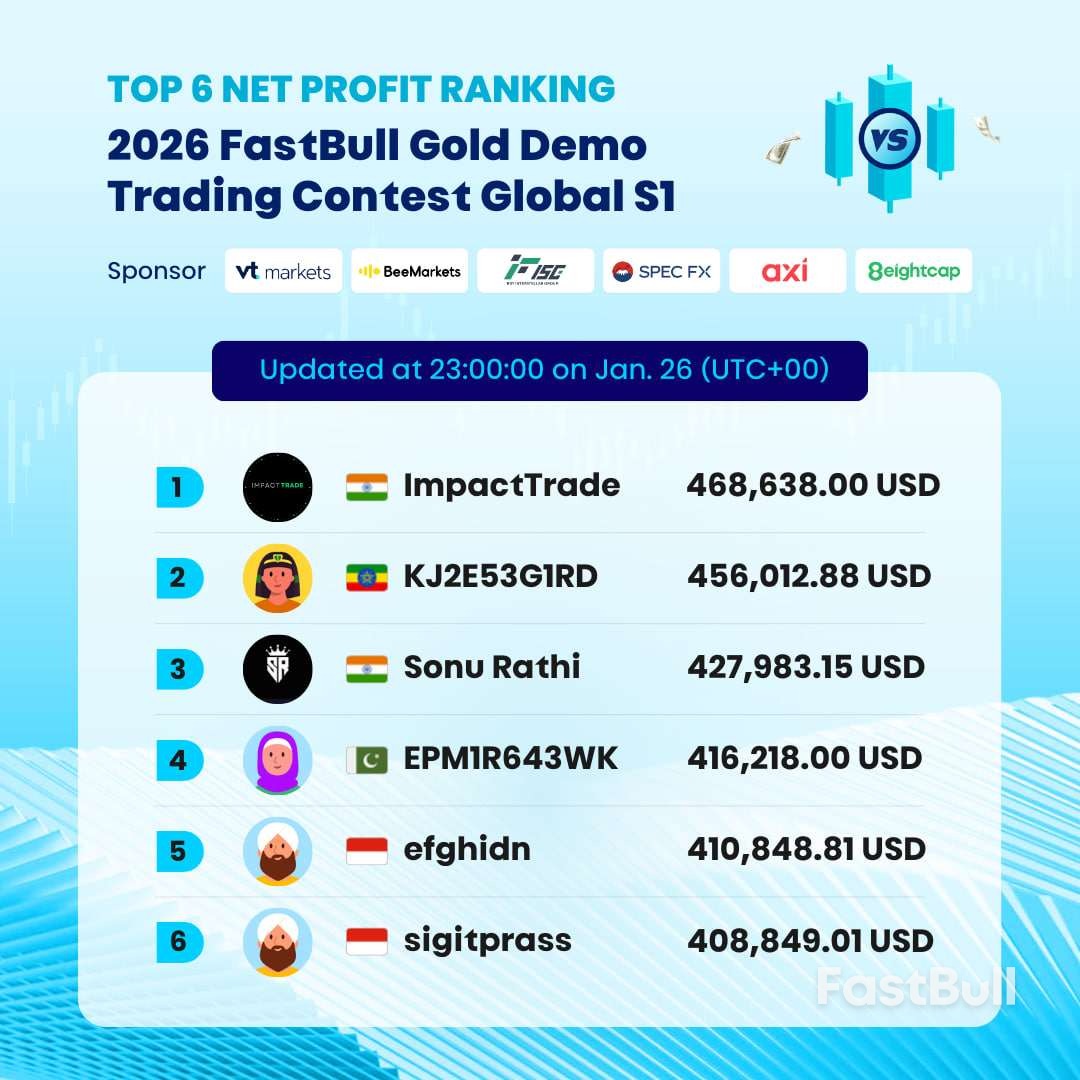
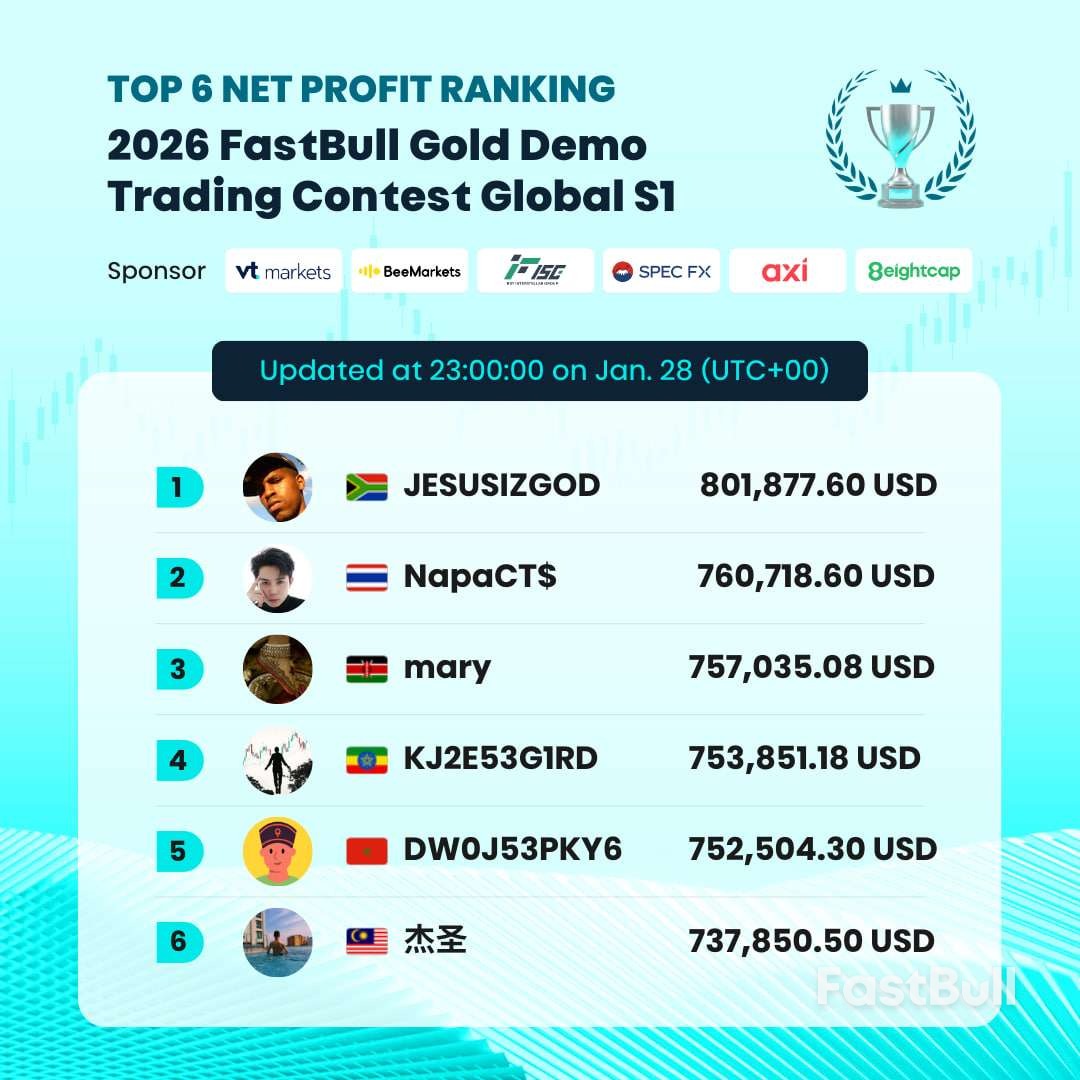
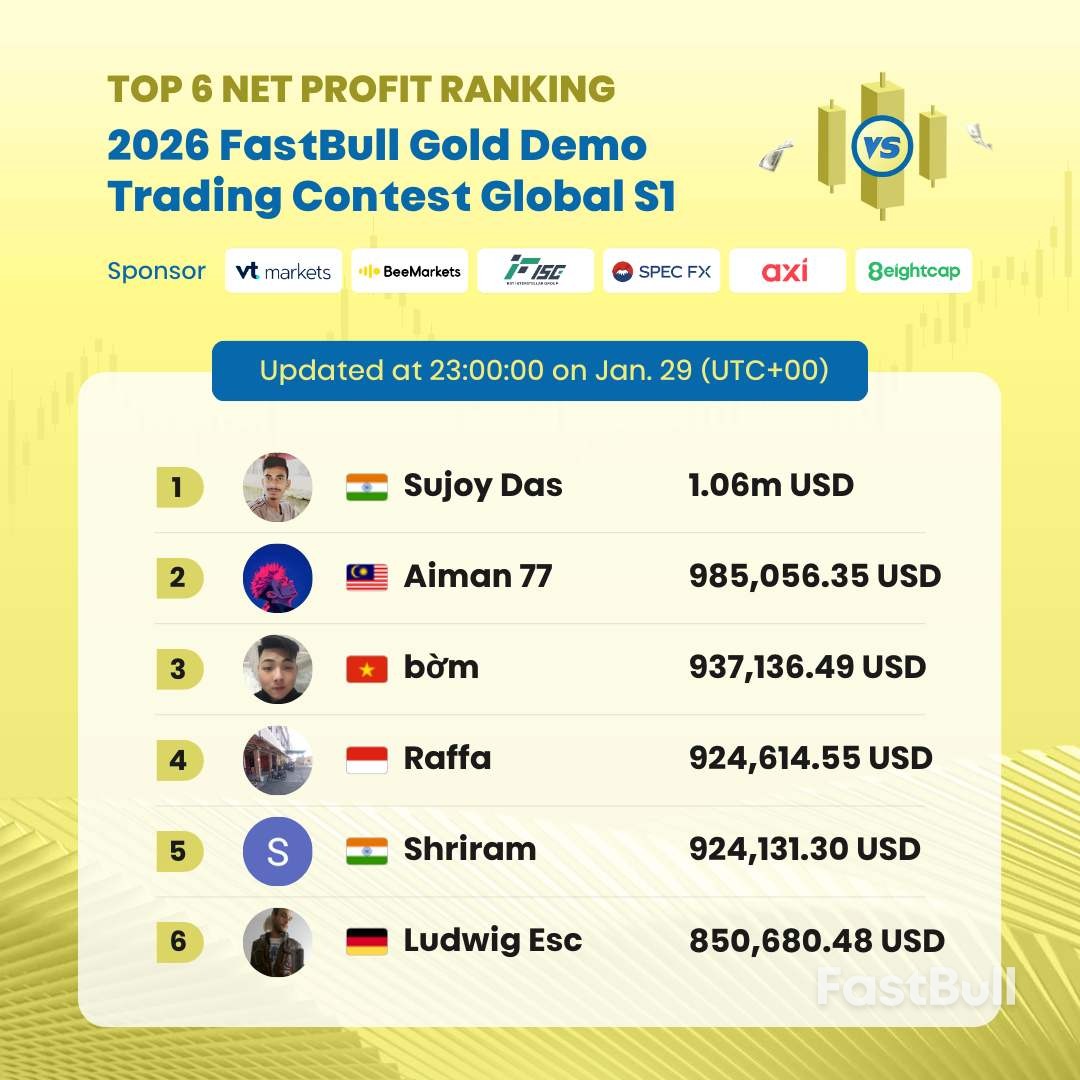
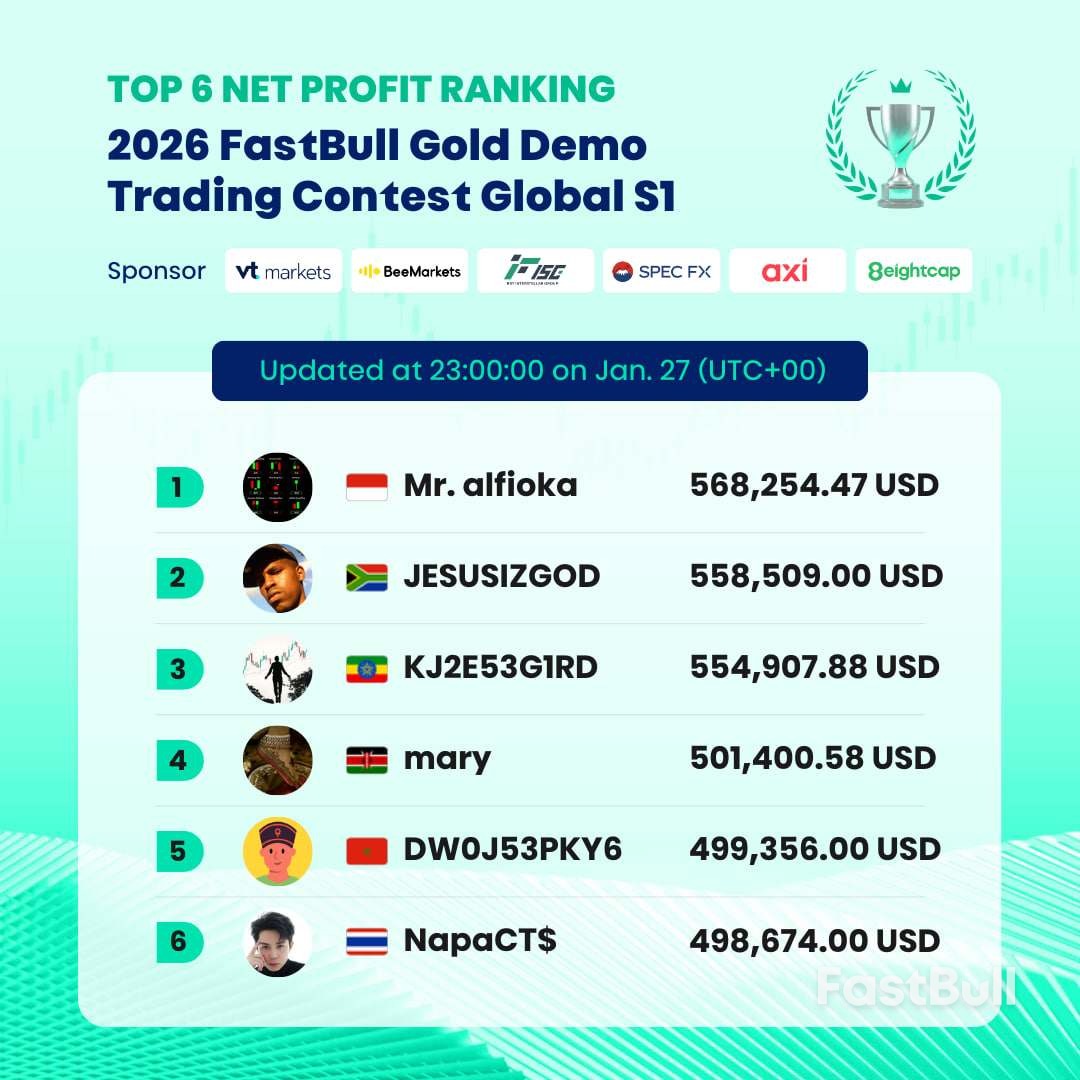
          The 2026 FastBull Gold Demo Trading Contest Global S1 is now in full swing, attracting gold traders from around the world to compete and demonstrate their trading expertise. Since its official launch on January 20, it becoming a key stage for traders to test strategies, refine skills, and compete under real-market conditions.
          The contest offers all participants a standardized environment featuring demo capital of $100,000 with leverage of up to 400:1.
          The top five performers will be awarded substantial prizes sponsored by industry leaders VT Markets, BeeMarkets, FXTM, Axi, FISG, and Spec FX, including cash rewards, funded live trading accounts ("Reward Accounts"), or deposit bonuses, ranging from $1,000 to $6,000 USD. The prize breakdown is as follows:
          1st Place: Cash prize, 6,000 USD, sponsored by VT Markets
          2nd place: Reward account, 3,000 USD, sponsored by BeeMarkets
          3rd place: Reward account, 2,000 USD, sponsored by FISG
          4th place: Reward account, 1,500 USD, sponsored by Spec FX
          5th place: Reward account, 1,000 USD, sponsored by BeeMarkets
          The competition is exclusively for trading XAUUSD. Key rules include a lot size limit of 0.01 to 1.00 lots per trade and a maximum of 10 open positions (including pending orders) allowed simultaneously.
          To ensure consistent participation and strategy validity, contestants are required to execute a minimum of 100 market trades during the challenge period (orders held for less than 60 seconds are not counted).
          Exciting Competition! 2026 FastBull Gold Demo Trading Contest Global S1 is in Full Swing_2
          Top 6 on January 26
          Exciting Competition! 2026 FastBull Gold Demo Trading Contest Global S1 is in Full Swing_3
          Top 6 on January 27
          Exciting Competition! 2026 FastBull Gold Demo Trading Contest Global S1 is in Full Swing_4
          Top 6 on January 28
          Exciting Competition! 2026 FastBull Gold Demo Trading Contest Global S1 is in Full Swing_5
          Top 6 on January 29
          The challenge is set to conclude on February 7, 2026, at 00:00 (UTC). Final rankings and the official list of winners will be announced on official channels following the competition's close. The contest is currently in a highly competitive phase, with every trade potentially reshaping the leaderboard.
          Visit the competition platform now to select your account and embark on your path to victory:
          https://www.fastbull.com/trading-contest/detail/2026-FastBull-GOLD-Global-S1-11
          Risk Warnings and Disclaimers
          You understand and acknowledge that there is a high degree of risk involved in trading. Following any strategies or investment methods may lead to potential losses. The content on the site is provided by our contributors and analysts for information purposes only. You are solely responsible for determining whether any trading assets, securities, strategy, or any other product is suitable for investing based on your own investment objectives and financial situation.
          Add to Favorites
          Share

          Trump Signals Talks with Iran as Warship Deploys

          James Riley

          Middle East Situation

          Political

          Remarks of Officials

          President Donald Trump announced on Thursday his plan to speak with Iran, a diplomatic overture that comes as the United States simultaneously dispatches another warship to the Middle East. The move highlights a dual strategy of potential engagement backed by a significant show of military force.

          Speaking to reporters, Trump confirmed his intentions but did not provide details on the timing or nature of the dialogue, nor did he specify who would lead negotiations for Washington.

          "I am planning on it, yeah," Trump stated when asked about discussions with Tehran. He immediately followed this by referencing the American military presence in the region, adding, "We have a lot of very big, very powerful ships sailing to Iran right now, and it would be great if we didn't have to use them."

          Tensions Rise Amid Military Buildup

          The backdrop for these developments is a period of soaring U.S.-Iranian tensions, which recently escalated following a bloody crackdown on widespread protests by Iran's clerical authorities. U.S. officials have indicated that Trump is reviewing his options but has not yet decided whether to authorize a military strike against Iran.

          The protests, driven by economic hardship and political repression, have since subsided. However, Trump had previously threatened U.S. intervention if the Iranian government continued its violent suppression of demonstrators.

          At a cabinet meeting, Trump asked Pentagon chief Pete Hegseth to comment on the situation. Hegseth affirmed the military's readiness to act on the president's orders.

          "We will be prepared to deliver whatever this president expects of the War Department," Hegseth said, using the Trump administration's unofficial term for the Defense Department.

          U.S. Red Lines on Nuclear Ambitions

          Hegseth also issued a direct warning to Tehran regarding its nuclear program, a key point of contention. "They should not pursue nuclear capabilities," he stated.

          President Trump has previously made it clear the United States would act if Iran resumed its nuclear program. This follows air strikes conducted by Israeli and U.S. forces in June on key Iranian nuclear installations, which were aimed at disrupting Tehran's progress.

          Risk Warnings and Disclaimers
          You understand and acknowledge that there is a high degree of risk involved in trading. Following any strategies or investment methods may lead to potential losses. The content on the site is provided by our contributors and analysts for information purposes only. You are solely responsible for determining whether any trading assets, securities, strategy, or any other product is suitable for investing based on your own investment objectives and financial situation.
          Add to Favorites
          Share
          FastBull
          Copyright © 2026 FastBull Ltd

          728 RM B 7/F GEE LOK IND BLDG NO 34 HUNG TO RD KWUN TONG KLN HONG KONG

          TelegramInstagramTwitterfacebooklinkedin
          App Store Google Play Google Play
          Products
          Charts

          Chats

          Q&A with Experts
          Screeners
          Economic Calendar
          Data
          Tools
          Membership
          Features
          Function
          Markets
          Copy Trading
          Latest Signals
          Contests
          News
          Analysis
          24/7
          Columns
          Education
          Company
          Careers
          About Us
          Contact Us
          Advertising
          Help Center
          Feedback
          User Agreement
          Privacy Policy
          Personal Information Protection Statement
          Business

          White Label

          Data API

          Web Plug-ins

          Poster Maker

          Affiliate Program

          Risk Disclosure

          The risk of loss in trading financial instruments such as stocks, FX, commodities, futures, bonds, ETFs and crypto can be substantial. You may sustain a total loss of the funds that you deposit with your broker. Therefore, you should carefully consider whether such trading is suitable for you in light of your circumstances and financial resources.

          No decision to invest should be made without thoroughly conducting due diligence by yourself or consulting with your financial advisors. Our web content might not suit you since we don't know your financial conditions and investment needs. Our financial information might have latency or contain inaccuracy, so you should be fully responsible for any of your trading and investment decisions. The company will not be responsible for your capital loss.

          Without getting permission from the website, you are not allowed to copy the website's graphics, texts, or trademarks. Intellectual property rights in the content or data incorporated into this website belong to its providers and exchange merchants.

          Not Logged In

          Log in to access more features

          Connect Broker
          Become a signal provider
          Help Center
          Customer Service
          Dark Mode
          Price Up/Down Colors

          Log In

          Sign Up
          Position
          Layout
          Fullscreen
          Default to Chart
          The chart page opens by default when you visit fastbull.com