Markets
News
Analysis
User
24/7
Economic Calendar
Education
Data
- Names
- Latest
- Prev



Signal Accounts for Members
All Signal Accounts
All Contests


The Main Shanghai Gold Futures Contract Fell By 2.00% During The Day, Currently Trading At 1098.00 Yuan/gram
Bessent: Cap On Credit Card Interest At 10% For One Year Would Help Allow Americans To Recover From Past Inflation
The Survey Results Show That OPEC Oil Production Declined In January, With Venezuela Experiencing Significant Fluctuations
U.S. Treasury Secretary Bessant Stated That The U.S. Will Not "go To Any Lengths" To Loosen Financial Regulations
A Senior Iranian Source Said The Outcome Of The Negotiations Depends On Whether The United States Changes Its Current Approach. Consultations Are Currently Underway Regarding The Final Arrangements For Friday's Talks And Whether Direct Negotiations Can Take Place
U.S. Treasury Secretary Bessenter: The Federal Reserve’s Involvement In Other Areas Would Damage Its Independence
[Italian Banking Sector Continues To Hit Record Closing Highs] Germany's DAX 30 Index Preliminarily Closed Down 0.54% At 24,647.18 Points. France's Stock Index Preliminarily Closed Up 1.22%, Italy's Stock Index Preliminarily Closed Up 0.69% With Its Banking Index Up 0.36%, And The UK Stock Index Preliminarily Closed Up 1.22%
The STOXX Europe 600 Index Closed Up 0.27% At 619.57 Points, A Record Closing High. The Eurozone STOXX 50 Index Closed Down 0.17% At 5984.95 Points. The FTSE Eurotop 300 Index Closed Up 0.21% At 2468.84 Points
U.S. Treasury Secretary Bessant: The Fed’s Dual Mandate (maintaining Price Stability And Achieving Full Employment) Is A “very Good Balance.”
Bessent: Independence Of Federal Reserve Is Based On Its Trust Among The American People, It Has Lost That -House Financial Services Committee Hearing

Euro Zone Services PMI Final (Jan)A:--
F: --
P: --
U.K. Composite PMI Final (Jan)A:--
F: --
P: --
U.K. Total Reserve Assets (Jan)A:--
F: --
P: --
U.K. Services PMI Final (Jan)A:--
F: --
P: --
U.K. Official Reserves Changes (Jan)A:--
F: --
P: --
Euro Zone Core CPI Prelim YoY (Jan)A:--
F: --
P: --
Euro Zone Core HICP Prelim YoY (Jan)A:--
F: --
P: --
Euro Zone HICP Prelim YoY (Jan)A:--
F: --
P: --
Euro Zone PPI MoM (Dec)A:--
F: --
Euro Zone Core HICP Prelim MoM (Jan)A:--
F: --
P: --
Italy HICP Prelim YoY (Jan)A:--
F: --
P: --
Euro Zone Core CPI Prelim MoM (Jan)A:--
F: --
P: --
Euro Zone PPI YoY (Dec)A:--
F: --
U.S. MBA Mortgage Application Activity Index WoWA:--
F: --
P: --
Brazil IHS Markit Composite PMI (Jan)A:--
F: --
P: --
Brazil IHS Markit Services PMI (Jan)A:--
F: --
P: --
U.S. ADP Employment (Jan)A:--
F: --
The U.S. Treasury Department released its quarterly refinancing statement.
U.S. IHS Markit Composite PMI Final (Jan)A:--
F: --
P: --
U.S. IHS Markit Services PMI Final (Jan)A:--
F: --
P: --
U.S. ISM Non-Manufacturing Price Index (Jan)A:--
F: --
P: --
U.S. ISM Non-Manufacturing Employment Index (Jan)A:--
F: --
P: --
U.S. ISM Non-Manufacturing New Orders Index (Jan)A:--
F: --
P: --
U.S. ISM Non-Manufacturing Inventories Index (Jan)A:--
F: --
P: --
U.S. ISM Non-Manufacturing PMI (Jan)A:--
F: --
P: --
U.S. EIA Weekly Crude Oil Imports ChangesA:--
F: --
P: --
U.S. EIA Weekly Heating Oil Stock ChangesA:--
F: --
P: --
U.S. EIA Weekly Crude Demand Projected by ProductionA:--
F: --
P: --
U.S. EIA Weekly Gasoline Stocks ChangeA:--
F: --
P: --
U.S. EIA Weekly Crude Stocks ChangeA:--
F: --
P: --
U.S. EIA Weekly Cushing, Oklahoma Crude Oil Stocks ChangeA:--
F: --
P: --
Australia Trade Balance (SA) (Dec)--
F: --
P: --
Australia Exports MoM (SA) (Dec)--
F: --
P: --
Japan 30-Year JGB Auction Yield--
F: --
P: --
Indonesia Annual GDP Growth--
F: --
P: --
Indonesia GDP YoY (Q4)--
F: --
P: --
France Industrial Output MoM (SA) (Dec)--
F: --
P: --
Italy IHS Markit Construction PMI (Jan)--
F: --
P: --
Euro Zone IHS Markit Construction PMI (Jan)--
F: --
P: --
Germany Construction PMI (SA) (Jan)--
F: --
P: --
Italy Retail Sales MoM (SA) (Dec)--
F: --
P: --
U.K. Markit/CIPS Construction PMI (Jan)--
F: --
P: --
France 10-Year OAT Auction Avg. Yield--
F: --
P: --
Euro Zone Retail Sales YoY (Dec)--
F: --
P: --
Euro Zone Retail Sales MoM (Dec)--
F: --
P: --
U.K. BOE MPC Vote Cut (Feb)--
F: --
P: --
U.K. BOE MPC Vote Hike (Feb)--
F: --
P: --
U.K. BOE MPC Vote Unchanged (Feb)--
F: --
P: --
U.K. Benchmark Interest Rate--
F: --
P: --
MPC Rate Statement
U.S. Challenger Job Cuts (Jan)--
F: --
P: --
U.S. Challenger Job Cuts MoM (Jan)--
F: --
P: --
U.S. Challenger Job Cuts YoY (Jan)--
F: --
P: --
Bank of England Governor Bailey held a press conference on monetary policy.
Euro Zone ECB Marginal Lending Rate--
F: --
P: --
Euro Zone ECB Deposit Rate--
F: --
P: --


No matching data
View All

No data
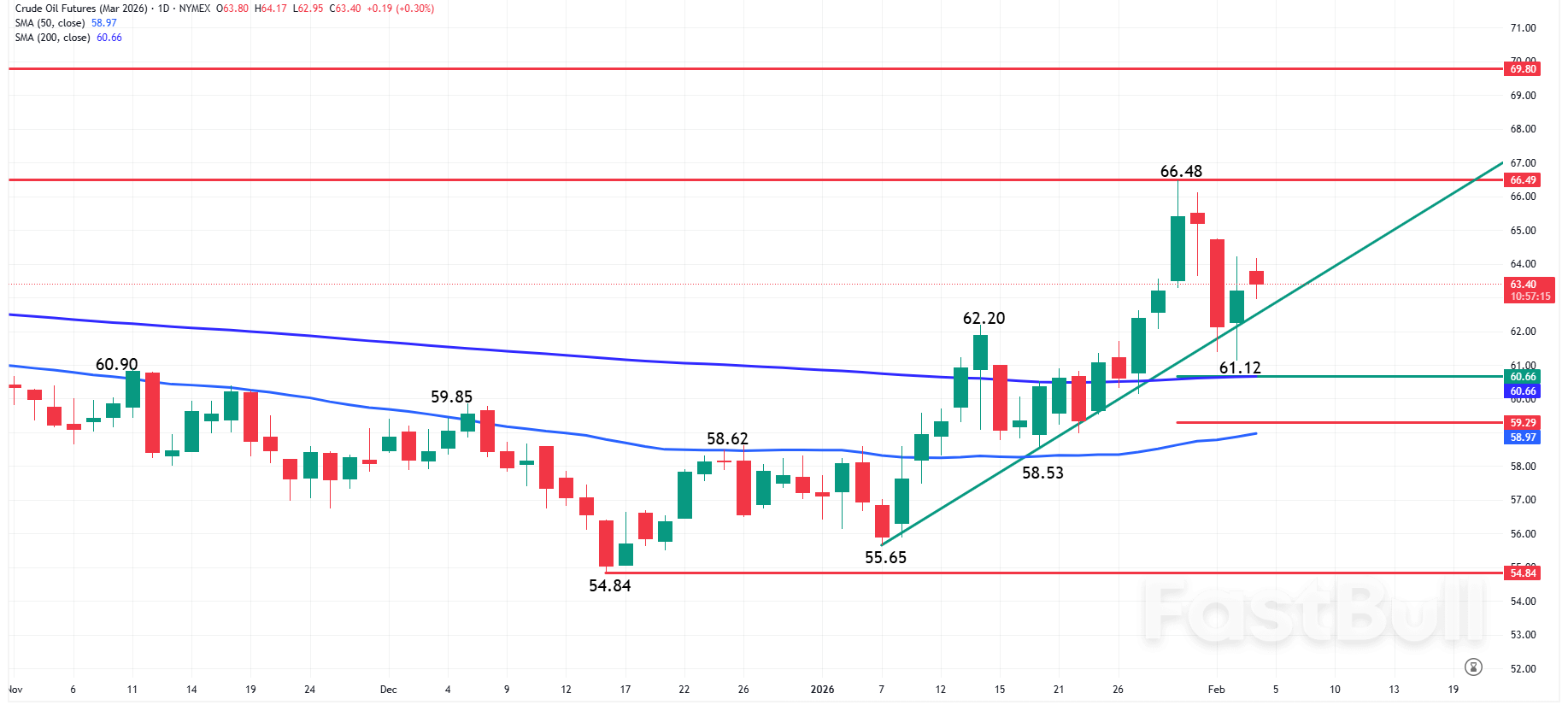
WTI crude held firm as U.S.–Iran tensions and a large API inventory draw supported prices, reinforcing a bullish trend, while traders awaited EIA data and watched key technical levels.
Daily March WTI Crude Oil FuturesThe United Nations is sounding the alarm over its finances, warning of a potential cash crisis by July as funding from the United States dwindles and unpaid dues from member states accumulate.
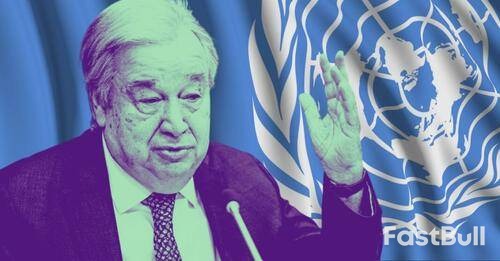
U.N. Secretary-General António Guterres stated that outstanding contributions from members reached a record $1.568 billion by the end of 2025. With collections covering only 76.7% of assessed contributions, the organization's financial stability is at risk.
Guterres cautioned that unless collections improve dramatically, the U.N. will be unable to fully implement its 2026 budget and could face a severe liquidity crisis by the middle of the year. The situation is compounded by new budgeting rules that require the U.N. to return certain "unspent funds" to members.

The financial squeeze follows significant policy shifts from the Trump administration, which has been cutting support over claims the U.N. fails to advance U.S. interests. Historically, the United States has been the organization's largest financial backer.
In 2024, for instance, U.S. taxpayers provided approximately 25% of the U.N.'s core budget and peacekeeping operations, along with 40% of its humanitarian assistance funding. The withdrawal of this support exposes the U.N.'s deep financial dependence on American contributions.
This dynamic intensified in January 2026 when the United States formally withdrew from the World Health Organization and began exiting dozens of other international bodies, citing a misalignment with American priorities.
The funding shortfall is already having tangible effects on U.N. operations worldwide. Agencies including the World Food Programme and various refugee organizations are reportedly preparing for layoffs and program reductions. Overall contributions have fallen to their lowest point in a decade, forcing a widespread tightening of spending.
In his final yearly address before stepping down at the end of 2026, Secretary-General Guterres made a direct appeal to member states. "Either all member states honour their obligations to pay in full and on time—or member states must fundamentally overhaul our financial rules to prevent an imminent financial collapse," he wrote.
Guterres also highlighted a world troubled by "self-defeating geopolitical divides" and "brazen violations of international law," while denouncing "wholesale cuts in development and humanitarian aid."
The crisis raises a fundamental question that drives the U.S. position: why American taxpayers should continue funding a global institution that is increasingly viewed as ideologically opposed to their country's values and national interests.

The United States has transferred $500 million to Venezuela, fulfilling the terms of an oil sales agreement established between the two governments in January. The payment represents the full proceeds from the initial sale of Venezuelan crude brokered by the U.S.
According to a U.S. government official who spoke with Reuters, "Venezuela has officially received all $500 million from the first Venezuelan oil sale." The official clarified that the funds will be "disbursed for the benefit of the Venezuelan people at the discretion of the U.S. government."
The deal, announced by President Trump on social media, involves Venezuela providing between 30 and 50 million barrels of its crude oil to the United States. The U.S. then manages the sale of this oil, with the revenue earmarked to support Venezuela's struggling economy.
To ensure neutrality and security, the proceeds were deposited into a U.S. government-controlled account in Qatar. This initial transaction is expected to be the first of several, with future sales intended to further stabilize the country.
In January, Secretary of State Marco Rubio framed the deal as a way to prevent a national crisis. "So in essence, we allowed Venezuela to use their own oil to generate revenue to pay teachers and firefighters and police officers and keep the function of government operating so we didn't have systemic collapse," he explained.
Following this development, major commodity trading firms are actively pursuing deals with Washington to handle Venezuelan oil. Companies including Chevron, Vitol, and Trafigura are reportedly looking to expand their tanker fleets to manage large volumes from the 30-50 million barrel allocation.
Industry sources suggest that Venezuela's crude exports to the U.S. could eventually return to pre-sanction levels of approximately 500,000 barrels per day.
However, a return to full capacity faces immediate challenges. Insiders told Reuters in January that the first shipments will come from existing oil inventories. Clearing this stored crude could take three to four months and will require resolving logistical bottlenecks at the Jose terminal, which has limited storage capacity.
Prime Minister Sanae Takaichi has called a general election for February 8, 2026, just months after taking office in October 2025. While her strong cabinet approval ratings offer a clear tactical advantage, the move highlights a persistent issue in Japanese politics: the prioritization of political survival over long-term policy success.
This strategy of calling a snap election during a political "honeymoon period" is a well-worn tactic for the Liberal Democratic Party. It was honed into a strategic weapon by former prime minister Shinzo Abe, creating what is now known as the 'Abe style' of dissolution.
Like her mentor, Takaichi is using this power to secure a stable majority and lessen her reliance on coalition partners like Nihon Ishin no Kai. However, this political maneuvering masks a deeper, more fundamental problem within Japan's political system.
At its core, the issue is that Japan holds too many elections. Over the past decade, national elections have occurred almost every one to two years, including four House of Councillors elections and three House of Representatives elections triggered by prime ministerial dissolutions.
This state of constant campaigning creates a destructive feedback loop. Whenever a government tries to implement necessary but unpopular reforms, such as fiscal consolidation or deregulation, the next election is always just around the corner. To avoid a backlash at the polls, administrations often pivot back to populist spending and policies designed to boost short-term popularity.
A clear example of this occurred in the 2017 House of Representatives election. Prime Minister Abe pledged to redirect consumption tax revenues, originally intended for fiscal reconstruction and social security, to fund a "free education" program instead.
A comparison with the United Kingdom reveals a different path. The UK's Fixed-Term Parliaments Act of 2011 restricted a prime minister's power to call early elections, creating stability. This allowed the 2010–2015 government to implement a five-year fiscal austerity program, forcing voters in the 2015 election to evaluate the administration based on actual policy outcomes. While the act was repealed in 2022, it demonstrates how institutional stability can shift democratic focus from promises to performance.
In Japan, the high frequency of elections has done the opposite. Voters are often sent to the polls before new policies have had time to work, turning elections into referendums on a new leader's "freshness" and their political vision, not their track record. For instance, former prime minister Shigeru Ishiba lost public support over his economic policies but never faced voters, as Takaichi’s arrival effectively reset public opinion. Japanese voters are once again being asked to decide based on what a government might do, not what it has done.
This cycle also contributes to Japan's chronically low voter turnout. When elections are seen as the result of tactical party maneuvering rather than substantive national debates, citizens become disengaged.
Takaichi is entering this election with a massive ¥21 trillion (US$135 billion) economic stimulus package at the center of her agenda. Dubbed 'Sanaenomics', the policy aims to combat rising prices through measures like electronic coupons and cash handouts.
From a macroeconomic perspective, however, this level of fiscal expansion is likely to fuel more inflation. Flooding the market with cash risks accelerating the yen's depreciation and driving up the cost of imports. While these measures are politically popular, they do little to address the underlying structural weaknesses of the Japanese economy.
To her credit, Takaichi's 'Sanaenomics' does represent an improvement on its predecessor, 'Abenomics'. While Abenomics was often criticized as a "one-legged policy" that relied almost entirely on monetary easing, Takaichi has proposed a more complete growth strategy.
Her 17-point plan focuses on fostering new industries through investment in artificial intelligence, semiconductors, quantum computing, and space exploration. This signals a welcome shift from propping up declining sectors to building new ones.
However, the success of this long-term strategy depends on political stability and the will to dismantle entrenched regulations—commitments that are consistently undermined by repeated election cycles. If Takaichi wins, no national elections are scheduled until the House of Councillors poll in 2028. The crucial question is whether she will use that time to focus on policy implementation or, like Abe, dissolve the Diet again to further consolidate her power.
Japan's political climate increasingly revolves around a "heroine cult," where public excitement for a new leader can obscure critical analysis of their economic policies. While Takaichi is poised to win the political legitimacy she seeks in February, a victory built on expectations rests on a fragile foundation.
For Japan to break free from its prolonged stagnation, it must escape this democracy of perpetual campaigning. The country needs institutional reforms that enable stable, results-oriented governance. Until the prime minister's power to dissolve parliament is curbed and voters begin judging governments on their outcomes, Japan will remain trapped in a vicious cycle of populist promises and deferred structural reform.
The risk of loss in trading financial instruments such as stocks, FX, commodities, futures, bonds, ETFs and crypto can be substantial. You may sustain a total loss of the funds that you deposit with your broker. Therefore, you should carefully consider whether such trading is suitable for you in light of your circumstances and financial resources.
No decision to invest should be made without thoroughly conducting due diligence by yourself or consulting with your financial advisors. Our web content might not suit you since we don't know your financial conditions and investment needs. Our financial information might have latency or contain inaccuracy, so you should be fully responsible for any of your trading and investment decisions. The company will not be responsible for your capital loss.
Without getting permission from the website, you are not allowed to copy the website's graphics, texts, or trademarks. Intellectual property rights in the content or data incorporated into this website belong to its providers and exchange merchants.
Not Logged In
Log in to access more features
Log In
Sign Up