Markets
News
Analysis
User
24/7
Economic Calendar
Education
Data
- Names
- Latest
- Prev



Signal Accounts for Members
All Signal Accounts
All Contests
 Canada GDP YoY (Oct)
A:--
F: --
P: --
Canada GDP MoM (SA) (Oct)A:--
F: --
P: --
 U.S. Core PCE Price Index Prelim YoY (Q3)
A:--
F: --
P: --
U.S. PCE Price Index Prelim YoY (Q3)A:--
F: --
P: --
U.S. Annualized Real GDP Prelim (Q3)A:--
F: --
P: --
U.S. Non-Defense Capital Durable Goods Orders MoM (Excl. Aircraft) (Oct)A:--
F: --
U.S. Durable Goods Orders MoM (Excl. Defense) (SA) (Oct)A:--
F: --
P: --
U.S. Durable Goods Orders MoM (Excl.Transport) (Oct)A:--
F: --
U.S. Real Personal Consumption Expenditures Prelim QoQ (Q3)A:--
F: --
P: --
U.S. Durable Goods Orders MoM (Oct)A:--
F: --
U.S. Weekly Redbook Index YoYA:--
F: --
P: --
U.S. Manufacturing Output MoM (SA) (Nov)A:--
F: --
P: --
U.S. Manufacturing Capacity Utilization (Nov)A:--
F: --
U.S. Industrial Output YoY (Nov)A:--
F: --
P: --
U.S. Industrial Output MoM (SA) (Nov)A:--
F: --
P: --
U.S. Capacity Utilization MoM (SA) (Nov)A:--
F: --
U.S. Richmond Fed Manufacturing Shipments Index (Dec)A:--
F: --
P: --
U.S. Richmond Fed Services Revenue Index (Dec)A:--
F: --
P: --
U.S. Conference Board Consumer Expectations Index (Dec)A:--
F: --
P: --
U.S. Conference Board Present Situation Index (Dec)A:--
F: --
P: --
U.S. Richmond Fed Manufacturing Composite Index (Dec)A:--
F: --
P: --
U.S. Conference Board Consumer Confidence Index (Dec)A:--
F: --
Canada Federal Government Budget Balance (Oct)A:--
F: --
P: --
U.S. 5-Year Note Auction Avg. YieldA:--
F: --
P: --
U.S. Weekly Total Oil Rig CountA:--
F: --
P: --
U.S. Weekly Total Rig CountA:--
F: --
P: --
U.S. API Weekly Cushing Crude Oil StocksA:--
F: --
P: --
U.S. API Weekly Crude Oil StocksA:--
F: --
P: --
U.S. API Weekly Refined Oil StocksA:--
F: --
P: --
U.S. API Weekly Gasoline StocksA:--
F: --
P: --
 Mexico Unemployment Rate (Not SA) (Nov)
--
F: --
P: --
U.S. MBA Mortgage Application Activity Index WoW--
F: --
P: --
U.S. Dallas Fed PCE Price Index YoY (Oct)--
F: --
P: --
U.S. Weekly Continued Jobless Claims (SA)--
F: --
P: --
U.S. Weekly Initial Jobless Claims (SA)--
F: --
P: --
U.S. Initial Jobless Claims 4-Week Avg. (SA)--
F: --
P: --
U.S. EIA Weekly Crude Oil Imports Changes--
F: --
P: --
U.S. EIA Weekly Heating Oil Stock Changes--
F: --
P: --
Canada Federal Government Budget Balance (Oct)--
F: --
P: --
 Japan Construction Orders YoY (Nov)
--
F: --
P: --
Japan New Housing Starts YoY (Nov)--
F: --
P: --
 Turkey Capacity Utilization (Dec)
--
F: --
P: --
Japan Tokyo CPI YoY (Excl. Food & Energy) (Dec)--
F: --
P: --
Japan Unemployment Rate (Nov)--
F: --
P: --
Japan Tokyo Core CPI YoY (Dec)--
F: --
P: --
Japan Tokyo CPI YoY (Dec)--
F: --
P: --
Japan Jobs to Applicants Ratio (Nov)--
F: --
P: --
Japan Tokyo CPI MoM (Dec)--
F: --
P: --
Japan Tokyo CPI MoM (Excl. Food & Energy) (Dec)--
F: --
P: --
Japan Industrial Inventory MoM (Nov)--
F: --
P: --
Japan Retail Sales (Nov)--
F: --
P: --
Japan Industrial Output Prelim MoM (Nov)--
F: --
P: --
Japan Large-Scale Retail Sales YoY (Nov)--
F: --
P: --
Japan Industrial Output Prelim YoY (Nov)--
F: --
P: --
Japan Retail Sales MoM (SA) (Nov)--
F: --
P: --
Japan Retail Sales YoY (Nov)--
F: --
P: --
 India Deposit Gowth YoY
--
F: --
P: --











No matching data

Latest Views
Latest Views
Trending Topics
Top Columnists
Latest Update
White Label
Data API
Web Plug-ins
Affiliate Program
View All
No data
Oil held a five-day gain as traders weighed escalating geopolitical tensions against swelling inventories.
Oil held a five-day gain as traders weighed escalating geopolitical tensions against swelling inventories.
West Texas Intermediate traded near $58 a barrel after gaining almost 6% in the prior five sessions, while Brent settled above $62 on Tuesday. Washington is still in pursuit of a third oil tanker off the coast of Venezuela as the White House ramps up pressure on Nicolás Maduro's government.
Meanwhile, Russian crude is building up at sea, with the volume jumping 48% since the end of August. The US actions in Venezuela may be raising concerns among shippers and buyers of Russian barrels, who worry their cargoes could also be targeted.
In the US, an industry report showed crude stockpiles increasing by 2.4 million barrels last week, with holdings of gasoline and distillate both rising. Official data is set to be released on Dec. 29, rather than Wednesday as originally planned, after President Donald Trump declared a federal holiday.

A Bank of Japan rate hike and surging Japanese Government Bond yields led to the unthinkable this week. USD/JPY rallied to 157.765 on December 19, while 10-year JGB yields soared to 2.1% on December 22, before dropping to 2.026% on December 23.
Monetary policy uncertainty, concerns about the coming year's fiscal budget and likely bond issuances, and intervention warnings clashed. Japan's Finance Minister Satsuki Katayama threatened yen interventions for two consecutive days as USD/JPY climbed toward 158. The two days of warnings briefly sent the pair below 156.
Fiscal concerns have festered since Prime Minister Sanae Takaichi became the frontrunner to be Japan's first woman prime minister. USD/JPY has risen 8.46% in H2 2025, while 10-year JGB yields have soared 0.60 basis points to 2.1%, the highest since February 1999.
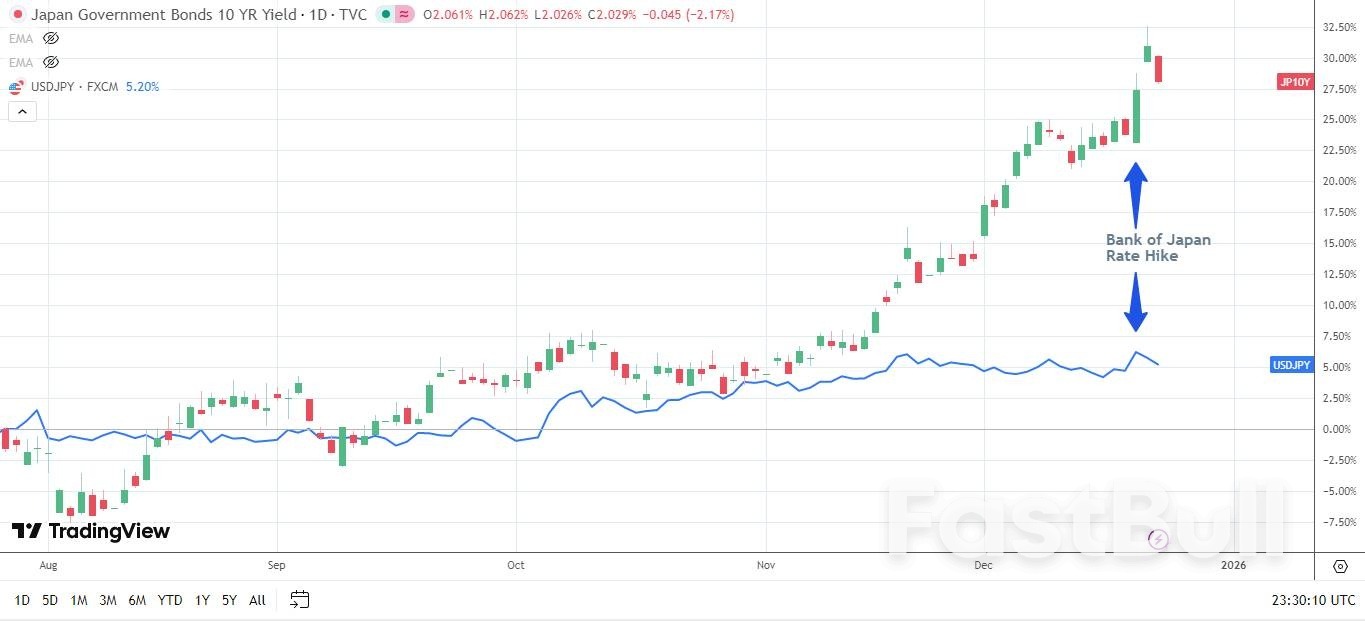 10-Year JGB Yields – USDJPY – Daily Chart – 241225
Crucially, intervention threats overshadowed fiscal concerns and strong US economic data, supporting a bearish USD/JPY outlook. Japanese economic indicators will likely add to the market volatility as the Japanese government and the BoJ grapple with yen stability.
Below, I'll discuss the macro backdrop, the near-term price catalysts, and technical levels traders should closely watch.
Following the choppy start to the week, the market focus will briefly shift to the Japanese economic calendar. The Conference Board Leading Economic Index (LEI) will give insights into the domestic demand outlook.
The LEI rose from 108.2 in September to 110.0 in October, indicating a pickup in business and consumer sentiment. Typically, a higher LEI reading indicates rising business investment, increasing employment, and stronger wage growth.
Higher wages would boost households' purchasing power, fueling consumer spending and demand-driven inflation. This chain of events would support a more hawkish BoJ policy stance, strengthening the yen.
However, the weaker yen has pushed import prices higher, dampening households' purchasing power and curbing private consumption. The effects of higher import prices on private consumption have been a key concern for the BoJ and the Japanese government, leading to yen intervention warnings.
An upward revision to the October LEI would align with improving sentiment toward the Japanese economy and strengthen the yen. However, USD/JPY losses will likely be limited, considering the ongoing fiscal concerns and the BoJ's cautious policy outlook and fading bets on a March Fed rate cut.
An unexpected surge in US GDP growth and a hotter-than-expected US price deflator tempered expectations of a March rate cut on Tuesday. A sharp increase in PCE prices signaled a sticky inflation outlook, while concerns mount about a decoupling of the labor market from GDP growth.
Later on Wednesday, initial jobless claims will come under scrutiny after last week's weak US jobs report. Economists forecast initial jobless claims to slip from 224k (week ending December 13) to 223k (week ending December 20).
A lower claims reading would ease immediate concerns about the labor market, while supporting a more hawkish Fed policy stance. However, an unexpected spike in claims could revive Fed rate cut bets, supporting a bearish USD/JPY price outlook.
According to the CME FedWatch Tool, the chances of a March Fed rate cut dropped from 52.9% on December 22 to 45.1% on December 23. The sharp drop reflected the impact of the Q3 US GDP report on sentiment toward the Fed policy stance.
While US data will influence US dollar demand and USD/JPY trends, risks of a yen carry trade unwind linger ahead of the holidays.
Elevated JGB and rising US Treasury yields will likely shift focus back to USD/JPY trends for early warning signs of an unwind. However, economists have mixed views on the USD/JPY's breaking point. 10-year JGB yields could boost demand from domestic investors. The prospect of a stronger yen on repatriations and higher yields reinforces the constructive short- to medium-term bias.
A drop below 155 could be crucial for the negative short- to medium-term bias, given Tuesday's low of 155.649.
With markets monitoring technical indicators and fundamentals, they will offer crucial signals into potential USD/JPY price trends.
Looking at the daily chart, USD/JPY remained above the 50-day and 200-day Exponential Moving Averages (EMAs), indicating a bullish bias. While technicals remained bullish, fundamentals are increasingly outweighing the technical structure, indicating a bearish outlook.
A drop below the 155 support level would bring the 50-day EMA into play. If breached, 150 would be the next key support level. Importantly, a sustained break below the 50-day EMA would signal a bearish near-term trend reversal, paving the way to the 200-day EMA and 150. A break below the 200-day EMA would reinforce the bearish medium- to longer-term USD/JPY price outlook.
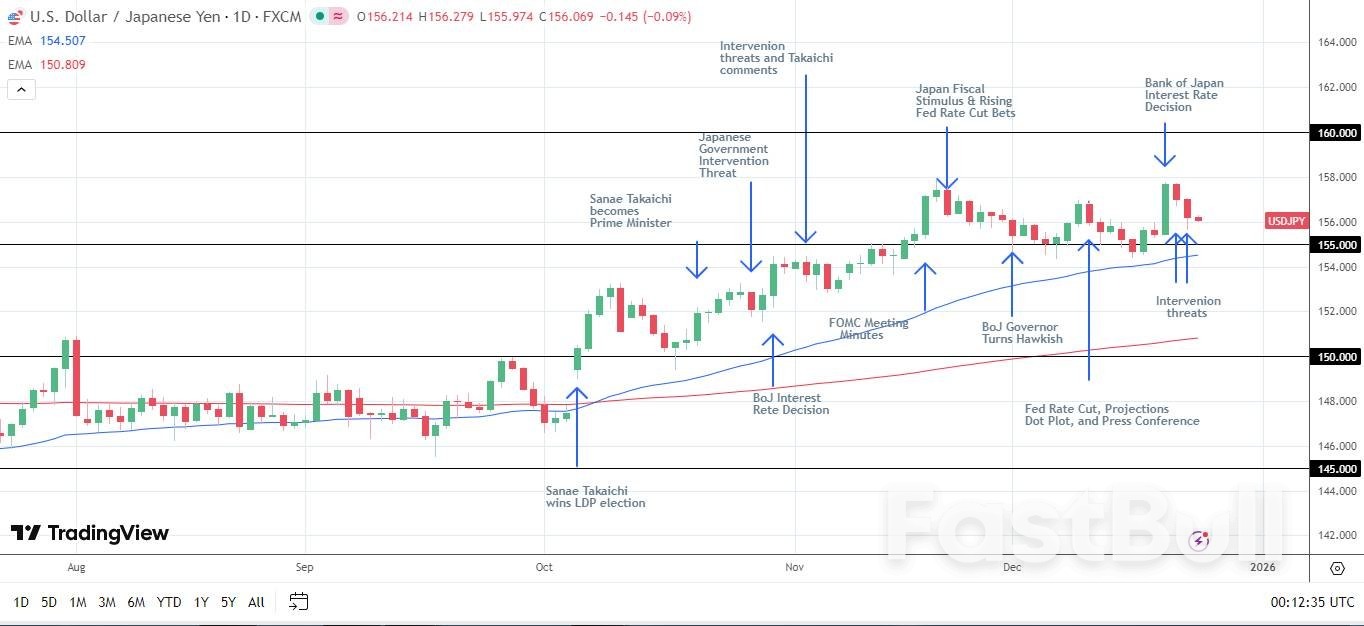 USDJPY – Daily Chart – 241225 – EMAs
In my view, intervention threats will continue to cap USD/JPY gains, while elevated JGB yields could boost yen demand, signaling a negative price outlook. However, the BoJ's messaging on the neutral interest rate will be crucial, given concerns about US inflation.
A higher neutral interest rate, neither accommodative nor restrictive, would signal multiple BoJ rate hikes and a sharp narrowing in US-Japan rate differentials. A less profitable yen carry trade into US assets and higher JGB yields would likely trigger a yen carry trade unwind, sending USD/JPY toward 130 in the longer term.
However, upside risks to the bearish outlook include:
This chain of events would fuel demand for the US dollar and send USD/JPY higher. However, yen intervention warnings are likely to cap the upside at around the 158 level, based on past communication.
In summary, USD/JPY trends reflect shifting sentiment toward narrowing rate differentials. Market focus remains on BoJ Governor Ueda's communications regarding the neutral rate.
A neutral rate at the higher end of the Bank's current 1% to 2.5% range would signal more aggressive rate hikes, supporting the bearish short- to medium-term outlook for USD/JPY. Furthermore, a more dovish Fed policy stance colliding with a hawkish BoJ will likely push USD/JPY toward 130 in the 6-12 month time horizon.
Colombia's leftist government said it will use emergency powers to raise taxes on the nation's richest citizens as well as on the financial services sector.
The government is decreeing an increase on the top wealth tax rate to 5%, from 1.5%, and would also slash the threshold at which it becomes payable to 2 billion pesos ($530,000) from 3.6 billion pesos, President Gustavo Petro said Tuesday, in a national address.
Those figures are unchanged from the rates the government sent in a bill to congress this year, which lawmakers rejected.
The surcharge on financial services company will triple to 15%, Petro said in a presentation.
The government declared an economic emergency this week, saying it was justified by a strained fiscal position, the need for higher spending on health care and security, and the rejection of the tax bill.
The declaration allows the government to increase taxes without congressional approval. However, economic emergencies are normally reserved for crises such as earthquakes and pandemics, and it is possible that the nation's Constitutional Court will overturn it.





A pair of explosions and a fire, apparently sparked by leaking gas, ripped through a nursing home near Philadelphia on Tuesday, killing at least two people and prompting an intense search for victims in a collapsed portion of the building, officials said.
Five people were believed to be missing hours after the blasts and flames ravaged the Silver Lake Nursing Home in Bristol Township, about 21 miles (33 km) northeast of Philadelphia, Bristol Township Fire Marshal Kevin Dippolito said.
Besides the two people killed, an unspecified number of survivors were injured, Dippolito said, adding that numerous patients and staff initially trapped inside a demolished portion of the building were rescued.
The Bucks County emergency dispatch center received first reports of an explosion shortly after 2:00 p.m. EST (1900 GMT).
Dippolito said the first firefighters arriving on the scene, some from a fire-and-rescue station across the street, encountered "a major structural collapse," with part of the building's first floor crumbling into the basement below.
He said numerous victims were extricated from debris, blocked stairwells and stuck elevators, while firefighters ventured into the collapsed basement zone and pulled at least two more people to safety before retreating amid lingering gas fumes.
"We got everyone out that we could, that we could find, that we could see, and we exited the building," Dippolito said. "Within approximately 15 to 30 seconds of us exiting the building, knowing there was a heavy odor of natural gas around us, there was another explosion and fire."
The front of the structure appeared to have been blasted away from the inside, but the majority of the facility remained standing, though most of its windows were shattered, according to a Reuters photographer on the scene.
News footage from WPVI-TV, an ABC News affiliate, showed roaring flames and smoke billowing from the crippled building shortly after the first explosion.
The precise number of patients and staff inside at the time was not immediately known. The nursing home is certified for up to 174 beds, according to an official Medicare provider site.
More than 50 patients, ranging in age from 50 to 95, are typically in the building at any one time, WCAU-TV reported, citing a nurse employed by the facility who arrived on the scene after the blast. About five hours later, nursing home officials had informed authorities that all patients had been accounted for, Dippolito said.
In the early moments following the initial explosion, bystanders rushed to assist police and firefighters in escorting people to safety, Bristol Township Police Lieutenant Sean Cosgrove told local media earlier.
"This is the Pennsylvania way, neighbors helping neighbors in a moment of need," Governor Josh Shapiro said at the news briefing with fire and police officials.
Five hours after the incident, Dippolito said fire and rescue personnel were still treating the search effort as a rescue operation as heavy equipment was brought in to help clear away larger pieces of rubble.
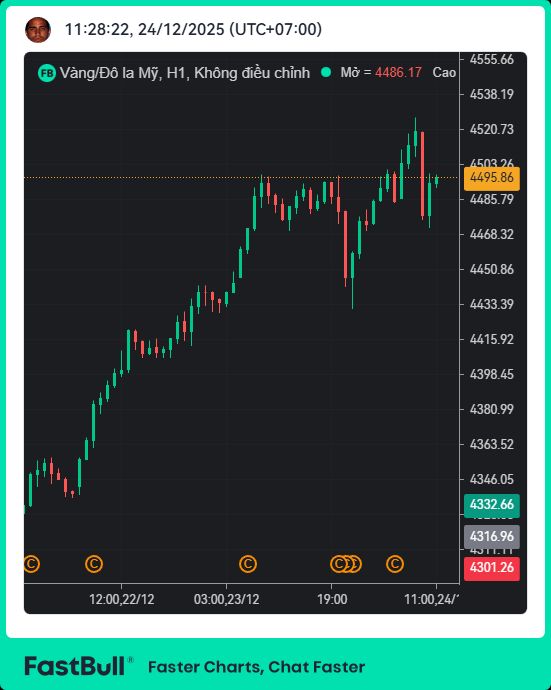
Gold steadied near a record, with escalating geopolitical tensions and expectations for more US rate cuts reinforcing the latest rally.
Bullion was trading a little below $4,500 an ounce, after three days of gains brought it within 15 cents of that milestone on Tuesday. Frictions in Venezuela, where the US has blockaded oil tankers, have added to the metal's haven appeal as it heads for its best annual performance since 1979.
Traders are also betting the US Federal Reserve will follow three straight interest-rate cuts by lowering the cost of borrowing again next year, which would be a tailwind for non-yielding precious metals.
Spot gold edged up 0.2% to $4,494.73 an ounce as of 7:20 a.m. in Singapore. Silver advanced as much as 0.5% to an all-time high of $71.7741. Platinum added 0.5% to trade above $2,300 an ounce for the first time, according to data compiled by Bloomberg going back to 1987. Palladium also rose. The Bloomberg Dollar Spot Index ended the previous session down 0.3%.

The US State Department on Tuesday said it would deny visas to former EU Commissioner Thierry Breton and four others in protest of European regulation of social media.
The measure comes amid increasing tensions between the US and the Europe, with President Donald Trump's adminstration accusing Brussels of cracking down on freedoms.
Besides Breton, the US visa ban targets:
US Secretary of State Marco Rubio said the five people targeted with visa bans "have led organized efforts to coerce American platforms to censor, demonetize and suppress American viewpoints they oppose."
He did not initially name those facing the visa ban, but Under Secretary for Public Diplomacy Sarah Rogers later identified them in a post on social media.
Rogers described Breton as the "mastermind" of the EU's Digital Services Act (DSA), which imposes content moderation and other standards on major social media platforms operating in Europe.
The State Department said HateAid functions as a trusted flagger for enforcing the DSA.
Breton decried the ban as a "witch hunt."
"To our American friends: Censorship isn't where you think it is," he wrote in a post on X.
The GDI called the US action "immoral, unlawful, and un-American" and "an authoritarian attack on free speech and an egregious act of government


Global pharma giants Eli Lilly (LLY.N)and Novo Nordisk (NOVOb.CO)are scrambling to cement their lead in India's booming obesity drug market before cheaper generic versions hit shelves in March next year.
Novo's strategy emphasizes price cuts and accelerated launches, while Lilly's products benefitted from hitting the market early. Both companies focused on aggressive outreach to doctors, heavier advertising about obesity, tie-ups with clinics, patient incentives and distribution deals with local drugmakers, according to doctors, analysts, medical representatives, patients and distributors who spoke to Reuters.
Lilly has even teamed up in India with well-known Bollywood actors in a social media ad campaign about obesity.
India, projected to have the world's second-largest overweight or obese population by 2050 in absolute numbers, is becoming a key battleground for obesity drugs. Analysts expect the global market for such drugs to hit $150 billion a year by the end of this decade.
Although the U.S. remains the largest market for obesity drugs, early sales figures in India show rapid uptake, even though most patients in the world's most populous nation pay for the medication out-of-pocket.
"We believe that this market can be more than $1 billion within two years," said Shrikant Akolkar, vice president at research firm Nuvama Institutional Equities.
Data analytics firm Pharmarack said in July that the market was estimated to be worth 6.28 billion rupees ($70.23 million) at present, growing fivefold since 2021.
U.S. drugmaker Lilly's Mounjaro, approved for diabetes and weight loss in India, became the top-selling therapy by value in October, with sales doubling within months of its March launch, outpacing Danish drugmaker Novo's Wegovy, which entered the Indian market in June.
"We realized just after a couple of months that for accessibility, we had to take a price cut," said Vikrant Shrotriya, Novo Nordisk's managing director in India, referring to Wegovy's price cut in November. Shrotriya spoke earlier this month while launching Novo Nordisk's blockbuster diabetes drug, Ozempic, in the country.
Ozempic, a once-weekly injection approved by the U.S. drug regulator in 2017 for Type 2 diabetes, became a global bestseller and is widely used off-label for weight loss due to its appetite-suppressing effects.
More than 20 Indian drugmakers, including Dr Reddy's (REDY.NS), Cipla (CIPL.NS, Sun Pharma (SUN.NS), Zydus (ZYDU.NS)and Lupin (LUPN.NS),plan to launch cheaper versions of Novo's weight-loss drug in India once its patent on semaglutide, the active ingredient in Wegovy and Ozempic, expires in March 2026.
Analysts expect generic drugs to cost about 60% less, intensifying the fight - particularly for Novo - for dominance in India's price-sensitive market.
Shrotriya played down concerns over looming patent expiries, telling Reuters that Novo will focus on quality, trust and affordability rather than on patents or competition in India.
Lilly's Mounjaro has quickly gained traction in India. A 2.5 mg Mounjaro KwikPen costs about 13,125 rupees ($146.79) for a month's usage, with the highest 15 mg dose going up to 25,781 rupees ($288.33).
In response, Novo cut the price of Wegovy in India by up to 37% in November, pricing its lowest dose of 0.25 mg at 10,850 rupees ($121.34) for a one-month pack. It launched Ozempic last week for a monthly price of 8,800 rupees ($98.42) for 0.25 mg.
While Wegovy is catching up, Mounjaro's early launch helped it penetrate the market, and the latter drug's claim of offering greater weight loss makes it a popular choice among patients, said five doctors who spoke with Reuters.
"Mounjaro clearly has first-strike advantage and continues to have strong demand, but price-sensitive patients are reassessing alternatives," said Dr. Anoop Misra, an endocrinologist and executive chairman of Fortis C-DOC Hospital.
Mounjaro also differentiates itself by targeting people with severe obesity, said Vishal Manchanda, analyst at Systematix Institutional Equities. He added that Lilly faces no immediate pressure to cut prices, given its strong position.
Even if Lilly lowers prices later, Mounjaro would still cost about 30% more than other branded weight-loss drugs, he said.
Lilly declined to comment on its Indian pricing strategy. It said, however, that early response to Mounjaro in India has been "highly encouraging."
Ozempic, Wegovy and Mounjaro belong to a class of drugs called GLP-1 agonists, which mimic a hormone that slows digestion and helps people feel full longer.
Novo has sued Dr Reddy's and Sun Pharma in a local court to enforce semaglutide patents and attempted to block generics until March 2026.
Longer patent protection for Mounjaro's active ingredient, tirzepatide, which extends at least until the middle of the next decade, also gives Lilly an advantage, analysts said.
The battle has expanded beyond pricing and patents.
Demand for weight-loss treatments in India is spreading beyond urban elites as interest grows among middle-class families, office workers, women nearing menopause and people with obesity-related complications in smaller towns.
Lilly has partnered with India's third-largest drugmaker by revenue, Cipla (CIPL.NS), to launch a second tirzepatide brand, Yurpeak, targeting smaller towns, and teamed up with Apollo Hospitals (APLH.NS) to raise awareness of obesity and diabetes. It is also investing more than $1 billion to expand contract manufacturing in India.
Cipla said it would help market Lilly's weight-loss medication in deeper markets in India.
Meanwhile, Novo has tied up with Emcure Pharmaceuticals (EMCU.NS),and launched a second semaglutide brand, Poviztra, to widen distribution beyond India's major cities. It has teamed with startup Healthify to offer patients health coaching and with Apollo to raise awareness of obesity.
In India, where prescription drug ads are prohibited, Novo launched a "WeGoWithYou" obesity awareness campaign that connects people to doctors to learn more about the disease and its management. Lilly has a similar initiative known as "WeKnowNow" that talks about obesity management.
Both drugmakers are pushing to frame obesity as a disease, utilizing newspaper ads, billboards, airport displays and pamphlets at wellness clinics.
Neither company disclosed its spending on marketing in India.
($1 = 89.4160 Indian rupees)
728 RM B 7/F GEE LOK IND BLDG NO 34 HUNG TO RD KWUN TONG KLN HONG KONG


White Label
Data API
Web Plug-ins
Poster Maker
Affiliate Program
The risk of loss in trading financial instruments such as stocks, FX, commodities, futures, bonds, ETFs and crypto can be substantial. You may sustain a total loss of the funds that you deposit with your broker. Therefore, you should carefully consider whether such trading is suitable for you in light of your circumstances and financial resources.
No decision to invest should be made without thoroughly conducting due diligence by yourself or consulting with your financial advisors. Our web content might not suit you since we don't know your financial conditions and investment needs. Our financial information might have latency or contain inaccuracy, so you should be fully responsible for any of your trading and investment decisions. The company will not be responsible for your capital loss.
Without getting permission from the website, you are not allowed to copy the website's graphics, texts, or trademarks. Intellectual property rights in the content or data incorporated into this website belong to its providers and exchange merchants.
Not Logged In
Log in to access more features

FastBull Membership
Not yet
Purchase


Log In
Sign Up