Markets
News
Analysis
User
24/7
Economic Calendar
Education
Data
- Names
- Latest
- Prev


Signal Accounts for Members
All Signal Accounts
All Contests


Turkey Trade BalanceA:--
F: --
P: --
Germany Construction PMI (SA) (Nov)A:--
F: --
P: --
Euro Zone IHS Markit Construction PMI (Nov)A:--
F: --
P: --
Italy IHS Markit Construction PMI (Nov)A:--
F: --
P: --
U.K. Markit/CIPS Construction PMI (Nov)A:--
F: --
P: --
France 10-Year OAT Auction Avg. YieldA:--
F: --
P: --
Euro Zone Retail Sales MoM (Oct)A:--
F: --
P: --
Euro Zone Retail Sales YoY (Oct)A:--
F: --
P: --
Brazil GDP YoY (Q3)A:--
F: --
P: --
U.S. Challenger Job Cuts (Nov)A:--
F: --
P: --
U.S. Challenger Job Cuts MoM (Nov)A:--
F: --
P: --
U.S. Challenger Job Cuts YoY (Nov)A:--
F: --
P: --
U.S. Initial Jobless Claims 4-Week Avg. (SA)A:--
F: --
P: --
U.S. Weekly Initial Jobless Claims (SA)A:--
F: --
P: --
U.S. Weekly Continued Jobless Claims (SA)A:--
F: --
P: --
Canada Ivey PMI (SA) (Nov)A:--
F: --
P: --
Canada Ivey PMI (Not SA) (Nov)A:--
F: --
P: --
U.S. Non-Defense Capital Durable Goods Orders Revised MoM (Excl. Aircraft) (SA) (Sept)A:--
F: --
U.S. Factory Orders MoM (Excl. Transport) (Sept)A:--
F: --
P: --
U.S. Factory Orders MoM (Sept)A:--
F: --
P: --
U.S. Factory Orders MoM (Excl. Defense) (Sept)A:--
F: --
P: --
U.S. EIA Weekly Natural Gas Stocks ChangeA:--
F: --
P: --
Saudi Arabia Crude Oil ProductionA:--
F: --
P: --
U.S. Weekly Treasuries Held by Foreign Central BanksA:--
F: --
P: --
Japan Foreign Exchange Reserves (Nov)A:--
F: --
P: --
India Repo RateA:--
F: --
P: --
India Benchmark Interest RateA:--
F: --
P: --
India Reverse Repo RateA:--
F: --
P: --
India Cash Reserve RatioA:--
F: --
P: --
Japan Leading Indicators Prelim (Oct)A:--
F: --
P: --
U.K. Halifax House Price Index YoY (SA) (Nov)--
F: --
P: --
U.K. Halifax House Price Index MoM (SA) (Nov)--
F: --
P: --
France Current Account (Not SA) (Oct)--
F: --
P: --
France Trade Balance (SA) (Oct)--
F: --
P: --
France Industrial Output MoM (SA) (Oct)--
F: --
P: --
Italy Retail Sales MoM (SA) (Oct)--
F: --
P: --
Euro Zone Employment YoY (SA) (Q3)--
F: --
P: --
Euro Zone GDP Final YoY (Q3)--
F: --
P: --
Euro Zone GDP Final QoQ (Q3)--
F: --
P: --
Euro Zone Employment Final QoQ (SA) (Q3)--
F: --
P: --
Euro Zone Employment Final (SA) (Q3)--
F: --
Brazil PPI MoM (Oct)--
F: --
P: --
Mexico Consumer Confidence Index (Nov)--
F: --
P: --
Canada Unemployment Rate (SA) (Nov)--
F: --
P: --
Canada Labor Force Participation Rate (SA) (Nov)--
F: --
P: --
Canada Employment (SA) (Nov)--
F: --
P: --
Canada Part-Time Employment (SA) (Nov)--
F: --
P: --
Canada Full-time Employment (SA) (Nov)--
F: --
P: --
U.S. Dallas Fed PCE Price Index YoY (Sept)--
F: --
P: --
U.S. PCE Price Index YoY (SA) (Sept)--
F: --
P: --
U.S. PCE Price Index MoM (Sept)--
F: --
P: --
U.S. Personal Outlays MoM (SA) (Sept)--
F: --
P: --
U.S. Core PCE Price Index MoM (Sept)--
F: --
P: --
U.S. UMich 5-Year-Ahead Inflation Expectations Prelim YoY (Dec)--
F: --
P: --
U.S. Core PCE Price Index YoY (Sept)--
F: --
P: --
U.S. 5-10 Year-Ahead Inflation Expectations (Dec)--
F: --
P: --
U.S. UMich Current Economic Conditions Index Prelim (Dec)--
F: --
P: --
U.S. UMich Consumer Sentiment Index Prelim (Dec)--
F: --
P: --
U.S. UMich 1-Year-Ahead Inflation Expectations Prelim (Dec)--
F: --
P: --
U.S. UMich Consumer Expectations Index Prelim (Dec)--
F: --
P: --


No matching data
Latest Views
Latest Views
Trending Topics
Top Columnists
Latest Update
White Label
Data API
Web Plug-ins
Affiliate Program
View All

No data
Ever since OPEC+ started ramping up supplies in April, the group has drawn reassurance from one key oil indicator: the price curve. As it prepares to meet this weekend, that gauge is faltering.
OPEC officials pay close attention to the premium that Brent crude futures for more immediate supply command over later contracts. The positive spread — known as backwardation — has held up for months, even as Saudi Arabia and its allies fast-tracked the return of 2.2 million barrels a day. It means traders saw the oil market as tight.
But as the Organization of the Petroleum Exporting Countries and its partners ponder their next steps, the metric is deteriorating. The difference between the second and third months shrank to the weakest level since November on Thursday, at 18 cents a barrel. Similar gauges for the Middle Eastern market, representing barrels key OPEC producers pump, have also come under pressure.
Inventories remain tight in the US, but oil supplies are starting to accumulate at sea, including a flotilla of unsold cargoes from the Middle East. Morgan Stanley expects the forward curve will flip into the reverse structure where prompt barrels trade at a discount — known as contango — as stockpiles eventually pile up in the West. That’s normally a bearish signal.
“We are all waiting for these ballooning global stocks to finally show up in Atlantic Basin crude,” said Martijn Rats, the bank’s global oil strategist said at the Argus Global Markets conference this week. “At some point they’re going to build and then we’re going to go to contango.”
The group is still striving for consensus on what to do next. The options under preliminary discussion include another marginal increase of 137,000 barrels a day like this month’s, or multiples of that, according to delegates.
Earlier this week, one delegate said the group would discuss whether to fast-track its latest round of supply hikes in three monthly instalments of about 500,000 barrels a day. OPEC said it didn’t have plans in place to increase output by that amount.
The decline of oil’s forward curve suggests they have good reason to be cautious.
Applications for US unemployment benefits edged up last week, according to a Goldman Sachs Group Inc analysis of state-level filings released during the federal government shutdown.
Initial claims rose to about 224,000 in the week ended Sept 27 from the 218,000 filings reported by the government in the prior period, Goldman Sachs economists led by Jan Hatzius said in a note to clients. The bank used the Labor Department’s pre-released seasonal factors to adjust the available raw state-level figures.
The Labor Department did not publish its weekly report on Thursday due to the government shutdown, but it did release downloadable data for most states. The September jobs report, which was scheduled for earlier Friday, is also delayed.
Continuing claims, a proxy for the number of people receiving benefits, slipped to 1.91 million in the week ended Sept 20 from the prior week’s 1.93 million, the economists found.
Goldman Sachs economists estimated initial claims for Arizona and Massachusetts, and assumed those applications were in line with the prior week.
We've been documenting how more and more US Patriot missile batteries have been showing up in Ukraine, as even Israel has of late openly acknowledged sending one, with more said to be on the way.But it hasn't taken long for Russia to respond by upgrading its ballistic missile systems to evade Ukrainian air defenses, including US-supplied Patriot systems, according to a report by the Financial Times on Thursday. The report, which cites Ukrainian and US officials, details that the modifications affect both the Iskander-M short-range ballistic missiles and the air-launched Kinzhal missiles.
Russian MoD/TASSThese have ranges of up to around 300 miles, with the upgraded missiles now said to be capable of performing sharp maneuvers or steep dives as they approach their targets, making them significantly more difficult to intercept.
One Ukrainian official admitted the development to be a "game-changer for Russia" - as cited in Financial Times. Western intel sources further conceded a noticeable drop in successful interceptions by Ukraine's air defenses as a result."Ukraine's ballistic missile interception rate improved over the summer, reaching 37 per cent in August, but it plummeted to 6 per cent in September, despite fewer launches, according to public Ukrainian air force data compiled by the London-based Centre for Information Resilience and analyzed by the Financial Times," the report underscores.
A notable successful Russian strike which was able to evade significant air defenses was on August 28, when a major facility for the manufacture of Turkish-made Bayraktar drones was hit, in what many analysts said at the time sent a clear message to Ankara.And during an attack wave on September 18, Ukraine’s Air Force reported - somewhat unusually - that all four Iskander missiles launched that day bypassed Patriot defenses entirely. Such had become a 'pattern' over the summer.These prior instances in the summer saw Ukraine's air defenses at times down merely one missile out of seven or more, and that the intercept rate was previously consistently higher.
An American Patriot surface-to-air missile lies on the streets in Kiev:

Also of note in the fresh report is the feedback that major defense makers are getting in real-time. "Ukraine shares Patriot engagement data with the Pentagon and the air defense system’s US manufacturers, said the western and Ukrainian officials," FT writes."Virginia-based Raytheon makes the Patriot system, while Maryland-based Lockheed Martin produces the system’s interceptor missiles," the report continues, describing that "The data is used to make updates needed to keep pace with Russia’s adjustments, but one official said those improvements often lagged behind Moscow’s evolving tactics."
U.S. services sector activity was unchanged in September, while a measure of employment in the segment contracted for the fourth straight month.
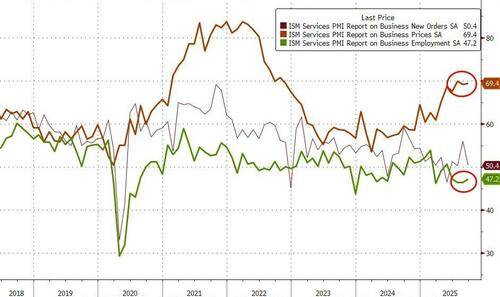
The Institute for Supply Management’s non-manufacturing purchasing managers index came in at 50 last month, hitting the breakeven point between expansion and contraction for the first time since January 2010. Economists had anticipated the metric would stand at 51.8, compared to 52.0 in August.
In a statement, Steve Miller, Chair of the ISM’s Services Business Survey Committee said September’s level returned to numbers "very similar" to May and July, with commentary from executives indicating "moderate or weak growth" in the services industry.
An index measuring employment ticked higher to 47.2, up from 46.5 in August but still well within the sub-50 contraction territory, due to a combination of delayed hiring efforts and difficulty finding qualified staff, Miller said.
The employment gauge may receive additional scrutiny because of an ongoing U.S. government shutdown, which has led to the delay of key official economic data, including the all-important nonfarm payrolls report on Friday.
A slowing U.S. labor market was cited as a key motivating factor behind the Federal Reserve’s decision last month to restart a cycle of monetary policy easing, with the central bank slashing interest rates by 25 basis points and signaling thatmore reductions could be coming this year. In theory, drawing down borrowing costs can help boost investment and hiring, albeit at the risk of driving up inflation.
To that end, a metric of prices paid by services organizations registered 69.4, rising from 69.2 in August. It was the second-highest mark since October 2022, as some companies flagged that the cost of sweeping U.S. tariffs is beginning to be felt.
The government shutdown delayed the Bureau of Labor Statistics jobs report, “arguably the most important piece of information” for the Federal Reserve to review before its meeting at the end of the month, according to Bank of America Global Research economists.
The jobs report was due out Oct. 3. However, the federal shutdown forced the bureau to furlough employees as well as pause data collection and dissemination. If the shutdown lingers, it could also postpone the bureau’s next Consumer Price Index report, a key benchmark for inflation, expected Oct. 15.
While BLS releases are widely viewed as gold standard of economic data, the Fed and economists rely on a broad range of reports to gauge the health of the economy.
“At this point, while it’s an incomplete picture, we’re not flying completely blind,” Mike Skordeles, head of U.S. economics at Truist, told USA TODAY. “Obviously, if the shutdown drags on for longer than a week or so, that stale data makes it harder get an accurate picture of the economy.”
Mark Hamrick, a Bankrate senior economic analyst, said in an Oct. 3 note the jobs report "was expected to show about 50,000 jobs added to payrolls, with the unemployment rate remaining at 4.3%."
The data delay comes at a time when economists were looking for signs of a rebound in the job market after months of disappointing reports and when the Fed is expected to announce at least one additional rate cut before the end of the year to stimulate growth.
In 2019, a report to the Federal Open Market Committee acknowledged a then-ongoing partial government shutdown’s impact on releases, saying that “the model places more weight” on non-government surveys when BLS data is unavailable.
Still, “it is a very big deal” to not have the BLS’ jobs report, according to Jobs for the Future CEO Maria Flynn, who served as a senior official in the Department of Labor during the Clinton and Bush administrations.
“We have been here before, but it is very rare,” Flynn said. “The fact that it is happening at a time where we have seen the role of the Bureau of Labor Statistics be politicized in ways that I personally haven’t seen before, I think, makes it even more concerning.”
Without fresh government data, Flynn said businesses can turn to reports from job boards including Zip Recruiter, Indeed and LinkedIn, as well as data from Lightcast, a real-time labor market information provider.
There are other releases economists have their eyes on, like the ADP’s National Employment Report, which published Oct. 1 and found private employers shed 32,000 jobs during September.
Skordeles said some private sources economists examine include freight data from ports and railroads, industry group data from organizations like the National Association of Realtors, and earnings reports from public companies.
Homebase’s September Main Street Health Report on small business labor trends, found workforce participation fell 3.6% and hours worked declined 4.7%, closely mirroring late-summer declines in 2023. While the report focuses on small businesses that primarily employ hourly workers, Homebase CEO John Waldmann said it can offer early signals about broader economic conditions.
“We started sharing data publicly during COVID because we were seeing real-time signals so early in the pandemic of the impact on local economies, so we were trying to raise the alarm everywhere,” Waldmann said. “Small businesses have traditionally provided most of the job growth in this country. I think as you look at the technology and labor market changes ahead of us, their role in providing jobs in this country is only going to be more important.”
Sometimes non-government reports contradict one another, which makes the absence of BLS data a challenge, Flynn said.
“It’s always good to be able to triangulate the data and compare and contrast across difference sources,” Flynn said. “If you’re taking one leg of the stool out of the equation, and it is the public sector government-sponsored leg of the stool, then I think it does start to open things up for more interpretation.”
Government-sourced data is the best available in many cases, and the only source in others, according to Skordeles.
“For instance, there aren’t a lot of comprehensive inflation data series outside of pricing statistics for narrow slices of the economy, like auto data from Manheim or existing home prices from NAR,” Skordeles added.
The shutdown’s duration is unknown, though the longest in U.S. history lasted 35 days. Flynn noted that if economists were without government data for more than three months, it could fundamentally change some of the assumptions behind their analyses and the reliability of their decisions.
She added the jobs report matters to everyday Americans because it helps inform the Fed’s interest rate decisions, affecting loans, credit cards, and other borrowing costs. It also highlights “the important role federal statistical agencies play in guiding our economy.”
“If they themselves or anyone in their family is looking for a different job, they need information to really help make those decisions about their best next step,” Flynn said. “Having government-backed data is a critical piece of that puzzle.”
Latino voters are showing reduced support for Democrats despite dissatisfaction with Donald Trump, affecting the 2024 U.S. election political landscape.This voter sentiment shift may impact U.S. political strategies but has no evident effect on the cryptocurrency market or related policies.Recent polling data highlights a shift in Latino voter preferences amidst upcoming elections.Former President Donald Trump has gained notable backing among Latino men, while the Democratic party maintains a majority overall, with the focus remaining on policy impacts on wages, energy, and food costs.
Recent polling data highlights a shift in Latino voter preferences amidst upcoming elections. Former President Donald Trump has gained notable backing among Latino men, while the Democratic party maintains a majority overall.Prominent political figures including Donald Trump and Vice President Kamala Harris have seen varying support levels. Polling indicates the focus remains on policy impacts on wages, energy, and food costs. As Vice President Kamala Harris stated, "The path to winning the Latino vote is clear, and it starts with showing up, listening, and speaking to their needs directly."
The Latino voter shift does not directly affect cryptocurrency markets or U.S. regulatory frameworks. Analysts find that financial implications remain minimal, with no reported changes in asset values or crypto funding.While the political scene adjusts, crypto markets show stability with no regulatory alerts triggered. Historical data suggests such shifts mostly influence societal trends rather than direct financial markets.
Previous elections witnessed similar interplay between voter sentiment and political responses. However, crypto markets remained unaffected, pointing to a disconnect between political dynamics and crypto asset value changes.
Experts from Kanalcoin suggest monitoring future regulations rather than immediate financial impacts. Past trends reveal that policy directions have the potential for market influence, but temporarily remain separate from voter sentiment changes. For further insights into political changes, the Brookings Institution's research programs offer valuable perspectives.
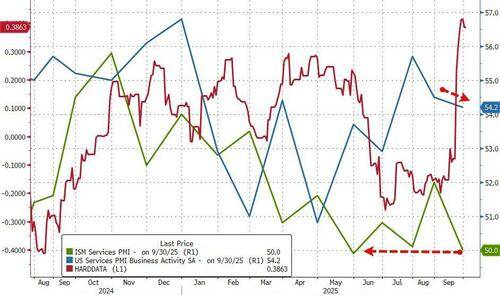
With the market desperate for any visibility into the economy - due to data being cutoff during the shutdown - this morning's soft survey data on the services sector could have a larger impact on stocks and bonds than normal.
With 'hard' data surging higher, S&P Global's US Services PMI rose from 53.9 preliminary to 54.2 final in September (but that is down from the 54.5 final print for August). The ISM Services PMI also fell MoM from 52.0 to 50.0 (worse than the 51.7 expected) - that is the weakest since May...
Under the hood of the ISM survey we saw prices sticky at highs, employment weak (but a small improvement) and orders slowdown...
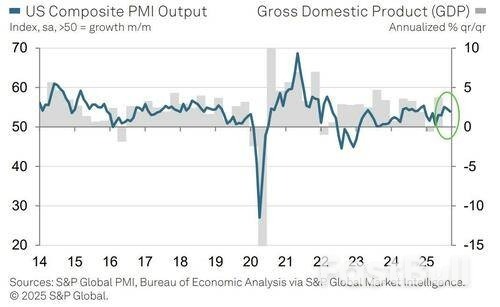
The S&P Global US Composite PMI recorded 53.9 in September. That was down from 54.6 in August and represented the slowest growth for three months.
Both sectors covered by the survey recorded weaker output expansions in line with slower gains in new business. Employment meanwhile barely rose, but confidence in the outlook strengthened noticeably. Cost pressures remained elevated, although inflation softened to a five-month low. A similar trend was seen for output charges.
“Service sector growth softened slightly in September but remained strong enough to round off an impressive performance over the third quarter a whole," according to Chris Williamson, Chief Business Economist at S&P Global Market Intelligence
"Combined with sustained growth in the manufacturing sector, the expansion of service sector activity is indicative of robust third quarter annualized GDP growth of around 2.5%."
The recessions shows no signs of appearing:
“Growth is being fueled principally by rising financial services and tech sector activity, though we are also seeing more signs of improving demand for consumer-facing services such as leisure and recreation, likely linked in part to lower interest rates.
Lower borrowing costs have also fed through to a broadbased improvement in business optimism about the outlook for the next 12 months.
But jobs remain a worry:
“Disappointingly, the improvement in business optimism failed to spur more jobs growth, with hiring almost stalling in a sign of further labor market malaise as companies often focused on running more efficiently amid uncertain trading conditions.
As do (tariff-driven) price hikes...
“A further ongoing source of concern from the surveys are heightened cost pressures which survey respondents have attributed to tariffs. Input costs rose sharply again in September as import levies were seen to have again fed through from goods to services.
However, rates charged for services rose at the slowest rate for five months in a welcome sign that some of these tariff price pressures in supply chains are starting to moderate.”
So choose your own adventure - employment data remains in contraction but did improve modestly.
White Label
Data API
Web Plug-ins
Poster Maker
Affiliate Program
The risk of loss in trading financial instruments such as stocks, FX, commodities, futures, bonds, ETFs and crypto can be substantial. You may sustain a total loss of the funds that you deposit with your broker. Therefore, you should carefully consider whether such trading is suitable for you in light of your circumstances and financial resources.
No decision to invest should be made without thoroughly conducting due diligence by yourself or consulting with your financial advisors. Our web content might not suit you since we don't know your financial conditions and investment needs. Our financial information might have latency or contain inaccuracy, so you should be fully responsible for any of your trading and investment decisions. The company will not be responsible for your capital loss.
Without getting permission from the website, you are not allowed to copy the website's graphics, texts, or trademarks. Intellectual property rights in the content or data incorporated into this website belong to its providers and exchange merchants.
Not Logged In
Log in to access more features

FastBull Membership
Not yet
Purchase
Log In
Sign Up