• Trade
  • Markets
  • Copy
  • Contests
  • News
  • 24/7
  • Calendar
  • Q&A
  • Chats
Trending
Screeners
SYMBOL
LAST
BID
ASK
HIGH
LOW
NET CHG.
%CHG.
SPREAD
SPX
S&P 500 Index
6846.50
6846.50
6846.50
6878.28
6827.18
-23.90
-0.35%
--
DJI
Dow Jones Industrial Average
47739.31
47739.31
47739.31
47971.51
47611.93
-215.67
-0.45%
--
IXIC
NASDAQ Composite Index
23545.89
23545.89
23545.89
23698.93
23455.05
-32.22
-0.14%
--
USDX
US Dollar Index
99.000
99.080
99.000
99.000
99.000
+0.050
+ 0.05%
--
EURUSD
Euro / US Dollar
1.16339
1.16394
1.16339
1.16362
1.16322
-0.00025
-0.02%
--
GBPUSD
Pound Sterling / US Dollar
1.33176
1.33286
1.33176
1.33177
1.33140
-0.00029
-0.02%
--
XAUUSD
Gold / US Dollar
4189.70
4190.14
4189.70
4218.85
4175.92
-8.21
-0.20%
--
WTI
Light Sweet Crude Oil
58.555
58.807
58.555
60.084
58.495
-1.254
-2.10%
--

Community Accounts

Signal Accounts
--
Profit Accounts
--
Loss Accounts
--
View More

Become a signal provider

Sell trading signals to earn additional income

View More

Guide to Copy Trading

Get started with ease and confidence

View More

Signal Accounts for Members

All Signal Accounts

Best Return
  • Best Return
  • Best P/L
  • Best MDD
Past 1W
  • Past 1W
  • Past 1M
  • Past 1Y

All Contests

  • All
  • Trump Updates
  • Recommend
  • Stocks
  • Cryptocurrencies
  • Central Banks
  • Featured News
Top News Only
Share

On Monday (December 8), In Late New York Trading, S&P 500 Futures Fell 0.21%, Dow Jones Futures Fell 0.43%, NASDAQ 100 Futures Fell 0.08%, And Russell 2000 Futures Fell 0.04%

Share

Morgan Stanley: Data Center ABS Spreads Are Expected To Widen In 2026

Share

(US Stocks) The Philadelphia Gold And Silver Index Closed Down 2.34% At 311.01 Points. (Global Session) The NYSE Arca Gold Miners Index Closed Down 2.17%, Hitting A Daily Low Of 2235.45 Points; US Stocks Remained Slightly Down Before The Opening Bell—holding Steady Around 2280 Points—before Briefly Rising Slightly

Share

IMF: IMF Executive Board Approves Extension Of The Extended Credit Facility Arrangement With Nepal

Share

Trump: Same Approach Will Apply To Amd, Intel, And Other Great American Companies

Share

Trump: Department Of Commerce Is Finalizing Details

Share

Trump: $25% Will Be Paid To United States Of America

Share

Trump: President Xi Responded Positively

Share

[Consumer Discretionary ETFs Fell Over 1.4%, Leading The Decline Among US Sector ETFs; Semiconductor ETFs Rose Over 1.1%] On Monday (December 8), The Consumer Discretionary ETF Fell 1.45%, The Energy ETF Fell 1.09%, The Internet ETF Fell 0.18%, The Regional Banks ETF Rose 0.34%, The Technology ETF Rose 0.70%, The Global Technology ETF Rose 0.93%, And The Semiconductor ETF Rose 1.13%

Share

Trump: I Have Informed President Xi, Of China, That United States Will Allow Nvidia To Ship Its H200 Products To Approved Customers In China

Share

Argentina's Merval Index Closed Up 0.02% At 3.047 Million Points. It Rose To A New Daily High Of 3.165 Million Points In Early Trading In Buenos Aires Before Gradually Giving Back Its Gains

Share

US Stock Market Closing Report | On Monday (December 8), The Magnificent 7 Index Fell 0.20% To 208.33 Points. The "mega-cap" Tech Stock Index Fell 0.33% To 405.00 Points

Share

Pentagon - USA State Dept Approves Potential Sale Of Hellfire Missiles To Belgium For An Estimated $79 Million

Share

Toronto Stock Index .GSPTSE Unofficially Closes Down 141.44 Points, Or 0.45 Percent, At 31169.97

Share

The Nasdaq Golden Dragon China Index Closed Up Less Than 0.1%. Nxtt Rose 21%, Microalgo Rose 7%, Daqo New Energy Rose 4.3%, And 21Vianet, Baidu, And Miniso All Rose More Than 3%

Share

The S&P 500 Initially Closed Down More Than 0.4%, With The Telecom Sector Down 1.9%, And Materials, Consumer Discretionary, Utilities, Healthcare, And Energy Sectors Down By As Much As 1.6%, While The Technology Sector Rose 0.7%. The NASDAQ 100 Initially Closed Down 0.3%, With Marvell Technology Down 7%, Fortinet Down 4%, And Netflix And Tesla Down 3.4%

Share

IMF: Review Pakistan Authorities To Draw The Equivalent Of About US$1 Billion

Share

President Trump Is Committed To The Continued Cessation Of Violence And Expects The Governments Of Cambodia And Thailand To Fully Honor Their Commitments To End This Conflict - Senior White House Official

Share

[Water Overflows From Spent Fuel Pool At Japanese Nuclear Facility] According To Japan's Nuclear Waste Management Company, Following A Strong Earthquake Off The Coast Of Aomori Prefecture Late On December 8th, Workers At The Nuclear Waste Treatment Plant In Rokkasho Village, Aomori Prefecture, Discovered "at Least 100 Liters Of Water" On The Ground Around The Spent Fuel Pool During An Inspection. Analysis Suggests This Water "may Have Overflowed Due To The Earthquake's Shaking." However, It Is Reported That The Overflowed Water "remains Inside The Building And Has Not Affected The External Environment."

Share

Trump Says Netflix, Paramount Are Not His Friends As Warner Bros Fight Heats Up

TIME
ACT
FCST
PREV
France Trade Balance (SA) (Oct)

A:--

F: --

P: --
Euro Zone Employment YoY (SA) (Q3)

A:--

F: --

P: --
Canada Part-Time Employment (SA) (Nov)

A:--

F: --

P: --

Canada Unemployment Rate (SA) (Nov)

A:--

F: --

P: --

Canada Full-time Employment (SA) (Nov)

A:--

F: --

P: --

Canada Labor Force Participation Rate (SA) (Nov)

A:--

F: --

P: --

Canada Employment (SA) (Nov)

A:--

F: --

P: --

U.S. PCE Price Index MoM (Sept)

A:--

F: --

P: --

U.S. Personal Income MoM (Sept)

A:--

F: --

P: --

U.S. Core PCE Price Index MoM (Sept)

A:--

F: --

P: --

U.S. PCE Price Index YoY (SA) (Sept)

A:--

F: --

P: --

U.S. Core PCE Price Index YoY (Sept)

A:--

F: --

P: --

U.S. Personal Outlays MoM (SA) (Sept)

A:--

F: --

P: --
U.S. 5-10 Year-Ahead Inflation Expectations (Dec)

A:--

F: --

P: --

U.S. Real Personal Consumption Expenditures MoM (Sept)

A:--

F: --

P: --
U.S. Weekly Total Rig Count

A:--

F: --

P: --

U.S. Weekly Total Oil Rig Count

A:--

F: --

P: --

U.S. Consumer Credit (SA) (Oct)

A:--

F: --

P: --
China, Mainland Foreign Exchange Reserves (Nov)

A:--

F: --

P: --

Japan Trade Balance (Oct)

A:--

F: --

P: --

Japan Nominal GDP Revised QoQ (Q3)

A:--

F: --

P: --

China, Mainland Imports YoY (CNH) (Nov)

A:--

F: --

P: --

China, Mainland Exports (Nov)

A:--

F: --

P: --

China, Mainland Imports (CNH) (Nov)

A:--

F: --

P: --

China, Mainland Trade Balance (CNH) (Nov)

A:--

F: --

P: --

China, Mainland Exports YoY (USD) (Nov)

A:--

F: --

P: --

China, Mainland Imports YoY (USD) (Nov)

A:--

F: --

P: --

Germany Industrial Output MoM (SA) (Oct)

A:--

F: --

P: --
Euro Zone Sentix Investor Confidence Index (Dec)

A:--

F: --

P: --

Canada National Economic Confidence Index

A:--

F: --

P: --

U.K. BRC Like-For-Like Retail Sales YoY (Nov)

--

F: --

P: --

U.K. BRC Overall Retail Sales YoY (Nov)

--

F: --

P: --

Australia Overnight (Borrowing) Key Rate

--

F: --

P: --

RBA Rate Statement
RBA Press Conference
Germany Exports MoM (SA) (Oct)

--

F: --

P: --

U.S. NFIB Small Business Optimism Index (SA) (Nov)

--

F: --

P: --

Mexico 12-Month Inflation (CPI) (Nov)

--

F: --

P: --

Mexico Core CPI YoY (Nov)

--

F: --

P: --

Mexico PPI YoY (Nov)

--

F: --

P: --

U.S. Weekly Redbook Index YoY

--

F: --

P: --

U.S. JOLTS Job Openings (SA) (Oct)

--

F: --

P: --

China, Mainland M1 Money Supply YoY (Nov)

--

F: --

P: --

China, Mainland M0 Money Supply YoY (Nov)

--

F: --

P: --

China, Mainland M2 Money Supply YoY (Nov)

--

F: --

P: --

U.S. EIA Short-Term Crude Production Forecast For The Year (Dec)

--

F: --

P: --

U.S. EIA Natural Gas Production Forecast For The Next Year (Dec)

--

F: --

P: --

U.S. EIA Short-Term Crude Production Forecast For The Next Year (Dec)

--

F: --

P: --

EIA Monthly Short-Term Energy Outlook
U.S. API Weekly Gasoline Stocks

--

F: --

P: --

U.S. API Weekly Cushing Crude Oil Stocks

--

F: --

P: --

U.S. API Weekly Crude Oil Stocks

--

F: --

P: --

U.S. API Weekly Refined Oil Stocks

--

F: --

P: --

South Korea Unemployment Rate (SA) (Nov)

--

F: --

P: --

Japan Reuters Tankan Non-Manufacturers Index (Dec)

--

F: --

P: --

Japan Reuters Tankan Manufacturers Index (Dec)

--

F: --

P: --

Japan Domestic Enterprise Commodity Price Index MoM (Nov)

--

F: --

P: --

Japan Domestic Enterprise Commodity Price Index YoY (Nov)

--

F: --

P: --

China, Mainland PPI YoY (Nov)

--

F: --

P: --

China, Mainland CPI MoM (Nov)

--

F: --

P: --

Italy Industrial Output YoY (SA) (Oct)

--

F: --

P: --

Q&A with Experts
    • All
    • Chatrooms
    • Groups
    • Friends
    Connecting
    .
    .
    .
    Type here...
    Add Symbol or Code

      No matching data

      All
      Trump Updates
      Recommend
      Stocks
      Cryptocurrencies
      Central Banks
      Featured News
      • All
      • Russia-Ukraine Conflict
      • Middle East Flashpoint
      • All
      • Russia-Ukraine Conflict
      • Middle East Flashpoint
      Search
      Products

      Charts Free Forever

      Chats Q&A with Experts
      Screeners Economic Calendar Data Tools
      Membership Features
      Data Warehouse Market Trends Institutional Data Policy Rates Macro

      Market Trends

      Market Sentiment Order Book Forex Correlations

      Top Indicators

      Charts Free Forever
      Markets

      News

      News Analysis 24/7 Columns Education
      From Institutions From Analysts
      Topics Columnists

      Latest Views

      Latest Views

      Trending Topics

      Top Columnists

      Latest Update

      Signals

      Copy Rankings Latest Signals Become a signal provider AI Rating
      Contests
      Brokers

      Overview Brokers Assessment Rankings Regulators News Claims
      Broker listing Forex Brokers Comparison Tool Live Spread Comparison Scam
      Q&A Complaint Scam Alert Videos Tips to Detect Scam
      More

      Business
      Events
      Careers About Us Advertising Help Center

      White Label

      Data API

      Web Plug-ins

      Affiliate Program

      Awards Institution Evaluation IB Seminar Salon Event Exhibition
      Vietnam Thailand Singapore Dubai
      Fans Party Investment Sharing Session
      FastBull Summit BrokersView Expo
      Recent Searches
        Top Searches
          Markets
          News
          Analysis
          User
          24/7
          Economic Calendar
          Education
          Data
          • Names
          • Latest
          • Prev

          View All

          No data

          Scan to Download

          Faster Charts, Chat Faster!

          Download App
          English
          • English
          • Español
          • العربية
          • Bahasa Indonesia
          • Bahasa Melayu
          • Tiếng Việt
          • ภาษาไทย
          • Français
          • Italiano
          • Türkçe
          • Русский язык
          • 简中
          • 繁中
          Open Account
          Search
          Products
          Charts Free Forever
          Markets
          News
          Signals

          Copy Rankings Latest Signals Become a signal provider AI Rating
          Contests
          Brokers

          Overview Brokers Assessment Rankings Regulators News Claims
          Broker listing Forex Brokers Comparison Tool Live Spread Comparison Scam
          Q&A Complaint Scam Alert Videos Tips to Detect Scam
          More

          Business
          Events
          Careers About Us Advertising Help Center

          White Label

          Data API

          Web Plug-ins

          Affiliate Program

          Awards Institution Evaluation IB Seminar Salon Event Exhibition
          Vietnam Thailand Singapore Dubai
          Fans Party Investment Sharing Session
          FastBull Summit BrokersView Expo

          Nvidia CEO Jensen Huang says AI is in a ‘virtuous cycle.’ Here’s what he means

          Adam

          Economic

          Summary:

          Nvidia’s CEO says AI is in a “virtuous cycle” where better models drive more usage and investment, reshaping computing and fueling a long-term industry buildout.

          Nvidia CEO Jensen Huang said on Friday that artificial intelligence had reached a “virtuous cycle,” tipping the industry for continuous growth.
          Speaking at the APEC CEO Summit in South Korea, Huang said the vast improvements in AI models were leading to more investment in the technology, which was, in turn, improving the AI models even further.
          “We have now achieved what is called the virtual cycle,” he said on stage at the event, wearing a suit rather than his usual black leather jacket.
          “The AIs get better. More people use it. More people use it, it makes more profit, creates more factories, which allows us to create even better AIs, which allows more people to use it. The virtual cycle of AI has been designed, and this is ... the reason why you’re seeing the world’s capex going so fast.”
          His comments come as Big Tech is spending billions to build out AI-related infrastructure and serve its end users.
          This year was expected to be a big one for AI spend with Meta, Amazon, Alphabet and Microsoft announcing plans to spend over $300 billion combined on AI technologies and datacenter buildouts. This looks set to continue into 2026 as the tech giants plan to boost spending again, per their respective earnings, reported this week.
          Dan Ives, Wedbush Securities global head of technology research, described Nvidia as “the foundation of the AI Revolution” in comments to CNBC after Huang’s comments on stage.
          He described the AI virtuous cycle as: “The more demand, the more building of AI building blocks. And demand creates more demand and capex.”
          Huang stressed that profitability was at the heart of the current boom in AI capital investment.
          “When something becomes profitable, you want to manufacture more of it, just like when you’re manufacturing chips and wafers and DRAM, if the manufacturing of those chips were profitable, you want to build more factories to create more chips,” he added.
          A new era of computing
          It is the beginning of a new era of computing, as, with AI, “every single layer of the computing stack is being fundamentally changed,” Huang said on stage.
          We are at the beginning of a 10-year build-out of this new era, he added.
          “AI runs on GPUs [graphics processing unit], whereas hand-coded software runs on CPUs [central processing unit]. This entire software stack, from the ... the needs of energy, chips, the infrastructure, all of the software associated with the systems, the AI models and the applications on top, every single layer of computing has been fundamentally changed,” he said.
          “Just think: the computer industry has been largely the same for 60 years, and now, with AI and accelerated computing, every single layer of the computing stack is being changed. All of the computers we’ve created in the past, a trillion dollars, maybe more, of computers needs to now be transitioned, shifted to the new computing platform,” he added.
          Nvidia, which became the first company to surpass $5 trillion in market value earlier this week, announced a partnership with Korean semiconductor giant Samsung earlier on Friday. Samsung plans to buy and deploy a cluster of 50,000 Nvidia GPUs to improve its chip manufacturing for mobile devices and robots.
          Huang painted a picture of the future in which AI is able to “work,” rather than just be used as a tool. Highlighting the rise of fully automated manufacturing factories, the CEO expects AI to reshape $100 trillion worth of industries around the world.

          Source: cnbc

          To stay updated on all economic events of today, please check out our Economic calendar
          Risk Warnings and Disclaimers
          You understand and acknowledge that there is a high degree of risk involved in trading. Following any strategies or investment methods may lead to potential losses. The content on the site is provided by our contributors and analysts for information purposes only. You are solely responsible for determining whether any trading assets, securities, strategy, or any other product is suitable for investing based on your own investment objectives and financial situation.
          Add to Favorites
          Share

          Air India Seeks $1.1 Billion Lifeline From Tata, SIA After Crash

          Justin

          Forex

          Stocks

          Economic

          Unprofitable Air India Ltd. is seeking at least 100 billion rupees ($1.1 billion) in financial support from its owners Tata Sons Pvt. and Singapore Airlines Ltd., said people familiar with the matter, as the airline grapples with the aftermath of a deadly plane crash among other challenges.The request includes funds for overhauling Air India's systems and services as well as developing in-house engineering and maintenance departments, some of the people said, requesting not to be identified as the information is not public.

          The ailing carrier is far from a goal of breaking even operationally by end of March next year after facing multiple setbacks. The appeal for more funding underscores the challenges of operating in the India's aviation market where many carriers have exited after burning cash. Sector leader Interglobe Aviation Ltd., which operates the IndiGo fleet, is the only profitable domestic carrier with over 64% market share.The carrier is 74.9% owned by the Tata Group, with the rest held by SIA. Any financial support would be proportional to ownership, the people said, adding that the owners would decide if the funding will be an interest-free loan or via equity.

          Spokespersons for Tata Sons, Air India and SIA did not respond to emailed queries seeking comments on the financial support sought by the carrier.Air India's pursuit of profitability was already tottering in early June as it had to fly longer hours for its non-stop west-bound flights from India after an armed border conflict in May with Pakistan led to airspace curbs.The financial math worsened after one of its Boeing 787 Dreamliner headed for London crashed immediately after take off from Ahmedabad on June 12, killing all but one on board. Safety concerns following the tragedy led to a system-wide audit by India's aviation regulator. Air India also slashed international flights on widebody jets by 15% starting June through August, which curbed revenue as well.

          SIA is closely involved in key functions such as engineering, operations and airport services at the airline after the Ahmedabad crash, the people said.AI Engineering Services Ltd. - a government-owned entity and formerly a subsidiary of Air India - does maintenance work for the airline. The financial support will help Air India scale up its own engineering and maintenance capabilities by building hangars at key airports in the country, the people said.

          Airport services at six key airports are done through Air India-Singapore Airport Terminal Services - an equal joint venture between Air India and SATS, the people said, adding that ground services at other airports were also being looked into.

          Source: Bloomberg Europe

          To stay updated on all economic events of today, please check out our Economic calendar
          Risk Warnings and Disclaimers
          You understand and acknowledge that there is a high degree of risk involved in trading. Following any strategies or investment methods may lead to potential losses. The content on the site is provided by our contributors and analysts for information purposes only. You are solely responsible for determining whether any trading assets, securities, strategy, or any other product is suitable for investing based on your own investment objectives and financial situation.
          Add to Favorites
          Share

          Precious metals rally defying dollar strength with surging investment demand

          Adam

          Commodity

          Gold and silver posted substantial gains this week, defying the traditional inverse relationship with the U.S. dollar as investors increasingly turn to precious metals amid geopolitical uncertainty and shifting market dynamics.
          According to data released by the World Gold Council, investor appetite for gold continues to strengthen, with total demand for the precious metal rising 3% year-over-year to reach 1,313 metric tons. The organization attributed this growth primarily to robust exchange-traded fund inflows and heightened retail investment in bars and coins. The Council noted that fear-of-missing-out sentiment has taken hold among retail investors, amplified by ongoing geopolitical concerns. Notably, gold's rapid price appreciation—which has historically dampened demand during previous rallies—appears to have had little deterrent effect on current buying activity.
          The World Gold Council maintains an optimistic outlook for the remainder of the year, projecting central bank purchases to remain substantial at between 750 and 900 metric tons. While this estimate represents a decline from the previous year's levels, it aligns with purchasing patterns observed year-to-date, underscoring continued institutional demand for gold reserves.
          Recent developments in U.S.-China trade relations have contributed to dollar strength, with the Trump administration announcing a one-year agreement with Beijing covering rare earth elements and critical minerals. As part of the deal, tariffs on fentanyl-related imports were reduced by half to 10%, while China committed to curtailing fentanyl production and resuming purchases of American agricultural products, including soybeans.
          These trade developments, combined with what markets interpreted as hawkish commentary from Federal Reserve Chairman Jerome Powell, propelled the U.S. Dollar Index to consecutive daily gains of 0.41% and 0.38% respectively. The greenback reached an intraday high of 99.72—a level last observed on August 1st—marking its strongest performance in months.
          Despite the appreciating dollar, which typically exerts downward pressure on commodity prices, both gold and silver demonstrated remarkable resilience. Silver futures for December delivery on the Comex exchange advanced $1.50, or 3.17%, to trade at $48.75 per ounce. Spot silver gained $1.34, or 2.84%, to $48.89, with the premium of spot prices over futures indicating a return to backwardation—a market structure that signals robust demand for physical metal is outpacing available supply.
          Precious metals rally defying dollar strength with surging investment demand_1
          Gold followed silver's lead with an even more pronounced rally, posting nearly $100 in single-day gains. The most actively traded December Comex gold futures contract climbed $98.30, or 2.51%, to settle at $4,039.80 per troy ounce. The advance restored both futures and spot gold above the psychologically significant threshold of $4,000 per ounce, reinforcing bullish sentiment in the precious metals complex.
          The concurrent strength in precious metals and the dollar represents an unusual market dynamic, suggesting that safe-haven demand and investment flows are currently overriding traditional currency-driven price relationships.

          Source : kitco

          Risk Warnings and Disclaimers
          You understand and acknowledge that there is a high degree of risk involved in trading. Following any strategies or investment methods may lead to potential losses. The content on the site is provided by our contributors and analysts for information purposes only. You are solely responsible for determining whether any trading assets, securities, strategy, or any other product is suitable for investing based on your own investment objectives and financial situation.
          Add to Favorites
          Share

          Euro zone business conditions improving, AI is booming, ECB survey shows

          Adam

          Economic

          Euro zone firms are enjoying a slight improvement in business conditions but this still points to only modest growth, even if some sectors, such as AI, are booming, the ECB's survey of non-financial companies showed on Friday.
          The ECB kept policy unchanged on Thursday, saying the economic outlook remained in line with its earlier projections for slow but steady growth as tariff headwinds are offset by consumption.
          "Many firms were investing strongly in digital infrastructure, giving rise to substantially growing demand for software and databases, particularly cloud solutions, and AI," the ECB said.
          Firms said these investments were particularly strong in the financial and public sectors and the increasing deployment of artificial intelligence was also starting to disrupt the business model of traditional consultancy firms.
          Meanwhile, manufacturing, continued to struggle.
          "Manufacturing output was still weighed down by tariffs, uncertainty and challenges to competitiveness as well as relatively muted growth in consumer goods spending, with little improvement anticipated in the short term," the ECB said.
          Construction was, however, slowly turning the corner, and firms pointed to good or reasonable growth, linked especially to consumer spending on tourism and hospitality, and to investment in software, data solutions and artificial intelligence, the ECB added.
          Consumer spending remained lacklustre, appliance and electronics manufacturers were more positive and contacts in tourism, hospitality and entertainment had grown strongly over the summer.
          Machine investment still remained subdued but spending on AI was booming.
          The survey also showed that the employment outlook remained relatively subdued, wage growth was moderating and selling price momentum was showing a further slight slowdown.

          Source: reuters

          To stay updated on all economic events of today, please check out our Economic calendar
          Risk Warnings and Disclaimers
          You understand and acknowledge that there is a high degree of risk involved in trading. Following any strategies or investment methods may lead to potential losses. The content on the site is provided by our contributors and analysts for information purposes only. You are solely responsible for determining whether any trading assets, securities, strategy, or any other product is suitable for investing based on your own investment objectives and financial situation.
          Add to Favorites
          Share

          Easy-Money Policy Accelerates As The Fed Freezes QT And Lowers The Target Interest Rate

          Samantha Luan

          Forex

          Economic

          Political

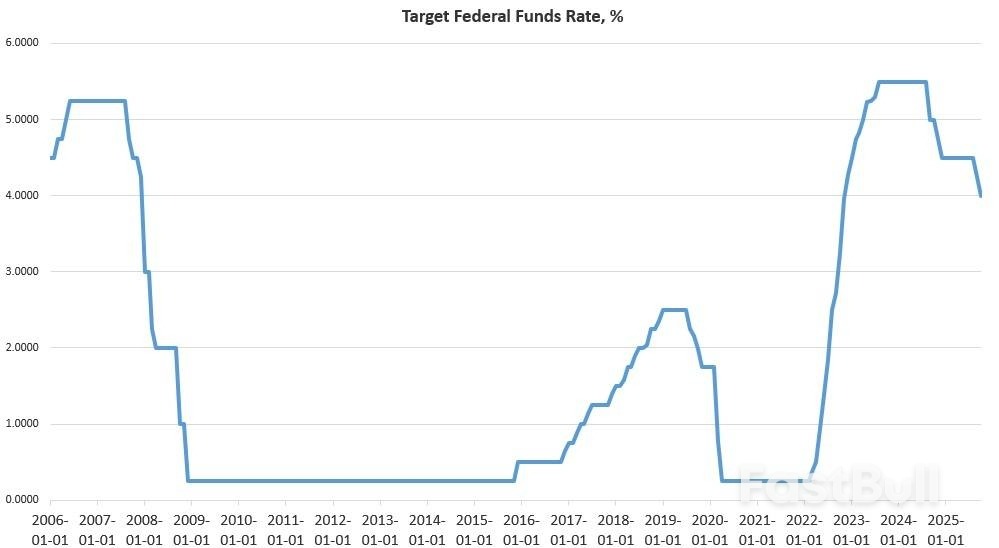
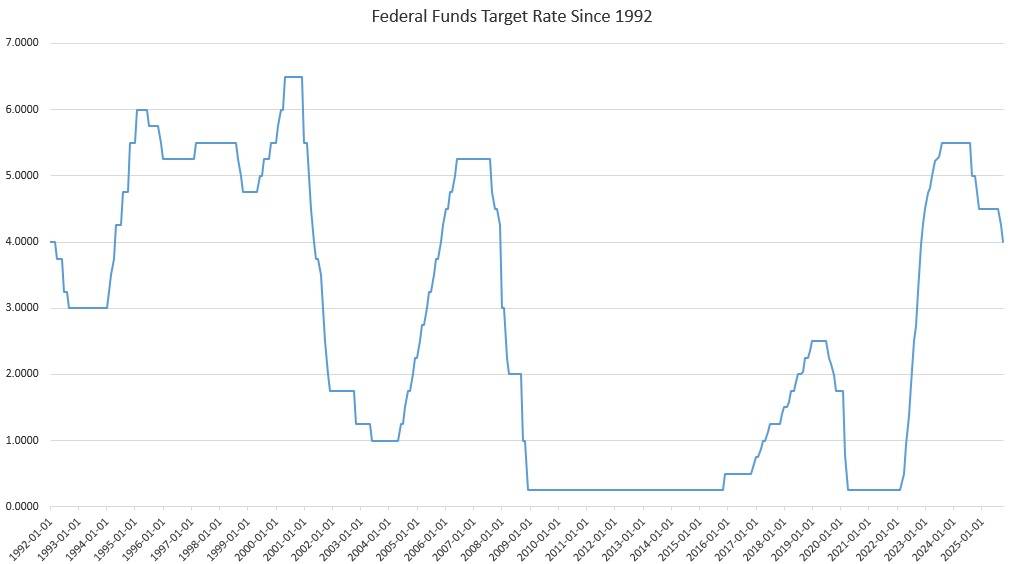
          The Federal Reserve's Federal Open Market Committee (FOMC) on Wednesday voted to again reduce the target policy interest rate by 25 basis points, down to an upper bound of 4.0 percent. The FOMC has now cut the policy rate (i.e., the federal funds rate) five times since September 2024, totaling a reduction in 150 basis points over 13 months.

          Fed Chairman Jerome Powell also announced on Wednesday that the Fed plans to end quantitative easing as of December 1. That is, the Fed will cease allowing reductions in its balance sheet and will switch to maintaining its balance sheet at current levels. Moreover, the Fed will reconfigure its balance sheet to increase its focus on Treasurys and reduce its holdings of mortgage-backed securities.

          The Fed has embraced these further efforts at monetary easing even though official price-inflation rates continue to show that price inflation remains far from the Fed's claimed two-percent goal. Apparently, the Fed has shifted its focus from price inflation to economic stimulus. After all, the FOMC's policy changes, as well as Powell's comments during the following press conference, paint a picture of a Fed that has all but completely abandoned any alleged commitment to a two-percent price-inflation target. The Fed is now preoccupied with the lackluster employment situation and providing ever more monetary stimulus.

          Lowering the Target Interest Rate

          With this new cut to the target policy interest rate, the FOMC continues its current cycle of monetary easing that has been in place since last fall. In spite of Fed claims that the US economy is robust, the 150-bp reduction is a clear sign that the Fed regards the US economy as incapable of standing on its own without continued monetary stimulus to maintain weakening bubble spending and investment.

          In recent decades, a 150-bp-point drop in the target rate—with no intervening rate hikes— has always been followed by (or coincided with) a recession. This was certainly the case in 2001, 2008, and in 2020.

          The Fed Ends Quantitative Tightening

          As is expected, the Fed maintains that the economy is "expanding" in Wednesday's FOMC statement, although the committee's brief summary of economic conditions does admit of a slowing employment situation:

          Available indicators suggest that economic activity has been expanding at a moderate pace. Job gains have slowed this year, and the unemployment rate has edged up but remained low through August; more recent indicators are consistent with these developments. Inflation has moved up since earlier in the year and remains somewhat elevated.

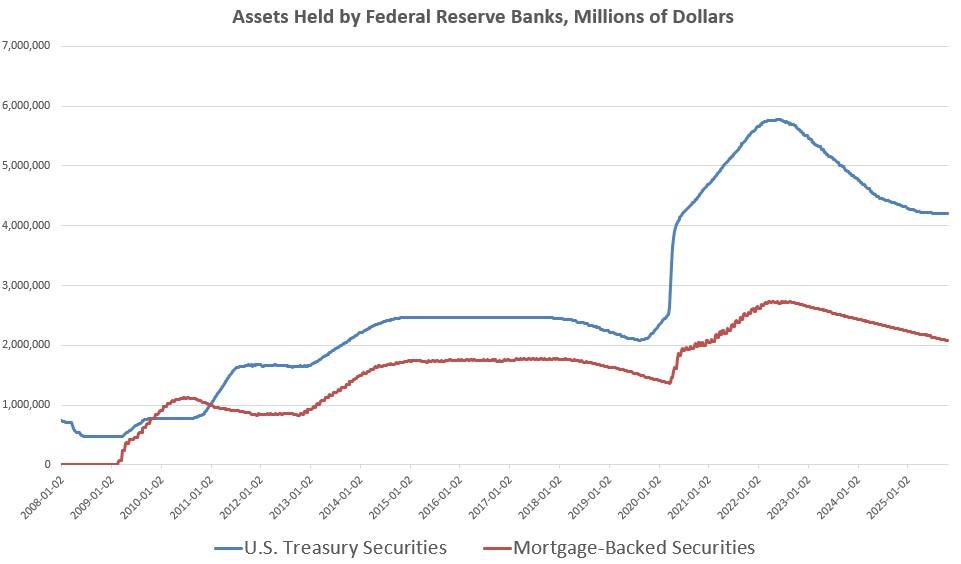
          Further evidence of the Fed's commitment to loosening economic conditions can be found in the FOMC's new announcement that "quantitative tightening" will cease on December 1. In the current context "quantitative tightening" is the Fed's slow but ongoing reduction in its balance sheet, where the Fed has amassed trillions of dollars in mortgage-backed securities and government Treasurys. Since 2008, the Fed has purchased these assets in an effort to reduce interest rates for Treasurys—by raising demand—and to create more liquidity for housing markets.

          The total size of the portfolio peaked in mid 2022 at $5.7 trillion in Treasury debt and $2.7 trillion in mortgage securities. In recent years, however, the Fed has very slowly reduced the size of its portfolio, mostly by allowing assets to mature without replacing them. Since mid 2022, the portfolio has been reduced by a total of $2.2 trillion, with $1.5 trillion of that being Treasurys, and $651 billion being mortgage securities. This is not surprising because the Fed has always been committed to manufacturing demand for Treasurys to help reduce Treasury yields, and thus reduce interest paid on federal debt.

          These assets were purchased with newly created dollars, so increases in the portfolio have resulted in adding trillions of dollars to the total money supply. Thus, the creation of the Fed's massive asset hoard has long been an important component of quantitative easing. In contrast, when the Fed allows the size of the portfolio to shrink, this is a type of quantitative tightening, or "QT" and has a deflationary effect.

          According to Powell, this will end in December at which time the Fed will presumably no longer allow the size of the portfolio to further decrease as assets mature and "roll off." Instead, Powell noted the Fed will end QT by purchasing new assets to replace the older maturing assets. 1

          Notably, Powell also stated that the Fed will work to increase the proportion of Treasurys in the portfolio, in relation to mortgage securities (i.e., agency securities). This is an extension of the Fed's existing policy—begun earlier this year—of reducing its stock of mortgage securities at a faster rate than it has been reducing its stock of Treasurys.

          Doubts About the Job Market

          The FOMC statement maintains that the "unemployment rate has edged up but remained low," but during the press conference, Powell clarified that "job creation ... is pretty close to zero" and so many FOMC members concluded "that it was appropriate for us to react by supporting demand with our rates." Powell also admitted that the no hire, no fire economy persists, and he stated "available evidence suggests that both layoffs and hiring remain low, and that both households' perceptions of job availability and firms' perceptions of hiring difficulty continue to decline." Prompted by questions, Powell admitted that there had a been a number of major layoff announcements earlier in the week and stated "we're here to — by lowering rates at the margin that will support demand, and that will support more hiring. And that's why we do it."

          Powell also stated that a large part of the employment story is a declining supply of labor, which has helped keep the labor situation seemingly stable. He noted that this is due to falling labor-force participation (for whatever reason) and also by the fact that "the supply of workers has dropped very, very sharply due to mainly immigration." Powell doesn't use the word "deportations" but that is clearly a factor in what he is describing here. In other words, there is very little hiring going on, but since the labor force has declined so much, a lack of hiring has prevented any significant surge in the unemployment rate.

          After all, if the supply of labor falls at the same rate as the supply of jobs, the unemployment rate will not change. But, even here, Powell admits that "demand for workers has gone down a little more than supply." This explains why the unemployment rate rose in August, even as the administration ramped up deportations. One can only guess what the unemployment rate would be of the supply of workers had continued to increase due to immigration or any other factor.

          Has the Fed Given Up on the Two-Percent Price-Inflation Target?

          It is important to remember that all this talk of creating monetary stimulus in the face of a declining job market is happening while the official price-inflation number is nowhere near the Fed's supposed two-percent target. Indeed, in the most recent CPI report, core price inflation was 3 percent, has been above three percent for three months. Core CPI year-over-year inflation has only dipped below 2 percent during three months of the past 53 months.

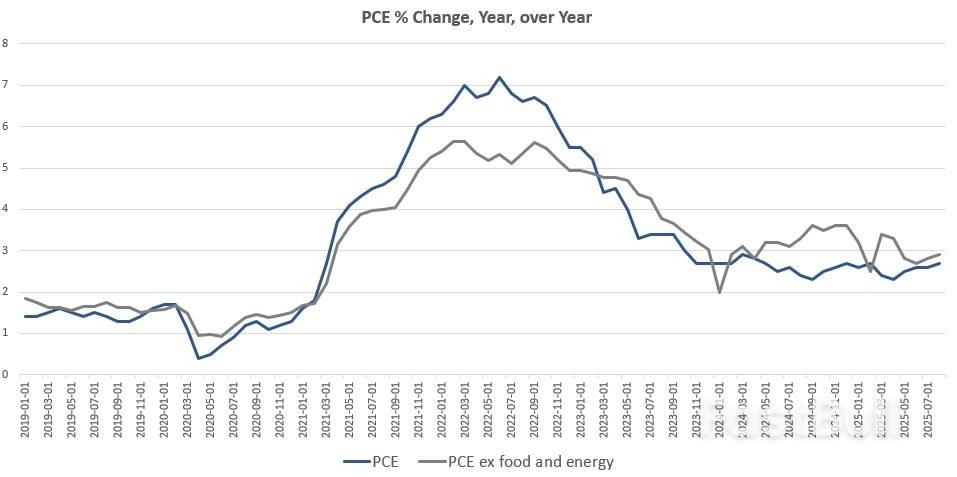
          Last September, when the Fed began the current easing cycle, and lowered the target rate by 50 basis points, Powell claimed that price-inflation was rapidly returning to the two-percent target. Either his data was way off, or he was simply lying. Even measured by the PCE (the Fed's preferred price-inflation measure), price-inflation is certainly not near two percent. The August PCE measure (the most recent available number) was up 2.7 percent, year over year, while the core PCE increase for August was 2.9 percent.

          Yet, Powell has invented a way of waving this inconvenient data aside. In his remarks on Wednesday, Powell apparently invented a new inflation measure which can be described as "price inflation minus the effects of tariffs." Or, as Powell puts it:

          inflation away from tariffs is actually not so far from our 2 percent goal. We estimate, people have different estimates of what that is, but it might be five or six tenths, and so if it's 2.8, then core PCE, not including tariffs, might be 2.3 or 2.4, in that range, something like that. So that's not so far from your goal.

          Powell doesn't offer any actual numbers or explanation of how he came up with this "price-inflation ex tariff" number. It's apparently something the Fed is simply speculating about.

          This new "measure" however, is nothing more than a political ploy used to explain away rising prices, so the Fed can claim that price inflation is really close to two percent, even if the federal government's own official numbers say otherwise. The Fed might as well go back to claiming that price inflation is "transitory" because of "Putin's price hike."

          Tariffs don't cause inflation in the technical sense, of course, but in an environment of monetary inflation, tariffs do often contribute to upward pressure on prices of imports and import-dependent goods. So, what Powell is doing here is simply inventing a new number that excludes some higher prices from the CPI and PCE in order to create a narrative in which the Fed has steered price inflation back to two percent.

          Once we look past this ruse, it's likely we're witnessing the Fed give up on its two-percent target in real time.

          On the other hand, given the weakening job market, it could be that the Fed is betting on a worsening economy to get price-inflation back below two percent. A slowing economy, accompanied by a rapid slowdown in demand, would allow the Fed to continue to inflate the money supply without apparent inflation above the two percent target. This would only produce an illusion of success, of course, since monetary inflation combined with weakening demand simply robs ordinary people of the benefits of deflation—which are badly needed during times of economic bust—while still inflating new bubbles and creating new malinvestments.

          Source: Gold-Eagle

          To stay updated on all economic events of today, please check out our Economic calendar
          Risk Warnings and Disclaimers
          You understand and acknowledge that there is a high degree of risk involved in trading. Following any strategies or investment methods may lead to potential losses. The content on the site is provided by our contributors and analysts for information purposes only. You are solely responsible for determining whether any trading assets, securities, strategy, or any other product is suitable for investing based on your own investment objectives and financial situation.
          Add to Favorites
          Share

          US Dollar Squeezing Every Bit of Powell’s Hawkishness

          Adam

          Forex

          The US dollar enjoyed a second round of support yesterday as Powell’s relatively hawkish press conference continued to resonate with data-starved markets. But the conditions for another big leg higher in USD aren’t there, in our view. Meanwhile, Japan has intervened verbally to curb JPY volatility, and GBP is looking closely at Reeves’ political position

          USD: Further Gains Harder to Justify

          The US dollar found more support yesterday on the tail effect of Fed Chair Powell’s hawkish press conference and, more marginally, the US-China trade deal (on the latter, we recommend our commodities team’s rare earths note). Throughout September and October, we have discussed how short-dollar trades clearly hit a roadblock and needed to be fuelled by more compelling negative USD news.
          The government shutdown has prevented jobs data from offering that catalyst, and Powell’s caution on a December cut has to be taken more at face value now.
          But our short-term call on the dollar remains more one of ‘lack of direction’ rather than the initiation of a more sustainable rebound. And the reason is precisely the lack of data releases, which incidentally prevents markets from making any conviction call on slower Fed easing. In our view, DXY lacks the thrust to break above 100.0. Today, the PCE report should be delayed.
          In Japan, USD/JPY is now obviously causing concerns for authorities. Finance Minister Satsuki Katayama said overnight that the yen’s “very one-sided and rapid currency” moves are being watched with a “high sense of urgency”. This confirms it’s officially the rate of change rather than the level that matters, although previous instances of BoJ FX intervention tell us that psychological levels play a role too. This time, there is a larger question mark on whether the US will condone FX intervention.
          Markets may be willing to test whether 155.0 is a line in the sand – inaction around that level could prompt more speculative long USD/JPY bets. However, hot Tokyo CPI and industrial production overnight raise the chance of a December hike, which is our base case, but only 45% priced in by markets.

          EUR: Bar for More ECB Easing Is High

          It’s abundantly clear that the ECB wants to keep things boring at this stage. Here are our ECB watcher Carsten Brzeski’s takes on yesterday’s statement and press conference. The only real highlight was the shift from a ‘balance of risk’ wording to a broader set of upside and downside risks to growth. Lagarde acknowledged some downside risks had eased, but didn’t give much weight to the shift in wording. Admittedly, eurozone growth was better than expected in 3Q (0.2% QoQ), largely due to surprisingly strong French numbers (0.5% QoQ).
          The coming weeks will see Governing Council members offering their nuances to the policy-inflation-growth assessments. But don’t expect much. The ECB is clearly in a ‘good place’ at 2% and the bar for more easing remains high.
          Anyway, EUR/USD remains entirely a function of dollar moves, and post-FOMC price action is leading to speculation of a potential break below 1.150. We don’t see the conditions for another big leg lower in the pair, though. Jobs data need to confirm Powell’s more cautious stance, and we doubt the bar is much higher for a Fed dovish repricing should US jobs deterioration continue.
          The contribution of the euro is small, but a slight improvement in the growth story and a firm ECB cannot harm. Our call remains bullish on EUR/USD into year-end.

          GBP: A Surprise Reeves Resignation Would Be Bad for Markets

          We published a market guide to the UK Autumn Budget yesterday, looking at four different scenarios and their impact on gilts and the pound. In our baseline scenario, Chancellor Rachel Reeves delivers a combination of tax hikes whilst avoiding the more inflationary measures. That has gradually been priced in by markets via some dovish BoE repricing, lower gilt yields and a weaker pound. Our post-budget EUR/GBP target is 0.880 on the back of that.
          One source of risk for gilts and GBP, even before any clearer details on the Budget emerge, is from opposition calls on Reeves to resign following her admission of failing to obtain a required license to rent her home. The story slightly deflated yesterday as PM Starmer fully backed Reeves and a real estate agency took the blame for the error.
          In July, when Reeves appeared close to leaving her post, gilt yields spiked. Markets are wary that a change in Chancellor could herald more relaxed fiscal rules and additional borrowing, at a time when gilt issuance remains elevated. A surprise resignation, which looks unlikely, would, in our view, cause elevated volatility in gilts and the pound.

          Source: investing

          Risk Warnings and Disclaimers
          You understand and acknowledge that there is a high degree of risk involved in trading. Following any strategies or investment methods may lead to potential losses. The content on the site is provided by our contributors and analysts for information purposes only. You are solely responsible for determining whether any trading assets, securities, strategy, or any other product is suitable for investing based on your own investment objectives and financial situation.
          Add to Favorites
          Share

          Oil News: WTI Nears Key Fibonacci Support Zone as Oil Demand Outlook Weakens

          Adam

          Commodity

          Light Crude Slips Toward Key Support as Supply Pressures Mount

          Light crude oil futures are edging lower on Friday, consolidating for a third straight session as traders weigh growing global supply against weak demand signals. WTI crude remains under pressure, heading for its third consecutive monthly decline, dragged by a stronger U.S. dollar and sluggish economic data from China.
          At 09:47 GMT, Light Crude Oil Futures are trading $60.24, down $0.33 or -0.54%.

          Dollar Strength and China Data Pressure Prices

          A firming U.S. dollar continued to weigh on commodity markets, limiting appetite for dollar-denominated assets like crude. The greenback gained traction after Federal Reserve Chair Jerome Powell pushed back on expectations for a December rate cut.
          Meanwhile, sentiment took another hit after official data confirmed that China’s factory activity contracted for a seventh consecutive month in October, reinforcing concerns about tepid demand from the world’s second-largest oil consumer.

          Supply Growth Outpaces Demand

          The market is grappling with a clear oversupply narrative. According to analysts, October’s roughly 3% drop in both Brent and WTI reflects a structural imbalance as global production increases outpace demand growth. Recent reports show OPEC and key non-OPEC producers have added more than 2.7 million barrels per day to the market, representing about 2.5% of global supply.
          Top exporter Saudi Arabia posted crude exports of 6.407 million bpd in August—the highest level in six months—with volumes projected to rise further. In the U.S., the Energy Information Administration reported record production of 13.6 million bpd last week, underscoring persistent supply pressure.

          OPEC+ Output Decisions Loom Ahead of Sunday Meeting

          Market attention is now focused on the upcoming OPEC+ meeting, with sources indicating the group is leaning toward a modest output boost in December. This stance contrasts with ongoing Western sanctions on Russian exports, which have yet to significantly impact flows to top buyers China and India.
          Although U.S. President Donald Trump suggested China may begin large-scale purchases of American oil and gas, analysts remain cautious. Barclays noted that Alaska, the likely source of any energy exports under the potential deal, accounts for just 3% of total U.S. crude production, minimizing its market impact.

          Oil Prices Forecast: Bearish Outlook Holds as Technicals and Fundamentals Align

          Oil News: WTI Nears Key Fibonacci Support Zone as Oil Demand Outlook Weakens_1

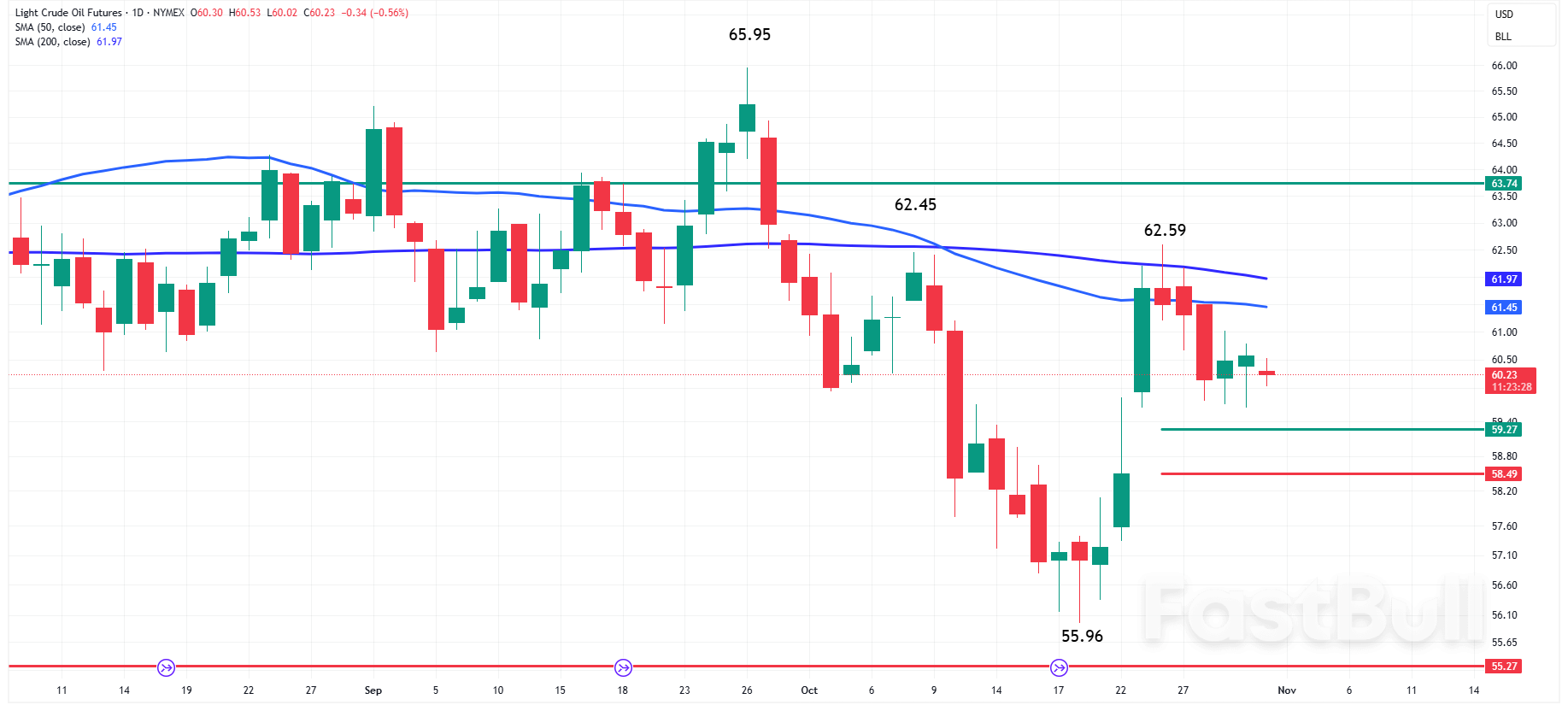
          Daily Light Crude Oil Futures

          With WTI crude failing to hold recent lows and approaching a key Fibonacci support zone between $59.27 and $58.49, downside risks remain elevated. A breakdown below the 61.8% retracement at $58.49 could trigger further selling and open the door to a retest of the October 20 low at $55.96.
          Upside potential appears capped by the 50-day and 200-day moving averages at $61.45 and $61.97, respectively. Unless a fundamental shift occurs, oil prices are likely to remain under pressure in the near term.

          Source: fxempire

          Risk Warnings and Disclaimers
          You understand and acknowledge that there is a high degree of risk involved in trading. Following any strategies or investment methods may lead to potential losses. The content on the site is provided by our contributors and analysts for information purposes only. You are solely responsible for determining whether any trading assets, securities, strategy, or any other product is suitable for investing based on your own investment objectives and financial situation.
          Add to Favorites
          Share
          FastBull
          Copyright © 2025 FastBull Ltd

          728 RM B 7/F GEE LOK IND BLDG NO 34 HUNG TO RD KWUN TONG KLN HONG KONG

          TelegramInstagramTwitterfacebooklinkedin
          App Store Google Play Google Play
          Products
          Charts

          Chats

          Q&A with Experts
          Screeners
          Economic Calendar
          Data
          Tools
          Membership
          Features
          Function
          Markets
          Copy Trading
          Latest Signals
          Contests
          News
          Analysis
          24/7
          Columns
          Education
          Company
          Careers
          About Us
          Contact Us
          Advertising
          Help Center
          Feedback
          User Agreement
          Privacy Policy
          Business

          White Label

          Data API

          Web Plug-ins

          Poster Maker

          Affiliate Program

          Risk Disclosure

          The risk of loss in trading financial instruments such as stocks, FX, commodities, futures, bonds, ETFs and crypto can be substantial. You may sustain a total loss of the funds that you deposit with your broker. Therefore, you should carefully consider whether such trading is suitable for you in light of your circumstances and financial resources.

          No decision to invest should be made without thoroughly conducting due diligence by yourself or consulting with your financial advisors. Our web content might not suit you since we don't know your financial conditions and investment needs. Our financial information might have latency or contain inaccuracy, so you should be fully responsible for any of your trading and investment decisions. The company will not be responsible for your capital loss.

          Without getting permission from the website, you are not allowed to copy the website's graphics, texts, or trademarks. Intellectual property rights in the content or data incorporated into this website belong to its providers and exchange merchants.

          Not Logged In

          Log in to access more features

          FastBull Membership

          Not yet

          Purchase

          Become a signal provider
          Help Center
          Customer Service
          Dark Mode
          Price Up/Down Colors

          Log In

          Sign Up
          Position
          Layout
          Fullscreen
          Default to Chart
          The chart page opens by default when you visit fastbull.com