• Trade
  • Markets
  • Copy
  • Contests
  • News
  • 24/7
  • Calendar
  • Q&A
  • Chats
Trending
Screeners
SYMBOL
LAST
BID
ASK
HIGH
LOW
NET CHG.
%CHG.
SPREAD
SPX
S&P 500 Index
6870.39
6870.39
6870.39
6895.79
6858.28
+13.27
+ 0.19%
--
DJI
Dow Jones Industrial Average
47954.98
47954.98
47954.98
48133.54
47871.51
+104.05
+ 0.22%
--
IXIC
NASDAQ Composite Index
23578.12
23578.12
23578.12
23680.03
23506.00
+72.99
+ 0.31%
--
USDX
US Dollar Index
98.920
99.000
98.920
98.960
98.730
-0.030
-0.03%
--
EURUSD
Euro / US Dollar
1.16482
1.16489
1.16482
1.16717
1.16341
+0.00056
+ 0.05%
--
GBPUSD
Pound Sterling / US Dollar
1.33209
1.33219
1.33209
1.33462
1.33136
-0.00103
-0.08%
--
XAUUSD
Gold / US Dollar
4205.17
4205.51
4205.17
4218.85
4190.61
+7.26
+ 0.17%
--
WTI
Light Sweet Crude Oil
59.318
59.348
59.318
60.084
58.980
-0.491
-0.82%
--

Community Accounts

Signal Accounts
--
Profit Accounts
--
Loss Accounts
--
View More

Become a signal provider

Sell trading signals to earn additional income

View More

Guide to Copy Trading

Get started with ease and confidence

View More

Signal Accounts for Members

All Signal Accounts

Best Return
  • Best Return
  • Best P/L
  • Best MDD
Past 1W
  • Past 1W
  • Past 1M
  • Past 1Y

All Contests

  • All
  • Trump Updates
  • Recommend
  • Stocks
  • Cryptocurrencies
  • Central Banks
  • Featured News
Top News Only
Share

Yemen's Stc Now Present In All Areas Of South Yemen, Offical

Share

Israeli Government Spokesperson: Netanyahu Will Meet Trump On December 29

Share

Stc Did Not Ask Internationally-Government To Leave Aden - Senior Stc Official To Reuters

Share

Members Of Internationally-Recognised Government, Opposed To Northern Houthis, Have Left Aden - Senior Stc Official To Reuters

Share

Yemen's Southern Separatist Group Stc Is Now Present In All Governorates Of South Yemen, Including The Southern City Of Aden - Senior Stc Official To Reuters

Share

[Trump: Single Rule Executive Order For AI To Be Issued This Week] US President Trump Stated That If We Are To Continue To Lead In Artificial Intelligence, There Must Be Only One Rulebook. So Far, We Have Beaten All The Countries In This Race, But If In The Future 50 States Are Involved In Setting The Rules And Approval Processes, And Many Of Those States Are Likely To Violate Those Rules, This Advantage Will Quickly Disappear. There Is No Doubt About That! Artificial Intelligence Will Be Destroyed In Its Infancy! I Will Issue A "single Rule" Executive Order This Week. You Can't Expect A Company To Get Approval From 50 States Every Time It Wants To Do Something. That Will Never Work!

Share

Two Iraq Energy Officials: Iraq Shuts Down Entire West Qurna 2 Production Of Around 460000 Barrels/Day Due To Export Pipeline Leak

Share

Petroleum Ministry: Egypt Exports LNG Shipment To Turkey Chartered By Shell

Share

White House Economic Adviser Hassett: Trump Will Release A Lot Of Positive Economic News

Share

Ukraine President Zelenskiy: We Can't Manage Without Europeans, We Can't Manage Without The Americans, That's Why We Have Some Important Decisions To Make

Share

White House Economic Adviser Hassett On Netflix, Wbd: In The End Justice Department Will Study Impact For Quite A While

Share

White House Economic Adviser Hassett On Trump's Ai 'One Rule': Order Should Help Ai Companies Understand What The Rules Are

Share

German Chancellor Merz: Sceptical About Some Of The Details In Documents Coming From The United States

Share

White House Economic Adviser Hassett On Aca Subsidies: There Is Room For Negotiation

Share

French President Macron: Russia Economy Is Starting To Suffer After Latest Sanctions

Share

Ukraine President Zelenskiy: Unity Between Europe, Ukraine And Unites States Is Important

Share

UK Labour Party Leader Starmer: Matters For Ukraine Are For Ukraine

Share

China's Commerce Minister: China Has Already Implemented Export License Exemptions For Nexperia Chips

Share

China's Commerce Minister: China Is Gradually Applying A General Licensing System In Areas Such As Rare Earths

Share

China's Commerce Minister: China Attaches Importance To Germany's Concerns Regarding Export Controls And Nexperia

TIME
ACT
FCST
PREV
France Trade Balance (SA) (Oct)

A:--

F: --

P: --
Euro Zone Employment YoY (SA) (Q3)

A:--

F: --

P: --
Canada Part-Time Employment (SA) (Nov)

A:--

F: --

P: --

Canada Unemployment Rate (SA) (Nov)

A:--

F: --

P: --

Canada Full-time Employment (SA) (Nov)

A:--

F: --

P: --

Canada Labor Force Participation Rate (SA) (Nov)

A:--

F: --

P: --

Canada Employment (SA) (Nov)

A:--

F: --

P: --

U.S. PCE Price Index MoM (Sept)

A:--

F: --

P: --

U.S. Personal Income MoM (Sept)

A:--

F: --

P: --

U.S. Core PCE Price Index MoM (Sept)

A:--

F: --

P: --

U.S. PCE Price Index YoY (SA) (Sept)

A:--

F: --

P: --

U.S. Core PCE Price Index YoY (Sept)

A:--

F: --

P: --

U.S. Personal Outlays MoM (SA) (Sept)

A:--

F: --

P: --
U.S. 5-10 Year-Ahead Inflation Expectations (Dec)

A:--

F: --

P: --

U.S. Real Personal Consumption Expenditures MoM (Sept)

A:--

F: --

P: --
U.S. Weekly Total Rig Count

A:--

F: --

P: --

U.S. Weekly Total Oil Rig Count

A:--

F: --

P: --

U.S. Consumer Credit (SA) (Oct)

A:--

F: --

P: --
China, Mainland Foreign Exchange Reserves (Nov)

A:--

F: --

P: --

Japan Trade Balance (Oct)

A:--

F: --

P: --

Japan Nominal GDP Revised QoQ (Q3)

A:--

F: --

P: --

China, Mainland Imports YoY (CNH) (Nov)

A:--

F: --

P: --

China, Mainland Exports (Nov)

A:--

F: --

P: --

China, Mainland Imports (CNH) (Nov)

A:--

F: --

P: --

China, Mainland Trade Balance (CNH) (Nov)

A:--

F: --

P: --

China, Mainland Exports YoY (USD) (Nov)

A:--

F: --

P: --

China, Mainland Imports YoY (USD) (Nov)

A:--

F: --

P: --

Germany Industrial Output MoM (SA) (Oct)

A:--

F: --

P: --
Euro Zone Sentix Investor Confidence Index (Dec)

A:--

F: --

P: --

Canada National Economic Confidence Index

A:--

F: --

P: --

U.K. BRC Like-For-Like Retail Sales YoY (Nov)

--

F: --

P: --

U.K. BRC Overall Retail Sales YoY (Nov)

--

F: --

P: --

Australia Overnight (Borrowing) Key Rate

--

F: --

P: --

RBA Rate Statement
RBA Press Conference
Germany Exports MoM (SA) (Oct)

--

F: --

P: --

U.S. NFIB Small Business Optimism Index (SA) (Nov)

--

F: --

P: --

Mexico 12-Month Inflation (CPI) (Nov)

--

F: --

P: --

Mexico Core CPI YoY (Nov)

--

F: --

P: --

Mexico PPI YoY (Nov)

--

F: --

P: --

U.S. Weekly Redbook Index YoY

--

F: --

P: --

U.S. JOLTS Job Openings (SA) (Oct)

--

F: --

P: --

China, Mainland M1 Money Supply YoY (Nov)

--

F: --

P: --

China, Mainland M0 Money Supply YoY (Nov)

--

F: --

P: --

China, Mainland M2 Money Supply YoY (Nov)

--

F: --

P: --

U.S. EIA Short-Term Crude Production Forecast For The Year (Dec)

--

F: --

P: --

U.S. EIA Natural Gas Production Forecast For The Next Year (Dec)

--

F: --

P: --

U.S. EIA Short-Term Crude Production Forecast For The Next Year (Dec)

--

F: --

P: --

EIA Monthly Short-Term Energy Outlook
U.S. API Weekly Gasoline Stocks

--

F: --

P: --

U.S. API Weekly Cushing Crude Oil Stocks

--

F: --

P: --

U.S. API Weekly Crude Oil Stocks

--

F: --

P: --

U.S. API Weekly Refined Oil Stocks

--

F: --

P: --

South Korea Unemployment Rate (SA) (Nov)

--

F: --

P: --

Japan Reuters Tankan Non-Manufacturers Index (Dec)

--

F: --

P: --

Japan Reuters Tankan Manufacturers Index (Dec)

--

F: --

P: --

Japan Domestic Enterprise Commodity Price Index MoM (Nov)

--

F: --

P: --

Japan Domestic Enterprise Commodity Price Index YoY (Nov)

--

F: --

P: --

China, Mainland PPI YoY (Nov)

--

F: --

P: --

China, Mainland CPI MoM (Nov)

--

F: --

P: --

Q&A with Experts
    • All
    • Chatrooms
    • Groups
    • Friends
    Connecting
    .
    .
    .
    Type here...
    Add Symbol or Code

      No matching data

      All
      Trump Updates
      Recommend
      Stocks
      Cryptocurrencies
      Central Banks
      Featured News
      • All
      • Russia-Ukraine Conflict
      • Middle East Flashpoint
      • All
      • Russia-Ukraine Conflict
      • Middle East Flashpoint
      Search
      Products

      Charts Free Forever

      Chats Q&A with Experts
      Screeners Economic Calendar Data Tools
      Membership Features
      Data Warehouse Market Trends Institutional Data Policy Rates Macro

      Market Trends

      Market Sentiment Order Book Forex Correlations

      Top Indicators

      Charts Free Forever
      Markets

      News

      News Analysis 24/7 Columns Education
      From Institutions From Analysts
      Topics Columnists

      Latest Views

      Latest Views

      Trending Topics

      Top Columnists

      Latest Update

      Signals

      Copy Rankings Latest Signals Become a signal provider AI Rating
      Contests
      Brokers

      Overview Brokers Assessment Rankings Regulators News Claims
      Broker listing Forex Brokers Comparison Tool Live Spread Comparison Scam
      Q&A Complaint Scam Alert Videos Tips to Detect Scam
      More

      Business
      Events
      Careers About Us Advertising Help Center

      White Label

      Data API

      Web Plug-ins

      Affiliate Program

      Awards Institution Evaluation IB Seminar Salon Event Exhibition
      Vietnam Thailand Singapore Dubai
      Fans Party Investment Sharing Session
      FastBull Summit BrokersView Expo
      Recent Searches
        Top Searches
          Markets
          News
          Analysis
          User
          24/7
          Economic Calendar
          Education
          Data
          • Names
          • Latest
          • Prev

          View All

          No data

          Scan to Download

          Faster Charts, Chat Faster!

          Download App
          English
          • English
          • Español
          • العربية
          • Bahasa Indonesia
          • Bahasa Melayu
          • Tiếng Việt
          • ภาษาไทย
          • Français
          • Italiano
          • Türkçe
          • Русский язык
          • 简中
          • 繁中
          Open Account
          Search
          Products
          Charts Free Forever
          Markets
          News
          Signals

          Copy Rankings Latest Signals Become a signal provider AI Rating
          Contests
          Brokers

          Overview Brokers Assessment Rankings Regulators News Claims
          Broker listing Forex Brokers Comparison Tool Live Spread Comparison Scam
          Q&A Complaint Scam Alert Videos Tips to Detect Scam
          More

          Business
          Events
          Careers About Us Advertising Help Center

          White Label

          Data API

          Web Plug-ins

          Affiliate Program

          Awards Institution Evaluation IB Seminar Salon Event Exhibition
          Vietnam Thailand Singapore Dubai
          Fans Party Investment Sharing Session
          FastBull Summit BrokersView Expo

          Money Supply Growth Surges To Multi-Year High As The Fed Loosens Policy

          Winkelmann

          Forex

          Economic

          Summary:

          In recent months, Federal Reserve officials have repeatedly referred to monetary policy as restrictive.

          In recent months, Federal Reserve officials have repeatedly referred to monetary policy as restrictive. In September, Jerome Powell said policy was "clearly restrictive," and in November, New York Fed President John Williams stated "I still view the current monetary policy level as moderately tight..."

          Well, it may be that current policy is "restrictive" compared to, say, the policies of Bernanke and Yellen. But recent data on the money supply suggests that the money supply in recent months is finding plenty of room to increase rapidly, in spite of what Fed officials say.

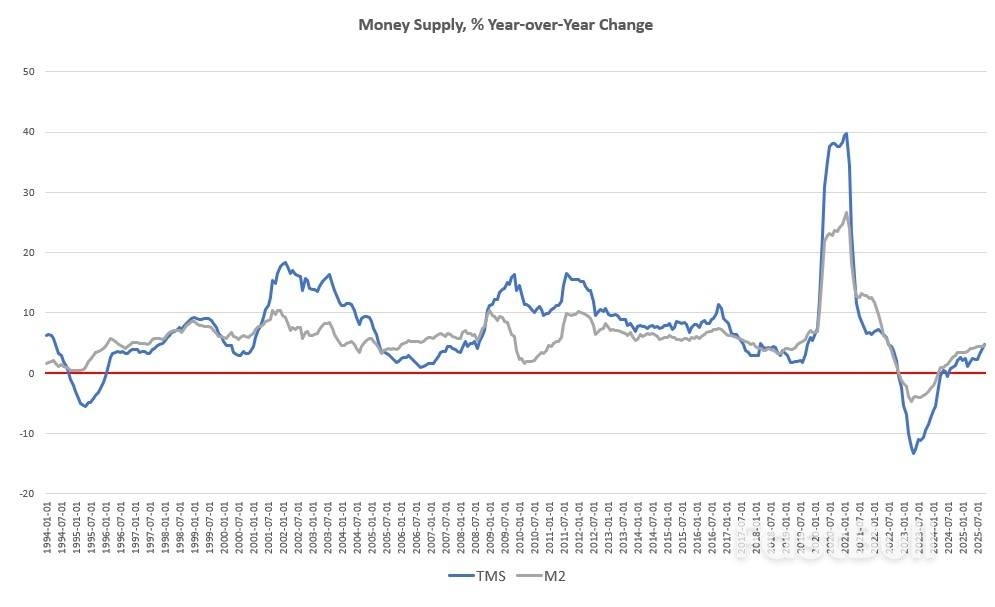
          For example, the money supply has increased every month for the past four months, and as some of the highest rates we've seen in years. Moreover, when measured year-over-year, the money supply has accelerated over the past three months and is now at the highest rate of growth seen in 40 months—or since July of 2022.

          While the money supply largely flatlined through much of the mid-2025, growth has clearly accelerated since August of this year.

          During October, year-over-year growth in the money supply was at 4.76 percent. That's up from September year-over-year increase of 4.06 percent. Money supply growth is also up sizably compared to October of last year when year-over-year growth was 1.27 percent.
          In October, the total money supply again rose above $20 trillion for the first time since January of 2023, and grew by half a trillion dollars from August to October.

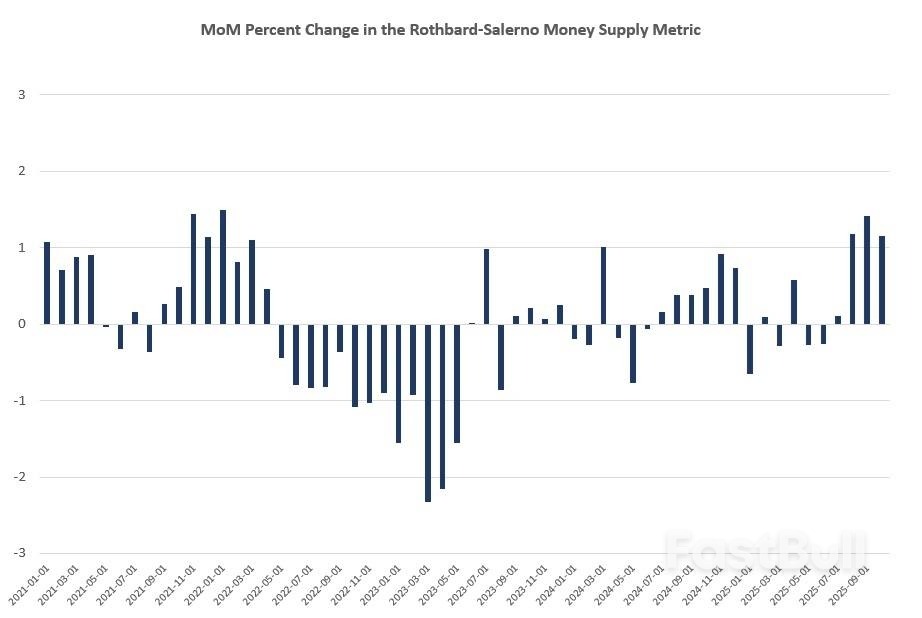
          In month-to-month growth, August, September, and October all posted some of the largest growth rates we've seen since 2022, rising 1.18 percent, 1.4 percent, and 1.14 percent, respectively. topping off four months of growth.
          The money supply metric used here—the "true," or Rothbard-Salerno, money supply measure (TMS)—is the metric developed by Murray Rothbard and Joseph Salerno, and is designed to provide a better measure of money supply fluctuations than M2. (The Mises Institute now offers regular updates on this metric and its growth.)

          Historically, M2 growth rates have often followed a similar course to TMS growth rates, but M2 has even outpaced TMS growth in eleven of the last twelve months. In October, the M2 growth rate, year over year, was 4.63 percent. That's up from September's growth rate of 4.47 percent. October's growth rate was also up from October 2024's rate of 2.97 percent.

          Although year-over-year and month-to-month growth rates moderated during the summer—and even fell substantially during 2023 and early 2024, money-supply totals are again rapidly heading upward. M2 is now at the highest level it's ever been, topping $22.2 trillion. TMS has not yet returned to its 2022 peak, but is now at a 34-month high.
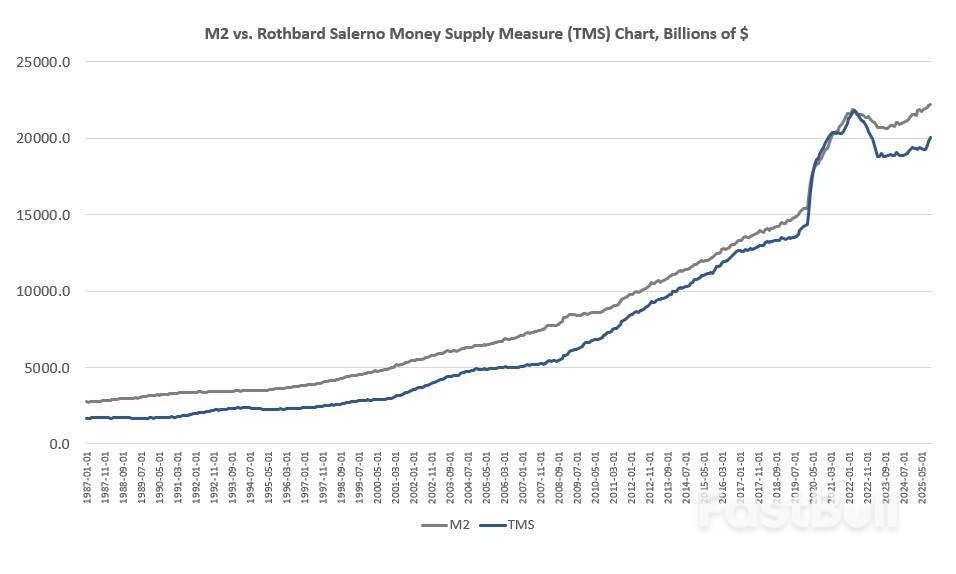
          Since 2009, the TMS money supply is now up by more than 200 percent. (M2 has grown by nearly 160 percent in that period.) Out of the current money supply of $20 trillion, nearly 29 percent of that has been created since January 2020. Since 2009, in the wake of the global financial crisis, more than $13 trillion of the current money supply has been created. In other words, more than two-thirds of the total existing money supply have been created since the Great Recession.

          Given current economic conditions, it is surprising to see such robust growth in the money supply.

          Given current stagnating economic conditions, it is surprising to see such robust growth in the money supply. Private commercial banks play a large role in growing the money supply in response to loose Fed policy. When economic conditions are expansive, and as employment grows, lending also grows, further loosening monetary conditions.

          In recent months, however, economic indicators continue to point to both worsening employment conditions and rising delinquencies. For example, US layoffs in October surged to a two-month high. Meanwhile, Bloomberg reports that " Mom-and-Pop Business Bankruptcies Hit a Record as Debts Rise." The latest price-sector jobs numbers show more job losses.

          This all applies downward pressure on money supply growth. However, in an effort to further pump asset prices and somehow counter our growing economic stagnation, the Fed lowered the target federal funds rate in September and throughout much of this year has slowed its efforts to reduce the Fed's balance sheet—also known as "quantitative tightening."

          This return to accommodative monetary policy—which belies Fed claims of "restrictive" policy—has surely done its part in returning the money supply to growth levels we haven't seen in years.

          Source: Gold-Eagle

          To stay updated on all economic events of today, please check out our Economic calendar
          Risk Warnings and Disclaimers
          You understand and acknowledge that there is a high degree of risk involved in trading. Following any strategies or investment methods may lead to potential losses. The content on the site is provided by our contributors and analysts for information purposes only. You are solely responsible for determining whether any trading assets, securities, strategy, or any other product is suitable for investing based on your own investment objectives and financial situation.
          Add to Favorites
          Share

          US Issues NATO's European Members New Self-Defense Deadline

          Michelle

          Political

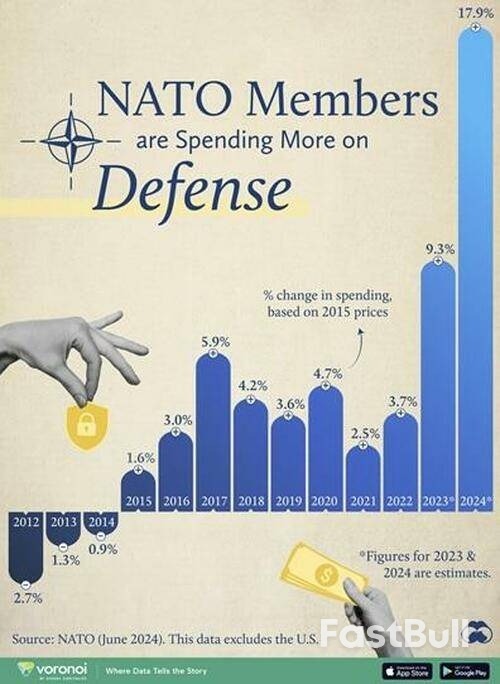
          European members of NATO have been warned by Washington that they must assume greater responsibility for the alliance's intelligence operations and missile production - which will require significantly more defense spending by 2027, Reuters has reported.

          Reuters in its exclusive Friday report said that the United States "wants Europe to take over the majority of NATO's conventional defense capabilities, from intelligence to missiles, by 2027, Pentagon officials told diplomats in Washington this week, a tight deadline that struck some European officials as unrealistic."

          "The message, recounted by five sources familiar with the discussion, including a U.S. official, was conveyed at a meeting in Washington this week of Pentagon staff overseeing NATO policy and several European delegations," the report continued.

          The directive was coupled with a warning behind the scenes, reportedly involving Pentagon officials cautioning representatives from several European nations that the US may scale back its role in certain NATO defense efforts if this target and deadline is not met.

          US Army/NATO file image

          It was noted in the report that some European officials consider the 2027 goal unrealistic, saying that rapidly substituting American military support would demand far greater investment than current plans and NATO member approved defense budgets allow.

          This generally reflects the Trump administration's long verbalized dissatisfaction with with Europe's progress on shouldering more of NATO's collective defense burden.

          But the Reuters report also underscored that European officials were not offered tangible metrics whereby failure or success would be assessed:

          Conventional defense capabilities include non-nuclear assets from troops to weapons and the officials did not explain how the U.S. would measure Europe's progress toward shouldering most of the burden.

          It was also not clear if the 2027 deadline represented the Trump administration position or only the views of some Pentagon officials. There are significant disagreements in Washington over the military role the U.S. should play in Europe.

          One NATO official was cited as saying "Allies have recognized the need to invest more in defense and shift the burden on conventional defense" from the US to Europe.

          As we described previously the Trump administration's new National Security Strategy really hits out hard at Europe, stating saying "it is far from obvious whether certain European countries will have economies and militaries strong enough to remain reliable allies" to the United States.

          The document further highlights that this current reality of European weakness could have certain negative implications for potential for heightened Western escalation with Russia:

          "Managing European relations with Russia will require significant U.S. diplomatic engagement, both to reestablish conditions of strategic stability across the Eurasian landmass, and to mitigate the risk of conflict between Russia and European states," the document reads.

          Most analysts see the language in the document as opening the door for greater Washington meddling in European affairs.

          Source: Visual Capitalist

          "Washington is no longer pretending it won't meddle in Europe's internal affairs" Pawel Zerka, a senior policy fellow at the European Council on Foreign Relations, observed.

          "It now frames such interference as an act of benevolence ('we want Europe to remain European') and a matter of US strategic necessity. The priority? 'Cultivating resistance to Europe's current trajectory within European nations'," he concludes.

          Source: Zero Hedge

          Risk Warnings and Disclaimers
          You understand and acknowledge that there is a high degree of risk involved in trading. Following any strategies or investment methods may lead to potential losses. The content on the site is provided by our contributors and analysts for information purposes only. You are solely responsible for determining whether any trading assets, securities, strategy, or any other product is suitable for investing based on your own investment objectives and financial situation.
          Add to Favorites
          Share

          U.S. Treasury Yields Steady Ahead of Fed Decision as Markets Price In High Probability of Rate Cut

          Gerik

          Economic

          Treasury Yields Flat as Markets Await Fed's Final Move of the Year

          U.S. bond markets entered the week in a holding pattern, with yields across the curve showing minimal movement ahead of the Federal Reserve’s highly anticipated final policy decision of 2025. At 2:39 a.m. New York time, the 10-year Treasury yield held steady at 4.141%, the 30-year yield was similarly unchanged at 4.794%, and the 2-year yield saw only a minor fluctuation at 3.561%.
          This calm in yields reflects market consensus that the Fed is poised to deliver a 25-basis-point rate cut when it concludes its two-day meeting on Wednesday. Data from the CME FedWatch tool shows traders are assigning an 87% probability to the cut, up significantly from 67% just a month ago, highlighting the influence of recent economic indicators and shifting policy commentary.

          Recent Economic Data Reinforces Case for Easing

          Expectations of a rate cut have been reinforced by a mix of softer labor data and subdued inflation readings. Last week’s ADP report surprised markets with a drop in private payrolls, while jobless claims for the week ending November 29 fell to their lowest level since September 2022. These indicators suggest a cooling labor market without signaling a major downturn, a combination that supports the Fed’s potential pivot toward easing without raising immediate recession alarms.
          In parallel, the delayed release of the September core Personal Consumption Expenditures (PCE) index came in below forecasts, further justifying a dovish tilt. While the Fed’s mandate includes both employment and price stability, this recent data mix has helped ease concerns about inflation persistence, allowing policymakers more room to maneuver.

          Market Reactions and Institutional Forecast Adjustments

          Investment banks have quickly adjusted their forecasts. Morgan Stanley recently reversed its earlier projection, now expecting a cut in December after acknowledging their previous call “jumped the gun.” JPMorgan and Bank of America have also aligned with the view that the Fed will lower rates this week, citing more dovish tones from Fed officials and the broader macro backdrop.
          The bond market’s muted response reflects how thoroughly the cut has already been priced in. While short-term Treasuries such as the 2-year note have shown slight movement, yields on long-dated securities like the 30-year have remained largely unmoved, suggesting that investors are more focused on guidance for 2026 and beyond rather than the immediate policy adjustment.

          Economic Outlook Boosted by Strong Holiday Season and GDP Momentum

          Adding to the market’s confidence, Treasury Secretary Scott Bessent noted over the weekend that consumer activity during the holiday season has been “very strong,” and projected that the economy will close the year with roughly 3% real GDP growth despite political gridlock. He cited recent quarterly growth exceeding 4% as evidence of sustained economic momentum.
          This macro backdrop has likely given the Fed added confidence to cut rates without triggering fears of overheating or inflation resurgence. The implication is that the Fed is moving from a phase of restrictive policy to one of normalization, rather than engaging in aggressive stimulus.

          Global Central Banks Also in Focus

          This week also marks a key period for monetary policy globally. The Swiss National Bank is scheduled to deliver its policy update on Thursday, while the Bank of England and European Central Bank will issue their rate decisions on December 18. Both institutions are expected to take cues from the Fed’s move. The Bank of Japan will follow with its final policy meeting of the year on December 19.
          These decisions will be closely watched for signs of synchronization or divergence in global monetary policy, particularly as Europe grapples with persistent inflation and Japan remains cautious about exiting ultra-loose policy.
          Treasury yields remain steady as markets await confirmation of a widely expected Fed rate cut this week. Recent labor and inflation data have solidified expectations, while commentary from policymakers and strong economic growth have created a favorable environment for easing. The real focus, however, will be on the Fed’s forward guidance whether this week’s move marks the beginning of a sustained rate-cutting cycle or a one-off adjustment to recalibrate monetary conditions heading into 2026.

          Source: CNBC

          To stay updated on all economic events of today, please check out our Economic calendar
          Risk Warnings and Disclaimers
          You understand and acknowledge that there is a high degree of risk involved in trading. Following any strategies or investment methods may lead to potential losses. The content on the site is provided by our contributors and analysts for information purposes only. You are solely responsible for determining whether any trading assets, securities, strategy, or any other product is suitable for investing based on your own investment objectives and financial situation.
          Add to Favorites
          Share

          Dollar Eases As Investors Gear Up for Tricky Fed Decision

          Glendon

          Forex

          Economic

          The dollar eased on Monday, ahead of a week packed with central bank meetings and headlined by the U.S. Federal Reserve, where an interest rate cut is all but priced in, although a highly divided committee makes for a wild card.

          Besides the Fed decision on Wednesday, the central banks of Australia, Brazil, Canada and Switzerland also hold rate-setting meetings, although none of these are expected to make any changes to monetary policy.

          Analysts expect the Fed to make a "hawkish cut", where the language of the statement, median forecasts and Chair Jerome Powell's press conference point to a higher bar on further rate reduction.

          That could support the dollar if it pushes investors to dial back expectations for two or three rate cuts next year, though messaging could be complicated by policymakers' division as several have already all but indicated their voting intentions.

          HIGH RISK OF DISSENT

          "We expect to see some dissents, potentially from both hawkish and dovish members," said BNY's head of markets macro strategy Bob Savage in a note to clients.

          The Federal Open Market Committee has not had three or more dissents at a meeting since 2019, and that has happened just nine times since 1990.

          Even though the U.S. currency has drifted lower for the past three weeks, dollar bulls have recovered some of their bottle. Weekly positioning data shows speculators hold their largest long position - one that assumes the value of the dollar will rise - since before President Donald Trump's "Liberation Day" tariff bombshell that sent the currency tumbling.

          The labour market is softening, but overall growth is holding up, the stimulus from the "One Big Beautiful Bill" should start to filter through and inflation is still well above the central bank's target rate of 2%.

          "These factors could discourage additional rate cuts if they spill over into stronger labour market conditions," MUFG currency strategist Lee Hardman said.

          EURO LIFTED BY RISE IN YIELDS

          Beyond U.S. monetary policy, the euro edged up 0.1% to $1.1652, lifted by higher euro zone bond yields. German 30-year yields hit their highest since 2011 in early trading.

          Unlike the Fed, the ECB is not expected to cut rates again in the coming year. Influential policymaker Isabel Schnabel on Monday said the central bank's next move could even be a hike.

          The Australian dollar briefly touched a high of $0.6649, the highest since mid-September, to last trade down 0.1% on the day at $0.6635.

          The Reserve Bank of Australia meets on Tuesday after a run of hot data on inflation, economic growth and household spending. Futures imply the next move will be up and possibly as soon as May, leaving the focus on the post-meeting statement and media conference.

          "We expect the RBA to be on an extended hold, with the cash rate to remain at its current level of 3.60%," said analysts at ANZ in a note last week, revising previous expectations for a cut.

          CANADA EXPECTED TO HOLD

          The Bank of Canada is also widely expected to leave its interest rate on hold on Wednesday and a hike is fully priced by December 2026. The currency was steady at C$1.3819 on Monday, having hit 10-week highs on Friday following strong jobs data.

          The yen , which has stabilised in this past week, having weakened sharply in November, was mostly steady at 155.44 per dollar, while sterling held around $1.3325 and the Swiss franc was a touch stronger at 0.804 francs.

          Source: Reuters

          To stay updated on all economic events of today, please check out our Economic calendar
          Risk Warnings and Disclaimers
          You understand and acknowledge that there is a high degree of risk involved in trading. Following any strategies or investment methods may lead to potential losses. The content on the site is provided by our contributors and analysts for information purposes only. You are solely responsible for determining whether any trading assets, securities, strategy, or any other product is suitable for investing based on your own investment objectives and financial situation.
          Add to Favorites
          Share

          Bloomberg Analyst Dismisses Bitcoin-Tulip Mania Comparison

          Justin

          Forex

          Cryptocurrency

          What to Know:

          · Eric Balchunas refutes Bitcoin-tulip analogy; emphasizes institutional adoption.
          · Bitcoin shows 17-year resilience and multi-cycle performance.
          · Bitcoin's adoption mirrors other valuable non-productive assets like gold.

          Bloomberg's Eric Balchunas dismisses comparisons between Bitcoin and tulip mania, citing its resilience and institutional adoption at a recent financial analysis event.

          This perspective strengthens Bitcoin's position as a durable macro asset, supporting institutional interest and market confidence amidst ongoing asset volatility.

          Eric Balchunas, a senior ETF analyst at Bloomberg, has rejected the notion that Bitcoin is a modern tulip mania, highlighting its long-term resilience and institutional interest.

          This analysis underscores Bitcoin's lasting appeal and invalidates the comparison to historical speculative bubbles, reassuring both institutional and retail investors.

          Bitcoin's Resilience Over 17 Years Highlighted

          Balchunas refutes the "Bitcoin = tulip mania" analogy, arguing Bitcoin's 17‑year history of resilience differs vastly from the three-year tulip bubble. He highlights ongoing institutional adoption as a key factor in Bitcoin's durability.

          Bloomberg's senior ETF analyst noted Bitcoin's performance, gaining approximately 250% over the past three years. His statements challenge historical perceptions and support Bitcoin as a durable financial asset.

          "The tulip market rose and collapsed in around three years, punched once in the face and knocked out, whereas Bitcoin has been through 6–7 brutal selloffs over 17 years and still makes new highs." - Eric Balchunas, Senior ETF Analyst, Bloomberg Intelligence

          Institutional Confidence and Market Impact

          Balchunas' assertions bolster confidence in Bitcoin's stability among investors. His analysis emphasizes continuing institutional interest, contrary to the short-lived tulip mania. Institutional flows remain strong, highlighting Bitcoin's sustained market presence.

          Financially, Bitcoin's resilience enhances its status among non-productive store-of-value assets like gold. Institutional backing and ETF flows signify an asset exceeding typical bubble characteristics, supporting long-term strategic investments.

          Bitcoin's Recovery Mirrors Gold, Says Balchunas

          Historically, Bitcoin has rebounded from deep drawdowns, mirroring other resilient assets like gold. Balchunas' insights indicate a pattern of recovery and growth not aligned with single-cycle bubbles.

          This analysis suggests that Bitcoin's role as a macro asset is cemented by its historical performance, encouraging ongoing adoption and positioning it beyond mere speculative comparisons.

          Source: CryptoSlate

          Risk Warnings and Disclaimers
          You understand and acknowledge that there is a high degree of risk involved in trading. Following any strategies or investment methods may lead to potential losses. The content on the site is provided by our contributors and analysts for information purposes only. You are solely responsible for determining whether any trading assets, securities, strategy, or any other product is suitable for investing based on your own investment objectives and financial situation.
          Add to Favorites
          Share

          Gartner Warns of AI Investment Collapse Among Automakers by 2029, Predicts Sharp Divide Between Digital Leaders and Legacy Laggards

          Gerik

          Economic

          AI Momentum in Automotive Faces a Sharp Drop-Off by 2029

          The latest report by technology research firm Gartner paints a stark picture for the future of artificial intelligence adoption in the global automotive sector. While AI development is currently a central strategic focus for nearly all automakers, the report forecasts that by 2029, only around 5% of companies will sustain robust investment growth in AI. This projected decline raises fundamental concerns about whether the current surge of AI enthusiasm can translate into long-term transformation and competitive advantage across the industry.
          According to Gartner’s analysis, the future of automotive AI will be dictated not by manufacturing prowess, but by software fluency and leadership commitment. Companies like Tesla and BYD, which are built on digital-first models, are expected to dominate the AI frontier due to their internal tech capabilities and executive-level prioritization of innovation. By contrast, legacy automakers such as Volkswagen face structural and cultural barriers that continue to inhibit their ability to compete at the same pace.
          The causal relationship here is clear: without strong internal software foundations and leadership alignment, traditional carmakers will be unable to scale or sustain AI initiatives. Analyst Pedro Pacheco from Gartner emphasized that success in this space demands deep organizational change, including the removal of internal roadblocks and the elevation of software leadership to the highest decision-making levels. Failure to adapt, he warned, will leave these firms at a perpetual disadvantage.

          From Engineering Excellence to Digital Adaptation

          Historically, the automotive industry has rewarded excellence in mechanical engineering and production. However, the shift toward autonomous driving, intelligent mobility services, and AI-powered vehicle systems demands a complete transformation of that legacy. Automakers now face the challenge of transitioning from hardware-centric models to software-driven operations—something only a few are equipped to achieve.
          Tesla and BYD stand as case studies in this new era, having integrated AI into their operations from the outset. Their vehicles are as much software platforms as they are physical products, giving them a significant lead not just in AI integration but also in customer experience, predictive maintenance, and autonomous capabilities.

          Structural Resistance Slows Legacy Players

          Despite mounting pressure to innovate, traditional automakers remain constrained by legacy systems and risk-averse cultures. Gartner’s report highlights that many companies lack the internal agility to pivot toward AI-led strategies. Pacheco pointed to the need for automakers to become “digital-first” organizations, with AI leadership reporting directly to CEOs. Without this level of strategic alignment, AI investments risk being superficial or unsustainable, ultimately widening the gap between tech-driven and legacy players.
          Gartner’s 2026 outlook for the automotive sector serves as both a warning and a roadmap. The industry’s AI gold rush may be short-lived for many, unless there is a fundamental rethinking of how technology is prioritized and integrated within corporate structures. As the divide grows between software-native automakers and traditional manufacturers struggling to adapt, the next four years will likely determine who leads the industry into the AI-driven future and who gets left behind.

          Source: Reuters

          To stay updated on all economic events of today, please check out our Economic calendar
          Risk Warnings and Disclaimers
          You understand and acknowledge that there is a high degree of risk involved in trading. Following any strategies or investment methods may lead to potential losses. The content on the site is provided by our contributors and analysts for information purposes only. You are solely responsible for determining whether any trading assets, securities, strategy, or any other product is suitable for investing based on your own investment objectives and financial situation.
          Add to Favorites
          Share

          European Markets Tread Water Ahead of Fed Decision as Global Focus Turns to Central Bank Signals

          Gerik

          Economic

          Stocks

          Cautious Opening as Europe Eyes Fed’s Policy Signal

          European equities are poised for a subdued start to the week, with market participants remaining cautious ahead of the U.S. Federal Reserve’s final policy meeting of 2025. Futures data indicate a slight dip in the UK’s FTSE 100 by 0.1%, flat openings for Germany’s DAX and France’s CAC 40, and a modest 0.17% decline in Italy’s FTSE MIB. This hesitancy reflects a broader global pause, as investors wait for clarity on the Fed’s next move and its implications for global monetary policy alignment.
          Markets have priced in an 87% probability of a 25-basis-point rate cut from the Fed, according to the CME FedWatch tool. If realized, this would be the central bank’s final policy move for the year, capping a volatile period of tightening and cautious easing. The anticipated rate cut follows softer-than-expected U.S. core personal consumption expenditures (PCE) data for September, which reinforced the view that inflationary pressures are easing. This latest data point, though delayed, served as one of the final economic indicators before the Fed’s decision and bolstered investor confidence in a dovish shift.
          The causal link between cooling inflation and expectations of monetary easing is clear in this instance. The decline in PCE supports a Fed pivot, and market sentiment has responded accordingly.

          European and Asian Markets Mirror Global Uncertainty

          While the Fed sets the tone, other central banks are preparing to weigh in. The Swiss National Bank is scheduled to release its policy update on Thursday, while the European Central Bank and Bank of England will meet on December 18. The ECB is expected to hold rates steady, while debate continues over whether the BOE will begin easing or maintain its cautious stance amid lingering inflation concerns.
          Asian markets traded mixed overnight, influenced by China’s stronger-than-expected export data for November. This development had limited spillover effect on European sentiment, as traders remain more focused on domestic economic indicators and central bank forecasts.

          Macro Events Drive Market Narrative in Absence of Earnings

          With no major corporate earnings expected in Europe on Monday, attention has shifted fully to macroeconomic developments. German industrial production data, due later in the day, will offer insight into Europe’s largest economy and may influence sentiment, especially if it deviates from consensus estimates.
          U.S. futures remained nearly unchanged on Sunday night, suggesting investors are not willing to take directional bets until Wednesday’s Fed announcement. Friday’s rally in U.S. stocks, triggered by the benign PCE inflation print, is still fresh in investors’ minds but has not carried over with strength into Monday’s trading outlook.
          European markets are entering the week cautiously, reflecting global investor hesitance ahead of the U.S. Fed’s pivotal rate decision. While optimism exists around the possibility of easing monetary conditions, particularly in the U.S., markets are restrained by the need for confirmation. This wait-and-see approach underscores the dominant influence of central bank actions on global equity momentum as 2025 draws to a close. Traders across Europe are positioning portfolios defensively, awaiting macro clarity before making broader risk-on moves.

          Source: CNBC

          To stay updated on all economic events of today, please check out our Economic calendar
          Risk Warnings and Disclaimers
          You understand and acknowledge that there is a high degree of risk involved in trading. Following any strategies or investment methods may lead to potential losses. The content on the site is provided by our contributors and analysts for information purposes only. You are solely responsible for determining whether any trading assets, securities, strategy, or any other product is suitable for investing based on your own investment objectives and financial situation.
          Add to Favorites
          Share
          FastBull
          Copyright © 2025 FastBull Ltd

          728 RM B 7/F GEE LOK IND BLDG NO 34 HUNG TO RD KWUN TONG KLN HONG KONG

          TelegramInstagramTwitterfacebooklinkedin
          App Store Google Play Google Play
          Products
          Charts

          Chats

          Q&A with Experts
          Screeners
          Economic Calendar
          Data
          Tools
          Membership
          Features
          Function
          Markets
          Copy Trading
          Latest Signals
          Contests
          News
          Analysis
          24/7
          Columns
          Education
          Company
          Careers
          About Us
          Contact Us
          Advertising
          Help Center
          Feedback
          User Agreement
          Privacy Policy
          Business

          White Label

          Data API

          Web Plug-ins

          Poster Maker

          Affiliate Program

          Risk Disclosure

          The risk of loss in trading financial instruments such as stocks, FX, commodities, futures, bonds, ETFs and crypto can be substantial. You may sustain a total loss of the funds that you deposit with your broker. Therefore, you should carefully consider whether such trading is suitable for you in light of your circumstances and financial resources.

          No decision to invest should be made without thoroughly conducting due diligence by yourself or consulting with your financial advisors. Our web content might not suit you since we don't know your financial conditions and investment needs. Our financial information might have latency or contain inaccuracy, so you should be fully responsible for any of your trading and investment decisions. The company will not be responsible for your capital loss.

          Without getting permission from the website, you are not allowed to copy the website's graphics, texts, or trademarks. Intellectual property rights in the content or data incorporated into this website belong to its providers and exchange merchants.

          Not Logged In

          Log in to access more features

          FastBull Membership

          Not yet

          Purchase

          Become a signal provider
          Help Center
          Customer Service
          Dark Mode
          Price Up/Down Colors

          Log In

          Sign Up

          Position
          Layout
          Fullscreen
          Default to Chart
          The chart page opens by default when you visit fastbull.com