• Trade
  • Markets
  • Copy
  • Contests
  • News
  • 24/7
  • Calendar
  • Q&A
  • Chats
Trending
Screeners
SYMBOL
LAST
BID
ASK
HIGH
LOW
NET CHG.
%CHG.
SPREAD
SPX
S&P 500 Index
6932.04
6932.04
6932.04
6937.32
6904.90
+22.25
+ 0.32%
--
DJI
Dow Jones Industrial Average
48731.17
48731.17
48731.17
48771.32
48386.59
+288.77
+ 0.60%
--
IXIC
NASDAQ Composite Index
23613.30
23613.30
23613.30
23621.72
23527.97
+51.46
+ 0.22%
--
USDX
US Dollar Index
97.610
97.690
97.610
97.650
97.380
+0.060
+ 0.06%
--
EURUSD
Euro / US Dollar
1.17761
1.17809
1.17761
1.18077
1.17725
-0.00160
-0.14%
--
GBPUSD
Pound Sterling / US Dollar
1.34997
1.35134
1.34997
1.35338
1.34911
-0.00145
-0.11%
--
XAUUSD
Gold / US Dollar
4479.98
4480.39
4479.98
4525.79
4448.21
-4.18
-0.09%
--
WTI
Light Sweet Crude Oil
58.218
58.248
58.218
58.655
58.045
-0.171
-0.29%
--

Community Accounts

Signal Accounts
--
Profit Accounts
--
Loss Accounts
--
View More

Become a signal provider

Sell trading signals to earn additional income

View More

Guide to Copy Trading

Get started with ease and confidence

View More

Signal Accounts for Members

All Signal Accounts

Best Return
  • Best Return
  • Best P/L
  • Best MDD
Past 1W
  • Past 1W
  • Past 1M
  • Past 1Y

All Contests

  • All
  • Trump Updates
  • Recommend
  • Stocks
  • Cryptocurrencies
  • Central Banks
  • Featured News
Top News Only
Share

KCNA: Russian President Putin Sent A Message To North Korea's Supreme Leader Kim To Celebrate New Year's Day

Share

Japan Will Increase The Cost Of Certain OTC Drugs For Patients

Share

KCNA: North Korea's Supreme Leader Kim Jong UN Oversees Test-Firing Of Long-Range Missile

Share

US President Trump Spoke About “fighting Drug Traffickers” And Reiterated That Taking Action From Land (which Is “easier” Than From The Sea)

Share

[Ukrainian Army To Receive 3 Million First-View (FPV) Drones This Year] Ukrainian Defense Minister Shmyhal Stated On The 24th That The Ukrainian Armed Forces Will Receive A Total Of 3 Million First-view (FPV) Drones For Precision Strikes This Year, Almost 2.5 Times The Number Received Last Year. Shmyhal Said On Social Media That The Role Of Unmanned Systems On The Battlefield Is Increasingly Prominent, And Developing Innovative Combat Tools Is A Top Priority For Ukraine. The Vast Majority Of Drones Currently In Service With The Ukrainian Military Are Domestically Produced

Share

The Yen Rose About 0.2%, Testing 156 Yen. In Late New York Trading On Wednesday (December 24), The Dollar Fell 0.18% Against The Yen To 155.96 Yen, Trading Between 156.28 And 155.56 Yen During The Day, Mostly Declining. A Significant Drop Occurred Before 10:00 AM Beijing Time, Followed By Low-level Consolidation. The Euro Fell 0.34% Against The Yen To 183.61 Yen; The Pound Fell 0.32% Against The Yen To 210.479 Yen

Share

Russian President Putin Sent A Message To North Korea's Supreme Leader Kim To Celebrate New Year's Day

Share

On Wednesday (December 24), In Late New York Trading, The ICE Dollar Index Rose 0.01% To 97.949, Trading Between 97.749 And 98.012, Exhibiting A Three-wave V-shaped Pattern. The Bloomberg Dollar Index Fell 0.10% To 1200.68, Trading Between 1201.41 And 1199.07

Share

North Korea's Supreme Leader Kim Says South Korea's Building Of Nuclear Submarine Poses A Risk To National Security

Share

Sean Bratton, A Meteorologist At Commodity Weather Group, Says Another Cold Front, Accompanied By Precipitation, Will Sweep Across The Midwest And East Coast Of The United States Next Week, Bringing Cold Weather During The New Year's Holiday. We Are Currently In A Rather Variable Weather Pattern

Share

[New York City To Receive Winter Storm And Snowfall After Christmas] Snowfall And Path Forecasts Indicate That A Fast-moving Storm Known As The "Alberta Clipper" Will Push Cold Air Across The Northeastern United States And Mid-Atlantic States On Friday (December 26). According To The National Weather Service, New York City And Surrounding Areas May Receive 4-8 Inches (approximately 10-20 Cm) Of Snowfall Between Friday And Saturday Afternoon, Potentially Causing Dangerous Disruptions To Friday Evening's Rush Hour Traffic. As The Clipper Moves South, The Precipitation Will Gradually Turn Into Rain

Share

Trump-Backed Nasry Asfura Wins Honduras Election After Conclusion Of Delayed Manual Vote Count - National Electoral Council

Share

Toronto Stock Index .GSPTSE Unofficially Closes Down 58.97 Points, Or 0.18 Percent, At 31999.76

Share

(US Stocks) The Philadelphia Gold And Silver Index Closed Down 0.68% At 358.01 Points, Retreating From Its Record Closing High And Marking The Second Consecutive Trading Day That It Has Fallen From Its Intraday Record High. (Global Session) The NYSE Arca Gold Miners Index Closed Down 0.37% At 2545.80 Points

Share

Ecuador Receives $500 Million Balance-Of-Payments Support Loan Disbursement From Latin American Reserve Fund- Ecuador Central Bank

Share

[Former Trump Administration Doge Advisor Elon Musk: AI Could Help US GDP Achieve Triple-digit Growth In Five Years] Tesla CEO Elon Musk: The US Will Achieve Double-digit (percentage) GDP Growth In The Next 12-18 Months. If The Application Of Artificial Intelligence (AI) Is Considered A Substitute Indicator For Economic Growth (which Should Hold True), Then Triple-digit Growth Within About Five Years Is Achievable

Share

White House Has Ordered Its Forces To Focus Almost Exclusively On Enforcing The Quarantine Of Venezuela. Sanctioned Oil For At Least The Next Two Months - USA.Official

Share

California Governor Newsom Declared A State Of Emergency In Response To The Impending Torrential Rains In Southern California

Share

The Union At Glencore's Mantovede Copper-gold Mine In Chile Has Stated That Workers Are Prepared To Strike If Labor Negotiations Fail, With A Work Stoppage Potentially Starting On December 29. The Government Has Initiated A Five-day Preliminary Mediation Process, Which Could Be Extended For Another Five Days If Both Parties Agree

Share

Doj: We Will Release Documents As Soon As Possible, Due To Mass Volume Of Material, This Process May Take A Few More Weeks

TIME
ACT
FCST
PREV
U.S. Core PCE Price Index Prelim YoY (Q3)

A:--

F: --

P: --

U.S. PCE Price Index Prelim YoY (Q3)

A:--

F: --

P: --

U.S. Annualized Real GDP Prelim (Q3)

A:--

F: --

P: --

U.S. Non-Defense Capital Durable Goods Orders MoM (Excl. Aircraft) (Oct)

A:--

F: --

P: --
U.S. Real Personal Consumption Expenditures Prelim QoQ (Q3)

A:--

F: --

P: --

U.S. Weekly Redbook Index YoY

A:--

F: --

P: --

U.S. Manufacturing Output MoM (SA) (Nov)

A:--

F: --

P: --

U.S. Manufacturing Capacity Utilization (Nov)

A:--

F: --

P: --
U.S. Industrial Output YoY (Nov)

A:--

F: --

P: --

U.S. Industrial Output MoM (SA) (Nov)

A:--

F: --

P: --

U.S. Capacity Utilization MoM (SA) (Nov)

A:--

F: --

P: --
U.S. Richmond Fed Manufacturing Shipments Index (Dec)

A:--

F: --

P: --

U.S. Richmond Fed Services Revenue Index (Dec)

A:--

F: --

P: --

U.S. Conference Board Consumer Expectations Index (Dec)

A:--

F: --

P: --

U.S. Conference Board Present Situation Index (Dec)

A:--

F: --

P: --

U.S. Richmond Fed Manufacturing Composite Index (Dec)

A:--

F: --

P: --

U.S. Conference Board Consumer Confidence Index (Dec)

A:--

F: --

P: --
Canada Federal Government Budget Balance (Oct)

A:--

F: --

P: --

U.S. 5-Year Note Auction Avg. Yield

A:--

F: --

P: --

U.S. Weekly Total Oil Rig Count

A:--

F: --

P: --

U.S. Weekly Total Rig Count

A:--

F: --

P: --

U.S. API Weekly Cushing Crude Oil Stocks

A:--

F: --

P: --

U.S. API Weekly Crude Oil Stocks

A:--

F: --

P: --

U.S. API Weekly Refined Oil Stocks

A:--

F: --

P: --

U.S. API Weekly Gasoline Stocks

A:--

F: --

P: --

Mexico Unemployment Rate (Not SA) (Nov)

A:--

F: --

P: --

U.S. MBA Mortgage Application Activity Index WoW

A:--

F: --

P: --

U.S. Weekly Continued Jobless Claims (SA)

A:--

F: --

P: --
U.S. Weekly Initial Jobless Claims (SA)

A:--

F: --

P: --

U.S. Initial Jobless Claims 4-Week Avg. (SA)

A:--

F: --

P: --

Japan Construction Orders YoY (Nov)

--

F: --

P: --

Japan New Housing Starts YoY (Nov)

--

F: --

P: --

Turkey Capacity Utilization (Dec)

--

F: --

P: --

Japan Tokyo CPI YoY (Excl. Food & Energy) (Dec)

--

F: --

P: --

Japan Unemployment Rate (Nov)

--

F: --

P: --

Japan Tokyo Core CPI YoY (Dec)

--

F: --

P: --

Japan Tokyo CPI YoY (Dec)

--

F: --

P: --

Japan Jobs to Applicants Ratio (Nov)

--

F: --

P: --

Japan Tokyo CPI MoM (Dec)

--

F: --

P: --

Japan Tokyo CPI MoM (Excl. Food & Energy) (Dec)

--

F: --

P: --

Japan Industrial Inventory MoM (Nov)

--

F: --

P: --

Japan Retail Sales (Nov)

--

F: --

P: --

Japan Industrial Output Prelim MoM (Nov)

--

F: --

P: --

Japan Large-Scale Retail Sales YoY (Nov)

--

F: --

P: --

Japan Industrial Output Prelim YoY (Nov)

--

F: --

P: --

Japan Retail Sales MoM (SA) (Nov)

--

F: --

P: --

Japan Retail Sales YoY (Nov)

--

F: --

P: --

India Deposit Gowth YoY

--

F: --

P: --

Russia Retail Sales YoY (Nov)

--

F: --

P: --

Russia Unemployment Rate (Nov)

--

F: --

P: --

Argentina Retail Sales YoY (Oct)

--

F: --

P: --

U.S. Weekly Treasuries Held by Foreign Central Banks

--

F: --

P: --

China, Mainland Industrial Profit YoY (YTD) (Nov)

--

F: --

P: --

India Industrial Production Index YoY (Nov)

--

F: --

P: --

India Manufacturing Output MoM (Nov)

--

F: --

P: --

Russia IHS Markit Manufacturing PMI (Dec)

--

F: --

P: --

India Manufacturing Output MoM (Nov)

--

F: --

P: --

India Industrial Production Index YoY (Nov)

--

F: --

P: --

France Unemployment Class-A (Nov)

--

F: --

P: --

Euro Zone Total Reserve Assets (Nov)

--

F: --

P: --

Q&A with Experts
    • All
    • Chatrooms
    • Groups
    • Friends
    john flag
    Galileo
    any economic data releases on 25th
    @Galileono bro ppl are on holiday
    john flag
    Galileo
    any economic data releases on 25th
    @GalileoGovernments and agencies are closed.
    john flag
    Price action is mostly technical or sentiment-driven
    Galileo flag
    but on 26th the real activity resumes right?
    john flag
    Galileo
    but on 26th the real activity resumes right?
    @GalileoYes, though liquidity only gradually returns.
    Jamolla flag
    john
    @johnBoxing Day still sees lighter participation.
    john flag
    Jamolla
    @Jamollabut better than Christmas Day
    john flag
    So the smart play is patience
    john flag
    Christmas trading is more about observation than execution
    Jamolla flag
    Well said protect capital, plan for the next move
    RPGFX flag
    Galileo
    but on 26th the real activity resumes right?
    @GalileoYes, on the 26th trading activity will resume again
    RPGFX flag
    Jamolla
    Well said protect capital, plan for the next move
    @JamollaIt is only those who preserve their capital that will see what to trade after the Christmas holiday break
    RPGFX flag
    Galileo
    any economic data releases on 25th
    @GalileoToday is more like a bank holiday so nothing can actually come out today
    RPGFX flag
    Jamolla
    @JamollaBut for today's case, the market participation does not just drop, the market actually closes out
    RPGFX flag
    Sanjeev Ku
    @Sanjeev KuWith thin liquidity I can see that you are just working with a small achievable target 🎯
    RPGFX flag
    Sanjeev Ku
    @Sanjeev KuMeanwhile, how did it go,have you hit target yet?
    Sanjeev Ku flag
    RPGFX
    @RPGFX yeh now 87770. almost nearing my tgt but can be jackpot will exit half and hold half
    Sanjeev Ku flag
    RPGFX
    @RPGFX bro purely chart analysis
    Sanjeev Ku flag
    RPGFX
    @RPGFX bro when MKT is running their is always opportunity for trade
    Sanjeev Ku flag
    Sanjeev Ku
    exact high 87900 till now
    Type here...
    Add Symbol or Code

      No matching data

      All
      Trump Updates
      Recommend
      Stocks
      Cryptocurrencies
      Central Banks
      Featured News
      • All
      • Russia-Ukraine Conflict
      • Middle East Flashpoint
      • All
      • Russia-Ukraine Conflict
      • Middle East Flashpoint
      Search
      Products

      Charts Free Forever

      Chats Q&A with Experts
      Screeners Economic Calendar Data Tools
      Membership Features
      Data Warehouse Market Trends Institutional Data Policy Rates Macro

      Market Trends

      Market Sentiment Order Book Forex Correlations

      Top Indicators

      Charts Free Forever
      Markets

      News

      News Analysis 24/7 Columns Education
      From Institutions From Analysts
      Topics Columnists

      Latest Views

      Latest Views

      Trending Topics

      Top Columnists

      Latest Update

      Signals

      Copy Rankings Latest Signals Become a signal provider AI Rating
      Contests
      Brokers

      Overview Brokers Assessment Rankings Regulators News Claims
      Broker listing Forex Brokers Comparison Tool Live Spread Comparison Scam
      Q&A Complaint Scam Alert Videos Tips to Detect Scam
      More

      Business
      Events
      Careers About Us Advertising Help Center

      White Label

      Data API

      Web Plug-ins

      Affiliate Program

      Awards Institution Evaluation IB Seminar Salon Event Exhibition
      Vietnam Thailand Singapore Dubai
      Fans Party Investment Sharing Session
      FastBull Summit BrokersView Expo
      Recent Searches
        Top Searches
          Markets
          News
          Analysis
          User
          24/7
          Economic Calendar
          Education
          Data
          • Names
          • Latest
          • Prev

          View All

          No data

          Scan to Download

          Faster Charts, Chat Faster!

          Download App
          English
          • English
          • Español
          • العربية
          • Bahasa Indonesia
          • Bahasa Melayu
          • Tiếng Việt
          • ภาษาไทย
          • Français
          • Italiano
          • Türkçe
          • Русский язык
          • 简中
          • 繁中
          Open Account
          Search
          Products
          Charts Free Forever
          Markets
          News
          Signals

          Copy Rankings Latest Signals Become a signal provider AI Rating
          Contests
          Brokers

          Overview Brokers Assessment Rankings Regulators News Claims
          Broker listing Forex Brokers Comparison Tool Live Spread Comparison Scam
          Q&A Complaint Scam Alert Videos Tips to Detect Scam
          More

          Business
          Events
          Careers About Us Advertising Help Center

          White Label

          Data API

          Web Plug-ins

          Affiliate Program

          Awards Institution Evaluation IB Seminar Salon Event Exhibition
          Vietnam Thailand Singapore Dubai
          Fans Party Investment Sharing Session
          FastBull Summit BrokersView Expo

          Markets May Be Underpricing the Risk to Fed Independence

          Adam

          Economic

          Summary:

          Markets may be underestimating risks to Federal Reserve independence, as political pressure could erode policy credibility, raise inflation expectations, weaken the dollar, and boost demand for gold and Bitcoin.

          President Trump’s recent statement that “anybody that disagrees with me will never be the Fed Chairman” may sound like political theater. For markets, it’s something else entirely: a reminder that central bank independence which is a cornerstone of modern monetary stability, is no longer a guaranteed assumption.
          Markets don’t trade personalities. They trade credibility. And right now, there’s a credibility question hanging over the Federal Reserve that bond yields, equity valuations, and currency markets may not be fully pricing in.

          Why Fed Independence Actually Matters for Your Portfolio

          Central bank independence isn’t an abstract concept debated in economics seminars. It’s the foundation of how markets price inflation expectations, government debt, and the dollar’s reserve currency status.
          When markets believe the Fed sets rates based purely on economic data, unemployment, inflation and growth. They can price risk with confidence. Interest rate futures behave predictably. Treasury yields reflect real economic fundamentals. The dollar maintains credibility as a store of value.
          But when political pressure enters the equation, that entire framework starts to crack. If markets suspect rate decisions might be influenced by electoral cycles or executive preferences rather than inflation targets, the risk premium on everything changes.
          This isn’t hypothetical. We’ve seen it before.

          The Nixon-Burns Precedent Markets Forgot

          The 1970s offer a textbook case. Federal Reserve Chairman Arthur Burns, under pressure from President Nixon to keep rates low ahead of the 1972 election, accommodated an inflationary monetary policy. The result wasn’t just bad economics. It was a market catastrophe.
          Inflation spiraled into double digits. Treasury yields exploded. The dollar collapsed against gold and foreign currencies. Equity markets stagnated for a decade in real terms.
          It took Paul Volcker’s credibility-restoring rate hikes in the early 1980s, pushing the Fed funds rate above 19%—to rebuild trust in the Fed’s inflation-fighting commitment. The cost was a brutal recession, but the alternative was unanchored inflation expectations and currency collapse.
          Markets today seem to have forgotten this lesson. Or perhaps they’re betting it can’t happen again.

          What Changes When Credibility Is Questioned

          The immediate market risk isn’t that Trump fires Jerome Powell or appoints a dovish successor. Though both are technically possible under certain legal interpretations. The risk is subtler and potentially more damaging: a slow erosion of the belief that Fed policy is truly independent.

          Consider what happens when that belief weakens:

          Treasury markets start demanding higher term premiums to compensate for political risk. Long-duration bonds become less attractive. The yield curve reflects not just growth and inflation expectations, but also policy uncertainty.
          The dollar loses some of its safe-haven appeal. If Fed decisions might be politically influenced, why hold dollars over other reserve currencies? Currency markets begin pricing in a Fed that’s less credible as an inflation anchor.
          Inflation expectations become unmoored. If markets suspect the Fed might keep rates lower than fundamentals justify, inflation breakevens rise. Real yields fall. Hard assets and inflation hedges gain appeal.
          Equity valuations face pressure from both higher discount rates and greater uncertainty around future policy paths. The “Fed put” becomes less reliable if markets don’t trust Fed independence.

          Why This Matters Right Now

          The timing of this credibility question couldn’t be more delicate. The Fed is navigating one of the trickiest policy paths in recent history: trying to maintain restrictive rates long enough to ensure inflation stays near the 2% target, while avoiding a hard landing.
          Inflation has cooled from its 2022 peak, but progress has been uneven. Core PCE remains above target. Labor markets are softening but not collapsing. The last thing the Fed needs right now is markets questioning whether rate decisions will be driven by data or by political considerations.
          If traders start pricing in even a small probability that the Fed might cut rates prematurely due to political pressure, you’d expect to see it first in rate-sensitive sectors: a steepening yield curve, weaker dollar positioning, higher gold prices, and increased demand for Bitcoin as a non-sovereign store of value.
          Some of that is already happening. Gold hit record highs this year. Bitcoin is consolidating near elevated levels. Whether that’s due to Fed credibility concerns or other factors is debatable, but the correlation is worth watching.

          The Credibility Trade

          When central bank independence comes into question, markets historically rotate toward assets that don’t depend on government policy credibility. Gold, traditionally, has been the primary beneficiary. But in 2025, the playbook has expanded.
          Bitcoin and other decentralized assets gain appeal precisely because they can’t be influenced by central bank decisions. Institutional investors increasingly view them as hedges against monetary policy uncertainty not inflation itself, but the credibility of the institutions managing inflation.
          This doesn’t mean crypto replaces traditional hedges. It means the toolkit for protecting against central bank credibility risk has broadened.

          What Investors Should Watch

          The key question for markets isn’t whether Trump will actually interfere with Fed policy. It’s whether the possibility of interference changes how risk is priced.
          Watch the Fed’s response. If Powell and other officials feel the need to publicly reaffirm their independence more frequently, that’s a signal markets are beginning to price in credibility risk. Watch term premiums on long-duration Treasuries. Watch how gold and Bitcoin respond to Fed communications.
          Most importantly, watch whether inflation expectations start to drift upward without corresponding economic data to justify the move. That would be the clearest sign that markets are beginning to doubt the Fed’s ability or willingness to maintain price stability independent of political considerations.
          Central bank credibility is built slowly and lost quickly. Right now, markets seem comfortable assuming Fed independence remains intact. But the cost of being wrong on that assumption is substantial. And history suggests it’s a risk worth taking seriously.​​​​​​​​​​​​​​​​

          Source : investing

          To stay updated on all economic events of today, please check out our Economic calendar
          Risk Warnings and Disclaimers
          You understand and acknowledge that there is a high degree of risk involved in trading. Following any strategies or investment methods may lead to potential losses. The content on the site is provided by our contributors and analysts for information purposes only. You are solely responsible for determining whether any trading assets, securities, strategy, or any other product is suitable for investing based on your own investment objectives and financial situation.
          Add to Favorites
          Share

          Gold’s bull run is set to continue in 2026, and crypto’s weakness could boost silver higher – ByteTree’s Charlie Morris

          Adam

          Commodity

          While Bitcoin, AI and the tech sector are likely to take a step back in 2026, gold’s bull run still has legs – and crypto’s weakness could add to silver’s strength, according to Charlie Morris, CIO and founder of ByteTree.
          ByteTree created the BOLD Index, which blends Bitcoin and gold on a risk-weighted basis, and the 21Shares BOLD ETP (BOLD) which tracks the index is listed across Europe. The theory behind the BOLD index is that gold and Bitcoin are uncorrelated alternative assets, so balancing between them is very advantageous.
          Morris is very bullish on both Bitcoin and gold over the long term. Five years ago – well before the current bull market had even begun – he predicted that the yellow metal would hit $7,000 per ounce by 2030. This was an extreme outlier at the time, but with gold prices gaining around $2,500 in the five years since, it looks less outlandish by the day.
          “Generally speaking, I don't make projections, but I did in 2020 make that projection,” Morris told Kitco News. “It's not looking so stupid now.”
          “It's all worked for the wrong reasons, which is hilarious,” he said. “And maybe the [original] reasons come true later, but my simple thesis was that long-term expectations for inflation rose in the Western world, from 2% to about 4%, and the money printing would see lasting inflation.”
          Morris said markets have since seen monetary inflation, but not yet sustained consumer inflation. Still, he believes this will materialize eventually. “It just seems so inevitable with these persistent deficits that at some point it will come through,” he said. “I just don't see how you can come into this world full of money and for it not to feed through eventually, particularly with policymakers so focused these days on the real economy. As money finds its way into the real economy, then that's got to be inflationary sooner or later.”
          Morris said that when this same thesis is applied to silver, it produces a projection that looks even more dramatic – even after silver’s recent run to fresh all-time highs.
          “The silver forecast was just logical,” he said. “Silver is in a nice bull market, and if gold is $7,000 and you have a gold-silver ratio of 40 – which is not particularly aggressive for the top of a bull market – it takes you to $175,” he said. “It was as simple as that, and I just pointed out the obvious.”
          Morris said his philosophy on Bitcoin and gold is very simple: the two assets are not in competition.
          “Gold is the reserve asset of the real world, and Bitcoin is the reserve asset of the internet. That's why the price of gold correlates with things in the real world like bonds, real yields and stuff, and that's why Bitcoin correlates with internet stocks and anything to do with technology and the internet. It's obvious in that sense.”
          And unlike many Bitcoin maximalists, Morris’ bullishness does not rely on BTC becoming a fully mainstream reserve asset. “Why the hell should Bitcoin be the reserve asset of the real world, and why the hell would gold be the reserve asset of the internet?” he mused. “There are people waiting for the central banks to buy Bitcoin. It's just not going to happen. Not in my lifetime, not in anyone's lifetime. Gold has that role.”
          “I think that's really important to understand,” he added. “That's why they're fundamentally different, and they're uncorrelated, and that's why BOLD works.”
          Morris said this logic results in a simple yet powerful strategy for long-term investment – one that relies on the ability of gold and Bitcoin to sniff out the likely trajectory of their respective sectors.
          “When is Bitcoin going to go up? When gold goes down,” he said. “I think that when we get bored of gold and silver, then it's Bitcoin's turn. I don’t know when that is; it could be today, it could be next year, it could be the year after, but they seem to take it in turns.”
          And the two assets are clearly at opposite ends of the investor sentiment spectrum at the moment.
          “Bitcoin is currently very oversold; it's been more oversold in the past,” Morris said. “And gold and silver are very over bought, [but] they've been more overbought in the past. One's hot, one's not, that's pretty obvious.”
          The BOLD thesis would also suggest that AI and tech are indeed overvalued – and overdue for a significant correction. “I do think that the Internet's going down, because it's just been too hot for too long,” he said. “AI obviously is a frenzy in terms of capital expenditure and returns on net capital, and the no-profit stocks have overdone it.”
          “We are in a historic equity momentum bubble; the extension of net positive momentum has never been large for 25 years at least,” Morris added. “And Bitcoin is correlated to the internet, so I think anything internet is probably going to say, ‘Thanks, it's been great, time to take a break.’”
          That said, Morris believes that gold and Bitcoin will both continue to post strong gains for many years to come – even as they take turns as the top performer – in part because neither has yet achieved mainstream industry support.
          “On gold, I would say institutional investors are underweight and retail and family offices are probably okay,” he said. “And where are we on Bitcoin? The world is underweight – given the size of the asset and its likely future importance, no one owns it.”
          “Most average wealth managers in America, I still don't believe are allocated to Bitcoin,” he added. “If you go and buy a balanced portfolio off your bank or wealth advisor, I get the impression you're not getting Bitcoin. We look at the [iShares Bitcoin Trust ETF] holders, and it's all the pirates of Wall Street. It's all the trading firms and the hedge funds and the high-frequency crowd. It's not really the mom-and-pop, Merrill Lynch-type wealth managers.”
          “That's what keeps me more bullish than anything else, is the fact that the allocation, certainly in UK wealth management, European wealth management, U.S., Canadian wealth management, is approximately zero.”
          Morris said that in the near term, silver also stands to benefit from the crypto correction.
          “Kitco people love silver like I love silver, and silver's just been forgotten,” he said. “The gold/silver ratio is at 68 or so at the moment, but it's been hanging around 100 or just below for years. All the fun money went, ‘Ah, I’m bored of silver, let's have a go at this digital stuff,’ so they all went away. Then silver had no friends and it just was dirt.”
          “Then a few weirdos like me and Kitco readers said, ‘Let's buy this thing.’ And guess what? Its time has come.”
          That said, Morris cautioned against getting too attached to silver, characterizing it as more of a short-term play. “Gold and Bitcoin are the daddies in their respective categories, global neutral assets,” he said. “Silver's the tourist. You don't need to own silver; you rent silver. You own Bitcoin and gold.”
          And while others are ready to call the top of the precious metals bull market, Morris sees other indications that gold has further to fly.
          “The VanEck GDX still hasn't had any inflows,” he noted. “It's got the same number of shares that it did at the end of 2013. Oil's on the floor, and with the miners, they've had this perfect setup with a high gold price and a low oil price, margins through the roof… and I just don't think Wall Street's that interested.”
          The general public also appears to still be skeptical, even after the yellow metal’s record-breaking run. “You look at the comments section in a credible newspaper whenever they talk about gold, and you just get these ridiculous comments about ‘barbaric relic’ still, after all these years,” Morris said. “There's just no societal consensus that gold is useful.”
          “I think that's really bullish,” he said. “[The top isn’t in] until everyone agrees that actually this is what you ought to be doing. And I just don't see a frenzy in the Western gold bullion space.”
          Asked about the bear case for gold and Bitcoin, Morris pointed to their fundamental drivers as reasons why they’re both good long-term bets.
          “Both of them could, of course, collapse,” he said, tongue-in-cheek. “If every country was managed like Switzerland, there would indeed be no purpose to have gold or Bitcoin. If we all balanced the budgets and didn't have debt problems, and we didn't have asset confiscation and these sorts of things, they would serve no purpose. They'd just sit in the background for wedding rings, and intellectual curiosity in the case of blockchain or Bitcoin."
          "If [former Prime Minister of Singapore] Lee Kuan Yew was in charge of the Western world, and Japan, and frankly most other emerging markets too, then there'd be no need for Bitcoin and gold,” Morris added. “Unfortunately, Lee Kuan Yew is pretty singular, and dead.”

          Source: kitco

          Risk Warnings and Disclaimers
          You understand and acknowledge that there is a high degree of risk involved in trading. Following any strategies or investment methods may lead to potential losses. The content on the site is provided by our contributors and analysts for information purposes only. You are solely responsible for determining whether any trading assets, securities, strategy, or any other product is suitable for investing based on your own investment objectives and financial situation.
          Add to Favorites
          Share

          Amb Huckabee: Iran "Didn't Get The Full Message"

          Winkelmann

          Political

          US Ambassador to Israel Mike Huckabee said on Monday that Iran "didn't get the full message" following the US airstrikes that targeted Iranian nuclear facilities in June, comments that came as Israel is pushing for the US to support another attack on the country.

          "Iran, I don't know if they ever took [President Trump] seriously until the night that the B-2 bombers went to Fordow," Huckabee said in an interview with Israel's Institute for National Security Studies, referring to one of the underground Iranian nuclear facilities bombed by the US.

          "I hope they got the message, but apparently they didn't get the full message because … they appear to be trying to reconstitute and find a new way to dig the hole deeper, secure it more," Huckabee added, referring to reports that say there's been activity at the bombed nuclear sites.

          Source: Israel National News

          Huckabee made the comments when asked if the US would support another attack on Iran if Israel determined "further military action was necessary" based on Iran's work on its civilian nuclear program and ballistic missile program.

          According to a report from NBC News, Israeli Prime Minister Benjamin Netanyahu will ask President Trump to back another attack on Iran over Israeli concerns about Iran's ballistic missiles, which were effective at striking Israeli territory during the 12-Day War.

          "It's hard for me to tell you what the US would do because that's a policy decision that'll be made at the White House," Huckabee said. "All I can do is point to you what the president has said repeatedly, and he consistently has said Iran is never going to enrich uranium."

          Since the ceasefire that ended the US-Israeli war on Iran, President Trump has repeatedly threatened to bomb Iran again if it resumes enriching uranium. Earlier this month, he also suggested that he could "obliterate" Iran's ballistic missiles. "We can knock out their missiles very quickly. We have great power," Trump said.

          For its part, Iran has said its uranium enrichment has been halted by the US bombing campaign, but it has vowed to restart the program, framing it as a matter of national pride, while maintaining its policy that it will never pursue a nuclear weapon.

          Iran has also rejected the idea of entering a deal with the US that requires limits on its ballistic missile program since its missiles are its only way to deter Israel and the US.

          Source: Zero Hedge

          Risk Warnings and Disclaimers
          You understand and acknowledge that there is a high degree of risk involved in trading. Following any strategies or investment methods may lead to potential losses. The content on the site is provided by our contributors and analysts for information purposes only. You are solely responsible for determining whether any trading assets, securities, strategy, or any other product is suitable for investing based on your own investment objectives and financial situation.
          Add to Favorites
          Share

          Asia’s year in review: Who had it best — and who had it worst — in 2025

          Adam

          Economic

          What a year this has been. Understandably for many, it could not be over soon enough.
          From the impact of President Donald Trump’s tariffs to natural and man-made disasters across Asia. To new leaders breaking glass ceilings and old leaders whisked off to The International Criminal Court, or even sentenced to death in absentia. Missiles fired across borders. Terrorist attacks in South Asia and the Pacific. Enduring corruption challenges and real estate woes. And people scammed and enslaved.
          As 2025 comes to a close, we look back and see who had it bad and who had it good.

          Worst year: Asia’s cyber scam victims

          The year saw a growing tsunami of cybercrime sweeping across the globe, emanating from Southeast Asia. Criminal gangs largely operating out of Myanmar, Laos, and Cambodia defrauded billions of dollars from victims worldwide.
          The “perpetrators” are also the victims. Hundreds of thousands of individuals enticed with fake employment offers to these nations, many transiting via Thailand, then held against their will, enslaved to work in these scam centers.
          The kidnapping of Chinese actor Wang Xing, who was lured by a fraudulent acting gig, then forced to work in one operation in January 2025, brought heightened attention to this growing crisis. Even the Trump administration took notice. “The scam centers are creating a generational wealth transfer from Main Street America into the pockets of Chinese organized crime,” said U.S. Attorney Jeanine Pirro.
          Weak governments and corruption allow these multi-billion-dollar criminal enterprises to function, despite high-profile efforts to free captives and close compounds that have operated with near impunity in Southeast Asia.
          Unless stopped, these operations will only grow more sophisticated as they begin to use AI and deepfakes to perpetrate their crimes. Asia’s enslaved cyber scam victims earn the distinction of having the worst year in Asia, with sadly far too little hope for escape and rescue in sight.

          Bad year: casualties of earth, wind, water and fire

          The death count across large swaths of Asia seemed to accelerate by the year’s end. Throughout all of 2025, too many people fell victim to natural disasters such as earthquakes, typhoons and floods, seemingly made worse by human corruption or ineptness.
          A March 28 earthquake in Myanmar killed more than 3,600, displaced some 200,000 and even brought down a skyscraper under construction across the border in distant Bangkok, killing dozens more. From Sri Lanka to Thailand to Indonesia to Vietnam to Malaysia and the Philippines, floods, mudslides and typhoons combined to impact millions and kill more than 1,600.
          Add fire to the mix. The year closed with the horrific Wang Fuk Court apartment complex fire in Tai Po, Hong Kong. Televised scenes of towering infernos were seen worldwide. Inoperable fire alarms and below-grade construction materials reportedly contributed to the heartbreaking tragedy, with at least 160 people dead — making it one of the deadliest fires in the city’s history.

          Mixed Year: Gen Z uprisings

          Armed with memes, hashtags and reels and some waving the Jolly Roger Flag popularized by the Japanese anime and manga series “One Piece,” Gen Zers hungering for change had a mixed year in 2025.
          Many in this cohort of young people born between 1997 and 2012 took to the streets, including in Nepal, Indonesia, Philippines, the Maldives and even in the new ASEAN member state Timor-Leste, to protest corruption, nepotism and economic inequality. The results were decidedly mixed though their frustrations seemed all too common in Asia.
          These “digital natives” succeeded in bringing down Nepal’s government. Last year, this generation had played a key role in toppling the government of Bangladesh. In other countries, small concessions were achieved in 2025. Yet, at year-end, the question remains whether Gen Z — the first generation to fully grow up in the internet era — is able to maintain momentum and turn these uprisings into a viable movement for constructive change.
          The shared hope remains for a political force that can reform entrenched and corrupt systems, alleviate the youth’s deep frustration with the status quo and bring about more economic opportunities. To quote Monkey D. Luffy from “One Piece,” “If you don’t take risks, you can’t create a future.”

          Good Year: Asia’s ‘Bamboo Economic Tactics’

          Resilience was in full display across Asia’s slowing but still growing economies at year-end. Leaders across the region adopted flexible strategies — akin to bamboo bending in high winds — to navigate Trump’s “Liberation Day” tariffs.
          Indeed, it proved a good year for “bamboo economic tactics” as the region’s reputation for pragmatism held and countries were able to manage the new global economic reality. This approach led to reduced U.S. tariffs — down from duties proposed initially — and revamped trade configurations and new economic strategies.
          One example is the India, Canada and Australia cooperation agreement on technology and innovation, underscoring Asian nations’ own “Art of the Deal.”
          Recalibrating economic approach allowed developing Asia to achieve growth hovering around 5% for the year, according to the Asian Development Bank. This also kept Asia on track overall as the world’s fastest-growing region in the world.

          Best Year: Chinese Soft Power

          If tech and creative content are the new soft power, this past year showed that “Made In China” could be a contender, with Beijing joining the ranks of the United States and Korea as a soft-power giant.
          The year began with the January surprise: the launch of DeepSeek’a low-cost AI model in a world once-enamored by ChatGPT and American tech prowess. By year-end, the “ugly-cute” Pop Mart collectible, Labubu, had taken the world by a storm, even appearing in New York City’s iconic Macy’s Thanksgiving Day Parade. Labubu is part of a larger group of characters called “The Monsters,” created by Hong Kong artist and author Kasing Lung.
          From BYD electric vehicles to the biggest animated film in the world ever — Ne Zha 2 that reportedly grossed more than $2 billion — to Li-Ning sneakers appearing on NBA courts and Luckin Coffee shops opening at a rapid pace throughout Asia and the United States, Chinese soft power was clearly on the rise in 2025, and so receives the distinction for having the best year in Asia.
          Here’s to a better, safer and more peaceful year for all in 2026.

          Source: cnbc

          To stay updated on all economic events of today, please check out our Economic calendar
          Risk Warnings and Disclaimers
          You understand and acknowledge that there is a high degree of risk involved in trading. Following any strategies or investment methods may lead to potential losses. The content on the site is provided by our contributors and analysts for information purposes only. You are solely responsible for determining whether any trading assets, securities, strategy, or any other product is suitable for investing based on your own investment objectives and financial situation.
          Add to Favorites
          Share

          Why 2026 Is Poised to Be Another Rocky Year for Global Trade

          Adam

          Economic

          The global trading system, which is finishing up one of its most transformational years of the past century, heads into another facing more challenges to stability and growth.
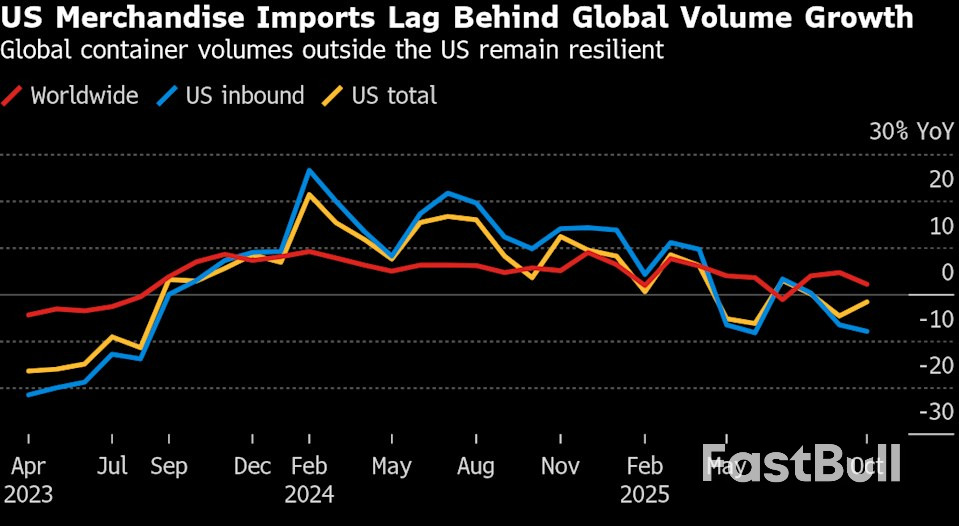
          Merchandise trade across the world held up relatively well through 2025, even as US President Donald Trump started erecting a tariff wall around the world’s largest economy. Data cited this week by shipping industry veteran John McCown show global container volumes grew 2.1% in October from a year earlier.
          Yet beneath the overall resilience are shifting undercurrents: The US saw a 8% contraction in inbound volumes, while imports into Africa, the Middle East, Latin America and India all showed robust growth.
          Why 2026 Is Poised to Be Another Rocky Year for Global Trade_1
          “World container supply chains have already begun to adapt and reconfigure trading patterns,” McCown wrote in a research note on Monday. After the US in 2024 saw a 15.2% gain in container imports for the full year, “to say that the annual total for 2025 will be in diametric contrast is an understatement.”
          Trump’s trade threats were among the chief reasons for the rewiring of shipments, according to McCown. If 2025 was the year of the tariff, he wrote in a LinkedIn post, then 2026 will be the year of tariff consequences.
          Other experts in recent weeks have said they anticipate more trade turmoil in the year ahead, with these four issues among the most widely discussed:
          Revisiting USMCA
          The US, Canada and Mexico are about to start reviewing the North American free-trade deal that took effect in 2020. The negotiations will take the three nations into “new territory” given the novelty of the provision allowing for an update after just six years, according to comments by US Trade Representative Jamieson Greer to lawmakers this month.
          Greer said the government received more than 1,500 responses during the public comment period ahead of the coming review.
          “Many stakeholders expressed support for the USMCA and many explicitly called for the agreement to be extended,” Greer said. “At the same time, virtually all stakeholders also called for some sort of improvement to the agreement.”
          But any “improvement” for one of the three members of the trade bloc risks coming at the expense of another. And that sets the stage for a tough round of talks for the largest US trading partners, whose industries are strugging amid American import taxes. Ties are already strained between the US and Canada, after Trump terminated trade talks with the northern neighbor in October — in response to anti-tariff ads featuring Ronald Reagan.
          Rough Sailing
          For container ships and other workhorses of global trade, the year ahead may bring two shocks that sound like welcome developments but could actually snarl global supply chains in ways seen during the Covid pandemic, according to experts including Lars Jensen, the CEO of the consultancy Vespucci Maritime.
          The first change would be a return of the world’s cargo fleet to using the Red Sea, rather than the longer route around southern Africa that vessels have had to resort to for the past two years. Houthi attacks in the Red Sea have largely subsided since the Gaza peace plan took effect in October, making the old route more appealing. Carriers including France’s CMA CGM SA and Denmark’s A.P. Moller-Maersk A/S are already sending a small number of ships through.
          But a full return to the Red Sea and the Suez Canal shortcut between Asia and Europe will “flood the market with a lot more capacity” and create “massive port congestion issues in Europe,” Jensen said during a Flexport webinar in November.
          The second blow could be more demand driven, according to Jensen. If the US economy accelerates as quickly in 2026 as Trump administration officials predict — fueled by an investment boom and lower interest rates — the resulting inventory restocking could swamp the shipping industry’s ability to cope.
          Shaky Deals
          High on the White House’s list of 2025 accomplishments are trade deals with several major economies, most of which bent to Trump’s demands ranging from investment pledges to better market access for US exports. In exchange for their submissiveness, their goods were smacked with a tariff rate that was lower than the duty they would’ve gotten if they retaliated.
          But these aren’t traditional, binding trade deals with enforcement provisions and fine print spelling out the rules, and there’s only a one-year truce with China rather than a full agreement — leaving out the US’s most unbalanced trading relationship.
          That’s left concern that pacts could yet come undone, especially given the potential for pressure from Beijing against any nation open to working with Washington at China’s expense.
          Developments within the past month have showcased the risks. Since the White House announced its “landmark trade deal” in July, Indonesia has been resisting US trade demands that it feared would restrain its independence and now sees an agreement being signed in late January. China complained to Malaysia and Cambodia about the trade deals those two nations signed with Washington, warning them against measures that undermine Beijing’s interest.
          Even the UK has seen fresh difficulties crop up.
          Last week, Greer singled out the European Union and India, saying that contentious talks aimed their respective trade deals are set to spill into the new year. Greer’s office, in a social media post last week, threatened retaliation against the EU for what Washington considers to be excessive regulation of American tech companies.
          The Supreme Court
          Among the biggest unknowns in trade circles heading into 2026 is a pending US Supreme Court ruling on the legality of Trump’s so-called reciprocal tariffs — the broad levies he imposed on most major trading partners.
          If Trump does lose the case, one of the most consequential questions for the economy and the country’s fiscal outlook will be whether the government will have to refund the money that American importers paid in tariffs. It’s not clear cut that’ll happen in a timely or organized way.
          Kevin Hassett, director of the National Economic Council, told CBS’s that even if the high court doesn’t rule in the administration’s favor, it would be “pretty unlikely that they’re going to call for widespread refunds, because it would be an administrative problem” to distribute those.
          Betting markets have put about a 75% chance on a Trump loss, which means the administration will have to use other authorities at the president’s disposal to impose tariffs.
          Asked at the Atlantic Council earlier this month whether 2026 will be quieter on the tariff front than this year, Greer declined to offer a forecast. “That’s a question for President Trump,” he said.

          Source: Bloomberg

          To stay updated on all economic events of today, please check out our Economic calendar
          Risk Warnings and Disclaimers
          You understand and acknowledge that there is a high degree of risk involved in trading. Following any strategies or investment methods may lead to potential losses. The content on the site is provided by our contributors and analysts for information purposes only. You are solely responsible for determining whether any trading assets, securities, strategy, or any other product is suitable for investing based on your own investment objectives and financial situation.
          Add to Favorites
          Share

          Indonesian, Vietnamese Footwear Makers Feel The Heat Of U.S. Tariffs

          Samantha Luan

          Forex

          Economic

          Foreign footwear makers have canceled plans to invest in Indonesia, and shoe factory managers in Vietnam are absorbing some additional costs, accelerating automation and tapping the brakes on hiring as U.S. President Donald Trump's "reciprocal" tariffs infiltrate a key sector for Southeast Asian economies.

          Slowing demand in the U.S. is also driving Asian-based manufacturers to seek new markets, but some American buyers have indicated the new levies will not prompt them to abandon their current suppliers in the region. This suggests that the tariffs, which Trump said are meant to push manufacturers to move production to the U.S., are not having the desired effect.

          Vietnam and Indonesia are the world's second and third largest footwear exporters after China, according to the World Footwear Yearbook 2025, shipping 1.6 billion and 600 million pairs respectively in 2024. Cambodia is also in the top 10.

          After much negotiating, U.S. President Donald Trump imposed so-called reciprocal tariffs of 19% on goods from Indonesia and Cambodia, and 20% on those from Vietnam.

          Yoseph Billie Dosiwoda, executive director of the Indonesian Footwear Association (Aprisindo), said the uncertainty triggered by the tariffs had prompted some investors to cancel plans to build factories in the country.

          "The investment trend is now downward," he told Nikkei Asia, although he declined to name any companies. "We hope the [U.S.] government can lower the 19% reciprocal tariff to 15% or 10%."

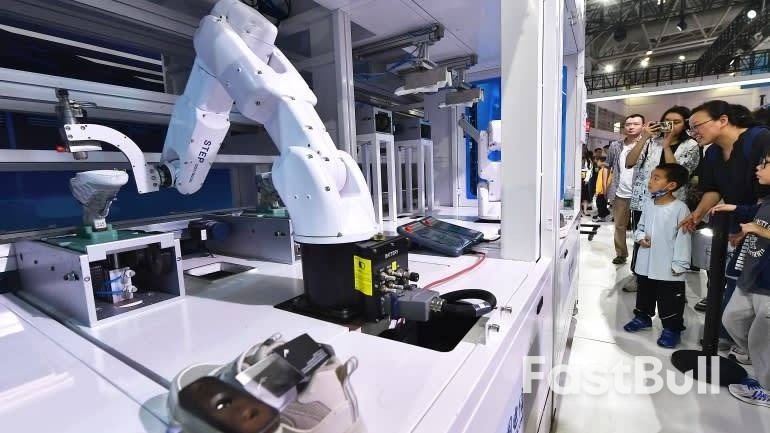
          Visitors watch robots making shoes on a production line at an exhibition in Fuzhou, Fujian province, China. Footwear makers in Vietnam say the new U.S. tariffs have prompted them to accelerate their automation drives. © Getty Images

          Indonesian footwear exports to the U.S. were valued at $2.39 billion in 2024, accounting for 33.7% of the sector's exports.

          But Dosiwoda said U.S. demand for Indonesian footwear products decreased by some 23% in the first nine months of 2025 compared to the same period last year. While October and November data have yet to be published, he said the slump was exacerbated in these months by the decline in American purchasing power due to the U.S. government shutdown for 43 days. The downturn has led to layoffs across the industry.

          If tariffs remain above 15%, Indonesian-made products will no longer be competitive, he added, citing high production costs and low labor productivity. "Industry players need domestic deregulation to improve many things, including productivity, a conducive [business climate], and friendly wages [for employers]," Dosiwoda said. Indonesian unions are demanding a 10% wage hike, while in Vietnam the overall minimum wage will rise about 7%.

          Vietnam's shoe exports to the U.S. dropped 4% in November versus a year earlier after falling 13% in the previous three months, national statistics show. Companies have reacted to the tariffs by looking for new customers, cutting costs and selling more expensive products.

          One executive managing tens of thousands of workers said the increased costs were being shared by the buyers and manufacturers, with many factories pushing increased automation. "These are things we need to do anyway," the industry veteran said. "This gives us no choice but to go faster."

          Maybank economist Brian Lee confirmed the trend. "Lower external demand could weigh on the employment outlook," he told Nikkei. "Indeed, firms have become more cautious on hiring."

          Indonesia's Aprisindo and the Vietnam Leather, Footwear and Handbag Association say they are increasingly looking toward markets like the European Union -- and Japan in Vietnam's case -- for new opportunities. Indonesia and the E.U. signed a trade deal in September that is likely to remove almost all tariffs on footwear, although this is unlikely to come into effect before the second half of 2027.

          Ken Loo, secretary general of the Textile, Apparel, Footwear and Travel Goods Association of Cambodia, said he expects "all players in the supply chain" will share the increased costs of the U.S. tariffs on Cambodian exports.

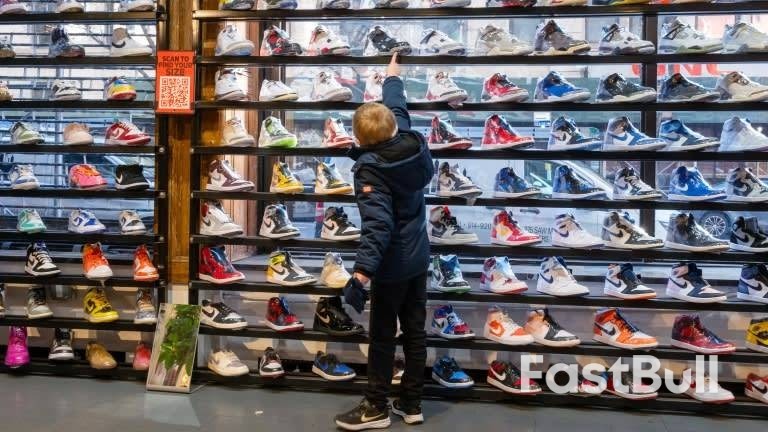
          A boy in a New York shoe store. Footwear sellers in the U.S. are predicting demand will soften in the coming months as tariffs lead to higher prices.

          The tariffs are also being felt in the U.S. Footwear prices began climbing in July due to the tariffs. According to consumer price index data for September, the latest available, footwear rose 1.3% year over year, while women's shoes went up 2.8%.

          Edward Rosenfeld, CEO of casual footwear brand Steve Madden, said in a November earnings call that the price increases have not fully offset the tariffs, and so the levies have eaten into his company's profit margins. He added that the company will be prudent about any more price hikes. Athletic apparel maker Nike, meanwhile, said its U.S. sales rose 9.3% in the three months to the end of November but warned of only modest growth in the current quarter.

          VF Corporation, which owns Vans and Timberland, said in an earnings call that it began increasing prices in the fourth quarter of this year to pay for the tariffs.

          More turmoil could be on the way as some U.S. importers hold off on placing orders as they await a decision from the U.S. Supreme Court on whether Trump's sweeping tariffs were imposed illegally. The decision could be months away.

          The National Retail Federation is therefore forecasting U.S. imports will continue to decline in 2026.

          Nevertheless, Indonesia, India and Cambodia are the three most popular emerging sourcing destinations, according to a U.S. Fashion Industry Association survey, with more than 60% of respondents planning to expand sourcing from these countries over the next two years.

          Patrick Soong, who helps U.S. companies source in Asia, said none of his customers have shifted sourcing because of the tariffs. Some 20% of Soong's customers source from Vietnam, Thailand and Indonesia.

          "It doesn't truly matter in the eyes of the U.S. brand, on where you source," he said. "It's more about the factories' capabilities and the output they can reach."

          Source: Asia_Nikkei

          To stay updated on all economic events of today, please check out our Economic calendar
          Risk Warnings and Disclaimers
          You understand and acknowledge that there is a high degree of risk involved in trading. Following any strategies or investment methods may lead to potential losses. The content on the site is provided by our contributors and analysts for information purposes only. You are solely responsible for determining whether any trading assets, securities, strategy, or any other product is suitable for investing based on your own investment objectives and financial situation.
          Add to Favorites
          Share

          Bitcoin 2026 outlook: bullish structure or bear market reset?

          Adam

          Cryptocurrency

          2025 overview

          The end of 2025 was rough. Over $1.2 trillion in crypto market value gone in six weeks. Bitcoin (BTC) gave up more than 30% and slipped below $82,000; a liquidity vacuum. Leverage wiped out, exchange-traded funds (ETF) outflows, passive funds pulling capital at once.
          But as of now, things feel different. The panic’s faded. What’s left is tighter, more focused. Price is recovering, but slowly. This time around, the engine underneath looks stronger.

          Liquidity: everything flows from here

          What hit hardest recently wasn’t retail panic, it was mechanical. Business Insider reported $19 billion in liquidations in one day, the biggest in crypto history. Add a wave of institutional de-risking, and the market had no buffer.
          Many major central banks are nearing the end of their tightening cycles. Inflation is easing, growth is slowing, and rate cuts are already underway. Historically, Bitcoin tends to perform better when liquidity improves and interest rates fall, as the opportunity cost of holding non-yielding assets like BTC declines.
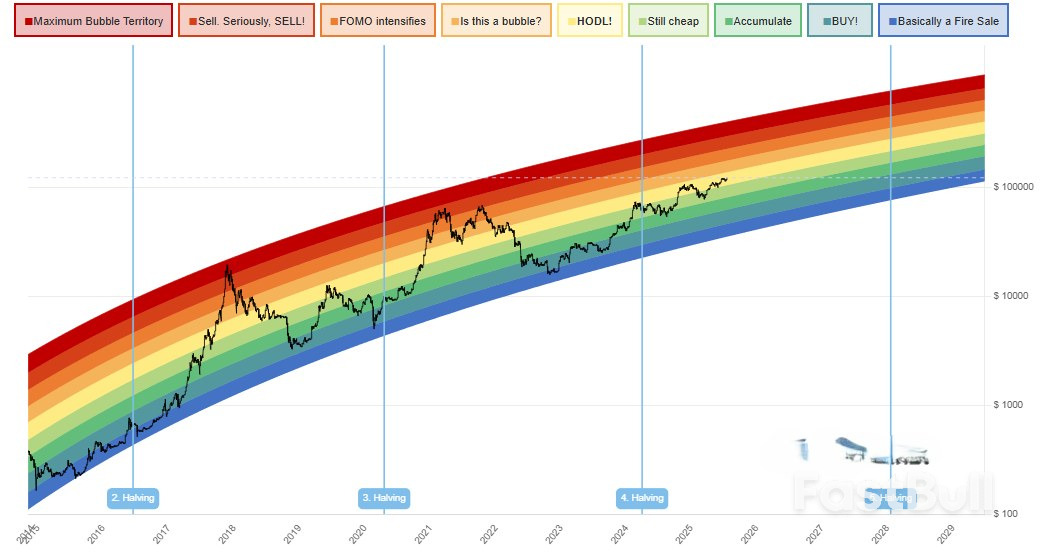
          2026 lands in the typical post-halving expansion zone, historically where momentum builds
          Bitcoin 2026 outlook: bullish structure or bear market reset?_1

          Supply: thinning, quietly

          Post-halving dynamics from 2024 are fully in play. Miners are getting half the rewards they used to, and many are scaling back or consolidating. Meanwhile, according to CryptoQuant, exchange reserves are at their lowest since 2018. Coins just aren’t moving like they used to.
          A lot of BTC is now effectively out of circulation and locked in long-term wallets, ETFs, corporate treasuries. We can see it in the on-chain data: the active supply is thin, it isn’t a supply shock yet, but it’s close.

          Demand: still there, but slower

          ETF flows paused last quarter of 2025, but they didn’t collapse. That’s a big change from earlier cycles. Over $50 billion went into spot Bitcoin ETFs in the past year, and most of that capital hasn’t left. Allocators are treating BTC like an asset, not a trade.
          Then there’s Strategy. Still sitting on 430K+ BTC and recently raised $1.4 billion in cash. As JPMorgan pointed out, if they’re not forced to sell and its market new asset value (mNAV) – a metric assessing crypto treasury companies’ valuation - holds above 1, they become a backstop. Add in the pending MSCI ruling in January (which decides whether crypto-heavy firms get to stay in major indices), and you’ve got real market structure in play.

          2026 outlook

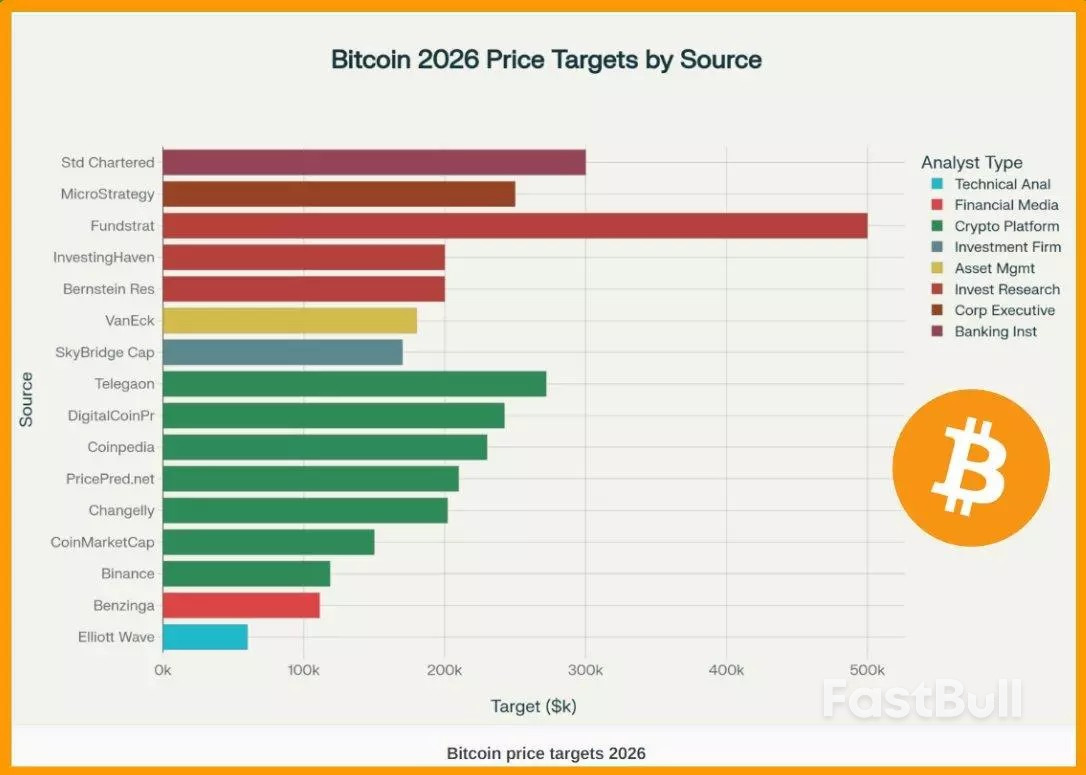
          The outlook isn’t unanimous, but most serious forecasts now sit in the $120K to $170K range. The outlook is based on ETF flows, constrained supply, and improved liquidity conditions.
          Fundstrat is more aggressive, pushing $400K+. JPMorgan’s volatility-adjusted gold model suggests $170K is in play if Bitcoin continues to attract capital the way commodities do (especially gold). But few are pricing in euphoria. Most are looking at this as a grind upward.
          2026 price target from $60K to nearly $500K, but most cluster between $120K and $170K
          Bitcoin 2026 outlook: bullish structure or bear market reset?_2

          Key risks to monitor

          ETF outflows could return fast if macro flips again. The Bybit hack reminded everyone the security layer still isn’t foolproof, Decrypt reported $1.4B lost to a hot wallet exploit. And if MSCI excludes firms like Strategy, $2.8B in passive outflows could hit the tape fast.

          Technical analysis: bear phase into late 2026?

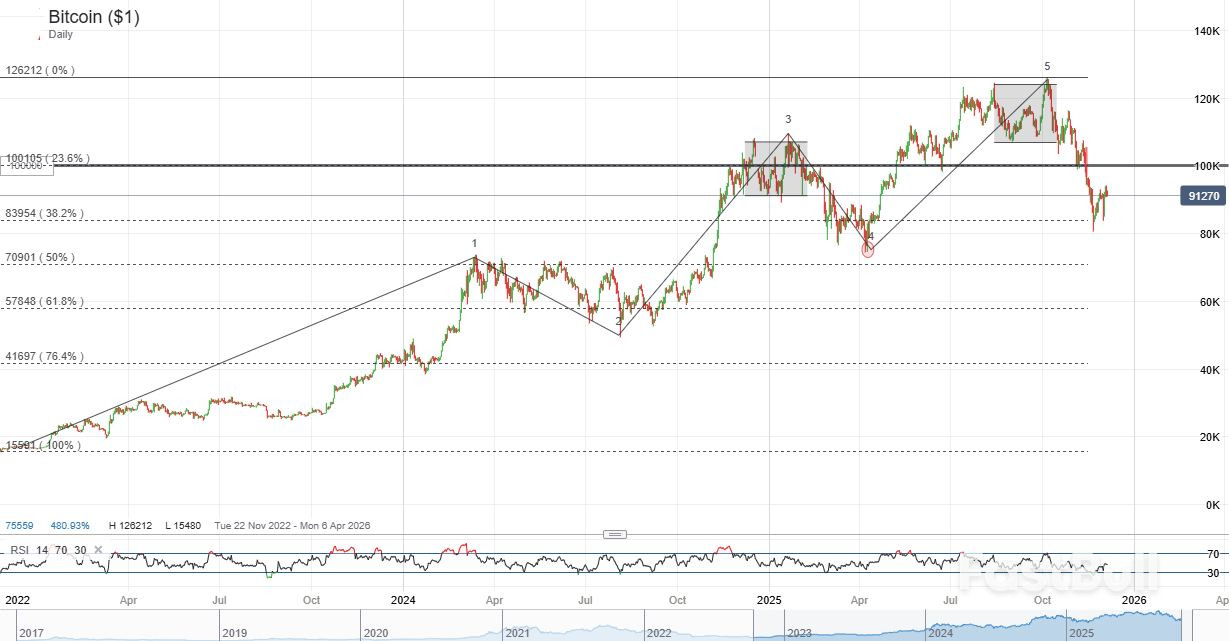
          From the 2022 lows at $16.5K to the 2025 peak at ~$126K, BTC has already a completed five-wave rally under the Elliott Wave theory. If that’s correct, the end of year drop below $108K could’ve been the start of a longer correction.
          In Elliott Wave terms, corrections following the five-wave rally usually play out in three stages: a first drop (A), a bounce (B), then a deeper pullback (C). If this pattern realises, Bitcoin could stay under pressure into mid-2026. Key price zones to watch on the way down include $84K, $70K, and $58K - areas where past cycles have found support.
          Bitcoin daily price chart
          Bitcoin 2026 outlook: bullish structure or bear market reset?_3

          Conclusion: a tighter market, but a split path

          Bitcoin heads into 2026 with real structure: liquidity conditions are improving, supply remains limited, and institutional demand hasn’t disappeared. That sets the stage for continued strength, if those drivers hold.
          But with the recent breakdown and a possible completed five-wave rally, the case for a longer correction is also on the table. Whether this cycle has one more leg higher or already topped, the next phase will be shaped more by mechanics than momentum.

          Source: ig

          Risk Warnings and Disclaimers
          You understand and acknowledge that there is a high degree of risk involved in trading. Following any strategies or investment methods may lead to potential losses. The content on the site is provided by our contributors and analysts for information purposes only. You are solely responsible for determining whether any trading assets, securities, strategy, or any other product is suitable for investing based on your own investment objectives and financial situation.
          Add to Favorites
          Share
          FastBull
          Copyright © 2025 FastBull Ltd

          728 RM B 7/F GEE LOK IND BLDG NO 34 HUNG TO RD KWUN TONG KLN HONG KONG

          TelegramInstagramTwitterfacebooklinkedin
          App Store Google Play Google Play
          Products
          Charts

          Chats

          Q&A with Experts
          Screeners
          Economic Calendar
          Data
          Tools
          Membership
          Features
          Function
          Markets
          Copy Trading
          Latest Signals
          Contests
          News
          Analysis
          24/7
          Columns
          Education
          Company
          Careers
          About Us
          Contact Us
          Advertising
          Help Center
          Feedback
          User Agreement
          Privacy Policy
          Personal Information Protection Statement
          Business

          White Label

          Data API

          Web Plug-ins

          Poster Maker

          Affiliate Program

          Risk Disclosure

          The risk of loss in trading financial instruments such as stocks, FX, commodities, futures, bonds, ETFs and crypto can be substantial. You may sustain a total loss of the funds that you deposit with your broker. Therefore, you should carefully consider whether such trading is suitable for you in light of your circumstances and financial resources.

          No decision to invest should be made without thoroughly conducting due diligence by yourself or consulting with your financial advisors. Our web content might not suit you since we don't know your financial conditions and investment needs. Our financial information might have latency or contain inaccuracy, so you should be fully responsible for any of your trading and investment decisions. The company will not be responsible for your capital loss.

          Without getting permission from the website, you are not allowed to copy the website's graphics, texts, or trademarks. Intellectual property rights in the content or data incorporated into this website belong to its providers and exchange merchants.

          Not Logged In

          Log in to access more features

          FastBull Membership

          Not yet

          Purchase

          Become a signal provider
          Help Center
          Customer Service
          Dark Mode
          Price Up/Down Colors

          Log In

          Sign Up

          Position
          Layout
          Fullscreen
          Default to Chart
          The chart page opens by default when you visit fastbull.com