• Trade
  • Markets
  • Copy
  • Contests
  • News
  • 24/7
  • Calendar
  • Q&A
  • Chats
Trending
Screeners
SYMBOL
LAST
BID
ASK
HIGH
LOW
NET CHG.
%CHG.
SPREAD
SPX
S&P 500 Index
6849.51
6849.51
6849.51
6861.30
6847.07
+22.10
+ 0.32%
--
DJI
Dow Jones Industrial Average
48562.63
48562.63
48562.63
48679.14
48562.63
+104.59
+ 0.22%
--
IXIC
NASDAQ Composite Index
23284.44
23284.44
23284.44
23345.56
23265.18
+89.28
+ 0.38%
--
USDX
US Dollar Index
97.860
97.940
97.860
98.070
97.810
-0.090
-0.09%
--
EURUSD
Euro / US Dollar
1.17529
1.17536
1.17529
1.17596
1.17262
+0.00135
+ 0.11%
--
GBPUSD
Pound Sterling / US Dollar
1.33914
1.33921
1.33914
1.33961
1.33546
+0.00207
+ 0.15%
--
XAUUSD
Gold / US Dollar
4327.31
4327.65
4327.31
4350.16
4294.68
+27.92
+ 0.65%
--
WTI
Light Sweet Crude Oil
56.891
56.921
56.891
57.601
56.789
-0.342
-0.60%
--

Community Accounts

Signal Accounts
--
Profit Accounts
--
Loss Accounts
--
View More

Become a signal provider

Sell trading signals to earn additional income

View More

Guide to Copy Trading

Get started with ease and confidence

View More

Signal Accounts for Members

All Signal Accounts

Best Return
  • Best Return
  • Best P/L
  • Best MDD
Past 1W
  • Past 1W
  • Past 1M
  • Past 1Y

All Contests

  • All
  • Trump Updates
  • Recommend
  • Stocks
  • Cryptocurrencies
  • Central Banks
  • Featured News
Top News Only
Share

The Nasdaq Golden Dragon China Index Fell 0.9% In Early Trading

Share

The S&P 500 Opened 32.78 Points Higher, Or 0.48%, At 6860.19; The Dow Jones Industrial Average Opened 136.31 Points Higher, Or 0.28%, At 48594.36; And The Nasdaq Composite Opened 134.87 Points Higher, Or 0.58%, At 23330.04

Share

Miran: Goods Inflation Could Be Settling In At A Higher Level Than Was Normal Before The Pandemic, But That Will Be More Than Offset By Housing Disinflation

Share

Miran, Who Dissented In Favor Of A Larger Cut At Last Fed Meeting, Repeats Keeping Policy Too Tight Will Lead To Job Losses

Share

Miran: Does Not Think Higher Goods Inflation Is Mostly From Tariffs, But Acknowledges Does Not Have A Full Explanation For It

Share

Toronto Stock Index .GSPTSE Rises 67.16 Points, Or 0.21 Percent, To 31594.55 At Open

Share

Miran: Excluding Housing And Non-Market Based Items, Core Pce Inflation May Be Below 2.3%, “Within Noise” Of The Fed's 2% Target

Share

Polish State Assets Minister Balczun Says Jsw Needs Over USD 830 Million Financing To Keep Liquidity For A Year

Share

Miran: Prices Are “Once Again Stable” And Monetary Policy Should Reflect That

Share

Fed's Miran: Current Excess Inflation Is Not Reflective Of Underlying Supply And Demand In The Economy

Share

Portugal Treasury Puts 2026 Net Financing Needs At 13 Billion Euros, Up From 10.8 Billion In 2025

Share

Portugal Treasury Expects 2026 Net Financing Needs At 29.4 Billion Euros, Up From 25.8 Billion In 2025

Share

Bank Of America Says With Indonesia's Smelter Now Ramping Up, It Expects Aluminium Supply Growth To Accelerate To 2.6% Year On Year In 2026

Share

Bank Of America Expects A Deficit In Aluminium Next Year And Sees Prices Pushing Above $3000/T

Share

Fed Data - USA Effective Federal Funds Rate At 3.64 Percent On 12 December On $102 Billion In Trades Versus 3.64 Percent On $99 Billion On 11 December

Share

Brazil's Petrobras Says No Impact Seen On Oil, Petroleum Products Output As Workers Start Planned Strike

Share

Statement: US Travel Group Warns New Proposed Trump Administration Requirements For Foreign Tourists To Provide Social Media Histories Could Mean Millions Of People Opting Not To Visit

Share

Blackrock: Kerry White Will Become Head Of Citi Investment Management At Citi Wealth

Share

Blackrock: Rob Jasminski, Head Of Citi Investment Management, Has Joined With Team

Share

Blackrock: Effective Dec 15, Citi Investment Management Employees Will Join Blackrock

TIME
ACT
FCST
PREV
Japan Tankan Small Manufacturing Outlook Index (Q4)

A:--

F: --

P: --

Japan Tankan Large Non-Manufacturing Outlook Index (Q4)

A:--

F: --

P: --

Japan Tankan Large Manufacturing Outlook Index (Q4)

A:--

F: --

P: --

Japan Tankan Small Manufacturing Diffusion Index (Q4)

A:--

F: --

P: --

Japan Tankan Large Manufacturing Diffusion Index (Q4)

A:--

F: --

P: --

Japan Tankan Large-Enterprise Capital Expenditure YoY (Q4)

A:--

F: --

P: --

U.K. Rightmove House Price Index YoY (Dec)

A:--

F: --

P: --

China, Mainland Industrial Output YoY (YTD) (Nov)

A:--

F: --

P: --

China, Mainland Urban Area Unemployment Rate (Nov)

A:--

F: --

P: --

Saudi Arabia CPI YoY (Nov)

A:--

F: --

P: --

Euro Zone Industrial Output YoY (Oct)

A:--

F: --

P: --

Euro Zone Industrial Output MoM (Oct)

A:--

F: --

P: --

Canada Existing Home Sales MoM (Nov)

A:--

F: --

P: --

Canada National Economic Confidence Index

A:--

F: --

P: --

Canada New Housing Starts (Nov)

A:--

F: --

P: --
U.S. NY Fed Manufacturing Employment Index (Dec)

A:--

F: --

P: --

U.S. NY Fed Manufacturing Index (Dec)

A:--

F: --

P: --

Canada Core CPI YoY (Nov)

A:--

F: --

P: --

Canada Manufacturing Unfilled Orders MoM (Oct)

A:--

F: --

P: --

U.S. NY Fed Manufacturing Prices Received Index (Dec)

A:--

F: --

P: --

U.S. NY Fed Manufacturing New Orders Index (Dec)

A:--

F: --

P: --

Canada Manufacturing New Orders MoM (Oct)

A:--

F: --

P: --

Canada Core CPI MoM (Nov)

A:--

F: --

P: --

Canada Trimmed CPI YoY (SA) (Nov)

A:--

F: --

P: --

Canada Manufacturing Inventory MoM (Oct)

A:--

F: --

P: --

Canada CPI YoY (Nov)

A:--

F: --

P: --

Canada CPI MoM (Nov)

A:--

F: --

P: --

Canada CPI YoY (SA) (Nov)

A:--

F: --

P: --

Canada Core CPI MoM (SA) (Nov)

A:--

F: --

P: --

Canada CPI MoM (SA) (Nov)

A:--

F: --

P: --

Federal Reserve Board Governor Milan delivered a speech
U.S. NAHB Housing Market Index (Dec)

--

F: --

P: --

Australia Composite PMI Prelim (Dec)

--

F: --

P: --

Australia Services PMI Prelim (Dec)

--

F: --

P: --

Australia Manufacturing PMI Prelim (Dec)

--

F: --

P: --

Japan Manufacturing PMI Prelim (SA) (Dec)

--

F: --

P: --

U.K. 3-Month ILO Employment Change (Oct)

--

F: --

P: --

U.K. Unemployment Claimant Count (Nov)

--

F: --

P: --

U.K. Unemployment Rate (Nov)

--

F: --

P: --

U.K. 3-Month ILO Unemployment Rate (Oct)

--

F: --

P: --

U.K. Average Weekly Earnings (3-Month Average, Including Bonuses) YoY (Oct)

--

F: --

P: --

U.K. Average Weekly Earnings (3-Month Average, Excluding Bonuses) YoY (Oct)

--

F: --

P: --

France Services PMI Prelim (Dec)

--

F: --

P: --

France Composite PMI Prelim (SA) (Dec)

--

F: --

P: --

France Manufacturing PMI Prelim (Dec)

--

F: --

P: --

Germany Services PMI Prelim (SA) (Dec)

--

F: --

P: --

Germany Manufacturing PMI Prelim (SA) (Dec)

--

F: --

P: --

Germany Composite PMI Prelim (SA) (Dec)

--

F: --

P: --

Euro Zone Composite PMI Prelim (SA) (Dec)

--

F: --

P: --

Euro Zone Services PMI Prelim (SA) (Dec)

--

F: --

P: --

Euro Zone Manufacturing PMI Prelim (SA) (Dec)

--

F: --

P: --

U.K. Services PMI Prelim (Dec)

--

F: --

P: --

U.K. Manufacturing PMI Prelim (Dec)

--

F: --

P: --

U.K. Composite PMI Prelim (Dec)

--

F: --

P: --

Euro Zone ZEW Economic Sentiment Index (Dec)

--

F: --

P: --

Germany ZEW Current Conditions Index (Dec)

--

F: --

P: --

Germany ZEW Economic Sentiment Index (Dec)

--

F: --

P: --

Euro Zone Trade Balance (Not SA) (Oct)

--

F: --

P: --

Euro Zone ZEW Current Conditions Index (Dec)

--

F: --

P: --

Euro Zone Trade Balance (SA) (Oct)

--

F: --

P: --

U.S. Retail Sales MoM (Excl. Automobile) (SA) (Oct)

--

F: --

P: --

Q&A with Experts
    • All
    • Chatrooms
    • Groups
    • Friends
    Connecting
    .
    .
    .
    Type here...
    Add Symbol or Code

      No matching data

      All
      Trump Updates
      Recommend
      Stocks
      Cryptocurrencies
      Central Banks
      Featured News
      • All
      • Russia-Ukraine Conflict
      • Middle East Flashpoint
      • All
      • Russia-Ukraine Conflict
      • Middle East Flashpoint
      Search
      Products

      Charts Free Forever

      Chats Q&A with Experts
      Screeners Economic Calendar Data Tools
      Membership Features
      Data Warehouse Market Trends Institutional Data Policy Rates Macro

      Market Trends

      Market Sentiment Order Book Forex Correlations

      Top Indicators

      Charts Free Forever
      Markets

      News

      News Analysis 24/7 Columns Education
      From Institutions From Analysts
      Topics Columnists

      Latest Views

      Latest Views

      Trending Topics

      Top Columnists

      Latest Update

      Signals

      Copy Rankings Latest Signals Become a signal provider AI Rating
      Contests
      Brokers

      Overview Brokers Assessment Rankings Regulators News Claims
      Broker listing Forex Brokers Comparison Tool Live Spread Comparison Scam
      Q&A Complaint Scam Alert Videos Tips to Detect Scam
      More

      Business
      Events
      Careers About Us Advertising Help Center

      White Label

      Data API

      Web Plug-ins

      Affiliate Program

      Awards Institution Evaluation IB Seminar Salon Event Exhibition
      Vietnam Thailand Singapore Dubai
      Fans Party Investment Sharing Session
      FastBull Summit BrokersView Expo
      Recent Searches
        Top Searches
          Markets
          News
          Analysis
          User
          24/7
          Economic Calendar
          Education
          Data
          • Names
          • Latest
          • Prev

          View All

          No data

          Scan to Download

          Faster Charts, Chat Faster!

          Download App
          English
          • English
          • Español
          • العربية
          • Bahasa Indonesia
          • Bahasa Melayu
          • Tiếng Việt
          • ภาษาไทย
          • Français
          • Italiano
          • Türkçe
          • Русский язык
          • 简中
          • 繁中
          Open Account
          Search
          Products
          Charts Free Forever
          Markets
          News
          Signals

          Copy Rankings Latest Signals Become a signal provider AI Rating
          Contests
          Brokers

          Overview Brokers Assessment Rankings Regulators News Claims
          Broker listing Forex Brokers Comparison Tool Live Spread Comparison Scam
          Q&A Complaint Scam Alert Videos Tips to Detect Scam
          More

          Business
          Events
          Careers About Us Advertising Help Center

          White Label

          Data API

          Web Plug-ins

          Affiliate Program

          Awards Institution Evaluation IB Seminar Salon Event Exhibition
          Vietnam Thailand Singapore Dubai
          Fans Party Investment Sharing Session
          FastBull Summit BrokersView Expo

          Japan's July Exports Drop By 2.6%, Steepest Plunge In More Than Four Years

          James Whitman

          Economic

          Summary:

          Japan's exports dropped 2.6% year over year in July, their steepest drop since February 2021.

          Japan's exports dropped 2.6% year over year in July, their steepest drop since February 2021.

          The fall was sharper than the 2.1% contraction expected by economists polled by Reuters and compared to the 0.5% drop seen in June.

          Imports to the world's fourth-largest economy sank 7.5%, compared to the 10.4% fall expected by the Reuters poll.

          Exports to the U.S. also continued to fall, dropping 10.1% in July and slightly softer than June's decline of 11.4%.

          Japan reached a deal with Washington on July 22 that saw its so-called "reciprocal tariff" lowered to 15% from the 25% threatened by U.S. President Donald Trump earlier that month.

          The trade readings come after Japan reported its second-quarter GDP figures, which saw the country beat expectations as net exports drove growth.

          Japan's economy grew by 0.3% quarter over quarter and 1.2% on a yearly basis in the second quarter as exports remained resilient, even as imports fell.

          Hirofumi Suzuki, Chief FX Strategist at Sumitomo Mitsui Banking Corporation, told CNBC after the GDP release that while exports have been volatile, there was a higher level of automobile shipments in April to June.

          This may be due to an increase in catch-up shipments after production recovered from an accident at an automobile parts manufacturer in March, Suzuki said.

          Tariffs on automobiles were cut from 25% to 15% as part of Japan's trade deal. Autos are one of Japan's largest exports, and make up its largest export to the U.S. in 2024.

          The value of auto exports — which includes cars, buses and trucks — to the U.S. plunged 28.4% year over year in July, a steeper fall compared to the 26.7% decline in June.

          While the effects of the 15% tariffs will not show up until the August data, analysts have warned about their impact on the Japanese economy.

          Senior economist Masato Koike at Sompo Institute Plus said in an Aug 14 note that there was a possibility that Japan could enter a recession, depending on the magnitude of the impact of tariffs.

          Source: CNBC

          To stay updated on all economic events of today, please check out our Economic calendar
          Risk Warnings and Disclaimers
          You understand and acknowledge that there is a high degree of risk involved in trading. Following any strategies or investment methods may lead to potential losses. The content on the site is provided by our contributors and analysts for information purposes only. You are solely responsible for determining whether any trading assets, securities, strategy, or any other product is suitable for investing based on your own investment objectives and financial situation.
          Add to Favorites
          Share

          Japan's Nikkei To Ease Off Record Peak As Trade Honeymoon Fades

          James Whitman

          Economic

          Key points:

          ● Analysts predict Nikkei will slip to 42,000 by December
          ● Recent Nikkei gains linked to corporate governance push
          ● Outlook hinges on Japan's fragile trade deal with US

          Japan's Nikkei share averagewill likely ease off recent record highs toward year-end, according to strategists in a Reuters poll, though much depends on a fragile trade agreement with the United States.

          Japan's benchmark stocks index last week surpassed its previous intraday record, and traded as high as 43,876.42 this week.

          The index is up more than 9% so far this year, but is forecast to slip back to 42,000 at the end of December, according to the median estimate of 18 analysts polled August 8-18.

          The Nikkei joined global equity bourses in a steep dive in April after U.S. President Donald Trump announced sweeping tariffs on imports. As Trump backed down on deadlines and his administration worked out bilateral trade deals, many benchmarks recovered.

          Japanese equities jumped around 11% after the U.S. agreed last month to reduce tariffs on Japanese auto imports to 15% from 27.5%, though a timeframe for the change and other details remain nebulous.

          "The 15% tariff is relatively low compared to the one on China, so Japanese companies may be able to gain a competitive advantage," said Masayuki Kubota, chief strategist at Rakuten Securities. "However, there is growing uncertainty about whether President Trump will actually uphold this agreement."

          Japan's economy remains largely reliant on exports. Data last week showed that the country's gross domestic product, the fourth biggest globally, grew much faster than expected in the second quarter.

          GOVERNANCE PUSH

          A major theme behind the Nikkei's gains in recent years has been the Tokyo Stock Exchange's push to boost corporate governance. Under pressure to improve returns and corporate value, companies have bought back shares in droves, and go-private deals have proliferated.

          The Nikkei early last year finally broke through the key high of 38,957.44 that had stood since 1989 during Japan's heady bubble economy. The gauge of blue-chip shares went on to set an intraday high of 42,426.77 on July 11, 2024, before the momentum petered out.
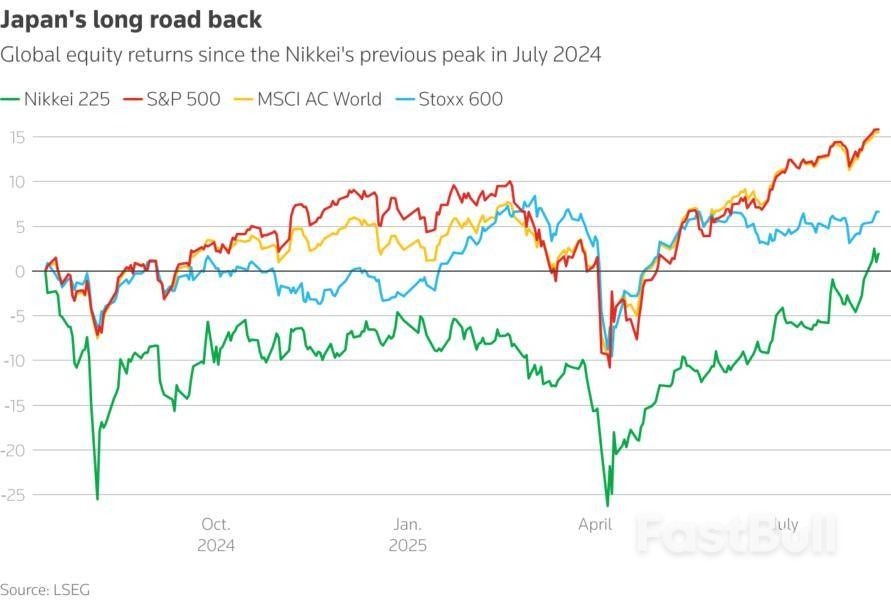
          Japan's long road back

          With the tariff turmoil diminishing and the domestic economy resilient, nine of 12 analysts in the Reuters poll expect Japanese corporate earnings to be higher in the second half of 2025 than the first.

          "If the U.S. economy is solid, it becomes easier for Japanese firms to raise prices for their exported goods to cover the cost of the tariffs," said Yugo Tsuboi, chief strategist at Daiwa Securities. "That will underpin corporate earnings."

          Median forecasts predict the Nikkei will trade at 43,000 by mid-2026 and 45,500 by end 2026.

          Improving domestic wages, along with looser monetary policy by the U.S. Federal Reserve, will continue to make Japan a destination for foreign investors, said Oanda senior market analyst Kelvin Wong.

          "An increase in global liquidity due to a weaker U.S. dollar and an impending dovish Fed pivot is likely to trigger a positive feedback loop back into the Japanese stock market," said Wong.

          BOJ AND POLITICS

          Within the country, the major events investors are looking out for are a long-delayed rate hike by the Bank of Japan and the potential for political upheaval.

          Prime Minister Shigeru Ishiba is under pressure to step aside after an electoral drubbing last month. Expectations that his replacement will be more fiscally expansive have added to tailwinds for stocks, said IG analyst Tony Sycamore.

          "We do see the market continue to run higher into year-end, and then after that I'd expect to see a pullback as we get close to the BOJ rate-hiking cycle taking effect," he added.

          Source: Reuters

          To stay updated on all economic events of today, please check out our Economic calendar
          Risk Warnings and Disclaimers
          You understand and acknowledge that there is a high degree of risk involved in trading. Following any strategies or investment methods may lead to potential losses. The content on the site is provided by our contributors and analysts for information purposes only. You are solely responsible for determining whether any trading assets, securities, strategy, or any other product is suitable for investing based on your own investment objectives and financial situation.
          Add to Favorites
          Share

          Federal Reserve Says US Banks Should Serve Crypto Without Fear of Penalties

          Manuel

          Cryptocurrency

          Central Bank

          Federal Reserve Vice Chair for Supervision Michelle Bowman acknowledged that crypto firms experienced debanking due to regulatory uncertainty.
          During the Wyoming Blockchain Symposium on Aug. 19, Bowman also announced a fundamental shift in the Fed’s approach to blockchain innovation.
          She revealed the central bank eliminated reputational risk considerations from bank supervision in late June to address barriers preventing financial institutions from serving digital asset companies engaged in legal activities.
          The Fed official stated: “Your industry [crypto] has already experienced significant frictions with bank regulators applying unclear standards, conflicting guidance, and inconsistent regulatory interpretations.”
          Bowman emphasized that banks should not face penalties for serving customers conducting lawful business operations, stating that customer selection decisions “lie solely within the purview of bank management” rather than regulatory interference.
          Furthermore, she noted the Fed’s transition from an “overly cautious mindset” toward embracing blockchain technology within the traditional banking system.
          She warned that regulators must choose between shaping technological frameworks or allowing innovations to bypass banks entirely, potentially diminishing the banking sector’s economic relevance.
          The Fed is updating examination manuals and supervisory materials to ensure lasting implementation of the reputational risk removal policy.

          Four-principle regulatory framework

          The Fed Vice Chair established four core principles guiding the central bank’s new approach to digital asset regulation.
          Regulatory certainty tops the list, addressing industry concerns about investing in blockchain development without clear supervisory standards.
          Bowman questioned whether companies would partner with banks, knowing that regulatory scrutiny brings uncertainty, rather than pursuing alternatives outside the banking system.
          Tailored regulation forms the second principle, requiring supervisors to evaluate use cases based on specific circumstances rather than applying worst-case scenario expectations.
          The Fed must recognize unique features distinguishing digital assets from traditional financial instruments while avoiding one-size-fits-all approaches that fail to address actual risk profiles.
          Consumer protection represents the third principle, ensuring customer-facing products comply with existing consumer protection laws, including prohibitions against unfair, deceptive, or abusive practices.
          Digital asset frameworks must incorporate Bank Secrecy Act and anti-money laundering requirements while maintaining bank safety and soundness standards.
          American competitiveness completes the framework, positioning the US as the premier global innovation destination. Bowman warned that failing to establish appropriate regulatory structures could jeopardize long-term American leadership in financial technology development.

          Technology integration and supervision changes

          Bowman announced the Fed’s “novel supervision” activities will be reintegrated into Reserve Bank examination staff, reestablishing normal supervisory processes for monitoring banks’ innovative activities.
          She proposed allowing Federal Reserve staff to hold minimal digital assets to develop a working understanding of blockchain functionality, comparing the necessity to hands-on learning rather than theoretical knowledge.
          [Editor’s Note: This is an abrupt U-turn from previous government approaches, notably those of former SEC Chair Gary Gensler. Gensler taught college-level blockchain courses at MIT yet never actually touched a blockchain with his own funds, having admitted to never holding any digital assets and, therefore, never executing his own transactions.]
          The Fed recognizes tokenization potential for facilitating faster asset ownership transfers while reducing transaction costs and settlement risks. Bowman noted that banks of all sizes, including community institutions, can benefit from efficiency gains flowing from asset tokenization technology.
          Furthermore, she highlighted that the GENIUS Act passage and presidential signature position stablecoins as integral components of the financial system, with implications for traditional payment rails.
          Bowman called for industry engagement to help regulators understand blockchain’s capacity for solving additional problems beyond current use cases.
          She specifically requested input on leveraging new technologies to combat fraud, identifying this as an exciting collaboration opportunity between the Fed and the digital asset sector.
          The Fed Vice Chair concluded that innovation and regulation complement rather than oppose each other in creating more modern, efficient financial systems.

          Source: Cryptoslate

          Risk Warnings and Disclaimers
          You understand and acknowledge that there is a high degree of risk involved in trading. Following any strategies or investment methods may lead to potential losses. The content on the site is provided by our contributors and analysts for information purposes only. You are solely responsible for determining whether any trading assets, securities, strategy, or any other product is suitable for investing based on your own investment objectives and financial situation.
          Add to Favorites
          Share

          S&P 500 Gains and Losses Today: Palantir Stock Plunges; Intel Rallies on Softbank Support

          Manuel

          Stocks

          Economic

          Major U.S. equities indexes were mixed Tuesday as tech sector losses weighed on their performance. The S&P 500 ended the session 0.6% lower, while the tech-heavy Nasdaq dropped 1.5%. The Dow held onto a fractional gain.
          Shares of analytics software provider Palantir Technologies (PLTR) tumbled over 9%, falling the most of any S&P 500 stock. The slide marked the fifth consecutive day of losses for the stock, which was sitting at record-high levels just a week ago after a strong earnings report. The latest move lower came after short seller Andrew Left of Citron Research expressed concerns about the stock's valuation, suggesting its price has become disconnected from the company's fundamentals.
          The price of Bitcoin (BTCUSD) and other major cryptocurrencies moved lower, extending declines posted over the past week. Shares of Coinbase Global (COIN), operator of the largest U.S. cryptocurrency exchange, sank 5.8%.
          Shares of enterprise software provider Oracle (ORCL) also lost 5.8% Tuesday. The company is in the midst of a reorganization and has been cutting jobs, particularly in its cloud infrastructure division as it aims to focus more resources on AI, according to reports last week. Yesterday, Bloomberg reported Mary Ann Davidson, the company's long-serving chief security officer, would be stepping down from her role.
          Intel (INTC) shares soared nearly 7%, logging the top performance in the S&P 500 Tuesday. The latest push higher for the struggling chipmaker's stock followed the announcement of a $2 billion investment by Japan's SoftBank Group (SFTBY). Masayoshi Son, CEO of SoftBank, said the move reflects the firm's anticipation of an expansion in U.S. semiconductor manufacturing, and comes amid speculation the Trump administration is evaluating taking a stake in the struggling chipmaker.
          Shares of Prologis (PLD), a real estate investment trust focused on warehouses, data centers, and other industrial properties, jumped 5%. Analysts at Mizuho upgraded Prologis to "outperform" from "neutral" and raised their price target, citing a more favorable view on the industrial REIT subsector. Mizuho suggested Prologis could be positioned to benefit from potential interest-rate cuts, as well as growth following the recently passed tax and spending bill.
          Palo Alto Networks (PANW) shares added just over 3% after the cybersecurity firm reported quarterly earnings that topped analysts' forecasts. The company's outlook for fiscal 2026 also exceeded consensus estimates. Analysts said the strong quarter demonstrated Palo Alto's success in the implementation of its platformization strategy, positioning itself as a one-stop shop for clients by offering multiple cybersecurity products on a single platform.

          Source: Investopedia

          To stay updated on all economic events of today, please check out our Economic calendar
          Risk Warnings and Disclaimers
          You understand and acknowledge that there is a high degree of risk involved in trading. Following any strategies or investment methods may lead to potential losses. The content on the site is provided by our contributors and analysts for information purposes only. You are solely responsible for determining whether any trading assets, securities, strategy, or any other product is suitable for investing based on your own investment objectives and financial situation.
          Add to Favorites
          Share

          Mexico to Propose Joint Steel Committee With US to Bolster Ties

          Manuel

          Commodity

          Political

          Mexico will propose reinstating a North American steel committee to improve trade ties with the US and reduce reliance on Asian steel imports, according to a top trade official.
          As part of its negotiations with the US over steel tariffs, Mexico plans to float the idea of bringing back a committee comprising steel companies in both Mexico and the US, as well as government trade officials from both nations, said Luis Rosendo Gutiérrez Romano, Mexico’s deputy economy minister for trade. While negotiations have focused on the bilateral relationship, the committee proposal envisions including Canada down the line.
          The committee would be similar to the former North American Steel Trade Committee under NAFTA, the trade agreement prior to the current USMCA between Mexico, the US and Canada. It would be tasked with building a stronger regional ecosystem including private sector actors rather than relying solely on government negotiations, said Gutiérrez.
          For example, the committee would consider measures aimed at increasing Mexico’s purchase of US steel to replace Asian imports. The move would potentially enable Mexico to increase tariffs on imported Asian steel, said Gutiérrez, who’s seen as Mexico’s second-most important commerce negotiator.
          “It’s something that the United States views very favorably and we view very favorably, because we have to work hand in hand,” he said. “We are looking at a series of trade practices to strengthen ourselves as a region, to protect ourselves as a region and to work together on a common policy that strengthens our industries.”
          To address US concerns, in addition to the joint committee proposal, Mexico has closed 1,062 so-called “phantom” Asian steel mills, which are buildings that are registered as mills but don’t contain any actual steel operations and function as cover for foreign imports. About 40% were linked to China, 10% to India and 6% to Iran.
          The government is also exploring domestic policies to increase local steel consumption, said Gutiérrez, such as having Mexico’s construction industry commit to buying local steel to offset a potential 5% to 10% drop in exports to the US.
          The proposals come amid negotiations between Mexico and the US over its tariff policies, including crippling 50% tariffs on Mexican steel and aluminum. The measures have forced some steel producers to pause planned investments, such as the cancellation of a $600 million special steel mill proposed by Brazilian steelmaker Gerdau SA.

          Gerdau Drops Mexican Steel Mill Plan Amid Trump Tariff Turmoil

          Gutiérrez said that Mexico is prioritizing negotiating a deal to reduce tariffs for autos, steel and aluminum. Whether planned steel investment is withdrawn or even increased will depend entirely on the final terms of a possible steel agreement, he said. Investment “could go elsewhere, but it could also double,” he said. “This is an agenda that concerns us a lot, and we will not take our eye off the ball so that we can reduce the tariff.”

          Source: Bloomberg

          Risk Warnings and Disclaimers
          You understand and acknowledge that there is a high degree of risk involved in trading. Following any strategies or investment methods may lead to potential losses. The content on the site is provided by our contributors and analysts for information purposes only. You are solely responsible for determining whether any trading assets, securities, strategy, or any other product is suitable for investing based on your own investment objectives and financial situation.
          Add to Favorites
          Share

          Polkadot Eyes Wall Street Investors to Close Gap With Ethereum, Solana

          Manuel

          Cryptocurrency

          Polkadot is moving to reposition itself in the current bull market by introducing a dedicated unit to bridge its ecosystem with institutional capital.
          On Aug. 19, the network announced the launch of Polkadot Capital Group, a capital markets-focused division designed to attract Wall Street investors and build stronger ties with traditional finance.
          According to the network team, the initiative aims to capitalize on recent developments, including the growing crypto demand from institutional players and increasing clarity in the US regulatory environment.
          The Polkadot team stated that the Polkadot Capital Group will help traditional finance participants navigate the network and identify investment opportunities.
          David Sedacca, the division’s lead, said: “Our goal is to lead through data-driven education, driving adoption through knowledge transfer, and adapting in real-time to the dynamic priorities of institutional market participants.We envision a future where institutions clearly understand the unique value of our network and can engage confidently.”

          Gavin Wood returns to Parity

          This organizational pivot arrives simultaneously as a leadership change within Parity, the blockchain network’s developer.
          On Aug. 13, Polkadot co-founder Gavin Wood confirmed he would return as CEO by the end of the month, replacing Björn Wagner, who has served in the role for three years.
          Wood said his decision was driven by “leverage,” explaining that with the core architecture completed and markets gaining momentum, his leadership from the top seat would allow Polkadot to accelerate execution.
          He added: “Nothing changes day-to-day. Teams, projects, and plans stay on course. But the bigger picture is evolving and you’ll start to feel that in the months ahead.”
          Why Polkadot needs these changes
          The timing of these changes reflects Polkadot’s recent struggles to compete with heavyweight rivals such as Ethereum and Solana.
          The two ecosystems have captured billions of dollars in DeFi and stablecoin activity. By contrast, Polkadot hosts only about $88 million in stablecoins, a fraction of its competitors’ figures.
          Moreover, current market forces have amplified these Polkadot challenges.
          While Ethereum has risen nearly 30% this year thanks to rising institutional interest and Solana has benefited from strong memecoin activity, Polkadot’s DOT token has lost more than 40% of its value in 2025.
          This underperformance has fueled concerns among backers, who see governance restructuring and capital market outreach as necessary steps to restore relevance.

          Source: Cryptoslate

          Risk Warnings and Disclaimers
          You understand and acknowledge that there is a high degree of risk involved in trading. Following any strategies or investment methods may lead to potential losses. The content on the site is provided by our contributors and analysts for information purposes only. You are solely responsible for determining whether any trading assets, securities, strategy, or any other product is suitable for investing based on your own investment objectives and financial situation.
          Add to Favorites
          Share

          The Fed's Jackson Hole Symposium Starts This Week. Here's What You Should Know

          Manuel

          Central Bank

          Economic

          The investment world will turn its attention away from Wall Street and toward Wyoming this week.
          Some of the world’s leading economists and monetary policymakers will meet for the 48th annual Jackson Hole Economic Symposium. The long-standing conference has often served as an opportunity for key officials to make public statements that have implications for Americans' wallets.
          This year is no exception. Markets and economists will closely follow Federal Reserve Chair Jerome Powell's remarks on Friday. Powell is expected to address potential next steps for the central bank as it decides whether or not to cut its influential interest rate.
          Several other policymakers are expected to speak at the three-day event, which brings together representatives of central banks from nearly 40 countries to meet with other business and economic leaders. This year’s theme is “Labor Markets in Transition: Demographics, Productivity, and Macroeconomic Policy."
          Sponsored by the Kansas City Federal Reserve, the meeting has been hosted at Jackson Lake Lodge for most of its history. The National Park Service provides a mountain backdrop for the 120 people who attend every year.
          Here’s more about what to expect from this year’s symposium.

          Fed Chairs Have Made Important Remarks During Historic Periods

          When former Federal Reserve Chair Paul Volcker spoke at the event in 1982, he shifted the conference’s focus from agricultural issues. He started a tradition of the Fed chief addressing the meeting each year.
          Over the years, the meeting has featured important speeches that have marked a turning point for the economy. Volcker used his remarks to defend his interest rate policy as the central bank fought record inflation in the early 1980s, while former Chair Alan Greenspan addressed issues with the 1990s tech bubble when he spoke there.
          Amid the 2008 financial crisis, then-Chair Ben Bernanke addressed key monetary policy issues at the conference.
          The conference is no longer focused solely on U.S. economics. European Central Bank President Christine Lagarde is among the speakers scheduled for this year’s conference.

          Interest Rates Will Likely Be at the Top of the Agenda for Powell

          Powell’s comments will focus during this year's conference as investors await clarity on the Fed’s policy path ahead.
          Recent inflation readings have shown price pressures remain above the Fed’s target of 2%, while worries about a weakening labor market intensify. While most investors believe the Federal Reserve will make its first interest rate cut when it next meets in September, Powell’s comments could provide some insight into how the board will move.
          “With markets pricing in a quarter-point cut for September, and some even expecting a bigger move, the Fed chief will use this platform to appropriately set forward guidance and outline his views on inflation and the labor market,” wrote BMO Senior Economist Priscilla Thiagamoorthy.

          Powell Expected to Weigh In on Fed’s Decision-Making Playbook

          Powell will also likely address another key issue for the Federal Reserve. The title of his speech indicates he will discuss the central bank’s framework for analyzing and acting on economic data.
          The Fed's policymaking committee updates the framework periodically; the most recent iteration was established in 2020. So far this year, the Fed has been analyzing its current strategy and taking feedback. It is looking to complete its review by late summer and will then assess its findings.
          A team of analysts at Deutsche Bank wrote that the current framework may have slowed the Federal Reserve's response to the 2022 spike in inflation. They said that could influence Powell's take on the framework.
          “[We] expect Powell’s speech to call for rolling back the 2020 modifications,” the note said.

          Source: Investopedia

          To stay updated on all economic events of today, please check out our Economic calendar
          Risk Warnings and Disclaimers
          You understand and acknowledge that there is a high degree of risk involved in trading. Following any strategies or investment methods may lead to potential losses. The content on the site is provided by our contributors and analysts for information purposes only. You are solely responsible for determining whether any trading assets, securities, strategy, or any other product is suitable for investing based on your own investment objectives and financial situation.
          Add to Favorites
          Share
          FastBull
          Copyright © 2025 FastBull Ltd

          728 RM B 7/F GEE LOK IND BLDG NO 34 HUNG TO RD KWUN TONG KLN HONG KONG

          TelegramInstagramTwitterfacebooklinkedin
          App Store Google Play Google Play
          Products
          Charts

          Chats

          Q&A with Experts
          Screeners
          Economic Calendar
          Data
          Tools
          Membership
          Features
          Function
          Markets
          Copy Trading
          Latest Signals
          Contests
          News
          Analysis
          24/7
          Columns
          Education
          Company
          Careers
          About Us
          Contact Us
          Advertising
          Help Center
          Feedback
          User Agreement
          Privacy Policy
          Business

          White Label

          Data API

          Web Plug-ins

          Poster Maker

          Affiliate Program

          Risk Disclosure

          The risk of loss in trading financial instruments such as stocks, FX, commodities, futures, bonds, ETFs and crypto can be substantial. You may sustain a total loss of the funds that you deposit with your broker. Therefore, you should carefully consider whether such trading is suitable for you in light of your circumstances and financial resources.

          No decision to invest should be made without thoroughly conducting due diligence by yourself or consulting with your financial advisors. Our web content might not suit you since we don't know your financial conditions and investment needs. Our financial information might have latency or contain inaccuracy, so you should be fully responsible for any of your trading and investment decisions. The company will not be responsible for your capital loss.

          Without getting permission from the website, you are not allowed to copy the website's graphics, texts, or trademarks. Intellectual property rights in the content or data incorporated into this website belong to its providers and exchange merchants.

          Not Logged In

          Log in to access more features

          FastBull Membership

          Not yet

          Purchase

          Become a signal provider
          Help Center
          Customer Service
          Dark Mode
          Price Up/Down Colors

          Log In

          Sign Up

          Position
          Layout
          Fullscreen
          Default to Chart
          The chart page opens by default when you visit fastbull.com
