• Trade
  • Markets
  • Copy
  • Contests
  • News
  • 24/7
  • Calendar
  • Q&A
  • Chats
Trending
Screeners
SYMBOL
LAST
BID
ASK
HIGH
LOW
NET CHG.
%CHG.
SPREAD
SPX
S&P 500 Index
6870.39
6870.39
6870.39
6895.79
6858.28
+13.27
+ 0.19%
--
DJI
Dow Jones Industrial Average
47954.98
47954.98
47954.98
48133.54
47871.51
+104.05
+ 0.22%
--
IXIC
NASDAQ Composite Index
23578.12
23578.12
23578.12
23680.03
23506.00
+72.99
+ 0.31%
--
USDX
US Dollar Index
98.930
99.010
98.930
98.960
98.730
-0.020
-0.02%
--
EURUSD
Euro / US Dollar
1.16501
1.16508
1.16501
1.16717
1.16341
+0.00075
+ 0.06%
--
GBPUSD
Pound Sterling / US Dollar
1.33163
1.33172
1.33163
1.33462
1.33136
-0.00149
-0.11%
--
XAUUSD
Gold / US Dollar
4211.68
4212.09
4211.68
4218.85
4190.61
+13.77
+ 0.33%
--
WTI
Light Sweet Crude Oil
59.281
59.311
59.281
60.084
59.160
-0.528
-0.88%
--

Community Accounts

Signal Accounts
--
Profit Accounts
--
Loss Accounts
--
View More

Become a signal provider

Sell trading signals to earn additional income

View More

Guide to Copy Trading

Get started with ease and confidence

View More

Signal Accounts for Members

All Signal Accounts

Best Return
  • Best Return
  • Best P/L
  • Best MDD
Past 1W
  • Past 1W
  • Past 1M
  • Past 1Y

All Contests

  • All
  • Trump Updates
  • Recommend
  • Stocks
  • Cryptocurrencies
  • Central Banks
  • Featured News
Top News Only
Share

S.Africa's Eskom Says Regulator Nersa Is Processing An Application For An Interim Tariff Adjustment For The Smelters, While Government Is Working On A Complementary Mechanism To Support A More Competitive Pricing Path For The Sector

Share

SEBI: Modalities For Migration To Ai Only Schemes And Relaxations To Large Value Funds For Accredited Investors

Share

All 6 Bank Of Israel Monetary Policy Committee Members Voted To Lower Benchmark Interest Rate 25 Bps To 4.25% On Nov 24

Share

India Government: Cancellations Are On Account Of Developer Delays And Not Due To Transmission Side Delays

Share

Fitch: We See Moderation Of Export Performance In China In 2026

Share

India Government: Revokes Grid Access Permissions For Renewable Energy Projects

Share

Fitch: Calibrating Fiscal And Monetary Policies In China To Boost Domestic Demand And Reverse Deflationary Pressures Will Be A Key Challenge

Share

Stats Office - Tanzania Inflation At 3.4% Year-On-Year In November

Share

Fitch: External Risks From US Tariffs For Greater China Region Have Subsided

Share

Temasek CEO Dilhan Pillay: We Are Taking A Conservative Stance On Allocating Capital

Share

Brazil Economists See Brazilian Real At 5.40 Per Dollar By Year-End 2025 Versus 5.40 In Previous Estimate - Central Bank Poll

Share

Brazil Economists See Year-End 2026 Interest Rate Selic At 12.25% Versus 12.00% In Previous Estimate - Central Bank Poll

Share

Brazil Economists See Year-End 2025 Interest Rate Selic At 15.00% Versus 15.00% In Previous Estimate - Central Bank Poll

Share

EU Commission Says Meta Has Committed To Give EU Users Choice On Personalised Ads

Share

Sources Revealed That The Bank Of England Has Invited Employees To Voluntarily Apply For Layoffs

Share

The Bank Of England Plans To Cut Staff Due To Budget Pressures

Share

Traders Believe There Is Less Than A 10% Chance That The European Central Bank Will Cut Interest Rates By 25 Basis Points In 2026

Share

Egypt, European Bank For Reconstruction And Development Sign $100 Million Financing Agreement

Share

Israel Budget Deficit 4.5% Of GDP In November Over Past 12 Months Versus 4.9% Deficit In October

Share

JPMorgan - Council Chaired By Jamie Dimon Includes Jeff Bezos

TIME
ACT
FCST
PREV
France Industrial Output MoM (SA) (Oct)

A:--

F: --

P: --
France Trade Balance (SA) (Oct)

A:--

F: --

P: --
Euro Zone Employment YoY (SA) (Q3)

A:--

F: --

P: --
Canada Part-Time Employment (SA) (Nov)

A:--

F: --

P: --

Canada Unemployment Rate (SA) (Nov)

A:--

F: --

P: --

Canada Full-time Employment (SA) (Nov)

A:--

F: --

P: --

Canada Labor Force Participation Rate (SA) (Nov)

A:--

F: --

P: --

Canada Employment (SA) (Nov)

A:--

F: --

P: --

U.S. PCE Price Index MoM (Sept)

A:--

F: --

P: --

U.S. Personal Income MoM (Sept)

A:--

F: --

P: --

U.S. Core PCE Price Index MoM (Sept)

A:--

F: --

P: --

U.S. PCE Price Index YoY (SA) (Sept)

A:--

F: --

P: --

U.S. Core PCE Price Index YoY (Sept)

A:--

F: --

P: --

U.S. Personal Outlays MoM (SA) (Sept)

A:--

F: --

P: --
U.S. 5-10 Year-Ahead Inflation Expectations (Dec)

A:--

F: --

P: --

U.S. Real Personal Consumption Expenditures MoM (Sept)

A:--

F: --

P: --
U.S. Weekly Total Rig Count

A:--

F: --

P: --

U.S. Weekly Total Oil Rig Count

A:--

F: --

P: --

U.S. Consumer Credit (SA) (Oct)

A:--

F: --

P: --
China, Mainland Foreign Exchange Reserves (Nov)

A:--

F: --

P: --

Japan Trade Balance (Oct)

A:--

F: --

P: --

Japan Nominal GDP Revised QoQ (Q3)

A:--

F: --

P: --

China, Mainland Imports YoY (CNH) (Nov)

A:--

F: --

P: --

China, Mainland Exports (Nov)

A:--

F: --

P: --

China, Mainland Imports (CNH) (Nov)

A:--

F: --

P: --

China, Mainland Trade Balance (CNH) (Nov)

A:--

F: --

P: --

China, Mainland Exports YoY (USD) (Nov)

A:--

F: --

P: --

China, Mainland Imports YoY (USD) (Nov)

A:--

F: --

P: --

Germany Industrial Output MoM (SA) (Oct)

A:--

F: --

P: --
Euro Zone Sentix Investor Confidence Index (Dec)

A:--

F: --

P: --

Canada National Economic Confidence Index

--

F: --

P: --

U.K. BRC Like-For-Like Retail Sales YoY (Nov)

--

F: --

P: --

U.K. BRC Overall Retail Sales YoY (Nov)

--

F: --

P: --

Australia Overnight (Borrowing) Key Rate

--

F: --

P: --

RBA Rate Statement
RBA Press Conference
Germany Exports MoM (SA) (Oct)

--

F: --

P: --

U.S. NFIB Small Business Optimism Index (SA) (Nov)

--

F: --

P: --

Mexico 12-Month Inflation (CPI) (Nov)

--

F: --

P: --

Mexico Core CPI YoY (Nov)

--

F: --

P: --

Mexico PPI YoY (Nov)

--

F: --

P: --

U.S. Weekly Redbook Index YoY

--

F: --

P: --

U.S. JOLTS Job Openings (SA) (Oct)

--

F: --

P: --

China, Mainland M1 Money Supply YoY (Nov)

--

F: --

P: --

China, Mainland M0 Money Supply YoY (Nov)

--

F: --

P: --

China, Mainland M2 Money Supply YoY (Nov)

--

F: --

P: --

U.S. EIA Short-Term Crude Production Forecast For The Year (Dec)

--

F: --

P: --

U.S. EIA Natural Gas Production Forecast For The Next Year (Dec)

--

F: --

P: --

U.S. EIA Short-Term Crude Production Forecast For The Next Year (Dec)

--

F: --

P: --

EIA Monthly Short-Term Energy Outlook
U.S. API Weekly Gasoline Stocks

--

F: --

P: --

U.S. API Weekly Cushing Crude Oil Stocks

--

F: --

P: --

U.S. API Weekly Crude Oil Stocks

--

F: --

P: --

U.S. API Weekly Refined Oil Stocks

--

F: --

P: --

South Korea Unemployment Rate (SA) (Nov)

--

F: --

P: --

Japan Reuters Tankan Non-Manufacturers Index (Dec)

--

F: --

P: --

Japan Reuters Tankan Manufacturers Index (Dec)

--

F: --

P: --

Japan Domestic Enterprise Commodity Price Index MoM (Nov)

--

F: --

P: --

Japan Domestic Enterprise Commodity Price Index YoY (Nov)

--

F: --

P: --

China, Mainland PPI YoY (Nov)

--

F: --

P: --

China, Mainland CPI MoM (Nov)

--

F: --

P: --

Q&A with Experts
    • All
    • Chatrooms
    • Groups
    • Friends
    Connecting
    .
    .
    .
    Type here...
    Add Symbol or Code

      No matching data

      All
      Trump Updates
      Recommend
      Stocks
      Cryptocurrencies
      Central Banks
      Featured News
      • All
      • Russia-Ukraine Conflict
      • Middle East Flashpoint
      • All
      • Russia-Ukraine Conflict
      • Middle East Flashpoint
      Search
      Products

      Charts Free Forever

      Chats Q&A with Experts
      Screeners Economic Calendar Data Tools
      Membership Features
      Data Warehouse Market Trends Institutional Data Policy Rates Macro

      Market Trends

      Market Sentiment Order Book Forex Correlations

      Top Indicators

      Charts Free Forever
      Markets

      News

      News Analysis 24/7 Columns Education
      From Institutions From Analysts
      Topics Columnists

      Latest Views

      Latest Views

      Trending Topics

      Top Columnists

      Latest Update

      Signals

      Copy Rankings Latest Signals Become a signal provider AI Rating
      Contests
      Brokers

      Overview Brokers Assessment Rankings Regulators News Claims
      Broker listing Forex Brokers Comparison Tool Live Spread Comparison Scam
      Q&A Complaint Scam Alert Videos Tips to Detect Scam
      More

      Business
      Events
      Careers About Us Advertising Help Center

      White Label

      Data API

      Web Plug-ins

      Affiliate Program

      Awards Institution Evaluation IB Seminar Salon Event Exhibition
      Vietnam Thailand Singapore Dubai
      Fans Party Investment Sharing Session
      FastBull Summit BrokersView Expo
      Recent Searches
        Top Searches
          Markets
          News
          Analysis
          User
          24/7
          Economic Calendar
          Education
          Data
          • Names
          • Latest
          • Prev

          View All

          No data

          Scan to Download

          Faster Charts, Chat Faster!

          Download App
          English
          • English
          • Español
          • العربية
          • Bahasa Indonesia
          • Bahasa Melayu
          • Tiếng Việt
          • ภาษาไทย
          • Français
          • Italiano
          • Türkçe
          • Русский язык
          • 简中
          • 繁中
          Open Account
          Search
          Products
          Charts Free Forever
          Markets
          News
          Signals

          Copy Rankings Latest Signals Become a signal provider AI Rating
          Contests
          Brokers

          Overview Brokers Assessment Rankings Regulators News Claims
          Broker listing Forex Brokers Comparison Tool Live Spread Comparison Scam
          Q&A Complaint Scam Alert Videos Tips to Detect Scam
          More

          Business
          Events
          Careers About Us Advertising Help Center

          White Label

          Data API

          Web Plug-ins

          Affiliate Program

          Awards Institution Evaluation IB Seminar Salon Event Exhibition
          Vietnam Thailand Singapore Dubai
          Fans Party Investment Sharing Session
          FastBull Summit BrokersView Expo

          It’s Only A Matter of Time Until Americans Pay for Trump’s Tariffs

          Michelle

          Economic

          Forex

          Summary:

          One of the reassuring things about the laws of physics is that they’re immutable. They create a stable, predictable physical world, where balls roll downhill, parked cars stay put, and the lawn chair you’re sitting in doesn’t vanish into thin air underneath you. The laws of economics, however, aren’t always so reliable.

          One of the reassuring things about the laws of physics is that they’re immutable. They create a stable, predictable physical world, where balls roll downhill, parked cars stay put, and the lawn chair you’re sitting in doesn’t vanish into thin air underneath you. The laws of economics, however, aren’t always so reliable.

          Take tariffs. Back on April 2, President Donald Trump announced the most draconian set of tariffs the US has seen in decades. World leaders panicked, markets tanked, and economists of all stripes took to the airwaves, warning that we’d see drastically higher prices as Trump’s import taxes rippled through the economy. The Yale Budget Lab predicted clothing prices would spike 64% in the short run.

          Most of the Trump administration’s “Liberation Day” tariffs are still in flux, but the average tariff on goods coming into the US is more than 13%, according to Bloomberg Economics. That’s in addition to levies of 30% on most imports from China and fluctuating tariffs on imports from Canada and Mexico.

          But so far the impact has been difficult to see. Company earnings, for the most part, have been strong, markets have been ebullient, and the monthly inflation reports have remained pretty sleepy. (Clothing prices have actually ticked down a bit.) So … where did the tariffs go?

          “There are essentially three parties who can end up bearing the cost of tariffs,” says economist Alberto Cavallo, head of the Pricing Lab at Harvard Business School. “It could be foreign exporters, it could be the US firms that are bringing those goods into the US, or it could be US consumers.”

          Studying real-time pricing data on hundreds of thousands of items from four major US retailers, Cavallo and his team have tracked things from their countries of origin to store shelves to see how prices are fluctuating day to day and which of the three parties has been bearing the biggest costs of Trump’s tariffs. Let’s examine.

          It has long been the administration’s claim that, while the US businesses importing goods might be the ones that pay the import tax, the foreign company on the other end of the transaction would foot the bill. The idea is that exporters will agree to mark down their prices as a way to help US companies offset the tariffs. Strange as that may sound, it’s not such an unreasonable assumption. US companies—whether it’s Amazon.com, Apple, Walmart or the local hardware store—are the gatekeepers to the American consumer, and the American consumer is, quite simply, the pot of gold at the end of the global economy’s rainbow.

          US shoppers buying stuff constitute almost 70% of the US economy and 15% of the world’s economy. For Canada, China, Colombia, Germany, Japan, Mexico and many others, the US is the top buyer of what they produce. Threatening to cut companies off from their biggest customer base unless they slash prices does seem, on some level, like an offer many countries couldn’t refuse.

          Except, apparently, most of them have. If the strong-arming had worked, the Import Price Index, which tracks what US companies pay for their imported goods, would be falling. But so far the index has been inching up. Interestingly almost the same thing happened during Trump’s first (much more modest) round of tariffs in 2017: Import prices stayed largely the same. Foreign companies aren’t paying for Trump’s tariffs. So who is?

          US businesses are the ones coughing up the money to pay the tariffs at ports and airports across the country. Even at 10%, those fees result in a substantial increase in costs. (One shipping container coming into the US will often carry $1 million worth of products. A 10% tariff means $100,000 more in taxes.) This leaves companies with a couple of choices: They can eat those costs and simply accept lower profits, or they can pass those tariffs along to us. So far neither has happened in a major way. What’s going on?

          Chad Bown, an economist at the Peterson Institute for International Economics, has been studying the tariffs. “It’s all that I do,” he says. He thinks we’re in a kind of liminal space with tariffs. The reason: Many companies haven’t really been paying Liberation Day tariffs yet, because they started panic-importing long before April 2. “Trump campaigned on tariffs,” Bown says. “When Trump won the election, American companies said, ‘Gosh, we’d better import as much stuff as we can and put it into storage in case he actually does impose those tariffs.’”

          Apple Inc. airlifted 600 tons of iPhones out of India shortly before the Liberation Day tariffs were announced, according to Reuters, and in the preceding weeks, import data shows companies all across the US had similar—albeit less elaborate—ideas. Bown says US businesses now have inventories they can draw down. That means they can hold off on raising prices and their profits won’t suffer. But eventually the stockpiles will run out, and companies will find themselves between a profit hit and a price hike.

          Still, we aren’t likely to see prices rise right at that point. For one thing, most businesses don’t yet know how much they should raise their prices. Since Liberation Day, the Trump administration has made (and remade) a handful of deals but has mostly delayed concrete decisions. As of midsummer, almost nothing is settled. “Companies don’t actually know how much the tariffs will be in the end,” says Harvard’s Cavallo. And raising prices is a serious endeavor. “It’s a very complicated decision for companies. They don’t want to antagonize their customers.”

          Right now, US consumers seem to be feeling pretty antagonized about the economy in general. Raising prices risks alienating customers, not to mention giving a potential edge to competitors. That’s why companies are likely to wait, even if it costs them. And in some cases it already has. General Motors Co. reported a $1.1 billion decline in quarterly profit from a year ago, largely because of tariffs. GM made the decision to eat the costs of tariffs rather than pass them on to car buyers.

          Cavallo expects we’ll see many more companies making similar announcements in the coming months. He points to research he and his team did during Trump’s 2017 tariffs. “It took a long time for companies to raise their prices,” he recalls. “It actually took almost six months for us to start seeing an impact.” Even a year and a half after the tariffs had been imposed, Cavallo and his team found many companies were still absorbing at least some of the financial burden.

          At some point, though, companies will almost certainly pass the tariffs along to customers. Data shows pricing has already started rising (an average of 3%) in response to Trump’s tariffs. “These increases were largely driven by goods from China,” says Paola Llama, a research fellow at Northwestern University’s Kellogg School of Management who has been working with Harvard’s pricing lab. “We’re seeing this particularly in categories like household goods, furniture and electronics.”

          But prices don’t always tell the whole story. Inflation is something of a shape-shifter. Tariffs can show up as fewer tube socks in your assorted package, more air in your potato chip bag, cheaper handles on your chest of drawers, an extra charge for almond milk in your Americano, flimsier thread in your shirt buttons. Shrinkflation, “skimpflation,” hidden fees, rolling back perks: These are all ways companies can pass tariff costs on to customers.

          There’s another way tariffs can manifest in an economy, though it’s much harder to see. “Sometimes goods just disappear,” says Bown, the economist. Tariffs can make it unprofitable for companies to import goods, so oftentimes they’ll simply stop. This means a smaller selection at the store. After Trump’s first round of tariffs in 2017, imports from China dropped by roughly 10% over the next couple of years.

          Which items will be affected is difficult to know. Trump’s 50% tariffs on steel and aluminum will touch products all across the economy: toys, electronics, cars, housewares and … even lawn chairs.

          Things can get unruly in the realm of economics: Prices can hold steady even as costs go up, buying power doesn’t always equal pricing power, and lawn chairs can vanish into thin air. The laws of physics could never pull that off.

          Source: Bloomberg Europe

          To stay updated on all economic events of today, please check out our Economic calendar
          Risk Warnings and Disclaimers
          You understand and acknowledge that there is a high degree of risk involved in trading. Following any strategies or investment methods may lead to potential losses. The content on the site is provided by our contributors and analysts for information purposes only. You are solely responsible for determining whether any trading assets, securities, strategy, or any other product is suitable for investing based on your own investment objectives and financial situation.
          Add to Favorites
          Share

          Mining Giants Reign in Dividends to Fuel Growth Amid Commodity Weakness

          Gerik

          Economic

          Commodity

          Shift in Capital Allocation Reflects Strategic Repositioning

          The current earnings season marks a turning point for global mining giants as they tighten dividend distributions in favor of long-term investment. Companies such as Rio Tinto, Anglo American, and Glencore have all reported reduced first-half earnings in 2025, and expectations are aligned for BHP to follow suit when it reports later in August. The downturn in commodity prices, especially iron ore and coal both down approximately 13% since January has significantly impacted profitability. Simultaneously, the surge in capital-intensive development projects is reshaping the sector’s financial priorities.
          After a prolonged period of strong cash flow driven by Chinese demand and global supply disruptions linked to COVID-19 and the Russia-Ukraine conflict, miners are now adjusting to a new landscape. Lower revenues have directly affected their willingness and ability to return capital to shareholders. The connection between falling commodity prices and the suppression of dividends is not merely correlational; it reveals a deliberate reprioritization of internal funding to secure future production capacity amid challenging market conditions.

          Rising Capital Expenditures Signal Long-Term Growth Focus

          The industry is currently experiencing one of its most capital-intensive phases in recent history. BHP's Jansen potash mine in Canada, with projected stage-one spending rising from $5.7 billion to $7.4 billion, exemplifies the scale of this investment wave. Rio Tinto has committed over $13 billion to replenish depleting iron ore reserves in Western Australia over the next three years. These ventures suggest a strategic pivot toward diversification and supply security, with copper gaining favor due to its role in the energy transition up 8% year-to-date. However, copper’s share in the miners’ portfolios remains too small to offset broader losses in coal and iron ore.
          Each major miner is facing distinct challenges that further strain payout policies. Anglo American posted a $1.9 billion loss in the first half of 2025, initiated the lowest dividend in at least five years, and is restructuring by shedding coal and diamond units. Glencore, meanwhile, recorded a 14% decline in earnings on weaker coal prices and reduced copper output, and while it maintained its base dividend of $0.05 per share, this figure remains at its lowest since 2021. Notably, it chose not to announce additional share buybacks, reflecting heightened caution amid rising debt levels.
          Rio Tinto’s performance aligns with the broader downtrend. The company reported its smallest first-half underlying profit since 2020 and the lowest interim dividend in seven years, attributing the decline to falling iron ore prices and escalating Australian operational costs. Analysts anticipate that BHP’s upcoming results will reveal a full-year dividend of $1.02, which would be its lowest payout in eight years, underscoring the pervasive nature of this capital discipline.

          Broader Market Dynamics Reinforce Conservative Outlook

          The sector-wide restraint in dividend policy reflects a deeper transformation underway. According to fund managers, unless commodity prices rebound meaningfully, shareholder returns will likely remain muted. The preference for funding growth through retained earnings, rather than leveraging external capital or issuing equity, illustrates a defensive posture aimed at sustaining long-term competitiveness.
          This behavior is not merely a reactive measure to current market softness it represents a structural adaptation to emerging demands, such as the global shift toward renewable infrastructure and electric vehicle supply chains, which are heavily reliant on future-facing minerals like copper and potash.
          Global mining companies are recalibrating their financial strategies, constraining dividends to direct resources toward expansion and portfolio realignment. In a climate defined by lower prices, rising costs, and evolving demand patterns, this shift signals a longer-term focus on resilience and relevance. While this may disappoint yield-focused investors in the short term, it positions the sector for greater adaptability and profitability in a future where resource dynamics are increasingly shaped by sustainability and technological transformation.

          Source: Reuters

          To stay updated on all economic events of today, please check out our Economic calendar
          Risk Warnings and Disclaimers
          You understand and acknowledge that there is a high degree of risk involved in trading. Following any strategies or investment methods may lead to potential losses. The content on the site is provided by our contributors and analysts for information purposes only. You are solely responsible for determining whether any trading assets, securities, strategy, or any other product is suitable for investing based on your own investment objectives and financial situation.
          Add to Favorites
          Share

          EUR/GBP Technical: Bullish Impulsive Upleg Intact (EUR Outperformance Over GBP) As BoE Looms

          Blue River

          Technical Analysis

          Today, the Bank of England (BoE) is set to cut its short-term policy interest rate by 25 basis points to 4%, its lowest level in over two years, based on consensus expectations.

          It will be the BoE’s second rate cut this year, as several of its Monetary Policy Committee members were cautious over a sticky inflationary trend that overshadowed growth concerns.

          The latest core inflation rate in the UK jumped to 3.7% y/y in June, surpassing May’s print of 3.5%, and market expectations of 3.5%. Since the current inflation print is close to double the central bank’s 2% target, the MPC is expected to leave in place guidance steering markets toward more “gradual and careful” interest-rate cuts and a meeting-by-meeting approach.

          Let’s now focus on a short-term technical trading set-up on the EUR/GBP cross ahead of the BoE’s monetary policy decision today.

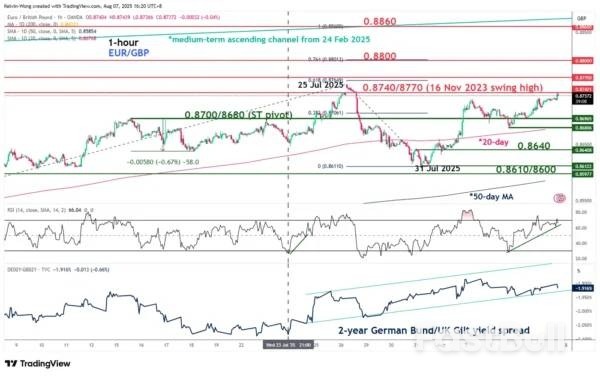
          Fig. 1: EUR/GBP minor trend as of 7 Aug 2025 (Source: TradingView)

          Preferred trend bias (1-3 days)

          The recent minor corrective decline of 145 pips seen in the EUR/GBP from the 25 July high to the 31 July low is likely to have ended.

          A potential bullish impulsive up move sequence is unfolding that supports EUR outperformance over GBP within its medium-term uptrend phase.

          Bullish bias with 0.8700/8680 as the key short-term pivotal support for the next intermediate resistances to come in at 0.8740/8770, 0.8800, and 0.8860 (Fibonacci extension and upper boundary of the medium-term ascending channel from 24 February 2025) (see Fig. 1).

          Key elements

          • The price actions of the EUR/GBP have reintegrated back above its upward sloping 20-day and 50-day moving averages, which suggests the medium-term uptrend phase remains intact.
          • Its hourly RSI momentum indicator has continued to exhibit a bullish momentum condition that advocates short-term EUR outperformance over GBP.
          • The discount yield spread between the 2-year German Bund and 2-year UK Gilt has narrowed from -2.08% to -1.92% which suggests that short-term sovereign bonds in the UK are getting “less attractive” to own than Germany’s short-term sovereign bonds. A positive driver of further potential upside in EUR/GBP.

          Alternative trend bias (1 to 3 days)

          A break below 0.8680 negates the bullish tone, where the EUR/GBP may see a minor slide to retest the next intermediate supports of 0.8640 and 0.8610/8600 (31 July 2025 minor swing low and 50-day moving average).

          Source: ACTIONFOREX

          Risk Warnings and Disclaimers
          You understand and acknowledge that there is a high degree of risk involved in trading. Following any strategies or investment methods may lead to potential losses. The content on the site is provided by our contributors and analysts for information purposes only. You are solely responsible for determining whether any trading assets, securities, strategy, or any other product is suitable for investing based on your own investment objectives and financial situation.
          Add to Favorites
          Share

          Japan's Steel Output May Sink To Lowest Since 1968 As US Tariff Risks Loom

          Winkelmann

          Commodity

          Economic

          Political

          Key points:

          ● Nippon Steel, JFE, Kobe Steel saw lower Q1 crude steel output
          ● All say US tariffs pose a great risk
          ● Japan's steel output may drop to lowest since 1968

          Kobe Steel, Japan's No. 3 steelmaker, on Thursday reported a 3% fall in quarterly crude steel output due to lower prices and the potential impact of U.S. tariffs on car production, similar to declines at Nippon Steeland JFE Holdings.With the U.S. tariff risk looming, Japan's Iron and Steel Federation has warned domestic crude steel output could fall below 80 million metric tons this year versus 84 million tons a year ago. That would be the lowest since the 67 million tons produced in 1968, the Federation said.

          The latest pressure comes as Japan's top tariff negotiator Ryosei Akazawa pressed the U.S. to swiftly implement an agreed cut to auto tariffs during a meeting this week with U.S. Secretary of Commerce Howard Lutnick in Washington.Japan is also grappling with a surge in cheap steel exports from top producer China, which is dragging down prices and prompting countries, including Japan, to consider protective trade measures.

          Japanese car sales to the U.S. are already falling as automakers shift production to the U.S., Mexico and Canada to reduce costs.For the April-June quarter, Kobe Steel's crude steel output slid 3% to 1.46 million metric tons on weaker domestic consumption in the construction and auto sectors. Nippon Steel's output fell by 7% to 9.46 million tons and JFE dropped by 3% to 5.61 million tons.

          "The downward trend in domestic steel demand will continue due to population decline, decrease in exports of finished auto to the U.S. and indirect exports by other manufacturing industries," Nippon Steel said on Friday.Nippon Steel expects a 50 billion yen hit to its annual profits from the U.S. tariffs, while Kobe Steel sees a 5 billion yen impact. JFE plans to close several domestic facilities to reduce capacity."U.S. tariff measures pose the greatest risk, particularly with regard to trends and impacts in the automotive and construction machinery sectors," JFE said in its earnings presentation on Monday.

          To offset domestic weakness, Nippon Steel and JFE are focusing on overseas expansion. Nippon Steel bought U.S. Steel (X.MC) for $15 billion, pledging close to a similar amount in investments into the newly acquired assets, betting on U.S. demand growth.JFE, together with a partner, announced a 120 billion yen investment to expand facilities in India, the biggest driver of the global steel demand, backed by heavy infrastructure spending.

          "Looking at the world, the only attractive markets for the steel industry are India and the U.S.," said Ryunosuke Shibata, analyst at SBI Securities. "Even if Asian countries have the potential to expand demand, there is a risk as China is close."To survive, "there is no choice but to expand business in growing overseas markets," Shibata said.

          Source: TradingView

          To stay updated on all economic events of today, please check out our Economic calendar
          Risk Warnings and Disclaimers
          You understand and acknowledge that there is a high degree of risk involved in trading. Following any strategies or investment methods may lead to potential losses. The content on the site is provided by our contributors and analysts for information purposes only. You are solely responsible for determining whether any trading assets, securities, strategy, or any other product is suitable for investing based on your own investment objectives and financial situation.
          Add to Favorites
          Share

          Chinese Exporters Harness Currency Options Amid Yuan Stability and Low Volatility

          Gerik

          Economic

          Exporters Leverage Currency Options as a Yield Strategy

          Amid a period of relative calm in the Chinese foreign exchange market, domestic companies especially exporters turned aggressively to derivatives trading in the first six months of 2025. New data from the State Administration of Foreign Exchange (SAFE) show that commercial banks facilitated $132.5 billion worth of dollar/yuan options sales on behalf of corporate clients. This marks an all-time high and reveals a growing appetite among Chinese firms to profit from the predictable nature of the yuan’s movements while protecting themselves from adverse currency shifts.
          The uptick in options activity is strongly correlated with declining implied volatility in the yuan. One-month implied volatility for the dollar/yuan pair hovered around 2.5% the lowest since July 2024. This low-risk environment has encouraged exporters to sell options as a source of premium income. The People's Bank of China's continued efforts to maintain yuan stability, despite external macroeconomic fluctuations and political risks, appear to have created the conditions necessary for such trading behavior.

          Dollar Weakness Supports Yuan but Limits Remain

          Although the US dollar index declined by nearly 11% during the first half of 2025, the yuan appreciated by only 1.9% in the same period. This disparity suggests that the yuan’s appreciation was managed rather than market-driven. The yuan’s upside has been constrained by underlying economic concerns at home and persistent uncertainty in US-China trade relations. As a result, exporters are not fully confident in a sustained yuan rally and are instead choosing derivative strategies that offer limited downside with the possibility of upside participation.
          Exporters are reportedly selling one-year call options with strike prices above the current spot level. This strategy creates a favorable payoff structure: if the yuan strengthens beyond the strike price within the year, the options are exercised, allowing exporters to convert at more advantageous rates. If the spot remains below the strike price, the exporter retains the premium paid by the buyer. This mechanism allows exporters to enhance their yield without the need to immediately convert their foreign earnings into yuan, which currently offers low domestic returns.

          Incentives for Dollar Holdings Amid Currency Anchoring

          The behavior of Chinese firms points to a clear causal dynamic: the central bank’s firm anchoring of the yuan discourages immediate forex conversion by reducing volatility-driven incentives. With low yields available in yuan-denominated instruments, holding foreign currency and deploying options becomes a rational strategy. The pattern suggests that exporters are not merely speculating but actively adapting to a policy-induced environment that offers minimal fluctuations and low interest rates.
          The surge in option sales also serves as a signal to policymakers. If such behavior becomes widespread and persistent, it could create latent risks in the financial system, particularly if there is a sudden shock to currency expectations. Additionally, the growing sophistication of Chinese firms in using derivatives reflects a maturing foreign exchange market. However, it also indicates that capital conversion incentives remain weak, highlighting a broader structural issue within China’s domestic financial ecosystem.
          Chinese exporters are responding to a tightly controlled currency environment with financial ingenuity, exploiting stable exchange rates and low volatility to boost returns through option sales. While this reflects a strategic response to prevailing monetary conditions, it also underscores deeper economic tensions such as low domestic yields and external trade uncertainty that continue to shape China's foreign exchange behavior. As long as the central bank maintains its current policy stance, derivative-driven strategies are likely to remain a fixture in corporate risk management and revenue enhancement.

          Source: Reuters

          To stay updated on all economic events of today, please check out our Economic calendar
          Risk Warnings and Disclaimers
          You understand and acknowledge that there is a high degree of risk involved in trading. Following any strategies or investment methods may lead to potential losses. The content on the site is provided by our contributors and analysts for information purposes only. You are solely responsible for determining whether any trading assets, securities, strategy, or any other product is suitable for investing based on your own investment objectives and financial situation.
          Add to Favorites
          Share

          USDJPY Fell To Support At 147.00

          Blue River

          Forex

          Economic

          Technical Analysis

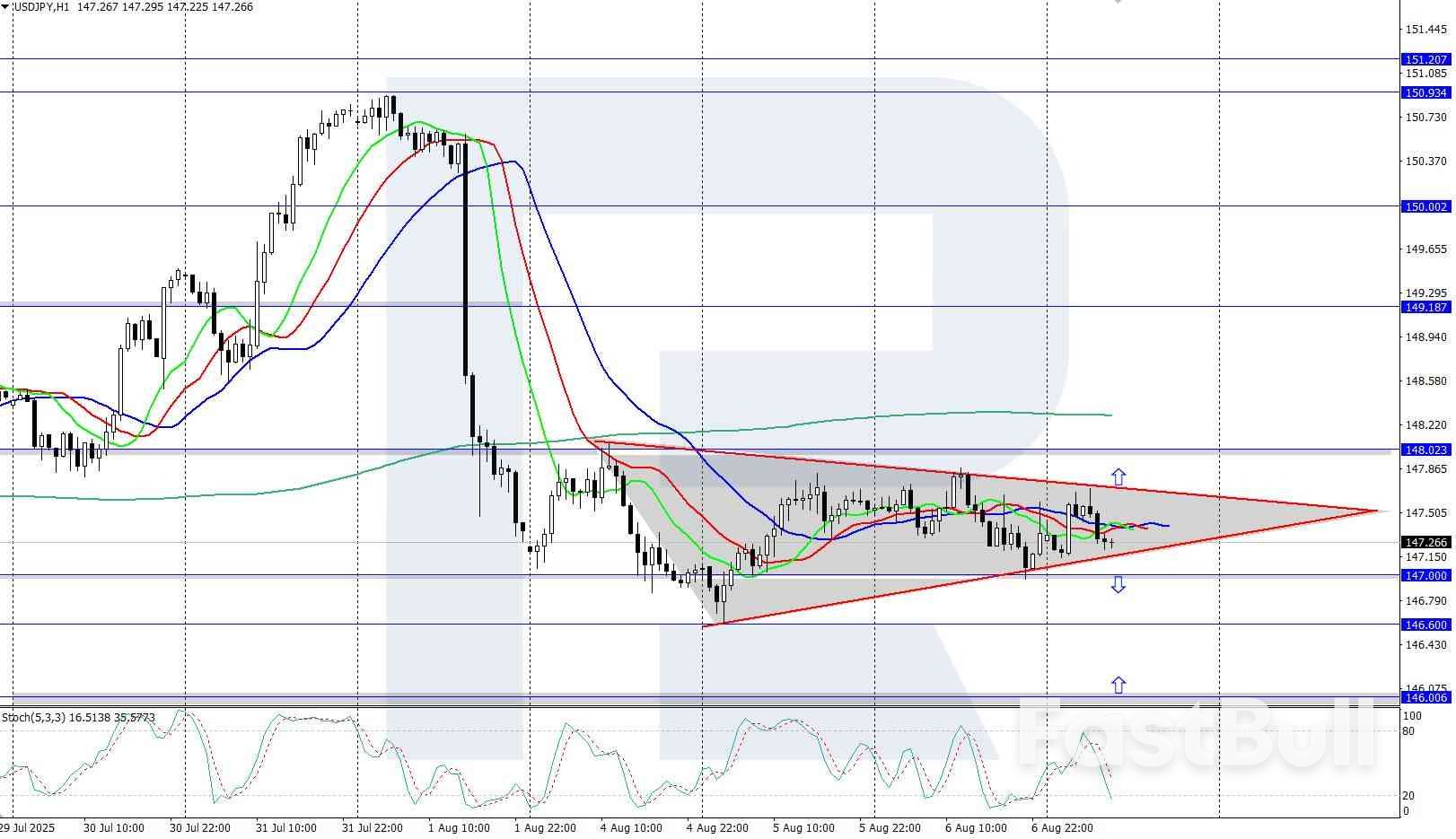
          The USDJPY pair has fallen to the area around 147.00 due to general US dollar weakness and strong Japanese statistics. A Triangle pattern is forming on the chart, indicating a possible continuation of the pair’s downtrend.

          The USDJPY rate is declining, falling to the support area around 147.00 amid general dollar weakness and positive data from Japan. Find out more in our analysis for 7 August 2025.

          USDJPY forecast: key trading points

          ●Market focus: Japan's Leading Index rose to 106.1 in June, the highest since March this year
          ●Current trend: moving downwards
          ●USDJPY forecast for 7 August 2025: 148.00 or 146.00

          Fundamental analysis

          The Japanese yen is moderately strengthening amid positive economic data. Japan’s Leading Index, which reflects economic prospects for the coming months, rose to 106.1 in June 2025 according to preliminary estimates, compared to the final reading of 104.8 in May.

          Last week, the Bank of Japan left interest rates unchanged but raised its inflation forecast, warning of growing risks due to current global trade tensions. The minutes from the monetary policy meeting showed that the central bank remains open to further rate hikes, particularly if external risks subside.

          USDJPY technical analysis

          The USDJPY pair is declining, with a Triangle pattern forming on the H1 chart. The Alligator indicator is moving downwards, confirming the ongoing bearish trend. The current local support stands at 147.00; a breakout below this level could pave the way to 146.00.

          Today's USDJPY forecast suggests the pair may dip further towards 147.00 and lower if bears maintain momentum. Conversely, a bullish scenario will become possible if buyers reverse the pair and gain a foothold above 148.00, potentially opening the path towards the 149.00 resistance level.

          Source: RoboForex

          To stay updated on all economic events of today, please check out our Economic calendar
          Risk Warnings and Disclaimers
          You understand and acknowledge that there is a high degree of risk involved in trading. Following any strategies or investment methods may lead to potential losses. The content on the site is provided by our contributors and analysts for information purposes only. You are solely responsible for determining whether any trading assets, securities, strategy, or any other product is suitable for investing based on your own investment objectives and financial situation.
          Add to Favorites
          Share

          Ethereum ETH At $4,500? Wave Theory Meets Open Interest In Bullish Sync

          Samantha Luan

          Cryptocurrency

          Forex

          ● A completed Wave 4 and bullish Fibonacci bounce signal ETH’s next leg higher is underway.
          ● There is a high capital inflow and positioning in the futures market, which supports the bullish run of Ethereum.
          ● Although it has experienced several rejections around the 4,000 mark, ETH trades at high lows—a pointer that could lead to a breakout.

          There is a positive indication of Ethereum, as technical and derivatives data indicate that it might break past levels in excess of 4000 dollars. The price action aligns with wave theory and increasing open interest, signaling market strength. ETH is trading near $3,681, and a push toward $4,500 is becoming a key focus.

          ETHUSD Shows Wave Structure Supporting Upside

          The structure of the price movement of Ethereum shows that a full corrective Wave 4 is completed, and Wave 5 might be underway on the 3-day chart. Analysts point out that ETH pulled back at the 50 percent Fibonacci retracement as the past support is visible. A zone of Fibonacci between 0.618 and 0.65 served as a bouncing zone, resisting the downward trend.

          Elliott Wave labeling shows sub-waves forming, which supports an extended upward move if ETH maintains current levels. The chart reflects earlier waves with strong impulses, indicating that price continuation is likely. If ETH surpasses $4,000, the wave structure suggests $4,500 is a logical target.ETHUSD now trades under heavy observation, as it must break the $4,000 resistance to validate the fifth wave projection. Previous peaks align with strong rejection zones, but volume and trend structure show readiness for a breakout. Traders are watching for a firm candle close above $4,000.

          ETH Futures Open Interest Backs Bullish Outlook

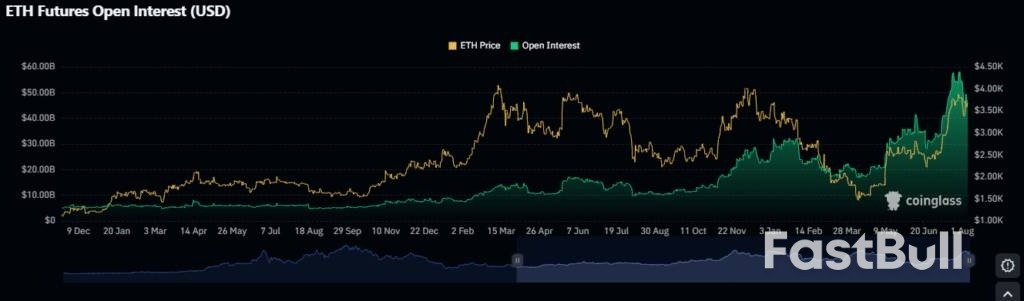
          ETH futures open interest has steadily increased since June, aligning with price gains across spot and derivative markets. Data from Coinglass confirms a surge in open interest, which reached multi-year highs as ETH neared $4,500. This pattern reflects strong market participation and capital inflows.

          Open interest rising with price usually indicates new capital rather than profit-taking, suggesting stronger positioning. The current trend supports the wave structure analysis and confirms bullish behavior. If open interest continues climbing, Ethereum may extend gains without deep retracements.Unlike past cycles, this rise shows sustained demand and leveraged exposure without major sell-offs. Earlier phases saw drops after peaks, but this rally has broader participation. ETH may soon test the $4,500 level if support zones hold and sentiment remains aligned.

          ETH Faces Resistance But Maintains Higher Lows

          On the weekly chart, Ethereum faced four rejections at the $3,950–$4,000 zone but has continued forming higher lows. Price remains inside a tight consolidation range, but the longer it holds, the higher the breakout probability. ETH’s price action shows pressure building just under resistance.

          Repeated failures to break $4,000 usually indicate exhaustion, but not in this case. Market structure holds, and the reaction to pullbacks is quick and shallow. This behavior supports the view that ETH will make another attempt soon.Support levels below include $3,200 and $2,400, but these remain untouched in the latest rally. The higher lows suggest strength despite resistance. ETH is close to unlocking the next move, and the target remains $4,500.

          Source: CryptoSlate

          Risk Warnings and Disclaimers
          You understand and acknowledge that there is a high degree of risk involved in trading. Following any strategies or investment methods may lead to potential losses. The content on the site is provided by our contributors and analysts for information purposes only. You are solely responsible for determining whether any trading assets, securities, strategy, or any other product is suitable for investing based on your own investment objectives and financial situation.
          Add to Favorites
          Share
          FastBull
          Copyright © 2025 FastBull Ltd

          728 RM B 7/F GEE LOK IND BLDG NO 34 HUNG TO RD KWUN TONG KLN HONG KONG

          TelegramInstagramTwitterfacebooklinkedin
          App Store Google Play Google Play
          Products
          Charts

          Chats

          Q&A with Experts
          Screeners
          Economic Calendar
          Data
          Tools
          Membership
          Features
          Function
          Markets
          Copy Trading
          Latest Signals
          Contests
          News
          Analysis
          24/7
          Columns
          Education
          Company
          Careers
          About Us
          Contact Us
          Advertising
          Help Center
          Feedback
          User Agreement
          Privacy Policy
          Business

          White Label

          Data API

          Web Plug-ins

          Poster Maker

          Affiliate Program

          Risk Disclosure

          The risk of loss in trading financial instruments such as stocks, FX, commodities, futures, bonds, ETFs and crypto can be substantial. You may sustain a total loss of the funds that you deposit with your broker. Therefore, you should carefully consider whether such trading is suitable for you in light of your circumstances and financial resources.

          No decision to invest should be made without thoroughly conducting due diligence by yourself or consulting with your financial advisors. Our web content might not suit you since we don't know your financial conditions and investment needs. Our financial information might have latency or contain inaccuracy, so you should be fully responsible for any of your trading and investment decisions. The company will not be responsible for your capital loss.

          Without getting permission from the website, you are not allowed to copy the website's graphics, texts, or trademarks. Intellectual property rights in the content or data incorporated into this website belong to its providers and exchange merchants.

          Not Logged In

          Log in to access more features

          FastBull Membership

          Not yet

          Purchase

          Become a signal provider
          Help Center
          Customer Service
          Dark Mode
          Price Up/Down Colors

          Log In

          Sign Up

          Position
          Layout
          Fullscreen
          Default to Chart
          The chart page opens by default when you visit fastbull.com