• Trade
  • Markets
  • Copy
  • Contests
  • News
  • 24/7
  • Calendar
  • Q&A
  • Chats
Trending
Screeners
SYMBOL
LAST
BID
ASK
HIGH
LOW
NET CHG.
%CHG.
SPREAD
SPX
S&P 500 Index
6827.42
6827.42
6827.42
6899.86
6801.80
-73.58
-1.07%
--
DJI
Dow Jones Industrial Average
48458.04
48458.04
48458.04
48886.86
48334.10
-245.98
-0.51%
--
IXIC
NASDAQ Composite Index
23195.16
23195.16
23195.16
23554.89
23094.51
-398.69
-1.69%
--
USDX
US Dollar Index
98.000
98.080
98.000
98.070
97.920
+0.050
+ 0.05%
--
EURUSD
Euro / US Dollar
1.17335
1.17342
1.17335
1.17447
1.17283
-0.00059
-0.05%
--
GBPUSD
Pound Sterling / US Dollar
1.33563
1.33572
1.33563
1.33740
1.33549
-0.00144
-0.11%
--
XAUUSD
Gold / US Dollar
4326.87
4327.32
4326.87
4329.64
4294.68
+27.48
+ 0.64%
--
WTI
Light Sweet Crude Oil
57.536
57.573
57.536
57.601
57.194
+0.303
+ 0.53%
--

Community Accounts

Signal Accounts
--
Profit Accounts
--
Loss Accounts
--
View More

Become a signal provider

Sell trading signals to earn additional income

View More

Guide to Copy Trading

Get started with ease and confidence

View More

Signal Accounts for Members

All Signal Accounts

Best Return
  • Best Return
  • Best P/L
  • Best MDD
Past 1W
  • Past 1W
  • Past 1M
  • Past 1Y

All Contests

  • All
  • Trump Updates
  • Recommend
  • Stocks
  • Cryptocurrencies
  • Central Banks
  • Featured News
Top News Only
Share

Reuters Poll - Bank Of Thailand To Lower Key Policy Rate To 1.00% In Q1 Of 2026, Said A Majority Of Economists

Share

Reuters Poll - Bank Of Thailand To Cut Its Key Interest Rate To 1.25% On December 17, Said 26 Of 27 Economists

Share

Thai Finance Minister: Earlier Stimulus Measures To Shore Up Economy

Share

Thai Finance Minister: Strong Baht Driven By Capital Inflows

Share

Thai Finance Minister: Has Discussed With Central Bank To Handle Baht

Share

India's Nifty Bank Futures Down 0.1% In Pre-Open Trade

Share

India's Nifty 50 Futures Down 0.3% In Pre-Open Trade

Share

India's Nifty 50 Index Down 0.45% In Pre-Open Trade

Share

Indian Rupee Weakens Past 90.55 Versus USA Dollar To All-Time Low

Share

China's Fossil-Fuelled Power Generation Falls 4.2% Year-On-Year In November

Share

Indian Rupee Opens Down 0.1% At 90.5450 Per USA Dollar, Versus 90.4150 Previous Close

Share

Australia Home Minister: Father Involved In Bondi Gun Attack Came To Australia On Student Visa, Son Is An Australian-Born Citizen

Share

Australian Prime Minister Albanese: Stricter Gun Control Laws Will Include Restrictions On The Number Of Guns An Individual Can Own Or License To Use

Share

Australia's Prime Minister Albanese: We Are Considering A Review Of Gun Licenses For Some Time

Share

Australia's Prime Minister Albanese: Government Considering Tougher Gun Laws

Share

China Stats Bureau Spokesperson: Next Year, Adverse Impact Of Protectionism And Unilateralism May Continue

Share

China's Onshore Yuan Strengthens To A High Of 7.0516 Per Dollar, Strongest Level Since Oct 8, 2024

Share

Indonesia's November Refined Tin Exports At 7458.64 Metric Tons

Share

China's National Bureau Of Statistics: In The Next Stage, We Will Continue To Implement The Special Action To Boost Consumption And Focus On Stabilizing Employment And Promoting Income Growth

Share

China Stats Bureau Spokesperson: Household Consumption Capability And Confidence Needs To Be Further Improved

TIME
ACT
FCST
PREV
U.K. Trade Balance (Oct)

A:--

F: --

P: --

France HICP Final MoM (Nov)

A:--

F: --

P: --

China, Mainland Outstanding Loans Growth YoY (Nov)

A:--

F: --

P: --

China, Mainland M2 Money Supply YoY (Nov)

A:--

F: --

P: --

China, Mainland M0 Money Supply YoY (Nov)

A:--

F: --

P: --

China, Mainland M1 Money Supply YoY (Nov)

A:--

F: --

P: --

India CPI YoY (Nov)

A:--

F: --

P: --

India Deposit Gowth YoY

A:--

F: --

P: --

Brazil Services Growth YoY (Oct)

A:--

F: --

P: --

Mexico Industrial Output YoY (Oct)

A:--

F: --

P: --

Russia Trade Balance (Oct)

A:--

F: --

P: --

Philadelphia Fed President Henry Paulson delivers a speech
Canada Building Permits MoM (SA) (Oct)

A:--

F: --

P: --

Canada Wholesale Sales YoY (Oct)

A:--

F: --

P: --

Canada Wholesale Inventory MoM (Oct)

A:--

F: --

P: --

Canada Wholesale Inventory YoY (Oct)

A:--

F: --

P: --

Canada Wholesale Sales MoM (SA) (Oct)

A:--

F: --

P: --

Germany Current Account (Not SA) (Oct)

A:--

F: --

P: --

U.S. Weekly Total Rig Count

A:--

F: --

P: --

U.S. Weekly Total Oil Rig Count

A:--

F: --

P: --

Japan Tankan Small Manufacturing Outlook Index (Q4)

A:--

F: --

P: --

Japan Tankan Large Non-Manufacturing Diffusion Index (Q4)

A:--

F: --

P: --

Japan Tankan Large Non-Manufacturing Outlook Index (Q4)

A:--

F: --

P: --

Japan Tankan Large Manufacturing Outlook Index (Q4)

A:--

F: --

P: --

Japan Tankan Small Manufacturing Diffusion Index (Q4)

A:--

F: --

P: --

Japan Tankan Large Manufacturing Diffusion Index (Q4)

A:--

F: --

P: --

Japan Tankan Large-Enterprise Capital Expenditure YoY (Q4)

A:--

F: --

P: --

U.K. Rightmove House Price Index YoY (Dec)

A:--

F: --

P: --

China, Mainland Industrial Output YoY (YTD) (Nov)

A:--

F: --

P: --

China, Mainland Urban Area Unemployment Rate (Nov)

A:--

F: --

P: --

Saudi Arabia CPI YoY (Nov)

--

F: --

P: --

Euro Zone Industrial Output YoY (Oct)

--

F: --

P: --

Euro Zone Industrial Output MoM (Oct)

--

F: --

P: --

Canada Existing Home Sales MoM (Nov)

--

F: --

P: --

Euro Zone Total Reserve Assets (Nov)

--

F: --

P: --

U.K. Inflation Rate Expectations

--

F: --

P: --

Canada National Economic Confidence Index

--

F: --

P: --

Canada New Housing Starts (Nov)

--

F: --

P: --

U.S. NY Fed Manufacturing Employment Index (Dec)

--

F: --

P: --

U.S. NY Fed Manufacturing Index (Dec)

--

F: --

P: --

Canada Core CPI YoY (Nov)

--

F: --

P: --

Canada Manufacturing Unfilled Orders MoM (Oct)

--

F: --

P: --

U.S. NY Fed Manufacturing Prices Received Index (Dec)

--

F: --

P: --

U.S. NY Fed Manufacturing New Orders Index (Dec)

--

F: --

P: --

Canada Manufacturing New Orders MoM (Oct)

--

F: --

P: --

Canada Core CPI MoM (Nov)

--

F: --

P: --

Canada Trimmed CPI YoY (SA) (Nov)

--

F: --

P: --

Canada Manufacturing Inventory MoM (Oct)

--

F: --

P: --

Canada CPI YoY (Nov)

--

F: --

P: --

Canada CPI MoM (Nov)

--

F: --

P: --

Canada CPI YoY (SA) (Nov)

--

F: --

P: --

Canada Core CPI MoM (SA) (Nov)

--

F: --

P: --

Canada CPI MoM (SA) (Nov)

--

F: --

P: --

Federal Reserve Board Governor Milan delivered a speech
U.S. NAHB Housing Market Index (Dec)

--

F: --

P: --

Australia Composite PMI Prelim (Dec)

--

F: --

P: --

Australia Services PMI Prelim (Dec)

--

F: --

P: --

Australia Manufacturing PMI Prelim (Dec)

--

F: --

P: --

Japan Manufacturing PMI Prelim (SA) (Dec)

--

F: --

P: --

U.K. Unemployment Rate (Nov)

--

F: --

P: --

U.K. 3-Month ILO Unemployment Rate (Oct)

--

F: --

P: --

Q&A with Experts
    • All
    • Chatrooms
    • Groups
    • Friends
    Connecting
    .
    .
    .
    Type here...
    Add Symbol or Code

      No matching data

      All
      Trump Updates
      Recommend
      Stocks
      Cryptocurrencies
      Central Banks
      Featured News
      • All
      • Russia-Ukraine Conflict
      • Middle East Flashpoint
      • All
      • Russia-Ukraine Conflict
      • Middle East Flashpoint
      Search
      Products

      Charts Free Forever

      Chats Q&A with Experts
      Screeners Economic Calendar Data Tools
      Membership Features
      Data Warehouse Market Trends Institutional Data Policy Rates Macro

      Market Trends

      Market Sentiment Order Book Forex Correlations

      Top Indicators

      Charts Free Forever
      Markets

      News

      News Analysis 24/7 Columns Education
      From Institutions From Analysts
      Topics Columnists

      Latest Views

      Latest Views

      Trending Topics

      Top Columnists

      Latest Update

      Signals

      Copy Rankings Latest Signals Become a signal provider AI Rating
      Contests
      Brokers

      Overview Brokers Assessment Rankings Regulators News Claims
      Broker listing Forex Brokers Comparison Tool Live Spread Comparison Scam
      Q&A Complaint Scam Alert Videos Tips to Detect Scam
      More

      Business
      Events
      Careers About Us Advertising Help Center

      White Label

      Data API

      Web Plug-ins

      Affiliate Program

      Awards Institution Evaluation IB Seminar Salon Event Exhibition
      Vietnam Thailand Singapore Dubai
      Fans Party Investment Sharing Session
      FastBull Summit BrokersView Expo
      Recent Searches
        Top Searches
          Markets
          News
          Analysis
          User
          24/7
          Economic Calendar
          Education
          Data
          • Names
          • Latest
          • Prev

          View All

          No data

          Scan to Download

          Faster Charts, Chat Faster!

          Download App
          English
          • English
          • Español
          • العربية
          • Bahasa Indonesia
          • Bahasa Melayu
          • Tiếng Việt
          • ภาษาไทย
          • Français
          • Italiano
          • Türkçe
          • Русский язык
          • 简中
          • 繁中
          Open Account
          Search
          Products
          Charts Free Forever
          Markets
          News
          Signals

          Copy Rankings Latest Signals Become a signal provider AI Rating
          Contests
          Brokers

          Overview Brokers Assessment Rankings Regulators News Claims
          Broker listing Forex Brokers Comparison Tool Live Spread Comparison Scam
          Q&A Complaint Scam Alert Videos Tips to Detect Scam
          More

          Business
          Events
          Careers About Us Advertising Help Center

          White Label

          Data API

          Web Plug-ins

          Affiliate Program

          Awards Institution Evaluation IB Seminar Salon Event Exhibition
          Vietnam Thailand Singapore Dubai
          Fans Party Investment Sharing Session
          FastBull Summit BrokersView Expo

          Iranian State Sources Warn Retaliation On US Bases Coming In Next 'Hours'

          Thomas

          Political

          Summary:

           Iranian state media sources are reporting that Iran is likely to attack US military facilities in the Mideast region 'in the coming hours'.

          Iranian state media sources are reporting that Iran is likely to attack US military facilities in the Mideast region 'in the coming hours'.

          There are an estimated 40,000 American troops throughout the whole region, including at bases and on warships in the CENTCOM area of responsibility.

          On Sunday the NY Times had cited US officials to say anonymous US military and intelligence officials had detected signs that Iran-backed groups are preparing hostile action against US forces in places like Syria and Iraq. There's also the possibility of direct Iranian ballistic missile launches on bases in Iraq, just as happened in the wake of Soleimani's assassination during the first Trump administration.

          But is this response being telegraphed or even coordinated with the US so as to avoid uncontrollable escalation? Israeli journalist Amit Segal reports:

          Senior Israeli officials assess that Iran will, in one way or another, coordinate its attack on the United States — similar to how it acted following the assassination of Qassem Soleimani. This is intended to avoid an unplanned escalation and out of hope to contain the incident. Perhaps in this context come the reports suggesting that the U.S. already knows the attack will take place within the next 48 hours.

          Iranian missile and drone attacks on Israel started out fierce and sustained, but have waned in the last days. Tehran is not expected to go after US assets with such intensity, fearing that Washington could launch a full war of regime change targeting the Ayatollah.

          White House Press Secretary Karoline Leavitt has said in a fresh interview that the US administration is 'confident' that Saturday’s bombings of three key Iranian nuclear sites accomplished the job of dismantling Tehran’s alleged nuclear ambitions. She also said Trump made the decision "based on his own instincts and the US intelligence that he saw."

          "This strike on Saturday did make our homeland safer because it took away Iran’s ability to create a nuclear bomb. This is a regime that threatens ‘death to America,’ and ‘death to Israel, and they no longer have the capability to build this nuclear weapon and threaten the world," she told ABC News on Monday morning while making media rounds.

          At a moment White House officials have been trying to downplay that this is a conflict of regime change in Iran, Leavitt did say the US is seeking to "Take away the power of this incredibly violent regime."

          Fordow, Isfahan and Natanz were hit with huge bunker-buster bombs over the weekend, after which President Trump late Sunday declared on Truth Social: “Monumental Damage was done to all Nuclear sites in Iran, as shown by satellite images. Obliteration is an accurate term!”

          However, UN inspectors at the IAEA currently have no access to the impacted sites of Fordow, Isfahan and Natanz - and the country remains essentially a warzone, also with airspace closed- as the region braces for potential Iranian response against US bases and assets. And of course, satellites can't assess damage underground, where the enrichment facilities and stockpiles are located.

          Press Secretary on FOX: "why shouldn't the Iranian people take away the power of this incredibly violent regime?"

          Also interesting is that Leavitt repeated the US administration talking point that the intel on Iran that Trump was provided made clear that Iran was 'weeks' from a nuclear weapon.

          It remains that once again the American people are being led into supporting another US war and quagmire in the Middle East based on 'trust us!' from this administration, citing vague 'intel reports' on WMD, which sounds suspiciously like the faulty Bush-Cheney case against Saddam Hussein.

          Still, the White House official narrative remains that Trump is not seeking full regime change in Iran, and this is also how Israeli media is presenting it in recent headlines:

          “The President’s posture and our military posture has not changed,” White House Press Secretary Karoline Leavitt tells reporters.

          “The president was simply raising a question that I think many people around the world are asking: if the Iranian regime refuses to give up its nuclear program or engage in talks… if they refuse to engage in diplomacy moving forward, why shouldn’t the Iranian people rise up against this brutal terrorist regime?”

          So we are already in the 'Iranian people should rise up' phase of this war.

          Below are all the latest headlines and developments of the last 24-48 hours...

          Israel-Iran Latest Highlights

          • US President Trump confirmed the launch of “Operation Midnight Hammer”, which involved targeted strikes on Iran’s nuclear facilities at Fordow, Natanz, and Isfahan. The operation used 125 aircraft, including seven B-2 bombers, alongside submarine-launched Tomahawk cruise missiles. Fourteen GBU-57 Massive Ordnance Penetrators ("bunker busters") were deployed to penetrate deeply buried targets, notably Fordow.
          • Satellite imagery shows significant damage at all facilities. Trump described it as a joint effort with Israel.
          • IAEA say the damage assessment is pending; no signs of radiation leak.
          • In retaliation, Iran's parliament has approved the closure of the Strait of Hormuz after the US launched strikes against the country’s nuclear facilities. Iran’s security body will make the final decision on whether to proceed with the plan, state television reported.
          • Iran retaliated by missile strikes on Israel. Has said future action could target over 20 US bases or naval assets. Iran's Military Central Command says powerful operations with heavy consequences for the US are to be expected. US entering the conflict expands the list of legitimate targets for Iran.
          • The European morning has seen a slew of geopolitical updates (see section below). Some additional USD strength on: an Iranian provincial official says Israel is targeting the Fordow nuclear facility, via Tasnim. Israel struck Fordow's access road, to prevent certain elements from approaching the area, according to Journalist Stein.
          • Iran's Military Central Command says powerful operations with heavy consequences for the US are to be expected. US entering the conflict expands the list of legitimate targets for Iran.
          • Iran's Army Chief says they are now free to take action against US interests, via IRNA.
          • Iranian city Karaj has been targeted by Israeli missiles, according to Fars; reports of large explosions being heard in Tehran.
          • Russian Kremlin says President Putin will receive the Iranian Foreign Minister later today. Communication channels remain open with the US, a call between US President Trump and Putin can be "quickly organised if required"; no current plans for a call. Iran can share its proposals later today.

          US Strike Operations

          • US President Trump confirmed the launch of “Operation Midnight Hammer”, which involved targeted strikes on Iran’s nuclear facilities at Fordow, Natanz, and Isfahan. The operation used 125 aircraft, including seven B-2 bombers, alongside submarine-launched Tomahawk cruise missiles.
          • Fourteen GBU-57 Massive Ordnance Penetrators ("bunker busters") were deployed to penetrate deeply buried targets, notably Fordow.
          • Satellite imagery confirmed significant infrastructure damage at all three nuclear sites, with Fordow showing six fresh craters.
          • All targets were reportedly struck between 23:40 BST (Saturday) and 00:05 BST (Sunday). Iran’s air defence systems failed to detect or intercept the incoming attacks.
          • Trump described the attack as a joint effort with Israel, saying they “worked as a team like perhaps no team has ever worked before.”
          • Axios quoted officials as saying that Whitkov told Araqchi during the operation that “the strike is only once.” He confirmed that Washington was still seeking a diplomatic solution and wanted Tehran to return to negotiations.
          • US President Trump did not want to continue striking Iran, but he would do so if US bases were targeted, according to Sky News Arabia citing Axios.
          • US President Trump reportedly directed staff to announce a two-week window in order to conceal plans for the Iran attack, according to CNN sources.

          Damage Assessment & Nuclear Risk

          • IAEA Director General Grossi said craters are visible at Fordow, Natanz suffered direct hits, and tunnel entrances at Isfahan were struck. Full underground damage assessment remains pending. A special IAEA board meeting is scheduled for Monday.
          • Chairman of the Joint Chiefs Gen. Dan Caine stated it is “too early” to assess whether Iran’s nuclear capability was fully neutralised.
          • US intelligence officials have raised concerns Iran may have relocated enriched uranium stockpiles in advance.
          • US Secretary of State Rubio urged Iran to surrender its enriched uranium stockpiles, claiming they remain buried under Isfahan and likely were not moved before the strikes.
          • The IAEA reported no signs of a radiation leak. Saudi Arabia’s Nuclear and Radiological Regulatory Authority confirmed no radioactive effects were detected in Gulf states.

          Strait of Hormuz & Oil Flow Threat

          • The Iranian parliament has approved the closure of the Strait of Hormuz after the US launched strikes against the country’s nuclear facilities. Iran’s security body will make the final decision on whether to proceed with the plan, state television reported.
          • US Secretary of State Rubio warned such a move would be “economic suicide” for Iran but remains a credible escalation vector.
          • NOTE: Market contacts have suggested OPEC+ have not had any calls, with no talks of an emergency meeting yet amid no signs of supply disruptions, yet.

          Iranian Military Response

          • Iran launched retaliatory missile strikes on Tel Aviv and Haifa, Israel, resulting in at least 86 reported injuries.
          • Iranian officials have warned that future actions could target over 20 US bases or naval assets in the region.
          • Iran stated that its military would determine the timing, nature, and scale of its response, according to Reuters.
          • Signs have emerged of Iran‑backed militias preparing to attack US bases in Iraq and Syria, according to Sky News Arabia citing The New York Times.
          • Iranian air defences reportedly activated in Isfahan, targeting hostile Israeli aircraft.
          • Iranian forces reported that Israeli airstrikes killed nine personnel — seven Revolutionary Guards and two conscripts — in Yazd province.

          Iranian Messaging

          • Iran is weighing its response — with its Foreign Minister saying “all options” are on the table after Washington proved “they only understand the language of threat and force”, according to CNN.
          • Supreme Leader Khamenei warned that US strikes would “result in irreparable damage” to the US.
          • Iran’s President Pezeshkian warned of a “more devastating” retaliation if Israel’s bombing campaign continued.
          • Iranian regime sources denied any major nuclear material loss from the strikes, implying the sites had been pre-emptively evacuated.
          • Iran’s Crisis Management HQ stated there was “no danger” to civilians near Fordow; state media reported the site had “long been evacuated.”
          • An adviser to Khamenei claimed Iran still retains its enriched uranium, indigenous nuclear knowledge, and political will, despite facility damage.
          • Iran’s Foreign Minister condemned the strikes as a violation of international law and the Nuclear Non-Proliferation Treaty.
          • The Iranian Atomic Energy Organisation called the attacks “a barbaric act” breaching international law.

          International Reactions

          • The UN Security Council held an emergency meeting at 20:00 BST on Sunday in response to the strikes. US Ambassador Dorothy Shea defended the operation; China, Russia, and Pakistan called for an immediate ceasefire and accused the US of breaching the UN Charter.
          • The UN and EU called for de-escalation, with Secretary-General António Guterres warning of a “dangerous escalation.”
          • The E3 (UK, France, Germany) released a joint statement urging Iran to return to nuclear negotiations and warning against further destabilising actions.
          • Gulf Arab states including Qatar, Saudi Arabia, and Kuwait condemned the US strikes, calling for restraint and diplomatic resolution.
          • UK PM Keir Starmer backed the US strike, describing it as a response to a “grave threat.”
          • Israeli PM Netanyahu praised the US action, calling it a display of “awesome and righteous might” that could “change history.”
          • Saudi Arabia, Oman, and India expressed concern and urged all sides to pursue diplomatic solutions.

          US Political & Legal Fallout

          • Congressional response to the strikes was mixed. Most Republicans expressed support, with Senator Ted Cruz praising the operation. However, some dissent emerged within the party, notably from Representative Marjorie Taylor Greene, who stated, “Not our fight.” Democrats strongly criticised the move; Senator Bernie Sanders labelled it “grossly unconstitutional” and accused President Trump of bypassing Congress.
          • US Department of Justice said President Trump had the authority under Article II to order Iran strikes without congressional approval, but a prolonged conflict might require Congress’s involvement, according to CNN.
          • US President Trump to meet with National Security team at 13:00 EDT/18:00 BST on Monday, according to Bloomberg.

          Trump on Truth Social

          • US President Trump posted on Sunday "The damage to the Nuclear sites in Iran is said to be “monumental.” The hits were hard and accurate. Great skill was shown by our military. " Trump added that "if the current Iranian Regime is unable to MAKE IRAN GREAT AGAIN, why wouldn’t there be a Regime change", and that "The GREAT B-2 pilots have just landed, safely, in Missouri."
          • President Trump later posted "Monumental Damage was done to all Nuclear sites in Iran, as shown by satellite images. Obliteration is an accurate term!... The biggest damage took place far below ground level. Bullseye!!!"

          US Homeland Security & Domestic Threats

          • The US is on high alert for Iranian-backed terrorist attacks, especially in the 48 hours following the strike. FBI, DHS, and local law enforcement have increased security presence at places of worship in major cities including New York and Washington, DC.
          • DHS warned of a heightened domestic threat environment, including potential for cyberattacks or lone-wolf incidents inspired by religious rulings.
          • The White House is monitoring potential Iranian sleeper cells inside the US.
          • VP Vance stated the administration is watching known terror watch list individuals who entered during the Biden era.

          Regional Axis Responses/Headlines

          • Iranian Foreign Minister Araghchi arrived in Moscow to consult with President Putin. Russia condemned the US strikes as a “flagrant violation of international law.”
          • Iran's Foreign Minister Araqchi said he would discuss tackling common challenges and threats with Russian President Putin, according to Iranian news agency SNN.
          • Hezbollah condemned the US strikes, calling them a violation of international and humanitarian law and warned the conflict could spiral globally.
          • A Yemeni Houthi official warned retaliation for the US attack was “only a matter of time.”

          Source: Zero Hedge

          Risk Warnings and Disclaimers
          You understand and acknowledge that there is a high degree of risk involved in trading. Following any strategies or investment methods may lead to potential losses. The content on the site is provided by our contributors and analysts for information purposes only. You are solely responsible for determining whether any trading assets, securities, strategy, or any other product is suitable for investing based on your own investment objectives and financial situation.
          Add to Favorites
          Share

          EURUSD Buyers Defend 1.1445 Support And Reverse Higher. EURUSD Retests Friday High

          Blue River

          Forex

          Technical Analysis

          EURUSD technicals

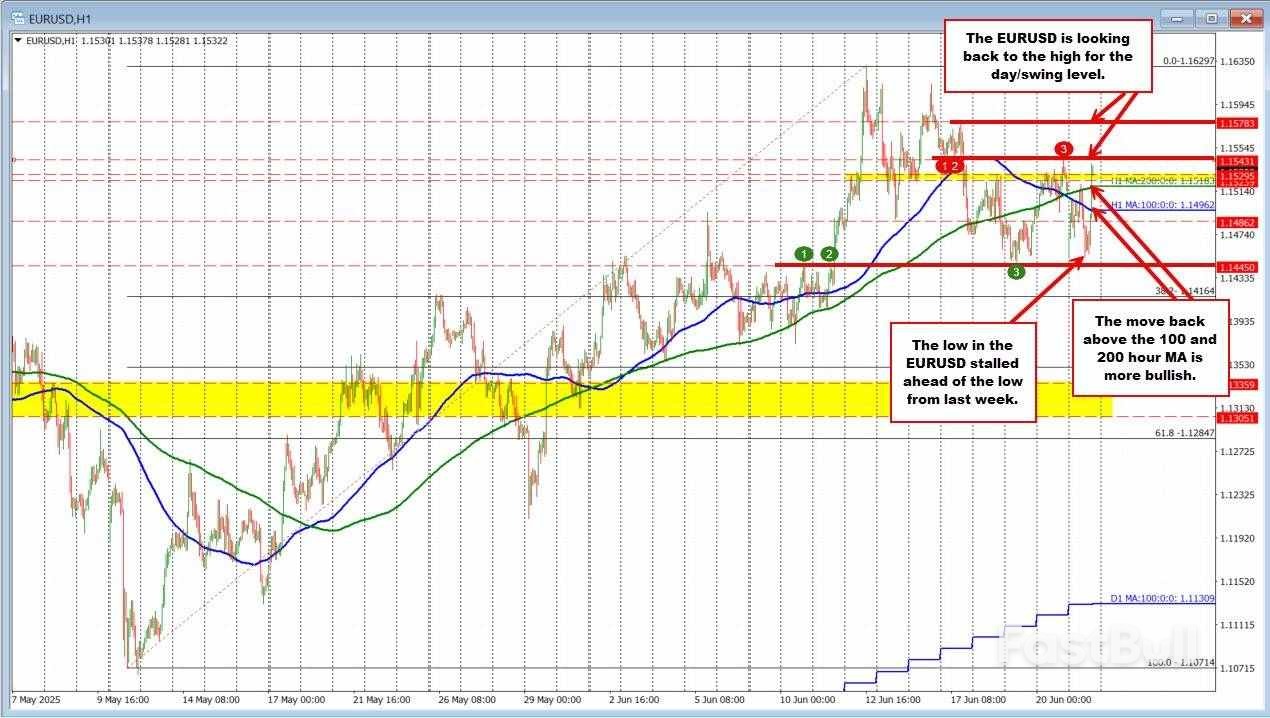
          After a soft European open, an early rally in the Asian session saw the EURUSD stall at the 200-hour MA (≈ 1.1518) and slipped under the 100-hour line (1.1496). Dip-buyers on the 2nd move lower on the day, stepped in just ahead of last week’s swing floor at 1.1445, marking another successful defense of that level (see green numbered circles).

          Fresh USD selling followed dovish remarks from Fed Governor Bowman—echoing Waller’s “July cut” hint from Friday—while calmer headlines out of the Middle East nudged Treasury yields lower. The pair powered back above both hourly averages and is now poking at Friday’s peak near 1.1543. A clean break would confirm the intraday bullish reversal and target swing highs from the last few weeks at 1.1578, 1.1614 and the high for the year (and going back to 2021) at 1.16297.

          Conversely, a failure to hold the dual-MA band (1.1518-1.1496) would hand momentum back to sellers and refocus attention on 1.1466 and the pivotal 1.1445 floor.

          Key technical levels

          Resistance:

          ● 1.1543 – Friday / day high

          ● 1.1578 – 24 May swing cap

          ● 1.1614 – high from June 16

          ● 1.16297 - high for the year and going back to 2021

          Support:

          ● 1.1518 – 200-hour MA

          ● 1.1496 – 100-hour MA

          ● 1.1445– swing level (green circles)

          ● 1.1416 – 38.2% retracement level

          Bias stays tilted higher while EURUSD holds above the 1.1518-1.1496 zone.

          Source: ForexLive

          Risk Warnings and Disclaimers
          You understand and acknowledge that there is a high degree of risk involved in trading. Following any strategies or investment methods may lead to potential losses. The content on the site is provided by our contributors and analysts for information purposes only. You are solely responsible for determining whether any trading assets, securities, strategy, or any other product is suitable for investing based on your own investment objectives and financial situation.
          Add to Favorites
          Share

          US Indices Forecast: Tech Stocks and Fed Policy Drive Market Outlook After Iran Strike

          Adam

          Stocks

          Dow Gains as Tech and Crypto Rally; Markets Absorb Iran Strike, Watch Oil Prices

          U.S. equities rose Monday as markets looked past a major U.S. military strike on Iranian nuclear facilities, focusing instead on resilient tech performance and relatively stable oil prices. The Dow added 200 points, while crypto and cybersecurity stocks posted notable gains. Traders assessed geopolitical fallout but found comfort in limited immediate supply disruptions and dovish Federal Reserve commentary.

          How Did Markets React to the Iran Strike?

          Despite the high-profile B-2 bomber assault on Iranian sites in Fordow, Natanz, and Isfahan, markets responded with restraint. Wall Street viewed the strike as a long-anticipated move, reducing uncertainty rather than adding to it. Wedbush’s Dan Ives said the operation removed an “overhang,” boosting investor sentiment, particularly in tech. He noted growing confidence that Iran’s retaliatory capabilities have been weakened, lessening the risk of broad market contagion.

          Will Oil Stay Contained Even if the Strait of Hormuz Is Threatened?

          Crude briefly spiked Sunday night but fell more than 1% Monday as traders weighed President Trump’s comments urging low oil prices. WTI settled at $74.48, up 0.87%, while Brent gained 0.70% to $77.55. Natural gas and refined products saw marginal increases.
          Though Tehran’s parliament supported a resolution to close the Strait of Hormuz, the move requires further approval and is not yet operational. Traders remained cautious but not alarmed, with analysts suggesting that ample global supplies and Iran’s limited support base could cap oil’s upside.

          Where Are Traders Seeing Opportunity in Tech and Crypto?

          Tech stocks remained firm, with cybersecurity plays emerging as a short-term hedge. Ives highlighted names like Palo Alto, CrowdStrike, Zscaler, and CyberArk as potential winners if Iran resorts to cyber retaliation.
          AI and cloud leaders—Nvidia, Microsoft, Amazon, and Palantir—were also flagged for potential buying opportunities. Meanwhile, digital assets rallied sharply:
          Bitcoin surged 2.32% to $101,384, Ether rose 3.27%, and Solana advanced 4.18%, driven by safe-haven interest and growing optimism for decentralized assets during geopolitical unrest.

          What Signals Are Coming from the Federal Reserve?

          Adding to Monday’s bullish tone, Fed Governor Michelle Bowman signaled support for a potential rate cut at the July meeting, echoing Governor Waller’s Friday remarks. The dovish lean helped offset geopolitical anxiety and bolstered rate-sensitive tech stocks. With inflation data easing and Middle East tensions yet to disrupt global supply chains materially, expectations for a summer cut are building.

          Outlook: Can Markets Sustain the Upside?

          Traders are watching Iran’s next steps closely, especially any actions targeting U.S. forces or oil chokepoints. While short-term volatility is likely, the lack of broad military escalation and continued Fed support have given equities room to rise. Focus now shifts to energy infrastructure and cyber risk as barometers of geopolitical fallout, with sector rotation into tech and digital assets expected to continue if traditional safe havens remain calm.

          Fxempire: source

          Risk Warnings and Disclaimers
          You understand and acknowledge that there is a high degree of risk involved in trading. Following any strategies or investment methods may lead to potential losses. The content on the site is provided by our contributors and analysts for information purposes only. You are solely responsible for determining whether any trading assets, securities, strategy, or any other product is suitable for investing based on your own investment objectives and financial situation.
          Add to Favorites
          Share

          Putin Says US Strikes On Iran Are Pushing World To 'very Dangerous Line'

          James Whitman

          Middle East Situation

          Political

          Russian President Vladimir Putin said on Monday that "unjustified" U.S. attacks on Iran's nuclear sites were pushing the world towards great danger and he promised to try to help the Iranian people, although did not spell out how.

          U.S. President Donald Trump and Israel have publicly speculated about killing Supreme Leader Ayatollah Ali Khamenei and about regime change, steps Russia says could thrust the entire region into the abyss of a major war.

          Putin received Iranian Foreign Minister Abbas Araqchi in the Kremlin alongside Russian Foreign Minister Sergei Lavrov, Kremlin foreign policy aide Yuri Ushakov and Igor Kostyukov, the head of Russia's GRU military intelligence agency.

          "The absolutely unprovoked aggression against Iran has no basis and no justification," Putin told Araqchi, adding that he wanted to speak about ways to calm the crisis. "For our part, we are making efforts to assist the Iranian people."

          Araqchi was due to deliver a letter from Khamenei to Putin, seeking more help from Russia, a senior source told Reuters. There was no confirmation of that from Moscow, though Araqchi passed on best wishes from Iran's supreme leader and president.

          At a meeting later with advanced military recruits, Putin noted the escalation of the conflict in the Middle East and the involvement of powers from outside the region, though he did not mention the United States by name.

          "Extra-regional powers are also being drawn into the conflict," Putin said. "All this brings the world to a very dangerous line."

          Iran has not been impressed with Russia's support so far, Iranian sources told Reuters, and the country wants Putin to do more to back it against Israel and the United States. The sources did not elaborate on what assistance Tehran wanted.

          'STRATEGIC PARTNERSHIP'

          While Russia has bought weapons from Iran and signed a 20-year strategic partnership deal with Tehran earlier this year, the published accord does not contain a mutual defence clause.

          Russian Deputy Foreign Minister Sergei Ryabkov, asked if Iran had requested military help, was quoted by state news agency RIA as saying: "We interact with Iran in many areas. It is clear that it would be irresponsible for me to disclose the content of the contacts that are being conducted, including today, given all the circumstances."

          Ryabkov added that "our strategic partnership with Iran is unbreakable", and that Iran had the full right to defend itself.

          Putin, whose army is fighting a major war of attrition in Ukraine, has shown little appetite for a confrontation with the U.S. over Iran just as Trump seeks to repair ties with Moscow.

          Asked if the U.S. attack on Iran would affect the developing dialogue between Russia and the United States, Kremlin spokesman Dmitry Peskov replied: "These are separate processes."

          Russia has also said it does not want Iran to develop an atomic bomb, a step that Moscow fears would trigger a nuclear arms race across the Middle East.

          Iranian officials say they feel Russia has not done enough to support it, and that they feel betrayed by major powers such as Russia and China.

          Russia intervened in the Syrian civil war in 2015 to support Iran's ally Bashar al-Assad, but as his enemies closed in on Damascus in late 2024 it refused to send troops or more air power as it considered the situation too dangerous, though it did grant Assad asylum when he was overthrown.

          Inside Russia, there were calls for Moscow to come to the aid of Iran and provide it with the same support which Washington had given to Ukraine - including air defence systems, missiles and satellite intelligence.

          At the U.N. Security Council on Sunday, Russia, China and Pakistan proposed the 15-member body adopt a resolution calling for an immediate and unconditional ceasefire in the Middle East after U.S. strikes.

          Russia's U.N. Ambassador Vassily Nebenzia recalled former U.S. Secretary of State Colin Powell making the case at the U.N. Security Council in 2003 that Iraqi President Saddam Hussein constituted an imminent danger to the world because of the country's stockpiles of chemical and biological weapons.

          "Again we're being asked to believe the U.S.'s fairytales, to once again inflict suffering on millions of people living in the Middle East," Nebenzia said. "This cements our conviction that history has taught our U.S. colleagues nothing."

          Source: Reuters

          Risk Warnings and Disclaimers
          You understand and acknowledge that there is a high degree of risk involved in trading. Following any strategies or investment methods may lead to potential losses. The content on the site is provided by our contributors and analysts for information purposes only. You are solely responsible for determining whether any trading assets, securities, strategy, or any other product is suitable for investing based on your own investment objectives and financial situation.
          Add to Favorites
          Share

          Fed’s Bowman Signals Possible Rate Cut Amid Inflation Control

          Damon

          Central Bank

          Federal Reserve Governor Michelle Bowman has suggested a possible reduction in interest rates if inflationary pressures remain under control. Her remarks, made during an event this week, have sparked discussions on potential shifts in policy that might impact financial markets.

          This possibility of a rate cut could refresh bullish sentiment within the crypto sector and influence market dynamics.

          Bowman's Rate Cut Remarks Signal a Shift in Fed Strategy

          Michelle Bowman, in her first significant public economic forecast since becoming Vice Chair for Supervision, indicated openness to lowering the policy interest rate at the next Federal Open Market Committee meeting. Bowman's focus highlights her concern over inflation risks and the strategic timing for potential rate adjustments based on evolving economic indicators like anticipated idle capacity and modest tariff-induced price rises. Her comments come amidst an expected projection of solid labor market performance anticipated to approach full employment levels.

          Immediate implications suggest that if inflationary pressures are managed, the Fed could pivot interest rates closer to a neutral stance. This action would contribute significantly to economic stabilization efforts, promoting liquidity and potentially enhancing risk asset appetite, including for prominent cryptocurrencies.

          "If inflationary pressures are controlled, I will support lowering the policy interest rate as soon as possible at the next meeting to bring it closer to a neutral level and maintain a healthy labor market..." — Michelle Bowman, Vice Chair for Supervision, Federal Reserve.

          Market reactions have been noteworthy, with industry analysts and traders interpreting Bowman's statements as supportive of risk-sensitive assets such as Bitcoin and Ethereum. While direct reactions from key stakeholders or institutions remain limited, Bowman's outlook effectively fuels speculative activities within financial markets, especially during discussions surrounding crypto-impacting monetary policies.

          Cryptocurrency Market Response to Fed's Potential Rate Cut

          Did you know? Bowman's willingness to adjust interest rates reflects a historical trend where similar announcements have previously led to increased investor confidence in cryptocurrencies, signifying a potential continuation of this pattern.

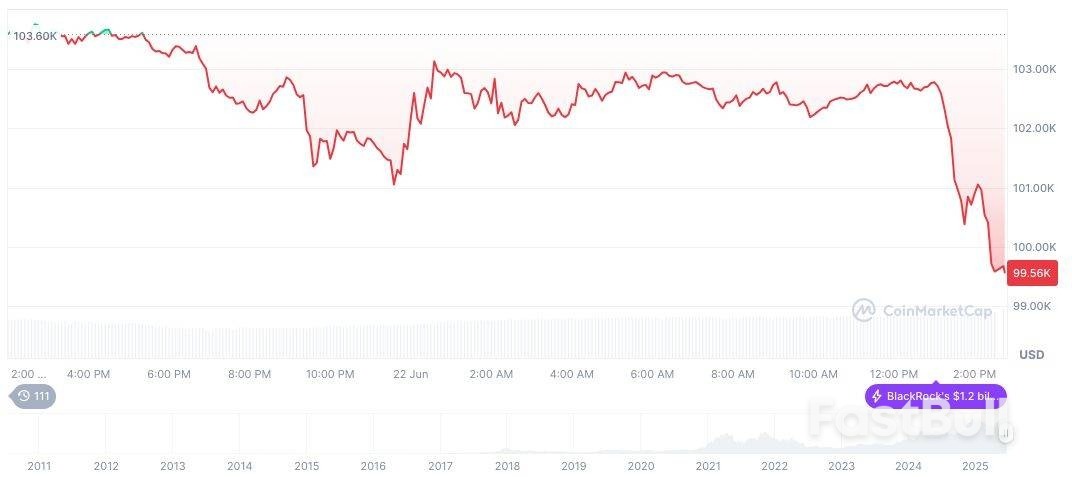
          According to CoinMarketCap, Bitcoin (BTC) is currently priced at $102,321.98, holding a market cap of $2.03 trillion with a dominance of 64.76%. Its 24-hour trading volume reached $61.53 billion, reflecting a 1.95% increase in the past 24 hours but a 4.57% decrease over the last 7 days. These statistics underscore the responsiveness of BTC's value to macroeconomic signals, as investor sentiment fluctuates following Fed policy updates.

          Bitcoin(BTC), daily chart, screenshot on CoinMarketCap at 14:19 UTC on June 23, 2025. Source: CoinMarketCap

          Source: CryptoSlate

          Risk Warnings and Disclaimers
          You understand and acknowledge that there is a high degree of risk involved in trading. Following any strategies or investment methods may lead to potential losses. The content on the site is provided by our contributors and analysts for information purposes only. You are solely responsible for determining whether any trading assets, securities, strategy, or any other product is suitable for investing based on your own investment objectives and financial situation.
          Add to Favorites
          Share

          Insight: Succession Plans for Iran's Khamenei Hit Top Gear

          Michelle

          Political

          Middle East Situation

          The clock's ticking for senior clerics seeking a successor to Iran's Supreme Leader Ayatollah Ali Khamenei.

          A three-man committee from a top clerical body, appointed by Khamenei himself two years ago to identify his replacement, has accelerated its planning in recent days since Israel attacked Iran and threatened to assassinate the veteran leader, five insiders with knowledge of the discussions told Reuters.

          Khamenei, 86, is being regularly briefed on the talks, according to the Iranian sources who requested anonymity to discuss highly sensitive matters. He has gone into hiding with his family and is being guarded by the Vali-ye Amr special forces unit of the Revolutionary Guards, a top security official said.

          The ruling establishment will immediately seek to name a successor to Khamenei if he is killed, to signal stability and continuity, according to the sources who acknowledged that predicting Iran's subsequent political trajectory was difficult.

          A new leader will still be chosen for his devotion to the revolutionary precepts of the Islamic Republic's late founder Ayatollah Ruhollah Khomeini, according to one insider, who is close to Khamenei's office and privy to succession discussions.

          At the same time, the top echelon of power is also considering which candidate might present a more moderate face to ward off foreign attacks and internal revolts, the person said.

          Two frontrunners have emerged in the succession discussions, the five insiders said: Khamenei's 56-year-old son Mojtaba, long seen as a continuity choice, and a new contender, Hassan Khomeini, grandson of the father of the Islamic revolution.

          Khomeini, a close ally of the reformist faction that favours the easing of social and political restrictions, nonetheless commands respect among senior clerics and the Revolutionary Guards because of his lineage, the sources added.

          "I once again humbly express that this small and insignificant servant of the Iranian people stands ready to proudly be present on any front or scene you deem necessary," the 53-year-old said in a public message of support to the supreme leader on Saturday, hours before the U.S. bombed Iran's nuclear facilities.

          Khomeini has come into the frame as a serious candidate this month amid the conflict with Israel and America because he could represent a more conciliatory choice internationally and domestically than Mojtaba Khamenei, the five people said.

          By contrast, Khamenei hews closely to his father's hardline policies, according to the insiders who cautioned that nothing had been determined, candidates could change and the supreme leader would have the final say.

          However, with the military conflict continuing, it remains unclear whether any new leader could be chosen easily or installed securely or if he could assume the level of authority enjoyed by Khamenei, they added.

          Israeli strikes have also killed several of Iran's top Revolutionary Guards commanders, potentially complicating a handover of power as the elite military force has long played a central role in enforcing the supreme leader's rule.

          Khamenei's office and the Assembly of Experts, the clerical body from which the succession committee was drawn, were not available to comment.

          TRUMP: KHAMENEI IS EASY TARGET

          Planning for an eventual handover was already in the works because of Khamenei's age and the longstanding health concerns of a leader who has dominated all aspects of Iranian politics for decades, the sources said.

          The urgency of the task was underlined in September when Israel killed Hezbollah leader Sayyed Hassan Nasrallah, a close ally of Khamenei's, and the planning accelerated significantly this month following the Israeli attacks on nuclear sites, which were followed by the American attacks at the weekend.

          "We know exactly where the so-called 'Supreme Leader' is hiding," U.S. President Trump warned on social media last week, calling for Tehran's unconditional surrender. "He is an easy target."

          Khamenei hasn't publicly expressed any preference for his successor. The sources said he had repeatedly opposed the idea of his son taking over, in succession discussions in the past, concerned about any suggestion of Iran returning to the kind of hereditary rule that ended with the ousting of the shah in 1979.

          The role of Supreme Leader was created after the revolution and then enshrined in the constitution giving a top cleric ultimate authority in guiding the elected president and parliament.

          Officially, the leader is named by the Assembly of Experts, made up of 88 senior clerics who are chosen through a national election in which a hardline watchdog body aligned with Khamenei must approve all the candidates.

          "Whether the Islamic Republic survives or not, it will be a very different one, because the context in which it has existed has fundamentally changed," said London-based Iranian political analyst Hossein Rassam, adding that Hassan Khomeini could fit the bill for a leader to take Iran in a new direction.

          "The regime has to opt for someone who'll facilitate slow transition."

          Hassan Khomeini's close links to the reformist faction of Iranian politics, which pursued an ultimately unsuccessful policy of opening Iran to the outside world in the 1990s, saw hardline officials bar him from running as a member of senior clerical body the Assembly of Experts in 2016.

          The succession planners are aware that Khomeini is likely to be more palatable to the Iranian population than a hardliner, the five insiders said. Last year he warned of a "crisis of rising popular dissatisfaction" among Iranians due to poverty and deprivation.

          By contrast, Mojtaba Khamenei's views echo those of his father on every major topic from cracking down on opponents to taking a hardline with foreign foes, the sources said - qualities they saw as hazardous with Iran under attack.

          A mid-ranking cleric who teaches theology at a religious seminary in the city Qom, the centre of Iranian religious life, Mojtaba has never held a formal position the Islamic Republic, though exercises influence behind the scenes as the gatekeeper to his father, according to Iran watchers.

          The U.S. Treasury Department imposed sanctions on Mojtaba in 2019, saying he represented the Supreme Leader in "an official capacity despite never being elected or appointed to a government position" aside from working his father's office.

          OTHER CANDIDATES FALL AWAY

          Several of the candidates long seen as possible successors to Khamenei have already died.

          Former presidents Hashemi Rafsanjani passed away in 2017, former judiciary chief Mahmoud Hashemi Shahroudi died of natural causes in 2018 and former President Ebrahim Raisi was killed in a helicopter crash in 2024. Another senior cleric Sadegh Amoli Larijani, has been sidelined.

          Others, such as the Assembly of Experts member Ayatollah Alireza Arafi, are still in contention but have fallen behind Mojtaba Khamenei and Hassan Khomeini, the five sources said.

          Beyond the most likely candidates, it's also possible that a less prominent cleric could be chosen as a pawn of Revolutionary Guards, said Ali Vaez, Iran project director at the International Crisis Group think-tank.

          "It is possible that they would put forward a candidate that no one has ever heard of and would not really hold the same levers of power that Ayatollah Khamenei has held now for more than 30 years," he said.

          The supreme leader's voice is powerful.

          After the death of the Islamic Republic's founder Ruhollah Khomeini in 1989, Khamenei was publicly hailed as his predecessor's choice. Although he had already served as president, Khamenei was only a mid-ranking cleric and was initially dismissed by influential clerics as weak and an unlikely successor to his charismatic predecessor.

          However, he steadily tightened his grip to become Iran's unquestioned decision-maker, relying on the Revolutionary Guards as he outmanoeuvred rivals and crushed bouts of popular unrest.

          Source: Reuters

          Risk Warnings and Disclaimers
          You understand and acknowledge that there is a high degree of risk involved in trading. Following any strategies or investment methods may lead to potential losses. The content on the site is provided by our contributors and analysts for information purposes only. You are solely responsible for determining whether any trading assets, securities, strategy, or any other product is suitable for investing based on your own investment objectives and financial situation.
          Add to Favorites
          Share

          'Challenging for investors': What Wall Street strategists are saying about the US strikes on Iran

          Adam

          Economic

          Middle East Situation

          Wall Street is closely watching escalating tensions in the Middle East after President Trump confirmed that the US launched a surprise strike on Iran’s nuclear sites late Saturday, marking the country’s official entry into the two-week-old conflict.
          "The strikes were a spectacular military success," Trump said in an address at the White House Saturday evening. "Iran’s key nuclear enrichment facilities have been completely and totally obliterated."
          The president, who referred to Iran as the "bully of the Middle East," said the country "must now make peace." He added, "If they do not, future attacks would be far greater and a lot easier."
          Markets have held mostly steady in the aftermath of the escalation, although US stock futures fell in the lead-up to Monday's market open.
          Additionally, bitcoin (BTC-USD) prices, often viewed as a barometer of risk appetite, dropped over 1% to trade around $101,000 a coin. WTI crude (CL=F) and Brent (BZ=F) futures initially jumped when futures trading began on Sunday, but pared gains to trade near $74.50 and $77.50 a barrel, respectively, shortly before the opening bell.
          Until now, most strategists have said markets largely dismissed the risk of a prolonged conflict, with investors still weighing the potential for unintended consequences following US intervention.
          Nicholas Colas, co-founder of DataTrek Research, said in a research note Monday that markets are likely to discount downside scenarios and could even resume their rally despite continued negative headlines.
          "The disconnect between human nature’s focus on the present and markets’ forward-looking gaze is an under-appreciated reason why volatility of the sort we will see this week is so challenging for investors," he said.
          But with direct US military engagement now underway, markets may be forced to reprice risk, especially if oil prices continue to rise, threatening to reverse recent disinflation trends and further strain consumers already grappling with elevated costs.
          "It has been and remains our belief that the longer and broader the conflict becomes, the more challenging it could be for US equities," Lori Calvasina, head of US equity strategy research at RBC Capital Markets, wrote in a Sunday evening note to clients. "These escalations come at a tricky time for US equities, as the S&P 500 has looked fairly valued to us (perhaps a bit overvalued) from a fundamental perspective, with more room to run from a sentiment perspective."
          The analyst said her three main concerns include: first, the risk that rising national security uncertainty could weigh on equity valuations; second, the possibility that renewed geopolitical tensions could stall the recovery in sentiment that began after the early April tariff lows; and third, the potential for a spike in oil prices, which could fuel inflation concerns.
          Citi analyst Stuart Kaiser agreed that sharply higher oil prices remain "the channel for geopolitical risks to impact stock markets," identifying crude prices "well above $80 a barrel" as a critical threshold for concern.
          Kaiser added that options markets are now pricing in a 10% chance that oil surges 20% over the next month, up from just 2.5% two weeks ago, reflecting mounting tail risks as the conflict deepens.
          Still, Neil Shearing, group chief economist at Oxford Economics, wrote on Monday that oil prices "would need to climb much higher, and stay higher for much longer, to really pose an inflation threat."
          "Past flare-ups in the region have seen prices fall back quickly, offering some reassurance," he said. "But in a world of radical uncertainty, there’s less confidence that history will repeat itself."

          'Stagflationary' risks

          Wall Street analysts have warned that a prolonged conflict and the potential closure of the Strait of Hormuz could drive oil prices as high as $130 a barrel, pushing US inflation back toward 6%. So far, that risk seems mostly contained, with markets cautiously monitoring developments but not yet pricing in a worst-case scenario.
          But here's the concern: A sharp rise in energy prices would likely reverse the recent disinflation trend in gas prices.
          According to the latest May CPI report, prices at the pump have fallen 12% over the past year. The government’s energy index declined 1% month over month in the most recent reading. If those trends reverse, economists warn that an inflation rebound could delay interest rate cuts until early 2026 as the Federal Reserve balances its dual mandate of price stability and maximum employment.
          While the Fed typically focuses on core inflation, which excludes volatile energy prices, higher energy costs could ripple through the supply chain and raise prices across a wide range of goods and services.
          "You're looking at a potentially more 'stagflationary' scenario out of that," Bank of America senior US economist Stephen Juneau told Yahoo Finance on Monday. "Of course, this has to persist. We're still at a point where oil prices are relatively low compared to a year ago, so we'll just have to see how things unfold from here. I think it's too early to say."

          source : finance.yahoo

          To stay updated on all economic events of today, please check out our Economic calendar
          Risk Warnings and Disclaimers
          You understand and acknowledge that there is a high degree of risk involved in trading. Following any strategies or investment methods may lead to potential losses. The content on the site is provided by our contributors and analysts for information purposes only. You are solely responsible for determining whether any trading assets, securities, strategy, or any other product is suitable for investing based on your own investment objectives and financial situation.
          Add to Favorites
          Share
          FastBull
          Copyright © 2025 FastBull Ltd

          728 RM B 7/F GEE LOK IND BLDG NO 34 HUNG TO RD KWUN TONG KLN HONG KONG

          TelegramInstagramTwitterfacebooklinkedin
          App Store Google Play Google Play
          Products
          Charts

          Chats

          Q&A with Experts
          Screeners
          Economic Calendar
          Data
          Tools
          Membership
          Features
          Function
          Markets
          Copy Trading
          Latest Signals
          Contests
          News
          Analysis
          24/7
          Columns
          Education
          Company
          Careers
          About Us
          Contact Us
          Advertising
          Help Center
          Feedback
          User Agreement
          Privacy Policy
          Business

          White Label

          Data API

          Web Plug-ins

          Poster Maker

          Affiliate Program

          Risk Disclosure

          The risk of loss in trading financial instruments such as stocks, FX, commodities, futures, bonds, ETFs and crypto can be substantial. You may sustain a total loss of the funds that you deposit with your broker. Therefore, you should carefully consider whether such trading is suitable for you in light of your circumstances and financial resources.

          No decision to invest should be made without thoroughly conducting due diligence by yourself or consulting with your financial advisors. Our web content might not suit you since we don't know your financial conditions and investment needs. Our financial information might have latency or contain inaccuracy, so you should be fully responsible for any of your trading and investment decisions. The company will not be responsible for your capital loss.

          Without getting permission from the website, you are not allowed to copy the website's graphics, texts, or trademarks. Intellectual property rights in the content or data incorporated into this website belong to its providers and exchange merchants.

          Not Logged In

          Log in to access more features

          FastBull Membership

          Not yet

          Purchase

          Become a signal provider
          Help Center
          Customer Service
          Dark Mode
          Price Up/Down Colors

          Log In

          Sign Up

          Position
          Layout
          Fullscreen
          Default to Chart
          The chart page opens by default when you visit fastbull.com