• Trade
  • Markets
  • Copy
  • Contests
  • News
  • 24/7
  • Calendar
  • Q&A
  • Chats
Trending
Screeners
SYMBOL
LAST
BID
ASK
HIGH
LOW
NET CHG.
%CHG.
SPREAD
SPX
S&P 500 Index
6827.42
6827.42
6827.42
6899.86
6801.80
-73.58
-1.07%
--
DJI
Dow Jones Industrial Average
48458.04
48458.04
48458.04
48886.86
48334.10
-245.98
-0.51%
--
IXIC
NASDAQ Composite Index
23195.16
23195.16
23195.16
23554.89
23094.51
-398.69
-1.69%
--
USDX
US Dollar Index
97.950
98.030
97.950
98.500
97.950
-0.370
-0.38%
--
EURUSD
Euro / US Dollar
1.17394
1.17409
1.17394
1.17496
1.17192
+0.00011
+ 0.01%
--
GBPUSD
Pound Sterling / US Dollar
1.33707
1.33732
1.33707
1.33997
1.33419
-0.00148
-0.11%
--
XAUUSD
Gold / US Dollar
4299.39
4299.39
4299.39
4353.41
4257.10
+20.10
+ 0.47%
--
WTI
Light Sweet Crude Oil
57.233
57.485
57.233
58.011
56.969
-0.408
-0.71%
--

Community Accounts

Signal Accounts
--
Profit Accounts
--
Loss Accounts
--
View More

Become a signal provider

Sell trading signals to earn additional income

View More

Guide to Copy Trading

Get started with ease and confidence

View More

Signal Accounts for Members

All Signal Accounts

Best Return
  • Best Return
  • Best P/L
  • Best MDD
Past 1W
  • Past 1W
  • Past 1M
  • Past 1Y

All Contests

  • All
  • Trump Updates
  • Recommend
  • Stocks
  • Cryptocurrencies
  • Central Banks
  • Featured News
Top News Only
Share

Kuwait's Oil Minister Says: We Expected Prices To Remain At Least As They Were, If Not Better, But We Were Surprised By Their Drop

Share

Kuwait Sees Fair Oil Price At $60-$68 A Barrel Under Current Conditions

Share

Syria Produces About 100000 Barrels/Day And Aims To Boost Output If Issues East Of The Euphrates Are Resolved

Share

Australia Intelligence Official: National Terrorism Threat Level Remains At Probable

Share

Australia Intelligence Official: We're Looking To See If There Are Anyone In The Community That Has Similar Intent

Share

Australia Intelligence Official: We Are Looking At The Identities Of The Attackers

Share

Australia Prime Minister: Tells Jews We Will Dedicate Every Resource Required To Making Sure You Are Safe And Protected

Share

Australia Prime Minister: Police And Security Agencies Are Working To Determine Anyone Associated With This Outrage

Share

Australia Police: Police Bomb Disposal Unit Currently Working On Several Suspected Improvised Explosive Devices

Share

Syria's Oil Ministry Forecasts Country's Gas Production To Increase To 15 Million Cubic Meters By End Of 2026

Share

His Office: Ukraine's President Zelenskiy Landed In Germany

Share

Australia Police: This Is Not A Time For Retribution. This Is A Time To Allow The Police To Do Their Duty

Share

Australia Police: We Know That We Have Two Definite Offenders, But We Want To Make Sure The Community Is Safe

Share

Australia Police: Our Counter-Terrorism Command Will Lead This Investigation With Investigators From The State Crime Command. No Stone Will Be Left Unturned

Share

Australia Police: This Is A Terrorist Incident

Share

Ukraine President Zelenskiy: Ukraine-Russia Ceasefire Along The Current Frontlines Would Be A Fair Option

Share

New South Wales Premier Chris Minns: This Is A Massive, Complex And Just Beginning Investigation

Share

New South Wales Premier Chris Minns: 12 Killed In Bondi Shooting

Share

Ukraine President Zelenskiy: Security Guarantees Should Be Legally Binding

Share

Ukraine President Zelenskiy: US, European Security Guarantees Instead Of NATO Membership Is Compromise From Ukraine's Side

TIME
ACT
FCST
PREV
U.K. Trade Balance (Oct)

A:--

F: --

P: --

U.K. Services Index MoM

A:--

F: --

P: --

U.K. Construction Output MoM (SA) (Oct)

A:--

F: --

P: --

U.K. Industrial Output YoY (Oct)

A:--

F: --

P: --

U.K. Trade Balance (SA) (Oct)

A:--

F: --

P: --

U.K. Trade Balance EU (SA) (Oct)

A:--

F: --

P: --

U.K. Manufacturing Output YoY (Oct)

A:--

F: --

P: --

U.K. GDP MoM (Oct)

A:--

F: --

P: --

U.K. GDP YoY (SA) (Oct)

A:--

F: --

P: --

U.K. Industrial Output MoM (Oct)

A:--

F: --

P: --

U.K. Construction Output YoY (Oct)

A:--

F: --

P: --

France HICP Final MoM (Nov)

A:--

F: --

P: --

China, Mainland Outstanding Loans Growth YoY (Nov)

A:--

F: --

P: --

China, Mainland M2 Money Supply YoY (Nov)

A:--

F: --

P: --

China, Mainland M0 Money Supply YoY (Nov)

A:--

F: --

P: --

China, Mainland M1 Money Supply YoY (Nov)

A:--

F: --

P: --

India CPI YoY (Nov)

A:--

F: --

P: --

India Deposit Gowth YoY

A:--

F: --

P: --

Brazil Services Growth YoY (Oct)

A:--

F: --

P: --

Mexico Industrial Output YoY (Oct)

A:--

F: --

P: --

Russia Trade Balance (Oct)

A:--

F: --

P: --

Philadelphia Fed President Henry Paulson delivers a speech
Canada Building Permits MoM (SA) (Oct)

A:--

F: --

P: --

Canada Wholesale Sales YoY (Oct)

A:--

F: --

P: --

Canada Wholesale Inventory MoM (Oct)

A:--

F: --

P: --

Canada Wholesale Inventory YoY (Oct)

A:--

F: --

P: --

Canada Wholesale Sales MoM (SA) (Oct)

A:--

F: --

P: --

Germany Current Account (Not SA) (Oct)

A:--

F: --

P: --

U.S. Weekly Total Rig Count

A:--

F: --

P: --

U.S. Weekly Total Oil Rig Count

A:--

F: --

P: --

Japan Tankan Large Non-Manufacturing Diffusion Index (Q4)

--

F: --

P: --

Japan Tankan Small Manufacturing Outlook Index (Q4)

--

F: --

P: --

Japan Tankan Large Non-Manufacturing Outlook Index (Q4)

--

F: --

P: --

Japan Tankan Large Manufacturing Outlook Index (Q4)

--

F: --

P: --

Japan Tankan Small Manufacturing Diffusion Index (Q4)

--

F: --

P: --

Japan Tankan Large Manufacturing Diffusion Index (Q4)

--

F: --

P: --

Japan Tankan Large-Enterprise Capital Expenditure YoY (Q4)

--

F: --

P: --

U.K. Rightmove House Price Index YoY (Dec)

--

F: --

P: --

China, Mainland Industrial Output YoY (YTD) (Nov)

--

F: --

P: --

China, Mainland Urban Area Unemployment Rate (Nov)

--

F: --

P: --

Saudi Arabia CPI YoY (Nov)

--

F: --

P: --

Euro Zone Industrial Output YoY (Oct)

--

F: --

P: --

Euro Zone Industrial Output MoM (Oct)

--

F: --

P: --

Canada Existing Home Sales MoM (Nov)

--

F: --

P: --

Euro Zone Total Reserve Assets (Nov)

--

F: --

P: --

U.K. Inflation Rate Expectations

--

F: --

P: --

Canada National Economic Confidence Index

--

F: --

P: --

Canada New Housing Starts (Nov)

--

F: --

P: --

U.S. NY Fed Manufacturing Employment Index (Dec)

--

F: --

P: --

U.S. NY Fed Manufacturing Index (Dec)

--

F: --

P: --

Canada Core CPI YoY (Nov)

--

F: --

P: --

Canada Manufacturing Unfilled Orders MoM (Oct)

--

F: --

P: --

Canada Manufacturing New Orders MoM (Oct)

--

F: --

P: --

Canada Core CPI MoM (Nov)

--

F: --

P: --

Canada Manufacturing Inventory MoM (Oct)

--

F: --

P: --

Canada CPI YoY (Nov)

--

F: --

P: --

Canada CPI MoM (Nov)

--

F: --

P: --

Canada CPI YoY (SA) (Nov)

--

F: --

P: --

Canada Core CPI MoM (SA) (Nov)

--

F: --

P: --

Canada CPI MoM (SA) (Nov)

--

F: --

P: --

Q&A with Experts
    • All
    • Chatrooms
    • Groups
    • Friends
    Connecting
    .
    .
    .
    Type here...
    Add Symbol or Code

      No matching data

      All
      Trump Updates
      Recommend
      Stocks
      Cryptocurrencies
      Central Banks
      Featured News
      • All
      • Russia-Ukraine Conflict
      • Middle East Flashpoint
      • All
      • Russia-Ukraine Conflict
      • Middle East Flashpoint
      Search
      Products

      Charts Free Forever

      Chats Q&A with Experts
      Screeners Economic Calendar Data Tools
      Membership Features
      Data Warehouse Market Trends Institutional Data Policy Rates Macro

      Market Trends

      Market Sentiment Order Book Forex Correlations

      Top Indicators

      Charts Free Forever
      Markets

      News

      News Analysis 24/7 Columns Education
      From Institutions From Analysts
      Topics Columnists

      Latest Views

      Latest Views

      Trending Topics

      Top Columnists

      Latest Update

      Signals

      Copy Rankings Latest Signals Become a signal provider AI Rating
      Contests
      Brokers

      Overview Brokers Assessment Rankings Regulators News Claims
      Broker listing Forex Brokers Comparison Tool Live Spread Comparison Scam
      Q&A Complaint Scam Alert Videos Tips to Detect Scam
      More

      Business
      Events
      Careers About Us Advertising Help Center

      White Label

      Data API

      Web Plug-ins

      Affiliate Program

      Awards Institution Evaluation IB Seminar Salon Event Exhibition
      Vietnam Thailand Singapore Dubai
      Fans Party Investment Sharing Session
      FastBull Summit BrokersView Expo
      Recent Searches
        Top Searches
          Markets
          News
          Analysis
          User
          24/7
          Economic Calendar
          Education
          Data
          • Names
          • Latest
          • Prev

          View All

          No data

          Scan to Download

          Faster Charts, Chat Faster!

          Download App
          English
          • English
          • Español
          • العربية
          • Bahasa Indonesia
          • Bahasa Melayu
          • Tiếng Việt
          • ภาษาไทย
          • Français
          • Italiano
          • Türkçe
          • Русский язык
          • 简中
          • 繁中
          Open Account
          Search
          Products
          Charts Free Forever
          Markets
          News
          Signals

          Copy Rankings Latest Signals Become a signal provider AI Rating
          Contests
          Brokers

          Overview Brokers Assessment Rankings Regulators News Claims
          Broker listing Forex Brokers Comparison Tool Live Spread Comparison Scam
          Q&A Complaint Scam Alert Videos Tips to Detect Scam
          More

          Business
          Events
          Careers About Us Advertising Help Center

          White Label

          Data API

          Web Plug-ins

          Affiliate Program

          Awards Institution Evaluation IB Seminar Salon Event Exhibition
          Vietnam Thailand Singapore Dubai
          Fans Party Investment Sharing Session
          FastBull Summit BrokersView Expo

          Iran, US see Hope for Progress After US Nuclear Talks

          Manuel

          Middle East Situation

          Energy

          Summary:

          U.S. Secretary of State Marco Rubio said on Tuesday that Washington was working to reach an accord that would allow Iran to have a civil nuclear energy programme but not enrich uranium.

          Iranian and U.S. delegations wrapped up a fifth round of talks in Rome on Friday and signs of some limited progress emerged in the negotiations aimed at resolving a decades-long dispute over Tehran's nuclear ambitions.
          Despite both Washington and Tehran taking a tough stance in public ahead of the talks on Iran's uranium enrichment, Iranian Foreign Minister Abbas Araqchi said there was potential for progress after Oman made several proposals during the talks.
          "We have just completed one of the most professional rounds of talks ... We firmly stated Iran's position ... The fact that we are now on a reasonable path, in my view, is itself a sign of progress," Araqchi told state TV.
          "The proposals and solutions will be reviewed in respective capitals ... and the next round of talks will be scheduled accordingly."
          A senior U.S. official said the talks lasted more than two hours and were both direct and indirect with Omani mediators.
          "The talks continue to be constructive – we made further progress, but there is still work to be done. Both sides agreed to meet again in the near future. We are grateful to our Omani partners for their continued facilitation," the official said.
          The stakes are high for both sides. President Donald Trump wants to curtail Tehran's potential to produce a nuclear weapon that could trigger a regional nuclear arms race and perhaps threaten Israel. The Islamic Republic, for its part, wants to be rid of devastating sanctions on its oil-based economy.
          Omani Foreign Minister Badr Albusaidi said on X the talks between Araqchi and Trump's Middle East envoy Steve Witkoff had ended "with some but not conclusive progress".
          Ahead of the talks, Araqchi wrote on X: "Zero nuclear weapons = we Do have a deal. Zero enrichment = we do NOT have a deal. Time to decide."
          Among remaining stumbling blocks are Tehran's refusal to ship abroad its entire stockpile of highly enriched uranium - possible raw material for nuclear bombs - or engage in discussions over its ballistic missile programme.
          Diplomats have said reaching a concrete deal before the summer would technically be impossible given the complexities of an accord. In the meantime, a senior Iranian official involved in nuclear talks with the U.S. said "if Washington drops its 'zero enrichment' demand, a political agreement is feasible."

          STUMBLING BLOCKS

          U.S. Secretary of State Marco Rubio said on Tuesday that Washington was working to reach an accord that would allow Iran to have a civil nuclear energy programme but not enrich uranium, while acknowledging that this "will not be easy".
          Iranian Supreme Leader Ayatollah Ali Khamenei, who has the last say on matters of state, rejected demands to stop refining uranium as "excessive and outrageous", warning that such talks were unlikely to yield results.
          Iran says it is ready to accept some limits on enrichment, but needs watertight guarantees that Washington would not renege on a future nuclear accord.
          Trump in his first term in 2018 ditched a 2015 nuclear pact between major powers and Iran. Since returning to office this year, he has restored a "maximum pressure" campaign on Tehran and reimposed sweeping U.S. sanctions that continue to hobble the Iranian economy.
          Iran responded by escalating enrichment far beyond the 2015 pact's limits.
          Wendy Sherman, a former U.S. undersecretary who led the U.S. negotiating team that reached the 2015 agreement, earlier said that Tehran presents enrichment as a matter of sovereignty.
          "I don't think it is possible to get a deal with Iran where they literally dismantle their programme, give up their enrichment, even though that would be ideal," she told Reuters.
          The cost of failure of the talks could be high. Iran's arch-foe Israel sees Iran's nuclear programme as an existential threat and says it would never allow the clerical establishment to obtain nuclear weapons. Tehran says it has no such ambitions and the purposes are purely civilian.
          Israel's strategic affairs minister and the head of its foreign intelligence service, Mossad, were also due to be in Rome for talks with the U.S. negotiators, a source aware of the matter told Reuters.
          Araqchi said on Thursday that Washington would bear legal responsibility if Israel attacked Iranian nuclear installations, following a CNN report that Israel might be preparing strikes.

          Source: Reuters

          Risk Warnings and Disclaimers
          You understand and acknowledge that there is a high degree of risk involved in trading. Following any strategies or investment methods may lead to potential losses. The content on the site is provided by our contributors and analysts for information purposes only. You are solely responsible for determining whether any trading assets, securities, strategy, or any other product is suitable for investing based on your own investment objectives and financial situation.
          Add to Favorites
          Share

          Trump Threatens EU, Smartphones as Tariff Rhetoric Escalates

          Manuel

          Economic

          Political

          President Donald Trump dug in on his threat to impose a 50% tariff on the European Union and said a potential 25% charge on smartphones would apply to all foreign-made devices, in the latest escalation of a trade war that is rattling markets and confusing businesses.
          Trump on Friday reiterated his complaints about the EU, accusing the bloc of slow-walking negotiations and unfairly targeting US companies with lawsuits and regulations. The president downplayed the ability of the EU to broker a lower tariff rate, which he said would hit June 1. “We’ve set the deal. It’s at 50%,” he said.
          “They don’t go about it right,” Trump told reporters in the Oval Office. “I just said, it’s time that we play the game the way I know how to play the game.”
          Separately, the president said that a potential 25% tariff he threatened in a social media post Friday morning against Apple Inc. smartphones would also apply to devices from Samsung Electronics Co. “and anybody that makes that product,” and that his administration was moving to impose the levy by the end of June.
          “Otherwise it wouldn’t be fair,” Trump said.
          Taken together, the threats — which could dramatically reshape US trade on key consumer products — delivered a fresh shock for investors.
          Equities held losses after Trump said he was “not looking for a deal” with Brussels. Earlier, losses were nearly erased after US Treasury Secretary Scott Bessent said several trade deals may be struck in the coming weeks. Apple led a selloff in tech, falling more than 3%.
          The president’s missives, first posted early Friday, represented a fresh round of trade brinkmanship after previously indicating he was looking to wind down talks with partners over his April 2 duties, which he paused for 90 days to allow for negotiations.
          Trump’s attention this week has mostly been focused on a massive tax and spending package currently being considered by the US Congress.
          Trump dismissed concerns that his moves could result in higher prices for Americans, predicting that foreign countries and companies could absorb the cost of the tariffs — or would move manufacturing to the US. Still, he acknowledged that some costs could be passed on to consumers.
          “Sometimes the country will eat it. Sometimes Walmart will eat it, and sometimes it’ll be something to be paid, something extra,” Trump said.
          The defiant tone came despite top administration officials saying earlier Friday that Trump was primarily seeking to drive US trading partners and international corporations to strike better deals.
          “The president was getting frustrated with the EU,” Bessent said on Bloomberg Television earlier Friday. In a previous interview on Fox News, Bessent expressed hope “this would light a fire under the EU.”
          The pivot was a notable change in tone from a Group of Seven finance ministers’ meeting earlier this week, where the US Treasury secretary appeared keen on improving relations with Europe, according to a person familiar with the discussions.
          Separately, Trump posted to social media that he already told Apple the company’s popular smartphones should be made in the US and that he was nonplussed by its effort to partially move production from China to India. The comments came days after a meeting between the president and Apple Chief Executive Officer Tim Cook, which was disclosed by a White House official.
          “I had an understanding with Tim that he wouldn’t be doing this. He said he’s going to India to build plants. I said, ‘that’s OK to go to India, but you’re not going to sell into here without tariffs.’”
          Trump’s latest posturing comes after the EU earlier this week shared a revived trade proposal with the US in a bid to jump-start talks. The EU’s trade chief, Maros Sefcovic, is planning to hold a call with Jamieson Greer, his US counterpart, on Friday to take stock of negotiations, a European Commission spokesperson said before Trump’s post.
          A spokesperson for the commission declined to comment on the president’s threat ahead of the discussion.
          Irish Prime Minister Micheal Martin called Trump’s suggestion “enormously disappointing.”
          “Tariffs are damaging to all sides,” Martin posted on X. “A negotiated outcome is the best possible result for both sides, as well as for global trade.”
          Trump’s latest tariff threat would hit $321 billion worth of US-EU goods trade, lowering US gross domestic product by close to 0.6% and boosting prices by more than 0.3%, according to Bloomberg Economics calculations.
          The new EU framework covers tariff and non-tariff barriers, as well as ways to enhance economic security, mutual investments, strategic purchases and cooperation on global challenges, according to people familiar with the matter who requested anonymity to discuss the terms, which are not public.
          The aim of the paper, which was sent to the White House earlier this week, was to jump-start formal trade negotiations.
          Others in Europe saw Trump’s threats as an attempt to gain leverage on the bloc rather than an ironclad directive.
          “This is all part of the negotiation; we will look calmly at the proposals and respond robustly and firmly,” Dutch Prime Minister Dick Schoof said Friday during a weekly press conference.
          But there were signals the negotiations were not proceeding well. One EU official described a prior US proposal as a wish list of unrealistic and unilateral demands, Bloomberg reported earlier. The EU is aiming to cooperate with the US, and is seeking a balanced and mutually beneficial deal. EU officials and many member states remain skeptical that the Trump administration is driven by similar goals.
          US Commerce Secretary Howard Lutnick on Wednesday said at an Axios event that some trade negotiations had proved “impossible.”
          “Like the European Union — it’s just very difficult because, you know, Germany would like to make a deal, but they’re not allowed,” Lutnick said.
          The EU plans to move forward with preparing countermeasures if negotiations fail to produce a satisfactory outcome. The trade bloc has put together plans to hit €95 billion of US exports ($107 billion) with additional tariffs in response to Trump’s “reciprocal” levies and 25% tariffs on cars and some parts.
          European nations agreed earlier this month to delay for 90 days the implementation of a separate set of retaliatory duties against the US over 25% levies Trump imposed on the bloc’s steel and aluminum exports. That move came after Trump lowered his so-called reciprocal rate on most EU exports to 10% from 20% for the same amount of time.
          “We are maintaining the same line: de-escalation, but we are ready to respond,” French trade minister Laurent Saint-Martin posted Friday on X.

          Source: Bloomberg

          To stay updated on all economic events of today, please check out our Economic calendar
          Risk Warnings and Disclaimers
          You understand and acknowledge that there is a high degree of risk involved in trading. Following any strategies or investment methods may lead to potential losses. The content on the site is provided by our contributors and analysts for information purposes only. You are solely responsible for determining whether any trading assets, securities, strategy, or any other product is suitable for investing based on your own investment objectives and financial situation.
          Add to Favorites
          Share

          US Debt Limit Nail-Biter Looms as Senate Ponders Tax Bill

          Manuel

          Economic

          Political

          Chances of a close brush with a US payment default are growing as the Senate plans for time-consuming revisions to President Donald Trump’s sprawling, multi-trillion-dollar tax and spending package.
          Republican congressional leaders attached an increase in the US legal debt limit to the president’s signature economic legislation. That gambit adds urgency to the enactment of a top-priority bill, but could put averting a default at the mercy of the complex legislative obstacle course that lies ahead.
          Not only does the tax bill face a protracted process in the Senate, but Republican members have indicated that they expect to make extensive changes on the way to passage. That could provoke further problems when the revised measure is returned to the House for approval, given it only passed on Thursday by a single vote after tortuous negotiations among warring GOP factions.
          The drama and delay could prompt market jitters as a possible default date nears.
          Treasury bill investors have already started maneuvering around securities maturing in August after Secretary Scott Bessent told lawmakers that the US was likely to exhaust its borrowing authority that month if the debt ceiling isn’t raised or suspended by then. Bills maturing in August are cheapening relative to the rest of the curve — with Aug. 21 maturities yielding 4.34%.
          Wall Street analysts and private forecasters, however, see the debt ceiling deadline, known as the X date, falling sometime between late August and mid-October.
          If the US runs out of borrowing capacity, investors who hold debt that’s due to be repaid shortly afterward are among those most immediately exposed. That’s because the government won’t be able to sell fresh securities to provide the necessary cash for repaying holders.
          Republicans have no ready backup plan for raising the debt ceiling besides the Trump tax measure. They need the the cuts in safety-net spending and enhanced border enforcement funding in the legislation to persuade ultraconservatives who have never voted for a debt increase to pass the bill. If they turn instead to the opposition party to avert a default, Democrats are expected to demand spending increases and other policy concessions that Republicans are loathe to make.
          That means the debt ceiling increase depends on resolving GOP differences on the tax package.
          Senate Republican leader John Thune said that a goal of enacting the tax bill by July 4 is tenuous given the need to find a majority to approve it.
          “Obviously that’s the goal and aspiration. We’ll see how it goes. What does it take to get to 51 votes?” Thune told reporters Thursday. “They give us a good product to work with but we have senators who want to write our own bill.”
          Thune will have to strike a delicate balance in revising the House’s $4 trillion tax cut package to get it through the Senate.
          Bessent in an interview with Bloomberg Television on Friday said that the tax bill will do a “great job” of growing the economy and bringing down the debt-to-GDP ration.
          He added that he is not expecting to see big changes to the legislation once the Senate picks up the bill, counter to Thune’s view.
          A group of Republicans wants to increase the price-tag of the bill by making temporary business tax breaks in the House legislation permanent. At the same time, deficit hawks like Senator Ron Johnson of Wisconsin are demanding larger spending cuts that moderates in the party oppose.
          And some senators object to provisions in the House bill that quickly end clean energy tax breaks, a rollback that hurts not only renewable energy companies but the banks backing current projects.
          “I think we’re going to be looking to how we can perhaps have more realistic phase-out” of clean electricity credits, said Senator Lisa Murkowski, an Alaska Republican.
          The Senate is using a budget gimmick to allow $1.3 trillion more in tax cuts than the House bill. That could antagonize fiscal hawks in the House already upset by the extra debt burden in the bill they just approved.
          Other senators like West Virginia’s Jim Justice want a permanent tax cut on tips and overtime, which only lasts four years in the bill now, while scaling back changes to the Medicaid provider tax that could hurt his state’s budget.
          “I’m sure a lot of stuff will change,” said Senator Josh Hawley of Missouri. “I know a lot of my colleagues have a lot of ideas about things to change.”
          Hawley told reporters he would push to include a provision increasing taxes on carried interest which is used by private equity, venture capitalists and real estate partners.
          Hawley also wants a higher child tax credit than the $2,500 maximum in the House bill.
          That change will cost money, which in turn will escalate demands for more spending cuts.
          Johnson, the Wisconsin deficit hawk, also wants to pick a fight with a group of House Republicans from high-tax states such as New York, New Jersey and California, who only agreed to support the tax bill after winning a higher limit on the deduction for state and local taxes. The SALT lawmakers had otherwise threatened to block the legislation.
          Johnson has vowed to strip out the concession they won, which raises the SALT limit to $40,000 from the current $10,000. House leaders have said the SALT provision is crucial to getting the bill through their chamber.
          Asked if he is likely to be ignored by his party’s Senate leaders, Johnson said he doubted they would have the votes to pass the bill without him. “If they got them, God bless them,” he said.
          Democrats will be largely sidelined in the Republican-only budget bill process. Nonetheless they will have the ability to use the Senate rules to strike non-fiscal provisions from the bill. These likely include provisions like the deregulation of gun silencers and a block on state regulation of artificial intelligence in the House bill. The litigation of those provisions will likely take weeks.
          “We are pulling out all the stops,” said Senator Ron Wyden, an Oregon Democrat. “That bill is stuffed full of policy which is not allowed under the rules.”

          Source: Bloomberg

          To stay updated on all economic events of today, please check out our Economic calendar
          Risk Warnings and Disclaimers
          You understand and acknowledge that there is a high degree of risk involved in trading. Following any strategies or investment methods may lead to potential losses. The content on the site is provided by our contributors and analysts for information purposes only. You are solely responsible for determining whether any trading assets, securities, strategy, or any other product is suitable for investing based on your own investment objectives and financial situation.
          Add to Favorites
          Share

          Trump threatens Apple with tariffs. He has been making such threats since 2016.

          Adam

          Economic

          President Trump threatened Apple (AAPL) on Friday with 25% duties on overseas-made iPhones, the latest entry in a long list of company-specific tariff threats from the president stretching back to his first term in office.
          He also has a history of not following through on these warnings, often ending them with a claim of victory or by simply dropping the issue.
          Trump himself alluded to the frequency of his threats, writing Friday that he "long ago informed [Apple CEO] Tim Cook" of his position and his focus on iPhone manufacturing in India. The president added that not complying would take the form of a tariff that "must be paid by Apple to the U.S."
          The companies that Trump has singled out in a similar manner since his first administration range from John Deere (DE) to General Motors (GM) and others. He has also made previous threats against Apple dating back to 2016, even before he took office.
          "Companies like Apple will start making their iPhones and other products inside the United States," Trump promised that year when part of his first campaign's platform was 35% tariffs on companies if they move overseas.
          In recent weeks, Trump has also called out at least four other companies by name — Walmart (WMT), Amazon (AMZN), Ford (F), and Mattel (MAT) — over the possibility that they could raise prices due to tariffs.
          The threats from Trump do have the ability to affect investor sentiment. Apple's stock fell more than 2% on Friday morning following Trump's warning, issued on Truth Social.
          In Apple’s case, in spite of Trump’s years of threats and the recent opening of new US Apple manufacturing facilities around AI and silicon engineering, no iPhones are currently made in the United States now, as in 2016, and that isn’t seen as likely to change anytime soon.
          Wedbush analyst Dan Ives quickly reacted to Trump’s threat by posting that a scenario of Apple acceding to Trump “would result in an iPhone price point [of ~$3,500 and] that is a non-starter for Cupertino."
          He offered more details as to why in a note to investors, citing an “upside down cost model and Herculean-like supply chain logistics needed for such an initiative.”
          Also Friday morning, Trump announced he was "recommending" a 50% tariff on the European Union in a separate post that quickly drove down broader markets alongside the Apple broadside.
          An array of company threats
          Another company often in focus for Trump during his most recent presidential campaign was John Deere, with Trump last September promising a 200% tariff on the company over "everything that you want to sell into the United States" amid concerns that the company would move operations to Mexico.
          Trump relented and suggested his threats had worked in claims that John Deere at the time dismissed as fictional.
          Something similar happened to other manufacturers in 2017 when Trump threatened both Toyota and GM with a "big border tax" over production facilities in Mexico.
          Since those auto threats were issued, there have not been significant shifts in auto company production. These companies continue to split between various countries, with both continuing to operate manufacturing facilities in both Mexico and the US today.
          The number of companies Trump has threatened over the years grows much longer when threats over non-tariff issues are included.
          That is a list that stretches to dozens or perhaps hundreds of companies and has been a mainstay of the president's time in public life, even down to a threat of prosecution during the last campaign against Google (GOOG) for "only revealing and displaying bad stories about Donald J. Trump."
          Trump’s new move against Apple appears to be in reaction to news earlier this week that Foxconn will invest an additional $1.5 billion in factories in India as part of a larger shift out of China.
          What’s also unclear is what action Trump could take if he looks to target this facility and iPhone production more generally.
          The tools Trump has relied on tariff authority for so far in his second term give him wide latitude to impose tariffs on entire nations, with his "Liberation Day" actions drawing on a 1977 law called the International Emergency Economic Powers Act (IEEPA).
          Other powers let him target sectors like steel or semiconductors, but they can require investigations and have not historically been aimed at specific companies.

          Source: finance.yahoo

          To stay updated on all economic events of today, please check out our Economic calendar
          Risk Warnings and Disclaimers
          You understand and acknowledge that there is a high degree of risk involved in trading. Following any strategies or investment methods may lead to potential losses. The content on the site is provided by our contributors and analysts for information purposes only. You are solely responsible for determining whether any trading assets, securities, strategy, or any other product is suitable for investing based on your own investment objectives and financial situation.
          Add to Favorites
          Share

          Tariff Chaos And Fiscal Ineptitude Are A Bad Economic Recipe

          Devin

          Economic

          On Friday, President Donald Trump warned that goods from the European Union would attract a 50% tariff from next month and Apple Inc. may be hit with special levies of “at least” 25% if it doesn’t manufacture iPhones in the US. This episode comes at a uniquely bad time for the economy: borrowing costs are even more elevated than they were before, consumption strength is flagging and the labor market is adrift.

          Let’s start with borrowing costs. Yields on 30-year Treasury bonds entered this bout of volatility about half a percentage point higher than they were before the April 2 “Liberation Day” trade shock, a reflection of markets jitters about persistently high fiscal deficits. Senate Republicans are now taking their first crack at a sweeping tax and spending plan from the House, which — at least in its current form — would worsen the already unsustainable fiscal trajectory. Adding to the signs of agita, Moody’s Ratings downgraded the US by one notch last week, the last of the big three credit assessors to do so. The negative sentiment in the market was reflected in this week’s sub-par auction of 20-year bonds. None of this means that yields can’t drop from their current levels, but lower borrowing costs may not be quite the release valve for the economy that they’ve been in the past.

          The Federal Reserve is another factor here. Trump has been actively campaigning for lower policy rates on social media, and Governor Christopher Waller on Thursday outlined a path for the president to get his wish. “If we can get the tariffs down closer to 10% and then that’s all sealed, done and delivered somewhere by July, then we’re in good shape for the second half of the year,” Waller told Fox Business in reference to rate cuts. Unfortunately, Trump seems intent on pursuing policies that prevent that from happening.

          The president’s latest salvo ratchets up the uncertainty. If the administration thinks the pressure campaign will speed up a deal, there’s also a non-negligible chance that it forestalls one, forcing the Fed to stay on hold for longer. Austan Goolsbee, president of the Federal Reserve Bank of Chicago, told CNBC on Friday after the tariff news that the ever-shifting environment could prevent him from advocating for cuts. “In the short run, we gotta just wait for the dust to come out of the air,” he said, adding: “I feel like the bar for me is a little higher for action in any direction while we’re waiting to get some clarity.”

          The combination of higher borrowing costs and tariff uncertainty is, of course, likely to weigh on the economy, but how bad it gets depends to a great degree on our interpretation of the underlying economic momentum. The decent consumption growth of the first quarter was somewhat flattered by tariff front-running that began cooling in April. A report from Bank of America Institute showed that credit and debit card spending was essentially flat in the first half of May from a year ago. To the extent that consumers brought forward purchases of big-ticket items such as autos, the report suggested that boost has faded. The labor market is, similarly, a mixed picture. While layoff and unemployment data seem generally benign, hiring has been extremely slow and continuing jobless claims have crept back up to near the highest since 2021.

          On the bright side, Treasury Secretary Scott Bessent told Bloomberg on Friday that he expects “several large deals” with trading partners over the next couple of weeks and potentially more in-person meetings with China. He was also on Fox News earlier, just as the cash equities market was opening, with similarly soothing rhetoric to help pare earlier declines in US stock futures. At the time of writing, the S&P 500 Index was down about 0.8%, but still about 2.9% above its April 1 close pre-Liberation Day.

          With regard to the EU specifically, the market is right to be skeptical that substantially higher tariffs are inevitable: after all, Trump has now walked back or delayed tariffs on most of the world, including a massive (but fragile and temporary) detente with China. The glass-half-empty interpretation is that, if talks have gone this poorly with the EU, they’re probably going to get rocky again with China, a trade partner and global adversary with whom America has much deeper issues.

          At the end of the day, the administration is gambling on how much uncertainty this economy can withstand — and for how long. In remarks to Bloomberg’s Saleha Mohsin, White House Council of Economic Advisers Chairman Stephen Miran acknowledged that the outstanding trade and tax questions may cause companies to delay investments and hiring. “But waiting for the resolution, dealing with the uncertainty, that doesn’t cause a recession,” Miran said. “That just pushes activity from one time period to another.” That’s plausible, but it implicitly assumes that the uncertainty will abate eventually — and not just get replaced by new types of economic uncertainty. President Trump has now been slinging tariff threats for four months, and there’s still no guarantee that policy will ultimately land in a sane place.

          Source: Bloomberg Europe

          To stay updated on all economic events of today, please check out our Economic calendar
          Risk Warnings and Disclaimers
          You understand and acknowledge that there is a high degree of risk involved in trading. Following any strategies or investment methods may lead to potential losses. The content on the site is provided by our contributors and analysts for information purposes only. You are solely responsible for determining whether any trading assets, securities, strategy, or any other product is suitable for investing based on your own investment objectives and financial situation.
          Add to Favorites
          Share

          Nuclear stocks surge on report Trump executive orders to boost industry

          Adam

          Commodity

          Economic

          Shares of nuclear power companies surged after a report that U.S. President Donald Trump would sign executive orders as soon as Friday to jumpstart the industry.
          Trump is expected to streamline the regulatory process for new reactor approvals and enhance fuel supply chains, Reuters reported citing four sources familiar with the matter.
          U.S. power consumption is estimated to touch record highs in 2025 and 2026, after stagnating for nearly two decades, as power-hungry data centers dedicated to artificial intelligence and crypto miners plug into the grid.
          "Our confidence in the AI revolution data center buildout is increasing under the Trump administration, with nuclear energy ultimately playing a key role in powering data centers," Wedbush analysts said.
          Shares of uranium mining companies Uranium Energy (UEC.A) , opens new tab, Energy Fuels (UUUU.A), opens new tab and Centrus Energy (LEU.A), opens new tab jumped between 10% and 19%. Canadian miner Cameco (CCO.TO) , opens new tab was up 6.6%.
          The Global X Uranium ETF (URA.P) , opens new tab, which invests in a broad range of uranium-linked stocks, rose more than 9%.
          Nuclear utilities Constellation Energy (CEG.O) , opens new tab, Vistra (VST.N), opens new tab, GE Vernova (GEV.N), opens new tab all added more than 1% in morning trading.
          Nuclear energy has garnered renewed interest from investors and companies, as it is considered to be a cleaner source of fuel and more reliable than wind or solar energy.
          The industry is also expected to benefit from Trump's sweeping tax and spending bill, which rolled back many green-energy subsidies but preserved tax credits for nuclear energy.
          "We are clearly witnessing the billowing of tailwinds behind the broader nuclear industry," H.C. Wainwright analysts said.
          Nano Nuclear Energy (NNE.O) , opens new tab led the gains for companies involved in developing new nuclear technology, with its shares surging more than 22%. Sam Altman-backed nuclear startup Oklo (OKLO.N), opens new tab gained 20.7%, while NuScale Power (SMR.N), opens new tab soared 14.2%.

          source : Reuters

          To stay updated on all economic events of today, please check out our Economic calendar
          Risk Warnings and Disclaimers
          You understand and acknowledge that there is a high degree of risk involved in trading. Following any strategies or investment methods may lead to potential losses. The content on the site is provided by our contributors and analysts for information purposes only. You are solely responsible for determining whether any trading assets, securities, strategy, or any other product is suitable for investing based on your own investment objectives and financial situation.
          Add to Favorites
          Share

          Bitcoin Price Drops 4% as Trump EU Tariff Talk Liquidates Over $300M

          Warren Takunda

          Cryptocurrency

          Key points:
          Bitcoin joins risk assets in a knee-jerk reaction to the latest instalment of the US trade war, this time focused on the EU.
          BTC price action dives up to 4% before recovering with $110,000 now a resistance level.
          Traders demand that price holds higher levels going forward to protect bullish momentum.
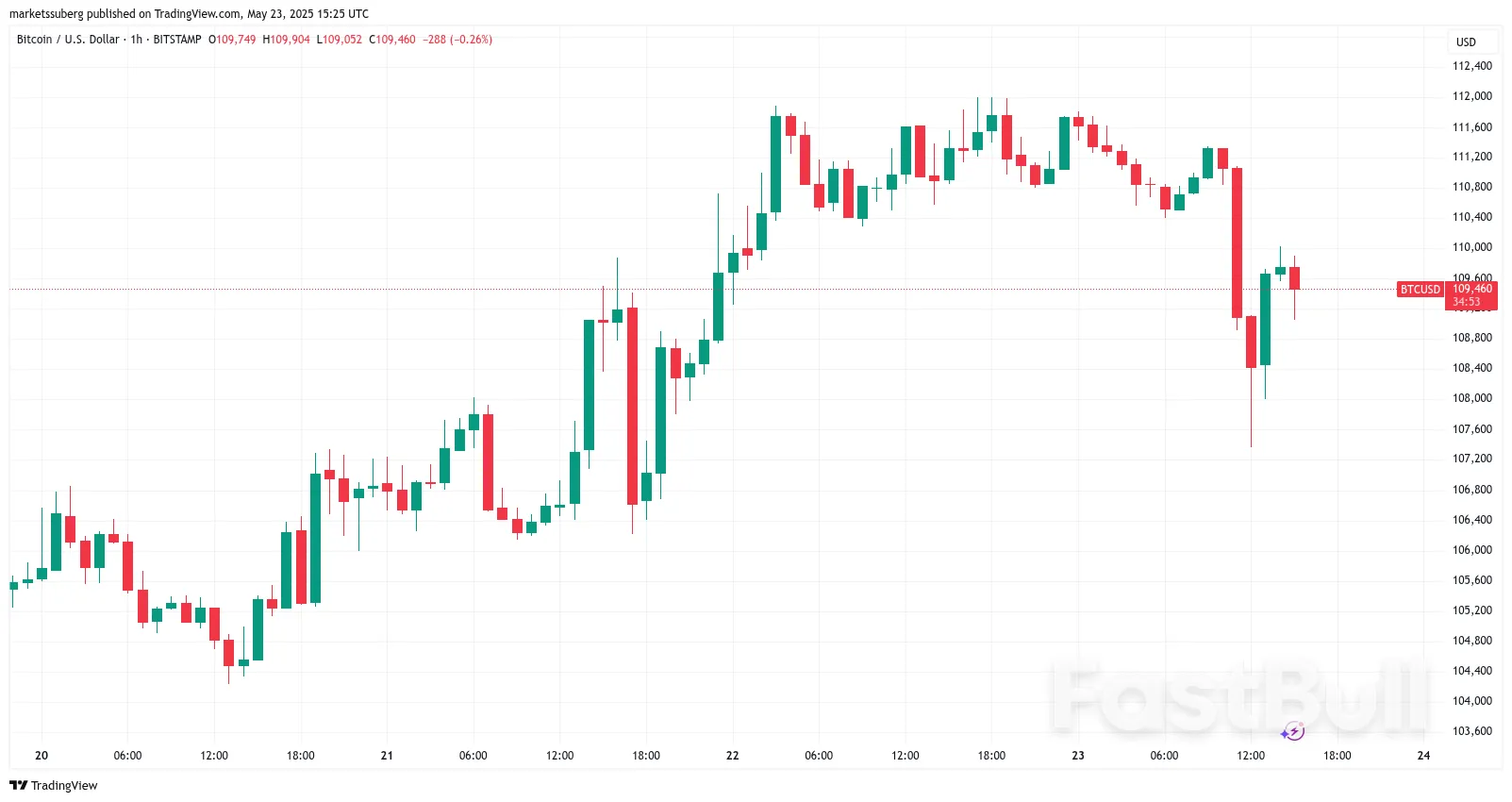
          Bitcoin saw flash volatility into the May 23 Wall Street open as news headlines liquidated longs.Bitcoin Price Drops 4% as Trump EU Tariff Talk Liquidates Over $300M_1

          BTC/USD 1-hour chart. Source: Cointelegraph/TradingView

          Bitcoin trips as Trump says EU talks “going nowhere”

          Data from Cointelegraph Markets Pro and TradingView showed BTC/USD hitting lows of $107,367 on Bitstamp before rebounding.
          This marked daily losses of up to 4% as markets reacted to comments from US President Donald Trump over tariffs on the European Union.
          “Our discussions with them are going nowhere!” Trump wrote in a post on Truth Social.
          “Therefore, I am recommending a straight 50% Tariff on the European Union, starting on June 1, 2025.”Source:
          Truth Social
          US stocks reacted immediately at the open, with the S&P 500 and Nasdaq Composite Index down 1% and 1.2%, respectively, at the time of writing.
          Reflecting on the latest developments, crypto market participants were unsurprised, given the existing precedent for tariff-related volatility.
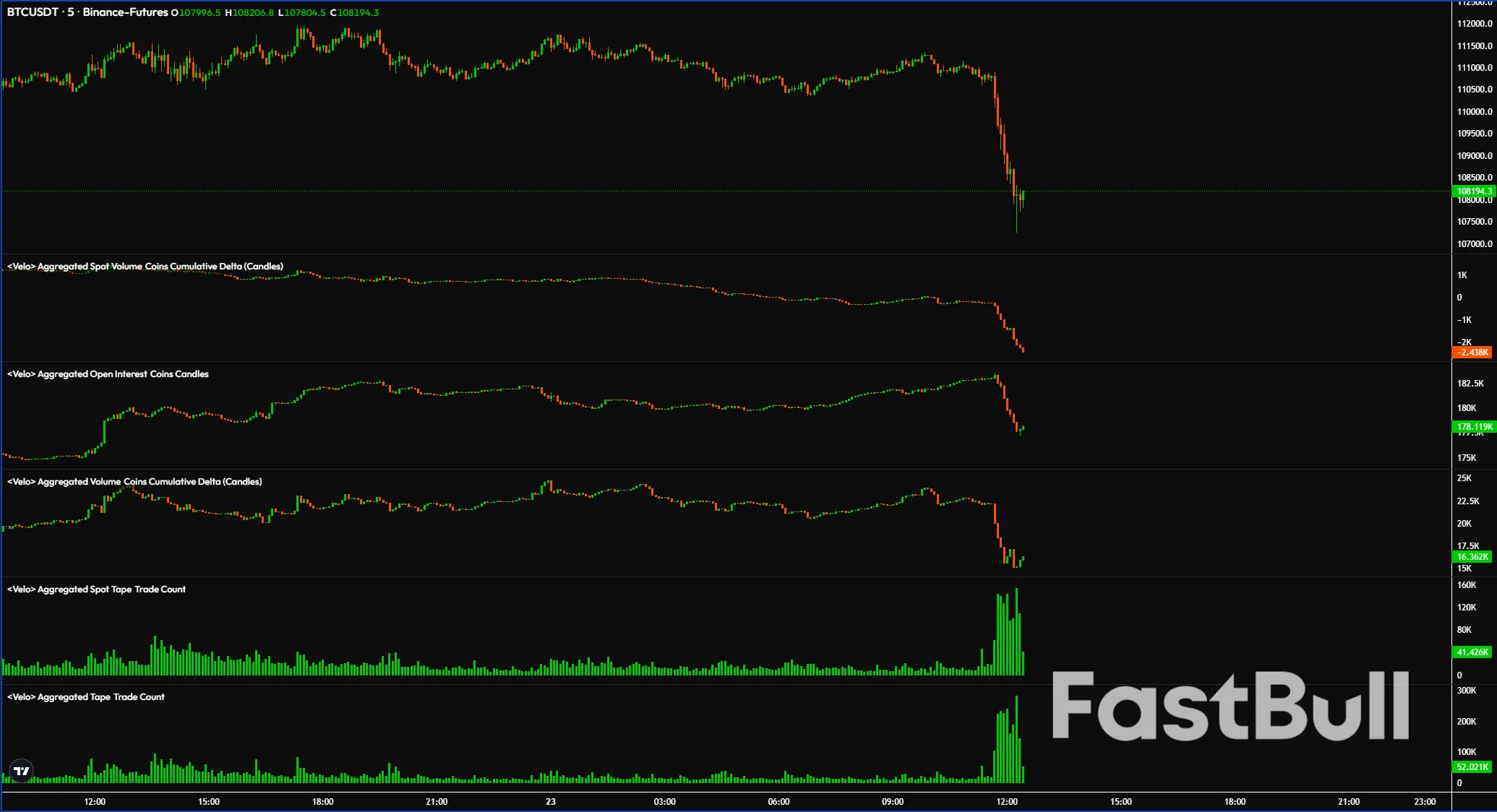
          “Nice aggregate flush of long leverage & de-risk selling from spot,” popular trader Skew summarized in a post on X.
          “All driven by headlines once again.”

          Bitcoin Price Drops 4% as Trump EU Tariff Talk Liquidates Over $300M_2Binance Bitcoin futures market data overview. Source: Skew/X

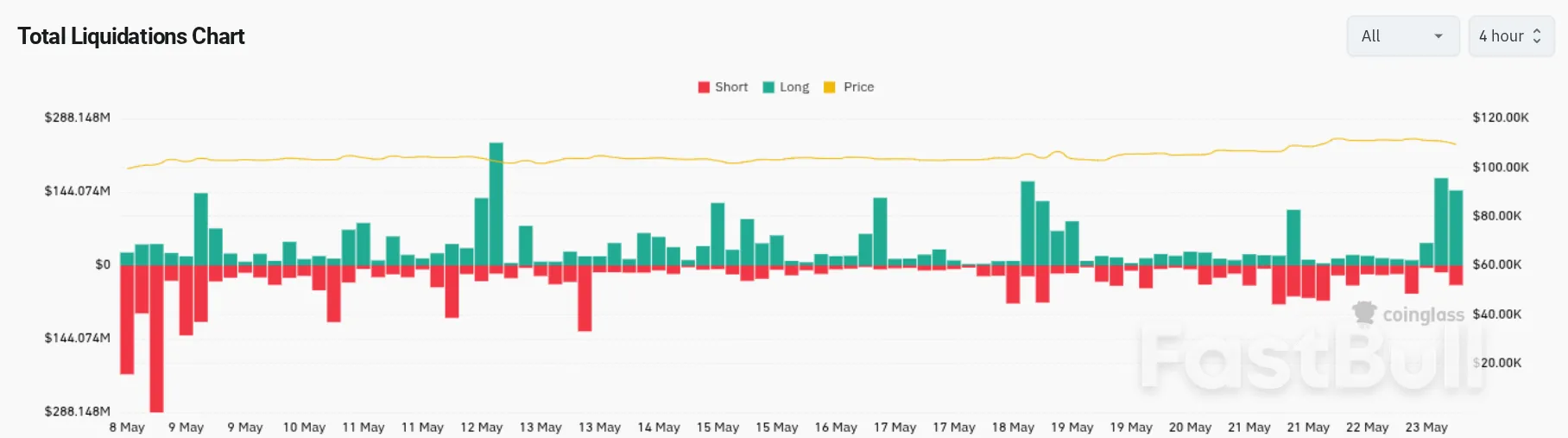
          Data from monitoring resource CoinGlass put 4-hour liquidations at nearly $350 million, with the 24-hour tally at over $500 million.Bitcoin Price Drops 4% as Trump EU Tariff Talk Liquidates Over $300M_3

          Total crypto liquidations (screenshot). Source: CoinGlass

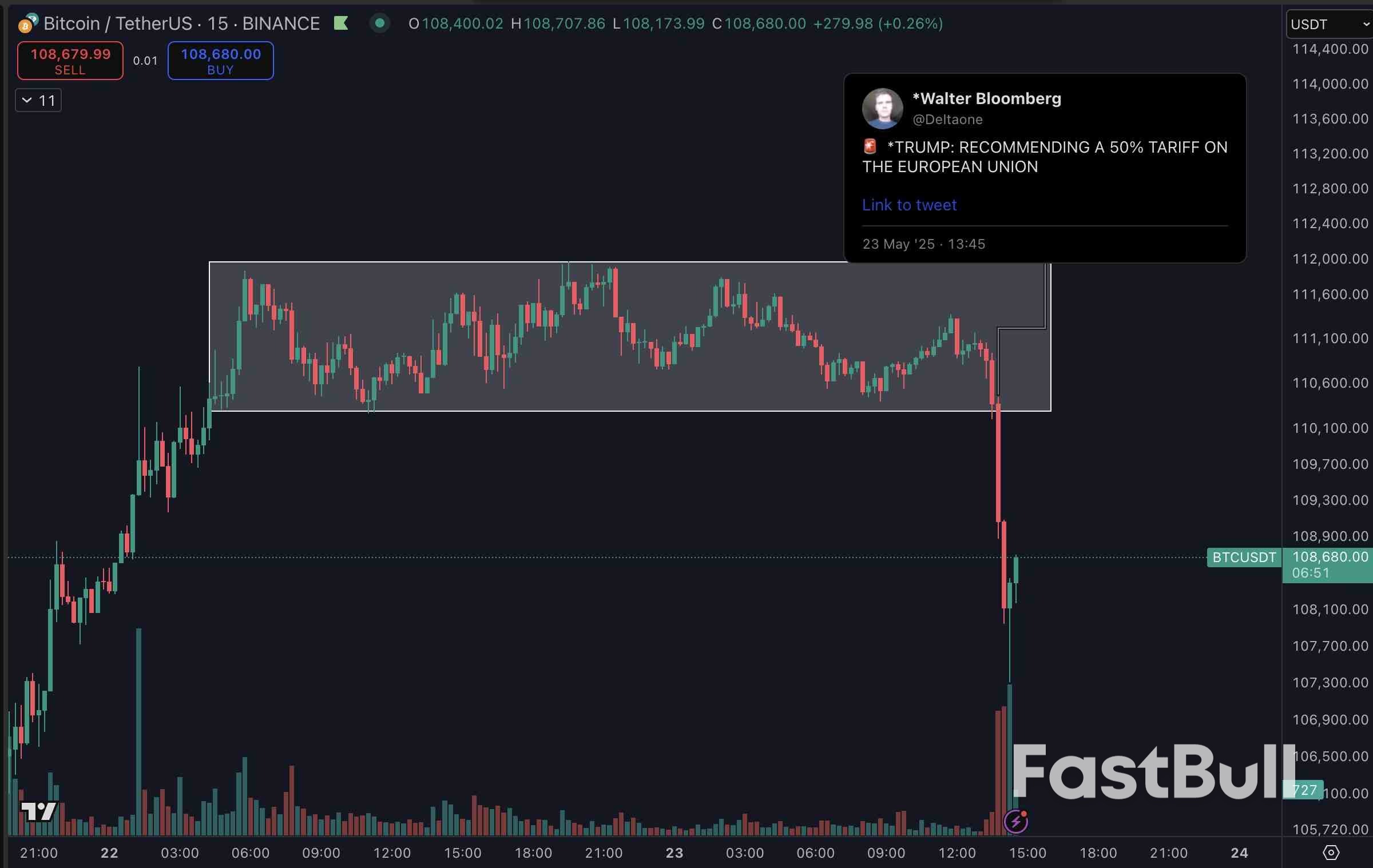
          “There's the break from the compression with a push from Trump. Markets worldwide obviously not liking the news,” fellow trader Daan Crypto Trades continued.
          “Will have to see where this settles today and how BTC ends up performing relative to equities now the trade uncertainty is back.”

          Bitcoin Price Drops 4% as Trump EU Tariff Talk Liquidates Over $300M_4BTC/USDT 15-minute chart. Source: Daan Crypto Trades/X

          Commenting on the macro outlook, trading resource The Kobeissi Letter suggested that the Trump administration was caught between a rock and a hard place.
          “We have now learned: Too much tariff pressure causes the basis trade to unwind. Too little tariff pressure causes inflation expectations to rise,” it wrote in part of an X response.
          “Now, President Trump must find a middle ground to maintain tariffs but also suppress treasury yields WITHOUT Fed cuts.”
          Kobeissi referred to the Federal Reserve’s unwillingness to hasted interest rate cuts despite declining inflation — a key ingredient in further risk-asset upside.
          Elsewhere, traders eyed key BTC price levels to preserve going forward as the market sought a rebound.
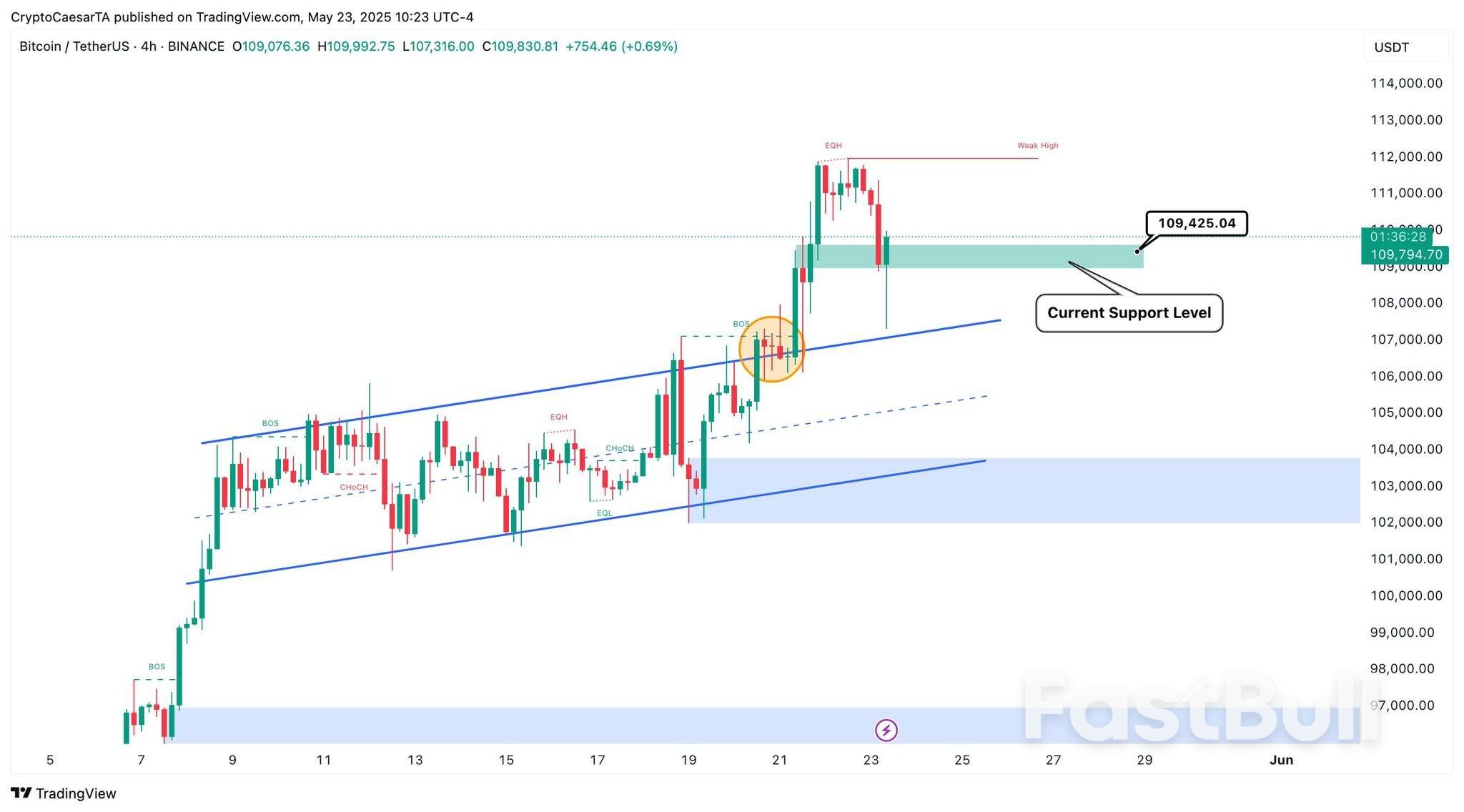
          “We need to hold the green zone,” trader Crypto Caesar argued alongside a chart showing an area of interest immediately below $110,000.Bitcoin Price Drops 4% as Trump EU Tariff Talk Liquidates Over $300M_5

          BTC/USDT 4-hour chart. Source: Crypto Caesar/X

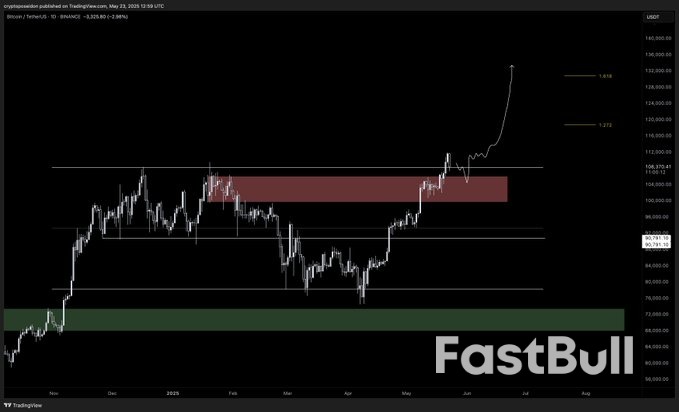
          Another trader, Poseidon, acknowledged the comparative lack of resistance above spot price, keeping the door open to easy upside.Bitcoin Price Drops 4% as Trump EU Tariff Talk Liquidates Over $300M_6
          “Front ran $110K tag,” Skew continued alongside a chart of order book liquidity concentrations.
          “Important level from here for the market to auction above (key for continuation).”

          Source: Cointelegraph

          Risk Warnings and Disclaimers
          You understand and acknowledge that there is a high degree of risk involved in trading. Following any strategies or investment methods may lead to potential losses. The content on the site is provided by our contributors and analysts for information purposes only. You are solely responsible for determining whether any trading assets, securities, strategy, or any other product is suitable for investing based on your own investment objectives and financial situation.
          Add to Favorites
          Share
          FastBull
          Copyright © 2025 FastBull Ltd

          728 RM B 7/F GEE LOK IND BLDG NO 34 HUNG TO RD KWUN TONG KLN HONG KONG

          TelegramInstagramTwitterfacebooklinkedin
          App Store Google Play Google Play
          Products
          Charts

          Chats

          Q&A with Experts
          Screeners
          Economic Calendar
          Data
          Tools
          Membership
          Features
          Function
          Markets
          Copy Trading
          Latest Signals
          Contests
          News
          Analysis
          24/7
          Columns
          Education
          Company
          Careers
          About Us
          Contact Us
          Advertising
          Help Center
          Feedback
          User Agreement
          Privacy Policy
          Business

          White Label

          Data API

          Web Plug-ins

          Poster Maker

          Affiliate Program

          Risk Disclosure

          The risk of loss in trading financial instruments such as stocks, FX, commodities, futures, bonds, ETFs and crypto can be substantial. You may sustain a total loss of the funds that you deposit with your broker. Therefore, you should carefully consider whether such trading is suitable for you in light of your circumstances and financial resources.

          No decision to invest should be made without thoroughly conducting due diligence by yourself or consulting with your financial advisors. Our web content might not suit you since we don't know your financial conditions and investment needs. Our financial information might have latency or contain inaccuracy, so you should be fully responsible for any of your trading and investment decisions. The company will not be responsible for your capital loss.

          Without getting permission from the website, you are not allowed to copy the website's graphics, texts, or trademarks. Intellectual property rights in the content or data incorporated into this website belong to its providers and exchange merchants.

          Not Logged In

          Log in to access more features

          FastBull Membership

          Not yet

          Purchase

          Become a signal provider
          Help Center
          Customer Service
          Dark Mode
          Price Up/Down Colors

          Log In

          Sign Up

          Position
          Layout
          Fullscreen
          Default to Chart
          The chart page opens by default when you visit fastbull.com