Markets
News
Analysis
User
24/7
Economic Calendar
Education
Data
- Names
- Latest
- Prev


Signal Accounts for Members
All Signal Accounts
All Contests


Japan Tankan Small Manufacturing Outlook Index (Q4)A:--
F: --
P: --
Japan Tankan Large Non-Manufacturing Outlook Index (Q4)A:--
F: --
P: --
Japan Tankan Large Manufacturing Outlook Index (Q4)A:--
F: --
P: --
Japan Tankan Small Manufacturing Diffusion Index (Q4)A:--
F: --
P: --
Japan Tankan Large Manufacturing Diffusion Index (Q4)A:--
F: --
P: --
Japan Tankan Large-Enterprise Capital Expenditure YoY (Q4)A:--
F: --
P: --
U.K. Rightmove House Price Index YoY (Dec)A:--
F: --
P: --
China, Mainland Industrial Output YoY (YTD) (Nov)A:--
F: --
P: --
China, Mainland Urban Area Unemployment Rate (Nov)A:--
F: --
P: --
Saudi Arabia CPI YoY (Nov)A:--
F: --
P: --
Euro Zone Industrial Output YoY (Oct)A:--
F: --
P: --
Euro Zone Industrial Output MoM (Oct)A:--
F: --
P: --
Canada Existing Home Sales MoM (Nov)A:--
F: --
P: --
Canada National Economic Confidence IndexA:--
F: --
P: --
Canada New Housing Starts (Nov)A:--
F: --
U.S. NY Fed Manufacturing Employment Index (Dec)A:--
F: --
P: --
U.S. NY Fed Manufacturing Index (Dec)A:--
F: --
P: --
Canada Core CPI YoY (Nov)A:--
F: --
P: --
Canada Manufacturing Unfilled Orders MoM (Oct)A:--
F: --
P: --
U.S. NY Fed Manufacturing Prices Received Index (Dec)A:--
F: --
P: --
U.S. NY Fed Manufacturing New Orders Index (Dec)A:--
F: --
P: --
Canada Manufacturing New Orders MoM (Oct)A:--
F: --
P: --
Canada Core CPI MoM (Nov)A:--
F: --
P: --
Canada Trimmed CPI YoY (SA) (Nov)A:--
F: --
P: --
Canada Manufacturing Inventory MoM (Oct)A:--
F: --
P: --
Canada CPI YoY (Nov)A:--
F: --
P: --
Canada CPI MoM (Nov)A:--
F: --
P: --
Canada CPI YoY (SA) (Nov)A:--
F: --
P: --
Canada Core CPI MoM (SA) (Nov)A:--
F: --
P: --
Canada CPI MoM (SA) (Nov)A:--
F: --
P: --
Federal Reserve Board Governor Milan delivered a speech
U.S. NAHB Housing Market Index (Dec)--
F: --
P: --
Australia Composite PMI Prelim (Dec)--
F: --
P: --
Australia Services PMI Prelim (Dec)--
F: --
P: --
Australia Manufacturing PMI Prelim (Dec)--
F: --
P: --
Japan Manufacturing PMI Prelim (SA) (Dec)--
F: --
P: --
U.K. 3-Month ILO Employment Change (Oct)--
F: --
P: --
U.K. Unemployment Claimant Count (Nov)--
F: --
P: --
U.K. Unemployment Rate (Nov)--
F: --
P: --
U.K. 3-Month ILO Unemployment Rate (Oct)--
F: --
P: --
U.K. Average Weekly Earnings (3-Month Average, Including Bonuses) YoY (Oct)--
F: --
P: --
U.K. Average Weekly Earnings (3-Month Average, Excluding Bonuses) YoY (Oct)--
F: --
P: --
France Services PMI Prelim (Dec)--
F: --
P: --
France Composite PMI Prelim (SA) (Dec)--
F: --
P: --
France Manufacturing PMI Prelim (Dec)--
F: --
P: --
Germany Services PMI Prelim (SA) (Dec)--
F: --
P: --
Germany Manufacturing PMI Prelim (SA) (Dec)--
F: --
P: --
Germany Composite PMI Prelim (SA) (Dec)--
F: --
P: --
Euro Zone Composite PMI Prelim (SA) (Dec)--
F: --
P: --
Euro Zone Services PMI Prelim (SA) (Dec)--
F: --
P: --
Euro Zone Manufacturing PMI Prelim (SA) (Dec)--
F: --
P: --
U.K. Services PMI Prelim (Dec)--
F: --
P: --
U.K. Manufacturing PMI Prelim (Dec)--
F: --
P: --
U.K. Composite PMI Prelim (Dec)--
F: --
P: --
Euro Zone ZEW Economic Sentiment Index (Dec)--
F: --
P: --
Germany ZEW Current Conditions Index (Dec)--
F: --
P: --
Germany ZEW Economic Sentiment Index (Dec)--
F: --
P: --
Euro Zone Trade Balance (Not SA) (Oct)--
F: --
P: --
Euro Zone ZEW Current Conditions Index (Dec)--
F: --
P: --
Euro Zone Trade Balance (SA) (Oct)--
F: --
P: --
U.S. Retail Sales MoM (Excl. Automobile) (SA) (Oct)--
F: --
P: --


No matching data
Latest Views
Latest Views
Trending Topics
Top Columnists
Latest Update
White Label
Data API
Web Plug-ins
Affiliate Program
View All

No data
Indonesia is facing a tough political climate, as it grapples with protests over rising living costs, lawmakers' pay and police violence, hurting investor sentiment in Southeast Asia's largest economy.
Indonesia is facing a tough political climate, as it grapples with protests over rising living costs, lawmakers' pay and police violence, hurting investor sentiment in Southeast Asia's largest economy.The Jakarta Composite Index fell as much as 3.6% on Monday, while the Indonesian rupiah depreciated to 16,500 against the U.S. dollar — its weakest intra-day level since Aug. 1 — according to LSEG data.While the violence and protests have rattled investors confidence, they are unlikely to challenge the underlying growth story for Indonesia, several market watchers said.
The latest selloff was primarily "sentiment driven," as investors reacted to developments over the weekend, said Howe Chung Wan, managing director and head of Asian fixed income at Principal Fixed Income.Indonesia still ranks among the more stable emerging markets, Howe said, shrugging off impact from the demonstrations as a near-term setback. "I don't think it completely changes the story at this point."
The near-term potential softness for rupiah is expected to be temporary and will likely reverse when domestic uncertainties fade, according to Christopher Wong, FX analyst at OCBC Bank. He refrained from giving more precise forecasts, citing heightened uncertainty.It was unclear if demonstrations in Jakarta or other cities will continue on Monday, with some Indonesian students and civil society groups having called off protests to avoid any violent escalation by authorities.Investors will watch the government's next steps to address the public's demands and improve market confidence, said Ari Jahja, head of Indonesia research, Macquarie Capital. "On slight positive side, Indonesia could emerge stronger if structural reforms are executed."
Radhika Rao, economist at DBS, agreed that the long-term growth drivers remain intact for Indonesia. Investors will watch for any signs of the government's priority to boost growth and jobs, she said, expecting part of Jakarta's spending cuts could be redirected to alleviate unemployment.Bank Indonesia still has ample room to keep policy accommodative, she said, expecting the central bank to act swiftly to calm markets and step in to support the rupiah when it's due.Yields on Indonesia's 10-year government bonds ticked higher to 6.335 on Monday while yields on the 30-year debts were little changed at 6.850, according to LSEG data.
Thousands of protestors in several major cities in the Southeast Asian nation have rallied for for about a week, demonstrating against increasing cost of living, high unemployment rate and what many see as excessive pay for lawmakers.Lawmakers' housing allowances which are said to be 10 times the country's monthly minimum wage at a time when tax hikes, layoffs and inflation have hit lower-income Indonesians, have been key to stoking public anger.
That discontent over economic hardship has morphed into a broader outrage after a motorcycle taxi driver was reportedly killed during police action at a protest site last Thursday. That incident set off a wave of violent protests across several Indonesian cities, calling for a police reform.Protests intensified over the weekend, with rioters targeting the homes of lawmakers, ransacking and looting properties, and burning government buildings, according to media reports. Hundreds of people reportedly stormed finance minister Sri Mulyani's residence in South Tangerang, forcing their way in and taking away valuables.
In an attempt to quell the public anger, Indonesian President Prabowo Subianto said on Sunday the country's parliament would listen and act on people's concerns, pledging to curb hefty allowances for lawmakers.Indonesia, the world's fourth-largest economy with a population of 284 million, had been seen as one of Southeast Asia's most stable economies. The latest protests, which killed at least five and injured hundreds, created the worst crisis for the country since Subianto took office about a year ago.
"This moment represents a key test for Prabowo's approach to dissent," said Bob Herrera-Lim, managing director at political consultancy Teneo. "The president may worry that continuing to yield ground on the streets for more than a few days may generate the impression that he is encouraging a popular opposition to emerge to challenge his government"
The president has warned that firm action will be taken against violent demonstrators. "We cannot deny that signs of extrajudicial, even unlawful, actions are beginning to emerge, some even leading to treason and terrorism," he reportedly said, while ordering the military and police to take stern action against rioters and looters.
Friday’s US July PCE inflation gauges printed bang in line with expectations. Lacking signs of tariff-related inflationary pressures, they basically vindicated Fed chair Powell paving the way for a first rate cut in a year at this month’s meeting. A softer Chicago PMI and a downward revision in the US Michigan consumer survey’s inflation expectation gauges added to the US yield curve steepening. Net daily changes varied between -1.3 bps (2-yr) to +5.2 bps (30-yr). European rates followed the same curve movement, adding up to 3.8 bps at the long end. The first national inflation readings (Germany, France, Spain) suggest little to no surprises to tomorrow’s EMU print expected at 2%. That allows the ECB to stick to the sidelines for some time to come with its 2% deposit rate. The euro tried to capitalize on some dollar weakness that prevailed in the early US trading hours with EUR/USD pushing for the 1.17 barrier. The move lacked strength and conviction, perhaps due to the long weekend ahead in the US (markets closed today for Labour Day), but the pair is giving it another shot this morning (1.1714). A federal appeals court late Friday found that US president Trump had gone too far in his use of emergency powers, mostly under the veil of national security, to install his signature import tariffs. It gave the US administration a mid-October deadline to appeal to the Supreme Court before the ruling takes effect. It’s considered the most consequential ruling so far but comes along with several other judges having concluded that the president is acting without legal support. It’s one of the legal themes to keep an eye at, the other one being Trump vs Cook. Friday’s emergency hearing on the firing of the Fed board governor came with no initial ruling though. Stock markets ended Friday on softer footing. The main European and US indices (especially tech) printed losses up to 1%.
With US investors lacking and an uninspiring economic calendar elsewhere, including the euro area, trading is likely to be technically inspired. That’ll change starting tomorrow though. The US offers an important economic update, kicking off with the manufacturing ISM for August. The JOLTS job report is due Wednesday, the services ISM and ADP job report on Thursday and the official payrolls on Friday. After Powell’s pivot at Jackson Hole, markets are probably especially vulnerable for downside surprises in anything related to the labour market. That would trigger additional dovish repositioning (eg. from two to three rate cuts this year) in US markets, weighing on front-end yields and the dollar. The European focus is mainly directed towards France, where the vote of no confidence is drawing near (September 8). The OAT/swapspread is on our radar.
South Korean August trade data showed export growth of 1.3% Y/Y in August, showing no harm so far from the higher reciprocal tariff rate installed by the US in July (15%). Semiconductor exports jumped by 27% with vehicle shipments rising by 9%. It will be interesting to see if export momentum holds going into year-end. The US Commerce Department complicated things on Friday by saying that it will revoke a waiver (in 120 days) for South Korean companies Samsung and SK Hynix to use US technologies in their Chinese operations. These regulations allowed them to import chipmaking equipment without applying for a new license each time (“validated end user”). South Korean imports fell by 4% Y/Y with the trade surplus slightly narrowing from $6.6bn to $6.5bn.
EC president von der Leyen said that the EU’s $150bn SAFE programme reached full subscription. Under the programme, cash will be borrowed against the EU budget to member states to jointly spend on military purchases. Those are mainly EU manufactured products with the EU imposing clauses that limit the amount of third-country components. The EC will now review the bids and optimize the distribution of the funds. Initial disbursements could already begin this year.

The dollar fell on Monday as investors looked ahead to a raft of U.S. labour market data this week that could determine the size of an expected rate cut by the Federal Reserve later this month.Traders were also still assessing Friday's U.S. inflation data and a court ruling that most of Donald Trump's tariffs are illegal, as well as the U.S. president's ongoing tussle with the Fed over his attempt to fire Governor Lisa Cook.The dollar fell 0.04% against the yen to 146.98 in the Asian session, extending its monthly decline of 2.5% against the Japanese currency in August.
The euro was up 0.25% to $1.1710, while sterling edged 0.14% higher to $1.3522. U.S. markets are closed for a holiday on Monday.Top of investors' radar this week will be Friday's U.S. nonfarm payrolls report, which will be preceded by data on job openings and private payrolls."Markets will pay close attention to those data releases in order to gauge the state of the labour market ... any downward surprises to the U.S. labour market data this week will increase market expectations of a rate cut, and that will further give us clues as to whether that cut will be a normal 25-basis-point cut or an outsized 50-basis-point cut," said Carol Kong, a currency strategist at Commonwealth Bank of Australia.
Investors are currently pricing in a roughly 88% chance the Fed will ease rates by 25bps at its September 16-17 meeting, according to the CME FedWatch tool.Against a basket of currencies, the dollar eased 0.15% to 97.69 , having clocked a monthly decline of 2.2% on Friday.Rate expectations aside, the dollar has also been weighed down by worries over Fed independence, as Trump steps up his campaign to exert more influence over monetary policy.
A court hearing on Trump's attempt to fire Fed Governor Cook ended on Friday with no immediate ruling on the unprecedented legal fight, meaning she will remain in place for now.At the same time, uncertainty over Trump's tariffs continues to linger.U.S. Trade Representative Jamieson Greer said on Sunday the Trump administration is continuing its talks with trading partners despite a U.S. appeals court ruling that most of Trump's tariffs are illegal."I doubt it will be market-moving if tariffs are going to stay in place, and even if they are ruled to be illegal, I think Trump will find another legal avenue to implement the tariffs," said CBA's Kong.In other currencies, the Australian dollar rose 0.11% to $0.6544 after earlier touching a two-week high, while the New Zealand dollar similarly advanced 0.13% to $0.5902.
The onshore yuan <CNY=CFXS> steadied near Friday's roughly 10-month high and last stood at 7.1318 per dollar.The yuan has drawn support from firm central bank fixings in the onshore market and a buoyant domestic stock market, even as China's economy struggles to mount a solid recovery.
China's factory activity in August expanded at the quickest pace in five months on the back of rising new orders, a private-sector survey showed on Monday, contrasting with an official survey released on Sunday that showed factory activity shrinking for the fifth straight month.
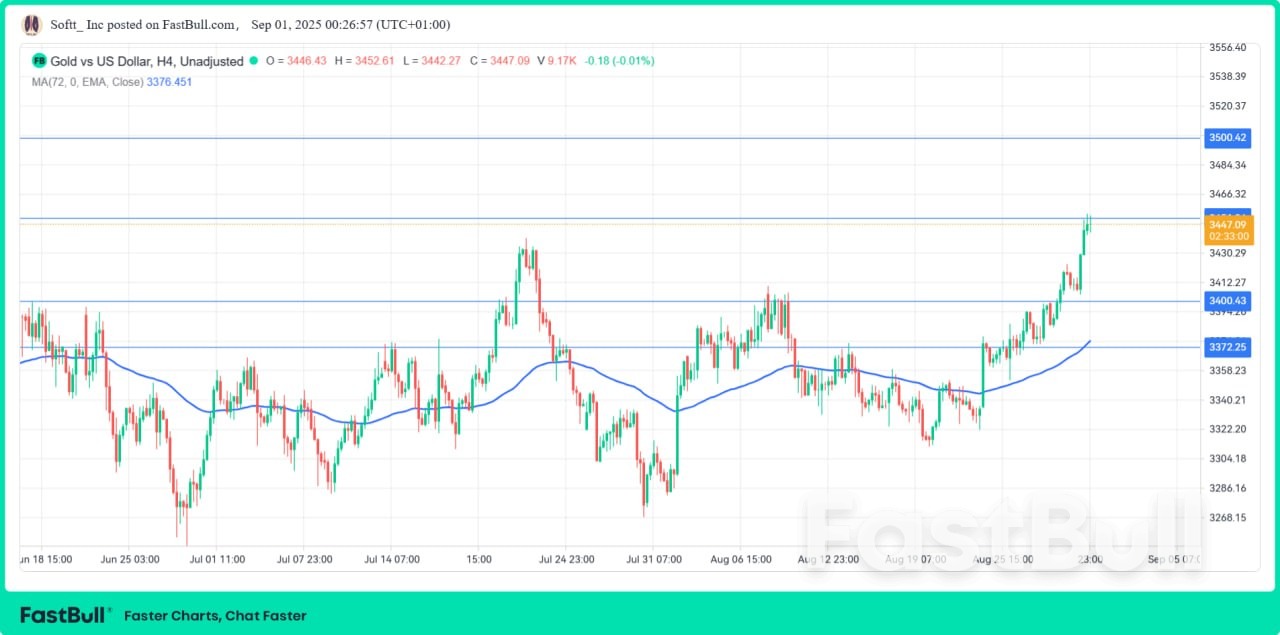
Today’s Asia session was marked by a mixed equity performance, led by pronounced weakness in tech-heavy markets (Japan, Korea, Australia), a sharp rebound in select Chinese tech stocks, and strong moves in precious metals as investors sought safety amid policy and trade uncertainty. Key macro data from China (better-than-expected PMI) and South Korea supported regional outlooks, while currencies traded cautiously ahead of global monetary policy updates.
The Dollar is currently under pressure with investors prioritizing US employment data and Federal Reserve decisions this week—signs point toward further weakening if rate cuts are confirmed. Currency movements have been somewhat subdued due to US markets being closed for Labor Day, with trading expected to resume tomorrow. Against the yen, the dollar rose slightly to 147.20 but had recorded a monthly decline of 2.5%. The euro strengthened to 1.1693 against the dollar, and the British pound ticked higher to 1.3510.Central Bank Notes:
Next 24 Hours Bias
Weak Bearish
The Euro starts September 2025 stable and slightly stronger, as inflation drops and policy uncertainty fades. Economic growth remains modest, supported by EU investment and robust labor markets, while the political climate is increasingly reactive to populist movements and ongoing border and security issues. Eurozone GDP growth for 2025 is projected at about 0.9–1%, with inflation dropping to 2.1%—close to the European Central Bank’s target. Less restrictive monetary policies and increased EU public spending are improving economic confidence, even as trade policy uncertainty lingers.Central Bank Notes:
Next 24 Hours Bias
Weak Bearish
The Swiss Franc enters September 2025 from a position of considerable strength, having appreciated significantly against major currencies over the past year. Key developments include the SNB’s maintenance of zero interest rates with potential for negative territory, escalated US trade tensions with 39% tariffs on Swiss goods, and weakening economic growth momentum. The combination of safe-haven demand, deflationary pressures, and trade uncertainties continues to present challenges for Swiss policymakers, with markets anticipating potential further monetary easing at the September 25 SNB meeting. The franc’s strength, while reflecting its safe-haven status, poses ongoing concerns for Switzerland’s export-dependent economy amid deteriorating global trade conditions.Central Bank Notes:
Next 24 Hours Bias
Medium Bearish
Central Bank Notes:
The Canadian dollar faces a complex environment on September 1, 2025, balancing between domestic economic weakness and potential US monetary policy easing. While the currency has shown modest strength today, underlying pressures from weak GDP growth, declining oil prices, and anticipated Bank of Canada rate cuts continue to weigh on medium-term prospects. The upcoming September 17 Bank of Canada meeting will be crucial in determining the currency’s near-term direction, with markets increasingly pricing in monetary policy easing to support the struggling economy.Central Bank Notes:
Next 24 Hours Bias
Medium Bearish
Oil markets on September 1, 2025, reflect a fundamental shift toward oversupply concerns overwhelming geopolitical risk premiums. While Ukrainian attacks on Russian energy infrastructure and broader Middle East tensions continue to provide some price support, the combination of aggressive OPEC+ production increases, record U.S. output, and weakening Chinese demand is creating substantial downward pressure on prices.The market faces a critical juncture as traders await the September 7 OPEC+ meeting, which could determine whether the cartel will pause its production increases or continue prioritizing market share over price support. With oil inventories building and demand growth slowing globally, the structural bear case for oil appears increasingly compelling, suggesting prices may continue trending lower through the remainder of 2025 unless significant supply disruptions occur or demand unexpectedly accelerates.Next 24 Hours BiasWeak Bullish
In the euro area, attention shifts to August unemployment data. While the labour market has remained robust with low unemployment, employment growth has moderated lately. We expect the unemployment rate to remain unchanged at 6.2%. Additionally, the final manufacturing PMI is due today. With much of Europe on holiday in August, late responses not captured in the preliminary release could influence the final print. This is particularly important as the flash estimate surprised significantly on the upside.
This week offers plenty of key data, including euro area inflation on Tuesday, Sweden’s flash inflation figures on Thursday, which will be closely watched and key to near-term Riksbank rate decisions. The week concludes with the US jobs report on Friday.
What happened overnight and over the weekend
In China, PMIs for August released this morning and yesterday highlight ongoing economic softness. Official PMI manufacturing rose slightly to 49.4, while RatingDog PMI (formerly Caixin PMI) edged up to 50.3. While better than expected, weakness persists in construction and employment indices, underscoring the need for stronger stimulus targeting housing and consumption. The price indices were the main bright spot suggesting easing deflationary pressures as output price indices improved.
In the US, an appeals court ruled IEEPA tariffs illegal but allowed them to remain until 14 October, giving the Supreme Court time to intervene. The Trump administration has prepared a backup plan to replace IEEPA tariffs with broader sectoral tariffs, similar to Section 232 tariffs on steel and aluminium, though these would take longer to implement. While fewer tariffs would be positive for now, the prolonged uncertainty poses a downside risk.
In the US, July’s PCE figures aligned with expectations, with headline inflation at 2.6% y/y and core inflation rising to 2.9% y/y, marking the third consecutive monthly increase in core inflation and leaving the door open to a potential rate cut in September. Meanwhile, August’s revised Michigan Consumer Sentiment index dropped to 58.2, indicating a modest decline in consumer confidence, as both current conditions and future expectations weakened, with a growing number of consumers viewing jobs as ‘hard to get’.
In euro area, we received inflation figures for France, Germany and Spain ahead of the euro area inflation release this Tuesday. Both France and Spain reported lower-than-expected inflation. French HICP inflation fell to 0.8% y/y, below the expected 0.9%, driven by muted services inflation, while Spain’s headline inflation remained steady at 2.7% y/y, below the anticipated rise to 2.8%, though core inflation edged up to 2.4% y/y. In contrast, German HICP inflation surprised to the upside at 2.1% y/y, driven by base effects in energy and goods as well as strong food prices. Overall, we expect euro area HICP inflation to come in at 2.0% y/y (cons: 2.1%).
In Sweden, GDP figures were revised upward as expected, slightly exceeding consensus at 0.5% q/q and 1.4% y/y. Consumption rose 0.4% y/y in Q2, signalling some recovery for households, while retail sales improved in July but remained below early-year levels. Backward revisions lowered GDP growth for both FY2025 and FY2024, yet Q2 recovery momentum was stronger than anticipated, presenting a mixed outcome for the Riksbank.
In Norway, the NAV unemployment rate remained steady at 2.1% (s.a.), aligning with Norges Bank’s June MPR estimate and should in isolation support the case for a September rate cut. Meanwhile, Norwegian retail sales rose by 0.6% m/m in July, slightly below our expectations of a 1% lift signalled by leading indicators, following a largely flat performance in Q2.
Equities: Global risk sentiment deteriorated on Friday amid a sell-off in US yields, led by the long end, with the 30-year US Treasury yield rising by 4bp. The S&P 500 closed -0.6% on Friday, erasing earlier gains from the week and ending broadly unchanged for the week. Unsurprisingly, defensives outperformed cyclicals by 1pp on Friday. The sell-off in cyclicals was led by the tech sector, after a strong run last week, declining 1.6%. In Europe, the CAC 40 continues to underperform amid lingering political turmoil.
FI and FX: On a relatively muted day in the FX market terms of price action, SEK, NZD and AUD gained vis-à-vis GBP and JPY. EUR/USD ended the week close to the 1.17 level, EUR/SEK close to 11.05 and EUR/NOK around 11.75. The 10Y US Treasury yield finished the week at 4.23% – around the lowest in about two weeks. Both the 10Y US and German swap spreads ended the week at a tighter level.
Asia’s manufacturing activity split across the region’s various hubs in August with Indonesia and Thailand powering ahead while South Korea and Japan cooled as tariffs weighed on output.In Indonesia, output and new orders increased for the first time in five months and production in Thailand rose at the fastest pace in 13 months, according to S&P Global data published on Monday. Overall activity in South Korea, Japan and Taiwan remained below the 50-mark that is the midpoint between expansion and contraction.
Asian producers have been whipsawed by US tariffs this year, and August marked the arrival of President Donald Trump’s so-called “reciprocal” tariffs on nations around the world. Overall exports have eased in recent months after a surge earlier in the year as firms sought to get ahead of the levies.The impact of higher US import duties varied across the region: In Japan, new export orders contracted at the quickest pace since March 2024, with reduced demand from Europe, China and the US. In South Korea, the decline was the biggest since April. Even in Thailand, a surge in new orders was led by domestic demand, as new export orders fell for the first time since April.
Meanwhile, Indonesia strengthened as overall activity expanded for the first time since March, allowing firms to raise prices by the most in about a year. New export orders rose at the steepest rate since September 2023 and companies remained optimistic for the year. In recent days, though, widespread protests have gripped the nation on inequality and labour concerns.Vietnam and Malaysia purchasing managers indices are reported later in the week and will provide a fuller picture of activity in the region.
White Label
Data API
Web Plug-ins
Poster Maker
Affiliate Program
The risk of loss in trading financial instruments such as stocks, FX, commodities, futures, bonds, ETFs and crypto can be substantial. You may sustain a total loss of the funds that you deposit with your broker. Therefore, you should carefully consider whether such trading is suitable for you in light of your circumstances and financial resources.
No decision to invest should be made without thoroughly conducting due diligence by yourself or consulting with your financial advisors. Our web content might not suit you since we don't know your financial conditions and investment needs. Our financial information might have latency or contain inaccuracy, so you should be fully responsible for any of your trading and investment decisions. The company will not be responsible for your capital loss.
Without getting permission from the website, you are not allowed to copy the website's graphics, texts, or trademarks. Intellectual property rights in the content or data incorporated into this website belong to its providers and exchange merchants.
Not Logged In
Log in to access more features

FastBull Membership
Not yet
Purchase
Log In
Sign Up