• Trade
  • Markets
  • Copy
  • Contests
  • News
  • 24/7
  • Calendar
  • Q&A
  • Chats
Trending
Screeners
SYMBOL
LAST
BID
ASK
HIGH
LOW
NET CHG.
%CHG.
SPREAD
SPX
S&P 500 Index
6857.13
6857.13
6857.13
6865.94
6827.13
+7.41
+ 0.11%
--
DJI
Dow Jones Industrial Average
47850.93
47850.93
47850.93
48049.72
47692.96
-31.96
-0.07%
--
IXIC
NASDAQ Composite Index
23505.13
23505.13
23505.13
23528.53
23372.33
+51.04
+ 0.22%
--
USDX
US Dollar Index
98.920
99.000
98.920
99.000
98.740
-0.060
-0.06%
--
EURUSD
Euro / US Dollar
1.16483
1.16492
1.16483
1.16715
1.16408
+0.00038
+ 0.03%
--
GBPUSD
Pound Sterling / US Dollar
1.33459
1.33469
1.33459
1.33622
1.33165
+0.00188
+ 0.14%
--
XAUUSD
Gold / US Dollar
4235.58
4236.01
4235.58
4236.27
4194.54
+28.41
+ 0.68%
--
WTI
Light Sweet Crude Oil
59.424
59.454
59.424
59.543
59.187
+0.041
+ 0.07%
--

Community Accounts

Signal Accounts
--
Profit Accounts
--
Loss Accounts
--
View More

Become a signal provider

Sell trading signals to earn additional income

View More

Guide to Copy Trading

Get started with ease and confidence

View More

Signal Accounts for Members

All Signal Accounts

Best Return
  • Best Return
  • Best P/L
  • Best MDD
Past 1W
  • Past 1W
  • Past 1M
  • Past 1Y

All Contests

  • All
  • Trump Updates
  • Recommend
  • Stocks
  • Cryptocurrencies
  • Central Banks
  • Featured News
Top News Only
Share

Canada Nov Participation Rate 65.1%, Oct Was 65.3%

Share

Canada Nov Employment +53.6K, Full-Time -9.4K, Part-Time +63.0K, Forecast For Total Employment Was -5.0K

Share

Canada's Employment Increased By 53,600 In November, Compared With An Expected Decrease Of 5,000 And A Previous Increase Of 66,600

Share

Canada Goods Sector +11.0K Jobs In Nov, Services Sector +42.8K Jobs

Share

Swiss Government: Swiss-EU Package Expected To Go To Swiss Parliament In March 2026

Share

White House National Economic Council Director Hassett: Supports Treasury Secretary Bessant's Views On The Federal Reserve Chairman

Share

White House National Economic Council Director Hassett: No Discussion With US President Trump Regarding The Federal Reserve Chair (selection)

Share

Croatia Adopts 2026 Budget Foreseeing Deficit Of 2.9% Of GDP

Share

Nine German Conservative Lawmakers Voted Against Or Abstained In Pensions Vote - Parliament Tally

Share

Reuters Poll - Brazil Central Bank To Hold Benchmark Interest Rate At 15% On December 10, Say All 41 Economists

Share

Reuters Poll - 19 Of 36 Economists See Rate Cut In March, 14 In January, Three In April

Share

Meta Said It Has Struck Several Commercial Ai Data Agreements With News Publishers Ranging From USA Today, People Inc., Cnn, Fox News, The Daily Caller, Washington Examiner And Le Monde

Share

Monetary Policy Committee Members Said That The November Projection Shows That Inflation Outlook Should Be Better In The Next Few Quarters

Share

Monetary Policy Committee Members Said That The Projected Rate Of Inflation Is Subject To Uncertainty, Particularily Due To Energy Prices

Share

Monetary Policy Committee Members Said High Budget Deficit Planned For 2026 Limits Scope For Cutting Interest Rates

Share

Monetary Policy Committee Members Said That The Central Bank's November Projection Shows Wage Grows Will Slow, Which May Limit Demand Pressure - November Minutes

Share

Mvm CEO: Mvm In Talks With Mol To Extend Cooperation Into 2026 Under Which Mol Buys And Ships Azeri Oil To Its Refineries

Share

Swiss Federal Council: Committed To Further Improving Access To The US Market

Share

Swiss Federal Council: Prepared To Consider Further Tariff Concessions On Products Originating In The USA, Provided USA Also Willing To Grant More Concessions

Share

Swiss Federal Council: Draft Mandate Will Now Be Consulted With Foreign Policy Committees Of Parliament And Cantons

TIME
ACT
FCST
PREV
U.S. Non-Defense Capital Durable Goods Orders Revised MoM (Excl. Aircraft) (SA) (Sept)

A:--

F: --

P: --
U.S. Factory Orders MoM (Excl. Transport) (Sept)

A:--

F: --

P: --

U.S. Factory Orders MoM (Excl. Defense) (Sept)

A:--

F: --

P: --

U.S. EIA Weekly Natural Gas Stocks Change

A:--

F: --

P: --

Saudi Arabia Crude Oil Production

A:--

F: --

P: --

U.S. Weekly Treasuries Held by Foreign Central Banks

A:--

F: --

P: --

Japan Foreign Exchange Reserves (Nov)

A:--

F: --

P: --

India Repo Rate

A:--

F: --

P: --

India Benchmark Interest Rate

A:--

F: --

P: --

India Reverse Repo Rate

A:--

F: --

P: --

India Cash Reserve Ratio

A:--

F: --

P: --

Japan Leading Indicators Prelim (Oct)

A:--

F: --

P: --

U.K. Halifax House Price Index YoY (SA) (Nov)

A:--

F: --

P: --

U.K. Halifax House Price Index MoM (SA) (Nov)

A:--

F: --

P: --

France Current Account (Not SA) (Oct)

A:--

F: --

P: --

France Trade Balance (SA) (Oct)

A:--

F: --

P: --

France Industrial Output MoM (SA) (Oct)

A:--

F: --

P: --

Italy Retail Sales MoM (SA) (Oct)

A:--

F: --

P: --

Euro Zone Employment YoY (SA) (Q3)

A:--

F: --

P: --

Euro Zone GDP Final YoY (Q3)

A:--

F: --

P: --

Euro Zone GDP Final QoQ (Q3)

A:--

F: --

P: --

Euro Zone Employment Final QoQ (SA) (Q3)

A:--

F: --

P: --

Euro Zone Employment Final (SA) (Q3)

A:--

F: --

P: --
Brazil PPI MoM (Oct)

A:--

F: --

P: --

Mexico Consumer Confidence Index (Nov)

A:--

F: --

P: --

Canada Unemployment Rate (SA) (Nov)

A:--

F: --

P: --

Canada Labor Force Participation Rate (SA) (Nov)

A:--

F: --

P: --

Canada Employment (SA) (Nov)

A:--

F: --

P: --

Canada Part-Time Employment (SA) (Nov)

A:--

F: --

P: --

Canada Full-time Employment (SA) (Nov)

A:--

F: --

P: --

U.S. Personal Income MoM (Sept)

--

F: --

P: --

U.S. Dallas Fed PCE Price Index YoY (Sept)

--

F: --

P: --

U.S. PCE Price Index YoY (SA) (Sept)

--

F: --

P: --

U.S. PCE Price Index MoM (Sept)

--

F: --

P: --

U.S. Personal Outlays MoM (SA) (Sept)

--

F: --

P: --

U.S. Core PCE Price Index MoM (Sept)

--

F: --

P: --

U.S. UMich 5-Year-Ahead Inflation Expectations Prelim YoY (Dec)

--

F: --

P: --

U.S. Core PCE Price Index YoY (Sept)

--

F: --

P: --

U.S. Real Personal Consumption Expenditures MoM (Sept)

--

F: --

P: --

U.S. 5-10 Year-Ahead Inflation Expectations (Dec)

--

F: --

P: --

U.S. UMich Current Economic Conditions Index Prelim (Dec)

--

F: --

P: --

U.S. UMich Consumer Sentiment Index Prelim (Dec)

--

F: --

P: --

U.S. UMich 1-Year-Ahead Inflation Expectations Prelim (Dec)

--

F: --

P: --

U.S. UMich Consumer Expectations Index Prelim (Dec)

--

F: --

P: --

U.S. Weekly Total Rig Count

--

F: --

P: --

U.S. Weekly Total Oil Rig Count

--

F: --

P: --

U.S. Consumer Credit (SA) (Oct)

--

F: --

P: --

China, Mainland Foreign Exchange Reserves (Nov)

--

F: --

P: --

China, Mainland Exports YoY (USD) (Nov)

--

F: --

P: --

China, Mainland Imports YoY (CNH) (Nov)

--

F: --

P: --

China, Mainland Imports YoY (USD) (Nov)

--

F: --

P: --

China, Mainland Imports (CNH) (Nov)

--

F: --

P: --

China, Mainland Trade Balance (CNH) (Nov)

--

F: --

P: --

China, Mainland Exports (Nov)

--

F: --

P: --

Japan Wages MoM (Oct)

--

F: --

P: --

Japan Trade Balance (Oct)

--

F: --

P: --

Q&A with Experts
    • All
    • Chatrooms
    • Groups
    • Friends
    Connecting
    .
    .
    .
    Type here...
    Add Symbol or Code

      No matching data

      All
      Trump Updates
      Recommend
      Stocks
      Cryptocurrencies
      Central Banks
      Featured News
      • All
      • Russia-Ukraine Conflict
      • Middle East Flashpoint
      • All
      • Russia-Ukraine Conflict
      • Middle East Flashpoint
      Search
      Products

      Charts Free Forever

      Chats Q&A with Experts
      Screeners Economic Calendar Data Tools
      Membership Features
      Data Warehouse Market Trends Institutional Data Policy Rates Macro

      Market Trends

      Market Sentiment Order Book Forex Correlations

      Top Indicators

      Charts Free Forever
      Markets

      News

      News Analysis 24/7 Columns Education
      From Institutions From Analysts
      Topics Columnists

      Latest Views

      Latest Views

      Trending Topics

      Top Columnists

      Latest Update

      Signals

      Copy Rankings Latest Signals Become a signal provider AI Rating
      Contests
      Brokers

      Overview Brokers Assessment Rankings Regulators News Claims
      Broker listing Forex Brokers Comparison Tool Live Spread Comparison Scam
      Q&A Complaint Scam Alert Videos Tips to Detect Scam
      More

      Business
      Events
      Careers About Us Advertising Help Center

      White Label

      Data API

      Web Plug-ins

      Affiliate Program

      Awards Institution Evaluation IB Seminar Salon Event Exhibition
      Vietnam Thailand Singapore Dubai
      Fans Party Investment Sharing Session
      FastBull Summit BrokersView Expo
      Recent Searches
        Top Searches
          Markets
          News
          Analysis
          User
          24/7
          Economic Calendar
          Education
          Data
          • Names
          • Latest
          • Prev

          View All

          No data

          Scan to Download

          Faster Charts, Chat Faster!

          Download App
          English
          • English
          • Español
          • العربية
          • Bahasa Indonesia
          • Bahasa Melayu
          • Tiếng Việt
          • ภาษาไทย
          • Français
          • Italiano
          • Türkçe
          • Русский язык
          • 简中
          • 繁中
          Open Account
          Search
          Products
          Charts Free Forever
          Markets
          News
          Signals

          Copy Rankings Latest Signals Become a signal provider AI Rating
          Contests
          Brokers

          Overview Brokers Assessment Rankings Regulators News Claims
          Broker listing Forex Brokers Comparison Tool Live Spread Comparison Scam
          Q&A Complaint Scam Alert Videos Tips to Detect Scam
          More

          Business
          Events
          Careers About Us Advertising Help Center

          White Label

          Data API

          Web Plug-ins

          Affiliate Program

          Awards Institution Evaluation IB Seminar Salon Event Exhibition
          Vietnam Thailand Singapore Dubai
          Fans Party Investment Sharing Session
          FastBull Summit BrokersView Expo

          IDF Vows To Destroy All Hamas 'Terror Tunnels' As Part Of Disarming Gaza

          Samantha Luan

          Economic

          Political

          Forex

          Palestinian-Israeli conflict

          Summary:

          Israeli Defense Minister Israel Katz said on Sunday that the Israeli military would destroy tunnels in Gaza after the remaining Israeli captives are released by Hamas, which has happened on Monday.

          Israeli Defense Minister Israel Katz said on Sunday that the Israeli military would destroy tunnels in Gaza after the remaining Israeli captives are released by Hamas, which has happened on Monday."Israel’s great challenge after the phase of returning the hostages will be the destruction of all of Hamas’s terror tunnels in Gaza, directly by the IDF and through the international mechanism to be established under the leadership and supervision of the United States," Katz wrote on X.

          “This is the primary significance of implementing the agreed-upon principle of demilitarizing Gaza and neutralizing Hamas of its weapons. I have instructed the IDF to prepare for carrying out the mission,” he added.

          According to the outline of the Gaza ceasefire proposal released by the White House, all “military, terror, and offensive infrastructure, including tunnels and weapon production facilities, will be destroyed and not rebuilt,” and there will be a “process of demilitarization of Gaza under the supervision of independent monitors.” But the details of how those steps will be taken, including who will be doing it, are unclear. A senior Hamas official has also said that Hamas won’t disarm unless it can hand its weapons to a Palestinian state.

          So far, Israel and Hamas have just entered the first phase of the ceasefire deal, which involves the release of the Israeli hostages in exchange for thousands of Palestinians held in Israeli jails, the IDF pulling back to an agreed-upon line, and Israel allowing more aid to enter Gaza. Details on implementing the rest of the agreement still need to be worked out in negotiations between Israel and Hamas.Katz’s comments come as many are concerned Israel will restart its brutal war once Hamas releases the Israeli captives. Also on Sunday, Israeli Prime Minister Benjamin Netanyahu said the military “campaign is not over,” though he could be referring to other areas where Israel is at war or potential escalations elsewhere in the region.

          “And I want to say: Everywhere we fought – we won. But in the same breath, I must tell you: The campaign is not over. There are still very great security challenges ahead of us,” Netanyahu said, according to a statement from his office. “Some of our enemies are trying to rebuild themselves to attack us again. And as we say – ‘We’re on it.'”According to a report from Israel Hayom, the US has given Israel a guarantee that it would back Israeli military action if it determined Hamas violated the deal in a way that “poses a security threat.” The report said the understanding “constitutes a side agreement” between the US and Israel.The US gave Israel a similar side deal for the November 2024 Lebanon ceasefire agreement, which Israel continues to violate on a near-daily basis.

          Source: Zero Hedge

          To stay updated on all economic events of today, please check out our Economic calendar
          Risk Warnings and Disclaimers
          You understand and acknowledge that there is a high degree of risk involved in trading. Following any strategies or investment methods may lead to potential losses. The content on the site is provided by our contributors and analysts for information purposes only. You are solely responsible for determining whether any trading assets, securities, strategy, or any other product is suitable for investing based on your own investment objectives and financial situation.
          Add to Favorites
          Share

          Auto sector bankruptcies spark fresh scrutiny of Wall Street credit risks

          Adam

          Economic

          The bankruptcies of automotive-related companies First Brands and Tricolor, along with potential losses at banks and investment funds, are raising new concerns about hidden risks in parts of the credit market — prompting investors to take a closer look at risky debt.
          Auto parts supplier First Brands and subprime lender and dealership Tricolor both filed for bankruptcy protection last month. The two collapses have rattled some stakeholders in Wall Street's multitrillion-dollar credit machinery, from leveraged loans and collateralized loan obligations (CLOs) to trade‑finance funds and subprime auto loans, raising questions about exposure levels of a number of Wall Street fund managers, which pool capital from investors to provide loans to companies.
          "This would serve as a strong precedent for LPs (investors) to question risky offerings," said Zain Bukhari, associate director of risk and valuations at S&P Global. LPs, referring to limited partners, are passive investors that provide capital to a fund.
          Some investors may ask for audited statements or quality of earnings from independent audit firms before investing in unsecured assets, Bukhari added. First Brands had roughly $800 million in unsecured supply chain financing liabilities.
          A sign of such scrutiny appeared in July when First Brands was trying to raise a $6 billion loan to refinance its debt. In August, however, it became clear that potential lenders would require further diligence, including a quality-of-earnings report, according to a document filed by the auto parts company's chief restructuring officer in bankruptcy court.
          Investors and analysts are now assessing the fallout for the individual firms exposed as well as for the broader market. They hope to gain some clarity during the third-quarter earnings season, which kicks off this week.
          "The third quarter earnings become a very interesting litmus test for how this shakes out - people will be very closely following the bank reporting," said Andrew Sheets, global head of corporate credit research at Morgan Stanley. "There will be big questions about where auto loan trends are, (and) other consumer credit charge-off trends are."
          First Brands filed for bankruptcy protection on September 29, listing more than $10 billion in liabilities. Some of the finance industry's most prominent names, including Jefferies and UBS Group (UBSG.S), have since disclosed exposure of more than $1 billion tied to the collapse of the Ohio-based company. Earlier in October, Jefferies said a fund in its asset management division, Leucadia Asset Management, has about $715 million of receivables tied to First Brands. UBS is assessing more than $500 million of exposure across certain funds.
          Some investors have asked Jefferies-linked Point Bonita Capital's fund to return money invested in the fund, a source familiar with the matter told Reuters. On Sunday, Jefferies said its exposure to First Brands Group is limited and that any potential losses would be "readily absorbable." When Jefferies was asked if it will face pressure from investors for more scrutiny on risky investments, a spokesman for the firm declined to comment on Monday.
          Other banks exposed include SouthState Bank and CIT Group, which is now owned by First Citizens. A broad range of funds including Sound Point Capital Management, Benefit Street Partners and Palmer Square Capital Management hold CLOs, which collectively hold hundreds of millions of the $4 billion of first-lien term loans of First Brands, according to court documents. Investment firms with over $100 million CLO exposure each include AGL Credit and PGIM, according to the recent court filings.
          The funds and banks either declined to comment or did not respond to requests for comment. A UBS spokesperson said the bank was "working to determine the potential performance impact on the small number of our affected funds."
          Meanwhile, Tricolor listed over $1 billion in liabilities, with more than 25,000 creditors, according to its bankruptcy petition. Lenders such as JPMorgan (JPM.N) have nearly $200 million of exposure to Tricolor, Reuters has previously reported.
          CREDIT RALLY SPUTTERS
          The credit rally, which got off to a robust start earlier in October, has hit a speed bump in recent days as investors reduced exposure to certain sectors over concerns around weakness in consumer and auto lending, experts said.
          "We now seem to have a catalyst important enough to engender a shade of fear," said Neha Khoda, head of U.S. credit strategy at Bank of America, in a note dated October 10. "Credit investors are questioning if they need to be all-in at super-tight spreads, and they won't get a pushback from us."
          To be sure, the collapse of First Brands is unlikely to cause a widespread global meltdown across credit markets, some experts said.
          "On a deal-by-deal basis, we don't see conditions in the leveraged finance markets as materially different from historical norms," said Logan Nicholson, senior managing director at asset manager Blue Owl Capital.
          In the U.S., the overall exposure of CLOs to First Brands currently stands at 0.21%, according to estimates from Morgan Stanley in a note dated September 26. For the CLO funds currently holding First Brands loans, the exposure levels range between 0.001% and 1.8%.
          Some experts said that a divergence has emerged in the CLO industry between holders of senior and junior loans, as a cohort of companies with weaker credit ratings have been buffeted by slower macroeconomic growth and headwinds from the Trump administration's tariff policy.
          "Probably the larger impact on markets has been on the loan side," said Morgan Stanley's Sheets, adding that the ripple effect from the bankruptcies could impact junior parts of a CLO's capital structure.

          Source: reuters

          To stay updated on all economic events of today, please check out our Economic calendar
          Risk Warnings and Disclaimers
          You understand and acknowledge that there is a high degree of risk involved in trading. Following any strategies or investment methods may lead to potential losses. The content on the site is provided by our contributors and analysts for information purposes only. You are solely responsible for determining whether any trading assets, securities, strategy, or any other product is suitable for investing based on your own investment objectives and financial situation.
          Add to Favorites
          Share

          Bank of England Rate-Setter Sees Growing Hard-Landing Risk in UK

          Michelle

          Economic

          Forex

          The British economy faces a growing risk of a hard-landing, Bank of England policymaker Alan Taylor said on Tuesday, reaffirming his calls to speed the pace of interest rate cuts.

          Taylor, an external member of the BOE’s Monetary Policy Committee, made the remarks as part of a broader speech about the impact of tariffs on the British economy. The economist and Columbia University professor said downside risks in the UK were fueling concerns that the British central bank “may have braked too hard” while raising interest rates to combat inflation in the wake of the pandemic and Russia’s invasion of Ukraine.

          While Taylor said he believed that a “bumpy landing” had eclipsed a soft landing has the most likely outcome for the UK, he warned that the risk of a hard landing was growing. In that scenario, weak domestic demand can prompt a more forceful downturn, whereby recession dynamics kick in a way that’s difficult to contain or reverse, he said.

          “This was a remote and low probability event a year ago, but the risk is rising,” Taylor said at King’s College, Cambridge. “The probability of this outcome is now not trivial.”

          Data released earlier on Tuesday showed that UK unemployment unexpectedly rose and wage growth slowed more than forecast, prompting traders to add to bets on further interest-rate cuts from the BOE. The jobless rate climbed to 4.8% in the three months through August, the highest since May 2021 when Covid restrictions were in place, the Office for National Statistics said.

          There was further bad news for Chancellor of the Exchequer Rachel Reeves ahead of what’s shaping up to be a challenging budget on Nov. 26. In its latest forecasts, the International Monetary Fund said Britain will suffer the highest inflation of any Group of Seven country next year and the weakest growth in living standards.

          Taylor has emerged as one of the MPC’s most dovish members since joining the panel a year ago, having voted to cut rates at almost every meeting. He’s worried about a rapidly deteriorating economy, while colleagues such as Megan Greene have argued for keeping borrowing costs on hold until at least March due to worries about lingering price pressures.

          Traders fully priced two quarter-point interest-rate cuts through next year earlier Tuesday, with the first point cut expected in by March.

          “By maintaining what I think is a too restrictive path of interest rates, we may have braked too hard, such that inflation cannot smoothly return to target with the economy close to potential,” Taylor said.

          Taylor said he saw more evidence that China was rerouting cheap goods destined for the US to the UK. He said that underestimating the impact of trade diversion may cause inflation to come in below the 2% target.

          Taylor’s comments contrast with views held by fellow external rate-setter Catherine Mann, one of his most hawkish colleagues. In a recent interview with Bloomberg TV, Mann dismissed the effects of trade diversion on inflation, arguing that domestic factors will prevent firms from passing on lower prices to consumers.

          An imported good “coming in on the dock there, still has to make it to the shelf in the UK, and that gets us back to the domestic foundations for the inflation pressures in the UK... whatever is happening with tariffs abroad,” Mann said. “The domestic component is the more important issue that I need to face.”

          But Taylor argued that those domestic inflationary forces are receding. He said that wage settlements are set to end the year around 3.5% and are likely to decline to 3%, close to the BOE’s preferred rate, as soon as next year.

          “As I see it, in an economy with rising unemployment and weak demand, wage settlements will be pushed down, and wage-led domestic inflation will not re-kindle an upward spiral,” Taylor said.

          Source: Bloomberg Europe

          To stay updated on all economic events of today, please check out our Economic calendar
          Risk Warnings and Disclaimers
          You understand and acknowledge that there is a high degree of risk involved in trading. Following any strategies or investment methods may lead to potential losses. The content on the site is provided by our contributors and analysts for information purposes only. You are solely responsible for determining whether any trading assets, securities, strategy, or any other product is suitable for investing based on your own investment objectives and financial situation.
          Add to Favorites
          Share

          Rare earth stocks rally in premarket, extending gains amid renewed U.S.-China trade spat

          Adam

          Commodity

          Shares of U.S. rare earth miners rallied in premarket trade on Tuesday, extending sharp gains from the previous session after U.S. President Donald Trump threatened China with 100% tariffs over Beijing’s strict export controls on critical minerals.
          Critical Metals jumped more than 39% in premarket, USA Rare Earth rallied 9% and MP Materials
          rose 5%. Shares of Energy Fuels were last seen up 11%, while NioCorp Developments
          stood nearly 10% higher.
          The moves come as investors keep a close eye on the potential for a renewed trade spat between the world’s two largest economies.
          Trump on Friday announced the U.S. would impose new tariffs of 100% on imports from China starting from Nov. 1, adding that the White House would also slap export controls on “any and all critical software.”
          The U.S. president appeared to water down his rhetoric on Sunday, however, saying the situation with Beijing will “be fine.”
          China on Thursday announced a new framework for restricting rare earth exports in a move that was seen as a stark warning to the West — and a reflection of the deepening mistrust between Beijing and Washington.
          U.S. rare earth stocks posted bumper gains on Monday. Critical Metals closed the session up more than 55%, while MP Materials rose 21% and USA Rare Earth popped 18%.
          China is the undisputed leader of the critical minerals supply chain, producing nearly 70% of the world’s supply of rare earths from mines and processing almost 90%, which means it is importing these materials from other countries and refining them.
          Western officials have repeatedly flagged Beijing’s supply chain dominance as a strategic challenge, particularly given that critical mineral demand is expected to grow exponentially, as the clean energy transition picks up pace.

          Source: cnbc

          Risk Warnings and Disclaimers
          You understand and acknowledge that there is a high degree of risk involved in trading. Following any strategies or investment methods may lead to potential losses. The content on the site is provided by our contributors and analysts for information purposes only. You are solely responsible for determining whether any trading assets, securities, strategy, or any other product is suitable for investing based on your own investment objectives and financial situation.
          Add to Favorites
          Share

          USD/JPY Clears Key Barrier, Eyes Fresh Highs Above 158 Amid Japan’s Dovish Signals

          Adam

          Forex

          Markets have recently been shaken by China restricting exports of rare earths and Trump responding with new tariffs. Trump’s more positive comments have eased some concerns, but investors are keeping a close eye on upcoming talks between the US and China.
          In Japan, the political scene has changed, with Sanae Takaichi, who favors lower government spending, becoming the leader of the ruling party. At the same time, the Bank of Japan’s signals suggest interest rates are unlikely to rise soon. These factors put pressure on the USD/JPY, which could push the USD/JPY pair back into an upward trend.

          US Moving Without Macroeconomic Data

          The ongoing US government shutdown is affecting financial markets in two ways. First, it delays the budget process, leaving uncertainty about how it will be resolved. Second, key economic data are not being released because the statistics bureau is closed.
          As a result, we do not have updated information on the labor market, and this week’s inflation figures are in doubt. This is especially important with the Federal Reserve meeting at the end of the month. The market expects a 25-basis-point rate cut with almost full certainty, though there is a small chance the Fed might pause without the latest data. That scenario is unlikely, but it cannot be completely ruled out.
          If normal government operations resume and labor market data are released before the Fed meeting, the market will use that data as the benchmark for expectations.
          USD/JPY Clears Key Barrier, Eyes Fresh Highs Above 158 Amid Japan’s Dovish Signals_1
          In Japan, both the government and the Bank of Japan have sent dovish signals. Governor Ueda highlighted uncertainties around U.S. tariffs and wage trends, reducing expectations for an interest rate hike this year. On top of that, the rise of Sanae Takaichi, a supporter of Abenomics, as the new leader of the ruling party adds to yen weakness, which could push the USD/JPY pair back into an upward trend.

          USD/JPY Technical Analysis

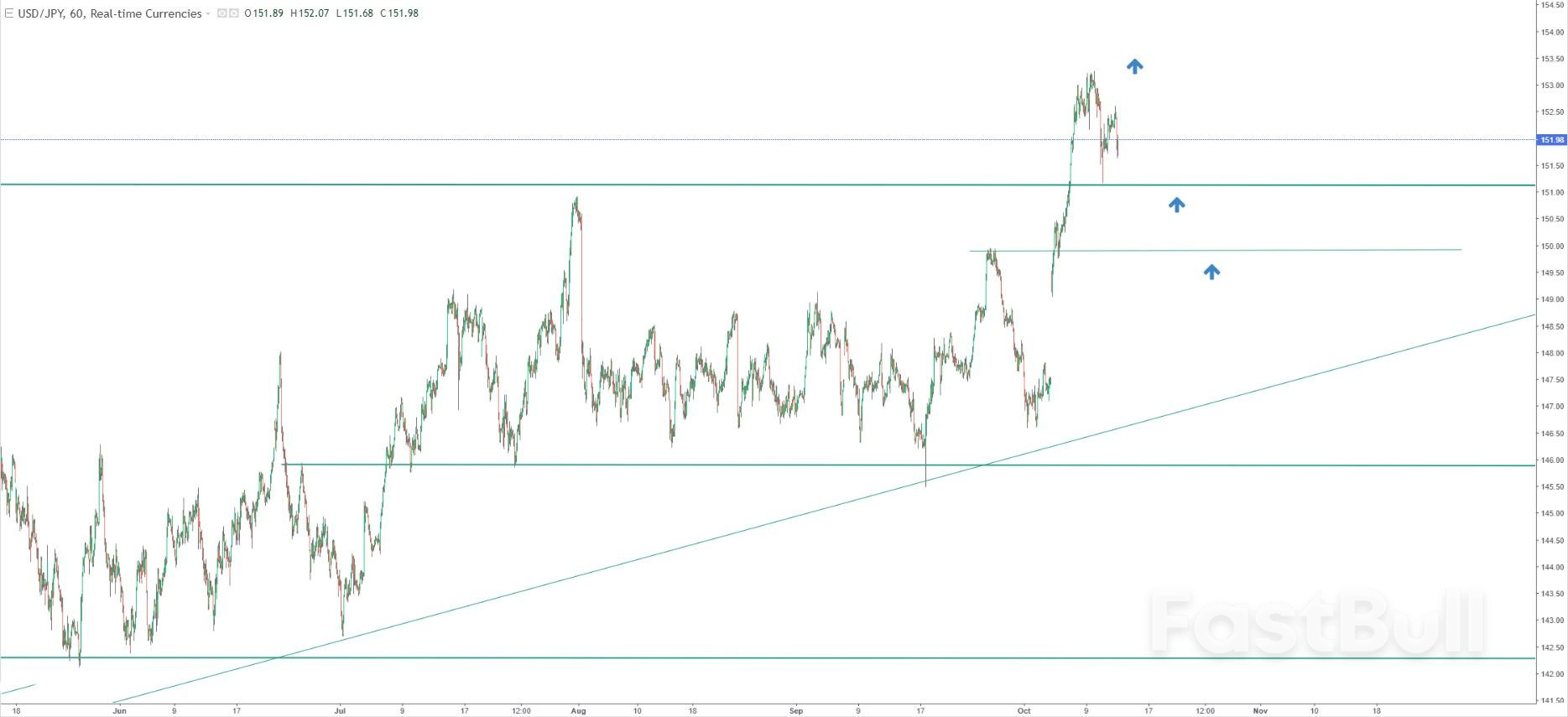
          The recent surge in USD/JPY allowed it to break past resistance around 151 yen per dollar. This clears the way for the uptrend to continue, with the next target near this year’s high at 158 yen per dollar.
          USD/JPY Clears Key Barrier, Eyes Fresh Highs Above 158 Amid Japan’s Dovish Signals_2
          The previous resistance has now turned into key support, where buyers are holding the line for now. If sellers manage to push through, the correction could reach around 150 yen per dollar, but the overall uptrend is still expected to continue.

          Source: investing

          Risk Warnings and Disclaimers
          You understand and acknowledge that there is a high degree of risk involved in trading. Following any strategies or investment methods may lead to potential losses. The content on the site is provided by our contributors and analysts for information purposes only. You are solely responsible for determining whether any trading assets, securities, strategy, or any other product is suitable for investing based on your own investment objectives and financial situation.
          Add to Favorites
          Share

          IMF Raises Global Growth Forecast to 3.2% for 2025

          Glendon

          Economic

          Forex

          The International Monetary Fund (IMF) has raised its global growth forecast for 2025 to 3.2%, up from its July prediction of 3.0%, while maintaining its 2026 outlook at 3.1%.

          The upward revision, announced Tuesday in the IMF’s World Economic Outlook, comes as tariff impacts and financial conditions have proven less severe than initially feared. However, the organization warned that a potential escalation in the U.S.-China trade war threatened by President Donald Trump poses a "significant risk" to global economic growth.

          IMF Chief Economist Pierre-Olivier Gourinchas noted that recent trade agreements between the U.S. and major economies have avoided the worst of Trump’s threatened tariffs with minimal retaliation. This marks the IMF’s second growth upgrade since April, when it had projected a more pessimistic 2.8% growth rate following Trump’s implementation of broad "reciprocal" tariffs.

          However, tensions escalated Friday when Trump threatened 100% duties on Chinese goods, on top of existing tariffs averaging 55%, in response to Beijing’s expanded export controls on rare earths. Treasury Secretary Scott Bessent indicated Monday that negotiations were underway to prevent a major trade war escalation.

          The IMF’s downside risk scenario shows that if tariffs increase by 30 percentage points on Chinese goods and 10 percentage points on goods from Japan, the euro area, and Asian emerging markets, global growth could be reduced by 0.3 percentage points in 2026, with negative impacts increasing to more than 0.6 percentage points through 2028.

          U.S. growth remains resilient in the IMF’s baseline forecast, with a slight upgrade to 2.0% for 2025 from the previous 1.9%, and 2.1% for 2026. These figures remain below the 2024 growth rate of 2.8%.

          The euro zone growth forecast improved to 1.2% from 1.0%, driven by fiscal expansion in Germany and strong momentum in Spain. Japan saw a significant increase to 1.1% from 0.7%, benefiting from front-loaded trade and stronger wage growth.

          The IMF maintained its China growth forecasts at 4.8% for 2025 and 4.2% for 2026, while warning that "the outlook remains worrisome" with elevated financial stability risks as the property sector continues to struggle.

          Global headline inflation forecasts remained largely unchanged at 4.2% for 2025 and 3.7% for 2026, though the IMF noted divergence among countries, with inflation forecasts rising in the U.S. as firms begin passing tariff costs to consumers.

          Source: Yahoo Finance

          To stay updated on all economic events of today, please check out our Economic calendar
          Risk Warnings and Disclaimers
          You understand and acknowledge that there is a high degree of risk involved in trading. Following any strategies or investment methods may lead to potential losses. The content on the site is provided by our contributors and analysts for information purposes only. You are solely responsible for determining whether any trading assets, securities, strategy, or any other product is suitable for investing based on your own investment objectives and financial situation.
          Add to Favorites
          Share

          China’s Biggest Builders Hobble Toward End Of Restructurings

          Samantha Luan

          Stocks

          Forex

          Economic

          Most of China’s biggest defaulted developers are reaching a restructuring milestone, as creditors increasingly accept that better terms are unlikely during a real estate crisis that has triggered $130 billion of defaults.Eight of China’s 10 most indebted developers have largely if not entirely put the offshore restructuring process behind them. One of those, Sunac China Holdings Ltd., which has already gained majority support for its restructuring from creditors, is scheduled to hold a vote on Tuesday, among the last procedural hurdles it has to clear.

          While policymakers have rolled out a slew of measures aimed at propping up the housing market, sales are still sluggish and Chinese developers continue to face challenges. So far, eight of the country’s 30 major builders that have defaulted on dollar debt have received liquidation orders, including China Evergrande Group and China South City Holdings Ltd., according to Bloomberg-compiled data. Many defaulted companies are still working on onshore debt plans also.

          Bondholders who once banged tables and peppered executives with questions during debt negotiations are now more muted, people familiar with several Chinese real estate restructuring deals said.“Creditors have come to realize that things won’t get better anytime soon, so they’re willing to take larger haircuts,” said Ron Thompson, managing director and head of the Asia restructuring practice at Alvarez & Marsal.When Sunac’s restructuring process began in 2022, creditors balked at a proposal to swap some debt for equity at a conversion price of HK$20 ($2.57) a share, Bloomberg reported earlier. In February 2023, they held contentious all-day meetings with the Chief Financial Officer Gao Xi seeking better terms. Months later, more than 75% of offshore creditors had signed on to the deal with a much lower conversion price.

          Less than two years after completing its initial restructuring, Sunac ran into repayment problems and pursued another one. This time, the deal took about two months to officially wrap up, compared with a little over a year for its first restructuring.

          Such condensed debt talks are becoming more common across the property sector. In general, some bondholders don’t even bother to dial in to calls about small things once the basic restructuring framework is done, according to two restructuring advisers.Yuzhou Group Holdings Co., for example, spent more than two years negotiating its restructuring, which it sought court approval for last year. When it later revised some terms, it faced little opposition from bondholders, according to people familiar with the matter, and the deal was concluded within months.

          While some creditors are willing to accept more onerous terms, others are choosing to abandon debt talks and seek immediate liquidation.That was the case with state-backed builder China South City. The company missed a couple of deadlines set by a key bondholder group and eventually proposed restructuring terms that were far from the recovery of around 70-80 cents on the dollar that bondholders had sought, people familiar with the matter said.

          At its last winding up hearing in August, Hong Kong High Court Judge Linda Chan asked creditors if one more adjournment would be acceptable to them. But the bondholders’ lawyer insisted on immediate liquidation instead.Sunac declined to comment. Yuzhou and China South City didn’t respond to requests for comment.The China real estate era has changed and the last thing international creditors are looking for is dragged out talks, said Jason He, debt capital markets advisory leader at Deloitte China.“Either take the terms or press the liquidation button — both work,” he added.

          Source: Bloomberg Europe

          To stay updated on all economic events of today, please check out our Economic calendar
          Risk Warnings and Disclaimers
          You understand and acknowledge that there is a high degree of risk involved in trading. Following any strategies or investment methods may lead to potential losses. The content on the site is provided by our contributors and analysts for information purposes only. You are solely responsible for determining whether any trading assets, securities, strategy, or any other product is suitable for investing based on your own investment objectives and financial situation.
          Add to Favorites
          Share
          FastBull
          Copyright © 2025 FastBull Ltd

          728 RM B 7/F GEE LOK IND BLDG NO 34 HUNG TO RD KWUN TONG KLN HONG KONG

          TelegramInstagramTwitterfacebooklinkedin
          App Store Google Play Google Play
          Products
          Charts

          Chats

          Q&A with Experts
          Screeners
          Economic Calendar
          Data
          Tools
          Membership
          Features
          Function
          Markets
          Copy Trading
          Latest Signals
          Contests
          News
          Analysis
          24/7
          Columns
          Education
          Company
          Careers
          About Us
          Contact Us
          Advertising
          Help Center
          Feedback
          User Agreement
          Privacy Policy
          Business

          White Label

          Data API

          Web Plug-ins

          Poster Maker

          Affiliate Program

          Risk Disclosure

          The risk of loss in trading financial instruments such as stocks, FX, commodities, futures, bonds, ETFs and crypto can be substantial. You may sustain a total loss of the funds that you deposit with your broker. Therefore, you should carefully consider whether such trading is suitable for you in light of your circumstances and financial resources.

          No decision to invest should be made without thoroughly conducting due diligence by yourself or consulting with your financial advisors. Our web content might not suit you since we don't know your financial conditions and investment needs. Our financial information might have latency or contain inaccuracy, so you should be fully responsible for any of your trading and investment decisions. The company will not be responsible for your capital loss.

          Without getting permission from the website, you are not allowed to copy the website's graphics, texts, or trademarks. Intellectual property rights in the content or data incorporated into this website belong to its providers and exchange merchants.

          Not Logged In

          Log in to access more features

          FastBull Membership

          Not yet

          Purchase

          Become a signal provider
          Help Center
          Customer Service
          Dark Mode
          Price Up/Down Colors

          Log In

          Sign Up

          Position
          Layout
          Fullscreen
          Default to Chart
          The chart page opens by default when you visit fastbull.com