• Trade
  • Markets
  • Copy
  • Contests
  • News
  • 24/7
  • Calendar
  • Q&A
  • Chats
Trending
Screeners
SYMBOL
LAST
BID
ASK
HIGH
LOW
NET CHG.
%CHG.
SPREAD
SPX
S&P 500 Index
6827.42
6827.42
6827.42
6899.86
6801.80
-73.58
-1.07%
--
DJI
Dow Jones Industrial Average
48458.04
48458.04
48458.04
48886.86
48334.10
-245.98
-0.51%
--
IXIC
NASDAQ Composite Index
23195.16
23195.16
23195.16
23554.89
23094.51
-398.69
-1.69%
--
USDX
US Dollar Index
97.990
98.070
97.990
98.020
97.980
+0.040
+ 0.04%
--
EURUSD
Euro / US Dollar
1.17379
1.17390
1.17379
1.17385
1.17285
-0.00015
-0.01%
--
GBPUSD
Pound Sterling / US Dollar
1.33679
1.33693
1.33679
1.33732
1.33580
-0.00028
-0.02%
--
XAUUSD
Gold / US Dollar
4304.17
4304.61
4304.17
4304.65
4294.68
+4.78
+ 0.11%
--
WTI
Light Sweet Crude Oil
57.271
57.308
57.271
57.348
57.194
+0.038
+ 0.07%
--

Community Accounts

Signal Accounts
--
Profit Accounts
--
Loss Accounts
--
View More

Become a signal provider

Sell trading signals to earn additional income

View More

Guide to Copy Trading

Get started with ease and confidence

View More

Signal Accounts for Members

All Signal Accounts

Best Return
  • Best Return
  • Best P/L
  • Best MDD
Past 1W
  • Past 1W
  • Past 1M
  • Past 1Y

All Contests

  • All
  • Trump Updates
  • Recommend
  • Stocks
  • Cryptocurrencies
  • Central Banks
  • Featured News
Top News Only
Share

Nomura CEO: Aim To Develop Japanese Direct Lending Market

Share

Nomura CEO: Aim To Bring Private Debt Know-How From Overseas

Share

HSBC - Scheme Consideration Refers To Proposal For Privatisation Of Hang Seng Bank

Share

[Report: SpaceX Launches Bake-Off Process To Select Underwriters For Potential IPO] According To Sources Familiar With The Matter, SpaceX Executives Have Initiated A Process To Select Wall Street Investment Banks To Advise The Company On Its Initial Public Offering (IPO). Several Investment Banks Are Scheduled To Submit Their First Round Of Proposals This Week, A Process Known As "bake-off," Which Represents The Most Concrete Step The Rocket Maker Has Taken Towards A Potentially "blockbuster IPO," According To The Sources

Share

RBNZ: ASB Has Co-Operated With The Reserve Bank And Has Admitted Liability For All Seven Causes Of Action

Share

RBNZ: Court Proceedings For Breaches Of Core Requirements Under Anti-Money Laundering And Countering Financing Of Terrorism Act From At Least December 2019

Share

Jose Antonio Kast Leads Chile Presidential Election's Runoff Vote With 4.46% Of Ballots Counted: Official Count

Share

Mayor: Russian Air Defence Units Destroy Drone Heading For Moscow

Share

Australia's ASIC - ASIC And Reserve Bank Of Australia Will Step Up Their Review To Uplift Their Joint Supervisory Model

Share

US Envoy Witkoff Says A Lot Of Progress Was Made At Berlin Talks On Russia/Ukraine War

Share

Syria's President Sharaa Sends Condolences To Trump Over Killing Of USA Soldiers In Syria - Syrian Presidency

Share

ECOWAS Commission President: ECOWAS Rejects Guinea-Bissau Junta Transition Plan, Demands Return To Constitutional Order

Share

On Sunday (December 14), The Bangladesh DSE Broad Index Closed Down 0.62% At 4932.97 Points

Share

US President Trump: A New Federal Reserve Chairman Will Be Chosen Soon

Share

US President Trump: Inflation Is “completely Offset” And You Don’t Want To See Deflation

Share

Trump: Will Be A Lot Of Damage Done To The People That Attacked Troops In Syria

Share

Trump: Terrible Attack In Bondi Beach

Share

Interior Ministry - Syria Arrests Five Suspects In Shooting Of USA And Syrian Troops In Palmyra

Share

France Says Conditions For EU Vote On MERCOSUR Deal Not Yet Met, Despite Recent Progress — Prime Minister's Office

Share

CEO: Tokyo Gas To Steer More Than Half Of Overseas Investments To US In Next 3 Years

TIME
ACT
FCST
PREV
U.K. Trade Balance (Oct)

A:--

F: --

P: --

U.K. Services Index MoM

A:--

F: --

P: --

U.K. Construction Output MoM (SA) (Oct)

A:--

F: --

P: --

U.K. Industrial Output YoY (Oct)

A:--

F: --

P: --

U.K. Trade Balance (SA) (Oct)

A:--

F: --

P: --

U.K. Trade Balance EU (SA) (Oct)

A:--

F: --

P: --

U.K. Manufacturing Output YoY (Oct)

A:--

F: --

P: --

U.K. GDP MoM (Oct)

A:--

F: --

P: --

U.K. GDP YoY (SA) (Oct)

A:--

F: --

P: --

U.K. Industrial Output MoM (Oct)

A:--

F: --

P: --

U.K. Construction Output YoY (Oct)

A:--

F: --

P: --

France HICP Final MoM (Nov)

A:--

F: --

P: --

China, Mainland Outstanding Loans Growth YoY (Nov)

A:--

F: --

P: --

China, Mainland M2 Money Supply YoY (Nov)

A:--

F: --

P: --

China, Mainland M0 Money Supply YoY (Nov)

A:--

F: --

P: --

China, Mainland M1 Money Supply YoY (Nov)

A:--

F: --

P: --

India CPI YoY (Nov)

A:--

F: --

P: --

India Deposit Gowth YoY

A:--

F: --

P: --

Brazil Services Growth YoY (Oct)

A:--

F: --

P: --

Mexico Industrial Output YoY (Oct)

A:--

F: --

P: --

Russia Trade Balance (Oct)

A:--

F: --

P: --

Philadelphia Fed President Henry Paulson delivers a speech
Canada Building Permits MoM (SA) (Oct)

A:--

F: --

P: --

Canada Wholesale Sales YoY (Oct)

A:--

F: --

P: --

Canada Wholesale Inventory MoM (Oct)

A:--

F: --

P: --

Canada Wholesale Inventory YoY (Oct)

A:--

F: --

P: --

Canada Wholesale Sales MoM (SA) (Oct)

A:--

F: --

P: --

Germany Current Account (Not SA) (Oct)

A:--

F: --

P: --

U.S. Weekly Total Rig Count

A:--

F: --

P: --

U.S. Weekly Total Oil Rig Count

A:--

F: --

P: --

Japan Tankan Large Non-Manufacturing Diffusion Index (Q4)

--

F: --

P: --

Japan Tankan Small Manufacturing Outlook Index (Q4)

--

F: --

P: --

Japan Tankan Large Non-Manufacturing Outlook Index (Q4)

--

F: --

P: --

Japan Tankan Large Manufacturing Outlook Index (Q4)

--

F: --

P: --

Japan Tankan Small Manufacturing Diffusion Index (Q4)

--

F: --

P: --

Japan Tankan Large Manufacturing Diffusion Index (Q4)

--

F: --

P: --

Japan Tankan Large-Enterprise Capital Expenditure YoY (Q4)

--

F: --

P: --

U.K. Rightmove House Price Index YoY (Dec)

--

F: --

P: --

China, Mainland Industrial Output YoY (YTD) (Nov)

--

F: --

P: --

China, Mainland Urban Area Unemployment Rate (Nov)

--

F: --

P: --

Saudi Arabia CPI YoY (Nov)

--

F: --

P: --

Euro Zone Industrial Output YoY (Oct)

--

F: --

P: --

Euro Zone Industrial Output MoM (Oct)

--

F: --

P: --

Canada Existing Home Sales MoM (Nov)

--

F: --

P: --

Euro Zone Total Reserve Assets (Nov)

--

F: --

P: --

U.K. Inflation Rate Expectations

--

F: --

P: --

Canada National Economic Confidence Index

--

F: --

P: --

Canada New Housing Starts (Nov)

--

F: --

P: --

U.S. NY Fed Manufacturing Employment Index (Dec)

--

F: --

P: --

U.S. NY Fed Manufacturing Index (Dec)

--

F: --

P: --

Canada Core CPI YoY (Nov)

--

F: --

P: --

Canada Manufacturing Unfilled Orders MoM (Oct)

--

F: --

P: --

Canada Manufacturing New Orders MoM (Oct)

--

F: --

P: --

Canada Core CPI MoM (Nov)

--

F: --

P: --

Canada Manufacturing Inventory MoM (Oct)

--

F: --

P: --

Canada CPI YoY (Nov)

--

F: --

P: --

Canada CPI MoM (Nov)

--

F: --

P: --

Canada CPI YoY (SA) (Nov)

--

F: --

P: --

Canada Core CPI MoM (SA) (Nov)

--

F: --

P: --

Canada CPI MoM (SA) (Nov)

--

F: --

P: --

Q&A with Experts
    • All
    • Chatrooms
    • Groups
    • Friends
    Connecting
    .
    .
    .
    Type here...
    Add Symbol or Code

      No matching data

      All
      Trump Updates
      Recommend
      Stocks
      Cryptocurrencies
      Central Banks
      Featured News
      • All
      • Russia-Ukraine Conflict
      • Middle East Flashpoint
      • All
      • Russia-Ukraine Conflict
      • Middle East Flashpoint
      Search
      Products

      Charts Free Forever

      Chats Q&A with Experts
      Screeners Economic Calendar Data Tools
      Membership Features
      Data Warehouse Market Trends Institutional Data Policy Rates Macro

      Market Trends

      Market Sentiment Order Book Forex Correlations

      Top Indicators

      Charts Free Forever
      Markets

      News

      News Analysis 24/7 Columns Education
      From Institutions From Analysts
      Topics Columnists

      Latest Views

      Latest Views

      Trending Topics

      Top Columnists

      Latest Update

      Signals

      Copy Rankings Latest Signals Become a signal provider AI Rating
      Contests
      Brokers

      Overview Brokers Assessment Rankings Regulators News Claims
      Broker listing Forex Brokers Comparison Tool Live Spread Comparison Scam
      Q&A Complaint Scam Alert Videos Tips to Detect Scam
      More

      Business
      Events
      Careers About Us Advertising Help Center

      White Label

      Data API

      Web Plug-ins

      Affiliate Program

      Awards Institution Evaluation IB Seminar Salon Event Exhibition
      Vietnam Thailand Singapore Dubai
      Fans Party Investment Sharing Session
      FastBull Summit BrokersView Expo
      Recent Searches
        Top Searches
          Markets
          News
          Analysis
          User
          24/7
          Economic Calendar
          Education
          Data
          • Names
          • Latest
          • Prev

          View All

          No data

          Scan to Download

          Faster Charts, Chat Faster!

          Download App
          English
          • English
          • Español
          • العربية
          • Bahasa Indonesia
          • Bahasa Melayu
          • Tiếng Việt
          • ภาษาไทย
          • Français
          • Italiano
          • Türkçe
          • Русский язык
          • 简中
          • 繁中
          Open Account
          Search
          Products
          Charts Free Forever
          Markets
          News
          Signals

          Copy Rankings Latest Signals Become a signal provider AI Rating
          Contests
          Brokers

          Overview Brokers Assessment Rankings Regulators News Claims
          Broker listing Forex Brokers Comparison Tool Live Spread Comparison Scam
          Q&A Complaint Scam Alert Videos Tips to Detect Scam
          More

          Business
          Events
          Careers About Us Advertising Help Center

          White Label

          Data API

          Web Plug-ins

          Affiliate Program

          Awards Institution Evaluation IB Seminar Salon Event Exhibition
          Vietnam Thailand Singapore Dubai
          Fans Party Investment Sharing Session
          FastBull Summit BrokersView Expo

          How Will the PBOC Respond to the Short-Selling of RMB Exchange Rate?

          King Ten

          China-U.S. Relations

          Summary:

          Even if you are only a foreign exchange bystander, yesterday's market is also enough to leave you with an aftertaste. In the daytime, U.S. Treasury yields broke 4%, and the dollar broke above 7.26 against the yuan. Then the People's Bank of China (PBOC), China's central bank, intervened, driving the dollar to fall to 7.22 against the yuan. Next, the market may be concerned about what the PBOC will do, and then wait and see.

          "Autumn Winds Withered Trees Up Last Night"

          It is reasonable that the capital markets rise and fall, just like the roller coaster ride which we are used to it. But the market yesterday did give us a big blow. In the daytime yesterday, the U.S. Treasury yields broke above 4%, the dollar index was closed to 115, and the USDCNH broke above 7.26. In the evening, the television conference content on China's foreign exchange market self-regulatory mechanism was spread in the market. China's central bank warned not to bet on the unilateral appreciation or depreciation of the RMB exchange rate. Then the USDCNH dived 400pips and began to reverse. Later, the Bank of England announced unlimited temporary bond purchases, stirring the market. By this morning's close, U.S. stocks, and European and U.S. government bonds surged, and the 10-year U.S. Treasury yields plunged 30bps. Crude oil, natural gas, and precious metals recorded big gains, while the U.S. dollar index hit the biggest drop in six weeks. Such a surge and plummet are enough to spark your adrenaline.

          Speculative Attack

          Since the RMB exchange rate reform in 2015, overseas hedge funds have been waiting for an opportunity to short the RMB for profit. On August 11, 2015, the Chinese central bank announced that it would adjust and improve the mid-price quotation mechanism of the USDCNH exchange rate, which meant the mid-price would be set by the market. Then the USDCNH mid-price of the day would be determined with reference to the closing price of the previous day and the market factors of that morning. That move was considered by the market as the PBOC would exit from the daily intervention of the USDCNH mid-price formation mechanism, so those overseas hedge funds immediately shorted the RMB exchange rate, resulting in the USDCNH rising from 6.22 in August 2015 to 6.99. And 2018 was the climax of shorting the RMB exchange rate. With the escalation of trade friction between China and the United States, those overseas hedge funds smelt the blood and found the opportunity to short RMB for profit. It caused the USDCNH to rise from 6.263 in March 2018 all the way to 7.196. This year, as the Fed has continued to raise interest rates sharply, triggering an increasingly serious inversion of the U.S.-China interest rate spread, they are back again. The USDCNH has been depreciating from 6.305 in March 2022 to 7.265. The scale of the short selling was relatively small during the exchange rate reform while it lasted longer during the trade friction. But the current short selling has a worse impact, and we cannot judge the end of this round of devaluation.

          PBOC's Defence

          After several rounds of overseas short selling, the Chinese central bank has accumulated much experience. During the depreciation in the 2015 exchange rate reform, the PBOC directly intervened in the foreign exchange market with foreign exchange reserves to stabilize the RMB exchange rate, and withdrew the offshore RMB liquidity to raise the cost of shorting the RMB. At the same time, it repeatedly raised refinancing rates to stabilize the U.S.-China rate spread to curb capital outflow pressure. Finally, in May 2017, the PBOC formally introduced the counter-cyclical factor into the mid-price formation mechanism, ending that round of short selling. However, the direct intervention with foreign exchange reserves has little effect, and instead, it will provoke speculators to strengthen their short selling, while strengthening expectations management is more effective in curbing the "herd behavior" in the RMB foreign exchange market.
          This is also the ancient wisdom of the Chinese. In the face of the pressure of sharp exchange rate depreciation, they unblock rather than block blind investments. Direct intervention is undoubtedly blocking, which is not a good method. Unblocking is to guide domestic foreign enterprises to increase foreign exchange hedging and reduce unilateral gaming. Only with good management of expectations in these enterprises, the external problems can be easy to solve. And external short-selling speculators will also feel a strong deterrent.
          The short-selling was even stronger during the U.S.-China trade friction in 2018. The PBOC continuously introduced three major measures in August 2018. The first was to restart the counter-cyclical factor to make up for the "loopholes" in the RMB exchange rate pricing mechanism, reduce the pro-cyclical fluctuations in the exchange rate and control the herd behavior. The second was to raise foreign exchange reserves to reduce the shorting. And the third was to tighten the RMB liquidity in offshore markets to raise the cost of short selling for speculators.

          What Will the PBOC Act Next

          This year, the RMB has actually undergone some internationalization changes, which have a relatively great deterrent effect on short-selling speculators. For example, the IMF increased the weight of the RMB in the SDR in May, which can attract more central banks to include the RMB in their foreign reserve assets. The extension of trading hours in the inter-bank foreign exchange market in June cut the opportunity for speculators to suppress the mid-price by taking advantage of the night trading. The launch of the Hong Kong-Mainland China interest rate swap markets in July has provided interest rate risk hedging tools for overseas investors to invest in RMB bonds and has also largely alleviated the pressure from decreased RMB bond holdings caused by the inverse U.S.-China yield spread. And of course, the increase in the RMB's share in global trade settlement is also improving the supply and demand in the RMB foreign exchange market.
          The repeated pandemic in China in April and the closure of Shanghai led to a serious downturn in the Chinese economy. Moreover, the Fed's aggressive interest rate hikes caused a continued inversion of the U.S.-China spread. Foreign investors cut their holdings of Chinese bonds, which triggered this short-selling boom in the RMB and made it even more tricky. Since the effect of direct intervention in 2015 was small, and no direct intervention was made after that, it is expected that direct intervention will not be used this time. In the face of this rapid depreciation, China's central bank has adjusted the reserve requirement for foreign exchange sales and will use more flexible policy tools later. Perhaps it will mainly continue to regulate the RMB liquidity in the offshore markets, strengthen cross-border capital flow control, and introduce counter-cyclical factors, strengthening expectations management and striking precisely.
          Risk Warnings and Disclaimers
          You understand and acknowledge that there is a high degree of risk involved in trading. Following any strategies or investment methods may lead to potential losses. The content on the site is provided by our contributors and analysts for information purposes only. You are solely responsible for determining whether any trading assets, securities, strategy, or any other product is suitable for investing based on your own investment objectives and financial situation.
          Comments
          Add to Favorites
          Share

          Dollar Dishes the Pain as New Selloff Takes Hold

          Jason
          Investors pedalled into another cycle of selling on Thursday as the dollar tightened its hold on the currency markets, recession fears sapped stocks and bonds suffered more interest rate pain.
          Europe's open was brutal. The STOXX 600 share index dropped nearly 2% from the open, while both the euro and the pound, hammered over the last week by UK debt concerns, slumped 1%.
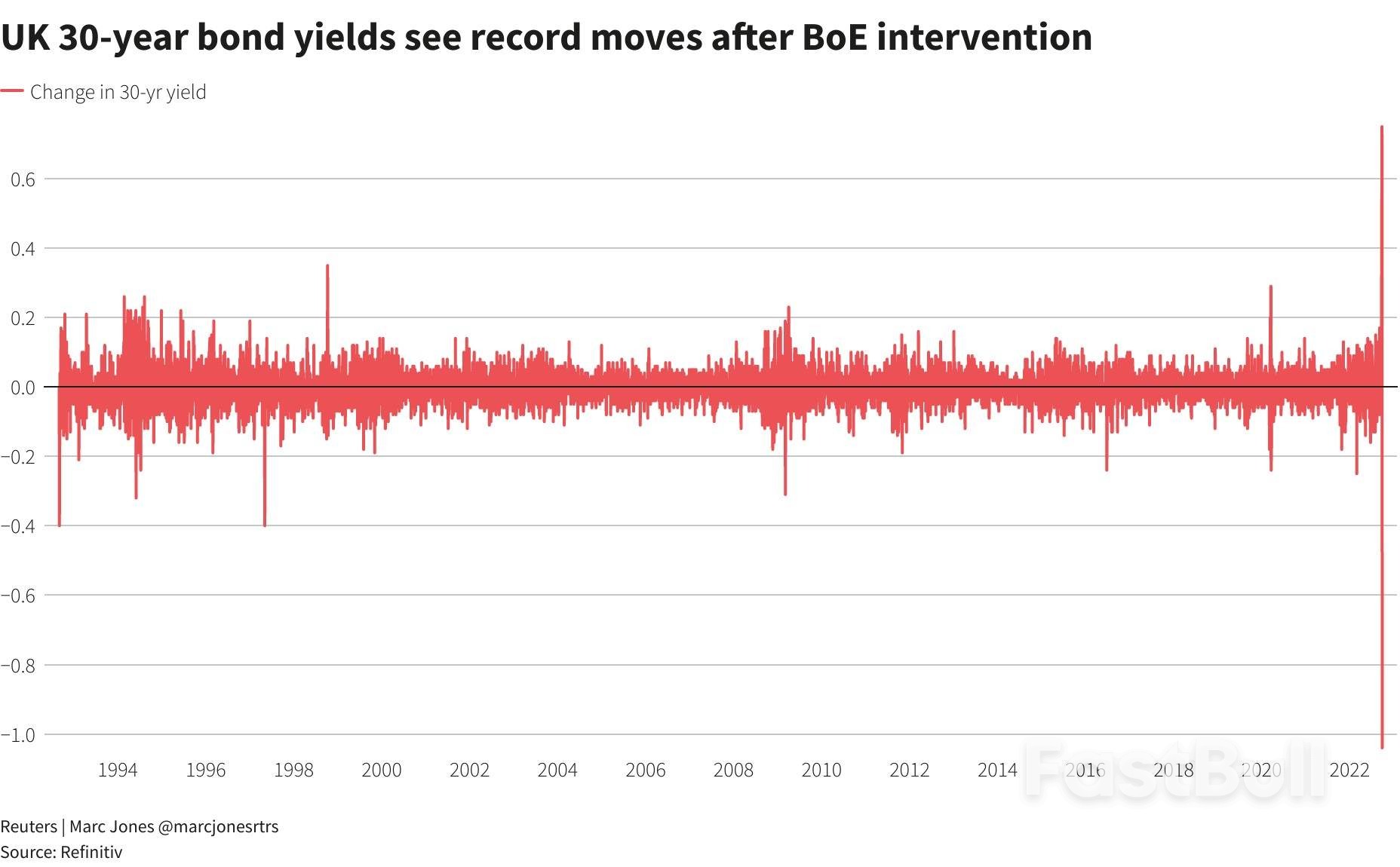
          Government bond markets were braced for German data expected to show consumer prices rising there at the fastest rate since the 1950s. Gilt selling also resumed a day after the Bank of England dramatically intervened in the UK market to try and quell the storm around the government's spending plans.
          "The market wouldn't mind some stability, it has become a little bit unpredictable," said Barings Investment Institute's Chief European strategist Agnes Belaisch.
          She said investors were now seeing "incoherence" in the UK with government spending as the BoE tries to rein in inflation, while everywhere else the focus is on how high central banks are prepared to go with interest rates.
          Germany's 10-year government bond yield, the benchmark of the euro zone, jumped to 2.27%, as pacey numbers from the German state of North Rhine-Westphalia pointed to a double-digit inflation figure for the country as a whole later.
          The UK 10-year gilt yield, which drives UK borrowing costs, rose 15 bps to 4.16% after falling almost 50 bps the day before due the BoE's sudden intervention.
          UK Prime Minister Liz Truss defended her new economic programme that has sent sterling to a record low this week and left the UK's borrowing costs close to Greece's - saying it was designed to tackle the difficult situation Britain was now in.
          Dollar Dishes the Pain as New Selloff Takes Hold_1Bit Of a Mess
          Zooming back out, it was still about the dollar which has crushed currencies virtually everywhere this year.
          Speaking with reporters in London on Wednesday, veteran Federal Reserve policymaker Charles Evans gave no indication that any of the recent drama would blow the U.S. central bank off its rate hike course.
          "We just really need to get inflation in check," Evans said, backing lifting the Fed's rates - now at 3%-3.25% - to a range of 4.5%-4.75% by the end of the year or March.
          Thursday's moves saw the U.S. dollar index, which measures the currency against sterling, the euro and four other peers, rise back towards its recent 20-year high again having had its worst session in 2-1/2 years on Wednesday.
          Overnight, China's yuan had fallen again although it stayed just off recent post-financial crisis lows as China's central bank said stabilising the foreign exchange market was its top priority.
          MSCI's broadest index of Asia-Pacific shares outside Japan, ended the day virtually flat, although Japan's Nikkei did manage a near 1% rise. S&P 500 futures pointed to Wall Street falling more than 1.2% later with more Fed policymakers also due to speak.
          Oil prices were down again after gaining more than $3 in the prior session, with the strong dollar capping oil demand and concerns over the faltering global economic outlook clouding market sentiment.
          Brent crude futures fell 91 cents, or 1%, to $88.41 per barrel, while U.S. crude futures dropped by 80 cents, or 1%, to $81.33 and gold fell 1% to $1,642 an ounce.
          Goldman Sachs cut its 2023 oil price forecast this week, citing expectations of weaker demand and a stronger U.S. dollar, but said global supply issues reinforced its long-term view that prices could rise again.
          "It's all a bit of a mess," said ANZ economist Finn Robinson.
          ($1 = 0.9252 pounds)

          Source: Reuters

          Risk Warnings and Disclaimers
          You understand and acknowledge that there is a high degree of risk involved in trading. Following any strategies or investment methods may lead to potential losses. The content on the site is provided by our contributors and analysts for information purposes only. You are solely responsible for determining whether any trading assets, securities, strategy, or any other product is suitable for investing based on your own investment objectives and financial situation.
          Comments
          Add to Favorites
          Share

          After Breaking The 80$ Barrier , We Will See An Increase The Expected Rise , Or The External Situation Has An Other Opinion ?

          Traders' Opinions

          After climbing for two straight sessions, WTI oil futures wavered around $82 per barrel on Thursday as traders balanced mounting worries about a demand-draining global economic slowdown against a tightening supply outlook. The US oil benchmark is expected to decline for a fourth consecutive month, and it is on pace to post its first quarterly loss in more than two years. Markets were concerned that rash interest rate increases might harm the world economy and energy demand, and a relentless dollar rally added to the pressure on commodities. At the same time, falling crude prices sparked rumors that OPEC+ would declare another production cut at its meeting on October 5 as the European Union and Russia's energy spat threatened to further disrupt supplies. Oil prices rose by around 7% over the prior two sessions. Additionally, according to official data, US crude inventories unexpectedly decreased last week, marking the first decrease in a month.
          Asian markets have recovered significantly after experiencing a drop after a few trading days. After the benchmark US Treasury yields for the 10-year note fell, Asian indices experienced a rapid recovery. In 2010, yields reached a high of 4%. Since then, they have dropped considerably to almost 3.76%. The risk-on drive has been supported by this, and risk-sensitive assets are thriving.
          As of the time of publication, China's A50 added 0.38%, Japan's Nikkei225 rose 0.92%, and Hong Kong's Hang Seng gained more than 1%.The US dollar index (DXY) had a decline after failing to maintain above the significant threshold of 114.50. The Federal Reserve (Fed) will gradually increase interest rates following larger rate increases in the first week of November and the middle of December, investors have begun to realize, and the DXY is beginning to lose favor.
          Additionally, with a lower consensus for the US Gross Domestic Product, investors are penalizing the DXY (GDP). According to consensus, on an annualized basis, the US economy's growth rate decreased by 0.6% in the second quarter.
          According to News, the Chinese Finance Ministry intends to issue bonds totaling 2.5 trillion yuan in the fourth quarter. The decision is meant to protect the markets from any more turbulence because the economy is not anticipated to grow at a respectable rate given the real estate crisis and the government's zero-tolerance policy for the Covid-19 virus.
          On the oil front, prices have solidly recovered after being held down by bears. After showing a reduction in US oil stockpiles as reported by the Energy Information Administration, black gold has surpassed the psychological resistance of $80.00. (EIA). For the week ending September 23, the oil stockpiles decreased by 0.215 million barrels.

          Technical Analysis:

          WTI crude oil prices lose some of the previous day's gains, which were the largest in four months, as bulls pause around approximately $82.00 on Thursday during the Asian session. However , the price of black gold had dropped to $81.30.
          The commodities prices are anticipated to continue to rise over the most recent barrier at $82.00 given the recently higher RSI and the bullish MACD signals.
          Therefore, the ability to consolidate the wedge formation with a clear breach of $82.80 and overcome the 100-SMA barrier surrounding $83.55 will be crucial for the quote's continued upward.
          On the other hand, retreat movements could return to the $80.00 level before reaching the weekly horizontal support area near $78.0.
          The most recent multi-month low near $76.00 and the mentioned wedge's lower line, at about $75.20, could pose obstacles to WTI crude oil's future decline in the event that the price falls below the $78.00 support level.
          After Breaking The 80$ Barrier , We Will See An Increase The Expected Rise , Or The External Situation Has An Other Opinion ?_1
          We believe that there are good chances that the price of crude oil will now revert to a bearish trend and move toward negative targets that begin at 79.35 and extend to 76.30. The price of crude oil settled around the EMA50 and failed to cross the minor bearish channel's resistance line that can be seen on the chart.
          Therefore, a negative bias will be anticipated for today. It should be noted that a breakthrough of 82.70 will halt the anticipated slide and cause the price to increase further, reaching 83.10 and then 84.45.A trading range between 79.00 support and 83.00 resistance is anticipated for today.
          After Breaking The 80$ Barrier , We Will See An Increase The Expected Rise , Or The External Situation Has An Other Opinion ?_2
          Risk Warnings and Disclaimers
          You understand and acknowledge that there is a high degree of risk involved in trading. Following any strategies or investment methods may lead to potential losses. The content on the site is provided by our contributors and analysts for information purposes only. You are solely responsible for determining whether any trading assets, securities, strategy, or any other product is suitable for investing based on your own investment objectives and financial situation.
          Comments
          Add to Favorites
          Share

          After The Important Recovery That Gold Witnessed Yesterday , Today It's Rolling Again , 1600 Will Be The Limit ?

          Traders' Opinions

          Following a significant recovery in the previous session, gold prices dropped toward $1,650 an ounce on Thursday, weighed down by demand for the dollar as a safe haven amid worries that tighter monetary conditions could push the world economy into a recession. As the US Federal Reserve led a global wave of interest rate hikes to combat growing inflation, the metal is on course to drop for the sixth consecutive month, undermining the appeal of non-yielding bullion. Given the US economy's strength in comparison to other industrialized nations, investors also kept choosing the dollar over gold as a secure store of value during times of increased economic uncertainty. The Bank of England announced on Wednesday that it will buy bonds in an effort to calm its financial markets, which caused the dollar and global bond yields to fall as the price of gold increased by almost 2%.
          Although it struck its lowest level since April 2020 on Tuesday, gold managed a tiny comeback but saw no further purchasing. A major element that provided some support for the dollar-denominated commodity was the intraday decline in the US dollar. However, the likelihood of a Federal Reserve policy tightening that is more aggressive helped the USD to recover from its initial decline. This, along with rising US Treasury bond yields, prevented the non-yielding yellow metal from appreciating further.
          The typical safe-haven assets were weakened by the anti-risk flow, which also helped the precious metal close the day in the black and break a three-day losing skid. However, the persistent USD buying drives new selling around the XAU/USD on Wednesday throughout the Asian session and reinforces expectations for a further near-term weakening trend. The market is now anticipating remarks by significant FOMC members, such as Fed Chair Jerome Powell, for some significant trade opportunities.
          Following a strong surge, the gold price (XAU/USD) is undergoing a healthy pullback during the Tokyo session. As the downward bias is not supported by momentum, the precious metal is anticipated to find large bids around the immediate support of $1,650.00. The shiny metal will so resume moving upward after the pullback move is over.
          The US dollar index's hesitant decline is what led to the slight correction in gold prices (DXY). After failing to maintain itself above the crucial threshold of 144.50, the DXY fell. For the time being, the DXY's high is approaching in tandem with the Federal Reserve's target interest rate peak of 4.6%. (Fed).
          After examining the continued velocity of interest rate hikes, it is important to note that the Fed's interest rate peak is not far from current interest rates at 3.-3.325 percent. Until it notices a reduction in the price pressures for several months, the Fed is anticipated to keep the terminal rate at 4.6% for a longer period of time.
          The US dollar bulls are back at the table after a brief absence the day before, and the gold market (XAU/USD) braces for the new yearly low that would terminate a two-day rally. The main factors that recently boosted the dollar were worries about a worldwide recession and hawkish central bank policies. Positive US trade figures and concerns about the ability of the People's Bank of China (PBOC) and the Bank of England (BOE) to control the economic slowdown may be on the same page.It's important to note that the previous day, the metal experienced its largest daily increase in six months as a result of rumors of significant rate increases from the European Central Bank (ECB) and the BOE's unexpected bond action.
          The bears are likely to maintain control given the negative attitude and the XAU/retreat USD's from important resistance levels. For unambiguous directions, it appears vital to keep a close eye on the aforementioned risk drivers and the final US Q2 Gross Domestic Product (GDP) figures.

          Technical Analysis:

          On an hourly basis, gold prices are falling near the horizontal support set from Monday's high at $1,650 The precious metal is steadily losing value, thus it is anticipated that it will take advantage of the specified horizontal support. This will show a shift in polarity, and the bright metal will act more impulsively and firmly.
          The short-term uptrend is still present as long as the price of gold holds above the 50-period Exponential Moving Average (EMA) at $1,641. While the brilliant metal has fallen beneath the 200-EMA at $1,655, it is anticipated that it will quickly retake it.
          Relative Strength Index (RSI) (14) is currently swinging in a bullish area of 60.00-80.00, which suggests further upward movement. Additionally, at 60.00, the momentum oscillator can find support.
          After The Important Recovery That Gold Witnessed Yesterday , Today It's Rolling Again , 1600 Will Be The Limit ? _1
          The rise in the gold price was halted at the 23.6% Fibonacci correction level, which formed strong resistance at 1660.00. Today's opening bearish bias suggests that yesterday's rise was satisfied, and the main bearish trend will resume. On the way to negative targets starting at 1638.00, it will also visit the yesterday's recorded low at 1614.80.
          Therefore, a bearish bias will be recommended for today, supported by the stochastic's negative overlapping signal, with the understanding that a breach of 1660.00 will put an end to the worst-case scenario and force the price to experience further bullish correction, with 1686.40 as its next target.
          Today's predicted trading range lies between 1670.00 resistance and 1625.00 support.
          After The Important Recovery That Gold Witnessed Yesterday , Today It's Rolling Again , 1600 Will Be The Limit ? _2
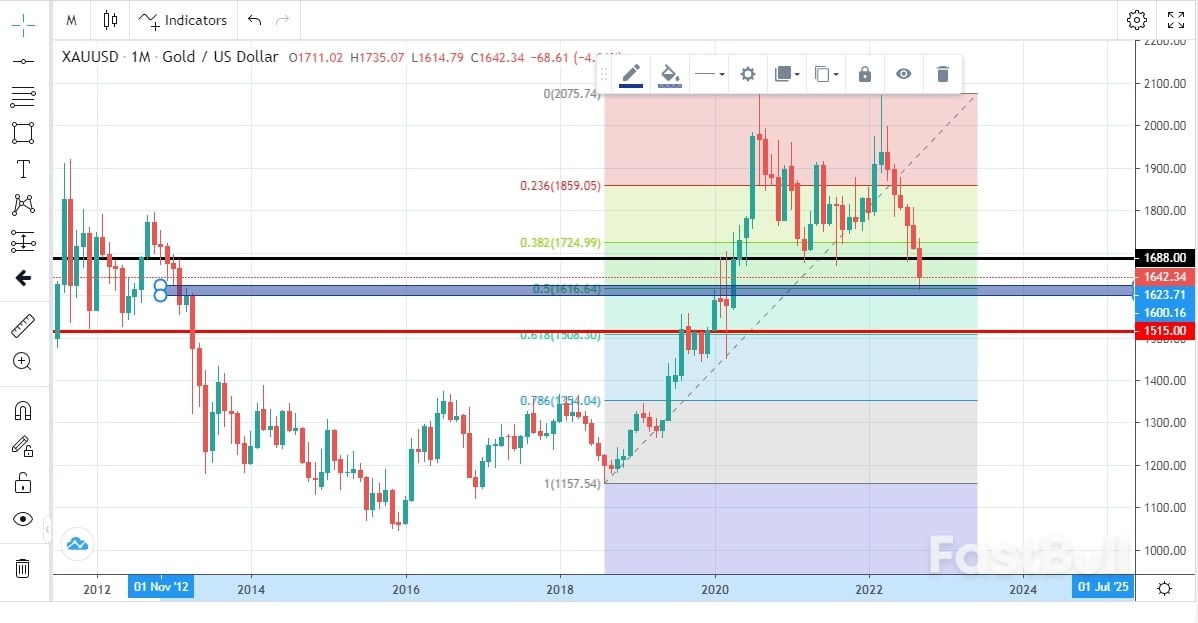
          From the low of $1170.50 on August 15, 2018, to the record high of almost $2088 on August 6, 2020, we have constructed a simple Fibonacci extension. Two significant retracement levels have been highlighted: the 50% retracement level at $1628.90 and the 38.2% Fibonacci retracement level at $1737.10.
          Additionally, we have drawn a red horizontal line at $1680, which we consider to be a crucial and important level of previous support that was breached last week. December gold's price moved strongly today by $32, rising from the low to close just below the day's high of $1671.60 at $1660.50, which is one dollar above the 50% retracement level.
          We have the initial level of resistance around $1680 with major barrier at $1737, both of which are based on the 38.2% Fibonacci retracement. It seems doubtful that gold would find support at $1515, which is where the 61.8% in the retracement set of the chart is located. The more likely support range for gold is between $1600 and $1620.
          After The Important Recovery That Gold Witnessed Yesterday , Today It's Rolling Again , 1600 Will Be The Limit ? _3
          Risk Warnings and Disclaimers
          You understand and acknowledge that there is a high degree of risk involved in trading. Following any strategies or investment methods may lead to potential losses. The content on the site is provided by our contributors and analysts for information purposes only. You are solely responsible for determining whether any trading assets, securities, strategy, or any other product is suitable for investing based on your own investment objectives and financial situation.
          Comments
          Add to Favorites
          Share

          USDC Multichain Expansion adds Stablecoin Access on Five More Networks

          Kevin Du
          The world's second largest stablecoin by market capitalization, USDC, has expanded to five more networks including the two leading layer-2 ecosystems.
          In an announcement on Sept. 28, USDC issuer Circle stated that stablecoin was coming to five more networks: Arbitrum, Cosmos, NEAR, Optimism, and Polkadot.
          The stablecoin will be launched on Arbitrum One, NEAR, Optimism, and Polkadot by the end of 2022 and Cosmos in early 2023, it added.
          The announcement was made at the Converge22 conference running this week in San Francisco.

          Layer-2 expansion

          Joao Reginatto, vice president of product at Circle, said that "the multi-chain expansion is intended to increase USDC's native availability from eight ecosystems to thirteen," before adding that it "enables blockchain developers building on USDC and their users to experience greater liquidity and interoperability within the crypto economy."
          When launched, developers will be able to use Circle APIs for fiat on and off-ramps to and from USDC in their products, as well as programmable wallet infrastructure, the team tweeted.
          Circle currently supports USDC natively across Algorand, Avalanche, Ethereum, Flow, Hedera, Solana, Stellar, and TRON.
          Arbitrum One and Optimism are the leading two layer-2 networks with a joint market share of more than 80%. Arbitrum is the market leader with a total value locked of $2.42 billion while Optimism has $1.44 billion according to L2beat.
          NEAR Protocol is a low-cost, high throughput blockchain and Polkadot is an Ethereum rivaling smart contract and dApp ecosystem. Cosmos also provides an expanding ecosystem of decentralized applications and interconnected chains.
          USDC continues to increase its stablecoin market share which now stands at about a third.

          USDC supply decline

          USDC supply has been on the decline over the past three months. Since the beginning of July, it has shrunk by 12.5% from 56 billion USDC to its current level of 49 billion USDC. A deepening bear market and diminished demand for DeFi have resulted in a decline in stablecoin usage.
          Leading stablecoin Tether has also seen its supply shrink by 18% from a record 83 billion in mid-May to current levels of 68 billion USDT.
          The total stablecoin market capitalization is $151 billion which represents 15.4% of the entire crypto market cap. Tether has a market share of 45% with 68 billion USDT while Circle has a 32.5% share. The third most popular stablecoin is Binance USD with a 14% market share.

          Source: beincrypto

          Risk Warnings and Disclaimers
          You understand and acknowledge that there is a high degree of risk involved in trading. Following any strategies or investment methods may lead to potential losses. The content on the site is provided by our contributors and analysts for information purposes only. You are solely responsible for determining whether any trading assets, securities, strategy, or any other product is suitable for investing based on your own investment objectives and financial situation.
          Comments
          Add to Favorites
          Share

          Australia Rules Out Curbs on Gas Exports After Producer Deal

          Owen Li
          Australia will not put curbs on gas exports after reaching a deal with its three east coast producers of liquefied natural gas (LNG) to avert a forecast supply crunch, Resources Minister Madeleine King said on Thursday.
          The government threatened the export curbs in August, worrying Asian buyers and LNG investors, following a warning by the competition watchdog that the east coast market faced a shortfall of 57 petajoules of gas in 2023.
          The pact unveiled on Thursday provides for Queensland Curtis LNG, run by Shell; Australia Pacific LNG, run by ConocoPhillips; and Gladstone LNG (GLNG), run by Santos to offer an extra 157 petajoules of gas to the domestic market next year.
          "Given the agreement means the projected shortfall will be avoided, I am satisfied I do not need to take steps to activate the Australian domestic gas security mechanism at this time," Resources Minister Madeleine King said in a statement.
          The terms require the LNG exporters to offer uncontracted gas to the domestic market before international buyers and ensure domestic buyers will not pay more for uncontracted gas than customers offshore.
          King said the pact would not affect supplies to overseas customers or existing contracts.
          "I want to state, very firmly and clearly, that Australia will always be a trusted and reliable trading partner and a safe place to invest," she told a televised media conference.
          Santos's GLNG, whose partners include TotalEnergies, Korea Gas Corp (KOGAS) and Malaysia's Petroliam Nasional Bhd (Petronas), had been seen as the most vulnerable to export curbs.
          This is because it is the only east coast exporter to take more gas out of the domestic market each year than it supplies.
          GLNG agreed to step up domestic supply during Australia's peak winter demand period, Santos said.
          "The (agreement) is a good outcome for Santos and very welcome, to remove sovereign risk and ensure long-term LNG supply contracts are honoured," its managing director Kevin Gallagher said in a statement.

          Source: Reuters

          Risk Warnings and Disclaimers
          You understand and acknowledge that there is a high degree of risk involved in trading. Following any strategies or investment methods may lead to potential losses. The content on the site is provided by our contributors and analysts for information purposes only. You are solely responsible for determining whether any trading assets, securities, strategy, or any other product is suitable for investing based on your own investment objectives and financial situation.
          Comments
          Add to Favorites
          Share

          Bitcoin-Sterling Volumes Spike to Record High as British Currency Flounders

          Kevin Du
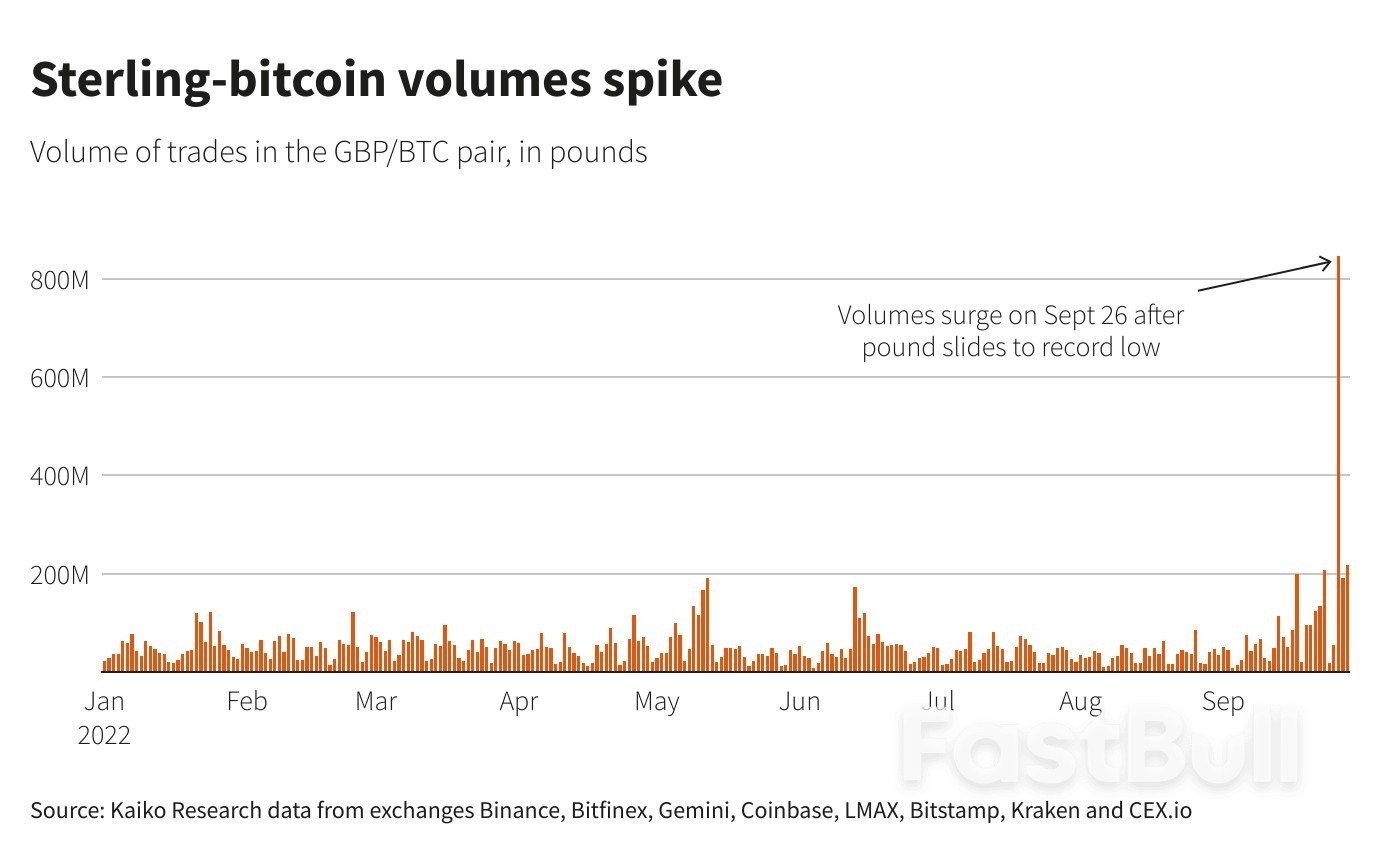
          Trading volumes between the British pound and the cryptocurrency bitcoin spiked to a record high after sterling dropped on Monday, according to market data firm Kaiko Research, in what analysts said was likely a rush by investors to dump their sterling for the digital asset or profit from arbitrage.
          The pound fell to a record low against the dollar on Monday, having plunged the previous Friday after the UK government announced unfunded tax cuts.
          The volume of transactions in the bitcoin-sterling trading pair across eight major exchanges globally spiked to a record high of 846 million pounds ($920 million) on Monday, according to Kaiko Research, compared with an average of around 54.1 million pounds a day so far in 2022.
          The surge was likely due to traders swapping sterling for bitcoin, said James Butterfill, head of research at crypto firm CoinShares.
          "There is a high correlation to bitcoin volume growth and political/monetary instability," he said.
          Butterfill said spikes have previously occurred in other currencies' crypto trading volumes, such as the Russian ruble and Ukrainian hryvnia, but that he had never seen such big moves in the bitcoin-sterling pair's volume.
          Conor Ryder, research analyst at Kaiko, said the data suggests cryptocurrency markets reacted to the volatility in fiat currencies. When sterling crashed on Sept. 26, "opportunistic investors rushed to crypto exchanges offering BTC-GBP to try and profit via arbitrage from any mispricing of bitcoin across the major fiat currencies," he said in emailed comments.
          Crypto exchange Bitfinex said it saw a "significant spike" in volume and trading activity for the bitcoin-sterling pair on Monday, which Bitfinex analysts said "underlined the potential of the biggest cryptocurrency to benefit from an apparent fragility in fiat currencies."
          To be sure, cryptocurrencies are highly volatile and the price of bitcoin has fallen sharply so far in 2022 as rising interest rates prompted investors to ditch riskier assets.
          Versus the dollar, bitcoin is down around 58% so far this year, while the British pound is down 20%.
          Bitcoin was trading around $19,515 on Wednesday and at 17,940 versus the British pound. The cryptocurrency hit a two-week high against the British pound on Tuesday.Bitcoin-Sterling Volumes Spike to Record High as British Currency Flounders_1
          ($1 = 0.9195 pound)

          Source: Reuters

          Risk Warnings and Disclaimers
          You understand and acknowledge that there is a high degree of risk involved in trading. Following any strategies or investment methods may lead to potential losses. The content on the site is provided by our contributors and analysts for information purposes only. You are solely responsible for determining whether any trading assets, securities, strategy, or any other product is suitable for investing based on your own investment objectives and financial situation.
          Comments
          Add to Favorites
          Share
          FastBull
          Copyright © 2025 FastBull Ltd

          728 RM B 7/F GEE LOK IND BLDG NO 34 HUNG TO RD KWUN TONG KLN HONG KONG

          TelegramInstagramTwitterfacebooklinkedin
          App Store Google Play Google Play
          Products
          Charts

          Chats

          Q&A with Experts
          Screeners
          Economic Calendar
          Data
          Tools
          Membership
          Features
          Function
          Markets
          Copy Trading
          Latest Signals
          Contests
          News
          Analysis
          24/7
          Columns
          Education
          Company
          Careers
          About Us
          Contact Us
          Advertising
          Help Center
          Feedback
          User Agreement
          Privacy Policy
          Business

          White Label

          Data API

          Web Plug-ins

          Poster Maker

          Affiliate Program

          Risk Disclosure

          The risk of loss in trading financial instruments such as stocks, FX, commodities, futures, bonds, ETFs and crypto can be substantial. You may sustain a total loss of the funds that you deposit with your broker. Therefore, you should carefully consider whether such trading is suitable for you in light of your circumstances and financial resources.

          No decision to invest should be made without thoroughly conducting due diligence by yourself or consulting with your financial advisors. Our web content might not suit you since we don't know your financial conditions and investment needs. Our financial information might have latency or contain inaccuracy, so you should be fully responsible for any of your trading and investment decisions. The company will not be responsible for your capital loss.

          Without getting permission from the website, you are not allowed to copy the website's graphics, texts, or trademarks. Intellectual property rights in the content or data incorporated into this website belong to its providers and exchange merchants.

          Not Logged In

          Log in to access more features

          FastBull Membership

          Not yet

          Purchase

          Become a signal provider
          Help Center
          Customer Service
          Dark Mode
          Price Up/Down Colors

          Log In

          Sign Up

          Position
          Layout
          Fullscreen
          Default to Chart
          The chart page opens by default when you visit fastbull.com