• Trade
  • Markets
  • Copy
  • Contests
  • News
  • 24/7
  • Calendar
  • Q&A
  • Chats
Trending
Screeners
SYMBOL
LAST
BID
ASK
HIGH
LOW
NET CHG.
%CHG.
SPREAD
SPX
S&P 500 Index
6827.42
6827.42
6827.42
6899.86
6801.80
-73.58
-1.07%
--
DJI
Dow Jones Industrial Average
48458.04
48458.04
48458.04
48886.86
48334.10
-245.98
-0.51%
--
IXIC
NASDAQ Composite Index
23195.16
23195.16
23195.16
23554.89
23094.51
-398.69
-1.69%
--
USDX
US Dollar Index
97.950
98.030
97.950
98.500
97.950
-0.370
-0.38%
--
EURUSD
Euro / US Dollar
1.17394
1.17409
1.17394
1.17496
1.17192
+0.00011
+ 0.01%
--
GBPUSD
Pound Sterling / US Dollar
1.33707
1.33732
1.33707
1.33997
1.33419
-0.00148
-0.11%
--
XAUUSD
Gold / US Dollar
4299.39
4299.39
4299.39
4353.41
4257.10
+20.10
+ 0.47%
--
WTI
Light Sweet Crude Oil
57.233
57.485
57.233
58.011
56.969
-0.408
-0.71%
--

Community Accounts

Signal Accounts
--
Profit Accounts
--
Loss Accounts
--
View More

Become a signal provider

Sell trading signals to earn additional income

View More

Guide to Copy Trading

Get started with ease and confidence

View More

Signal Accounts for Members

All Signal Accounts

Best Return
  • Best Return
  • Best P/L
  • Best MDD
Past 1W
  • Past 1W
  • Past 1M
  • Past 1Y

All Contests

  • All
  • Trump Updates
  • Recommend
  • Stocks
  • Cryptocurrencies
  • Central Banks
  • Featured News
Top News Only
Share

Thai Leader Anutin: Landmine Blast That Killed Thai Soldiers 'Not A Roadside Accident'

Share

Thai Leader Anutin: Thailand To Continue Military Action Until 'We Feel No More Harm'

Share

Cambodian Prime Minister Hun Manet Says He Had Phone Calls With Trump And Malaysian Leader Anwar About Ceasefire

Share

Cambodia's Hun Manet Says USA, Malaysia Should Verify 'Which Side Fired First' In Latest Conflict

Share

Cambodia's Hun Manet: Cambodia Maintains Its Stance In Seeking Peaceful Resolution Of Disputes

Share

Nasdaq Companies: Allergan, Ferrovia, Insmed, Monolithic Power Systems, Seagate Technology, And Western Digital Will Be Added To The NASDAQ 100 Index. Biogen, CdW, GlobalFoundries, Lululemon, ON Semiconductor, And Tradedesk Will Be Removed From The NASDAQ 100 Index

Share

Witkoff Headed To Berlin This Weekend To Meet With Zelenskiy, European Leaders -Wsj Reporter On X

Share

Russia Attacks Two Ukrainian Ports, Damaging Three Turkish-Owned Vessels

Share

[Historic Flooding Occurs In At Least Four Rivers In Washington State Due To Days Of Torrential Rains] Multiple Areas In Washington State Have Been Hit By Severe Flooding Due To Days Of Torrential Rains, With At Least Four Rivers Experiencing Historic Flooding. Reporters Learned On The 12th That The Floods Caused By The Torrential Rains In Washington State Have Destroyed Homes And Closed Several Highways. Experts Warn That Even More Severe Flooding May Occur In The Future. A State Of Emergency Has Been Declared In Washington State

Share

Trump Says Proposed Free Economic Zone In Donbas Would Work

Share

Trump: I Think My Voice Should Be Heard

Share

Trump Says Will Be Choosing New Fed Chair In Near Future

Share

Trump Says Proposed Free Economic Zone In Donbas Complex But Would Work

Share

Trump Says Land Strikes In Venezuela Will Start Happening

Share

US President Trump: Thailand And Cambodia Are In A Good Situation

Share

State Media: North Korean Leader Kim Hails Troops Returning From Russia Mission

Share

The 10-year Treasury Yield Rose About 5 Basis Points During The "Fed Rate Cut Week," And The 2/10-year Yield Spread Widened By About 9 Basis Points. On Friday (December 12), In Late New York Trading, The Yield On The Benchmark 10-year US Treasury Note Rose 2.75 Basis Points To 4.1841%, A Cumulative Increase Of 4.90 Basis Points For The Week, Trading Within A Range Of 4.1002%-4.2074%. It Rose Steadily From Monday To Wednesday (before The Fed Announced Its Rate Cut And Treasury Bill Purchase Program), Subsequently Exhibiting A V-shaped Recovery. The 2-year Treasury Yield Fell 1.82 Basis Points To 3.5222%, A Cumulative Decrease Of 3.81 Basis Points For The Week, Trading Within A Range Of 3.6253%-3.4989%

Share

Trump: Lots Of Progress Being Made On Russia-Ukraine

Share

NOPA November US Soybean Crush Estimated At 220.285 Million Bushels

Share

SPDR Gold Trust Reports Holdings Up 0.22%, Or 2.28 Tonnes, To 1053.11 Tonnes By Dec 12

TIME
ACT
FCST
PREV
U.K. Trade Balance Non-EU (SA) (Oct)

A:--

F: --

P: --

U.K. Trade Balance (Oct)

A:--

F: --

P: --

U.K. Services Index MoM

A:--

F: --

P: --

U.K. Construction Output MoM (SA) (Oct)

A:--

F: --

P: --

U.K. Industrial Output YoY (Oct)

A:--

F: --

P: --

U.K. Trade Balance (SA) (Oct)

A:--

F: --

P: --

U.K. Trade Balance EU (SA) (Oct)

A:--

F: --

P: --

U.K. Manufacturing Output YoY (Oct)

A:--

F: --

P: --

U.K. GDP MoM (Oct)

A:--

F: --

P: --

U.K. GDP YoY (SA) (Oct)

A:--

F: --

P: --

U.K. Industrial Output MoM (Oct)

A:--

F: --

P: --

U.K. Construction Output YoY (Oct)

A:--

F: --

P: --

France HICP Final MoM (Nov)

A:--

F: --

P: --

China, Mainland Outstanding Loans Growth YoY (Nov)

A:--

F: --

P: --

China, Mainland M2 Money Supply YoY (Nov)

A:--

F: --

P: --

China, Mainland M0 Money Supply YoY (Nov)

A:--

F: --

P: --

China, Mainland M1 Money Supply YoY (Nov)

A:--

F: --

P: --

India CPI YoY (Nov)

A:--

F: --

P: --

India Deposit Gowth YoY

A:--

F: --

P: --

Brazil Services Growth YoY (Oct)

A:--

F: --

P: --

Mexico Industrial Output YoY (Oct)

A:--

F: --

P: --

Russia Trade Balance (Oct)

A:--

F: --

P: --

Philadelphia Fed President Henry Paulson delivers a speech
Canada Building Permits MoM (SA) (Oct)

A:--

F: --

P: --

Canada Wholesale Sales YoY (Oct)

A:--

F: --

P: --

Canada Wholesale Inventory MoM (Oct)

A:--

F: --

P: --

Canada Wholesale Inventory YoY (Oct)

A:--

F: --

P: --

Canada Wholesale Sales MoM (SA) (Oct)

A:--

F: --

P: --

Germany Current Account (Not SA) (Oct)

A:--

F: --

P: --

U.S. Weekly Total Rig Count

A:--

F: --

P: --

U.S. Weekly Total Oil Rig Count

A:--

F: --

P: --

Japan Tankan Large Non-Manufacturing Diffusion Index (Q4)

--

F: --

P: --

Japan Tankan Small Manufacturing Outlook Index (Q4)

--

F: --

P: --

Japan Tankan Large Non-Manufacturing Outlook Index (Q4)

--

F: --

P: --

Japan Tankan Large Manufacturing Outlook Index (Q4)

--

F: --

P: --

Japan Tankan Small Manufacturing Diffusion Index (Q4)

--

F: --

P: --

Japan Tankan Large Manufacturing Diffusion Index (Q4)

--

F: --

P: --

Japan Tankan Large-Enterprise Capital Expenditure YoY (Q4)

--

F: --

P: --

U.K. Rightmove House Price Index YoY (Dec)

--

F: --

P: --

China, Mainland Industrial Output YoY (YTD) (Nov)

--

F: --

P: --

China, Mainland Urban Area Unemployment Rate (Nov)

--

F: --

P: --

Saudi Arabia CPI YoY (Nov)

--

F: --

P: --

Euro Zone Industrial Output YoY (Oct)

--

F: --

P: --

Euro Zone Industrial Output MoM (Oct)

--

F: --

P: --

Canada Existing Home Sales MoM (Nov)

--

F: --

P: --

Euro Zone Total Reserve Assets (Nov)

--

F: --

P: --

U.K. Inflation Rate Expectations

--

F: --

P: --

Canada National Economic Confidence Index

--

F: --

P: --

Canada New Housing Starts (Nov)

--

F: --

P: --

U.S. NY Fed Manufacturing Employment Index (Dec)

--

F: --

P: --

U.S. NY Fed Manufacturing Index (Dec)

--

F: --

P: --

Canada Core CPI YoY (Nov)

--

F: --

P: --

Canada Manufacturing Unfilled Orders MoM (Oct)

--

F: --

P: --

Canada Manufacturing New Orders MoM (Oct)

--

F: --

P: --

Canada Core CPI MoM (Nov)

--

F: --

P: --

Canada Manufacturing Inventory MoM (Oct)

--

F: --

P: --

Canada CPI YoY (Nov)

--

F: --

P: --

Canada CPI MoM (Nov)

--

F: --

P: --

Canada CPI YoY (SA) (Nov)

--

F: --

P: --

Canada Core CPI MoM (SA) (Nov)

--

F: --

P: --

Q&A with Experts
    • All
    • Chatrooms
    • Groups
    • Friends
    Connecting
    .
    .
    .
    Type here...
    Add Symbol or Code

      No matching data

      All
      Trump Updates
      Recommend
      Stocks
      Cryptocurrencies
      Central Banks
      Featured News
      • All
      • Russia-Ukraine Conflict
      • Middle East Flashpoint
      • All
      • Russia-Ukraine Conflict
      • Middle East Flashpoint
      Search
      Products

      Charts Free Forever

      Chats Q&A with Experts
      Screeners Economic Calendar Data Tools
      Membership Features
      Data Warehouse Market Trends Institutional Data Policy Rates Macro

      Market Trends

      Market Sentiment Order Book Forex Correlations

      Top Indicators

      Charts Free Forever
      Markets

      News

      News Analysis 24/7 Columns Education
      From Institutions From Analysts
      Topics Columnists

      Latest Views

      Latest Views

      Trending Topics

      Top Columnists

      Latest Update

      Signals

      Copy Rankings Latest Signals Become a signal provider AI Rating
      Contests
      Brokers

      Overview Brokers Assessment Rankings Regulators News Claims
      Broker listing Forex Brokers Comparison Tool Live Spread Comparison Scam
      Q&A Complaint Scam Alert Videos Tips to Detect Scam
      More

      Business
      Events
      Careers About Us Advertising Help Center

      White Label

      Data API

      Web Plug-ins

      Affiliate Program

      Awards Institution Evaluation IB Seminar Salon Event Exhibition
      Vietnam Thailand Singapore Dubai
      Fans Party Investment Sharing Session
      FastBull Summit BrokersView Expo
      Recent Searches
        Top Searches
          Markets
          News
          Analysis
          User
          24/7
          Economic Calendar
          Education
          Data
          • Names
          • Latest
          • Prev

          View All

          No data

          Scan to Download

          Faster Charts, Chat Faster!

          Download App
          English
          • English
          • Español
          • العربية
          • Bahasa Indonesia
          • Bahasa Melayu
          • Tiếng Việt
          • ภาษาไทย
          • Français
          • Italiano
          • Türkçe
          • Русский язык
          • 简中
          • 繁中
          Open Account
          Search
          Products
          Charts Free Forever
          Markets
          News
          Signals

          Copy Rankings Latest Signals Become a signal provider AI Rating
          Contests
          Brokers

          Overview Brokers Assessment Rankings Regulators News Claims
          Broker listing Forex Brokers Comparison Tool Live Spread Comparison Scam
          Q&A Complaint Scam Alert Videos Tips to Detect Scam
          More

          Business
          Events
          Careers About Us Advertising Help Center

          White Label

          Data API

          Web Plug-ins

          Affiliate Program

          Awards Institution Evaluation IB Seminar Salon Event Exhibition
          Vietnam Thailand Singapore Dubai
          Fans Party Investment Sharing Session
          FastBull Summit BrokersView Expo

          Goldman Sees Carbon Market Heading for Historic Tipping Point

          Samantha Luan

          Economic

          Summary:

          The cost of emitting carbon dioxide into the atmosphere is set to decouple from gas prices in the European Union...

          The cost of emitting carbon dioxide into the atmosphere is set to decouple from gas prices in the European Union, marking an historic shift in the dynamic between the two markets, according to the EMEA head of natural resources research at Goldman Sachs Group Inc.
          The EU is facing "a complete break from the historical relationship where lower gas always meant lower carbon," Goldman's Michele Della Vigna said in an interview. The development reflects the changing dynamics affecting the carbon market, including shrinking emissions caps, with industry replacing power producers as the biggest buyers of permits to pollute and "a complete change in the gas market," he said.
          Until now, gas prices have tended to move in tandem with the price for carbon allowances. But that relationship is unlikely to last, Della Vigna said.
          Russia's invasion of Ukraine triggered a new wave of energy investment in Europe, as the bloc raced to address supply holes. Not only did that race lead to a surge in the production of renewables, but with gas getting a stamp of approval in the EU's green taxonomy, its supply is now set to pick up meaningfully. Goldman predicts that infrastructure investments will drive up global liquid natural gas supplies by 50% in the next five years, leading to a halving of gas prices over the period.
          That has major implications for inflation, and will ultimately have a big impact on carbon prices, Della Vigna said.
          Assuming a 50% decline in the price of gas, "then actually even with a higher carbon price, we would see no inflation in energy in Europe, no hit" to consumers or industry, Della Vigna said. "If anything, the higher carbon price will be a helpful way to make sure power prices don't fall so much that the development of renewable power becomes challenged from an economics perspective."
          Concerns over inflation may make the EU less inclined to allow the carbon price "to go much higher than where it is at the moment in a high energy price environment," Della Vigna said. "That's why cheaper gas actually should mean higher carbon prices. Not just because of affordability, but also because cheaper gas means European heavy industry can come back and as they come back more emissions come back, which leads to a tighter carbon market from 2026."
          "Industry has gone back into properly developing a new infrastructure for liquefied natural gas," he said. And that "is now about to all come on stream."
          The development has the potential to drive the price of carbon allowances on the European Union's Emissions Trading System to as much as €130 a tonne by 2028, Della Vigna said. This year, prices have averaged at around €66 (RM323) a tonne, according to BloombergNEF.
          The EU's carbon market is set to tighten significantly in the coming decades as the bloc works toward its goal of net-zero emissions by the middle of the century. Analysts at BloombergNEF forecast EU carbon increasing to nearly €150 by 2030.
          At the same time, financial market participants have been buying allowances in anticipation of higher prices, Della Vigna said. As an asset, carbon allowances traded on the ETS can offer value if investors think prices will rise, "which is certainly our view," he said.
          "Clearly in a surplus the market tends to be weaker, and that's what we've seen in the last couple of years," he said. But from 2026, that surplus is likely to "turn into a deficit," he said.
          Carbon allowance prices are currently depressed after the EU brought forward some supply to help generate revenue for member states and move away from Russian energy supplies, said Huan Chang, an analyst with BloombergNEF. And for many industries, it's still cheaper to exceed emissions caps than it is to invest in decarbonising technologies. But with higher prices for carbon allowances, that looks set to change.
          Emissions covered by the EU ETS fell by 16% last year, representing the biggest annual decline on record.
          The EU, which has set a 2030 target to cut emissions by at least 55%, is gradually reducing the supply of ETS allowances as part of a defined strategy to force key sectors to decarbonise. Since the 2005 start of the EU ETS, emissions generated by companies it covers have fallen by 41%, according to EU data. That's led to a 28% decline in total emissions across the EU. Over time, the list of industries covered by the ETS has been expanded with shipping a recent addition.

          Source: Bloomberg

          To stay updated on all economic events of today, please check out our Economic calendar
          Risk Warnings and Disclaimers
          You understand and acknowledge that there is a high degree of risk involved in trading. Following any strategies or investment methods may lead to potential losses. The content on the site is provided by our contributors and analysts for information purposes only. You are solely responsible for determining whether any trading assets, securities, strategy, or any other product is suitable for investing based on your own investment objectives and financial situation.
          Add to Favorites
          Share

          London Midday: FTSE Pares Opening Gains; UK Construction Data in Focus

          Warren Takunda

          Stocks

          London stocks had pared gains by midday on Tuesday as the relief rally lost steam following a heavy selloff a day earlier which saw global markets plunge.
          The FTSE 100 was up just 0.1% at 8,018.15, having briefly dipped into the red.
          Stocks tumbled on Monday after the non-farm payrolls report for July released on Friday came in much weaker than expected, fuelling concerns the Fed may have made a mistake by not cutting rates last week.
          Russ Mould, investment director at AJ Bell, said: "Fears about a sharp recession in the US, engendered by weak jobs data, remain and the unwinding of the yen carry trade may continue to play out, although whether the market moves are being exacerbated because many traders are on the beach is an open question.
          "The next key test will come with the market open in the US this afternoon, with futures prices suggesting a recovery rally will take hold on Wall Street too.
          "Investors will have to wait until next week for significant economic releases from the US, with data on consumer sentiment, retail sales and inflation all due. These could help point towards whether the Federal Reserve will cut rates in September and how far they might go."
          Investors were also digesting the latest reading on the UK construction sector, which showed activity grew in July at the fastest pace in 26 months.
          The headline S&P Global construction purchasing managers’ index rose to 55.3 from 52.2 in June. This marked the fastest rate of expansion since May 2022.
          A reading above 50.0 indicates growth, while a reading below signals contraction.
          The survey found that all three categories of construction saw activity increase in July as work on housing projects returned to growth.
          Commercial activity increased solidly, but the fastest expansion was seen in civil engineering, where the rate of growth accelerated to the sharpest in almost two-and-a-half years.
          Andrew Harker, economics director at S&P Global Market Intelligence, said: "The election-related slowdown in growth seen in June proved to be temporary, with the pace of expansion roaring ahead in July. Firms saw the strongest increases in new orders and activity since 2022 as paused projects were released amid reports of improved customer confidence.
          "The strength of demand moved the sector closer to capacity, bringing a recent period of improving supplier performance to an end. There were also signs of inflationary pressures picking up, something that will need to be watched closely if demand strength continues in the months ahead."
          In equity markets, InterContinental Hotels rallied after saying its bottom line shrank by 10% in the first half due to the planned reduction of its so-called System Fund surplus, but underlying profits improved by 12% due to solid margin improvements and an acceleration in RevPAR growth in the second quarter.
          Operating profit from reportable segments improved to $535m, up from $479m the year before.
          Rolls-Royce got a boost as JPMorgan Cazenove lifted its price target on the stock to 535p from 475p "after another set of strong results".
          Keller surged as it said its full-year performance was set to be "materially ahead" of current market expectations after a strong first half.
          Flexible workspace provider IWG racked up strong gains as it reported record first-half revenue.
          On the downside, Domino’s Pizza was in the red as it warned full-year profit would be towards the lower end of the current range of market expectations after a slower start to the first half.
          Rightmove lost ground as it said its contract with OpenRent will end on 1 September, but reiterated its revenue and margin guidance for the full year.

          Source: ShareCast

          Risk Warnings and Disclaimers
          You understand and acknowledge that there is a high degree of risk involved in trading. Following any strategies or investment methods may lead to potential losses. The content on the site is provided by our contributors and analysts for information purposes only. You are solely responsible for determining whether any trading assets, securities, strategy, or any other product is suitable for investing based on your own investment objectives and financial situation.
          Add to Favorites
          Share

          Pound to Canadian Dollar Week Ahead Forecast: Supported Near 1.7660

          Warren Takunda

          Economic

          GBP/CAD receded from July’s multi-year highs around 1.7850 last week but appeared to find support around 1.7625 on Thursday, Friday and on Monday, which is the 23.8% Fibonacci retracement of the April uptrend and a level that should continue to underpin the pair over the coming days.
          The pullback in GBP/CAD has been modest despite widespread losses for Sterling pairs connected with last Thursday’s interest rate cut from the Bank of England. This is because the Canadian dollar has also weakened broadly over recent days in apparent sympathy with a softening of the US dollar.
          “GBPCAD gains are slowing, around the highest point seen for the GBP since 2021. While longer term technical pointers remain bullish, the GBP’s run higher is looking overextended in the short run,” said Shaun Osbourne, chief FX strategist at Scotiabank, in a review of the Canadian dollar charts last Wednesday.
          Pound to Canadian Dollar Week Ahead Forecast: Supported Near 1.7660_1

          Above: Pound to Canadian dollar rate shown at daily intervals with selected moving averages and Fibonacci retracements of the April uptrend indicating possible areas of technical support for the pair.

          While Sterling has fallen with the onset of the Bank of England easing cycle, GBP/CAD has been supported by losses for the Canadian and US dollars as the market has moved to price in as many as four interest rate cuts from the Federal Reserve for this year following a spate of soft economic numbers from the US.
          Last Wednesday’s statement from Fed Chairman Jerome Powell suggesting a September rate cut is possible has been an important source of support for GBP/CAD, alongside the softer ISM Manufacturing PMI for July out last Thursday, and weaker than expected July jobs report announced in the US last Friday.
          However, the easing cycle underway at the Bank of Canada is also supportive of the outlook for GBP/CAD, which reached its highest level since February 2021 in July, and could provide an extra lift to the pair as soon as this Friday if Canada’s jobs data for July comes in soft for a second month running.
          “The BoC has clearly telegraphed that with unemployment rising and inflation at target they have no qualms easing further/more than the Fed,” Barclays strategists wrote in a Sunday note to clients. “Accordingly, we expect further pressure on CAD. This week the highlight will be jobs data on Friday.”
          Pound to Canadian Dollar Week Ahead Forecast: Supported Near 1.7660_2

          Above: Change in market-implied expectations for BoC cash rate over time. Source: Goldman Sachs Marquee.

          Friday’s July jobs data from Canada is the highlight of an otherwise quiet week for economic calendars on both sides of the GBP/CAD equation, though the trajectory of the US dollar will also be an important influence.
          Canada’s dollar often follows the US dollar in trade-weighted terms so would likely weaken, lifting GBP/CAD from Monday’s levels, if the US dollar weakens afresh as it did over the second half of July.
          One big risk for GBP/CAD, however, is that Federal Reserve officials push back against the expectation of a deeper easing cycle while out on the speaking circuit this week, lifting both the US and Canadian dollars.
          Another risk is of geopolitical tensions between Iran and Israel, and worries about the global economy, driving a continued sell-off in risky assets and positively correlated currencies like sterling over the coming days.
          GBP/CAD could test the 23.8% Fibonacci retracement of the April uptrend at 1.7625 in those circumstances, where it should remain supported, pending another attempt on the 1.78 handle over subsequent weeks.
          Pound to Canadian Dollar Week Ahead Forecast: Supported Near 1.7660_3

          Above: Pound to Canadian dollar rate shown at weekly intervals with selected moving averages.

          Source: Poundsterlinglive

          To stay updated on all economic events of today, please check out our Economic calendar
          Risk Warnings and Disclaimers
          You understand and acknowledge that there is a high degree of risk involved in trading. Following any strategies or investment methods may lead to potential losses. The content on the site is provided by our contributors and analysts for information purposes only. You are solely responsible for determining whether any trading assets, securities, strategy, or any other product is suitable for investing based on your own investment objectives and financial situation.
          Add to Favorites
          Share

          USD to INR Forecast for August

          Glendon

          Economic

          This week, the USD to INR exchange rate continues to be a focal point for investors, traders, and those involved in international transactions between the United States and India. As of August 6, 2024, the exchange rate stands at approximately 83.68 INR for 1 USD, reflecting a relatively stable trend over the past week.
          The USD/INR pair has been trading in a tight range near record highs, influenced by various economic factors and government controls. This week's forecast suggests continued stability with a slight bullish tendency, as the pair is expected to fluctuate between 83.36 and 85.66, with an average rate of 84.08 for the month.
          Several key factors are influencing the USD to INR exchange rate this week:

          Government Controls

          The Indian government has taken a more active role in managing the USD/INR exchange rate. This intervention aims to maintain economic stability and manage inflation, while also supporting export-driven growth. As a result, the currency pair is not trading as a free-floating forex pair, which limits speculative activities.

          Economic Indicators

          Both the United States and India have recently released important economic data, including GDP growth rates, inflation figures, and employment statistics. These indicators play a crucial role in shaping investor confidence and currency valuations. The Indian economy's performance, particularly in terms of export growth and inflation management, is being closely watched by market participants.

          Central Bank Policies

          The monetary policies of the US Federal Reserve and the Reserve Bank of India (RBI) continue to be significant factors. The US Fed's recent dovish stance regarding interest rates has not significantly impacted the USD/INR pair, unlike its effect on other major currencies. The RBI's interventions and policy decisions are playing a more direct role in managing the exchange rate.

          Global Trade Dynamics

          Trade relations between the US and India, as well as broader global trade patterns, are influencing the demand for both currencies. The Indian government's focus on creating dynamic export conditions for Indian manufacturers is a key factor in their approach to currency management.
          For traders and investors looking to capitalize on USD/INR movements this week, it's important to note that the currency pair is not behaving in a manner typical of freely traded forex pairs. The tight control exercised by the Indian government means that price fluctuations, while healthy for speculators using trading platforms, are occurring within a managed range.
          Trading strategies for this week should take into account the following:

          Tight Range Trading

          Given the controlled nature of the USD/INR pair, traders should be prepared for tight range trading. Setting narrow stop-loss and take-profit orders may be necessary to capture small price movements.

          Technical Analysis

          While fundamental factors are heavily influenced by government intervention, technical analysis can still provide insights into short-term price movements. Resistance levels around 83.74 and support near 83.67 have been observed in recent trading.

          Economic Calendar

          Keeping a close eye on economic releases from both the US and India this week can help anticipate potential price movements. However, the impact of these releases may be muted compared to other currency pairs due to government controls.

          Long-Term Trends

          Despite short-term fluctuations, the overall trend for USD/INR has been bullish. This week's trading is likely to continue this trend, with the pair potentially testing new highs.
          For those involved in currency exchange or international transactions, it's advisable to monitor rates closely and consider the following options:
          Banks and authorized dealers offer currency exchange services, though rates may be less competitive.
          Online forex platforms often provide more favorable rates and convenient services.
          For large transactions, negotiating rates with financial institutions may be beneficial.
          Looking ahead, market analysts are closely watching several factors that could influence the USD/INR exchange rate in the coming weeks and months:

          US Economic Performance

          The strength of the US economy and potential delays in the Federal Reserve's rate-cut cycle could support a stronger dollar in the near term.

          Indian Fiscal Policies

          Any announcements regarding government spending, tax reforms, or economic stimulus measures in India could affect the INR's valuation.

          Foreign Investment Flows

          The inflow or outflow of foreign investments in Indian markets can cause short-term fluctuations in the exchange rate.

          Global Economic Conditions

          Broader global economic trends, including trade tensions and geopolitical events, may impact both currencies.
          In conclusion, the USD to INR forecast for this week suggests a continuation of the recent trend of tight range trading near record highs. While the overall trajectory remains bullish, government controls are likely to limit extreme fluctuations. Traders and investors should approach the USD/INR pair with caution, considering the unique factors influencing its movement and the limited scope for speculative trading. As always, staying informed about economic indicators, policy decisions, and global events will be crucial for understanding and anticipating movements in the USD/INR exchange rate.
          To stay updated on all economic events of today, please check out our Economic calendar
          Risk Warnings and Disclaimers
          You understand and acknowledge that there is a high degree of risk involved in trading. Following any strategies or investment methods may lead to potential losses. The content on the site is provided by our contributors and analysts for information purposes only. You are solely responsible for determining whether any trading assets, securities, strategy, or any other product is suitable for investing based on your own investment objectives and financial situation.
          Add to Favorites
          Share

          Bitcoin Falls to ‘Extreme Fear’ on Aug. 5 as $168M Exits ETFs

          Warren Takunda

          Cryptocurrency

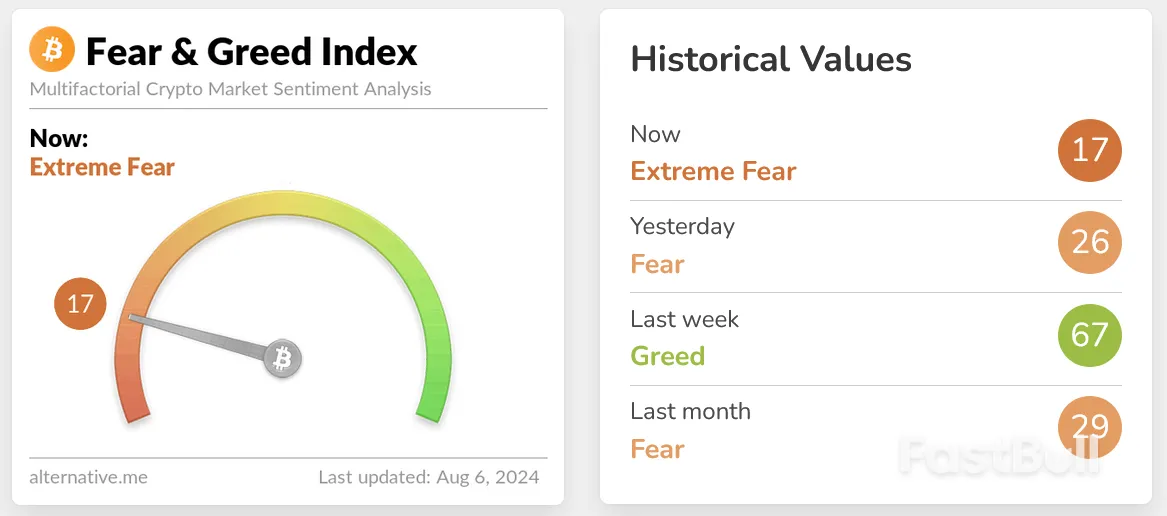
          The Crypto Fear & Greed Index has just tipped into the “Extreme Fear” zone for the first time in two years, as United States spot Bitcoin exchange-traded funds (ETFs) reported outflows of $168.4 million on Aug. 5.
          The index, which measures market sentiment for Bitcoin and the broader cryptocurrency industry, fell to a score of 17 out of 100 on Aug. 5 — the lowest since July 12, 2022.
          The index score was 67 on July 29 — marking one of the biggest week-to-week declines in recent years.Bitcoin Falls to ‘Extreme Fear’ on Aug. 5 as $168M Exits ETFs_1

          Crypto Fear & Greed Index score. Source: Alternative.me

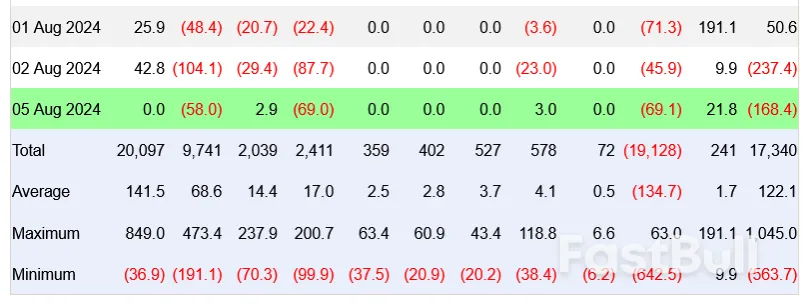
          It comes as spot Bitcoin ETFs reported $168 million in outflows on Aug. 5. Most came from the Grayscale Bitcoin Trust and the ARK 21Shares Bitcoin ETF at $69.1 million and $69 million, respectively, Farside Investors data shows.
          The Grayscale Bitcoin Mini Trust, VanEck Bitcoin ETF and Bitwise Bitcoin ETF recorded inflows of $21.8 million, $3 million and $2.9 million, respectively, while BlackRock’s iShares Bitcoin Trust recorded zero..Bitcoin Falls to ‘Extreme Fear’ on Aug. 5 as $168M Exits ETFs_2

          Spot Bitcoin ETF flows since Aug. 1. Source: Farside Investors

          However, the spot Ether (ETH) ETFs saw $48.8 million of inflows led by BlackRock’s iShares Ethereum Trust at $47.1 million, according to Farside Investors.
          VanEck and Fidelity’s Ether products also saw inflows of $16.6 million and $16.2 million, respectively.
          Sentiment fell when Bitcoin and Ether tanked 10% and 18% in a short two-hour window on Aug. 5.
          Over $600 million in leveraged long positions were wiped out, including many altcoins that were hit far harder than Bitcoin and Ether.
          Trillions of dollars were also wiped from the US stock market on Aug. 5.
          The market stumble has been led by weak employment data, slowed growth among major tech stocks and revived fears of a recession.
          Independent trader Bob Loukas described the last three days in a one in seven to 10-year event, which saw more than $500 billion wiped from the crypto market cap.
          One Bitcoin analyst, Tuur Demeester, believes Bitcoin could bottom somewhere between $40,000 and $45,000 — though he cautioned against betting on it.
          “In a Bitcoin bull market you don’t take bearish bets because prices can whipsaw back up in no time.”
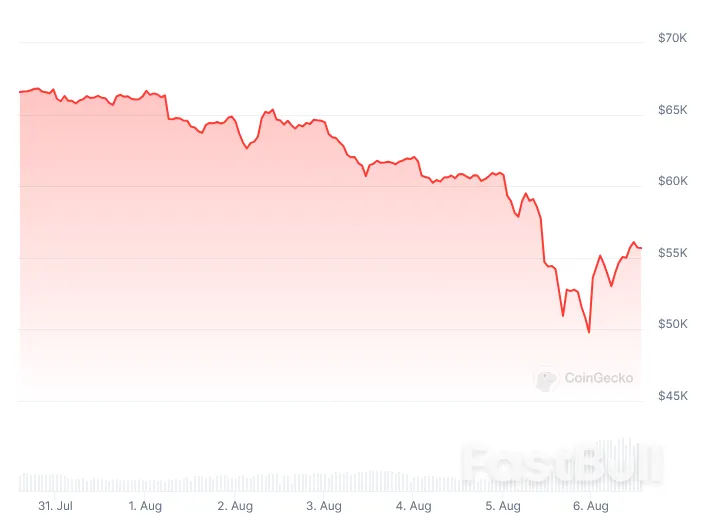
          Bitcoin has partially recovered since and is up 11.85% to $55,680 since bottoming out at $49,780 on Aug. 5, CoinGecko data shows.Bitcoin Falls to ‘Extreme Fear’ on Aug. 5 as $168M Exits ETFs_3

          Bitcoin’s change in price over the last week. Source: CoinGecko

          Source: Cointelegraph

          Risk Warnings and Disclaimers
          You understand and acknowledge that there is a high degree of risk involved in trading. Following any strategies or investment methods may lead to potential losses. The content on the site is provided by our contributors and analysts for information purposes only. You are solely responsible for determining whether any trading assets, securities, strategy, or any other product is suitable for investing based on your own investment objectives and financial situation.
          Add to Favorites
          Share

          RBA on hold, but hawkish amongst market whiplash

          Westpac

          Central Bank

          Economic

          The RBA left rates on hold in August as we expected, but their rhetoric and view of aggregate demand were surprisingly hawkish. Given the Board apparently does not see its way to cutting rates this year, our expectation of a November rate cut is unlikely to be achieved. Our rate forecasts are under review while we assess the basis for the RBA’s own economic outlook.
          As widely expected, and recently completely priced in by financial markets, the RBA Board left rates unchanged today. This had been our expectation as well. Inflation still looks to be on track to return to the target range next year; the RBA’s forecasts for trimmed mean inflation are not materially different to our own, though its near-term headline inflation forecasts are a little higher. While in our view, this expected decline in inflation sets up the conditions for the RBA to start scaling back some of the current restrictiveness in the stance of monetary policy later this year, the Board does not expect that start to occur that soon.
          The Board’s statement and the Statement on Monetary Policy (SMP) continued to highlight upside risks to inflation and to not rule anything in or out. The statement and forecasts were more hawkish than we expected, reflecting a surprisingly bullish view on domestic demand. In the media conference after the decision, the Governor went one step further, all but ruling out rate cuts this year by stating explicitly that: ‘A near-term reduction in the cash rate doesn't align with the Board's current thinking.’
          Prominent in the Governor’s language in the media conference was the need to ‘stay the course’ to get inflation down. This and some other language reveal that the RBA Board is not yet thinking in a forward-looking manner, but it appears to want to see inflation almost back in the target range before cutting rates. Given the lags in transmission of policy, this implies that the risk of inflation undershooting the inflation target range in the years ahead have gone up.
          Given the Board apparently does not see its way to cutting rates this year, our expectation of a November rate cut is unlikely to be achieved. Our rate forecasts are under review while we assess the basis for the RBA’s own economic outlook.
          That the RBA would be on hold today did not look so obvious to market participants a week ago. In the lead-up to the June quarter CPI release, much of the focus was on upside risks to inflation. Market pricing implied a material chance that the RBA would lift rates at the August meeting. As it turned out, though, CPI inflation was in line with our sub-consensus call. The crucial trimmed mean measure of trend inflation was slightly below even our expectations; the RBA has characterised the result as broadly in line with their May forecasts.
          And then at the end of the week, the US payrolls data were much weaker than the market expected. Risk appetite declined and so did equity markets and bond yields. The Federal Reserve is unlikely to respond to these shifts in the way that some of the more feverish speculation has suggested. It will, however, respond to the softening in the labour market, which has taken the unemployment rate above the Fed’s forecast for year-end. We continue to expect the Fed to start cutting the Fed funds rate at its next meeting in September, and we have revised our forecast for subsequent months to be a slightly steeper trajectory than previously expected.
          Likewise, the RBA Board will not overreact to these latest market developments, and the Governor’s comments confirmed this. Indeed, they have remained more hawkish than recent market pricing would imply.
          On the international front, the RBA has persisted with the view, expressed in the June minutes, that global growth has troughed. As we noted at the time, there are risks around this view. The SMP contained multiple mentions of upside risks to goods inflation due to stronger demand for Asian goods, trade and geopolitical tensions and an increase in shipping costs. That said, global progress on inflation had ‘surprised to the downside’, which ‘raised the prospect of a faster easing in inflation’.
          Central to the Board’s hawkishness is its assessment that the level of demand continues to outstrip the level of supply, partly because the level of domestic supply capacity is smaller than previously thought. This levels-based analytical approach is a relatively new emphasis at the RBA; it is substantially based on past inflation outcomes and assumes a lot about the structure of the supply side. In the media conference, the Governor said she would not ‘hang her hat’ on the staff’s numerical estimates of supply. But these estimates have clearly had a bearing on the Board’s latest policy decision and language.
          The RBA has also upgraded its view of the resilience of domestic demand. Other than some revisions to the past for consumption, which drop out of the growth rates for next year, most of this upgrade is coming from public demand. Also important has been a shifting out of the assumed decline in population growth. The RBA has now aligned with our own population assumptions, first articulated nearly a year ago by Westpac Economics Economist Ryan Wells: that population growth has peaked, but that it will take a couple of years to return to pre-pandemic trends. (A side note: 2023 turned out a touch higher than we originally thought, and we would now put growth in 2024 at 2% from 1.9% previously, similar to where the RBA has now got to.) As a result, the RBA’s view of employment growth and overall demand growth has been upgraded.
          Also central to the RBA’s view on inflation is that it has revised down its view of the near-term outlook for productivity. This is largely because of a mechanical adjustment driven by average hours worked remaining a bit stronger than previously thought, but also because the RBA’s forecasts for business investment are not strong enough to result in much catch-up in the stock of capital per worker.
          Some of the other forecast revisions go the other way, however. It is noteworthy that both unemployment and wages growth have been revised down, the latter quite noticeably. But the previously mentioned revision to productivity growth means that the RBA took no signal from this.
          While the Board understandably wants to continue to be seen to be resolute on inflation and vigilant to the upside risks, its current view of the outlook hangs on a number of strong assumptions. It was always going to be the case that the RBA would be among the last of its peers to start cutting, given it did not raise rates as far. However, recent evolutions in its analytical framework and rhetoric increase the risk that it will now not pivot in time.
          To stay updated on all economic events of today, please check out our Economic calendar
          Risk Warnings and Disclaimers
          You understand and acknowledge that there is a high degree of risk involved in trading. Following any strategies or investment methods may lead to potential losses. The content on the site is provided by our contributors and analysts for information purposes only. You are solely responsible for determining whether any trading assets, securities, strategy, or any other product is suitable for investing based on your own investment objectives and financial situation.
          Add to Favorites
          Share

          Stocks Bounce Back in Whiplash Reversal

          Devin

          Stocks

          Global stocks rallied on Tuesday, partly reversing some of the previous day's brutal declines, while the Japanese yen retreated modestly, after central bank officials said all the right things to soothe investor nerves.
          The Nikkei soared more than 10% to above 34,500, rebounding sharply from its 31,458 close on Monday. The index plummeted 12.4% in the previous session in its biggest daily sell-off since the 1987 Black Monday crash.
          Wall Street also looked steadier, with S&P 500 futures up 1%, while Nasdaq futures rose 1.4% and Europe's STOXX 600 index edged up by 0.7%, regaining some stability after Monday's 2.2% drop.
          The S&P 500 lost 3% on Monday, while the Nasdaq slumped 3.43%, extending a recent sell-off as fears of a possible U.S. recession spooked global markets.
          Yields on 10-year Treasury notes were back at 3.84%, having been as low as 3.667% at one stage.
          "If you wake up in the morning to discover that Japan is down 10-12%, it’s going to scare the daylights out of the sanest person in the world, so it's understandable that people take flight," IG chief market strategist Chris Beauchamp said.
          "On the flipside, I think people got a bit carried away yesterday and it always seems very dramatic at the time," he said. "It’s normal to see weakness this time of year. The question is - was that enough to reset markets or is there going to be more?"
          Federal Reserve officials sought to reassure markets with San Francisco Fed President Mary Daly saying it was "extremely important" to prevent the labor market tipping into a downturn. Daly said her mind was open to cutting interest rates as necessary and policy needed to be proactive.
          "The Nikkei's enjoying a decent retracement against Monday's plunge, as comments from the Fed's Daly and a stronger-than-expected ISM services report soothed fears of a panic Fed cut next week," said Matt Simpson, a senior market analyst at City Index in Brisbane.
          "But this is not exactly a risk-on rally. And we are not yet sure if this is just a breather between water-boardings or there is more pain to follow."

          Unwinding The Unwinding

          Currencies also reversed some of Monday's sharp moves, as the dollar rose 0.7% to 145.31 yen, having dropped 1.5% on Monday to as deep as 141.675. The yen has shot higher in recent sessions as investors were squeezed out of carry trades, where they borrowed yen at low rates to buy higher yielding assets.
          The dollar pared its losses against the Swiss franc, rising 0.4% to 0.8555 francs from a low of 0.8430.
          Treasury yields had also come off their lows, in part in reaction to a rebound in the U.S. ISM services index to 51.4 for July. In particular, its employment index jumped 5 points to 51.1, suggesting last week's payrolls report may have overstated the weakness in the labour market.
          "Gauging the bottom of such historic selloffs is complicated and investors will most likely remain cautious before pouring capital back into equity markets," said Boris Kovacevic, Austria-based global macro strategist at payments firm Convera.
          "However, the dollar-yen pair has now fallen 12% since peaking five weeks ago and is in highly oversold territory. The yen is therefore vulnerable to any upside surprises in U.S. macro data leading investors to reconsider the recession trade. This would help Japanese equities stabilize," he said.
          Market expectations the Fed would cut by 50 basis points at its September meeting remained intact, with futures implying a 71% chance of such an outsized move.
          The market has around 100 basis points of easing priced in for this year, and a similar amount for 2025.
          In precious metals, gold failed to get a safe haven bid amid talk investors were taking profits to cover losses elsewhere. But by Tuesday, it had found a firmer footing, holding steady on the day at $2,408 an ounce, having lost 1.52% overnight.
          In energy markets, oil prices bounced early Tuesday as the risk of a wider conflict in the Middle East picked up after news that several U.S. personnel were injured in an attack against a military base in Iraq.
          Brent crude futures were last up 0.9% at $77 a barrel, having hit a seven-month low of $75.05 the day before.

          Source: Reuters

          Risk Warnings and Disclaimers
          You understand and acknowledge that there is a high degree of risk involved in trading. Following any strategies or investment methods may lead to potential losses. The content on the site is provided by our contributors and analysts for information purposes only. You are solely responsible for determining whether any trading assets, securities, strategy, or any other product is suitable for investing based on your own investment objectives and financial situation.
          Add to Favorites
          Share
          FastBull
          Copyright © 2025 FastBull Ltd

          728 RM B 7/F GEE LOK IND BLDG NO 34 HUNG TO RD KWUN TONG KLN HONG KONG

          TelegramInstagramTwitterfacebooklinkedin
          App Store Google Play Google Play
          Products
          Charts

          Chats

          Q&A with Experts
          Screeners
          Economic Calendar
          Data
          Tools
          Membership
          Features
          Function
          Markets
          Copy Trading
          Latest Signals
          Contests
          News
          Analysis
          24/7
          Columns
          Education
          Company
          Careers
          About Us
          Contact Us
          Advertising
          Help Center
          Feedback
          User Agreement
          Privacy Policy
          Business

          White Label

          Data API

          Web Plug-ins

          Poster Maker

          Affiliate Program

          Risk Disclosure

          The risk of loss in trading financial instruments such as stocks, FX, commodities, futures, bonds, ETFs and crypto can be substantial. You may sustain a total loss of the funds that you deposit with your broker. Therefore, you should carefully consider whether such trading is suitable for you in light of your circumstances and financial resources.

          No decision to invest should be made without thoroughly conducting due diligence by yourself or consulting with your financial advisors. Our web content might not suit you since we don't know your financial conditions and investment needs. Our financial information might have latency or contain inaccuracy, so you should be fully responsible for any of your trading and investment decisions. The company will not be responsible for your capital loss.

          Without getting permission from the website, you are not allowed to copy the website's graphics, texts, or trademarks. Intellectual property rights in the content or data incorporated into this website belong to its providers and exchange merchants.

          Not Logged In

          Log in to access more features

          FastBull Membership

          Not yet

          Purchase

          Become a signal provider
          Help Center
          Customer Service
          Dark Mode
          Price Up/Down Colors

          Log In

          Sign Up

          Position
          Layout
          Fullscreen
          Default to Chart
          The chart page opens by default when you visit fastbull.com