• Trade
  • Markets
  • Copy
  • Contests
  • News
  • 24/7
  • Calendar
  • Q&A
  • Chats
Trending
Screeners
SYMBOL
LAST
BID
ASK
HIGH
LOW
NET CHG.
%CHG.
SPREAD
SPX
S&P 500 Index
6826.22
6826.22
6826.22
6861.30
6801.50
-1.19
-0.02%
--
DJI
Dow Jones Industrial Average
48429.74
48429.74
48429.74
48679.14
48317.93
-28.30
-0.06%
--
IXIC
NASDAQ Composite Index
23135.46
23135.46
23135.46
23345.56
23012.00
-59.70
-0.26%
--
USDX
US Dollar Index
97.800
97.880
97.800
98.070
97.740
-0.150
-0.15%
--
EURUSD
Euro / US Dollar
1.17592
1.17600
1.17592
1.17686
1.17262
+0.00198
+ 0.17%
--
GBPUSD
Pound Sterling / US Dollar
1.33906
1.33913
1.33906
1.34014
1.33546
+0.00199
+ 0.15%
--
XAUUSD
Gold / US Dollar
4323.85
4324.19
4323.85
4350.16
4294.68
+24.46
+ 0.57%
--
WTI
Light Sweet Crude Oil
56.678
56.708
56.678
57.601
56.601
-0.555
-0.97%
--

Community Accounts

Signal Accounts
--
Profit Accounts
--
Loss Accounts
--
View More

Become a signal provider

Sell trading signals to earn additional income

View More

Guide to Copy Trading

Get started with ease and confidence

View More

Signal Accounts for Members

All Signal Accounts

Best Return
  • Best Return
  • Best P/L
  • Best MDD
Past 1W
  • Past 1W
  • Past 1M
  • Past 1Y

All Contests

  • All
  • Trump Updates
  • Recommend
  • Stocks
  • Cryptocurrencies
  • Central Banks
  • Featured News
Top News Only
Share

[California Sues Trump Administration Over Commercial Vehicle Safety Program] California Is Suing The Trump Administration Over Allegations That Its Failure To Crack Down On Foreign Drivers Resulted In The Withholding Of $33 Million In Federal Funding. According To The Lawsuit Filed On December 12 In The U.S. District Court For The Northern District Of California, The State Claims That The Federal Motor Transportation Safety Administration (FMSA) Issued A Preliminary Notice Stating That California Failed To Comply With Requirements To Prevent Drivers Without English Language Skills From Driving, Violating The Administrative Procedure Act And Constituting "arbitrary And Capricious" Behavior

Share

EU's Foreign Policy Chief Kallas: Everybody Understands Belgium's Worries And Is Willing To Share Burden

Share

African Stock Market Closing Report | On Monday (December 15), The South African FTSE/Jse Africa Leading 40 Trading Index Closed Down 0.43%, Nearing 105,200 Points

Share

The Athens Stock Exchange Composite Index Closed Up 0.15% At 2107.43 Points

Share

The Offshore Yuan Broke Through 7.04 Against The US Dollar

Share

Fbi Director: A Fifth Individual Believed To Be Planning A Separate Attack Arrested By Fbi New Orleans

Share

New York Fed President Williams: The 2% Inflation Target Must Be Achieved Without Impacting The Job Market

Share

New York Fed President Williams: Monetary Policy Very Focused On Balancing Job, Inflation Risks

Share

New York Fed President Williams Expects USA Unemployment To Be 4.5% By End Of 2025

Share

New York Fed President Williams: Labor Market Risks Have Risen As Risks To Inflation Have Eased

Share

New York Fed President Williams Expects Inflation To Move To 2.5% In 2026, 2% In 2027

Share

New York Fed President Williams Sees Tariffs As A One-Off Price Adjustment, Not Spilling Over Into Broader Inflation

Share

New York Fed President Williams: Labor Market Cooling Has Been Gradual Process

Share

New York Fed President Williams Expects Active Usage Of Standing Repo Facility To Manage Liquidity

Share

New York Fed President Williams: Critical For USA Central Bank To Get Inflation Back To 2%

Share

New York Fed President Williams Expects 2026 GDP Growth To Hit 2.25%, Well Above 2025 Rate

Share

New York Fed President Williams Projects Jobless Rate Will Come Back Down Over Next Few Years

Share

New York Fed President Williams: Fed Policy Has Moved Toward Neutral From Modestly Restrictive

Share

Federal Reserve Governor Milan: I Would Be Happy To Vote For The Re-election Of Regional Fed Presidents

Share

Miran: What Is Most Surprising Is How Nice And Collegial The Fed Has Been

TIME
ACT
FCST
PREV
Japan Tankan Small Manufacturing Outlook Index (Q4)

A:--

F: --

P: --

Japan Tankan Large Non-Manufacturing Outlook Index (Q4)

A:--

F: --

P: --

Japan Tankan Large Manufacturing Outlook Index (Q4)

A:--

F: --

P: --

Japan Tankan Small Manufacturing Diffusion Index (Q4)

A:--

F: --

P: --

Japan Tankan Large-Enterprise Capital Expenditure YoY (Q4)

A:--

F: --

P: --

U.K. Rightmove House Price Index YoY (Dec)

A:--

F: --

P: --

China, Mainland Industrial Output YoY (YTD) (Nov)

A:--

F: --

P: --

China, Mainland Urban Area Unemployment Rate (Nov)

A:--

F: --

P: --

Saudi Arabia CPI YoY (Nov)

A:--

F: --

P: --

Euro Zone Industrial Output YoY (Oct)

A:--

F: --

P: --

Euro Zone Industrial Output MoM (Oct)

A:--

F: --

P: --

Canada Existing Home Sales MoM (Nov)

A:--

F: --

P: --

Canada National Economic Confidence Index

A:--

F: --

P: --

Canada New Housing Starts (Nov)

A:--

F: --

P: --
U.S. NY Fed Manufacturing Employment Index (Dec)

A:--

F: --

P: --

U.S. NY Fed Manufacturing Index (Dec)

A:--

F: --

P: --

Canada Core CPI YoY (Nov)

A:--

F: --

P: --

Canada Manufacturing Unfilled Orders MoM (Oct)

A:--

F: --

P: --

U.S. NY Fed Manufacturing Prices Received Index (Dec)

A:--

F: --

P: --

U.S. NY Fed Manufacturing New Orders Index (Dec)

A:--

F: --

P: --

Canada Manufacturing New Orders MoM (Oct)

A:--

F: --

P: --

Canada Core CPI MoM (Nov)

A:--

F: --

P: --

Canada Trimmed CPI YoY (SA) (Nov)

A:--

F: --

P: --

Canada Manufacturing Inventory MoM (Oct)

A:--

F: --

P: --

Canada CPI YoY (Nov)

A:--

F: --

P: --

Canada CPI MoM (Nov)

A:--

F: --

P: --

Canada CPI YoY (SA) (Nov)

A:--

F: --

P: --

Canada Core CPI MoM (SA) (Nov)

A:--

F: --

P: --

Canada CPI MoM (SA) (Nov)

A:--

F: --

P: --

Federal Reserve Board Governor Milan delivered a speech
U.S. NAHB Housing Market Index (Dec)

A:--

F: --

P: --

Australia Composite PMI Prelim (Dec)

--

F: --

P: --

Australia Services PMI Prelim (Dec)

--

F: --

P: --

Australia Manufacturing PMI Prelim (Dec)

--

F: --

P: --

Japan Manufacturing PMI Prelim (SA) (Dec)

--

F: --

P: --

U.K. 3-Month ILO Employment Change (Oct)

--

F: --

P: --

U.K. Unemployment Claimant Count (Nov)

--

F: --

P: --

U.K. Unemployment Rate (Nov)

--

F: --

P: --

U.K. 3-Month ILO Unemployment Rate (Oct)

--

F: --

P: --

U.K. Average Weekly Earnings (3-Month Average, Including Bonuses) YoY (Oct)

--

F: --

P: --

U.K. Average Weekly Earnings (3-Month Average, Excluding Bonuses) YoY (Oct)

--

F: --

P: --

France Services PMI Prelim (Dec)

--

F: --

P: --

France Composite PMI Prelim (SA) (Dec)

--

F: --

P: --

France Manufacturing PMI Prelim (Dec)

--

F: --

P: --

Germany Services PMI Prelim (SA) (Dec)

--

F: --

P: --

Germany Manufacturing PMI Prelim (SA) (Dec)

--

F: --

P: --

Germany Composite PMI Prelim (SA) (Dec)

--

F: --

P: --

Euro Zone Composite PMI Prelim (SA) (Dec)

--

F: --

P: --

Euro Zone Services PMI Prelim (SA) (Dec)

--

F: --

P: --

Euro Zone Manufacturing PMI Prelim (SA) (Dec)

--

F: --

P: --

U.K. Services PMI Prelim (Dec)

--

F: --

P: --

U.K. Manufacturing PMI Prelim (Dec)

--

F: --

P: --

U.K. Composite PMI Prelim (Dec)

--

F: --

P: --

Euro Zone ZEW Economic Sentiment Index (Dec)

--

F: --

P: --

Germany ZEW Current Conditions Index (Dec)

--

F: --

P: --

Germany ZEW Economic Sentiment Index (Dec)

--

F: --

P: --

Euro Zone Trade Balance (Not SA) (Oct)

--

F: --

P: --

Euro Zone ZEW Current Conditions Index (Dec)

--

F: --

P: --

Euro Zone Trade Balance (SA) (Oct)

--

F: --

P: --

U.S. Retail Sales MoM (Excl. Gas Stations & Vehicle Dealers) (SA) (Oct)

--

F: --

P: --

U.S. Retail Sales MoM (Excl. Automobile) (SA) (Oct)

--

F: --

P: --

Q&A with Experts
    • All
    • Chatrooms
    • Groups
    • Friends
    Connecting
    .
    .
    .
    Type here...
    Add Symbol or Code

      No matching data

      All
      Trump Updates
      Recommend
      Stocks
      Cryptocurrencies
      Central Banks
      Featured News
      • All
      • Russia-Ukraine Conflict
      • Middle East Flashpoint
      • All
      • Russia-Ukraine Conflict
      • Middle East Flashpoint
      Search
      Products

      Charts Free Forever

      Chats Q&A with Experts
      Screeners Economic Calendar Data Tools
      Membership Features
      Data Warehouse Market Trends Institutional Data Policy Rates Macro

      Market Trends

      Market Sentiment Order Book Forex Correlations

      Top Indicators

      Charts Free Forever
      Markets

      News

      News Analysis 24/7 Columns Education
      From Institutions From Analysts
      Topics Columnists

      Latest Views

      Latest Views

      Trending Topics

      Top Columnists

      Latest Update

      Signals

      Copy Rankings Latest Signals Become a signal provider AI Rating
      Contests
      Brokers

      Overview Brokers Assessment Rankings Regulators News Claims
      Broker listing Forex Brokers Comparison Tool Live Spread Comparison Scam
      Q&A Complaint Scam Alert Videos Tips to Detect Scam
      More

      Business
      Events
      Careers About Us Advertising Help Center

      White Label

      Data API

      Web Plug-ins

      Affiliate Program

      Awards Institution Evaluation IB Seminar Salon Event Exhibition
      Vietnam Thailand Singapore Dubai
      Fans Party Investment Sharing Session
      FastBull Summit BrokersView Expo
      Recent Searches
        Top Searches
          Markets
          News
          Analysis
          User
          24/7
          Economic Calendar
          Education
          Data
          • Names
          • Latest
          • Prev

          View All

          No data

          Scan to Download

          Faster Charts, Chat Faster!

          Download App
          English
          • English
          • Español
          • العربية
          • Bahasa Indonesia
          • Bahasa Melayu
          • Tiếng Việt
          • ภาษาไทย
          • Français
          • Italiano
          • Türkçe
          • Русский язык
          • 简中
          • 繁中
          Open Account
          Search
          Products
          Charts Free Forever
          Markets
          News
          Signals

          Copy Rankings Latest Signals Become a signal provider AI Rating
          Contests
          Brokers

          Overview Brokers Assessment Rankings Regulators News Claims
          Broker listing Forex Brokers Comparison Tool Live Spread Comparison Scam
          Q&A Complaint Scam Alert Videos Tips to Detect Scam
          More

          Business
          Events
          Careers About Us Advertising Help Center

          White Label

          Data API

          Web Plug-ins

          Affiliate Program

          Awards Institution Evaluation IB Seminar Salon Event Exhibition
          Vietnam Thailand Singapore Dubai
          Fans Party Investment Sharing Session
          FastBull Summit BrokersView Expo

          Gold (XAUUSD) Weekly Forecast: Uptrend Remains Intact

          Winkelmann

          Forex

          Commodity

          Summary:

          Gold (XAUUSD) remains in a stable consolidation zone around $4230 per ounce, near October highs.

          Gold (XAUUSD) remains in a stable consolidation zone around $4230 per ounce, near October highs. Support for prices comes from dovish signals from the Fed following the December rate cut, improved forecasts for U.S. economic growth, and lower inflation expectations for 2025–2026. Additional demand for gold arises from ongoing geopolitical risks, including the interception of a sanctioned tanker off the coast of Venezuela and continued uncertainty surrounding key conflict negotiations.

          This report examines the key factors expected to drive gold prices during 15–19 December 2025, with a focus on market reactions to the Fed meeting, expectations for the 2026 rate path, and the technical structure within the 4150–4250 range where XAUUSD has been consolidating since the September–October rally.

          XAUUSD forecast for this week: quick overview

          · Weekly performance: Gold (XAUUSD) ends the week higher at $4230 per ounce, near October levels. Support came from the anticipated Fed rate cut and Powell's comments confirming no plans for tightening. An additional factor was rising demand for safe-haven assets amid geopolitical uncertainty.
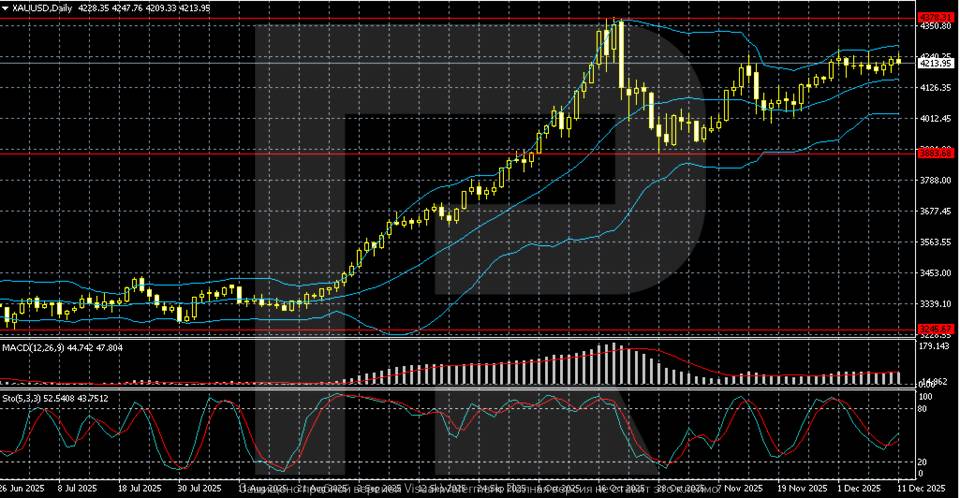
          · Support and resistance: Gold is trading within a broad upward channel of 3883–4378. The nearest support lies in the 4150–4165 zone, with key support at 3883. Resistance is concentrated at 4250 (upper boundary of the current consolidation) and 4378 (local high from late October).
          · Fundamentals: The Fed maintained a moderately dovish tone, signaling possible further rate cuts. This boosted interest in gold. The central bank improved its U.S. growth outlook and lowered inflation expectations, while geopolitical events increased the appeal of safe-haven assets. Official central bank demand also continues to support prices.
          · Outlook: The base case is continued consolidation within 4150–4250 as markets await new drivers. A breakout above 4250 would open the way for a test of the all-time high at 4378. A drop below 4150 would raise the risk of a deeper correction toward 4050 and then 3883. The medium-term structure remains bullish.

          Gold (XAUUSD) fundamental analysis

          Gold (XAUUSD) prices closed the week higher at $4230 per ounce, close to October levels when a record high was reached. This time, the driver was the expected Fed rate cut following the FOMC meeting.

          Fed Chair Jerome Powell stated that the central bank is considering three policy paths: a slower pace of cuts, moderate reductions, or more aggressive steps. A rate hike is not on the table.

          The Fed also maintained its forecast for one rate cut in 2026 but emphasized increased uncertainty around the timing and scale of future decisions.

          In addition, the Fed raised its U.S. economic growth forecast and lowered inflation expectations for 2025–2026.

          Geopolitical developments further supported gold. These include the U.S. interception of a sanctioned tanker off Venezuela's coast and continued uncertainty in global conflict negotiations — both of which are increasing safe-haven demand.

          XAUUSD technical analysis

          On the daily chart, Gold (XAUUSD) maintains a strong uptrend that began after breaking through the key 3883 area. Gold remains above the Bollinger midline, confirming bullish dominance and momentum. The upper band is widening, reflecting increased volatility. However, over the past weeks, price has been consolidating within the 4150–4250 range, entering a sideways phase.

          MACD remains in positive territory, but the histogram shows a noticeable decline in amplitude, indicating weakening momentum after October's surge. The MACD lines are converging, often a precursor to consolidation or a deeper correction.

          Stochastic, after exiting overbought territory, is now turning higher following a pullback, suggesting an attempt to resume the rally, though without a clear reversal signal yet.

          The nearest resistance lies around 4378 — the local high from late October. A breakout above this level would open the path to new all-time highs. Support is at 3883, and a loss of this area would signal a deeper correction toward the lower Bollinger Band.

          Overall, the structure remains bullish, but the market has entered a consolidation phase awaiting new drivers for trend continuation.
          XAUUSD trading scenarios

          The fundamental backdrop for gold remains positive. Gold (XAUUSD) ends the week near $4230 per ounce — close to October highs. The market was supported by dovish Fed signals: Powell confirmed that only rate cut scenarios are being discussed, with no hikes in sight. Growth forecasts were upgraded and inflation expectations lowered.

          Additional demand for gold comes from geopolitical risks, such as the U.S. tanker interception and uncertainty over negotiations. Technically, gold is consolidating within the 4150–4250 range, maintaining a medium-term uptrend.

          • Buy scenario

          Longs are appropriate if price holds above 4150–4165.

          A breakout above 4240–4250 would open the way to a retest of 4378 and potential new all-time highs.

          Support for bulls comes from dovish Fed commentary and strong safe-haven demand.

          · Sell scenario

          Shorts may be considered if price breaks below 4150.

          Targets: 4050 — key support at 3883.

          Selling pressure would increase with a strengthening U.S. dollar and rising bond yields.

          Conclusion

          The base scenario is continued consolidation in the 4150–4250 range while awaiting new catalysts.

          A breakout above 4250 would strengthen bullish momentum, while a drop below 4150 would signal a deeper correction.

          The medium-term trend remains bullish.

          Summary

          Gold (XAUUSD) ends the week at $4230 per ounce, in a phase of stable consolidation following the autumn rally. The market is pricing in the expected Fed rate cut: the likelihood of a 25 bps move in December is nearing 90%, and Jerome Powell's statements have reinforced expectations of a dovish policy path in 2026.

          Gold is also supported by geopolitical risks.

          The technical picture remains neutral-to-bullish. XAUUSD continues to trade within the 4150–4250 range, above key support at 3883.

          The nearest resistance is at 4240–4250: a breakout above this area would open the way to a retest of the all-time high at 4378.

          A break below 4150 would raise the risk of a deeper correction toward the 4050–3883 area.

          The medium-term trend remains bullish.

          EURUSD 2026-2027 forecast: key market trends and future predictions

          This article provides the EURUSD forecast for 2026 and 2027 and highlights the main factors determining the direction of the pair's movements. We will apply technical analysis, take into account the opinions of leading experts, large banks, and financial institutions, and study AI-based forecasts. This comprehensive insight into EURUSD predictions should help investors and traders make informed decisions.

          Gold (XAUUSD) forecast 2026 and beyond: expert insights, price predictions, and analysis

          Dive deep into the Gold (XAUUSD) price outlook for 2026 and beyond, combining technical analysis, expert forecasts, and key macroeconomic factors. It explains the drivers behind gold's recent surge, explores potential scenarios including a move toward 4,500 to 5,000 USD per ounce, and highlights why the metal remains a strong hedge during global uncertainty.

          Source: RoboForex

          Risk Warnings and Disclaimers
          You understand and acknowledge that there is a high degree of risk involved in trading. Following any strategies or investment methods may lead to potential losses. The content on the site is provided by our contributors and analysts for information purposes only. You are solely responsible for determining whether any trading assets, securities, strategy, or any other product is suitable for investing based on your own investment objectives and financial situation.
          Add to Favorites
          Share

          Britain To Begin Crypto Regulation Under FCA Starting 2027, Treasury Says

          James Whitman

          Cryptocurrency

          The UK Treasury is drafting rules to bring crypto under the FCA supervision, starting in 2027. Digital assets will be regulated similar to other financial products under the legislation, the finance ministry said in a statement.

          that Britain is moving to formally regulate crypto from October 2027.

          The move would provide "clear rules of the road" and keep "dodgy actors" out of the market, said Chancellor Rachel Reeves. She added that the rules will hand "strong consumer protections."

          "Bringing crypto into the regulatory perimeter is a crucial step in securing the UK's position as a world-leading financial centre in the digital age," the Chancellor noted.

          The European Union introduced a similar legislation (MiCA) one year ago, while the US is progressing with its own set of rules for crypto regulation.

          Britain seeks to collaborate with the US to foster crypto regulation and innovation through the "". The UK will introduce a draft bill into Parliament later today.Crypto Regulation Under FCA Supervision

          The new set of rules would place crypto firms, including exchanges and digital wallets, under the purview of the Financial Conduct Authority (FCA).

          This means the crypto services are regulated in the same way as other financial products, including by being subject to transparency standards, .

          Lucy Rigby, the minister for the City of London, said that these new rules "will give firms the clarity and consistency they need to plan for the long term."

          Besides, recent data from the financial regulator shows around 12% of UK adults hold some form of cryptocurrency, a figure that has risen steadily in recent years.

          As a result, the UK formally recognized Bitcoin and crypto assets as legal property under a new Act of Parliament. Under the law, digital assets can be owned, inherited, and recovered.Regulator, Bank to Finalize Own Rules by End 2026

          Separately, the UK FCA is planning rules for trading and market abuse, custody and issuance. Additionally, the Bank of England last month unveiled its proposals for regulating stablecoins.

          Both the BoE and the FCA have promised to finalize their rules by end-2026, the Reuters report added.

          The crypto regulatory rulebook plans come at a time when crypto has suffered from market turbulence and several digital asset scams recently.

          The amount of money lost to investment scams by UK crypto consumers has leapt 55% in a year, per .

          Separately, ministers are also drawing up plans to ban crypto political donations, raising red flags about their unverifiable origin and ownership.

          Source: TradingView

          Risk Warnings and Disclaimers
          You understand and acknowledge that there is a high degree of risk involved in trading. Following any strategies or investment methods may lead to potential losses. The content on the site is provided by our contributors and analysts for information purposes only. You are solely responsible for determining whether any trading assets, securities, strategy, or any other product is suitable for investing based on your own investment objectives and financial situation.
          Add to Favorites
          Share

          France Pushes to Delay EU-Mercosur Trade Deal Over Agricultural Concerns

          Gerik

          Economic

          France Raises Last-Minute Objections to Mercosur Agreement

          As the European Union prepares for a key summit on December 20, French Prime Minister Sebastien Lecornu has formally requested a delay in the vote on the EU-Mercosur free trade agreement, citing insufficient safeguards for European farmers and consumers. While the European Commission has proposed some protective measures, France contends that they remain incomplete and untested, and that additional proposals are required to establish a level playing field for EU producers.
          Lecornu emphasized that the conditions necessary for signing the agreement have “not been met,” and that implementation must be “operative, robust and effective” to ensure fairness in market access and compliance with EU standards.

          The Trade Pact: Opportunity Meets Opposition

          The EU-Mercosur accord, involving Argentina, Brazil, Paraguay, and Uruguay, aims to integrate a market of 780 million consumers, linking the EU’s manufacturing strength with South America’s agricultural abundance. From an economic standpoint, the deal offers mutual diversification:
          The EU seeks to revitalize its industrial sector, especially amid global trade tensions and the fallout of protectionist U.S. policies under President Donald Trump.
          Mercosur countries aim to boost agricultural exports and secure greater access to European markets.
          Additionally, the deal has geostrategic implications, with the EU looking to counterbalance China’s growing influence in South America, where Beijing has become a dominant commodities buyer and industrial partner.

          Agricultural Tensions Remain a Sticking Point

          Despite its economic promise, the agreement has long drawn criticism from France, Poland, and several other EU countries. Their concern centers on cheap agricultural imports from Latin America, which are often produced under lower environmental and safety standards. European farmers fear these imports would undercut them on price, eroding domestic agricultural competitiveness and compromising EU food safety standards.
          The European Commission has promised extra safety checks and safeguards, but the European Parliament has not yet ratified these provisions, fueling skepticism about their enforceability and political durability.

          Deadline Pressure and Risk of Collapse

          The urgency stems from the fact that the deal has been under negotiation for 25 years, and failure to secure an agreement by year-end could collapse the entire process, according to sources familiar with internal EU discussions. A further delay potentially into early 2026 may reopen political divisions or allow protectionist forces to solidify opposition.
          France's stance underscores the broader intra-EU divide between economic liberalization and agricultural protectionism. While the EU aims to expand its global trade footprint, especially in light of geopolitical realignments, member states like France remain unwilling to compromise domestic agricultural interests. Whether the EU can bridge these internal rifts without sacrificing strategic objectives will determine the fate of the Mercosur deal and perhaps set a precedent for future trade negotiations.

          Source: Reuters

          To stay updated on all economic events of today, please check out our Economic calendar
          Risk Warnings and Disclaimers
          You understand and acknowledge that there is a high degree of risk involved in trading. Following any strategies or investment methods may lead to potential losses. The content on the site is provided by our contributors and analysts for information purposes only. You are solely responsible for determining whether any trading assets, securities, strategy, or any other product is suitable for investing based on your own investment objectives and financial situation.
          Add to Favorites
          Share

          UK to Begin Regulating Cryptoassets in 2027: A Transatlantic Pivot Toward Certainty and Control

          Gerik

          Economic

          Cryptocurrency

          Regulatory Framework to Launch in 2027

          The UK finance ministry has announced that a new legal framework to regulate cryptoassets will come into effect in October 2027. This regulatory shift is part of a broader effort to provide legal clarity and reduce market misconduct. The upcoming legislation, to be introduced into Parliament on the same day as the announcement, will integrate crypto firms into the UK's existing financial regulatory regime. This move marks a strategic alignment with the United States' regulatory trajectory, contrasting with the EU’s industry-specific MiCA (Markets in Cryptoassets) rules implemented in 2024.
          Finance Minister Rachel Reeves emphasized that the goal is to create “clear rules of the road,” bolster consumer protections, and keep out “dodgy actors” from the digital asset space. The new rules aim to foster industry development while mitigating systemic risk. This aligns with the UK’s broader digital economy ambitions under the current government.

          Transatlantic Collaboration and Market Response

          A transatlantic taskforce is being established to synchronize U.S.-UK digital asset policy approaches. This cooperation responds to U.S. President Donald Trump's pro-crypto stance, which has contributed to rising global interest in digital assets despite recent volatility in Bitcoin, which has sharply dropped after reaching record highs earlier in 2025.
          Market participants have welcomed the clarity. Daniel Slutzkin, UK head at Gemini, said firms had “long awaited regulatory clarity” and could now begin preparing for compliance. However, Natalie Lewis, a partner at Travers Smith, expressed concerns that the original draft legislation contained multiple unresolved legal issues and hoped for more substantial changes in the final version.

          Scope of Regulation and Institutional Readiness

          The UK’s Financial Conduct Authority (FCA) and Bank of England (BoE) are developing detailed frameworks, covering key areas such as:
          Trading practices and market abuse
          Custody and issuance
          Stablecoin regulation (particularly for everyday payments)
          Both regulators plan to finalize their crypto rules by the end of 2026, providing a full year for market participants to adjust ahead of the October 2027 deadline. Meanwhile, public warnings from the BoE and FCA about the speculative risks of cryptocurrencies persist, with reminders that investors should be prepared to lose all of their money.
          The UK’s crypto regulatory regime represents a balancing act between promoting innovation and protecting consumers. By aligning with U.S. frameworks and diverging from the EU's approach, the UK is signaling its intent to be a competitive, yet cautious, global crypto hub. The timeline through 2027 gives both regulators and businesses room to adapt, although legal experts remain watchful of how thoroughly the upcoming law addresses technical gaps.

          Source: Reuters

          To stay updated on all economic events of today, please check out our Economic calendar
          Risk Warnings and Disclaimers
          You understand and acknowledge that there is a high degree of risk involved in trading. Following any strategies or investment methods may lead to potential losses. The content on the site is provided by our contributors and analysts for information purposes only. You are solely responsible for determining whether any trading assets, securities, strategy, or any other product is suitable for investing based on your own investment objectives and financial situation.
          Add to Favorites
          Share

          Asia-Pacific Stocks Retreat as China Data Disappoints and AI Optimism Cools

          Gerik

          Economic

          South Korea Leads Regional Declines Amid Global Caution

          Asian equities opened the week under pressure, mirroring Wall Street’s Friday retreat and reflecting growing investor caution around AI stocks and underwhelming economic indicators from China. South Korea’s KOSPI took the heaviest hit, tumbling 2.16% as semiconductor giants like SK Hynix and Samsung Electronics saw sharp sell-offs, dropping over 4% and 3.3% respectively. The tech-heavy Kosdaq also declined by 1.17%.
          This move echoes broader global risk-off sentiment, with portfolio managers citing fatigue in the AI rally and a general sense of nervousness heading into year-end positioning. Jed Ellerbroek of Argent Capital Management summed it up: “Investors are definitely skittish as it relates to AI not outright pessimistic, but just cautious and hesitant.”

          Chinese Data Underdelivers, Pressuring Regional Sentiment

          Markets were particularly sensitive to China’s latest economic releases for November. Retail sales rose just 1.3% year-over-year, significantly missing the 2.8% growth forecast and marking a notable slowdown from October’s 2.9% pace. Fixed asset investment and industrial production figures also fell short of expectations, with the latter rising only 4.8%, down from 4.9% previously.
          These readings dampen optimism about a near-term rebound in Chinese domestic demand. As China remains a key trading partner and growth driver for the region, any weakness there reverberates across Asia, particularly in export-dependent economies like South Korea, Japan, and Australia.

          Japan's Tankan Survey Offers a Glimmer

          Contrasting China’s sluggishness, Japan’s latest Tankan survey brought a rare positive surprise. The business sentiment index for large manufacturers rose to +15 in the fourth quarter its highest level in four years meeting economist expectations and suggesting resilience in Japan’s industrial base. The non-manufacturing index also showed strength at +34, reinforcing signs of recovery in the service sector.
          However, Japan’s stock markets didn’t escape the regional downturn. The Nikkei 225 dropped 1.3% and the broader Topix fell 0.27%, dragged lower by global cues and profit-taking.

          Broader Regional Moves and Australian Tragedy

          Across other markets, Australia’s S&P/ASX 200 lost 0.66%, with sentiment further dampened by tragic domestic news its deadliest mass shooting in three decades, which left at least 15 dead. In Hong Kong, the Hang Seng index slipped 0.79%, while the mainland’s Shanghai Composite edged down 0.12%, with the CSI 300 remaining flat amid mixed investor reactions to China’s data dump.
          India’s Nifty 50 remained unchanged, while Taiwan and Southeast Asian markets showed modest movements ahead of regional central bank decisions later this week.

          Wall Street’s AI Reversal Sets the Tone

          The regional mood was further darkened by Friday’s U.S. session, where major indices pulled back sharply from recent highs. The S&P 500 slid 1.07%, while the Nasdaq tumbled 1.69%, weighed down by sharp losses in AI-related stocks. Broadcom plunged over 11% after its earnings report failed to match lofty investor expectations. AMD, Palantir Technologies, and Micron also saw declines, raising concerns about an overextended AI trade.
          This global reset in tech optimism is feeding into Asia, where semiconductor stocks and AI-adjacent sectors are crucial market drivers.

          Outlook: Volatility Ahead

          As the year winds down, investors remain highly sensitive to macro signals, with China’s faltering recovery and AI trade fatigue clouding near-term visibility. Unless China unveils more aggressive policy support or global tech sentiment stabilizes, Asia-Pacific markets could continue facing downward pressure.
          Market watchers now look to upcoming central bank meetings and U.S. data releases to assess whether the recent correction is a pause or the start of a broader risk-off shift.

          Source: CNBC

          To stay updated on all economic events of today, please check out our Economic calendar
          Risk Warnings and Disclaimers
          You understand and acknowledge that there is a high degree of risk involved in trading. Following any strategies or investment methods may lead to potential losses. The content on the site is provided by our contributors and analysts for information purposes only. You are solely responsible for determining whether any trading assets, securities, strategy, or any other product is suitable for investing based on your own investment objectives and financial situation.
          Add to Favorites
          Share

          A Beachside Shooting Throws Australia's Three-decade Gun Control Regime Into Question

          Samantha Luan

          Political

          Economic

          · Gun control system faces scrutiny after Bondi shooting
          · More than 4 million guns owned legally in Australia, above pre-1996 levels
          · One of Bondi attack suspects had licence for six weapons

          After Australia's worst mass shooting in 1996, it took the government 12 days to ban semi-automatic weapons, organise a gun buyback scheme and introduce a licensing system to weed out people considered unfit to carry a weapon.

          Sunday's shooting at a beachside Jewish celebration in Sydney's Bondi, which left 15 people dead as well as one of the two suspects, has shaken the country's long-standing faith in that gun control system - among the world's toughest - and raised new questions about whether it remains fit for purpose.

          Australia's gun ownership system has been widely credited with one of the lowest gun homicide rates, per capita. But the number of guns held legally has risen steadily for more than two decades and now, at four million, exceeds the number before the 1996 crackdown, think-tank the Australia Institute said earlier this year.

          The fact that one of the Bondi suspects had a gun licence and six registered weapons raises questions about whether Australia should toughen its laws further, gun control groups and researchers said.

          "Events like this feel unimaginable here, which is a testament to the strength of our gun laws," said Gun Control Australia president Tim Quinn in a blog post about the attack.

          "It is essential that we ask careful, evidence-based questions about how this attack occurred, including how any weapons were obtained and whether our current laws and enforcement mechanisms are keeping pace with changing risks and technologies."

          Members of the forensic team work at the scene of a shooting during a Jewish holiday celebration at Bondi Beach, in Sydney, Australia, December 15, 2025. REUTERS/Hollie Adams

          Speaking to reporters on Monday, Prime Minister Anthony Albanese said that "if there is any action required in terms of legislative response, we will certainly have it."

          Chris Minns, New South Wales state premier, whose jurisdiction includes Sydney, said he would consider recalling state parliament to fast-track new gun legislation.

          "It's time we have a change to the law in relation to the firearms legislation ... but I am not ready to announce it today. You can expect action soon," Minns told reporters, without going into detail.

          As things stood, the licence held by one of the suspects entitled him to own the weapons he had, NSW police commissioner Mal Lanyon told reporters.

          Minns, the premier, said police had recommended an audit of gun licences in Australia's most populous state, adding that "the granting of a firearms licence in perpetuity is clearly not fit for purpose".

          Maya Gomez, a lecturer in criminology at Swinburne University of Technology, said NSW gun licence holders must first prove a genuine reason for needing a weapon.

          In the aftermath of the Bondi shooting, "questions may turn on the genuine reason provided in terms of the amount, as well as the reasons linked to the types of guns registered and used in the attack", Gomez said in an email.

          Source: Reuters

          To stay updated on all economic events of today, please check out our Economic calendar
          Risk Warnings and Disclaimers
          You understand and acknowledge that there is a high degree of risk involved in trading. Following any strategies or investment methods may lead to potential losses. The content on the site is provided by our contributors and analysts for information purposes only. You are solely responsible for determining whether any trading assets, securities, strategy, or any other product is suitable for investing based on your own investment objectives and financial situation.
          Add to Favorites
          Share

          Copper Surge Fueled by U.S. Hoarding and Tariff Fears Could Trigger Stratospheric Rally

          Gerik

          Economic

          Commodity

          Copper: The Red Metal’s Meteoric Rise

          Copper has reasserted itself as the star commodity of 2025, smashing through historical highs and grabbing headlines across financial markets. Often dubbed “Dr. Copper” for its role as a leading indicator of global economic health, the metal is now at the center of an aggressive rally fueled by a potent mix of geopolitical tension, tariff speculation, and U.S. hoarding behavior.
          Recent trading sessions have seen copper breach previous resistance levels, marking all-time highs on major commodity exchanges. Analysts point to an increasingly bullish narrative around supply-chain nationalism, with the U.S. stockpiling industrial metals, including copper, as part of broader economic security measures. This hoarding, viewed by many as preemptive stock insurance against escalating global trade friction, is tightening an already constrained market.

          Tariff Fears as a Catalyst

          The latest leg of the rally is being significantly accelerated by concerns over potential tariffs. While policymakers have not yet enacted sweeping copper-specific tariffs, the rising tensions between China and Western economies, especially the U.S., are prompting businesses to build buffer inventories. Traders are also front-running policy risks, adding to the speculative surge.
          The hoarding behavior aligns with what was seen in other strategic commodities rare earths, lithium, and aluminum where future supply concerns have created self-fulfilling pricing spirals. As copper is critical for electric vehicles, data centers, renewable energy systems, and grid upgrades, any perception of disrupted access sends ripple effects through industrial supply chains.

          Supply Constraints Add Fuel

          Beyond geopolitical catalysts, copper is also facing deep-rooted structural constraints. Many of the world’s largest mines especially in Chile, Peru, and Indonesia are dealing with declining ore grades, regulatory headwinds, and environmental pushback. The development pipeline for new copper projects has thinned out due to high capital intensity and long lead times, meaning demand outstripping supply could persist into the next decade.
          Moreover, global green energy transitions are copper-intensive, from EVs to solar farms to high-voltage cabling. As nations race to meet net-zero goals, demand for copper is expected to outpace supply growth significantly unless major new investments are unlocked quickly.

          Market Outlook: How High Can It Go?

          Industry insiders now warn that copper prices may be entering a phase of “stratospheric new highs” if the current dynamic continues unchecked. Futures traders are pricing in continued upward pressure, with some analysts forecasting copper breaching the $12,000 per metric ton threshold by early 2026, particularly if China’s stimulus measures bolster demand or the U.S. formalizes new trade restrictions.
          While some caution that prices could overshoot fundamentals in the short term, the convergence of real demand, speculative momentum, and long-term structural imbalance presents a bullish case few investors can ignore.
          Copper’s surge is not just a commodity rally it’s a reflection of deep structural realignments in the global economy. With supply tightening, governments stockpiling, and energy transitions accelerating, the market appears poised for a sustained high-price era. Unless global production responds quickly or policy shocks are averted, copper may be on a trajectory that rewrites commodity price history.

          Source: CNBC

          To stay updated on all economic events of today, please check out our Economic calendar
          Risk Warnings and Disclaimers
          You understand and acknowledge that there is a high degree of risk involved in trading. Following any strategies or investment methods may lead to potential losses. The content on the site is provided by our contributors and analysts for information purposes only. You are solely responsible for determining whether any trading assets, securities, strategy, or any other product is suitable for investing based on your own investment objectives and financial situation.
          Add to Favorites
          Share
          FastBull
          Copyright © 2025 FastBull Ltd

          728 RM B 7/F GEE LOK IND BLDG NO 34 HUNG TO RD KWUN TONG KLN HONG KONG

          TelegramInstagramTwitterfacebooklinkedin
          App Store Google Play Google Play
          Products
          Charts

          Chats

          Q&A with Experts
          Screeners
          Economic Calendar
          Data
          Tools
          Membership
          Features
          Function
          Markets
          Copy Trading
          Latest Signals
          Contests
          News
          Analysis
          24/7
          Columns
          Education
          Company
          Careers
          About Us
          Contact Us
          Advertising
          Help Center
          Feedback
          User Agreement
          Privacy Policy
          Business

          White Label

          Data API

          Web Plug-ins

          Poster Maker

          Affiliate Program

          Risk Disclosure

          The risk of loss in trading financial instruments such as stocks, FX, commodities, futures, bonds, ETFs and crypto can be substantial. You may sustain a total loss of the funds that you deposit with your broker. Therefore, you should carefully consider whether such trading is suitable for you in light of your circumstances and financial resources.

          No decision to invest should be made without thoroughly conducting due diligence by yourself or consulting with your financial advisors. Our web content might not suit you since we don't know your financial conditions and investment needs. Our financial information might have latency or contain inaccuracy, so you should be fully responsible for any of your trading and investment decisions. The company will not be responsible for your capital loss.

          Without getting permission from the website, you are not allowed to copy the website's graphics, texts, or trademarks. Intellectual property rights in the content or data incorporated into this website belong to its providers and exchange merchants.

          Not Logged In

          Log in to access more features

          FastBull Membership

          Not yet

          Purchase

          Become a signal provider
          Help Center
          Customer Service
          Dark Mode
          Price Up/Down Colors

          Log In

          Sign Up

          Position
          Layout
          Fullscreen
          Default to Chart
          The chart page opens by default when you visit fastbull.com