• Trade
  • Markets
  • Copy
  • Contests
  • News
  • 24/7
  • Calendar
  • Q&A
  • Chats
Trending
Screeners
SYMBOL
LAST
BID
ASK
HIGH
LOW
NET CHG.
%CHG.
SPREAD
SPX
S&P 500 Index
6857.13
6857.13
6857.13
6865.94
6827.13
+7.41
+ 0.11%
--
DJI
Dow Jones Industrial Average
47850.93
47850.93
47850.93
48049.72
47692.96
-31.96
-0.07%
--
IXIC
NASDAQ Composite Index
23505.13
23505.13
23505.13
23528.53
23372.33
+51.04
+ 0.22%
--
USDX
US Dollar Index
98.830
98.910
98.830
98.980
98.740
-0.150
-0.15%
--
EURUSD
Euro / US Dollar
1.16595
1.16603
1.16595
1.16715
1.16408
+0.00150
+ 0.13%
--
GBPUSD
Pound Sterling / US Dollar
1.33587
1.33597
1.33587
1.33622
1.33165
+0.00316
+ 0.24%
--
XAUUSD
Gold / US Dollar
4226.03
4226.46
4226.03
4230.62
4194.54
+18.86
+ 0.45%
--
WTI
Light Sweet Crude Oil
59.382
59.412
59.382
59.469
59.187
-0.001
0.00%
--

Community Accounts

Signal Accounts
--
Profit Accounts
--
Loss Accounts
--
View More

Become a signal provider

Sell trading signals to earn additional income

View More

Guide to Copy Trading

Get started with ease and confidence

View More

Signal Accounts for Members

All Signal Accounts

Best Return
  • Best Return
  • Best P/L
  • Best MDD
Past 1W
  • Past 1W
  • Past 1M
  • Past 1Y

All Contests

  • All
  • Trump Updates
  • Recommend
  • Stocks
  • Cryptocurrencies
  • Central Banks
  • Featured News
Top News Only
Share

Norway To Acquire 2 More Submarines, Long-Range Missiles, Daily Vg Reports

Share

Ucb Sa Shares Open Up 7.3% After 2025 Guidance Upgrade, Top Of Bel 20 Index

Share

Shares In Italy's Mediobanca Down 1.3% After Barclays Cuts To Underweight From Equal-Weight

Share

Stats Office - Austrian November Wholesale Prices +0.9% Year-On-Year

Share

Britain's FTSE 100 Up 0.15%

Share

Europe's STOXX 600 Up 0.1%

Share

Taiwan November PPI -2.8% Year-On-Year

Share

Stats Office - Austrian September Trade -230.8 Million EUR

Share

Swiss National Bank Forex Reserves Revised To Chf 724906 Million At End Of October - SNB

Share

Swiss National Bank Forex Reserves At Chf 727386 Million At End Of November - SNB

Share

Shanghai Warehouse Rubber Stocks Up 8.54% From Week Earlier

Share

Turkey's Main Banking Index Up 2%

Share

French October Trade Balance -3.92 Billion Euros Versus Revised -6.35 Billion Euros In September

Share

Kremlin Aide Says Russia Is Ready To Work Further With Current USA Team

Share

Kremlin Aide Says Russia And USA Are Moving Forward In Ukraine Talks

Share

Shanghai Rubber Warehouse Stocks Up 7336 Tons

Share

Shanghai Tin Warehouse Stocks Up 506 Tons

Share

Reserve Bank Of India Chief Malhotra: Goal Is To Have Inflation Be Around 4%

Share

Ukmto Says Master Has Confirmed That The Small Crafts Have Left The Scene, Vessel Is Proceeding To Its Next Port Of Call

Share

Shanghai Nickel Warehouse Stocks Up 1726 Tons

TIME
ACT
FCST
PREV
France 10-Year OAT Auction Avg. Yield

A:--

F: --

P: --

Euro Zone Retail Sales MoM (Oct)

A:--

F: --

P: --

Euro Zone Retail Sales YoY (Oct)

A:--

F: --

P: --

Brazil GDP YoY (Q3)

A:--

F: --

P: --

U.S. Challenger Job Cuts (Nov)

A:--

F: --

P: --

U.S. Challenger Job Cuts MoM (Nov)

A:--

F: --

P: --

U.S. Challenger Job Cuts YoY (Nov)

A:--

F: --

P: --

U.S. Initial Jobless Claims 4-Week Avg. (SA)

A:--

F: --

P: --

U.S. Weekly Initial Jobless Claims (SA)

A:--

F: --

P: --

U.S. Weekly Continued Jobless Claims (SA)

A:--

F: --

P: --

Canada Ivey PMI (SA) (Nov)

A:--

F: --

P: --

Canada Ivey PMI (Not SA) (Nov)

A:--

F: --

P: --

U.S. Non-Defense Capital Durable Goods Orders Revised MoM (Excl. Aircraft) (SA) (Sept)

A:--

F: --

P: --
U.S. Factory Orders MoM (Excl. Transport) (Sept)

A:--

F: --

P: --

U.S. Factory Orders MoM (Sept)

A:--

F: --

P: --

U.S. Factory Orders MoM (Excl. Defense) (Sept)

A:--

F: --

P: --

U.S. EIA Weekly Natural Gas Stocks Change

A:--

F: --

P: --

Saudi Arabia Crude Oil Production

A:--

F: --

P: --

U.S. Weekly Treasuries Held by Foreign Central Banks

A:--

F: --

P: --

Japan Foreign Exchange Reserves (Nov)

A:--

F: --

P: --

India Repo Rate

A:--

F: --

P: --

India Benchmark Interest Rate

A:--

F: --

P: --

India Reverse Repo Rate

A:--

F: --

P: --

India Cash Reserve Ratio

A:--

F: --

P: --

Japan Leading Indicators Prelim (Oct)

A:--

F: --

P: --

U.K. Halifax House Price Index YoY (SA) (Nov)

A:--

F: --

P: --

U.K. Halifax House Price Index MoM (SA) (Nov)

A:--

F: --

P: --

France Current Account (Not SA) (Oct)

A:--

F: --

P: --

France Trade Balance (SA) (Oct)

A:--

F: --

P: --

France Industrial Output MoM (SA) (Oct)

A:--

F: --

P: --

Italy Retail Sales MoM (SA) (Oct)

--

F: --

P: --

Euro Zone Employment YoY (SA) (Q3)

--

F: --

P: --

Euro Zone GDP Final YoY (Q3)

--

F: --

P: --

Euro Zone GDP Final QoQ (Q3)

--

F: --

P: --

Euro Zone Employment Final QoQ (SA) (Q3)

--

F: --

P: --

Euro Zone Employment Final (SA) (Q3)

--

F: --

P: --
Brazil PPI MoM (Oct)

--

F: --

P: --

Mexico Consumer Confidence Index (Nov)

--

F: --

P: --

Canada Unemployment Rate (SA) (Nov)

--

F: --

P: --

Canada Labor Force Participation Rate (SA) (Nov)

--

F: --

P: --

Canada Employment (SA) (Nov)

--

F: --

P: --

Canada Part-Time Employment (SA) (Nov)

--

F: --

P: --

Canada Full-time Employment (SA) (Nov)

--

F: --

P: --

U.S. Personal Income MoM (Sept)

--

F: --

P: --

U.S. Dallas Fed PCE Price Index YoY (Sept)

--

F: --

P: --

U.S. PCE Price Index YoY (SA) (Sept)

--

F: --

P: --

U.S. PCE Price Index MoM (Sept)

--

F: --

P: --

U.S. Personal Outlays MoM (SA) (Sept)

--

F: --

P: --

U.S. Core PCE Price Index MoM (Sept)

--

F: --

P: --

U.S. UMich 5-Year-Ahead Inflation Expectations Prelim YoY (Dec)

--

F: --

P: --

U.S. Core PCE Price Index YoY (Sept)

--

F: --

P: --

U.S. Real Personal Consumption Expenditures MoM (Sept)

--

F: --

P: --

U.S. 5-10 Year-Ahead Inflation Expectations (Dec)

--

F: --

P: --

U.S. UMich Current Economic Conditions Index Prelim (Dec)

--

F: --

P: --

U.S. UMich Consumer Sentiment Index Prelim (Dec)

--

F: --

P: --

U.S. UMich 1-Year-Ahead Inflation Expectations Prelim (Dec)

--

F: --

P: --

U.S. UMich Consumer Expectations Index Prelim (Dec)

--

F: --

P: --

U.S. Weekly Total Rig Count

--

F: --

P: --

U.S. Weekly Total Oil Rig Count

--

F: --

P: --

U.S. Consumer Credit (SA) (Oct)

--

F: --

P: --

Q&A with Experts
    • All
    • Chatrooms
    • Groups
    • Friends
    Connecting
    .
    .
    .
    Type here...
    Add Symbol or Code

      No matching data

      All
      Trump Updates
      Recommend
      Stocks
      Cryptocurrencies
      Central Banks
      Featured News
      • All
      • Russia-Ukraine Conflict
      • Middle East Flashpoint
      • All
      • Russia-Ukraine Conflict
      • Middle East Flashpoint
      Search
      Products

      Charts Free Forever

      Chats Q&A with Experts
      Screeners Economic Calendar Data Tools
      Membership Features
      Data Warehouse Market Trends Institutional Data Policy Rates Macro

      Market Trends

      Market Sentiment Order Book Forex Correlations

      Top Indicators

      Charts Free Forever
      Markets

      News

      News Analysis 24/7 Columns Education
      From Institutions From Analysts
      Topics Columnists

      Latest Views

      Latest Views

      Trending Topics

      Top Columnists

      Latest Update

      Signals

      Copy Rankings Latest Signals Become a signal provider AI Rating
      Contests
      Brokers

      Overview Brokers Assessment Rankings Regulators News Claims
      Broker listing Forex Brokers Comparison Tool Live Spread Comparison Scam
      Q&A Complaint Scam Alert Videos Tips to Detect Scam
      More

      Business
      Events
      Careers About Us Advertising Help Center

      White Label

      Data API

      Web Plug-ins

      Affiliate Program

      Awards Institution Evaluation IB Seminar Salon Event Exhibition
      Vietnam Thailand Singapore Dubai
      Fans Party Investment Sharing Session
      FastBull Summit BrokersView Expo
      Recent Searches
        Top Searches
          Markets
          News
          Analysis
          User
          24/7
          Economic Calendar
          Education
          Data
          • Names
          • Latest
          • Prev

          View All

          No data

          Scan to Download

          Faster Charts, Chat Faster!

          Download App
          English
          • English
          • Español
          • العربية
          • Bahasa Indonesia
          • Bahasa Melayu
          • Tiếng Việt
          • ภาษาไทย
          • Français
          • Italiano
          • Türkçe
          • Русский язык
          • 简中
          • 繁中
          Open Account
          Search
          Products
          Charts Free Forever
          Markets
          News
          Signals

          Copy Rankings Latest Signals Become a signal provider AI Rating
          Contests
          Brokers

          Overview Brokers Assessment Rankings Regulators News Claims
          Broker listing Forex Brokers Comparison Tool Live Spread Comparison Scam
          Q&A Complaint Scam Alert Videos Tips to Detect Scam
          More

          Business
          Events
          Careers About Us Advertising Help Center

          White Label

          Data API

          Web Plug-ins

          Affiliate Program

          Awards Institution Evaluation IB Seminar Salon Event Exhibition
          Vietnam Thailand Singapore Dubai
          Fans Party Investment Sharing Session
          FastBull Summit BrokersView Expo

          Gold Sustains Bullish Momentum Above $3,400 as Fed Bets and Safe-Haven Demand Drive Flows

          Balogun Opeyemi

          Commodity

          Summary:

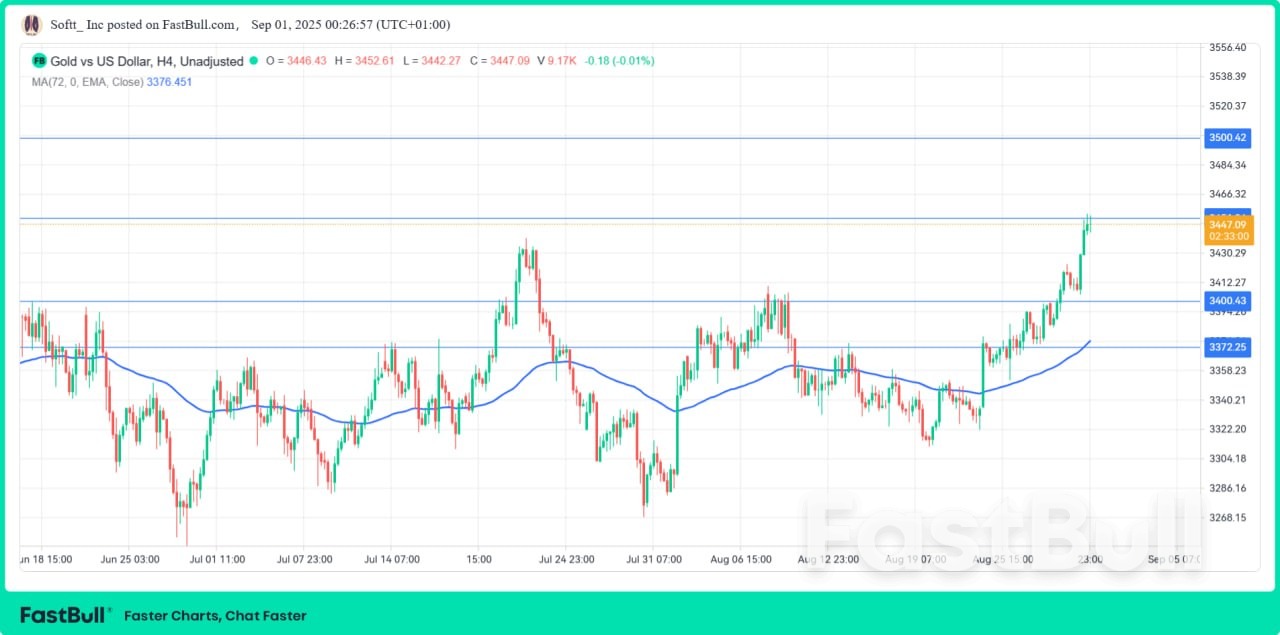
          Gold (XAU/USD) rebounded last week, supported by steady US PCE data, dollar softness, and safe-haven demand. The metal trades near $3,447, with strong monthly gains intact. While fundamentals point to dip-buying interest, the key focus remains on whether price can hold $3,400 support or break $3,452 resistance to extend toward $3,500.
          Fundamental Overview

          Gold (XAU/USD) extended its bullish run on Friday, reversing early weakness to settle near $3,447, its highest level since mid-June. The rebound came after the US PCE inflation data reinforced expectations that the Federal Reserve may begin easing policy as early as September.
          The Core PCE Price Index rose 0.3% MoM in July, in line with consensus and unchanged from June, while the annual reading ticked higher from 2.8% to 2.9%. Headline PCE grew 0.2% MoM, slightly below the prior 0.3%. While inflation remains sticky, the lack of an upside surprise strengthened bets that the Fed may maintain a dovish tilt, keeping US yields and the dollar under pressure.
          Beyond inflation, gold continues to benefit from safe-haven demand. Ongoing geopolitical tensions and concerns about the Fed’s independence amid political pressures are increasing the appeal of bullion as a defensive asset. Furthermore, month-end flows and broad uncertainty in global risk sentiment have amplified gold’s resilience, setting it up for one of its strongest monthly performances this year.
          In the near term, the interplay between Fed policy expectations and global risk appetite is likely to guide gold’s trajectory. Pullbacks may remain shallow, as market participants prefer to buy into dips amid heightened uncertainty.

          Technical OutlookGold Sustains Bullish Momentum Above $3,400 as Fed Bets and Safe-Haven Demand Drive Flows_1

          On the upside, immediate resistance is aligned at $3,452 (Friday’s high). A firm break above this zone would reinforce bullish momentum, paving the way toward the $3,480 region, before exposing the $3,500 psychological barrier. Sustained strength beyond $3,500 could trigger further extensions toward $3,520–$3,540 in the short term.
          On the downside, the first key support rests at the $3,400 base. A failure to defend this level could open the door toward $3,380–$3,370, where heavier technical support is located. Deeper losses may expose $3,350, though this is likely to attract renewed buying interest.
          Risk Warnings and Disclaimers
          You understand and acknowledge that there is a high degree of risk involved in trading. Following any strategies or investment methods may lead to potential losses. The content on the site is provided by our contributors and analysts for information purposes only. You are solely responsible for determining whether any trading assets, securities, strategy, or any other product is suitable for investing based on your own investment objectives and financial situation.
          Add to Favorites
          Share

          Dollar Dips Ahead Of US Jobs Test

          Samantha Luan

          Economic

          Forex

          Political

          The dollar fell on Monday as investors looked ahead to a raft of U.S. labour market data this week that could determine the size of an expected rate cut by the Federal Reserve later this month.Traders were also still assessing Friday's U.S. inflation data and a court ruling that most of Donald Trump's tariffs are illegal, as well as the U.S. president's ongoing tussle with the Fed over his attempt to fire Governor Lisa Cook.The dollar fell 0.04% against the yen to 146.98 in the Asian session, extending its monthly decline of 2.5% against the Japanese currency in August.

          The euro was up 0.25% to $1.1710, while sterling edged 0.14% higher to $1.3522. U.S. markets are closed for a holiday on Monday.Top of investors' radar this week will be Friday's U.S. nonfarm payrolls report, which will be preceded by data on job openings and private payrolls."Markets will pay close attention to those data releases in order to gauge the state of the labour market ... any downward surprises to the U.S. labour market data this week will increase market expectations of a rate cut, and that will further give us clues as to whether that cut will be a normal 25-basis-point cut or an outsized 50-basis-point cut," said Carol Kong, a currency strategist at Commonwealth Bank of Australia.

          Investors are currently pricing in a roughly 88% chance the Fed will ease rates by 25bps at its September 16-17 meeting, according to the CME FedWatch tool.Against a basket of currencies, the dollar eased 0.15% to 97.69 , having clocked a monthly decline of 2.2% on Friday.Rate expectations aside, the dollar has also been weighed down by worries over Fed independence, as Trump steps up his campaign to exert more influence over monetary policy.

          A court hearing on Trump's attempt to fire Fed Governor Cook ended on Friday with no immediate ruling on the unprecedented legal fight, meaning she will remain in place for now.At the same time, uncertainty over Trump's tariffs continues to linger.U.S. Trade Representative Jamieson Greer said on Sunday the Trump administration is continuing its talks with trading partners despite a U.S. appeals court ruling that most of Trump's tariffs are illegal."I doubt it will be market-moving if tariffs are going to stay in place, and even if they are ruled to be illegal, I think Trump will find another legal avenue to implement the tariffs," said CBA's Kong.In other currencies, the Australian dollar rose 0.11% to $0.6544 after earlier touching a two-week high, while the New Zealand dollar similarly advanced 0.13% to $0.5902.

          The onshore yuan <CNY=CFXS> steadied near Friday's roughly 10-month high and last stood at 7.1318 per dollar.The yuan has drawn support from firm central bank fixings in the onshore market and a buoyant domestic stock market, even as China's economy struggles to mount a solid recovery.

          China's factory activity in August expanded at the quickest pace in five months on the back of rising new orders, a private-sector survey showed on Monday, contrasting with an official survey released on Sunday that showed factory activity shrinking for the fifth straight month.

          Source: Reuters

          To stay updated on all economic events of today, please check out our Economic calendar
          Risk Warnings and Disclaimers
          You understand and acknowledge that there is a high degree of risk involved in trading. Following any strategies or investment methods may lead to potential losses. The content on the site is provided by our contributors and analysts for information purposes only. You are solely responsible for determining whether any trading assets, securities, strategy, or any other product is suitable for investing based on your own investment objectives and financial situation.
          Add to Favorites
          Share

          IC Markets Europe Fundamental Forecast | 01 September 2025

          IC Markets

          Economic

          Forex

          Commodity

          What happened in the Asia session?

          Today’s Asia session was marked by a mixed equity performance, led by pronounced weakness in tech-heavy markets (Japan, Korea, Australia), a sharp rebound in select Chinese tech stocks, and strong moves in precious metals as investors sought safety amid policy and trade uncertainty. Key macro data from China (better-than-expected PMI) and South Korea supported regional outlooks, while currencies traded cautiously ahead of global monetary policy updates.

          What does it mean for the Europe & US sessions?

          Global stocks, especially in Europe, are starting September on a positive footing amid cautious U.S. sentiment and ongoing volatility. Key inflation and jobs data will steer market expectations for central bank policy, while technical trends and macro flows point to defensive positioning. Economists and traders are watching Eurozone CPI, China PMI, and upcoming U.S. labor data for signals on growth and risk direction.

          The Dollar Index (DXY)

          The Dollar is currently under pressure with investors prioritizing US employment data and Federal Reserve decisions this week—signs point toward further weakening if rate cuts are confirmed. Currency movements have been somewhat subdued due to US markets being closed for Labor Day, with trading expected to resume tomorrow. Against the yen, the dollar rose slightly to 147.20 but had recorded a monthly decline of 2.5%. The euro strengthened to 1.1693 against the dollar, and the British pound ticked higher to 1.3510.Central Bank Notes:

          ● The Board of Governors of the Federal Reserve System voted unanimously to maintain the Federal Funds Rate in a target range of 4.25% to 4.50% at its meeting on July 29–30, 2025, keeping policy unchanged for the fifth consecutive meeting.
          ● The Committee reiterated its objective of achieving maximum employment and inflation at the rate of 2% over the longer run. While uncertainty around the economic outlook has diminished since earlier in the year, the Committee notes that challenges remain and continued vigilance is warranted.
          ● Policymakers remain highly attentive to risks on both sides of their dual mandate. The unemployment rate remains low, near 4.2%–4.5%, and labor market conditions are described as solid. However, inflation is still somewhat elevated, with the PCE price index at 2.6% and core inflation forecast at 3.1% for year-end 2025, up from earlier projections; tariff-related pressures are cited as a contributing factor.
          ● The Committee acknowledged that recent economic activity has expanded at a solid pace, with second-quarter annualized growth estimates near 2.4%. However, GDP growth for 2025 has been revised downward to 1.4% (from 1.7% projected in March), reflecting expectations of a slowdown in the coming quarters.
          ● In the revised Summary of Economic Projections, the unemployment rate is expected to average 4.5% in 2025, and headline PCE inflation is forecast at 3.0% for the year, with core PCE at 3.1%. Policymakers continue to anticipate that inflation will moderate gradually, with ongoing risks from tariffs and global conditions.
          ● The Committee reaffirmed its data-dependent and risk-aware approach to future policy decisions. Officials stated they are prepared to adjust the stance of monetary policy as appropriate if risks emerge that could impede progress toward the Fed’s goals.
          ● As previously outlined, the Committee continues the measured run-off of its securities holdings. The pace of balance sheet reduction, which slowed since April (monthly redemption cap on Treasury securities reduced from $25B to $5B, while holding agency MBS cap steady at $35B), was left unchanged this month to support orderly market functioning and financial conditions.
          ● The next meeting is scheduled for 16 to 17 September 2025.
          Next 24 Hours BiasMedium Bullish

          Gold (XAU)

          September 1, 2025, marks a watershed moment for gold markets with record-breaking prices across global and domestic exchanges. The convergence of dovish Federal Reserve policy expectations, unprecedented central bank accumulation, U.S. dollar weakness, and persistent geopolitical tensions has created ideal conditions for gold’s continued ascent. With an 87-89% probability of a September Fed rate cut and analysts projecting potential targets of $3,700+ per ounce, gold’s rally appears positioned to continue despite reaching historic levels. The precious metal’s role as both an inflation hedge and safe-haven asset remains firmly intact as global economic uncertainty persists.

          Next 24 Hours Bias

          Weak Bearish

          The Euro (EUR)

          The Euro starts September 2025 stable and slightly stronger, as inflation drops and policy uncertainty fades. Economic growth remains modest, supported by EU investment and robust labor markets, while the political climate is increasingly reactive to populist movements and ongoing border and security issues. Eurozone GDP growth for 2025 is projected at about 0.9–1%, with inflation dropping to 2.1%—close to the European Central Bank’s target. Less restrictive monetary policies and increased EU public spending are improving economic confidence, even as trade policy uncertainty lingers.Central Bank Notes:

          ● The Governing Council kept the three key ECB interest rates unchanged at its July 24 meeting, maintaining the main refinancing rate at 2.15%, the marginal lending facility at 2.40%, and the deposit facility at 2.00%, following eight consecutive cuts preceding this decision.
          ● The decision to hold rates steady was driven by evidence that inflation is stabilizing near the Governing Council’s medium-term target of 2%. Policymakers communicated that further rate moves would be data-dependent, explicitly refraining from pre-committing to any future path amid persistent global and domestic uncertainties.
          ● According to the latest Eurosystem staff projections, headline inflation is expected to remain around 2.0% for 2025, with projections indicating 1.6% for 2026 and a rebound to 2.0% in 2027. Downward revisions from previous forecasts primarily reflect lower energy price assumptions and a stronger euro. Inflation excluding energy and food is seen averaging 2.4% in 2025 and 1.9% in 2026–2027, little changed from prior projections.
          ● Real GDP growth for the Eurozone is forecast at 0.9% in 2025, 1.1% in 2026, and 1.3% in 2027. The projections note that a strong first quarter offsets a weaker outlook for the rest of 2025. While business investment and exports are dampened by ongoing trade policy uncertainties—including recent U.S. tariff measures—rising government investment, particularly in defense and infrastructure, is expected to progressively underpin growth.
          ● Household spending should be supported by firm real income gains and a still-solid labour market. More favorable financing conditions are expected to help strengthen the economy’s resilience to further global shocks. Wage growth, although still elevated, continues to moderate, with profit margins partially absorbing cost pressures.
          ● Amid significant geopolitical and economic uncertainty, the Governing Council underscored its commitment to ensuring inflation stabilises sustainably at the 2% target. The ECB reiterated it would pursue a meeting-by-meeting, data-dependent approach to its monetary policy stance.
          ● Future rate decisions will be guided by the assessment of incoming economic and financial data, the outlook for inflation and underlying inflation dynamics, and the effectiveness of monetary policy transmission. The Council continues to stress that it is not pre-committed to any specific rate trajectory.
          ● The asset purchase programme (APP) and pandemic emergency purchase programme (PEPP) portfolios are continuing to decline in an orderly and predictable way, as the Eurosystem has ceased reinvesting principal payments from maturing securities.
          ● The next meeting is on 11 September 2025

          Next 24 Hours Bias

          Weak Bearish

          The Swiss Franc (CHF)

          The Swiss Franc enters September 2025 from a position of considerable strength, having appreciated significantly against major currencies over the past year. Key developments include the SNB’s maintenance of zero interest rates with potential for negative territory, escalated US trade tensions with 39% tariffs on Swiss goods, and weakening economic growth momentum. The combination of safe-haven demand, deflationary pressures, and trade uncertainties continues to present challenges for Swiss policymakers, with markets anticipating potential further monetary easing at the September 25 SNB meeting. The franc’s strength, while reflecting its safe-haven status, poses ongoing concerns for Switzerland’s export-dependent economy amid deteriorating global trade conditions.Central Bank Notes:

          ● The SNB eased monetary policy by lowering its key policy rate by 25 basis points, from 0.25% to 0% on 19 June 2025, marking the sixth consecutive reduction.
          ● Inflationary pressure has decreased further as compared to the previous quarter, decreasing from 0.3% in February to -0.1% in May, mainly attributable to lower prices in tourism and oil products.
          ● Compared to March, the new conditional inflation forecast is lower in the short term. In the medium term, there is hardly any change from March, putting the average annual inflation at 0.2% for 2025, 0.5% for 2026, and 0.7% for 2027.
          ● The global economy continued to grow at a moderate pace in the first quarter of 2025, but the global economic outlook for the coming quarters has deteriorated due to the increase in trade tensions.
          ● Swiss GDP growth was strong in the first quarter of 2025, but this development was largely because, as in other countries, exports to the U.S. were brought forward.
          ● Following the strong first quarter, growth is likely to slow again and remain rather subdued over the remainder of the year; the SNB expects GDP growth of 1% to 1.5% for 2025 as a whole, while also anticipating GDP growth of 1% to 1.5% for 2026.
          ● The SNB will continue to monitor the situation closely and will adjust its monetary policy if necessary to ensure inflation remains within the range consistent with price stability over the medium term.
          ● The next meeting is on 25 September 2025.

          Next 24 Hours Bias

          Medium Bearish

          The Pound (GBP)

          The British Pound on September 1, 2025, demonstrates resilience despite fiscal headwinds, supported by strong business activity data and reduced expectations of aggressive Bank of England rate cuts. While Sterling has gained nearly 2% monthly against the Dollar and sits at $1.3520, it faces ongoing challenges from elevated inflation (expected to peak at 4% in September), fiscal policy uncertainties, and the lasting structural impact of Brexit.The currency’s performance reflects a delicate balance between improving economic indicators and persistent inflationary pressures that limit monetary policy flexibility. Market analysts maintain cautiously optimistic outlooks with 12-month targets around $1.32-1.34, though pre-Brexit strength levels remain elusive.

          Central Bank Notes:

          ● The Bank of England’s Monetary Policy Committee (MPC) voted on 7 August 2025 by a majority (exact split likely 5–3–1 or similar, based on expectations) to cut the Bank Rate by 25 basis points to 4.00%. Multiple members supported the move, citing fragile economic growth and signs of disinflation, while others preferred a larger reduction, and at least one member voted to hold the rate steady due to concerns about persistent inflation.
          ● The Committee unanimously decided to continue reducing the stock of UK government bond purchases held for monetary policy purposes by £100 billion over the next 12 months, targeting a balance of £558 billion by October 2025. As of 7 August, the gilt stock stands at £590 billion.
          ● Disinflation has been substantial since 2023 owing to policy tightening and the fading of external shocks. However, an unexpected uptick in headline CPI inflation—to 3.6% in June—reflects pass-through from regulated prices and earlier energy price rises, as well as signs of sticky core inflation.
          ● Headline CPI inflation is now 3.6%, above the Bank’s 2% target, reflecting regulated and energy price effects. The Committee expects inflation to remain around this level through Q3 before resuming its downward trend into 2026.
          ● UK GDP growth remains weak. Business and consumer surveys point to lacklustre activity, and the labour market continues to loosen, with increasing evidence of slack. Wage growth has softened but remains above pre-pandemic norms.
          ● Pay growth and employment indicators have moderated further, and the Committee expects a significant slowing in pay settlements over the rest of 2025.
          ● Global uncertainty remains elevated, especially with rising energy prices and supply disruptions linked to conflict in the Middle East and renewed trade tensions. These factors prompt the MPC to remain vigilant in monitoring cost and wage shocks.
          ● The risks to inflation are considered two-sided. With the outlook for growth subdued and inflation persistence less clear, the Committee argues that a gradual and careful approach to further easing is warranted, with future policy decisions highly data-dependent.
          ● The Committee’s bias is still towards maintaining monetary policy at a restrictive stance until there is firmer evidence that inflation will return sustainably to the 2% target over the medium term. Further adjustments to policy will be decided on a meeting-by-meeting basis, with scrutiny of developments in demand, costs, and inflation expectations.
          ● The next meeting is on 18 September 2025.
          Next 24 Hours Bias
          Weak Bearish

          The Canadian Dollar (CAD)

          The Canadian dollar faces a complex environment on September 1, 2025, balancing between domestic economic weakness and potential US monetary policy easing. While the currency has shown modest strength today, underlying pressures from weak GDP growth, declining oil prices, and anticipated Bank of Canada rate cuts continue to weigh on medium-term prospects. The upcoming September 17 Bank of Canada meeting will be crucial in determining the currency’s near-term direction, with markets increasingly pricing in monetary policy easing to support the struggling economy.Central Bank Notes:

          ● The Bank of Canada maintained its target for the overnight rate at 2.75%, with the Bank Rate at 3% and the deposit rate at 2.70% as of July 30, marking the third consecutive meeting with rates on hold.
          ● The Council cited ongoing U.S. tariff adjustments and unresolved trade negotiations as driving factors for elevated economic uncertainty. The persistence of tariffs well above early-2025 levels continues to present downside risks for growth and keeps inflation expectations elevated, supporting a cautious approach to monetary easing.
          ● The lack of a clear U.S. policy path, plus frequent threats of additional tariffs, led the Bank to highlight risks to Canadian exports and broader demand, amplifying uncertainty about future growth.
          ● Canada’s economic growth in the first quarter came in at 2.2%, slightly stronger than the original forecast, while the composition of GDP growth was largely as expected. Consumption slowed from its very strong fourth-quarter pace, but continued to grow despite a large drop in consumer confidence.
          ● Canadian GDP growth is expected to be near 0% in Q2 2025, closely aligned with the more optimistic scenario outlined earlier in the year. Weakness in manufacturing activity—driven by both U.S. trade disruptions and sector-specific challenges like wildfires—contributed to softer output. A partial recovery is anticipated in Q3 due to rebuilding efforts and stronger retail sales in June.
          ● Consumer spending slowed, especially as households front-loaded durable goods purchases ahead of tariffs. Housing activity remains subdued, with resales and construction still soft despite some government tax relief measures.
          ● Headline CPI inflation continued to ease, holding close to 1.7% in June, aided by declines in energy prices following the removal of the fuel charge. However, the Bank’s measures of core inflation and underlying price pressures moved up further due to higher import costs from tariffs and lingering supply disruptions.
          ● The Governing Council reiterated that it will carefully weigh ongoing upward inflation pressure from tariffs and cost shocks against the gradual downward pull from economic weakness. While additional rate cuts remain possible, timing and scale will depend on trade policy developments and inflation’s path.
          ● The next meeting is on 17 September 2025.

          Next 24 Hours Bias

          Medium Bearish

          Oil

          Oil markets on September 1, 2025, reflect a fundamental shift toward oversupply concerns overwhelming geopolitical risk premiums. While Ukrainian attacks on Russian energy infrastructure and broader Middle East tensions continue to provide some price support, the combination of aggressive OPEC+ production increases, record U.S. output, and weakening Chinese demand is creating substantial downward pressure on prices.The market faces a critical juncture as traders await the September 7 OPEC+ meeting, which could determine whether the cartel will pause its production increases or continue prioritizing market share over price support. With oil inventories building and demand growth slowing globally, the structural bear case for oil appears increasingly compelling, suggesting prices may continue trending lower through the remainder of 2025 unless significant supply disruptions occur or demand unexpectedly accelerates.Next 24 Hours BiasWeak Bullish

          Source: IC Markets

          To stay updated on all economic events of today, please check out our Economic calendar
          Risk Warnings and Disclaimers
          You understand and acknowledge that there is a high degree of risk involved in trading. Following any strategies or investment methods may lead to potential losses. The content on the site is provided by our contributors and analysts for information purposes only. You are solely responsible for determining whether any trading assets, securities, strategy, or any other product is suitable for investing based on your own investment objectives and financial situation.
          Add to Favorites
          Share

          Euro Area Labour Market Figures Kick Off Eventful Week

          Winkelmann

          Economic

          Forex

          Stocks

          In focus today

          In the euro area, attention shifts to August unemployment data. While the labour market has remained robust with low unemployment, employment growth has moderated lately. We expect the unemployment rate to remain unchanged at 6.2%. Additionally, the final manufacturing PMI is due today. With much of Europe on holiday in August, late responses not captured in the preliminary release could influence the final print. This is particularly important as the flash estimate surprised significantly on the upside.

          This week offers plenty of key data, including euro area inflation on Tuesday, Sweden’s flash inflation figures on Thursday, which will be closely watched and key to near-term Riksbank rate decisions. The week concludes with the US jobs report on Friday.

          Economic and market news

          What happened overnight and over the weekend

          In China, PMIs for August released this morning and yesterday highlight ongoing economic softness. Official PMI manufacturing rose slightly to 49.4, while RatingDog PMI (formerly Caixin PMI) edged up to 50.3. While better than expected, weakness persists in construction and employment indices, underscoring the need for stronger stimulus targeting housing and consumption. The price indices were the main bright spot suggesting easing deflationary pressures as output price indices improved.

          In the US, an appeals court ruled IEEPA tariffs illegal but allowed them to remain until 14 October, giving the Supreme Court time to intervene. The Trump administration has prepared a backup plan to replace IEEPA tariffs with broader sectoral tariffs, similar to Section 232 tariffs on steel and aluminium, though these would take longer to implement. While fewer tariffs would be positive for now, the prolonged uncertainty poses a downside risk.

          What happened Friday

          In the US, July’s PCE figures aligned with expectations, with headline inflation at 2.6% y/y and core inflation rising to 2.9% y/y, marking the third consecutive monthly increase in core inflation and leaving the door open to a potential rate cut in September. Meanwhile, August’s revised Michigan Consumer Sentiment index dropped to 58.2, indicating a modest decline in consumer confidence, as both current conditions and future expectations weakened, with a growing number of consumers viewing jobs as ‘hard to get’.

          In euro area, we received inflation figures for France, Germany and Spain ahead of the euro area inflation release this Tuesday. Both France and Spain reported lower-than-expected inflation. French HICP inflation fell to 0.8% y/y, below the expected 0.9%, driven by muted services inflation, while Spain’s headline inflation remained steady at 2.7% y/y, below the anticipated rise to 2.8%, though core inflation edged up to 2.4% y/y. In contrast, German HICP inflation surprised to the upside at 2.1% y/y, driven by base effects in energy and goods as well as strong food prices. Overall, we expect euro area HICP inflation to come in at 2.0% y/y (cons: 2.1%).

          In Sweden, GDP figures were revised upward as expected, slightly exceeding consensus at 0.5% q/q and 1.4% y/y. Consumption rose 0.4% y/y in Q2, signalling some recovery for households, while retail sales improved in July but remained below early-year levels. Backward revisions lowered GDP growth for both FY2025 and FY2024, yet Q2 recovery momentum was stronger than anticipated, presenting a mixed outcome for the Riksbank.

          In Norway, the NAV unemployment rate remained steady at 2.1% (s.a.), aligning with Norges Bank’s June MPR estimate and should in isolation support the case for a September rate cut. Meanwhile, Norwegian retail sales rose by 0.6% m/m in July, slightly below our expectations of a 1% lift signalled by leading indicators, following a largely flat performance in Q2.

          Equities: Global risk sentiment deteriorated on Friday amid a sell-off in US yields, led by the long end, with the 30-year US Treasury yield rising by 4bp. The S&P 500 closed -0.6% on Friday, erasing earlier gains from the week and ending broadly unchanged for the week. Unsurprisingly, defensives outperformed cyclicals by 1pp on Friday. The sell-off in cyclicals was led by the tech sector, after a strong run last week, declining 1.6%. In Europe, the CAC 40 continues to underperform amid lingering political turmoil.

          FI and FX: On a relatively muted day in the FX market terms of price action, SEK, NZD and AUD gained vis-à-vis GBP and JPY. EUR/USD ended the week close to the 1.17 level, EUR/SEK close to 11.05 and EUR/NOK around 11.75. The 10Y US Treasury yield finished the week at 4.23% – around the lowest in about two weeks. Both the 10Y US and German swap spreads ended the week at a tighter level.

          Source: ACTIONFOREX

          To stay updated on all economic events of today, please check out our Economic calendar
          Risk Warnings and Disclaimers
          You understand and acknowledge that there is a high degree of risk involved in trading. Following any strategies or investment methods may lead to potential losses. The content on the site is provided by our contributors and analysts for information purposes only. You are solely responsible for determining whether any trading assets, securities, strategy, or any other product is suitable for investing based on your own investment objectives and financial situation.
          Add to Favorites
          Share

          Southeast Asia’s Factories Power Ahead As Japan, South Korea Cool

          Winkelmann

          Economic

          Forex

          Asia’s manufacturing activity split across the region’s various hubs in August with Indonesia and Thailand powering ahead while South Korea and Japan cooled as tariffs weighed on output.In Indonesia, output and new orders increased for the first time in five months and production in Thailand rose at the fastest pace in 13 months, according to S&P Global data published on Monday. Overall activity in South Korea, Japan and Taiwan remained below the 50-mark that is the midpoint between expansion and contraction.

          Asian producers have been whipsawed by US tariffs this year, and August marked the arrival of President Donald Trump’s so-called “reciprocal” tariffs on nations around the world. Overall exports have eased in recent months after a surge earlier in the year as firms sought to get ahead of the levies.The impact of higher US import duties varied across the region: In Japan, new export orders contracted at the quickest pace since March 2024, with reduced demand from Europe, China and the US. In South Korea, the decline was the biggest since April. Even in Thailand, a surge in new orders was led by domestic demand, as new export orders fell for the first time since April.

          Meanwhile, Indonesia strengthened as overall activity expanded for the first time since March, allowing firms to raise prices by the most in about a year. New export orders rose at the steepest rate since September 2023 and companies remained optimistic for the year. In recent days, though, widespread protests have gripped the nation on inequality and labour concerns.Vietnam and Malaysia purchasing managers indices are reported later in the week and will provide a fuller picture of activity in the region.

          Source: Theedgemarkets

          To stay updated on all economic events of today, please check out our Economic calendar
          Risk Warnings and Disclaimers
          You understand and acknowledge that there is a high degree of risk involved in trading. Following any strategies or investment methods may lead to potential losses. The content on the site is provided by our contributors and analysts for information purposes only. You are solely responsible for determining whether any trading assets, securities, strategy, or any other product is suitable for investing based on your own investment objectives and financial situation.
          Add to Favorites
          Share

          The Pentagon Cracks Down On Big Tech's Coziness With China

          Winkelmann

          Economic

          Forex

          Political

          Stocks

          Defense Secretary Pete Hegseth announced last week that the military would cease using a Microsoft program that relied on Chinese engineers. This obviously presented a major security issue, which Hegseth noted.“If you’re thinking ‘America first’ and common sense, this doesn’t pass either of those tests,” Hegseth said of the program.“The use of Chinese nationals to service Department of Defense cloud environments? It’s over.”

          He also declared that the DOD had delivered a formal letter to Microsoft, chiding the tech giant for breaching the trust of its government and for allowing such a problem to arise. The Pentagon promises to do more audits of its Microsoft-provided programs and other tech initiatives for China connections.

          Microsoft is one of the worst offenders in this CCP connection.

          Its co-founder, Bill Gates, always finds an opportunity to praise China. In March, Gates gushed over the communist state’s tech advances and warned that any American attempts to counter Chinese growth would stifle global innovation.The tech giant has a large presence in the country, generating fears that this would allow the CCP access to our national security operations.The “digital escorts” program that the DOD just revoked, confirmed these fears.Microsoft’s Chinese engineers handle some of the most sensitive material the Pentagon processes.

          As ProPublica reported in July:

          Microsoft uses the escort system to handle the government’s most sensitive information that falls below “classified.” According to the government, this “high impact level” category includes “data that involves the protection of life and financial ruin.” The “loss of confidentiality, integrity, or availability” of this information “could be expected to have a severe or catastrophic adverse effect” on operations, assets, and individuals, the government has said. In the Defense Department, the data is categorized as “Impact Level” 4 and 5 and includes materials that directly support military operations.

          Former CIA senior executive Harry Coker told the outlet, “If I were an operative, I would look at that as an avenue for extremely valuable access. We need to be very concerned about that.”The ChiComs may even inspire some of Microsoft’s domestic operations. The tech giant played a critical role in setting up the censorship industrial complex that has been weaponized against conservatives in the U.S. and elsewhere. The CCP would be proud of such an endeavor.

          Microsoft cultivates close ties with China because its dominance of the market makes its executives think it’s too big to punish. It’s only the operator who can serve the government’s national security needs in certain areas. Any concerns about communist subversion are ignored when it’s the only option available.These practices likely run afoul of antitrust law, making Microsoft a prime target for a Federal Trade Commission investigation. FTC Chairman Andrew Ferguson has made it a priority to crack down on Big Tech malfeasance in the market. Microsoft’s actions don’t just violate free market principles—they also put our national security at risk.

          The FTC announced a probe into Microsoft’s bundling practices last December. The tech company allegedly uses this strategy to make itself seem the best option for government contracting while unfairly cutting out the competition. This lack of serious competition cements Microsoft’s cavalier attitude towards China and its reluctance to change that behavior. If no other company can challenge Microsoft’s stranglehold, there’s little motivation to correct the tech giant’s errors.

          The administration wants to mandate a simple standard for companies it does business with: put America first. Microsoft and other tech giants fail this basic criterion. Previous administrations allowed them to skate by due to their monopolies. It’s time to change that for the sake of the national interest. We can’t allow China to further undermine our defense capabilities because we’re afraid of upsetting Bill Gates.

          Source: Zero Hedge

          To stay updated on all economic events of today, please check out our Economic calendar
          Risk Warnings and Disclaimers
          You understand and acknowledge that there is a high degree of risk involved in trading. Following any strategies or investment methods may lead to potential losses. The content on the site is provided by our contributors and analysts for information purposes only. You are solely responsible for determining whether any trading assets, securities, strategy, or any other product is suitable for investing based on your own investment objectives and financial situation.
          Add to Favorites
          Share

          Tariff Uncertainty Intensifies With The U.S. Court's Ruling

          Samantha Luan

          Forex

          Political

          Economic

          As if the ever-changing trade mandates from U.S. President Donald Trump weren't hard enough for companies, here comes a new complication: the federal appeals court.On Friday, the U.S. Court of Appeals for the Federal Circuit ruled that Trump's imposition of "reciprocal" tariffs on countries, as well as those on China, Canada and Mexico ostensibly in relation to fentanyl trafficking, was an overreach of his authority.

          That said, those tariffs will be allowed to persist until Oct. 14 so that the Trump administration has time to appeal to the U.S. Supreme Court.On first blush, this development might seem to benefit stocks, which have already had a rip-roaring August. For the month, the S&P 500 added nearly 2%, the Dow Jones Industrial Average advanced over 3% and the Nasdaq Composite rose 1.6%.However, tariffs flicking on and off might be more anxiety-inducing than the certainty of planning strategies around tackling those duties.

          And that means potential volatility in markets. August's gains could be tested in September — the worst month for the S&P 500, historically speaking. Investors might hope to score consecutive months of gains but, at this moment, the added uncertainty around trade policies might diminish those chances.

          What you need to know today

          Most Trump tariffs are illegal, U.S. appeals court rules on Friday. Nevertheless, the court allowed the tariffs to run until Oct. 14 to give the Trump administration time to appeal the decision to the Supreme Court. Here are the tariffs affected by the ruling.Core inflation in the U.S. ticked up in July. The personal consumption expenditures price index, released Friday, showed a 2.9% rise in prices on the year. While in line with expectations, the reading is the highest since February.

          U.S. stocks had a winning August. Even though the S&P 500, Dow Jones Industrial Average and Nasdaq Composite fell on Friday, all notched solid gains for the month. The pan-European Stoxx 600 index lost 0.64%, with most regional bourses in the red.China and India could be partners instead of rivals, Xi Jinping says. The Chinese president made that remark at a security conference on Sunday, according to Xinhua. The sentiment was echoed by his Indian counterpart Narendra Modi, Reuters reported.

          August jobs number in focus. After July's dismal report made Trump fire the U.S. commissioner of labor statistics, investors will keep a close eye on August's report, out Friday, not just for the data but also the president's reaction.

          Here's what it really means for Trump to get control of the Federal Reserve board

          President Donald Trump's effort to sack Federal Reserve Governor Lisa Cook is about more than firing someone: It's a maneuver that, if successful, would mark a seismic shift for an institution that for ages has been considered above politics.Should Trump get a majority of members on the board of governors to vote the way he wants — and the evidence right now, to be sure, is scant that he can ever achieve such a goal — it would give him access to key levers that control the economy as well as the nation's financial infrastructure.

          Source: CNBC

          To stay updated on all economic events of today, please check out our Economic calendar
          Risk Warnings and Disclaimers
          You understand and acknowledge that there is a high degree of risk involved in trading. Following any strategies or investment methods may lead to potential losses. The content on the site is provided by our contributors and analysts for information purposes only. You are solely responsible for determining whether any trading assets, securities, strategy, or any other product is suitable for investing based on your own investment objectives and financial situation.
          Add to Favorites
          Share
          FastBull
          Copyright © 2025 FastBull Ltd

          728 RM B 7/F GEE LOK IND BLDG NO 34 HUNG TO RD KWUN TONG KLN HONG KONG

          TelegramInstagramTwitterfacebooklinkedin
          App Store Google Play Google Play
          Products
          Charts

          Chats

          Q&A with Experts
          Screeners
          Economic Calendar
          Data
          Tools
          Membership
          Features
          Function
          Markets
          Copy Trading
          Latest Signals
          Contests
          News
          Analysis
          24/7
          Columns
          Education
          Company
          Careers
          About Us
          Contact Us
          Advertising
          Help Center
          Feedback
          User Agreement
          Privacy Policy
          Business

          White Label

          Data API

          Web Plug-ins

          Poster Maker

          Affiliate Program

          Risk Disclosure

          The risk of loss in trading financial instruments such as stocks, FX, commodities, futures, bonds, ETFs and crypto can be substantial. You may sustain a total loss of the funds that you deposit with your broker. Therefore, you should carefully consider whether such trading is suitable for you in light of your circumstances and financial resources.

          No decision to invest should be made without thoroughly conducting due diligence by yourself or consulting with your financial advisors. Our web content might not suit you since we don't know your financial conditions and investment needs. Our financial information might have latency or contain inaccuracy, so you should be fully responsible for any of your trading and investment decisions. The company will not be responsible for your capital loss.

          Without getting permission from the website, you are not allowed to copy the website's graphics, texts, or trademarks. Intellectual property rights in the content or data incorporated into this website belong to its providers and exchange merchants.

          Not Logged In

          Log in to access more features

          FastBull Membership

          Not yet

          Purchase

          Become a signal provider
          Help Center
          Customer Service
          Dark Mode
          Price Up/Down Colors

          Log In

          Sign Up

          Position
          Layout
          Fullscreen
          Default to Chart
          The chart page opens by default when you visit fastbull.com