• Trade
  • Markets
  • Copy
  • Contests
  • News
  • 24/7
  • Calendar
  • Q&A
  • Chats
Trending
Screeners
SYMBOL
LAST
BID
ASK
HIGH
LOW
NET CHG.
%CHG.
SPREAD
SPX
S&P 500 Index
6827.42
6827.42
6827.42
6899.86
6801.80
-73.58
-1.07%
--
DJI
Dow Jones Industrial Average
48458.04
48458.04
48458.04
48886.86
48334.10
-245.98
-0.51%
--
IXIC
NASDAQ Composite Index
23195.16
23195.16
23195.16
23554.89
23094.51
-398.69
-1.69%
--
USDX
US Dollar Index
97.950
98.030
97.950
98.500
97.950
-0.370
-0.38%
--
EURUSD
Euro / US Dollar
1.17394
1.17409
1.17394
1.17496
1.17192
+0.00011
+ 0.01%
--
GBPUSD
Pound Sterling / US Dollar
1.33707
1.33732
1.33707
1.33997
1.33419
-0.00148
-0.11%
--
XAUUSD
Gold / US Dollar
4299.39
4299.39
4299.39
4353.41
4257.10
+20.10
+ 0.47%
--
WTI
Light Sweet Crude Oil
57.233
57.485
57.233
58.011
56.969
-0.408
-0.71%
--

Community Accounts

Signal Accounts
--
Profit Accounts
--
Loss Accounts
--
View More

Become a signal provider

Sell trading signals to earn additional income

View More

Guide to Copy Trading

Get started with ease and confidence

View More

Signal Accounts for Members

All Signal Accounts

Best Return
  • Best Return
  • Best P/L
  • Best MDD
Past 1W
  • Past 1W
  • Past 1M
  • Past 1Y

All Contests

  • All
  • Trump Updates
  • Recommend
  • Stocks
  • Cryptocurrencies
  • Central Banks
  • Featured News
Top News Only
Share

Ukraine Says It Received 114 Prisoners From Belarus

Share

USA Embassy In Lithuania: Maria Kalesnikava Is Not Going To Vilnius

Share

USA Embassy In Lithuania: Other Prisoners Are Being Sent From Belarus To Ukraine

Share

Ukraine President Zelenskiy: Five Ukrainians Released By Belarus In US-Brokered Deal

Share

USA Vilnius Embassy: USA Stands Ready For "Additional Engagement With Belarus That Advances USA Interests"

Share

USA Vilnius Embassy: Belarus, USA, Other Citizens Among The Prisoners Released Into Lithuania

Share

USA Vilnius Embassy: USA Will Continue Diplomatic Efforts To Free The Remaining Political Prisoners In Belarus

Share

USA Vilnius Embassy: Belarus Releases 123 Prisoners Following Meeting Of President Trump's Envoy Coale And Belarus President Lukashenko

Share

USA Vilnius Embassy: Masatoshi Nakanishi, Aliaksandr Syrytsa Are Among The Prisoners Released By Belarus

Share

USA Vilnius Embassy: Maria Kalesnikava And Viktor Babaryka Are Among The Prisoners Released By Belarus

Share

USA Vilnius Embassy: Nobel Peace Prize Laureate Ales Bialiatski Is Among The Prisoners Released By Belarus

Share

Belarusian Presidential Administration Telegram Channel: Lukashenko Has Pardoned 123 Prisoners As Part Of Deal With US

Share

Two Local Syrian Officials: Joint US-Syrian Military Patrol In Central Syria Came Under Fire From Unknown Assailants

Share

Israeli Military Says It Targeted 'Key Hamas Terrorist' In Gaza City

Share

Rwanda's Actions In Eastern Drc Are A Clear Violation Of Washington Accords Signed By President Trump - Secretary Of State Rubio

Share

Israeli Military Issues Evacuation Warning In Southern Lebanon Village Ahead Of Strike - Spokesperson On X

Share

Belarusian State Media Cites US Envoy Coale As Saying He Discussed Ukraine And Venezuela With Lukashenko

Share

Belarusian State Media Cites US Envoy Coale As Saying That US Removes Sanctions On Belarusian Potassium

Share

Thai Prime Minister: No Ceasefire Agreement With Cambodia

Share

US, Ukraine To Discuss Ceasefire In Berlin Ahead Of European Summit

TIME
ACT
FCST
PREV
U.K. Trade Balance Non-EU (SA) (Oct)

A:--

F: --

P: --

U.K. Trade Balance (Oct)

A:--

F: --

P: --

U.K. Services Index MoM

A:--

F: --

P: --

U.K. Construction Output MoM (SA) (Oct)

A:--

F: --

P: --

U.K. Industrial Output YoY (Oct)

A:--

F: --

P: --

U.K. Trade Balance (SA) (Oct)

A:--

F: --

P: --

U.K. Trade Balance EU (SA) (Oct)

A:--

F: --

P: --

U.K. Manufacturing Output YoY (Oct)

A:--

F: --

P: --

U.K. GDP MoM (Oct)

A:--

F: --

P: --

U.K. GDP YoY (SA) (Oct)

A:--

F: --

P: --

U.K. Industrial Output MoM (Oct)

A:--

F: --

P: --

U.K. Construction Output YoY (Oct)

A:--

F: --

P: --

France HICP Final MoM (Nov)

A:--

F: --

P: --

China, Mainland Outstanding Loans Growth YoY (Nov)

A:--

F: --

P: --

China, Mainland M2 Money Supply YoY (Nov)

A:--

F: --

P: --

China, Mainland M0 Money Supply YoY (Nov)

A:--

F: --

P: --

China, Mainland M1 Money Supply YoY (Nov)

A:--

F: --

P: --

India CPI YoY (Nov)

A:--

F: --

P: --

India Deposit Gowth YoY

A:--

F: --

P: --

Brazil Services Growth YoY (Oct)

A:--

F: --

P: --

Mexico Industrial Output YoY (Oct)

A:--

F: --

P: --

Russia Trade Balance (Oct)

A:--

F: --

P: --

Philadelphia Fed President Henry Paulson delivers a speech
Canada Building Permits MoM (SA) (Oct)

A:--

F: --

P: --

Canada Wholesale Sales YoY (Oct)

A:--

F: --

P: --

Canada Wholesale Inventory MoM (Oct)

A:--

F: --

P: --

Canada Wholesale Inventory YoY (Oct)

A:--

F: --

P: --

Canada Wholesale Sales MoM (SA) (Oct)

A:--

F: --

P: --

Germany Current Account (Not SA) (Oct)

A:--

F: --

P: --

U.S. Weekly Total Rig Count

A:--

F: --

P: --

U.S. Weekly Total Oil Rig Count

A:--

F: --

P: --

Japan Tankan Large Non-Manufacturing Diffusion Index (Q4)

--

F: --

P: --

Japan Tankan Small Manufacturing Outlook Index (Q4)

--

F: --

P: --

Japan Tankan Large Non-Manufacturing Outlook Index (Q4)

--

F: --

P: --

Japan Tankan Large Manufacturing Outlook Index (Q4)

--

F: --

P: --

Japan Tankan Small Manufacturing Diffusion Index (Q4)

--

F: --

P: --

Japan Tankan Large Manufacturing Diffusion Index (Q4)

--

F: --

P: --

Japan Tankan Large-Enterprise Capital Expenditure YoY (Q4)

--

F: --

P: --

U.K. Rightmove House Price Index YoY (Dec)

--

F: --

P: --

China, Mainland Industrial Output YoY (YTD) (Nov)

--

F: --

P: --

China, Mainland Urban Area Unemployment Rate (Nov)

--

F: --

P: --

Saudi Arabia CPI YoY (Nov)

--

F: --

P: --

Euro Zone Industrial Output YoY (Oct)

--

F: --

P: --

Euro Zone Industrial Output MoM (Oct)

--

F: --

P: --

Canada Existing Home Sales MoM (Nov)

--

F: --

P: --

Euro Zone Total Reserve Assets (Nov)

--

F: --

P: --

U.K. Inflation Rate Expectations

--

F: --

P: --

Canada National Economic Confidence Index

--

F: --

P: --

Canada New Housing Starts (Nov)

--

F: --

P: --

U.S. NY Fed Manufacturing Employment Index (Dec)

--

F: --

P: --

U.S. NY Fed Manufacturing Index (Dec)

--

F: --

P: --

Canada Core CPI YoY (Nov)

--

F: --

P: --

Canada Manufacturing Unfilled Orders MoM (Oct)

--

F: --

P: --

Canada Manufacturing New Orders MoM (Oct)

--

F: --

P: --

Canada Core CPI MoM (Nov)

--

F: --

P: --

Canada Manufacturing Inventory MoM (Oct)

--

F: --

P: --

Canada CPI YoY (Nov)

--

F: --

P: --

Canada CPI MoM (Nov)

--

F: --

P: --

Canada CPI YoY (SA) (Nov)

--

F: --

P: --

Canada Core CPI MoM (SA) (Nov)

--

F: --

P: --

Q&A with Experts
    • All
    • Chatrooms
    • Groups
    • Friends
    Connecting
    .
    .
    .
    Type here...
    Add Symbol or Code

      No matching data

      All
      Trump Updates
      Recommend
      Stocks
      Cryptocurrencies
      Central Banks
      Featured News
      • All
      • Russia-Ukraine Conflict
      • Middle East Flashpoint
      • All
      • Russia-Ukraine Conflict
      • Middle East Flashpoint
      Search
      Products

      Charts Free Forever

      Chats Q&A with Experts
      Screeners Economic Calendar Data Tools
      Membership Features
      Data Warehouse Market Trends Institutional Data Policy Rates Macro

      Market Trends

      Market Sentiment Order Book Forex Correlations

      Top Indicators

      Charts Free Forever
      Markets

      News

      News Analysis 24/7 Columns Education
      From Institutions From Analysts
      Topics Columnists

      Latest Views

      Latest Views

      Trending Topics

      Top Columnists

      Latest Update

      Signals

      Copy Rankings Latest Signals Become a signal provider AI Rating
      Contests
      Brokers

      Overview Brokers Assessment Rankings Regulators News Claims
      Broker listing Forex Brokers Comparison Tool Live Spread Comparison Scam
      Q&A Complaint Scam Alert Videos Tips to Detect Scam
      More

      Business
      Events
      Careers About Us Advertising Help Center

      White Label

      Data API

      Web Plug-ins

      Affiliate Program

      Awards Institution Evaluation IB Seminar Salon Event Exhibition
      Vietnam Thailand Singapore Dubai
      Fans Party Investment Sharing Session
      FastBull Summit BrokersView Expo
      Recent Searches
        Top Searches
          Markets
          News
          Analysis
          User
          24/7
          Economic Calendar
          Education
          Data
          • Names
          • Latest
          • Prev

          View All

          No data

          Scan to Download

          Faster Charts, Chat Faster!

          Download App
          English
          • English
          • Español
          • العربية
          • Bahasa Indonesia
          • Bahasa Melayu
          • Tiếng Việt
          • ภาษาไทย
          • Français
          • Italiano
          • Türkçe
          • Русский язык
          • 简中
          • 繁中
          Open Account
          Search
          Products
          Charts Free Forever
          Markets
          News
          Signals

          Copy Rankings Latest Signals Become a signal provider AI Rating
          Contests
          Brokers

          Overview Brokers Assessment Rankings Regulators News Claims
          Broker listing Forex Brokers Comparison Tool Live Spread Comparison Scam
          Q&A Complaint Scam Alert Videos Tips to Detect Scam
          More

          Business
          Events
          Careers About Us Advertising Help Center

          White Label

          Data API

          Web Plug-ins

          Affiliate Program

          Awards Institution Evaluation IB Seminar Salon Event Exhibition
          Vietnam Thailand Singapore Dubai
          Fans Party Investment Sharing Session
          FastBull Summit BrokersView Expo

          Gold Stocks In Comex Warehouses On Track To Hit New Records Over Coming Days

          Thomas

          Economic

          Commodity

          Summary:

          A man arranges gold jewelry in a store in the old city of Tripoli · Reuters By Polina Devitt LONDON (Reuters) - Gold stocks in C

          LONDON (Reuters) - Gold stocks in Comex warehouses are on track to hit new records over the coming days due to the risk of import tariffs curtailing shipments to the United States from other countries, analysts and traders say.

          Latest data from Comex, part of CME Group, shows gold stored in its warehouses in the United States at an all-time high of 43.3 million troy ounces worth $135 billion at current prices compared with 17.1 million in November when Donald Trump was elected U.S. President.

          Spot gold prices surged past $3,100 per ounce to a fresh record high on Monday. Bullion is up 19% so far this year after rising 27% in 2024. [GOL/]

          Flows may have slowed recently, but sources say gold is still being flown to the U.S. as Trump has promised to unveil a massive tariff plan on Wednesday, which he has dubbed "Liberation Day."

          "There is still material going to the U.S. almost daily," said a source from a Swiss refinery. Switzerland is the world's biggest bullion refining and transit hub.

          Between December and March, 25.4 million ounces of gold worth $79 billion were delivered to Comex as the risk of U.S. import tariffs widened the premium between Comex futures and London spot prices.

          As gold travels quickly by airplanes, these flows are the most striking example of the pricing and physical dislocation caused in the market by the uncertainty.

          Comex gold stocks are now equal to five years of U.S. total gold consumption, estimated by BNP Paribas at 8.8 million ounces a year.

          "I would be surprised if anyone started exporting gold out of the U.S. any time soon," Adrian Ash, head of research at London-based BullionVault.

          If gold is excluded from U.S. import tariffs, the market could see a reversal, perhaps muted, of the trend.

          "If that is confirmed, I see no reason why some of those bars should not head back to London, which remains the main trading hub for physical gold," said Ole Hansen, head of commodity strategy at Saxo Bank.

          In London, the world's largest over-the-counter gold trading hub, the shock of massive supplies to New York has been absorbed and the liquidity improved as the market borrowed from central banks, storing their bullion at the Bank of England's (BoE) vaults.

          The waiting time to load gold out of the BoE vaults has narrowed to 2-3 weeks from 4-6 weeks in January, according to three sources familiar with the matter, who requested anonymity to reveal operations.

          BoE declined to comment.

          The London Bullion Market Association reported 8,477 metric tons as of the end of February - that is still six times more gold stored in the London vaults than there is in Comex gold stocks. The price discovery process remains in London, according to analysts.

          Source: Yahoo Finance

          To stay updated on all economic events of today, please check out our Economic calendar
          Risk Warnings and Disclaimers
          You understand and acknowledge that there is a high degree of risk involved in trading. Following any strategies or investment methods may lead to potential losses. The content on the site is provided by our contributors and analysts for information purposes only. You are solely responsible for determining whether any trading assets, securities, strategy, or any other product is suitable for investing based on your own investment objectives and financial situation.
          Add to Favorites
          Share

          S&P 500 Drops As Trump’s ’liberation Day’ Tariffs Loom

          Devin

          Economic

          Stocks

          At 12:58 ET (17:58 GMT), the Dow Jones Industrial Average rose 0.3%, the S&P 500 index fell 0.5%, and the NASDAQ Composite dropped 1.4%.

          The major indices are on pace to end the month sharply lower, weighed by mounting trade and economic concerns.

          Trump tariff jitters grow as ‘liberation day’ approaches

          President Trump is set to unveil several more trade tariffs on April 2, a date he has repeatedly touted as “liberation day.”

          A WSJ report over the weekend said Trump will consider higher tariffs against a broader range of countries, as he embarks on a trade agenda aimed at correcting alleged trade imbalances against the U.S.

          The U.S. president rattled markets last week by imposing a 25% tariff on all non-American cars. The tariff will take effect from April 2, where Trump could also announce tariffs against other sectors such as commodities, semiconductors and pharmaceuticals.

          Markets fear that Trump’s tariffs, which will be borne by U.S. importers, will underpin inflation and compromise U.S. economic growth in the coming months.

          Goldman Sachs sees a 35% chance of a recession in the next 12 months, and also expects inflation to rise further above the Federal Reserve’s 2% target in 2025.

          Jobs report looms large

          This week sees an abundance of major economic releases, including the all-important jobs report for March.

          The U.S. economy is tipped to have added 139,000 roles in March, down from 151,000 in the previous month, while the unemployment rate is seen equaling February’s mark of 4.1%.

          Prior to the release of the nonfarm payrolls figures on Friday, measures of private hiring and job openings will also be published, along with separate numbers tracking manufacturing activity.

          Wall Street indexes fell sharply on Friday after PCE price index inflation- the Fed’s preferred inflation gauge- read higher than expected for February.

          The reading gives the Fed more impetus to keep interest rates steady for longer, especially in the face of heightened uncertainty over the economy.

          Tesla to reveal Q1 deliveries

          In the corporate sector, Tesla (NASDAQ:TSLA) is expected to unveil first-quarter deliveries data this week, with analysts and investors bracing for a potential drop in the proxy for the electric vehicle maker’s sales.

          The numbers, which are due out on April 2, are projected to show a decline in the figure versus the year-ago period, as the company contends with a backlash to CEO Elon Musk’s political activities that have led to protests at showrooms.

          Coreweave drops; Mr. Cooper Group jumps on deal activity;

          CoreWeave Inc (NASDAQ:CRWV) fell more than 5% just days after making its public debut. The Nvidia-backed company opened trading its below IPO price on Friday.

          Mr. Cooper Group Inc (NASDAQ:COOP) shrugged off the broader market malaise, rising more than 12% after the mortgage services provider agreed to be aquired by Rocket Companies in a $9.4B deal.

          Source: Investing

          To stay updated on all economic events of today, please check out our Economic calendar
          Risk Warnings and Disclaimers
          You understand and acknowledge that there is a high degree of risk involved in trading. Following any strategies or investment methods may lead to potential losses. The content on the site is provided by our contributors and analysts for information purposes only. You are solely responsible for determining whether any trading assets, securities, strategy, or any other product is suitable for investing based on your own investment objectives and financial situation.
          Add to Favorites
          Share

          Worst Q1 for BTC Price Since 2018: 5 Things to Know in Bitcoin This Week

          Warren Takunda

          Cryptocurrency

          Bitcoin limps into the end of Q1 on 13% losses as fresh macroeconomic volatility looms.
          BTC price action risks a fresh dip below $80,000 as new US trade tariffs weigh on risk-asset sentiment.
          Crypto traders’ tariff woes focus on April 2, dubbed “Liberation Day” by US President Donald Trump, while gold heads higher.
          Despite the doom and gloom, Bitcoin has had a relatively mild March, while Q1 threatens to be its worst in seven years.
          Profitability currently points the way to a bull market drawdown with no realistic bottom in sight.
          The Coinbase Premium puts up a fight amid the price dip, suggesting that panic sellers have already exited.

          BTC price: “Bearish engulfing” sets the tone

          Bitcoin traders are on edge this week as US trade tariffs follow the monthly and quarterly candle closes.
          A recipe for risk-asset volatility has many market participants bracing for the worst as BTC price action edges increasingly close to $80,000.
          The lowest levels in two weeks at about $81,200 accompanied the March 30 weekly close, data from Cointelegraph Markets Pro and TradingView confirmed.
          “In LTF, the first noticeable thing is this new wick to the downside,” trader CrypNuevo responded on X.
          “The odds are on the side of it getting filled quite soon.”Worst Q1 for BTC Price Since 2018: 5 Things to Know in Bitcoin This Week_1

          BTC/USD 4-hour chart. Source: Cointelegraph/TradingView

          Fellow trading account HTL-NL noted a “bearish engulfing” candle on the weekly chart.
          “Let's see if it plays out,” he told X followers.Worst Q1 for BTC Price Since 2018: 5 Things to Know in Bitcoin This Week_2

          BTC/USD 1-week chart. Source: HTL-NL/X

          The picture on longer timeframes, per trading resource Barchart, is no better unless the risk-asset landscape improves.
          Bitcoin and US stocks are headed for so-called “death crosses,” it warned prior to the Wall Street open, as short-term losses catch up to the broader uptrend.
          “What if price action is red heading into those Death Crosses with the actual Crosses marking the bottom like we've seen many times before?” Barchart queried.Worst Q1 for BTC Price Since 2018: 5 Things to Know in Bitcoin This Week_3

          BTC liquidation heatmap (screenshot). Source: CoinGlass

          A look at exchange order book data from monitoring resource CoinGlass meanwhile shows bid and ask liquidity clustered tightly around price.
          Continuing, CrypNuevo paid particular attention to the 50-day and 50-week exponential moving averages (EMAs).
          “Seeing some compression between the 1W50EMA and 1D50EMA which always leads to an aggressive move,” he observed.
          “It might take a bit more time based on previous cases. It's also quite common seeing multiple and consecutives retests of this bull market support.”Worst Q1 for BTC Price Since 2018: 5 Things to Know in Bitcoin This Week_4

          BTC/USD 1-day chart with 50-day, 50-week EMA. Source: Cointelegraph/TradingView

          D-Day for US tariffs precedes jobs data onslaught

          US employment data and Federal Reserve officials are among the key events on the radar for risk-asset traders this week.
          Job openings, jobless claims and nonfarm payrolls are all due, with the first round of numbers released on April 2.
          This may be overshadowed by the start of new US trade tariffs set to begin on the same day. As Cointelegraph continues to report, crypto remains highly sensitive to tariff news, with Trump giving mixed messages as to which measures will ultimately come into force.
          In a dedicated X thread on the topic, trading resource The Kobeissi Letter noted that tariffs may impact about $1.5 trillion worth of US imports by the end of the month.
          “President Trump has been discussing this Wednesday, April 2nd, for weeks. This is a day that he has named ‘Liberation Day’ where widespread new tariffs are coming,” it wrote.
          “We believe April 2nd will be the biggest escalation of the trade war to date. Markets are in for a wild week.”Worst Q1 for BTC Price Since 2018: 5 Things to Know in Bitcoin This Week_5

          US Economic Policy Uncertainty Index. Source: The Kobeissi Letter/X

          Kobeissi pointed to unusually high levels of market uncertainty, as represented by the Economic Policy Uncertainty Index.
          With many a surprise to come, market commentators are not the only ones in “wait and see” mode.
          April 4 will see Fed Chair Powell take to the stage with a speech on the economic outlook at the Society for Advancing Business Editing and Writing (SABEW) Annual Conference in Arlington, Virginia.
          Earlier this month, Powell said that while it was not easy to pin inflation pressures on tariffs, he was in no hurry to lower interest rates — the key move awaited by risk-asset traders.
          The latest estimates from CME Group’s FedWatch Tool continue to favor the Fed’s June meeting as the date of the next rate cut.Worst Q1 for BTC Price Since 2018: 5 Things to Know in Bitcoin This Week_6

          Fed target rate probabilities for June 18 FOMC meeting. Source: CME Group

          Bitcoin rounds off a limp Q1

          As both the monthly and quarterly candles prepare to close, Bitcoin is looking at a distinctly uninspiring mid-term performance.
          Data from CoinGlass shows BTC/USD down 12.7% in Q1 at the time of writing, making it the worst first quarter of the year since 2018.Worst Q1 for BTC Price Since 2018: 5 Things to Know in Bitcoin This Week_7

          BTC/USD quarterly returns (screenshot). Source: CoinGlass

          Conditions have worsened for hodlers thanks to gold outperforming as a safe-haven bet, hitting repeated all-time highs while BTC/USD fell 30% from its January peak.
          That bull market correction, however, remains fairly standard in a historical perspective. Data from onchain analytics firm Glassnode confirms that the maximum drawdown in previous bull markets passed 60%.
          “This cycle continues to be the least volatile of all,” it acknowledged in February.Worst Q1 for BTC Price Since 2018: 5 Things to Know in Bitcoin This Week_8

          Bitcoin bull market drawdowns. Source: Glassnode

          Others agree that despite the frustrating lack of further price upside, Bitcoin has weathered the macroeconomic storm fairly well.
          “Overall quarter not horrible,” trader Daan Crypto Trades summarized about the CoinGlass figures this weekend.
          On a monthly basis, the picture remains far from the most bearish BTC price scenarios — 2.7% losses since March 1, making for a fairly average third month of the year.Worst Q1 for BTC Price Since 2018: 5 Things to Know in Bitcoin This Week_9

          BTC/USD monthly returns (screenshot). Source: CoinGlass

          MVRV Ratio lacks “definitive bottom signal”

          A key Bitcoin price metric continues to give off warning signals this week as the market flushes out “overheated” conditions.
          The market value to realized value (MVRV) ratio, which compares the market cap to realized cap to determine short-term and long-term profitability, is trending back toward its long-term average.
          In early March, the tool printed a so-called “death cross” — its short-term moving average crossed below a long-term equivalent, in keeping with the profit drawdown sparked by Bitcoin’s descent below $80,000.
          “Much like in previous cycles, this cross was followed by a price decline after Bitcoin hit a local peak, reinforcing the MVRV's effectiveness as a market sentiment indicator,” Yonsei Dent, a contributor to onchain analytics platform CryptoQuant, wrote in one of its “Quicktake” blog posts on March 30.
          “With the MVRV now converging toward its long-term historical average, it appears the market has exited the overheated zone. However, no definitive bottom signal has emerged yet.” Worst Q1 for BTC Price Since 2018: 5 Things to Know in Bitcoin This Week_10

          Bitcoin MVRV momentum chart. Source: CryptoQuant

          Dent suggested that while current behavior mimics past BTC price cycles, market participants “should remain cautious of further downside risk.”
          Last month, analysis predicted that Bitcoin still has room for fresh all-time highs on longer timeframes, based on MVRV ratio data.

          Coinbase traders keep the faith

          The return of the Coinbase Premium has been painfully slow this quarter as episodes of panic selling characterized recent market behavior.
          The Premium, which is the difference in spot price between the Coinbase BTC/USD and Binance BTC/USDT pairs, currently hovers around neutral.
          While unremarkable in and of itself, the metric’s resilience to ongoing BTC price pressure caught the eye of CryptoQuant contributor Crypto Sunmoon.
          “Panic selling is decreasing,” he concluded in another Quicktake post this weekend.
          A positive Premium reflects increasing US investor confidence in adding BTC exposure and is traditionally a key ingredient in sustainable Bitcoin bull markets.
          Meanwhile, its resistance to the downside in the face of falling prices leads Sunmoon to suspect a “possible trend reversal.”Worst Q1 for BTC Price Since 2018: 5 Things to Know in Bitcoin This Week_11

          Bitcoin Coinbase Premium. Source: CryptoQuant

          Source: Cointelegraph

          Risk Warnings and Disclaimers
          You understand and acknowledge that there is a high degree of risk involved in trading. Following any strategies or investment methods may lead to potential losses. The content on the site is provided by our contributors and analysts for information purposes only. You are solely responsible for determining whether any trading assets, securities, strategy, or any other product is suitable for investing based on your own investment objectives and financial situation.
          Add to Favorites
          Share

          Will Trump’s ‘Liberation Day’ Be the Start of a Trade War – or Another Climbdown?

          Warren Takunda

          Economic

          Donald Trump won back the White House with a promise to transform the US economy. Millions of Americans, struggling with higher prices and bigger bills, elected a president who pledged to revive his country’s industrial heartlands – and leave the rest of the world to pick up the bill.
          On Wednesday – a day dubbed Liberation Day by the president and his aides – Trump has vowed to pull the trigger and impose an historic barrage of tariffs on goods from overseas he claims will fund an extraordinary revival.
          Ten weeks after obtaining power, Trump has said he will raise tariffs on all products from countries that charge tariffs on US exports; hit goods from Canada and Mexico with sweeping duties; introduce steep tariffs on foreign cars, computer chips and drugs; and target countries importing oil from Venezuela with duties on their US exports.
          This is “the big one”, according to the president. Business leaders and economists are certainly worried about the scale of his trade strategy, which the Tax Foundation already estimates could knock US gross domestic product (GDP) by roughly 0.7% and cost about 500,000 US jobs.
          “The escalating tariffs are a body blow to the global trading system,” said Eswar Prasad, professor of trade policy at Cornell University, and a former official at the International Monetary Fund.
          Wherever you stand, a move on this scale would constitute a radical shake-up – and set the stage for a fundamental overhaul of the US economy. And yet, even as he ramped up the rhetoric, Trump has appeared to tread carefully.
          “I will immediately begin the overhaul of our trade system to protect American workers and families,” the president declared at his inauguration in January. “Instead of taxing our citizens to enrich other countries, we will tariff and tax foreign countries to enrich our citizens.”
          While the threats were immediate, the action was not.
          Take Canada and Mexico. The administration has adopted a strikingly hardline stance against the US’s largest and nearest trading partners, but its imposition of blanket tariffs has been hit by a dizzying array of shifting deadlines, delays and reversals.
          An initial pledge to impose tariffs from “day one” shifted, without explanation, to February. When February rolled around, a last-ditch deal kicked the can to March. When the tariffs were finally imposed, it was a little over 24 hours before carmakers were granted a temporary exemption, and 48 hours before all goods covered by an existing trade deal between the US, Mexico and Canada were spared for another month.
          All the while, Trump and his most senior officials have slowly, but surely, accepted the risks they are raising in pursuit of the rewards they have vowed to obtain.
          “Tariffs don’t cause inflation,” the president claimed in January. OK, prices “could go up somewhat short term”, he conceded in February. “There’ll be a little disturbance,” he added in March, stressing that he was alright with that.
          The US treasury secretary, Scott Bessent, acknowledged earlier this month that there may well be a “one-time price adjustment” as a result of Trump’s tariffs. “Access to cheap goods is not the essence of the American dream,” he argued.
          While Trump predicts that slapping high US tariffs on foreign goods will prompt an influx of international companies to make products inside the US, rather than out, companies and investors worldwide are already struggling to keep up with his administration’s erratic trade policymaking.
          So far, since his return to office, Trump has hiked tariffs on Chinese exports to the US and raised tariffs on foreign steel and aluminium to 25%.
          The average US tariff rate has already shot up from 2.5% to 8.4% this year, the highest level since 1946, according to the Tax Foundation.
          Alex Durante, its senior economist, said the country is “inching towards” the kind of tariffs last seen since the 1930s, when the Smoot-Hawley bill, among the most decried pieces of legislation in US history, introduced tariffs on thousands of goods.
          “With each tariff action we’re rapidly approaching a universal tariff that would be damaging to the economy,” said Durante. “Behind the scenes, I think there is probably some concern, even among some of [Trump’s] staff, that they’re rapidly approaching the point of no return.”
          As his administration grappled with the fallout from the inadvertent inclusion of a journalist in a group chat about secret military plans last week, the president summoned reporters to the Oval Office to pre-announce tariffs on foreign cars. “This is very exciting,” he told them.
          The excitement is far from universal. Prasad, at Cornell, said: “We are shifting to a world where a commonly accepted set of rules is being displaced by unilateral actions that ostensibly promote a fair trading system, but will instead create volatility and uncertainty, inhibiting the free flow of goods and financial capital across national borders.”
          The car tariffs would be “a hurricane-like headwind to foreign (and many US) automakers”, said Dan Ives, an analyst at Wedbush Securities, who suggested they would push up prices by as much as $10,000 in the US. “We continue to believe this is some form of negotiation and these tariffs could change by the week,” he added, “although this initial 25% tariff on autos from outside the US is almost an untenable head-scratching number for the US consumer”.
          Such action is also widely expected to prompt retaliation – with US exporters in the firing line.
          While a spokesperson for the European Commission stressed it was too early to detail the European Union’s response to actions “still not implemented” by the US, they added: “I can assure you that it will be timely, that it will be robust, that it will be well calibrated and that it will achieve the intended impact.”
          Trump is watching closely. As countries and markets hit by new US tariffs consider how to hit back, the president publicly warned the EU and Canada that he would hit them with “far larger” duties if they worked together on their response.
          Some doubt whether the federal government has enough capacity to execute the trade onslaught which Trump has said is coming. “I simply just don’t think that [the US Trade Representative] right now has enough staff to even figure out how to implement some of these tariffs,” said Durante.
          But after myriad false starts and much fluctuation, the lingering question – despite all the shots, warnings and vows – is not how far Trump can take his trade wars, but how far he will.
          The president is, at heart, a salesman. In business, he sold real estate – with mixed success. In television, and then politics, he sold stories – with extreme success.
          Millions of Americans bought the image he constructed on The Apprentice of himself as a phenomenally successful entrepreneur. Millions more bought his promise on the campaign trail to share this phenomenal success with the rest of the nation.
          Trump is no longer selling a promise, but his strategy to deliver it. He won the White House twice by using stories, sometimes unbound by truth, to bend perceptions, break norms and build support. But rhetoric – however bold, and brash – can’t change reality.
          The president says unleashing a wave of tariffs, and triggering an abrupt surge in costs in the US and across the world, would cause just a “little disturbance”.
          Should Wednesday’s action prove as drastic as billed, businesses and consumers may struggle to reconcile this description with what they encounter.
          Liberation Day is the moniker coined by this administration. Liability Day might prove more apt.

          Source: Theguardian

          To stay updated on all economic events of today, please check out our Economic calendar
          Risk Warnings and Disclaimers
          You understand and acknowledge that there is a high degree of risk involved in trading. Following any strategies or investment methods may lead to potential losses. The content on the site is provided by our contributors and analysts for information purposes only. You are solely responsible for determining whether any trading assets, securities, strategy, or any other product is suitable for investing based on your own investment objectives and financial situation.
          Add to Favorites
          Share

          "Make Europe Great Again" Trades Are Gaining Traction

          Warren Takunda

          Economic

          A more independent, less U.S.-reliant Europe is taking shape and investors sense opportunities in a long-shunned region that go beyond just snapping up defence shares.
          Yes, there is reason for caution since massive German spending on defence and infrastructure will take time to be felt. Yet many are playing the long game.
          "It seems that MEGA (Make Europe Great Again) trades are now rapidly replacing MAGA trades, which have lost their appeal," said Mark Dowding, CIO at RBC's BlueBay fixed income team, referring to U.S. President Donald Trump's Make America Great Again movement.

          1/ DEFENCE FIRST

          Brussels' plan to mobilise up to 800 billion euros ($866 billion) for rearmament and German fiscal expansion mean defence stocks remain fertile ground for investors, even after their surge since Russia invaded Ukraine in 2022.
          European aerospace and defence stocks have gained 33% this year, and valuation multiples have topped those of U.S. peers, reaching levels associated with luxury or tech.
          Tankmaker Rheinmetall was briefly more expensive than Ferrari this month, trading at 44 times its expected earnings, highlighting investor willingness to pay a premium for exposure to this long-term trend."Make Europe Great Again" Trades Are Gaining Traction_1

          Line chart showing 12-month forward PE of Rheinmetall and Ferrari

          Defence companies' expected average yearly profit growth to 2028 range from 8% for BAE to 32% for Rheinmetall, Citi estimates.
          The European Union wants to buy more European arms, but it's a challenge. Since 2022, 78% of EU procurement has gone outside the bloc, with 63% to the U.S., European Commission data show.
          And after a broad rally, some advise caution.
          Vontobel fund manager Markus Hansen believes investors should focus on areas with real and pressing demand such as rebuilding depleted ammunition stockpiles and infantry-related equipment.
          Defence supply chain firms and other sectors including communications meanwhile could benefit.
          Eutelsat has surged 260% this month, driven by suggestions the Franco-British satellite operator could replace Elon Musk's Starlink in providing internet access to Ukraine."Make Europe Great Again" Trades Are Gaining Traction_2

          Eutelsat shares surged over 100% on March 5 on reports the Franco-British satellite operator could replace Elon Musk's Starlink in providing internet access to Ukraine.

          "Apart from weaponry, defence is also about logistics, data and communication, and personnel. It's a comprehensive value chain where suppliers play an important role," Evli portfolio manager Tomas Hildebrandt said.
          Truckmaker Scania, a unit of Traton, Atlas Copco, which makes machinery for infrastructure and industrial projects, and construction companies in general, are possible examples, he said.

          2/ HEY BOND

          Whether it's joint EU bonds or more German debt, a wider pool of triple-A rated bonds that supports the euro's reserve currency status is coming.
          Germany's historic infrastructure and defence spending could add up to more than a trillion euros of additional debt.
          What's more, the EU plans to jointly borrow up to 150 billion euros backing loans to member states to help increase defence spending, a move even proponents didn't anticipate just months ago.
          The bonds backing the programme, dubbed SAFE, will boost the EU's roughly 650-billion-euro debt pile.
          It's a sign the bloc might become a more permanent borrower as investors have long hoped, stepping up to another challenge after its vast COVID-19 recovery fund.
          The loans, however, are just a small share of the total 800-billion-euro plan, leaving the rest to national governments.
          "Make Europe Great Again" Trades Are Gaining Traction_3

          A 500 billion euro infrastructure fund announced by Berlin is expected to boost the gross domestic product of Germany over the next decade.

          3/ BANKING ON IT

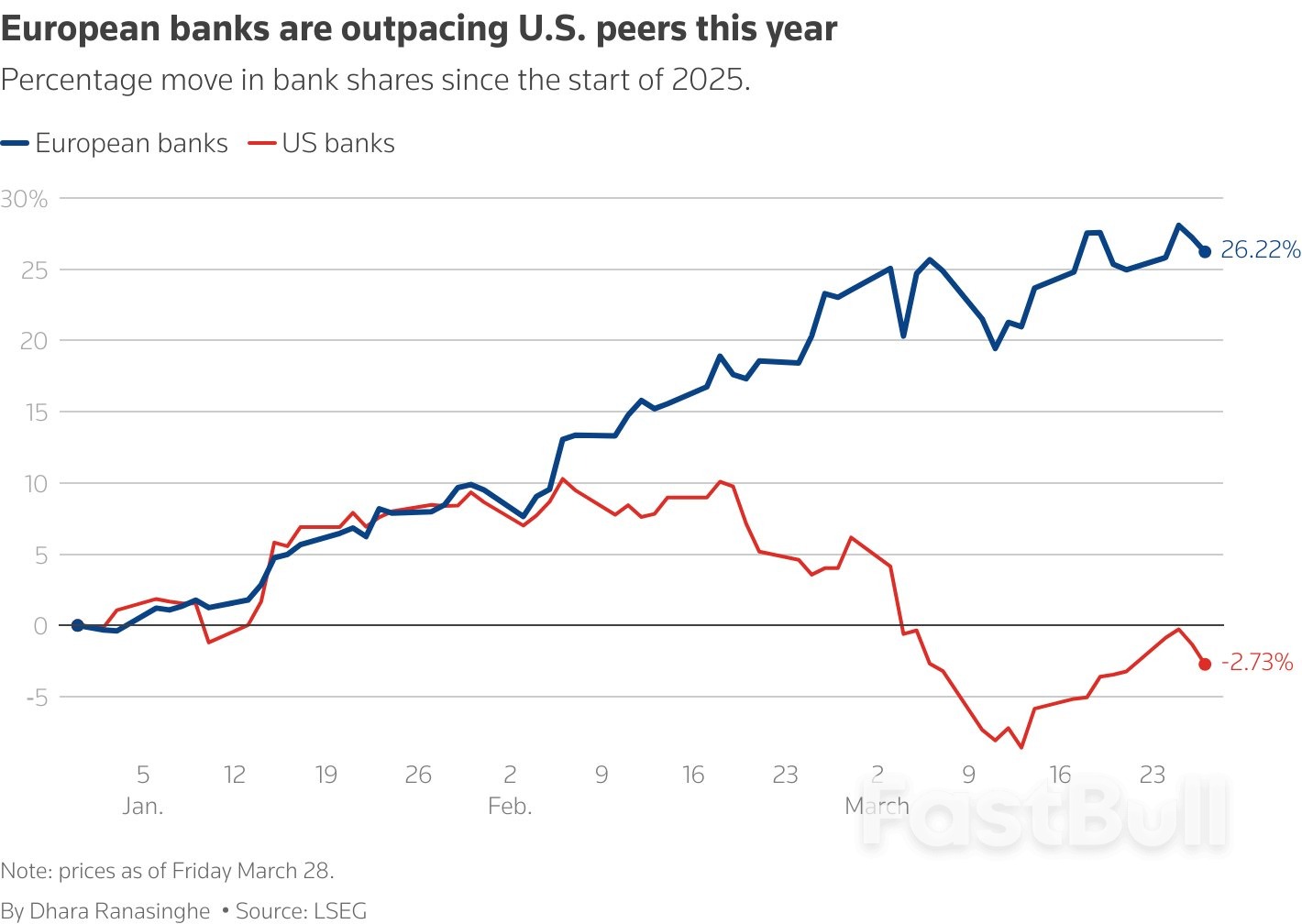
          European banks are popular as the fiscal boost brightens the economic outlook, and have surged 26% year-to-date in their best quarter since 2020.
          Germany's economy should expand roughly 1.4% in 2026 and 2027 after almost four years of stagnation, Berenberg estimates.
          A March BofA fund manager survey showed banks and insurance are the largest sector overweights in Europe, followed by industrials.
          "We're positive on banks as higher growth expectations should steepen the (bond) yield curve, which would benefit banks and really spur credit growth," said GlobalX senior investment analyst Trevor Yates, noting the firm has seen strong interest in its DAX German stocks ETF.
          Investors also expect European regulators will ease rules for banks given a U.S. deregulation drive.
          BlueBay's Dowding said European bank capital bonds were the firm's largest overweight position in multi-asset credit funds.
          "Make Europe Great Again" Trades Are Gaining Traction_4

          Percentage move in bank shares since the start of 2025.

          4/ PERIPHERAL WINS

          Spanish and Italian equities,are significantly cheaper than those in core Europe, says Societe Generale multi-asset strategist Manish Kabra, leaving them poised for gains.
          Southern European stocks are also proportionally less exposed to U.S. tariffs than Germany or France and have a large exposure to banks.
          "There are parallel things going on. One is the German debt brake and for that (mid-cap) MDAX and long euro is your trade, the other is banking regulation, and European nominal GDP growth, both of which impact banks," Kabra said.
          "That is exactly what the periphery of Europe provides."
          "Make Europe Great Again" Trades Are Gaining Traction_5

          Equity markets in Spain and Italy have performed better than German and French peers so far this year.

          5/ RENEWABLE

          Europe's push to become more energy independent, starting in 2022, is expected to continue, with renewable energy and home-based power firms benefiting, analysts said.
          The European Commission has put forward an Action Plan to speed up permits for renewable energy projects, change how energy tariffs are set, and increase state aid for clean industries and more flexible power generation.
          And 100 billion euros of Germany's planned spending increase will be channelled into climate and economic transformation.
          Solar generation provided 11% of the EU electricity mix in 2024, versus 9.3% in 2023, overtaking coal, think tank Ember says.
          European utility firms Iberdola , Endesa and Enel have rallied 7-16% so far this year.

          Source: Reuters

          To stay updated on all economic events of today, please check out our Economic calendar
          Risk Warnings and Disclaimers
          You understand and acknowledge that there is a high degree of risk involved in trading. Following any strategies or investment methods may lead to potential losses. The content on the site is provided by our contributors and analysts for information purposes only. You are solely responsible for determining whether any trading assets, securities, strategy, or any other product is suitable for investing based on your own investment objectives and financial situation.
          Add to Favorites
          Share

          Crude Oil Markets Retreat as Economic Concerns Outweigh Trump’s Tariff Threats

          Warren Takunda

          Economic

          Crude oil futures prices opened higher during Monday’s Asian session following Trump’s threats to impose tariffs on Russia’s oil exports. The US president also said there would be “bombing” and “secondary tariff” on Iran if the country failed to make a nuclear deal.
          The West Texas Intermediate (WTI) and Brent futures both jumped 0.6% at the market open but later retreated as risk-off sentiment prevailed. Concerns over a global economic downturn intensified ahead of Trump’s auto and reciprocal tariffs, which are set to take effect on Wednesday.

          Geopolitical tensions drive oil prices higher

          Oil prices have climbed approximately 5% since mid-March after the US struck Houthis militants, an Iran-backed military group in Yemen. Houthis group had launched attacks on commercial shipping vessels in the Red Sea following Israel’s retaliation against Hamas in Gaza.
          Last week, Trump also threatened to impose 25% tariffs on countries purchasing Venezuela’s oil, expected to take effect on 2 April. His latest comments over the weekend have added further upside pressure on crude prices.
          “If Russia and I are unable to make a deal on stopping the bloodshed in Ukraine, and if I think it was Russia’s fault — which it might not be — but if I think it was Russia’s fault, I am going to put secondary tariffs on oil, on all oil coming out of Russia,” said Trump during a phone interview with NBC News on Sunday, “That would be that if you buy oil from Russia, you can’t do business in the United States…There will be a 25% tariff on all oil, a 25 to 50 point tariff on all oil.”
          In a separate interview on Saturday, Trump threatened “secondary tariffs” and “bombing” on Iran if the country refuses to stop nuclear weapons development. “There will be bombing. It will be bombing the likes of which they have never seen before.”
          “It's totally geopolitical risk. Both actions would impact supply and open up second order effects that could also drive prices higher,” said Kyle Rodda, a senior market analyst at Capital.com Australia.

          OPEC to hike production

          The Organisation of the Petroleum Exporting Countries (OPEC) and allies are set to begin unwinding its voluntary oil production cuts of 2.2 million barrels per day in April. However, Trump’s tariff threats against key OPEC+ members, including Russia, Iran, and Venezuela, may reduce their supplies, effectively offsetting the planned increase in output.
          The OPEC+ is scheduled to hold a meeting on 5 April to discuss future joint output plans. According to Reuters, the group is expected to extend its production hike, raising output by 135,000 barrels per day in May. Meanwhile, some members will be required to reduce supplies to compensate for overproduction compared to their output targets, totalling 4.2 million barrels per day. This suggests that if members fully comply with the plan, the net effect could be an overall reduction in supply rather than an increase. However, analysts at BNP Paribas expect low compliance with the compensation cuts.

          Recession fears weigh on oil demand

          Despite heightened geopolitical risks, economic concerns may overshadow supply-side factors. Trump’s tariff threats on Russia and Iran have raised fears of higher inflation and weaker economic growth, potentially leading to stagflation or even recession, which could dampen oil demand.
          During Monday’s Asian session, equity markets across the region fell as Trump’s auto and reciprocal tariffs are set to take effect this week. Gold prices continued their rally, with both spot and futures prices reaching new highs in early trading. The typical haven currency, the Japanese yen, also strengthened significantly.

          Source: Euronews

          To stay updated on all economic events of today, please check out our Economic calendar
          Risk Warnings and Disclaimers
          You understand and acknowledge that there is a high degree of risk involved in trading. Following any strategies or investment methods may lead to potential losses. The content on the site is provided by our contributors and analysts for information purposes only. You are solely responsible for determining whether any trading assets, securities, strategy, or any other product is suitable for investing based on your own investment objectives and financial situation.
          Add to Favorites
          Share

          Pound-to-Euro Week Ahead: Two-way Risks into 'Liberation Day'

          Warren Takunda

          Economic

          The British Pound has recorded three consecutive weekly advances against the Euro, although upside momentum is soft and prone to mean reversion.
          We saw a good example of such mean reverting tendencies on Friday, when a rally in the Pound-to-Euro exchange rate suddenly turned tail at 1.2025, resulting in a 0.35% daily close.
          So, there is a decent amount of random volatility to watch out for here, even if the general drift of the past couple of weeks has been higher.
          Pound Sterling is well supported against the Euro and we would look for buying support to come in at 1.1943, which is last Wednesday's low.
          To be sure, we are close to this level on Monday amidst soft global equity market conditions that betray a sense of investor uncertainty regarding Wednesday's U.S. tariff announcements.
          Generally, market selloffs weigh on the Pound-Euro exchange rate, which speaks of downside risks heading into Wednesday's tariff event.
          Pound-to-Euro Week Ahead: Two-way Risks into 'Liberation Day'_1

          Above: GBPEUR at daily intervals with annotations.

          Nervousness about the scale and timeline of Trump's proposed tariffs will keep direction relatively random, confirming a distinct lack of conviction as to how the currency market should react to the announcements.
          This will keep GBP/EUR churning around the nine-day exponential moving average (EMA), located at 1.1957.
          The Week Ahead Forecast model looks for the area between 1.1943 and 1.1980 to account for the majority of price action in the first half of the week.
          What happens beyond Wednesday is harder to discern as we have noted the Pound to be something of a hedge to tariff news. Because the UK is perceived to be relatively at little risk to U.S. tariffs, the British Pound has at times found itself well supported around tariff announcements.
          If this is the case this week, then a rally to 1.2025 and even higher would be possible into the weekened.
          But what if markets show some relief on Trump's midweek announcements? For instance, if the announcements aren't as severe as suspected, the Euro could be one of the bigger winners.
          "Sell the rumour, buy the fact" price action is highly likely.
          In this instance, the Euro ends the week stronger, pushing Pound-Euro to 1.1860.
          "One could argue that given the elevated focus on tariffs, anything short of immediate implementation could drive some relief," says Goldman Sachs in a weekly FX briefing.
          Heading into the midweek announcement GBP/EUR momentum is flat with the Relative Strength Index (RSI) at 50, which confirms neither the Euro nor the Pound has the upper hand at present.
          Although we would be inclined to say the first half of the week will see flat trade ahead of Wednesday's announcement, beware of any leaks from the White House.
          The Pound has proven resilient to tariff headlines as the UK is considered relatively immune to tariffs owing to a broadly balanced goods trade.
          Last week's suggestions that VAT tax would not be in scope for reciprocal tariffs also helped the UK currency, as this was a potential weak spot for the UK.
          Downing Street sources have meanwhile said UK negotiators were approaching last-ditch talks to secure a carve-out for Britain with "cool, calm heads", but were prepared to deploy "sharp teeth" if a response were needed.
          Prime Minister Keir Starmer spoke directly to Trump on Sunday.
          Trump is planning to introduce sweeping tariffs on goods from all countries on April 2, which he has called "Liberation Day" for the U.S.
          At the weekend, he confirmed tariffs "on all countries" were proceeding, and commentators said this is why global equity markets are under pressure on Monday.
          However, Trump's comments offer us absolutely no new information, and the market selloff looks to be a positioning adjustment ahead of Wednesday, which makes a post-announcement relief rally all the more likely (GBP/EUR weakness).
          How other countries respond will be important, as this will determine the extent to which the issue evolves into a true trade war.
          The EU will be particularly important in this regard. The EU should "not back down in the face of the USA. Strength and self-confidence are required," said Germany's acting Economy Minister Robert Habeck.
          "The only solution for the European Union will be to raise tariffs on American products in response," French Finance Minister Eric Lombard said.

          Source: Poundsterlinglive

          To stay updated on all economic events of today, please check out our Economic calendar
          Risk Warnings and Disclaimers
          You understand and acknowledge that there is a high degree of risk involved in trading. Following any strategies or investment methods may lead to potential losses. The content on the site is provided by our contributors and analysts for information purposes only. You are solely responsible for determining whether any trading assets, securities, strategy, or any other product is suitable for investing based on your own investment objectives and financial situation.
          Add to Favorites
          Share
          FastBull
          Copyright © 2025 FastBull Ltd

          728 RM B 7/F GEE LOK IND BLDG NO 34 HUNG TO RD KWUN TONG KLN HONG KONG

          TelegramInstagramTwitterfacebooklinkedin
          App Store Google Play Google Play
          Products
          Charts

          Chats

          Q&A with Experts
          Screeners
          Economic Calendar
          Data
          Tools
          Membership
          Features
          Function
          Markets
          Copy Trading
          Latest Signals
          Contests
          News
          Analysis
          24/7
          Columns
          Education
          Company
          Careers
          About Us
          Contact Us
          Advertising
          Help Center
          Feedback
          User Agreement
          Privacy Policy
          Business

          White Label

          Data API

          Web Plug-ins

          Poster Maker

          Affiliate Program

          Risk Disclosure

          The risk of loss in trading financial instruments such as stocks, FX, commodities, futures, bonds, ETFs and crypto can be substantial. You may sustain a total loss of the funds that you deposit with your broker. Therefore, you should carefully consider whether such trading is suitable for you in light of your circumstances and financial resources.

          No decision to invest should be made without thoroughly conducting due diligence by yourself or consulting with your financial advisors. Our web content might not suit you since we don't know your financial conditions and investment needs. Our financial information might have latency or contain inaccuracy, so you should be fully responsible for any of your trading and investment decisions. The company will not be responsible for your capital loss.

          Without getting permission from the website, you are not allowed to copy the website's graphics, texts, or trademarks. Intellectual property rights in the content or data incorporated into this website belong to its providers and exchange merchants.

          Not Logged In

          Log in to access more features

          FastBull Membership

          Not yet

          Purchase

          Become a signal provider
          Help Center
          Customer Service
          Dark Mode
          Price Up/Down Colors

          Log In

          Sign Up

          Position
          Layout
          Fullscreen
          Default to Chart
          The chart page opens by default when you visit fastbull.com