• Trade
  • Markets
  • Copy
  • Contests
  • News
  • 24/7
  • Calendar
  • Q&A
  • Chats
Trending
Screeners
SYMBOL
LAST
BID
ASK
HIGH
LOW
NET CHG.
%CHG.
SPREAD
SPX
S&P 500 Index
6857.13
6857.13
6857.13
6865.94
6827.13
+7.41
+ 0.11%
--
DJI
Dow Jones Industrial Average
47850.93
47850.93
47850.93
48049.72
47692.96
-31.96
-0.07%
--
IXIC
NASDAQ Composite Index
23505.13
23505.13
23505.13
23528.53
23372.33
+51.04
+ 0.22%
--
USDX
US Dollar Index
98.940
99.020
98.940
98.980
98.740
-0.040
-0.04%
--
EURUSD
Euro / US Dollar
1.16484
1.16492
1.16484
1.16715
1.16408
+0.00039
+ 0.03%
--
GBPUSD
Pound Sterling / US Dollar
1.33368
1.33375
1.33368
1.33622
1.33165
+0.00097
+ 0.07%
--
XAUUSD
Gold / US Dollar
4224.61
4225.02
4224.61
4230.62
4194.54
+17.44
+ 0.41%
--
WTI
Light Sweet Crude Oil
59.350
59.380
59.350
59.543
59.187
-0.033
-0.06%
--

Community Accounts

Signal Accounts
--
Profit Accounts
--
Loss Accounts
--
View More

Become a signal provider

Sell trading signals to earn additional income

View More

Guide to Copy Trading

Get started with ease and confidence

View More

Signal Accounts for Members

All Signal Accounts

Best Return
  • Best Return
  • Best P/L
  • Best MDD
Past 1W
  • Past 1W
  • Past 1M
  • Past 1Y

All Contests

  • All
  • Trump Updates
  • Recommend
  • Stocks
  • Cryptocurrencies
  • Central Banks
  • Featured News
Top News Only
Share

Citigroup Expects European Central Bank To Hold Interest Rates At 2.0% At Least Until End-Of-2027 Versus Prior Forecast Of Cuts To 1.5% By March 2026

Share

Japan Economy Minister Kiuchi: Hope Bank Of Japan Guides Appropriate Monetary Policy To Stably Achieve 2% Inflation Target, Working Closely With Government In Line With Principles Stipulated In Government-Bank Of Japan Joint Agreement

Share

Japan Economy Minister Kiuchi: Specific Monetary Policy Means Up To Bank Of Japan To Decide, Government Won't Comment

Share

Japan Economy Minister Kiuchi: Government Will Watch Market Moves With High Sense Of Urgency

Share

Japan Economy Minister Kiuchi: Important For Stock, Forex, Bond Markets To Move Stably Reflecting Fundamentals

Share

Norway Government: Will Order 2 More German-Made Submarines, Taking Total To 6 Submarines, Increasing Planned Spending By Nok 46 Billion

Share

Norway Government: Plans To Buy Long-Range Artillery Weapons For Nok 19 Billion, With Strike Distance Of Up To 500 Km

Share

Japan Economy Minister Kiuchi: Inflationary Impact Of Stimulus Package Likely Limited

Share

BP : BofA Global Research Cuts To Underperform From Neutral, Cuts Price Objective To 375P From 440P

Share

Shell : BofA Global Research Cuts To Neutral From Buy, Cuts Price Objective To 3100P From 3200P

Share

Russia Plans To Supply 5-5.5 Million Tons Of Fertilizers To India In 2025

Share

Euro Zone Q3 Employment Revised To 0.6% Year-On-Year

Share

Rheinmetall Ag : BofA Global Research Cuts Price Objective To EUR 2215 From EUR 2540

Share

China's Commerce Minister: Will Eliminate Restrictive Measures

Share

Russia - India Statement Says Defence Partnership Is Responding To India's Aspirations For Self-Reliance

Share

Russia - India Statement Says Defence Ties Being Reoriented Towards Joint R&D And Production Of Advanced Defence Platforms

Share

Russia And India Express Interest In Deepening Cooperation In Exploration, Processing And Refining Technologies For Critical Minerals And Rare Earth Elements

Share

Eurostat - Euro Zone Q3 Employment +0.6% Year-On-Year (Reuters Poll +0.5%)

Share

Eurostat - Euro Zone Q3 Employment +0.2% Quarter-On-Quarter (Reuters Poll +0.1%)

Share

Indian Rupee At 89.98 Per USA Dollar As Of 3:30 P.M. Ist, Nearly Unchanged Form 89.9750 Previous Close

TIME
ACT
FCST
PREV
U.S. Challenger Job Cuts MoM (Nov)

A:--

F: --

P: --

U.S. Initial Jobless Claims 4-Week Avg. (SA)

A:--

F: --

P: --

U.S. Weekly Initial Jobless Claims (SA)

A:--

F: --

P: --

U.S. Weekly Continued Jobless Claims (SA)

A:--

F: --

P: --

Canada Ivey PMI (SA) (Nov)

A:--

F: --

P: --

Canada Ivey PMI (Not SA) (Nov)

A:--

F: --

P: --

U.S. Non-Defense Capital Durable Goods Orders Revised MoM (Excl. Aircraft) (SA) (Sept)

A:--

F: --

P: --
U.S. Factory Orders MoM (Excl. Transport) (Sept)

A:--

F: --

P: --

U.S. Factory Orders MoM (Sept)

A:--

F: --

P: --

U.S. Factory Orders MoM (Excl. Defense) (Sept)

A:--

F: --

P: --

U.S. EIA Weekly Natural Gas Stocks Change

A:--

F: --

P: --

Saudi Arabia Crude Oil Production

A:--

F: --

P: --

U.S. Weekly Treasuries Held by Foreign Central Banks

A:--

F: --

P: --

Japan Foreign Exchange Reserves (Nov)

A:--

F: --

P: --

India Repo Rate

A:--

F: --

P: --

India Benchmark Interest Rate

A:--

F: --

P: --

India Reverse Repo Rate

A:--

F: --

P: --

India Cash Reserve Ratio

A:--

F: --

P: --

Japan Leading Indicators Prelim (Oct)

A:--

F: --

P: --

U.K. Halifax House Price Index YoY (SA) (Nov)

A:--

F: --

P: --

U.K. Halifax House Price Index MoM (SA) (Nov)

A:--

F: --

P: --

France Current Account (Not SA) (Oct)

A:--

F: --

P: --

France Trade Balance (SA) (Oct)

A:--

F: --

P: --

France Industrial Output MoM (SA) (Oct)

A:--

F: --

P: --

Italy Retail Sales MoM (SA) (Oct)

A:--

F: --

P: --

Euro Zone Employment YoY (SA) (Q3)

A:--

F: --

P: --

Euro Zone GDP Final YoY (Q3)

A:--

F: --

P: --

Euro Zone GDP Final QoQ (Q3)

A:--

F: --

P: --

Euro Zone Employment Final QoQ (SA) (Q3)

A:--

F: --

P: --

Euro Zone Employment Final (SA) (Q3)

A:--

F: --

P: --
Brazil PPI MoM (Oct)

--

F: --

P: --

Mexico Consumer Confidence Index (Nov)

--

F: --

P: --

Canada Unemployment Rate (SA) (Nov)

--

F: --

P: --

Canada Labor Force Participation Rate (SA) (Nov)

--

F: --

P: --

Canada Employment (SA) (Nov)

--

F: --

P: --

Canada Part-Time Employment (SA) (Nov)

--

F: --

P: --

Canada Full-time Employment (SA) (Nov)

--

F: --

P: --

U.S. Personal Income MoM (Sept)

--

F: --

P: --

U.S. Dallas Fed PCE Price Index YoY (Sept)

--

F: --

P: --

U.S. PCE Price Index YoY (SA) (Sept)

--

F: --

P: --

U.S. PCE Price Index MoM (Sept)

--

F: --

P: --

U.S. Personal Outlays MoM (SA) (Sept)

--

F: --

P: --

U.S. Core PCE Price Index MoM (Sept)

--

F: --

P: --

U.S. UMich 5-Year-Ahead Inflation Expectations Prelim YoY (Dec)

--

F: --

P: --

U.S. Core PCE Price Index YoY (Sept)

--

F: --

P: --

U.S. Real Personal Consumption Expenditures MoM (Sept)

--

F: --

P: --

U.S. 5-10 Year-Ahead Inflation Expectations (Dec)

--

F: --

P: --

U.S. UMich Current Economic Conditions Index Prelim (Dec)

--

F: --

P: --

U.S. UMich Consumer Sentiment Index Prelim (Dec)

--

F: --

P: --

U.S. UMich 1-Year-Ahead Inflation Expectations Prelim (Dec)

--

F: --

P: --

U.S. UMich Consumer Expectations Index Prelim (Dec)

--

F: --

P: --

U.S. Weekly Total Rig Count

--

F: --

P: --

U.S. Weekly Total Oil Rig Count

--

F: --

P: --

U.S. Consumer Credit (SA) (Oct)

--

F: --

P: --

China, Mainland Foreign Exchange Reserves (Nov)

--

F: --

P: --

China, Mainland Exports YoY (USD) (Nov)

--

F: --

P: --

Q&A with Experts
    • All
    • Chatrooms
    • Groups
    • Friends
    Connecting
    .
    .
    .
    Type here...
    Add Symbol or Code

      No matching data

      All
      Trump Updates
      Recommend
      Stocks
      Cryptocurrencies
      Central Banks
      Featured News
      • All
      • Russia-Ukraine Conflict
      • Middle East Flashpoint
      • All
      • Russia-Ukraine Conflict
      • Middle East Flashpoint
      Search
      Products

      Charts Free Forever

      Chats Q&A with Experts
      Screeners Economic Calendar Data Tools
      Membership Features
      Data Warehouse Market Trends Institutional Data Policy Rates Macro

      Market Trends

      Market Sentiment Order Book Forex Correlations

      Top Indicators

      Charts Free Forever
      Markets

      News

      News Analysis 24/7 Columns Education
      From Institutions From Analysts
      Topics Columnists

      Latest Views

      Latest Views

      Trending Topics

      Top Columnists

      Latest Update

      Signals

      Copy Rankings Latest Signals Become a signal provider AI Rating
      Contests
      Brokers

      Overview Brokers Assessment Rankings Regulators News Claims
      Broker listing Forex Brokers Comparison Tool Live Spread Comparison Scam
      Q&A Complaint Scam Alert Videos Tips to Detect Scam
      More

      Business
      Events
      Careers About Us Advertising Help Center

      White Label

      Data API

      Web Plug-ins

      Affiliate Program

      Awards Institution Evaluation IB Seminar Salon Event Exhibition
      Vietnam Thailand Singapore Dubai
      Fans Party Investment Sharing Session
      FastBull Summit BrokersView Expo
      Recent Searches
        Top Searches
          Markets
          News
          Analysis
          User
          24/7
          Economic Calendar
          Education
          Data
          • Names
          • Latest
          • Prev

          View All

          No data

          Scan to Download

          Faster Charts, Chat Faster!

          Download App
          English
          • English
          • Español
          • العربية
          • Bahasa Indonesia
          • Bahasa Melayu
          • Tiếng Việt
          • ภาษาไทย
          • Français
          • Italiano
          • Türkçe
          • Русский язык
          • 简中
          • 繁中
          Open Account
          Search
          Products
          Charts Free Forever
          Markets
          News
          Signals

          Copy Rankings Latest Signals Become a signal provider AI Rating
          Contests
          Brokers

          Overview Brokers Assessment Rankings Regulators News Claims
          Broker listing Forex Brokers Comparison Tool Live Spread Comparison Scam
          Q&A Complaint Scam Alert Videos Tips to Detect Scam
          More

          Business
          Events
          Careers About Us Advertising Help Center

          White Label

          Data API

          Web Plug-ins

          Affiliate Program

          Awards Institution Evaluation IB Seminar Salon Event Exhibition
          Vietnam Thailand Singapore Dubai
          Fans Party Investment Sharing Session
          FastBull Summit BrokersView Expo

          Gold Rises as Geopolitical Worries, a Weaker USD, and Fed Rate Cut Predictions Support Prices

          Balogun Opeyemi

          Commodity

          Summary:

          Gold (XAU/USD) remains resilient above the $4,200 level, supported by dovish Fed expectations, persistent geopolitical risks, and a weaker U.S. dollar. With markets pricing in two additional Fed rate cuts this year, investors continue to favor gold as a safe-haven asset amid rising uncertainty.
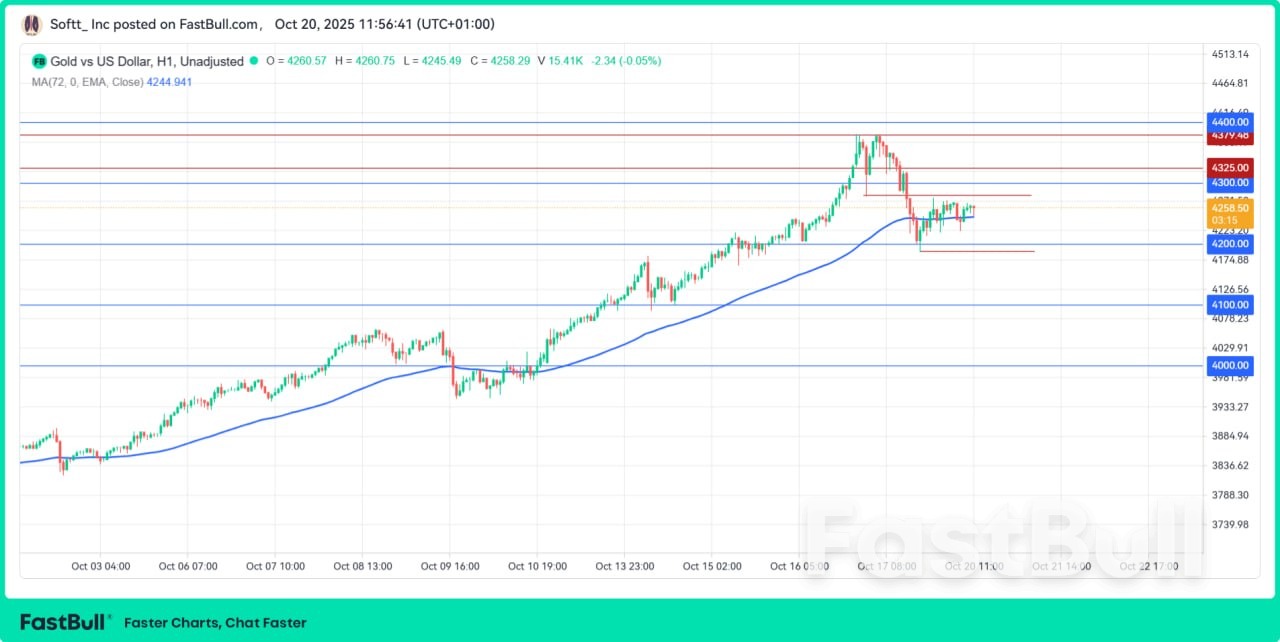
          Gold (XAU/USD) held firm above the $4,200 mark in the early European session on Monday, stabilizing after Friday’s record-breaking surge to $4,380. The precious metal remains underpinned by a combination of dovish Federal Reserve expectations, persistent geopolitical tensions, and renewed safe-haven flows amid mounting fiscal and political uncertainty in major economies.
          Market sentiment continues to favor bullion as investors increasingly price in two more rate cuts by the Fed before year-end. The latest U.S. economic data, including softer labor market indicators and moderating inflation, have reinforced the view that the Fed’s tightening cycle has peaked. Fed officials’ cautious tone in recent speeches further supports the notion that monetary easing could begin as early as September, weighing heavily on U.S. Treasury yields and the dollar.
          The U.S. Dollar Index (DXY) remains subdued despite intermittent recoveries, as global investors diversify away from the greenback. Concurrently, central banks particularly from emerging markets have sustained their gold accumulation as a hedge against currency debasement and geopolitical fragmentation. This structural demand underpins the long-term bullish narrative for gold.
          Meanwhile, global tensions ranging from escalating Middle East conflicts to U.S. China trade uncertainties continue to add to gold’s appeal as a strategic hedge. Although U.S. President Donald Trump’s recent remarks aimed at easing trade war fears offered short-term relief, traders remain cautious amid fragile diplomatic dynamics and ongoing supply chain disruptions.

          Technical Outlook: Gold Eyes $4,325–$4,380 Resistance Zone

          Gold Rises as Geopolitical Worries, a Weaker USD, and Fed Rate Cut Predictions Support Prices_1
          From a technical perspective, XAU/USD shows resilience above the $4,210–$4,200 support zone, signaling that buyers are defending key levels. The next resistance is seen near $4,280, and a sustained move above this area could open the door for a test of the $4,325 horizontal barrier. A break higher would likely encourage bulls to challenge the record peak around $4,379–$4,380.
          On the downside, immediate support lies at $4,219–$4,218, followed by the $4,200 psychological mark. Further weakness below this zone could expose Friday’s swing low at $4,186, and then the $4,163–$4,162 region, where stronger buying interest may emerge. A decisive break below this level, however, could trigger a deeper pullback toward the $4,100 handle.
          Risk Warnings and Disclaimers
          You understand and acknowledge that there is a high degree of risk involved in trading. Following any strategies or investment methods may lead to potential losses. The content on the site is provided by our contributors and analysts for information purposes only. You are solely responsible for determining whether any trading assets, securities, strategy, or any other product is suitable for investing based on your own investment objectives and financial situation.
          Add to Favorites
          Share

          Europe Lags As US IPO Activity Takes Off

          Samantha Luan

          Economic

          Stocks

          Forex

          Insurance IPO activity in 2025 has shown stark regional contrasts. While the U.S. has seen a surge in activity as tech-driven insurers capture investors' attention, activity in the UK and Europe has been subdued amid liquidity shortages and valuation hurdles.In the U.S., Neptune Insurance's $3.1 billion debut, Slide Insurance's $2.6 billion listing and HCI Group's Exzeo Group, which is targeting a valuation of up to $2 billion in its U.S. IPO, are among examples that have shown heightened investor appetite for profitable business in the insurance space.

          Cristiano Dalla Bona, co-head of U.S. equity capital markets at Mergermarket, said this latest wave of U.S. insurance IPOs is differentiated by "the breadth of business models coming to market, with a focus on insurtech offerings".Dalla Bona highlighted that while some insurance platforms carry significant underwriting exposure, others – particularly MGA and broker-driven businesses – are asset-light.He noted: "The broker model is especially attractive because it doesn't require holding underwriting risk, operates with light capital intensity and remains a deeply fragmented sector, offering ample opportunities for growth through consolidation."

          The U.S. market benefits from a deep, insurance-savvy investor base in New York, a regulatory environment supportive of public offerings and a valuation premium that has grown in the aftermath of the COVID-19 pandemic.

          EUROPE AND LONDON IPO ACTIVITY LAGS

          By contrast, IPO activity across Europe and London remains subdued in 2025.The London Stock Exchange saw only nine new listings in the first half of this year, none of which were in the insurance space.Market uncertainty, geopolitical tensions and macroeconomic challenges have dampened investor appetite and delayed many IPO plans. Some hoped-for European insurance IPO activity failed to materialise.Inigo, once considered a strong IPO candidate, opted for acquisition rather than going public. Similarly, Centerbridge Partners-led Canopius withdrew its IPO plans earlier this year.

          Aspen Insurance, closely linked to the London market, chose to list in New York instead, seeking higher valuations and more favorable conditions in the U.S. market, and has since agreed to be acquired by Sompo in a $3.5 billion deal pending regulatory approvals.Despite these headwinds, analysts remain cautiously optimistic about a likely rebound in activity in Europe in the months to come, fuelled by regulatory reforms and renewed M&A activity. Nevertheless, the environment remains risk-averse and focused on profitability and resilience.

          Erickson Davis, head of European equities, KBW, said: “In general, across sector, EU and UK IPO activity has been subdued versus US activity levels.” He pointed to liquidity differentials: “Liquidity profiles of listing venues is a major factor in this, particularly in insurance where there is often an international business mix or distribution profile to the company which enables more flexibility in an IPO listing decision.”This dynamic is evident in insurer valuations. More liquid U.S.-listed stocks which have offered a way to play a hard market have been easier investments for global fund managers than less liquid UK or EU alternatives. Davis added: "We find the relative valuation multiples on several UK and EU-listed insurers too cheap to ignore, particularly as capital return dynamics play out.”

          The post-pandemic era has also shifted valuation premiums. “It’s also noteworthy that in the post-COVID era, a valuation premium for U.S.-listed insurers has emerged. This is most pronounced in the reinsurance space when looking at Bermudians vs Lloyd’s stocks,” Davis said.London’s challenges are heightened by Brexit-related market access issues and macroeconomic headwinds, according to Lukas Muehlbauer, research associate and Europe director, IPOx.

          “(The) UK’s new listing rules to simplify requirements and attract more companies are a step in the right direction,” Muehlbauer, said. He added that “sizeable European IPO candidates have opted for sales rather than listings”.U.S. mortgage insurer Radian's $1.7 billion acquisition of UK-based Inigo is one such example, which “removed another potential IPO candidate from an already thin roster of prospective London floats”, according to Muehlbauer.

          REGULATORY AND STRUCTURAL CHALLENGES

          Against that backdrop, Allianz CEO Oliver Bäte acknowledged the pull of deeper U.S. markets. “For Europe's largest insurer, it would currently be a rational decision to move to the New York Stock Exchange,” he said at the Bundesbank's Financial Center Conference in Frankfurt in September.A 2024 report by former European Central Bank president Mario Draghi on European competitiveness shed light on these structural challenges, emphasizing that “capital markets in Europe remain fragmented”.

          This fragmentation leads to “higher compliance costs and inefficiencies,” which weigh heavily on companies seeking to list in Europe, the report stated.Draghi and Bäte’s observations underscore the tough structural situation for European insurers, who face weaker liquidity and limited capital market support compared to their U.S. peers.Elaborating on the scope of dual listings, Fitch senior director Gerald Glombicki said: "There’s not many companies that do that because it’s pretty expensive and there’s a lot of regulatory burdens to it, and some who do, don't get the benefit of being dual listed.”

          Meanwhile, IPOx’s Muehlbauer highlighted the limitations in crossing markets. “Some European insurers may look at a U.S. dual listing to reach a larger pool of investors, yet they may also have to factor in higher underwriting fees on average and greater litigation exposure in the U.S., so it isn’t an automatic choice," he said.

          Source: TradingView

          To stay updated on all economic events of today, please check out our Economic calendar
          Risk Warnings and Disclaimers
          You understand and acknowledge that there is a high degree of risk involved in trading. Following any strategies or investment methods may lead to potential losses. The content on the site is provided by our contributors and analysts for information purposes only. You are solely responsible for determining whether any trading assets, securities, strategy, or any other product is suitable for investing based on your own investment objectives and financial situation.
          Add to Favorites
          Share

          China Charts Course for The Next Five Years

          Michelle

          Economic

          Forex

          Amid a backdrop of slowing growth and rising trade tensions, China’s leaders gathered in Beijing to sketch out policies for the next five years. Problem is, it’s hard enough to navigate the next five days right now as US President Donald Trump ratchets up the tariff pressure.

          Speaking from Air Force One on Sunday, Trump listed rare earths, fentanyl and soybeans as the US’s top issues with China just before the two sides return to the negotiating table and as a fragile trade truce nears expiration. Days earlier, the US leader threatened a 100% tariff on Chinese shipments after Beijing vowed to exert broad controls on the minerals.

          While President Xi Jinping and his officials have become accustomed to dealing with Trump’s threats, shrugging off the first trade war and keeping the export engines humming through the second take so far, the tariff uncertainty can only complicate their planning.

          Chang Shu, Eric Zhu and David Qu of Bloomberg Economics expect a more balanced approach among growth, equity, and security, reflecting a deeper understanding of how these goals reinforce each other.

          “This trinity of priorities could mark a shift from the growth-at-all-costs model in the older plans and the heavier emphasis on equity and security in the past two,” they wrote. As for trade, Beijing “will likely signal a shift from a long-held mercantilist approach to a more two-way opening with diversified global engagement.”

          But that’s not to say growth — which came in at the weakest pace in a year during the third quarter — will no longer be a priority.

          Standard Chartered’s China economists Shuang Ding and Hunter Chan say recent deliberations in policy circles indicate that average growth of 4.7-4.8% is desired for 2026-30, to pave way for a doubling of 2020 GDP by 2035.

          To pull that off, Beijing will aim to boost productivity amid an aging population and technology restrictions from the West, they say. Specific policy proposals over the period could center around:

          The authorities may see the next five years as a good window to promote the use of Renminbi in international trade and investment, they said.

          Macquarie’s China economist Larry Hu expects a three-prong approach will underpin policy in the next five years:

          “To achieve the growth target, Beijing will have no choice but to boost domestic demand,” Hu said. “For investors, it's the single most important thing to watch, although the timing is less determined by the 5-Year Plan made in Beijing, and more by policies made in Washington.”

          After being delayed by the US government shutdown, the Bureau of Labor Statistics will release of the September consumer price index on Friday. The data, originally slated for Oct. 15, will give Federal Reserve officials a critical piece of information on inflation ahead of their policy meeting the following week.

          Elsewhere, inflation data from Japan to the UK, purchasing manager indexes from major economies, and the first summary of a meeting by Swiss central bank officials will be among the highlights.

          Source: Bloomberg Europe

          To stay updated on all economic events of today, please check out our Economic calendar
          Risk Warnings and Disclaimers
          You understand and acknowledge that there is a high degree of risk involved in trading. Following any strategies or investment methods may lead to potential losses. The content on the site is provided by our contributors and analysts for information purposes only. You are solely responsible for determining whether any trading assets, securities, strategy, or any other product is suitable for investing based on your own investment objectives and financial situation.
          Add to Favorites
          Share

          Oil Prices Could Fall Another 15% By The End of The Year

          FxPro

          Economic

          Commodity

          Crude oil prices fell 0.7% on Monday after three consecutive weeks of decline. Global production is growing while global economic growth is slowing, putting pressure on prices. In addition, the risk premium on signing the gas agreement and intensifying efforts to resolve the Ukrainian conflict has begun to decline. At the same time, oil prices are far from oversold, leaving room for further decline in the coming months.

          Baker Hughes reported on Friday that 418 oil rigs are operating in the US, the same as a week earlier, undermining the recovery trend seen since August. However, America is increasing production efficiency, extracting more oil from each well.

          Bloomberg noted that there are now nearly 1.2 billion barrels of oil at sea, a record since the peak in 2020, when US production was at historic highs and Saudi Arabia and Russia were fighting for market share, boasting of their potential.

          The current situation strongly resonates with what happened more than five years ago. The latest weekly data showed a record high in daily production in the US, with supplies of 13.64 million barrels per day.

          Inventory figures are a stabilising factor. Commercial inventories in the US are at the lower end of the range for the last decade, but they were about the same in January 2020, and six months later, this figure set a new record. However, without a collapse in consumption, such rapid growth should not be expected. The US government may also move to more actively rebuild the strategic petroleum reserve sold off in 2022.

          The price of oil has been in a downward channel for just over three years, and at the end of September, it accelerated its decline as it approached the 50-week moving average and the upper limit of the range. The lower limit of this range is now close to $53 per barrel of Brent, with a decline towards the end of the year closer to $50.50 against the current $61.00.

          The main scenario for oil is a decline towards $50 in the next 2-4 months. At the same time, the potential for an increase in US inventories is a potential stabilising factor. We assume that the situation with inventories is roughly similar worldwide, excluding the abundance of oil at sea.

          Source: FxPro

          To stay updated on all economic events of today, please check out our Economic calendar
          Risk Warnings and Disclaimers
          You understand and acknowledge that there is a high degree of risk involved in trading. Following any strategies or investment methods may lead to potential losses. The content on the site is provided by our contributors and analysts for information purposes only. You are solely responsible for determining whether any trading assets, securities, strategy, or any other product is suitable for investing based on your own investment objectives and financial situation.
          Add to Favorites
          Share

          How Does the Stock Market Work? Inside the Mechanics of Trading, Prices, and Investor Behavior

          Winkelmann

          Stocks

          How Does the Stock Market Work in 2025? Key Principles and Market Insights

          The stock market plays a central role in the global economy, allowing investors and companies to trade ownership and raise capital. This article explains how the stock market works, what drives prices, and how investors can participate responsibly.

          Part 1 — Understanding the Basics of the Stock Market

          The stock market is a network of exchanges where shares of publicly listed companies are bought and sold. When investors purchase a company’s stock, they acquire partial ownership and a claim on its future profits. Prices move constantly as buyers and sellers react to news, earnings reports, and economic data.

          Major exchanges include the New York Stock Exchange (NYSE) and the Nasdaq. Each operates under strict regulations to ensure transparency, fair pricing, and investor protection. The market serves two core purposes: helping companies raise capital and giving investors opportunities to grow wealth.

          Part 2 — How the Stock Market Operates

          1. Primary Market: Where Shares Are First Issued

          When a company goes public through an Initial Public Offering (IPO), it sells shares directly to investors for the first time. The funds raised help finance expansion, research, or debt repayment.

          2. Secondary Market: Everyday Buying and Selling

          After the IPO, shares trade on the secondary market between investors. Prices fluctuate based on supply and demand—when more investors want to buy than sell, prices rise, and vice versa.

          3. Market Participants

          • Retail investors — individuals buying and selling for personal portfolios.
          • Institutional investors — large entities like pension funds or mutual funds managing billions in assets.
          • Market makers — firms that provide liquidity by continuously quoting buy and sell prices.
          • Regulators — agencies like the SEC ensure compliance and protect investors from fraud.

          Part 3 — What Determines Stock Prices

          Stock prices reflect investors’ collective expectations about a company’s future performance. Several factors influence these movements:

          • Earnings reports: Profitability and revenue growth directly affect valuation.
          • Economic indicators: Inflation, GDP, and interest rates shape overall sentiment.
          • Market psychology: Fear, optimism, and herd behavior can exaggerate price swings.
          • Global events: Geopolitical tensions, policy changes, or major innovations shift risk appetite.

          In the short term, markets can be volatile. But over time, stock prices tend to follow corporate fundamentals and economic trends.

          Part 4 — How Investors Make Money in the Stock Market

          Investors can earn returns in two main ways:

          • Capital gains: Selling a stock at a higher price than the purchase cost.
          • Dividends: Periodic payments companies distribute from their profits.

          Long-term investors often focus on compounding growth by reinvesting dividends and holding through market cycles. Short-term traders, in contrast, aim to profit from daily price movements.

          Part 5 — Risks and How to Invest Wisely

          All investments carry risk. Market downturns, poor corporate performance, or global crises can reduce portfolio value. To manage risk:

          • Diversify across sectors and asset classes.
          • Invest regularly rather than trying to time the market.
          • Research companies and understand what you own.
          • Maintain a long-term mindset focused on goals, not short-term noise.

          Modern investors also use index funds and ETFs to gain broad exposure while minimizing fees and individual stock risk.

          Conclusion — How the Stock Market Works

          The stock market functions as a global exchange connecting companies seeking capital with investors pursuing growth. Prices move based on fundamentals, sentiment, and macroeconomic forces. Understanding these mechanisms helps investors participate more confidently and make informed, disciplined decisions for the long term.

          Risk Warnings and Disclaimers
          You understand and acknowledge that there is a high degree of risk involved in trading. Following any strategies or investment methods may lead to potential losses. The content on the site is provided by our contributors and analysts for information purposes only. You are solely responsible for determining whether any trading assets, securities, strategy, or any other product is suitable for investing based on your own investment objectives and financial situation.
          Add to Favorites
          Share

          Germany's Merz Calls For A "Wall Street" For Europe

          Samantha Luan

          Forex

          Political

          Economic

          In the German Bundestag, Friedrich Merz appealed to the EU to integrate the fragmented European capital market more deeply and reduce bureaucratic hurdles. His vision for the next step: a kind of Wall Street for Europe.German Chancellor Friedrich Merz used his government statement on Thursday to take a strategic look at what he called the “fragmented and over-bureaucratized” European stock and capital market landscape. His stated goal: the completion of the Capital Markets Union.“We need a kind of European Stock Exchange, so that successful companies like BionTech from Germany don’t have to go to the New York Stock Exchange,” Merz said. “Our companies need a sufficiently broad and deep capital market to fund themselves faster and more efficiently.”

          Keeping Value Creation in Europe

          The Chancellor linked this call to a strong appeal to the European Commission for consistent de-bureaucratization of the fragmented European capital market. Only in this way, he stressed, will the value created from German and European research truly remain in Europe. Only then can societal wealth grow via the capital market, Merz argued.The debate is fueled by the growing trend of European innovative companies raising capital on U.S. exchanges. Recent examples include Linde, Birkenstock Holding, and BioNTech – firms that chose Wall Street listings over domestic options.

          This discussion fits into a broader financial context: the integration of European financial and capital markets. A far-reaching harmonization of financial hubs and access to capital would not be a mistake. Currently, there are around 15 securities exchanges in the Eurozone. The two largest operators – Euronext N.V. and Deutsche Börse AG – together handle about 80 percent of the annual €8 trillion equity trading volume.

          Ending Capital Flight

          Merz’ initiative stands not only for institutional reform but also as an attempt to free Europe’s financial markets from self-imposed regulatory constraints.The Chancellor emphasized the importance of better financing for innovative startups in high-tech future industries. Experience shows, however, that these companies tend to rely on venture capital – and they have no difficulty listing on international exchanges like Frankfurt or London.

          The real question for Brussels and Berlin is whether focusing on a new financial hub alone is enough to prevent visible capital flows from Europe to the United States.Germany alone lost around €64.5 billion last year due to capital flight – a symptom of deeper issues: an overbearing regulatory framework from Brussels and EU capitals, excessive fiscal burdens, and an escalating energy cost crisis.

          The Real Target

          These are fundamental economic imbalances that cannot be resolved simply by creating a European mega-exchange. They are homegrown design flaws – at the heart of today’s economic crisis.In reality, the debate over the Capital Markets Union is about something else entirely: the European Commission’s strategic goal to consolidate member state debt under its roof. This would give Brussels greater financial clout through regular EU bond issuances. More centralization in Brussels, less national oversight – the dream of the Brussels power center.

          The EU is gradually moving toward a paradigm shift in debt financing. Originally, the Commission was strictly prohibited from financing itself via market issuances. That red line has long been crossed.The COVID lockdowns provided a lever to launch NextGenerationEU, an unprecedented €800 billion debt program. This money largely financed national deficits, with the Commission acting as a market borrower, backed by the European Central Bank.

          Brussels Is Already Active in the Market

          It is no secret that Brussels wants to expand this model. The Ukraine conflict serves as a convenient pretext to issue new joint debt under the media-amplified threat of Russian aggression. Chancellor Merz has already indicated this spring that EU-wide borrowing for defense purposes is not off the table – but only for “absolute exceptional cases.”

          Merz deliberately avoided the term “Eurobonds,” just like Ursula von der Leyen, who in her State of the Union speech on September 10 circumnavigated the term, instead proposing a common European budget for “European goods.”The signal is clear: we are in a transitional phase where old debt rules are being gradually loosened, and the centralization of debt issuance in Brussels is systematically advanced.

          Euroclear as an Anchor

          This aligns seamlessly with thinking about a shared European exchange – potentially hosted by Euroclear in Brussels, the central player in the safekeeping and settlement of Eurozone securities. A serious move would also consider relocating the European Central Bank to Brussels for fast debt issuance.The EU’s response to the looming debt crisis is obvious: a much higher degree of centralization. Activating capital that can be leveraged to expand debt becomes strategic; the exchange consolidation is just a secondary concern.

          This also ties into the debate over using frozen Russian assets at Euroclear. The goal: collateralize a portfolio worth around €200 billion, largely expired European sovereign bonds, to finance reparations loans to Ukraine. Brussels is searching for credit collateral, regardless of origin.

          Source: Zero Hedge

          To stay updated on all economic events of today, please check out our Economic calendar
          Risk Warnings and Disclaimers
          You understand and acknowledge that there is a high degree of risk involved in trading. Following any strategies or investment methods may lead to potential losses. The content on the site is provided by our contributors and analysts for information purposes only. You are solely responsible for determining whether any trading assets, securities, strategy, or any other product is suitable for investing based on your own investment objectives and financial situation.
          Add to Favorites
          Share

          Why Did the Stock Market Drop? Main Reasons, Reactions, and What Comes Next (2025 Update)

          Winkelmann

          Stocks

          Why Did the Stock Market Drop? Analyzing the Causes and Investor Reactions in 2025

          In 2025, global markets experienced a notable decline that raised concerns among investors. This article explores the main reasons behind the stock market drop—from economic pressures to investor sentiment shifts—and examines what these developments could mean for the future.

          Part 1 — Overview: What Happened in the Stock Market

          The first quarter of 2025 saw sharp declines across major indices. The S&P 500 dropped nearly 8%, the Nasdaq lost around 10%, and the Dow Jones slipped by 6%. These movements reflected a combination of macroeconomic uncertainty, rising rates, and profit-taking after a strong 2024 rally.

          Analysts noted that while the drop was significant, it resembled a market correction rather than a long-term crash. The pullback was fueled by valuation adjustments and investor caution toward sectors with stretched earnings multiples.

          Part 2 — Key Reasons Why the Stock Market Dropped

          1. Rising Interest Rates and Inflation Pressure

          Central banks continued tightening monetary policy to combat persistent inflation. Higher borrowing costs reduced corporate profits and made equities less appealing compared to bonds. Growth stocks, particularly in technology, were hit hardest as future earnings were discounted more aggressively.

          2. Slowing Economic Growth and Recession Fears

          Global manufacturing and consumer spending data began to soften. Economists warned of potential stagflation, where growth slows while prices remain high. This combination eroded confidence and led investors to rebalance toward defensive sectors like healthcare and utilities.

          3. Corporate Earnings Disappointments

          Several major companies reported weaker-than-expected earnings. Profit margins compressed due to higher input costs and sluggish demand. Disappointing forecasts from technology and retail firms triggered broad-based selling across related sectors.

          4. Geopolitical and Policy Uncertainty

          Ongoing geopolitical tensions, trade disputes, and policy changes amplified volatility. Energy prices spiked after new supply disruptions, while investor sentiment turned risk-averse amid uncertainty around global alliances and fiscal debates.

          5. Sector Rotation and Valuation Correction

          After two years of strong gains in AI, semiconductor, and fintech stocks, valuations reached unsustainable levels. Institutional investors began rotating into lower-risk assets, sparking a wave of profit-taking that accelerated the overall market decline.

          Part 3 — Market and Investor Reactions

          Investor behavior shifted rapidly during the selloff. Volatility indexes such as the VIX surged, and trading volumes spiked as hedge funds unwound leveraged positions. At the same time, demand for safe-haven assets like gold, Treasury bonds, and the U.S. dollar increased sharply.

          Despite short-term losses, many analysts viewed the correction as a healthy reset. The market had grown overly concentrated in high-valuation stocks, and a pullback was seen as necessary for long-term stability.

          Part 4 — What It Means for Investors

          • Stay diversified: Avoid overexposure to single sectors or regions.
          • Focus on fundamentals: Favor companies with stable cash flow, low debt, and pricing power.
          • Embrace defensive positioning: Allocate to assets less sensitive to economic cycles.
          • Think long term: Corrections often create attractive entry points for disciplined investors.

          Investors who maintain perspective and avoid panic selling are more likely to benefit when market sentiment eventually improves.

          Conclusion — Why the Stock Market Dropped

          The stock market’s decline in 2025 was driven by a mix of rising interest rates, slowing growth, and valuation corrections after years of strong gains. While unsettling, the drop reflected a natural adjustment to shifting economic conditions rather than a systemic failure. Understanding these dynamics helps investors make informed decisions and prepare for the market’s eventual recovery.

          Risk Warnings and Disclaimers
          You understand and acknowledge that there is a high degree of risk involved in trading. Following any strategies or investment methods may lead to potential losses. The content on the site is provided by our contributors and analysts for information purposes only. You are solely responsible for determining whether any trading assets, securities, strategy, or any other product is suitable for investing based on your own investment objectives and financial situation.
          Add to Favorites
          Share
          FastBull
          Copyright © 2025 FastBull Ltd

          728 RM B 7/F GEE LOK IND BLDG NO 34 HUNG TO RD KWUN TONG KLN HONG KONG

          TelegramInstagramTwitterfacebooklinkedin
          App Store Google Play Google Play
          Products
          Charts

          Chats

          Q&A with Experts
          Screeners
          Economic Calendar
          Data
          Tools
          Membership
          Features
          Function
          Markets
          Copy Trading
          Latest Signals
          Contests
          News
          Analysis
          24/7
          Columns
          Education
          Company
          Careers
          About Us
          Contact Us
          Advertising
          Help Center
          Feedback
          User Agreement
          Privacy Policy
          Business

          White Label

          Data API

          Web Plug-ins

          Poster Maker

          Affiliate Program

          Risk Disclosure

          The risk of loss in trading financial instruments such as stocks, FX, commodities, futures, bonds, ETFs and crypto can be substantial. You may sustain a total loss of the funds that you deposit with your broker. Therefore, you should carefully consider whether such trading is suitable for you in light of your circumstances and financial resources.

          No decision to invest should be made without thoroughly conducting due diligence by yourself or consulting with your financial advisors. Our web content might not suit you since we don't know your financial conditions and investment needs. Our financial information might have latency or contain inaccuracy, so you should be fully responsible for any of your trading and investment decisions. The company will not be responsible for your capital loss.

          Without getting permission from the website, you are not allowed to copy the website's graphics, texts, or trademarks. Intellectual property rights in the content or data incorporated into this website belong to its providers and exchange merchants.

          Not Logged In

          Log in to access more features

          FastBull Membership

          Not yet

          Purchase

          Become a signal provider
          Help Center
          Customer Service
          Dark Mode
          Price Up/Down Colors

          Log In

          Sign Up

          Position
          Layout
          Fullscreen
          Default to Chart
          The chart page opens by default when you visit fastbull.com