Markets
News
Analysis
User
24/7
Economic Calendar
Education
Data
- Names
- Latest
- Prev


Signal Accounts for Members
All Signal Accounts
All Contests


France Trade Balance (SA) (Oct)A:--
F: --
Euro Zone Employment YoY (SA) (Q3)A:--
F: --
Canada Part-Time Employment (SA) (Nov)A:--
F: --
P: --
Canada Unemployment Rate (SA) (Nov)A:--
F: --
P: --
Canada Full-time Employment (SA) (Nov)A:--
F: --
P: --
Canada Labor Force Participation Rate (SA) (Nov)A:--
F: --
P: --
Canada Employment (SA) (Nov)A:--
F: --
P: --
U.S. PCE Price Index MoM (Sept)A:--
F: --
P: --
U.S. Personal Income MoM (Sept)A:--
F: --
P: --
U.S. Core PCE Price Index MoM (Sept)A:--
F: --
P: --
U.S. PCE Price Index YoY (SA) (Sept)A:--
F: --
P: --
U.S. Core PCE Price Index YoY (Sept)A:--
F: --
P: --
U.S. Personal Outlays MoM (SA) (Sept)A:--
F: --
U.S. 5-10 Year-Ahead Inflation Expectations (Dec)A:--
F: --
P: --
U.S. Real Personal Consumption Expenditures MoM (Sept)A:--
F: --
U.S. Weekly Total Rig CountA:--
F: --
P: --
U.S. Weekly Total Oil Rig CountA:--
F: --
P: --
U.S. Consumer Credit (SA) (Oct)A:--
F: --
China, Mainland Foreign Exchange Reserves (Nov)A:--
F: --
P: --
Japan Trade Balance (Oct)A:--
F: --
P: --
Japan Nominal GDP Revised QoQ (Q3)A:--
F: --
P: --
China, Mainland Imports YoY (CNH) (Nov)A:--
F: --
P: --
China, Mainland Exports (Nov)A:--
F: --
P: --
China, Mainland Imports (CNH) (Nov)A:--
F: --
P: --
China, Mainland Trade Balance (CNH) (Nov)A:--
F: --
P: --
China, Mainland Exports YoY (USD) (Nov)A:--
F: --
P: --
China, Mainland Imports YoY (USD) (Nov)A:--
F: --
P: --
Germany Industrial Output MoM (SA) (Oct)A:--
F: --
Euro Zone Sentix Investor Confidence Index (Dec)A:--
F: --
P: --
Canada National Economic Confidence IndexA:--
F: --
P: --
U.K. BRC Like-For-Like Retail Sales YoY (Nov)--
F: --
P: --
U.K. BRC Overall Retail Sales YoY (Nov)--
F: --
P: --
Australia Overnight (Borrowing) Key Rate--
F: --
P: --
RBA Rate Statement
RBA Press Conference
Germany Exports MoM (SA) (Oct)--
F: --
P: --
U.S. NFIB Small Business Optimism Index (SA) (Nov)--
F: --
P: --
Mexico 12-Month Inflation (CPI) (Nov)--
F: --
P: --
Mexico Core CPI YoY (Nov)--
F: --
P: --
Mexico PPI YoY (Nov)--
F: --
P: --
U.S. Weekly Redbook Index YoY--
F: --
P: --
U.S. JOLTS Job Openings (SA) (Oct)--
F: --
P: --
China, Mainland M1 Money Supply YoY (Nov)--
F: --
P: --
China, Mainland M0 Money Supply YoY (Nov)--
F: --
P: --
China, Mainland M2 Money Supply YoY (Nov)--
F: --
P: --
U.S. EIA Short-Term Crude Production Forecast For The Year (Dec)--
F: --
P: --
U.S. EIA Natural Gas Production Forecast For The Next Year (Dec)--
F: --
P: --
U.S. EIA Short-Term Crude Production Forecast For The Next Year (Dec)--
F: --
P: --
EIA Monthly Short-Term Energy Outlook
U.S. API Weekly Gasoline Stocks--
F: --
P: --
U.S. API Weekly Cushing Crude Oil Stocks--
F: --
P: --
U.S. API Weekly Crude Oil Stocks--
F: --
P: --
U.S. API Weekly Refined Oil Stocks--
F: --
P: --
South Korea Unemployment Rate (SA) (Nov)--
F: --
P: --
Japan Reuters Tankan Non-Manufacturers Index (Dec)--
F: --
P: --
Japan Reuters Tankan Manufacturers Index (Dec)--
F: --
P: --
Japan Domestic Enterprise Commodity Price Index MoM (Nov)--
F: --
P: --
Japan Domestic Enterprise Commodity Price Index YoY (Nov)--
F: --
P: --
China, Mainland PPI YoY (Nov)--
F: --
P: --
China, Mainland CPI MoM (Nov)--
F: --
P: --
Italy Industrial Output YoY (SA) (Oct)--
F: --
P: --


No matching data
Latest Views
Latest Views
Trending Topics
Top Columnists
Latest Update
White Label
Data API
Web Plug-ins
Affiliate Program
View All

No data
XAU/USD quotes continue to move within the development of the correction and the bullish…
XAU/USD quotes continue to move within the development of the correction and the bullish channel. At the time of publication of the forecast, the price of Gold for today is 3340 Dollars per Troy Ounce. Moving averages indicate the presence of a short-term upward trend. Prices have broken through the area between the signal lines upwards, which indicates pressure from asset buyers and potential continuation of growth from the current levels. At the moment, we should expect an attempt to develop a bearish correction of gold and a test of the support level near the 3320 area. From where we should expect an upward rebound and continued growth in the price of Gold with a potential target above the level of 3525.
An additional signal in favor of the growth of XAU/USD quotes will be a test of the support line on the relative strength indicator (RSI indicator). The second signal will be a rebound from the lower border of the bullish channel. The cancellation of the Gold price increase option on May 9, 2025 will be a fall in prices and a breakout of the 3295 level. This will indicate a breakout of the support area and a continuation of the fall in asset quotes to the area below the 3245 level. It is worth expecting an acceleration of the growth of XAU/USD quotes with a breakout of the resistance area and a price close above the 3425 level.
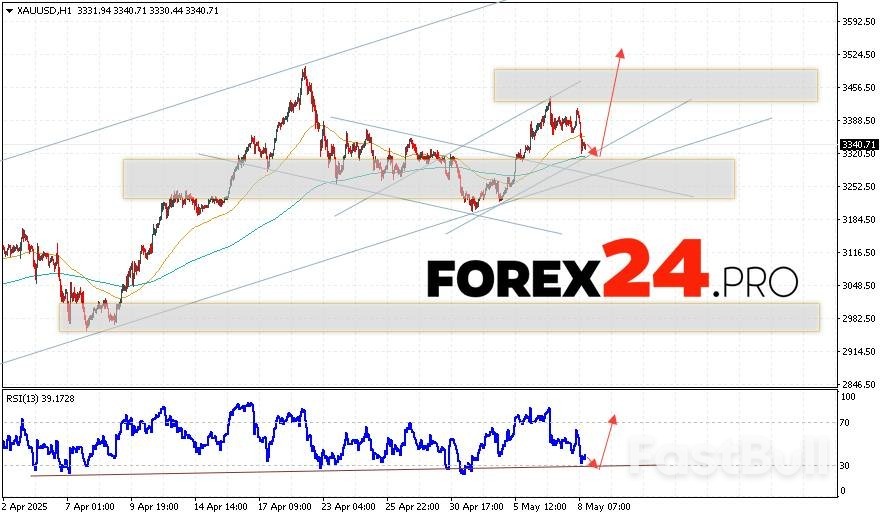
GOLD Forecast and Analysis for May 9, 2025 suggests an attempt to develop a price decline and test the support area near the 3320 level. Further, the continuation of the growth of non-ferrous metal quotes with a target above the 3525 level. The cancellation of the Gold price increase option will be a fall in the asset value on the markets and a breakout of the 3295 level. This will indicate a continuation of the decline in Gold prices with a potential target below the 3245 mark.
The agreement will open up the British market to American beef, ethanol, and other agricultural products, the White House said. It will also allow British cars and steel better access to U.S. consumers.
President Donald Trump said in the Oval Office Thursday that additional details will be worked out in the "coming weeks." But in a fact sheet the administration said the deal is “historic” and “a great deal for America.”
U.K. Prime Minister Keir Starmer has said the deal would protect thousands of auto jobs and stressed the importance of the relationship between the two countries.
Here are some elements of the agreement announced by the two countries:
—The United States will maintain the 10% duty on nearly all imports from the U.K., which Trump imposed April 2. Many economists had hoped that the tariff would be dropped as part of any trade deal, but Trump suggested that the 10% universal duty was likely to be a floor in any talks.
—The U.K. will be able to export 100,000 cars to the U.S. annually that will pay a 10% tariff, down from its current 27.5%, according to the U.K. government. The UK exported 92,000 cars to the U.S. in 2024.
—U.K. steel imports will enter the U.S. duty-free, rather than face the 25% tariff the White House has placed on all steel imports.
—The two countries have agreed to greater market access for each other's beef, with the U.K. able to export 13,000 metric tons of beef to the U.S. tariff-free.
—The U.K. will eliminate its tariff on ethanol from the U.S.
—The U.K. will “reduce or eliminate” non-tariff barriers to U.S. exports, the White House said, though it did not provide details. The agreement creates opportunities for $5 billion in new exports of U.S. agricultural and other goods, according to the administration's fact sheet.
Daily US Government Bonds 10-Year Yield
The number of Americans filing new applications for unemployment benefits fell sharply last week as the spring break-related boost from the prior week faded, suggesting the labor market continued to chug along, though risks are mounting from tariffs.
Employers are hoarding workers after difficulties finding labor during and after the COVID-19 pandemic. But that could become tougher to maintain as other data from the Labor Department on Thursday showed worker productivity declining for the first time in nearly three years in the first quarter, boosting labor costs.
The weakness in productivity, if sustained, could pressure margins for businesses at a time when they are facing higher costs from President Donald Trump's sweeping import duties.
"Companies in the face of trade war uncertainty are holding onto their workers for now," said Christopher Rupkey, chief economist at FWDBONDS. "The million-dollar question is, how long can companies tough it out as first-quarter productivity statistics show unit labor costs soared?"
Initial claims for state unemployment benefits dropped 13,000 to a seasonally adjusted 228,000 for the week ended May 3. Economists polled by Reuters had forecast 230,000 claims for the latest week. The decline unwound some of the boost from school spring breaks in New York state, which had lifted claims to a two-month high.
Unadjusted claims for New York tumbled 15,089 last week. They had soared 15,418 in the prior week, attributed to layoffs in the transportation and warehousing, accommodation and food services as well as public administration and educational services industries. There were also significant decreases in claims in Massachusetts and New Jersey.
But filings vaulted 6,906 in Michigan, potentially hinting at layoffs in the automobile industry amid duties on motor vehicles and parts. General Motors (GM.N), opens new tab and Ford Motor (F.N), opens new tab have pulled their annual forecasts. General Motors said it expected a $4-$5 billion tariff hit on profits, while Ford estimated the drag at $1.5 billion.
A separate program for unemployment compensation for federal employees (UCFE), which is reported with a one-week lag, still showed little impact of the mass firings of public workers, part of the Trump administration's unprecedented campaign to drastically shrink the federal government.
Many workers have taken severance packages, which will run out in September, while others have been put on paid leave after courts ordered their reinstatement.
Trump's tariffs, including hiking duties on Chinese imports to 145%, have soured business and consumer sentiment, heightening economic uncertainty. Trump sees the tariffs as a tool to raise revenue to offset his promised tax cuts and to revive a long-declining U.S. industrial base.
Economists say it is only a matter of time before the weakness in business and consumer surveys spills over to so-called hard data like claims, inflation and employment reports.
The Federal Reserve on Wednesday kept its benchmark overnight interest rate in the 4.25%-4.50% range, with policymakers at the U.S. central bank noting that "the risks of higher unemployment and higher inflation have risen."
Fed Chair Jerome Powell told reporters "the tariff increases announced so far have been significantly larger than anticipated," adding "if sustained, they're likely to generate a rise in inflation, a slowdown in economic growth and an increase in unemployment."
The dollar rose against a basket of currencies. U.S. stocks opened higher.

A column chart titled "US unemployment claims" that tracks the metric over a recent period.
Worker hoarding accounts for most of the labor market's resilience. Some companies more exposed to the trade tensions have started laying off workers, though on a small scale.
An Institute for Supply Management survey last week showed manufacturing employment remained depressed in April, noting that "layoffs were the primary tools used, an indication that head-count reduction is becoming more urgent."
Rising economic uncertainty has added to companies' hesitancy to hire more workers, leaving those who lose their jobs experiencing long bouts of unemployment.
The number of people receiving benefits after an initial week of aid, a proxy for hiring, decreased 29,000 to a seasonally adjusted 1.879 million during the week ending April 26, the claims report showed.
The unemployment rate was unchanged at 4.2% in April, but the median duration of joblessness jumped to 10.4 weeks from 9.8 weeks in March. The economy added 177,000 jobs in April.
In a separate report, the Labor Department's Bureau of Labor Statistics said nonfarm productivity, which measures hourly output per worker, fell at a 0.8% annualized rate in the first quarter. That was the first decline since the second quarter of 2022 and followed a 1.7% growth pace in the October-December quarter. Productivity grew at a 1.4% rate from a year ago.
The quarterly drop in productivity was flagged by the government's advance gross domestic product report for the first quarter published last week, which showed the economy contracting at a 0.3% rate, the first decline in three years.
The economy was swamped by a flood of imports as businesses rushed to bring in goods before tariffs kicked in.
Unit labor costs - the price of labor per single unit of output - jumped at a 5.7% rate in the first quarter after rising at a 2.0% rate in the October-December period. Labor costs increased at a 1.3% rate from a year ago.
"The drop in worker productivity likely increases caution from firms to invest or expand operations this year, especially given the elevated uncertainty surrounding tariffs and supply chains," said Ben Ayers, senior economist at Nationwide.
White Label
Data API
Web Plug-ins
Poster Maker
Affiliate Program
The risk of loss in trading financial instruments such as stocks, FX, commodities, futures, bonds, ETFs and crypto can be substantial. You may sustain a total loss of the funds that you deposit with your broker. Therefore, you should carefully consider whether such trading is suitable for you in light of your circumstances and financial resources.
No decision to invest should be made without thoroughly conducting due diligence by yourself or consulting with your financial advisors. Our web content might not suit you since we don't know your financial conditions and investment needs. Our financial information might have latency or contain inaccuracy, so you should be fully responsible for any of your trading and investment decisions. The company will not be responsible for your capital loss.
Without getting permission from the website, you are not allowed to copy the website's graphics, texts, or trademarks. Intellectual property rights in the content or data incorporated into this website belong to its providers and exchange merchants.
Not Logged In
Log in to access more features

FastBull Membership
Not yet
Purchase
Log In
Sign Up