• Trade
  • Markets
  • Copy
  • Contests
  • News
  • 24/7
  • Calendar
  • Q&A
  • Chats
Trending
Screeners
SYMBOL
LAST
BID
ASK
HIGH
LOW
NET CHG.
%CHG.
SPREAD
SPX
S&P 500 Index
6857.13
6857.13
6857.13
6865.94
6827.13
+7.41
+ 0.11%
--
DJI
Dow Jones Industrial Average
47850.93
47850.93
47850.93
48049.72
47692.96
-31.96
-0.07%
--
IXIC
NASDAQ Composite Index
23505.13
23505.13
23505.13
23528.53
23372.33
+51.04
+ 0.22%
--
USDX
US Dollar Index
98.850
98.930
98.850
98.980
98.740
-0.130
-0.13%
--
EURUSD
Euro / US Dollar
1.16582
1.16590
1.16582
1.16715
1.16408
+0.00137
+ 0.12%
--
GBPUSD
Pound Sterling / US Dollar
1.33530
1.33539
1.33530
1.33622
1.33165
+0.00259
+ 0.19%
--
XAUUSD
Gold / US Dollar
4223.93
4224.34
4223.93
4230.62
4194.54
+16.76
+ 0.40%
--
WTI
Light Sweet Crude Oil
59.457
59.487
59.457
59.480
59.187
+0.074
+ 0.12%
--

Community Accounts

Signal Accounts
--
Profit Accounts
--
Loss Accounts
--
View More

Become a signal provider

Sell trading signals to earn additional income

View More

Guide to Copy Trading

Get started with ease and confidence

View More

Signal Accounts for Members

All Signal Accounts

Best Return
  • Best Return
  • Best P/L
  • Best MDD
Past 1W
  • Past 1W
  • Past 1M
  • Past 1Y

All Contests

  • All
  • Trump Updates
  • Recommend
  • Stocks
  • Cryptocurrencies
  • Central Banks
  • Featured News
Top News Only
Share

Kremlin Aide Ushakov Says USA Kushner Is Working Very Actively On Ukrainian Settlement

Share

Norway To Acquire 2 More Submarines, Long-Range Missiles, Daily Vg Reports

Share

Ucb Sa Shares Open Up 7.3% After 2025 Guidance Upgrade, Top Of Bel 20 Index

Share

Shares In Italy's Mediobanca Down 1.3% After Barclays Cuts To Underweight From Equal-Weight

Share

Stats Office - Austrian November Wholesale Prices +0.9% Year-On-Year

Share

Britain's FTSE 100 Up 0.15%

Share

Europe's STOXX 600 Up 0.1%

Share

Taiwan November PPI -2.8% Year-On-Year

Share

Stats Office - Austrian September Trade -230.8 Million EUR

Share

Swiss National Bank Forex Reserves Revised To Chf 724906 Million At End Of October - SNB

Share

Swiss National Bank Forex Reserves At Chf 727386 Million At End Of November - SNB

Share

Shanghai Warehouse Rubber Stocks Up 8.54% From Week Earlier

Share

Turkey's Main Banking Index Up 2%

Share

French October Trade Balance -3.92 Billion Euros Versus Revised -6.35 Billion Euros In September

Share

Kremlin Aide Says Russia Is Ready To Work Further With Current USA Team

Share

Kremlin Aide Says Russia And USA Are Moving Forward In Ukraine Talks

Share

Shanghai Rubber Warehouse Stocks Up 7336 Tons

Share

Shanghai Tin Warehouse Stocks Up 506 Tons

Share

Reserve Bank Of India Chief Malhotra: Goal Is To Have Inflation Be Around 4%

Share

Ukmto Says Master Has Confirmed That The Small Crafts Have Left The Scene, Vessel Is Proceeding To Its Next Port Of Call

TIME
ACT
FCST
PREV
France 10-Year OAT Auction Avg. Yield

A:--

F: --

P: --

Euro Zone Retail Sales MoM (Oct)

A:--

F: --

P: --

Euro Zone Retail Sales YoY (Oct)

A:--

F: --

P: --

Brazil GDP YoY (Q3)

A:--

F: --

P: --

U.S. Challenger Job Cuts (Nov)

A:--

F: --

P: --

U.S. Challenger Job Cuts MoM (Nov)

A:--

F: --

P: --

U.S. Challenger Job Cuts YoY (Nov)

A:--

F: --

P: --

U.S. Initial Jobless Claims 4-Week Avg. (SA)

A:--

F: --

P: --

U.S. Weekly Initial Jobless Claims (SA)

A:--

F: --

P: --

U.S. Weekly Continued Jobless Claims (SA)

A:--

F: --

P: --

Canada Ivey PMI (SA) (Nov)

A:--

F: --

P: --

Canada Ivey PMI (Not SA) (Nov)

A:--

F: --

P: --

U.S. Non-Defense Capital Durable Goods Orders Revised MoM (Excl. Aircraft) (SA) (Sept)

A:--

F: --

P: --
U.S. Factory Orders MoM (Excl. Transport) (Sept)

A:--

F: --

P: --

U.S. Factory Orders MoM (Sept)

A:--

F: --

P: --

U.S. Factory Orders MoM (Excl. Defense) (Sept)

A:--

F: --

P: --

U.S. EIA Weekly Natural Gas Stocks Change

A:--

F: --

P: --

Saudi Arabia Crude Oil Production

A:--

F: --

P: --

U.S. Weekly Treasuries Held by Foreign Central Banks

A:--

F: --

P: --

Japan Foreign Exchange Reserves (Nov)

A:--

F: --

P: --

India Repo Rate

A:--

F: --

P: --

India Benchmark Interest Rate

A:--

F: --

P: --

India Reverse Repo Rate

A:--

F: --

P: --

India Cash Reserve Ratio

A:--

F: --

P: --

Japan Leading Indicators Prelim (Oct)

A:--

F: --

P: --

U.K. Halifax House Price Index YoY (SA) (Nov)

A:--

F: --

P: --

U.K. Halifax House Price Index MoM (SA) (Nov)

A:--

F: --

P: --

France Current Account (Not SA) (Oct)

A:--

F: --

P: --

France Trade Balance (SA) (Oct)

A:--

F: --

P: --

France Industrial Output MoM (SA) (Oct)

A:--

F: --

P: --

Italy Retail Sales MoM (SA) (Oct)

--

F: --

P: --

Euro Zone Employment YoY (SA) (Q3)

--

F: --

P: --

Euro Zone GDP Final YoY (Q3)

--

F: --

P: --

Euro Zone GDP Final QoQ (Q3)

--

F: --

P: --

Euro Zone Employment Final QoQ (SA) (Q3)

--

F: --

P: --

Euro Zone Employment Final (SA) (Q3)

--

F: --

P: --
Brazil PPI MoM (Oct)

--

F: --

P: --

Mexico Consumer Confidence Index (Nov)

--

F: --

P: --

Canada Unemployment Rate (SA) (Nov)

--

F: --

P: --

Canada Labor Force Participation Rate (SA) (Nov)

--

F: --

P: --

Canada Employment (SA) (Nov)

--

F: --

P: --

Canada Part-Time Employment (SA) (Nov)

--

F: --

P: --

Canada Full-time Employment (SA) (Nov)

--

F: --

P: --

U.S. Personal Income MoM (Sept)

--

F: --

P: --

U.S. Dallas Fed PCE Price Index YoY (Sept)

--

F: --

P: --

U.S. PCE Price Index YoY (SA) (Sept)

--

F: --

P: --

U.S. PCE Price Index MoM (Sept)

--

F: --

P: --

U.S. Personal Outlays MoM (SA) (Sept)

--

F: --

P: --

U.S. Core PCE Price Index MoM (Sept)

--

F: --

P: --

U.S. UMich 5-Year-Ahead Inflation Expectations Prelim YoY (Dec)

--

F: --

P: --

U.S. Core PCE Price Index YoY (Sept)

--

F: --

P: --

U.S. Real Personal Consumption Expenditures MoM (Sept)

--

F: --

P: --

U.S. 5-10 Year-Ahead Inflation Expectations (Dec)

--

F: --

P: --

U.S. UMich Current Economic Conditions Index Prelim (Dec)

--

F: --

P: --

U.S. UMich Consumer Sentiment Index Prelim (Dec)

--

F: --

P: --

U.S. UMich 1-Year-Ahead Inflation Expectations Prelim (Dec)

--

F: --

P: --

U.S. UMich Consumer Expectations Index Prelim (Dec)

--

F: --

P: --

U.S. Weekly Total Rig Count

--

F: --

P: --

U.S. Weekly Total Oil Rig Count

--

F: --

P: --

U.S. Consumer Credit (SA) (Oct)

--

F: --

P: --

Q&A with Experts
    • All
    • Chatrooms
    • Groups
    • Friends
    Connecting
    .
    .
    .
    Type here...
    Add Symbol or Code

      No matching data

      All
      Trump Updates
      Recommend
      Stocks
      Cryptocurrencies
      Central Banks
      Featured News
      • All
      • Russia-Ukraine Conflict
      • Middle East Flashpoint
      • All
      • Russia-Ukraine Conflict
      • Middle East Flashpoint
      Search
      Products

      Charts Free Forever

      Chats Q&A with Experts
      Screeners Economic Calendar Data Tools
      Membership Features
      Data Warehouse Market Trends Institutional Data Policy Rates Macro

      Market Trends

      Market Sentiment Order Book Forex Correlations

      Top Indicators

      Charts Free Forever
      Markets

      News

      News Analysis 24/7 Columns Education
      From Institutions From Analysts
      Topics Columnists

      Latest Views

      Latest Views

      Trending Topics

      Top Columnists

      Latest Update

      Signals

      Copy Rankings Latest Signals Become a signal provider AI Rating
      Contests
      Brokers

      Overview Brokers Assessment Rankings Regulators News Claims
      Broker listing Forex Brokers Comparison Tool Live Spread Comparison Scam
      Q&A Complaint Scam Alert Videos Tips to Detect Scam
      More

      Business
      Events
      Careers About Us Advertising Help Center

      White Label

      Data API

      Web Plug-ins

      Affiliate Program

      Awards Institution Evaluation IB Seminar Salon Event Exhibition
      Vietnam Thailand Singapore Dubai
      Fans Party Investment Sharing Session
      FastBull Summit BrokersView Expo
      Recent Searches
        Top Searches
          Markets
          News
          Analysis
          User
          24/7
          Economic Calendar
          Education
          Data
          • Names
          • Latest
          • Prev

          View All

          No data

          Scan to Download

          Faster Charts, Chat Faster!

          Download App
          English
          • English
          • Español
          • العربية
          • Bahasa Indonesia
          • Bahasa Melayu
          • Tiếng Việt
          • ภาษาไทย
          • Français
          • Italiano
          • Türkçe
          • Русский язык
          • 简中
          • 繁中
          Open Account
          Search
          Products
          Charts Free Forever
          Markets
          News
          Signals

          Copy Rankings Latest Signals Become a signal provider AI Rating
          Contests
          Brokers

          Overview Brokers Assessment Rankings Regulators News Claims
          Broker listing Forex Brokers Comparison Tool Live Spread Comparison Scam
          Q&A Complaint Scam Alert Videos Tips to Detect Scam
          More

          Business
          Events
          Careers About Us Advertising Help Center

          White Label

          Data API

          Web Plug-ins

          Affiliate Program

          Awards Institution Evaluation IB Seminar Salon Event Exhibition
          Vietnam Thailand Singapore Dubai
          Fans Party Investment Sharing Session
          FastBull Summit BrokersView Expo

          Gold Climbs to Two-Week High

          Golden Gleam

          Commodity

          Technical Analysis

          Summary:

          On Monday, gold advanced by more than 1% to 4,050 USD per ounce, reaching a fresh two-week high. The rally was fuelled by mounting concerns over the health of the US economy.

          On Monday, gold advanced by more than 1% to 4,050 USD per ounce, reaching a fresh two-week high. The rally was fuelled by mounting concerns over the health of the US economy.

          A softening US dollar provided further support for the precious metal, enhancing the affordability of dollar-denominated assets for international buyers.

          Data released on Friday revealed that the University of Michigan's consumer sentiment index had fallen to its lowest level in nearly three and a half years. This decline is largely attributed to the ongoing US government shutdown, which has now become the longest in the nation's history. Investors are closely monitoring the situation as the US Senate moves closer to approving a Democratic-backed proposal to reopen the government.

          Amid the economic uncertainty, market expectations for the Federal Reserve's next move remain divided. The probability of a 25 basis point rate cut in December is currently priced at approximately 67%, unchanged from the end of last week.

          Technical Analysis: XAU/USD

          H4 Chart:

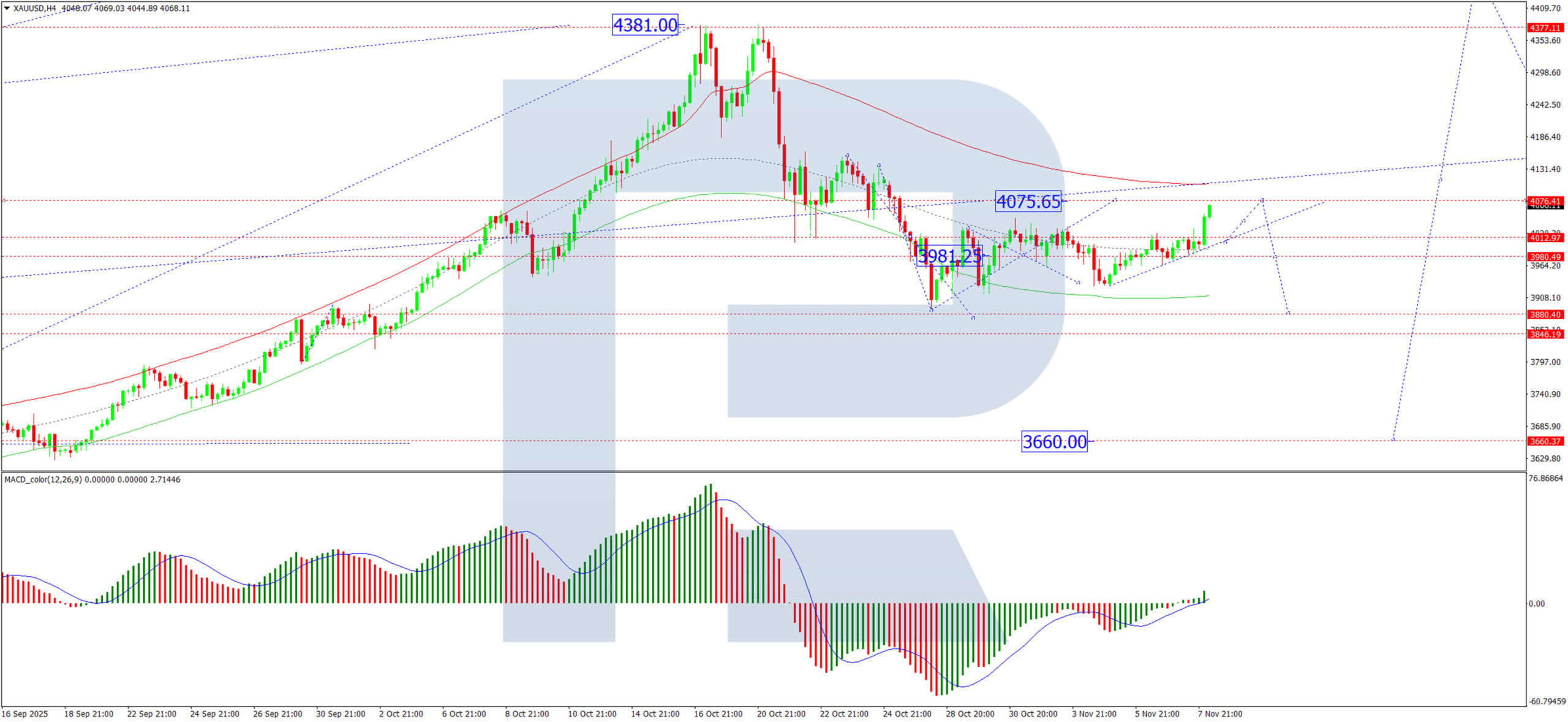
          On the H4 chart, XAU/USD is forming a consolidation range around 3,988 USD. A breakout to the upside is expected to initiate a growth wave towards 4,075 USD, which may then be followed by a decline to 4,020 USD (testing the level from below). A subsequent breakdown from this range could extend the correction towards 3,660 USD, where the downward move is anticipated to conclude. This would potentially set the stage for a new upward wave targeting 4,400 USD. The MACD indicator supports this outlook, with its signal line above zero and pointing upward, suggesting continued near-term bullish momentum.
          H1 Chart:

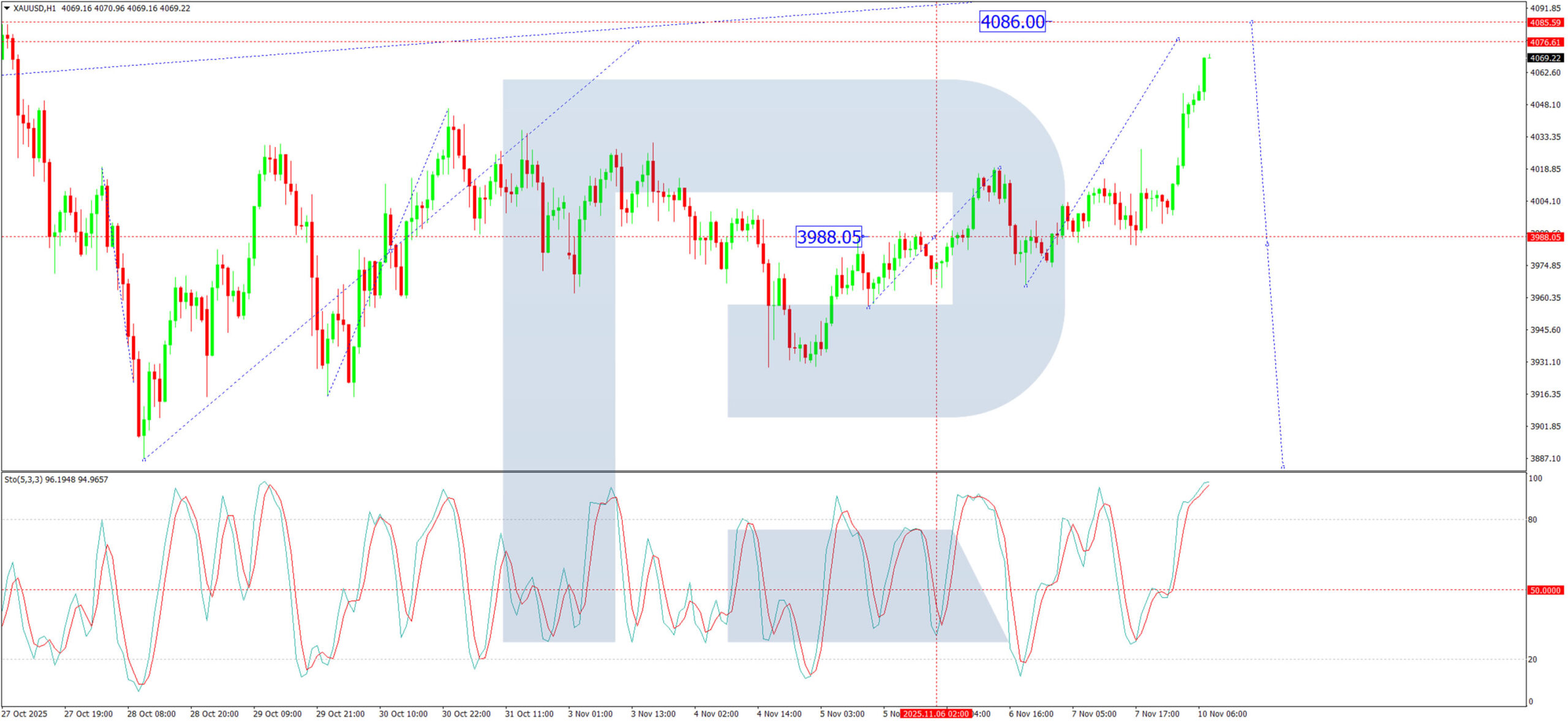
          On the H1 chart, the market is also consolidating around 3,988 USD. An upward breakout is likely to propel prices towards 4,075 USD, after which a decline to at least 4,020 USD is expected. The Stochastic oscillator aligns with this view, as its signal line is positioned above 80 and appears poised to reverse downward towards 20, indicating potential for a near-term pullback.
          Conclusion

          Gold is trading at a two-week high, supported by economic concerns and a weaker US dollar. While the near-term technical structure suggests potential for further gains towards 4,075 USD, a subsequent correction towards 4,020 USD is anticipated. The broader outlook remains constructive, with a deeper corrective move towards 3,660 USD expected to present a buying opportunity ahead of a potential resumption of the broader uptrend.

          Source: ACTIONFOREX

          Risk Warnings and Disclaimers
          You understand and acknowledge that there is a high degree of risk involved in trading. Following any strategies or investment methods may lead to potential losses. The content on the site is provided by our contributors and analysts for information purposes only. You are solely responsible for determining whether any trading assets, securities, strategy, or any other product is suitable for investing based on your own investment objectives and financial situation.
          Add to Favorites
          Share

          Gold Rallies Above $4,070 as U.S. Economic Weakness Fuels Rate Cut Expectations

          Gerik

          Economic

          Commodity

          Gold Strengthens on Economic Weakness and Dovish Fed Expectations

          Gold climbed for a second consecutive session on Monday, with spot prices rising to $4,071.55 an ounce in Asia. This rebound follows last week’s muted performance and reflects renewed investor positioning as economic indicators suggest the U.S. economy may be losing momentum. The rally is largely driven by weak consumer sentiment and private labor data that paint a sluggish picture of household and employment strength.
          Gold’s rise of nearly 2% marks a notable recovery from its recent retreat. Prices had dropped roughly 7% since peaking at an all-time high above $4,380 in mid-October. Still, the year-to-date gains remain substantial, with gold up more than 50%, sustained by macroeconomic uncertainty, robust central bank buying, and persistent geopolitical risk.
          The upward price movement demonstrates a classic correlation between deteriorating economic data and increased safe-haven demand. More importantly, this suggests a cause-effect dynamic in which the prospect of monetary easing made likelier by weak data directly boosts gold's appeal as a non-yielding asset.

          Dovish Signals Amplified by Shutdown-Induced Data Vacuum

          Recent labor and sentiment data have added fuel to expectations that the Federal Reserve may cut interest rates at its next meeting in December. The University of Michigan’s consumer sentiment index has fallen to near-record lows, echoing growing concern among households about inflation and economic direction. A separate private-sector employment report also hinted at a weakening labor market.
          However, the government shutdown has significantly delayed the release of key economic data, leaving the Fed with an incomplete view of the economy. This constraint has forced policymakers to rely more heavily on secondary indicators and qualitative data. With moderate Senate Democrats reportedly backing a plan to reopen the government, investor attention is pivoting to what a data restart might reveal and whether it would justify immediate monetary easing.
          According to Riya Singh of Emkay Global, while the potential resolution of the shutdown could slightly reduce gold’s momentum, the underlying economic fragility remains the primary force behind the current rally.

          Continued Central Bank Buying Bolsters Market Confidence

          One of the most structurally supportive factors for gold remains the aggressive accumulation by central banks led by the People’s Bank of China, which has now added gold to its reserves for 12 consecutive months. This consistent buying trend suggests a deliberate shift by major sovereigns toward asset diversification and longer-term inflation hedging.
          Additionally, recent inflows into gold-backed exchange-traded funds (ETFs) underscore rising retail and institutional demand for the metal, particularly amid mounting recession risks. This multi-channel demand pattern reinforces gold’s role not only as a defensive asset but also as a liquidity vehicle in volatile conditions.

          Shutdown Resolution Shifts Focus to Fed Policy

          According to Vasu Menon of OCBC, if the U.S. government reopens and delayed economic data is released, the market may quickly pivot to pricing in a rate-cut timeline more precisely. That, in turn, would sharpen expectations for the Fed’s next move, especially if indicators point to a broader economic slowdown.
          This relationship is nuanced. While resolution of the shutdown removes one source of uncertainty, it may paradoxically support gold if the incoming data confirms a slowdown, thereby making a rate cut not just likely, but urgent.
          Meanwhile, the Bloomberg Dollar Spot Index remained steady, suggesting the dollar's strength was not a significant counterweight to gold's rise on the day. Silver also surged 2.4%, while platinum and palladium registered additional gains, indicating broader momentum in precious metals.

          Weak Data and Policy Uncertainty Keep Gold in Rally Mode

          Gold’s latest rally underscores the asset’s sensitivity to real-time shifts in U.S. macroeconomic sentiment and monetary policy expectations. Although optimism about ending the shutdown exists, the key drivers for gold remain elevated: soft labor data, low consumer confidence, and delayed economic visibility. Together, these increase the likelihood of a dovish Fed response a development that continues to support gold's upward trajectory.
          As central banks continue to buy and investors hedge against policy missteps and inflation persistence, gold remains well-positioned in the short to medium term, particularly if hard data confirms that the U.S. economy is indeed approaching a slowdown.

          Source: Bloomberg

          To stay updated on all economic events of today, please check out our Economic calendar
          Risk Warnings and Disclaimers
          You understand and acknowledge that there is a high degree of risk involved in trading. Following any strategies or investment methods may lead to potential losses. The content on the site is provided by our contributors and analysts for information purposes only. You are solely responsible for determining whether any trading assets, securities, strategy, or any other product is suitable for investing based on your own investment objectives and financial situation.
          Add to Favorites
          Share

          India Considers Raising Sugar Export Quota To Avert Looming Glut

          Daniel Carter

          Economic

          India is considering a proposal to allow sugar mills to export 1.5 million tons of the sweetener in 2025-26, as the outlook for an abundant harvest raises concerns about a looming glut.
          A decision on the proposal from India's food ministry is likely to be announced soon, according to people familiar with the matter, asking not to be identified as the discussions are private. That would be higher than the export quota for 2024-25, which was 1 million tons.
          The food ministry didn't immediately respond to a request for comment.
          While the higher allocation would help alleviate a domestic surplus, additional supply in the global market could weigh further on benchmark prices. Futures in New York have declined 27% this year due to rising output and lackluster demand from key importers such as Indonesia and China.
          Industry group Indian Sugar and Bio-Energy Manufacturers Association recently urged the government to allow local millers to export 2 million tons of sugar to avert a domestic glut, and before supplies from Brazil's new crop — the world's largest producer — hit the market in April 2026.
          Officials in New Delhi signaled in September that the South Asian nation had room to increase shipments in 2025-26 based on industry estimates. India introduced a quota system in 2022-23 after late rains cut production and squeezed supply for the domestic market.

          Source: Bloomberg Europe

          To stay updated on all economic events of today, please check out our Economic calendar
          Risk Warnings and Disclaimers
          You understand and acknowledge that there is a high degree of risk involved in trading. Following any strategies or investment methods may lead to potential losses. The content on the site is provided by our contributors and analysts for information purposes only. You are solely responsible for determining whether any trading assets, securities, strategy, or any other product is suitable for investing based on your own investment objectives and financial situation.
          Add to Favorites
          Share

          Shutdown Progress Gives Risk A Lift

          ING

          Forex

          Economic

          USD: Thanksgiving focuses the minds

          Developments over the weekend hint at a path to ending the US government shutdown. It seems the prospect of massive flight delays around Thanksgiving and the delay in food aid payments has prompted a group of moderate Democrats to back a proposed compromise bill in the Senate. The compromise is far from meeting the full Democratic demands of a delay in the end of Obamacare healthcare subsidies, and Democrats in the House may still reject the compromise. But the next 48 hours in Congress should tell us whether this initiative has legs. US equity futures are marked close to 1% higher on the news, and Asian equity futures have had a good Monday – helped in part by a proposed dividend tax cut in Korea.

          FX markets have responded by taking the risk-sensitive Australian dollar close to 0.5% higher. Remember, we said last week that a cross-rate like AUD/JPY had the highest correlation with the US Nasdaq index, which is marked some 1.2% higher today. USD/JPY is pushing over 154 again, and the prospect of a December Bank of Japan rate hike is being swamped by the use of the yen as a funding currency.

          While some might argue that the end of the shutdown could be a risk-on, dollar-negative impulse for the FX markets, its impact may be more mixed. Late last week, the dollar was under pressure on job layoffs and rhetoric that the US economy could contract in the fourth quarter should the shutdown extend. At the same time, Friday's release of poor US consumer sentiment data was read as a dollar negative. Progress to end the shutdown may be felt more by risk-sensitive FX cross rates than the dollar.

          Away from politics, it is an exceptionally quiet week for US data, and tomorrow the US observes the Veterans' Day public holiday. Where there is data, the focus will be on tomorrow's release of the NFIB small business optimism index. Plus, there are quite a few Federal Reserve speakers. The probability of a December 25bp Fed cut has dropped to 64%. And without US data, that probability may drop close to 50% as Fed speakers generally point to the need to go slow in cutting rates.

          If last week's 100.36 high in DXY is to prove significant, it should not really be making it back above the 99.90/100.00 area now.

          EUR: Rally needs a helping hand

          EUR/USD is becalmed after finding support below 1.15 last week. Most probably think that 1.15 proves the bottom of the range, but the rally needs a helping hand. One source of that could be an end to the government shutdown and the release of delayed US data, such as the September or October US non-farm payrolls report. But frankly, that feels like clutching at straws as we start the week.

          In terms of eurozone data this week, we've got some investor sentiment data both in the form of the Sentix data at 10:30am CET today and the German ZEW tomorrow. And later this week, we should also see third-quarter eurozone GDP data confirmed at 0.2% quarter-on-quarter.

          Again, if last week's 1.1470 low is to prove significant, EUR/USD should somehow find support at 1.1515/1530 through the early part of this week.

          GBP: Tomorrow's jobs data should weigh

          EUR/GBP is back below 0.88 again as GBP/USD seems to find good demand under 1.31. We still think the prospects of a December 25bp cut from the Bank of England are underpriced. The market now attaches just a 60% probability to such an outcome.

          Feeding into the BoE story will be tomorrow's release of the September wage data. This is expected to slow further and give the BoE greater confidence that inflation is less persistent than first thought.

          Expect EUR/GBP to meet good demand at 0.8750/60 should it make it that low. We prefer levels above 0.88 now.

          CEE: From central bank meetings to inflation prints

          After a busy week of central bank meetings, attention will shift to inflation figures in the CEE region. Tomorrow, October's data will be released in Hungary, where we expect only a small change from 4.3% to 4.4% year-on-year. Underlying price pressures still do not favour a change in monetary policy, as we see core inflation moving above 4% again. In the Czech Republic, final inflation figures will also be released, providing a detailed breakdown.

          On Wednesday, Romania will also release October inflation, which we expect to slow down slightly from 9.9% to 9.7%, after a September peak. The National Bank of Romania will also make a decision on the same day, but that should be a non-event with rates unchanged at 6.50%.

          On Thursday and Friday, Poland and Romania will release third-quarter GDP figures, where we expect some recovery in both cases. On Friday, the Czech National Bank will release the minutes of its last meeting, and Turkey will release inflation expectations.

          CEE currencies have had a decent week, with the Hungarian forint remaining the leader of the pack with new highs on Friday. EUR/USD reversal provides something of a boost for the region, while the market is in no hurry to price in more rate cuts following last week's central bank meetings in the Czech Republic and Poland last week. EUR/HUF approached 384 on Friday, and the forint rally seems too fast for us.

          On the other hand, on Friday, we saw talks between US President Donald Trump and Hungarian Prime Minister Viktor Orbán providing an exemption from US sanctions on Russian energy, which should be good news for the markets. We therefore remain slightly bullish on HUF, but it would not be surprising to see some correction of Friday's rally today. Overall, though, the conditions for the CEE region remain slightly bullish in our opinion, and we could see some gains this week as well.

          Source: ING

          To stay updated on all economic events of today, please check out our Economic calendar
          Risk Warnings and Disclaimers
          You understand and acknowledge that there is a high degree of risk involved in trading. Following any strategies or investment methods may lead to potential losses. The content on the site is provided by our contributors and analysts for information purposes only. You are solely responsible for determining whether any trading assets, securities, strategy, or any other product is suitable for investing based on your own investment objectives and financial situation.
          Add to Favorites
          Share

          At China’s Largest Import Expo, US Exhibitors Hopeful Worst Of Trade War Is Over

          Winkelmann

          Forex

          Political

          Economic

          U.S. exporters of agricultural goods to China are optimistic that trade between the two countries will return to normalcy after a framework agreement reached last month by their leaders, according to several exporters and industry officials.

          The mood this year in the U.S. pavilion at the China International Import Expo (CIIE), China's largest import expo, which began on November 5 and wraps up in Shanghai on Monday, is positive.

          "I think people are very hopeful," Jeffrey Lehman, chair of the American Chamber of Commerce in Shanghai, which counts over 1,000 companies among its members, told Reuters at the U.S. Pavilion, which housed exhibits from industry bodies dealing in wine, ginseng, potatoes and more, and was 50% larger than last year's.

          "I think the reason why they're here is because they want to engage with new customers. They want to find new opportunities for partnership, and I think they're here because they think that's going to happen," he added.

          CIIE kicked off just a week after a meeting between Chinese President Xi Jinping and U.S. President Donald Trump in South Korea that led to a framework agreement to roll back a number of tariffs and export control measures that had been put into place this year, including some that had overtly impacted exhibitors of agricultural products such as soybeans and sorghum.

          "We just had this successful meeting in Busan, and so we're celebrating that, but (we) had plans to come even before that meeting. I think that's important to note that we didn't give up on the relationship, that we were working to maintain and continue to strengthen the relationship, even if there were some troubles," said Jim Sutter, CEO of the U.S. Soybean Export Council.

          China had shunned soybean purchases from the U.S. 2025 harvest amid rising trade tensions between the two countries but has resumed purchases recently.

          Mark Wilson, chairman of the U.S. Grains and BioProducts Council, pointed to recent shipments of soybeans and sorghum bought by China as a positive signal for future trade returning to normal. Prior to this year, China accounted for 95% of the U.S. export market for sorghum, he added.

          "I do have hope that they continue talking, because if they can continue talking, they can hopefully work things out, because that's what it takes," Wilson said.

          CHINA'S EXPANDING TRADE SURPLUS

          Despite optimism from the U.S. agricultural associations in Shanghai, analysts say the latest trade détente hammered out by Xi and Trump may be no more than a fragile truce in a trade war with root causes still unresolved.

          U.S. soybeans still face a 13% tariff, which analysts say makes U.S. shipments to China too expensive for commercial buyers, compared to Brazilian alternatives.

          CIIE was launched under President Xi Jinping in 2018 to promote China's free trade credentials and counter criticism of its trade surplus with many countries.

          But the expo has its sceptics, as the country's trade surpluses with other markets have only grown in the years since.

          China's trade surplus is set to exceed last year's record of roughly $1 trillion as exporters offset a plunge in U.S. sales due to higher U.S. tariffs by selling more to the rest of the world, often at a loss in pursuit of market share.

          More than 155 countries, regions and organisations participated in this year's CIIE, the commerce ministry said. Over 4,100 overseas enterprises took part, with U.S. companies maintaining the largest exhibition area for the seventh consecutive year.

          This year's expo generated intended turnover of $83.49 billion, an increase of 4.4% over last year and a record high, state media reported.

          Source: Investing

          To stay updated on all economic events of today, please check out our Economic calendar
          Risk Warnings and Disclaimers
          You understand and acknowledge that there is a high degree of risk involved in trading. Following any strategies or investment methods may lead to potential losses. The content on the site is provided by our contributors and analysts for information purposes only. You are solely responsible for determining whether any trading assets, securities, strategy, or any other product is suitable for investing based on your own investment objectives and financial situation.
          Add to Favorites
          Share

          China’s Internet Giants Tiptoe Back into Lending as Regulators Signal Softer Stance

          Gerik

          Stocks

          Economic

          Beijing’s Policy Pivot Rekindles Online Lending Expansion

          After years of intense regulatory scrutiny, China's internet platforms are gradually re-entering the consumer lending space, interpreting recent policy moves and leadership engagement as a sign of regulatory normalization. The shift comes as Beijing attempts to stimulate domestic consumption, stabilize private-sector sentiment, and navigate economic turbulence compounded by external pressures such as trade tensions with the United States.
          The revival has been notably subtle. Companies like Ant Group, WeBank, ByteDance’s financial arm, and Meituan are cautiously increasing lending volumes, encouraged by Beijing’s August announcement of consumer-loan interest subsidies. By including both internet-backed and traditional financial institutions in its list of eligible lenders, the government appeared to offer tacit approval for the return of fintech-led credit growth.
          The behavioral shift in lending strategy suggests that regulation is no longer the primary constraint. Instead, expansion decisions are increasingly strategic, with risk assessment now centered on economic volatility and consumer repayment behavior rather than regulatory retaliation.

          Regulatory Freeze Thaws, but Not Without Memory

          The transformation from aggressive fintech growth to compliance-heavy restructuring began in 2020, when Beijing abruptly halted Ant Group’s IPO and launched a sector-wide crackdown on “disorderly expansion.” This ushered in a period of enforced restructuring, including the conversion of tech-finance arms into regulated financial holding companies with higher capital requirements and tighter data governance.
          By 2023, regulatory authorities declared that 14 major platforms had completed these restructurings. Still, market participants remained wary of policy unpredictability. This caution began to lift after signals from high-level meetings between Chinese leaders and tech executives, including Alibaba’s Jack Ma. These interactions were perceived as a rehabilitation of private-sector voices, if not a full policy reversal.
          UBS projects lending through online platforms will grow 7.6% in 2025 to 5.4 trillion yuan, and maintain a compound annual growth rate of 7.4% through 2029. The sector, which accounts for around 25% of China’s total consumer lending, is also expected to earn 110 billion yuan in profit this year, up 9.8% from 2024.
          While such estimates suggest healthy expansion, they rest on the assumption that regulatory oversight will remain consistent. Analysts like UBS's May Yan interpret the current environment as one of “normalized” regulation, not liberalization, a critical distinction in a system prone to abrupt policy shifts.

          Loan Demand Rebounds, but Default Risks Mount

          Consumer appetite for online credit appears to be rebounding. Borrowers are increasingly approached by agents offering rapid approval and minimal documentation, while platforms regain visibility in personal finance spaces. This echoes pre-2020 lending practices, though with more formal compliance structures in place.
          Still, a deeper risk lurks beneath the growth data. A sharp increase in non-performing consumer loans reflects macroeconomic fragility, with defaults surging due to weak income growth, high youth unemployment, and debt-fueled speculation. The Banking Credit Asset Registration and Transfer Center reported 74.3 billion yuan of non-performing loans for sale in Q1 2025, a 190% increase year-on-year, with consumer loans accounting for 70% of that total.
          This rise in default volumes reveals a causal link between softened lending constraints and financial vulnerability. Borrowers such as Shanghai’s Yang Dongdong, who took out her first online loan for home furnishings, represent the emerging trend of casual loan use driven by ease of access. However, others—like Liao Kui and Max Luo used loans for speculative trading and refinancing, only to default under pressure.
          Analysts estimate that 5–7% of China’s adult population may have already defaulted or fallen behind on repayments. These figures highlight the precarious nature of extending credit during periods of economic stress, where borrowing may not fund consumption but rather financial desperation or risk-taking.

          Cautious Optimism from Platforms But Not a Free-For-All

          Not all firms are aggressively pursuing expansion. ByteDance is reportedly increasing loan activity significantly, whereas Tencent remains reserved despite internal discussions about ambitious targets. This divergence suggests that while the regulatory window is more forgiving, internal risk management is now a critical driver of growth decisions.
          Companies may be encouraged by current subsidies and a more “benign” policy environment, but they remain aware that any sign of systemic risk—especially widespread defaults—could prompt a swift regulatory response. Thus, while firms are reactivating lending arms, they are not repeating the unchecked aggression of the 2010s.

          Fintech Revival Reflects Policy Flexibility, Not Deregulation

          The cautious comeback of online consumer lending in China reflects a nuanced policy recalibration rather than a wholesale deregulation. Beijing’s short-term need to stimulate consumption has created space for fintechs to expand, yet the memory of previous crackdowns tempers any euphoria.
          Internet lenders are navigating a “window of opportunity” shaped by regulatory leniency, economic necessity, and political signaling. However, as non-performing loans mount and income growth stalls, the sector walks a tightrope between recovery and renewed scrutiny.
          In this evolving environment, sustained growth will depend less on regulatory relaxation and more on disciplined underwriting, risk management, and the ability to channel credit into real, productive consumption rather than speculative or circular debt.

          Source: Bloomberg

          To stay updated on all economic events of today, please check out our Economic calendar
          Risk Warnings and Disclaimers
          You understand and acknowledge that there is a high degree of risk involved in trading. Following any strategies or investment methods may lead to potential losses. The content on the site is provided by our contributors and analysts for information purposes only. You are solely responsible for determining whether any trading assets, securities, strategy, or any other product is suitable for investing based on your own investment objectives and financial situation.
          Add to Favorites
          Share

          China Halts Port Fees on U.S.-Linked Ships for One Year Amid Trade De-escalation Signals

          Gerik

          Economic

          China–U.S. Trade War

          China Temporarily Lifts Port Charges on U.S.-Related Vessels in Strategic Trade Gesture

          In a sudden but strategically significant policy move, China’s Ministry of Transport has suspended port fees for ships connected to U.S. trade for a full year, beginning November 10, 2025, at 13:01 local time. The announcement, made Monday through an official statement, provides no further context or rationale, but the implications may signal a temporary softening of logistics-related friction between the world’s two largest economies.
          This measure effectively removes a recurring cost burden for U.S.-linked maritime traffic entering Chinese ports. While the direct financial impact may vary depending on cargo type, vessel size, and frequency of port calls, the suspension introduces a marginal yet meaningful cost saving for U.S. shippers and maritime operators navigating China's gateway ports, including Shanghai’s Yangshan Port, one of the busiest container ports globally.

          Possible Motivations: Economic Stabilization or Tactical De-escalation?

          Though the ministry’s statement did not provide an explicit justification, the timing and nature of the suspension suggest multiple possible motivations. First, this could be a calibrated effort to stimulate trade throughput and maintain volume at major ports amid signs of global shipping slowdowns and faltering Chinese export growth. Data released recently indicated a significant decline in Chinese outbound shipments the worst since February prompting the need for responsive policy adjustments.
          Second, this action may reflect a broader tactical maneuver within the U.S.–China trade framework. While not amounting to a formal concession or trade deal, the suspension of fees serves as a low-cost gesture that could build goodwill, particularly during a time of ongoing trade recalibration under renewed U.S. tariffs introduced earlier this year by President Trump’s administration. This move, therefore, represents a correlational rather than causal gesture toward trade thawing, though follow-up actions or reciprocal measures will be necessary to confirm any trend.

          Logistical Impact: Improved Flow for U.S.-Linked Shipping Routes

          For logistics operators and shipping firms, the fee suspension may reduce port call expenses and support more predictable cost modeling during a volatile freight market. Although port fees are typically just one part of a larger cost structure, their removal simplifies certain tariff scenarios and may influence routing decisions, especially among U.S. exporters and importers operating in East Asia.
          The policy may also aim to boost utilization of Chinese port infrastructure by U.S.-affiliated carriers during a time when global container volumes are under pressure due to weaker demand and higher inventory levels in Western economies.

          A Tactical But Measured Step Amid Broader Trade Frictions

          China’s one-year suspension of port fees on U.S.-linked ships should be viewed as a strategically timed, low-risk policy maneuver. It is unlikely to shift the trajectory of broader trade dynamics alone, but it reflects Beijing’s willingness to maintain operational flexibility in maritime logistics and perhaps signal openness to dialogue or stabilization.
          The move eases near-term costs for U.S. maritime operators while reinforcing China’s responsiveness to changing trade and economic conditions. Whether this action becomes a precedent for further logistical or tariff-related adjustments remains to be seen, but its practical implications in global shipping lanes are immediate and tangible.

          Source: Reuters

          To stay updated on all economic events of today, please check out our Economic calendar
          Risk Warnings and Disclaimers
          You understand and acknowledge that there is a high degree of risk involved in trading. Following any strategies or investment methods may lead to potential losses. The content on the site is provided by our contributors and analysts for information purposes only. You are solely responsible for determining whether any trading assets, securities, strategy, or any other product is suitable for investing based on your own investment objectives and financial situation.
          Add to Favorites
          Share
          FastBull
          Copyright © 2025 FastBull Ltd

          728 RM B 7/F GEE LOK IND BLDG NO 34 HUNG TO RD KWUN TONG KLN HONG KONG

          TelegramInstagramTwitterfacebooklinkedin
          App Store Google Play Google Play
          Products
          Charts

          Chats

          Q&A with Experts
          Screeners
          Economic Calendar
          Data
          Tools
          Membership
          Features
          Function
          Markets
          Copy Trading
          Latest Signals
          Contests
          News
          Analysis
          24/7
          Columns
          Education
          Company
          Careers
          About Us
          Contact Us
          Advertising
          Help Center
          Feedback
          User Agreement
          Privacy Policy
          Business

          White Label

          Data API

          Web Plug-ins

          Poster Maker

          Affiliate Program

          Risk Disclosure

          The risk of loss in trading financial instruments such as stocks, FX, commodities, futures, bonds, ETFs and crypto can be substantial. You may sustain a total loss of the funds that you deposit with your broker. Therefore, you should carefully consider whether such trading is suitable for you in light of your circumstances and financial resources.

          No decision to invest should be made without thoroughly conducting due diligence by yourself or consulting with your financial advisors. Our web content might not suit you since we don't know your financial conditions and investment needs. Our financial information might have latency or contain inaccuracy, so you should be fully responsible for any of your trading and investment decisions. The company will not be responsible for your capital loss.

          Without getting permission from the website, you are not allowed to copy the website's graphics, texts, or trademarks. Intellectual property rights in the content or data incorporated into this website belong to its providers and exchange merchants.

          Not Logged In

          Log in to access more features

          FastBull Membership

          Not yet

          Purchase

          Become a signal provider
          Help Center
          Customer Service
          Dark Mode
          Price Up/Down Colors

          Log In

          Sign Up

          Position
          Layout
          Fullscreen
          Default to Chart
          The chart page opens by default when you visit fastbull.com
