• Trade
  • Markets
  • Copy
  • Contests
  • News
  • 24/7
  • Calendar
  • Q&A
  • Chats
Trending
Screeners
SYMBOL
LAST
BID
ASK
HIGH
LOW
NET CHG.
%CHG.
SPREAD
SPX
S&P 500 Index
6861.83
6861.83
6861.83
6901.43
6857.40
-34.41
-0.50%
--
DJI
Dow Jones Industrial Average
48147.15
48147.15
48147.15
48394.51
48110.85
-219.90
-0.45%
--
IXIC
NASDAQ Composite Index
23292.53
23292.53
23292.53
23445.26
23272.98
-126.54
-0.54%
--
USDX
US Dollar Index
97.970
98.050
97.970
98.180
97.850
+0.090
+ 0.09%
--
EURUSD
Euro / US Dollar
1.17445
1.17454
1.17445
1.17591
1.17198
-0.00029
-0.02%
--
GBPUSD
Pound Sterling / US Dollar
1.34699
1.34706
1.34699
1.34763
1.34014
+0.00024
+ 0.02%
--
XAUUSD
Gold / US Dollar
4319.61
4320.02
4319.61
4373.05
4274.29
-19.50
-0.45%
--
WTI
Light Sweet Crude Oil
57.439
57.469
57.439
58.414
57.330
-0.414
-0.72%
--

Community Accounts

Signal Accounts
--
Profit Accounts
--
Loss Accounts
--
View More

Become a signal provider

Sell trading signals to earn additional income

View More

Guide to Copy Trading

Get started with ease and confidence

View More

Signal Accounts for Members

All Signal Accounts

Best Return
  • Best Return
  • Best P/L
  • Best MDD
Past 1W
  • Past 1W
  • Past 1M
  • Past 1Y

All Contests

  • All
  • Trump Updates
  • Recommend
  • Stocks
  • Cryptocurrencies
  • Central Banks
  • Featured News
Top News Only
Share

Explosion Heard In Syria's Aleppo, Ekhbariya TV Reports

Share

EIA - USA Oct Distillates Demand Up 0.2 Percent Or 9000 Barrels/Day Versus Last Year At 4.14 Million Barrels/Day (Versus 2.2 Percent Rise In Sept)

Share

USA Total Oil Demand In Oct Down 1.7 Percent Or 371000 Barrels/Day Versus Last Year At 20.878 Million Barrels/Day (Versus 2.6 Percent Rise In Sept)- EIA's Petroleum Supply Monthly

Share

EIA - USA Oct Gasoline Demand Down 0.7 Percent Or 60000 Barrels/Day Versus Last Year At 9.01 Million Barrels/Day (Versus 0.3 Percent Fall In Sept)

Share

EIA - USA Product Supplied Of Distillate Fuel Oil Rose To 4.1 Million Barrels/Day In October, The Highest In Three Years

Share

EIA - USA Product Supplied Of Finished Motor Gasoline Rose To 9 Million Barrels/Day In October

Share

EIA - USA Product Supplied Of Crude And Petroleum Products Rose To 20.9 Million Barrels/Day In October

Share

The S&P 500 Fell 0.5%, And The NASDAQ 100 Fell 0.6%

Share

Brent Crude Oil Fell 1.0% On The Day, To $60.71 A Barrel

Share

ICE Cotton Futures Fall 6% In 2025, Their Fourth Consecutive Yearly Decline

Share

Brent Crude Futures Settle At $60.85/Bbl, Down 48 Cents, 0.78 Percent

Share

EIA - USA Natural Gas Liquids Production Falls By 97000 Barrels/Day In Oct To 7.798 Million Barrels/Day (Versus 7.895 Million Barrels/Day In Sept)

Share

EIA - USA Crude-By-Rail Shipments Rose By 30000 Barrels/Day In October

Share

French President Macron Called For Europe To Achieve Independence In The Fields Of AI And Quantum Computing

Share

USA Natural Gas Futures Rise About 2% In 2025, Its Second Straight Yearly Gain

Share

USA Crude Oil Futures Settle At $57.42/Bbl, Down 53 Cents, 0.91 Percent

Share

EIA Data - Total USA/Canada Crude-By-Rail Shipments To W.Coast (Padd 5) Rose To 140000 Barrels/Day In October (Versus 100000 Barrels/Day In September)

Share

EIA Data - Total USA/Canada Crude-By-Rail Shipments At Gulf Coast (Padd 3) Unchanged At 123000 Barrels/Day In October (Versus 123000 Barrels/Day In September)

Share

EIA Data - Total USA/Canada Crude-By-Rail Shipments To E.Coast (Padd 1) Fell To 36000 Barrels/Day In October (Versus 43000 Barrels/Day In September)

Share

EIA Data - Canadian Shipments Of Crude Oil By Rail To United States 80000 Barrels/Day In October

TIME
ACT
FCST
PREV
U.S. S&P/CS 10-City Home Price Index YoY (Oct)

A:--

F: --

P: --

U.S. S&P/CS 10-City Home Price Index MoM (Not SA) (Oct)

A:--

F: --

P: --

U.S. S&P/CS 20-City Home Price Index (Not SA) (Oct)

A:--

F: --

P: --

U.S. S&P/CS 20-City Home Price Index MoM (Not SA) (Oct)

A:--

F: --

P: --

U.S. FHFA House Price Index YoY (Oct)

A:--

F: --

P: --
U.S. Chicago PMI (Dec)

A:--

F: --

P: --

Brazil CAGED Net Payroll Jobs (Nov)

A:--

F: --

P: --

U.S. Weekly Total Oil Rig Count

A:--

F: --

P: --

U.S. Weekly Total Rig Count

A:--

F: --

P: --

FOMC Meeting Minutes
U.S. API Weekly Refined Oil Stocks

A:--

F: --

P: --

U.S. API Weekly Crude Oil Stocks

A:--

F: --

P: --

U.S. API Weekly Cushing Crude Oil Stocks

A:--

F: --

P: --

U.S. API Weekly Gasoline Stocks

A:--

F: --

P: --

South Korea CPI YoY (Dec)

A:--

F: --

P: --

China, Mainland NBS Manufacturing PMI (Dec)

A:--

F: --

P: --

China, Mainland Composite PMI (Dec)

A:--

F: --

P: --

China, Mainland NBS Non-manufacturing PMI (Dec)

A:--

F: --

P: --

China, Mainland Caixin Manufacturing PMI (SA) (Dec)

A:--

F: --

P: --

Turkey Trade Balance (Nov)

A:--

F: --

P: --

South Africa Trade Balance (Nov)

A:--

F: --

P: --

U.S. Initial Jobless Claims 4-Week Avg. (SA)

A:--

F: --

P: --
U.S. Weekly Continued Jobless Claims (SA)

A:--

F: --

P: --
U.S. Weekly Initial Jobless Claims (SA)

A:--

F: --

P: --
U.S. EIA Weekly Cushing, Oklahoma Crude Oil Stocks Change

A:--

F: --

P: --

U.S. EIA Weekly Crude Demand Projected by Production

A:--

F: --

P: --

U.S. EIA Weekly Gasoline Stocks Change

A:--

F: --

P: --

U.S. EIA Weekly Crude Stocks Change

A:--

F: --

P: --

U.S. EIA Weekly Heating Oil Stock Changes

A:--

F: --

P: --

U.S. EIA Weekly Crude Oil Imports Changes

A:--

F: --

P: --

U.S. EIA Weekly Natural Gas Stocks Change

A:--

F: --

P: --

South Korea Trade Balance Prelim (Dec)

--

F: --

P: --

South Korea IHS Markit Manufacturing PMI (SA) (Dec)

--

F: --

P: --

Indonesia IHS Markit Manufacturing PMI (Dec)

--

F: --

P: --

India HSBC Manufacturing PMI Final (Dec)

--

F: --

P: --

Russia IHS Markit Manufacturing PMI (Dec)

--

F: --

P: --

U.K. Nationwide House Price Index MoM (Dec)

--

F: --

P: --

U.K. Nationwide House Price Index YoY (Dec)

--

F: --

P: --

Turkey Manufacturing PMI (Dec)

--

F: --

P: --

Italy Manufacturing PMI (SA) (Dec)

--

F: --

P: --

Euro Zone Manufacturing PMI Final (Dec)

--

F: --

P: --

Euro Zone M3 Money Supply (SA) (Nov)

--

F: --

P: --

Euro Zone 3-Month M3 Money Supply YoY (Nov)

--

F: --

P: --

Euro Zone Private Sector Credit YoY (Nov)

--

F: --

P: --

Euro Zone M3 Money Supply YoY (Nov)

--

F: --

P: --

U.K. Manufacturing PMI Final (Dec)

--

F: --

P: --

India Deposit Gowth YoY

--

F: --

P: --

Brazil IHS Markit Manufacturing PMI (Dec)

--

F: --

P: --

U.S. MBA Mortgage Application Activity Index WoW

--

F: --

P: --

Canada Manufacturing PMI (SA) (Dec)

--

F: --

P: --

U.S. IHS Markit Manufacturing PMI Final (Dec)

--

F: --

P: --

Mexico Manufacturing PMI (Dec)

--

F: --

P: --

U.S. Weekly Treasuries Held by Foreign Central Banks

--

F: --

P: --

Philadelphia Fed President Henry Paulson delivers a speech
Japan Manufacturing PMI Final (Dec)

--

F: --

P: --

China, Mainland Caixin Composite PMI (Dec)

--

F: --

P: --

China, Mainland Caixin Services PMI (Dec)

--

F: --

P: --

Indonesia Trade Balance (Nov)

--

F: --

P: --

Indonesia Core Inflation YoY (Dec)

--

F: --

P: --

Indonesia Inflation Rate YoY (Dec)

--

F: --

P: --

Saudi Arabia IHS Markit Composite PMI (Dec)

--

F: --

P: --

Q&A with Experts
    • All
    • Chatrooms
    • Groups
    • Friends
    ANor Epys flag
    HFM
    rawa ronte flag
    ANor Epys
    HFM
    @ANor EpysWow, that's the same thing... but why is the chart still moving in the trading view?
    ANor Epys flag
    What do you use? This is Fastbull, so I'm curious about BeeMarket.
    ANor Epys flag
    rawa ronte
    @rawa ronteYes, it may be different for each broker, but it's not a problem.
    3207570 flag
    Buy Gold limit 4404 to next resistance .. thank me later
    ANor Epys flag
    Yes, okay, I have 2 strong buyer zones in that area.
    rawa ronte flag
    3207570
    Buy Gold limit 4404 to next resistance .. thank me later
    @Pengunjung3207570how can I buy... my broker is closed😅
    rawa ronte flag
    ANor Epys
    Yes, okay, I have 2 strong buyer zones in that area.
    @ANor EpysHow much can I buy it for?
    V0EDWL8NGW flag
    btc running profit
    Anh Minh flag
    Can someone explain this to me?
    Freddy94_ flag
    ANor Epys
    Yes, okay, I have 2 strong buyer zones in that area.
    @ANor Epys show me screenshot my friend
    Freddy94_ flag

    Freddy94_

    ID: 1815108
    Share Chart:XAUUSD, H1
    Chart
    EVMKQR7N0G flag
    hello
    luigi flag
    EVMKQR7N0G
    hello
    @EVMKQR7N0Ghi
    luigi flag
    happy new year
    Johnson Le flag
    Happy new year
    Gerald flag
    happy new year 🕛
    王涵 flag
    Why is the chart not moving?
    2953273 flag
    hello
    Raktim flag
    hi
    Type here...
    Add Symbol or Code

      No matching data

      All
      Trump Updates
      Recommend
      Stocks
      Cryptocurrencies
      Central Banks
      Featured News
      • All
      • Russia-Ukraine Conflict
      • Middle East Flashpoint
      • All
      • Russia-Ukraine Conflict
      • Middle East Flashpoint
      Search
      Products

      Charts Free Forever

      Chats Q&A with Experts
      Screeners Economic Calendar Data Tools
      Membership Features
      Data Warehouse Market Trends Institutional Data Policy Rates Macro

      Market Trends

      Market Sentiment Order Book Forex Correlations

      Top Indicators

      Charts Free Forever
      Markets

      News

      News Analysis 24/7 Columns Education
      From Institutions From Analysts
      Topics Columnists

      Latest Views

      Latest Views

      Trending Topics

      Top Columnists

      Latest Update

      Signals

      Copy Rankings Latest Signals Become a signal provider AI Rating
      Contests
      Brokers

      Overview Brokers Assessment Rankings Regulators News Claims
      Broker listing Forex Brokers Comparison Tool Live Spread Comparison Scam
      Q&A Complaint Scam Alert Videos Tips to Detect Scam
      More

      Business
      Events
      Careers About Us Advertising Help Center

      White Label

      Data API

      Web Plug-ins

      Affiliate Program

      Awards Institution Evaluation IB Seminar Salon Event Exhibition
      Vietnam Thailand Singapore Dubai
      Fans Party Investment Sharing Session
      FastBull Summit BrokersView Expo
      Recent Searches
        Top Searches
          Markets
          News
          Analysis
          User
          24/7
          Economic Calendar
          Education
          Data
          • Names
          • Latest
          • Prev

          View All

          No data

          Scan to Download

          Faster Charts, Chat Faster!

          Download App
          English
          • English
          • Español
          • العربية
          • Bahasa Indonesia
          • Bahasa Melayu
          • Tiếng Việt
          • ภาษาไทย
          • Français
          • Italiano
          • Türkçe
          • Русский язык
          • 简中
          • 繁中
          Open Account
          Search
          Products
          Charts Free Forever
          Markets
          News
          Signals

          Copy Rankings Latest Signals Become a signal provider AI Rating
          Contests
          Brokers

          Overview Brokers Assessment Rankings Regulators News Claims
          Broker listing Forex Brokers Comparison Tool Live Spread Comparison Scam
          Q&A Complaint Scam Alert Videos Tips to Detect Scam
          More

          Business
          Events
          Careers About Us Advertising Help Center

          White Label

          Data API

          Web Plug-ins

          Affiliate Program

          Awards Institution Evaluation IB Seminar Salon Event Exhibition
          Vietnam Thailand Singapore Dubai
          Fans Party Investment Sharing Session
          FastBull Summit BrokersView Expo

          Gold and Silver Stumble at the End of Best Year Since the 1970s

          Manuel

          Commodity

          Summary:

          The big swings prompted exchange operator CME Group to raise margin requirements twice.
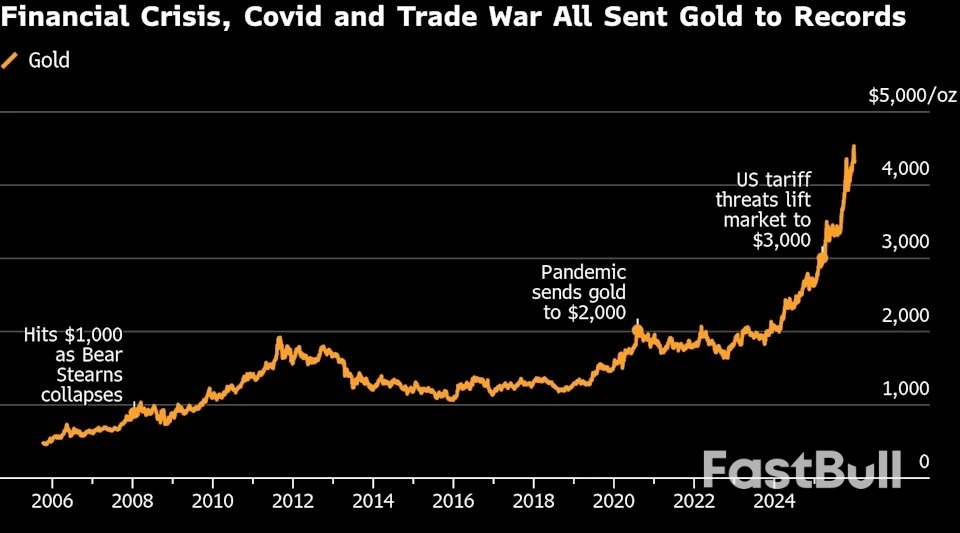
          Gold and silver fell on the last trading day of 2025, though both remained on track for the biggest annual gain in more than four decades as a banner year for precious metals draws to a close.
          Spot gold hovered around $4,320 an ounce, while silver slid toward $71. The two have seen exceptional volatility in thin post-holiday trading, plunging Monday before recovering Tuesday and dropping again Wednesday. The big swings prompted exchange operator CME Group to raise margin requirements twice.
          Both metals are still on track for their best year since 1979, supported by strong demand for haven assets amid mounting geopolitical risks, and by interest-rate cuts by the US Federal Reserve. The so-called debasement trade — triggered by fears of inflation and swelling debt burdens in developed economies — has helped supercharge the scorching rally.
          In gold, the bigger market by far, those factors spurred a rush by investors into bullion-backed exchange-traded funds, while central banks extended a years-long buying spree.Gold and Silver Stumble at the End of Best Year Since the 1970s_1
          Gold is up about 63% this year. In September, it eclipsed an inflation-adjusted peak set 45 years ago — a time when US currency pressures, spiking inflation and an unfolding recession pushed prices to $850. This time around, the record run saw prices smash through $4,000 in early October.
          “In my career, it’s unprecedented,” said John Reade, a market veteran and chief strategist at the World Gold Council. “Unprecedented by the number of new all-time highs, and unprecedented in the performance of gold exceeding the expectations of so many people by so much.”
          Silver has notched up a gain of more than 140% during the year, driven by speculative buying but also by industrial demand, with the metal used extensively in electronics, solar panels and electric cars. In October, it soared to a record as tariff concerns drove imports into the US, tightening the London market and triggering a historic squeeze.
          The new peak was then passed the following month as US rate cuts and speculative fervor drove prices higher, and the rally topped out above $80 earlier this week — in part reflecting elevated buying in China.
          Yet the latest move swiftly reversed, with the market closing down 9% on Monday then swinging the following two days. In response to the extreme volatility, CME Group again raised margins on precious-metal futures, meaning traders must put up more cash to keep their positions open. Some speculators may be forced to shrink or exit their trades — weighing on prices.
          “The key driver today is the CME raising margins for the second time in just a few days,” said Ross Norman, chief executive officer of Metals Daily, a pricing and analysis website. The higher collateral requirements are “cooling the markets off,” he said.

          Platinum, Palladium

          The enthusiasm for gold and silver has extended into the wider precious-metals complex in 2025, with platinum breaking out of a years-long holding pattern to hit a new high.
          The metal is on course for a third annual deficit, following disruptions in major producer South Africa, and supply will likely remain tight until there’s clarity on whether the Trump administration will impose tariffs — as well as on silver.
          Prices for silver, platinum and palladium all sagged on Wednesday, though there’s little sign of enthusiasm waning.
          “2025’s surprise was how safe-haven metals turned into momentum trades — silver in particular,” said Charu Chanana, chief market strategist at Saxo Markets in Singapore.
          Silver traded down 6% at $71.44 an ounce as of 12:28 p.m. in New York. Gold slipped 0.4% to $4,322.04 an ounce, while the Bloomberg Dollar Spot Index was up 0.1%.

          Source: Bloomberg

          Risk Warnings and Disclaimers
          You understand and acknowledge that there is a high degree of risk involved in trading. Following any strategies or investment methods may lead to potential losses. The content on the site is provided by our contributors and analysts for information purposes only. You are solely responsible for determining whether any trading assets, securities, strategy, or any other product is suitable for investing based on your own investment objectives and financial situation.
          Add to Favorites
          Share

          Will Trump Get His Rate Cuts In 2026?

          Devin

          Central Bank

          Despite incremental dovish shifts in the makeup of the FOMC voters, early 2026 is still likely to bring a pause to the Fed's easing cycle.

          FOMC, Federal Reserve Key Points

          • The Fed may shift to a slightly more dovish or centrist outlook heading into the new year based on the rotating cast of FOMC voters.
          • The bigger shift will be at the top: Chairman Powell's term ends in May, leaving an opening at the top for President Trump to nominate a more dovish successor early next year.
          • Despite these dovish shifts, early 2026 is still likely to bring a pause to the central bank's easing cycle.

          "New Year, New You" the saying goes, but for traders, the more salient phrase may be more along the lines of "New Fed, New Markets."

          The FOMC will enter 2026 with a fresh slate of regional bank presidents and a leadership transition on the horizon, developments that could shift the markets current expectations for interest rate cuts at the world's most important central bank.

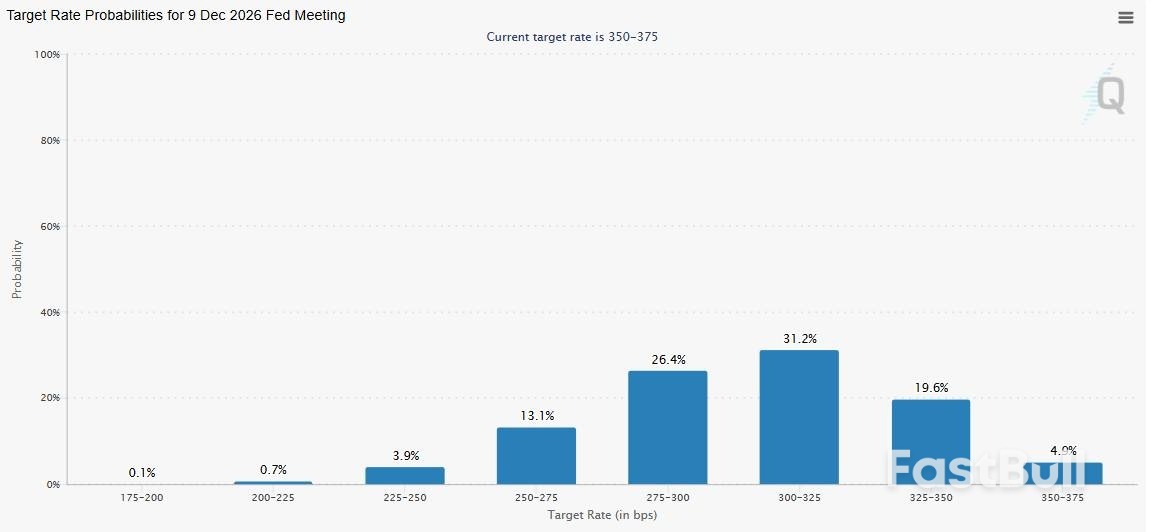
          As the chart below shows, traders are currently pricing in a wide range between one and four 25bps interest rate cuts by the Fed in 2026, presenting clear trading opportunities for traders who are able to successfully handicap the outcome:

          Source: CME FedWatch

          FOMC Voter Changes in 2026: Who's In and Who's Out?

          When it comes to the usual rotating voters, four Reserve Bank presidents will rotate off the FOMC in the new year: Susan Collins (Boston), Austan Goolsbee (Chicago), Alberto Musalem (St. Louis), and Jeff Schmid (Kansas City).

          Their replacements are Anna Paulson (Philadelphia), Beth Hammack (Cleveland), Lorie Logan (Dallas), and Neel Kashkari (Minneapolis).

          On balance, the outgoing voters lean hawkish (less inclined to cut interest rates overall. Recent quotes from the outgoing presidents follow:

          • Susan Collins (hawkish lean): "Policy remains restrictive and that's appropriate for now."
          • Alberto Musalem (hawkish lean): "[There is] limited room for further cuts"
          • Jeff Schmid (outright hawk): "Inflation is still too high and policy is only modestly restrictive." (also note his dissents against the most recent two interest rate cuts)
          • Austan Goolsbee (centrist/hawkish lean): "I expect more cuts in 2026 than most of my colleagues." (note this came after a dissent against the December rate cut in favor of waiting for more data)

          Meanwhile, the new voters are more balanced, with two leaning hawkish and two more dovish:

          • Anna Paulson (dovish lean): "I'm more concerned about weakening employment than lingering inflation." (She also noted that tariff-driven price pressures should fade, signaling openness to insurance cuts.)
          • Neel Kashkari (centrist/dovish lean): "I supported additional cuts because tariffs are a one-off shock and the labor market is cooling."
          • Beth Hammack (hawk): "We should take the recent inflation improvement with a grain of salt and keep policy slightly more restrictive until we're confident."
          • Lorie Logan (hawk): "Further cuts risk moving policy into accommodative territory while core services inflation remains sticky."

          Overall, the regular voter rotation could shift the Fed to a slightly more dovish or centrist outlook heading into the new year, though the move is likely to be marginal and economic data will still take precedence over broad ideological leans.

          2026 FOMC Shift: The Leadership Wildcard

          As you've no doubt heard, the bigger shift could be at the top: Chairman Powell's second four-year term ends in May, leaving an opening at the top for President Trump to nominate a(n almost certainly more dovish) successor early next year.

          Names floated include Kevin Hassett, Kevin Warsh, and Chris Waller. Hassett and Warsh are widely viewed as favoring a more aggressive easing stance, citing growth risks and political priorities. Waller, meanwhile, has leaned hawkish historically but could pivot under a Trump mandate for faster cuts.

          Beyond the appointment of a new Chairman in January, readers should also be aware that Trump-appointed Governor Stephen Miran exits January 31, 2026. In his so-far short tenure at the Fed, Miran has repeatedly dissented in favor of large 50bps rate cuts, making him the most dovish voice on the Board. In all likelihood, his replacement will reinforce a pro-easing tilt. Combined with a new Chair, this could shift the seven-member Board toward a majority favoring quicker normalization, even if regional presidents urge caution.

          Despite these dovish shifts, early 2026 is still likely to bring a pause to the central bank's easing cycle, with the potential for interest rate cuts to accelerate through the middle of the year on the back of a new, more dovish Chairman, especially if employment data continues to deteriorate.

          Source: Investing

          Risk Warnings and Disclaimers
          You understand and acknowledge that there is a high degree of risk involved in trading. Following any strategies or investment methods may lead to potential losses. The content on the site is provided by our contributors and analysts for information purposes only. You are solely responsible for determining whether any trading assets, securities, strategy, or any other product is suitable for investing based on your own investment objectives and financial situation.
          Add to Favorites
          Share

          Why 2026 may be a strong year for biotech stocks

          Adam

          Stocks

          Biotech stocks have staged an impressive rally over the past six months, with the XBI index – key benchmark for small and mid-cap biotech names – posting one of its strongest stretches on record.
          Mizuho’s senior healthcare analyst Jared Holz believes this momentum is more than a short-term bounce.
          Speaking with CNBC, he argued the sector is positioned for continued strength in 2026, supported by easing drug pricing concerns, healthier market dynamics, and robust merger activity.
          While volatility is inherent in biotech, Holz sees the current environment as one of the most bullish for biotech stocks in years.

          Why is Mizuho bullish on biotech stocks?

          For years, uncertainty related to drug pricing weighed heavily on biotech valuations.
          The Inflation Reduction Act (IRA) and negotiations with the White House created a noisy backdrop that deterred investors.
          However, under the Trump administration, “a dozen pharma companies have agreed with White House on pricing mechanisms,” Holz told CNBC, suggesting much of the uncertainty is now behind the sector.
          With the most contentious debates resolved, investors are beginning to view pharma and biotech stocks as more investable.
          According to the Mizuho analyst, this thawing of rhetoric will allow multiples to expand further, as the market no longer fears sudden regulatory shocks.
          In his view, 2026 could mark a turning point where pricing risks fade into the background.

          Market structure bodes well for biotech stocks

          Another reason Jared Holz is constructive is the healthier structure of the biotech market itself.
          The sheer number of listed biotech assets overwhelmed investors for years, creating a “denominator problem” that diluted attention and capital.
          This exponential increase in the listed biotech firms was a major reason for Holz’s bearish stance in the past.
          However, with fewer new entrants and more rationalised pipelines, investors can better analyse opportunities now, the Mizuho analyst argued in the CNBC interview.
          Combined with the prospect of more rate cuts, which would improve financing conditions, biotech stocks look increasingly attractive for 2026.
          Additionally, the sector’s recent six-month winning streak is unprecedented, which Holz said is indicative of renewed confidence among institutional investors heading into the new year.

          Merger activity could drive biotech stocks higher

          Finally, Holz expects deal-making to serve as a powerful tailwind for biotech stocks in 2026.
          “20 deals worth over $500 million just this year in publicly traded equities,” he noted, highlighting the scale of consolidation.
          Beyond public markets, private biotech has also seen notable acquisition activity.
          This wave of mergers not only validates the value of biotech innovation but also provides liquidity and confidence to investors.
          Larger pharmaceutical companies are increasingly turning to biotech firms for pipeline expansion, reinforcing the sector’s strategic importance.
          According to Jared Holz, this trend will continue next year, creating catalysts for valuations and sustaining momentum in small and mid-cap biotech stocks.

          Source: invezz

          Risk Warnings and Disclaimers
          You understand and acknowledge that there is a high degree of risk involved in trading. Following any strategies or investment methods may lead to potential losses. The content on the site is provided by our contributors and analysts for information purposes only. You are solely responsible for determining whether any trading assets, securities, strategy, or any other product is suitable for investing based on your own investment objectives and financial situation.
          Add to Favorites
          Share

          China takes record share of Europe’s EV market in November

          Adam

          Economic

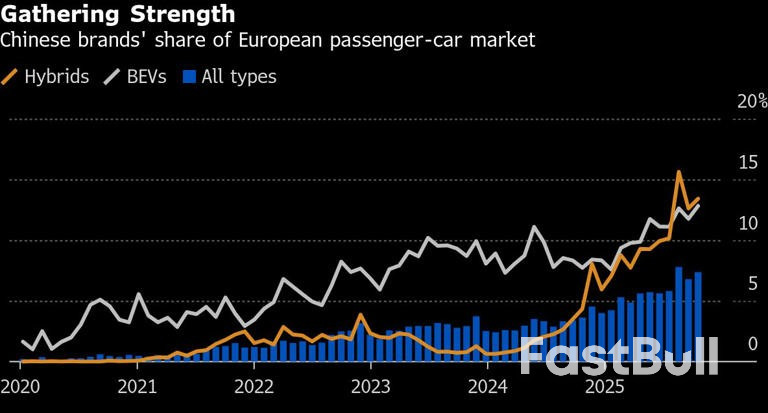
          Chinese carmakers captured a record 12.8% of Europe’s electric-vehicle market in November, building on gains made this year despite the cost of European Union tariffs.
          In the fast-growing hybrid-car categories, Chinese brands resumed their rise, surpassing 13% across the EU, EFTA countries and the UK, according to researcher Dataforce.
          China takes record share of Europe’s EV market in November_1

          Gathering Strength | Chinese brands' share of European passenger-car market

          Brands led by BYD Co. and SAIC Motor Corp., along with newer entrants such as Chery Automobile Co. and Zhejiang Leapmotor Technology Co., have redoubled efforts to crack the European market this year. Overcapacity in China has fed the export push, as manufacturers seek a release from relentless price wars in their domestic market.
          Mainland automakers have largely absorbed the extra fees that the EU imposed on Chinese-made EVs in late 2024, while pressing into areas unaffected by the new tariffs, such as hybrid models and non-EU markets like the UK.
          Through October, Leapmotor’s European EV sales had surged more than 4,000%, based on separate data from Jato Dynamics — growth bolstered by a joint venture with Stellantis NV, the parent of Peugeot, Fiat and Opel. Chery’s Omoda brand saw an 1,100% EV rise over the same time frame.
          As Chinese automakers sell more electrified models in Europe, the region’s homegrown automakers have tried to keep up, while lobbying for an easing of rules phasing out traditional fossil fuel-powered cars.
          EU officials have proposed dropping a plan to ban sales of new combustion-powered vehicles by 2035, in the latest bid to protect one of the continent’s most important industries from a chaotic energy transition.

          Source: Bloomberg

          To stay updated on all economic events of today, please check out our Economic calendar
          Risk Warnings and Disclaimers
          You understand and acknowledge that there is a high degree of risk involved in trading. Following any strategies or investment methods may lead to potential losses. The content on the site is provided by our contributors and analysts for information purposes only. You are solely responsible for determining whether any trading assets, securities, strategy, or any other product is suitable for investing based on your own investment objectives and financial situation.
          Add to Favorites
          Share

          Gold And Silver Outlook For 2026: Why Hard Assets May Beat Stocks

          Justin

          Stocks

          That old line — you either own paper or you own hard assets — made sense in a world where inflation cycles were shorter, balance sheets were smaller, and capital still respected gravity. I heard it constantly when I started in this business back in 1982. You picked a side. Paper meant you thought growth was coming. Hard assets meant you thought trouble was coming.

          What's changed is not the rule, but the environment it operates in.

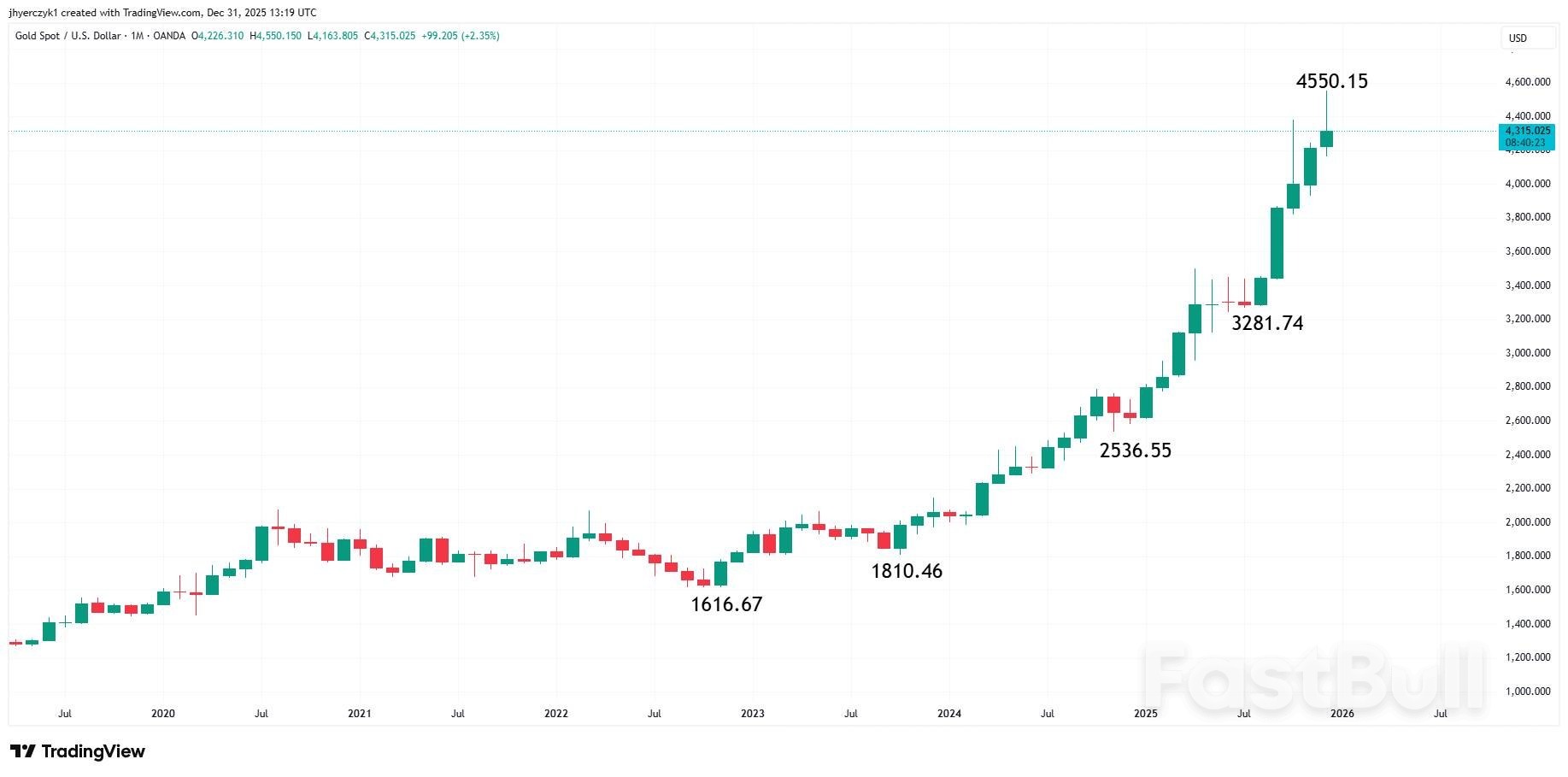
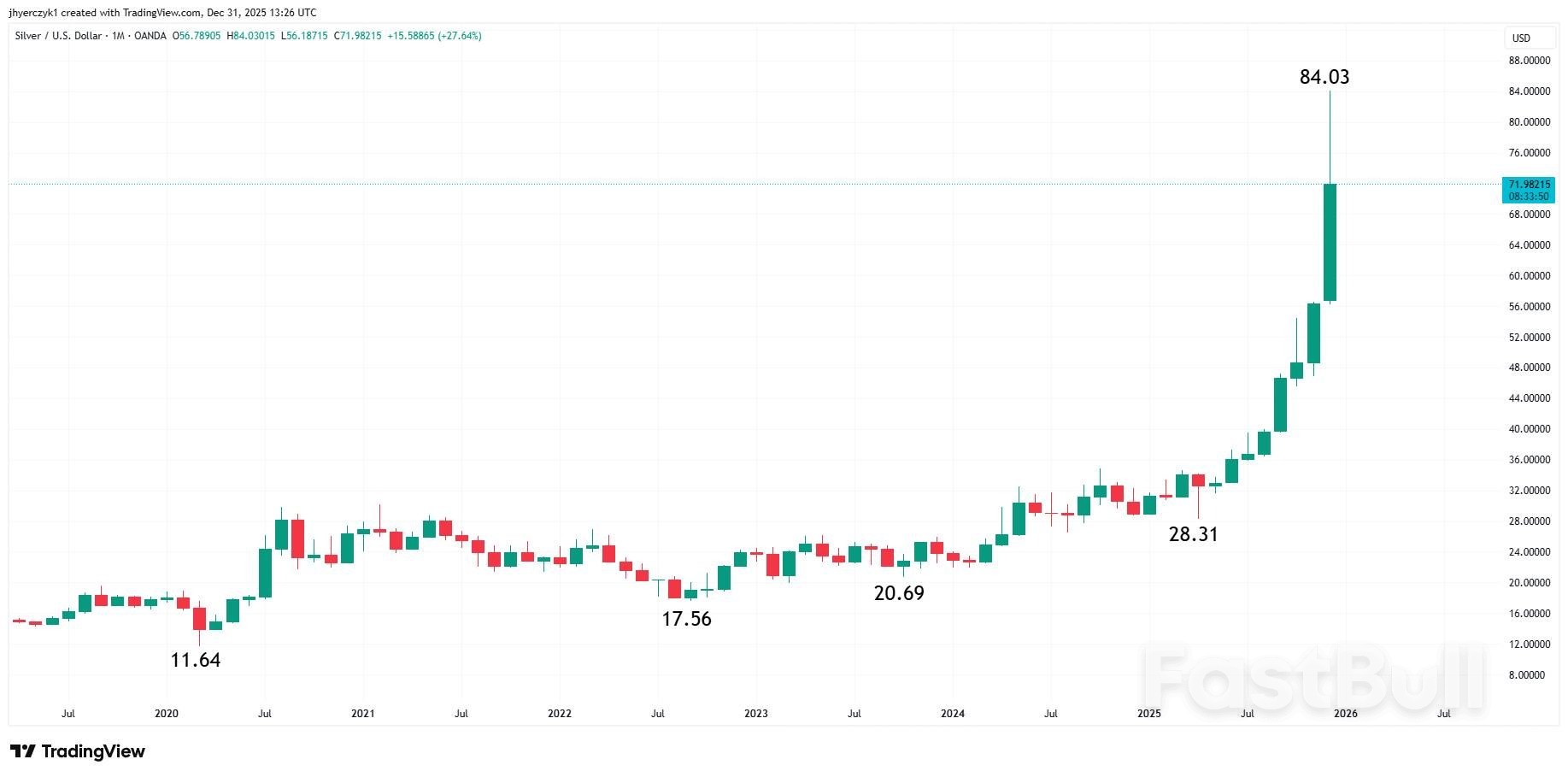
          As we head into the final stretch of 2025, both stocks and precious metals are trading near record highs. The S&P sits around 6,900. Gold is testing $4,600. Silver touched $84. But if you look at where the real conviction is right now — not the hope, the actual targets — the metal guys are a lot more certain than the equity guys.

          Richmond Lee, CFA and Senior Market Analyst at PU Prime commented:

          As markets move toward the final stretch of 2025, a striking divergence is emerging between financial assets and hard assets. Both U.S. equities and precious metals are trading near record highs, yet the degree of conviction behind future expectations differs materially. While equity forecasts remain conditional and tightly range-bound, projections for gold and silver continue to move higher with growing confidence.

          In precious metals, the narrative has become increasingly structural. Major institutions such as JPMorgan and Bank of America have lifted gold targets toward the 5,000 to 6,000 dollar range over the next two years, citing sustained central bank diversification, currency debasement, and long-term demand resilience. These forecasts are not framed as short-term trades, but as part of a longer regime shift in global reserve management. Gold now represents a larger share of central bank reserves than U.S. Treasuries for the first time in decades, reinforcing the idea of a structural reallocation rather than a cyclical move.

          Silver's case appears even more asymmetric. Prices have already exceeded many bank forecasts, forcing analysts to revise models upward as the market enters price discovery. Persistent supply deficits, combined with rising industrial demand from solar, electric vehicles, and data centers, leave little room for complacency. Unlike gold, silver's dual role as a monetary and industrial metal amplifies upside during periods of strong demand.

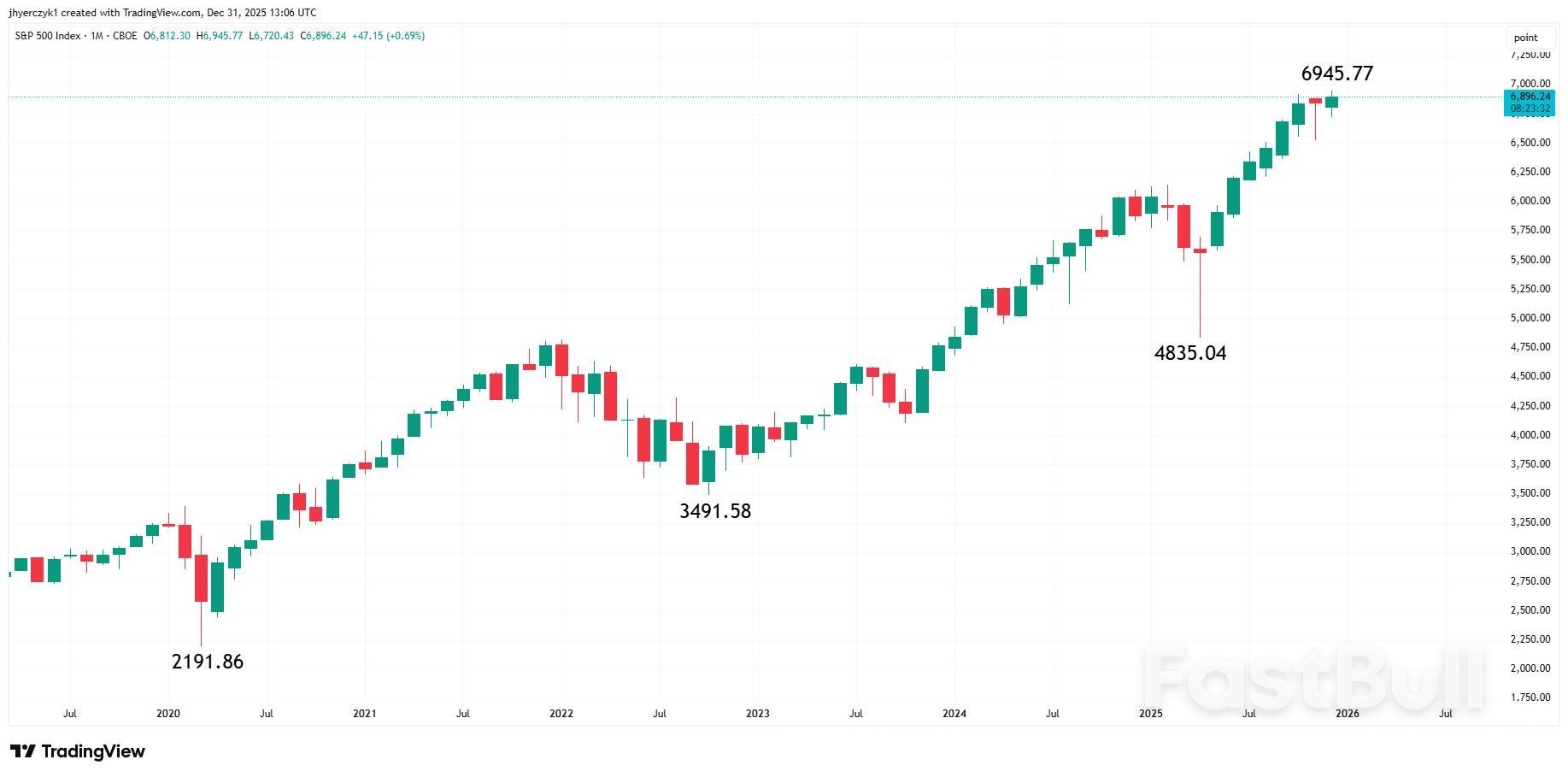
          Equities, by contrast, face a narrower margin for error. Wall Street targets for the S&P 500 cluster between 7,100 and 8,000, implying mid to low double-digit upside that depends on strong earnings growth, stable inflation, and supportive monetary policy. Valuations remain elevated, meaning disappointment rather than crisis could be enough to pressure returns.

          Looking into 2026, the contrast is clear. Equities require near-perfect execution, while metals simply require existing structural trends to persist. In the current macro regime, capital appears increasingly aligned with the latter.

          The Metal Bulls Keep Raising Targets

          JPMorgan's Natasha Kaneva isn't hedging. $5,000 gold by year-end 2026, heading toward $5,400 in 2027.

          "While this rally in gold has not, and will not, be linear, we believe the trends driving this rebasing higher in gold prices are not exhausted," Kaneva said. "The long-term trend of official reserve and investor diversification into gold has further to run."

          Ed Yardeni — whose calls have been right often enough that people listen — sits at $6,000 gold by the end of 2026, with $10,000 by the end of the decade. Bank of America is at $5,000.

          That's a directional consensus: $5,000 to $6,000. Even from today's levels, that's 10% to 30% upside. And the forecasts keep getting revised higher as the rally continues.

          Monthly Spot Gold (XAUUSD). Source: TradingView

          Silver? Wall Street Can't Keep Up.

          Silver is making a mockery of the forecasts. Most of the major bank targets for year-end 2026 have already been blown through.

          The problem isn't that analysts got it wrong. It's that they're scrambling to catch up with a market that's in price discovery mode. Citi's more aggressive models point toward $110 in the second half of 2026. Technical analysts are talking about $100-plus if the gold-to-silver ratio compression continues.

          Steven Orrell at OCM Gold Fund explained what's happening: "Historically, silver tends to lag gold early in a bull run and then experiences sharp catch-up rallies, which is what we're seeing now."

          That's the pattern playing out in real time. Silver doesn't follow gold — it amplifies gold. And when Wall Street's year-end targets are already behind the spot price, you're not in a normal bull market anymore. You're in a structural repricing.

          Monthly Spot Silver (XAGUSD). Source: TradingView

          The equity guys? They're hoping.

          Deutsche Bank has the highest target on the Street: 8,000 on the S&P 500. That's roughly 15% upside from current levels.

          Goldman Sachs sits at 7,600, forecasting $305 in earnings per share — 12% growth.

          JPMorgan's baseline is 7,500, with upside to 8,000 if the Fed cuts more aggressively. But listen to how Dubravko Lakos-Nujas frames it: "Despite AI bubble and valuation concerns, we see current elevated multiples correctly anticipating above-trend earnings growth, an AI capex boom, rising shareholder payouts and easier fiscal policy."

          Despite bubble concerns. That's not conviction. That's hope that valuations don't matter because earnings will bail everyone out.

          Bank of America is more honest. 7,100 target. $310 in earnings. But here's what matters:

          "Multiple expansion and earnings growth both pushed the S&P 500 up 15% this year. In 2026, earnings will do the lift with about 10pt PE contraction."

          Translation: don't expect the market to get more expensive. Expect it to get cheaper, and hope earnings growth offsets the valuation decline.

          The range across Wall Street: 7,100 to 8,000. That's 5% to 15% upside, and every forecast comes with conditions attached.

          Monthly S&P 500 Index (SPX). Source: TradingView

          Goldman's number "assumes strong profit growth, stable inflation, and rate cuts starting in mid-2026."

          Ned Davis Research sits at just 7,000 — barely 3% higher than today. Ed Clissold told CNBC he worries investors are on a "sugar high" and that changing Fed leadership in May could create volatility.

          One analyst put it bluntly: "At current valuation levels, stocks don't need a crisis to fall; they only need disappointment."

          This Isn't a Cycle. It's a Regime.

          I've been in this business for 43 years. I know what conviction looks like.

          When JPMorgan talks about a "long-term trend of official reserve diversification" that has "further to run," they're not talking about a six-month trade. They're talking about something structural.

          Ben McMillan at IDX Advisors called it what it is: "After Covid is when we started seeing central banks really step up buying gold to an unprecedented level, and it hasn't really waned. That was kind of a structural shift, not a shift along the demand curve for gold; that's a regime change."

          A regime change.

          For the first time since 1996, gold now accounts for a larger share of central bank reserves than U.S. Treasuries. That's not a trend line. That's a tectonic shift in how sovereign wealth views risk.

          Gold ETFs posted a record $26 billion inflow in Q3 2025 alone. Silver has been in a structural supply deficit for five consecutive years. Solar, EVs, AI data centers — they all need silver, and there's no substitute that performs as well.

          Meanwhile, the S&P 500 is trading at a forward P/E around 22 to 23 times earnings — well above the historical average of 15.3x. The bull case for stocks requires everything to go right: strong GDP, stable inflation, margin expansion, no policy mistakes, AI spending that actually translates to profits.

          The bull case for metals requires one thing: that central banks keep doing what they've been doing.

          The Setup for 2026

          Stocks could deliver 7%, 10%, maybe 12% if everything breaks right. But they could just as easily go sideways or down 10% if anything disappoints — and at these valuations, the margin for error is thin.

          Gold and silver? The structural drivers — currency dilution, central bank buying, supply deficits — aren't going away. The downside is limited. The upside is wide open.

          The stock guys are penciling in single-digit to low-teens returns if the stars align.

          The metal guys are already revising targets higher because the foundation shifted underneath the market.

          After watching every major turn since Volcker broke inflation's back, I've learned one thing: when equity forecasts come with asterisks and metal forecasts keep getting raised mid-cycle, the metals win.

          Stocks need perfect execution. Metals just need the system to keep being the system.

          I know which bet I'd take.

          Source: FX Empire

          Risk Warnings and Disclaimers
          You understand and acknowledge that there is a high degree of risk involved in trading. Following any strategies or investment methods may lead to potential losses. The content on the site is provided by our contributors and analysts for information purposes only. You are solely responsible for determining whether any trading assets, securities, strategy, or any other product is suitable for investing based on your own investment objectives and financial situation.
          Add to Favorites
          Share

          FTSE 100 at a new high📈 Those 3 sectors are powering UK stocks

          Adam

          Stocks

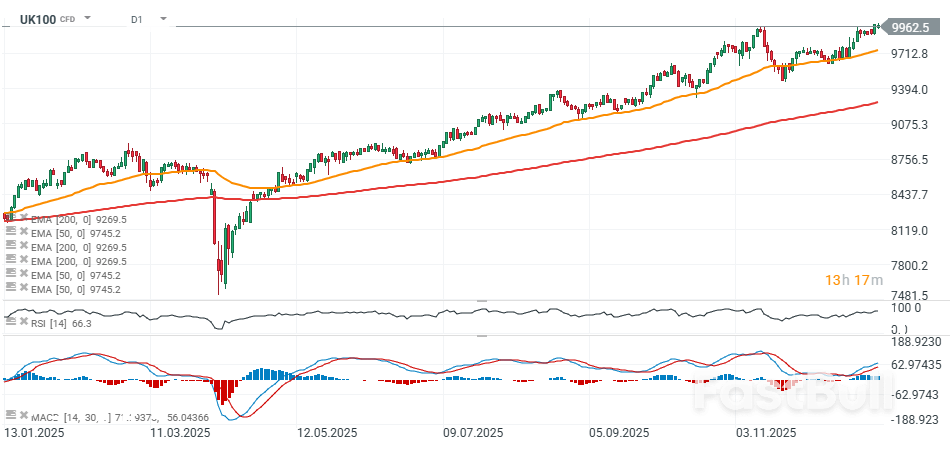
          UK FTSE100 index hit historic high yesterday, driven by mining and metals sectors and aerospace & defense. London stocks are slightly lower today, with the FTSE 100 expected to give back a small portion of its strong year-to-date run after hitting fresh records on Tuesday 30 December. The rally in 2025 has been powerful. The FTSE 100 is up roughly 22% year-to-date, following a more modest appx. 5% gain in 2024.
          Precious metal miners have been standout winners, led by Fresnillo, which is up roughly five-fold this year on the back of surging commodity prices. Fresnillo also hit a record high on Tuesday, underscoring how dominant the metals theme has been.
          Aerospace and defence stocks have enjoyed a strong year, with Babcock and Rolls-Royce roughly doubling and BAE Systems up around 50%. The sector remains supported by broader geopolitical trends and rising defence spending.
          UK banks have also contributed significantly to performance: LLoyds and Barclays gained almost 80% while Standard Chartered and HSBC gained 85% and 50% respectively
          Will FTSE100 outperform UK mid and small stocks?
          2026 is increasingly looking like another year where the FTSE 100 beats the FTSE 250. The large-cap index has the wind at its back, while UK-focused mid-caps face a tougher domestic backdrop.
          The performance gap is already massive. Over the last five years, the FTSE 100 is up roughly 50%, around five times more than the FTSE 250.
          The “UK reopening” story that helped the FTSE 250 in 2021 is gone, back then, the domestically-driven index benefited from post-lockdown momentum — but heading into 2026, there’s no similar feel-good catalyst.
          Both indices show similar earnings growth expectations (~9%), but the risk profile isn’t equal, the FTSE 250 looks more exposed to earnings downgrades given signs of weakness in the UK economy.
          UK consumer data is a warning signal; Barclays data suggests UK households are entering 2026 on a weaker footing, which doesn’t bode well for the more domestic FTSE 250.
          The FTSE 100’s structure is simply more attractive right now; it leans more international and defensive (with sectors like health care), which tends to hold up better when economic momentum softens.
          Even for mid-cap exposure, the FTSE 250 doesn’t stack up well versus Europe, the index lags European peers in expected earnings growth next year.
          Bloomberg Intelligence expects FTSE 100 earnings momentum to stay stronger than the Stoxx 600, which strenghthens the case for large-cap UK exposure vs broader Europe.
          Mining exposure is a major wildcard advantage for the FTSE 100, and if metals keep rallying, FTSE 100 names may benefit disproportionately. Fresnillo has already surged ~450% year-to-date, underlining how powerful this theme can be.
          Rising global defense spending continues to favor names like BAE Systems and Rolls-Royce, adding structural support to the FTSE 100.
          Limited room for BOE cuts is a tailwind for FTSE 100 banks. That setup tends to favor bank-heavy exposure, while it works against the FTSE 250’s heavier weighting in interest-rate-sensitive real estate.

          UK100 (D1 interval)

          FTSE 100 at a new high📈 Those 3 sectors are powering UK stocks_1

          Source: xtb

          Risk Warnings and Disclaimers
          You understand and acknowledge that there is a high degree of risk involved in trading. Following any strategies or investment methods may lead to potential losses. The content on the site is provided by our contributors and analysts for information purposes only. You are solely responsible for determining whether any trading assets, securities, strategy, or any other product is suitable for investing based on your own investment objectives and financial situation.
          Add to Favorites
          Share

          US Markets Reveal Wide YTD Dispersion Beneath Strong Headline Equity Returns

          Adam

          Economic

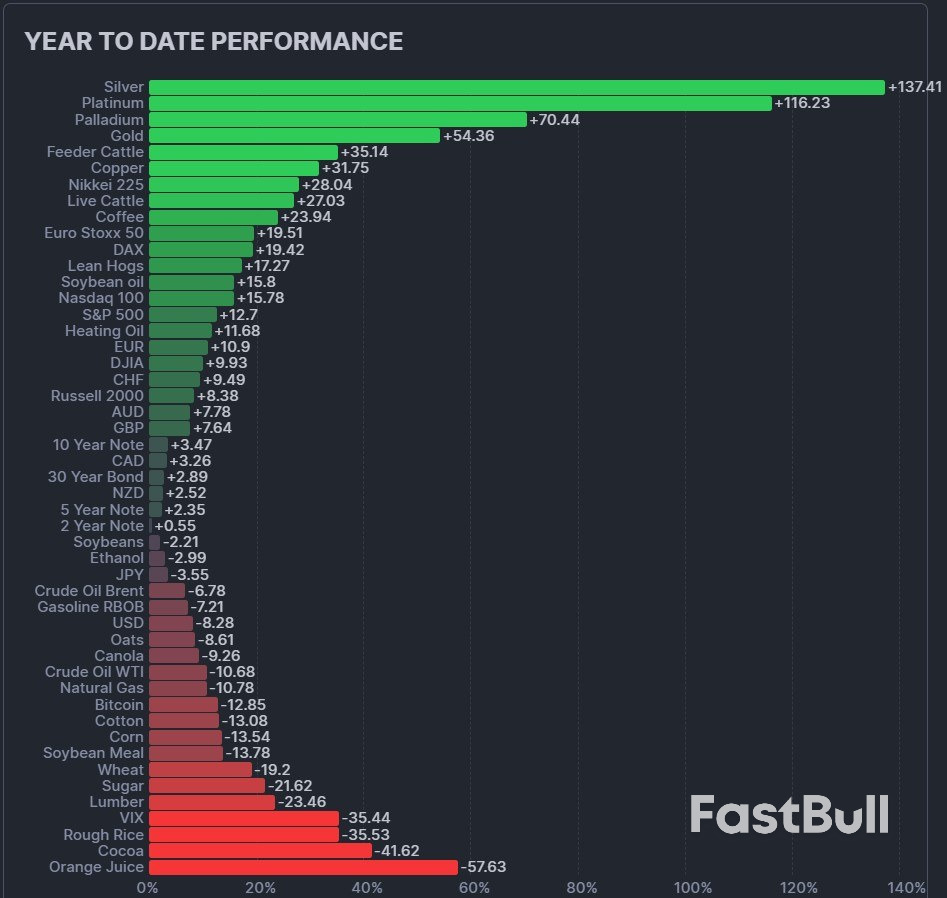
          YTD returns across major U.S. asset classes continue to reflect a highly concentrated market. The Finviz chart below does a nice job illustrating YTD returns across a wide array of futures contracts. Large-caps dominate YTD equity returns, while small- and mid-cap stocks lag amid tighter financial conditions and slower earnings growth.
          Outside of equities, YTD returns have been more muted. Bonds have stabilized as yields eased from their highs, offering modest diversification benefits, while cash remains competitive thanks to elevated short-term rates. Commodities and real assets have delivered mixed YTD returns as global growth slows and inflation pressures fade.
          The takeaway is clear: YTD returns viewed at a high level mask wide dispersion beneath the surface, making positioning and diversification far more critical than broad market exposure.
          US Markets Reveal Wide YTD Dispersion Beneath Strong Headline Equity Returns_1
          Fed Minutes Point to a Slower Path for Rate Cuts
          Minutes from the Fed’s December meeting show policymakers growing more cautious about cutting rates further in early 2026. Several officials noted that the decision to ease in December was “finely balanced,” with some preferring to hold rates steady as inflation progress shows signs of stalling.
          While labor market conditions have softened, economic growth and consumer spending remain resilient, complicating the policy outlook. As a result, many participants favored keeping rates unchanged for “some time” while assessing incoming data. That stance aligns with the Fed’s projections, which point to a slower and more data-dependent path for future cuts.

          Source: investing

          To stay updated on all economic events of today, please check out our Economic calendar
          Risk Warnings and Disclaimers
          You understand and acknowledge that there is a high degree of risk involved in trading. Following any strategies or investment methods may lead to potential losses. The content on the site is provided by our contributors and analysts for information purposes only. You are solely responsible for determining whether any trading assets, securities, strategy, or any other product is suitable for investing based on your own investment objectives and financial situation.
          Add to Favorites
          Share
          FastBull
          Copyright © 2026 FastBull Ltd

          728 RM B 7/F GEE LOK IND BLDG NO 34 HUNG TO RD KWUN TONG KLN HONG KONG

          TelegramInstagramTwitterfacebooklinkedin
          App Store Google Play Google Play
          Products
          Charts

          Chats

          Q&A with Experts
          Screeners
          Economic Calendar
          Data
          Tools
          Membership
          Features
          Function
          Markets
          Copy Trading
          Latest Signals
          Contests
          News
          Analysis
          24/7
          Columns
          Education
          Company
          Careers
          About Us
          Contact Us
          Advertising
          Help Center
          Feedback
          User Agreement
          Privacy Policy
          Personal Information Protection Statement
          Business

          White Label

          Data API

          Web Plug-ins

          Poster Maker

          Affiliate Program

          Risk Disclosure

          The risk of loss in trading financial instruments such as stocks, FX, commodities, futures, bonds, ETFs and crypto can be substantial. You may sustain a total loss of the funds that you deposit with your broker. Therefore, you should carefully consider whether such trading is suitable for you in light of your circumstances and financial resources.

          No decision to invest should be made without thoroughly conducting due diligence by yourself or consulting with your financial advisors. Our web content might not suit you since we don't know your financial conditions and investment needs. Our financial information might have latency or contain inaccuracy, so you should be fully responsible for any of your trading and investment decisions. The company will not be responsible for your capital loss.

          Without getting permission from the website, you are not allowed to copy the website's graphics, texts, or trademarks. Intellectual property rights in the content or data incorporated into this website belong to its providers and exchange merchants.

          Not Logged In

          Log in to access more features

          FastBull Membership

          Not yet

          Purchase

          Become a signal provider
          Help Center
          Customer Service
          Dark Mode
          Price Up/Down Colors

          Log In

          Sign Up

          Position
          Layout
          Fullscreen
          Default to Chart
          The chart page opens by default when you visit fastbull.com