Markets
News
Analysis
User
24/7
Economic Calendar
Education
Data
- Names
- Latest
- Prev


Signal Accounts for Members
All Signal Accounts
All Contests


France Trade Balance (SA) (Oct)A:--
F: --
Euro Zone Employment YoY (SA) (Q3)A:--
F: --
Canada Part-Time Employment (SA) (Nov)A:--
F: --
P: --
Canada Unemployment Rate (SA) (Nov)A:--
F: --
P: --
Canada Full-time Employment (SA) (Nov)A:--
F: --
P: --
Canada Labor Force Participation Rate (SA) (Nov)A:--
F: --
P: --
Canada Employment (SA) (Nov)A:--
F: --
P: --
U.S. PCE Price Index MoM (Sept)A:--
F: --
P: --
U.S. Personal Income MoM (Sept)A:--
F: --
P: --
U.S. Core PCE Price Index MoM (Sept)A:--
F: --
P: --
U.S. PCE Price Index YoY (SA) (Sept)A:--
F: --
P: --
U.S. Core PCE Price Index YoY (Sept)A:--
F: --
P: --
U.S. Personal Outlays MoM (SA) (Sept)A:--
F: --
U.S. 5-10 Year-Ahead Inflation Expectations (Dec)A:--
F: --
P: --
U.S. Real Personal Consumption Expenditures MoM (Sept)A:--
F: --
U.S. Weekly Total Rig CountA:--
F: --
P: --
U.S. Weekly Total Oil Rig CountA:--
F: --
P: --
U.S. Consumer Credit (SA) (Oct)A:--
F: --
China, Mainland Foreign Exchange Reserves (Nov)A:--
F: --
P: --
Japan Trade Balance (Oct)A:--
F: --
P: --
Japan Nominal GDP Revised QoQ (Q3)A:--
F: --
P: --
China, Mainland Imports YoY (CNH) (Nov)A:--
F: --
P: --
China, Mainland Exports (Nov)A:--
F: --
P: --
China, Mainland Imports (CNH) (Nov)A:--
F: --
P: --
China, Mainland Trade Balance (CNH) (Nov)A:--
F: --
P: --
China, Mainland Exports YoY (USD) (Nov)A:--
F: --
P: --
China, Mainland Imports YoY (USD) (Nov)A:--
F: --
P: --
Germany Industrial Output MoM (SA) (Oct)A:--
F: --
Euro Zone Sentix Investor Confidence Index (Dec)A:--
F: --
P: --
Canada National Economic Confidence IndexA:--
F: --
P: --
U.K. BRC Like-For-Like Retail Sales YoY (Nov)--
F: --
P: --
U.K. BRC Overall Retail Sales YoY (Nov)--
F: --
P: --
Australia Overnight (Borrowing) Key Rate--
F: --
P: --
RBA Rate Statement
RBA Press Conference
Germany Exports MoM (SA) (Oct)--
F: --
P: --
U.S. NFIB Small Business Optimism Index (SA) (Nov)--
F: --
P: --
Mexico 12-Month Inflation (CPI) (Nov)--
F: --
P: --
Mexico Core CPI YoY (Nov)--
F: --
P: --
Mexico PPI YoY (Nov)--
F: --
P: --
U.S. Weekly Redbook Index YoY--
F: --
P: --
U.S. JOLTS Job Openings (SA) (Oct)--
F: --
P: --
China, Mainland M1 Money Supply YoY (Nov)--
F: --
P: --
China, Mainland M0 Money Supply YoY (Nov)--
F: --
P: --
China, Mainland M2 Money Supply YoY (Nov)--
F: --
P: --
U.S. EIA Short-Term Crude Production Forecast For The Year (Dec)--
F: --
P: --
U.S. EIA Natural Gas Production Forecast For The Next Year (Dec)--
F: --
P: --
U.S. EIA Short-Term Crude Production Forecast For The Next Year (Dec)--
F: --
P: --
EIA Monthly Short-Term Energy Outlook
U.S. API Weekly Gasoline Stocks--
F: --
P: --
U.S. API Weekly Cushing Crude Oil Stocks--
F: --
P: --
U.S. API Weekly Crude Oil Stocks--
F: --
P: --
U.S. API Weekly Refined Oil Stocks--
F: --
P: --
South Korea Unemployment Rate (SA) (Nov)--
F: --
P: --
Japan Reuters Tankan Non-Manufacturers Index (Dec)--
F: --
P: --
Japan Reuters Tankan Manufacturers Index (Dec)--
F: --
P: --
Japan Domestic Enterprise Commodity Price Index MoM (Nov)--
F: --
P: --
Japan Domestic Enterprise Commodity Price Index YoY (Nov)--
F: --
P: --
China, Mainland PPI YoY (Nov)--
F: --
P: --
China, Mainland CPI MoM (Nov)--
F: --
P: --
Italy Industrial Output YoY (SA) (Oct)--
F: --
P: --


No matching data
Latest Views
Latest Views
Trending Topics
Top Columnists
Latest Update
White Label
Data API
Web Plug-ins
Affiliate Program
View All

No data
A global pledge to triple nuclear power capacity by 2050 has drawn support from two more nations, meaning 33 countries now back efforts to expand the world's fleet of atomic plants.
Senegal and Rwanda signed up to the goal Friday during the COP30 talks in Belém, Brazil, as the World Nuclear Association said its latest assessment indicates the target to install about 1,200 gigawatts by mid-century is now achievable — if countries fully implement their promises.
"The path to tripling nuclear capacity is open, but it demands bold, pragmatic and visionary leadership," Sama Bilbao y León, the association's director general, said in a speech at the UN talks. "Governments must act now."
While there are dozens of reactors under construction, other forecasts suggest the world will struggle to meet the ambition agreed during COP28 in Dubai to triple the nuclear fleet from 2020 levels by mid-century. Capacity is forecast to rise to as much as 992 gigawatts by that date under a high-growth scenario, the International Atomic Energy Agency said in a September report.
To have any chance of achieving the nuclear target, nations will need to follow the lead of a country that so far isn't a signatory to the pledge: China.
Asia's top economy, and the world's biggest polluter, has roughly 30 reactors under development and in April approved a 200 billion yuan ($28 billion) program to add a further 10. In comparison, the US — the world's largest nuclear generator — has connected three new commercial reactors in the last two decades.
"The world is not on pace because the West is not on pace," said Mark Nelson, chief of staff at The Nuclear Company, a US-based firm focused on deployment of the technology.
China's bewildering pace of development is on display in the southeastern Fujian province, where the country's newest nuclear plant — the Zhangzhou facility — was completed in five years across a vast sweep of Dongshan Bay. A first reactor began producing power in 2024 and another will follow later this year. Two more are already under construction, with an additional pair also planned.
Construction projects in other parts of the world have typically struggled to stick to deadlines or stay within budget.
In the US, two reactors at the Vogtle plant in Georgia were seven years late and more than double an original budget. Two reactors at the Hinkley Point C project in the UK are now years behind schedule and expected to cost billions of pounds more than planned.
Improving the industry's recent record outside China is seen as crucial, as the AI boom and industrialization in developing economies pushes electricity demand growth to its fastest rate in years — bolstering the case for more nuclear capacity. Microsoft Corp. and Meta Platforms Inc. are among firms to have struck recent deals for US electricity supply from existing or revived nuclear plants.
The scale of China's buildout has aided its success, allowing the nation's nuclear industry to drive down material costs, expand its specialist workforce, standardize supply chains and refine technologies — most importantly, the homegrown Hualong One reactor design.
"When you do something over and over and over again, you become very good at it," Bilbao y León told Bloomberg Television in an interview last month. "It's not one project, it's a program. This is what we're trying to do everywhere else in the world."
Gold (GLD) is grinding its way higher again, and the move could be telling investors something about where the market wants to go next. The metal has now risen for a second straight session, climbing as much as 0.7% and trading around $4,090 an ounce, even as equities slipped and leveraged positions were unwound. A Bank of America survey suggested bullion may be one of the more favored global assets for 2026second only to the yenat a moment when the next big test for risk appetite arrives Wednesday with Nvidia (NASDAQ:NVDA)'s earnings.
Behind the scenes, longer-term buyers and central banks appear to be absorbing much of the forced selling triggered by recent volatility. Saxo Bank's Ole Hansen noted that this steady demand could be building the groundwork for another advance in 2026. Gold has gained about 55% this year and is still positioned for its strongest annual performance since 1979, supported by persistent central-bank purchases and investors hedging against risks tied to sovereign debt and currencies. Even after pulling back from last month's record, the broader precious-metals complexsilver, palladium and platinumalso traded higher.
The macro picture remains complicated as the longest US government shutdown in history delays key economic releases, leaving traders with limited visibility. Hopes for a near-term rate cut have softened after recent comments from Federal Reserve officials, with interest-rate swaps now pricing roughly even odds for a December move after nearly assuming a quarter-point reduction two weeks ago. Investors will receive two important signals this week: Thursday's delayed September jobs report and Wednesday's release of the minutes from the Fed's Oct. 2829 meeting, which could offer insight into how reserve-management purchases and future liquidity decisions may shape demand for precious metals.
The US trade deficit shrank in August as imports declined by the most in four months, official data showed Wednesday after a lengthy delay due to a government shutdown.
The goods and services trade gap narrowed almost 24% from the prior month to $59.6 billion, the Commerce Department said. The median estimate in a Bloomberg survey of economists was for a $60.4 billion deficit.
The trade report had been scheduled for release on Oct. 7 but was delayed by the longest federal government shutdown, which ended last week. The agency said an updated release date for the September trade data, initially slated for Nov. 4, has yet to be determined.
In August, the value of imports decreased 5.1%, while exports edged up. The figures aren't adjusted for inflation.
A month earlier, the trade deficit widened as companies raced to import goods and materials before President Donald Trump unveiled new tariffs on global trading partners.
The large monthly swings in trade this year have introduced similar volatility in the government's measure of economic activity — gross domestic product. Prior to the August data, the Federal Reserve Bank of Atlanta's GDPNow forecast saw net exports contributing 0.57 percentage point to third-quarter GDP.
The slump in imports was led by a sharp drop in inbound shipments of nonmonetary gold, the agency said. Imports of capital goods including computer accessories and communications equipment also fell.
On an inflation-adjusted basis, the merchandise trade deficit narrowed to $83.7 billion in August, the smallest since the end of 2023.
Yen's selloff accelerated again today despite repeated warnings from top Japanese officials that they are monitoring FX markets with a "strong sense of urgency." The latest remarks came after Finance Minister Satsuki Katayama met BoJ Governor Kazuo Ueda and Economic Revitalisation Minister Minoru Kiuchi, where all sides reaffirmed their commitment to the 2013 joint agreement to achieve 2% inflation.
Yet markets latched on to Katayama's admission that she has proposed a technical tweak to the joint agreement while keeping substantial elements intact. Any hint of modification is noteworthy. The original 2013 statement—signed under intense pressure from then-Prime Minister Shinzo Abe—called on the BoJ to achieve its 2% inflation target "at the earliest date possible" and committed both sides to defeating deflation. That language remained unchanged even after inflation has exceeded 2% for more than three years.
What the tweak entails is still unclear, but investors see it through the lens of Prime Minister Sanae Takaichi's clear pro-growth agenda and her administration's resistance to any rapid tightening. A revised framework that places greater emphasis on supporting the economy—or softens the urgency around 2%—could effectively tie the BoJ's hands and delay the next rate hike.
Yen bears also remain emboldened by expectations that Takaichi will deliver a massive fiscal package underpinned by ultra-low borrowing costs. Kyodo reported this week that the stimulus could exceed JPY 20 trillion, funded largely through an extra budget of around JPY 17 trillion. While Katayama said no final decision on size has been made, the political direction is clear: Tokyo wants growth first, tightening later.
Sterling, meanwhile, is holding steady after slightly stronger-than-expected headline UK inflation. But the details still show price pressures peaked in September at levels below the BoE's own projections. That keeps a December rate cut firmly on the table, with swaps pricing around an 80% probability. Friday's October retail sales and November PMIs are expected to reinforce the slowdown narrative.
The Autumn Budget next week remains the final catalyst. Markets will watch closely for clarity on whether tax measures will be deployed to plug the fiscal gap—an outcome that could shape the BoE's path beyond December.
In the broader currency space so far today, Euro is the strongest performer, followed by Dollar and Loonie. Kiwi sits at the bottom, followed by Yen and Aussie, while Sterling and Swiss Franc are trading mid-pack.
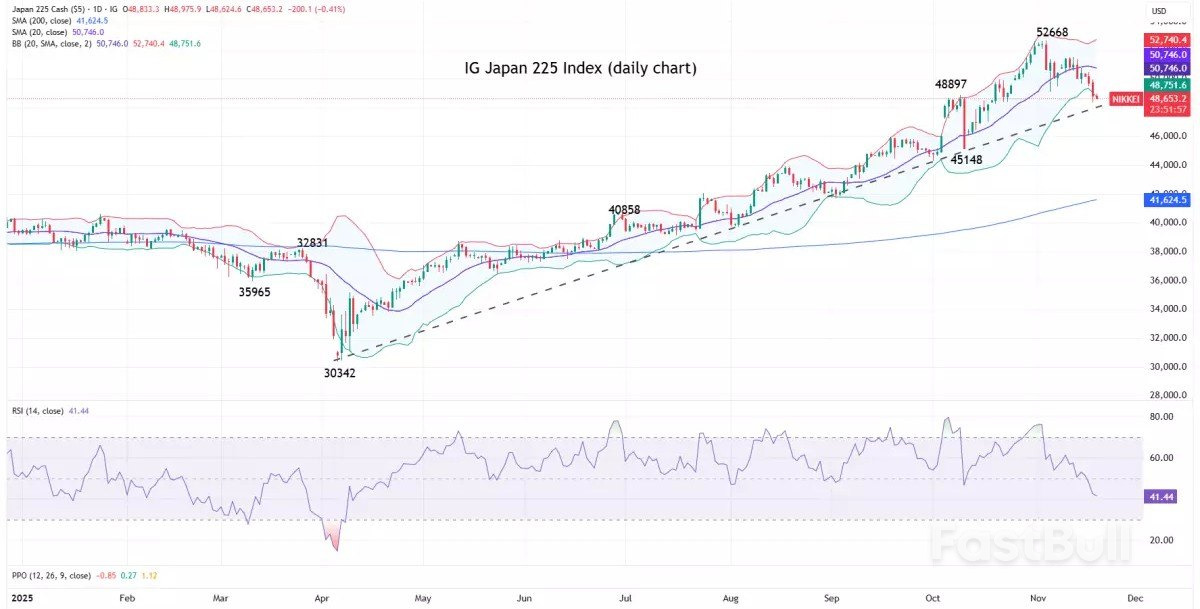
In Europe, at the time of writing, FTSE is down -0.06%. DAX is up 0.22%. CAC is flat. UK 10-year yield is up 0.003 at 4.560. Germany 10-year yield is down -0.018 at 2.689. Earlier in Asia, Nikkei fell -0.34%. Hong Kong HSI fell -0.38%. China Shanghai SSE rose 0.18%. Singapore Strait Times rose 0.01%. Japan 10-year JGB yield rose 0.023 to 1.772.
Eurozone CPI was finalized at 2.1% yoy in October, edging down from September's 2.2% and keeping headline inflation close to the ECB's target. Core CPI held steady at 2.4% yoy, unchanged from the previous month.
Services remained the dominant driver of inflation in Eurozone, contributing +1.54 percentage points, followed by food, alcohol and tobacco at +0.48 pp, while energy once again exerted a mild drag by -0.08pp.
Across the EU, inflation softened slightly to 2.5% yoy from September's 2.6%. Price dynamics continued to diverge sharply across member states: Cyprus recorded the lowest annual rate at 0.2%, followed by France (0.8%) and Italy (1.3%). At the other end of the spectrum, Romania remained an outlier at 8.4%, with Estonia (4.5%) and Latvia (4.3%) also posting elevated readings. Compared with the previous month, inflation eased in fifteen member states, held steady in three, and increased in nine.
UK inflation eased in October, with headline CPI slowing from 3.8% yoy to 3.6%, just above the market's 3.5% forecast. Core inflation (excluding energy, food, alcohol and tobacco) matched expectations at 3.4% yoy, down from 3.5% previously.
Goods inflation cooled, slipping from 2.9% yoy to 2.6%, while services inflation—still the stickiest component—eased from 4.7% to 4.5%.
On a monthly basis, headline CPI rose 0.4% mom.
The figures point to steady, gradual deceleration rather than sharp disinflation, leaving the BoE's December cut narrative largely intact. Markets are unlikely to adjust pricing meaningfully until the Autumn Budget clarifies the fiscal stance. For now, the data reinforces a picture of easing, but not yet subdued, domestic price pressures.
Australia's wage price index rose 0.8% qoq in Q3, matching expectations and holding the same pace as Q2. The headline stability masks a mild divergence across sectors: private-sector wages increased 0.7% qoq while public-sector wages climbed 0.9% qoq, continuing their recent outperformance.
On an annual basis, wage growth came in at 3.4% yoy, unchanged from Q2. Public-sector pay rose 3.8% yoy, edging up from last year's 3.7%. Private-sector wage growth slowed to 3.2% yoy from 3.5% in September 2024. This marks the third consecutive quarter in which public wages have grown faster than their private counterparts.
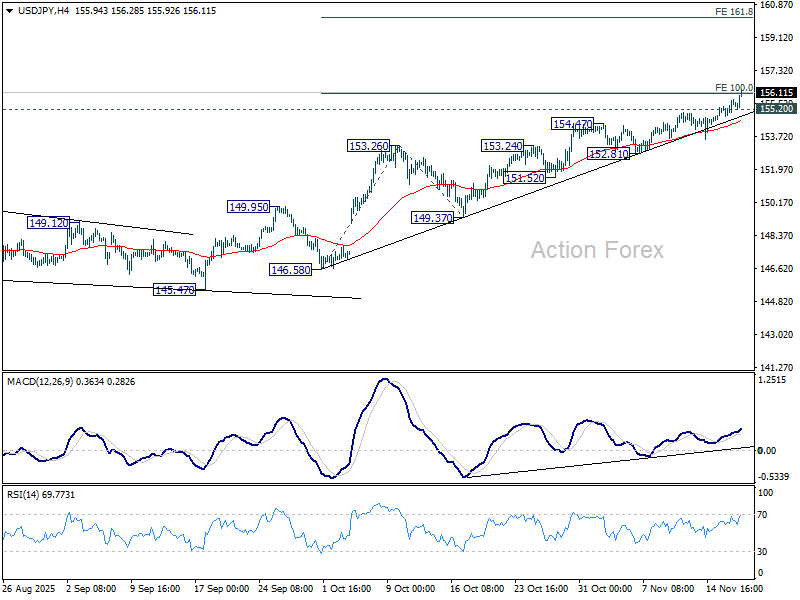
Daily Pivots: (S1) 154.98; (P) 155.36; (R1) 155.89;
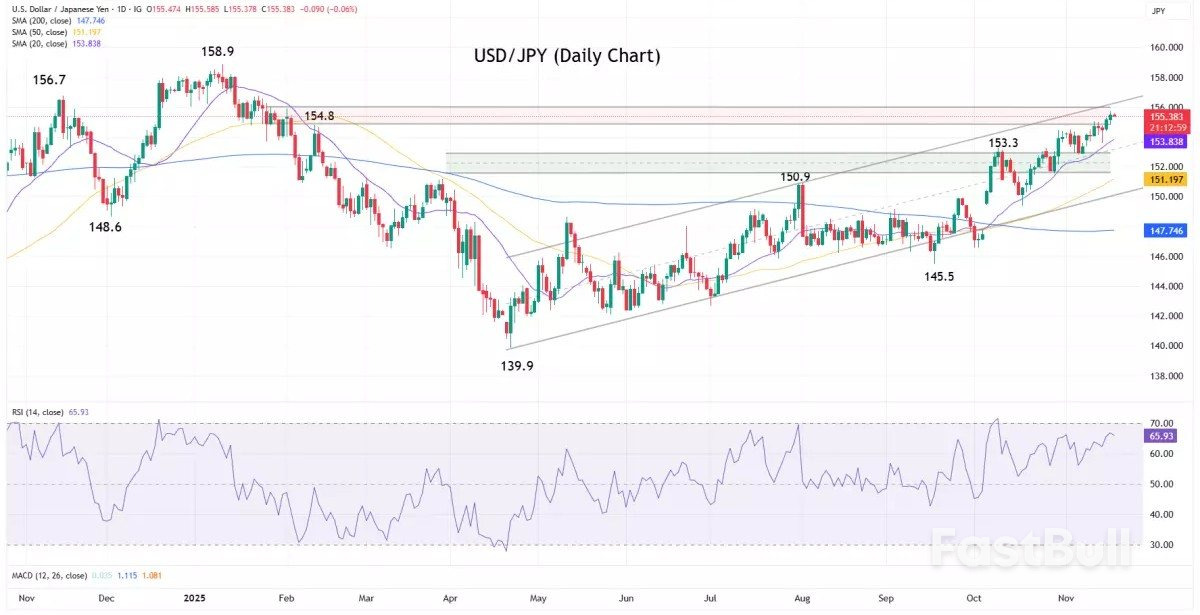
USD/JPY's rally continues today and breaks above 100% projection of 146.58 to 153.26 from 149.37 at 156.05. There is no sign of topping yet and the break of medium term rising channel indicates upside acceleration. Intraday bias stays on the upside. Next target is 158.85 key structural resistance, and then 161.8% projection at 160.17. On the downside, below 155.20 minor support will turn intraday bias neutral and bring consolidations, before staging another rise.
In the bigger picture, current development suggests that corrective pattern from 161.94 (2024 high) has completed with three waves at 139.87. Larger up trend from 102.58 (2021 low) could be ready to resume through 161.94 high. On the downside, break of 150.90 restiveness turned support will dampen this bullish view and extend the corrective pattern with another falling leg.
as of 19 November 2025. Past performance is not a reliable indicator of future performance.
as of 19 November 2025. Past performance is not a reliable indicator of future performance.The U.S. trade deficit narrowed more than expected in August as imports declined, but trade could still subtract from economic growth in the third quarter.
The trade gap contracted 23.8% to $59.6 billion, the Commerce Department's Bureau of Economic Analysis and Census Bureau said on Wednesday. Economists polled by Reuters had forecast the trade deficit would ease to $61.0 billion.
Imports decreased 5.1% to $340.4 billion, while exports edged up 0.1% to $280.8 billion.
The report, which was initially scheduled for release on October 7, was delayed because of the recently ended 43-day shutdown of the government.
President Donald Trump's protectionist trade policy, marked by sweeping tariffs, has caused big swings in imports and the trade deficit, distorting the overall economic picture.
The U.S. Supreme Court early this month heard arguments on the legality of Trump's import duties, with justices raising doubts about his authority to impose tariffs under the 1977 International Emergency Economic Powers Act.
Trade sliced off a record 4.68 percentage points from gross domestic product in the first quarter before adding all that back to GDP in the April-June quarter. Estimates for third-quarter GDP growth are well above a 3.0% annualized rate.
The third-quarter GDP report was due in late October but delayed by the government shutdown. The economy grew at a 3.8% pace in the second quarter, with a smaller trade deficit being the key driver.
White Label
Data API
Web Plug-ins
Poster Maker
Affiliate Program
The risk of loss in trading financial instruments such as stocks, FX, commodities, futures, bonds, ETFs and crypto can be substantial. You may sustain a total loss of the funds that you deposit with your broker. Therefore, you should carefully consider whether such trading is suitable for you in light of your circumstances and financial resources.
No decision to invest should be made without thoroughly conducting due diligence by yourself or consulting with your financial advisors. Our web content might not suit you since we don't know your financial conditions and investment needs. Our financial information might have latency or contain inaccuracy, so you should be fully responsible for any of your trading and investment decisions. The company will not be responsible for your capital loss.
Without getting permission from the website, you are not allowed to copy the website's graphics, texts, or trademarks. Intellectual property rights in the content or data incorporated into this website belong to its providers and exchange merchants.
Not Logged In
Log in to access more features

FastBull Membership
Not yet
Purchase
Log In
Sign Up