
• Trade
  • Markets
  • Copy
  • Contests
  • News
  • 24/7
  • Calendar
  • Q&A
  • Chats
Trending
Screeners
SYMBOL
LAST
BID
ASK
HIGH
LOW
NET CHG.
%CHG.
SPREAD
SPX
S&P 500 Index
6846.50
6846.50
6846.50
6878.28
6827.18
-23.90
-0.35%
--
DJI
Dow Jones Industrial Average
47739.31
47739.31
47739.31
47971.51
47611.93
-215.67
-0.45%
--
IXIC
NASDAQ Composite Index
23545.89
23545.89
23545.89
23698.93
23455.05
-32.22
-0.14%
--
USDX
US Dollar Index
99.000
99.080
99.000
99.000
99.000
+0.050
+ 0.05%
--
EURUSD
Euro / US Dollar
1.16349
1.16380
1.16349
1.16365
1.16322
-0.00015
-0.01%
--
GBPUSD
Pound Sterling / US Dollar
1.33194
1.33240
1.33194
1.33217
1.33140
-0.00011
-0.01%
--
XAUUSD
Gold / US Dollar
4189.70
4190.14
4189.70
4218.85
4175.92
-8.21
-0.20%
--
WTI
Light Sweet Crude Oil
58.555
58.807
58.555
60.084
58.495
-1.254
-2.10%
--

Community Accounts

Signal Accounts
--
Profit Accounts
--
Loss Accounts
--
View More

Become a signal provider

Sell trading signals to earn additional income

View More

Guide to Copy Trading

Get started with ease and confidence

View More

Signal Accounts for Members

All Signal Accounts

Best Return
  • Best Return
  • Best P/L
  • Best MDD
Past 1W
  • Past 1W
  • Past 1M
  • Past 1Y

All Contests

  • All
  • Trump Updates
  • Recommend
  • Stocks
  • Cryptocurrencies
  • Central Banks
  • Featured News
Top News Only
Share

Ukraine's Security Must Be Guaranteed, In The Long Term, As A First Line Of Defence For Our Union, Says European Commission President

Share

Ukraine's Sovereignty Must Be Respected, Says European Commission President

Share

The Goal Is A Strong Ukraine, On The Battlefield And At The Negotiating Table, Says European Commission President

Share

As Peace Talks Are Ongoing, The EU Remains Ironclad In Its Support For Ukraine, Says European Commission President

Share

Pepsico: Asking USA-Based Pepna Employees As Well As Pbus Division Offices And Pfus Region Offices To Work Remotely This Week

Share

A U.S. Judge Ruled That President Trump’s Ban On Several Wind Power Projects Was Illegal

Share

Senior USA Administration Official: We Continue To Monitor Drc-Rwanda Situation Closely, Continue To Work With All Sides To Ensure Commitments Are Honored

Share

Israeli Military Says It Has Struck Infrastructure Belonging To Hezbollah In Several Areas In Southern Lebanon

Share

SPDR Gold Holdings Down 0.11%, Or 1.14 Tonnes

Share

On Monday (December 8), In Late New York Trading, S&P 500 Futures Fell 0.21%, Dow Jones Futures Fell 0.43%, NASDAQ 100 Futures Fell 0.08%, And Russell 2000 Futures Fell 0.04%

Share

Morgan Stanley: Data Center ABS Spreads Are Expected To Widen In 2026

Share

(US Stocks) The Philadelphia Gold And Silver Index Closed Down 2.34% At 311.01 Points. (Global Session) The NYSE Arca Gold Miners Index Closed Down 2.17%, Hitting A Daily Low Of 2235.45 Points; US Stocks Remained Slightly Down Before The Opening Bell—holding Steady Around 2280 Points—before Briefly Rising Slightly

Share

IMF: IMF Executive Board Approves Extension Of The Extended Credit Facility Arrangement With Nepal

Share

Trump: Same Approach Will Apply To Amd, Intel, And Other Great American Companies

Share

Trump: Department Of Commerce Is Finalizing Details

Share

Trump: $25% Will Be Paid To United States Of America

Share

Trump: President Xi Responded Positively

Share

[Consumer Discretionary ETFs Fell Over 1.4%, Leading The Decline Among US Sector ETFs; Semiconductor ETFs Rose Over 1.1%] On Monday (December 8), The Consumer Discretionary ETF Fell 1.45%, The Energy ETF Fell 1.09%, The Internet ETF Fell 0.18%, The Regional Banks ETF Rose 0.34%, The Technology ETF Rose 0.70%, The Global Technology ETF Rose 0.93%, And The Semiconductor ETF Rose 1.13%

Share

Trump: I Have Informed President Xi, Of China, That United States Will Allow Nvidia To Ship Its H200 Products To Approved Customers In China

Share

Argentina's Merval Index Closed Up 0.02% At 3.047 Million Points. It Rose To A New Daily High Of 3.165 Million Points In Early Trading In Buenos Aires Before Gradually Giving Back Its Gains

TIME
ACT
FCST
PREV
France Trade Balance (SA) (Oct)

A:--

F: --

P: --
Euro Zone Employment YoY (SA) (Q3)

A:--

F: --

P: --
Canada Part-Time Employment (SA) (Nov)

A:--

F: --

P: --

Canada Unemployment Rate (SA) (Nov)

A:--

F: --

P: --

Canada Full-time Employment (SA) (Nov)

A:--

F: --

P: --

Canada Labor Force Participation Rate (SA) (Nov)

A:--

F: --

P: --

Canada Employment (SA) (Nov)

A:--

F: --

P: --

U.S. PCE Price Index MoM (Sept)

A:--

F: --

P: --

U.S. Personal Income MoM (Sept)

A:--

F: --

P: --

U.S. Core PCE Price Index MoM (Sept)

A:--

F: --

P: --

U.S. PCE Price Index YoY (SA) (Sept)

A:--

F: --

P: --

U.S. Core PCE Price Index YoY (Sept)

A:--

F: --

P: --

U.S. Personal Outlays MoM (SA) (Sept)

A:--

F: --

P: --
U.S. 5-10 Year-Ahead Inflation Expectations (Dec)

A:--

F: --

P: --

U.S. Real Personal Consumption Expenditures MoM (Sept)

A:--

F: --

P: --
U.S. Weekly Total Rig Count

A:--

F: --

P: --

U.S. Weekly Total Oil Rig Count

A:--

F: --

P: --

U.S. Consumer Credit (SA) (Oct)

A:--

F: --

P: --
China, Mainland Foreign Exchange Reserves (Nov)

A:--

F: --

P: --

Japan Trade Balance (Oct)

A:--

F: --

P: --

Japan Nominal GDP Revised QoQ (Q3)

A:--

F: --

P: --

China, Mainland Imports YoY (CNH) (Nov)

A:--

F: --

P: --

China, Mainland Exports (Nov)

A:--

F: --

P: --

China, Mainland Imports (CNH) (Nov)

A:--

F: --

P: --

China, Mainland Trade Balance (CNH) (Nov)

A:--

F: --

P: --

China, Mainland Exports YoY (USD) (Nov)

A:--

F: --

P: --

China, Mainland Imports YoY (USD) (Nov)

A:--

F: --

P: --

Germany Industrial Output MoM (SA) (Oct)

A:--

F: --

P: --
Euro Zone Sentix Investor Confidence Index (Dec)

A:--

F: --

P: --

Canada National Economic Confidence Index

A:--

F: --

P: --

U.K. BRC Like-For-Like Retail Sales YoY (Nov)

--

F: --

P: --

U.K. BRC Overall Retail Sales YoY (Nov)

--

F: --

P: --

Australia Overnight (Borrowing) Key Rate

--

F: --

P: --

RBA Rate Statement
RBA Press Conference
Germany Exports MoM (SA) (Oct)

--

F: --

P: --

U.S. NFIB Small Business Optimism Index (SA) (Nov)

--

F: --

P: --

Mexico 12-Month Inflation (CPI) (Nov)

--

F: --

P: --

Mexico Core CPI YoY (Nov)

--

F: --

P: --

Mexico PPI YoY (Nov)

--

F: --

P: --

U.S. Weekly Redbook Index YoY

--

F: --

P: --

U.S. JOLTS Job Openings (SA) (Oct)

--

F: --

P: --

China, Mainland M1 Money Supply YoY (Nov)

--

F: --

P: --

China, Mainland M0 Money Supply YoY (Nov)

--

F: --

P: --

China, Mainland M2 Money Supply YoY (Nov)

--

F: --

P: --

U.S. EIA Short-Term Crude Production Forecast For The Year (Dec)

--

F: --

P: --

U.S. EIA Natural Gas Production Forecast For The Next Year (Dec)

--

F: --

P: --

U.S. EIA Short-Term Crude Production Forecast For The Next Year (Dec)

--

F: --

P: --

EIA Monthly Short-Term Energy Outlook
U.S. API Weekly Gasoline Stocks

--

F: --

P: --

U.S. API Weekly Cushing Crude Oil Stocks

--

F: --

P: --

U.S. API Weekly Crude Oil Stocks

--

F: --

P: --

U.S. API Weekly Refined Oil Stocks

--

F: --

P: --

South Korea Unemployment Rate (SA) (Nov)

--

F: --

P: --

Japan Reuters Tankan Non-Manufacturers Index (Dec)

--

F: --

P: --

Japan Reuters Tankan Manufacturers Index (Dec)

--

F: --

P: --

Japan Domestic Enterprise Commodity Price Index MoM (Nov)

--

F: --

P: --

Japan Domestic Enterprise Commodity Price Index YoY (Nov)

--

F: --

P: --

China, Mainland PPI YoY (Nov)

--

F: --

P: --

China, Mainland CPI MoM (Nov)

--

F: --

P: --

Italy Industrial Output YoY (SA) (Oct)

--

F: --

P: --

Q&A with Experts
    • All
    • Chatrooms
    • Groups
    • Friends
    Connecting
    .
    .
    .
    Type here...
    Add Symbol or Code

      No matching data

      All
      Trump Updates
      Recommend
      Stocks
      Cryptocurrencies
      Central Banks
      Featured News
      • All
      • Russia-Ukraine Conflict
      • Middle East Flashpoint
      • All
      • Russia-Ukraine Conflict
      • Middle East Flashpoint
      Search
      Products

      Charts Free Forever

      Chats Q&A with Experts
      Screeners Economic Calendar Data Tools
      Membership Features
      Data Warehouse Market Trends Institutional Data Policy Rates Macro

      Market Trends

      Market Sentiment Order Book Forex Correlations

      Top Indicators

      Charts Free Forever
      Markets

      News

      News Analysis 24/7 Columns Education
      From Institutions From Analysts
      Topics Columnists

      Latest Views

      Latest Views

      Trending Topics

      Top Columnists

      Latest Update

      Signals

      Copy Rankings Latest Signals Become a signal provider AI Rating
      Contests
      Brokers

      Overview Brokers Assessment Rankings Regulators News Claims
      Broker listing Forex Brokers Comparison Tool Live Spread Comparison Scam
      Q&A Complaint Scam Alert Videos Tips to Detect Scam
      More

      Business
      Events
      Careers About Us Advertising Help Center

      White Label

      Data API

      Web Plug-ins

      Affiliate Program

      Awards Institution Evaluation IB Seminar Salon Event Exhibition
      Vietnam Thailand Singapore Dubai
      Fans Party Investment Sharing Session
      FastBull Summit BrokersView Expo
      Recent Searches
        Top Searches
          Markets
          News
          Analysis
          User
          24/7
          Economic Calendar
          Education
          Data
          • Names
          • Latest
          • Prev

          View All

          No data

          Scan to Download

          Faster Charts, Chat Faster!

          Download App
          English
          • English
          • Español
          • العربية
          • Bahasa Indonesia
          • Bahasa Melayu
          • Tiếng Việt
          • ภาษาไทย
          • Français
          • Italiano
          • Türkçe
          • Русский язык
          • 简中
          • 繁中
          Open Account
          Search
          Products
          Charts Free Forever
          Markets
          News
          Signals

          Copy Rankings Latest Signals Become a signal provider AI Rating
          Contests
          Brokers

          Overview Brokers Assessment Rankings Regulators News Claims
          Broker listing Forex Brokers Comparison Tool Live Spread Comparison Scam
          Q&A Complaint Scam Alert Videos Tips to Detect Scam
          More

          Business
          Events
          Careers About Us Advertising Help Center

          White Label

          Data API

          Web Plug-ins

          Affiliate Program

          Awards Institution Evaluation IB Seminar Salon Event Exhibition
          Vietnam Thailand Singapore Dubai
          Fans Party Investment Sharing Session
          FastBull Summit BrokersView Expo

          Global Rice Supplies at Risk as Harsh Weather Hits Top Exporters

          Damon
          Summary:

          Rice output in India, China, Bangladesh, Vietnam at risk. Weather damage to rice crops comes amid near record food prices.
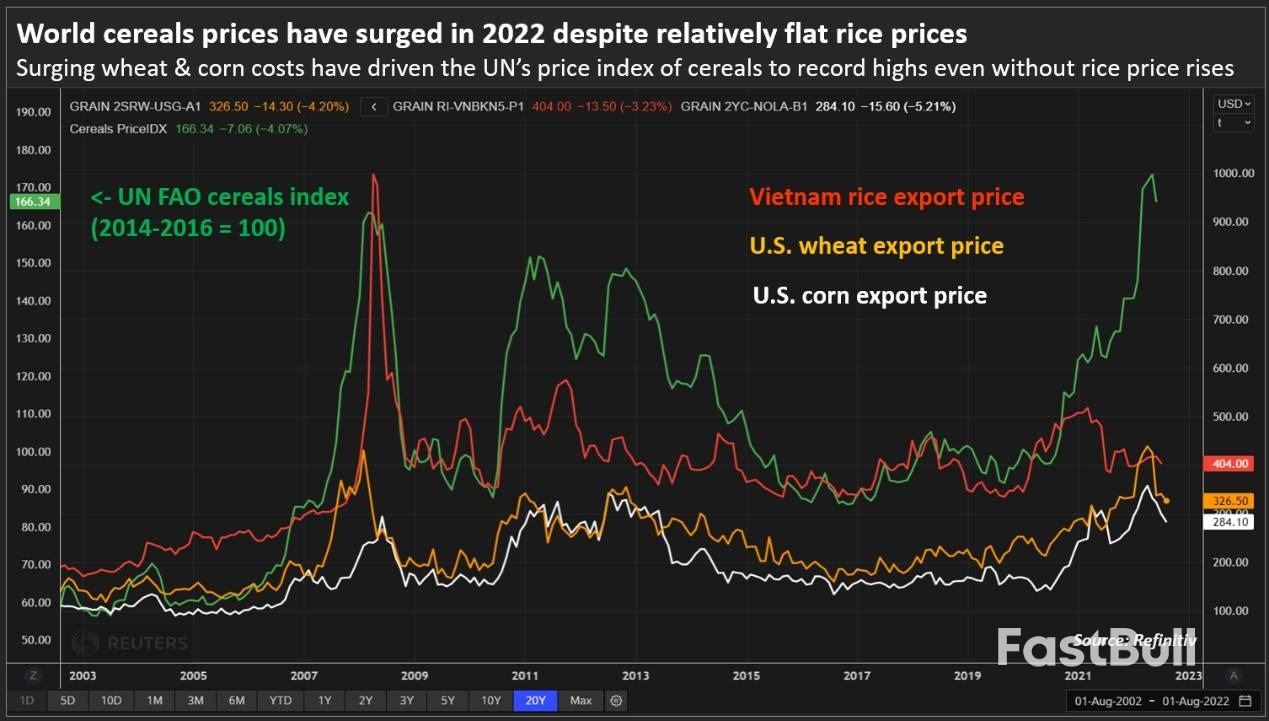
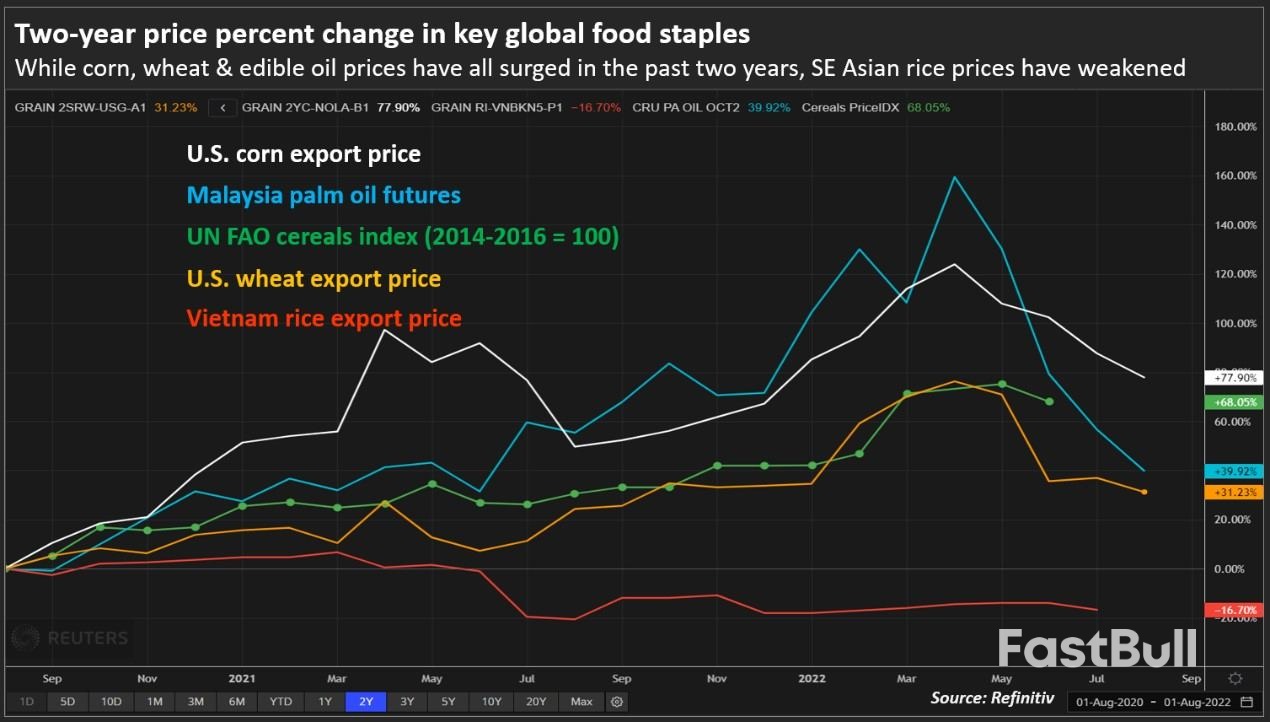
          Adverse weather across top rice suppliers in Asia, including the biggest exporter India, is threatening to reduce the output of the world's most important food staple and stoke food inflation that is already near record highs.
          Rice has bucked the trend of rising food prices amid bumper crops and large inventories at exporters over the past two years, even as COVID-19, supply disruptions and more recently the Russia-Ukraine conflict made other grains costlier.
          But inclement weather in exporting countries in Asia, which accounts for about 90% of the world's rice output, is likely to change the price trajectory, traders and analysts said.
          "There is an upside potential for rice prices with the possibility of production downgrades in key exporting countries," said Phin Ziebell, agribusiness economist at National Australia Bank.
          "An increase in rice prices would add to already major challenges for food affordability in parts of the developing world," Ziebell told Reuters.
          Patchy rains in India's grain belt, a heatwave in China, floods in Bangladesh and quality downgrades in Vietnam could curb yields in four of the world's top five rice producers, farmers, traders and analysts told Reuters.
          "Rice has remained accessible even as overall food prices reached record levels earlier this year," said U.N.'s Food and Agriculture Organisation economist, Shirley Mustafa.
          "We are now witnessing weather-related setbacks in some key rice producing countries, including India, China and Bangladesh, which could result in lower output if conditions don't improve in the next few weeks," Mustafa added.Global Rice Supplies at Risk as Harsh Weather Hits Top Exporters_1

          'Production drop is certain'

          India's top rice producing states of Bihar, Jharkhand, West Bengal and Uttar Pradesh have recorded a monsoon rainfall deficit of as much as 45% so far this season, data from the state-run weather department shows.
          That has in part led to a 13% drop in rice planting this year, which could result in production falling by 10 million tonnes or around 8% from last year, said B.V. Krishna Rao, president of the All-India Rice Exporters Association.
          The area under rice cultivation is down also because some farmers shifted to pulses and oilseeds, Rao said.
          India's summer-sown rice accounts for more than 85% of its annual production, which jumped to a record 129.66 million tonnes in the crop year to June 2022.
          "A production drop is certain, but the big question is how the government will react," a Mumbai-based dealer with a global trading firm said.
          Milled and paddy rice stocks in India as of July 1 totalled 55 million tonnes, versus the target of 13.54 million tonnes.
          That has kept rice prices down in the past year together with India's record 21.5 million tonnes shipment in 2021, which was more than the total shipped by the world's next four biggest exporters - Thailand, Vietnam, Pakistan and the United States.
          "But the government is hypersensitive about prices. A small rise could prompt it to impose export curbs," the trader said.
          In Vietnam, rains during harvest have damaged grain quality.
          "Never before have I seen it rain that much during harvest. It's just abnormal," said Tran Cong Dang, a 50-year-old farmer based in the Mekong Delta province of Bac Lieu.
          "In just ten days, the total measured rain is somewhat equal to the whole of previous month," said Dang, who estimated a 70% output loss on his 2-hectare paddy field due to floods.

          Imports, Prices

          China, the world's biggest rice consumer and importer, has suffered yield losses from extreme heat in grain growing areas and is expected to lift imports to a record 6 million tonnes in 2022/23, according to the U.S. Department of Agriculture.
          China imported 5.9 million tonnes a year ago.
          The world's third-biggest consumer, Bangladesh, is also expected to import more rice following flood-damage in its main producing regions, traders said.
          The full extent of shortfalls in countries other than India has yet to be estimated by analysts or government agencies that often only publish output data later in the year.
          But the impact of unfriendly crop weather can already be seen in the slight rise in export prices from India and Thailand this week.
          "Rice prices are already close to the bottom and we see the market rising from current levels," said a Singapore-based trader at one of the world's biggest rice merchants.
          "The demand is picking up with buyers such as the Philippines and others in Africa looking to book cargoes."Global Rice Supplies at Risk as Harsh Weather Hits Top Exporters_2

          Source: Reuters

          Risk Warnings and Disclaimers
          You understand and acknowledge that there is a high degree of risk involved in trading. Following any strategies or investment methods may lead to potential losses. The content on the site is provided by our contributors and analysts for information purposes only. You are solely responsible for determining whether any trading assets, securities, strategy, or any other product is suitable for investing based on your own investment objectives and financial situation.
          Comments
          Add to Favorites
          Share

          S.Africa's Ramaphosa on a Knife Edge As Crises Spur Leadership Contest

          Alex
          South Africa's Cyril Ramaphosa is beset by crises that have cast doubt on his presidency and left him vulnerable to a leadership challenge as his party begins the process of selecting candidates for the next national election.
          As clouds gather, analysts and party insiders say his best chance of survival is that many in the governing African National Congress see him as the least objectionable nominee - both to investors and voters - in the 2024 polls, which could see the party lose its parliamentary majority for the first time since white minority rule ended nearly three decades ago.
          ANC members will chose their party leader, and hence presidential nominee, in December. But the battle lines are being drawn now, with power blocks coalescing around candidates at gatherings to elect provincial party officials, and at a national policy conference last weekend.
          Challengers include former health minister Zweli Mkhize, Tourism Minister Lindiwe Sisulu and Duduzane Zuma, son of the former president Jacob Zuma.
          "It's severely dented, but (Ramaphosa) still retains more trust than the other alternative political leaders," Susan Booysen, director of research at the Mapungubwe Institute for Strategic Reflection, said. "The alternatives would have to show they've got credibility."
          The ANC has never been so unpopular.
          Struggling state power company Eskom has imposed its worst power cuts in more than two years. Poor service delivery saw the ANC's support in municipal polls in November drop below 50% for the first time.
          A looting spree a year ago and mass shootings in July highlighted police failures and yawning wealth inequalities.
          And a $4 million heist at Ramaphosa's private farm in June raised questions about his vast wealth - awkward for a leader who won his ticket on a promise to clean up endemic graft.
          Four ANC insiders said Ramaphosa's rivals are to varying degrees allied with his predecessor Jacob Zuma's faction, whose victory would be seen as a setback by investors in Africa's most industrialised economy. A judicial corruption inquiry pointed to systemic graft during Zuma's tenure in 2009-2018; he denies wrongdoing.
          Zuma's faction recently captured the party leadership in the ANC strongholds of Mpumalanga and Kwazulu-Natal, shrinking Ramaphosa's provincial power base.
          Some ANC members also favour Deputy President David Mabuza, who hasn't said he'll run but would automatically take over if Ramaphosa is forced out early.

          Gathering Clouds

          Ramaphosa acted decisively against COVID-19 in 2020 - imposing some of the world's toughest restrictions and expanding social welfare to prevent hunger - but has prevaricated on other contentious policy issues. It took his government over two years to start implementing plans to buy more power from private producers and cut reliance on Eskom, a process fraught with delays.
          "He's caught between paranoia and paralysis. There's that indecisiveness, lurching from thing to thing," Ebrahim Fakir of South Africa's Auwal Socio-Economic Research Institute said.
          Police are probing the origin of millions of dollars worth of foreign banknotes stolen from Ramaphosa's private farm for tax or exchange control irregularities. He says the funds are from game sales and has welcomed the investigation.
          "Ramaphosa is in a very weak position because of this foreign currency found in his house," said Moeletsi Mbeki, deputy chairman of the South African Institute of International Affairs and a brother of ex-president Thabo Mbeki. "He has to account for why (it) was ... not in the bank."
          At the policy conference, Ramaphosa faced down Zuma allies arguing that the party should suspend a rule that any officials charged with crimes must step down while they are being investigated.
          The "step-aside" rule is preventing the ANC's suspended secretary general Ace Magashule from challenging Ramaphosa after being charged with corruption. But it could come to haunt the president if he himself is charged.

          Ramaphosa's Challengers

          Any one of his likely challengers would prompt fears from investors about "taking South Africa back to a more difficult place," Razia Khan, Standard Chartered's head of research for Africa and the Middle East, said.
          Mkhize was suspended a year ago over allegations his department irregularly awarded COVID-19-related contracts to former associates. He did not respond to a request comment, but denies wrongdoing.
          Mabuza has struggled to shrug off allegations - which he denies - of irregular tenders for a 2010 World Cup stadium and links to political killings. His spokeswoman did not comment.
          Sisulu supported Zuma throughout the graft inquiry. He "is a valued and respected leader of the ANC," her spokesman Steve Motale said.
          Duduzane Zuma - known for his designer suits, partying on speed boats in Dubai and crashing his Porsche into a minibus taxi in 2014 - is being investigated alongside his father for alleged corruption.
          "I've showed up every time and pleaded not-guilty," he told Reuters. "I'm young at heart. If I want to jump on a jet ski or quad bike or a private plane, that shouldn't be an issue. I've worked hard."
          If the ANC loses its parliamentary majority, it could force the party into an uneasy coalition. Several conference delegates told Reuters they still see Ramaphosa as their best bet.
          "I don't see any other person who can rival him," Home Affairs Minister Aaron Motsoaledi told Reuters.
          Some analysts agree.
          "Removing Ramaphosa would be a suicide mission. He is what has slowed down their decline," author and political analyst Ralph Mathekga said. "He's the most electable, and ... can help the party to survive."

          Source: Reuters

          Risk Warnings and Disclaimers
          You understand and acknowledge that there is a high degree of risk involved in trading. Following any strategies or investment methods may lead to potential losses. The content on the site is provided by our contributors and analysts for information purposes only. You are solely responsible for determining whether any trading assets, securities, strategy, or any other product is suitable for investing based on your own investment objectives and financial situation.
          Comments
          Add to Favorites
          Share

          Pacific Rim Economies in Doldrums, Sapped by Inflation, War

          Owen Li
          Economies in the Asia-Pacific are forecast to hit the doldrums this year as decades-high inflation and the war in Ukraine compound geopolitical uncertainties and the aftereffects of the pandemic.
          A report on Pacific Rim economies by the Asia Pacific Economic Cooperation forum said Friday that growth in the region will likely fall by more than half this year to 2.5% from 5.9% last year, when many countries were recovering from the worst of their COVID-19 outbreaks.
          Weaker growth in the U.S. and China is a big factor behind the regional malaise, though other economies are also slowing. Russia's economy is expected to contract due to the implications of its war in Ukraine, and the three economies account for nearly 70% of the APEC region's GDP, the report said.
          The report forecast that regional growth would only pick up slightly in 2023, to 2.6%.
          Most economies in the region are just beginning to fully emerge from border closures and other pandemic-related precautions. Tourists have reappeared on the streets of Bangkok, but many businesses remain shuttered, casualties of the many months when travel was virtually paralyzed.
          In China, where authorities are still imposing lockdowns to wipe out COVID-19 outbreaks, the economy contracted 2.6% in the three months ending in June compared with the previous quarter after Shanghai and other cities were shut down to fight coronavirus outbreaks.
          The U.S. economy contracted by 0.9% in April-June, while Russia's economy shrank 0.5% in January-June compared with a year before, according to its Ministry of Economic Development.
          Japan's economy shrank at a 0.5% annual rate i n January-March and is forecast to expand only 2% in the fiscal year ending in March 2023.
          Some economies are doing better.
          Indonesia reported Friday that its economy grew at a better-than-expected 5.4% annual rate in the April-June quarter as it bounced back from a wave of omicron variant coronavirus infections.
          An exporter of raw materials such as coal and palm oil, the country saw its exports jump nearly 20% in the last quarter as prices for many materials soared. But that windfall is likely to dissipate as price increases ease or reverse, analysts said.
          “We expect slowing growth in the rest of the world to take its toll ... as commodity prices continue to recede. On the domestic front, headwinds from high inflation, which reached a seven-year high and is set to rise further in the coming months, are growing," Alex Holmes of Oxford Economics said in a commentary.
          India is also growing faster than much of the rest of the region.
          Reserve Bank of India Governor Shaktikanta Das projected that growth would remain robust, at 7.2% in the financial year ending in March 2023. But to counter inflation that hit 6.7% in June, the central bank raised its key interest rate on Friday by a half percentage point to 5.4%.
          More than half of the 21 APEC members have raised rates or otherwise tightened monetary policy to counter inflation, which now averages 5.4% for the region, the APEC report said.
          It pointed to a 23% overall increase in the food price index of the U.N. Food and Agricultural Organization, noting that inflation is likely to remain elevated for at least the rest of the year as central banks adjust their policies to try to bring it under control.
          Source: ABC
          Risk Warnings and Disclaimers
          You understand and acknowledge that there is a high degree of risk involved in trading. Following any strategies or investment methods may lead to potential losses. The content on the site is provided by our contributors and analysts for information purposes only. You are solely responsible for determining whether any trading assets, securities, strategy, or any other product is suitable for investing based on your own investment objectives and financial situation.
          Comments
          Add to Favorites
          Share

          East Europe's Party Is Over as Double-Digit Inflation Bites

          Devin
          In the weeks that followed Russia's invasion of Ukraine, western Europe's big economies began to falter. But further east it was still boom-time thanks to double-digit wage hikes and generous state handouts in some countries.

          Not anymore

          A sharp slowdown in retail sales and plunging confidence indicators show that the cost-of-living crisis has caught up with Europe's eastern wing, where people now face a harsh reality check as stubborn double-digit inflation erodes their incomes while food price rises top 15%-22% and energy costs soar.
          As household consumption takes a hit, analysts are downgrading their GDP forecasts and the risk of a Europe-wide recession looms.
          Families have started to tighten their belts. Poles are taking shorter holidays, Czechs are saving on restaurant bills while some seek second jobs, and in Hungary - where food inflation alone was an annual 22.1% in June - people are cutting down on grocery bills and purchases of consumer durables as a slide in the forint currency pushes up import prices.
          "I went into the bakery one day and a loaf of bread cost 550 forints. I go in the next day and it costs 650. For God's sake!", exclaimed Lajos, a 73-year-old man shopping at a market in the northern city of Esztergom on the Danube river.
          Standing by his bicycle, grey-bearded Lajos, who did not give his family name, said the surge in food prices had consumed some of his monthly pension and he would not be able to pay higher utility bills, which will rise after the government last month scrapped price caps for what it called higher-usage households.
          So, he is making his own plans.
          "I can heat with gas but also wood ... as I have a tile-stove. So, with my wife we will move into one room, heat up the stove, put on some warm sweaters and watch TV like that."
          Across Hungary, retail sales growth slowed to an annual 4.5% in June from 10.9% in May, with furniture and electronic goods sales down by 4.3%, suggesting the impact of huge tax breaks and fiscal transfers from Prime Minister Viktor Orban's government before April's elections has now faded.
          Polish retail sales growth also slowed to an annual 3.2% in June from 8.2% in May, while Czech adjusted retail sales excluding cars and motorcycles dropped by 6.0% year-on-year in June after a fall of 6.6% in May, data showed on Friday.
          "Households have reacted to the rising cost of living in a meaningful way, and the consumption of things has started to slow," said Peter Virovacz, an analyst at ING in Budapest.
          According to a survey by the National Bank of Hungary on Friday, commercial banks expect demand for loans to decline and credit conditions to tighten in the second half.

          Belt-Tightening

          The slowdown in domestic demand, rising interest rates, government spending cuts and companies' rising costs look set to dampen economic growth in Central Europe in the second half of this year and slow them down sharply in 2023.
          Citigroup said Hungary's economy could grow by close to 5% in 2022 but that there were downside risks to its 1% forecast for next year.
          "The risk of prolonged high energy prices keeping inflation in double-digit territory even in 2023 and our updated Euro Area in-house forecasts point towards downside risks," it said.
          The Hungarian central bank still projects 2.0%-3.0% growth for 2023, and it will release new forecasts in September.
          The Polish economy is expected to grow by 3.8% this year and 3.2% in 2023, according to government projections.
          The Czech central bank, the first to call a halt to its rate-hike cycle on Thursday, predicts recession at the turn of the year as it sees the economy contracting 0.4% in the fourth quarter of 2022 and 1% in the first quarter of 2023.
          "Our base scenario includes a mild recession - a technical recession - we have two quarters in a row with a quarterly decline there... That would be a healthy recession, which also allows for cutting inflation," Governor Ales Michl said.
          While the summer is still expected to see a boom in the tourism sector, Poles have started to save on trips according to travel website Noclegi.pl.
          "We can see that what characterizes this season is the shortening of trips, on average by one day, and postponing the booking until the last moment," said Natalia Jaworska, an expert at Noclegi.pl. Poles have also begun to save on food.
          Data from various restaurant payment services, like Sodexo, have shown falling spending in restaurants in the Czech Republic as well. The STEM polling agency's latest survey in June found 80% of Czech households were cutting back or limiting their purchases because of fast-rising energy bills.
          Czech consumer confidence hit a new low in July, according to the statistics office’s monthly survey, while a survey by think-tank GKI showed the Hungarian consumer confidence index in July plunged to its lowest level since April 2020 during the first wave of the COVID-19 pandemic.
          Martin Hulovec, a 43-year-old Czech film producer, said he was not worried about his income right now, but he was less optimistic about the future.
          "The hard times have not arrived yet for me to deal with it immediately... but it will come," Hulovec said.
          "I will certainly seek more energy savings... I will definitely not buy new stuff for the kids, clothing or sport equipment. You can find that secondhand for half the price."
          And he too will be switching on the heating less when winter comes.

          Source: Reuters

          Risk Warnings and Disclaimers
          You understand and acknowledge that there is a high degree of risk involved in trading. Following any strategies or investment methods may lead to potential losses. The content on the site is provided by our contributors and analysts for information purposes only. You are solely responsible for determining whether any trading assets, securities, strategy, or any other product is suitable for investing based on your own investment objectives and financial situation.
          Comments
          Add to Favorites
          Share

          BoE Being Goaded Into 'Scorched Earth' Policy

          Devin
          Torn between inflation and recession, the Bank of England is being pushed hard by a UK government-in-flux into a scorched earth monetary policy now and possibly an equally dramatic and unnerving U-turn next year.
          Foreign Minister Liz Truss, overwhelming favourite to replace Boris Johnson as Prime Minister next month, plans looser fiscal policy via largely unfunded tax cuts in an "emergency budget" - a plan many fear could force the central bank into an overburdened solo effort to rein in raging prices as the economy heads into a long recession.
          As if to reinforce that point, Truss' campaign team openly complains the Bank was too slow in tackling inflation last year and insists on a review the central bank's 25-year-old operational independence by way of censure.
          The irony of this threat to BoE independence is that it goads the bank to tighten even more aggressively now to sate public anger over higher bills and allow room for quick tax cuts - contrasting with a perennial fear that government interference in central banking typically tries to engineer cheaper credit.
          But many feel that political pressure to tighten harder now could quickly flip-flop next year too - creating the sort of macro policy volatility investors may balk at.
          In a report entitled "Nightmare on Threadneedle Street", Rabobank's Stefan Koopman reckons fiscal easing implied by "Trussonomics" will reinforce expectations for another 100 basis points of BoE rate rises by year end.
          Political questioning of BoE independence likely reinforces both that and a sharp reversal late next year.
          "Even though this seems a call for tougher action now, a deep recession in the years before the general election is unpopular too," Koopman said. "This will put the central bank on collision course with 10 Downing Street."
          Brian Nick, Chief Investment Strategist at Chicago-based asset manager Nuveen said the Bank of England had "no good options" right now but rumblings about its inflation mandate and independence would only complicate the situation even more.
          "History suggests that (removing the BoE's independence) would be a mistake. This is an extremely challenging time for central banks, partly due to their own errors in 2021 but primarily due to circumstances beyond their control."BoE Being Goaded Into 'Scorched Earth' Policy_1

          BoE Being Goaded Into 'Scorched Earth' Policy_2Bleak

          Against that backdrop, Thursday's BoE interest rate hike, the biggest in more than a quarter century, was almost a sideshow.
          To be fair, the move had been well flagged and merely aped a growing hawkishness among the Bank's peers around the world in tackling decades-high global inflation. The initial market reaction was fairly subdued.
          Even though the BoE was the first of the G7 central banks to start raising interest rates late last year, its main policy rate remains lower than the equivalent in the United States, Canada and Australia.
          That lag is best explained by the Bank's apocalyptic forecasting around Thursday's hike - an outlook markets will find much harder to brush off over the remainder of the year and painting Britain as a likely outlier among rival economies.
          The Bank now sees inflation peaking above 13% in October just as a mammoth five-quarter recession unfolds - the longest UK downturn since the banking crash 14 years ago, involving a two percent contraction of output and almost doubling the unemployment rate to more than 6%.
          Fears of a 'scorched earth' policy were echoed in the Bank's own forecast that inflation will eventually plummet back below 1% by 2025.
          Which way to turn? It may get dizzy.
          For all his attempts on Thursday at sounding resolute on getting inflation back to target with 'no ifs and buts', BoE chief Andrew Bailey went on to suggest the risks to these forecasts were "exceptionally large".
          "It's hard to recall a bleaker outcome to a central bank meeting," said Nick at Nuveen.
          The pointed political backdrop will not make the job any easier.

          Source: Reuters

          Risk Warnings and Disclaimers
          You understand and acknowledge that there is a high degree of risk involved in trading. Following any strategies or investment methods may lead to potential losses. The content on the site is provided by our contributors and analysts for information purposes only. You are solely responsible for determining whether any trading assets, securities, strategy, or any other product is suitable for investing based on your own investment objectives and financial situation.
          Comments
          Add to Favorites
          Share

          As Recession Fears Grow, Hiring in American Job Market Likely Slowing

          Damon
          The American job market has defied raging inflation, rising interest rates, growing recession fears. Month after month, US employers just kept adding hundreds of thousands of workers, often beating forecasters' expectations.
          But now economists worry that signs of weakness are starting to turn up in hiring, threatening one of the United States' last remaining redoubts of economic strength. Job openings are down, and the number of Americans signing up for unemployment benefits is up.
          When we look across the labour market, we are seeing broad indications of cracks beginning to show,'' said Sarah House, senior economist at Wells Fargo. Overall conditions aren't nearly as strong as what we were seeing three to six months ago.''
          The Labor Department reports on Friday how many jobs were created in July and whether the super-low US unemployment rate has begun to tick higher.
          Forecasters, on average, expect the economy to have picked up another 250,000 jobs last month, according to a survey by the data firm FactSet. That would be a solid number in normal times but would mark a big deceleration for 2022: Employers have been hiring an average 457,000 workers a month so far this year.
          The unemployment rate is expected to stay at 3.6 per cent just off a 50-year low for the fifth straight month.
          The job news will have political implications, too: Worries about high prices and the risk of recession are likely to weigh on voters in November's midterm elections, potentially making it tougher for President Joe Biden's Democrats to keep control of Congress.
          The economic backdrop is troubling: Gross domestic product the broadest measure of economic output fell in both the first and second quarters; consecutive GDP drops is one definition of a recession.
          And inflation is roaring at a 40-year high.
          The job market's continued strength especially the low jobless rate is the main reason most economists don't believe a downturn has started yet, though they increasingly fear that one is on the way. History isn't entirely reassuring: The unemployment rate was even lower 3.5 per cent when an 11-month recession began in December 1969.
          Americans aren't the only ones contending with difficult economic times.
          Recession fears are rising in Europe, too. In the United Kingdom, the Bank of England on Thursday projected that the world's fifth-largest economy would slide into recession by the end of the year.
          Russia's war in Ukraine has darkened the outlook across Europe. The conflict has made energy supplies scarce and driven prices higher. European countries are bracing for the possibility that Moscow will keep reducing and perhaps completely cut off flows of natural gas, used to power factories, generate electricity and keep homes warm in winter.
          If Europeans can't store enough gas for the cold months, rationing may be required by industry.
          Economies have been on a wild ride since COVID hit in early 2020.
          The pandemic brought economic life to a near standstill as companies shut down and consumers stayed home as a health precaution. In March and April 2020, American employers slashed a staggering 22 million jobs and the economy plunged into a deep, two-month recession.
          But massive government aid and the Federal Reserve's decision to slash interest rates and pour money into financial markets fueled a surprisingly quick recovery. Caught off guard by the strength of the rebound, factories, shops, ports and freight yards were overwhelmed with orders and scrambled to bring back the workers they furloughed when COVID hit.
          The result has been shortages of workers and supplies, delayed shipments -- and rising prices. In the United States, inflation has been rising steadily for more than a year. In June, consumer prices jumped 9.1 per cent from a year earlier the biggest increase since 1981.
          The Fed at first underestimated inflation's resurgence, thinking prices were rising because of temporary supply chain bottlenecks. But inflation refused to go away.
          Now the central bank is responding aggressively. It has raised its benchmark short-term interest rate four times this year, and more rate hikes are ahead.
          Higher borrowing costs are taking a toll. Rising mortgage rates, for instance, have cooled a red-hot housing market. Sales of previously occupied homes dropped in June for the fifth straight month.
          Real estate companies including lending firm loanDepot and online housing broker Redfin have begun laying off workers.
          The labor market is showing other signs of wobbliness.
          The Labor Department reported Tuesday that employers posted 10.7 million job openings in June a healthy number but the lowest since September.
          And the four-week average number of Americans signing up for unemployment benefits a proxy for layoffs that smooths out week-to-week swings rose last week to the highest level since November, though the numbers may have been exaggerated by seasonal factors.
          Friday's jobs report comes at a critical moment for President Biden, who has maintained that the economy is merely slowing down rather than heading into a recession. Inflation has dogged public support for Biden, yet the administration has stressed that the 3.6 per cent unemployment rate and solid job gains are signs of a healthy economy.
          White House press secretary Karine Jean-Pierre said the administration expects the pace of hiring to fall further in the coming months because the unemployment rate is already near historic lows and fewer potential workers are available.
          A slower pace of hiring and reduced levels of wage growth could also suggest that inflationary pressures are easing, but it has the White House attempting to convince the American public that less growth is a positive at a moment when Republican lawmakers are saying a recession has already started; they cite the drop in GDP over the first half of the year.
          We're expecting it to be closer to 150,000 jobs per month, Jean-Pierre said at Thursday's briefing. This kind of job growth is consistent with the lower level of unemployment numbers that we've been seeing.
          Economist House at Wells Fargo expects employers to keep adding jobs for a few months. But rising interest rates, she said, will gradually choke off economic growth.
          We are actually looking for outright declines in hiring come the first quarter, maybe second quarter of next year,'' she said. As monetary policy continues to tighten, that's going to have an effect on overall business conditions and therefore demand for workers.
          Our expectation is that the US economy will slip into recession, probably at the start of the year.

          Source: Business Standard

          Risk Warnings and Disclaimers
          You understand and acknowledge that there is a high degree of risk involved in trading. Following any strategies or investment methods may lead to potential losses. The content on the site is provided by our contributors and analysts for information purposes only. You are solely responsible for determining whether any trading assets, securities, strategy, or any other product is suitable for investing based on your own investment objectives and financial situation.
          Comments
          Add to Favorites
          Share

          [ECB] Eurozone Economic Activity Slowing, Inflation Outlook Rising and Intensifying

          FastBull Featured

          Remarks of Officials

          The ECB released its Economic Bulletin Issue 5 for 2022, with some key points as follows.
          Eurozone economic activity has slowed since the ECB's June meeting, and the Russia-Ukraine war continues to be a drag on growth in the euro area. High inflation, supply bottlenecks, and high uncertainty make the economic outlook for the second half of 2022 and beyond highly uncertain. However, economic activity will continue to benefit from a reopening economy, strong labor markets, and fiscal support.
          The risks to the inflation outlook continue to be on the upside and have intensified, particularly in the short term. The risks to the medium-term inflation outlook include a lasting reduction in the production capacity of our economy, persistently high energy and food prices, inflation expectations rising above our target and higher than anticipated wage rises. However, if demand were to weaken over the medium term, it would lower pressures on prices.
          Over the review period (9 June to 20 July 2022) financial market developments were dominated by the impact of the ongoing monetary policy tightening in advanced economies and by growing concerns about an imminent global slowdown. The euro short-term rate (€STR) forward curve exhibited high volatility. Long-term sovereign bond yields declined amid lower risk-free rates; sovereign spreads also narrowed, albeit displaying some volatility over the review period. Euro area equity markets recorded sizeable losses, while corporate bond spreads widened. The euro continued to depreciate in trade-weighted terms.

          Economic Bulletin Issue 5

          Risk Warnings and Disclaimers
          You understand and acknowledge that there is a high degree of risk involved in trading. Following any strategies or investment methods may lead to potential losses. The content on the site is provided by our contributors and analysts for information purposes only. You are solely responsible for determining whether any trading assets, securities, strategy, or any other product is suitable for investing based on your own investment objectives and financial situation.
          Comments
          Add to Favorites
          Share
          FastBull
          Copyright © 2025 FastBull Ltd

          728 RM B 7/F GEE LOK IND BLDG NO 34 HUNG TO RD KWUN TONG KLN HONG KONG

          TelegramInstagramTwitterfacebooklinkedin
          App Store Google Play Google Play
          Products
          Charts

          Chats

          Q&A with Experts
          Screeners
          Economic Calendar
          Data
          Tools
          Membership
          Features
          Function
          Markets
          Copy Trading
          Latest Signals
          Contests
          News
          Analysis
          24/7
          Columns
          Education
          Company
          Careers
          About Us
          Contact Us
          Advertising
          Help Center
          Feedback
          User Agreement
          Privacy Policy
          Business

          White Label

          Data API

          Web Plug-ins

          Poster Maker

          Affiliate Program

          Risk Disclosure

          The risk of loss in trading financial instruments such as stocks, FX, commodities, futures, bonds, ETFs and crypto can be substantial. You may sustain a total loss of the funds that you deposit with your broker. Therefore, you should carefully consider whether such trading is suitable for you in light of your circumstances and financial resources.

          No decision to invest should be made without thoroughly conducting due diligence by yourself or consulting with your financial advisors. Our web content might not suit you since we don't know your financial conditions and investment needs. Our financial information might have latency or contain inaccuracy, so you should be fully responsible for any of your trading and investment decisions. The company will not be responsible for your capital loss.

          Without getting permission from the website, you are not allowed to copy the website's graphics, texts, or trademarks. Intellectual property rights in the content or data incorporated into this website belong to its providers and exchange merchants.

          Not Logged In

          Log in to access more features

          FastBull Membership

          Not yet

          Purchase

          Become a signal provider
          Help Center
          Customer Service
          Dark Mode
          Price Up/Down Colors

          Log In

          Sign Up

          Position
          Layout
          Fullscreen
          Default to Chart
          The chart page opens by default when you visit fastbull.com