Markets
News
Analysis
User
24/7
Economic Calendar
Education
Data
- Names
- Latest
- Prev


Signal Accounts for Members
All Signal Accounts
All Contests


U.S. Initial Jobless Claims 4-Week Avg. (SA)A:--
F: --
P: --
U.S. Weekly Continued Jobless Claims (SA)A:--
F: --
P: --
Canada Ivey PMI (SA) (Nov)A:--
F: --
P: --
Canada Ivey PMI (Not SA) (Nov)A:--
F: --
P: --
U.S. Non-Defense Capital Durable Goods Orders Revised MoM (Excl. Aircraft) (SA) (Sept)A:--
F: --
U.S. Factory Orders MoM (Excl. Transport) (Sept)A:--
F: --
P: --
U.S. Factory Orders MoM (Sept)A:--
F: --
P: --
U.S. Factory Orders MoM (Excl. Defense) (Sept)A:--
F: --
P: --
U.S. EIA Weekly Natural Gas Stocks ChangeA:--
F: --
P: --
Saudi Arabia Crude Oil ProductionA:--
F: --
P: --
U.S. Weekly Treasuries Held by Foreign Central BanksA:--
F: --
P: --
Japan Foreign Exchange Reserves (Nov)A:--
F: --
P: --
India Repo RateA:--
F: --
P: --
India Benchmark Interest RateA:--
F: --
P: --
India Reverse Repo RateA:--
F: --
P: --
India Cash Reserve RatioA:--
F: --
P: --
Japan Leading Indicators Prelim (Oct)A:--
F: --
P: --
U.K. Halifax House Price Index YoY (SA) (Nov)A:--
F: --
P: --
U.K. Halifax House Price Index MoM (SA) (Nov)A:--
F: --
P: --
France Current Account (Not SA) (Oct)A:--
F: --
P: --
France Trade Balance (SA) (Oct)A:--
F: --
P: --
France Industrial Output MoM (SA) (Oct)A:--
F: --
P: --
Italy Retail Sales MoM (SA) (Oct)A:--
F: --
P: --
Euro Zone Employment YoY (SA) (Q3)A:--
F: --
P: --
Euro Zone GDP Final YoY (Q3)A:--
F: --
P: --
Euro Zone GDP Final QoQ (Q3)A:--
F: --
P: --
Euro Zone Employment Final QoQ (SA) (Q3)A:--
F: --
P: --
Euro Zone Employment Final (SA) (Q3)A:--
F: --
Brazil PPI MoM (Oct)A:--
F: --
P: --
Mexico Consumer Confidence Index (Nov)A:--
F: --
P: --
Canada Unemployment Rate (SA) (Nov)--
F: --
P: --
Canada Labor Force Participation Rate (SA) (Nov)--
F: --
P: --
Canada Employment (SA) (Nov)--
F: --
P: --
Canada Part-Time Employment (SA) (Nov)--
F: --
P: --
Canada Full-time Employment (SA) (Nov)--
F: --
P: --
U.S. Personal Income MoM (Sept)--
F: --
P: --
U.S. Dallas Fed PCE Price Index YoY (Sept)--
F: --
P: --
U.S. PCE Price Index YoY (SA) (Sept)--
F: --
P: --
U.S. PCE Price Index MoM (Sept)--
F: --
P: --
U.S. Personal Outlays MoM (SA) (Sept)--
F: --
P: --
U.S. Core PCE Price Index MoM (Sept)--
F: --
P: --
U.S. UMich 5-Year-Ahead Inflation Expectations Prelim YoY (Dec)--
F: --
P: --
U.S. Core PCE Price Index YoY (Sept)--
F: --
P: --
U.S. Real Personal Consumption Expenditures MoM (Sept)--
F: --
P: --
U.S. 5-10 Year-Ahead Inflation Expectations (Dec)--
F: --
P: --
U.S. UMich Current Economic Conditions Index Prelim (Dec)--
F: --
P: --
U.S. UMich Consumer Sentiment Index Prelim (Dec)--
F: --
P: --
U.S. UMich 1-Year-Ahead Inflation Expectations Prelim (Dec)--
F: --
P: --
U.S. UMich Consumer Expectations Index Prelim (Dec)--
F: --
P: --
U.S. Weekly Total Rig Count--
F: --
P: --
U.S. Weekly Total Oil Rig Count--
F: --
P: --
U.S. Consumer Credit (SA) (Oct)--
F: --
P: --
China, Mainland Foreign Exchange Reserves (Nov)--
F: --
P: --
China, Mainland Exports YoY (USD) (Nov)--
F: --
P: --
China, Mainland Imports YoY (CNH) (Nov)--
F: --
P: --
China, Mainland Imports YoY (USD) (Nov)--
F: --
P: --
China, Mainland Imports (CNH) (Nov)--
F: --
P: --
China, Mainland Trade Balance (CNH) (Nov)--
F: --
P: --
China, Mainland Exports (Nov)--
F: --
P: --
Japan Wages MoM (Oct)--
F: --
P: --


No matching data
Latest Views
Latest Views
Trending Topics
Top Columnists
Latest Update
White Label
Data API
Web Plug-ins
Affiliate Program
View All

No data
Manufacturing output in France edged down slightly in October, falling by 0.1% after a strong 0.9% increase in September. Across the broader industrial sector, production rose by 0.2% on the month, following a 0.7% gain in September.

Manufacturing output in France edged down slightly in October, falling by 0.1% after a strong 0.9% increase in September. Across the broader industrial sector, production rose by 0.2% on the month, following a 0.7% gain in September. Sector performance was mixed: output in electrical, electronic, and IT equipment dropped sharply by 2.2%, while coke and refining surged by 3.6%, and most other sectors remained broadly stable.
Over the past three months, manufacturing output has been up 0.2% compared to the previous three-month period and 1.1% year-on-year. The picture is far bleaker in the construction sector, where output fell by 0.6% on the month and 1.4% over the year.
These figures paint a mixed picture of French industry. After a rebound since June, momentum appears to be fading, and business sentiment does not point to an imminent recovery. Production expectations among manufacturers declined in November, while order books contracted sharply. As a result, industrial output is likely to make a smaller contribution to GDP growth in the fourth quarter.
Looking ahead to 2026, the outlook remains mixed. On the positive side, France should continue to benefit from rising global military spending. As the world's second-largest arms exporter, with defence accounting for nearly 5% of total industry, France is the European country most exposed to this trend. Between 2022 and 2025, defence-related production grew by more than 20%, while overall industrial output remained flat. Order books and sentiment in the defence sector remain strong, suggesting that military spending will continue to support industrial production and GDP growth.
On the downside, political and fiscal uncertainty is likely to weigh on domestic investment and moderate activity growth, putting pressure on industrial production for domestic use. Overall, industrial growth should remain subdued in the first half of the year, with a possible pickup in the second half, supported by Germany's infrastructure plan – provided it delivers.
We forecast GDP growth of 0.9% in 2026, following 0.8% in 2025.
Gold prices held close to 4,200 USD per ounce on Friday, with investors focused on a significant, delayed inflation report ahead of next week's Federal Reserve policy decision.
All attention is on the release of the September Personal Consumption Expenditures (PCE) index, the Fed's preferred inflation gauge. The data could be decisive in shaping expectations for the timing and scale of upcoming monetary easing.
Earlier in the week, further signs of a cooling labour market emerged. ADP reported an unexpected decline of 32,000 in private sector payrolls, while the Challenger report recorded 71,000 layoffs in November – bringing the year-to-date total to nearly 1.17 million.
This combination of soft employment figures has reinforced investor conviction that the Fed will cut rates as early as next week, with the market-implied probability now standing at approximately 87%.
Adding to the dovish narrative are reports that White House economic adviser Kevin Hassett may succeed Jerome Powell as Fed Chair in May. Markets interpret this as a potential tilt towards more aggressive policy easing.
Despite a moderately lower weekly close, gold remains well-supported heading into the critical data release.
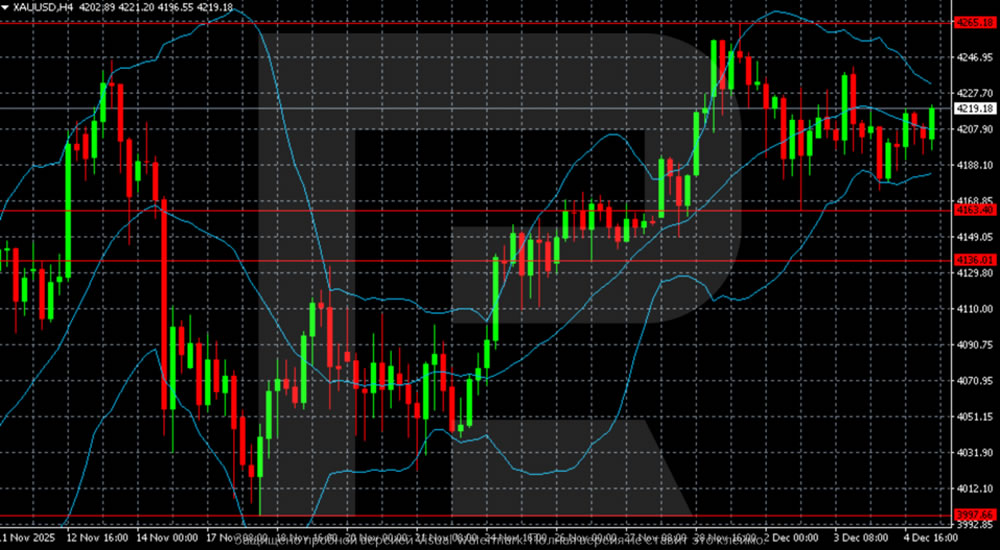
H4 Chart:
On the H4 chart, gold (XAU/USD) is consolidating after its recent advance toward 4,220–4,230 USD. The price remains above the middle Bollinger Band, with the upper band turning slightly upward, suggesting an attempt to recover from recent weakness.
Key resistance is around 4,265 USD, a level the market has repeatedly tested without securing a decisive breakout. A sustained move above this level would clear the path towards 4,300 USD and beyond.
Immediate support is marked at 4,163 USD. A break below this level would increase selling pressure and raise the risk of a decline towards the next demand zone near 4,136 USD. A close below 4,136 USD would signal a transition into a deeper corrective phase.
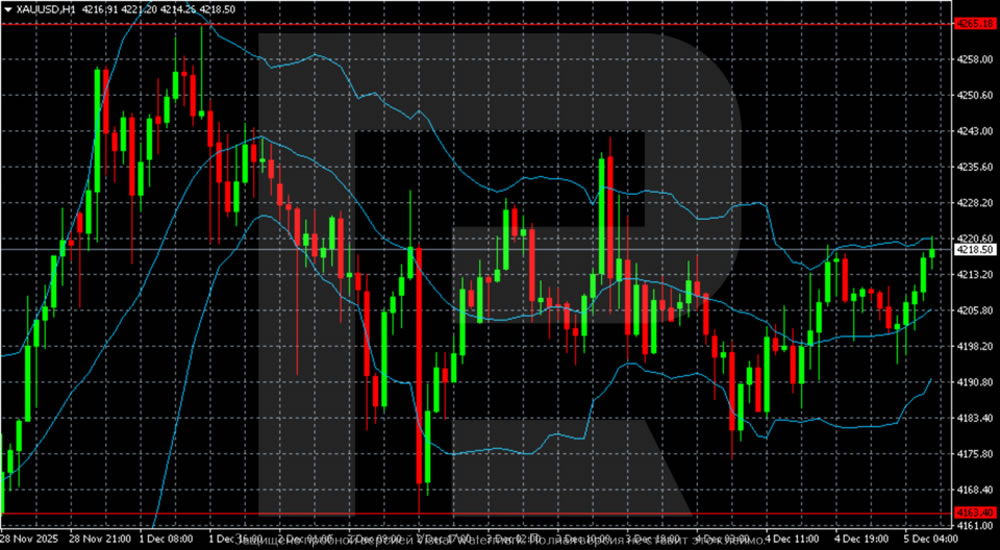
H1 Chart:
On the H1 chart, XAU/USD is trading within a tightening range between 4,188 USD and 4,220 USD, reflecting mixed short-term momentum. The middle Bollinger Band is providing near-term equilibrium, confirming the absence of a clear directional bias.
The upper Bollinger Band is capping advances near 4,220–4,225 USD, with several rejections from this zone indicating local overbought conditions. The lower band is offering support around 4,185–4,190 USD.
A sustained move above 4,220 USD would signal a resumption of bullish momentum, initially targeting 4,235–4,240 USD, and potentially 4,265 USD. Conversely, a break below 4,185 USD would open the way towards 4,163 USD. A loss of this support could intensify corrective pressure and expose the 4,136 USD level.
Gold remains in a holding pattern near 4,200 USD as traders await the delayed PCE inflation report. While labour market softness has bolstered expectations for Fed easing, the technical picture reflects consolidation within a defined range. A decisive reaction to today's data is likely to set the tone ahead of next week's FOMC meeting, with a break above 4,265 USD opening the door to further gains, while a drop below 4,163 USD risks a deeper correction.
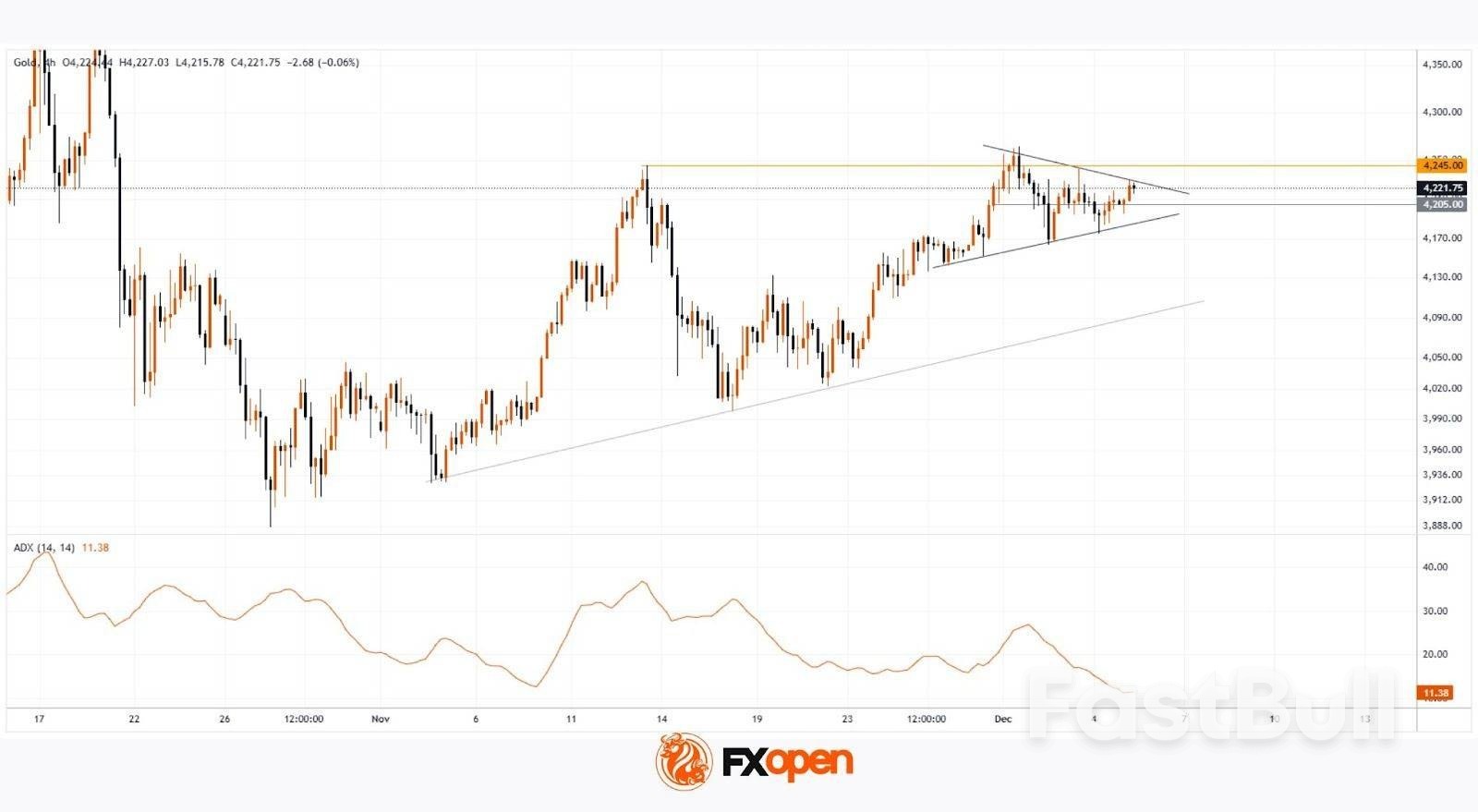
The ADX indicator on the 4-hour XAU/USD chart has dropped to a multi-month low, signalling the absence of a clear trend.
At the same time, a technical assessment of price movements allows for the construction of a symmetrical triangle pattern with a central axis around $4,205 — indicating that the current price reflects an equal balance of major drivers, including:
→ Weakening conditions in the US labour market. According to media reports, ADP recorded an unexpected decline of 32,000 private-sector jobs, while Challenger reported 71,000 layoffs in November, bringing the total number of job cuts since the start of the year close to 1.17 million.
→ Rumours that White House economic adviser Kevin Hassett may replace Federal Reserve Chair Jerome Powell in May — a development that has strengthened expectations of more aggressive policy easing in 2026.

It is worth noting that on 1 December, gold briefly rose above the November high — a move that coincided with silver reaching an all-time record (as suggested in our analysis on 27 November). However, the bulls failed to hold the price above $4,245, indicating a lack of sufficient buying interest. It appears that traders require stronger justification to purchase gold at such elevated levels.
Most likely, market participants have adopted a wait-and-see stance ahead of key releases:
→ Personal Consumption Expenditure (PCE) data for September, whose publication was delayed by the shutdown;
→ Next week's FOMC decision (10 December).
Although the market currently appears balanced, XAU/USD may be functioning like a "compressed spring". Be prepared for bursts of volatility.
India's government is reviewing a telecom industry proposal to force smartphone firms to enable satellite location tracking that is always activated for better surveillance, a move opposed by Apple, Google and Samsung due to privacy concerns, according to documents, emails and five sources.
A fierce privacy debate erupted in India this week after Prime Minister Narendra Modi's government was forced to rescind an order requiring smartphone makers to preload a state-run cyber safety app on all devices after activists and politicians raised concerns about potential snooping.
For years, the Modi administration has been concerned its agencies do not get precise locations when legal requests are made to telecom firms during investigations. Under the current system, the firms are limited to using cellular tower data that can only provide an estimated area location, which can be off by several meters.
The Cellular Operators Association of India (COAI), which represents Reliance's Jio and Bharti Airtel, has proposed that precise user locations should only be provided if the government orders smartphone makers to activate A-GPS technology - which uses satellite signals and cellular data - according to a June internal federal IT ministry email.
That would require location services to always be activated in smartphones with no option for users to disable them. Apple, Samsung and Alphabet's Google have told New Delhi that should not be mandated, said three of the sources who have direct knowledge of the deliberations.
A measure to track device-level location has no precedent anywhere else in the world, lobbying group India Cellular & Electronics Association (ICEA), which represents both Apple and Google, wrote in a confidential July letter to the government, which was viewed by Reuters.
"The A-GPS network service ... (is) not deployed or supported for location surveillance," said the letter, which added that the measure "would be a regulatory overreach."
India's home ministry had scheduled a meeting of top smartphone industry executives to discuss the matter on Friday but it was postponed, a source with direct knowledge of the matter said. On Thursday, Reuters sent questions related to this topic to the ministry.
India's IT and home ministries, which are both analysing the telecom industry's proposal, did not respond to Reuters queries.
Apple, Samsung, Google, Reliance and Airtel did not respond to requests for comment. Lobby groups ICEA and COAI also did not respond.
At this point, no policy decision has been made by the IT or home ministries.
Taking advantage of A-GPS technology - which is typically only turned on when certain apps are running or when emergency calls are being made - could provide authorities with location data precise enough that a user can be tracked to within about a meter, according to technology experts.
"This proposal would see phones operate as a dedicated surveillance device," said Junade Ali, a digital forensics expert associated with Britain's Institution of Engineering and Technology.
Cooper Quintin, a security researcher at the U.S.-based Electronic Frontier Foundation, said he had not heard of any such proposal elsewhere, calling it "pretty horrifying."
Governments worldwide routinely seek new ways to better track cellphone users' movements or data. Russia has mandated the installation of a state-backed communications app on all mobile phones in the country.
India is the world's second-biggest mobile market with 735 million smartphones as of mid-2025, where Google's Android powers more than 95% of the devices, with the rest using Apple's iOS, Counterpoint Research says.
Apple and Google's lobby group, the ICEA, argued in their July letter that there are significant "legal, privacy, and national security concerns" with the proposal from the telecom group.
It warned their user base would include people from the military, judges, corporate executives and journalists, adding that proposed location tracking risked their security given that they hold sensitive information.
Even the old way of location tracking is becoming problematic, the telecom group said, as smartphone makers show a pop-up message to users, alerting them that their "carrier is trying to access your location."
"A target can easily ascertain that he is being tracked by security agencies," said the telecom group, urging the government to order phone makers to disable the pop-up features.

Privacy concerns should take priority and India should also not consider disabling the pop-ups, Apple and Google's group argued in its July letter to the government.
This will "ensure transparency and user control over their location."
White Label
Data API
Web Plug-ins
Poster Maker
Affiliate Program
The risk of loss in trading financial instruments such as stocks, FX, commodities, futures, bonds, ETFs and crypto can be substantial. You may sustain a total loss of the funds that you deposit with your broker. Therefore, you should carefully consider whether such trading is suitable for you in light of your circumstances and financial resources.
No decision to invest should be made without thoroughly conducting due diligence by yourself or consulting with your financial advisors. Our web content might not suit you since we don't know your financial conditions and investment needs. Our financial information might have latency or contain inaccuracy, so you should be fully responsible for any of your trading and investment decisions. The company will not be responsible for your capital loss.
Without getting permission from the website, you are not allowed to copy the website's graphics, texts, or trademarks. Intellectual property rights in the content or data incorporated into this website belong to its providers and exchange merchants.
Not Logged In
Log in to access more features

FastBull Membership
Not yet
Purchase
Log In
Sign Up