• Trade
  • Markets
  • Copy
  • Contests
  • News
  • 24/7
  • Calendar
  • Q&A
  • Chats
Screeners
SYMBOL
LAST
ASK
BID
HIGH
LOW
NET CHG.
%CHG.
SPREAD
SPX
S&P 500 Index
6978.59
6978.59
6978.59
6988.81
6958.82
+28.36
+ 0.41%
--
DJI
Dow Jones Industrial Average
49003.40
49003.40
49003.40
49157.80
48862.52
-408.99
-0.83%
--
IXIC
NASDAQ Composite Index
23817.11
23817.11
23817.11
23865.26
23694.38
+215.76
+ 0.91%
--
USDX
US Dollar Index
95.930
96.010
95.930
95.950
95.770
+0.390
+ 0.41%
--
EURUSD
Euro / US Dollar
1.19956
1.19964
1.19956
1.20439
1.19924
-0.00436
-0.36%
--
GBPUSD
Pound Sterling / US Dollar
1.38020
1.38027
1.38020
1.38466
1.37987
-0.00449
-0.32%
--
XAUUSD
Gold / US Dollar
5206.88
5207.27
5206.88
5225.18
5157.13
+28.30
+ 0.55%
--
WTI
Light Sweet Crude Oil
62.358
62.393
62.358
62.501
62.192
-0.079
-0.13%
--

Community Accounts

Signal Accounts
--
Profit Accounts
--
Loss Accounts
--
View More

Become a signal provider

Sell trading signals to earn additional income

View More

Guide to Copy Trading

Get started with ease and confidence

View More

Signal Accounts for Members

All Signal Accounts

Best Return
  • Best Return
  • Best P/L
  • Best MDD
Past 1W
  • Past 1W
  • Past 1M
  • Past 1Y

All Contests

  • All
  • Trump Updates
  • Recommend
  • Stocks
  • Cryptocurrencies
  • Central Banks
  • Featured News
Top News Only
Share

Sri Lanka Private Sector Credit At 9767 Billion Rupees In Oct Versus 9521 Billion Rupees In Sept

Share

Sri Lanka Central Bank: Board Is Of The View That The Current Monetary Policy Stance Will Support Steering Inflation Towards The Target Of 5%

Share

Yield On 40-Year Japanese Government Bond Rises 2.0 Basis Points To 3.955%

Share

Spot Gold Continued Its Upward Trend, Reaching $5,220 Per Ounce, Up 0.78% On The Day

Share

Yield On 20-Year Japanese Government Bond Falls 0.5 Basis Points To 3.195%

Share

ANZ Analysts Have Changed Their View And Now Expect The Reserve Bank Of Australia To Raise Interest Rates By 25 Basis Points Next Week

Share

Aussie Dollar Slips 0.3% To $0.6989

Share

US 2025 Population Only Inches Up 0.5% As Immigration Slows Radically

Share

China Central Bank Injects 377.5 Billion Yuan Via 7-Day Reverse Repos At 1.40% Versus Prior 1.40%

Share

ANZ Bank Analysts Change View, Call For 25Bps Rate Hike From Reserve Bank Of Australia Next Week

Share

China's Central Bank Sets Yuan Mid-Point At 6.9755 / Dlr Versus Last Close 6.9545

Share

European Central Bank's Deputy Governor Cipollone: European Economy Has Been Proven Resilient And We Expect Data That Could Top Our Forecasts

Share

European Central Bank Executive Board Member Cipollone: Geopolitical Tensions Are Strengthening Case For European Payment Systems

Share

Japanese Defence Ministry: Japan, South Korea Defence Ministers To Meet In Yokosuka, Japan On Friday

Share

Spot Gold Hit A New Record High, Breaking Through $5,200 Per Ounce For The First Time, With A Cumulative Increase Of Over $880, Or 20%, In The First Month Of The New Year

Share

Taiwan Overnight Interbank Rate Opens At 0.805 Percent (Versus 0.805 Percent At Previous Session Open)

Share

Philippine Statistics Agency: Q4 Agricultural And Fisheries Output Up 0.5% Year-On-Year By Value

Share

Yield On 30-Year Japanese Government Bond Rises 2.0 Basis Points To 3.680%

Share

Australia Q4 CPI (All Groups) +3.6% Year-On-Year (Reuters Calculation, Reuters Poll +3.6%)

Share

Aussie Dollar Flat At $0.7012 After CPI Data

TIME
ACT
FCST
PREV
U.S. Dallas Fed New Orders Index (Jan)

A:--

F: --

P: --

U.S. 2-Year Note Auction Avg. Yield

A:--

F: --

P: --

U.K. BRC Shop Price Index YoY (Jan)

A:--

F: --

P: --

China, Mainland Industrial Profit YoY (YTD) (Dec)

A:--

F: --

P: --

Germany 2-Year Schatz Auction Avg. Yield

A:--

F: --

P: --

Mexico Trade Balance (Dec)

A:--

F: --

P: --

U.S. Weekly Redbook Index YoY

A:--

F: --

P: --

U.S. S&P/CS 20-City Home Price Index YoY (Not SA) (Nov)

A:--

F: --

P: --

U.S. S&P/CS 20-City Home Price Index MoM (SA) (Nov)

A:--

F: --

P: --
U.S. FHFA House Price Index MoM (Nov)

A:--

F: --

P: --

U.S. FHFA House Price Index (Nov)

A:--

F: --

P: --

U.S. FHFA House Price Index YoY (Nov)

A:--

F: --

P: --
U.S. S&P/CS 10-City Home Price Index YoY (Nov)

A:--

F: --

P: --

U.S. S&P/CS 10-City Home Price Index MoM (Not SA) (Nov)

A:--

F: --

P: --

U.S. S&P/CS 20-City Home Price Index (Not SA) (Nov)

A:--

F: --

P: --

U.S. S&P/CS 20-City Home Price Index MoM (Not SA) (Nov)

A:--

F: --

P: --

U.S. Richmond Fed Manufacturing Composite Index (Jan)

A:--

F: --

P: --

U.S. Conference Board Present Situation Index (Jan)

A:--

F: --

P: --

U.S. Conference Board Consumer Expectations Index (Jan)

A:--

F: --

P: --

U.S. Richmond Fed Manufacturing Shipments Index (Jan)

A:--

F: --

P: --

U.S. Richmond Fed Services Revenue Index (Jan)

A:--

F: --

P: --

U.S. Conference Board Consumer Confidence Index (Jan)

A:--

F: --

P: --
U.S. 5-Year Note Auction Avg. Yield

A:--

F: --

P: --

U.S. API Weekly Refined Oil Stocks

A:--

F: --

P: --

U.S. API Weekly Crude Oil Stocks

A:--

F: --

P: --

U.S. API Weekly Gasoline Stocks

A:--

F: --

P: --

U.S. API Weekly Cushing Crude Oil Stocks

A:--

F: --

P: --

Australia RBA Trimmed Mean CPI YoY (Q4)

A:--

F: --

P: --

Australia CPI YoY (Q4)

A:--

F: --

P: --

Australia CPI QoQ (Q4)

A:--

F: --

P: --

Germany GfK Consumer Confidence Index (SA) (Feb)

--

F: --

P: --

Germany 10-Year Bund Auction Avg. Yield

--

F: --

P: --

India Industrial Production Index YoY (Dec)

--

F: --

P: --

India Manufacturing Output MoM (Dec)

--

F: --

P: --

U.S. MBA Mortgage Application Activity Index WoW

--

F: --

P: --

Canada Overnight Target Rate

--

F: --

P: --

BOC Monetary Policy Report
U.S. EIA Weekly Crude Stocks Change

--

F: --

P: --

U.S. EIA Weekly Cushing, Oklahoma Crude Oil Stocks Change

--

F: --

P: --

U.S. EIA Weekly Crude Demand Projected by Production

--

F: --

P: --

U.S. EIA Weekly Crude Oil Imports Changes

--

F: --

P: --

U.S. EIA Weekly Heating Oil Stock Changes

--

F: --

P: --

U.S. EIA Weekly Gasoline Stocks Change

--

F: --

P: --

BOC Press Conference
Russia PPI MoM (Dec)

--

F: --

P: --

Russia PPI YoY (Dec)

--

F: --

P: --

U.S. Target Federal Funds Rate Lower Limit (Overnight Reverse Repo Rate)

--

F: --

P: --

U.S. Interest Rate On Reserve Balances

--

F: --

P: --

U.S. Federal Funds Rate Target

--

F: --

P: --

U.S. Target Federal Funds Rate Upper Limit (Excess Reserves Ratio)

--

F: --

P: --

FOMC Statement
FOMC Press Conference
Brazil Selic Interest Rate

--

F: --

P: --

Australia Import Price Index YoY (Q4)

--

F: --

P: --

Japan Household Consumer Confidence Index (Jan)

--

F: --

P: --

Turkey Economic Sentiment Indicator (Jan)

--

F: --

P: --

Euro Zone M3 Money Supply (SA) (Dec)

--

F: --

P: --

Euro Zone Private Sector Credit YoY (Dec)

--

F: --

P: --

Q&A with Experts
    • All
    • Chatrooms
    • Groups
    • Friends
    ndu flag
    杜伊布
    @nduYou are all very excellent and patient. Around what time was that?
    around 7 am UTC@杜伊布
    ndu flag
    marsgents
    @marsgentswell done😁
    杜伊布 flag
    @nduThank you for reminding me.
    marsgents flag
    5269 weekly
    marsgents flag
    5259 4h
    ndu flag
    Ko Ka
    sell or buy every one
    @Ko Kai dont sell gold i always buy. if you late you can wait for pull back and buy again
    ndu flag
    杜伊布
    @nduThank you for reminding me.
    @杜伊布you more than welcome😊
    Kira_XAU flag
    Traders ain't sleepin' huh, 😂
    Ko Ka flag
    ndu
    @nduthank you
    ndu flag
    if feds drop as trump wants we should expect more buys on gold.
    ndu flag
    Gibran Gib flag
    Kira_XAU
    Traders ain't sleepin' huh, 😂
    @Kira_XAU
    Gibran Gib flag
    ndu
    @ndu thanks
    ndu flag
    Kira_XAU
    Traders ain't sleepin' huh, 😂
    @Kira_XAUwe printing free money. trump is giving out free money😆😆😆😆
    ndu flag
    Gibran Gib
    @Gibran Gib😅
    Kira_XAU flag
    ndu
    @nduJollof Money guys 😂
    ndu flag
    Federal Reserve
    Act: 3.5-3.75,Prev: 4.0,Fcst: 3.75
    Policy Rates
    ndu flag
    lets waits for FOMC results
    Kira_XAU flag
    I'm holding my Gold till 5250. what's you Guys think?
    ndu flag
    Kira_XAU
    I'm holding my Gold till 5250. what's you Guys think?
    @Kira_XAUme too
    Type here...
    Add Symbol or Code

      No matching data

      All
      Trump Updates
      Recommend
      Stocks
      Cryptocurrencies
      Central Banks
      Featured News
      • All
      • Russia-Ukraine Conflict
      • Middle East Flashpoint
      • All
      • Russia-Ukraine Conflict
      • Middle East Flashpoint
      Search
      Products

      Charts Free Forever

      Chats Q&A with Experts
      Screeners Economic Calendar Data Tools
      Membership Features
      Data Warehouse Market Trends Institutional Data Policy Rates Macro

      Market Trends

      Market Sentiment Order Book Forex Correlations

      Top Indicators

      Charts Free Forever
      Markets

      News

      News Analysis 24/7 Columns Education
      From Institutions From Analysts
      Topics Columnists

      Latest Views

      Latest Views

      Trending Topics

      Top Columnists

      Latest Update

      Signals

      Copy Rankings Latest Signals Become a signal provider AI Rating
      Contests
      Brokers

      Overview Brokers Assessment Rankings Regulators News Claims
      Broker listing Forex Brokers Comparison Tool Live Spread Comparison Scam
      Q&A Complaint Scam Alert Videos Tips to Detect Scam
      More

      Business
      Events
      Careers About Us Advertising Help Center

      White Label

      Data API

      Web Plug-ins

      Affiliate Program

      Awards Institution Evaluation IB Seminar Salon Event Exhibition
      Vietnam Thailand Singapore Dubai
      Fans Party Investment Sharing Session
      FastBull Summit BrokersView Expo
      Recent Searches
        Top Searches
          Markets
          News
          Analysis
          User
          24/7
          Economic Calendar
          Education
          Data
          • Names
          • Latest
          • Prev

          View All

          No data

          Scan to Download

          Faster Charts, Chat Faster!

          Download App
          English
          • English
          • Español
          • العربية
          • Bahasa Indonesia
          • Bahasa Melayu
          • Tiếng Việt
          • ภาษาไทย
          • Français
          • Italiano
          • Türkçe
          • Русский язык
          • 简中
          • 繁中
          Open Account
          Search
          Products
          Charts Free Forever
          Markets
          News
          Signals

          Copy Rankings Latest Signals Become a signal provider AI Rating
          Contests
          Brokers

          Overview Brokers Assessment Rankings Regulators News Claims
          Broker listing Forex Brokers Comparison Tool Live Spread Comparison Scam
          Q&A Complaint Scam Alert Videos Tips to Detect Scam
          More

          Business
          Events
          Careers About Us Advertising Help Center

          White Label

          Data API

          Web Plug-ins

          Affiliate Program

          Awards Institution Evaluation IB Seminar Salon Event Exhibition
          Vietnam Thailand Singapore Dubai
          Fans Party Investment Sharing Session
          FastBull Summit BrokersView Expo

          FOMC Holds Funds Rate Steady; Powell Says Rate Cut Getting ‘Closer’

          Warren Takunda

          Economic

          Summary:

          The Federal Reserve held rates steady but signaled a potential cut in September, depending on economic data.

          The Federal Reserve refrained from cutting interest rates Wednesday but its rate-setting Federal Open Market Committee did lay the groundwork for a possible, initial reduction at its next meeting in mid-September.
          Chair Jerome Powell and his fellow monetary policymakers hinted that they are headed toward an initial rate cut in coming months, possibly as soon as September, but they stopped short of giving a strong or assertive near-term monetary easing signal.
          The FOMC repeated that it won’t cut rates until it gains “greater confidence” that inflation is headed “sustainably” to 2%, but its policy statement contained other changes suggesting greater concern about the “maximum employment” side of the Fed’s “dual mandate, as well as greater comfort with “progress” toward its inflation target.
          Powell told reporters the Fed is “getting closer to a point where it will be appropriate to dial back restriction” due to a combination of better inflation data and softer labor market data.
          Financial markets are placing high odds on a 25 basis point rate cut at the FOMC’s Sept. 17-18 meeting, with more reductions to follow. but Powell stopped short of sending a definitive signal on the timing or amount of second half rate cuts.
          He did say a rate cut may well be “on the table” at that meeting, but said “we’re not there yet” and noted that a lot of important data will be coming between over the next six weeks.
          He strongly denied that the timing of the Nov. election will influence the decision.
          Despite mounting pressure on the Fed to lower short-term interest rates, the FOMC left the federal funds rate in a target range of 5.25% to 5.50% for an eighth straight meeting after raising that key money market rate 525 basis points between March 2022 and July 2023. But the FOMC made significant changes to its policy statement, which suggest rates are about to start moving in the opposite direction before too much longer.
          A key policy sentence was left unchanged. As before, the FOMC said it “does not expect it will be appropriate to reduce the target range until it has gained greater confidence that inflation is moving sustainably toward 2%.”
          However, the FOMC seemed to soften that assertion by altering its preceding characterization of economic conditions in notable ways.
          In its latest statement, the FOMC says, “Job gains have moderated, and the unemployment rate has moved up but remains low. Inflation has eased over the past year but remains somewhat elevated. In recent months, there has been some further progress toward the Committee’s 2% inflation objective.”
          By contrast, the June 12 statement had put less emphasis on labor market softening and inflation progress: “Job gains have remained strong, and the unemployment rate has remained low. Inflation has eased over the past year but remains elevated. In recent months, there has been modest further progress toward the Committee’s 2 percent inflation objective.”
          The July 31 language, though not dramatically different, sounds somewhat more upbeat about the inflation outlook and less upbeat about the labor market’s prospects.
          Powell reinforced that basic message in his post-FOMC press conference, saying that, on the one hand, “good data” on inflation has made Fed policymakers “more confident” it is headed to 2%, while, on the other hand, the labor market is “cooling.”
          Powell said he “would not like to see further cooling of the labor market,” before amending the comment to say he wouldn’t want to see any “material cooling.”
          He said the labor market is “normalizing” in ways the FOMC had hoped it would and said he and his colleagues will be ‘watching closely to see if it’s more than that.” If so, he vowed, the Fed “will respond.”
          Powell said the Fed doesn’t want to ease “too late” and risk hurting the economy and employment but said it is “well-positioned to respond” if the labor market does weaken more than expected. So far, he said, unemployment remains “historically low” at 4.1%.
          “What we’re thinking is how do we keep this (combination of moderating inflation and normalizing labor markets) going?” he said. “The job is not done on inflation, but we can afford to begin to dial back the restriction.’
          How much the Fed will cut rates remains unclear. In their June Summary of Economic Projections, FOMC participants projected just one rate cut this year to a median 5.1% (5.0% to 5.25%), but officials were closely divided, with eight of the 19 projecting two rate cuts this year. Next year, the funds rate was projected to fall to a median 4.1% (4.0% to 4.25%).
          Addressing that very issue, Powell said “we’ve made no decisions about future meetings including September,” but he said, “the economy is moving closer to the point where it will be appropriate to reduce the policy rate.”
          He noted the FOMC will compile a new set of rate projections when it publishes a revised, quarterly SEP in September. Meanwhile, he said the Fed will be evaluating a wide variety of data.
          Powell stressed the exact timing will be “data dependent…The question will be whether the totality of the data and the outlook for the balance of risks is consistent with” rate cuts.
          He added that an initial rate cut could be “on the table as soon as September. We’re getting closer to where it will be appropriate to reduce our policy rate.”
          But he added, “we’re not quite there yet.”
          Powell suggested that a September rate cut would become more likely “if we were to see inflation moving down quickly or in line with expectations…,” but said “if inflation were to remain stickier … we would weigh that.”
          As reporters continued to probe the odds of a September rate cut, Powell welcomed better second quarter inflation data, but said “we need to see more to have confidence we’re on a path down to 2%,…but our confidence is greater, because we’ve been getting good data…It looks like an economy that’s normalizing…”
          Powell said a slowing of demand that has cooled both inflation and formerly “overheated” labor markets proves that monetary policy is “restrictive,” and he reiterated that “the time is coming … at which it will begin to be appropriate to dial back the level of restriction so we can address both mandates.”
          An initial rate cut could come “as soon as the next meeting, depending on how things come in,” he went on. “We think the time is approaching, and if we do get the data we hope we get a reduction could be on the table at the September meeting.’
          While holding rates steady, the FOMC reaffirmed its policy of “reducing its holdings of Treasury securities and agency debt and agency mortgage‑backed securities.” This means the Fed will continue to moderate the pace of so-called “quantitative tightening” or balance sheet shrinkage.
          At its May 1 meeting, the FOMC announced that, beginning in June, it would reduce its securities portfolio by $60 billion per month instead of by $95 billion per month by allowing fewer maturing Treasury securities to roll off the balance sheet. It authorized the New York Fed to roll over at auction the amount of principal payments from the Fed’s holdings that exceeds a cap of $25 billion per month – down from $60 billion. It left unchanged the amount of MBS reinvestments at $35 billion.
          Speculation has mounted that the FOMC will soon end QT altogether and stop shrinking its balance sheet. But Powell did not address this issue. Nor was he asked about it.
          The July meeting took place against the backdrop of favorable data.
          The price index for personal consumption expenditures, the Fed’s preferred inflation gauge, rose by 0.1% in June or 2.5% from a year earlier, as the Commerce Department reported Friday. The core PCE index was up 0.2% and 2.6% respectively. The Labor Department had previously reported that the consumer price index fell 0.1% in June, leaving it 3% higher than a year ago. The core CPI was 3.3% higher.
          Meanwhile, labor market conditions have been softening. Although non-farm payrolls rose a respectable 200,000 in June, the unemployment rate rose another tenth to 4.1%, compared to 3.4% at the start of last year. The closely watched job vacancy-unemployment ratio has fallen from 2.0 to a pre-pandemic 1.2. Wage gains have moderated, as shown Wednesday by a June dip in the Employment Cost Index.
          Economic activity “has continued to expand at a solid pace,” as the FOMC statement reiterated. The Commerce Department estimates that real GDP at a 2.8% annual rate in the second quarter – up from 1.4% in the first quarter. Core PCE inflation was up 2.9% in the period.

          Source: MaceNews

          To stay updated on all economic events of today, please check out our Economic calendar
          Risk Warnings and Disclaimers
          You understand and acknowledge that there is a high degree of risk involved in trading. Following any strategies or investment methods may lead to potential losses. The content on the site is provided by our contributors and analysts for information purposes only. You are solely responsible for determining whether any trading assets, securities, strategy, or any other product is suitable for investing based on your own investment objectives and financial situation.
          Add to Favorites
          Share

          Dollar Steady Following FOMC, BoE Rate Decision Looms

          Samantha Luan

          Central Bank

          Economic

          Forex

          Dollar remained relatively steady following the balanced post-FOMC press conference, with notable exceptions against the stronger yen and Swiss franc. Fed Chair Jerome Powell explicitly mentioned the possibility of a rate cut in September but refrained from making any firm commitments or providing extended guidance. While markets are aggressively betting on three Fed cuts this year, some economists view this as overly optimistic. The greenback's next moves will likely be influenced by today's ISM manufacturing data and tomorrow's non-farm payroll data.
          For the week, Yen remains the strongest currency with no clear signs of a sustainable pullback. Swiss Franc is currently the second strongest, with its strength partially attributed to rising tensions in the Middle East, which have also driven up gold and oil prices. Canadian Dollar is the third strongest, benefiting from a lack of significant selling pressure.
          Conversely, Euro and Sterling are at the bottom of the weekly performance chart alongside the Australian dollar. The selloff against Swiss franc is adding pressure on these two European majors. Sterling is now focused on BoE rate decision, where uncertainty about a potential rate cut looms large. The decision could trigger significant volatility in Pound and shift its position notably.
          In Asia, Nikkei fell -2.49%, more than reversing yesterday's gains. Hong Kong HSI is up 0.07%. China Shanghai SSE is down -0.17%. Singapore Strait Times is down -0.91%. Japan 10-year JGB yield is down -0.0248 at 1.036. Overnight, DOW rose 0.24%. S&P 500 rose 1.58%. NASDAQ rose 2.64%. 10-year yield fell -0.034 to 4.109.

          Fed's Powell opens door to Sep rate cut, markets price In 75% chance of three cuts by year-end

          US stocks closed higher overnight as investors cheered Fed Chair Jerome Powell's suggestion that a September rate cut is "on the table." Nevertheless, he emphasized that any decision would hinge on the "totality" of incoming economic data.
          In the post-FOMC meeting press conference, Powell highlighted that recent Q2 inflation data has "added to our confidence," and continued positive data would further solidify this confidence that inflation is moving towards the 2% target.
          He explained that the committee's "broad sense" is that the economy is nearing a point where reducing the policy rate could be appropriate. The decision will depend on whether the overall data, evolving economic outlook, and balance of risks align with increased confidence in controlling inflation while maintaining a robust labor market.
          "If that test is met, a reduction in our policy rate could be on the table for as soon as the next meeting in September," Powell stated. Meanwhile, he clarified that a 50bps rate cut is "not something we're thinking about right now."
          Market reactions were immediate. Fed funds futures are now pricing in over a 100% probability of a 25bps cut in September. More strikingly, the likelihood of three rate cuts by the end of this year has surged to over 75%, up from less than 60% a week ago.Dollar Steady Following FOMC, BoE Rate Decision Looms_1
          Technically, it appears that 55 D EMA is providing enough support for S&P 500 for now. Focus is back on 5585.34 resistance. Break there will argue that correction from 5669.67 has already completed at 5390.95. Larger up trend would then be ready to resume for new record highs.

          Dollar Steady Following FOMC, BoE Rate Decision Looms_2Japan confirms JPY5.53T intervention, AUD/JPY slide persists

          Japan confirmed its intervention in the currency market last month following Yen's drop to a 38-year low against Dollar. This intervention marked the turning point for Yen's massive month-long rally, which continues this week following BoJ's second interest rate hike this year. Governor Kazuo Ueda has indicated that further tightening remains a possibility.
          The Japanese Ministry of Finance disclosed on Wednesday that authorities spent JPY 5.53T, or USD 36.8B, on market intervention between June 27 and July 29. This amount aligns with market expectations and underscores the significant effort to stabilize the yen.
          The AUD/JPY pair has been one of the biggest losers, dropping more than 3% this week alone. Technically, the near-term outlook remains bearish as long as the 101.76 resistance holds, even if there is a rebound. The fall from 109.36 is viewed as a correction to the uptrend that started from the 2020 low of 59.85. A deeper decline is anticipated towards the 38.2% retracement level of 59.85 to 109.36 at 90.44. Strong support is likely at this level, considering its proximity to the 55-month EMA (currently at 90.83) and the psychological 90 level, which could provide a floor to the downside on the first attempt.Dollar Steady Following FOMC, BoE Rate Decision Looms_3

          Dollar Steady Following FOMC, BoE Rate Decision Looms_4Japan's PMI manufacturing finalized at 49.1 in Jul, back in contraction

          Japan's PMI Manufacturing was finalized at 49.1 in July, down from June's 50.0, indicating that the sector is back in contraction streak since early 2023.
          Usamah Bhatti of S&P Global Market Intelligence described the sector's performance as "downbeat" at the start of Q3. The decline was driven by a stronger reduction in new orders, leading to a renewed fall in production levels.
          Inflationary pressures remained high, with input price inflation reaching a 15-month peak. Despite this, firms raised their selling prices more cautiously to stay competitive.
          The near-term outlook appears "muted" due to the lack of new order inflows, allowing firms to clear outstanding business at the fastest rate since March. However, firms are optimistic that this period will pass within the coming year, expecting business expansion and new product launches to coincide with a broader economic recovery.

          China's Caixin PMI manufacturing drops to 49.8, below expectations

          China's Caixin PMI Manufacturing dropped from 51.8 to 49.8 in July, falling below the expected 51.6. S&P Global noted that output expanded at the slowest pace in nine months, average selling prices declined, and input cost inflation eased. However, business confidence showed improvement.
          Wang Zhe, Senior Economist at Caixin Insight Group, commented, "Overall, the manufacturing sector largely stabilized in July. Supply expanded slightly, while domestic demand declined and external demand was steady. The reduction in business purchases was coupled with decreases in raw material stocks. The job market contraction was steady. Price levels faced pressure while market optimism improved slightly."

          BoE faces uncertainty over first rate cut decision amid divided MPC

          Today's focus is squarely on BoE's rate decision, with significant uncertainty surrounding whether the first rate cut will be initiated to kick-start the policy easing cycle.
          Communications from various MPC members have shown no clear consensus. Known dove Swati Dhingra is expected to continue pushing for a rate reduction, urging BoE to stop squeezing living standards. Conversely, hawkish members like Catherine Mann are likely to guard against resurgence of inflation pressures, viewing the dip to 2% as "touch and go."
          Chief Economist Huw Pill has stated that it's still an "open question" on whether rate cuts should start now. Adding to the uncertainty, Deputy Governor Clare Lombardelli, who is voting for the first time, remains a big unknown factor in today's decision.
          Markets are currently pricing in around a 60% chance of a quarter-point cut today.
          GBP/USD has been in steady but slow downward spiral since hitting 1.3043 in mid-July. For now, risk will stay on the downside as long as 1.2936 resistance holds. Sustained trading below 55 D EMA (now at 1.2783) as well as near term channel support (now at 1.2781) will argue that whole rally from 1.2298 might be over. Deeper fall would then be seen back to 1.2612 support. Nevertheless, break of 1.2936 will suggest that the pull back from 1.3043 has completed, and rise from 1.2998 is ready to resume. We'll know very soon.

          Dollar Steady Following FOMC, BoE Rate Decision Looms_5Elsewhere

          Eurozone PMI manufacturing final and unemployment rate, as well as UK PMI manufacturing final will be released in European session. later in the day, US ISM manufacturing is the main event while jobless claims will also be featured.

          USD/CAD Daily Outlook

          Intraday bias in USD/CAD remains neutral for the moment. Further rally is expected as long as 1.3796 support holds. Rise from 1.3176 should be resuming and next target is 61.8% projection of 1.3176 to 1.3845 from 1.3588 at 1.4025. On the downside, below 1.3796 minor support will delay the bullish case and bring deeper pullback first.Dollar Steady Following FOMC, BoE Rate Decision Looms_6
          In the bigger picture, price actions from 1.3976 (2022 high) are viewed as a corrective pattern, that might have completed at 1.3176 (2023 low) already. Firm break of 1.3976 will confirm resumption of whole up trend from 1.2005 (2021 low). Next target is 61.8% projection of 1.2401 to 1.3976 from 1.3176 at 1.4149. This will be the favored case as long as 1.3588 support holds, in case of pullback.Dollar Steady Following FOMC, BoE Rate Decision Looms_7

          Source: ActionForex

          To stay updated on all economic events of today, please check out our Economic calendar
          Risk Warnings and Disclaimers
          You understand and acknowledge that there is a high degree of risk involved in trading. Following any strategies or investment methods may lead to potential losses. The content on the site is provided by our contributors and analysts for information purposes only. You are solely responsible for determining whether any trading assets, securities, strategy, or any other product is suitable for investing based on your own investment objectives and financial situation.
          Add to Favorites
          Share

          Asia's Crude Oil Imports Drop in JULY as China Stays Weak

          Owen Li

          Energy

          Asia's crude oil imports dropped to the lowest in two years in July as demand remained weak in top importer China and eased in number two India.
          A total of 24.88 million barrels per day (bpd) arrived in July in Asia, the world's biggest oil importing region, down 6.1% from the previous month and the lowest on a daily basis since July 2022, according to data compiled by LSEG Oil Research.
          For the first seven months of the year, Asia's imports averaged 26.78 million bpd, down 340,000 bpd from the same period in 2023.
          The ongoing weakness in Asia's oil imports undermines forecasts for robust growth for the region's oil demand from leading exporter group the Organization of Petroleum Exporting Countries (OPEC).
          OPEC's July monthly oil market report stuck to the group's forecast the world oil demand will rise by 2.25 million bpd in 2024, lead by an increase of 760,000 bpd in China, and supported by a gain of 230,000 bpd in India and a further 350,000 bpd for the rest of Asia.
          The International Energy Agency (IEA) has diverged from OPEC's view in its recent analysis, forecasting on July 11 that global oil demand growth will by 970,000 bpd.
          But contained within the IEA forecast is the expectation that China will account for about 40% of the global increase in crude demand, which is about 388,000 bpd.
          While imports are only one component of demand growth, the others being domestic production and potential inventory draws, it's fair to say that China's imports are tracking nowhere near the IEA's forecast, and are an ocean away from OPEC's.
          If LSEG's estimate of China's imports of 10.53 million bpd for July is confirmed in official trade data expected next week, it would mean arrivals of around 10.98 million bpd for the first seven months of the year.
          This is down 240,000 bpd, or about 2.1%, from the customs data of imports of 11.22 million bpd for the first seven months of 2023.
          Far from growing, China's demand for imported crude is slipping, meaning a dramatic turnaround will be needed for the remaining five months of the year to get anywhere close to even the modest forecast for demand growth from the IEA.
          The question is whether such a turnaround is likely, or if the sluggish economic story for China is locked in for the rest of the year.
          Growth Hopes
          It's possible economic growth will pick up over the remainder of 2024, especially if the early signs that Beijing is getting more serious about stimulus actually translate into increased activity.
          But even if policies to encourage consumers to swap old for new appliances and vehicles are enacted, it doesn't necessarily mean a boost to fuel consumption, especially since it's likely that a high percentage of any new vehicle sales will be electric.
          What's more hopeful for China's oil demand is LSEG's expectation that the world's biggest crude importer is once again building stockpiles.
          An additional 60 million barrels is believed to have been approved for the Strategic Petroleum Reserve (SPR) and LSEG reports that inflows to storage sites have already been assessed and the amount is expected to land between July and the end of the first quarter of 2025.
          There is a possible caveat to China's SPR purchases, namely that they are also likely dependent on the crude price remaining at what the Chinese assess as a reasonable level.
          Outside of China, there is little reason to be optimistic about a pick up in Asia's demand for crude, with India's imports slipping to 4.54 million bpd in July from 4.76 million bpd in June and 5.14 million bpd in May.
          A seasonal easing of imports is likely as India's monsoon season approaches, but they should recover after the wet season given solid economic growth in the South Asian nation amid an infrastructure boom.
          Elsewhere in Asia, demand for crude is being capped by lacklustre economic growth and weak margins for refiners - who have been battling relatively high crude oil prices, especially from Middle East suppliers such as Saudi Arabia - but limp product prices given soft demand across the region.

          Source:

          Risk Warnings and Disclaimers
          You understand and acknowledge that there is a high degree of risk involved in trading. Following any strategies or investment methods may lead to potential losses. The content on the site is provided by our contributors and analysts for information purposes only. You are solely responsible for determining whether any trading assets, securities, strategy, or any other product is suitable for investing based on your own investment objectives and financial situation.
          Add to Favorites
          Share

          [Fed] Powell: Remains Confident That Inflation Is Falling, Signaling a September Rate Cut

          FED

          Remarks of Officials

          After the Fed's July interest rate decision, Powell held a press conference with the following main points:
          The Fed will maintain the restrictive stance of monetary policy and is attentive to risks to both sides of our dual mandate. The economy has made considerable progress toward both goals over the past two years.
          Recent indicators suggest that economic activity has continued to expand at a solid pace. GDP growth moderated to 2.1 percent in the first half of the year. Private domestic final purchases, or PDFP, grew at a 2.6 percent pace over that same period last year. Growth of consumer spending has slowed from last year's robust pace but remains solid. Improving supply conditions have supported resilient demand and the strong performance of the U.S. economy over the past year.
          In the labor market, supply and demand conditions have come into better balance. Strong job creation over the past couple of years has been accompanied by an increase in the supply of workers, reflecting increases in participation among individuals aged 25 to 54 years and a strong pace of immigration. The unemployment rate has moved up but remains low at 4.1 percent. Nominal wage growth has eased over the past year. Overall, a broad set of indicators suggests that conditions in the labor market have returned to about where they stood on the eve of the pandemic—strong but not overheated.
          In the past two years, inflation has eased substantially from a peak of 7 percent to 2.5 percent, but slightly higher than the 2 percent target. Data suggests that inflation falls more, and longer-term inflation expectations appear to remain well anchored, but the upside risk is weakened. Reducing policy restraint too soon or too much could result in a reversal of the progress we have seen on inflation. At the same time, reducing policy restraint too late or too little could unduly weaken economic activity and employment.
          There is an in-depth discussion on rate cuts at this meeting and it is getting closer to the point where rates can be cut. However, it has not yet reached that point and more data is needed to further boost confidence. If inflation falls as expected and the labor market unexpectedly weakens, rates could be cut as early as the next meeting in September.

          Powell's Press Conference

          Risk Warnings and Disclaimers
          You understand and acknowledge that there is a high degree of risk involved in trading. Following any strategies or investment methods may lead to potential losses. The content on the site is provided by our contributors and analysts for information purposes only. You are solely responsible for determining whether any trading assets, securities, strategy, or any other product is suitable for investing based on your own investment objectives and financial situation.
          Add to Favorites
          Share

          Confidence Grows Amongst FOMC Members

          Westpac

          Economic

          Central Bank

          The scene is set for a September first cut by the FOMC. The underlying inflation trend warrants a series of cuts at a measured pace to a 3.375% terminal by mid-2026.
          At the July meeting, the FOMC kept rates steady but stated that the economy is moving closer to the point at which it will be appropriate to lower the policy rate. In the press conference, Chair Powell subsequently asserted that the economy does not need to weaken further to justify an easing cycle. Instead, the catalyst will be confidence in the sustainability of the established downtrend in inflation.
          The Committee continue to believe they have time on their side to gauge inflation's pace and risks. "The unemployment rate has moved up but remains low", and current momentum is believed to be consistent with a re-balancing of labour demand and supply rather than an outright weakening. Labour market conditions are expected return to a state broadly consistent with that just ahead of the pandemic in 2019, which itself was robust. In the press conference, Chair Powell also highlighted that growth in domestic demand has, to date, remained healthy in 2024.
          "Further progress toward the Committee's 2 percent inflation objective" is therefore desired in Q3 before beginning to ease policy. In thinking about the sustainability of the inflation downtrend and the probability of a September cut, it is noteworthy that annual CPI ex-shelter has, since June 2023, held within a 0.8%-2.3%yr range and averaged less than 2.0%yr. Inflation expectations are now also essentially in line with the decade average on a 1-year and 5-year view (University of Michigan Survey); and, as per the Employment Cost index overnight, wage growth is converging to a pace consistent with maintaining inflation at the 2.0%yr target into the medium-term.
          The underlying strength of the economy notwithstanding, "the economic outlook is uncertain, and the Committee is attentive to the risks to both sides of its dual mandate". This is a change from the language in the previous statement which highlighted only the risks to inflation. Chair Powell emphasised in the press conference that the FOMC have the capacity to adjust the pace of easing as necessary. Right now, the market is focusing on the downside risks for the labour market – which we have been highlighting throughout 2024 and will get an update on in Friday's July employment report – and consequently a more rapid and/or deeper cutting cycle than we are forecasting (see below). But, a year ahead, if the underlying strength of the economy holds up, inflation risks will likely assert again – the US' domestic capacity constraints are real and enduring, and trade policy a meaningful threat.
          Westpac's view of the FOMC outlook seeks to balance these risks. We continue to expect a first cut in September followed by a single cut per quarter from Q4 2024 to Q2 2026 to a 3.375% terminal rate. Against the FOMC's 2.8% 'longer run' estimate (revised up in June from 2.6% at the March meeting) and our own slightly higher view of the likely trend in neutral rates, the end point for the cycle is best considered mildly restrictive. In our view, policy is only likely to return to a neutral or expansionary setting if consumption growth weakens materially below trend: fiscal policy, the green transition and capacity all warrant robust, if not strong, momentum in US investment into the medium term.
          To stay updated on all economic events of today, please check out our Economic calendar
          Risk Warnings and Disclaimers
          You understand and acknowledge that there is a high degree of risk involved in trading. Following any strategies or investment methods may lead to potential losses. The content on the site is provided by our contributors and analysts for information purposes only. You are solely responsible for determining whether any trading assets, securities, strategy, or any other product is suitable for investing based on your own investment objectives and financial situation.
          Add to Favorites
          Share

          Fed Review: Mindful of Risks

          Danske Bank

          Economic

          Central Bank

          The Fed made no changes to its monetary policy in the July meeting, as widely anticipated. Powell avoided pre-committing but firmly opened the door for initiating rate cuts in September.
          The Fed sees plausible scenarios ranging from 'zero to several cuts this year'. Focus is on the risk of sharp deterioration in labour market conditions, but we see no reason for panic yet.
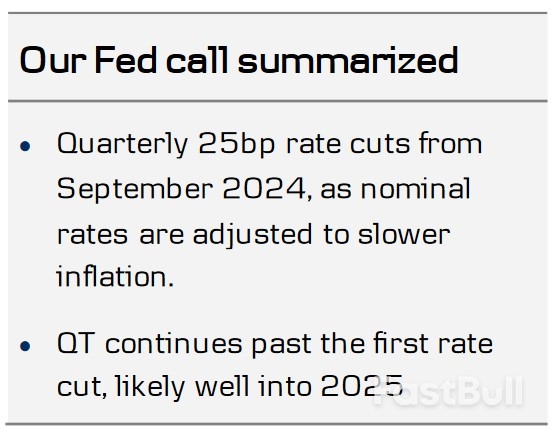
          Markets price in a 10-15% probability for a 50bp move in September and a cumulative 72bp of cuts by year-end. We still expect only quarterly 25bp reductions from September and forecast downside potential to EUR/USD.
          Powell made it as clear as possible that the September cut is firmly on the table. Already the initial statement noted that 'job gains have moderated' (prev. 'remained strong') and that 'Committee is attentive to risks to both sides of its dual mandate' (prev. only 'inflation risks').
          During the press conference, Powell noted several times that the Fed has become more mindful of downside risks with regards to the labour market, but also reaffirmed that the economy is 'actually in a good place' for now – and we would agree.
          The Fed has reached a point where there is no longer uncertainty over whether or not the current policy is restrictive. Economic growth is slowing and labour market conditions have cooled notably. Upside risks to inflation prevail, but Q2 data has increased the policymakers' confidence on price pressures moderating further.
          Powell emphasized that the outcome space for rates remains wide. He saw plausible scenarios ranging from 'zero to several cuts this year'. We have called for 25bp rate cuts in September and December, followed by four more in 2025, which is now already firmly on the hawkish side of current market pricing.
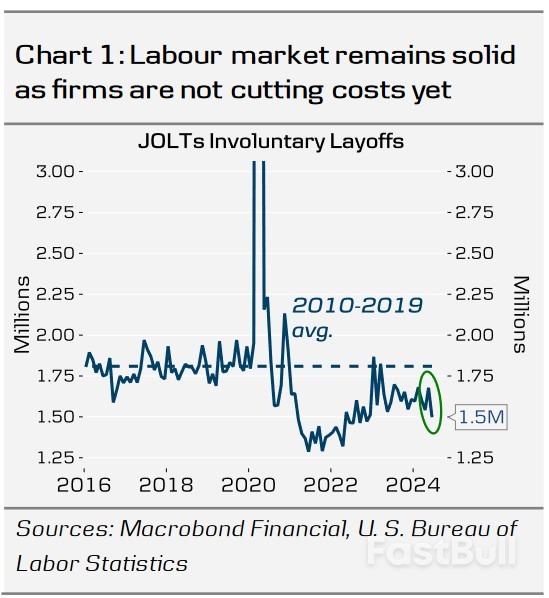
          So why don't we believe in rapid cuts? Simply put, we still think the economy remains on a solid footing. In our Fed preview, 25 July, we discussed why firms are not yet under pressure to start cutting costs abruptly, and how fiscal policy helps to keep growth afloat. This week, the latest JOLTs data supported that view as firms' involuntary layoffs fell to the lowest level since November 2022.Fed Review: Mindful of Risks_1
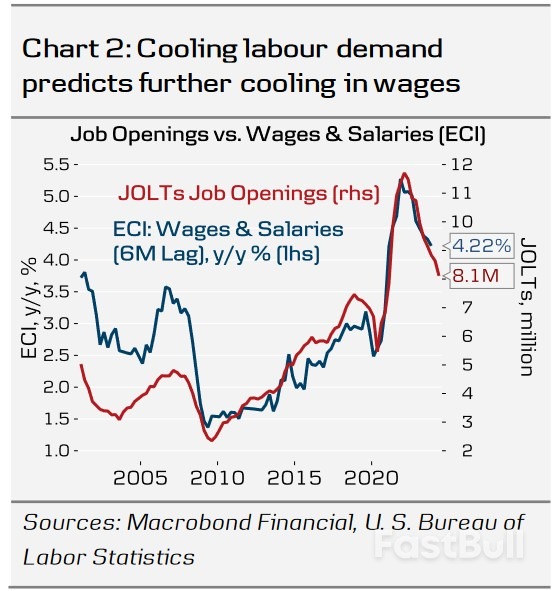
          Is there a risk that the Fed is falling behind the curve? Yes, but for now the evidence is lacking. Powell humbly noted that gauging the perfect time for initiating cuts is inarguably tricky. We have for long argued that as real interest rates remain restrictive and as inflation continues to cool, the Fed will need to start lowering nominal policy rates to avoid overtightening its policy. Today's ECI data showed further moderation in underlying cost pressures and leading indicators point towards further slowdown over the coming 6M. For now, the speculation about looming cuts and the consequent easing in financial conditions have helped to ease some of the restrictive effect even when the actual cuts are still in the horizon. The Fed remains mindful of risks, but not in panic mode for now.Fed Review: Mindful of Risks_2

          Markets: We think the current Fed cut pricing is excessive

          The dovish signals from Powell at today's conference added to the existing market narrative that Fed is set to ease aggressively. Money markets are now pricing 156bp worth of rate cuts over the next 12 months, up from 150bp prior to the statement release. EUR/USD moved lower during the press conference, but reversed part of the decline later on. The US Treasury curve bull-steepened, with the 10Y tenor declining by 6bp to a new 5-month low of 4.07. The current Fed pricing seems optimistic, and we believe that risks related to US rates are now strongly tilted to the upside (see Yield Outlook – Optimism has become excessive, 31 July).Fed Review: Mindful of Risks_3
          To stay updated on all economic events of today, please check out our Economic calendar
          Risk Warnings and Disclaimers
          You understand and acknowledge that there is a high degree of risk involved in trading. Following any strategies or investment methods may lead to potential losses. The content on the site is provided by our contributors and analysts for information purposes only. You are solely responsible for determining whether any trading assets, securities, strategy, or any other product is suitable for investing based on your own investment objectives and financial situation.
          Add to Favorites
          Share

          [Fed] July Rate Decision: Interest Rates Remain Unchanged, Upside Risks to Inflation Ease

          FED

          Data Interpretation

          July 31 ET, the Fed announced the decision of the monetary policy meeting to keep the target range of the federal funds rate unchanged at the level of 5.25 percent to 5.5 percent, in line with market expectations. The monetary policy statement showed:
          In recent months, there has been some further progress toward the Committee's 2 percent inflation objective.
          Economic activities rose stably. GDP slowed to 2.1 percent in the first half of the year from 3.1 percent last year. Consumer spending has likewise slowed but remains solid. Investment in equipment and intangible assets has rebounded from last year's slump, and improved supply conditions have supported the recovery in demand and the strong performance of the economy.
          The supply and demand in the labor market reached an equilibrium, with the employment growth eased, and the unemployment rate rose but stayed at a low of 4.1 percent. In addition, the pace of migration accelerated, the supply of workers increased and nominal wage growth slowed. A range of indicators suggests that labor market conditions have returned to pre-pandemic levels.
          Inflation eased over the past year but was still higher than the 2 percent long-term target. The PCE rose 2.5 percent YoY in June, and the core PCE rose 2.6 percent YoY. Further upside risks to inflation eased despite stubborn long-term inflation expectations.
          As the labor market cools and inflation declines, the risks to achieving its employment and inflation goals continue to move into better balance. The economic outlook is uncertain. The Committee seeks to achieve maximum employment and inflation at the rate of 2 percent over the longer run. It is attentive to the risks to both sides of its dual mandate.
          Easing policy too soon or too late could reverse the progress made on inflation, and it would not be appropriate to cut interest rates until there was greater confidence that inflation was moving sustainably towards 2 percent.
          In assessing the appropriate stance of monetary policy, the Committee will continue to monitor the implications of incoming information for the economic outlook.

          Fed's FOMC Statement

          Risk Warnings and Disclaimers
          You understand and acknowledge that there is a high degree of risk involved in trading. Following any strategies or investment methods may lead to potential losses. The content on the site is provided by our contributors and analysts for information purposes only. You are solely responsible for determining whether any trading assets, securities, strategy, or any other product is suitable for investing based on your own investment objectives and financial situation.
          Add to Favorites
          Share
          FastBull
          Copyright © 2026 FastBull Ltd

          728 RM B 7/F GEE LOK IND BLDG NO 34 HUNG TO RD KWUN TONG KLN HONG KONG

          TelegramInstagramTwitterfacebooklinkedin
          App Store Google Play Google Play
          Products
          Charts

          Chats

          Q&A with Experts
          Screeners
          Economic Calendar
          Data
          Tools
          Membership
          Features
          Function
          Markets
          Copy Trading
          Latest Signals
          Contests
          News
          Analysis
          24/7
          Columns
          Education
          Company
          Careers
          About Us
          Contact Us
          Advertising
          Help Center
          Feedback
          User Agreement
          Privacy Policy
          Personal Information Protection Statement
          Business

          White Label

          Data API

          Web Plug-ins

          Poster Maker

          Affiliate Program

          Risk Disclosure

          The risk of loss in trading financial instruments such as stocks, FX, commodities, futures, bonds, ETFs and crypto can be substantial. You may sustain a total loss of the funds that you deposit with your broker. Therefore, you should carefully consider whether such trading is suitable for you in light of your circumstances and financial resources.

          No decision to invest should be made without thoroughly conducting due diligence by yourself or consulting with your financial advisors. Our web content might not suit you since we don't know your financial conditions and investment needs. Our financial information might have latency or contain inaccuracy, so you should be fully responsible for any of your trading and investment decisions. The company will not be responsible for your capital loss.

          Without getting permission from the website, you are not allowed to copy the website's graphics, texts, or trademarks. Intellectual property rights in the content or data incorporated into this website belong to its providers and exchange merchants.

          Not Logged In

          Log in to access more features

          Connect Broker
          Become a signal provider
          Help Center
          Customer Service
          Dark Mode
          Price Up/Down Colors

          Log In

          Sign Up

          Position
          Layout
          Fullscreen
          Default to Chart
          The chart page opens by default when you visit fastbull.com