Markets
News
Analysis
User
24/7
Economic Calendar
Education
Data
- Names
- Latest
- Prev


Signal Accounts for Members
All Signal Accounts
All Contests


France Trade Balance (SA) (Oct)A:--
F: --
Euro Zone Employment YoY (SA) (Q3)A:--
F: --
Canada Part-Time Employment (SA) (Nov)A:--
F: --
P: --
Canada Unemployment Rate (SA) (Nov)A:--
F: --
P: --
Canada Full-time Employment (SA) (Nov)A:--
F: --
P: --
Canada Labor Force Participation Rate (SA) (Nov)A:--
F: --
P: --
Canada Employment (SA) (Nov)A:--
F: --
P: --
U.S. PCE Price Index MoM (Sept)A:--
F: --
P: --
U.S. Personal Income MoM (Sept)A:--
F: --
P: --
U.S. Core PCE Price Index MoM (Sept)A:--
F: --
P: --
U.S. PCE Price Index YoY (SA) (Sept)A:--
F: --
P: --
U.S. Core PCE Price Index YoY (Sept)A:--
F: --
P: --
U.S. Personal Outlays MoM (SA) (Sept)A:--
F: --
U.S. 5-10 Year-Ahead Inflation Expectations (Dec)A:--
F: --
P: --
U.S. Real Personal Consumption Expenditures MoM (Sept)A:--
F: --
U.S. Weekly Total Rig CountA:--
F: --
P: --
U.S. Weekly Total Oil Rig CountA:--
F: --
P: --
U.S. Consumer Credit (SA) (Oct)A:--
F: --
China, Mainland Foreign Exchange Reserves (Nov)A:--
F: --
P: --
Japan Trade Balance (Oct)A:--
F: --
P: --
Japan Nominal GDP Revised QoQ (Q3)A:--
F: --
P: --
China, Mainland Imports YoY (CNH) (Nov)A:--
F: --
P: --
China, Mainland Exports (Nov)A:--
F: --
P: --
China, Mainland Imports (CNH) (Nov)A:--
F: --
P: --
China, Mainland Trade Balance (CNH) (Nov)A:--
F: --
P: --
China, Mainland Exports YoY (USD) (Nov)A:--
F: --
P: --
China, Mainland Imports YoY (USD) (Nov)A:--
F: --
P: --
Germany Industrial Output MoM (SA) (Oct)A:--
F: --
Euro Zone Sentix Investor Confidence Index (Dec)A:--
F: --
P: --
Canada National Economic Confidence IndexA:--
F: --
P: --
U.K. BRC Like-For-Like Retail Sales YoY (Nov)--
F: --
P: --
U.K. BRC Overall Retail Sales YoY (Nov)--
F: --
P: --
Australia Overnight (Borrowing) Key Rate--
F: --
P: --
RBA Rate Statement
RBA Press Conference
Germany Exports MoM (SA) (Oct)--
F: --
P: --
U.S. NFIB Small Business Optimism Index (SA) (Nov)--
F: --
P: --
Mexico 12-Month Inflation (CPI) (Nov)--
F: --
P: --
Mexico Core CPI YoY (Nov)--
F: --
P: --
Mexico PPI YoY (Nov)--
F: --
P: --
U.S. Weekly Redbook Index YoY--
F: --
P: --
U.S. JOLTS Job Openings (SA) (Oct)--
F: --
P: --
China, Mainland M1 Money Supply YoY (Nov)--
F: --
P: --
China, Mainland M0 Money Supply YoY (Nov)--
F: --
P: --
China, Mainland M2 Money Supply YoY (Nov)--
F: --
P: --
U.S. EIA Short-Term Crude Production Forecast For The Year (Dec)--
F: --
P: --
U.S. EIA Natural Gas Production Forecast For The Next Year (Dec)--
F: --
P: --
U.S. EIA Short-Term Crude Production Forecast For The Next Year (Dec)--
F: --
P: --
EIA Monthly Short-Term Energy Outlook
U.S. API Weekly Gasoline Stocks--
F: --
P: --
U.S. API Weekly Cushing Crude Oil Stocks--
F: --
P: --
U.S. API Weekly Crude Oil Stocks--
F: --
P: --
U.S. API Weekly Refined Oil Stocks--
F: --
P: --
South Korea Unemployment Rate (SA) (Nov)--
F: --
P: --
Japan Reuters Tankan Non-Manufacturers Index (Dec)--
F: --
P: --
Japan Reuters Tankan Manufacturers Index (Dec)--
F: --
P: --
Japan Domestic Enterprise Commodity Price Index MoM (Nov)--
F: --
P: --
Japan Domestic Enterprise Commodity Price Index YoY (Nov)--
F: --
P: --
China, Mainland PPI YoY (Nov)--
F: --
P: --
China, Mainland CPI MoM (Nov)--
F: --
P: --
Italy Industrial Output YoY (SA) (Oct)--
F: --
P: --


No matching data
Latest Views
Latest Views
Trending Topics
Top Columnists
Latest Update
White Label
Data API
Web Plug-ins
Affiliate Program
View All

No data
It's been another frenetic year in China's electric vehicle market. Xiaomi continued its stunning rise from smartphone maker to EV darling, while market leader BYD's runaway growth stalled out.
Regulatory scrutiny increased, with policymakers focusing their attention on everything from the long-running price war, zero-mileage used cars and flush door handles.
Technology advances continued apace, with BYD and CATL going head-to-head to develop ultra-fast charging batteries and carmakers increasingly making advanced driver-assistance systems more widely available.
So what does 2026 have in store? Here are five key things to watch:
BYD started this year with a target to sell 5.5 million vehicles, building on last year's record 4.25 million. But after a strong start, sales have tailed off — particularly after steep price cuts invoked the wrath of government regulators — forcing the company to lower its objective for this year. BYD's earnings have declined the past two quarters, and the stock has slumped around 36% from its May peak.
The question is whether this ends up being just a blip for China's biggest EV maker, or the start of a tougher phase as it faces increased competition from the likes of Geely and Xiaomi, as well as heightened regulatory scrutiny. Analysts are still bullish, with 34 rating the stock a buy, compared to just three sells, according to data compiled by Bloomberg.
Deutsche Bank analysts see BYD's ultra-fast charging batteries, God's-Eye driver-assist features and new models helping drive sales to 5.6 million units in 2026. Chairman Wang Chuanfu blamed BYD's slowdown in domestic sales on a lack of compelling technological upgrades and said during a shareholder meeting last week that breakthroughs are ahead in the years to come.
While China's auto industry has long been the beneficiary of government support, the tables turned somewhat this year as part of the country's anti-involution drive pushing back against aggressive price wars and industry overcapacity.
In June, the chiefs of major carmakers were summoned to Beijing and given a dressing down for their "rat race competition." The government also took aim at the practice of offloading unsold cars into the secondhand market while boosting sales figures.
A continued hard line from Beijing could act as a damper on the EV market in 2026. The government has yet to renew its trade-in subsidy that encourages drivers to swap older cars for EVs or more fuel-efficient models. Tax rebates are also set to be wound back next year ahead of their total abolition in 2027, as policymakers look to wean the sector off state support.
The uncertain fate of the subsidies has had the effect of pulling car purchases into the final months of this year and could mean a rocky start to 2026.
Tech giant Xiaomi has enjoyed a stellar year with its EVs, consistently beating internal sales targets — it now expects to deliver 400,000 vehicles this year — and reaching profitability in less than half the time it took Tesla.
But there are constraints to the company's growth. It currently has just two models — the SU7 sedan and YU7 midsize sport utility vehicle — and with just one factory in Beijing, there's a lengthy wait time for its EVs. That should ease with a new production line, speeding delivery for some trims.
For the smartphone and home-device maker's next act, it's reportedly working on a full-size sport utility vehicle to compete with the likes of Nio and Li Auto in the highly competitive premium EV segment. The new model is key to bringing fresh impetus to Xiaomi's small lineup that also may need a refresh to stay competitive.
Given the feverish competition at home, Chinese automakers are accelerating their push into global markets. BYD has been at the forefront, opening factories in Brazil and Thailand, with Hungary and Turkey to follow.
The diversification is paying off, with the stock jumping last week after the company reported that exports climbed even as overall shipments fell in November.
BYD is aiming for export sales of 1.6 million vehicles in 2026, up from around 1 million this year, according to Citi analysts. Geely is targeting 600,000 international sales next year, which would be up to 80% higher than 2025.
Even with the key North American market effectively closed off due to tariffs, Europe, South America, Southeast Asia, Australia and even the Middle East are proving to be fertile ground for Chinese automakers.
Battery giant CATL is also pushing ahead with its overseas expansion efforts in a bid to localize production and be closer to customers, with a key factory in Hungary to come on line next year.
Nio faces a critical year, with founder William Li's goal to reach profitability this quarter looking like a stretch. The company was once the rising star of Chinese EV startups, taking on Tesla in the premium end of the market and building a cult-like following with its clubby Nio Houses and showy investor days.
It has failed to live up to the early promises, racking up $20 billion in losses and counting. The stock is down more than 90% from the heady peak of 2021, when the automaker was valued at almost $100 billion. Sales are hovering around 40,000 a month, a fraction of market leaders.
Nio heads into 2026 with limited visibility of its sales performance, according to Citi analyst Jeff Chung. As more rivals start to leapfrog Nio in deliveries, it adds pressure to its finances and finite cash reserves.
Renault supports France's call for EVs sold in Europe to contain locally sourced parts, but is warning against making the content requirements too onerous. Electric-car batteries are still mostly made outside Europe and are the most expensive part of an EV, Chief Strategy Officer Josep Maria Recasens said in an interview. Rather than single out EVs, the EU should impose a 60% local-content rule across all passenger vehicle types, including combustion models, he said.


Ethereum has managed to maintain its position above the $3,100 level, showing steady performance in recent days. As of the latest update, ETH is priced at $3,160, reflecting a 3.87% increase over the past 24 hours. This strong price action suggests a potential for further upward movement, with traders keeping an eye on key resistance levels that could trigger gains toward the $3,700 zone.
A significant factor behind Ethereum's current price stability is the involvement of large investors, often referred to as "whales." Analyst Ted pointed out that some whales have recently opened long positions in Ethereum. This activity has helped keep ETH's price above critical levels, as large trades can have a substantial impact on the market.
Despite the strong buying from major investors, Ethereum's price faces resistance between $3,300 and $3,400. If the cryptocurrency fails to break through this zone, there could be a retracement, bringing the price back to the $3,000 range. Investors are monitoring whether Ethereum can surpass this resistance to drive the price higher.
Looking forward, Ethereum faces crucial price levels that could determine its next move. If the price moves above the key resistance zone, it could pave the way for a move toward $3,700 or even $3,800.
Meanwhile, Ethereum exchange-traded funds (ETFs) have seen substantial outflows, which could signal a shift in investor sentiment. According to a recent report from Ted indicated that $65.4 million was withdrawn from Ethereum ETFs, with BlackRock alone selling $55.8 million worth of ETH.
These outflows suggest some investors may be pulling back or rebalancing their portfolios, potentially impacting Ethereum's price in the short term. Despite these ETF withdrawals, Ethereum has maintained a solid price above $3,100.
The market remains cautious but optimistic due to the cryptocurrency's underlying momentum and long-term appeal. Analysts have emphasized that if Ethereum continues to show positive momentum despite these ETF movements, it may highlight the resilience of ETH in the current market. With whales continuing to buy into ETH, there is potential for further upward momentum.

Hamas is ready to discuss "freezing or storing" its arsenal of weapons as part of its ceasefire with Israel, a senior official said Sunday, offering a possible formula to resolve one of the thorniest issues in the U.S.-brokered agreement.
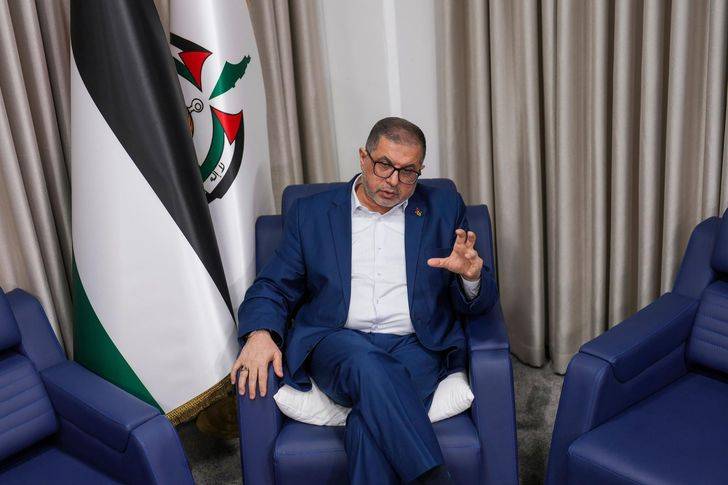
Bassem Naim, a member of Hamas' decision-making political bureau, spoke as the sides prepare to move into the second and more complicated phase of the agreement.
"We are open to have a comprehensive approach in order to avoid further escalations or in order to avoid any further clashes or explosions," Naim told The Associated Press in Qatar's capital, Doha, where much of the group's leadership is located.
The deal halted a two-year Israeli offensive in Gaza, launched in response to Hamas' Oct. 7, 2023, attack. Asked whether the attack was a mistake, Naim defended it as an "act of defense."
Since the truce took effect in October, Hamas and Israel have carried out a series of exchanges of Israeli hostages for Palestinian prisoners. With only the remains of one hostage still held in Gaza — an Israeli policeman killed in the Oct. 7 attack — the sides are preparing to enter the second phase.
The new phase aims to lay out a future for war-battered Gaza and promises to be even more difficult — addressing such issues as the deployment of an international security force, formation of a technocratic Palestinian committee in Gaza, the withdrawal of Israeli troops from the territory and the disarmament of Hamas. An international board, led by President Donald Trump, is to oversee implementation of the deal and reconstruction of Gaza.
The Israeli demand for Hamas to lay down its weapons promises to be especially tricky — with Israeli officials saying this is a key demand that could hold up progress in other areas. Hamas' ideology is deeply rooted in what it calls armed resistance against Israel, and its leaders have rejected calls to surrender despite over two years of war that left large parts of Gaza destroyed and killed tens of thousands of Palestinians.
Naim said Hamas retains its "right to resist," but said the group is ready to lay down its arms as part of a process aimed at leading to the establishment of a Palestinian state. He gave few details on how this might work but suggested a long-term truce of five or 10 years for discussions to take place.
"This time has to be used seriously and in a comprehensive way," he said, adding that Hamas is "very open minded" about what to do with its weapons.
"We can talk about freezing or storing or laying down, with the Palestinian guarantees, not to use it at all during this ceasefire time or truce," he said.
It is not clear whether the offer would meet Israel's demands for full disarmament.
The ceasefire is based on a 20-point plan presented by Trump, with international "guarantor" nations, in October.
The plan, adopted by the U.N. Security Council, offered a general way forward. But it was vague on details or timelines and will require painstaking negotiations involving the U.S. and the guarantors, which include Qatar, Egypt and Turkey.
"The plan is in need of a lot of clarifications," Naim said.
One of the most immediate concerns is deployment of the international stabilization force.
Several countries, including Indonesia, have expressed a willingness to contribute troops to the force, but its exact makeup, command structure and responsibilities have not been defined. U.S. officials say they expect "boots on the ground" early next year.
One key question is whether the force will take on the issue of disarmament.
Naim said this would be unacceptable to Hamas, and the group expects the force to monitor the agreement.
"We are welcoming a U.N. force to be near the borders, supervising the ceasefire agreement, reporting about violations, preventing any kind of escalations," he said. "But we don't accept that these forces have any kind of mandates authorizing them to do or to be implemented inside the Palestinian territories."

In one sign of progress, Naim said Hamas and the rival Palestinian Authority have made progress on the formation of the new technocratic committee set to run Gaza's daily affairs. He said they have agreed upon a Palestinian Cabinet minister who lives in the West Bank, but is originally from Gaza, to head the committee. He did not give the name, but Hamas officials, speaking on condition of anonymity to discuss the negotiations, have identified him as Health Minister Majed Abu Ramadan.
Both Israel and Hamas have accused each other of repeated violations of the deal during the first phase.
Israel has accused Hamas of dragging out the hostage returns, while Palestinian health officials say over 370 Palestinians have been killed in continued Israeli strikes since the ceasefire took effect.
Israel says its strikes have been in response to Palestinian violations, including the movement of Palestinians into the Israeli-held half of Gaza. Three soldiers have been killed in clashes with about 200 Hamas militants that Israeli and Egyptian officials say remain holed up underground in Israeli-held territory.
Naim said Hamas was "not aware" of these gunmen when the ceasefire was signed, and that communications with them were "totally cut."
"Therefore, they are not aware about what's going on now on the ground," he said.
He claimed that Israel has rejected Hamas offers to resolve the standoff and added numerous "conditions" to their surrender. Israel has not acknowledged the negotiations and says it has killed several dozens of them.
Naim said Hamas is committed to "fulfilling its obligations" and claimed that Israel has fallen short of key pledges, including not flooding Gaza with humanitarian supplies and failing to reopen the Rafah border crossing with Egypt.
Most of the supplies entering Gaza, he said, are goods for private merchants to sell to the few people in Gaza with money, leaving masses of poor people struggling without food or shelter.
Last week, Israel said it was ready to reopen Rafah — Gaza's main gateway to the outside world — but only for people to leave the strip. Egypt and the Palestinians fear this is a plot to expel Gaza's Palestinians and say Israel is obligated to open the crossing in both directions.
The Oct. 7 attack killed over 1,200 people and took over 250 others hostage. It is the deadliest attack in Israel's history and remains a source of great national trauma.
Israel's retaliatory offensive has killed over 70,000 Palestinians, according to local health officials, displaced nearly all of Gaza's 2 million people and caused widespread damage that will take years to rebuild. It remains unclear who will pay for the reconstruction or when it will begin.
The Palestinian Health Ministry, part of Gaza's Hamas government, does not distinguish between civilians and militants, but says that roughly half of the dead were women and children.
Naim acknowledged the Palestinians have paid a heavy price for Oct. 7 but when asked if the group regrets carrying out the attack, he insisted it came in response to years of Israeli policies going back to the war surrounding Israel's establishment in 1948.
"History didn't start on Oct. 7," he said. "Oct. 7 for us, it was an act of defense. We have done our duty to raise … the voice of our people."
White Label
Data API
Web Plug-ins
Poster Maker
Affiliate Program
The risk of loss in trading financial instruments such as stocks, FX, commodities, futures, bonds, ETFs and crypto can be substantial. You may sustain a total loss of the funds that you deposit with your broker. Therefore, you should carefully consider whether such trading is suitable for you in light of your circumstances and financial resources.
No decision to invest should be made without thoroughly conducting due diligence by yourself or consulting with your financial advisors. Our web content might not suit you since we don't know your financial conditions and investment needs. Our financial information might have latency or contain inaccuracy, so you should be fully responsible for any of your trading and investment decisions. The company will not be responsible for your capital loss.
Without getting permission from the website, you are not allowed to copy the website's graphics, texts, or trademarks. Intellectual property rights in the content or data incorporated into this website belong to its providers and exchange merchants.
Not Logged In
Log in to access more features

FastBull Membership
Not yet
Purchase
Log In
Sign Up