• Trade
  • Markets
  • Copy
  • Contests
  • News
  • 24/7
  • Calendar
  • Q&A
  • Chats
Trending
Screeners
SYMBOL
LAST
BID
ASK
HIGH
LOW
NET CHG.
%CHG.
SPREAD
SPX
S&P 500 Index
6846.50
6846.50
6846.50
6878.28
6827.18
-23.90
-0.35%
--
DJI
Dow Jones Industrial Average
47739.31
47739.31
47739.31
47971.51
47611.93
-215.67
-0.45%
--
IXIC
NASDAQ Composite Index
23545.89
23545.89
23545.89
23698.93
23455.05
-32.22
-0.14%
--
USDX
US Dollar Index
99.000
99.080
99.000
99.000
99.000
+0.050
+ 0.05%
--
EURUSD
Euro / US Dollar
1.16379
1.16387
1.16379
1.16389
1.16322
+0.00015
+ 0.01%
--
GBPUSD
Pound Sterling / US Dollar
1.33225
1.33233
1.33225
1.33239
1.33140
+0.00020
+ 0.02%
--
XAUUSD
Gold / US Dollar
4191.90
4192.34
4191.90
4193.80
4189.64
+2.20
+ 0.05%
--
WTI
Light Sweet Crude Oil
58.650
58.692
58.650
58.676
58.543
+0.095
+ 0.16%
--

Community Accounts

Signal Accounts
--
Profit Accounts
--
Loss Accounts
--
View More

Become a signal provider

Sell trading signals to earn additional income

View More

Guide to Copy Trading

Get started with ease and confidence

View More

Signal Accounts for Members

All Signal Accounts

Best Return
  • Best Return
  • Best P/L
  • Best MDD
Past 1W
  • Past 1W
  • Past 1M
  • Past 1Y

All Contests

  • All
  • Trump Updates
  • Recommend
  • Stocks
  • Cryptocurrencies
  • Central Banks
  • Featured News
Top News Only
Share

Brazil Finance Minister Haddad: Loan For Correios Is Possible This Year, But It Is Not The Only Option Under Works

Share

KCNA: North Korea's Supreme Leader Kim Jong UN Sends Condolences To Russian Embassy For Ambassador's Death

Share

Japan Prime Minister Takaichi: 30 Injuries Reported So Far From Monday Earthquake

Share

USA Senate Committee Votes To Advance Nomination Of Jared Isaacman To Head Nasa

Share

Singapore Post - New Rate For Standard Regular Mail & Standard Large Mail Will Be S$0.62 And S$0.90 Respectively

Share

Australia's S&P/ASX 200 Index Down 0.27% At 8601.10 Points In Early Trade

Share

Trump: The USA Needs Mexico To Release 200000 Acre-Feet Of Water Before December 31St, And The Rest Must Come Soon After

Share

Trump: I Have Authorized Documentation To Impose A 5% Tariff On Mexico If This Water Isn't Released

Share

Brazil's Sao Paulo State Governor Tarcisio De Freitas Says Flavio Bolsonaro Will Have His Support - Cnn Brasil

Share

Ukraine's Security Must Be Guaranteed, In The Long Term, As A First Line Of Defence For Our Union, Says European Commission President

Share

Ukraine's Sovereignty Must Be Respected, Says European Commission President

Share

The Goal Is A Strong Ukraine, On The Battlefield And At The Negotiating Table, Says European Commission President

Share

As Peace Talks Are Ongoing, The EU Remains Ironclad In Its Support For Ukraine, Says European Commission President

Share

Pepsico: Asking USA-Based Pepna Employees As Well As Pbus Division Offices And Pfus Region Offices To Work Remotely This Week

Share

A U.S. Judge Ruled That President Trump’s Ban On Several Wind Power Projects Was Illegal

Share

Senior USA Administration Official: We Continue To Monitor Drc-Rwanda Situation Closely, Continue To Work With All Sides To Ensure Commitments Are Honored

Share

Israeli Military Says It Has Struck Infrastructure Belonging To Hezbollah In Several Areas In Southern Lebanon

Share

SPDR Gold Holdings Down 0.11%, Or 1.14 Tonnes

Share

On Monday (December 8), In Late New York Trading, S&P 500 Futures Fell 0.21%, Dow Jones Futures Fell 0.43%, NASDAQ 100 Futures Fell 0.08%, And Russell 2000 Futures Fell 0.04%

Share

Morgan Stanley: Data Center ABS Spreads Are Expected To Widen In 2026

TIME
ACT
FCST
PREV
France Trade Balance (SA) (Oct)

A:--

F: --

P: --
Euro Zone Employment YoY (SA) (Q3)

A:--

F: --

P: --
Canada Part-Time Employment (SA) (Nov)

A:--

F: --

P: --

Canada Unemployment Rate (SA) (Nov)

A:--

F: --

P: --

Canada Full-time Employment (SA) (Nov)

A:--

F: --

P: --

Canada Labor Force Participation Rate (SA) (Nov)

A:--

F: --

P: --

Canada Employment (SA) (Nov)

A:--

F: --

P: --

U.S. PCE Price Index MoM (Sept)

A:--

F: --

P: --

U.S. Personal Income MoM (Sept)

A:--

F: --

P: --

U.S. Core PCE Price Index MoM (Sept)

A:--

F: --

P: --

U.S. PCE Price Index YoY (SA) (Sept)

A:--

F: --

P: --

U.S. Core PCE Price Index YoY (Sept)

A:--

F: --

P: --

U.S. Personal Outlays MoM (SA) (Sept)

A:--

F: --

P: --
U.S. 5-10 Year-Ahead Inflation Expectations (Dec)

A:--

F: --

P: --

U.S. Real Personal Consumption Expenditures MoM (Sept)

A:--

F: --

P: --
U.S. Weekly Total Rig Count

A:--

F: --

P: --

U.S. Weekly Total Oil Rig Count

A:--

F: --

P: --

U.S. Consumer Credit (SA) (Oct)

A:--

F: --

P: --
China, Mainland Foreign Exchange Reserves (Nov)

A:--

F: --

P: --

Japan Trade Balance (Oct)

A:--

F: --

P: --

Japan Nominal GDP Revised QoQ (Q3)

A:--

F: --

P: --

China, Mainland Imports YoY (CNH) (Nov)

A:--

F: --

P: --

China, Mainland Exports (Nov)

A:--

F: --

P: --

China, Mainland Imports (CNH) (Nov)

A:--

F: --

P: --

China, Mainland Trade Balance (CNH) (Nov)

A:--

F: --

P: --

China, Mainland Exports YoY (USD) (Nov)

A:--

F: --

P: --

China, Mainland Imports YoY (USD) (Nov)

A:--

F: --

P: --

Germany Industrial Output MoM (SA) (Oct)

A:--

F: --

P: --
Euro Zone Sentix Investor Confidence Index (Dec)

A:--

F: --

P: --

Canada National Economic Confidence Index

A:--

F: --

P: --

U.K. BRC Like-For-Like Retail Sales YoY (Nov)

--

F: --

P: --

U.K. BRC Overall Retail Sales YoY (Nov)

--

F: --

P: --

Australia Overnight (Borrowing) Key Rate

--

F: --

P: --

RBA Rate Statement
RBA Press Conference
Germany Exports MoM (SA) (Oct)

--

F: --

P: --

U.S. NFIB Small Business Optimism Index (SA) (Nov)

--

F: --

P: --

Mexico 12-Month Inflation (CPI) (Nov)

--

F: --

P: --

Mexico Core CPI YoY (Nov)

--

F: --

P: --

Mexico PPI YoY (Nov)

--

F: --

P: --

U.S. Weekly Redbook Index YoY

--

F: --

P: --

U.S. JOLTS Job Openings (SA) (Oct)

--

F: --

P: --

China, Mainland M1 Money Supply YoY (Nov)

--

F: --

P: --

China, Mainland M0 Money Supply YoY (Nov)

--

F: --

P: --

China, Mainland M2 Money Supply YoY (Nov)

--

F: --

P: --

U.S. EIA Short-Term Crude Production Forecast For The Year (Dec)

--

F: --

P: --

U.S. EIA Natural Gas Production Forecast For The Next Year (Dec)

--

F: --

P: --

U.S. EIA Short-Term Crude Production Forecast For The Next Year (Dec)

--

F: --

P: --

EIA Monthly Short-Term Energy Outlook
U.S. API Weekly Gasoline Stocks

--

F: --

P: --

U.S. API Weekly Cushing Crude Oil Stocks

--

F: --

P: --

U.S. API Weekly Crude Oil Stocks

--

F: --

P: --

U.S. API Weekly Refined Oil Stocks

--

F: --

P: --

South Korea Unemployment Rate (SA) (Nov)

--

F: --

P: --

Japan Reuters Tankan Non-Manufacturers Index (Dec)

--

F: --

P: --

Japan Reuters Tankan Manufacturers Index (Dec)

--

F: --

P: --

Japan Domestic Enterprise Commodity Price Index MoM (Nov)

--

F: --

P: --

Japan Domestic Enterprise Commodity Price Index YoY (Nov)

--

F: --

P: --

China, Mainland PPI YoY (Nov)

--

F: --

P: --

China, Mainland CPI MoM (Nov)

--

F: --

P: --

Italy Industrial Output YoY (SA) (Oct)

--

F: --

P: --

Q&A with Experts
    • All
    • Chatrooms
    • Groups
    • Friends
    Connecting
    .
    .
    .
    Type here...
    Add Symbol or Code

      No matching data

      All
      Trump Updates
      Recommend
      Stocks
      Cryptocurrencies
      Central Banks
      Featured News
      • All
      • Russia-Ukraine Conflict
      • Middle East Flashpoint
      • All
      • Russia-Ukraine Conflict
      • Middle East Flashpoint
      Search
      Products

      Charts Free Forever

      Chats Q&A with Experts
      Screeners Economic Calendar Data Tools
      Membership Features
      Data Warehouse Market Trends Institutional Data Policy Rates Macro

      Market Trends

      Market Sentiment Order Book Forex Correlations

      Top Indicators

      Charts Free Forever
      Markets

      News

      News Analysis 24/7 Columns Education
      From Institutions From Analysts
      Topics Columnists

      Latest Views

      Latest Views

      Trending Topics

      Top Columnists

      Latest Update

      Signals

      Copy Rankings Latest Signals Become a signal provider AI Rating
      Contests
      Brokers

      Overview Brokers Assessment Rankings Regulators News Claims
      Broker listing Forex Brokers Comparison Tool Live Spread Comparison Scam
      Q&A Complaint Scam Alert Videos Tips to Detect Scam
      More

      Business
      Events
      Careers About Us Advertising Help Center

      White Label

      Data API

      Web Plug-ins

      Affiliate Program

      Awards Institution Evaluation IB Seminar Salon Event Exhibition
      Vietnam Thailand Singapore Dubai
      Fans Party Investment Sharing Session
      FastBull Summit BrokersView Expo
      Recent Searches
        Top Searches
          Markets
          News
          Analysis
          User
          24/7
          Economic Calendar
          Education
          Data
          • Names
          • Latest
          • Prev

          View All

          No data

          Scan to Download

          Faster Charts, Chat Faster!

          Download App
          English
          • English
          • Español
          • العربية
          • Bahasa Indonesia
          • Bahasa Melayu
          • Tiếng Việt
          • ภาษาไทย
          • Français
          • Italiano
          • Türkçe
          • Русский язык
          • 简中
          • 繁中
          Open Account
          Search
          Products
          Charts Free Forever
          Markets
          News
          Signals

          Copy Rankings Latest Signals Become a signal provider AI Rating
          Contests
          Brokers

          Overview Brokers Assessment Rankings Regulators News Claims
          Broker listing Forex Brokers Comparison Tool Live Spread Comparison Scam
          Q&A Complaint Scam Alert Videos Tips to Detect Scam
          More

          Business
          Events
          Careers About Us Advertising Help Center

          White Label

          Data API

          Web Plug-ins

          Affiliate Program

          Awards Institution Evaluation IB Seminar Salon Event Exhibition
          Vietnam Thailand Singapore Dubai
          Fans Party Investment Sharing Session
          FastBull Summit BrokersView Expo

          Fed's Kashkari Expects Two Rate Cuts This Year, With Pause Possible

          Damon

          Central Bank

          Summary:

          Federal Reserve Bank of Minneapolis President Neel Kashkari is sticking to his view that cooling inflation will allow the world's most important major central bank to cut its policy rate twice this year, starting in September.

          Federal Reserve Bank of Minneapolis President Neel Kashkari is sticking to his view that cooling inflation will allow the world's most important major central bank to cut its policy rate twice this year, starting in September.

          In an essay released on Friday, Kashkari also signalled that if progress on inflation stalls or reverses the Fed could simply pause its rate-cutting cycle until prices ease again.

          Tariffs suggest an inflation boost is "likely coming," he said, as more goods from Asia, subject to the biggest tariff increases, arrive on the shelves of U.S. businesses.

          While businesses may not want to risk angering customers by charging more for their wares, they will start passing on price increases in the absence of trade deals lowering tariffs, he said.

          In this scenario, the effect of tariffs on inflation may simply arrive later than expected, Kashkari said.

          At the same time, Kashkari said, the economic data so far has revealed "only a modest imprint of the effects of tariffs on prices, activity or the labor market," with inflation making renewed progress toward the Fed's 2% goal.

          That may suggest, he said, that companies have won exemptions, have adjusted their supply routes, or are otherwise finding ways to avoid the tariffs altogether, limiting the impact on inflation.

          "Those opposing signals have led me to maintain my outlook for two cuts over the remainder of 2025, implying a possible first cut in September, barring some surprising development before then," Kashkari said.

          "If we were to cut in September and then the effects of tariffs showed up this fall, I believe we should not be on a preset easing course" but could adjust to fit the new data, he added.

          "If the data called for it we could hold the policy rate at the new level until we gained greater confidence that inflation was headed back to our target."

          For now, though, Kashkari said: "We should put more emphasis on the actual inflation and real economic data that we are seeing without committing to an easing policy path in case the effects of tariffs are merely delayed."

          Last week, Fed policymakers left their overnight target rate for lending between banks unchanged at between 4.25% and 4.5%. Uncertainty over the outlook is keeping the central bank on the sidelines amid expectations the tariffs will push up inflation this year while depressing growth and hiring.

          Source: Yahoo Finance

          Risk Warnings and Disclaimers
          You understand and acknowledge that there is a high degree of risk involved in trading. Following any strategies or investment methods may lead to potential losses. The content on the site is provided by our contributors and analysts for information purposes only. You are solely responsible for determining whether any trading assets, securities, strategy, or any other product is suitable for investing based on your own investment objectives and financial situation.
          Add to Favorites
          Share

          Ripple, SEC Agree to Mutually Abandon Appeals, Ending 5-Year Legal Battle

          Manuel

          Cryptocurrency

          Political

          Ripple will drop its cross-appeal in its prolonged legal battle with the U.S. Securities and Exchange Commission, signaling an end to one of the crypto industry’s most consequential court cases.
          Ripple CEO Brad Garlinghouse announced the move on social media on June 27 and also revealed that the SEC is expected to drop its appeal as well.
          He wrote: “We’re closing this chapter once and for all, and focusing on what’s most important – building the Internet of Value.”
          The decision follows Judge Analisa Torres’ denial of a joint motion for an indicative ruling earlier this week, marking the second time she dismissed the appeal.
          Ripple’s chief legal officer, Stuart Alderoty, explained that the court’s proffered options were to either dismiss its appeal challenging the prior finding on historic institutional sales of XRP or proceed with the appeal and continue litigation.
          The SEC sued Ripple in December 2020, alleging it conducted an unregistered securities offering by selling XRP tokens to institutional investors. In July 2023, Judge Torres ruled that while XRP itself is not a security and secondary market sales do not violate securities laws, Ripple’s direct sales to institutional investors did constitute unregistered securities offerings.
          The ruling was considered a landmark split decision, with Ripple securing a major victory for the industry in clarifying that programmatic sales and secondary market trading of XRP do not fall under SEC jurisdiction. However, the finding on institutional sales posed potential financial penalties for Ripple.
          The SEC initially signaled an intent to appeal the ruling on XRP’s non-security status but later indicated it would drop that appeal. Ripple’s decision to abandon its cross-appeal effectively ends the litigation over the institutional sales ruling, avoiding further legal expenses and uncertainty.
          The outcome preserves XRP’s legal clarity in the U.S. market while finalizing the company’s settlement exposure. Ripple is expected to pay a civil penalty related to institutional sales, though the final amount is yet to be determined.
          With both appeals set to be withdrawn, the case closes a chapter that has defined crypto’s regulatory landscape for nearly five years. Ripple now plans to shift its focus back to expanding global payment corridors, token utility, and adoption of its XRP Ledger as it advances its vision for an Internet of Value.

          Source: Cryptoslate

          Risk Warnings and Disclaimers
          You understand and acknowledge that there is a high degree of risk involved in trading. Following any strategies or investment methods may lead to potential losses. The content on the site is provided by our contributors and analysts for information purposes only. You are solely responsible for determining whether any trading assets, securities, strategy, or any other product is suitable for investing based on your own investment objectives and financial situation.
          Add to Favorites
          Share

          Canada's Steel Producers Tell Government its Tariff Protection Measures Aren't Enough

          Manuel

          Commodity

          Political

          Canadian steel industry representatives told government officials in a meeting this week that their measures to protect the industry from the consequences of U.S. tariffs are insufficient, two of the representatives who attended the meeting told Reuters.
          On Thursday, steel producers met with Patrick Haley, assistant deputy minister for trade and finance, and other officials from the ministry, telling them the measures announced earlier this month do not protect the industry from steel dumping and could cause mass layoffs, the representatives said.
          U.S. President Donald Trump increased import duties on steel and aluminum to 50% from 25% earlier this month. Canada is the top seller of metals to the United States.
          In response, Canada announced a raft of measures, including establishing new tariff-rate quotas of 100% of 2024 levels on imports of steel products from non-free trade agreement partners.
          Industry representatives at the meeting asked the government to extend tariff quotas to all countries with unfair trade practices, even if they have free trade agreements. Europe and Asia have started diverting their products to Canada to avoid U.S. tariffs, making domestic steel uncompetitive, they said.
          "We don't think the measures announced meet our needs under this dire time," Catherine Cobden, President and CEO of the Canadian Steel Producers Association, told Reuters. Cobden attended the meeting with finance ministry officials on Thursday.
          The Canadian Steel Producers Association said in a separate statement on Thursday that, in its current form, the tariff-rate quota will do little to support its industry.
          Canada's steel industry has laid off 1,000 workers since the first U.S. tariffs in March, and more layoffs could be coming, the association said.
          Keanin Loomis, president of the Canadian Institute of Steel Construction, which includes steel manufacturers, fabricators, and constructors, said that Thursday's government meeting was heavily steel producers-focused, noting that finished steel products imported to Canada have no tariff protection. Loomis also attended the meeting.
          In a text response to Reuters, the Canadian Finance Ministry said that the measures it announced represent a comprehensive and strategic package to defend producers and workers, and were a first step.
          Prime Minister Mark Carney has threatened to increase counter-tariffs on U.S.-produced steel and aluminum if Canada does not reach a broader trade deal with Trump by July 21. Trump on Friday abruptly cut off trade talks with Canada over its new tax targeting U.S. technology firms.
          "These are temporary and calibrated measures that could be expanded depending on the outcome of ongoing discussions with the United States. We are prepared to adjust our response as needed," a spokesperson for the finance minister said.

          Source: Reuters

          Risk Warnings and Disclaimers
          You understand and acknowledge that there is a high degree of risk involved in trading. Following any strategies or investment methods may lead to potential losses. The content on the site is provided by our contributors and analysts for information purposes only. You are solely responsible for determining whether any trading assets, securities, strategy, or any other product is suitable for investing based on your own investment objectives and financial situation.
          Add to Favorites
          Share

          EEUU, China Announce a Trade Agreement - Again, Here's hat it Means

          Manuel

          China–U.S. Trade War

          Economic

          The U.S. and China have reached an agreement — again — to deescalate trade tensions. But details are scarce, and the latest pact leaves major issues between the world's two biggest economies unresolved.
          President Donald Trump said late Thursday that a deal with China had been signed "the other day.'' China's Commerce Ministry confirmed Friday that some type of arrangement had been reached but offered few details about it.
          Sudden shifts and a lack of clarity have been hallmarks of Trump's trade policy since he returned to the White House determined to overturn a global trading system that he says is unfair to the United States and its workers.
          He's been engaged for months in a battle with China that has mostly revealed how much pain the two countries can inflict on each other. And he's racing against a July 8 deadline to reach deals with other major U.S. trading partners.
          The uncertainty over his dealmaking and the cost of the tariffs, which are paid by U.S. importers and usually passed on to consumers, have raised worries about the outlook for the U.S. economy. And although analysts welcomed the apparent easing of tensions with China, they also warned that the issues dividing Washington and Beijing are unlikely to be resolved anytime soon.

          What did the two sides agree to?

          U.S. Treasury Secretary Scott Bessent said Friday that the Chinese had agreed to make it easier for American firms to acquire Chinese magnets and rare earth minerals critical for manufacturing and microchip production. Beijing had slowed exports of the materials amid a bitter trade dispute with the Trump administration.
          Without explicitly mentioning U.S. access to rare earths, the Chinese Commerce Ministry said that “China will, in accordance with the law, review and approve eligible export applications for controlled items. In turn, the United States will lift a series of restrictive measures it had imposed on China.''
          The Chinese have complained about U.S. controls on exports of advanced U.S. technology to China. But the ministry statement did not specifically say whether the United States planned to ease or lift those controls.
          In his interview on Fox Business Network’s “Mornings with Maria,” Bessent mentioned that the United States had earlier imposed “countermeasures'' against China and ”had held back some vital supplies for them.''
          "What we’re seeing here is a de-escalation under President Trump’s leadership,'' Bessent said, without spelling out what concessions the United States had made or whether they involved America's export controls.
          Jeff Moon, a trade official in the Obama administration who now runs the China Moon Strategies consultancy, wondered why Trump hadn’t disclosed details of the agreement two days after it had been reached.
          “Silence regarding the terms suggests that there is less substance to the deal than the Trump Administration implies,″ said Moon, who also served as a diplomat in China.

          Wait. This sounds familiar. How did we get here?

          The agreement that emerged Thursday and Friday builds on a "framework'' that Trump announced June 11 after two days of high-level U.S.-China talks in London. Then, he announced, China had agreed to ease restrictions on rare earths. In return, the United States said it would stop seeking to revoke the visas of Chinese students on U.S. college campuses.
          And last month, after another meeting in Geneva, the two countries had agreed to dramatically reduce massive taxes they'd slapped on each other's products, which had reached as high as 145% against China and 125% against the U.S.
          Those triple-digit tariffs threatened to effectively end trade between the United States and China and caused a frightening sell-off in financial markets. In Geneva, the two countries agreed to back off and keep talking: America’s tariffs went back down to a still-high 30% and China’s to 10%. That led to the talks in London earlier this month and to this week's announcement.

          Where does all this leave U.S.-China economic relations?

          If nothing else, the two countries are trying to ratchet down tensions after demonstrating how much they can hurt each other.
          “The U.S. and China appear to be easing the chokeholds they had on each other’s economies through export controls on computer chips and rare earth minerals, respectively,” said Eswar Prasad, professor of trade policy at Cornell University. "This is a positive step but a far cry from signaling prospects of a substantial de-escalation of tariffs and other trade hostilities.''
          Trump launched a trade war with China in his first term, imposing tariffs on most Chinese goods in a dispute over China's attempts to supplant U.S. technological supremacy. Trump's trade team charged that China was unfairly subsidizing its own tech companies, forcing U.S. and other foreign companies to hand over sensitive technology in exchange for access to the Chinese market and even engaging outright theft of trade secrets.
          The squabbling and negotiating of the past few months appear to have done little to resolve Washington's complaints about unfair Chinese trade practices and America's massive trade deficit with China, which came to $262 billion last year.
          This week's agreement “includes absolutely nothing related to the U.S.’s concerns regarding China’s trade surplus or non-market behavior,'' said Scott Kennedy of the Center for Strategic and International Studies. ”If the two sides can implement these elements of the ceasefire, then they could begin negotiations on issues which generated the initial escalation in tensions in the first place.''

          What is happening with Trump's other tariffs?

          Since returning to the White House in January, Trump has made aggressive use of tariffs. In addition to his levies on China, he has imposed "baseline'' 10% taxes on imports from every country in the world . And he's announced even higher taxes — so-called reciprocal tariffs ranging from 11% to 50% — on countries with which the United States runs a trade deficit.
          But after financial markets sank on fears of massive disruption to world trade, Trump suspended the reciprocal levies for 90 days to give countries a chance to negotiate reductions in their barriers to U.S. exports. That pause lasts until July 8.
          On Friday, Bessent told Fox Business Network that the talks could extend beyond the deadline and be “wrapped up by Labor Day’’ Sept. 1 with 10 to 12 of America's most important trading partners.
          Trump further played down the July 8 deadline at a White House press conference Friday by noting that negotiations are ongoing but that “we have 200 countries, you could say 200 countries-plus. You can't do that.”
          Instead of new trade deals, Trump said his administration would in coming days or weeks send out a letter where “we're just gonna tell them what they have to pay to do business in the United States.''
          Separately, Trump took sudden aim at Canada Friday, saying on social media that he's immediately suspending trade talks with that country over its plan to impose a tax on technology firms next Monday. Trump called Canada's digital services tax “a direct and blatant attack on our country.”
          The digital services tax will hit companies like Amazon, Google, Meta, Uber and Airbnb with a 3% levy on revenue from Canadian users. It will apply retroactively, leaving U.S. companies with a $2 billion bill due at the end of the month.

          Source: AP

          To stay updated on all economic events of today, please check out our Economic calendar
          Risk Warnings and Disclaimers
          You understand and acknowledge that there is a high degree of risk involved in trading. Following any strategies or investment methods may lead to potential losses. The content on the site is provided by our contributors and analysts for information purposes only. You are solely responsible for determining whether any trading assets, securities, strategy, or any other product is suitable for investing based on your own investment objectives and financial situation.
          Add to Favorites
          Share

          Big Banks all Pass the Federal Reserve's stress Tests, but the Tests Were Less Vigorous This Year

          Manuel

          Central Bank

          Forex

          All the major banks passed the Federal Reserve's annual “stress tests" of the financial system, the central bank said Friday, but the test conducted by the central bank was notably less vigorous than it had been in previous years.
          All 22 banks tested this year would have remained solvent and above the minimum thresholds to continue to operate, the Fed said, despite absorbing roughly $550 billion in theoretical losses. In the Fed's scenario, there would be less of a rise in unemployment, less of a severe economic contraction, less of a drop in commercial real estate prices, less of a drop in housing prices, among other metrics compared to what they tested in 2024.
          All of these less harmful, but simulated, drops mean there would be less damage to these banks' balance sheets and less risk of these banks of potentially failing. Since the banks passed the 2024 tests, it was expected that the banks would pass the 2025 tests.
          “Large banks remain well capitalized and resilient to a range of severe outcomes,” said Michelle Bowman, the bank's vice chair for supervision, in a statement. An appointee of President Trump, Bowman became the Fed's vice chair of supervision earlier this month.
          It’s not clear why the Fed chose to go with a less vigorous test this year. In a statement, the bank said previous tests had shown “unintended volatility” in the results and it plans to seek public and industry comment to adjust stress tests in future years. The Fed also chose to not test the banks as heavily on their exposure to private equity assets, arguing that private equity assets are typically held for the long term and are not typically sold at times of distress.
          The Fed also didn’t test for any bank exposure to private credit, a $2 trillion asset class that even Fed researchers themselves have observed to be growing alarmingly quickly. The Federal Reserve Bank of Boston recently pointed out that private credit could be a systemic risk to the financial system under a severe adverse scenario, which is exactly what the stress tests are supposed to test for.
          There was no wording or phrasing in the Fed's press release, reports or methodology about testing or measuring private credit or private debt in this year's test.
          The Fed's “stress tests” were created after the 2008 financial crisis as a way to gauge whether the nation's “too big to fail” banks could withstand another financial crisis like the once that happened nearly 20 years ago. The tests are effectively an academic exercise, where the Fed simulates a scenario in the global economy and measures what that scenario would do to bank balance sheets.
          The 22 banks that are tested are the biggest names in the business, such as JPMorgan Chase, Citigroup, Bank of America, Morgan Stanley and Goldman Sachs, which hold hundreds of billions of dollars in assets and have wide-ranging businesses that touch every part of the U.S. and global economy.
          Under this year's hypothetical scenario, a major global recession would have caused a 30% decline in commercial real estate prices and a 33% decline in housing prices. The unemployment rate would rise to 10% and stock prices would fall 50%. In 2024, the hypothetical scenario was a 40% decline in commercial real estate prices, a 55% decline in stock prices and a 36% decline in housing prices.
          With their passing grades, the major banks will be allowed to issue dividends to shareholders and buy back shares of stock to return proceeds to investors. Those dividend plans will be announced next week.

          Source: AP

          Risk Warnings and Disclaimers
          You understand and acknowledge that there is a high degree of risk involved in trading. Following any strategies or investment methods may lead to potential losses. The content on the site is provided by our contributors and analysts for information purposes only. You are solely responsible for determining whether any trading assets, securities, strategy, or any other product is suitable for investing based on your own investment objectives and financial situation.
          Add to Favorites
          Share

          Trump Speeds up Tax Bill Deadline as Tentative SALT Deal Reached

          Manuel

          Economic

          Political

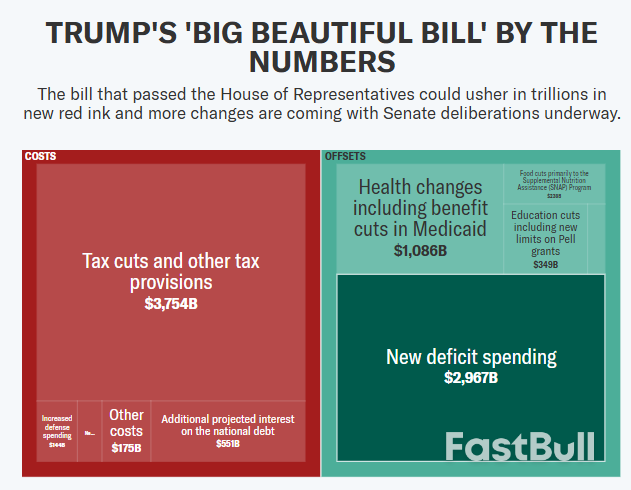
          President Donald Trump amped up pressure on Congress to speed the passage of his tax-cut bill as Republicans reached a tentative deal on the state and local tax deduction, one of the key sticking points in the negotiations.
          “The House of Representatives must be ready to send it to my desk before July 4th — We can get it done,” Trump said on Truth Social Friday.
          The new deadline — before July 4 — is somewhat of a reversal for the president who, hours earlier told reporters that it wouldn’t be the “end-all” if negotiations took it a little longer to pass the self-imposed Independence Day goal.
          On Friday afternoon, the tentative SALT deal suggested that Republicans may have momentum on their side. The agreement involved raising the limit on the state and local tax deduction to $40,000 a year for a five-year period, Senator John Hoeven told reporters.
          Senators said the tentative plan is to begin voting on the bill Saturday midday.
          It wasn’t immediately clear whether enough of the so-called SALT Republicans in the House would accept that proposal and drop their threats to block President Donald Trump’s massive tax and spending package.
          GOP lawmakers from New York, New Jersey and California have pressed to preserve a deal included in the House bill that increased the deduction cap to $40,000, up from the $10,000 in current law, for 10 years. The original Senate draft kept the write-off at $10,000.
          The latest deal retains a House proposal to phase out the deduction for taxpayers with at least $500,000 in income, a person familiar said, who requested anonymity to discuss private conversations.
          Republicans also plan to drop new limits they had sought on pass-through businesses’ deductions of state and local tax taxes, the person said.
          Until now, some business owners in most states haven’t actually needed to abide by the SALT cap that applies to everyone else, thanks to legal workarounds approved by legislatures in New York, New Jersey, Connecticut, California and dozens of other states.
          The House version of Trump’s massive tax and spending package put curbs on those workarounds.Trump Speeds up Tax Bill Deadline as Tentative SALT Deal Reached_1

          Tax Talks

          Treasury Secretary Scott Bessent told reporters at the Capitol that negotiators are “very, very close” on a SALT deal but he would not discuss specifics. He added that meeting the July 4 deadline provides “certainty.”
          The SALT provision has been one of several holdups for the Trump tax bill in the Senate.
          Senate Republican Leader John Thune is also trying to navigate competing demands from conservatives and moderates on social safety net cuts and the elimination of clean energy tax credits. He will need to resolve most of the disputes to secure the votes he needs to pass the bill.
          The massive tax and spending package is the legislative centerpiece of Trump’s economic agenda. The Senate version makes permanent individual and business tax breaks enacted in 2017, while adding temporary new breaks for tipped and overtime workers, seniors and car-buyers.
          The bill would add hundreds of billions of dollars in new spending for the military, border patrol and immigration enforcement. To partly pay for the revenue losses, the bill reduces spending on Medicaid health insurance for the poor and disabled, food assistance for low-income Americans and financial aid to college students.
          The measure would also avert a US payment default as soon as August by raising the debt ceiling by $5 trillion.

          Source: Bloomberg

          To stay updated on all economic events of today, please check out our Economic calendar
          Risk Warnings and Disclaimers
          You understand and acknowledge that there is a high degree of risk involved in trading. Following any strategies or investment methods may lead to potential losses. The content on the site is provided by our contributors and analysts for information purposes only. You are solely responsible for determining whether any trading assets, securities, strategy, or any other product is suitable for investing based on your own investment objectives and financial situation.
          Add to Favorites
          Share

          Trump Says Bitcoin Eases Pressure on Dollar, Boosts America´s Crypto Dominance

          Manuel

          Cryptocurrency

          Political

          President Donald Trump said Bitcoin (BTC) transactions “take a lot of pressure off the dollar” and argued that US leadership in digital assets blocks China from dominating the sector.
          He made the comments during a White House press conference on June 27, which was held after what he described as a major Supreme Court victory for his administration.
          Trump called cryptocurrency “an industry” and said he became a “fan of crypto” several years ago. He noted that Bitcoin and other tokens fell less than equities during the most recent market decline and claimed the US has “created a very powerful industry” that now produces jobs and investment.
          He added that more merchants now accept Bitcoin for payments and repeated his view that if the US did not nurture digital assets, “China would.”

          Personal holdings contested on Capitol Hill

          A reporter asked whether Trump would pause his family’s cryptocurrency ventures so that undecided Democrats might support pending digital asset legislation.
          Trump declined, stating that his sons manage the portfolio and that he “doesn’t care about investing” while in office. He said that US dominance of the sector matters more than personal finance and insisted that his involvement did not hinder congressional negotiations.
          The President’s family is currently involved in World Liberty Financial (WLFI), a credit market with its own stablecoin, USD1.
          Additionally, they formalized ties with the team behind the TRUMP memecoin on June 6, with Eric Trump adding that the WLFI would acquire a substantial position in the token for their treasury.
          Draft bills in the House and Senate aim to provide clarity on topics related to cryptocurrency, such as determining when tokens qualify as securities, establishing a federal license for trading platforms, and creating a framework for stablecoins in the US.
          Democratic sponsors have urged Trump to divest to help the measures advance but the president said statutory debates should proceed on their own merits. As a result, a delay in approving the GENIUS Act happened, which only recently left the Senate to progress in the House.
          Meanwhile, Trump recently called for a clean version of the stablecoin-focused bill to streamline its approval and create clarity for this market in the US.

          Source: Cryptoslate

          Risk Warnings and Disclaimers
          You understand and acknowledge that there is a high degree of risk involved in trading. Following any strategies or investment methods may lead to potential losses. The content on the site is provided by our contributors and analysts for information purposes only. You are solely responsible for determining whether any trading assets, securities, strategy, or any other product is suitable for investing based on your own investment objectives and financial situation.
          Add to Favorites
          Share
          FastBull
          Copyright © 2025 FastBull Ltd

          728 RM B 7/F GEE LOK IND BLDG NO 34 HUNG TO RD KWUN TONG KLN HONG KONG

          TelegramInstagramTwitterfacebooklinkedin
          App Store Google Play Google Play
          Products
          Charts

          Chats

          Q&A with Experts
          Screeners
          Economic Calendar
          Data
          Tools
          Membership
          Features
          Function
          Markets
          Copy Trading
          Latest Signals
          Contests
          News
          Analysis
          24/7
          Columns
          Education
          Company
          Careers
          About Us
          Contact Us
          Advertising
          Help Center
          Feedback
          User Agreement
          Privacy Policy
          Business

          White Label

          Data API

          Web Plug-ins

          Poster Maker

          Affiliate Program

          Risk Disclosure

          The risk of loss in trading financial instruments such as stocks, FX, commodities, futures, bonds, ETFs and crypto can be substantial. You may sustain a total loss of the funds that you deposit with your broker. Therefore, you should carefully consider whether such trading is suitable for you in light of your circumstances and financial resources.

          No decision to invest should be made without thoroughly conducting due diligence by yourself or consulting with your financial advisors. Our web content might not suit you since we don't know your financial conditions and investment needs. Our financial information might have latency or contain inaccuracy, so you should be fully responsible for any of your trading and investment decisions. The company will not be responsible for your capital loss.

          Without getting permission from the website, you are not allowed to copy the website's graphics, texts, or trademarks. Intellectual property rights in the content or data incorporated into this website belong to its providers and exchange merchants.

          Not Logged In

          Log in to access more features

          FastBull Membership

          Not yet

          Purchase

          Become a signal provider
          Help Center
          Customer Service
          Dark Mode
          Price Up/Down Colors

          Log In

          Sign Up

          Position
          Layout
          Fullscreen
          Default to Chart
          The chart page opens by default when you visit fastbull.com