Markets
News
Analysis
User
24/7
Economic Calendar
Education
Data
- Names
- Latest
- Prev


Signal Accounts for Members
All Signal Accounts
All Contests


Euro Zone IHS Markit Construction PMI (Nov)A:--
F: --
P: --
Italy IHS Markit Construction PMI (Nov)A:--
F: --
P: --
U.K. Markit/CIPS Construction PMI (Nov)A:--
F: --
P: --
France 10-Year OAT Auction Avg. YieldA:--
F: --
P: --
Euro Zone Retail Sales MoM (Oct)A:--
F: --
P: --
Euro Zone Retail Sales YoY (Oct)A:--
F: --
P: --
Brazil GDP YoY (Q3)A:--
F: --
P: --
U.S. Challenger Job Cuts (Nov)A:--
F: --
P: --
U.S. Challenger Job Cuts MoM (Nov)A:--
F: --
P: --
U.S. Challenger Job Cuts YoY (Nov)A:--
F: --
P: --
U.S. Initial Jobless Claims 4-Week Avg. (SA)A:--
F: --
P: --
U.S. Weekly Initial Jobless Claims (SA)A:--
F: --
P: --
U.S. Weekly Continued Jobless Claims (SA)A:--
F: --
P: --
Canada Ivey PMI (SA) (Nov)A:--
F: --
P: --
Canada Ivey PMI (Not SA) (Nov)A:--
F: --
P: --
U.S. Non-Defense Capital Durable Goods Orders Revised MoM (Excl. Aircraft) (SA) (Sept)A:--
F: --
U.S. Factory Orders MoM (Excl. Transport) (Sept)A:--
F: --
P: --
U.S. Factory Orders MoM (Sept)A:--
F: --
P: --
U.S. Factory Orders MoM (Excl. Defense) (Sept)A:--
F: --
P: --
U.S. EIA Weekly Natural Gas Stocks ChangeA:--
F: --
P: --
Saudi Arabia Crude Oil ProductionA:--
F: --
P: --
U.S. Weekly Treasuries Held by Foreign Central BanksA:--
F: --
P: --
Japan Foreign Exchange Reserves (Nov)A:--
F: --
P: --
India Repo RateA:--
F: --
P: --
India Benchmark Interest RateA:--
F: --
P: --
India Reverse Repo RateA:--
F: --
P: --
India Cash Reserve RatioA:--
F: --
P: --
Japan Leading Indicators Prelim (Oct)A:--
F: --
P: --
U.K. Halifax House Price Index YoY (SA) (Nov)A:--
F: --
P: --
U.K. Halifax House Price Index MoM (SA) (Nov)A:--
F: --
P: --
France Current Account (Not SA) (Oct)--
F: --
P: --
France Trade Balance (SA) (Oct)--
F: --
P: --
France Industrial Output MoM (SA) (Oct)--
F: --
P: --
Italy Retail Sales MoM (SA) (Oct)--
F: --
P: --
Euro Zone Employment YoY (SA) (Q3)--
F: --
P: --
Euro Zone GDP Final YoY (Q3)--
F: --
P: --
Euro Zone GDP Final QoQ (Q3)--
F: --
P: --
Euro Zone Employment Final QoQ (SA) (Q3)--
F: --
P: --
Euro Zone Employment Final (SA) (Q3)--
F: --
Brazil PPI MoM (Oct)--
F: --
P: --
Mexico Consumer Confidence Index (Nov)--
F: --
P: --
Canada Unemployment Rate (SA) (Nov)--
F: --
P: --
Canada Labor Force Participation Rate (SA) (Nov)--
F: --
P: --
Canada Employment (SA) (Nov)--
F: --
P: --
Canada Part-Time Employment (SA) (Nov)--
F: --
P: --
Canada Full-time Employment (SA) (Nov)--
F: --
P: --
U.S. Personal Income MoM (Sept)--
F: --
P: --
U.S. Dallas Fed PCE Price Index YoY (Sept)--
F: --
P: --
U.S. PCE Price Index YoY (SA) (Sept)--
F: --
P: --
U.S. PCE Price Index MoM (Sept)--
F: --
P: --
U.S. Personal Outlays MoM (SA) (Sept)--
F: --
P: --
U.S. Core PCE Price Index MoM (Sept)--
F: --
P: --
U.S. UMich 5-Year-Ahead Inflation Expectations Prelim YoY (Dec)--
F: --
P: --
U.S. Core PCE Price Index YoY (Sept)--
F: --
P: --
U.S. Real Personal Consumption Expenditures MoM (Sept)--
F: --
P: --
U.S. 5-10 Year-Ahead Inflation Expectations (Dec)--
F: --
P: --
U.S. UMich Current Economic Conditions Index Prelim (Dec)--
F: --
P: --
U.S. UMich Consumer Sentiment Index Prelim (Dec)--
F: --
P: --
U.S. UMich 1-Year-Ahead Inflation Expectations Prelim (Dec)--
F: --
P: --
U.S. UMich Consumer Expectations Index Prelim (Dec)--
F: --
P: --


No matching data
Latest Views
Latest Views
Trending Topics
Top Columnists
Latest Update
White Label
Data API
Web Plug-ins
Affiliate Program
View All

No data
Cleveland Federal Reserve President Beth Hammack said on Thursday she does not think the U.S. central bank needs to raise interest rates to combat inflation pressures she considers too high, while acknowledging how that view might change.
Despite where inflation is, moving rates up is "not my base case right now," Hammack said in a Reuters interview after a speech in which she reiterated her view that the Fed needs to keep monetary policy a touch tight to balance getting inflation down amid some softness in the jobs market.
"I'd like to be on the restrictive side of neutral," Hammack said, "given all the risks that I see, the pressure that we have on inflation, which is still too high and trending in the wrong direction, and the emerging signs of softening that we see in the labor market."
She laid out what could change her views on interest rate policy.
"If we saw that the labor market was healthier than where I see it, if the payroll numbers are not indicative of cooling, but just the change in immigration flows, that might shift my viewpoint," she said. "And if inflation continues to persist at these elevated levels, not coming down, then it might mean that we would need to raise rates in that eventuality."
Hammack, who does not have a vote on the rate-setting Federal Open Market Committee, has been one of the central bank's most hawkish members. She said in remarks last week that she opposed the Fed's recent move to cut its benchmark interest rate by a quarter of a percentage point to the 3.75%-4.00% range.
While the Fed remains concerned about elevated inflation pressures, it eased the cost of short-term borrowing to help support a job market that's shown signs of weakness. Financial markets also expect the central bank to cut rates in December, though Fed Chair Jerome Powell told reporters last week that such a move was not assured.
The ongoing U.S. government shutdown has complicated matters for the Fed, depriving its policymakers of top-tier economic data. Officials also have noted their two goals - keeping inflation stable and the job market as strong as possible - are somewhat at odds, forcing them to try to find a balance.
Hammack has said the greater miss has been on the inflation side of the Fed's dual mandate. In remarks to an Economic Club of New York event before her Reuters interview, she acknowledged challenges in hiring but said she did not at this time "put high odds on a labor market downturn."
She explained how the job market could bring her closer to the outlook shared by many of her fellow policymakers.
"If we saw more significant weakening in the labor market, that would probably lead me to believe that we weren't as restrictive as I thought we were, and that we probably needed to ease into it a bit more," she said. "I'm not seeing those signs right now," said Hammack, who noted that business contacts have told her they are seeing a low-hiring, low-firing environment.
Below are some key quotes from a news conference by the Bank of Canada Governor Tiff Macklem and Senior Deputy Governor Carolyn Rogers on Wednesday after the central bank held key interest rate at 5%.
"If governments were to add more spending on top of what they've already planned for this year it certainly could start getting in the way (of relieving inflation pressures). Particularly given that this is an important year to continue to make progress towards the inflation target, that would not be helpful."
"We are being very clear with Canadians the conditions under which we can start to discuss cutting interest rates. But I worry that putting that in a calendar is a false sense of precision. We are going to have to see how inflation evolves."
"We always take the data apart in great detail but we're really doing that now. There's a lot of push and pull as we described. There's some mixed signals in there. We are more confident that we're getting inflation back to target. We're more confident we're on the right path. We're confident enough that we didn't spend a lot of time talking about hikes to the rate this time."
"If you look at the share of CPI components that's rising more than 3%, that's slightly over 3%, so what this (is) telling you is that there's still underlying inflationary pressures across many goods and services. Inflation is still somewhat broad-based and that's why we're concerned about the persistence in underlying inflation and that's why we're holding our policy rate of 5% today."
"With respect to quantitative tightening, we'll take it one decision at a time but what would be the factors that would lead us to end quantitative tightening. Obviously, our balance sheet is gradually declining. At a certain point it will reach a more normal level and it will be time to start purchasing again to keep our balance sheet at the size we need. We put out some estimates about where we think that might be. Those are estimates, we're still some ways from there. As we get closer we will certainly be continuing to refine that view and engaging with market participants. And I can assure you, as we've done every time we've changed policy with respect to our balance sheet, we will get out ahead of that and indicate how we'd likely do that. But we're certainly not there yet."
"We're not forecasting a deep recession. We don't think we need a deep recession to get inflation back to target but we do need this period of weak growth and what that has done is it has allowed supply to catch."
"The focus across the council was very much a hold, there is a clear sense that yes inflation is coming down but there is a persistence underlying inflation, monetary policy is working but we need to keep it working"
"If you look at indicators there has been some progress but that progress has been uneven and we are concerned about the persistence of underlying inflation. And what that means is that it is premature to discuss reducing our policy rate."
"Our deliberations are shifting from whether we have done enough and how long do we hold. We need to see more progress before we see that discussion."
For weeks, 67-year-old Le Thi Minh Tam has been scouring Hanoi for gold to give her son at his upcoming wedding, battling long queues outside shops whose stock sells out fast.
"I'm getting worried, as I still don't have enough," Tam says with a sigh. "They don't sell gold bars anymore, only gold rings with a very limited amount for each customer."
Tam isn't alone. A global rally that sent the price of the precious metal to a record high of $4,380 an ounce last month has fueled a buying frenzy in Vietnam, where gold symbolizes luck and is often hoarded under beds as protection against economic uncertainty. The mania is proving an early test of the communist government's efforts to liberalize the market after ending a 13-year state monopoly on imports and production in October, a system that had restricted supply and inflated prices.
Supplies have been so short in Ho Chi Minh City, roughly 1,700 kilometers (1,056 miles) south of the capital Hanoi, that some determined shoppers camped overnight outside a leading store just to secure a few gold rings.
"I thought coming at 6 a.m. was early, but it was already crowded when I arrived," says Nguyen Kim Hue, a 57-year-old online food seller. "The last time I came, I couldn't buy anything because they ran out of gold."
The precious metal has long been woven into Vietnamese culture and holds a prized place in weddings, where close relatives gift it to bless newlyweds with prosperity. During the Vietnam War, it served as a safeguard for wealth when currencies faltered, and even today it's often trusted more than bank deposits.
In 2012 the government imposed a state monopoly to combat economic instability caused by people hoarding gold to hedge against inflation — making the State Bank of Vietnam the sole importer of gold and giving Saigon Jewelry Co. an exclusive license to produce gold bars. But the policy widened the gap between local and global prices and helped fuel a black market that destabilized the local currency. The new regulations undo those controls, though change is expected to be gradual: The central bank still determines how much gold can enter the country.
"We'll have to wait until mid-December to see how much gold import quota the central bank grants," says Huynh Trung Khanh, vice chairman of the Vietnam Gold Traders Association. "It'll probably be far below what the market needs to meet demand."
Vietnam's annual gold demand is about 55 tons — the highest in Southeast Asia — but the State Bank only imported about 13.5 tons last year, according to the association. The overhaul aims to narrow the gap between domestic and global prices: Locally, gold often trades at a 10%-15% premium, which the government hopes to cut to 2%-3%.
"We've been through wars and hard times, so people here have seen gold as the safest place for their money — a safe haven, something they can rely on when life gets tough," says Khanh.
Globally, gold has been among this year's best-performing major commodities, driven by demand from central banks and investors. From India to China to Turkey, shoppers keep snapping up jewelry and bullion despite soaring prices, with wedding season helping buoy demand for precious metals.
In Vietnam, prices have eased from recent highs, but "sold out" signs remain common at gold stores. Dozens of people waited for hours ahead of the opening of one of Ho Chi Minh City's most prominent gold shops last week, as staff handed out numbered tickets to maintain order. Hue brought her husband — and together they managed to buy five gold rings.
"At first the shopkeeper told me I could only buy one ring, but I persuaded her to sell me more," she says with a wide smile. "I'm so happy now."
New rules require any transaction above 20 million dong ($760) to be made by bank transfer, ending Vietnam's long tradition of cash-for-gold deals. That's proved difficult for some elderly buyers, who often need to call their children to complete online payments.
Hue began buying gold in June, when prices were around 120 million dong per tael — a local unit equivalent to about 1.2 troy ounces. Now it's around 147 million dong. "Before, I used to keep my savings in the bank, but now I feel safer holding gold," she says. "It's my way of making sure my money doesn't lose value. This is for my children's education and my retirement."
Tran Thi Yen Nhi, 20, who works at a construction materials trading company in Ho Chi Minh City, queued for three hours to buy gold for her sister's wedding. "My parents asked me to help, because it's hard for them to stand in line for so long," Nhi says.
"I've made it a habit to buy gold whenever I can save some money, just little by little," she adds. "Since I was a little girl, I saw my grandmother do the same. She bought gold whenever she saved a bit and then kept it under her bed."
The World Gold Council estimates that about 500 tons of gold are hoarded in Vietnam, much of it in locked boxes under beds. By comparison, households in India — the world's second-largest consumer of gold after China — own 34,600 tons, Morgan Stanley estimates. There's no reliable up-to-date data on private gold holdings in China.
To discourage hoarding and encourage other forms of investment, the Vietnam Association of Financial Investors has proposed the government impose a 10% tax on gold purchases, including bars and jewelry. For now, the government is considering a 0.1% tax on gold bars to provide a data trail, boost revenue and curb speculative trading and gray-market activity. A three-phase rollout of a national gold trading exchange also aims to bring gold stashed at home into circulation and further align domestic and international gold prices.
But that's little comfort for Tam, who's still struggling to buy gold for her son's nuptials. "I'm so tired and worried," she says. "The wedding is coming soon, and I still haven't been able to buy enough. In Vietnam, gold isn't just a gift. It's how we show our love."
Chicago Federal Reserve President Austan Goolsbee on Thursday expressed hesitation about lowering interest rates further because the government shutdown has resulted in a blackout on key inflation data.
While Goolsbee has otherwise been an advocate for gradually lowering rates, the central bank official said during a CNBC interview that he has concerns over the lack of important price reports, particularly with general inflation recently trending higher.
"If there are problems developing on the inflation side, it's going to be a fair amount bit of time before we see that, where if it starts to deteriorate on the job market side, we're going to see that pretty much right away," Goolsbee said. "So that makes me even more uneasy ... with front-loading rate cuts and counting on the inflation that we have seen in the last three months to just be transitory and assume that they're going to go away."
Goolsbee spoke as the Chicago Fed updated its own dashboard of labor market indicators. The data set indicated a stable unemployment rate in October and a steady pace of hirings and layoffs. The Chicago Fed's unemployment rate indicator was at 4.36% for the month, up just one one-hundredth of a percentage point from September.
However, the Bureau of Labor Statistics won't release its consumer price index report for October, which had been scheduled for next week.
The BLS did put out a report for September despite the shutdown, as that particular count is used for Social Security cost of living adjustments. That report showed inflation running at a 3% annual rate, compared to the Fed's goal of 2%. Whether the Commerce Department releases its personal consumption expenditures price index, the Fed's preferred gauge, depends on getting the lockdown resolved.
Goolsbee said the lack of inflation reports concerns him, as three-month trends prior to the shutdown showed core inflation, which excludes food and energy prices, running at a 3.6% annualized pace.
"Medium-run, I'm not hawkish on rates. I believe that the settling point for rates is going to be a fair bit below where it is today," he said. "When it's foggy, let's just be a little careful and slow down."
Goolsbee will get a vote when the Federal Open Market Committee meets in December to decide whether to cut rates again following reductions at the prior two meetings. However, he will rotate to being an alternate in 2026 before returning to a voting role in 2027.
Indonesia is scouting fresh markets including North Africa for its small-scale coffee and cocoa farmers at risk of losing access to the European Union under the bloc's new deforestation rules, according to a senior government official.
"We are helping now to find other markets," Indonesia Vice Minister of Foreign Affairs Arif Havas Oegroseno said in an interview on Thursday. "There are new markets for coffee and cacao in North Africa."
Officials are also working with Egypt to increase Indonesian commodity exports to the country and exploring Libya and Syria as potential markets, Havas said.
The EU Deforestation Regulation, which goes into full effect at the end of the year, aims to reduce the felling of trees for production of soy, cocoa, coffee, beef and palm oil. The Southeast Asian country is the world's biggest palm oil supplier and a major grower of cocoa and coffee.
While large-scale farming operations can deploy tree geo-tagging systems to prove their crops are deforestation-free, smallholders often can't shoulder the cost, he said. In East Bali, Havas added, cooperatives spent about $30,000 to geotag just 200 hectares of cocoa farms.
Furthermore, it's unclear if European buyers would pay a price premium for sustainably-produced goods, he said.
"Complying with the EU means cost, and the cost of just being compliant is probably even more than the cost of trying to find new markets," Havas said. "While they are incurring costs, the price is not guaranteed."
The government is also trying to boost the domestic market for palm oil by increasing the use of the commodity in biodiesel and sustainable aviation fuel, he said.
European nations are throwing their weight behind a $2.5 billion plan to save the Congo rainforest, a document seen by Reuters showed, launching a conservation scheme that may steal some thunder from the flagship initiative of COP30 host Brazil.
Mobilizing more money to protect and restore the world's last remaining rainforests is a central goal of the U.N. climate talks, deliberately held in the Brazilian Amazon this year to focus on the need to fight emissions from rampant deforestation.
The French-led initiative -- backed by Germany, Norway, Belgium and Britain -- is called "The Belem Call for the Forests of the Congo Basin." Backers expect to mobilise resources to help countries protect the second-largest rainforest in the world. The document written in French, dated November 6, was signed by the five European nations.
"The donors are ... committing to mobilize more than $2.5 billion over the next five years, in addition to the domestic resources that will be mobilized by Central African countries for the protection and sustainable management of the forests of the Congo Basin," said the document.
The signatories said they also aim to help African nations reduce deforestation through technology, training and partnerships.
The Congo, the Amazon, the world's biggest rainforest, and the Borneo-Mekong-Southeast Asia basin, the third-largest, all face threats from expanding farm frontiers, logging, mining, and other industries.
While protecting the Congo has drawn attention because it now absorbs more net greenhouse gases than other forests, the timing of the news threatened to compete with Brazil's focus on a global forest fund at the center of its COP30 agenda.
Brazilian President Luiz Inacio Lula da Silva has touted the Tropical Forests Forever Facility (TFFF), as the future of climate finance because it replaces grants with a more scalable investment model.
"In theory, both initiatives are very different," said a diplomat familiar with both proposals, noting that the TFFF would offer annual payments to rainforest nations with no strings attached. Still, the optics of two rival rainforest funds may be unhelpful, the source added.
Norway also pledged $3 billion to the TFFF on Thursday, the biggest contribution so far. France said it could contribute up to 500 million euros to the Brazilian-led initiative.
The Bank of England's committee decided to keep their main interest rate (Bank Rate) at 4%, which is what most people expected. However, the vote was close (5 members for keeping it, 4 members wanted to cut it by a small amount), showing that more people on the committee are leaning towards lowering rates.
They believe that the worst of inflation is over and prices are starting to slow down. This slowdown is due to their current high rates, slower wage increases, and weaker price growth in services. They also noted that a slow economy and a less tight job market are helping to push inflation down.
The committee now thinks the risks of missing their 2% inflation target are more balanced; they are less worried about high inflation sticking around and more worried about the economy being too weak. Still, they emphasized they need to see more proof that this trend will continue.
Future rate cuts will happen gradually and will depend entirely on the new economic data that comes in.
Optimism that the Bank of England (BoE) might cut interest rates this year is rising, causing UK 10-year bond yields to drop significantly since mid-October. Just a month ago, the market doubted the BoE would cut rates again soon. Now, the view is changing because inflation, currently at 3.8%, appears to have peaked.
Even though the full drop won't happen until next year, encouraging signs are appearing: food price inflation is easing more quickly than expected, and service sector inflation is slowing down. This is being helped by private sector wage growth also falling, which is on track to end the year below 4% after starting much higher.
This confidence is also boosted by expectations that the upcoming Autumn Budget will be viewed positively by the financial markets.
UK Chancellor Rachel Reeves welcomed today's BoE cut to inflation forecast.
According to the BoE "Progress on disinflation indicates bank rate likely to continue a gradual downward path: "gradual and careful approach" to further withdrawal of monetary policy restraint".
On the subject of inflation, Governor Bailey stated "It is encouraging that the inflation peak in September was 0.2 percentage points below our August forecast". All in all signs appear positive on the Inflation front.
There is another inflation print due out on November 19, which could have a major impact on pricing of a BoE rate cut in December, before attention turns to Chancellor Rachel Reeves' budget.
The UK budget will become the main area of focus as the month progresses. Fiscal sustainability remains key and will likely determine the impact the budget speech has on the GBP.
If Chancellor Reeves adopts more fiscal tightening the implications could lead to further weakness for the GBP. A budget which delivers tax hikes but pushes up 2026 inflation could potentially boost the GBP while a budget that under-delivers on fiscal sustainability could prompt a severe sell-off in the GBP.
Chancellor Reeves really has an unenviable task ahead of her with markets paying close attention.
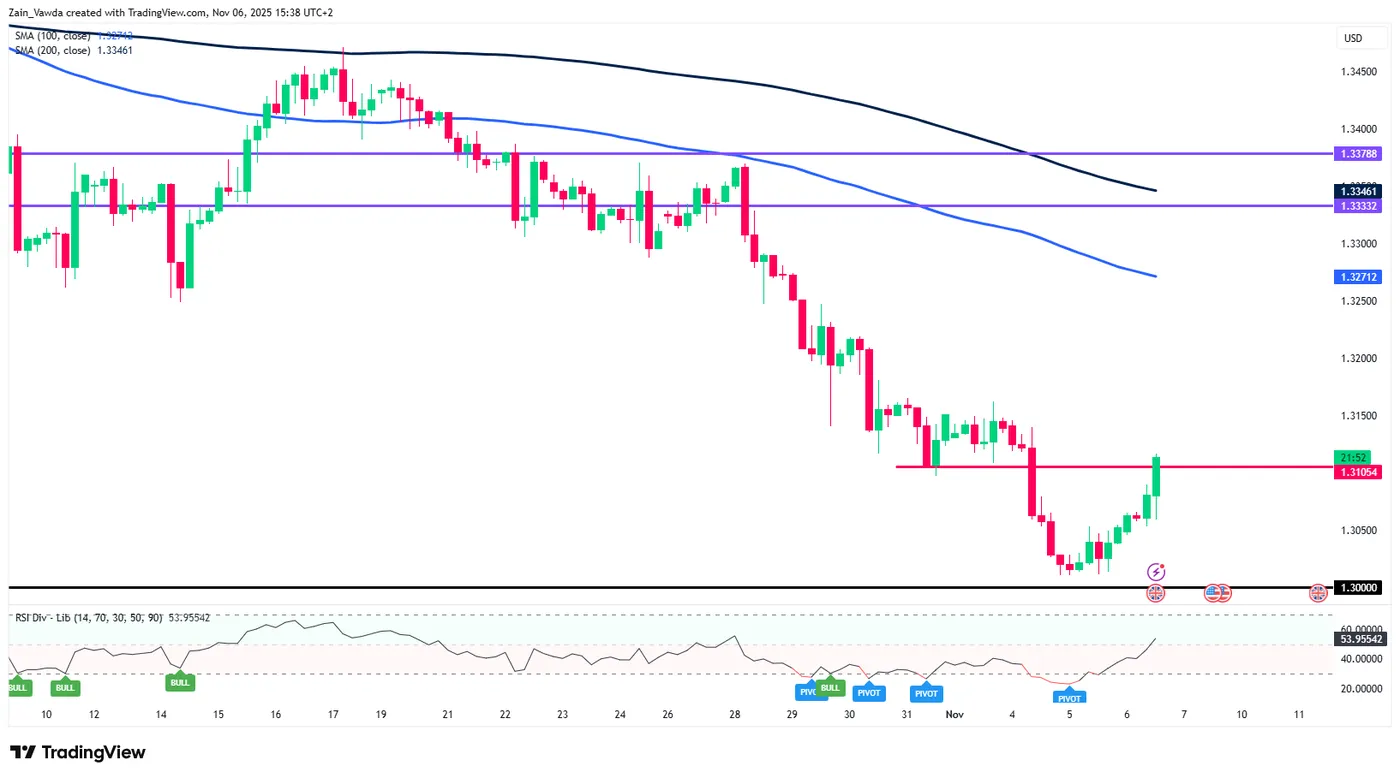
Markets saw the GBP weaken in the aftermath of today's rate decision with a 30-40 pip selloff in GBP/USD.
However, cable has since reversed this and pushed higher to trade around the 1.3100 handle at the time of writing.
A break above the 1.3100 handle and four-hour candle close could embolden bulls and push GBPUSD toward the 1.3250 handle and the 100-day MA which rests around the 1.3270.
If cable fails to find acceptance above 1.3100 handle, a retest of the crucial 1.3000 level may be in the offing.
GBP/USD Four-Hour Chart, November 6, 2025
White Label
Data API
Web Plug-ins
Poster Maker
Affiliate Program
The risk of loss in trading financial instruments such as stocks, FX, commodities, futures, bonds, ETFs and crypto can be substantial. You may sustain a total loss of the funds that you deposit with your broker. Therefore, you should carefully consider whether such trading is suitable for you in light of your circumstances and financial resources.
No decision to invest should be made without thoroughly conducting due diligence by yourself or consulting with your financial advisors. Our web content might not suit you since we don't know your financial conditions and investment needs. Our financial information might have latency or contain inaccuracy, so you should be fully responsible for any of your trading and investment decisions. The company will not be responsible for your capital loss.
Without getting permission from the website, you are not allowed to copy the website's graphics, texts, or trademarks. Intellectual property rights in the content or data incorporated into this website belong to its providers and exchange merchants.
Not Logged In
Log in to access more features

FastBull Membership
Not yet
Purchase
Log In
Sign Up