• Trade
  • Markets
  • Copy
  • Contests
  • News
  • 24/7
  • Calendar
  • Q&A
  • Chats
Trending
Screeners
SYMBOL
LAST
BID
ASK
HIGH
LOW
NET CHG.
%CHG.
SPREAD
SPX
S&P 500 Index
6848.59
6848.59
6848.59
6878.28
6833.87
-21.81
-0.32%
--
DJI
Dow Jones Industrial Average
47746.87
47746.87
47746.87
47971.51
47695.55
-208.11
-0.43%
--
IXIC
NASDAQ Composite Index
23548.16
23548.16
23548.16
23698.93
23481.60
-29.95
-0.13%
--
USDX
US Dollar Index
99.010
99.090
99.010
99.160
98.730
+0.060
+ 0.06%
--
EURUSD
Euro / US Dollar
1.16383
1.16390
1.16383
1.16717
1.16162
-0.00043
-0.04%
--
GBPUSD
Pound Sterling / US Dollar
1.33237
1.33246
1.33237
1.33462
1.33053
-0.00075
-0.06%
--
XAUUSD
Gold / US Dollar
4191.76
4192.17
4191.76
4218.85
4175.92
-6.15
-0.15%
--
WTI
Light Sweet Crude Oil
58.852
58.882
58.852
60.084
58.817
-0.957
-1.60%
--

Community Accounts

Signal Accounts
--
Profit Accounts
--
Loss Accounts
--
View More

Become a signal provider

Sell trading signals to earn additional income

View More

Guide to Copy Trading

Get started with ease and confidence

View More

Signal Accounts for Members

All Signal Accounts

Best Return
  • Best Return
  • Best P/L
  • Best MDD
Past 1W
  • Past 1W
  • Past 1M
  • Past 1Y

All Contests

  • All
  • Trump Updates
  • Recommend
  • Stocks
  • Cryptocurrencies
  • Central Banks
  • Featured News
Top News Only
Share

Zimbabwe's President Removes Winston Chitando As Mines Minister, Replaces Him With Polite Kambamura

Share

Ukraine President Zelenskiy: Ukraine Counts On Funding Based On Frozen Russian Assets In Any Form

Share

USA Commerce To Open Up Exports Of Nvidia H200 Chips To China -Semafor

Share

Ukraine: Ukraine Is Seeking Security Guarantees That Have Been Approved By The U.S. Capitol

Share

UN Spokesperson - UN Secretary General Guterres Very Concerned About Latest Developments Between Thailand And Cambodia

Share

LME Copper Futures Closed Up $15 At $11,636 Per Tonne. LME Aluminum Futures Closed Down $10 At $2,888 Per Tonne. LME Zinc Futures Closed Up $23 At $3,121 Per Tonne

Share

USA Federal Communications Commission Says It May Bar Providers From Connecting Calls From Chinese Telecom Companies To USA Networks Over Robocall Prevention Efforts - Order

Share

Ukraine President Zelenskiy: Ukraine Cannot Give Up Land, USA Is Trying To Find Compromise On The Issue

Share

Ukraine President Zelenskiy: Ukraine-Europe Plan Proposals Should Be Ready By Tomorrow To Share With USA

Share

Ukraine President Zelenskiy: Talks In London Were Productive, There Is Small Progress Towards Peace

Share

EU's Foreign Chief: Giving Ukraine The Resources It Needs To Defend Itself Doesn't Prolong The War, It Can Help End It

Share

EU's Foreign Chief: Securing Multi-Year Funding For Ukraine In December Is Absolutely Essential

Share

[Bank For International Settlements: US Tariffs Drive Record Global FX Trading Volume] Data From The Bank For International Settlements (BIS) Shows That Global FX Trading Volume Surged To A Record High This Year, With An Average Daily Trading Volume Of $9.5 Trillion In April, Amid Market Turmoil Triggered By US President Trump's Tariff Policies. On December 8, The Bank Released Its Quarterly Assessment, Citing Data From Its Triennial Survey, Stating That The Impact Of Tariffs Was "substantial," Leading To An Unexpected Depreciation Of The US Dollar And Accounting For Over $1.5 Trillion In Average Daily OTC Trading Volume In April. The Report Shows That Overall FX Trading Volume Increased By More Than A Quarter Compared To The Last Survey In 2022, Surpassing The Estimated Peak During The Market Turmoil Caused By The COVID-19 Pandemic In March 2020. This Data Is An Update Based On Preliminary Survey Results Released In September

Share

UN Secretary General Guterres Strongly Condemns Unauthorized Entry By Israeli Authorities Into UNRWA Compound In East Jerusalem

Share

Bank Of America: A Dovish Federal Reserve Poses A Key Risk To High-grade U.S. Bonds In 2026

Share

Bank CEOs Will Meet With U.S. Senators To Discuss The (regulatory) Framework For The Cryptocurrency Market

Share

The U.S. Supreme Court Has Hinted That It Will Support President Trump's Decision To Remove Heads Of Federal Government Agencies

Share

[BlackRock: The Surge Of Funds Into AI Infrastructure Is Far From Peaking] Ben Powell, Chief Investment Strategist For Asia Pacific At BlackRock, Stated That The Capital Expenditure Spree In The Artificial Intelligence (AI) Infrastructure Sector Continues And Is Far From Reaching Its Peak. Powell Believes That As Tech Giants Race To Increase Their Investments In A "winner-takes-all" Competition, The "shovel Sellers" (such As Chipmakers, Energy Producers, And Copper Wire Manufacturers) Who Provide The Foundational Resources For The Sector Are The Clearest Investment Winners

Share

[Ray Dalio: The Middle East Is Rapidly Becoming One Of The World's Most Influential AI Hubs] Bridgewater Associates Founder Ray Dalio Stated That The Middle East (particularly The UAE And Saudi Arabia) Is Rapidly Emerging As A Powerful Global AI Hub, Comparable To Silicon Valley, Due To The Region's Combination Of Massive Capital And Global Talent. Dalio Believes The Gulf Region's Transformation Is The Result Of Well-thought-out National Strategies And Long-term Planning, Noting That The UAE's Outstanding Performance In Leadership, Stability, And Quality Of Life Has Made It A "Silicon Valley For Capitalists." While He Believes The AI ​​rebound Is In Bubble Territory, He Advises Investors Not To Rush Out But Rather To Look For Catalysts That Could Cause The Bubble To "burst," Such As Monetary Tightening Or Forced Wealth Selling

Share

French President Emmanuel Macron Met With The Croatian Prime Minister At The Élysée Palace

TIME
ACT
FCST
PREV
France Trade Balance (SA) (Oct)

A:--

F: --

P: --
Euro Zone Employment YoY (SA) (Q3)

A:--

F: --

P: --
Canada Part-Time Employment (SA) (Nov)

A:--

F: --

P: --

Canada Unemployment Rate (SA) (Nov)

A:--

F: --

P: --

Canada Full-time Employment (SA) (Nov)

A:--

F: --

P: --

Canada Labor Force Participation Rate (SA) (Nov)

A:--

F: --

P: --

Canada Employment (SA) (Nov)

A:--

F: --

P: --

U.S. PCE Price Index MoM (Sept)

A:--

F: --

P: --

U.S. Personal Income MoM (Sept)

A:--

F: --

P: --

U.S. Core PCE Price Index MoM (Sept)

A:--

F: --

P: --

U.S. PCE Price Index YoY (SA) (Sept)

A:--

F: --

P: --

U.S. Core PCE Price Index YoY (Sept)

A:--

F: --

P: --

U.S. Personal Outlays MoM (SA) (Sept)

A:--

F: --

P: --
U.S. 5-10 Year-Ahead Inflation Expectations (Dec)

A:--

F: --

P: --

U.S. Real Personal Consumption Expenditures MoM (Sept)

A:--

F: --

P: --
U.S. Weekly Total Rig Count

A:--

F: --

P: --

U.S. Weekly Total Oil Rig Count

A:--

F: --

P: --

U.S. Consumer Credit (SA) (Oct)

A:--

F: --

P: --
China, Mainland Foreign Exchange Reserves (Nov)

A:--

F: --

P: --

Japan Trade Balance (Oct)

A:--

F: --

P: --

Japan Nominal GDP Revised QoQ (Q3)

A:--

F: --

P: --

China, Mainland Imports YoY (CNH) (Nov)

A:--

F: --

P: --

China, Mainland Exports (Nov)

A:--

F: --

P: --

China, Mainland Imports (CNH) (Nov)

A:--

F: --

P: --

China, Mainland Trade Balance (CNH) (Nov)

A:--

F: --

P: --

China, Mainland Exports YoY (USD) (Nov)

A:--

F: --

P: --

China, Mainland Imports YoY (USD) (Nov)

A:--

F: --

P: --

Germany Industrial Output MoM (SA) (Oct)

A:--

F: --

P: --
Euro Zone Sentix Investor Confidence Index (Dec)

A:--

F: --

P: --

Canada National Economic Confidence Index

A:--

F: --

P: --

U.K. BRC Like-For-Like Retail Sales YoY (Nov)

--

F: --

P: --

U.K. BRC Overall Retail Sales YoY (Nov)

--

F: --

P: --

Australia Overnight (Borrowing) Key Rate

--

F: --

P: --

RBA Rate Statement
RBA Press Conference
Germany Exports MoM (SA) (Oct)

--

F: --

P: --

U.S. NFIB Small Business Optimism Index (SA) (Nov)

--

F: --

P: --

Mexico 12-Month Inflation (CPI) (Nov)

--

F: --

P: --

Mexico Core CPI YoY (Nov)

--

F: --

P: --

Mexico PPI YoY (Nov)

--

F: --

P: --

U.S. Weekly Redbook Index YoY

--

F: --

P: --

U.S. JOLTS Job Openings (SA) (Oct)

--

F: --

P: --

China, Mainland M1 Money Supply YoY (Nov)

--

F: --

P: --

China, Mainland M0 Money Supply YoY (Nov)

--

F: --

P: --

China, Mainland M2 Money Supply YoY (Nov)

--

F: --

P: --

U.S. EIA Short-Term Crude Production Forecast For The Year (Dec)

--

F: --

P: --

U.S. EIA Natural Gas Production Forecast For The Next Year (Dec)

--

F: --

P: --

U.S. EIA Short-Term Crude Production Forecast For The Next Year (Dec)

--

F: --

P: --

EIA Monthly Short-Term Energy Outlook
U.S. API Weekly Gasoline Stocks

--

F: --

P: --

U.S. API Weekly Cushing Crude Oil Stocks

--

F: --

P: --

U.S. API Weekly Crude Oil Stocks

--

F: --

P: --

U.S. API Weekly Refined Oil Stocks

--

F: --

P: --

South Korea Unemployment Rate (SA) (Nov)

--

F: --

P: --

Japan Reuters Tankan Non-Manufacturers Index (Dec)

--

F: --

P: --

Japan Reuters Tankan Manufacturers Index (Dec)

--

F: --

P: --

Japan Domestic Enterprise Commodity Price Index MoM (Nov)

--

F: --

P: --

Japan Domestic Enterprise Commodity Price Index YoY (Nov)

--

F: --

P: --

China, Mainland PPI YoY (Nov)

--

F: --

P: --

China, Mainland CPI MoM (Nov)

--

F: --

P: --

Q&A with Experts
    • All
    • Chatrooms
    • Groups
    • Friends
    Connecting
    .
    .
    .
    Type here...
    Add Symbol or Code

      No matching data

      All
      Trump Updates
      Recommend
      Stocks
      Cryptocurrencies
      Central Banks
      Featured News
      • All
      • Russia-Ukraine Conflict
      • Middle East Flashpoint
      • All
      • Russia-Ukraine Conflict
      • Middle East Flashpoint
      Search
      Products

      Charts Free Forever

      Chats Q&A with Experts
      Screeners Economic Calendar Data Tools
      Membership Features
      Data Warehouse Market Trends Institutional Data Policy Rates Macro

      Market Trends

      Market Sentiment Order Book Forex Correlations

      Top Indicators

      Charts Free Forever
      Markets

      News

      News Analysis 24/7 Columns Education
      From Institutions From Analysts
      Topics Columnists

      Latest Views

      Latest Views

      Trending Topics

      Top Columnists

      Latest Update

      Signals

      Copy Rankings Latest Signals Become a signal provider AI Rating
      Contests
      Brokers

      Overview Brokers Assessment Rankings Regulators News Claims
      Broker listing Forex Brokers Comparison Tool Live Spread Comparison Scam
      Q&A Complaint Scam Alert Videos Tips to Detect Scam
      More

      Business
      Events
      Careers About Us Advertising Help Center

      White Label

      Data API

      Web Plug-ins

      Affiliate Program

      Awards Institution Evaluation IB Seminar Salon Event Exhibition
      Vietnam Thailand Singapore Dubai
      Fans Party Investment Sharing Session
      FastBull Summit BrokersView Expo
      Recent Searches
        Top Searches
          Markets
          News
          Analysis
          User
          24/7
          Economic Calendar
          Education
          Data
          • Names
          • Latest
          • Prev

          View All

          No data

          Scan to Download

          Faster Charts, Chat Faster!

          Download App
          English
          • English
          • Español
          • العربية
          • Bahasa Indonesia
          • Bahasa Melayu
          • Tiếng Việt
          • ภาษาไทย
          • Français
          • Italiano
          • Türkçe
          • Русский язык
          • 简中
          • 繁中
          Open Account
          Search
          Products
          Charts Free Forever
          Markets
          News
          Signals

          Copy Rankings Latest Signals Become a signal provider AI Rating
          Contests
          Brokers

          Overview Brokers Assessment Rankings Regulators News Claims
          Broker listing Forex Brokers Comparison Tool Live Spread Comparison Scam
          Q&A Complaint Scam Alert Videos Tips to Detect Scam
          More

          Business
          Events
          Careers About Us Advertising Help Center

          White Label

          Data API

          Web Plug-ins

          Affiliate Program

          Awards Institution Evaluation IB Seminar Salon Event Exhibition
          Vietnam Thailand Singapore Dubai
          Fans Party Investment Sharing Session
          FastBull Summit BrokersView Expo

          Fed’s Beige Book Finds Softening Job Market

          Olivia Brooks

          Political

          Economic

          Central Bank

          Summary:

          The job market weakened a bit this month as some employers cut back on hiring plans or reduced employees' hours and others shed jobs, according to the Federal Reserve's latest anecdotal Beige Book.
          Key Takeaways

          ●The Fed's latest Beige Book shows a slightly weaker job market as employers slow hiring, cut hours, or rely on attrition instead of layoffs.
          ●Consumer spending softened and price pressures persisted, giving policymakers mixed signals ahead of a potential year-end interest-rate decision.

          The job market weakened a bit this month as some employers cut back on hiring plans or reduced employees' hours and others shed jobs, according to the Federal Reserve's latest anecdotal Beige Book.

          The report is a data-light snapshot of the U.S. economy, giving the Fed visibility into what businesses are experiencing as Fed officials prepare to vote on interest rates. It may take on added importance at the Fed's Dec. 9-10 meeting, since the government shutdown prompted the cancellation of October's jobs report and a delay in November's.

          The picture suggests conditions may have weakened since September, when employers added some 119,000 jobs.

          Employment "declined slightly" as of mid-November, the Fed's Beige Book said, with about half of the Fed's 12 districts seeing weaker demand for workers.

          "Despite an uptick in layoff announcements, more Districts reported contacts limiting headcounts using hiring freezes, replacement-only hiring and attrition than through layoffs," the report said. "In addition, several employers adjusted hours worked to accommodate higher or lower than expected business volume instead of adjusting the number of employees."

          Why This Matters

          A cooling labor market and softer spending shape expectations for the Fed's next interest-rate move, influencing borrowing costs for consumers and businesses. These shifts also signal the economy's resilience as it enters the year-end.

          A few businesses also flagged early impacts of artificial intelligence, noting it replaced some entry-level positions "or made existing workers productive enough to curb new hiring."

          The weakening job market lines up with the assessment of one restaurant contact in the Philadelphia Fed district, who noted there had been "an exodus of workers to warehouse jobs" in 2021 and 2022. Now, that contact said, those workers haven't lost their jobs but are picking up part-time restaurant work since they've had their hours cut.

          While anecdotal, the report helps give the Fed visibility on whether their dashboards of data align with what local contacts are telling them.

          Fed officials have been unusually split in recent weeks, with some seeing more signs of economic strength than others and debating risks to inflation. Their data dashboards have also been a little smaller due to the federal government shutdown, with its economic data apparatus slowly starting to re-emerge.

          "In the absence of key data, the anecdotes will provide valuable insights for Fed officials and we see the FOMC proceeding with a year-end rate cut," Priscilla Thiagamoorthy, senior economist at BMO Capital Markets, wrote in a research note.

          Softer Consumer Spending

          The report also found that consumer spending was softening, as middle-of-the-road households became more cautious even as higher-income ones kept spending.

          "Overall consumer spending declined further, while higher-end retail spending remained resilient," the report said, adding that some travel and tourism contacts saw "cautious discretionary spending among consumers."

          In the Kansas City Fed district, the government shutdown led to "a visible slowdown in foot traffic" at many retailers and restaurants, the report said. Other businesses saw similar trends.

          "One firm remarked that now was the best time to get a tattoo, as even top artists have more open appointments than usual," the report said.

          The more wary tone lines up with recent data, with a monthly survey from The Conference Board showing confidence falling to its lowest levels since April. It also underscores the persistence of a "'K-shaped economy,'" BMO's Thiagamoorthy wrote, as spending among higher-income households rises while those on the lower end spend less.

          Prices On the Rise

          The report also flagged that prices "rose moderately," with tariffs helping prompt widespread pressures on input costs among manufacturers and retailers.

          It's not clear how much that will translate into higher sticker prices for consumers—and show up in the Consumer Price Index or other inflation data.

          "The extent of passthrough of higher input costs to customers varied, and depended upon demand, competitive pressures, price sensitivity of consumers, and pushback from clients," the report said.

          Fed officials tend to cut interest rates when the economy is weakening, but the risk of higher inflation is making some officials prefer keeping rates unchanged.

          Prices declined for some materials, the report said, with some businesses attributing to weaker demand, a delay in tariff implementations or the recent cut in tariff rates on some products.

          Other businesses are still seeing higher prices, with "multiple reports of margin compression or firms facing financial strain stemming from tariffs," the Beige Book said.

          The Fed's contacts broadly said they "anticipate upward cost pressures to persist," but their "plans to raise prices in the near term were mixed," the report said.

          Source: Investopedia

          To stay updated on all economic events of today, please check out our Economic calendar
          Risk Warnings and Disclaimers
          You understand and acknowledge that there is a high degree of risk involved in trading. Following any strategies or investment methods may lead to potential losses. The content on the site is provided by our contributors and analysts for information purposes only. You are solely responsible for determining whether any trading assets, securities, strategy, or any other product is suitable for investing based on your own investment objectives and financial situation.
          Add to Favorites
          Share

          Nvidia Says it Isn't Using 'Circular Financing' Schemes. 2 Famous Short Sellers Disagree

          Manuel

          Stocks

          Nvidia (NVDA) sent a memo to Wall Street analysts over the weekend arguing that it is not engaged in vendor financing, a controversial practice in which suppliers invest in or extend loans to their own customers.
          Famed short sellers Jim Chanos and Michael Burry aren't so sure.
          Nvidia wrote a seven-page document — first reported by Barron's on Tuesday morning — rebuffing claims that it invests in its own customers to inflate its revenue. The memo was written in response to a newsletter from a little-known Substack author last week claiming that the $5 trillion AI chipmaker is engaged in a "circular financing scheme" — using vendor financing to boost sales — drawing parallels between Nvidia and famous dot-com era accounting frauds committed by Enron and Lucent.
          Enron is notorious for manipulating its accounting and using off-balance sheet debt to hide losses in its broadband business during the internet boom. Internet infrastructure provider Lucent, meanwhile, is best known for aggressively investing in and extending loans to many of its loss-making telecom customers — who then used the funds to buy Lucent equipment that they couldn't have otherwise afforded. When the dot-com bubble burst and telecom startups couldn't pay back Lucent, the company had to write down revenue tied to those transactions and lost billions of dollars.
          Chanos, who is famous for predicting the fall of Enron, thinks the comparison between Nvidia and Lucent bears weight.
          "They're [Nvidia is] putting money into money-losing companies in order for those companies to order their chips," Chanos told Yahoo Finance in an interview.
          Nvidia has invested heavily in its own customers — from ChatGPT developer OpenAI (OPAI.PVT) to Elon Musk's xAI (XAAI.PVT) to a slew of AI cloud firms, including CoreWeave (CRWV) and Nebius (NBIS) — and those investments have raised eyebrows on Wall Street.
          "NVIDIA does not resemble historical accounting frauds because NVIDIA's underlying business is economically sound, our reporting is complete and transparent, and we care about our reputation for integrity," Nvidia wrote in its memo, which was obtained by Yahoo Finance.
          "[U]nlike Lucent, NVIDIA does not rely on vendor financing arrangements to grow revenue," the company continued. Nvidia noted that in typical vendor financing agreements, customers pay back suppliers over years. Meanwhile, the chipmaker said its customers pay the company within 53 days after purchasing its chips.
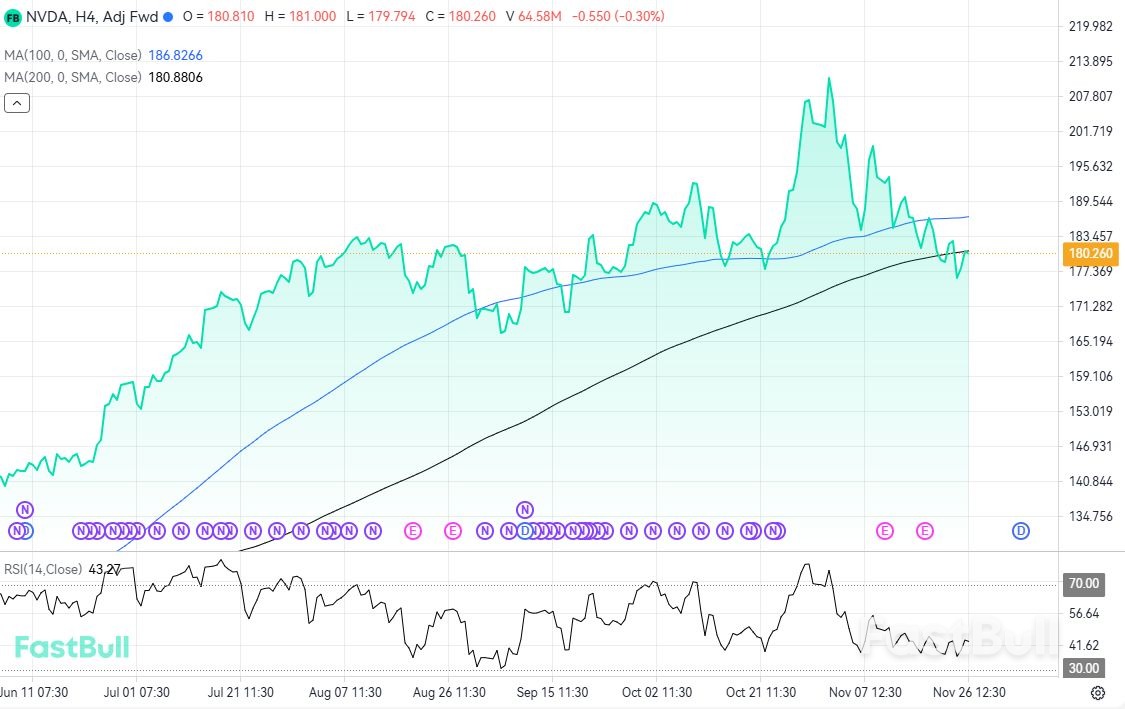
          Burry, the "Big Short" investor who predicted the collapse of the US housing market in 2008, went further than Chanos in a post on X last week, saying Nvidia is one of multiple companies in the AI market with "suspicious revenue recognition" due to investments in its customers.Nvidia Says it Isn't Using 'Circular Financing' Schemes. 2 Famous Short Sellers Disagree_1
          On top of vendor financing, Chanos views the entrance of debt in the AI market as another cause of concern for investors. Like Enron, Chanos said, some of Nvidia's customers, such as Meta (META) and xAI, are using off-balance sheet debt to finance their purchases of chips. Others, such as Anthropic (ANTH.PVT), are using traditional debt funding.
          "Putting lots of credit and really arcane financial structures on top of these money-losing entities is, I think, the real Achilles heel to the AI tech market," Chanos told Yahoo Finance on Tuesday.
          But while accounting could play a role in fueling the AI bubble by artificially inflating demand for the tech, the two short sellers argue that the bigger problem is simpler: The biggest tech companies are spending billions in a rush to build AI data centers ahead of demand.
          Burry claimed this weekend in a newsletter from his new Substack, Cassandra Unchained, that the AI market, like the dot-com era, is seeing "catastrophically overbuilt supply and nowhere near enough demand" — in other words, too many chips, servers, and data centers without enough underlying demand for AI applications used by businesses and consumers.
          For its part, Nvidia sees the market accelerating, saying demand for its AI chips is "off the charts" in its latest earnings report and arguing against the idea of a market bubble. The company argued Tuesday that it's "a generation ahead" of rivals, even as rising AI chip competition from Google sent the chipmaker's stock lower before it rebounded on Wednesday.
          But Chanos also thinks the rapidly accelerating AI build-out, ahead of demand, is cause for concern: "If it turns out that we don't quite need all the data center or chip capacity, we thought we will in '27 or '28, you could see orders begin to be canceled, and that's a big risk that not a lot of people are talking about."

          Source: Yahoo Finance

          Risk Warnings and Disclaimers
          You understand and acknowledge that there is a high degree of risk involved in trading. Following any strategies or investment methods may lead to potential losses. The content on the site is provided by our contributors and analysts for information purposes only. You are solely responsible for determining whether any trading assets, securities, strategy, or any other product is suitable for investing based on your own investment objectives and financial situation.
          Add to Favorites
          Share

          Canada's Prime Minister Announces Supports for Lumber, Steel Sectors Hit by U.S. Tariffs

          Manuel

          Political

          Commodity

          Canadian Prime Minister Mark Carney announced Wednesday new supports for the steel and lumber industries hit hard by U.S. tariffs.
          U.S. President Donald Trump has imposed 50% tariffs on steel and softwood lumber, long subject to U.S. tariffs, is currently taxed at 45% after the Trump administration’s hike last month.
          Carney said the decades-long process of an ever-closer economic relationship between Canada and the United States is now over.
          "As a consequence, many of our strengths have become vulnerabilities. Last year, more than 75% of our exports went to the United States. 90% of our lumber exports, 90% of our aluminum exports, and 90% of our steel exports, all bound for a single market,” Carney said.
          “We must protect our workers and industries who are most exposed to U.S. tariffs," he said.
          The plan tightens the quota on steel imports from countries that don’t have free-trade pacts with Canada from 50% to 20% of 2024 levels.
          Carney also said the federal government is offering an extra $500 million Canadian (US$356 million) in loan guarantees to the softwood lumber industry on top of other measures to encourage homebuilders to use made-in-Canada materials.
          Starting next spring, Ottawa will also subsidize freight fees on any rail shipments of steel and lumber across provincial borders to build up the domestic industry as Trump’s trade aggression cuts off the lucrative U.S. market.
          “We will make it more affordable to transport Canadian steel and lumber across the country by cutting freight rates,” Carney said.
          Trump cut off trade talks with Canada last month after the Ontario provincial government ran television advertisements in U.S. markets that criticize Trump’s tariffs by citing a speech by former U.S. President Ronald Reagan.
          Carney said he’ll be in Washington for the final draw on Dec. 5 for the FIFA World Cup 2026 tournament. He said he’ll speak to Trump then and said he spoke briefly to the president on Tuesday.
          “We are ready to re-engage on those talks when the United States wants to re-engage,” Carney said.

          Source: AP

          Risk Warnings and Disclaimers
          You understand and acknowledge that there is a high degree of risk involved in trading. Following any strategies or investment methods may lead to potential losses. The content on the site is provided by our contributors and analysts for information purposes only. You are solely responsible for determining whether any trading assets, securities, strategy, or any other product is suitable for investing based on your own investment objectives and financial situation.
          Add to Favorites
          Share

          Pentagon Cited Alibaba on China Military Aid in Oct. 7 Letter

          Manuel

          Stocks

          Political

          The Pentagon concluded that Alibaba Group Holding Ltd (BABAN.MX)., Baidu Inc. (BIDU) and BYD Co (BYDDY). should be added to a list of companies that aid the Chinese military, according to a letter to Congress sent roughly three weeks before Donald Trump and Xi Jinping agreed to a broad trade truce.
          Deputy Defense Secretary Stephen Feinberg informed lawmakers of the conclusion in the Oct. 7 letter, a copy of which was seen by Bloomberg News, to the heads of the House and Senate Armed Services Committees.
          It wasn’t clear whether the companies have been formally included in the the Pentagon’s so-called 1260H list, which carries no direct legal repercussions but serves as a major warning to US investors.
          Feinberg said the three companies along with five others — Eoptolink Technology Inc., Hua Hong Semiconductor Ltd., RoboSense Technology Co., WuXi AppTec Co. and Zhongji Innolight Co. — merit inclusion on the 1260H list, , which identifies businesses connected to the Chinese military operating in the US. The list is published annually, and the most recent version, which was updated in January before Trump took office, doesn’t include them.
          “In our review of the latest information available, the Department has identified eight entities that it has determined are ‘Chinese military companies’ in accordance with the statute that should be added to the 1260H list,” Feinberg wrote in the letter.
          The letter was written prior to the Oct. 30 summit between Trump and Xi in South Korea, where they agreed to a package of measures including lower tariffs and commitments to pause certain export controls. A spokesperson for the Pentagon didn’t respond to a request for comment.
          In a statement, China’s Foreign Ministry said it has “consistently opposed the US practice of overbroadly defining national security, establishing discriminatory lists under various pretexts, and unjustifiably suppressing Chinese enterprises.”
          “We urge the US to immediately correct its erroneous actions, and will take necessary measures to resolutely safeguard the legitimate rights and interests of Chinese enterprises,” the ministry added.
          Representatives of all the Chinese companies named in the letter didn’t immediately respond to requests for comment.

          AI, Robotics

          The inclusion of several prominent Chinese firms on the list in January triggered a stock selloff that hit Tencent Holdings Ltd. and Contemporary Amperex Technology Co. Ltd., which makes batteries for Elon Musk’s Tesla Inc. as well as other automakers. Inclusion on the list could amount to a serious challenge for Alibaba, which is stepping up efforts to compete globally in artificial intelligence, as well as the other firms.
          Earlier this month, a White House memo first reported by the Financial Times said Alibaba had provided the Chinese military with technology support against targets in the US. The company rejected the claims, calling them “completely false” and a “malicious PR operation” designed “to undermine President Trump’s recent trade deal with China.”
          Both Innolight and Eoptolink are leading makers of optical transceivers essential for connecting AI chips in clusters, and have been identified by Nvidia Corp. as its ecosystem partners. RoboSense provides sensors widely used in autonomous driving and robotics, is also named by Nvidia as a partner of the US firm’s autonomous driving platform.
          The list, first published in 2021, now includes more than 130 entities accused of working with the Chinese military. The names include those of airlines, construction companies, shipping companies, computer hardware manufacturers and communications companies.
          An analysis by the law firm of Hogan and Lovells said inclusion on the 1260H List has “several direct and indirect implications,” including restrictions on US defense contracts, potential inclusion on other restricted party lists, reputational damage and increased compliance costs.

          Source: Bloomberg

          Risk Warnings and Disclaimers
          You understand and acknowledge that there is a high degree of risk involved in trading. Following any strategies or investment methods may lead to potential losses. The content on the site is provided by our contributors and analysts for information purposes only. You are solely responsible for determining whether any trading assets, securities, strategy, or any other product is suitable for investing based on your own investment objectives and financial situation.
          Add to Favorites
          Share

          US Economic Activity Little Changed Ahead of Next Fed Meeting, Beige Book Report Shows

          Manuel

          Central Bank

          Economic

          U.S. economic activity was little changed in recent weeks, though employment was weaker in about half of the Federal Reserve's 12 districts and consumer spending declined, the U.S. central bank said on Wednesday, likely reinforcing concerns about labor market softening.
          "Economic activity was little changed since the previous report, according to most of the 12 Federal Reserve districts, though two districts noted a modest decline and one reported modest growth," the Fed said in its latest "Beige Book" report, a compendium of survey results, interviews, and other qualitative data from its 12 regional banks.
          "Employment declined slightly over the current period with around half of districts noting weaker labor demand," the report said. "Despite an uptick in layoff announcements, more districts reported contacts limiting headcounts using hiring freezes, replacement-only hiring, and attrition than through layoffs."
          Published two weeks ahead of each Fed policy meeting, the report is meant to help central bankers assess the U.S. economy's health with more timely, and often more colorful, insight than is available in the official statistics.
          With the data vacuum left by the record 43-day government shutdown that extended into mid-November, the Beige Book should get more weight than usual in the deliberations among deeply divided Fed policymakers, following their decision last month to cut rates by a quarter of a percentage point for the second consecutive meeting. The policy rate now stands in the 3.75%-4.00% range.
          The data flow has resumed since the shutdown ended, but most of the reports issued over the past two weeks have been significantly dated, covering the period just before the shutdown began on October 1, and have offered almost no fresh insight into the health of the economy.

          MARKETS BETTING ON ANOTHER RATE CUT NEXT MONTH

          One of the most current indicators, however, suggests the job market remains in a stable, gradually softening state.
          New claims for unemployment benefits fell last week to the lowest level since April, though the ranks of those remaining on benefits beyond a first week of assistance has plateaued near the highest level in about four years. Together, the figures point to no notable increase in layoffs despite a wave of job-cut announcements from big employers like Amazon.com, though those out of work are finding it harder to land a new job.
          Interest rate futures markets are reflecting a high probability of a third straight quarter-percentage-point reduction in borrowing costs at the Fed's December 9-10 meeting.
          Until last week it had been seen as a coin-toss decision amid deep divisions among Fed officials about whether more easing is needed to protect the job market or is too risky in light of inflation that remains above the central bank's 2% target. But the probability shifted sharply in favor of a rate cut after New York Fed President John Williams last week said he saw room to lower rates "in the near term."
          Whatever the decision at next month's meeting, it is likely to be made over the objections of several policymakers, and will come alongside a fresh batch of forecasts from Fed officials that will show how inclined they are to bring rates down further next year.

          Source: Reuters

          To stay updated on all economic events of today, please check out our Economic calendar
          Risk Warnings and Disclaimers
          You understand and acknowledge that there is a high degree of risk involved in trading. Following any strategies or investment methods may lead to potential losses. The content on the site is provided by our contributors and analysts for information purposes only. You are solely responsible for determining whether any trading assets, securities, strategy, or any other product is suitable for investing based on your own investment objectives and financial situation.
          Add to Favorites
          Share

          Why Texas is Buying Bitcoin From BlackRock Before Building a Real Reserve

          Manuel

          Cryptocurrency

          Political

          Texas has taken the first formal step toward becoming the first US state to hold Bitcoin as a strategic reserve asset.
          On Nov. 25, Lee Bratcher, president of the Texas Blockchain Council, reported that the world’s eighth-largest economy, valued at $2.7 trillion, purchased $5 million worth of BlackRock’s spot Bitcoin ETF, IBIT.
          He added that a second $5 million allocation is already lined up for direct Bitcoin acquisition once the state finalizes a custody and liquidity framework required under a new reserve law.
          The two tranches create a bridge between today’s institutional rails and a future in which governments do not just buy Bitcoin but hold it.

          Texas builds the first state-level blueprint

          The initial exposure did not go directly on-chain. Instead, Texas entered via IBIT, which has become the default wrapper for large allocators seeking Bitcoin access within familiar regulatory and operational infrastructure.
          This purchase was enabled by Senate Bill 21, a law signed by Governor Greg Abbott in June that established the Texas Strategic Bitcoin Reserve.
          The framework allows the state Comptroller to accumulate Bitcoin so long as the asset maintains a 24-month average market capitalization above $500 billion. Bitcoin is the only cryptocurrency that meets the threshold.
          The structure places the reserve outside the state treasury, sets governance channels for how the assets are held, and introduces an advisory committee to monitor risk and oversight.
          Meanwhile, the first $5 million is small relative to the scale of state finances, but the mechanics matter more than the number.
          Texas is testing whether Bitcoin can be formalized as a public reserve instrument within a state-level financial system that already manages hundreds of billions of dollars across different pools.
          Once the operational processes are in place, the second tranche will involve self-custodied Bitcoin, which introduces very different implications for liquidity, transparency, and audit practices.
          The state is designing procedures that resemble sovereign-grade custody rather than institutional brokerage. The reserve will require a qualified custodian, cold-storage capacity, key management protocols, independent audits, and reporting schedules.
          These are the building blocks of a repeatable template that other states could adopt without reinventing the governance architecture.

          Why BlackRock’s IBIT comes first

          The decision to enter through IBIT was not a signal of preference for ETFs over native Bitcoin. It was an operational workaround.
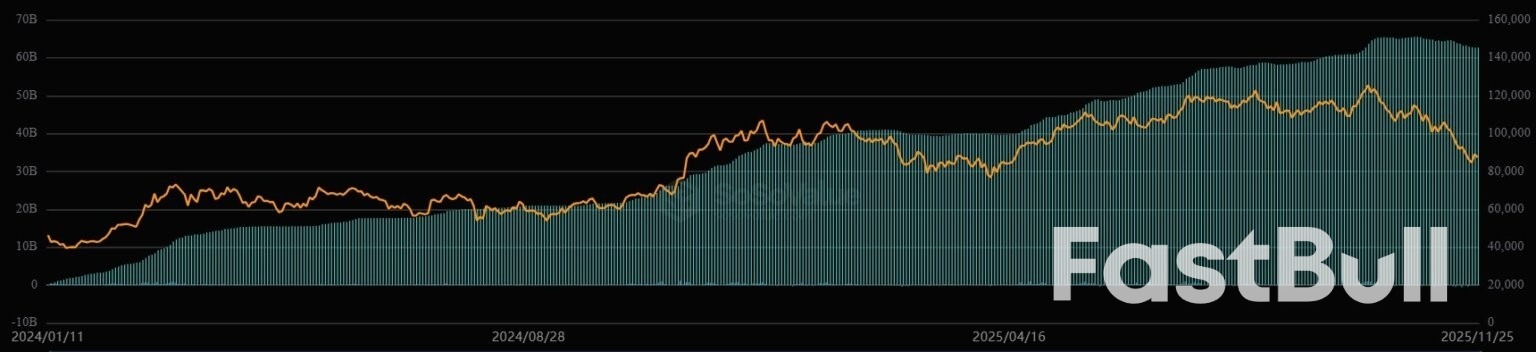
          IBIT is only in its second year, yet it has emerged as the most widely held Bitcoin ETF among major institutions. The fund is the largest Bitcoin ETF product, with cumulative net inflows of more than $62 billion.Why Texas is Buying Bitcoin From BlackRock Before Building a Real Reserve_1
          Moreover, the apparatus for public-sector self-custody does not exist in most jurisdictions, and creating that infrastructure requires procurement, security modeling, and political signoff. So, the state used IBIT as a placeholder, a temporary facility that allows it to express exposure while finalizing the permanent structure.
          This detour is instructive because it mirrors the trajectory of other large allocators.
          Harvard University disclosed that IBIT became one of its largest US equity holdings in the third quarter. Abu Dhabi Investment Council tripled its IBIT exposure over the same period, reaching roughly eight million shares. Wisconsin’s pension system disclosed more than $160 million across spot Bitcoin ETFs earlier this year, also routed through IBIT.
          The pattern is clear. Large institutions with different mandates, geographies, and risk frameworks are gravitating toward the same instrument. IBIT offers custody through a known intermediary, simplified reporting lines, and a clean accounting presentation under the new fair-value rules that took effect in 2025.
          These conveniences have turned the ETF into a de facto entry point for public and quasi-public entities. Texas is unique only in the fact that its IBIT exposure is meant to be temporary.

          What happens if others follow?

          The broader question is whether Texas becomes an anomaly or a blueprint.
          Bitcoin analyst Shanaka Anslem Perera said: “The cascade is mathematical. Four to eight states are positioned to follow within eighteen months, collectively commanding over $1.2 trillion in reserves. Institutional inflows projected between $300 million to $1.5 billion in near-term mimicry. This is not speculation. This is game theory in motion.”
          Already, politically aligned states like New Hampshire and Arizona also have Bitcoin reserve laws because they view the top crypto as a strategic hedge to the global financial system.
          More states could follow, as they could use their structural surpluses to allocate to Bitcoin for diversification, especially under the new accounting standards that neutralize earlier mark-to-market penalties.
          Moreover, the implications of state-level involvement extend beyond symbolism. ETF purchases do not alter the circulating supply because the trust structure issues and redeems shares without removing coins from liquid markets.
          Self-custody does the opposite. Once coins are purchased for cold storage, they leave the tradable float, reducing the supply available to exchanges and market makers.
          This distinction matters if Texas scales the reserve beyond its initial $10 million. Even modest state-level demand introduces a new type of buy-side participant, one that behaves countercyclically to noise traders and does not churn positions.
          The effect resembles a stabilizing anchor rather than a source of volatility. If other states adopt similar policies, the Bitcoin supply curve becomes more inelastic, increasing price sensitivity.

          Source: Cryptoslate

          Risk Warnings and Disclaimers
          You understand and acknowledge that there is a high degree of risk involved in trading. Following any strategies or investment methods may lead to potential losses. The content on the site is provided by our contributors and analysts for information purposes only. You are solely responsible for determining whether any trading assets, securities, strategy, or any other product is suitable for investing based on your own investment objectives and financial situation.
          Add to Favorites
          Share

          Alibaba Q2 FY2026 earnings: revenue beats estimates despite 71% profit decline

          Adam

          Economic

          Key financial metrics

          Alibaba reported RMB247.8 billion in revenue (versus consensus estimate of RMB242.7 billion) for the second quarter of fiscal year 2026, representing a 5% year-on-year (YoY) increase whilst remaining flat quarter-on-quarter. However, non-GAAP diluted earnings declined 71% year-on-year to RMB4.36 per American Depositary Share (ADS), approximately 20% below analyst expectations. This substantial contraction in profitability reflects the company's aggressive capital allocation towards strategic growth initiatives.

          Cloud business exceeds expectation

          The Cloud Intelligence Group sustained its position as the primary revenue growth driver, advancing 34% YoY to RMB39.8 billion during the quarter. AI-related products demonstrated triple-digit growth for the ninth consecutive quarter, underscoring sustained momentum in this critical segment.
          Chief Executive Officer Eddie Wu addressed market concerns regarding an AI bubble during yesterday's earnings call, indicating the company maintains confidence in the sector’s prospects in the next three years. He articulated Alibaba's strategic commitment to expanding AI infrastructure capabilities to accommodate surging market demand and navigate intensifying competitive pressures within the rapidly evolving technology landscape.
          The company is positioning itself to establish leadership within China's consumer AI applications sector, particularly given the absence of Google's Gemini and OpenAI's ChatGPT in the domestic market. Alibaba's proprietary AI application Qwen achieved over 10 million downloads within four days of launch this month, surpassing the initial adoption trajectory of DeepSeek upon its market entry.

          Core retail business demonstrates resilience

          Supported by government consumption stimulus measures and enhanced marketing expenditure, Alibaba's local e-commerce segment recorded 16% revenue growth – the fastest expansion rate since 2021. The company prioritised operational efficiency improvements within its quick commerce operations, yielding enhanced customer retention metrics and elevated average order values.
          The Singles' Day Shopping Festival successfully generated double-digit consumer growth YoY on the Taobao platform, substantially supported through promotional discounts underwritten by the retailer. These outcomes will be reflected in third quarter financial results.

          Marketing spend and AI investment constrain profitability

          However, the robust revenue growth trajectory came at considerable cost. Sales and marketing expenses more than doubled to RMB66 billion as the company competes for market share against rival quick commerce platforms including JD.com and Meituan. Adjusted EBITDA for the China E-commerce Group contracted 76% YoY. We anticipate marketing expenses will remain elevated in the near term.
          Alibaba's balance sheet position has deteriorated, reflecting a net cash flow outflow of RMB21.8 billion last quarter. An 80% YoY increase in capital expenditure served as the primary driver, as the company pursues aggressive investment in AI infrastructure development.

          Share price analysis

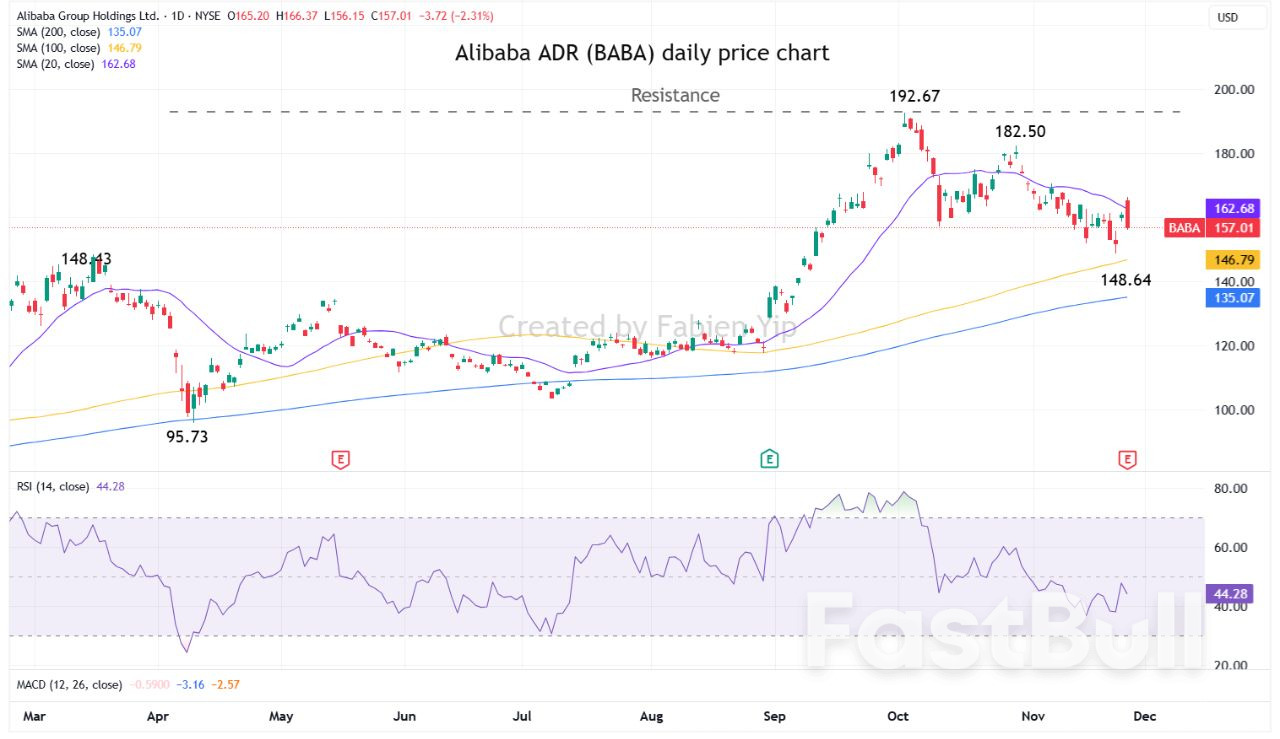
          Alibaba's ADR initially advanced approximately 3% during US pre-market trading following the results, though this optimism swiftly reversed as investor concerns regarding AI expenditure and margin compression intensified. Hong Kong-listed shares also opened lower today. Despite closing 2.3% lower in US markets yesterday, the security has delivered 86% year-to-date gains, significantly outperforming the MSCI China Index.
          From a fundamental analysis perspective, the stock's 12-month forward price-to-earnings ratio has expanded considerably from 12 times to 18 times over the past six months. As market participants increasingly focus on profit-taking ahead of year-end, a retracement following the sustained rally since April appears unsurprising.
          From a technical analysis standpoint, the share price has rebounded from $148.6, approximately a 50% Fibonacci retracement level from the recent upward wave. The recovery trajectory will encounter resistance around $182.5. Maintaining support above the 200-day moving average at $135.1 remains critical for sustaining the ascending medium-term trend. Failure to hold this level may trigger further downside towards the $115–$120 range.
          Figure 1: Alibaba daily price chart

          Alibaba Q2 FY2026 earnings: revenue beats estimates despite 71% profit decline_1as of 26 November 2025. Past performance is not a reliable indicator of future performance.

          Source: ig

          To stay updated on all economic events of today, please check out our Economic calendar
          Risk Warnings and Disclaimers
          You understand and acknowledge that there is a high degree of risk involved in trading. Following any strategies or investment methods may lead to potential losses. The content on the site is provided by our contributors and analysts for information purposes only. You are solely responsible for determining whether any trading assets, securities, strategy, or any other product is suitable for investing based on your own investment objectives and financial situation.
          Add to Favorites
          Share
          FastBull
          Copyright © 2025 FastBull Ltd

          728 RM B 7/F GEE LOK IND BLDG NO 34 HUNG TO RD KWUN TONG KLN HONG KONG

          TelegramInstagramTwitterfacebooklinkedin
          App Store Google Play Google Play
          Products
          Charts

          Chats

          Q&A with Experts
          Screeners
          Economic Calendar
          Data
          Tools
          Membership
          Features
          Function
          Markets
          Copy Trading
          Latest Signals
          Contests
          News
          Analysis
          24/7
          Columns
          Education
          Company
          Careers
          About Us
          Contact Us
          Advertising
          Help Center
          Feedback
          User Agreement
          Privacy Policy
          Business

          White Label

          Data API

          Web Plug-ins

          Poster Maker

          Affiliate Program

          Risk Disclosure

          The risk of loss in trading financial instruments such as stocks, FX, commodities, futures, bonds, ETFs and crypto can be substantial. You may sustain a total loss of the funds that you deposit with your broker. Therefore, you should carefully consider whether such trading is suitable for you in light of your circumstances and financial resources.

          No decision to invest should be made without thoroughly conducting due diligence by yourself or consulting with your financial advisors. Our web content might not suit you since we don't know your financial conditions and investment needs. Our financial information might have latency or contain inaccuracy, so you should be fully responsible for any of your trading and investment decisions. The company will not be responsible for your capital loss.

          Without getting permission from the website, you are not allowed to copy the website's graphics, texts, or trademarks. Intellectual property rights in the content or data incorporated into this website belong to its providers and exchange merchants.

          Not Logged In

          Log in to access more features

          FastBull Membership

          Not yet

          Purchase

          Become a signal provider
          Help Center
          Customer Service
          Dark Mode
          Price Up/Down Colors

          Log In

          Sign Up

          Position
          Layout
          Fullscreen
          Default to Chart
          The chart page opens by default when you visit fastbull.com