
Markets
News
Analysis
User
24/7
Economic Calendar
Education
Data
- Names
- Latest
- Prev


Signal Accounts for Members
All Signal Accounts
All Contests


Turkey Trade BalanceA:--
F: --
P: --
Germany Construction PMI (SA) (Nov)A:--
F: --
P: --
Euro Zone IHS Markit Construction PMI (Nov)A:--
F: --
P: --
Italy IHS Markit Construction PMI (Nov)A:--
F: --
P: --
U.K. Markit/CIPS Construction PMI (Nov)A:--
F: --
P: --
France 10-Year OAT Auction Avg. YieldA:--
F: --
P: --
Euro Zone Retail Sales MoM (Oct)A:--
F: --
P: --
Euro Zone Retail Sales YoY (Oct)A:--
F: --
P: --
Brazil GDP YoY (Q3)A:--
F: --
P: --
U.S. Challenger Job Cuts (Nov)A:--
F: --
P: --
U.S. Challenger Job Cuts MoM (Nov)A:--
F: --
P: --
U.S. Challenger Job Cuts YoY (Nov)A:--
F: --
P: --
U.S. Initial Jobless Claims 4-Week Avg. (SA)A:--
F: --
P: --
U.S. Weekly Initial Jobless Claims (SA)A:--
F: --
P: --
U.S. Weekly Continued Jobless Claims (SA)A:--
F: --
P: --
Canada Ivey PMI (SA) (Nov)A:--
F: --
P: --
Canada Ivey PMI (Not SA) (Nov)A:--
F: --
P: --
U.S. Non-Defense Capital Durable Goods Orders Revised MoM (Excl. Aircraft) (SA) (Sept)A:--
F: --
U.S. Factory Orders MoM (Excl. Transport) (Sept)A:--
F: --
P: --
U.S. Factory Orders MoM (Sept)A:--
F: --
P: --
U.S. Factory Orders MoM (Excl. Defense) (Sept)A:--
F: --
P: --
U.S. EIA Weekly Natural Gas Stocks ChangeA:--
F: --
P: --
Saudi Arabia Crude Oil ProductionA:--
F: --
P: --
U.S. Weekly Treasuries Held by Foreign Central BanksA:--
F: --
P: --
Japan Foreign Exchange Reserves (Nov)A:--
F: --
P: --
India Repo RateA:--
F: --
P: --
India Benchmark Interest RateA:--
F: --
P: --
India Reverse Repo RateA:--
F: --
P: --
India Cash Reserve RatioA:--
F: --
P: --
Japan Leading Indicators Prelim (Oct)A:--
F: --
P: --
U.K. Halifax House Price Index YoY (SA) (Nov)--
F: --
P: --
U.K. Halifax House Price Index MoM (SA) (Nov)--
F: --
P: --
France Current Account (Not SA) (Oct)--
F: --
P: --
France Trade Balance (SA) (Oct)--
F: --
P: --
France Industrial Output MoM (SA) (Oct)--
F: --
P: --
Italy Retail Sales MoM (SA) (Oct)--
F: --
P: --
Euro Zone Employment YoY (SA) (Q3)--
F: --
P: --
Euro Zone GDP Final YoY (Q3)--
F: --
P: --
Euro Zone GDP Final QoQ (Q3)--
F: --
P: --
Euro Zone Employment Final QoQ (SA) (Q3)--
F: --
P: --
Euro Zone Employment Final (SA) (Q3)--
F: --
Brazil PPI MoM (Oct)--
F: --
P: --
Mexico Consumer Confidence Index (Nov)--
F: --
P: --
Canada Unemployment Rate (SA) (Nov)--
F: --
P: --
Canada Labor Force Participation Rate (SA) (Nov)--
F: --
P: --
Canada Employment (SA) (Nov)--
F: --
P: --
Canada Part-Time Employment (SA) (Nov)--
F: --
P: --
Canada Full-time Employment (SA) (Nov)--
F: --
P: --
U.S. Dallas Fed PCE Price Index YoY (Sept)--
F: --
P: --
U.S. PCE Price Index YoY (SA) (Sept)--
F: --
P: --
U.S. PCE Price Index MoM (Sept)--
F: --
P: --
U.S. Personal Outlays MoM (SA) (Sept)--
F: --
P: --
U.S. Core PCE Price Index MoM (Sept)--
F: --
P: --
U.S. UMich 5-Year-Ahead Inflation Expectations Prelim YoY (Dec)--
F: --
P: --
U.S. Core PCE Price Index YoY (Sept)--
F: --
P: --
U.S. 5-10 Year-Ahead Inflation Expectations (Dec)--
F: --
P: --
U.S. UMich Current Economic Conditions Index Prelim (Dec)--
F: --
P: --
U.S. UMich Consumer Sentiment Index Prelim (Dec)--
F: --
P: --
U.S. UMich 1-Year-Ahead Inflation Expectations Prelim (Dec)--
F: --
P: --
U.S. UMich Consumer Expectations Index Prelim (Dec)--
F: --
P: --


No matching data
Latest Views
Latest Views
Trending Topics
Top Columnists
Latest Update
White Label
Data API
Web Plug-ins
Affiliate Program
View All

No data
In a major shift in U.S monetary policy, the federal reserve has officially ended its three year quantitative tightening (QT) program, marking one of the most significant pivots since the post pandemic economic recovery. The move signals a transition from balance sheet reduction to liquidity stabilization as the central bank seeks to maintain healthy banking system and guide inflation back towards target levels.
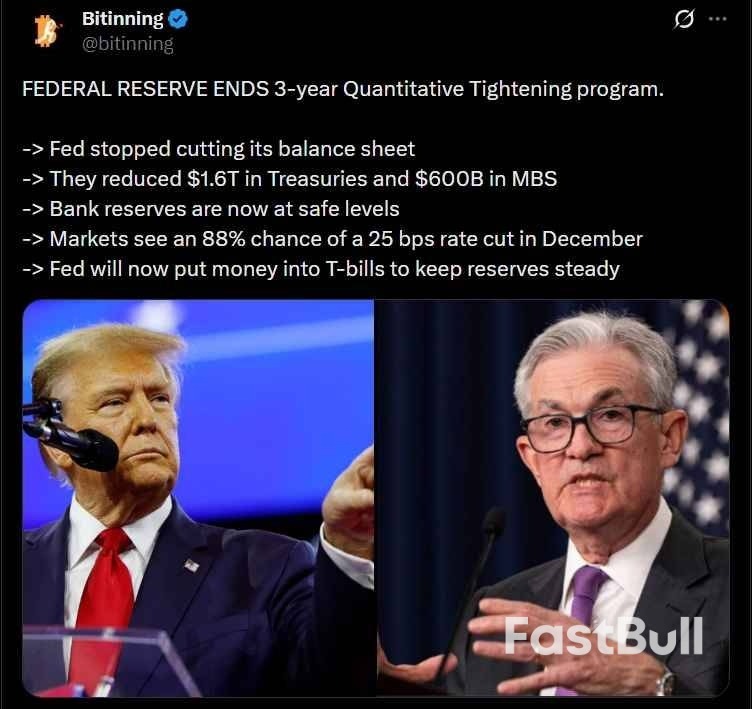

The federal reserve has stopped cutting its balance sheet, ending a QT cycle that ran from 2022 to 2024. During this period, the fed allowed assets to roll off without reinvestment reducing:
$1.6 trillion in U.S treasuries
$600 billion in mortgage backed securities (MBS)
This marks one of the largest balance sheet contractions in its history and reflects the central banks attempt to reverse the excessive liquidity created during covid era stimulus.
With QT ending, the Fed signaled the bank reserves have reached a comfortable and safe level reducing the risk of stress in short term funding assets. This is critical because excessively low reserves can trigger tightening in the repo market– a flashpoint to avoid after the volatile 2019 trading volume squeeze.
Following the policy shift, traders now see an 88% probability of a 25 bps rate cut in December. The market confidence has strengthened due to:
Easing inflation pressures
Steady labor market cooling
The Fed pivoting away from aggressive tightening
A rate cut would mark the first step towards a more accommodative environment that could support risk assets, lending activity and broader market funding conditions.
The Federal Reserve's decision to end its three-year QT cycle and shift toward liquidity support is being viewed as a bullish catalyst across the crypto assets. Traders expect improved dollar funding, higher risk appetite, and a potential December rate cut—all factors that typically boost digital assets.
With bank reserves stabilizing and preparing to add liquidity through T-bill purchases, Bitcoin and altcoins often benefit from easier financial conditions, stronger capital flows, and renewed market momentum.
If its pivot develops into a broader easing cycle, analysts anticipate increased inflows into crypto, stronger demand for risk assets, and a more favorable macro backdrop heading into the next phase.
Instead of shrinking its balance sheet further, the Federal Reserve will shift to purchasing treasury bills (T-bills) to keep reserves from failing. This approach allows the Fed to:
Stabilize the level of reserves in the banking system
Maintain flexibility in its balance sheet composition
Prevent tightening from resurging unintentionally
The Fed's decision to end its three year Quantitative tightening program is a major turning point in U.S monetary strategy. With bank reserves now stable,
Expectations for a December rate cut elevated, and the central bank shifting to T-bill purchases to maintain liquidity, markets are preparing for a more supportive policy environment.
The upcoming Decision will reveal whether this pivot evolves into a full easing cycle, shaping the economic landscape in the months ahead.
Bitcoin's price has surged back to $91,000 as of late November 2025, buoyed by institutional investor activity and favorable macroeconomic signals, notably due to potential Federal Reserve rate cuts.
This resurgence highlights market sensitivity to economic policy shifts, influencing both Bitcoin's valuation and wider cryptocurrency sentiment, with Ethereum also seeing gains above $3,000.
Bitcoin's price reached $91,000 in late November 2025, marking a strong recovery from previous lows near $80,000.
This rebound matters as it signals renewed institutional interest and aligns with expectations for a potential Federal Reserve rate cut.
Bitcoin has experienced a notable recovery attributed to macroeconomic optimism and institutional investor movements. Wall Street's growing interest in digital assets has driven increased trading volumes. Experts highlight support levels as crucial for ongoing price rallies.
The rebound follows an approximately 20% decline over the past month, impacted by market fluctuations and selling pressure from US-based investors. Analysts like Daan Crypto Trades emphasize the importance of the $89,000-$91,000 range.
The immediate effect on the cryptocurrency market has been significant, with a surge in trading volumes and increased buying pressure. Institutional trading volumes hitting $78 billion indicate significant inflows pushing the price above $91,000. Institutional investors leading the charge reflect heightened confidence.
Economically, expectations of a Federal Reserve rate cut have bolstered risk asset sentiment, further influencing Bitcoin's price trajectory. Ethereum similarly reacted, surpassing the $3,000 mark.
Similar rebounds have been observed during periods of anticipated monetary easing. Historical trends show support levels around $89,000-$91,000 often foreshadowing further rallies.
Experts speculate on potential outcomes, citing past rallies where sustained price levels led to significant gains. Michael Feroli, Economist at J.P. Morgan, noted,
"While the next FOMC meeting remains a close call, we now believe the latest round of Fedspeak tilts the odds toward the Committee deciding to cut rates in two weeks from today,"
Continued institutional interest and macroeconomic factors remain pivotal for future price stability.
White Label
Data API
Web Plug-ins
Poster Maker
Affiliate Program
The risk of loss in trading financial instruments such as stocks, FX, commodities, futures, bonds, ETFs and crypto can be substantial. You may sustain a total loss of the funds that you deposit with your broker. Therefore, you should carefully consider whether such trading is suitable for you in light of your circumstances and financial resources.
No decision to invest should be made without thoroughly conducting due diligence by yourself or consulting with your financial advisors. Our web content might not suit you since we don't know your financial conditions and investment needs. Our financial information might have latency or contain inaccuracy, so you should be fully responsible for any of your trading and investment decisions. The company will not be responsible for your capital loss.
Without getting permission from the website, you are not allowed to copy the website's graphics, texts, or trademarks. Intellectual property rights in the content or data incorporated into this website belong to its providers and exchange merchants.
Not Logged In
Log in to access more features

FastBull Membership
Not yet
Purchase
Log In
Sign Up