• Trade
  • Markets
  • Copy
  • Contests
  • News
  • 24/7
  • Calendar
  • Q&A
  • Chats
Trending
Screeners
SYMBOL
LAST
BID
ASK
HIGH
LOW
NET CHG.
%CHG.
SPREAD
SPX
S&P 500 Index
6887.46
6887.46
6887.46
6893.04
6833.46
+0.78
+ 0.01%
--
DJI
Dow Jones Industrial Average
48670.08
48670.08
48670.08
48722.98
48099.46
+612.34
+ 1.27%
--
IXIC
NASDAQ Composite Index
23514.72
23514.72
23514.72
23543.01
23308.95
-139.43
-0.59%
--
USDX
US Dollar Index
98.180
98.260
98.180
98.720
98.090
-0.410
-0.42%
--
EURUSD
Euro / US Dollar
1.17544
1.17552
1.17544
1.17623
1.16821
+0.00596
+ 0.51%
--
GBPUSD
Pound Sterling / US Dollar
1.34179
1.34188
1.34179
1.34378
1.33543
+0.00382
+ 0.29%
--
XAUUSD
Gold / US Dollar
4283.31
4283.74
4283.31
4285.76
4204.22
+55.09
+ 1.30%
--
WTI
Light Sweet Crude Oil
57.212
57.242
57.212
58.772
56.856
-1.465
-2.50%
--

Community Accounts

Signal Accounts
--
Profit Accounts
--
Loss Accounts
--
View More

Become a signal provider

Sell trading signals to earn additional income

View More

Guide to Copy Trading

Get started with ease and confidence

View More

Signal Accounts for Members

All Signal Accounts

Best Return
  • Best Return
  • Best P/L
  • Best MDD
Past 1W
  • Past 1W
  • Past 1M
  • Past 1Y

All Contests

  • All
  • Trump Updates
  • Recommend
  • Stocks
  • Cryptocurrencies
  • Central Banks
  • Featured News
Top News Only
Share

ICE Certified Arabica Stocks Increased By 1094 As Of December 11, 2025

Share

White House On Venezuela: Doj Approved Warrant To Seize Vessel

Share

New York Fed Accepts $2.874 Billion Of $2.874 Billion Submitted To Reverse Repo Facility On Dec 11

Share

Ukraine President Zelenskiy: Holding Elections In Ukraine Would Require Ceasefire

Share

Ukraine President Zelenskiy: He Tells 'Coalition Of The Willing' Security Guarantees Must Contain Element Of European Deterrence Of Russia, With Support From The USA

Share

Fed - USA Non-Seasonally Adjusted Foreign Financial Commercial Paper Outstanding Rises $5.7 Billion In Dec 10 Week

Share

Fed - USA Non-Seasonally Adjusted Commercial Paper Outstanding Rises $25.3 Billion In Dec 10 Week

Share

Fed - USA Seasonally Adjusted Commercial Paper Outstanding Rises $8.1 Billion In Dec 10 Week

Share

[UBS Asset Management's Fund Head Plans To Sell 10-Year US Treasuries Next Year, Betting On Widening Long-Short Yield Spread] Kevin Zhao Of UBS Asset Management Plans To Sell 10-year US Treasuries Next Year, Believing That A Dovish Federal Reserve And President Trump's Efforts To Stimulate Growth Before The Midterm Elections Will Reignite Inflation. Zhao, Who Is In Charge Of Actively Managed Sovereign, Fixed Income, And Foreign Exchange Funds At UBS Asset Management, Said The Market May Begin Pricing In A Fed Rate Hike By The End Of Next Year, Thereby Reducing The Attractiveness Of Longer-term US Treasuries And Pushing The Spread Between Them And Shorter-term Bonds To Its Widest Level Since 2021

Share

Ukrainian Military Says Its Forces Remain In Control Of Frontline City Of Siversk In Eastern Ukraine

Share

Senate Democrats Have Blocked A Republican Healthcare Bill That Aims To Replace The Expiring Obamacare Subsidies

Share

Argentina 2025/26 Wheat Harvest Estimated At Record 27.7 Million T Versus 24.5 Million T Previously Estimated - Rosario Grains Exchange

Share

The U.S. Department Of Energy Restructured A $9.6 Billion Loan For The Joint Venture Between Ford Motor Company And SK

Share

The Republican Healthcare Bill Failed To Garner Enough Votes To Pass The U.S. Senate; Voting Is Still Ongoing

Share

Ukraine President Zelenskiy: Parties Agreed To Continue Talks To Reach Concrete Understanding In Near Future

Share

Zelenskiy Said Ukraine Must Know How Partners Will Respond In Case Of New Russian Aggression

Share

Gold In New York Rose 2.0% On The Day, Reaching $4,309.8 Per Ounce

Share

[British MPs Urge Chancellor Reeves To Challenge Bank Of England's Stablecoin Plan] A Group Of Cross-party British MPs Has Urged Chancellor Rachel Reeves To Oppose The Bank Of England's Proposal To Limit Domestic Holdings Of Stablecoins, Arguing That The Policy Would Undermine The Government's Efforts To Position The UK As A Leader In Digital Assets. The MPs Say The Bank Of England's Plan To Restrict Individual Stablecoin Holdings Would Drive Capital Overseas Rather Than Mitigate Risk, And Would Hinder Innovation, Limit Adoption, And Push Activity Abroad

Share

[Microsoft Pledges To Create Superintelligence "In Line With Human Interests"] Mustafa Suleyman, Microsoft's Head Of Consumer AI, Is Working On Creating Superintelligence "in Line With Human Interests" And Has Pledged To Stop The Work If It Poses A Threat To Humanity. Suleyman's Work Was Previously Constrained By The Terms Of His Contract With Openai, But An Agreement Last October Granted Microsoft The Rights To Develop Its Own AI. In A Blog Post, Suleyman Announced The Progress On Superintelligence, Outlining Microsoft's View That These Systems Can Only Succeed If They Are Designed To Serve Humanity

Share

Spot Silver Continued Its Upward Trend, Rising Above $64 Per Ounce And Hitting A New All-time High, With A Weekly Gain Approaching 10%

TIME
ACT
FCST
PREV
U.K. 3-Month RICS House Price Balance (Nov)

A:--

F: --

P: --

Australia Employment (Nov)

A:--

F: --

P: --
Australia Full-time Employment (SA) (Nov)

A:--

F: --

P: --

Australia Unemployment Rate (SA) (Nov)

A:--

F: --

P: --

Australia Labor Force Participation Rate (SA) (Nov)

A:--

F: --

P: --

Turkey Retail Sales YoY (Oct)

A:--

F: --

P: --

South Africa Mining Output YoY (Oct)

A:--

F: --

P: --

South Africa Gold Production YoY (Oct)

A:--

F: --

P: --

Italy Quarterly Unemployment Rate (SA) (Q3)

A:--

F: --

P: --

IEA Oil Market Report
Turkey 1-Week Repo Rate

A:--

F: --

P: --

South Africa Refinitiv/Ipsos Primary Consumer Sentiment Index (PCSI) (Dec)

A:--

F: --

P: --

Turkey Overnight Lending Rate (O/N) (Dec)

A:--

F: --

P: --

Turkey Late Liquidity Window Rate (LON) (Dec)

A:--

F: --

P: --

U.K. Refinitiv/Ipsos Primary Consumer Sentiment Index (PCSI) (Dec)

A:--

F: --

P: --

Brazil Retail Sales MoM (Oct)

A:--

F: --

P: --

U.S. Weekly Continued Jobless Claims (SA)

A:--

F: --

P: --
U.S. Exports (Sept)

A:--

F: --

P: --

U.S. Trade Balance (Sept)

A:--

F: --

P: --
U.S. Weekly Initial Jobless Claims (SA)

A:--

F: --

P: --
Canada Imports (SA) (Sept)

A:--

F: --

P: --
U.S. Initial Jobless Claims 4-Week Avg. (SA)

A:--

F: --

P: --

Canada Trade Balance (SA) (Sept)

A:--

F: --

P: --
Canada Exports (SA) (Sept)

A:--

F: --

P: --
U.S. Wholesale Sales MoM (SA) (Sept)

A:--

F: --

P: --
U.S. EIA Weekly Natural Gas Stocks Change

A:--

F: --

P: --

China, Mainland M1 Money Supply YoY (Nov)

--

F: --

P: --

China, Mainland M0 Money Supply YoY (Nov)

--

F: --

P: --

China, Mainland M2 Money Supply YoY (Nov)

--

F: --

P: --

U.S. 30-Year Bond Auction Avg. Yield

A:--

F: --

P: --

Argentina CPI MoM (Nov)

--

F: --

P: --

Argentina National CPI YoY (Nov)

--

F: --

P: --

Argentina 12-Month CPI (Nov)

--

F: --

P: --

U.S. Weekly Treasuries Held by Foreign Central Banks

--

F: --

P: --

Japan Industrial Output Final MoM (Oct)

--

F: --

P: --

Japan Industrial Output Final YoY (Oct)

--

F: --

P: --

U.K. Services Index MoM (SA) (Oct)

--

F: --

P: --

U.K. Services Index YoY (Oct)

--

F: --

P: --

Germany HICP Final YoY (Nov)

--

F: --

P: --

Germany HICP Final MoM (Nov)

--

F: --

P: --

U.K. Trade Balance Non-EU (SA) (Oct)

--

F: --

P: --

U.K. Trade Balance (Oct)

--

F: --

P: --

U.K. Services Index MoM

--

F: --

P: --

U.K. Construction Output MoM (SA) (Oct)

--

F: --

P: --

U.K. Industrial Output YoY (Oct)

--

F: --

P: --

U.K. Trade Balance (SA) (Oct)

--

F: --

P: --

U.K. Trade Balance EU (SA) (Oct)

--

F: --

P: --

U.K. Manufacturing Output YoY (Oct)

--

F: --

P: --

U.K. GDP MoM (Oct)

--

F: --

P: --

U.K. GDP YoY (SA) (Oct)

--

F: --

P: --

U.K. Industrial Output MoM (Oct)

--

F: --

P: --

U.K. Manufacturing Output MoM (Oct)

--

F: --

P: --

U.K. Monthly GDP 3M/3M Change (Oct)

--

F: --

P: --

Germany CPI Final MoM (Nov)

--

F: --

P: --

Germany CPI Final YoY (Nov)

--

F: --

P: --

U.K. Construction Output YoY (Oct)

--

F: --

P: --

France HICP Final MoM (Nov)

--

F: --

P: --

China, Mainland Outstanding Loans Growth YoY (Nov)

--

F: --

P: --

U.K. Inflation Rate Expectations

--

F: --

P: --

India CPI YoY (Nov)

--

F: --

P: --

Q&A with Experts
    • All
    • Chatrooms
    • Groups
    • Friends
    Connecting
    .
    .
    .
    Type here...
    Add Symbol or Code

      No matching data

      All
      Trump Updates
      Recommend
      Stocks
      Cryptocurrencies
      Central Banks
      Featured News
      • All
      • Russia-Ukraine Conflict
      • Middle East Flashpoint
      • All
      • Russia-Ukraine Conflict
      • Middle East Flashpoint
      Search
      Products

      Charts Free Forever

      Chats Q&A with Experts
      Screeners Economic Calendar Data Tools
      Membership Features
      Data Warehouse Market Trends Institutional Data Policy Rates Macro

      Market Trends

      Market Sentiment Order Book Forex Correlations

      Top Indicators

      Charts Free Forever
      Markets

      News

      News Analysis 24/7 Columns Education
      From Institutions From Analysts
      Topics Columnists

      Latest Views

      Latest Views

      Trending Topics

      Top Columnists

      Latest Update

      Signals

      Copy Rankings Latest Signals Become a signal provider AI Rating
      Contests
      Brokers

      Overview Brokers Assessment Rankings Regulators News Claims
      Broker listing Forex Brokers Comparison Tool Live Spread Comparison Scam
      Q&A Complaint Scam Alert Videos Tips to Detect Scam
      More

      Business
      Events
      Careers About Us Advertising Help Center

      White Label

      Data API

      Web Plug-ins

      Affiliate Program

      Awards Institution Evaluation IB Seminar Salon Event Exhibition
      Vietnam Thailand Singapore Dubai
      Fans Party Investment Sharing Session
      FastBull Summit BrokersView Expo
      Recent Searches
        Top Searches
          Markets
          News
          Analysis
          User
          24/7
          Economic Calendar
          Education
          Data
          • Names
          • Latest
          • Prev

          View All

          No data

          Scan to Download

          Faster Charts, Chat Faster!

          Download App
          English
          • English
          • Español
          • العربية
          • Bahasa Indonesia
          • Bahasa Melayu
          • Tiếng Việt
          • ภาษาไทย
          • Français
          • Italiano
          • Türkçe
          • Русский язык
          • 简中
          • 繁中
          Open Account
          Search
          Products
          Charts Free Forever
          Markets
          News
          Signals

          Copy Rankings Latest Signals Become a signal provider AI Rating
          Contests
          Brokers

          Overview Brokers Assessment Rankings Regulators News Claims
          Broker listing Forex Brokers Comparison Tool Live Spread Comparison Scam
          Q&A Complaint Scam Alert Videos Tips to Detect Scam
          More

          Business
          Events
          Careers About Us Advertising Help Center

          White Label

          Data API

          Web Plug-ins

          Affiliate Program

          Awards Institution Evaluation IB Seminar Salon Event Exhibition
          Vietnam Thailand Singapore Dubai
          Fans Party Investment Sharing Session
          FastBull Summit BrokersView Expo

          Fed Cuts Rates as Reserve Operations Begin Amid Liquidity Strain

          Adam
          Summary:

          The Fed cut rates and launched $40B in bill purchases to ease liquidity strain, though the move seems late and insufficient. Powell nears exit, funding pressures persist, and Oracle’s weak cloud results hit AI sentiment.

          The FOMC decision to cut rates by 25 basis points, along with the introduction of reserve management operations, was widely expected—at least by me, and consistent with what I had been highlighting ahead of the meeting. It seemed clear that the Fed needed to prevent reserves from falling further, as the decline had been putting pressure on the overnight funding market, which we have been discussing here for months.
          Instead of freezing assets, they are trying to stabilize reserves, which is the more pressing issue. Perhaps things were worse behind the scenes than on the surface.
          The Fed clearly felt it had to act, announcing roughly $40 billion in bill purchases this month. In reality, this mostly offsets the week-to-week fluctuations we typically see on the balance sheet and may help lift reserves slightly. But the move feels a bit late, and the way they are implementing it almost comes across as a half-baked approach.
          The $40 billion does not appear to be a static amount. It sounds as though we will be learning the specific figures on the ninth of each month, at least until April, when the operation is expected to end.
          It is probably not a coincidence that the operation concludes around the same time Jay Powell is set to step down as Fed chair. It may even have been structured intentionally so that a new chair can come in and implement whatever policies they believe are appropriate.
          In a way, it seems Powell is trying to avoid letting the situation continue deteriorating under his tenure and is positioning himself to step aside before anything unfolds that could make the current environment worse.
          However, the real proof will come when we see how the overnight funding market actually behaves on a day-to-day basis—where SOFR trades and where volumes settle—and that will ultimately determine whether this operation is truly successful.
          In my view, $40 billion is unlikely to be enough to offset year-end funding pressures, and it will probably not be sufficient in January to meaningfully lower the rate pressures we have been seeing in a short period of time. But again, the results will speak for themselves as we monitor these dynamics day to day.
          Luckily, this comes at the perfect time for the $80 billion in Treasury settlements on Monday, 15 December.
          Anyway, Oracle (NYSE:ORCL) is getting smashed, down 10% on Wednesday, after its cloud revenue missed estimates and the company noted that CAPEX was rising to $50 billion from $35 billion. I guess that means today, we will be on CDS watch for the AI names once again.

          Source: investing

          Risk Warnings and Disclaimers
          You understand and acknowledge that there is a high degree of risk involved in trading. Following any strategies or investment methods may lead to potential losses. The content on the site is provided by our contributors and analysts for information purposes only. You are solely responsible for determining whether any trading assets, securities, strategy, or any other product is suitable for investing based on your own investment objectives and financial situation.
          Add to Favorites
          Share

          US Weekly Jobless Claims Post Largest Increase In Nearly 4-1/2 Years

          Devin

          Economic

          The number of Americans filing new applications for unemployment benefits increased by the most in nearly 4-1/2 years last week, but the surge likely does not suggest a material weakening in labor market conditions, as the claims data are volatile around this time of year.

          The larger-than-expected rise in initial weekly jobless claims reported by the Labor Department on Thursday reversed the sharp drop in the prior week, which had pushed filings to a three-year low.

          Economists said adjusting the data for seasonal fluctuations is always a challenge during the start of the holiday season, and recommended focusing on the four-week moving average to get a better read of the labor market. The four-week average of claims suggested labor market conditions remained stable.

          "The bulk of this week-to-week volatility is seasonal noise," said Stephen Stanley, chief U.S. economist at Santander U.S. Capital Markets. "On an underlying basis, nothing has changed, but if anything, we would have to say that initial claims are running slightly below the long-established trend, one of several data points that refutes (Federal Reserve) Chairman (Jerome) Powell's characterization of a shaky labor market."

          Initial claims for state unemployment benefits jumped 44,000, the biggest increase since mid-July of 2021, to a seasonally adjusted 236,000 for the week ended December 6, the Labor Department said. Economists polled by Reuters had forecast 220,000 claims for the latest week.

          Claims had dropped to a three-year low in the prior week, which was partly attributed to difficulties adjusting the data around the Thanksgiving holiday. The four-week moving average of claims, which irons out seasonal fluctuations, rose 2,000 to 216,750 last week. Economists continue to describe the labor market as being in a "no-fire, no-hire" state despite a raft of layoff announcements by large corporations, including Amazon.

          "It's a little surprising that recent layoff announcements haven't translated into a shift higher in initial claims," said Nancy Vanden Houten, lead U.S. economist at Oxford Economics.

          "It may be that some workers who have lost their jobs have received generous severance packages or have found other employment, although that is more difficult in the current labor market with a depressed rate of hiring."
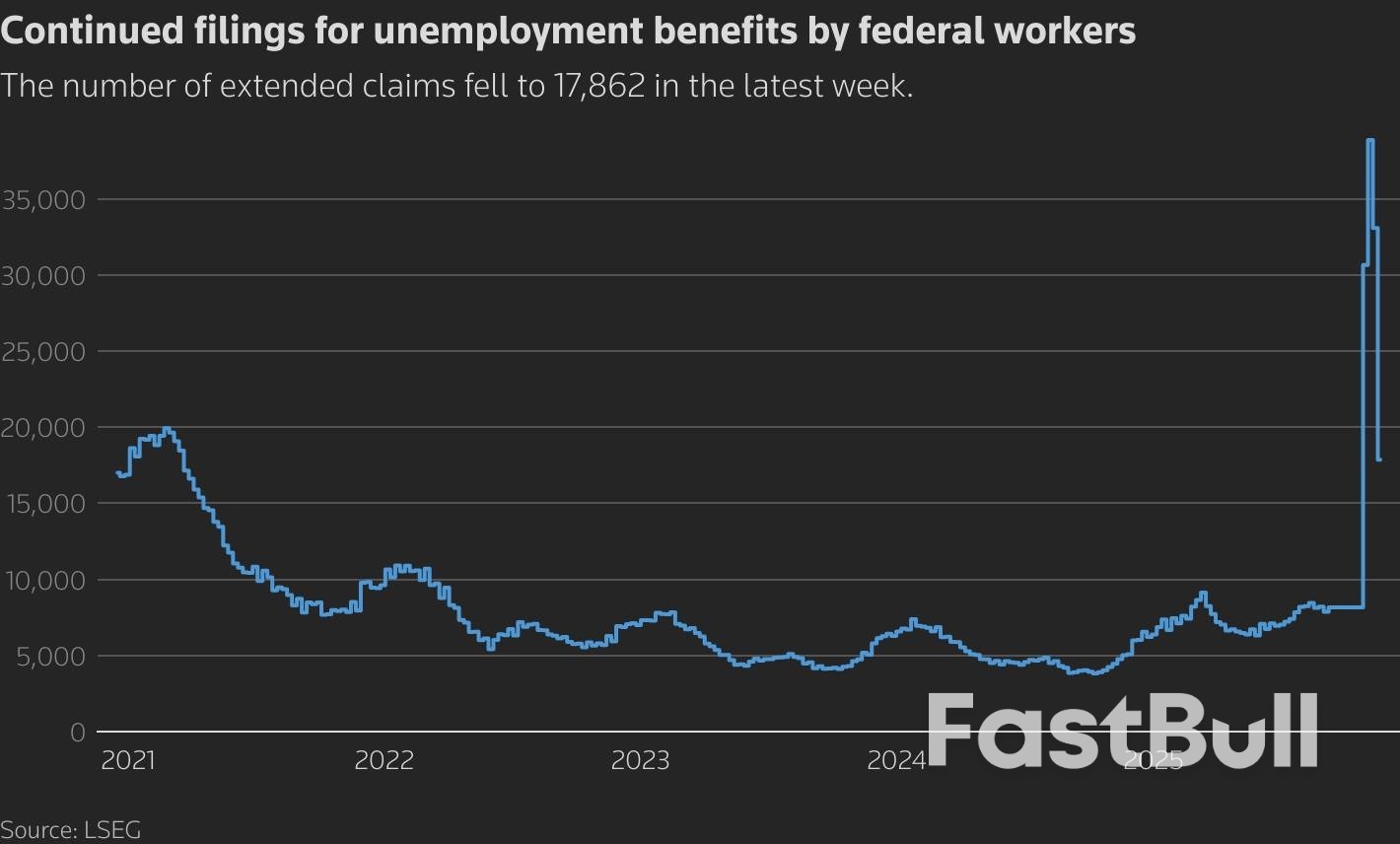
          A line chart with the title 'Continued filings for unemployment benefits by federal workers'

          The Fed on Wednesday cut its benchmark overnight interest rate by another 25 basis points to the 3.50%-3.75% range. The U.S. central bank has cut rates three times this year. Powell told reporters the labor market "seems to have significant downside risks," noting there was an overcounting of nonfarm payrolls, which policymakers believed was still persisting.

          U.S. stocks were trading mostly lower. The dollar weakened against a basket of currencies. U.S. Treasury yields also fell.

          In September, the Bureau of Labor Statistics estimated 911,000 fewer jobs were created in the 12 months through March than previously estimated, the equivalent of 76,000 fewer jobs per month. The BLS will publish the final payrolls benchmark revision in February along with January's employment report.

          ATTENTION SHIFTS TO NOVEMBER'S EMPLOYMENT REPORT

          The employment report for November, delayed by the 43-day government shutdown, will be released next Tuesday. It will incorporate October's nonfarm payrolls data. The unemployment rate for October, however, will not be available because the shutdown prevented the collection of data for the household survey, from which the jobless rate is calculated.

          The labor market has stagnated amid low supply and demand for workers, which economists blamed on reduced immigration and on import tariffs. The adoption of artificial intelligence for some job roles is also eroding demand for labor.

          The number of people receiving unemployment benefits after an initial week of aid, a proxy for hiring, dropped 99,000 to a seasonally adjusted 1.838 million during the week ending November 29, the claims report showed.

          Some of the decline in the so-called continuing claims could be the result of people exhausting their eligibility for benefits, limited to 26 weeks in most states. Continuing claims are consistent with a gradual rise in the unemployment rate.
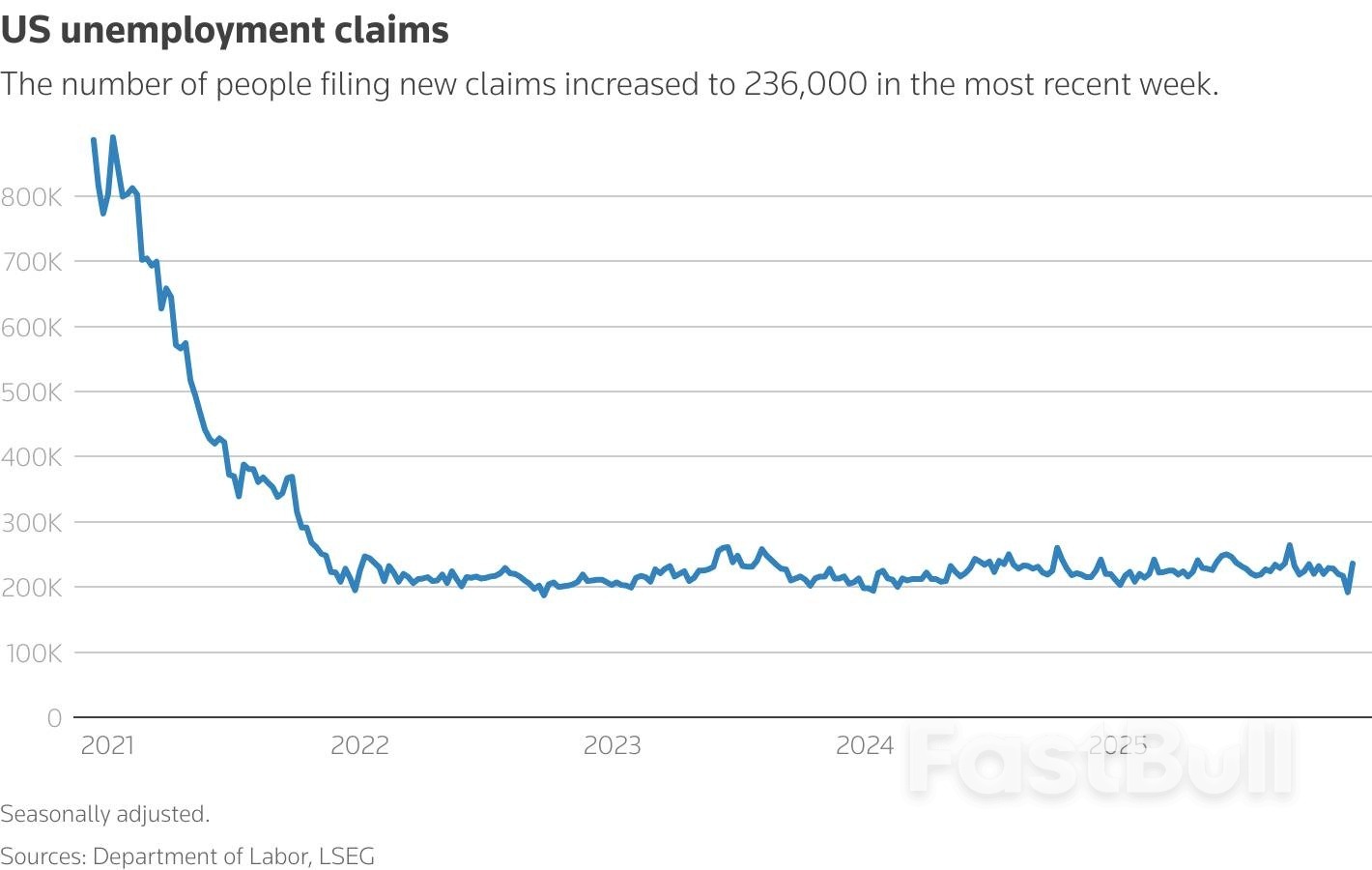
          A line chart with the title 'US unemployment claims'

          The unemployment rate increased to 4.4% in September from 4.3% in August. The Fed's new Summary of Economic Projections estimated the jobless rate would end this year at 4.5% and ease slightly to 4.4% in 2026, unchanged from the projections in September.

          A separate report from the Commerce Department's Bureau of Economic Analysis and Census Bureau showed the trade deficit contracted 10.9% to $52.8 billion in September, the lowest level since June 2020, as goods exports soared and imports rose marginally. The smaller trade gap suggested trade likely contributed to gross domestic product in the third quarter.

          Exports climbed 3.0% to $289.3 billion in September. Goods exports surged 4.9% to $187.6 billion, with shipments of consumer goods increasing to a record high. Imports rose 0.6% to $342.1 billion. Goods imports advanced 0.6% to $266.6 billion. But imports of automotive vehicles, parts and engines were the lowest since November 2022.

          The goods trade deficit compressed 8.2% to $79.0 billion, the lowest level since September 2020.

          The Atlanta Fed estimated GDP increased at a 3.5% annualized rate in the third quarter. The government will release its first estimate of third-quarter GDP on December 23, a delay prompted by the shutdown. The economy grew at a 3.8% pace in the April-June quarter.

          Source: Reuters

          To stay updated on all economic events of today, please check out our Economic calendar
          Risk Warnings and Disclaimers
          You understand and acknowledge that there is a high degree of risk involved in trading. Following any strategies or investment methods may lead to potential losses. The content on the site is provided by our contributors and analysts for information purposes only. You are solely responsible for determining whether any trading assets, securities, strategy, or any other product is suitable for investing based on your own investment objectives and financial situation.
          Add to Favorites
          Share

          The Hyperventilating Over The DOE Restructuring Is Ongoing

          Justin

          Political

          Economic

          In the latest wave of fearmongering surrounding President Trump's efforts to overhaul the U.S. Department of Education, a coalition of states that sued to stop mass layoffs at the department in March is now challenging recent decisions to transfer many of the DOE's core functions to the U.S. Department of Labor and other federal agencies.

          The attorneys general from 20 blue states and the District of Columbia, along with several teachers' unions, argue in an amended complaint filed on Nov. 25 that federal laws require the U.S. Department of Education to implement its own programs. The lawsuits focus on the fact that the department signed seven agreements with four other federal agencies, allowing those agencies to handle the day-to-day management of key grant programs. Under these arrangements, the Labor Department now heads up most K-12 grant programs, distributing over $20 billion annually to schools.

          The National Education Association issued a ridiculous statement alleging that the moves are "illegal, cruel, and shameful." NEA president Becky Pringle bizarrely declared, "Not only do they want to starve and steal from our students—they want to rob them of their futures. Nothing is more important than the success of our students, and America's educators and parents will not be silent as Trump and Linda McMahon turn their backs on our students, families, and communities to pay for billionaire tax cuts."

          American Federation of Teachers President Randi Weingarten also claims that the move is not legal. "There are lots of things about the Department of Education that are in statute," she declares, referring to funds that the department distributes to low-income families, students with disabilities, English as a Second Language learners, and work-study programs.

          Let's take a deep breath, step back, and look at the facts.

          While the federal government has spent money on education and developed education policies since the 19th century, the DOE didn't become a standalone agency until 1980, when it split off from the U.S. Department of Health, Education, and Welfare. Its creation came about when, as a sop to the National Education Association, Jimmy Carter established it while running for reelection. Clearly, it was politically motivated, and in response, the NEA subsequently issued its first-ever endorsement in a presidential contest.

          As Jay Greene, a senior research fellow at The Heritage Foundation, points out, most of the programs that the DOE now administers were created before the department was established. He writes that it is "just a bureaucratic restructuring. It doesn't get rid of programs; it doesn't cut funding; it doesn't close any schools. It's just a change in the administration, not a change in the programs and services and funding delivered to America's schools."

          Neal McCluskey, director of the Cato Institute's Center for Educational Freedom, further explains that under the restructuring, states may get money back, but with strings attached.

          Additionally, President Trump says his goal is to transfer the department's primary responsibilities—such as Pell Grants, Title I funding, and resources for students with disabilities—to other parts of the federal government.

          There is little reason to believe that moving various programs to different agencies will have any impact on schools whatsoever. Running the same programs under a different department is unlikely to affect students.

          "If that's all they're doing, they're not going to save any money, they're not going to change any policy," says Shep Melnick, a political scientist at Boston College.

          Melnick is correct. Essentially, what the feds are trying to do at this time is tantamount to rearranging the deck chairs on the Titanic.

          What the left and the teachers' unions truly fear is that the restructuring will eventually result in the federal government completely withdrawing all educational control.

          The reasons for shutting it down are numerous.

          First, spending is more efficient when it is closer to the source. Jim Blew, assistant secretary of education during the first Trump administration and co-founder of the Defense of Freedom Institute for Policy Studies, correctly notes, "This 'local control' message is often met by naysayers with the concern that some local districts may do worse without federal 'guardrails'—as if every school and district needs the same guardrails or that maintaining them comes with no cost. Perhaps some local districts will use their freedom to create worse outcomes (although that would be hard to do when roughly a third of our nation's 4th and 8th graders already cannot demonstrate even basic, grade-level reading or math skills), but I find it more likely that we will see committed, innovative educators improve student outcomes when freed to use federal funding as they think best."

          Perhaps no one fully comprehends the DOE's uselessness and waste more than former Secretary of Education Betsy DeVos. She contends that it shuffles money around, imposes unnecessary requirements and political agendas through its grants, and then shirks responsibility for evaluating whether any of what it does actually adds value. "Here's how it works: Congress appropriates funding for education; last year, it totaled nearly $80 billion. The department's bureaucrats take in those billions, add strings and red tape, peel off a percentage to pay for themselves, and then send it down to state education agencies."

          In summary, the DOE is ineffective, incompetent, unnecessary, and costly, and does nothing to support education. Its creation was a mistake, and it should be abolished. There is no strong policy reason or constitutional basis for the federal government to be involved in K-12 education. Ultimately, America's schools would be better off without it.

          But big-government leftists and teachers' unions rely on centralized authority. It's easier for them to influence a single federal agency where they already hold sway than to compete for control across 50 states and thousands of local districts. And, sadly, they will get their way, as 60 U.S. Senators would have to authorize the abolition of the DOE, which will not happen.

          Source: Zero Hedge

          To stay updated on all economic events of today, please check out our Economic calendar
          Risk Warnings and Disclaimers
          You understand and acknowledge that there is a high degree of risk involved in trading. Following any strategies or investment methods may lead to potential losses. The content on the site is provided by our contributors and analysts for information purposes only. You are solely responsible for determining whether any trading assets, securities, strategy, or any other product is suitable for investing based on your own investment objectives and financial situation.
          Add to Favorites
          Share

          Strategic Public Investment Surge to Power Vietnam’s Growth Engine in 2025–2026

          Gerik

          Economic

          Government Capital Injection to Spur a Multi-Sectoral Economic Rebound

          In the closing stretch of 2025, Vietnam is preparing a decisive deployment of over VND 400 trillion in public investment to reignite economic momentum. According to data from the Ministry of Finance, as of October 23, 2025, only VND 464.8 trillion or 51.7% of the year’s total capital plan had been disbursed. This indicates that nearly half of the planned investment remains untapped, presenting a substantial opportunity for late-year economic acceleration.
          At the Ministry of Construction, disbursement progress stands at roughly 51%, equivalent to just over VND 40.9 trillion. In response, Minister Trần Hồng Minh has instructed project owners to expand professional staffing, streamline administrative bottlenecks, and treat fund deployment not as a bureaucratic procedure but as a national priority.
          This urgency is underscored by a government mandate for five major expressway segments including Biên Hòa–Vũng Tàu and Cần Thơ–Hậu Giang to be operational by December 19, 2025. In tandem, seven strategic projects, such as the Lào Cai–Hà Nội–Hải Phòng railway and the Thần Vũ and Núi Vung tunnels, are compelled to commence before year-end despite earlier delays. The Vietnam Securities Company MBS has flagged the time constraint as significant, noting that with only two months left, the remaining VND 400 trillion creates immense pressure to disburse efficiently and effectively.

          Public Investment as a Catalyst for Private Capital and FDI Inflows

          Beyond short-term stimulus, the public investment wave is expected to have broader structural effects. Analysts emphasize that public spending will serve as foundational capital, enticing both private sector investment and foreign direct investment into alignment. As major infrastructure projects transition from feasibility studies into preparatory phases such as the North-South High-Speed Railway and the Lào Cai–Hà Nội–Hải Phòng corridor the role of the government becomes central to shaping economic direction.
          According to Bùi Nguyên Khoa, Deputy Director of BSC Research, the decentralization and empowerment in project management have accelerated decision-making, allowing greater local flexibility and responsiveness. These governance reforms enable faster implementation of large-scale infrastructure, which is critical for fostering inclusive national development.
          The government’s objective is to finalize 3,000 kilometers of expressways and more than 1,000 kilometers of coastal roads in 2025. Dr. Nguyễn Tú Anh of VinUni argues that public investment no longer merely stimulates demand it acts as a structural anchor around which other capital flows orbit. When macroeconomic stability is coupled with consistent FDI inflows, infrastructure becomes a central node in a multi-tiered growth model. He further suggests that capital demands from infrastructure could prompt a resurgence in bank liquidity and credit expansion.

          Infrastructure-Led Growth Triggers Sectoral Chain Reactions

          A sharp rise in Q4 disbursements is anticipated to ignite rapid growth in construction-related industries. Firms engaged in infrastructure such as HHV, FCN, VCG, and C4G are projected to benefit from increased workloads and fund allocations. At the same time, building material companies like HPG, HSG, PLC, and KSB are expected to witness dual gains: rising demand from new projects alongside relatively stable input costs.
          While the banking sector may not see immediate volume spikes, analysts point to its indirect gains. As public capital circulates back into the banking system, liquidity tightness may ease, thereby facilitating a stronger credit cycle into year-end.
          However, not all real estate sectors are poised for recovery. While improved infrastructure raises expectations for housing demand, analysts caution that growth will likely concentrate in segments tied closely to urban centers, transit corridors, and integrated industrial-urban zones. Peripheral land, speculative plots, and stalled tourism projects are less likely to benefit.

          Trade, FDI, and Consumption Gain Renewed Momentum

          Vietnam's global trade outlook also appears resilient. Agriseco forecasts a 17% increase in international trade in 2025 despite global protectionist pressures. This reflects Vietnam’s embeddedness in global supply chains, where total import-export turnover could reach a record USD 900 billion.
          FDI inflows are expected to remain strong following Vietnam’s reciprocal tax agreements with the United States, which pave the way for high-quality capital from Western investors. Targeted investment is likely to favor industrial parks, logistics, and export-oriented manufacturing sectors with long-term structural value.
          Concurrently, recovering consumer demand is bolstering essential retail chains and sectors such as food and beverage, electronics, and household goods. With input costs declining, retailers are positioned to enjoy improved profit margins. Tourism, too, is rebounding as visitor volumes climb, supporting airlines, hospitality, and travel services.

          Macroeconomic Pressures May Complicate Outlook

          Despite this optimistic trajectory, risks remain. A weakening Vietnamese đồng against major currencies, coupled with rising gold prices and inflationary pressures, could constrain monetary policy flexibility. This, in turn, may affect both credit expansion and the stock market’s ability to attract fresh capital.
          If inflation expectations rise too sharply, the State Bank of Vietnam may be forced to reconsider accommodative stances, potentially blunting the momentum gained from public investment. Moreover, volatile commodity markets and exchange rate fluctuations could erode investor confidence if not properly managed.

          A Delicate Balance Between Momentum and Caution

          Vietnam’s late-2025 public investment surge signals a strong political will to revive growth. The government’s strategic use of public funds as leverage to activate private and foreign capital presents a promising path for sustained recovery. However, success will hinge not only on rapid disbursement but also on maintaining macroeconomic stability, controlling inflation, and ensuring that the investment flows into productive, high-impact sectors.
          As 2025 transitions into 2026, the Vietnamese economy finds itself at a crossroads: with policy clarity, infrastructure execution, and capital synergy, it could accelerate into a new growth phase. Without such alignment, however, the risk of inefficient allocation and monetary tightening could dilute the intended stimulus.
          To stay updated on all economic events of today, please check out our Economic calendar
          Risk Warnings and Disclaimers
          You understand and acknowledge that there is a high degree of risk involved in trading. Following any strategies or investment methods may lead to potential losses. The content on the site is provided by our contributors and analysts for information purposes only. You are solely responsible for determining whether any trading assets, securities, strategy, or any other product is suitable for investing based on your own investment objectives and financial situation.
          Add to Favorites
          Share

          Copper Surges to Record High as Fed Cuts Rates and Lifts Growth Outlook

          Gerik

          Economic

          Commodity

          Fed Rate Cut Spurs Metal Rally

          The Federal Reserve's decision to lower interest rates for the third consecutive meeting acted as a catalyst for the industrial metals rally. With rates reduced and the Fed’s tone hinting at caution toward future cuts, markets interpreted the move as a boost for growth-sensitive commodities. The central bank also raised its US GDP growth forecast for 2026 to 2.3%, up from 1.8%, while expecting inflation to ease to 2.4%. This dual outlook of solid growth and cooling inflation is particularly supportive for industrial demand.
          Copper surged as much as 2.1% to reach $11,800.50 per ton, surpassing Monday’s record, and was still trading at $11,765 as of 2:29 p.m. on the London Metal Exchange. The metal has now gained nearly 35% year-to-date, driven not only by monetary easing but also by global supply concerns. Mine disruptions and stockpiling in the US due to expected tariffs in 2026 have amplified fears of an international shortage. At the same time, long-term demand remains underpinned by the ongoing expansion of renewable energy and electrification projects, sectors that rely heavily on copper.

          China’s Mixed Influence

          While Chinese copper consumption had declined in recent months, optimism has begun to return following Beijing's pledge to maintain a “proactive” fiscal policy and a “moderately loose” monetary approach. These policy signals suggest that domestic demand support is forthcoming, although the pace and scale of such recovery remain uncertain.
          The bullish sentiment extended beyond copper. Tin jumped 3.8% to a three-year high of over $41,500 per ton, while zinc rose 3%. The only major metal not participating in the rally was nickel, which remained under pressure. Lower interest rates generally enhance the attractiveness of non-yielding commodities like metals, and they reduce borrowing costs for capital-intensive sectors like construction, infrastructure, and manufacturing.
          Copper’s historic breakout reflects a convergence of monetary stimulus, strong US economic projections, and persistent supply bottlenecks. While short-term volatility remains especially with China’s recovery still uncertain the medium-to-long term fundamentals for copper appear robust, particularly amid the ongoing energy transition. Further upward pressure on prices could emerge if Chinese demand rebounds more forcefully or if geopolitical or trade tensions escalate supply risks.

          Source: Reuters

          To stay updated on all economic events of today, please check out our Economic calendar
          Risk Warnings and Disclaimers
          You understand and acknowledge that there is a high degree of risk involved in trading. Following any strategies or investment methods may lead to potential losses. The content on the site is provided by our contributors and analysts for information purposes only. You are solely responsible for determining whether any trading assets, securities, strategy, or any other product is suitable for investing based on your own investment objectives and financial situation.
          Add to Favorites
          Share

          Tariff revenue dipped slightly in November after Trump pulled back on grocery store duties

          Adam

          Economic

          The government's tariff revenues in November ticked down for the first time since President Trump began implementing his historic duties, according to new totals from the US Treasury Department.
          The agency's monthly statement for November, released on Wednesday, saw a reading of $30.76 billion in customs duties collected, following an October reading of $31.35 billion.
          The revenue decline came after Trump added no significant new duties last month and backtracked on some of his existing tariffs on grocery store items.
          On Nov. 14, the White House released an executive order that excluded items such as coffee, tea, beef, bananas, tropical fruit, and cocoa from duties as part of an effort to address Americans' affordability concerns.
          The downward tick in tariff revenue breaks a streak that began earlier this year when Trump began rolling out his tariff regime, leading to skyrocketing monthly revenues each month, from $7.25 billion collected in February until October's reading, which was over four times as large.
          Trump's first major tariff move of his second term was implementing new tariffs on goods from Mexico, Canada, and China, announced in February and fully taking effect in March.
          The step down in revenue isn't wholly unexpected and comes after the Congressional Budget Office recently slashed its estimate of tariff receipts expected for the decade ahead by $1 trillion.
          Wednesday's release brings the total revenue collected for this calendar year to about $236.16 billion, with one month to go. The November reading also remained well above the tariffs collected one year prior, which totaled $6.71 billion in November 2024.
          In an interview with Politico this week, Trump defended his tariff regime, but when asked whether he'd consider cutting tariffs on additional consumer staples, he suggested that he might allow for "some" additional carveouts, similar to those made last month.
          Wednesday's new Treasury Department report also showed the minimal dent tariffs are making in the yawning government deficit, with that data showing an overall $173 billion government shortfall in November, more than five times the tariff revenue number.
          Trump, meanwhile, has continued to tout tariff revenues at nearly every opportunity. He has both exaggerated the amount coming in and promised the money for multiple projects, from possible $2,000 tariff dividend checks to paying down the national debt to perhaps even replacing federal income taxes.
          Just this week, the president announced plans for a $12 billion bailout to farmers who have been pummeled by his trade fights and said that the money "would not be possible without tariffs."
          Wednesday's release could further stretch the already difficult math that economists often say would be unlikely to cover nearly any of Trump's ideas, much less all of them.
          As just one example, the Committee for a Responsible Federal Budget recently estimated that one round of tariff dividend checks would cost $600 billion and take about two years to pay off using only tariff revenues.
          The tariff revenue question remains even further in flux as the Supreme Court considers a suit that concerns whether a 1977 law called the International Emergency Economic Powers Act (IEEPA) empowers the president to impose tariffs.
          A ruling against the Trump administration could invalidate over half of Trump's tariffs, by revenue, and potentially even force the president to issue refunds.

          Source: finance.yahoo

          To stay updated on all economic events of today, please check out our Economic calendar
          Risk Warnings and Disclaimers
          You understand and acknowledge that there is a high degree of risk involved in trading. Following any strategies or investment methods may lead to potential losses. The content on the site is provided by our contributors and analysts for information purposes only. You are solely responsible for determining whether any trading assets, securities, strategy, or any other product is suitable for investing based on your own investment objectives and financial situation.
          Add to Favorites
          Share

          Trump, Modi Speak As US-India Trade Talks Inch Forward

          James Whitman

          Political

          President Donald Trump spoke with Prime Minister Narendra Modi as negotiators from the US and India work to resolve differences over an elusive trade agreement.

          Modi on Thursday described the conversation as "warm and engaging" and said they "reviewed the progress in our bilateral relations and discussed regional and international developments."

          "India and the U.S. will continue to work together for global peace, stability and prosperity," Modi posted on X.

          An Indian official added that the two leaders underlined the importance of sustaining momentum in bilateral trade talks, and also discussed cooperation in critical technologies, defense, and security.

          The White House did not immediately respond to a request for comment.

          A pair of American delegations traveled to New Delhi this week in an effort to repair ties between the two countries that were damaged amid Trump's tariff push.

          State Department official Allison Hooker was scheduled to meet with Indian diplomats including Foreign Secretary Vikram Misri. Separately, Deputy US Trade Representative Rick Switzer has been discussing a tariff framework with Indian negotiators.

          The engagement has raised hopes of a rapprochement, especially around trade. Trump's punitive 50% tariffs have battered Indian industries and New Delhi is eager to secure relief and negotiations over the rate have dragged on for months. Indian officials have recently expressed optimism that an initial agreement to lower import taxes could be clinched by year's end, after the two sides failed to reach an understanding in the fall.

          India's top economic adviser, V. Anantha Nageswaran, said in a Bloomberg Television interview that he would be surprised if a trade deal wasn't signed by March, saying most trade-related issues have been resolved.

          "I was hoping something would be done by the end of November, but it has turned out to be elusive," Nageswaran said. "That's why it is difficult to give a timeline on this. However, I would be surprised if we don't have it sealed by the end of the financial year."

          Trump has repeatedly signaled that he would lower the sky-high tariffs he imposed on Indian goods, which he enacted partially as a response to the country's purchases of Russian oil. But he has continued to send mixed messages about his views on India's trade practices.

          Earlier this week, Trump suggested he might impose new tariffs on Indian rice to address alleged dumping. India is the world's largest rice exporter and the second-largest source of imports for the US. The Indian Rice Exporters Federation said in response that exports to the US remain demand-led, with major American producers not growing a similar crop to Indian basmati.

          Source: Bloomberg

          Risk Warnings and Disclaimers
          You understand and acknowledge that there is a high degree of risk involved in trading. Following any strategies or investment methods may lead to potential losses. The content on the site is provided by our contributors and analysts for information purposes only. You are solely responsible for determining whether any trading assets, securities, strategy, or any other product is suitable for investing based on your own investment objectives and financial situation.
          Add to Favorites
          Share
          FastBull
          Copyright © 2025 FastBull Ltd

          728 RM B 7/F GEE LOK IND BLDG NO 34 HUNG TO RD KWUN TONG KLN HONG KONG

          TelegramInstagramTwitterfacebooklinkedin
          App Store Google Play Google Play
          Products
          Charts

          Chats

          Q&A with Experts
          Screeners
          Economic Calendar
          Data
          Tools
          Membership
          Features
          Function
          Markets
          Copy Trading
          Latest Signals
          Contests
          News
          Analysis
          24/7
          Columns
          Education
          Company
          Careers
          About Us
          Contact Us
          Advertising
          Help Center
          Feedback
          User Agreement
          Privacy Policy
          Business

          White Label

          Data API

          Web Plug-ins

          Poster Maker

          Affiliate Program

          Risk Disclosure

          The risk of loss in trading financial instruments such as stocks, FX, commodities, futures, bonds, ETFs and crypto can be substantial. You may sustain a total loss of the funds that you deposit with your broker. Therefore, you should carefully consider whether such trading is suitable for you in light of your circumstances and financial resources.

          No decision to invest should be made without thoroughly conducting due diligence by yourself or consulting with your financial advisors. Our web content might not suit you since we don't know your financial conditions and investment needs. Our financial information might have latency or contain inaccuracy, so you should be fully responsible for any of your trading and investment decisions. The company will not be responsible for your capital loss.

          Without getting permission from the website, you are not allowed to copy the website's graphics, texts, or trademarks. Intellectual property rights in the content or data incorporated into this website belong to its providers and exchange merchants.

          Not Logged In

          Log in to access more features

          FastBull Membership

          Not yet

          Purchase

          Become a signal provider
          Help Center
          Customer Service
          Dark Mode
          Price Up/Down Colors

          Log In

          Sign Up

          Position
          Layout
          Fullscreen
          Default to Chart
          The chart page opens by default when you visit fastbull.com
