• Trade
  • Markets
  • Copy
  • Contests
  • News
  • 24/7
  • Calendar
  • Q&A
  • Chats
Trending
Screeners
SYMBOL
LAST
BID
ASK
HIGH
LOW
NET CHG.
%CHG.
SPREAD
SPX
S&P 500 Index
6827.42
6827.42
6827.42
6899.86
6801.80
-73.58
-1.07%
--
DJI
Dow Jones Industrial Average
48458.04
48458.04
48458.04
48886.86
48334.10
-245.98
-0.51%
--
IXIC
NASDAQ Composite Index
23195.16
23195.16
23195.16
23554.89
23094.51
-398.69
-1.69%
--
USDX
US Dollar Index
97.950
98.030
97.950
98.500
97.950
-0.370
-0.38%
--
EURUSD
Euro / US Dollar
1.17394
1.17409
1.17394
1.17496
1.17192
+0.00011
+ 0.01%
--
GBPUSD
Pound Sterling / US Dollar
1.33707
1.33732
1.33707
1.33997
1.33419
-0.00148
-0.11%
--
XAUUSD
Gold / US Dollar
4299.39
4299.39
4299.39
4353.41
4257.10
+20.10
+ 0.47%
--
WTI
Light Sweet Crude Oil
57.233
57.485
57.233
58.011
56.969
-0.408
-0.71%
--

Community Accounts

Signal Accounts
--
Profit Accounts
--
Loss Accounts
--
View More

Become a signal provider

Sell trading signals to earn additional income

View More

Guide to Copy Trading

Get started with ease and confidence

View More

Signal Accounts for Members

All Signal Accounts

Best Return
  • Best Return
  • Best P/L
  • Best MDD
Past 1W
  • Past 1W
  • Past 1M
  • Past 1Y

All Contests

  • All
  • Trump Updates
  • Recommend
  • Stocks
  • Cryptocurrencies
  • Central Banks
  • Featured News
Top News Only
Share

Ukraine's Navy Says Russian Drone Attack Hit Civilian Turkish Vessel Carrying Sunflower Oil To Egypt On Saturday

Share

Israeli Military Says It Put Planned Strike On South Lebanon Site On Hold After Lebanese Army Requested Access

Share

Norwegian Nobel Committee: Calls On The Belarusian Authorities To Release All Political Prisoners

Share

Norwegian Nobel Committee: His Freedom Is A Deeply Welcome And Long-Awaited Moment

Share

Ukraine Says It Received 114 Prisoners From Belarus

Share

USA Embassy In Lithuania: Maria Kalesnikava Is Not Going To Vilnius

Share

USA Embassy In Lithuania: Other Prisoners Are Being Sent From Belarus To Ukraine

Share

Ukraine President Zelenskiy: Five Ukrainians Released By Belarus In US-Brokered Deal

Share

USA Vilnius Embassy: USA Stands Ready For "Additional Engagement With Belarus That Advances USA Interests"

Share

USA Vilnius Embassy: Belarus, USA, Other Citizens Among The Prisoners Released Into Lithuania

Share

USA Vilnius Embassy: USA Will Continue Diplomatic Efforts To Free The Remaining Political Prisoners In Belarus

Share

USA Vilnius Embassy: Belarus Releases 123 Prisoners Following Meeting Of President Trump's Envoy Coale And Belarus President Lukashenko

Share

USA Vilnius Embassy: Masatoshi Nakanishi, Aliaksandr Syrytsa Are Among The Prisoners Released By Belarus

Share

USA Vilnius Embassy: Maria Kalesnikava And Viktor Babaryka Are Among The Prisoners Released By Belarus

Share

USA Vilnius Embassy: Nobel Peace Prize Laureate Ales Bialiatski Is Among The Prisoners Released By Belarus

Share

Belarusian Presidential Administration Telegram Channel: Lukashenko Has Pardoned 123 Prisoners As Part Of Deal With US

Share

Two Local Syrian Officials: Joint US-Syrian Military Patrol In Central Syria Came Under Fire From Unknown Assailants

Share

Israeli Military Says It Targeted 'Key Hamas Terrorist' In Gaza City

Share

Rwanda's Actions In Eastern Drc Are A Clear Violation Of Washington Accords Signed By President Trump - Secretary Of State Rubio

Share

Israeli Military Issues Evacuation Warning In Southern Lebanon Village Ahead Of Strike - Spokesperson On X

TIME
ACT
FCST
PREV
U.K. Trade Balance Non-EU (SA) (Oct)

A:--

F: --

P: --

U.K. Trade Balance (Oct)

A:--

F: --

P: --

U.K. Services Index MoM

A:--

F: --

P: --

U.K. Construction Output MoM (SA) (Oct)

A:--

F: --

P: --

U.K. Industrial Output YoY (Oct)

A:--

F: --

P: --

U.K. Trade Balance (SA) (Oct)

A:--

F: --

P: --

U.K. Trade Balance EU (SA) (Oct)

A:--

F: --

P: --

U.K. Manufacturing Output YoY (Oct)

A:--

F: --

P: --

U.K. GDP MoM (Oct)

A:--

F: --

P: --

U.K. GDP YoY (SA) (Oct)

A:--

F: --

P: --

U.K. Industrial Output MoM (Oct)

A:--

F: --

P: --

U.K. Construction Output YoY (Oct)

A:--

F: --

P: --

France HICP Final MoM (Nov)

A:--

F: --

P: --

China, Mainland Outstanding Loans Growth YoY (Nov)

A:--

F: --

P: --

China, Mainland M2 Money Supply YoY (Nov)

A:--

F: --

P: --

China, Mainland M0 Money Supply YoY (Nov)

A:--

F: --

P: --

China, Mainland M1 Money Supply YoY (Nov)

A:--

F: --

P: --

India CPI YoY (Nov)

A:--

F: --

P: --

India Deposit Gowth YoY

A:--

F: --

P: --

Brazil Services Growth YoY (Oct)

A:--

F: --

P: --

Mexico Industrial Output YoY (Oct)

A:--

F: --

P: --

Russia Trade Balance (Oct)

A:--

F: --

P: --

Philadelphia Fed President Henry Paulson delivers a speech
Canada Building Permits MoM (SA) (Oct)

A:--

F: --

P: --

Canada Wholesale Sales YoY (Oct)

A:--

F: --

P: --

Canada Wholesale Inventory MoM (Oct)

A:--

F: --

P: --

Canada Wholesale Inventory YoY (Oct)

A:--

F: --

P: --

Canada Wholesale Sales MoM (SA) (Oct)

A:--

F: --

P: --

Germany Current Account (Not SA) (Oct)

A:--

F: --

P: --

U.S. Weekly Total Rig Count

A:--

F: --

P: --

U.S. Weekly Total Oil Rig Count

A:--

F: --

P: --

Japan Tankan Large Non-Manufacturing Diffusion Index (Q4)

--

F: --

P: --

Japan Tankan Small Manufacturing Outlook Index (Q4)

--

F: --

P: --

Japan Tankan Large Non-Manufacturing Outlook Index (Q4)

--

F: --

P: --

Japan Tankan Large Manufacturing Outlook Index (Q4)

--

F: --

P: --

Japan Tankan Small Manufacturing Diffusion Index (Q4)

--

F: --

P: --

Japan Tankan Large Manufacturing Diffusion Index (Q4)

--

F: --

P: --

Japan Tankan Large-Enterprise Capital Expenditure YoY (Q4)

--

F: --

P: --

U.K. Rightmove House Price Index YoY (Dec)

--

F: --

P: --

China, Mainland Industrial Output YoY (YTD) (Nov)

--

F: --

P: --

China, Mainland Urban Area Unemployment Rate (Nov)

--

F: --

P: --

Saudi Arabia CPI YoY (Nov)

--

F: --

P: --

Euro Zone Industrial Output YoY (Oct)

--

F: --

P: --

Euro Zone Industrial Output MoM (Oct)

--

F: --

P: --

Canada Existing Home Sales MoM (Nov)

--

F: --

P: --

Euro Zone Total Reserve Assets (Nov)

--

F: --

P: --

U.K. Inflation Rate Expectations

--

F: --

P: --

Canada National Economic Confidence Index

--

F: --

P: --

Canada New Housing Starts (Nov)

--

F: --

P: --

U.S. NY Fed Manufacturing Employment Index (Dec)

--

F: --

P: --

U.S. NY Fed Manufacturing Index (Dec)

--

F: --

P: --

Canada Core CPI YoY (Nov)

--

F: --

P: --

Canada Manufacturing Unfilled Orders MoM (Oct)

--

F: --

P: --

Canada Manufacturing New Orders MoM (Oct)

--

F: --

P: --

Canada Core CPI MoM (Nov)

--

F: --

P: --

Canada Manufacturing Inventory MoM (Oct)

--

F: --

P: --

Canada CPI YoY (Nov)

--

F: --

P: --

Canada CPI MoM (Nov)

--

F: --

P: --

Canada CPI YoY (SA) (Nov)

--

F: --

P: --

Canada Core CPI MoM (SA) (Nov)

--

F: --

P: --

Q&A with Experts
    • All
    • Chatrooms
    • Groups
    • Friends
    Connecting
    .
    .
    .
    Type here...
    Add Symbol or Code

      No matching data

      All
      Trump Updates
      Recommend
      Stocks
      Cryptocurrencies
      Central Banks
      Featured News
      • All
      • Russia-Ukraine Conflict
      • Middle East Flashpoint
      • All
      • Russia-Ukraine Conflict
      • Middle East Flashpoint
      Search
      Products

      Charts Free Forever

      Chats Q&A with Experts
      Screeners Economic Calendar Data Tools
      Membership Features
      Data Warehouse Market Trends Institutional Data Policy Rates Macro

      Market Trends

      Market Sentiment Order Book Forex Correlations

      Top Indicators

      Charts Free Forever
      Markets

      News

      News Analysis 24/7 Columns Education
      From Institutions From Analysts
      Topics Columnists

      Latest Views

      Latest Views

      Trending Topics

      Top Columnists

      Latest Update

      Signals

      Copy Rankings Latest Signals Become a signal provider AI Rating
      Contests
      Brokers

      Overview Brokers Assessment Rankings Regulators News Claims
      Broker listing Forex Brokers Comparison Tool Live Spread Comparison Scam
      Q&A Complaint Scam Alert Videos Tips to Detect Scam
      More

      Business
      Events
      Careers About Us Advertising Help Center

      White Label

      Data API

      Web Plug-ins

      Affiliate Program

      Awards Institution Evaluation IB Seminar Salon Event Exhibition
      Vietnam Thailand Singapore Dubai
      Fans Party Investment Sharing Session
      FastBull Summit BrokersView Expo
      Recent Searches
        Top Searches
          Markets
          News
          Analysis
          User
          24/7
          Economic Calendar
          Education
          Data
          • Names
          • Latest
          • Prev

          View All

          No data

          Scan to Download

          Faster Charts, Chat Faster!

          Download App
          English
          • English
          • Español
          • العربية
          • Bahasa Indonesia
          • Bahasa Melayu
          • Tiếng Việt
          • ภาษาไทย
          • Français
          • Italiano
          • Türkçe
          • Русский язык
          • 简中
          • 繁中
          Open Account
          Search
          Products
          Charts Free Forever
          Markets
          News
          Signals

          Copy Rankings Latest Signals Become a signal provider AI Rating
          Contests
          Brokers

          Overview Brokers Assessment Rankings Regulators News Claims
          Broker listing Forex Brokers Comparison Tool Live Spread Comparison Scam
          Q&A Complaint Scam Alert Videos Tips to Detect Scam
          More

          Business
          Events
          Careers About Us Advertising Help Center

          White Label

          Data API

          Web Plug-ins

          Affiliate Program

          Awards Institution Evaluation IB Seminar Salon Event Exhibition
          Vietnam Thailand Singapore Dubai
          Fans Party Investment Sharing Session
          FastBull Summit BrokersView Expo

          FastBull 2024 Trading Influencers Awards Singapore Opens for Voting!

          FastBull Events
          Summary:

          Today, FastBull is thrilled to announce that the voting stage for the 2024 Trading Influencers Awards Singapore is officially open! More than 200 traders are nominated as candidates for a total of 20 awards. From February 19 to March 1, 2024, you have the chance to vote for who you supporter and help decide who will win the top prizes.

          FastBull 2024 Trading Influencers Awards Singapore Opens for Voting!_1
          Today, FastBull is thrilled to announce that the voting stage for the 2024 Trading Influencers Awards Singapore is officially open! More than 200 traders are nominated as candidates for a total of 20 awards. From February 19 to March 1, 2024, you have the chance to vote for who you supporter and help decide who will win the top prizes.

          Vote Now​

          How to Vote

          For visitors: submitting your name and email address to cast 10 votes every day;
          For FastBull users: registering or signing in a FastBull account to cast 20 votes every day;
          For both visitors and users: sharing the event to get the privilege to cast 5 extra votes every day;
          A maximum of 25 votes are allowed to be cast with one device every day (In case that multiple email addresses are used to vote with the same IP/device, it will be inhibited from voting after casting a total of 25 votes within 24 hours);
          Each voter can vote for one or more candidates every day;
          The votes voters haven’t used up within 24 hours will be cleared. Please use up the votes you can cast every day.

          Winning and Announcement

          After the voting, we will conduct a vote count, and the first place in each award is the winner of that award.
          To ensure the fairness and impartiality of this event, please do not use any voting tools. If such a situation is detected by the system, it will be dealt with seriously. FastBull has the right to clear abnormal votes, those who are serious will be disqualified from the event if they trigger the voting ban rule 3 times. Please be aware that any act of selling, rigging the votes constitutes a severe violation of the event's impartiality. The violator(s) would be disqualified upon confirmation! This event is hosted by FastBull, and all rights of interpretation belong to FastBull. If you have any questions, please email event@fastbull.com.

          Awards Ceremony

          FastBull will invite the award winners to attend the awards ceremony. Others also have a chance to get win tickets!
          Risk Warnings and Disclaimers
          You understand and acknowledge that there is a high degree of risk involved in trading. Following any strategies or investment methods may lead to potential losses. The content on the site is provided by our contributors and analysts for information purposes only. You are solely responsible for determining whether any trading assets, securities, strategy, or any other product is suitable for investing based on your own investment objectives and financial situation.
          Comments
          Add to Favorites
          Share

          Canadian Dollar Faces Downward Pressure Following Disappointing Inflation Data, Sparking Speculation of April Rate Cut

          Warren Takunda

          Central Bank

          Traders' Opinions

          Economic

          The Canadian Dollar encountered broad-based depreciation in response to January's inflation figures from Canada, which fell short of expectations, consequently heightening the likelihood of a rate reduction by the Bank of Canada as early as April.
          Canadian Dollar Faces Downward Pressure Following Disappointing Inflation Data, Sparking Speculation of April Rate Cut_1
          Following Statistics Canada's announcement that the consumer price index had dipped to 2.9% year-on-year in January, below the anticipated 3.3% and down from December's 3.4%, the Pound to Canadian Dollar surged by half a per cent. Conversely, the Dollar to Canadian Dollar exchange rate saw a 0.20% uptick on the day, reaching 1.3515.
          The inflation data painted a bleak picture across the board, with the monthly change in CPI remaining stagnant at 0%, contrary to expectations of a 0.4% increase. Additionally, core inflation dipped to 2.4% from 2.6% following a modest 0.1% month-on-month rise.
          The probability of a Bank of Canada easing in April, currently estimated at roughly 30%, appeared to be underestimated. This adjustment in market sentiment was reflected in the decline in Canadian bond yields and the corresponding depreciation of the Canadian Dollar, as investors recalibrated their expectations regarding domestic interest rates.
          The Bank of Canada has previously signaled its intention to maintain interest rates at 5.0% until clear evidence emerges of inflation stabilizing at the 2.0% target over an extended period. The latest inflation figures could provide the central bank with added confidence in its inflation management strategy, potentially paving the way for a reduction in interest rates to stimulate economic activity.
          However, despite the mounting pressure for a rate cut, analysts caution against hasty conclusions regarding the timing of such a move. While certain indicators, such as CPI trim and median, remained elevated at 3.4% and 3.3% respectively, the overall inflationary landscape suggests a gradual easing rather than an immediate correction to meet the Bank of Canada's 2.0% target.
          Moreover, factors such as persistent shelter inflation and ongoing imbalances in housing markets may temper the urgency for aggressive monetary policy action. The current strength in labor markets provides the Bank of Canada with some flexibility to await clearer signals of inflationary trends before committing to interest rate adjustments.
          Consequently, while expectations for a rate cut have intensified, the consensus view anticipates a more measured approach by the Bank of Canada, with interest rate reductions likely to commence around mid-year. As economic conditions evolve, market participants will closely monitor central bank communications and economic data releases for further insights into the trajectory of Canadian monetary policy.
          To stay updated on all economic events of today, please check out our Economic calendar
          Risk Warnings and Disclaimers
          You understand and acknowledge that there is a high degree of risk involved in trading. Following any strategies or investment methods may lead to potential losses. The content on the site is provided by our contributors and analysts for information purposes only. You are solely responsible for determining whether any trading assets, securities, strategy, or any other product is suitable for investing based on your own investment objectives and financial situation.
          Comments
          Add to Favorites
          Share

          South African:Consumer Inflation Inches Higher In January

          Samantha Luan

          Economic

          South African:Consumer Inflation Inches Higher In January_1The categories in the CPI basket with the largest annual price increases were restaurants & hotels at 8,0%, food & non-alcoholic beverages (NAB) at 7,2%, and health at 6,5%.

          Fuel prices lower in the month, but still higher than a year ago

          A monthly decline of 5,2% in fuel prices between December and January was not enough to subdue the annual rate for fuel, which jumped from -2,5% in December to 3,3% in January. This contributed to a sharp rise in annual transport inflation to 4,6% from 2,6% in December.
          Inflation for several transport categories cooled in January. With the festive season over, public transport tariffs decreased by 2,0% in January compared with December, dragged lower by monthly price decreases for long-distance busses (down 21,2%), car rental (down 12,1%) and air fares (down 4,1%).

          Wining and dining more expensive

          Prices for the restaurants and hotels group increased by 8,0% in the 12 months to January, up from December’s print of 7,0%. Restaurant-related product groups that recorded relatively high annual increases in January included fish & seafood products (up 9,9%), red meat-based products (up 9,7%) and hamburgers (up 8,6%).
          After rising during the festive season, hotel room rates decreased by 2,1% between December and January. Despite this decline, hotel rooms remain more expensive than a year ago, with prices increasing by 10,7% in the last 12 months.

          Food inflation cools for a second consecutive month

          Annual inflation for food and NAB slowed to 7,2% in January from 8,5% in December and 9,0% in November. All sub-categories recorded lower annual rates, apart from sugar, sweets & desserts, oils & fats, and cold beverages.
          The annual rate for sugar, sweets & desserts increased from 17,9% in December to 18,5% in January. Sugar prices drove much of the upward momentum, with the annual rate for white sugar accelerating from 20,1% in December to 21,2% in January. Prices at the factory gate were also elevated. The December producer price index (PPI) reported sugar inflation at 23,5%, with raw cane sugar increasing by 36,7% and refined sugar by 18,8% in the last 12 months.1
          Annual inflation for bread & cereal products declined from 7,5% in December to 6,5% in January. Meat inflation was also softer, cooling from 3,9% to 2,2%.

          Other notable price changes in January

          Annual inflation for miscellaneous goods and services ticked up to 5,4% in January from 5,1% in December. Prices for personal care items increased by an annual rate of 9,5%, lower than the 10,3% rise recorded in December. An increase in bank fees contributed to a 5,5% annual rise in financial services.
          The graphs below show the products that recorded the most significant annual and monthly price increases in January.South African:Consumer Inflation Inches Higher In January_2

          Source:stats sa

          To stay updated on all economic events of today, please check out our Economic calendar
          Risk Warnings and Disclaimers
          You understand and acknowledge that there is a high degree of risk involved in trading. Following any strategies or investment methods may lead to potential losses. The content on the site is provided by our contributors and analysts for information purposes only. You are solely responsible for determining whether any trading assets, securities, strategy, or any other product is suitable for investing based on your own investment objectives and financial situation.
          Comments
          Add to Favorites
          Share

          Stocks in Hong Kong and Mainland China Surge Following Government Restrictions on Quantitative Trading

          Ukadike Micheal

          Stocks

          Economic

          On Wednesday, stock markets in Hong Kong and Mainland China experienced notable rallies, buoyed by the announcement of new regulatory measures aimed at the nation's quantitative (quant) funds. The Hong Kong Hang Seng index initially soared by 3.1% before settling at a 2% rise, while the CSI 300 index in China witnessed a climb of 2.6%, later adjusting to a 1.6% increase. This surge came on the heels of an announcement from the stock exchanges in Shanghai and Shenzhen, stipulating that newly established quant funds are now required to disclose their investment strategies to regulatory bodies prior to commencing their trading activities.
          In contrast, other major Asian markets did not fare as well, reflecting a diverse reaction across the region to various global and domestic factors. Japan's Topix index dipped by 0.2%, and the Nikkei 225, known for its export-oriented listings, also saw a decrease of 0.3%. Similarly, South Korea's Kospi index fell by 0.2%. However, India's Nifty 50 bucked the trend by trading at all-time highs, marking a slight increase of 0.1% for the day.
          The introduction of these new rules for quant-driven funds in China signifies a pivotal move towards increased transparency and oversight in one of the world's most dynamic financial markets. By requiring quant funds to report their investment strategies, regulators aim to mitigate systemic risks and foster a more stable trading environment. This move is seen as part of broader efforts to curb speculative trading practices that could potentially destabilize the market.
          From a technical standpoint, the impact of these regulatory changes on the market is multifaceted. Initially, the announcement has instilled a renewed sense of confidence among investors, as evidenced by the rallies in Hong Kong and Mainland China stocks. The requirement for quant funds to disclose their strategies could lead to a more informed and, consequently, more efficient market. Investors are likely to benefit from greater transparency, which enables better risk assessment and investment decision-making.
          Moreover, these regulations could lead to a shift in the investment landscape, with potential long-term implications for market volatility and the strategic approaches of quant funds. As quant funds adjust their strategies to comply with new regulatory requirements, we may observe changes in trading patterns and liquidity, which could influence market dynamics in significant ways.
          The recent regulatory changes in China's financial markets represent a critical step towards enhancing market stability and investor confidence. While the immediate response has been positive, with notable rallies in Hong Kong and Mainland Chinese equities, the longer-term effects on market dynamics, investment strategies, and overall market health remain to be seen. As the landscape for quant funds evolves under these new rules, the move towards greater transparency and oversight could well be a harbinger of a more robust, stable, and efficient market. Amidst the complexities of global finance, such regulatory initiatives underscore the delicate balance between innovation and stability, promising a fascinating chapter in the ongoing narrative of the world's financial markets.

          Source: Financial Times

          To stay updated on all economic events of today, please check out our Economic calendar
          Risk Warnings and Disclaimers
          You understand and acknowledge that there is a high degree of risk involved in trading. Following any strategies or investment methods may lead to potential losses. The content on the site is provided by our contributors and analysts for information purposes only. You are solely responsible for determining whether any trading assets, securities, strategy, or any other product is suitable for investing based on your own investment objectives and financial situation.
          Comments
          Add to Favorites
          Share

          India Set For Strong Growth In FY25 Amid Global Headwinds

          Samantha Luan

          Economic

          India’s economy is performing well, with risks evenly balanced, to achieve 7% growth in FY25, but geopolitical tensions and geo-economic fragmentation pose risks to the country’s growth, the finance ministry said in its latest monthly economic review.
          In its economic review for January, the ministry said risks to global trade, including a spike in commodity prices due to the Houthi militant group’s attacks on important trade routes in the Red Sea region, have resulted in supply chain disruptions.
          Also, persistent underlying inflation in developed countries could extend tight monetary conditions, the ministry said in the review, released on Tuesday.
          During the Reserve Bank of India’s latest bi-monthly monetary policy committee meeting, the regulator projected a real GDP growth of 7% for FY25, up from its previous forecast of 6.6%, while maintaining its benchmark lending rate at 6.5% for the sixth consecutive time.
          RBI’s growth projections for FY25 include a growth rate of 7.2% in Q1, 6.8% in Q2, 7% in Q3, and 6.9% in Q4.
          “Prospects of healthy rabi (winter crop) harvesting, sustained manufacturing profitability and underlying service resilience are expected to support economic activity in FY25," the ministry said.
          “On the demand side, household consumption is expected to improve, while prospects for capital formation are bright owing to an upturn in the private capex cycle, improved business sentiments, healthy balance sheets of banks and corporates, and the government’s continued thrust on capital expenditure," it added.
          India remains the fastest-growing major global economy, ahead of the US, China and other major advanced nations.
          Advanced economies, hurt by persistent inflation, have kept their repo rates high—affecting Indian exports. A higher repo rate, which is the interest rate at which the central bank lends money to banks, makes debt and debt-servicing more expensive, thus slowing economic activity.
          Conflicts in Ukraine and West Asia have further threatened to push up commodity oil prices, leading to greater inflationary pressures globally.
          In India, though, policy measures by the government and the transmission of monetary policy tightening have helped rein in inflation, the finance ministry states in its January economic review.
          “With the stable downward movement in core inflation and moderation in food prices, the outlook for a reasonably low headline inflation rate is good," it said. “It is expected that food inflation will moderate further in the upcoming months."
          Retail inflation fell to 5.1% in January from 5.7% in December aided by a slower rise in food prices. It still remains above the central bank’s target of 4%, but has stayed within its tolerance range of 2-6% for a fifth consecutive month.
          Overall, food inflation fell to 8.3% in January from 9.53% in December.
          The finance ministry expects the average crude oil price for the Indian basket for FY24 (up to 12 February 2024) at $82.2/bbl, lower than the average of $93.2/bbl in FY23.
          “Lower input prices and overall inflation can influence output growth positively, which in turn can further improve the prospects for exports," the ministry said.
          “Given persisting uncertainties for global output and trade growth, finding ways to enhance the competitiveness and attractiveness of India’s exports is both urgent and important," it added.

          Source:mint

          To stay updated on all economic events of today, please check out our Economic calendar
          Risk Warnings and Disclaimers
          You understand and acknowledge that there is a high degree of risk involved in trading. Following any strategies or investment methods may lead to potential losses. The content on the site is provided by our contributors and analysts for information purposes only. You are solely responsible for determining whether any trading assets, securities, strategy, or any other product is suitable for investing based on your own investment objectives and financial situation.
          Comments
          Add to Favorites
          Share

          China Acquires Russia's Sokol Crude Amidst a Shift in Interest from Indian Buyers

          Ukadike Micheal

          Economic

          Commodity

          In the intricate ballet of global energy markets, China's refiners are stepping up their dance with Russian crude, particularly the Sokol grade from Russia’s Far East, even as their Indian counterparts take a step back amid the crescendo of sanctions concerns. This shift in the global crude oil market dynamics underscores a broader narrative of changing alliances and market strategies in the face of geopolitical pressures. This month, China's mostly private oil processors have markedly increased their intake of Sokol crude to an average of 168,000 barrels per day, a significant leap from January's pace and tripling the volume seen in 2023. This surge comes at a time when Indian refiners have scaled down their purchases, reflecting a cautious stance in the wake of sanction worries and logistical challenges.
          Historically, both China and India emerged as principal buyers of Russian crude, including ESPO and Sokol, following the geopolitical shifts triggered by Moscow's actions in Ukraine in 2022. The ensuing Western sanctions and the establishment of a price-cap mechanism on oil shipments have reshaped the landscape of global crude oil trade, initially deterring Western buyers. However, the narrative evolved as Indian refiners, too, began facing hurdles late last year, ranging from payment difficulties to disputes over discounts, leading to a reevaluation of their sourcing strategies.
          In this context, Chinese refiners have capitalized on the situation, securing February-delivery Sokol cargoes at enticing discounts of about 50 cents a barrel to ICE Brent benchmarks. This pricing strategy, coupled with the Sokol grade's competitive edge against the traditionally favored ESPO blend, has sparked renewed interest among Chinese buyers. The Sokol grade, while not a staple for China's teapot refineries, has emerged as an attractive option amidst the shifting sands of global crude markets.
          The repercussions of these shifting trade flows are palpable. Nearly 15 million barrels of Sokol, originally destined for India, now languish on tankers off the coasts of Malaysia and South Korea, with little indication of impending movement. This standstill vividly illustrates the broader disruptions rippling through the energy sector, as markets, refiners, and nations navigate the complex web of sanctions, pricing dynamics, and geopolitical tensions.
          From a technical perspective, these developments carry profound implications for the market. The redirection of crude flows from India to China not only alters the demand-supply equations in regional markets but also underscores the agility of Chinese refiners in capitalizing on arbitrage opportunities. This ability to swiftly adapt to changing market conditions and geopolitical landscapes speaks to a broader trend of market resilience and strategic repositioning in the face of external pressures.
          Moreover, the fluctuating patterns of crude oil trade between Russia, China, and India reflect a deeper recalibration of global energy alliances. As sanctions squeeze traditional trading routes, alternative pathways emerge, reshaping the global energy architecture. This dynamic, in turn, affects crude oil pricing, trade balances, and the strategic calculus of nations and corporations alike.
          In essence, the unfolding saga of Sokol crude trade encapsulates the broader narrative of resilience, adaptation, and strategic foresight in the global energy markets. As China seizes new opportunities, and India treads cautiously amid sanction-induced complexities, the contours of global crude trade are being redrawn. Amidst this flux, the ability of markets and nations to navigate the choppy waters of geopolitical tensions, sanctions, and strategic realignments will continue to define the energy landscape of tomorrow.
          The dance of crude oil markets continues, with each step and turn revealing the intricate interplay of economics, politics, and strategy. As China embraces Russian Sokol crude, a new chapter in global energy dynamics unfolds, highlighting the enduring themes of adaptation and resilience. Amidst the shifting tides of sanctions and geopolitical pressures, the saga of Sokol crude serves as a testament to the ever-evolving narrative of global trade, where opportunities are seized, challenges are navigated, and the march of progress continues unabated.

          Source: Bloomberg

          To stay updated on all economic events of today, please check out our Economic calendar
          Risk Warnings and Disclaimers
          You understand and acknowledge that there is a high degree of risk involved in trading. Following any strategies or investment methods may lead to potential losses. The content on the site is provided by our contributors and analysts for information purposes only. You are solely responsible for determining whether any trading assets, securities, strategy, or any other product is suitable for investing based on your own investment objectives and financial situation.
          Comments
          Add to Favorites
          Share

          UK Public Sector Financial Overview: January 2024

          Ukadike Micheal

          Forex

          Economic

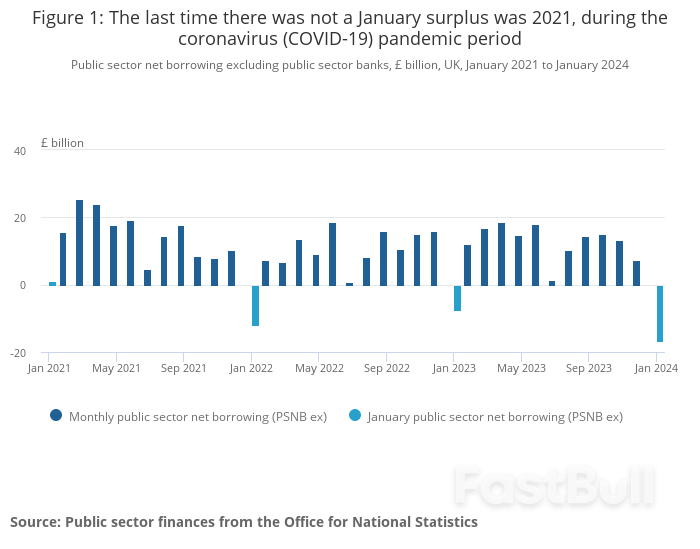
          In January 2024, the UK's public finances painted a remarkable picture, showcasing a record-breaking surplus alongside a nuanced financial landscape. The month witnessed an unprecedented surplus in public sector net borrowing excluding public sector banks, reaching £16.7 billion. This figure not only doubled the surplus from January 2023 but also set a new record since monthly records began in 1993. Such a substantial surplus is primarily attributed to the cyclical peak in tax receipts seen every January, reflecting the influx from self-assessed income and capital gains taxes, despite these being £1.8 billion lower than the previous year at £33.0 billion.
          Delving deeper into the fiscal year-to-date figures, borrowing for the period leading up to January 2024 was reported at £96.6 billion, marking a slight reduction of £3.1 billion compared to the same ten-month span in the previous year. This marks a pivotal moment in the current financial year, showcasing the first instance where borrowing has dipped below the prior year's levels, a development partly credited to revised central government receipts.UK Public Sector Financial Overview: January 2024_1
          The narrative of public debt unfolds with complexity, revealing that public sector net debt, excluding public sector banks, stood at £2,646.5 billion at the end of January 2024. This level corresponds to approximately 96.5% of the UK's GDP, indicating a rise of 1.8 percentage points from January 2023 and mirroring debt ratios last observed in the early 1960s. When the Bank of England's figures are excluded, the debt figures adjust to £2,417.6 billion, or 88.1% of GDP, underscoring a significant £228.9 billion difference from the broader debt measure.
          Further dissecting the public sector's financial health, the net worth, excluding public sector banks, was reported in deficit by £677.5 billion at the end of January 2024, widening from a £576.5 billion deficit the year prior. Additionally, the central government's net cash requirement, when excluding specific financial entities, presented a surplus of £19.5 billion in January 2024, albeit slightly lower by £1.4 billion than the surplus recorded in January 2023.
          From a technical standpoint, these developments hold significant implications for the market. The record surplus in January, driven by seasonal tax receipt peaks, not only demonstrates the cyclical nature of government finances but also highlights the government's capacity to generate higher revenue during certain periods. This phenomenon can instill confidence among investors and market observers, as it reflects a level of fiscal robustness.
          The reduction in year-to-date borrowing for the first time in the current financial year suggests a subtle yet positive shift towards fiscal consolidation. This could potentially ease long-term borrowing costs and create a more favorable environment for public investments. Additionally, the high level of public sector net debt as a percentage of GDP underscores the ongoing challenge of managing national debt levels, which remains a critical concern for economic policy and market stability.
          Moreover, the disparity between the broader debt measure and the figure excluding the Bank of England highlights the significant impact of monetary policy operations on public debt statistics. Understanding these nuances is crucial for market participants, as it affects the interpretation of the UK's fiscal health and its implications for monetary policy and interest rates.
          while the UK's public finances in January 2024 reveal a tapestry of challenges and achievements, the record-breaking surplus serves as a beacon of fiscal capability amidst the complexities of managing a national economy. The nuanced improvements in borrowing and the steadfast, though high, levels of public debt encapsulate a moment of cautious optimism. As these financial contours shape the landscape, the enduring dance between fiscal policy and market dynamics continues, reminding us of the delicate balance required to navigate the future. The market, ever watchful, interprets these signals as harbingers of the economic policy directions and fiscal health, pivotal in shaping investor confidence and economic stability in the times ahead.

          Source: Office for National Statistic (ONS)

          To stay updated on all economic events of today, please check out our Economic calendar
          Risk Warnings and Disclaimers
          You understand and acknowledge that there is a high degree of risk involved in trading. Following any strategies or investment methods may lead to potential losses. The content on the site is provided by our contributors and analysts for information purposes only. You are solely responsible for determining whether any trading assets, securities, strategy, or any other product is suitable for investing based on your own investment objectives and financial situation.
          Comments
          Add to Favorites
          Share
          FastBull
          Copyright © 2025 FastBull Ltd

          728 RM B 7/F GEE LOK IND BLDG NO 34 HUNG TO RD KWUN TONG KLN HONG KONG

          TelegramInstagramTwitterfacebooklinkedin
          App Store Google Play Google Play
          Products
          Charts

          Chats

          Q&A with Experts
          Screeners
          Economic Calendar
          Data
          Tools
          Membership
          Features
          Function
          Markets
          Copy Trading
          Latest Signals
          Contests
          News
          Analysis
          24/7
          Columns
          Education
          Company
          Careers
          About Us
          Contact Us
          Advertising
          Help Center
          Feedback
          User Agreement
          Privacy Policy
          Business

          White Label

          Data API

          Web Plug-ins

          Poster Maker

          Affiliate Program

          Risk Disclosure

          The risk of loss in trading financial instruments such as stocks, FX, commodities, futures, bonds, ETFs and crypto can be substantial. You may sustain a total loss of the funds that you deposit with your broker. Therefore, you should carefully consider whether such trading is suitable for you in light of your circumstances and financial resources.

          No decision to invest should be made without thoroughly conducting due diligence by yourself or consulting with your financial advisors. Our web content might not suit you since we don't know your financial conditions and investment needs. Our financial information might have latency or contain inaccuracy, so you should be fully responsible for any of your trading and investment decisions. The company will not be responsible for your capital loss.

          Without getting permission from the website, you are not allowed to copy the website's graphics, texts, or trademarks. Intellectual property rights in the content or data incorporated into this website belong to its providers and exchange merchants.

          Not Logged In

          Log in to access more features

          FastBull Membership

          Not yet

          Purchase

          Become a signal provider
          Help Center
          Customer Service
          Dark Mode
          Price Up/Down Colors

          Log In

          Sign Up

          Position
          Layout
          Fullscreen
          Default to Chart
          The chart page opens by default when you visit fastbull.com