Markets
News
Analysis
User
24/7
Economic Calendar
Education
Data
- Names
- Latest
- Prev


Signal Accounts for Members
All Signal Accounts
All Contests


Japan Tankan Small Manufacturing Outlook Index (Q4)A:--
F: --
P: --
Japan Tankan Large Non-Manufacturing Outlook Index (Q4)A:--
F: --
P: --
Japan Tankan Large Manufacturing Outlook Index (Q4)A:--
F: --
P: --
Japan Tankan Small Manufacturing Diffusion Index (Q4)A:--
F: --
P: --
Japan Tankan Large Manufacturing Diffusion Index (Q4)A:--
F: --
P: --
Japan Tankan Large-Enterprise Capital Expenditure YoY (Q4)A:--
F: --
P: --
U.K. Rightmove House Price Index YoY (Dec)A:--
F: --
P: --
China, Mainland Industrial Output YoY (YTD) (Nov)A:--
F: --
P: --
China, Mainland Urban Area Unemployment Rate (Nov)A:--
F: --
P: --
Saudi Arabia CPI YoY (Nov)A:--
F: --
P: --
Euro Zone Industrial Output YoY (Oct)A:--
F: --
P: --
Euro Zone Industrial Output MoM (Oct)A:--
F: --
P: --
Canada Existing Home Sales MoM (Nov)A:--
F: --
P: --
Canada National Economic Confidence IndexA:--
F: --
P: --
Canada New Housing Starts (Nov)A:--
F: --
U.S. NY Fed Manufacturing Employment Index (Dec)A:--
F: --
P: --
U.S. NY Fed Manufacturing Index (Dec)A:--
F: --
P: --
Canada Core CPI YoY (Nov)A:--
F: --
P: --
Canada Manufacturing Unfilled Orders MoM (Oct)A:--
F: --
P: --
U.S. NY Fed Manufacturing Prices Received Index (Dec)A:--
F: --
P: --
U.S. NY Fed Manufacturing New Orders Index (Dec)A:--
F: --
P: --
Canada Manufacturing New Orders MoM (Oct)A:--
F: --
P: --
Canada Core CPI MoM (Nov)A:--
F: --
P: --
Canada Trimmed CPI YoY (SA) (Nov)A:--
F: --
P: --
Canada Manufacturing Inventory MoM (Oct)A:--
F: --
P: --
Canada CPI YoY (Nov)A:--
F: --
P: --
Canada CPI MoM (Nov)A:--
F: --
P: --
Canada CPI YoY (SA) (Nov)A:--
F: --
P: --
Canada Core CPI MoM (SA) (Nov)A:--
F: --
P: --
Canada CPI MoM (SA) (Nov)A:--
F: --
P: --
Federal Reserve Board Governor Milan delivered a speech
U.S. NAHB Housing Market Index (Dec)--
F: --
P: --
Australia Composite PMI Prelim (Dec)--
F: --
P: --
Australia Services PMI Prelim (Dec)--
F: --
P: --
Australia Manufacturing PMI Prelim (Dec)--
F: --
P: --
Japan Manufacturing PMI Prelim (SA) (Dec)--
F: --
P: --
U.K. 3-Month ILO Employment Change (Oct)--
F: --
P: --
U.K. Unemployment Claimant Count (Nov)--
F: --
P: --
U.K. Unemployment Rate (Nov)--
F: --
P: --
U.K. 3-Month ILO Unemployment Rate (Oct)--
F: --
P: --
U.K. Average Weekly Earnings (3-Month Average, Including Bonuses) YoY (Oct)--
F: --
P: --
U.K. Average Weekly Earnings (3-Month Average, Excluding Bonuses) YoY (Oct)--
F: --
P: --
France Services PMI Prelim (Dec)--
F: --
P: --
France Composite PMI Prelim (SA) (Dec)--
F: --
P: --
France Manufacturing PMI Prelim (Dec)--
F: --
P: --
Germany Services PMI Prelim (SA) (Dec)--
F: --
P: --
Germany Manufacturing PMI Prelim (SA) (Dec)--
F: --
P: --
Germany Composite PMI Prelim (SA) (Dec)--
F: --
P: --
Euro Zone Composite PMI Prelim (SA) (Dec)--
F: --
P: --
Euro Zone Services PMI Prelim (SA) (Dec)--
F: --
P: --
Euro Zone Manufacturing PMI Prelim (SA) (Dec)--
F: --
P: --
U.K. Services PMI Prelim (Dec)--
F: --
P: --
U.K. Manufacturing PMI Prelim (Dec)--
F: --
P: --
U.K. Composite PMI Prelim (Dec)--
F: --
P: --
Euro Zone ZEW Economic Sentiment Index (Dec)--
F: --
P: --
Germany ZEW Current Conditions Index (Dec)--
F: --
P: --
Germany ZEW Economic Sentiment Index (Dec)--
F: --
P: --
Euro Zone Trade Balance (Not SA) (Oct)--
F: --
P: --
Euro Zone ZEW Current Conditions Index (Dec)--
F: --
P: --
Euro Zone Trade Balance (SA) (Oct)--
F: --
P: --
U.S. Retail Sales MoM (Excl. Automobile) (SA) (Oct)--
F: --
P: --


No matching data
Latest Views
Latest Views
Trending Topics
Top Columnists
Latest Update
White Label
Data API
Web Plug-ins
Affiliate Program
View All

No data
BYD has slashed its sales target for this year by as much as 16% to 4.6 million vehicles, two people with knowledge of the matter said, as the Chinese EV giant faces its slowest annual growth in five years and other signs that its era of record-setting expansion could be drawing to a close.
BYD has slashed its sales target for this year by as much as 16% to 4.6 million vehicles, two people with knowledge of the matter said, as the Chinese EV giant faces its slowest annual growth in five years and other signs that its era of record-setting expansion could be drawing to a close.China's largest automaker told analysts in March it was targeting sales of 5.5 million vehicles for 2025. But internally, the number has been downgraded multiple times in recent months, according to the people.
The latest figure of at least 4.6 million vehicles was communicated inside the company and to select suppliers last month to help guide planning, according to the people, both of whom spoke on condition of anonymity.The target remains subject to change depending on market conditions, the people added.The people didn't give a reason for the cut. However, one of them said it comes as BYD feels the heat from growing competition with rivals such as Geely Auto and Leapmotor.Last week, BYD reported a 30% drop in quarterly profit, its first decline in more than three years.
The latest target, which has not been previously reported, is below several recently lowered forecasts from analysts. This week Deutsche Bank said it expected BYD to sell 4.7 million vehicles while Morningstar said it expected 4.8 million.The new target represents a 7% increase from last year and would be the slowest annual growth since 2020, when sales fell by 7%.The pared-back outlook also speaks to the deflationary pressure weighing on the world's second-largest economy, where domestic demand has been hit by a prolonged housing downturn. In the first eight months of this year, BYD has only met some 52% of its original 5.5 million vehicle sales target.
In just a few years, BYD has transformed itself from an EV upstart to one of the world's most important automakers by doing much of its production in-house, allowing it to keep a lid on costs even as it rolls out cutting-edge features.Its sales of pure electric vehicles and plug-in hybrids grew ten-fold between 2020 and 2024, to 4.3 million vehicles, putting it on par with General Motors and Ford in terms of global sales.Yet it is now showing undeniable signs of a slowdown, especially in its main market China, which accounts for almost 80% of its sales and is in the midst of a bruising, years-old price war.
BYD has slowed production and delayed capacity expansion at its Chinese factories, Reuters reported in June.BYD's sales of economy cars - those that go for under 150,000 yuan ($21,000) and make up the bulk of its domestic sales - fell 9.6% in July versus last year, according to Reuters' analysis of its filing and a sales breakdown by Chinese auto data platform DATADIC.
By comparison, Geely's sales of cars in that price segment jumped 90% year-on-year in July.Geely raised its annual sales target for 2025 to 3 million vehicles from 2.71 million, its executives said during an August earnings conference.BYD's production slid for a second straight month in August, marking its first consecutive monthly contraction since 2020.
USDJPY, one of the most volatile FX pairs is still holding within a tight range as traders turn to metals with Gold making new all-time highs and Silver racing towards a fresh record.FED’s Waller appeared with comments this morning, foreshadowing a Rate cut at the upcoming 18th of September FOMC Meeting but the outlook for the pace of cuts is still uncertain.
As mentioned in our most recent USDJPY piece, the Bank of Japan would rather the Federal Reserve to move first to reduce the interest rate differential between the US and Japan which is detrimental to the Yen and hurting Japanese citizens’ buying power.As a matter of fact, BoJ Governor Ueda met Japan’s Prime Minister Ishiba in a bi-annual meeting to discuss Japanese and global market outlooks.
With Yields rising strongly (Japan’s 20Y and 30Y yields breaking 4 decade highs) while the BoJ tries to hold rates relatively low to stimulate inflation, challenges keep arising for the Yen.Still holding the range strongly, players are looking to confirm the future outlook for the US Dollar which will decide in which direction the pair breaks out, and the answer will come after Friday’s Job release.
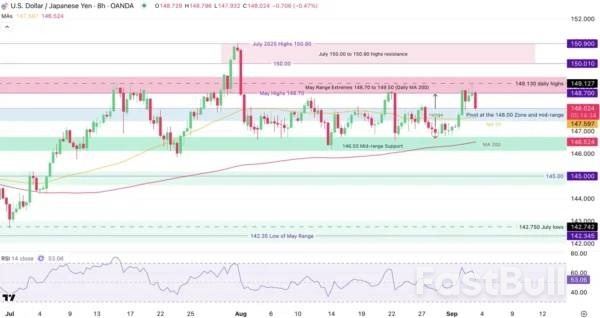
USDJPY 8H Chart and technicals

The traditionally volatile pair has been stuck in a 2,000 pip range since the beginning of August, with traders desperately awaiting for a clearer path ahead.US Labor data and the uncertainty it’s been holding is hurting trend traders but has helped participants who prefer rangebound conditions.Friday’s 8:30 Non-Farm Payrolls release will be more than consequential and has high probability of triggering a breakout.
For bulls, look for a break above above the range highs between 148.70 to 149.50 in the case of a strong Friday NFP release (a strong beat would reduce total rate cuts = bullish for the pair)Bears would on the other hand seek for a break below the 146.00 to 146.50 range lows, supported by the 200-period Moving Average (currently at 145.52).Today, the US Dollar is seeing some decent selling after this morning’s miss in JOLTS job openings data which confirms the deceleration of the US Job market, the question for Friday is to what extent.
Technical levels for USDJPY trading
Resistance Levels
Support Levels
Gold prices have extended their weekly gains to 3.5% and also a seventh successive green trading day. With bond yields rising and interest rate cuts coming, market participants are facing a host of uncertainties.Add to the mix the renewed uncertainty around US tariffs with many of them ruled illegal by a Federal appeals court last Friday and market jitters are at a peak.
The current macro economic backdrop is a complicated one. Recent developments globally continue to point toward unfavorable scenarios from fiscal issues in Europe and Fed independence concerns in the US.Since Fed Chair Powell’s Jackson Hole speech, rate cut expectations have continued to rise. Fed Chair Powell de facto admitted that employment risks have overtaken inflation concerns underlining the importance of Friday’s jobs data.It would take an extraordinary print to dampen market expectations significantly with the Fed expected to cut rates by 25 bps at the upcoming September 17 Fed meeting. LSEG data currently shows a 95% probability while the implied rate has also seen potential rate cuts climb from around 40 bps to around 57 bps through December 2025.

Any decision by the Fed may also come with a bit of controversy. Given that inflation remains well above the Fed target of 2% (despite comments by some Fed policymakers of a higher neutral rate moving forward), the discussion will be around whether the decision has been influenced by US President Donald Trump and the Feds independence.The constant attacks on the Fed by the Trump administration as well as the firing of Lisa Cook have raised many eyebrows.
Market participants have been putting a lot of money into exchange-traded funds (ETFs) that are backed by gold. The SPDR Gold Trust GLD, which is the biggest gold ETF, reported that its gold holdings have gone up to 977.68 tons. This is a 12% increase for the year and the highest it’s been since August 2022.While another factor aiding Gold’s surge is increasing Geopolitical risk. The Russia/Ukraine situation continues to bubble as European leaders maintain a combative approach and President Putin continues to blame the West for the conflict.
Comments this week from both Saudi sources and UAE sources around Israel and the occupation of Gaza City and potential annexation of the West Bank threaten further turmoil in the Middle East.“Annexation in the West Bank would constitute a red line for the UAE,” Lana Nusseibeh, Assistant Minister for Political Affairs at the UAE’s foreign ministry, said in a statement. “It would severely undermine the vision and spirit of (the Abraham) Accords, end the pursuit of regional integration, and would alter the widely-shared consensus on what the trajectory of this conflict should be – two states living side by side in peace, prosperity, and security.”
These renewed risks are all adding to the current pot of risks which are brewing and keeping market participants on edge and safe haven flows strong.How far can this rally go? Well the NFP will give us an answer. A poor NFP print could increase expectations for a 50 bps cut which, no matter how unlikely, could inject further fuel to the Gold rally.A strong print will have an impact but unless it is something out of this world is unlikely to lead to a huge correction. The size and pace of the rally could see a surge in profit taking post NFP which should also be considered.
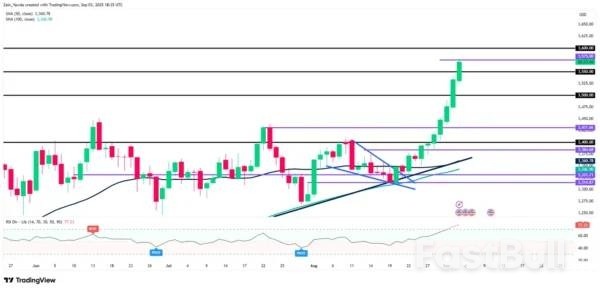
From a technical standpoint, it is very difficult to pick a top at the moment. Not to mention that the lack of historical price action makes it near impossible.In such cases and for Gold I tend to focus on the whole numbers (psychological) and the 25, 50, 75 areas as potential support resistance areas. What I mean is I look at 35753550 or 3525 etc.Looking ahead, the first point of interest will be the 3600 mark before the 3625 and 3650 areas catch my attention.
Looking at the downside, it’s a similar story.
Gold (XAU/USD) Daily Chart, September 3, 2025

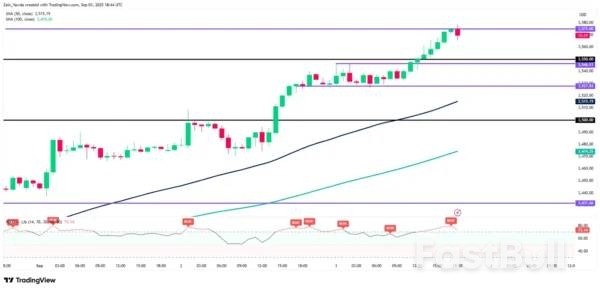
Dropping down to a one hour chart for any help identifying short-term support areas.There was a spike and rejection twice around the 3546 area which rests just below an area I like which is 3550.Below that we have the 3527 spot and then the 50-day MA may come into focus which rests at 3515.
Gold (XAU/USD) One-Hour Chart, September 3, 2025

Client Sentiment Data – XAU/USD
Looking at OANDA client sentiment data and market participants are Short on Gold with 69% of traders net-short. I prefer to take a contrarian view toward crowd sentiment and thus the fact that the majority of traders are net-short suggests that Gold prices could continue to rise in the near-term.
Japan’s 30-year government bond auction Thursday faces added uncertainty from global debt market turmoil and political instability at home which has reignited concerns over the country’s fiscal outlook.Investors are concerned the finance ministry’s bond sale may prove challenging amid mounting doubts about debt sustainability and sticky inflation. While the 10-year sale earlier this week drew solid demand, the 30-year yield surged to a fresh record of 3.285% in trading on Wednesday, tracking losses in long-dated US and European debt. The auction results are due at 12:35 p.m. Tokyo time.
Globally, ultra-long bonds have come under renewed pressure as fiscal worries resurface across major developed markets, with a shift away from longer maturities by institutional investors such as insurers and pensions. US Treasury yields for the 30-year maturity are close to the 5% mark, even after pulling back on Wednesday.Market anxiety has also been fueled by political developments in Japan. A key power broker of Prime Minister Shigeru Ishiba and several senior officials offered to resign this week, casting fresh doubt on the premier’s ability to hold onto power. Local media reported that former prime minister and Liberal Democratic Party member Taro Aso is set to call for an early party election.
The surge in super-long yields “naturally increases the cost of servicing debt and puts pressure on the budget, reducing fiscal flexibility,” said Freddy Wong, head of fixed income Asia Pacific at Invesco Ltd. “Coupled with the current political uncertainty, the ability to maintain fiscal discipline and policy continuity is being called into question.”Ishiba met with Bank of Japan Governor Kazuo Ueda Wednesday to exchange views on the economy and financial markets including currencies. The pair’s first meeting since February suggests the premier is trying to show market participants that his government and the BOJ will be coordinating closely even as concerns grow he may be forced to step down.
Adding to the steepening pressure on the bond curve, BOJ Deputy Governor Ryozo Himino struck a cautious tone in a speech Tuesday, saying the central bank must avoid hiking rates either too early or too late — a signal that fell short of the hawkish rhetoric some investors had anticipated.Traders have pared back expectations for a near-term rate hike, with overnight index swaps now pricing in less than a 40% chance of a move at the October policy meeting, versus more than 50% a week ago.
At Thursday’s auction, traders will be closely watching the bid-to-cover ratio, a key measure of demand. It stood at 3.43 at the last sale of 30-year debt in August, roughly in line with the 12-month average, after the finance ministry announced cuts to issuance of super-long bonds to calm volatility. But that may not be enough now to reassure investors given the current backdrop.In the coming days, the political situation overhangs the market, with a key LDP meeting on Sept. 8 being closely watched for any decision to bring forward the party’s leadership election. While Ishiba faces pressure from within the party, recent polls show his public approval has improved, and he has not indicated plans to step down.
“The outcome of the vote is important for the rates outlook,” Societe Generale SA strategists including Stephen Spratt wrote in a note Wednesday. A “rise in political risk would reduce the risk of a BOJ hike and keep fiscal concerns at the forefront,” translating into higher long-term yields.
Bank of England Governor Andrew Bailey played down the importance of a surge in long-dated gilt yields that has stoked concerns that Britain’s fragile fiscal position risks being destabilized.
Bailey said on Wednesday he wouldn’t “exaggerate” the significance of 30-year bond yields because the UK has shifted issuance away from the longest-dated debt. There’s a “danger of being slightly overly focused” on long-dated gilts, he told lawmakers on the House of Commons’ Treasury Committee.
The remarks came as scrutiny over Britain’s fiscal situation grows ahead of the autumn budget on Nov. 26 after the 30-year gilt yield jumped to its highest since 1990s.
Higher debt costs are draining money from the Exchequer, eroding Chancellor of the Exchequer Rachel Reeves’ already limited headroom. Higher interest rates alone have caused a £8 billion ($10.7 billion) hit to her budget plans since the last fiscal event in March. However, Bailey cautioned against overstating the importance of moves in long-dated debt.
“There’s a lot of rather — if you don’t mind — dramatic commentary on this going on,” he said. “The structural demand for long-dated, long-maturity bonds has gone down and I think sensibly the Debt Management Office has actually shortened the profile of their issuance to reflect that.”
For decades, the UK could rely on near-insatiable demand from defined-benefit pension funds looking to match their liabilities with long-dated gilts. Yet their purchases have been dissipating, pushing rates on 30-year debt up faster than shorter maturities.
The Debt Management Office has been slashing back its long-end program to a record low proportion of sales in response to this waning demand. Some investors want it to cut sales of such bonds further still.
The BOE could also respond to pressures in gilt markets by curbing its own sales of gilts built up from over a decade of quantitative easing. It will make its annual decision on the pace of its balance sheet run-off later this month.
Thailand’s House of Representatives will vote to select a new prime minister tomorrow, the body announced yesterday, a week after Prime Minister Paetongtarn Shinawatra’s was removed from office by the Constitutional Court.The announcement, which was published over the signature of the secretary-general of the Thai parliament, capped off an unusually hectic day of political maneuvering, even by the country’s recent standards. Earlier in the day, the opposition People’s Party announced that it would support the conservative Bhumjaithai party in forming a government, in return for a promise to dissolve parliament within four months.
In response, the ruling Pheu Thai party is attempting to block Anutin by petitioning the king to dissolve parliament immediately and approve a snap election. Pheu Thai has been struggling to shore up its shaky coalition since Bhumjaithai withdrew from its coalition in June, after the politically damaging leak of a recorded phone call between Paetongtarn and Cambodia’s former leader Hun Sen. Paetongtarn’s conduct in the call led to her removal from office last weekBhumjaithai’s ambitious leader Anutin Charnvirakul confirmed yesterday that with the support of the People’s Party, his party had the votes to secure his selection as prime minister. “We know that the formation of this government that will proceed from now on, we know that the People’s Party has cooperated and made sacrifices in finding a solution for Thailand during a period of crises,” Anutin said, according to Reuters.
The two parties have reportedly agreed to five points. In addition to agreeing to dissolve parliament within four months, Bhumjaithai has pledged not take any action that will lead towards building a majority government. (Anutin stated that the Bhumjaithai-led coalition now has the support of 146 lawmakers, meaning that it will be unable to pass legislation without the support of the opposition.)Two other points referred to the drafting of a new constitution to replace the military-drafted 2017 Constitution. If the Constitutional Court rules that drafting a new constitution requires a referendum first, Bhumjaithai has agreed to organize this prior to the next general election. But if no such referendum is necessary, the two parties will begin amending the constitution and setting up an elected constitution drafting assembly before the election. According to the final point, the People’s Party has pledged that it will not join the government, remaining in opposition.
According to the Thai Constitution, the appointment of the next prime minister requires a simple majority in the 500-seat House of Representatives, but candidates are limited to those nominated by the parties ahead of the 2023 general election. This rules out the People’s Party, which despite holding 143 seats in the House, did not participate in the election. Its predecessor, the Move Forward Party (MFP), was dissolved by the Constitutional Court last year, after which the People’s Party inherited its seats.
Instead, the People’s Party and its leader Natthaphong Ruengpanyawut have attempted to use their leverage to attempt a more fundamental solution to Thailand’s perpetual political crises. After Paetongtarn’s removal from office, the party announced that it would support any government that promised to call a referendum on the drafting of a new constitution, and to dissolve parliament within four months.
Given the MFP’s strong showing in 2023, the party has good reason to be confident of prevailing in an early election, which, if everything goes according to plan, could take place in early 2026.Both Bhumjaithai and Pheu Thai accepted the People’s Party’s conditions, and after two days of deliberation, the People’s Party announced its decision yesterday.
The party did not explain why it chose Bhumjaithai, a right-wing party that is in nearly every sense anathema to its own progressive politics, but it is likely that it did so in revenge for Pheu Thai’s betrayal of the MFP after the 2023 election. After the military-dominated Senate blocked the MFP from forming government with Pheu Thai’s support, Pheu Thai threw in its lot with conservative and military-backed parties, with which it formed the current coalition – an act that many in the progressive movement view as a betrayal.
“We do not trust any prime minister to run the country,” Natthaphong stated, as per The Nation. “We need a prime minister who will move forward with dissolving Parliament and drafting a new constitution. This is the People’s Party’s decision, focused on the country’s future rather than popularity and personal risk.”Sure enough, following Natthaphong’s announcement, Acting Prime Minister Phumtham Wechayachai told the press that he had submitted a royal decree to dissolve the House of Representatives, in a bid to prevent Anutin being selected as prime minister.
However, there is considerable legal uncertainty as to whether an acting prime minister has the power to make such a move, and there were reports that the Office of the Privy Council had returned Phumtham’s draft royal decree, citing legal deficiencies and procedural irregularities.
Even if Phumtham has the power to dissolve parliament, it is also unclear whether a new prime minister, if selected in time, has the power to rescind such a request. “These are uncharted waters,” Thai political observer Ken Lohatepanont wrote in his recap of yesterday’s events. “We’re in constitutional crisis territory here, because we truly do not know what will happen next – no acting government has ever tried to dissolve parliament.”In any event, unless King Vajiralongkorn agrees to dissolve parliament today, the prime ministerial vote seems set to go ahead and Anutin to become Thailand’s 32nd prime minister, although most likely a short-lived one.
White Label
Data API
Web Plug-ins
Poster Maker
Affiliate Program
The risk of loss in trading financial instruments such as stocks, FX, commodities, futures, bonds, ETFs and crypto can be substantial. You may sustain a total loss of the funds that you deposit with your broker. Therefore, you should carefully consider whether such trading is suitable for you in light of your circumstances and financial resources.
No decision to invest should be made without thoroughly conducting due diligence by yourself or consulting with your financial advisors. Our web content might not suit you since we don't know your financial conditions and investment needs. Our financial information might have latency or contain inaccuracy, so you should be fully responsible for any of your trading and investment decisions. The company will not be responsible for your capital loss.
Without getting permission from the website, you are not allowed to copy the website's graphics, texts, or trademarks. Intellectual property rights in the content or data incorporated into this website belong to its providers and exchange merchants.
Not Logged In
Log in to access more features

FastBull Membership
Not yet
Purchase
Log In
Sign Up