Markets
News
Analysis
User
24/7
Economic Calendar
Education
Data
- Names
- Latest
- Prev


Signal Accounts for Members
All Signal Accounts
All Contests


U.K. Trade Balance Non-EU (SA) (Oct)A:--
F: --
P: --
U.K. Trade Balance (Oct)A:--
F: --
P: --
U.K. Services Index MoMA:--
F: --
P: --
U.K. Construction Output MoM (SA) (Oct)A:--
F: --
P: --
U.K. Industrial Output YoY (Oct)A:--
F: --
P: --
U.K. Trade Balance (SA) (Oct)A:--
F: --
P: --
U.K. Trade Balance EU (SA) (Oct)A:--
F: --
P: --
U.K. Manufacturing Output YoY (Oct)A:--
F: --
P: --
U.K. GDP MoM (Oct)A:--
F: --
P: --
U.K. GDP YoY (SA) (Oct)A:--
F: --
P: --
U.K. Industrial Output MoM (Oct)A:--
F: --
P: --
U.K. Manufacturing Output MoM (Oct)A:--
F: --
P: --
U.K. Monthly GDP 3M/3M Change (Oct)A:--
F: --
P: --
U.K. Construction Output YoY (Oct)A:--
F: --
P: --
France HICP Final MoM (Nov)A:--
F: --
P: --
China, Mainland Outstanding Loans Growth YoY (Nov)A:--
F: --
P: --
China, Mainland M2 Money Supply YoY (Nov)A:--
F: --
P: --
China, Mainland M0 Money Supply YoY (Nov)A:--
F: --
P: --
China, Mainland M1 Money Supply YoY (Nov)A:--
F: --
P: --
India CPI YoY (Nov)A:--
F: --
P: --
India Deposit Gowth YoYA:--
F: --
P: --
Brazil Services Growth YoY (Oct)A:--
F: --
P: --
Mexico Industrial Output YoY (Oct)A:--
F: --
P: --
Russia Trade Balance (Oct)A:--
F: --
P: --
Philadelphia Fed President Henry Paulson delivers a speech
Canada Building Permits MoM (SA) (Oct)A:--
F: --
P: --
Canada Wholesale Sales YoY (Oct)A:--
F: --
P: --
Canada Wholesale Inventory MoM (Oct)A:--
F: --
P: --
Canada Wholesale Inventory YoY (Oct)A:--
F: --
P: --
Canada Wholesale Sales MoM (SA) (Oct)A:--
F: --
P: --
Germany Current Account (Not SA) (Oct)A:--
F: --
P: --
U.S. Weekly Total Rig Count--
F: --
P: --
U.S. Weekly Total Oil Rig Count--
F: --
P: --
Japan Tankan Large Non-Manufacturing Diffusion Index (Q4)--
F: --
P: --
Japan Tankan Small Manufacturing Outlook Index (Q4)--
F: --
P: --
Japan Tankan Large Non-Manufacturing Outlook Index (Q4)--
F: --
P: --
Japan Tankan Large Manufacturing Outlook Index (Q4)--
F: --
P: --
Japan Tankan Small Manufacturing Diffusion Index (Q4)--
F: --
P: --
Japan Tankan Large Manufacturing Diffusion Index (Q4)--
F: --
P: --
Japan Tankan Large-Enterprise Capital Expenditure YoY (Q4)--
F: --
P: --
China, Mainland Industrial Output YoY (YTD) (Nov)--
F: --
P: --
China, Mainland Urban Area Unemployment Rate (Nov)--
F: --
P: --
Saudi Arabia CPI YoY (Nov)--
F: --
P: --
Euro Zone Industrial Output YoY (Oct)--
F: --
P: --
Euro Zone Industrial Output MoM (Oct)--
F: --
P: --
Canada Existing Home Sales MoM (Nov)--
F: --
P: --
Euro Zone Total Reserve Assets (Nov)--
F: --
P: --
Canada National Economic Confidence Index--
F: --
P: --
Canada New Housing Starts (Nov)--
F: --
P: --
U.S. NY Fed Manufacturing Employment Index (Dec)--
F: --
P: --
U.S. NY Fed Manufacturing Index (Dec)--
F: --
P: --
Canada Core CPI YoY (Nov)--
F: --
P: --
Canada Manufacturing Unfilled Orders MoM (Oct)--
F: --
P: --
Canada Manufacturing New Orders MoM (Oct)--
F: --
P: --
Canada Core CPI MoM (Nov)--
F: --
P: --
Canada Manufacturing Inventory MoM (Oct)--
F: --
P: --
Canada CPI YoY (Nov)--
F: --
P: --
Canada CPI MoM (Nov)--
F: --
P: --
Canada CPI YoY (SA) (Nov)--
F: --
P: --
Canada Core CPI MoM (SA) (Nov)--
F: --
P: --
Canada CPI MoM (SA) (Nov)--
F: --
P: --


No matching data
Latest Views
Latest Views
Trending Topics
Top Columnists
Latest Update
White Label
Data API
Web Plug-ins
Affiliate Program
View All

No data
The EUR/USD pair rallied sharply to 1.1735 on Friday, propelled by a sustained sell-off in the US dollar. The move followed a widely anticipated Federal Reserve rate cut, which was accompanied by guidance that proved more accommodative than markets had expected.
Chair Jerome Powell explicitly ruled out further rate hikes, and the Fed's updated "dot plot" projections now indicate only one additional cut for 2026 – a more measured path of easing than previously anticipated.
Adding to dollar weakness, the Fed announced it would begin purchasing short-term Treasury bills to bolster banking system liquidity – a measure that pushed Treasury yields lower. This was compounded by economic data showing initial jobless claims rose last week at their fastest pace in nearly four and a half years, reinforcing the case for a more supportive policy stance.
The broader external environment is turning increasingly unfavourable for the greenback. While the Fed signals a slower pace of easing, markets are concurrently pricing in a relatively tighter policy trajectory for central banks in Australia, Canada, and the Eurozone. This divergence has driven the dollar lower against most major currencies this week, with its most pronounced decline coming against the euro.
H4 Chart:
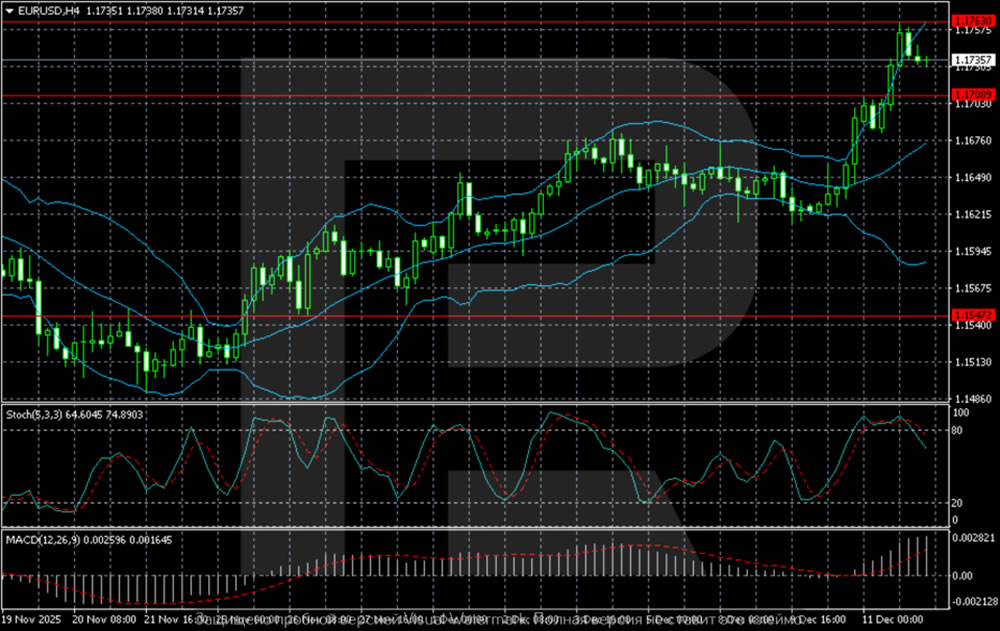
On the H4 chart, EUR/USD exhibits a robust bullish trend, trading near a key resistance zone at 1.1760–1.1780. The pair is holding firmly above the middle Bollinger Band, confirming buyer dominance. The upward slope and gradual widening of the upper band signal rising volatility and sustained momentum following a breakout to new highs.
Provided the price remains above the 1.1709 support, the market retains strong potential to challenge the 1.1780 ceiling. A decisive breakout and close above this zone would open a clear path towards 1.1850. Should a pullback materialise, the nearest significant support lies at 1.1650, the previous breakout point. A break below 1.1547 would be required to signal a deeper correction towards the lower Bollinger Band.
H1 Chart:
On the H1 chart, the pair is consolidating after a powerful impulse wave that targeted the 1.1760–1.1780 resistance area. The current correction is finding initial support at 1.1709, a level from which the latest acceleration originated.
The Stochastic oscillator is declining from overbought territory, increasing the probability of a near-term pause or shallow pullback. Nevertheless, the underlying structure remains bullish, with the price trading above the middle Bollinger Band, which now serves as dynamic support.
A confirmed breakout above 1.1780 would signal a continuation of the uptrend, with subsequent targets at 1.1820 and 1.1850. Conversely, a sustained move below 1.1709 would provide the first technical indication of fading bullish momentum, potentially triggering a correction towards the next demand zone in the 1.1650–1.1620 range.
EUR/USD has broken out decisively on the back of a dovish Fed pivot and a shifting global rate differential. The technical picture is firmly bullish, with the pair now testing a major resistance cluster near 1.1780. A successful breakout above this level would likely accelerate gains towards 1.1850. In the near term, the 1.1709 support is critical; holding above it keeps the immediate upward bias intact, while a break below would suggest a period of consolidation is needed before the next directional move.

Food inflation was marginally below what we had expected, non-food inflation was roughly in line with expectations, while services inflation was slightly higher than we had expected. That said, on the latter in particular, pressures appear to be less broad-based across the category, likely a sign that slower demand and diminishing wage pressures are starting to act on arguably the stickiest part of the consumer basket.
Today's data also offered a fresh look at wage growth evolution, which has shown some minor improvements (4.3% year-on-year in October versus 4.1% in September) but remained visibly below inflation, continuing to be a drag on consumption.
The small upside divergences from the past two months led to an upward adjustment in our year-end 2025 forecast from 9.6% to 9.8%. This also means minor upward changes in next year's inflation path. At this stage, our average inflation forecast for 2026 has inched up from 7.1% to 7.2%, with a year-end value of 4.5%, above the National Bank of Romania's 3.7% projection.
Risks to this outlook remain two-sided. On the upside, renewed energy price pressures, particularly gas bills from April 2026, could push inflation higher. On the downside, soft demand and moderating wages are likely to dominate the near-term picture, reducing the risk of second-round effects from the current inflationary upswing. Our commodities team also expects oil and natural gas prices to ease in 2026.
Overall, this inflation episode looks far less intense than the surge that followed the Covid pandemic, as key drivers such as fiscal stimulus, commodity shocks and strong wage growth are absent. This should, in principle, allow the National Bank of Romania to begin reducing interest rates even before inflation starts to print meaningfully lower in 2026, shifting its attention more towards the downside pressures in economic activity. Our base case remains for a first rate cut in May 2026, with a total of 100bp in cuts next year.
In Sweden, the Swedish labour force survey (LFS) for November is set to be released. We anticipate the unemployment rate to come in at 7.90% (8.80% seasonally adjusted). Recent indicators, including the Sweden's Public Employment Servies (SPES), has continued to show an improvement of the Swedish labour market. As SPES typically serves as a leading indicator for the LFS, we might see some improvement today. However, it could well be too early for significant changes to appear.
In Germany, we receive the final inflation data for November. While CPI was unchanged at 2.3% y/y there was a large upside surprise in the HICP index which rose to 2.6% y/y. HICP services inflation was the culprit behind the surprise as it rose to 4.2% y/y (prior: 3.6%) and the final print will shed more light on the drivers.
In the UK, October GDP data is released. After a couple of weak prints, job losses becoming more prominent, and inflation edging somewhat lower, the Bank of England looks ready to cut rates again next week.
In Japan, the Bank of Japan (BoJ) releases its extensive quarterly Tankan business survey on Sunday night. This will be scrutinised by the BoJ ahead of its rate decision Friday next week. Business sentiment is strong in Japan, particularly in the service sector, where tourism is contributing to solid demand.
Also, early Monday, China brings the release of the monthly batch of data for retail sales, industrial production, housing and investments. We expect it to show more of the same, i.e. still weak consumer spending, low home sales, further declines in home prices but decent increase in industrial production supported by robust exports. China is a two-speed economy with strong exports and tech development but weak demand in domestic demand.
What happened yesterday
In the US, the Federal Reserve has unanimously reappointed its 11 regional presidents in a vote held every five years. While this process typically attracts little attention, scrutiny from the Trump administration and debates about central bank independence raised concerns that some terms could have been blocked.
In Norway, Norges Bank Regional Survey showed that the aggregated production index for next quarter (Q1/26) dropped to 0.3, marginally lower than Norges Bank's expected growth in the September MPR. More importantly, capacity utilization fell from 35% to 33% and the indicator for labour shortage dropped from 25% to 22%. Combined with lower inflation and higher unemployment, this points to a lower rate path in the MPR published next week. Lastly, wage growth this year fell from 4.5% to 4.4%, a bit lower than Norges Bank expected in September.
In Sweden, final inflation figures aligned closely with the flash estimate. November CPI was 0.3% y/y and -0.4% m/m, while CPIF came in at 2.3% y/y and -0.2% m/m, slightly above the flash estimate by 0.1 percentage point. Core inflation was 2.4% y/y and -0.6% m/m. The larger-than-usual monthly decline was driven by a sharper drop in recreation and hotels. Goods prices also fell, including clothing and furniture, with clothing declining slightly more than anticipated, likely driven by earlier and more Black Friday sales. Core inflation was 0.4 percentage points below our forecast, with 0.3 percentage points explained by the unexpected dip in recreation, primarily from package holidays.
In Switzerland, The SNB kept the policy rate at 0%, as widely expected, and maintained its stance on FX intervention. Inflation forecasts were lowered due to recent weaker-than-expected inflation, and the SNB signalled continued monitoring and readiness to adjust policy if needed.
In Turkey, the Central Bank of Turkey surprised markets by lowering its key policy rate by 150 bp to 38%.
In geopolitics, Ukraine has presented its revised 20-point framework to the US, with territorial concessions remaining a key hurdle. The US proposed a 'free economic zone' in part of Donbas and potential joint governance of the Zaporizhzhia Nuclear Power Plant. The broader plan includes security guarantees, rebuilding efforts, and maintaining a strong Ukrainian military. While Washington seeks clarity by Christmas, Zelenskiy insists on a referendum for any territorial concessions.
Equities: Equities were generally higher yesterday despite some emerging weakness in the tech sector. The S&P 500 gained 0.2% but equal-weight S&P 500 0.8%, and the Stoxx 600 advanced 0.6%. The tech pullback was driven by a disappointing report from Oracle, which showed slowing revenue growth and a notable increase in spending. Had this occurred three weeks ago, the market reaction would likely have been pronounced. However, yesterday the weakness remained contained within tech. In fact, materials, financials, and industrials extended their post-Fed-meeting gains, rising another 1-2%. So, the rotation was notable. Futures are little changed this morning.
FI and FX: Norges Bank will publish their funding outlook for 2026, whereas the Riksbank is closing in on their second last nominal SGB QT-auction. The SNB left its policy rate unchanged but stands ready to act in foreign exchange markets, at the same time as they try to withstand a negative policy rate. Net movement in US and EUR rates were relatively muted during yesterday's session. EUR/USD continued to edge higher and touched 1.176 yesterday afternoon.
The S&P 500 continued to push higher yesterday as the US 2-year yield wavered around the 3.50% mark following a Federal Reserve (Fed) rate cut earlier this week that was ultimately perceived as not that hawkish after all. The cut is especially boosting the non-tech pockets of the market.
The S&P 500's equal-weight index is catching up with the tech-heavy, market-cap-weighted version, suggesting further upside potential from a rotation out of growth and into value. Normally, the tech and growth-heavy sectors react more to changes in borrowing costs because more of their future revenue gets discounted to today. But sky-high valuations in tech mean they've become less reactive to the rate cut. Investors clearly have bigger concerns.
The Nasdaq 100 failed to eke out gains after the Fed cut, as a more-than-10% slump in Oracle shares dampened sentiment across tech and dragged broader AI names lower. Nvidia, for example, lost more than 1.5% on worries about the circularity of AI deals — and for being situated at the centre of the largest AI loop to date: the one surrounding OpenAI.
If it's any comfort, OpenAI announced a $1bn deal with Disney yesterday. Under the agreement, Disney will invest $1bn in OpenAI, and OpenAI will allow Sora users to generate short videos using more than 200 Disney, Marvel, Pixar and Star Wars characters. You might remain sceptical, but this is an interesting revenue channel for OpenAI, as content creators may be willing to spend more on Sora — which has faded somewhat since launch — because these characters can boost engagement and monetisation on platforms like YouTube.
This announcement is encouraging for those wondering how companies will monetise AI without relying heavily on advertising. The OpenAI–Disney partnership offers an alternative to flooding chatbots with ads — something that would make them feel as annoying as Facebook's feed. It doesn't have the same scale as ad revenue (Facebook earned $51.24 bn last quarter, with roughly $50.1 bn coming from advertising), but it does illustrate how OpenAI turns its models into dollars. The company has commercial deals across a wide range of industries. There is Microsoft, where Copilot uses OpenAI's intelligence. There is Eli Lilly — a major pharma company — working with OpenAI on AI-enabled R&D and drug discovery. There are commerce-related partnerships, such as Walmart's integration that lets users buy products through ChatGPT's conversational interface. OpenAI previously supported Shopify and Etsy with chat-commerce capabilities in exchange for fees. And it has an enterprise partnership with Databricks to embed OpenAI models into its platform. OpenAI needs a continuous flow of such deals to justify its lofty valuation and those of its partners, but the negative press often feels disproportionate for a company that fundamentally changed how we interact with machines only three years ago.
Now, none of this answers whether "this is a bubble". The internet outlived the dot-com crisis even as countless companies disappeared. But it does show how far AI capabilities can extend across industries and clients — from Microsoft and Eli Lilly to Walmart and Disney — and how productivity gains, in blue-collar sectors, could support long-term demand.
Turning to individual earnings, Broadcom reported very strong results yesterday. Revenue jumped 28% to $18 bn, and earnings surpassed expectations thanks to surging AI-chip demand. The company disclosed $73 bn in AI-related orders already booked, issued an upbeat Q1 revenue outlook of $19 bn, and raised its dividend by 10%. Not bad. The problem is that expectations were simply too high, and after an initial uptick the stock fell more than 4% in after-hours trading as investors focused on margin pressures and profit dynamics in AI.
So we're back to square one. Taken together, Oracle and Broadcom reminded the market that while AI demand remains strong, leveraged investments and uncertain monetisation paths are preventing investors from adding exposure at current valuations.
Investors instead seem to prefer gold, silver, and copper. Gold is back in a solid uptrend after the October correction, supported by lower US yields and a softer dollar. Silver and copper benefit from the same bullish factors— plus tight supply conditions. Oil bulls, by contrast, remain impossible to cheer up. Despite earlier geopolitical tensions, WTI continues to test the $58 level on the downside, pressured by ample supply from the US, OPEC, and non-OPEC producers, even as the US dollar index falls below its 100-day moving average.
This week ends on a dovish note for the Fed, a positive one for Treasuries, metals, and value stocks, and a negative one for the dollar, oil, and tech stocks. Next week's US CPI release — the first one since the shutdown — will either confirm or challenge the post-Fed trend. The last headline figure pointed to 3% inflation, still above the Fed's 2% target. A sufficiently soft CPI print would likely reinforce the recent price action into year-end and could deliver fresh all-time highs in some indices, especially the smaller and non-tech ones. A stronger reading could cool risk appetite and revive concerns that the Fed may not be able to cut rates next year if inflation remains sticky.
The EURUSD rate has risen above the 1.1700 level. The euro received support from the Fed's rate cut and slowing inflation in the eurozone.
The US Federal Reserve implemented an expected 25-basis-point rate cut, while simultaneously signaling a likely pause in January as policymakers await additional data to assess the economic outlook.
Meanwhile, investors have reduced expectations for further policy easing by the ECB after officials indicated that additional rate cuts may not be necessary in 2026.
ECB President Christine Lagarde stated that the central bank will raise its eurozone growth forecasts next week, as the economy continues to demonstrate resilience despite ongoing trade tensions.
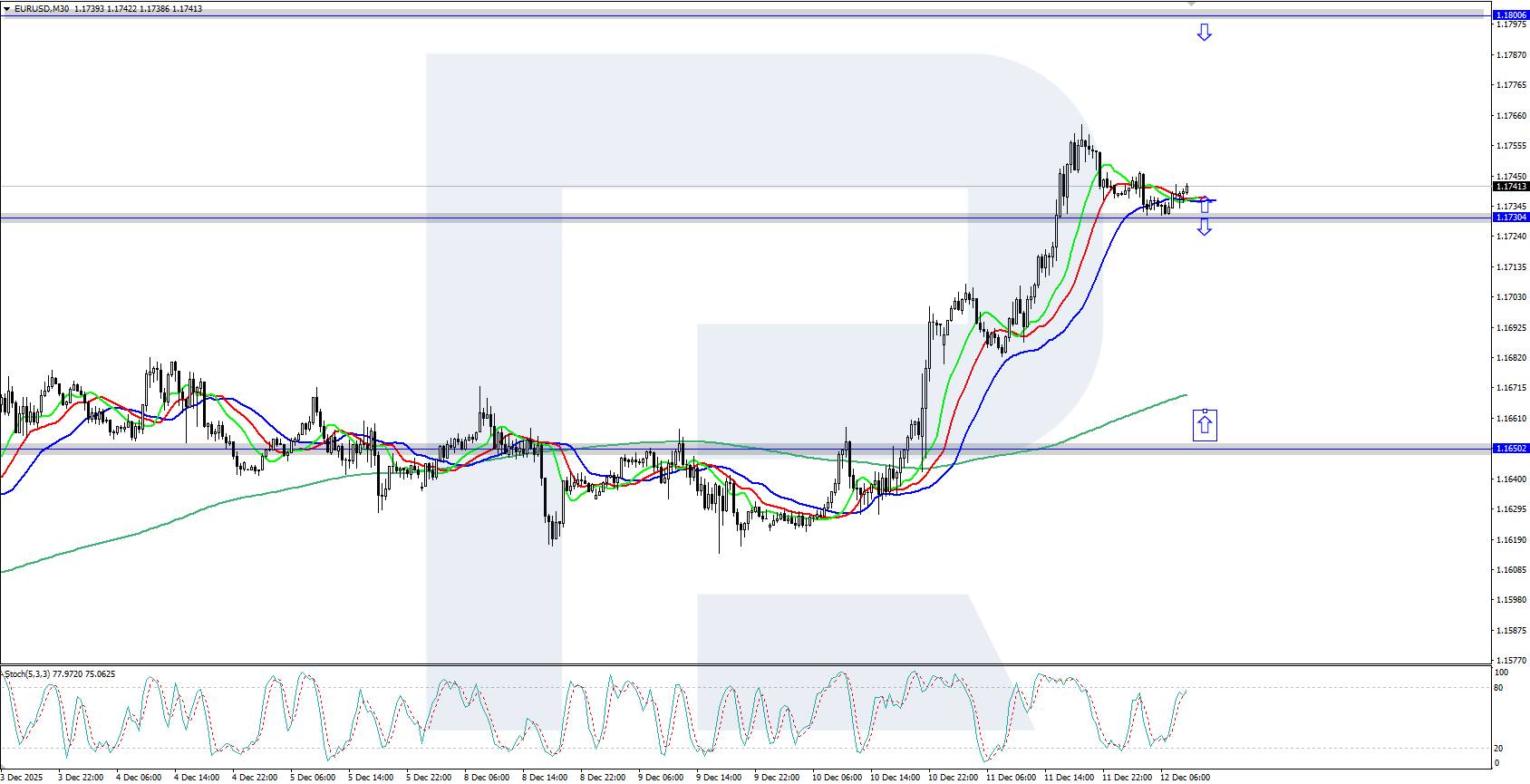
On the H4 chart, EURUSD quotes continue to strengthen, rising above the 1.1700 level. The Alligator indicator has also turned upward following the price, suggesting that the euro's advance may continue in the near term. The key support area is located around 1.1650.
Within the short-term EURUSD outlook, if bulls manage to maintain control, further growth toward the 1.1800 level and above is quite possible. If bears manage to regain the initiative, a pullback toward support at 1.1650 may occur.

The EURUSD price has risen above the 1.1700 mark. The ECB does not plan to cut interest rates in the near future.
EURUSD 2026-2027 forecast: key market trends and future predictionsThis article provides the EURUSD forecast for 2026 and 2027 and highlights the main factors determining the direction of the pair's movements. We will apply technical analysis, take into account the opinions of leading experts, large banks, and financial institutions, and study AI-based forecasts. This comprehensive insight into EURUSD predictions should help investors and traders make informed decisions.
Gold (XAUUSD) forecast 2026 and beyond: expert insights, price predictions, and analysisDive deep into the Gold (XAUUSD) price outlook for 2026 and beyond, combining technical analysis, expert forecasts, and key macroeconomic factors. It explains the drivers behind gold's recent surge, explores potential scenarios including a move toward 4,500 to 5,000 USD per ounce, and highlights why the metal remains a strong hedge during global uncertainty.
White Label
Data API
Web Plug-ins
Poster Maker
Affiliate Program
The risk of loss in trading financial instruments such as stocks, FX, commodities, futures, bonds, ETFs and crypto can be substantial. You may sustain a total loss of the funds that you deposit with your broker. Therefore, you should carefully consider whether such trading is suitable for you in light of your circumstances and financial resources.
No decision to invest should be made without thoroughly conducting due diligence by yourself or consulting with your financial advisors. Our web content might not suit you since we don't know your financial conditions and investment needs. Our financial information might have latency or contain inaccuracy, so you should be fully responsible for any of your trading and investment decisions. The company will not be responsible for your capital loss.
Without getting permission from the website, you are not allowed to copy the website's graphics, texts, or trademarks. Intellectual property rights in the content or data incorporated into this website belong to its providers and exchange merchants.
Not Logged In
Log in to access more features

FastBull Membership
Not yet
Purchase
Log In
Sign Up