• Trade
  • Markets
  • Copy
  • Contests
  • News
  • 24/7
  • Calendar
  • Q&A
  • Chats
Trending
Screeners
SYMBOL
LAST
BID
ASK
HIGH
LOW
NET CHG.
%CHG.
SPREAD
SPX
S&P 500 Index
6827.42
6827.42
6827.42
6899.86
6801.80
-73.58
-1.07%
--
DJI
Dow Jones Industrial Average
48458.04
48458.04
48458.04
48886.86
48334.10
-245.98
-0.51%
--
IXIC
NASDAQ Composite Index
23195.16
23195.16
23195.16
23554.89
23094.51
-398.69
-1.69%
--
USDX
US Dollar Index
97.950
98.030
97.950
98.500
97.950
-0.370
-0.38%
--
EURUSD
Euro / US Dollar
1.17394
1.17409
1.17394
1.17496
1.17192
+0.00011
+ 0.01%
--
GBPUSD
Pound Sterling / US Dollar
1.33707
1.33732
1.33707
1.33997
1.33419
-0.00148
-0.11%
--
XAUUSD
Gold / US Dollar
4299.39
4299.39
4299.39
4353.41
4257.10
+20.10
+ 0.47%
--
WTI
Light Sweet Crude Oil
57.233
57.485
57.233
58.011
56.969
-0.408
-0.71%
--

Community Accounts

Signal Accounts
--
Profit Accounts
--
Loss Accounts
--
View More

Become a signal provider

Sell trading signals to earn additional income

View More

Guide to Copy Trading

Get started with ease and confidence

View More

Signal Accounts for Members

All Signal Accounts

Best Return
  • Best Return
  • Best P/L
  • Best MDD
Past 1W
  • Past 1W
  • Past 1M
  • Past 1Y

All Contests

  • All
  • Trump Updates
  • Recommend
  • Stocks
  • Cryptocurrencies
  • Central Banks
  • Featured News
Top News Only
Share

Iranian Media Says 18 Crew Members Of Foreign Tanker Seized In Gulf Of Oman Over Carrying 'Smuggled Fuel' Detained

Share

Regional Governor: Two Killed In Ukrainian Drone Strike On Russia's Saratov

Share

Chinese Foreign Ministry - China Foreign Minister Met With United Arab Emirates Counterpart On Dec 12

Share

China's Central Financial And Economic Affairs Commission Deputy Director: Will Expand Export And Increase Import In 2026

Share

Thai Leader Anutin: Landmine Blast That Killed Thai Soldiers 'Not A Roadside Accident'

Share

Thai Leader Anutin: Thailand To Continue Military Action Until 'We Feel No More Harm'

Share

Cambodian Prime Minister Hun Manet Says He Had Phone Calls With Trump And Malaysian Leader Anwar About Ceasefire

Share

Cambodia's Hun Manet Says USA, Malaysia Should Verify 'Which Side Fired First' In Latest Conflict

Share

Cambodia's Hun Manet: Cambodia Maintains Its Stance In Seeking Peaceful Resolution Of Disputes

Share

Nasdaq Companies: Allergan, Ferrovia, Insmed, Monolithic Power Systems, Seagate Technology, And Western Digital Will Be Added To The NASDAQ 100 Index. Biogen, CdW, GlobalFoundries, Lululemon, ON Semiconductor, And Tradedesk Will Be Removed From The NASDAQ 100 Index

Share

Witkoff Headed To Berlin This Weekend To Meet With Zelenskiy, European Leaders -Wsj Reporter On X

Share

Russia Attacks Two Ukrainian Ports, Damaging Three Turkish-Owned Vessels

Share

[Historic Flooding Occurs In At Least Four Rivers In Washington State Due To Days Of Torrential Rains] Multiple Areas In Washington State Have Been Hit By Severe Flooding Due To Days Of Torrential Rains, With At Least Four Rivers Experiencing Historic Flooding. Reporters Learned On The 12th That The Floods Caused By The Torrential Rains In Washington State Have Destroyed Homes And Closed Several Highways. Experts Warn That Even More Severe Flooding May Occur In The Future. A State Of Emergency Has Been Declared In Washington State

Share

Trump Says Proposed Free Economic Zone In Donbas Would Work

Share

Trump: I Think My Voice Should Be Heard

Share

Trump Says Will Be Choosing New Fed Chair In Near Future

Share

Trump Says Proposed Free Economic Zone In Donbas Complex But Would Work

Share

Trump Says Land Strikes In Venezuela Will Start Happening

Share

US President Trump: Thailand And Cambodia Are In A Good Situation

Share

State Media: North Korean Leader Kim Hails Troops Returning From Russia Mission

TIME
ACT
FCST
PREV
U.K. Trade Balance Non-EU (SA) (Oct)

A:--

F: --

P: --

U.K. Trade Balance (Oct)

A:--

F: --

P: --

U.K. Services Index MoM

A:--

F: --

P: --

U.K. Construction Output MoM (SA) (Oct)

A:--

F: --

P: --

U.K. Industrial Output YoY (Oct)

A:--

F: --

P: --

U.K. Trade Balance (SA) (Oct)

A:--

F: --

P: --

U.K. Trade Balance EU (SA) (Oct)

A:--

F: --

P: --

U.K. Manufacturing Output YoY (Oct)

A:--

F: --

P: --

U.K. GDP MoM (Oct)

A:--

F: --

P: --

U.K. GDP YoY (SA) (Oct)

A:--

F: --

P: --

U.K. Industrial Output MoM (Oct)

A:--

F: --

P: --

U.K. Construction Output YoY (Oct)

A:--

F: --

P: --

France HICP Final MoM (Nov)

A:--

F: --

P: --

China, Mainland Outstanding Loans Growth YoY (Nov)

A:--

F: --

P: --

China, Mainland M2 Money Supply YoY (Nov)

A:--

F: --

P: --

China, Mainland M0 Money Supply YoY (Nov)

A:--

F: --

P: --

China, Mainland M1 Money Supply YoY (Nov)

A:--

F: --

P: --

India CPI YoY (Nov)

A:--

F: --

P: --

India Deposit Gowth YoY

A:--

F: --

P: --

Brazil Services Growth YoY (Oct)

A:--

F: --

P: --

Mexico Industrial Output YoY (Oct)

A:--

F: --

P: --

Russia Trade Balance (Oct)

A:--

F: --

P: --

Philadelphia Fed President Henry Paulson delivers a speech
Canada Building Permits MoM (SA) (Oct)

A:--

F: --

P: --

Canada Wholesale Sales YoY (Oct)

A:--

F: --

P: --

Canada Wholesale Inventory MoM (Oct)

A:--

F: --

P: --

Canada Wholesale Inventory YoY (Oct)

A:--

F: --

P: --

Canada Wholesale Sales MoM (SA) (Oct)

A:--

F: --

P: --

Germany Current Account (Not SA) (Oct)

A:--

F: --

P: --

U.S. Weekly Total Rig Count

A:--

F: --

P: --

U.S. Weekly Total Oil Rig Count

A:--

F: --

P: --

Japan Tankan Large Non-Manufacturing Diffusion Index (Q4)

--

F: --

P: --

Japan Tankan Small Manufacturing Outlook Index (Q4)

--

F: --

P: --

Japan Tankan Large Non-Manufacturing Outlook Index (Q4)

--

F: --

P: --

Japan Tankan Large Manufacturing Outlook Index (Q4)

--

F: --

P: --

Japan Tankan Small Manufacturing Diffusion Index (Q4)

--

F: --

P: --

Japan Tankan Large Manufacturing Diffusion Index (Q4)

--

F: --

P: --

Japan Tankan Large-Enterprise Capital Expenditure YoY (Q4)

--

F: --

P: --

U.K. Rightmove House Price Index YoY (Dec)

--

F: --

P: --

China, Mainland Industrial Output YoY (YTD) (Nov)

--

F: --

P: --

China, Mainland Urban Area Unemployment Rate (Nov)

--

F: --

P: --

Saudi Arabia CPI YoY (Nov)

--

F: --

P: --

Euro Zone Industrial Output YoY (Oct)

--

F: --

P: --

Euro Zone Industrial Output MoM (Oct)

--

F: --

P: --

Canada Existing Home Sales MoM (Nov)

--

F: --

P: --

Euro Zone Total Reserve Assets (Nov)

--

F: --

P: --

U.K. Inflation Rate Expectations

--

F: --

P: --

Canada National Economic Confidence Index

--

F: --

P: --

Canada New Housing Starts (Nov)

--

F: --

P: --

U.S. NY Fed Manufacturing Employment Index (Dec)

--

F: --

P: --

U.S. NY Fed Manufacturing Index (Dec)

--

F: --

P: --

Canada Core CPI YoY (Nov)

--

F: --

P: --

Canada Manufacturing Unfilled Orders MoM (Oct)

--

F: --

P: --

Canada Manufacturing New Orders MoM (Oct)

--

F: --

P: --

Canada Core CPI MoM (Nov)

--

F: --

P: --

Canada Manufacturing Inventory MoM (Oct)

--

F: --

P: --

Canada CPI YoY (Nov)

--

F: --

P: --

Canada CPI MoM (Nov)

--

F: --

P: --

Canada CPI YoY (SA) (Nov)

--

F: --

P: --

Canada Core CPI MoM (SA) (Nov)

--

F: --

P: --

Q&A with Experts
    • All
    • Chatrooms
    • Groups
    • Friends
    Connecting
    .
    .
    .
    Type here...
    Add Symbol or Code

      No matching data

      All
      Trump Updates
      Recommend
      Stocks
      Cryptocurrencies
      Central Banks
      Featured News
      • All
      • Russia-Ukraine Conflict
      • Middle East Flashpoint
      • All
      • Russia-Ukraine Conflict
      • Middle East Flashpoint
      Search
      Products

      Charts Free Forever

      Chats Q&A with Experts
      Screeners Economic Calendar Data Tools
      Membership Features
      Data Warehouse Market Trends Institutional Data Policy Rates Macro

      Market Trends

      Market Sentiment Order Book Forex Correlations

      Top Indicators

      Charts Free Forever
      Markets

      News

      News Analysis 24/7 Columns Education
      From Institutions From Analysts
      Topics Columnists

      Latest Views

      Latest Views

      Trending Topics

      Top Columnists

      Latest Update

      Signals

      Copy Rankings Latest Signals Become a signal provider AI Rating
      Contests
      Brokers

      Overview Brokers Assessment Rankings Regulators News Claims
      Broker listing Forex Brokers Comparison Tool Live Spread Comparison Scam
      Q&A Complaint Scam Alert Videos Tips to Detect Scam
      More

      Business
      Events
      Careers About Us Advertising Help Center

      White Label

      Data API

      Web Plug-ins

      Affiliate Program

      Awards Institution Evaluation IB Seminar Salon Event Exhibition
      Vietnam Thailand Singapore Dubai
      Fans Party Investment Sharing Session
      FastBull Summit BrokersView Expo
      Recent Searches
        Top Searches
          Markets
          News
          Analysis
          User
          24/7
          Economic Calendar
          Education
          Data
          • Names
          • Latest
          • Prev

          View All

          No data

          Scan to Download

          Faster Charts, Chat Faster!

          Download App
          English
          • English
          • Español
          • العربية
          • Bahasa Indonesia
          • Bahasa Melayu
          • Tiếng Việt
          • ภาษาไทย
          • Français
          • Italiano
          • Türkçe
          • Русский язык
          • 简中
          • 繁中
          Open Account
          Search
          Products
          Charts Free Forever
          Markets
          News
          Signals

          Copy Rankings Latest Signals Become a signal provider AI Rating
          Contests
          Brokers

          Overview Brokers Assessment Rankings Regulators News Claims
          Broker listing Forex Brokers Comparison Tool Live Spread Comparison Scam
          Q&A Complaint Scam Alert Videos Tips to Detect Scam
          More

          Business
          Events
          Careers About Us Advertising Help Center

          White Label

          Data API

          Web Plug-ins

          Affiliate Program

          Awards Institution Evaluation IB Seminar Salon Event Exhibition
          Vietnam Thailand Singapore Dubai
          Fans Party Investment Sharing Session
          FastBull Summit BrokersView Expo

          Europeans Supportive Of Retaliatory Tariffs On America, Poll Finds

          Jason

          Economic

          Summary:

          A sizable majority of Europeans would back retaliatory tariffs against the U.S. over new levies on goods produced in the EU.

          More than two thirds of those polled in Germany, Europe’s economic powerhouse, are in favor of countering America’s actions in the brewing trade war.

          The mood is similar, if not worse, in several other major economies on the Old Continent where an even larger share of people would like to see an appropriate response. Italians are the least belligerent in that context but over half of them would still support European countermeasures.

          Western Europe favors retaliating to Trump’s tariffs

          Most citizens of seven countries in Western Europe, EU member states and Britain, are largely supportive of retaliating against U.S. tariffs on the products they are making. The finding came ahead of an expected announcement, part of President Donald Trump’s policy of imposing “reciprocal tariffs” on nations that America has trade deficits with.

          At 79%, Danes are the most eager backers of adopting countermeasures, according to the Yougov Eurotrack survey conducted in March. Swedes are second with 73% of them declaring support for potential EU response.

          Exactly 70% of the respondents in Spain are in favor of Europe slapping higher tariffs on U.S. goods. Italians are least supportive with a total of 45% either unsure about or opposing a European retaliation, reflecting Italian Prime minister Giorgia Meloni’s recent call to avoid impulsive moves.

          France and Germany, Europe’s leading political powers, are ranking in the middle, both with 68% of their citizens hoping for an adequate EU reaction. In the United Kingdom, no longer a member of the European Union, 71% support retaliatory tariffs.

          With new US tariffs set to come into force tomorrow, most Western Europeans support imposing retaliatory tariffs on US goods.EU nations and the U.K. brace for tariff impact on their economies.

          Between 60 and 76% of those polled in EU countries expect U.S. tariffs to seriously affect the European Union’s economy, with people in Germany, France, Italy, and Spain being the most worried about the potential effects for the EU as a whole.

          Germans fear their national economy will be hit the hardest, given the large size of its automotive industry set to suffer the most under Trump’s 25% tax on imported cars. Some 75% of the participants in the poll there believe they are going to see a significant impact.

          YouGov noted that the majority of Brits (60%) also anticipate a substantial impact on business in the U.K., while respondents in Denmark are the least likely to feel this way. Still, every second Dane is uneasy about the prospects for the Danish economy.

          Germans are the most likely to think the US placing tariffs on EU goods would have a lot/fair amount of impact on their national economy.Europeans disagree with Trump’s reasons for ‘Liberation Day’

          Commenting on his plans for broad-based “reciprocal tariffs” in February, the U.S. president accused the European Union of being “very unfair to us” in terms of trade relations. He and members of his administration have been referring to April 2 as “Liberation Day.”

          The poll suggests, however, that Europeans largely disagree with Washington’s reading of the current state of affairs, with 40% (in Italy) to 67% (in Denmark) opposing Trump’s claims. Only between 7% and 18% of the EU respondents think he has good reasons.

          Britons are displaying similar attitudes – over half of them, or 55% of the surveyed, are convinced that the United Kingdom has been fair enough in its trade dealings with the United States. Only around 6% tend to agree with Donald Trump’s remarks.

          After imposing tariffs on steel and aluminum imports, the U.S. head of state unveiled last Wednesday a 25% tariff on “all cars that are not made in the United States,” which should take effect alongside the reciprocal tariffs expected this week.

          The European Commission, the EU’s executive arm, indicated on Thursday it’s going to wait for the April 2 announcement from Washington before countering. Quoted by Euronews, its spokesperson for economic security, Olof Gill, stated that if necessary, Brussels will deliver a “well calibrated” response.

          “Our objective is a negotiated solution. But of course, if need be, we will protect our interests, our people and our companies,” the Commission’s President Ursula von der Leyen said in a speech to the European Parliament, insisting the EU has a “strong plan to retaliate” while emphasizing the confrontation is “in no one’s interest.”

          Source: CryptoSlate

          To stay updated on all economic events of today, please check out our Economic calendar
          Risk Warnings and Disclaimers
          You understand and acknowledge that there is a high degree of risk involved in trading. Following any strategies or investment methods may lead to potential losses. The content on the site is provided by our contributors and analysts for information purposes only. You are solely responsible for determining whether any trading assets, securities, strategy, or any other product is suitable for investing based on your own investment objectives and financial situation.
          Add to Favorites
          Share

          Can Bitcoin Bring Down Banks?

          Devin

          Cryptocurrency

          Between promises of emancipation and technical challenges, its ascent raises questions: can it truly dethrone the giants of traditional finance? Far from clichés, let’s dive into an uncompromising analysis.

          Bitcoin vs banks: a war of architectures

          Bitcoin is based on a peer-to-peer network, without a conductor. Banks, on the other hand, function like centralized cathedrals, where each stone depends on a higher authority.

          This structural divergence explains why Bitcoin is appealing: it replaces trust in institutions with irrefutable mathematics.

          In 2021, El Salvador adopted Bitcoin as legal tender, despite criticism. The result? An economy less dependent on the dollar, but exposed to volatility.

          Meanwhile, traditional banks, protected by state safety nets, withstand storms. Bitcoin offers risky freedom; banks, a corseted stability.

          Bitcoin handles 7 transactions per second, compared to thousands for Visa. Solutions like Lightning Network are trying to bridge this gap, but the road remains long.

          Banks, despite their heaviness, master the art of massive flows. An advantage that could erode if blockchain technology matures.

          BTCUSDT chart by TradingView

          Bitcoin promises a bank account on a smartphone. Yet, 3 billion people still lack internet access. In sub-Saharan Africa, only 48% of adults own a mobile phone. Without digital infrastructure, the dream of inclusion remains a mirage.

          Cross-border transfers via Bitcoin cost a few cents, compared to an average of 6% via traditional banks. But this saving masks a problem: the volatility of BTC can cancel out gains in just a few hours. Stablecoins attempt to address this, but their peg to traditional currencies perpetuates dependency on the current system.

          Start your crypto adventure safely with Coinhouse This link uses an affiliate program.

          Security: blockchain vs human psychology

          The Bitcoin blockchain has never been hacked. But digital wallets, on the other hand, are vulnerable. In the first quarter of 2025, losses related to cryptocurrency platform hacks reached $1.63 billion.

          Banks spend billions on cybersecurity, yet experience regular data breaches. In 2022, 74% of financial institutions reported an increase in attacks. Bitcoin eliminates intermediaries, but not human errors.

          20% of bitcoins are locked in inaccessible wallets. A simple misplaced USB key, and fortunes evaporate. Banks, with their recovery procedures, offer a psychological security that Bitcoin cannot match.

          Economic stability: the deflationary trap

          Bitcoin is limited to 21 million units. A scarcity that attracts investors but poses a problem: how to manage an economy without monetary adjustment? Central banks use inflation as a tool; Bitcoin imposes a rigor incompatible with crises.

          In 2024, 60% of BTC holders consider it as “digital gold.” Few use it to buy a coffee.

          As long as it remains a speculative asset, its role as a daily currency will remain marginal. Banks, despite their flaws, retain the monopoly on everyday exchanges.

          BlackRock and JPMorgan are integrating Bitcoin into their portfolios, but as an investment product, not as a currency. A hybrid adoption that reinforces the current system more than it dismantles it.

          The EU adopted MiCA in 2023 to regulate cryptos. The United States oscillates between repression and innovation.

          Without a clear framework, Bitcoin will never supplant banks. But excessive regulation could jeopardize its decentralized essence. Bitcoin will not kill banks. It forces them to evolve. Meanwhile, the tax framework is evolving. Here are the essential dates to remember regarding crypto and taxes in 2025.

          Source: CryptoSlate

          Risk Warnings and Disclaimers
          You understand and acknowledge that there is a high degree of risk involved in trading. Following any strategies or investment methods may lead to potential losses. The content on the site is provided by our contributors and analysts for information purposes only. You are solely responsible for determining whether any trading assets, securities, strategy, or any other product is suitable for investing based on your own investment objectives and financial situation.
          Add to Favorites
          Share

          Are Privacy Coins Still A Thing In 2025? Trends And Predictions

          Thomas

          Cryptocurrency

          Designed to keep transactions confidential and identities hidden, these specialized cryptocurrencies sparked interest and controversy from day one. However, in 2025, with evolving regulations, innovative technology, and changing user priorities, the relevance of privacy coins feels increasingly uncertain. Are they still useful? Or are they becoming relics in a more transparent crypto ecosystem? Let’s take a closer look at their history, current trends, and what the future may hold.

          The Rise and Evolution of Privacy Coins

          To understand where privacy coins stand today, it’s essential to revisit their origins and the reasons they captured attention in the first place.

          What Are Privacy Coins?

          Privacy coins are a type of cryptocurrency designed to prioritize user anonymity and the confidentiality of transactions. Unlike Bitcoin and Ethereum, where transactions are publicly recorded on the blockchain, privacy coins hide transaction details—including amounts, sender addresses, and recipient addresses.

          Privacy technologies such as ring signatures, zk-SNARKs, and stealth addresses make this level of confidentiality possible. For example, Monero uses ring signatures to obscure the origin of funds, while Zcash employs zk-SNARKs to prove transactions occurred without revealing specific details. In short, these coins aim to protect user identities in an increasingly monitored digital world.

          Why Privacy Coins Became Popular

          The rise of privacy coins was driven by a growing demand for financial privacy. In the early days of crypto, Bitcoin was mistakenly thought of as an anonymous way to send value. When users realized Bitcoin transactions could be traced, privacy coins emerged to fill the gap.

          These coins appealed to individuals seeking to safeguard their financial activities—whether to protect personal information or avoid surveillance. They also resonated with libertarians and privacy advocates who saw them as a tool for resisting government control and protecting freedom.

          However, with anonymity came controversy. Privacy coins became heavily associated with illegal activities, such as money laundering and transactions on darknet markets. While many users employed these coins for lawful purposes, their misuse by bad actors attracted the attention of global regulators.

          Regulatory Challenges Over the Years

          From the start, privacy coins faced intense scrutiny from governments and financial institutions. Nations like Japan and South Korea banned their use entirely, citing concerns about tax evasion and criminal activity. Some exchanges in the US and Europe delisted privacy coins due to increasing compliance demands.

          Regulators’ primary concern has always been the inability to trace transactions. Transparent blockchains like Bitcoin allow law enforcement to track illicit financial flows when necessary, but privacy coins make this nearly impossible. Over the years, this regulatory pressure has made it harder for privacy coins to gain mainstream traction.

          Various technologies can bring privacy to blockchain and crypto.

          Privacy Coins in 2025: Current Trends

          Fast forward to the present day, and privacy coins still exist, but the landscape around them has shifted dramatically. Several key trends define their status today.

          Adoption and Usage

          As cryptocurrency adoption has gone mainstream, the demand for privacy coins has seen mixed results. On one hand, some industries and regions still rely on them. Privacy advocates, journalists, and political dissidents in authoritarian countries use these coins to protect themselves. On the other hand, stricter regulations and penalties have discouraged usage in developed economies.

          Interestingly, privacy coins have made a small comeback within niche sectors. For instance, in the gaming industry or among decentralized communities valuing privacy, these coins have carved out specific use cases. However, their overall market share remains small compared to more broadly adopted assets like Bitcoin and Ethereum.

          Advancements in Privacy Technology

          Technological innovation has kept privacy coins competitive despite decreasing popularity. In 2025, advancements like zk-STARKs (an evolution of zk-SNARKs) and adaptive anonymity protocols have improved the efficiency and security of privacy features. These upgrades make transactions even harder to trace while reducing computational costs.

          Moreover, some privacy concepts have migrated to mainstream blockchains, creating hybrid solutions. For example, Ethereum's layer-2 solutions now include optional privacy features, making it easier for users to toggle between transparent and private transactions. This integration raises questions about whether standalone privacy coins can maintain relevance in the long run.

          Impact of Regulatory Policies

          Regulators haven’t let up in their efforts to control or eliminate privacy coins. Compliance requirements have reached new levels of intensity. Most centralized exchanges outright refuse to list privacy coins due to Know Your Customer (KYC) and Anti-Money Laundering (AML) laws. Some countries, like the US and EU nations, have imposed severe penalties for their misuse.

          Still, enforcement isn’t universal. Nations with looser regulatory oversight or a history of favoring cryptocurrency innovation—such as certain parts of Asia and Africa, remain havens for privacy coin activity.

          Predictions for the Future of Privacy Coins

          So, what lies ahead for privacy coins? Several possibilities may shape their trajectory beyond 2025.

          Will Governments Intensify Restrictions?

          There’s little doubt that privacy coins will remain a regulatory target. Governments are wary of their capacity to enable untraceable transactions, and this concern will likely lead to stricter enforcement. Over time, some privacy coins may migrate underground, appealing exclusively to users willing to take legal risks. Others could attempt to adapt by incorporating semi-compliant features—but at the cost of losing their appeal to hardcore privacy advocates.

          Integration with Broader Blockchain Ecosystem

          Instead of withering away completely, privacy-focused technology could integrate into broader crypto ecosystems. Already, major blockchains like Ethereum are experimenting with privacy solutions that offer the best of both worlds: transparency when required and privacy when desired. If this trend continues, standalone privacy coins could lose relevance as these features become standard on larger platforms.

          Decentralized finance (DeFi) is also an area ripe for privacy innovation. Users of DeFi platforms might begin demanding more anonymity features, and privacy coins that integrate with DeFi protocols could see renewed interest.

          Will Privacy Coins Survive?

          The question of survival depends largely on whether these coins can adapt. If innovation stagnates or regulations become unbearable, they may fade into obscurity. However, as long as there’s demand for privacy in financial transactions, they’ll likely retain a small but dedicated user base. Their future may reside not in the mainstream but in specialized markets where privacy is non-negotiable.

          Conclusion

          Privacy coins occupy a unique, controversial space in the cryptocurrency world. While they’ve lost some of their early momentum due to regulatory crackdowns and technological competition, they remain valuable to those who prioritize financial privacy. The evolution of anonymity technology, combined with the steady push for compliance, will determine their survival in the years to come.

          For avid crypto enthusiasts or those concerned with personal privacy, the next few years will be critical. Will privacy coins adapt or disappear? Only time will tell. One thing is clear: as the conversation around privacy, transparency, and control evolves, so too will the tools we use to navigate the crypto space.

          Source: CryptoSlate

          Risk Warnings and Disclaimers
          You understand and acknowledge that there is a high degree of risk involved in trading. Following any strategies or investment methods may lead to potential losses. The content on the site is provided by our contributors and analysts for information purposes only. You are solely responsible for determining whether any trading assets, securities, strategy, or any other product is suitable for investing based on your own investment objectives and financial situation.
          Add to Favorites
          Share

          Trump Announces Tariffs Impacting Global Crypto Markets

          Damon

          Cryptocurrency

          Trump Announces Tariffs Impacting Global Crypto Markets

          Donald Trump declared the "Liberation Day" tariffs aiming to bolster U.S. industries. The policy affects over 25 countries, triggering market volatility. Trump's history of influencing markets continues, with crypto sectors responding swiftly.

          Bitcoin's value rose by 2.3% to $66,500, while Ethereum gained 3.1%, reflecting confident market reactions to tariffs. Markets also saw significant trading volume, with heightened activity on exchanges and derivatives markets.

          GameStop's $1.5 billion investment to "buy the dip" underscores institutional confidence in Bitcoin's potential amidst tariff-induced turbulence. Social media suggests bullish sentiment, with retail traders viewing this as a buying opportunity.

          Financial markets are navigating this volatility, with historical trends suggesting that similar economic measures previously led to significant Bitcoin appreciation. Experts propose Bitcoin's future price could ascend significantly, indicating strategic interest across sectors.

          Fred Krueger, Mathematician and Author, emphasized the role of Bitcoin in today's market dynamics: "Bitcoin is a portable digital gold, especially in the face of tariffs."

          Despite the absence of immediate regulatory responses, the market's enthusiasm remains cautious yet optimistic. Investors eye digital assets for safeguarding wealth, anticipating advantages if geopolitical tensions escalate further.

          Source: CryptoSlate

          Risk Warnings and Disclaimers
          You understand and acknowledge that there is a high degree of risk involved in trading. Following any strategies or investment methods may lead to potential losses. The content on the site is provided by our contributors and analysts for information purposes only. You are solely responsible for determining whether any trading assets, securities, strategy, or any other product is suitable for investing based on your own investment objectives and financial situation.
          Add to Favorites
          Share

          Bitcoin Sales at $109K All-Time High 'Significantly Below' Cycle Tops — Research

          Warren Takunda

          Cryptocurrency

          Bitcoin investors who bought BTC in 2020 or later are still waiting for higher prices, new research says.
          In findings published on X on April 1, onchain analytics firm Glassnode revealed that $110,000 was not high enough to make many hodlers sell.

          Glassnode: 2020 Bitcoin buyers “still holding”

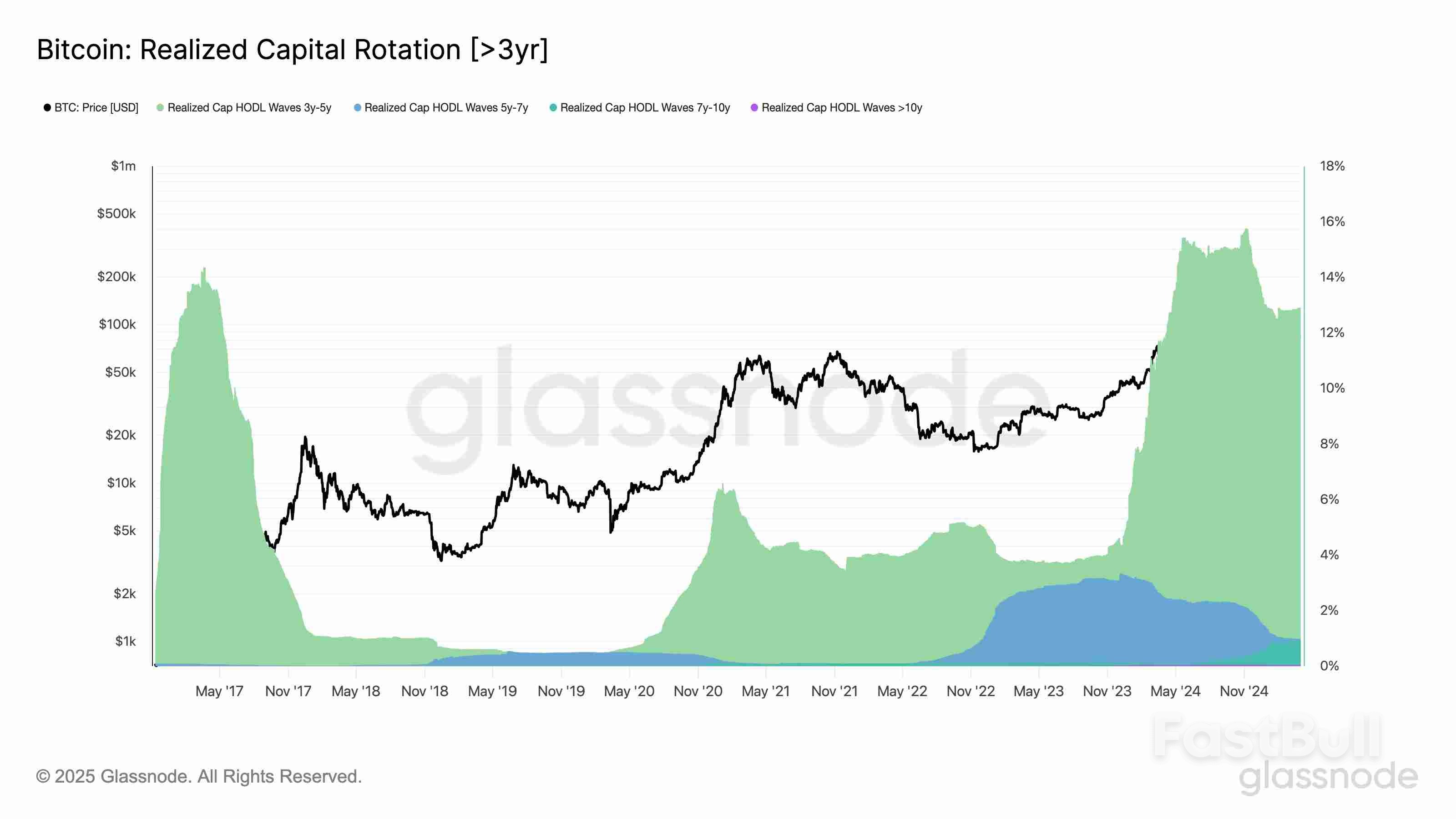
          Bitcoiners who entered the market between three and five years ago have retained their holdings despite significant BTC price upside.
          According to Glassnode, this investor cohort, with a cost basis between the 2020 lows of $3,600 and the 2021 highs of $69,000, is still hodling.
          “Although the share of wealth held by investors who bought $BTC 3–5 years ago has declined by 3 percentage points since its November 2024 peak, it remains at historically elevated levels,” it said.
          “This suggests that the majority of investors who entered between 2020 and 2022 are still holding.”Bitcoin Sales at $109K All-Time High 'Significantly Below' Cycle Tops — Research_1

          Bitcoin Realized Cap HODL Waves data. Source: Glassnode

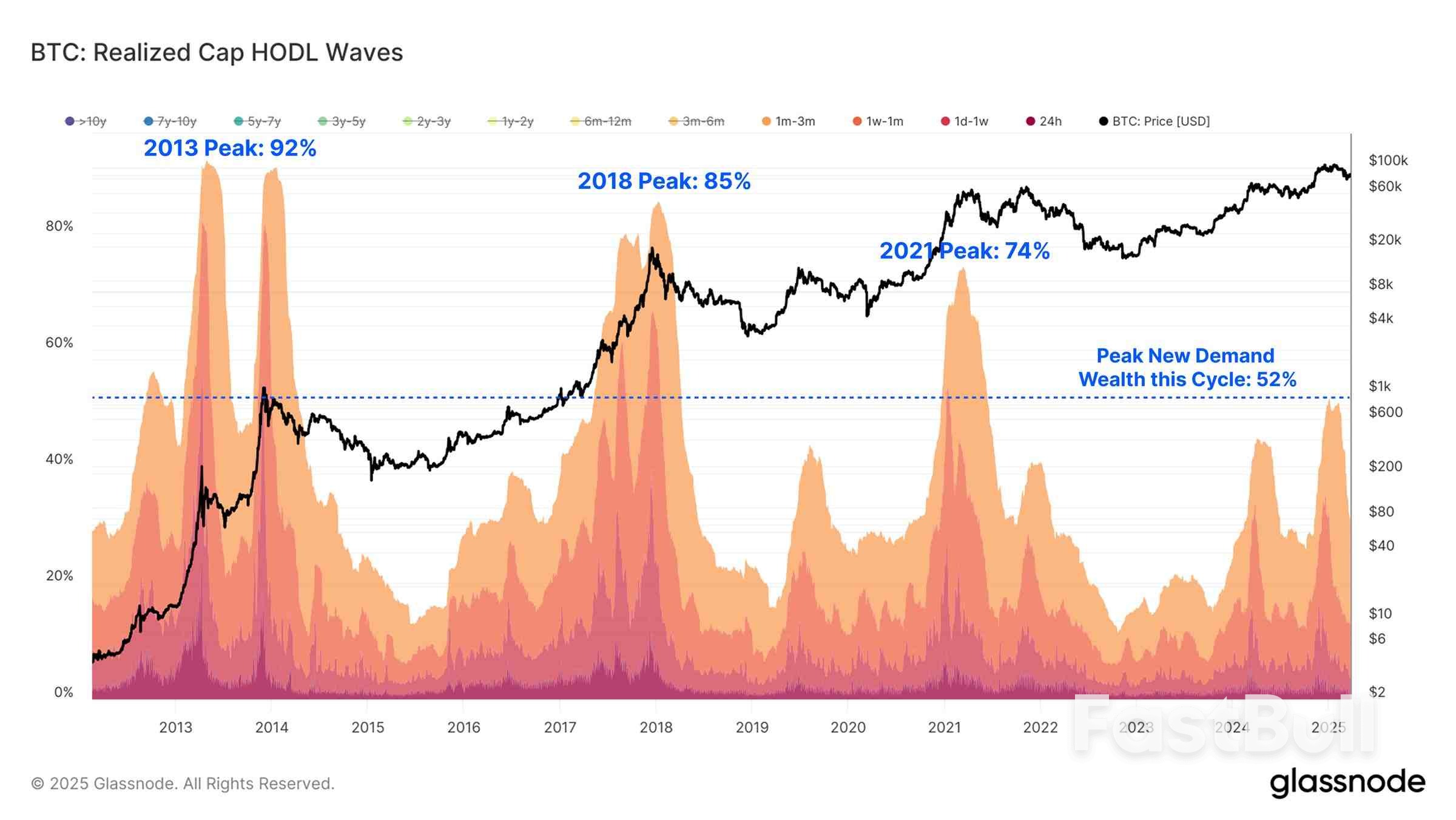
          An accompanying chart shows data from the Realized Cap HODL Waves metric, which splits the BTC supply into sections based on when each coin last moved onchain.
          Using this, Glassnode is able to draw a distinction between the 2020-22 buyers and those who came immediately before them.
          “In contrast, over two-thirds of those who had bought $BTC 5–7 years ago exited their positions by the December 2024 peak,” it reveals, reflecting their lower cost basis.

          Speculators stay cool at BTC price highs

          As Cointelegraph reported, more recent buyers, who form the more speculative investor cohort known as short-term holders (STHs), have proven much more sensitive to recent BTC price volatility.
          Episodes of panic selling have occurred throughout the past six months as BTC/USD hit new record highs and then fell by up to 30%.
          Continuing, Glassnode said that current STH participation does not suggest a speculative frenzy — something common to previous BTC price cycle tops.
          “Short-Term Holders currently hold around 40% of Bitcoin's network wealth, after peaking near 50% earlier in 2025,” it said, alongside Realized Cap HODL Waves data on March 31.
          “This remains significantly below prior cycle tops, where new investor wealth peaked at 70–90%, suggesting a more tempered and distributed bull market so far.”Bitcoin Sales at $109K All-Time High 'Significantly Below' Cycle Tops — Research_2

          Bitcoin Realized Cap HODL Waves. Source: Glassnode

          Source: Cointelegraph

          Risk Warnings and Disclaimers
          You understand and acknowledge that there is a high degree of risk involved in trading. Following any strategies or investment methods may lead to potential losses. The content on the site is provided by our contributors and analysts for information purposes only. You are solely responsible for determining whether any trading assets, securities, strategy, or any other product is suitable for investing based on your own investment objectives and financial situation.
          Add to Favorites
          Share

          Trump’s ‘Liberation Day’ Tariffs: What’s at Stake for UK and EU?

          Warren Takunda

          Economic

          The EU and the UK are bracing for a damaging trade war with the US, as Donald Trump is expected to implement his threat to impose tariffs on imports from Europe.
          For weeks, he has named 2 April “liberation day”, with the unveiling of a tariff plan to reverse what he called “unfair practices that have been ripping off our country for decades”.

          What tariffs are expected?

          A 20% blanket tariff on nearly all imports to the US has been drafted by Trump’s aides.
          However, EU and UK leaders are concerned about the possibility of sectoral tariffs, as well as permanent levies he may impose to counter Europe’s VAT rates, which he considers a de facto tax.
          Trump, who once challenged the then German chancellor Angela Merkel for not ensuring there were more Chevrolets in Munich, has already announced tariffs on cars starting on 3 April.

          Will the UK be spared?

          The relative warmth Trump showed Keir Starmer in the Oval Office last month is unlikely to protect the UK, with tariffs expected on “all countries”. However, the UK has been racing to agree a deal, with the business secretary, Jonathan Reynolds, suggesting that if any country can secure a carve-out, Britain could.
          On Tuesday, Starmer said businesses did not want a tit-for-tat war. Instead of a “kneejerk” reaction, he would respond in a “calm and collected” manner.
          He hoped a trade deal, something that eluded a succession of UK governments over decades, would “mitigate” the impact of tariffs. The UK was this time seeking a much narrower “economic prosperity deal” rather than a more comprehensive “free trade agreement”.
          Although this would be far less expansive in scope, the hope is that it should be quicker to agree.

          Does Trump really hate Europe?

          European leaders were alarmed by the attacks on Europe by the vice-president, JD Vance, but Trump has been notably less visceral, confining his interests to defence and the trade imbalance.
          He has complained that the US was “ripped off by every country in the world” and that he was “not happy with the EU” as a place to do business. His exclusion of the EU in talks over Ukraine has ruptured the higher-level geopolitical transatlantic relationship.Trump’s ‘Liberation Day’ Tariffs: What’s at Stake for UK and EU?_1

          How will the EU react?

          Strongly. The EU has already announced a string of tariffs it plans to introduce on US imports targeting steel and aluminium in kind, as well as textiles, leather goods, home appliances, house tools, plastics and wood.
          Sources say it is also considering nuclear options, including tariffs on revenues generated in the EU by big tech firms and social media.
          This could be seen as highly provocative and would put Trump’s allies, such as Elon Musk and Jeff Bezos, in the crosshairs. It would also test the unity of the EU, with Ireland expected to argue against more punitive measures because of the dominance of the US tech sector in Dublin.
          The EU’s preference is to negotiate so it has decided to delay countermeasures to open a space for talks. Maroš Šefčovič, the European commissioner for trade and economic security, has already met the US commerce secretary, Howard Lutnick, and, although Šefčovič reportedly came home last week “empty handed”, he is operating the Brexit playbook, hoping to build a personal relationship that will provide credit in the bank when they get down to talks.

          Why not enter immediate negotiations?

          One EU official said there was no point negotiating with the US at this stage, saying it would be like arguing over rotten fish.
          “It is not very productive to now start negotiating about removing the tariffs,” the official said. “You put a stinking fish on the table, and then you start negotiating to remove that stinking fish, and then you say: ‘Wow, we have a great result: there’s no stinking fish on the table.’ That is not a very productive conversation.”
          Trade experts also say negotiations with the US would involve agreeing a strategy between 27 different member states, which could be tricky given the potential for splits between countries, as EU states negotiate trade deals as a unified bloc.

          What is Trump’s game plan?

          Trump has been obsessed with tariffs since the 1980s, when he railed against the Japanese buying up real restate in the US, an open economy, but with US investors unable to reciprocate in Tokyo.
          His goal is to reindustrialise the US and to repatriate jobs and taxes he thinks US companies should be paying at home rather than abroad. While currently at a 21% corporate tax rate, the US for a long time operated at a 35% corporate tax rate, pushing some of its biggest companies to push for lower taxes.
          To revive local industry, Trump wants to shorten the supply chain and make sure more components are manufactured locally.

          What does the data on trade show?

          The US is the largest importer of goods in the world, buying $3tn-worth of products in 2023. Its largest trade deficit is with China, from where it imports $279bn more than it exports, followed by the EU at $208bn.
          EU-US trade is worth €1.6tn but only three countries – Ireland, Germany and Italy – enjoy a surplus in goods trade.
          Germany’s trade surplus in goods was €57bn in 2023, according to official US data. In 2023, Germany sold €144bn-worth of goods to the US, of which €22bn was on cars. By contrast, the US sold €87bn-worth of goods to Germany, including €8.25bn-worth of cars.
          Ireland has the second-largest trade imbalance, a surplus of €50bn largely caused by the export of pharmaceuticals to the US from large US multinationals. But it has been consistently singled out by Trump and is seen as highly exposed.
          Italyhas a trade surplus of €41bn, selling about €65bn-worth of goods to the US. Packaged medicines and cars account for about €5bn and €4.66bn of all exports respectively.
          The UK has a more balanced relationship with the US. The US is Britain’s largest single-export market, worth £60.4bn in goods in 2023, accounting for 15.3% of the global total. The UK imported £57.9bn in goods from the US.

          How is business reacting?

          The US markets are spooked, with S&P 500 and Nasdaq closing March trade with their worst quarter performance since Russia’s invasion of Ukraine in 2022.
          The EU is presenting itself as a safe haven. “I do think investors at the moment are re-evaluating the EU and investing in the European Union. I think there’s a growing appreciation of the value of predictability and order on the global stage,” said Paschal Donohoe, Ireland’s finance minister.
          So far this year, the pan-European Stoxx 600 index has gained 6.4%, while the US S&P 500 index has lost 5% and had its worst quarter since 2022.

          Source: Theguardian

          To stay updated on all economic events of today, please check out our Economic calendar
          Risk Warnings and Disclaimers
          You understand and acknowledge that there is a high degree of risk involved in trading. Following any strategies or investment methods may lead to potential losses. The content on the site is provided by our contributors and analysts for information purposes only. You are solely responsible for determining whether any trading assets, securities, strategy, or any other product is suitable for investing based on your own investment objectives and financial situation.
          Add to Favorites
          Share

          Pound Sterling 'Safe Haven' Status to Be Tested

          Warren Takunda

          Economic

          News reports rolling in ahead of the 'Liberation Day' tariff announcements - due at about 21:00 BST - show a growing preference for a flat universal tariff.
          If the flat-rate tariff rate is surprisingly high, a severe post-tariff market selloff could ensue. Here, Pound Sterling could fall against the Euro and Dollar but rise against the Australian and New Zealand Dollars and other risk-sensitive currencies.
          However, other reports point to a more nuanced set of announcements with the door left ajar to negotiations, which could allow the recent FX market function to persist, whereby the UK currency is seen as a relative 'safe haven' amidst the tariff noise.

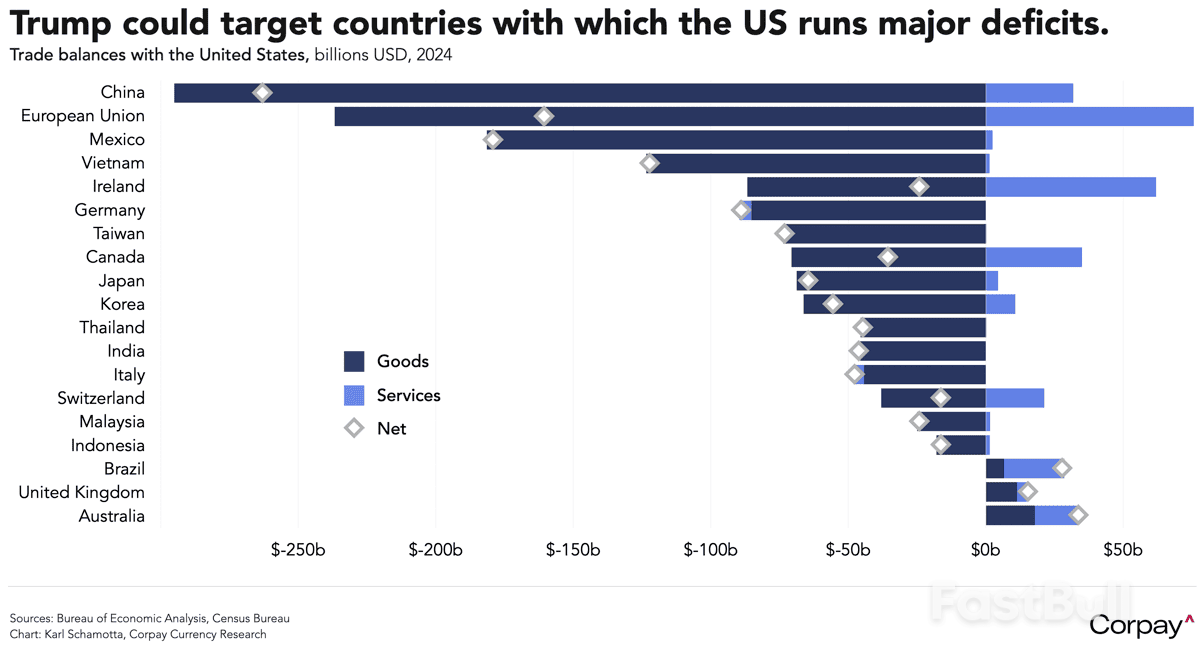
          The Pound's 'haven' status in the tariff trade is largely because of the UK's favourable trade relationship with the U.S., which means the world's biggest economy often runs a trade surplus in goods with the UK.
          This puts it well down the list of problem countries that the U.S. wants to reorganise its trade relationships).
          "There are a number of scenarios for the impact on the UK, but our sense is that the UK escapes the worst excesses of tariffs due largely to a relatively benign trade position with the US. That should be GBP supportive," says Kamal Sharma, FX Strategist at Bank of America.
          "While no outright bullish GBP theme has emerged, we have noticed clients using GBP as a numerator more and more. EURGBP puts, GBPAUD calls, and GBPCAD calls have all been going through," says a new note from Spectra Markets.
          Pound Sterling 'Safe Haven' Status to Be Tested_1

          Above: The UK and Australia stand out as running rare goods trade deficits, image courtesy of Corpay's Karl Schamotta.

          However, there are some significant tail risks for foreign exchange markets more broadly, and the Pound specifically.
          One of these is the prospect of a flat blanket tariff, which is said to be increasingly favoured by the administration. This would pose significant problems for UK exporters and could challenge the Pound's ongoing resilience to tariffs.
          If the Pound has benefited thus far, it is logical to assume that any unwind of a 'safe-haven' premium could be notable.
          We would also be wary that the tariffs, if severe enough, trigger a market rout that would hurt the Pound against the traditional safe havens likes the Dollar, yen and franc.
          The Pound-to-Euro exchange rate would also come under pressure in a broader market rout. However, gains against market-sensitive currencies like the Australian and New Zealand Dollars - as well as developing market names - would also be expected.
          "Talking with clients, the consensus appears to be for 10-15% blanket tariffs (maybe closer to the 10% mark), broadly similar to our house view. However, recent media reporting mentioned a 20% tariff baseline, which would be higher than expectations and risk-off," says Andrzej Szczepaniak, Senior European Economist at Nomura International.
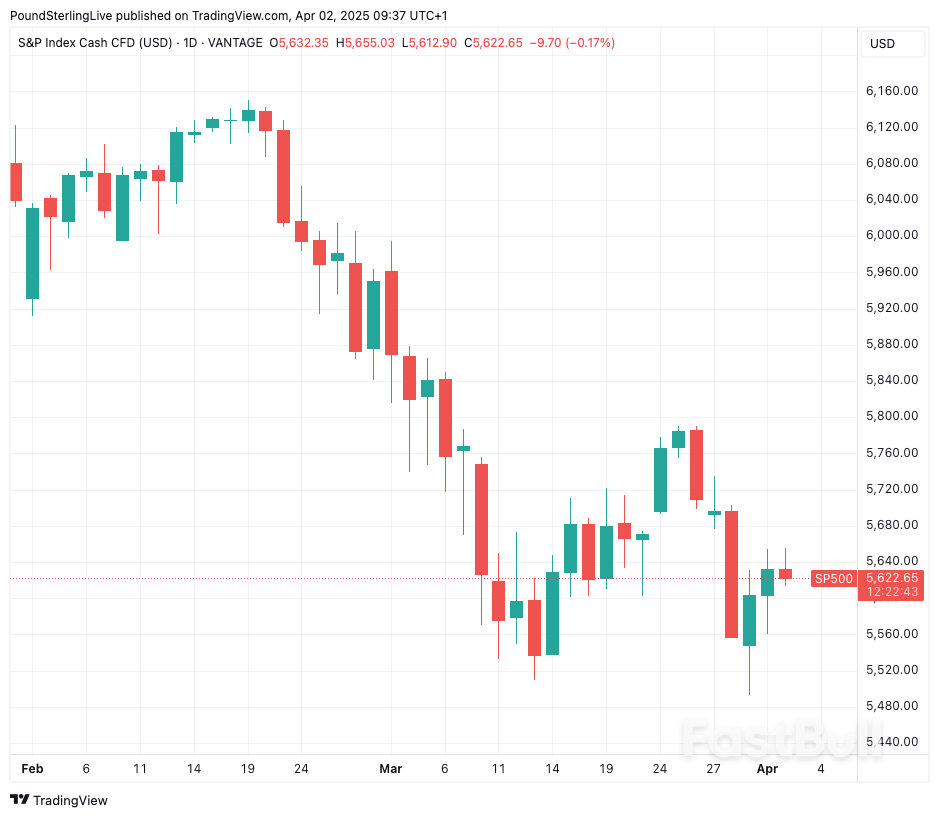
          Pound Sterling 'Safe Haven' Status to Be Tested_2

          Above: S&P 500 shows markets have settled in anticipation of the announcements.

          Trump is poised to unveil sweeping new trade measures on Wednesday, with investors and global partners anxiously awaiting details of a tariff strategy that could reshape U.S. trade relations and roil global markets.
          According to individuals familiar with internal deliberations, the Trump administration is weighing several competing tariff structures, including a tiered system, a customised reciprocal model, and a flat global rate, Bloomberg reported.
          Each approach represents a different method for delivering on the president’s long-promised campaign to "level the playing field" on trade.

          Broad Application to Rope in UK Exports

          Flat-rate levies could apply widely, including to countries with which the U.S. does not have a trade imbalance, Bloomberg reported. This would include the UK, which the U.S. enjoys a rare trade surplus with.
          While simple to administer, such a model risks triggering broad retaliatory action and complicating existing trade relationships.
          Sources cited by Bloomberg noted that the president has not made a final decision, even as the announcement looms. The event is scheduled to take place in the White House Rose Garden at 4 p.m. Eastern Time.
          While the tariff move has been framed as pro-worker and revenue-generating, questions persist as to whether the goal is negotiating leverage or a permanent shift in trade strategy.
          Trump’s aides are reportedly aiming to raise $700 billion annually in tariff revenue, a figure that would mark one of the most aggressive trade policy pivots in modern U.S. history.
          The market’s reaction so far has included sell-offs in equities, pressure on the dollar, and elevated caution in the corporate bond market, according to the Financial Times.

          Multiple Models Under Consideration

          Under an alternative tiered approach, countries would be grouped into bands based on their existing tariffs and non-tariff barriers, with levies imposed at either 10% or 20%. The highest rates would target nations deemed the most egregious offenders in terms of protectionist practices.
          An alternative reciprocal model—earlier touted by administration officials—would set individualised tariffs that mirror the trade barriers imposed on U.S. exports by specific countries.
          Though this strategy had gained traction in recent weeks, it is reportedly no longer the leading option under discussion.

          Tariffs to Take Immediate Effect

          White House Press Secretary Karoline Leavitt stated the tariffs would be "effective immediately," while Treasury Secretary Scott Bessent suggested the rates could act as a cap, with countries given the opportunity to negotiate them down post-announcement.
          According to the Financial Times, investors remain on edge, with many fund managers opting to reduce risk exposure ahead of the event. Market volatility has ticked up in recent days, with the VIX index rising to 22, above its long-term average.
          "People are doing aggressively nothing," said Ed Al-Hussainy of Columbia Threadneedle Investments, reflecting a general market hesitancy as traders await clarity.

          Potential Disruption and Ongoing Uncertainty

          Tariffs are expected to apply even to goods already en route to the U.S., raising immediate concerns for supply chains. While the official line suggests midnight enforcement, logistical complexities may delay implementation, as seen with earlier measures targeting auto and Canadian imports.
          The administration’s internal debate remains intense, reflecting uncertainty not only in strategy but in policy objectives.
          As TD Cowen’s Christopher Krueger put it, “It should answer the biggest question from markets, which is if the tariffs are a means to an end, or the end.”

          Source: Poundsterlinglive

          To stay updated on all economic events of today, please check out our Economic calendar
          Risk Warnings and Disclaimers
          You understand and acknowledge that there is a high degree of risk involved in trading. Following any strategies or investment methods may lead to potential losses. The content on the site is provided by our contributors and analysts for information purposes only. You are solely responsible for determining whether any trading assets, securities, strategy, or any other product is suitable for investing based on your own investment objectives and financial situation.
          Add to Favorites
          Share
          FastBull
          Copyright © 2025 FastBull Ltd

          728 RM B 7/F GEE LOK IND BLDG NO 34 HUNG TO RD KWUN TONG KLN HONG KONG

          TelegramInstagramTwitterfacebooklinkedin
          App Store Google Play Google Play
          Products
          Charts

          Chats

          Q&A with Experts
          Screeners
          Economic Calendar
          Data
          Tools
          Membership
          Features
          Function
          Markets
          Copy Trading
          Latest Signals
          Contests
          News
          Analysis
          24/7
          Columns
          Education
          Company
          Careers
          About Us
          Contact Us
          Advertising
          Help Center
          Feedback
          User Agreement
          Privacy Policy
          Business

          White Label

          Data API

          Web Plug-ins

          Poster Maker

          Affiliate Program

          Risk Disclosure

          The risk of loss in trading financial instruments such as stocks, FX, commodities, futures, bonds, ETFs and crypto can be substantial. You may sustain a total loss of the funds that you deposit with your broker. Therefore, you should carefully consider whether such trading is suitable for you in light of your circumstances and financial resources.

          No decision to invest should be made without thoroughly conducting due diligence by yourself or consulting with your financial advisors. Our web content might not suit you since we don't know your financial conditions and investment needs. Our financial information might have latency or contain inaccuracy, so you should be fully responsible for any of your trading and investment decisions. The company will not be responsible for your capital loss.

          Without getting permission from the website, you are not allowed to copy the website's graphics, texts, or trademarks. Intellectual property rights in the content or data incorporated into this website belong to its providers and exchange merchants.

          Not Logged In

          Log in to access more features

          FastBull Membership

          Not yet

          Purchase

          Become a signal provider
          Help Center
          Customer Service
          Dark Mode
          Price Up/Down Colors

          Log In

          Sign Up

          Position
          Layout
          Fullscreen
          Default to Chart
          The chart page opens by default when you visit fastbull.com