• Trade
  • Markets
  • Copy
  • Contests
  • News
  • 24/7
  • Calendar
  • Q&A
  • Chats
Trending
Screeners
SYMBOL
LAST
BID
ASK
HIGH
LOW
NET CHG.
%CHG.
SPREAD
SPX
S&P 500 Index
6827.42
6827.42
6827.42
6899.86
6801.80
-73.58
-1.07%
--
DJI
Dow Jones Industrial Average
48458.04
48458.04
48458.04
48886.86
48334.10
-245.98
-0.51%
--
IXIC
NASDAQ Composite Index
23195.16
23195.16
23195.16
23554.89
23094.51
-398.69
-1.69%
--
USDX
US Dollar Index
97.950
98.030
97.950
98.500
97.950
-0.370
-0.38%
--
EURUSD
Euro / US Dollar
1.17394
1.17409
1.17394
1.17496
1.17192
+0.00011
+ 0.01%
--
GBPUSD
Pound Sterling / US Dollar
1.33707
1.33732
1.33707
1.33997
1.33419
-0.00148
-0.11%
--
XAUUSD
Gold / US Dollar
4299.39
4299.39
4299.39
4353.41
4257.10
+20.10
+ 0.47%
--
WTI
Light Sweet Crude Oil
57.233
57.485
57.233
58.011
56.969
-0.408
-0.71%
--

Community Accounts

Signal Accounts
--
Profit Accounts
--
Loss Accounts
--
View More

Become a signal provider

Sell trading signals to earn additional income

View More

Guide to Copy Trading

Get started with ease and confidence

View More

Signal Accounts for Members

All Signal Accounts

Best Return
  • Best Return
  • Best P/L
  • Best MDD
Past 1W
  • Past 1W
  • Past 1M
  • Past 1Y

All Contests

  • All
  • Trump Updates
  • Recommend
  • Stocks
  • Cryptocurrencies
  • Central Banks
  • Featured News
Top News Only
Share

Ukraine's Navy Says Russian Drone Attack Hit Civilian Turkish Vessel Carrying Sunflower Oil To Egypt On Saturday

Share

Israeli Military Says It Put Planned Strike On South Lebanon Site On Hold After Lebanese Army Requested Access

Share

Norwegian Nobel Committee: Calls On The Belarusian Authorities To Release All Political Prisoners

Share

Norwegian Nobel Committee: His Freedom Is A Deeply Welcome And Long-Awaited Moment

Share

Ukraine Says It Received 114 Prisoners From Belarus

Share

USA Embassy In Lithuania: Maria Kalesnikava Is Not Going To Vilnius

Share

USA Embassy In Lithuania: Other Prisoners Are Being Sent From Belarus To Ukraine

Share

Ukraine President Zelenskiy: Five Ukrainians Released By Belarus In US-Brokered Deal

Share

USA Vilnius Embassy: USA Stands Ready For "Additional Engagement With Belarus That Advances USA Interests"

Share

USA Vilnius Embassy: Belarus, USA, Other Citizens Among The Prisoners Released Into Lithuania

Share

USA Vilnius Embassy: USA Will Continue Diplomatic Efforts To Free The Remaining Political Prisoners In Belarus

Share

USA Vilnius Embassy: Belarus Releases 123 Prisoners Following Meeting Of President Trump's Envoy Coale And Belarus President Lukashenko

Share

USA Vilnius Embassy: Masatoshi Nakanishi, Aliaksandr Syrytsa Are Among The Prisoners Released By Belarus

Share

USA Vilnius Embassy: Maria Kalesnikava And Viktor Babaryka Are Among The Prisoners Released By Belarus

Share

USA Vilnius Embassy: Nobel Peace Prize Laureate Ales Bialiatski Is Among The Prisoners Released By Belarus

Share

Belarusian Presidential Administration Telegram Channel: Lukashenko Has Pardoned 123 Prisoners As Part Of Deal With US

Share

Two Local Syrian Officials: Joint US-Syrian Military Patrol In Central Syria Came Under Fire From Unknown Assailants

Share

Israeli Military Says It Targeted 'Key Hamas Terrorist' In Gaza City

Share

Rwanda's Actions In Eastern Drc Are A Clear Violation Of Washington Accords Signed By President Trump - Secretary Of State Rubio

Share

Israeli Military Issues Evacuation Warning In Southern Lebanon Village Ahead Of Strike - Spokesperson On X

TIME
ACT
FCST
PREV
U.K. Trade Balance Non-EU (SA) (Oct)

A:--

F: --

P: --

U.K. Trade Balance (Oct)

A:--

F: --

P: --

U.K. Services Index MoM

A:--

F: --

P: --

U.K. Construction Output MoM (SA) (Oct)

A:--

F: --

P: --

U.K. Industrial Output YoY (Oct)

A:--

F: --

P: --

U.K. Trade Balance (SA) (Oct)

A:--

F: --

P: --

U.K. Trade Balance EU (SA) (Oct)

A:--

F: --

P: --

U.K. Manufacturing Output YoY (Oct)

A:--

F: --

P: --

U.K. GDP MoM (Oct)

A:--

F: --

P: --

U.K. GDP YoY (SA) (Oct)

A:--

F: --

P: --

U.K. Industrial Output MoM (Oct)

A:--

F: --

P: --

U.K. Construction Output YoY (Oct)

A:--

F: --

P: --

France HICP Final MoM (Nov)

A:--

F: --

P: --

China, Mainland Outstanding Loans Growth YoY (Nov)

A:--

F: --

P: --

China, Mainland M2 Money Supply YoY (Nov)

A:--

F: --

P: --

China, Mainland M0 Money Supply YoY (Nov)

A:--

F: --

P: --

China, Mainland M1 Money Supply YoY (Nov)

A:--

F: --

P: --

India CPI YoY (Nov)

A:--

F: --

P: --

India Deposit Gowth YoY

A:--

F: --

P: --

Brazil Services Growth YoY (Oct)

A:--

F: --

P: --

Mexico Industrial Output YoY (Oct)

A:--

F: --

P: --

Russia Trade Balance (Oct)

A:--

F: --

P: --

Philadelphia Fed President Henry Paulson delivers a speech
Canada Building Permits MoM (SA) (Oct)

A:--

F: --

P: --

Canada Wholesale Sales YoY (Oct)

A:--

F: --

P: --

Canada Wholesale Inventory MoM (Oct)

A:--

F: --

P: --

Canada Wholesale Inventory YoY (Oct)

A:--

F: --

P: --

Canada Wholesale Sales MoM (SA) (Oct)

A:--

F: --

P: --

Germany Current Account (Not SA) (Oct)

A:--

F: --

P: --

U.S. Weekly Total Rig Count

A:--

F: --

P: --

U.S. Weekly Total Oil Rig Count

A:--

F: --

P: --

Japan Tankan Large Non-Manufacturing Diffusion Index (Q4)

--

F: --

P: --

Japan Tankan Small Manufacturing Outlook Index (Q4)

--

F: --

P: --

Japan Tankan Large Non-Manufacturing Outlook Index (Q4)

--

F: --

P: --

Japan Tankan Large Manufacturing Outlook Index (Q4)

--

F: --

P: --

Japan Tankan Small Manufacturing Diffusion Index (Q4)

--

F: --

P: --

Japan Tankan Large Manufacturing Diffusion Index (Q4)

--

F: --

P: --

Japan Tankan Large-Enterprise Capital Expenditure YoY (Q4)

--

F: --

P: --

U.K. Rightmove House Price Index YoY (Dec)

--

F: --

P: --

China, Mainland Industrial Output YoY (YTD) (Nov)

--

F: --

P: --

China, Mainland Urban Area Unemployment Rate (Nov)

--

F: --

P: --

Saudi Arabia CPI YoY (Nov)

--

F: --

P: --

Euro Zone Industrial Output YoY (Oct)

--

F: --

P: --

Euro Zone Industrial Output MoM (Oct)

--

F: --

P: --

Canada Existing Home Sales MoM (Nov)

--

F: --

P: --

Euro Zone Total Reserve Assets (Nov)

--

F: --

P: --

U.K. Inflation Rate Expectations

--

F: --

P: --

Canada National Economic Confidence Index

--

F: --

P: --

Canada New Housing Starts (Nov)

--

F: --

P: --

U.S. NY Fed Manufacturing Employment Index (Dec)

--

F: --

P: --

U.S. NY Fed Manufacturing Index (Dec)

--

F: --

P: --

Canada Core CPI YoY (Nov)

--

F: --

P: --

Canada Manufacturing Unfilled Orders MoM (Oct)

--

F: --

P: --

Canada Manufacturing New Orders MoM (Oct)

--

F: --

P: --

Canada Core CPI MoM (Nov)

--

F: --

P: --

Canada Manufacturing Inventory MoM (Oct)

--

F: --

P: --

Canada CPI YoY (Nov)

--

F: --

P: --

Canada CPI MoM (Nov)

--

F: --

P: --

Canada CPI YoY (SA) (Nov)

--

F: --

P: --

Canada Core CPI MoM (SA) (Nov)

--

F: --

P: --

Q&A with Experts
    • All
    • Chatrooms
    • Groups
    • Friends
    Connecting
    .
    .
    .
    Type here...
    Add Symbol or Code

      No matching data

      All
      Trump Updates
      Recommend
      Stocks
      Cryptocurrencies
      Central Banks
      Featured News
      • All
      • Russia-Ukraine Conflict
      • Middle East Flashpoint
      • All
      • Russia-Ukraine Conflict
      • Middle East Flashpoint
      Search
      Products

      Charts Free Forever

      Chats Q&A with Experts
      Screeners Economic Calendar Data Tools
      Membership Features
      Data Warehouse Market Trends Institutional Data Policy Rates Macro

      Market Trends

      Market Sentiment Order Book Forex Correlations

      Top Indicators

      Charts Free Forever
      Markets

      News

      News Analysis 24/7 Columns Education
      From Institutions From Analysts
      Topics Columnists

      Latest Views

      Latest Views

      Trending Topics

      Top Columnists

      Latest Update

      Signals

      Copy Rankings Latest Signals Become a signal provider AI Rating
      Contests
      Brokers

      Overview Brokers Assessment Rankings Regulators News Claims
      Broker listing Forex Brokers Comparison Tool Live Spread Comparison Scam
      Q&A Complaint Scam Alert Videos Tips to Detect Scam
      More

      Business
      Events
      Careers About Us Advertising Help Center

      White Label

      Data API

      Web Plug-ins

      Affiliate Program

      Awards Institution Evaluation IB Seminar Salon Event Exhibition
      Vietnam Thailand Singapore Dubai
      Fans Party Investment Sharing Session
      FastBull Summit BrokersView Expo
      Recent Searches
        Top Searches
          Markets
          News
          Analysis
          User
          24/7
          Economic Calendar
          Education
          Data
          • Names
          • Latest
          • Prev

          View All

          No data

          Scan to Download

          Faster Charts, Chat Faster!

          Download App
          English
          • English
          • Español
          • العربية
          • Bahasa Indonesia
          • Bahasa Melayu
          • Tiếng Việt
          • ภาษาไทย
          • Français
          • Italiano
          • Türkçe
          • Русский язык
          • 简中
          • 繁中
          Open Account
          Search
          Products
          Charts Free Forever
          Markets
          News
          Signals

          Copy Rankings Latest Signals Become a signal provider AI Rating
          Contests
          Brokers

          Overview Brokers Assessment Rankings Regulators News Claims
          Broker listing Forex Brokers Comparison Tool Live Spread Comparison Scam
          Q&A Complaint Scam Alert Videos Tips to Detect Scam
          More

          Business
          Events
          Careers About Us Advertising Help Center

          White Label

          Data API

          Web Plug-ins

          Affiliate Program

          Awards Institution Evaluation IB Seminar Salon Event Exhibition
          Vietnam Thailand Singapore Dubai
          Fans Party Investment Sharing Session
          FastBull Summit BrokersView Expo

          EU To Set Out Plans To Halt Russian Gas Imports By End-2027

          Catherine Richards

          Economic

          Commodity

          Energy

          Summary:

          The European Union will publish plans on Tuesday to ban new Russian gas deals by the end of this year, and phase out existing contracts with Moscow by the end of 2027, three EU officials told Reuters.
          The European Union will publish plans on Tuesday to ban new Russian gas deals by the end of this year, and phase out existing contracts with Moscow by the end of 2027, three EU officials told Reuters.
          The bloc had set a non-binding aim to end Russian fossil fuel imports by 2027 after Moscow's full-scale invasion of Ukraine in 2022.
          The EU Commission's plan includes a commitment to propose in June a ban on new Russian gas import deals and spot contracts by the end of 2025, the officials told Reuters.
          It will also make a legal proposal to ban Russian gas and liquefied natural gas imports under existing contracts by the end of 2027, said the officials, who wished to remain anonymous to discuss the confidential plans, which could still be changed before they are published.
          The legal proposals would need approval from the European Parliament and a reinforced majority of EU countries.
          The EU has imposed sanctions on Russian coal and seaborne oil shipments, but not on gas due to opposition from Slovakia and Hungary, which receive Russian pipeline supplies and say switching to other suppliers would hike energy prices. Sanctions require unanimous approval from all 27 EU countries.
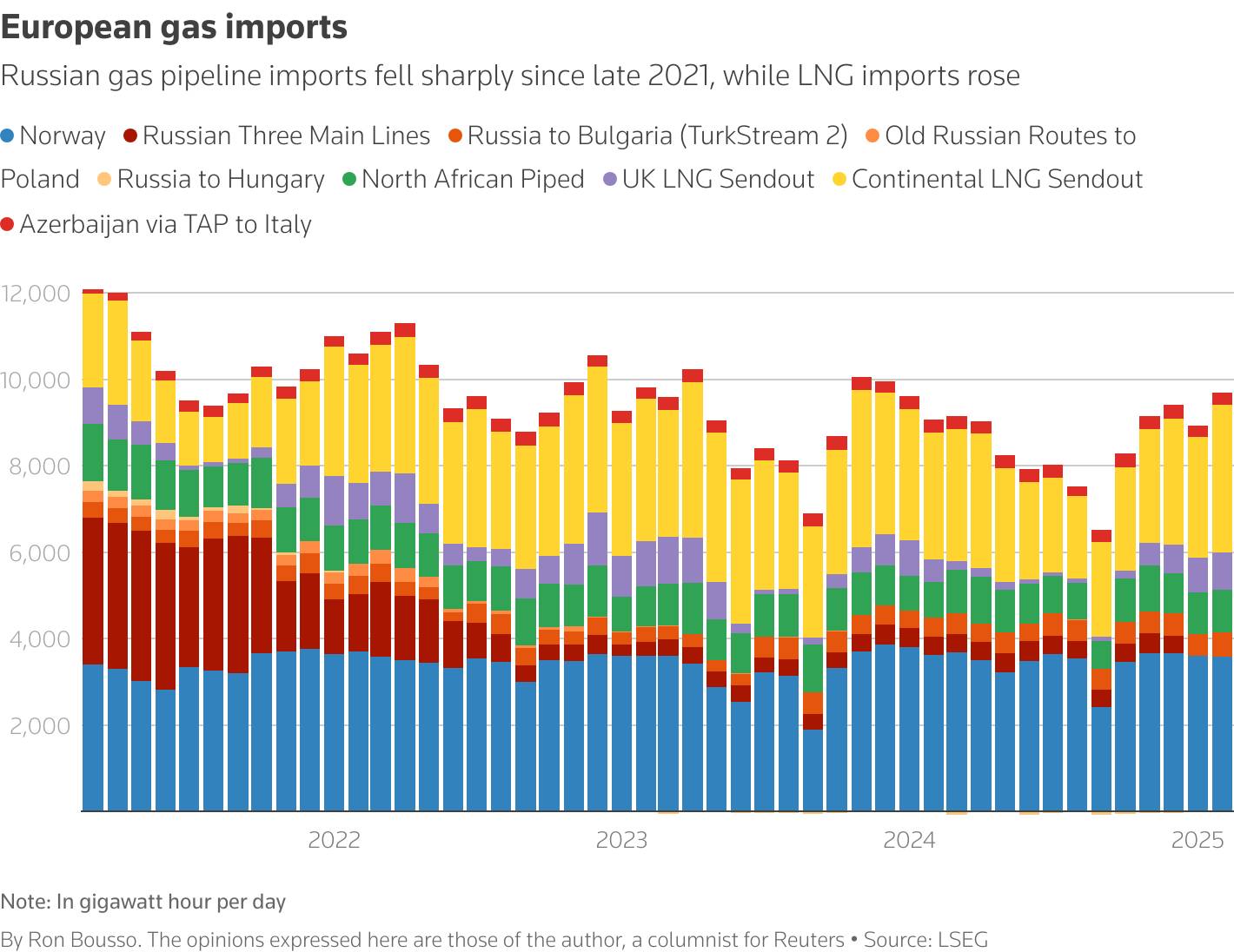
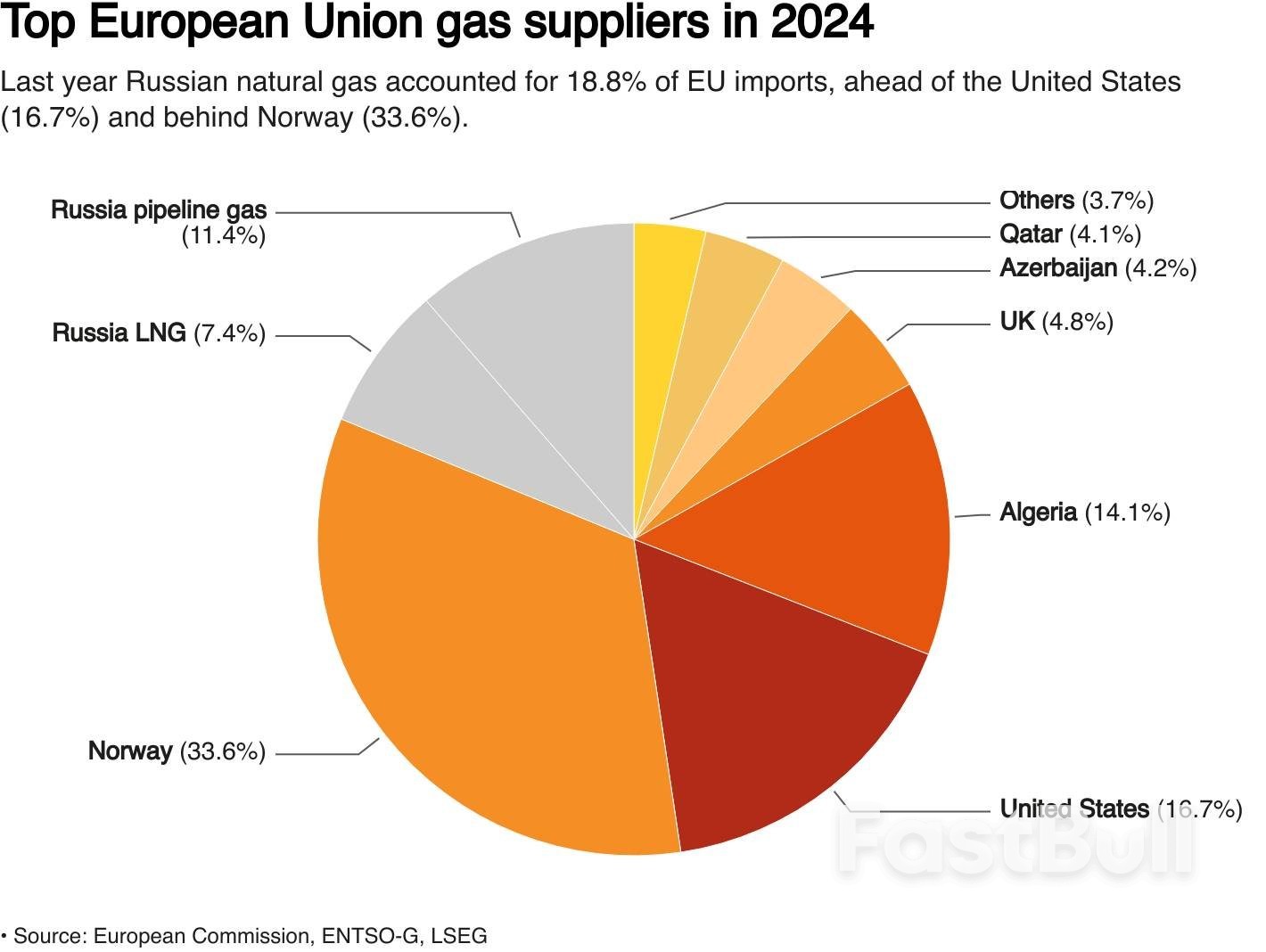
          Around 19% of Europe's gas still comes from Russia, via the TurkStream pipeline and liquefied natural gas shipments.
          That's far below the roughly 40% Russia supplied before 2022. But European buyers still have "take-or-pay" contracts with Gazprom which require those that refuse gas deliveries to pay for much of the contracted volumes.
          The Commission has been assessing legal options to allow European companies to break existing Russian gas contracts without facing financial penalties.
          The EU officials did not specify how Brussels intends to do this. Lawyers have said it would be difficult to invoke "force majeure" to quit these deals, and that buyers could face penalties or arbitration for doing so.

          Russian gas pipeline imports fell sharply since late 2021, while LNG imports rose

          Uncontracted "spot" purchases made up around 31% of the Russian LNG Europe bought last year, Rystad Energy data show.
          As it attempts to cut decades-old energy ties with Russia, the European Commission has signalled willingness to buy more U.S. LNG, a step President Donald Trump has demanded from Europe as a way of shrinking its trade surplus with the United States.

          A pie chart showing the various natural gas suppliers to the European Union in 2024. Norway 33.6%, Russia 18.8%, United States 16.7%, Algeria 14.1%, United Kingdom 4.8%, Azerbaijan 4.2%, Qatar 4.1%, Others 3.7%.

          The Commission is also concerned about energy prices, and has said any measures to restrict Russian energy imports must hurt Moscow more than the EU, and take into account the impact on fuel costs.
          The U.S. is pushing Russia for a peace deal with Ukraine, which, if reached, may reopen the door for Russian energy and ease sanctions.
          The European Commission had originally planned to publish its roadmap in March, but delayed it in part due to uncertainty around these developments.

          Source: Reuters

          To stay updated on all economic events of today, please check out our Economic calendar
          Risk Warnings and Disclaimers
          You understand and acknowledge that there is a high degree of risk involved in trading. Following any strategies or investment methods may lead to potential losses. The content on the site is provided by our contributors and analysts for information purposes only. You are solely responsible for determining whether any trading assets, securities, strategy, or any other product is suitable for investing based on your own investment objectives and financial situation.
          Add to Favorites
          Share

          Global Jitters Cool India’s IPO Momentum as Firms Postpone Listings

          Gerik

          Economic

          Stocks

          Indian IPO Market Loses Its Shine Amid Global Uncertainty

          India’s IPO landscape, which ranked among the world’s most active last year, has entered a subdued phase. At least two upcoming IPOs—those of Avanse Financial Services and Anthem Biosciences, worth a combined $759 million—are reportedly being postponed, joining a growing list of companies hesitating to go public. According to investment bankers, the weakening risk appetite among institutional and retail investors, largely due to global trade friction and geopolitical tension, is driving this slowdown.
          The situation reflects broader concerns about the economic climate. U.S. President Donald Trump’s escalating tariff policies and the lingering India-Pakistan tensions have increased volatility, clouding the outlook for capital markets in emerging economies. In response, many firms are pressing pause on capital-raising efforts, waiting for greater market stability before launching IPOs.

          Data Points to Broad-Based Decline in Public Listings

          India has seen a 58% drop in IPO activity on its main exchanges so far in 2025, according to data from PRIME Database. Total IPO fundraising across all platforms has declined 18%, per LSEG figures. Currently, 58 companies with regulatory approval are yet to initiate their public offerings. With many of these clearances set to expire soon, affected firms face the choice of restarting the IPO process or seeking regulatory extensions—both of which carry financial and procedural burdens.
          This disruption marks a sharp departure from 2024, when India trailed only the U.S. in IPO volume. Now, uncertainty over macroeconomic policy and tariff spillovers has disrupted the momentum that once positioned India as a global IPO hotspot.

          Investor Sentiment Turns Cautious Despite Full Subscription for Ather Energy

          The muted performance of Ather Energy's debut on May 6 served as a real-time indicator of cautious investor mood. Despite achieving full subscription for its $352 million IPO, the electric vehicle company had to slash its valuation target by 44% and reduce the offering size. Pre-market trading saw shares hovering near the issue price of ₹321 ($3.81), signaling a lackluster start.
          Retail investors have become particularly wary. After suffering losses during recent market swings, their appetite for new listings has diminished, resulting in tepid responses to offerings that just months ago might have been met with exuberance.

          Bankers Advise Patience, Realignment on Valuations

          In the face of increased volatility and valuation compression, investment bankers are urging potential IPO candidates to adjust expectations. Bhavesh Shah, managing director at Equirus, outlined a critical trade-off: “If the issue is important, you may need to reconsider valuations. If valuation is important, then waiting is your best option.”
          Other firms are already deferring timelines. Online automobile platform Droom, for example, has opted not to file draft IPO papers by June as originally planned, citing prolonged uncertainty. These decisions illustrate how pervasive caution has become, even among high-profile, tech-oriented ventures.
          The retreat in India’s IPO momentum underscores how global macroeconomic policy—particularly erratic tariff decisions—can ripple into emerging markets and reshape capital-raising strategies. With more companies delaying or downsizing offerings, the IPO pipeline remains crowded but frozen. Unless global and regional stability returns, and investor sentiment recovers, India’s public markets may remain in a state of cautious paralysis well into the second half of 2025.

          Source: Reuters

          To stay updated on all economic events of today, please check out our Economic calendar
          Risk Warnings and Disclaimers
          You understand and acknowledge that there is a high degree of risk involved in trading. Following any strategies or investment methods may lead to potential losses. The content on the site is provided by our contributors and analysts for information purposes only. You are solely responsible for determining whether any trading assets, securities, strategy, or any other product is suitable for investing based on your own investment objectives and financial situation.
          Add to Favorites
          Share

          Dollar Slide Pauses as Markets Weigh Trade Uncertainty and Asian FX Gains

          Gerik

          Forex

          Economic

          Dollar Stabilizes After Wave of Selling, But Trade Concerns Persist

          Markets opened Tuesday with a tempered tone as the U.S. dollar found temporary support following a sharp, two-day selloff driven by Asian currency surges—particularly the Taiwan dollar. The rally in regional currencies had previously sparked widespread dollar repositioning, reflecting heightened sensitivity to Washington's unpredictable tariff strategy. However, with no confirmed breakthroughs in trade negotiations, the positive sentiment that followed Beijing’s openness to U.S. talks last week has begun to wane.
          Investors remain cautious, interpreting the dollar’s pause not as a reversal, but as a breather before more clarity emerges—especially from the Federal Reserve’s policy decision due Wednesday. European markets are also expected to open flat, with futures signaling little momentum as traders await macroeconomic signals and hard data.

          Asian Currencies Drive Global FX Narrative

          The Taiwan dollar’s nearly 3% rally against the greenback on Monday remains a headline driver, underscoring the powerful repricing in regional FX markets. Other currencies also joined the trend: the Malaysian ringgit surged 1.5% on Monday, reaching its strongest point since October, though it has since pulled back slightly. The Hong Kong Monetary Authority once again intervened to maintain the peg, stepping into markets for the fourth time this month as the local currency tested the upper limit of its trading band.
          Market speculation is growing that some Asian economies are deliberately allowing their currencies to appreciate as leverage in ongoing or upcoming trade negotiations with the U.S., potentially using FX strength to signal policy flexibility in return for tariff concessions.
          While this strategy may offer diplomatic benefits, it also invites risks—particularly for export-driven economies. Rapid currency appreciation can undermine export competitiveness even as it helps dampen imported inflation and reduce dollar-denominated debt burdens.

          European Focus: PMI Data and Trade-Sensitive Sectors

          In Europe, attention is shifting to the release of April PMI figures for France, Germany, the UK, and the broader eurozone. These indicators are expected to shed light on how the region’s industrial activity is coping with global trade disruptions.
          Sectors exposed to U.S. trade policy—such as automotive—are under scrutiny. Ford Motor's decision to suspend its annual guidance due to U.S. policy uncertainty reverberated across the industry and put pressure on European carmakers. Meanwhile, earnings reports from Ferrari and Telenor are due, adding to a mixed outlook for equities.

          Fed Outlook: Message More Important Than Action

          Although the Federal Reserve is widely expected to hold interest rates steady at its policy meeting this week, investors will be parsing the language of its statement closely. The central bank is navigating a complex environment where inflation pressures—exacerbated by tariffs—are building, but growth momentum is fragile.
          Economists expect a "hawkish hold," signaling concern about inflation without a readiness to hike further. Traders are still pricing in 75 basis points of rate cuts for 2025, with the first move potentially in July, based on LSEG data.
          The current market backdrop is defined by hesitation. While the U.S. dollar's recent losses appear to have stalled, investor positioning remains vulnerable to headline volatility, especially related to trade policy. Asian currency strength, driven by both technical positioning and diplomatic signaling, has shifted the center of gravity in global FX markets. As the Federal Reserve, European data, and tariff headlines converge, this week could redefine near-term market sentime

          Source: Reuters

          To stay updated on all economic events of today, please check out our Economic calendar
          Risk Warnings and Disclaimers
          You understand and acknowledge that there is a high degree of risk involved in trading. Following any strategies or investment methods may lead to potential losses. The content on the site is provided by our contributors and analysts for information purposes only. You are solely responsible for determining whether any trading assets, securities, strategy, or any other product is suitable for investing based on your own investment objectives and financial situation.
          Add to Favorites
          Share

          Federal Reserve To Maintain Interest Rates, Weak Dollar Expected

          Grace Montgomery

          Cryptocurrency

          Central Bank

          Economic

          Key Points:
          ● Federal Reserve to maintain interest rates affecting dollar value predictions.
          ● Market trends suggest a declining dollar, impacting US economic prospects.
          ● Interest rate stability aligns with cautious economic monitoring amid tariffs.
          The Federal Reserve is set to maintain interest rates during its meeting on May 7, 2025, amid economic uncertainties. This move aligns with earlier projections from experts like UniCredit's Roberto Mialich and signals continued caution concerning tariff impacts.
          The Federal Reserve's stance on holding interest rates steady highlights its cautious approach amid unclear economic signals. Observers predict a weak dollar, aligning with market trends favoring downside bets on the currency.

          Fed's Interest Rate Hold Pressures U.S. Dollar

          The upcoming Federal Reserve meeting has the financial markets attentively watching the decision to maintain current interest rates. Analysts, including Roberto Mialich of UniCredit, expect this course of action to offer minimal support for the U.S. dollar. Federal Reserve Chairman Jerome Powell previously indicated a waiting approach to assess tariffs' effects.
          Market trends show an inclination towards a weaker dollar, with the options market favoring bets on its decline. Investors remain cautious, and the EUR/USD is forecasted to trade around the 1.13 mark.
          "The Federal Reserve will likely keep interest rates unchanged at its upcoming meeting on Wednesday, May 7, 2025." - Roberto Mialich, Foreign Exchange Analyst, UniCredit Bank.

          Digital Assets Stay Resilient Amid Rate Stability

          Did you know? The Federal Reserve's interest rate decisions can significantly influence global currency markets.
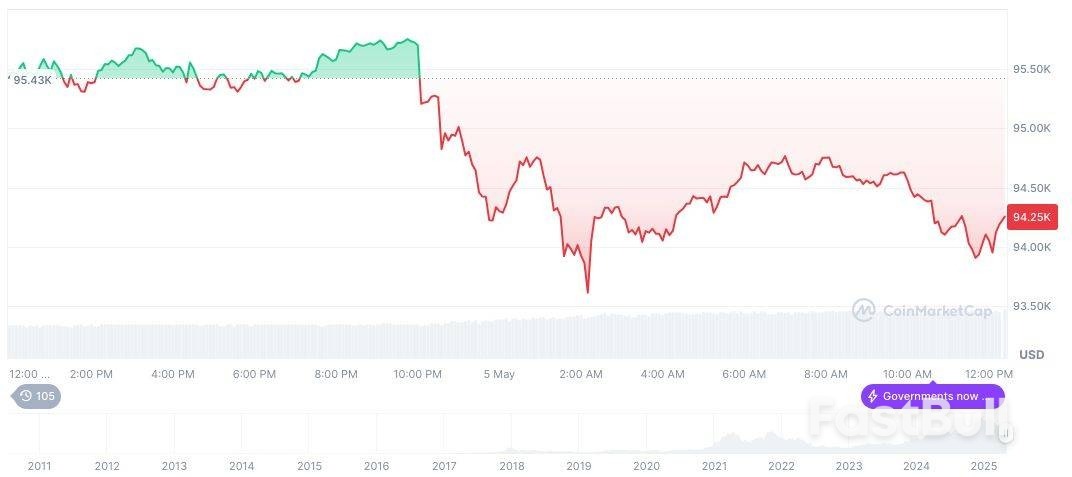
          According to CoinMarketCap, Bitcoin (BTC) currently trades at $94,387.86 with a market cap of $1.87 trillion, dominating 63.87% of the market. Trading volume in the past 24 hours reached $23.27 billion, reflecting an 11.16% change. Despite minor fluctuations, Bitcoin has shown modest short-term resilience.

          Bitcoin(BTC), daily chart, screenshot on CoinMarketCap at 05:49 UTC on May 6, 2025.

          Insights from the Coincu research team suggest that sustained interest rates may prolong uncertainty, maintaining pressure on digital assets. Regulatory outcomes could influence future economic assessments, with historical trends suggesting cautious optimism.

          Source: CryptoSlate

          To stay updated on all economic events of today, please check out our Economic calendar
          Risk Warnings and Disclaimers
          You understand and acknowledge that there is a high degree of risk involved in trading. Following any strategies or investment methods may lead to potential losses. The content on the site is provided by our contributors and analysts for information purposes only. You are solely responsible for determining whether any trading assets, securities, strategy, or any other product is suitable for investing based on your own investment objectives and financial situation.
          Add to Favorites
          Share

          Global Markets Pause as Dollar Stabilizes and Spotlight Shifts to Asian Currencies

          Gerik

          Forex

          Stocks

          Cautious Markets Await Fed Clarity as Tariff Uncertainty Lingers

          On May 6, global financial markets opened the week on a tentative note. Equities hovered in narrow ranges while the U.S. dollar attempted a modest recovery, especially against surging Asian currencies. The day’s trading was shaped by investors recalibrating expectations amid U.S. tariff volatility, with markets awaiting Wednesday’s Federal Reserve policy decision for clearer guidance on the interest rate outlook.
          President Donald Trump’s unpredictable tariff maneuvers—including a sudden 100% tax on foreign-produced films and ongoing uncertainty over trade negotiations with China—continued to weigh on market sentiment. While headlines hint at potential breakthroughs in trade talks, details remain vague, leaving investors to trade on shifting signals rather than concrete developments.

          Taiwan Dollar and Asian FX Take Center Stage

          The sharp strengthening of several Asian currencies has become a focal point for investors, signaling a broad repositioning away from the U.S. dollar. Bloomberg’s Asia currency index recently reached a six-month high, led by the Taiwan dollar, which touched a near three-year high on Monday at 29.59 before stabilizing around 30.185 per U.S. dollar on Tuesday. The offshore Chinese yuan also strengthened to 7.23 per dollar, its highest since March 20.
          The sudden appreciation in regional currencies is interpreted as both a reaction to tariff expectations and a technical correction. Years of trade surpluses in Asia have created large dollar reserves among exporters and insurers, which are now being reassessed. Charu Chanana, chief strategist at Saxo Bank, warned that further sharp appreciation could trigger a “reverse Asian currency crisis,” where a rapid revaluation disrupts capital flows and triggers bond market volatility.
          Hong Kong's de facto central bank intervened on Tuesday, spending $7.8 billion to prevent the local currency from breaching its dollar peg—highlighting concerns about excessive FX movements. Taiwan’s central bank has also indicated potential intervention should its currency continue to surge uncontrollably.

          Stock Markets React Cautiously Ahead of Trade and Rate Signals

          Equity markets mirrored the broader tone of caution. MSCI’s Asia-Pacific index (excluding Japan) rose 0.2% with Japan closed for a holiday. Chinese stocks rebounded from a break, with the blue-chip CSI 300 gaining nearly 1%, while the Hang Seng index climbed 0.69%. Taiwan’s benchmark was little changed after recent gains.
          European stock futures pointed to a subdued start, with traders eyeing incoming manufacturing data that may reflect the economic cost of U.S. tariffs. U.S. futures also slipped, suggesting that Wall Street is awaiting more definitive developments before making directional bets.

          Traders Look to Fed for Guidance on Inflation-Tariff Nexus

          Attention now turns to the Federal Reserve’s policy meeting, where rates are expected to remain unchanged. However, with U.S. service sector data showing acceleration in April and input prices rising at their fastest pace in over two years, pressure is mounting on the Fed to address inflation risks stemming from tariffs.
          Christian Scherrmann, chief U.S. economist at DWS, noted that the Fed is likely to strike a hawkish tone, not by raising rates, but by signaling a prolonged pause. Market data from LSEG indicates that traders expect a total of 75 basis points of rate cuts this year, with the first move possibly in July—though that outlook remains highly sensitive to both inflation data and tariff developments.

          Commodities Reflect Broader Risk Sentiment

          In the commodities space, oil prices stabilized after hitting four-year lows on Monday following an OPEC+ announcement to raise output. Safe-haven demand pushed gold prices to a one-week high, underscoring market nervousness amid geopolitical and economic uncertainty.
          The current landscape reflects a market in transition. As investors grapple with U.S. trade policy unpredictability and rising inflation pressures, focus has shifted to Asia—where currencies are rallying and policymakers are becoming increasingly active. With the Fed walking a tightrope between inflation control and economic support, this week’s decisions will be pivotal in shaping global risk sentiment for the months ahead.

          Source: Reuters

          Risk Warnings and Disclaimers
          You understand and acknowledge that there is a high degree of risk involved in trading. Following any strategies or investment methods may lead to potential losses. The content on the site is provided by our contributors and analysts for information purposes only. You are solely responsible for determining whether any trading assets, securities, strategy, or any other product is suitable for investing based on your own investment objectives and financial situation.
          Add to Favorites
          Share

          Indonesia's Economic Momentum Stalls as Q1 Growth Hits Three-Year Low

          Gerik

          Economic

          Growth Undershoots Expectations Amid Mounting Economic Headwinds

          Indonesia, Southeast Asia’s largest economy, started 2025 with a disappointing GDP growth rate of 4.87% in the first quarter—the slowest quarterly expansion since Q3 2021. This figure fell short of Reuters’ economist forecast of 4.91% and highlights persistent structural fragilities, as the nation struggles to reignite post-pandemic momentum. President Prabowo Subianto’s ambitious target of 8% annual growth for 2025 is now facing significant skepticism, especially as key growth drivers show signs of exhaustion.
          The economy had managed to hover around the 5% mark since the COVID-19 crisis, but Q1’s performance signals a broader deceleration. Consumer spending, the backbone of Indonesia’s economy, grew only 4.89%—its slowest pace in five quarters—while public investment rose just 2.12%, the weakest in two years. Simultaneously, government expenditure contracted, and inflation-adjusted wages failed to keep up with living costs.

          Weakened Middle Class and Employment Layoffs Limit Recovery

          One of the most concerning trends undermining Indonesia’s growth is the erosion of its middle class. In 2024, the share of Indonesians classified as middle class fell to 17.1%, down from 21.4% in 2019. This contraction reflects longer-term aftershocks of the pandemic, elevated interest rates, and widespread layoffs in labor-intensive industries. In just the first two months of 2025, an estimated 40,000 workers—predominantly from the textile and footwear sectors—were laid off, further curbing household spending and social stability.
          While exports grew 6.93% year-on-year in Q1, led by manufacturing and processing sectors, this external demand alone is insufficient to counterbalance the stagnation in domestic consumption and investment. Furthermore, Indonesia’s reliance on exports to China, which is experiencing its own slowdown, adds vulnerability to external shocks.

          Macroeconomic Uncertainty Grows Amid Rupiah Weakness and Tariff Pressures

          Currency depreciation is adding another layer of complexity. The Indonesian rupiah hit a record low in April, reflecting both global risk aversion and domestic fiscal anxieties. The ambitious social policies proposed by President Prabowo—such as a national free meal program for children—have raised investor concerns about fiscal sustainability.
          Adding to these concerns, Bank Indonesia recently revised its 2025 GDP forecast to a range of 4.7%–5.5%, citing risks associated with U.S. tariff policies and potential disruptions in global trade flows. These projections suggest a heightened awareness of how external economic policy—especially from major trade partners—can influence domestic trajectories in emerging markets like Indonesia.
          Indonesia’s weaker-than-expected Q1 growth underscores both cyclical and systemic challenges. While trade expansion offers some support, the fragility of consumer demand, an eroding middle class, and heightened unemployment point to deeper structural issues. The current environment demands a careful balance between fiscal ambition and macroeconomic discipline. Unless decisive steps are taken to strengthen labor markets, restore investor confidence, and stabilize the currency, Indonesia’s growth aspirations for 2025 may remain out of reach.

          Source: Nikkei Asia

          To stay updated on all economic events of today, please check out our Economic calendar
          Risk Warnings and Disclaimers
          You understand and acknowledge that there is a high degree of risk involved in trading. Following any strategies or investment methods may lead to potential losses. The content on the site is provided by our contributors and analysts for information purposes only. You are solely responsible for determining whether any trading assets, securities, strategy, or any other product is suitable for investing based on your own investment objectives and financial situation.
          Add to Favorites
          Share

          Asian Currencies Surge as Dollar Weakens Amid Trade Truce Signals

          Gerik

          Economic

          Forex

          Regional Currency Strength Reflects Shifting Trade and Rate Expectations

          On May 5, Asian currencies witnessed a sharp rally, buoyed by signs of de-escalation in the U.S.-China trade standoff and growing investor anticipation of regional trade deals. Bloomberg’s Asia currency index rose to its highest level in six months, led by Taiwan’s dollar, which surged more than 5%—marking its strongest level in over two years. The Malaysian ringgit and offshore Chinese yuan also posted multi-month highs, while the Japanese yen, South Korean won, and Singapore dollar gained significant ground.
          The momentum was catalyzed by Donald Trump’s statement a day earlier that he would consider reducing tariffs on Chinese goods “at some point,” citing concerns over stalled bilateral trade. The comment followed months of economic retaliation, where the U.S. imposed tariffs as high as 145% and China responded with 125% duties. Now, with both sides signaling openness to negotiation, market sentiment has turned sharply in favor of Asian assets.

          Capital Rotation and Short Covering Amplify Currency Moves

          The trade optimism triggered a flurry of adjustments in investor positioning. According to Peter Chia of United Overseas Bank, the softer tone in trade rhetoric gave investors confidence to re-enter previously undervalued Asian currencies, especially after months of outflows driven by Trump’s tariff policy. The rapid appreciation also prompted short-sellers to unwind positions, exacerbating the upswing.
          SEB’s chief strategist Namik Immelbäck highlighted that many investors were reducing dollar exposure in anticipation of trade agreements, viewing the current moment as a turning point in cross-border financial flows. In Taiwan, the local currency gained added momentum from strong foreign inflows into chipmaker stocks and exporters hedging against further U.S. dollar depreciation.
          China’s exporters mirrored this sentiment, with a Bloomberg survey showing a shift from stockpiling dollars to holding yuan amid declining faith in the dollar as a safe haven.

          Central Banks Step In to Cool Currency Surge

          The rapid gains have triggered concerns about export competitiveness and prompted some central banks to consider intervention. Taiwan’s central bank issued a rare warning that it may act if the currency appreciates too rapidly, while Hong Kong’s Monetary Authority spent a record HK$46.5 billion (approximately US$6 billion) buying U.S. dollars to temper the local currency’s strength.
          A stronger local currency helps reduce import costs and attract foreign capital, but it simultaneously risks damaging export sectors by making goods more expensive on the global market. This trade-off is especially critical in export-dependent economies like Taiwan, Malaysia, and South Korea.

          Dollar Weakness Rooted in Rate Outlook and Economic Anxiety

          Despite robust U.S. job data released at the end of April, broader market confidence in the dollar remains weak. Hedge fund managers last week were reportedly more bearish on the dollar than at any time since September 2024. Goldman Sachs noted that April’s labor report reflects past economic activity rather than forward-looking strength, and emphasized that uncertainties surrounding future rate cuts and trade policy still weigh heavily on the greenback.
          Morgan Stanley analysts echoed this view, citing the steepening U.S. yield curve as a warning signal of potential inflation pressures or an impending economic slowdown—both of which diminish the appeal of dollar-denominated assets. In such an environment, Asian currencies like the yuan, Taiwan dollar, and ringgit are increasingly viewed as attractive alternatives, particularly in the eyes of exporters and investors seeking yield and regional growth exposure.
          The sudden rally in Asian currencies is more than a technical rebound—it reflects a broader recalibration of investor expectations amid shifting geopolitical and macroeconomic signals. While trade talks and U.S. tariff strategies remain in flux, the market’s response highlights renewed confidence in Asia’s economic outlook and growing skepticism toward the U.S. dollar’s near-term prospects. With central banks now on alert and global capital flows adjusting, Asia’s currency markets are poised for continued volatility and strategic intervention.

          Source: Bloomberg

          To stay updated on all economic events of today, please check out our Economic calendar
          Risk Warnings and Disclaimers
          You understand and acknowledge that there is a high degree of risk involved in trading. Following any strategies or investment methods may lead to potential losses. The content on the site is provided by our contributors and analysts for information purposes only. You are solely responsible for determining whether any trading assets, securities, strategy, or any other product is suitable for investing based on your own investment objectives and financial situation.
          Add to Favorites
          Share
          FastBull
          Copyright © 2025 FastBull Ltd

          728 RM B 7/F GEE LOK IND BLDG NO 34 HUNG TO RD KWUN TONG KLN HONG KONG

          TelegramInstagramTwitterfacebooklinkedin
          App Store Google Play Google Play
          Products
          Charts

          Chats

          Q&A with Experts
          Screeners
          Economic Calendar
          Data
          Tools
          Membership
          Features
          Function
          Markets
          Copy Trading
          Latest Signals
          Contests
          News
          Analysis
          24/7
          Columns
          Education
          Company
          Careers
          About Us
          Contact Us
          Advertising
          Help Center
          Feedback
          User Agreement
          Privacy Policy
          Business

          White Label

          Data API

          Web Plug-ins

          Poster Maker

          Affiliate Program

          Risk Disclosure

          The risk of loss in trading financial instruments such as stocks, FX, commodities, futures, bonds, ETFs and crypto can be substantial. You may sustain a total loss of the funds that you deposit with your broker. Therefore, you should carefully consider whether such trading is suitable for you in light of your circumstances and financial resources.

          No decision to invest should be made without thoroughly conducting due diligence by yourself or consulting with your financial advisors. Our web content might not suit you since we don't know your financial conditions and investment needs. Our financial information might have latency or contain inaccuracy, so you should be fully responsible for any of your trading and investment decisions. The company will not be responsible for your capital loss.

          Without getting permission from the website, you are not allowed to copy the website's graphics, texts, or trademarks. Intellectual property rights in the content or data incorporated into this website belong to its providers and exchange merchants.

          Not Logged In

          Log in to access more features

          FastBull Membership

          Not yet

          Purchase

          Become a signal provider
          Help Center
          Customer Service
          Dark Mode
          Price Up/Down Colors

          Log In

          Sign Up

          Position
          Layout
          Fullscreen
          Default to Chart
          The chart page opens by default when you visit fastbull.com