Markets
News
Analysis
User
24/7
Economic Calendar
Education
Data
- Names
- Latest
- Prev



Signal Accounts for Members
All Signal Accounts
All Contests


China Central Bank Injects 477.5 Billion Yuan Via 7-Day Reverse Repos At 1.40% Versus Prior 1.40%
Spot Gold Fell Sharply, Dropping Nearly $50 In The Short Term To A Low Of $5,325.33 Per Ounce, Down 0.80% On The Day
Taiwan Overnight Interbank Rate Opens At 0.805 Percent (Versus 0.805 Percent At Previous Session Open)
Trump: 'Very Dangerous' For UK To Get Into Business With China, More Dangerous For Canada To Get Into Business With China

U.S. Exports (Nov)A:--
F: --
P: --
Canada Imports (SA) (Nov)A:--
F: --
Canada Exports (SA) (Nov)A:--
F: --
U.S. Factory Orders MoM (Excl. Defense) (Nov)A:--
F: --
P: --
U.S. Factory Orders MoM (Nov)A:--
F: --
U.S. Wholesale Sales MoM (SA) (Nov)A:--
F: --
P: --
U.S. Factory Orders MoM (Excl. Transport) (Nov)A:--
F: --
U.S. Non-Defense Capital Durable Goods Orders Revised MoM (Excl. Aircraft) (SA) (Nov)A:--
F: --
U.S. EIA Weekly Natural Gas Stocks ChangeA:--
F: --
P: --
Brazil CAGED Net Payroll Jobs (Dec)A:--
F: --
P: --
U.S. Weekly Treasuries Held by Foreign Central BanksA:--
F: --
P: --
South Korea Industrial Output MoM (SA) (Dec)A:--
F: --
P: --
South Korea Services Output MoM (Dec)A:--
F: --
P: --
South Korea Retail Sales MoM (Dec)A:--
F: --
P: --
Japan Tokyo CPI YoY (Excl. Food & Energy) (Jan)A:--
F: --
P: --
Japan Tokyo CPI MoM (Excl. Food & Energy) (Jan)A:--
F: --
P: --
Japan Unemployment Rate (Dec)A:--
F: --
P: --
Japan Tokyo CPI YoY (Jan)A:--
F: --
P: --
Japan Jobs to Applicants Ratio (Dec)A:--
F: --
P: --
Japan Tokyo CPI MoM (Jan)A:--
F: --
P: --
Japan Tokyo Core CPI YoY (Jan)A:--
F: --
P: --
Japan Retail Sales YoY (Dec)A:--
F: --
Japan Industrial Inventory MoM (Dec)A:--
F: --
P: --
Japan Retail Sales (Dec)A:--
F: --
P: --
Japan Retail Sales MoM (SA) (Dec)A:--
F: --
Japan Large-Scale Retail Sales YoY (Dec)A:--
F: --
P: --
Japan Industrial Output Prelim MoM (Dec)A:--
F: --
P: --
Japan Industrial Output Prelim YoY (Dec)A:--
F: --
P: --
Australia PPI YoY (Q4)A:--
F: --
P: --
Australia PPI QoQ (Q4)A:--
F: --
P: --
Japan Construction Orders YoY (Dec)--
F: --
P: --
Japan New Housing Starts YoY (Dec)--
F: --
P: --
France GDP Prelim YoY (SA) (Q4)--
F: --
P: --
Turkey Trade Balance (Dec)--
F: --
P: --
France PPI MoM (Dec)--
F: --
P: --
Germany Unemployment Rate (SA) (Jan)--
F: --
P: --
Germany GDP Prelim YoY (Not SA) (Q4)--
F: --
P: --
Germany GDP Prelim QoQ (SA) (Q4)--
F: --
P: --
Germany GDP Prelim YoY (Working-day Adjusted) (Q4)--
F: --
P: --
Italy GDP Prelim YoY (SA) (Q4)--
F: --
P: --
U.K. M4 Money Supply (SA) (Dec)--
F: --
P: --
U.K. M4 Money Supply YoY (Dec)--
F: --
P: --
U.K. M4 Money Supply MoM (Dec)--
F: --
P: --
U.K. Mortgage Lending (Dec)--
F: --
P: --
U.K. Mortgage Approvals (Dec)--
F: --
P: --
Italy Unemployment Rate (SA) (Dec)--
F: --
P: --
Euro Zone Unemployment Rate (Dec)--
F: --
P: --
Euro Zone GDP Prelim QoQ (SA) (Q4)--
F: --
P: --
Euro Zone GDP Prelim YoY (SA) (Q4)--
F: --
P: --
Italy PPI YoY (Dec)--
F: --
P: --
India Deposit Gowth YoY--
F: --
P: --
Mexico GDP Prelim YoY (Q4)--
F: --
P: --
Brazil Unemployment Rate (Dec)--
F: --
P: --
South Africa Trade Balance (Dec)--
F: --
P: --
Germany CPI Prelim YoY (Jan)--
F: --
P: --
Germany CPI Prelim MoM (Jan)--
F: --
P: --
Germany HICP Prelim YoY (Jan)--
F: --
P: --
Germany HICP Prelim MoM (Jan)--
F: --
P: --
Canada GDP MoM (SA) (Nov)--
F: --
P: --


No matching data
Latest Views
Latest Views
Trending Topics
Top Columnists
Latest Update
White Label
Data API
Web Plug-ins
Affiliate Program
View All

No data
EU designates Iran's IRGC a terror group, signaling a tougher stance and potential U.S. military action.
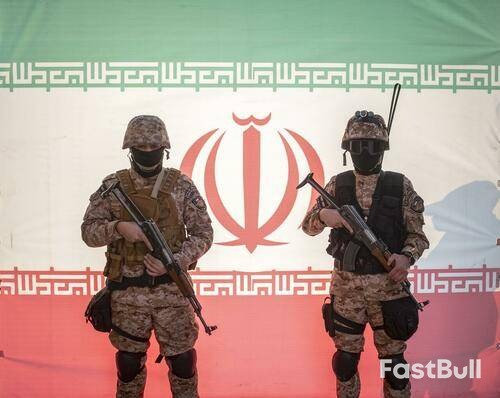
The European Union has formally agreed to designate Iran's Islamic Revolutionary Guard Corps (IRGC) as a terrorist organization, a landmark decision confirmed by EU foreign policy chief Kaja Kallas after a meeting of the bloc's foreign ministers on Thursday.
"Any regime that kills thousands of its own people is working toward its own demise," Kallas stated, marking a significant hardening of the EU's stance against Tehran.
This move follows an abrupt policy reversal from France and Spain, which had previously been key opponents of the designation. Their change of position provided the necessary momentum for the bloc to proceed with the politically charged classification.
The decision is widely seen as providing political and legal support for potential U.S. military strikes against Iran under President Trump. By labeling the IRGC a terrorist entity, the EU effectively streamlines the legal justification for future military interventions.
This action mirrors a strategy previously employed by Washington. Before launching regime change operations in Venezuela, the U.S. designated President Maduro as the head of a "terrorist organization"—the so-called Cartel of the Suns—which led to federal charges against him in New York. The EU's muted response to the subsequent removal of Maduro was widely interpreted as tacit approval.
With this new designation, EU leaders may be signaling their acceptance of similar action being taken against Tehran.
The push to blacklist the IRGC gained traction after the West accused the organization of directing a violent crackdown on domestic unrest in Iran. Widespread protests, driven by economic grievances, erupted in towns and cities across the country this month.
While Western governments point to the thousands of deaths as evidence of state-sponsored violence, Iranian officials maintain that armed saboteurs infiltrated peaceful demonstrations, causing the mayhem and high death toll.
The IRGC is Iran's most influential military-security force, operating under the direct command of the Ayatollah. Designating the entire organization as a terrorist group provides a broad framework for targeting the highest levels of Iran's command structure.
The EU's move brings it in line with several other Western nations. The United States, Canada, and Australia have already blacklisted the IRGC. Within the EU, Germany and the Netherlands have advocated for this step for years, and Italy recently shifted its position following the protests in Iran.
Poland leads Europe in defense spending as a percentage of GDP. Germany, the continent's economic powerhouse, is spending heavily to catch up. Both nations share a border, a deep understanding of the threat posed by Russia, and every reason to form a powerful new partnership at the heart of Europe.
And yet, relations between Warsaw and Berlin have rarely been so strained.
Instead of a seamless alliance, the relationship is defined by friction and historical grievances. This discord not only undermines European security but also benefits the very adversary they aim to counter.
On paper, cooperation should be deep. Germany is contributing forces to Poland's "East Shield" initiative, a project designed to fortify its border with Belarus against Russian-backed threats. Poland, more than any other major EU nation, has faced hybrid attacks, from drone incursions into its airspace to relentless disinformation campaigns.
But even in critical areas like defense, progress has stalled. Military cooperation is just one of many fields where collaboration is stuttering, hampered by a toxic political atmosphere. The chill is a product of both the distant past and present-day political maneuvering.
In Poland's deeply divided society, history has become a political tool. With parliamentary elections scheduled for next fall, there is little to gain from appearing too friendly to Germany. This trend reverses decades of progress that began with German Chancellor Willy Brandt’s historic gesture of reconciliation in Warsaw in 1970 and accelerated after the fall of communism.
Recent polling confirms the souring mood. The Polish-German Barometer, a regular survey conducted since 2000, shows Polish attitudes toward Germans have worsened significantly in recent years. This decline has been accelerated by the rise of far-right populism, which found support during the first and second Trump administrations.
To rally its base, Poland's far-right Law and Justice (PiS) party, which governed from 2015 to 2023, placed WWII reparations at the center of its foreign policy. In 2022, a government-commissioned report calculated that Germany owed Poland $1.3 trillion for damages caused by the Nazi occupation.
PiS leader Jaroslaw Kaczynski called this figure—more than three times Germany's annual federal budget—"conservative."
The demand was overwhelmingly passed by the Polish parliament, with even Donald Tusk's centrist Civic Platform party voting in favor. After Tusk became prime minister, ousting PiS, he could not afford to shelve the issue for fear of being branded as "siding" with Berlin. In July 2024, the German government reportedly prepared to offer 200 million euros ($214 million) to support surviving Polish victims, but Warsaw ultimately rejected the proposal.
Berlin has consistently maintained that the matter is legally closed. Germany's position rests on two key arguments:
1. Poland waived its right to reparations in a 1953 agreement, where East Germany ceded territories to Poland and Russia.
2. Any remaining issues were settled by the 1990 2+4 agreement between Britain, France, the Soviet Union, and the United States, which paved the way for German reunification.
The current Polish government counters that the 1953 waiver was made under pressure from the Soviet Union. The dispute continues to simmer, fueling diplomatic tension. In late 2025, Germany’s ambassador to Warsaw, Miguel Berger, voiced his frustration, suggesting some who raise the issue "do not want Polish-German relations to develop positively." He later added on social media that the demands only help Russian President Vladimir Putin, sparking further outrage from PiS politicians.
The strained relationship is complicated further by Poland's internal political gridlock. Last May's presidential election saw ultranationalist Karol Nawrocki defeat the Civic Platform candidate, Warsaw Mayor Rafal Trzaskowski.
Poland's post-communist constitution was designed to prevent any single leader from accumulating too much power. Today, this has created deadlock, as the offices of the president and prime minister are held by ideologically opposed parties.
While Prime Minister Tusk aims to move Poland closer to the EU's core, President Nawrocki has built his own foreign policy apparatus. He has aligned himself with the MAGA movement, endorsing the Trump administration's National Security Strategy (NSS).
This alignment has had tangible consequences. Washington invited Nawrocki to the White House during his campaign, and he received a formal endorsement from Kristi Noem, President Donald Trump's secretary of homeland security, during a Conservative Political Action Conference (CPAC) event in Poland. PiS politicians are now welcome guests at CPAC events in Washington, while the official Polish ambassador, who reports to Tusk, has struggled to get access.
When Nawrocki visited Trump for a second time as president, he broke protocol by not inviting anyone from the foreign ministry. The Trump administration's NSS openly states its intention to weaken the EU and embrace right-wing nationalists across Europe, further deepening the rift between Tusk's government and its German counterparts.
These high-level political battles have spilled over into real-world conflicts. Germany's unilateral decision last year to implement immigration checks on its border with Poland infuriated Warsaw.
When German police began turning back migrants, self-proclaimed "citizen patrols" formed on the Polish side to prevent the returns. The pressure forced Prime Minister Tusk to declare that "Poland's patience is running out," and his government responded with its own tit-for-tat border checks. While the measures have since been scaled back, the underlying tensions can be easily inflamed again.
The political rhetoric remains sharp. PiS leader Kaczynski has framed the EU as a liberal enterprise controlled by Germany, which he has called a "Fourth Reich." He has also labeled Tusk a "German agent," a remark that earned him a parliamentary reprimand. This narrative often leverages the fact that Tusk's grandfather was conscripted into the Nazi armed forces—a detail that omits his later desertion to fight against Hitler.
Despite the discord, diplomatic efforts continue. German Chancellor Friedrich Merz visited both Paris and Warsaw shortly after taking office last May, hoping for a "new opening" in relations. With its ties to France also under strain, Germany is eager for closer cooperation with Poland, especially on supporting Ukraine.
The trilateral Weimar Triangle, a forum for Paris, Berlin, and Warsaw, has also been revived. However, these initiatives are struggling against the weight of political division and historical distrust. For two of Europe's most critical powers, the path to a functional alliance remains obstructed.


The U.S. trade deficit in goods and services with Asia climbed to $70.8 billion in November, as a narrowing gap with China was more than offset by a surge in imports from Southeast Asia. This trend highlights the complex outcomes of the Trump administration's efforts to rebalance global trade.
According to new Commerce Department data, American imports from China dropped 12.2% to $20.9 billion in November. This decline aligns with President Donald Trump's stated goal, coming after the U.S. imposed an average effective tariff rate of 47.5% on Chinese goods.
However, while the U.S. deficit with China shrank by $80.9 billion in the first 11 months of 2025, the deficit with the rest of Asia grew. The total regional trade deficit hit $778 billion, marking a 10% increase year-over-year. Even with widespread tariffs, the U.S. continues to consume more Asian goods than it exports and appears headed for a larger annual trade deficit than in 2024 or 2023.
Analysts point to a clear pattern: as tariffs on China rose, trade flows shifted to neighboring countries. Kelvin Lam, senior China economist at Pantheon Macroeconomics, noted that Southeast Asia is likely being used by China to arbitrage tariff differences.
"The shifting of deficits from China to other Asian countries has been the trend since the first trade war in 2017," Lam said. He added that China’s share of the U.S. trade deficit with Asia is expected to fall from 66% in 2017 to just one-quarter last year.
Even with new tariffs slapped on them, Southeast Asian nations saw their collective trade surplus with the U.S. grow through November 2025. Deficits with Singapore, Malaysia, and Thailand all expanded in November, driven by electronics and textiles.
Gareth Leather, a senior economist at Capital Economics, explained that since tariffs were applied broadly across the rest of Asia, these nations "haven't seen a kind of a big competitive loss vis-a-vis their main kind of trading competitors."
Current U.S. tariff rates across the region include:
• Laos & Myanmar: 40%
• Vietnam: 20%
• Cambodia, Thailand, Malaysia, Indonesia: 19%
• Singapore: 10%
Experts say Chinese supply chains continue to reroute through Southeast Asia, where manufacturers have boosted capacity but still depend on Chinese components. This "China plus one" strategy is difficult to distinguish from illegal transshipment fraud.
Taiwan's AI-Fueled Export Boom
Shipments from Taiwan, primarily semiconductors needed for AI data centers, have caused the U.S. trade deficit with the island to nearly double. For the January-November 2025 period, the deficit reached a record $126 billion. In a recent deal, Taiwan agreed to invest $250 billion in American chipmaking, energy, and AI in exchange for a lower U.S. tariff rate of 15%, down from 20%.
Japan and South Korea Face Headwinds
In contrast, exports from Japan and South Korea declined in November compared to the previous month. This slowdown is likely linked to U.S. levies on automobiles and car parts, even after both countries secured agreements to lower their tariff rate to 15% last year.
India's Imports Shrink Under Pressure
Goods from India have also continued to decline, as the country faces a total tariff of 50%, which includes a secondary levy related to its purchases of Russian oil. While Indian imports fell 2% in November, a corresponding dip in American exports to India meant the trade deficit still expanded.
Overall, total U.S. imports jumped 5% in November from the prior month, while exports fell 3.6%. This widened the country's total trade deficit to $56.7 billion for the month.
A third of the import surge was attributed to pharmaceuticals, with shipments of computers and semiconductors also remaining strong. Thomas Ryan, North America economist at Capital Economics, sees this as a positive signal. "This provides further evidence... that business investment remained strong in the fourth quarter, supported by the AI buildout," he commented.
The Trump administration's aggressive tariff policies have disrupted trade flows and impacted small businesses. The legality of these sweeping tariffs is now under review by the U.S. Supreme Court, which will rule on whether the president overstepped his authority.
Regardless of the court's decision, the White House retains other options to impose tariffs on goods and sectors it considers vital to national security. As of January, the average effective U.S. tariff rate stands at 16.9%—the highest level since 1932, according to Yale's Budget Lab—making it significantly more expensive to import products into the country.
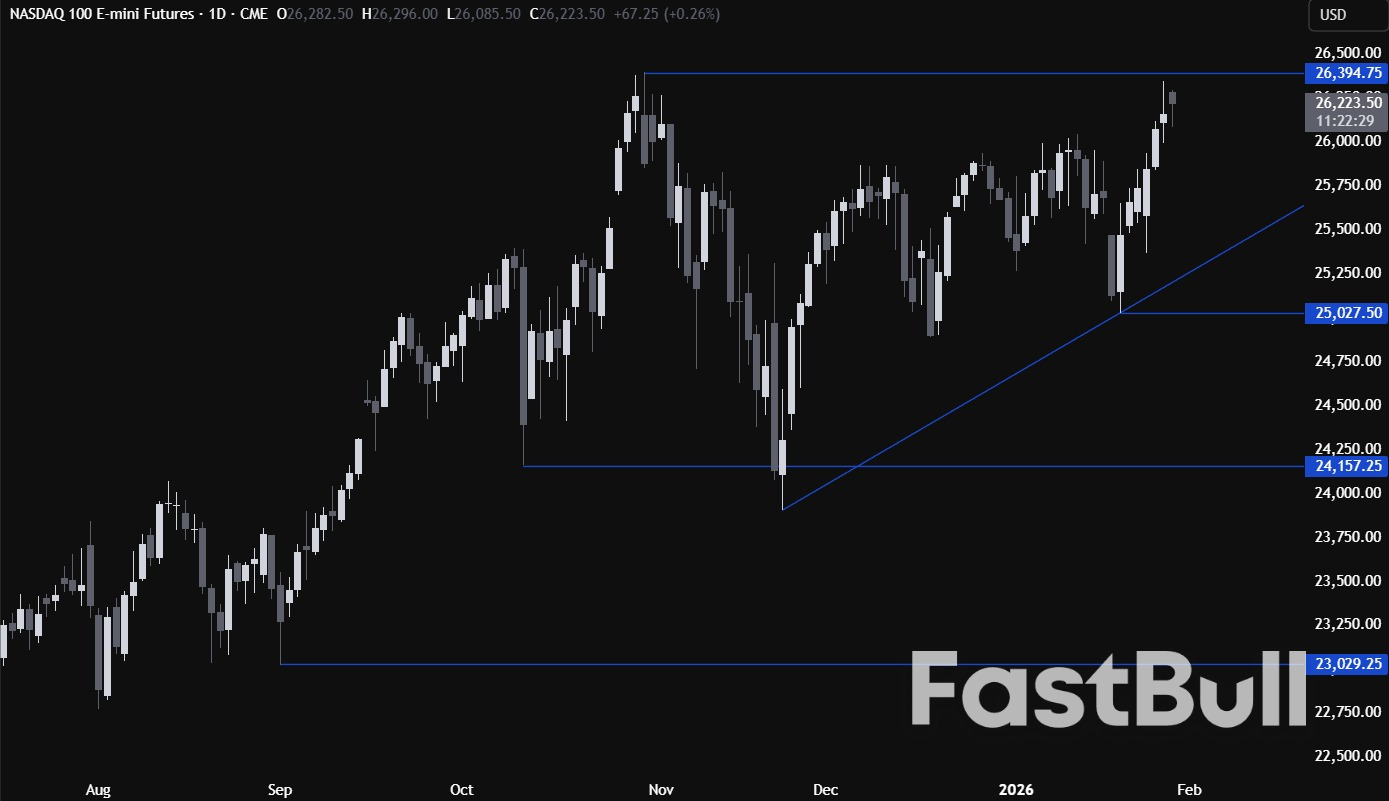
Nasdaq - daily
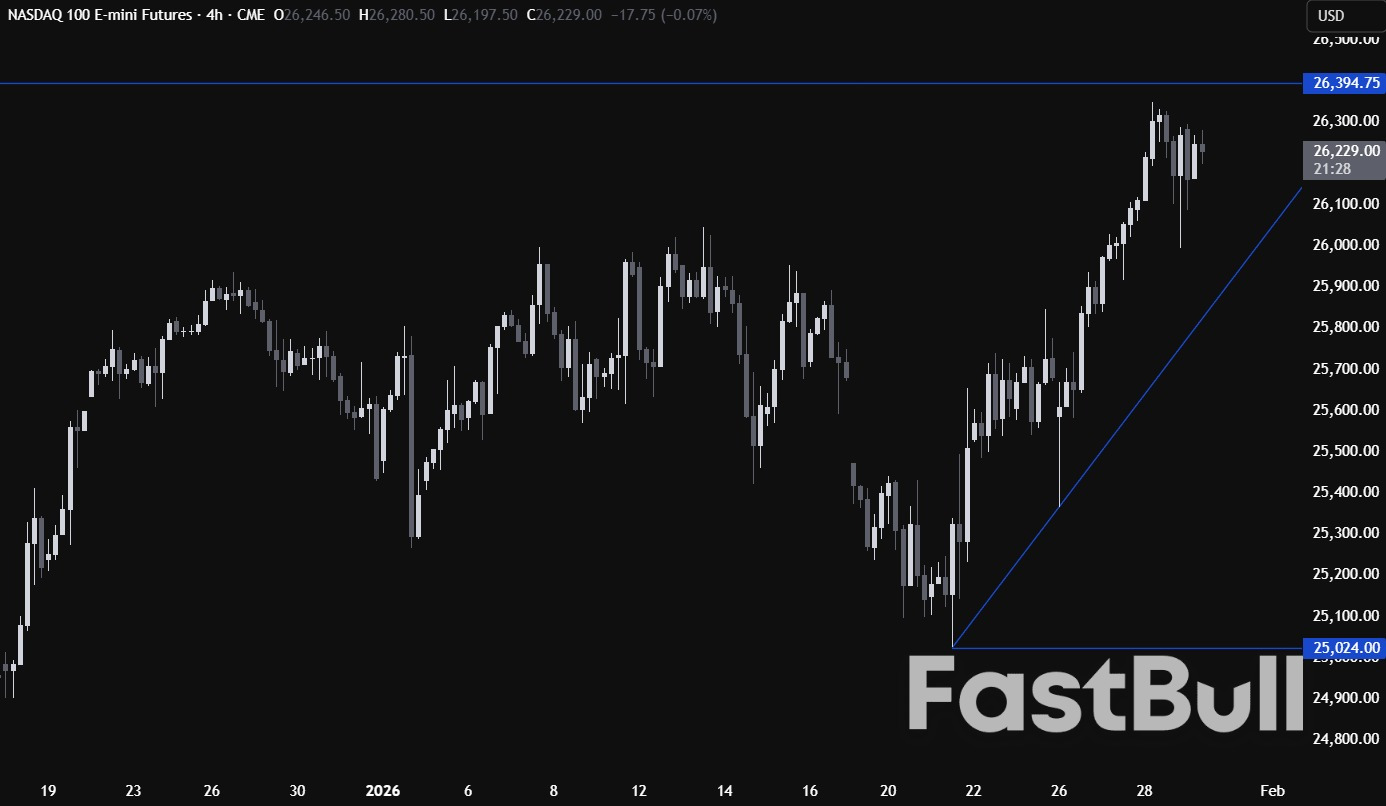
Nasdaq - 4 hour
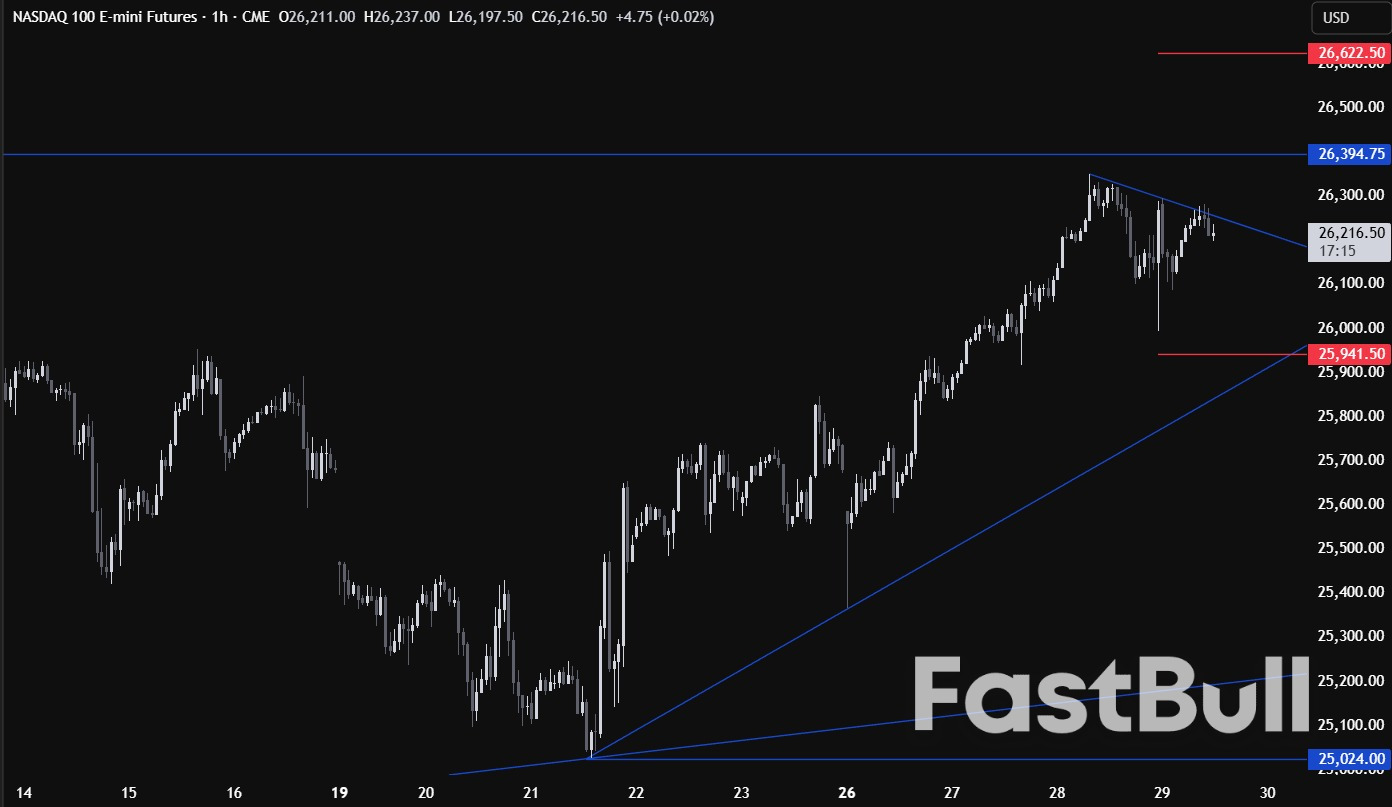
Nasdaq - 1 hourA high-stakes negotiation between Senate Democrats and the Trump administration is underway to prevent a partial government shutdown, with new restrictions on federal immigration agents at the center of the dispute. Funding for several federal agencies is set to expire at midnight on Friday, raising the pressure for a resolution.
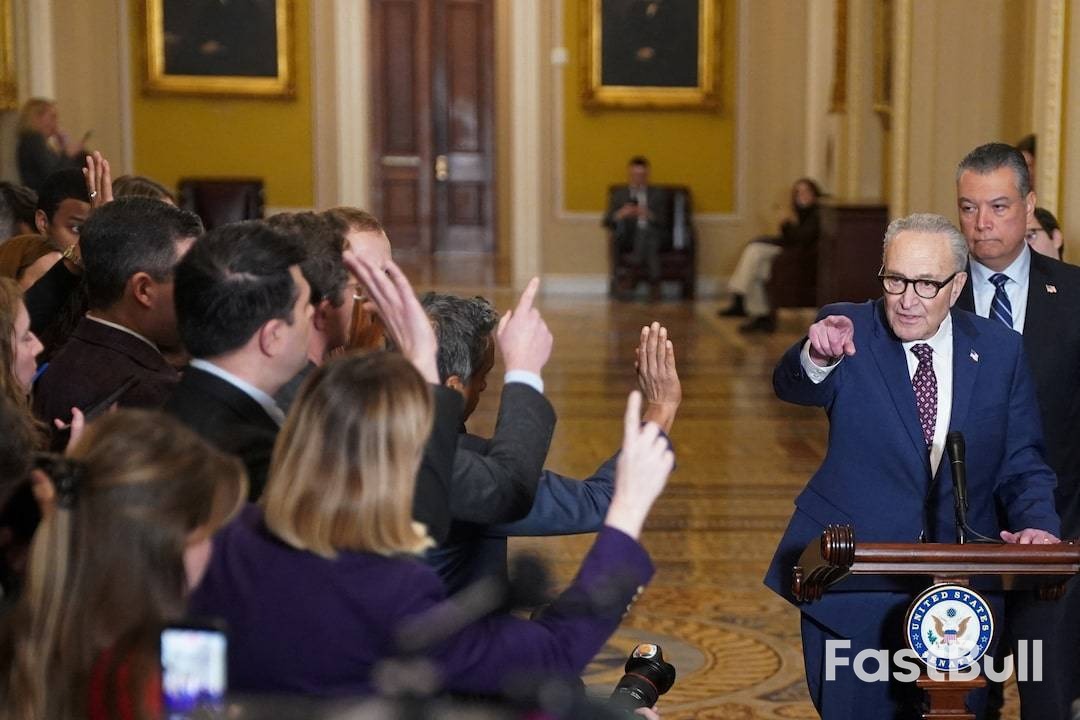
While no final agreement has been secured, a source familiar with the talks indicated that discussions are reportedly leaning in the Democrats' favor. The White House has not yet commented on the ongoing negotiations.
The political standoff escalated after a second U.S. citizen was shot by immigration agents in Minneapolis over the weekend. In response, Senate Democrats are demanding new limits on the enforcement activities of the Department of Homeland Security (DHS).
To force the issue, Democrats have threatened to block a crucial funding bill that covers DHS and other government departments. This move could trigger a partial shutdown if a deal isn't reached before the deadline.

Democrats are exploring two primary legislative paths to advance their goals while minimizing broader disruption:
• Isolating DHS Funding: They are pushing to separate the DHS budget from the larger spending package. This would allow funding to continue for the Pentagon, health programs, and other essential government operations without interruption.
• Requesting a Temporary Extension: An alternative strategy is to secure a short-term spending extension specifically for DHS, which would provide more time for negotiations over enforcement policies.
The Senate is scheduled to hold a preliminary vote on the broader spending package on Thursday, making the next 24 hours critical.
The recent shooting in Minneapolis, the second of its kind this month, has generated significant public outrage and prompted action from the Trump administration. In response to the incidents, the administration has already begun reshuffling personnel responsible for immigration enforcement in the region.
Furthermore, internal guidance issued Wednesday and seen by Reuters directs immigration agents in Minnesota to avoid interactions with "agitators," signaling an attempt to de-escalate tensions on the ground.
White Label
Data API
Web Plug-ins
Poster Maker
Affiliate Program
The risk of loss in trading financial instruments such as stocks, FX, commodities, futures, bonds, ETFs and crypto can be substantial. You may sustain a total loss of the funds that you deposit with your broker. Therefore, you should carefully consider whether such trading is suitable for you in light of your circumstances and financial resources.
No decision to invest should be made without thoroughly conducting due diligence by yourself or consulting with your financial advisors. Our web content might not suit you since we don't know your financial conditions and investment needs. Our financial information might have latency or contain inaccuracy, so you should be fully responsible for any of your trading and investment decisions. The company will not be responsible for your capital loss.
Without getting permission from the website, you are not allowed to copy the website's graphics, texts, or trademarks. Intellectual property rights in the content or data incorporated into this website belong to its providers and exchange merchants.
Not Logged In
Log in to access more features
Log In
Sign Up