Markets
News
Analysis
User
24/7
Economic Calendar
Education
Data
- Names
- Latest
- Prev


Signal Accounts for Members
All Signal Accounts
All Contests


Japan Tankan Small Manufacturing Outlook Index (Q4)A:--
F: --
P: --
Japan Tankan Large Non-Manufacturing Outlook Index (Q4)A:--
F: --
P: --
Japan Tankan Large Manufacturing Outlook Index (Q4)A:--
F: --
P: --
Japan Tankan Small Manufacturing Diffusion Index (Q4)A:--
F: --
P: --
Japan Tankan Large Manufacturing Diffusion Index (Q4)A:--
F: --
P: --
Japan Tankan Large-Enterprise Capital Expenditure YoY (Q4)A:--
F: --
P: --
U.K. Rightmove House Price Index YoY (Dec)A:--
F: --
P: --
China, Mainland Industrial Output YoY (YTD) (Nov)A:--
F: --
P: --
China, Mainland Urban Area Unemployment Rate (Nov)A:--
F: --
P: --
Saudi Arabia CPI YoY (Nov)A:--
F: --
P: --
Euro Zone Industrial Output YoY (Oct)A:--
F: --
P: --
Euro Zone Industrial Output MoM (Oct)A:--
F: --
P: --
Canada Existing Home Sales MoM (Nov)A:--
F: --
P: --
Canada National Economic Confidence IndexA:--
F: --
P: --
Canada New Housing Starts (Nov)A:--
F: --
U.S. NY Fed Manufacturing Employment Index (Dec)A:--
F: --
P: --
U.S. NY Fed Manufacturing Index (Dec)A:--
F: --
P: --
Canada Core CPI YoY (Nov)A:--
F: --
P: --
Canada Manufacturing Unfilled Orders MoM (Oct)A:--
F: --
P: --
U.S. NY Fed Manufacturing Prices Received Index (Dec)A:--
F: --
P: --
U.S. NY Fed Manufacturing New Orders Index (Dec)A:--
F: --
P: --
Canada Manufacturing New Orders MoM (Oct)A:--
F: --
P: --
Canada Core CPI MoM (Nov)A:--
F: --
P: --
Canada Trimmed CPI YoY (SA) (Nov)A:--
F: --
P: --
Canada Manufacturing Inventory MoM (Oct)A:--
F: --
P: --
Canada CPI YoY (Nov)A:--
F: --
P: --
Canada CPI MoM (Nov)A:--
F: --
P: --
Canada CPI YoY (SA) (Nov)A:--
F: --
P: --
Canada Core CPI MoM (SA) (Nov)A:--
F: --
P: --
Canada CPI MoM (SA) (Nov)A:--
F: --
P: --
Federal Reserve Board Governor Milan delivered a speech
U.S. NAHB Housing Market Index (Dec)--
F: --
P: --
Australia Composite PMI Prelim (Dec)--
F: --
P: --
Australia Services PMI Prelim (Dec)--
F: --
P: --
Australia Manufacturing PMI Prelim (Dec)--
F: --
P: --
Japan Manufacturing PMI Prelim (SA) (Dec)--
F: --
P: --
U.K. 3-Month ILO Employment Change (Oct)--
F: --
P: --
U.K. Unemployment Claimant Count (Nov)--
F: --
P: --
U.K. Unemployment Rate (Nov)--
F: --
P: --
U.K. 3-Month ILO Unemployment Rate (Oct)--
F: --
P: --
U.K. Average Weekly Earnings (3-Month Average, Including Bonuses) YoY (Oct)--
F: --
P: --
U.K. Average Weekly Earnings (3-Month Average, Excluding Bonuses) YoY (Oct)--
F: --
P: --
France Services PMI Prelim (Dec)--
F: --
P: --
France Composite PMI Prelim (SA) (Dec)--
F: --
P: --
France Manufacturing PMI Prelim (Dec)--
F: --
P: --
Germany Services PMI Prelim (SA) (Dec)--
F: --
P: --
Germany Manufacturing PMI Prelim (SA) (Dec)--
F: --
P: --
Germany Composite PMI Prelim (SA) (Dec)--
F: --
P: --
Euro Zone Composite PMI Prelim (SA) (Dec)--
F: --
P: --
Euro Zone Services PMI Prelim (SA) (Dec)--
F: --
P: --
Euro Zone Manufacturing PMI Prelim (SA) (Dec)--
F: --
P: --
U.K. Services PMI Prelim (Dec)--
F: --
P: --
U.K. Manufacturing PMI Prelim (Dec)--
F: --
P: --
U.K. Composite PMI Prelim (Dec)--
F: --
P: --
Euro Zone ZEW Economic Sentiment Index (Dec)--
F: --
P: --
Germany ZEW Current Conditions Index (Dec)--
F: --
P: --
Germany ZEW Economic Sentiment Index (Dec)--
F: --
P: --
Euro Zone Trade Balance (Not SA) (Oct)--
F: --
P: --
Euro Zone ZEW Current Conditions Index (Dec)--
F: --
P: --
Euro Zone Trade Balance (SA) (Oct)--
F: --
P: --
U.S. Retail Sales MoM (Excl. Automobile) (SA) (Oct)--
F: --
P: --


No matching data
Latest Views
Latest Views
Trending Topics
Top Columnists
Latest Update
White Label
Data API
Web Plug-ins
Affiliate Program
View All

No data
The U.S. dollar remains flat amid concerns over the Fed's independence, following President Trump’s criticism of Fed Governor Cook, as investors await Jerome Powell's speech that could influence future rate decisions....
The U.S. dollar drifted on Thursday as investors fretted about the Federal Reserve's independence after yet another attack from President Donald Trump ahead of remarks from Chair Jerome Powell later this week that could influence the outlook for rates.Trump called on Fed Governor Lisa Cook to resign on the basis of allegations made by one of his political allies about mortgages she holds in Michigan and Georgia, intensifying his effort to gain influence over the U.S. central bank.
Cook said she had "no intention of being bullied to step down" from her position at the central bank. Trump has also told aides he is considering trying to fire Cook, the Wall Street Journal reported on Wednesday."It has the potential to raise questions around the Fed's oversight and regulatory functions but it has little to no near-term monetary policy implications," said Prashant Newnaha, senior Asia-Pacific rates strategist at TD Securities.
That explained the relatively muted reaction in the currency markets to the news as the dollar initially dipped on the news but was mostly calm into the Asian session.The Japanese yen held onto gains made in previous sessions and was little changed at 147.41 per dollar, while the euro was steady at $1.1642. Sterling last fetched $1.34535.That left the dollar index, which measures the U.S. currency against six other peers, steady at 98.301.
Trump has repeatedly criticised Powell for being too slow to cut rates, stoking investor worries about the central bank's independence and its credibility.Investors expect Trump will replace Powell with a more dovish appointment when his term ends in May. Trump earlier this month said he would nominate Council of Economic Advisers Chairman Stephen Miran to serve out the final few months of a vacant Fed seat after Adriana Kugler unexpectedly resigned.
Kristina Clifton, a senior economist at the Commonwealth Bank of Australia in Sydney, said if Cook resigns it would create another opening for Trump to appoint a Fed Governor who will vote to lower interest rates."Perceived political interference in the Federal Reserve can undermine its independence, steepening the yield curve and denting the USD's safe haven status."
The main focus this week has been on whether Powell will push back against market expectations for a rate cut at the Fed’s September 16-17 meeting when he speaks on Friday at the Jackson Hole meeting, following a weak jobs report for July."Markets are adamant that recent labour market data necessitates some policy calibration and are expecting Chair Powell to tip his hat in that direction," TD's Newnaha said.
Key points:
Brazilian Supreme Court Justice Alexandre de Moraes, who recently had sanctions imposed on him by the U.S. government, told Reuters that courts could punish Brazilian financial institutions for seizing or blocking domestic assets in response to U.S. orders.Those remarks raise the stakes in a standoff that has hammered shares of Brazilian banks caught between U.S. sanctions and the orders of Brazil's highest court.
In a late Tuesday interview from his office in Brasilia, Moraes granted that U.S. law enforcement regarding Brazilian banks that operate in the United States "falls under U.S. jurisdiction.""However, if those banks choose to apply that law domestically, they cannot do so — and may be penalized under Brazilian law," he added.His remarks underscore the potential consequences of a Monday ruling by fellow Supreme Court Justice Flavio Dino, who warned that foreign laws cannot be automatically applied in Brazil.
That ruling was followed by a sharp rebuke from the U.S. State Department's Bureau of Western Hemisphere Affairs, which warned on social media hours later that Moraes was "toxic" and that "non-U.S. persons must tread carefully: those providing material support to human rights abusers face sanctions risk themselves."The U.S. Treasury Department slapped the sanctions on Moraes last month under the Global Magnitsky Act, a law designed to impose economic penalties on foreigners deemed to have a record of corruption or human rights abuse.
The order accused him of suppressing freedom of expression and leading politicized prosecutions, including against former President Jair Bolsonaro, a staunch Trump ally on trial before Brazil's Supreme Court on charges of plotting a coup to reverse his loss in the 2022 election. Bolsonaro has denied any wrongdoing and denounced the case as politically motivated.In his interview, Moraes said decisions by foreign courts and governments can only take effect in Brazil after validation through a domestic process. He said banks therefore cannot seize assets, freeze funds or block the property of Brazilian citizens without following those legal steps.
The global reach of the U.S. financial system means foreign banks often restrict a wider range of transactions to avoid secondary sanctions.Moraes said he was confident that the sanctions against him would be reversed via diplomatic channels or an eventual challenge in U.S. courts. But he acknowledged that for now they had put financial institutions in a bind."This misuse of legal enforcement places financial institutions in a difficult position — not only Brazilian banks, but also their American partners," he said.
"That is precisely why, I repeat, the diplomatic channel is important so this can be resolved quickly - to prevent misuse of a law that is important to fight terrorism, criminal organizations, international drug trafficking and human trafficking," he added.A Treasury Department spokesperson said Moraes had "engaged in serious human rights abuse," adding: "Rather than concocting a fantasy fiction, de Moraes should stop carrying out arbitrary detentions and politicized prosecutions."
The State Department cited comments from Deputy Secretary of State Christopher Landau on Wednesday reiterating criticism of the judge for alleged censorship of U.S. citizens and companies.
The clash could have serious consequences for Brazilian financial institutions, said two bankers in Brazil, who requested anonymity to discuss the matter candidly.Most large banks are supervised by the U.S. government in some way due to their international presence or exposure, either through a foreign branch or issuance of foreign securities, said the former director of an international bank in Brazil.
The choice for these banks, under pressure from the U.S., may be to invite sanctioned clients to seek a different institution to keep their assets, the banker added.The director of a major Brazilian bank said that, in practice, Monday's court ruling means any action taken by Brazilian banks based on rules involving the U.S. Treasury's Office of Foreign Assets Control, which oversees U.S. sanctions, will need approval from Brazil's Supreme Court.
At the same time, he added, failing to comply with an OFAC decision could cut a bank off from the international financial system."Brazil doesn't really have a choice," said the banker. "Given how interconnected everything is, and the disparity in economic power between the U.S. and Brazil, we're left in a position of subordination. There's not much we can do."
He stressed that the court would need to come up with a solution "that doesn't put the financial system at risk."Shares of state-run lender Banco do Brasil, where most federal officials including judges receive salaries, fell 6% on Tuesday, the largest drop among Brazil's three biggest banks.The bank said in a Tuesday statement it was prepared to deal with "complex, sensitive" issues involving global regulations.
Buenos Aires has switched on “BA Cripto,” a policy package that lets residents and businesses settle city taxes and administrative fees using cryptocurrencies, including Bitcoin. Rolled out on Tuesday, August 19, 2025, the program covers municipal levies such as ABL (property tax), Patentes (vehicle tax), and Ingresos Brutos (turnover tax), as well as non-tax procedures like driver’s licenses and traffic fines, payable via a city QR flow.
City Hall’s move is broader than a payments toggle. Officials unveiled four measures: adding crypto-linked activities to the city’s economic-activity nomenclator to simplify filings; excluding virtual-asset service providers (PSAVs) from certain bank-collection regimes under the turnover tax; shifting the taxable base for crypto trading from gross transaction value to the net spread; and enabling QR crypto payments for both taxes and administrative services. The government framed the package as a regulatory tune-up that reduces frictions while aligning taxation with how digital-asset markets actually operate.
Mayor Jorge Macri presented the initiative as an institutional modernization designed to attract investment and make compliance easier. “The goal is for the City to be a world leader in crypto,” he said, adding: “We already have the human capital, and now we are building the tools by reducing bureaucracy to make taxpayer compliance easier and to support the arrival of new companies setting up here.” The remarks were delivered at The Slow Kale in Colegiales, a venue that accepts crypto payments.
Macri also argued the package signals a friendlier posture toward the sector: “These measures ensure the crypto world sees that the City is increasingly friendly. The digital economy compels us to update and adapt with a modern, agile, efficient and intelligent State. We want talent to find a place to grow, innovate and lead without obstacles.”
The backdrop is growing usage. According to city data cited at launch, roughly 10,000 people in Buenos Aires receive income from abroad via crypto or PayPal, and the use of PIX rails has been rising. Nationwide, Argentina counts “more than 10 million” crypto accounts—about 22% of Latin America’s total—figures the city says justify tailored rules and public-service rails that natively accommodate digital assets.
For firms, the classification update matters because it gives crypto activities an explicit slot in the tax nomenclator, improving clarity “without fiscal cost” and easing cross-jurisdiction information matching. Excluding PSAVs from bank-collection regimes is intended to curb automatic withholdings that can tie up working capital, while the new spread-based tax base acknowledges the mismatch between high-volume, low-margin trading and a gross-receipts framework. Together, these steps amount to what the city calls a more “agile” and “transparent” environment for digital-asset businesses to operate in the capital.
On the consumer side, the payment experience is meant to be straightforward: scan a city QR and pay the selected tax or fee with a compatible wallet. Officials said only some wallets currently support crypto payments, but a Buenos Aires–provided “aggregator” is in the works to let “neighbors and companies” pay “from any wallet, directly, faster, and simpler.” The government did not publish a technical spec or list of supported assets at launch.
Hernán Lombardi, the city’s Economic Development Minister, cast the reforms as a recalibration of legal and tax treatment for digital assets. “These reforms mark a change in the legal and tax treatment of digital assets. Less bureaucracy, greater legal certainty, and clear rules will translate into more investment,” he said, noting the updated nomenclator will help “determine and clarify the activities of companies and individual crypto-asset users, and thus avoid withholdings that compromise the sector’s working capital.”
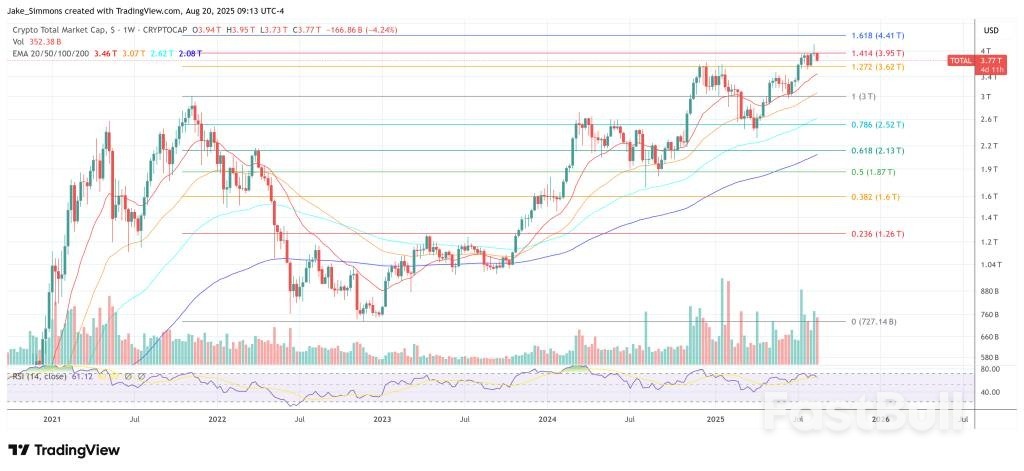
At press time, the total crypto market cap stood at $3.77 trillion.
Source: TradingViewNew Zealand said on Thursday it would spend NZ$2.7 billion ($1.6 billion) to buy five MH-60R Seahawk helicopters and two AirbusA321XLR aircraft, the first major investment following a decision to replace the country's aging defence fleet.NZ$2 billion will be used to buy the maritime helicopters, manufactured by Lockheed Martin'sSikorsky unit, and NZ$700 million for the A321XLRs, Defence Minister Judith Collins and Foreign Minister Winston Peters said in a joint statement.
Both investments are part of the planned commitments outlined in April in the government's Defence Capability Plan.New Zealand in April pledged to boost its defence spending by NZ$9 billion over the next four years, and aim to nearly double spending to 2% as a share of GDP in the next eight years as part of the Defence Capability Plan.
"We will now move at pace to procure helicopters directly through the United States' Foreign Military Sales programme instead of going to a wider tender, with cabinet expected to consider the final business case next year," Collins said.The two new Airbus aircraft, set to replace the Boeing 757 planes, will be acquired on a six-year lease-to-buy arrangement.
The New Zealand Defence Force's two 757s are more than 30 years old and their age has made them increasingly unreliable, breaking down several times and stranding the nation's leaders, forcing them to take commercial flights."This decision will ensure New Zealand has a critical combat capable, interoperable and dependable fleet," Collins said.The government's investment decisions showed it was responding to "the sharply deteriorating security environment," Peters said.
"Global tensions are increasing rapidly, and we must invest in our national security to ensure our economic prosperity," he added.
Key points:
The two Federal Reserve policymakers who dissented against the U.S. central bank decision's to leave interest rates unchanged last month appear not to have been joined by other policymakers in voicing support for lowering rates at that meeting, a readout of the gathering released on Wednesday showed.
"Almost all participants viewed it as appropriate to maintain the target range for the federal funds rate at 4.25% to 4.50% at this meeting," the minutes of the July 29-30 meeting said.
Fed Vice Chair for Supervision Michelle Bowman and Governor Christopher Waller both voted against the decision to leave the benchmark interest rate unchanged, favoring instead a quarter-percentage-point reduction to guard against further weakening of the job market. It was the first time since 1993 that more than one Fed governor dissented against a rate decision.
Not even 48 hours after the conclusion of last month's meeting, data from the Labor Department appeared to validate the concerns of Bowman and Waller when it showed far fewer jobs than expected were created in July, a rise in the unemployment rate and a drop in the labor force participation rate to the lowest level since late 2022.
More unsettling, though, was an historic downward revision for estimates of employment in the previous two months. That revision erased more than a quarter of a million jobs thought to have been created in May and June and put a hefty dent in the prevailing narrative of a still-strong-job market. The event was so angering to President Donald Trump that he fired the head of the Bureau of Labor Statistics.
Data since then, however, has provided some fodder for the camp more concerned that Trump's aggressive tariffs risk rekindling inflation to hold their ground against moving quickly to lower rates. The annual rate of underlying consumer inflation accelerated more than expected in July and was followed by an unexpectedly large jump in prices at the producer level.
The minutes showed officials continued an active debate on the effects of tariffs on inflation and the degree of restrictiveness in their policy stance. Several policymakers commented that the current level of the federal funds rate may not be far above its neutral level, where economic activity is neither stimulated nor constrained.
Fed policymakers assessed that the effects of higher tariffs had become more apparent in some goods prices but that the overall effect on the economy and inflation remained to be seen, the minutes showed.
Looking ahead, participants noted they may face difficult tradeoffs ahead if elevated inflation proved more persistent while the job market outlook weakened.
Heading into the release of the minutes, CME's FedWatch tool assigned an 85% probability of a quarter-percentage-point reduction in the Fed's policy rate at the September 16-17 meeting. That rate has been unchanged since December.
The minutes were released just two days before a highly anticipated speech from Fed Chair Jerome Powell at the annual economic symposium near Jackson Hole, Wyoming, which is hosted by the Kansas City Fed. Powell's keynote speech on Friday morning - set to be his last such address as head of the central bank, with his term expiring next May - could show whether he has joined ranks with those sensing the time has come for steps to shield the job market from further weakening or if he remains in league with those more wary of inflation in light of its moves away from the Fed's 2% target.
The lack of rate cuts since Trump returned to the White House has agitated the Republican president, and he regularly lashes out at Powell for not engineering them.
Trump is already in the process of screening possible successors to Powell. After the unexpected resignation earlier this month of one of the seven Fed governors, Trump has a chance to put his imprint on the central bank soon.
The president has nominated Council of Economic Advisers Chair Stephen Miran to fill the seat recently vacated by former Fed Governor Adriana Kugler, a term that expires at the end of January. It is unclear whether Miran will win Senate confirmation before the Fed's next meeting.
On Wednesday Trump demanded that Fed Governor Lisa Cook resign from the central bank over allegations of wrongdoing connected to mortgages on properties she owns in Georgia and Michigan.
White Label
Data API
Web Plug-ins
Poster Maker
Affiliate Program
The risk of loss in trading financial instruments such as stocks, FX, commodities, futures, bonds, ETFs and crypto can be substantial. You may sustain a total loss of the funds that you deposit with your broker. Therefore, you should carefully consider whether such trading is suitable for you in light of your circumstances and financial resources.
No decision to invest should be made without thoroughly conducting due diligence by yourself or consulting with your financial advisors. Our web content might not suit you since we don't know your financial conditions and investment needs. Our financial information might have latency or contain inaccuracy, so you should be fully responsible for any of your trading and investment decisions. The company will not be responsible for your capital loss.
Without getting permission from the website, you are not allowed to copy the website's graphics, texts, or trademarks. Intellectual property rights in the content or data incorporated into this website belong to its providers and exchange merchants.
Not Logged In
Log in to access more features

FastBull Membership
Not yet
Purchase
Log In
Sign Up