• Trade
  • Markets
  • Copy
  • Contests
  • News
  • 24/7
  • Calendar
  • Q&A
  • Chats
Trending
Screeners
SYMBOL
LAST
BID
ASK
HIGH
LOW
NET CHG.
%CHG.
SPREAD
SPX
S&P 500 Index
6870.39
6870.39
6870.39
6895.79
6858.28
+13.27
+ 0.19%
--
DJI
Dow Jones Industrial Average
47954.98
47954.98
47954.98
48133.54
47871.51
+104.05
+ 0.22%
--
IXIC
NASDAQ Composite Index
23578.12
23578.12
23578.12
23680.03
23506.00
+72.99
+ 0.31%
--
USDX
US Dollar Index
98.870
98.950
98.870
98.960
98.730
-0.080
-0.08%
--
EURUSD
Euro / US Dollar
1.16552
1.16560
1.16552
1.16717
1.16341
+0.00126
+ 0.11%
--
GBPUSD
Pound Sterling / US Dollar
1.33234
1.33243
1.33234
1.33462
1.33136
-0.00078
-0.06%
--
XAUUSD
Gold / US Dollar
4209.26
4209.69
4209.26
4218.85
4190.61
+11.35
+ 0.27%
--
WTI
Light Sweet Crude Oil
59.364
59.394
59.364
60.084
59.291
-0.445
-0.74%
--

Community Accounts

Signal Accounts
--
Profit Accounts
--
Loss Accounts
--
View More

Become a signal provider

Sell trading signals to earn additional income

View More

Guide to Copy Trading

Get started with ease and confidence

View More

Signal Accounts for Members

All Signal Accounts

Best Return
  • Best Return
  • Best P/L
  • Best MDD
Past 1W
  • Past 1W
  • Past 1M
  • Past 1Y

All Contests

  • All
  • Trump Updates
  • Recommend
  • Stocks
  • Cryptocurrencies
  • Central Banks
  • Featured News
Top News Only
Share

Hungary's Preliminary November Budget Balance Huf -403 Billion

Share

Indian Rupee Down 0.1% At 90.07 Per USA Dollar As Of 3:30 P.M. Ist, Previous Close 89.98

Share

India's Nifty 50 Index Provisionally Ends 0.96% Lower

Share

[JPMorgan: US Stock Rally May Stagnate Following Fed Rate Cut] JPMorgan Strategists Say The Recent Rally In US Stocks May Stall As Investors Take Profits Following The Anticipated Fed Rate Cut. The Market Currently Predicts A 92% Probability Of The Fed Lowering Borrowing Costs On Wednesday. Expectations Of A Rate Cut Have Continued To Rise, Fueled By Positive Signals From Policymakers In Recent Weeks. "Investors May Be More Inclined To Lock In Gains At The End Of The Year Rather Than Increase Directional Exposure," Mislav Matejka's Team Wrote In A Report

Share

Russian Defence Ministry: Russian Forces Take Control Of Novodanylivka In Ukraine's Zaporizhzhia Region

Share

Russian Defence Ministry: Russian Forces Take Control Of Chervone In Ukraine's Donetsk Region

Share

French Finance Ministry: Government Started Process To Block Temporarily Shein Platform

Share

Finance Minister: Indonesia To Impose Coal Export Tax Of Up To 5% Next Year

Share

[Trump Considering Fired Homeland Security Secretary Noem? White House Denies] According To Reports From US Media Outlets Such As The Daily Beast And The UK's Independent, The White House Has Denied Reports That US President Trump Is Considering Firing Homeland Security Secretary Noem. White House Spokesperson Abigail Jackson Posted On Social Media On The 7th Local Time, Calling The Claims "fake News" And Stating That "Secretary Noem Has Done An Excellent Job Implementing The President's Agenda And 'making America Safe Again'."

Share

HKEX: Standard Chartered Bought Back 571604 Total Shares On Other Exchanges For Gbp9.5 Million On Dec 5

Share

Morgan Stanley Reiterates Bullish Outlook On US Stocks Due To Fed Rate Cut Expectations. Morgan Stanley Strategists Believe That The US Stock Market Faces A "bullish Outlook" Given Improved Earnings Expectations And Anticipated Fed Rate Cuts. They Expect Strong Corporate Earnings By 2026, And Anticipate The Fed Will Cut Rates Based On Lagging Or Mildly Weak Labor Markets. They Expect The US Consumer Discretionary Sector And Small-cap Stocks To Continue To Outperform

Share

China's National Development And Reform Commission Announced That Starting From 24:00 On December 8, The Retail Price Limit For Gasoline And Diesel In China Will Be Reduced By 55 Yuan Per Ton, Which Translates To A Reduction Of 0.04 Yuan Per Liter For 92-octane Gasoline, 0.05 Yuan Per Liter For 95-octane Gasoline, And 0.05 Yuan Per Liter For 0# Diesel

Share

Tkms CEO: US Security Strategy Highlights Need For Europe To Take Care Of Its Own Defences

Share

USA S&P 500 E-Mini Futures Up 0.1%, NASDAQ 100 Futures Up 0.18%, Dow Futures Down 0.02%

Share

London Metal Exchange (LME): Copper Inventories Increased By 2,000 Tons, Aluminum Inventories Decreased By 2,500 Tons, Nickel Inventories Increased By 228 Tons, Zinc Inventories Increased By 2,375 Tons, Lead Inventories Decreased By 3,725 Tons, And Tin Inventories Decreased By 10 Tons

Share

Swiss Sight Deposits Of Domestic Banks At 440.519 Billion Sfr In Week Ending December 5 Versus 437.298 Billion Sfr A Week Earlier

Share

Czech November Jobless Rate 4.6% Versus Mkt Fcast 4.7%

Share

Czech Jobless Rate Unchanged At 4.6% In November

Share

Singapore Central Bank Data: November Foreign Exchange Reserves At $400.0 Billion

Share

Fitch On EMEA Homebuilders Says Weak Demand Is Likely To Constrain Completions And New Starts, Despite Easing Inflation And Gradual Rate Cuts

TIME
ACT
FCST
PREV
France Industrial Output MoM (SA) (Oct)

A:--

F: --

P: --
France Trade Balance (SA) (Oct)

A:--

F: --

P: --
Euro Zone Employment YoY (SA) (Q3)

A:--

F: --

P: --
Canada Part-Time Employment (SA) (Nov)

A:--

F: --

P: --

Canada Unemployment Rate (SA) (Nov)

A:--

F: --

P: --

Canada Full-time Employment (SA) (Nov)

A:--

F: --

P: --

Canada Labor Force Participation Rate (SA) (Nov)

A:--

F: --

P: --

Canada Employment (SA) (Nov)

A:--

F: --

P: --

U.S. PCE Price Index MoM (Sept)

A:--

F: --

P: --

U.S. Personal Income MoM (Sept)

A:--

F: --

P: --

U.S. Core PCE Price Index MoM (Sept)

A:--

F: --

P: --

U.S. PCE Price Index YoY (SA) (Sept)

A:--

F: --

P: --

U.S. Core PCE Price Index YoY (Sept)

A:--

F: --

P: --

U.S. Personal Outlays MoM (SA) (Sept)

A:--

F: --

P: --
U.S. 5-10 Year-Ahead Inflation Expectations (Dec)

A:--

F: --

P: --

U.S. Real Personal Consumption Expenditures MoM (Sept)

A:--

F: --

P: --
U.S. Weekly Total Rig Count

A:--

F: --

P: --

U.S. Weekly Total Oil Rig Count

A:--

F: --

P: --

U.S. Consumer Credit (SA) (Oct)

A:--

F: --

P: --
China, Mainland Foreign Exchange Reserves (Nov)

A:--

F: --

P: --

Japan Trade Balance (Oct)

A:--

F: --

P: --

Japan Nominal GDP Revised QoQ (Q3)

A:--

F: --

P: --

China, Mainland Imports YoY (CNH) (Nov)

A:--

F: --

P: --

China, Mainland Exports (Nov)

A:--

F: --

P: --

China, Mainland Imports (CNH) (Nov)

A:--

F: --

P: --

China, Mainland Trade Balance (CNH) (Nov)

A:--

F: --

P: --

China, Mainland Exports YoY (USD) (Nov)

A:--

F: --

P: --

China, Mainland Imports YoY (USD) (Nov)

A:--

F: --

P: --

Germany Industrial Output MoM (SA) (Oct)

A:--

F: --

P: --
Euro Zone Sentix Investor Confidence Index (Dec)

A:--

F: --

P: --

Canada National Economic Confidence Index

--

F: --

P: --

U.K. BRC Like-For-Like Retail Sales YoY (Nov)

--

F: --

P: --

U.K. BRC Overall Retail Sales YoY (Nov)

--

F: --

P: --

Australia Overnight (Borrowing) Key Rate

--

F: --

P: --

RBA Rate Statement
RBA Press Conference
Germany Exports MoM (SA) (Oct)

--

F: --

P: --

U.S. NFIB Small Business Optimism Index (SA) (Nov)

--

F: --

P: --

Mexico 12-Month Inflation (CPI) (Nov)

--

F: --

P: --

Mexico Core CPI YoY (Nov)

--

F: --

P: --

Mexico PPI YoY (Nov)

--

F: --

P: --

U.S. Weekly Redbook Index YoY

--

F: --

P: --

U.S. JOLTS Job Openings (SA) (Oct)

--

F: --

P: --

China, Mainland M1 Money Supply YoY (Nov)

--

F: --

P: --

China, Mainland M0 Money Supply YoY (Nov)

--

F: --

P: --

China, Mainland M2 Money Supply YoY (Nov)

--

F: --

P: --

U.S. EIA Short-Term Crude Production Forecast For The Year (Dec)

--

F: --

P: --

U.S. EIA Natural Gas Production Forecast For The Next Year (Dec)

--

F: --

P: --

U.S. EIA Short-Term Crude Production Forecast For The Next Year (Dec)

--

F: --

P: --

EIA Monthly Short-Term Energy Outlook
U.S. API Weekly Gasoline Stocks

--

F: --

P: --

U.S. API Weekly Cushing Crude Oil Stocks

--

F: --

P: --

U.S. API Weekly Crude Oil Stocks

--

F: --

P: --

U.S. API Weekly Refined Oil Stocks

--

F: --

P: --

South Korea Unemployment Rate (SA) (Nov)

--

F: --

P: --

Japan Reuters Tankan Non-Manufacturers Index (Dec)

--

F: --

P: --

Japan Reuters Tankan Manufacturers Index (Dec)

--

F: --

P: --

Japan Domestic Enterprise Commodity Price Index MoM (Nov)

--

F: --

P: --

Japan Domestic Enterprise Commodity Price Index YoY (Nov)

--

F: --

P: --

China, Mainland PPI YoY (Nov)

--

F: --

P: --

Q&A with Experts
    • All
    • Chatrooms
    • Groups
    • Friends
    Connecting
    .
    .
    .
    Type here...
    Add Symbol or Code

      No matching data

      All
      Trump Updates
      Recommend
      Stocks
      Cryptocurrencies
      Central Banks
      Featured News
      • All
      • Russia-Ukraine Conflict
      • Middle East Flashpoint
      • All
      • Russia-Ukraine Conflict
      • Middle East Flashpoint
      Search
      Products

      Charts Free Forever

      Chats Q&A with Experts
      Screeners Economic Calendar Data Tools
      Membership Features
      Data Warehouse Market Trends Institutional Data Policy Rates Macro

      Market Trends

      Market Sentiment Order Book Forex Correlations

      Top Indicators

      Charts Free Forever
      Markets

      News

      News Analysis 24/7 Columns Education
      From Institutions From Analysts
      Topics Columnists

      Latest Views

      Latest Views

      Trending Topics

      Top Columnists

      Latest Update

      Signals

      Copy Rankings Latest Signals Become a signal provider AI Rating
      Contests
      Brokers

      Overview Brokers Assessment Rankings Regulators News Claims
      Broker listing Forex Brokers Comparison Tool Live Spread Comparison Scam
      Q&A Complaint Scam Alert Videos Tips to Detect Scam
      More

      Business
      Events
      Careers About Us Advertising Help Center

      White Label

      Data API

      Web Plug-ins

      Affiliate Program

      Awards Institution Evaluation IB Seminar Salon Event Exhibition
      Vietnam Thailand Singapore Dubai
      Fans Party Investment Sharing Session
      FastBull Summit BrokersView Expo
      Recent Searches
        Top Searches
          Markets
          News
          Analysis
          User
          24/7
          Economic Calendar
          Education
          Data
          • Names
          • Latest
          • Prev

          View All

          No data

          Scan to Download

          Faster Charts, Chat Faster!

          Download App
          English
          • English
          • Español
          • العربية
          • Bahasa Indonesia
          • Bahasa Melayu
          • Tiếng Việt
          • ภาษาไทย
          • Français
          • Italiano
          • Türkçe
          • Русский язык
          • 简中
          • 繁中
          Open Account
          Search
          Products
          Charts Free Forever
          Markets
          News
          Signals

          Copy Rankings Latest Signals Become a signal provider AI Rating
          Contests
          Brokers

          Overview Brokers Assessment Rankings Regulators News Claims
          Broker listing Forex Brokers Comparison Tool Live Spread Comparison Scam
          Q&A Complaint Scam Alert Videos Tips to Detect Scam
          More

          Business
          Events
          Careers About Us Advertising Help Center

          White Label

          Data API

          Web Plug-ins

          Affiliate Program

          Awards Institution Evaluation IB Seminar Salon Event Exhibition
          Vietnam Thailand Singapore Dubai
          Fans Party Investment Sharing Session
          FastBull Summit BrokersView Expo

          David Cameron set to ‘slip Effortlessly’ into Foreign Secretary Role

          Justin

          Political

          Summary:

          Former PM’s return will bring weight and experience to the cabinet.
          Since assuming his position as UK prime minister, Rishi Sunak has been accused of being indecisive, overly managerial and not enough of a politician. Yet, for a man who has cancelled HS2, fired a home secretary and recalled David Cameron all in a short period, he seems rather determined and active.
          While most of the media were astonished by the appointment of David Cameron as foreign secretary and into the House of Lords, some were not so surprised. Cameron was always far too young a politician to be remembered solely as an ex-prime minister without a proper position to follow. There are precedents for an appointment like this: Alec Douglas-Home was appointed foreign secretary in 1960 while being an ex-prime minister. Peter Carrington in 1979 was also appointed foreign secretary as a member of the House of Lords.
          However, the House of Commons does not like senior ministers being appointed in the Lords, and that predictable reaction was not long in coming. The second chamber plays a useful role in allowing people who are not members of parliament to be involved in government.
          Though the announcement of Cameron’s appointment sharply divided opinion among Conservative MPs, many welcomed the return of an experienced politician with a record of winning elections. Others on the right felt the appointment of Cameron coinciding with the sacking of former home secretary Suella Braverman confirmed suspicions of a drift to the centre and a betrayal of the new red wall Tories.
          So why did the prime minister appoint him? By all accounts, Sunak had been consulting Cameron privately and regularly. Cameron is a brilliant communicator; far better than any current cabinet minister. However, he has a past with a certain amount of baggage, but this is outweighed by his experience of both domestic and international politics.
          Even so, it is important not to overstate the impact Cameron will make. He may be a source of wise advice on strategy and party management, but this doesn’t mean he can shift the political dial dramatically.
          As foreign secretary, he will slip effortlessly into the role. Even as a former remainer, he will have no difficulty pushing for new trade agreements and emphasising our ‘new Brexit freedoms’. He will want to improve Britain’s relations as a third party with the European Union, building on what Sunak has already done with the Windsor framework and the Horizon programme.
          It is also known that Cameron has been a strong supporter of Israel. That will continue. He may, however, have to moderate his views is in relation to China, where he, along with former chancellor of the exchequer George Osborne, was a strong advocate of deeper commercial ties and political engagement. At present, opinion in the Conservative party, just as in the US’ Republican party, has become increasingly hostile to China. Cameron will have to navigate carefully and accordingly.
          Whatever effect Sunak intended the announcement of the new foreign secretary to have, it was immediately overshadowed by Braverman’s bitterly direct and personal attack on the prime minister. Swiftly following her departure was the announcement of the Supreme Court ruling on her brainchild Rwanda scheme – the verdict on which is a massive reverse for the government. There may be some solutions to the issues posed by the court finding but it is difficult to believe these answers can be put into effect before the general election. The ticking of the clock seems to be getting louder.
          If the Conservative party is going to have any chance of avoiding a massive defeat at the next election, it needs to regain some sense of unity and purpose ahead of personal ambitions. It does not need a civil war which nobody can win.

          Spurce:Lord Norman Lamont of Lerwick

          Risk Warnings and Disclaimers
          You understand and acknowledge that there is a high degree of risk involved in trading. Following any strategies or investment methods may lead to potential losses. The content on the site is provided by our contributors and analysts for information purposes only. You are solely responsible for determining whether any trading assets, securities, strategy, or any other product is suitable for investing based on your own investment objectives and financial situation.
          Comments
          Add to Favorites
          Share

          Asia Week Ahead: Regional Inflation Numbers and a Bank Indonesia Decision

          ING

          Economic

          China Loan Prime Rates
          The People's Bank of China will release its benchmark lending rates, the five-year and one-year loan prime rate. We are expecting it to follow the medium-term lending facility (MLF) rate to stay put.
          Activity data released in the past few months have shown modest improvement in China's recovery, which together with concern about the weakness of the CNY, mean that rate cuts will probably be avoided for now.
          Bank Indonesia expected to pause
          Bank Indonesia (BI) is expected to hold rates steady at 6% next week. A better-than-expected trade report coupled with the rebound of IDR suggests that there is little pressure on the central bank to hike rates, so they should remain unchanged in the central bank's upcoming meeting.
          Japan inflation
          Next week, Japan's October CPI inflation will be out. We expect headline inflation to reaccelerate to 3.3% YoY in October (vs 3.0% in September). Prices of fresh food and energy will be the main drivers, but prices of other services are also expected to rise, reflecting the accumulated input price upward pressure.
          Core inflation (excluding fresh food and energy) will likely stay above the 4.0% level, which is likely to shift the Bank of Japan's policy stance more towards the neutral from the ultra-easing bias.
          Singapore inflation edging higher
          Singapore headline inflation could inch up slightly to 4.2% YoY from the previous month's reading of 4.1%. Compared to the previous month, prices might actually dip slightly by 0.2% month-on-month. Meanwhile, core inflation – the preferred measure of the Monetary Authority of Singapore – could be steady at 3%.
          To stay updated on all economic events of today, please check out our Economic calendar
          Risk Warnings and Disclaimers
          You understand and acknowledge that there is a high degree of risk involved in trading. Following any strategies or investment methods may lead to potential losses. The content on the site is provided by our contributors and analysts for information purposes only. You are solely responsible for determining whether any trading assets, securities, strategy, or any other product is suitable for investing based on your own investment objectives and financial situation.
          Comments
          Add to Favorites
          Share

          Limited Room for Tax Changes as UK Chancellor Gets set to Unveil Autumn Statement

          Justin

          Economic

          The chancellor is poised to get extra wiggle room

          UK Chancellor Jeremy Hunt is likely to be gifted with a rare bit of good news as he gears up for his Autumn Statement on 22 November. Not only has borrowing come in £20bn lower than forecast so far this fiscal year, but new projections from the Office for Budget Responsibility (OBR) are likely to show that he has a little more wiggle room to play with, whilst still meeting his main fiscal goal of lowering debt as a share of GDP within five years.
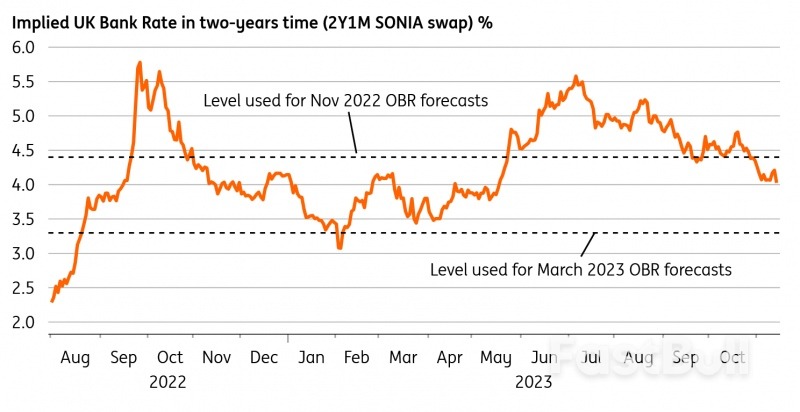
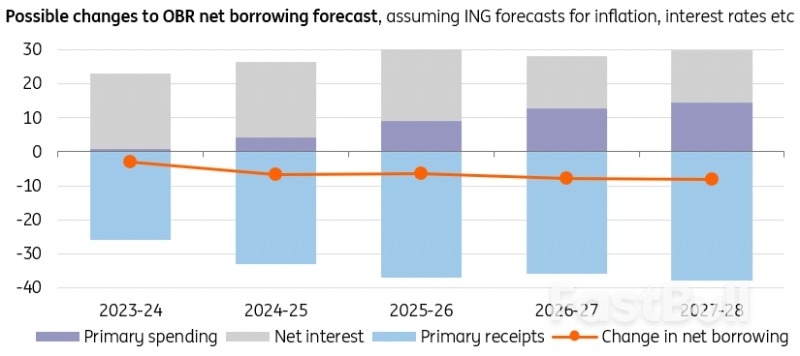
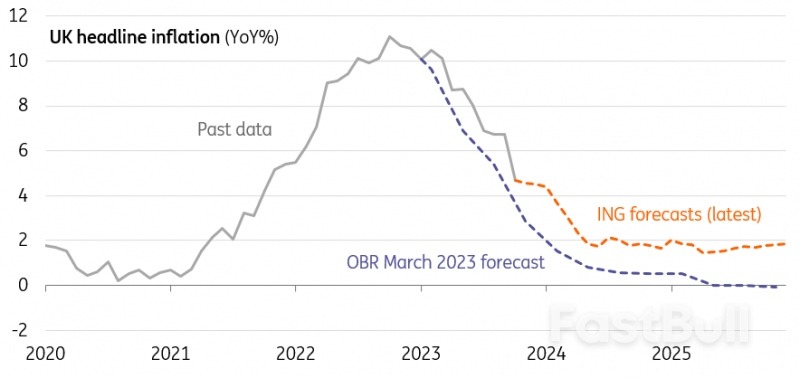
          It’s true that markets expect Bank Rate to be roughly one percentage point higher than when the OBR last produced forecasts in March, which is likely to push up the forecast for debt interest (net) by roughly £18bn in 2027/8 by our estimates. But that has, of course, gone hand in hand with higher inflation.
          That translates into higher nominal spending on things like welfare, though the government is reportedly looking to temper that increase by uprating welfare benefits by October's (lower) inflation reading, rather than using September's (higher) reading as is more typical. But higher inflation also means more money coming in for the Treasury, and that’s what’s likely to dominate the new OBR projections.
          When we wrap all of that together and plug our own inflation/wage forecasts into the OBR’s “ready reckoner” model, those extra revenues outweigh the negative impact of higher interest rates and inflation on spending.

          Inflation has come in higher than the OBR forecast in March...

          Limited Room for Tax Changes as UK Chancellor Gets set to Unveil Autumn Statement_1

          ...but interest rates are expected to be higher too

          Limited Room for Tax Changes as UK Chancellor Gets set to Unveil Autumn Statement_2

          "Headroom" is higher, but still limited

          Our rough estimates suggest the chancellor will be landed with roughly £15bn in “headroom” against his fiscal targets, which is an increase from the £6.5bn available back in March. That figure is based on market rate expectations, and we reckon that figure would rise by a further £6-7bn if we’re right that the Bank of England cuts Bank Rate more aggressively than markets expect over the next couple of years.
          Whichever way you cut it though, that’s still not a huge margin to play with. Hunt’s predecessors, particularly those in post before Covid, typically built in larger headroom than the £15bn likely to be available to the Treasury next week. It means he doesn’t have much to play with ahead of an anticipated election next year, which we’re assuming comes in October 2024 (though formally it can happen at any point before the end of January 2025).
          That’s even more true when you consider that some of the budgetary assumptions underpinning the forecasts described above look unrealistic. Hunt managed to win back markets this time last year with an Autumn Statement that combined some near-term stimulus with longer-term austerity, via an even mix of tighter tax and spending policies. Those included a 15% cut to public sector net investment in nominal terms annually by 2027/28 - or put another way, it goes from 2.9% of GDP to 2% over that same time frame.

          Higher revenues from inflation trump debt interest increases, according to OBR model

          Limited Room for Tax Changes as UK Chancellor Gets set to Unveil Autumn Statement_3

          Medium-term spending plans look challenging

          One particular challenge with this is that it appears inconsistent with the government’s net zero commitments. The pathway that the government has committed to will almost certainly require heavier public investment than we’ve seen so far (particularly in buildings). The opposition Labour Party has pledged to increase investment in this area, and the Institute for Fiscal Studies reckons this would limit the fall in net investment to 2.5% of GDP by 2027/8.
          The OBR’s forecasts are also based on government plans to limit day-to-day spending in government departments, such that in real terms, per capita expenditure will fall over the next couple of years. The scale of those real-terms cuts will be more aggressive in departments where budgets are not protected, and these could be challenging to achieve in practice.
          Finally, the plans for later this decade also assume that some of the government’s flagship tax policies are only temporary. That includes the government’s capital allowances, which allow firms to offset certain investments against their tax bill, and are slated to end after three years. Extending that looks inevitable, and would likely cost £9-10bn/year, eating up more than half of the chancellor’s already tight “headroom”. The OBR’s forecasts also assume that a 5p/litre cut to fuel duty is phased out, and that this is uprated by inflation in future years – something that hasn’t happened since 2011 despite repeated plans to the contrary.

          Modest tax cuts possible, but it wouldn't move the needle much for the BoE

          Does all of this rule out a sizable cut to, for example, income tax ahead of the next election? Hunt shelved plans to cut the basic rate of income tax from 20% to 19% this time last year, with a saving of £6bn/year later this decade. It’s possible that these plans will be reheated in the spring ahead of the forthcoming election, and it’s likely that the chancellor will have the fiscal space to do so. But that’s likely to be as far as the government can go without making even deeper planned cuts elsewhere later this decade.
          None of this would likely move the needle for the Bank of England. A tax cut of that magnitude, if it comes, is unlikely to make a decisive difference to next year’s growth outlook. More importantly, we think by the spring it will have become more evident that inflationary pressures are cooling, and by summer we think both services inflation and wage growth will be back to the 4% area. While still too high for the BoE’s liking, we think that would be sufficient to unlock rate cuts by August.

          Source: ING

          To stay updated on all economic events of today, please check out our Economic calendar
          Risk Warnings and Disclaimers
          You understand and acknowledge that there is a high degree of risk involved in trading. Following any strategies or investment methods may lead to potential losses. The content on the site is provided by our contributors and analysts for information purposes only. You are solely responsible for determining whether any trading assets, securities, strategy, or any other product is suitable for investing based on your own investment objectives and financial situation.
          Comments
          Add to Favorites
          Share

          Eurozone Wage Growth Is Set to Peak Soon

          ING

          Economic

          The job market is cooling off (a bit)
          The eurozone labour market has performed remarkably well in recent years. Job growth has been stronger than GDP growth in recent quarters and unemployment has fallen to the lowest level in decades. This has resulted in widespread labour shortages, which has boosted wage pressures.
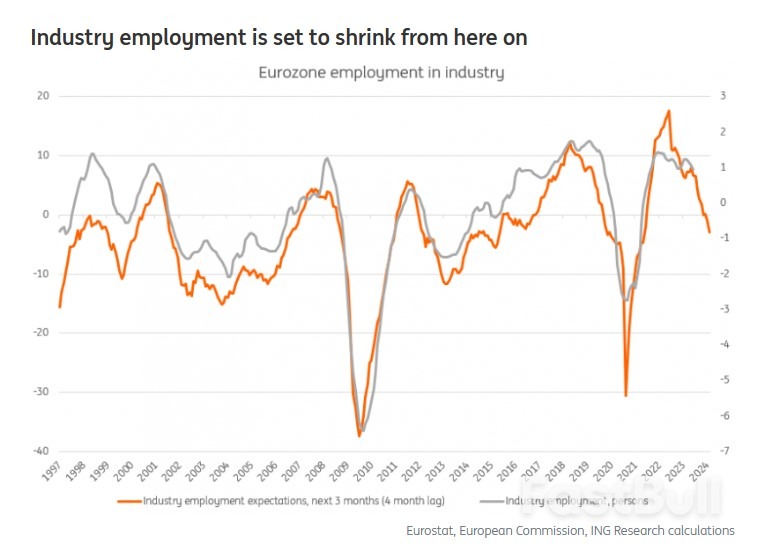
          Even though unemployment has not yet ticked up, signs of cooling are starting to show. Vacancy rates have been falling from their record highs across eurozone economies in recent quarters and surveys indicate that hiring intentions have slowed substantially in 2023. It looks like employment growth is still positive for business services, but for manufacturing, there are good indications that employment growth will turn negative before the end of the year.
          Eurozone Wage Growth Is Set to Peak Soon_1Even if the services sector keeps overall employment growth positive in the short run, it is industry which usually provides the benchmark for negotiated wage agreements. If employment in industry starts to drop, this will likely have a broader impact on union demands for wages in 2024.
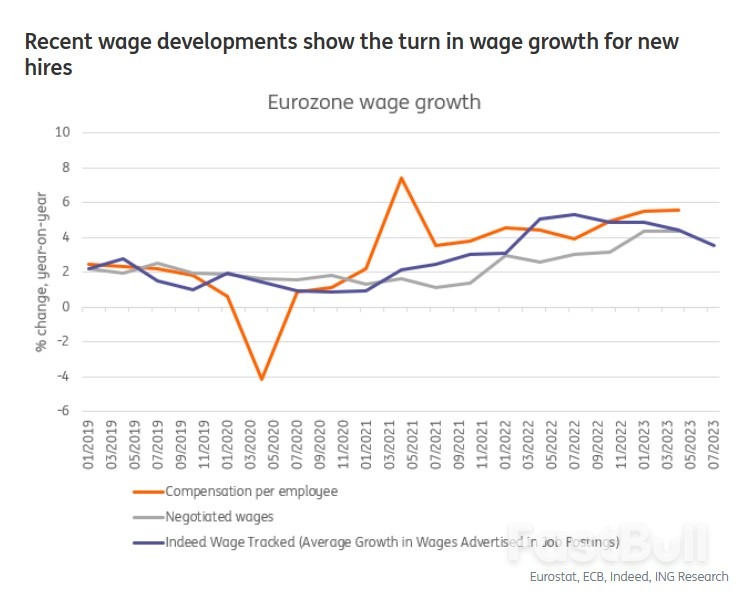
          Negotiated wage growth moves slowly and some increases are still in the pipeline
          Historically, inflation remains one of the most important drivers of wage growth in the eurozone as negotiated wage growth uses the cost of living as a key input. The rapid decline of inflation over the course of 2023 would therefore historically have a moderating impact on wage growth moving forward. As this coincides with a cooling labour market, it means more moderation in wage growth is to be expected. Using a simple model with historical relations, we would expect wage growth to trend in the low 3% range in 2024, down from the latest reading of 4.4% annual growth. This is not the time to be relying on historical relationships though.
          In fact, there are good reasons why wage growth will most likely turn out to be higher. Negotiated wages move slowly and are still adjusting somewhat for the high inflation of last year. Given the high inflation and resulting large negative real wage shock of last year, unions could try to go for yet another round of high wage demands. Also, unions might try to offset the end of one-off inflation compensation schemes with higher wage demands in 2024 and 2025. The ECB monitors the latest concluded negotiated wage agreements, which gives a decent sense of where overall wage growth will move in the first half of 2024. This seems to be hovering around 5% at the moment, somewhat above current levels. We don't expect further acceleration on the back of market developments, but it doesn't look like a decline in negotiated wage growth is imminent either.
          Outside of negotiated wage growth, wage growth for new hires also gives a sense of where wages are heading. The Indeed Wage Tracker provides an estimate for this, which is likely to move earlier than negotiated wages. Here, we see a cautious downward trend, which actually began in September of last year. That means that overall compensation growth per employee is set to come in somewhat below the negotiated wage developments as the market starts to turn.
          Eurozone Wage Growth Is Set to Peak Soon_2Will businesses allow their wage bill to rise much further?
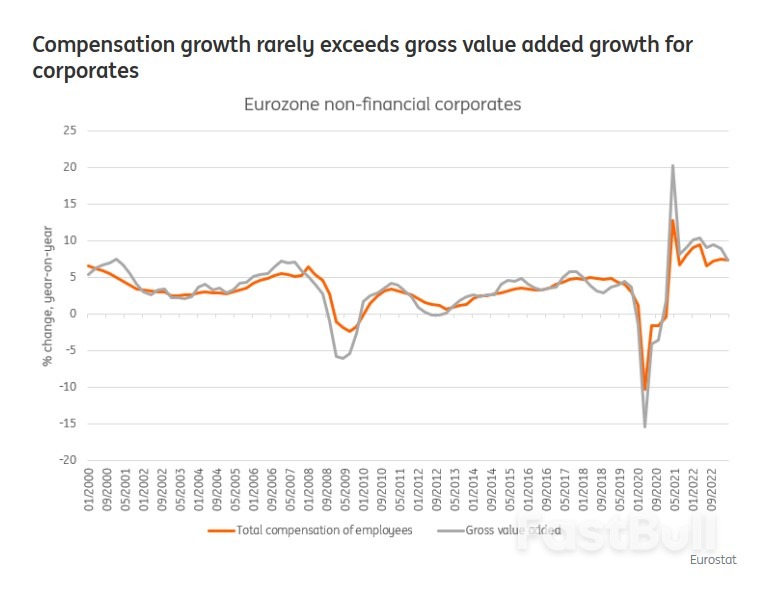
          Looking at wages from the employers' point of view also gives interesting insights into where wage growth might be headed in 2024. Historically, non-financial corporates have seen gross value added (a rough measure for revenues) increase more or less in line with the total compensation bill in the eurozone. See chart three. This indicates that when revenue growth slows, businesses slow down growth in total compensation paid. This can be done in two ways, either by shrinking headcount or by reducing average wage growth.
          Eurozone Wage Growth Is Set to Peak Soon_3Compensation growth for non-financial corporates is slightly less volatile than growth in revenues, but overall there have been no examples of severe deviation between the two since the start of the time series in 2000. The pandemic threw numbers off – as happened everywhere – but recent quarters are already more in sync again. With inflation falling quickly and real economic activity currently stagnating, the compensation environment for corporates is changing quickly. Annual gross value added growth trended around 10% for most of 2022 but came down to 7.4% in the second quarter of 2023.
          Whereas last year, strong price growth and decent volume increases allowed for very high overall compensation growth, 2024 will look very different. We expect nominal growth of corporate value added will drop to between 3% and 4% for 2024, which means that a significant squeeze for compensation growth will occur. As a result, employers might be forced to lay off employees and/or reduce average compensation per employee.
          There is an element of chicken and egg here of course. Some would be quick to argue that higher wage growth would also increase pressure on businesses to continue to force through higher prices, which would increase revenues. This risk is clearly present as productivity growth is negative at the moment, which means that unit labour costs – the most common measure of wage cost pressures – can still increase enough to cause price pressures at lower levels of wages. We recognise this as an upside risk to the wage outlook. Still, the economic environment has become markedly weaker in recent quarters and businesses are reporting that it is harder to price through higher costs to the consumers. That makes continued slowing revenue growth a more likely prospect.
          Wage growth is set to trend down again next year. Is the ECB behind the curve?
          All in all, we deem it likely that wage growth will peak before next summer and start to trend down over the course of next year for a number of reasons. The only question is how fast wage growth slows, not whether it will. Given the ECB's rather unsatisfying track record for forecasting inflation, it is not the time yet to publicly discuss the policy implications of such a plateauing of wage growth. This is why the ECB wants to wait for more evidence on how wage growth develops in 2024. The experience of the 1970s, when continued high wage growth allowed inflation to remain far too high for far too long, combined with the recent failures to forecast inflation, is keeping the ECB on high alert. For the time being, the ECB still prefers to err on the side of (too) tight monetary policy, rather than premature easing. However, if we are right and wage growth starts to turn soon, the ECB's current stance would be too restrictive. Once the ECB officially gives the all-clear on wage growth, the door for rate cuts is wide open. Last week, ECB President Christine Lagarde said that rate cuts could not be on the ECB's agenda for the next quarters. While this undermines our call for rate cuts next summer, we look back at comments made by Lagarde at the end of 2021. Back then, she didn't expect ECB rate hikes in 2022.
          To stay updated on all economic events of today, please check out our Economic calendar
          Risk Warnings and Disclaimers
          You understand and acknowledge that there is a high degree of risk involved in trading. Following any strategies or investment methods may lead to potential losses. The content on the site is provided by our contributors and analysts for information purposes only. You are solely responsible for determining whether any trading assets, securities, strategy, or any other product is suitable for investing based on your own investment objectives and financial situation.
          Comments
          Add to Favorites
          Share

          Labour Market Offers Hope for the Medium Term

          Swissquote

          Economic

          In Australia, the week began with another sombre update on confidence. The Westpac-MI Consumer Sentiment Index returned to deeply pessimistic levels, down 2.6% to 79.9. The RBA's decision to raise the cash rate was a key factor, as evinced by the sharp fall in sentiment between those surveyed before the decision (83.0) and after (78.2). Cost-of-living pressures and renewed concerns over interest rates point to weak holiday season spending; 40% of households plan to spend less on gifts this Christmas than last. This result is consistent with the family finances and spending on 'major household items' sub-indexes being well below long-run average levels.
          The labour market remains a bright-spot amid a gloomy outlook, however. The October labour force survey reported that employment increased by 55,000 (0.4%) in the month and hours worked gained 0.5%. Temporary hiring associated with the 2023 Australian Indigenous Voice referendum may have provided support, but the impact is uncertain.
          What remains clear, however, is that Australia's migration boom continues to expand the labour force, the participation rate returning to its post-WWI record high of 67.0% in October, seeing the unemployment rate rise to 3.7% even as employment grew above trend. In the months ahead, a further softening in hours worked is likely before employment experiences a material slowdown below trend.
          In-step with the resilience of the labour market, wage outcomes also remain supportive. Q3's 1.3% lift in the wage price index was in line with expectations, but the composition offered some surprises. A larger-than-expected contribution from awards and enterprise bargaining – a consequence of the minimum wage and aged care wage decisions as well as CPI indexation – was offset by a softer outcome from individual bargaining, a segment which tends to be more reactive to labour demand/ supply.
          This detail suggests upside risks for aggregate wage growth are limited, increasing the probability of the RBA being able to achieve their aim of preserving the gains made on unemployment since the pandemic while bringing inflation under control – a topic discussed by Westpac Chief Economist Luci Ellis this week.
          The latest NAB business survey also continued to report welcome progress regarding inflation. Following a sharp moderation in September, momentum in purchase costs, labour costs and final product prices all continued to ease in October, albeit at a slower pace. These results are within the context of a step-down in business conditions from last year (+13 vs. +25) and weakness in business confidence, the current level below the long-run average (–2 vs. +5).
          Moving offshore, US consumer prices were flat in October against expectations for a 0.1% gain, leaving annual inflation at 3.2%yr from 3.7%yr in September. Falling oil prices were the primary cause of the deceleration in the month, although core prices also came in below expectations at 0.2%. Within the core basket, goods prices have, at the margin, declined for five consecutive months. Disinflation also looks to be broadening through services ex-shelter, indicating softer consumer demand and business pricing power. As shelter retreats in coming months, the FOMC's 2.0%yr will come within reach, likely mid-2024.
          Retail sales meanwhile were broadly as expected in October, roughly flat for the month and up 2.7%yr. 2023's pattern has been periods of strength followed by a lull. If we are right in expecting GDP growth to slow below trend, sales growth will remain weak through year-end without another acceleration. Savings, real income growth and uncertainty over the outlook are all headwinds.
          Despite these developments, commentary from FOMC members remains cautious. Chicago Fed President Goolsbee highlighted the importance of rents to the next leg down in inflation, while San Francisco Fed President Mary Daly warned against prematurely claiming victory over inflation. To manage risks, it is prudent for the FOMC to support term interest rates around current levels into the new year when, on the current trend, the CPI will be much closer to target.
          UK consumer prices were also flat in October. Benefitting from 2022's high base – established by strong energy and fuel prices before subsidies took effect – annual inflation also jolted lower in October from 6.7% to 4.6%. Outside energy, substantial progress has been made with goods disinflation; however, services inflation remains sticky, contributing 3.0ppts to the CPI, i.e. two thirds of headline inflation, only 0.2ppts less than September. The Bank of England has said they expect services inflation to remain robust for some time. A meaningful turn must materialise before rates can be cut. Enduring strength in wage growth adds to the uncertainty regarding services inflation. Over the year to September, total wages rose 7.9%yr.
          Coming back to Asia, China's October activity data was again mixed. Base effects were favourable for retail sales, the pulse of recent months solid but not strong, 6.9%ytd. Fixed asset investment growth meanwhile continues to be held down by weakness in the property sector, respectively 2.9% and –9.3%ytd. The underlying detail of fixed asset investment ex property remains very positive though, with growth in infrastructure and manufacturing investment holding up. Rumours of significant support for the property sector offer the promise of more balanced investment and improving sentiment amongst households and businesses in 2024 if delivered on by authorities. Our expectation of 5.3% growth in 2023 and 2024 depends on further effective stimulus in the months ahead.
          Finally, Japanese GDP fell 0.5%qtr in Q3 driven by weakness in domestic demand. Household consumption declined 0.1%qtr following a 0.9%qtr decline in Q2. Exports increased another 0.5%qtr after a substantial 3.9%qtr increase in Q2, but strength in imports offset much of this gain. These results argue for accommodative fiscal and monetary policy to help mitigate the loss of lost purchasing power experienced by households due to inflation.
          To stay updated on all economic events of today, please check out our Economic calendar
          Risk Warnings and Disclaimers
          You understand and acknowledge that there is a high degree of risk involved in trading. Following any strategies or investment methods may lead to potential losses. The content on the site is provided by our contributors and analysts for information purposes only. You are solely responsible for determining whether any trading assets, securities, strategy, or any other product is suitable for investing based on your own investment objectives and financial situation.
          Comments
          Add to Favorites
          Share

          France Torn Between Morocco and Algeria

          Thomas

          Political

          Following the devastating earthquake in the High Atlas Mountains on September 8, 2023, which resulted in thousands of fatalities and the destruction of numerous villages, Morocco declined an offer of emergency aid from France. This refusal was the starkest indication yet of the deepening diplomatic rift between France and its former protectorate. For most of 2023, the Moroccan embassy in Paris had been without an ambassador. In March, in response to an attempt by French President Emmanuel Macron to de-escalate tensions, a Moroccan official stated that the "relationship is neither friendly nor good, neither between both governments nor between the Royal palace and the Elysee" – a straightforward, undiplomatic slap in the face of the old power.
          To understand the roots of the growing chill in Franco-Moroccan relations, besides recent public disputes, one must consider Morocco's shifting alliances, France's diplomatic challenges and both nations' interactions with Algeria. The disruption of the longtime friendship between France and Morocco likely reflects new geopolitical trends, as evidenced by Paris' diminishing influence in Mali, Burkina Faso and Niger.

          Morocco's metamorphosis

          Morocco's transformation under the reign of King Mohammed VI – who acceded to the throne in July 1999 after the death of his father, King Hassan II – is striking. From 2000 to 2021, gross domestic product (GDP) per capita has more than doubled, soaring from $1,492 to $3,795. The United Nations Development Programme reports that between 2011 and 2018, the kingdom halved its multidimensional poverty index.
          Cities like Tangiers or Casablanca have become modern economic powerhouses thanks to a business-friendly climate, strategic international alliances that draw in foreign direct investment (FDI) and massive efforts to improve youth education. Morocco is steadily establishing itself as an African hub, leveraging its prime position bordering both the Atlantic Ocean and the Mediterranean Sea and increasingly pivoting toward the African continent.
          France has benefited from Morocco's development, with the kingdom its top commercial partner in Africa. In 2022, French exports to Morocco amounted to 6.6 billion euros, making France the country's second-largest exporter with a 10 percent market share. French FDI stock in the same year stood at 8.1 billion euros, 30 percent of all FDI, with 1,300 subsidiaries in the kingdom, while Moroccan FDI in France was also notable, with a stock of 1.8 billion euros, up from 370 million euros in 2013.
          In light of this robust economic bond, the severity of the diplomatic crisis is particularly puzzling.

          Diminishing diplomatic clout

          A key factor to consider is the waning influence of French diplomatic power. First, its loss of momentum is likely tied to diminished foreign policy independence following Nicolas Sarkozy's decision to rejoin NATO's integrated military command in 2009. Earlier, from the 1960s when General Charles De Gaulle withdrew France from NATO command structures up to Jacques Chirac's firm condemnation of the invasion of Iraq, France's unique diplomatic position held a certain allure for the Global South. By adopting an Atlanticist approach, it forfeited this appeal.
          Second, French diplomacy is in a state of crisis due to internal reforms. Two elements are particularly significant: the gradual erosion of the French Foreign Ministry's influence through past decades and President Macron's ambition to further reform diplomacy, allowing any high-ranking civil servant to function as a diplomat. This "de-specialization" of the diplomatic corps is widely viewed as imprudent, as foreign service demands on-the-ground knowledge and a skill set honed through overseas experience.
          The outcome has been a centralization of diplomacy in the hands of a small group of decision-makers around the president. Consequently, French diplomacy now suffers from a lack of expertise and is driven by Mr. Macron's impulsive and often overly optimistic actions. His approach has oscillated between clumsiness – as in Algeria in 2021 when he accused the country's leadership of capitalizing on the legacy of the Franco-Algerian war – and naive hopes that dictatorial regimes can easily be transformed.
          French diplomacy has struggled to adjust to new global realities. But specific events in Franco-Moroccan relations also shed light on the heightened tensions.

          Grievances on both sides

          Paris's decision to halve the number of visas issued to Moroccans between October 2021 and December 2022 was met with displeasure in Rabat. The measure, which also applied to Algerians and Tunisians, aimed to pressure these nations to repatriate citizens residing illegally in France. However, the strategy was not particularly effective and even caused logistical issues (with truck drivers, for example).
          Morocco's grievances also stem from legal actions initiated against its high-ranking officials in France during the mid-2010s and more recently. As a result, Rabat suspended judicial cooperation with France in 2014-2015.
          The situation was further exacerbated in the summer of 2021 when France accused Moroccan intelligence of espionage using Israeli-made Pegasus software. The surveillance allegedly targeted a vast number of individuals, including the Moroccan king, French politicians and President Macron himself. Despite Moroccan authorities denying involvement, the incident strained the relationship between President Macron and King Mohammed VI.
          In December 2022, a scandal involving allegations of corruption of European Parliament (EP) officials by Qatar actually also implicated Morocco. Italian EU lawmaker Pier Antonio Panzeri and several associates were linked to Moroccan diplomat Abderrahim Atmoun and Moroccan intelligence, according to investigations by Belgian authorities. The lobbying efforts were reportedly designed to sway the EP in Morocco's favor.
          Subsequently, on January 19, 2023, the EP passed a resolution denouncing Morocco for the unfair trial and imprisonment of journalists and regime critics based on what human-rights NGOs called "fabricated evidence." The Moroccan parliament responded on January 23 with a vote to "reconsider its relations with the European Parliament," with Moroccan media insisting that France had influenced the EP's decision.

          Western Sahara

          Western Sahara, a vast territory along North Africa's Atlantic coast, has been the subject of Moroccan sovereignty claims since Spain withdrew in 1973. Rabat's quest for control over the area has been a persistent point of contention with Algeria, which has supported the Sahrawi independence movement, the Polisario Front, since its declaration of independence in 1976. In Rabat, Algeria's support for the Polisario Front is seen as a strategic move to curb Moroccan territorial expansion and secure Algerian access to the Atlantic.
          The United Nations, through its mission MINURSO, has sought to mitigate hostilities and has advocated for a self-determination referendum since 1991. As an alternative, Morocco offered "extended autonomy" for the region under Moroccan sovereignty. However, the proposed referendum has stalled, with both sides attempting to sway the demographic balance in their favor, leading to a stalemate. France, while backing the UN's efforts, has historically supported Morocco's position at the UN, countering Algerian-led destabilization attempts.
          Things changed in December 2020. United States President Donald Trump, in a complete reversal of the U.S. position, recognized Morocco's sovereignty over Western Sahara in exchange for its signing of the Abraham Accords on Arab-Israeli normalization. Some 60 other countries, including Germany, Spain and Israel, followed suit. But not France.
          It gave Rabat more leeway, and it more openly supported self-determination of the Algerian province of Kabylia. Algiers broke its diplomatic relations with Rabat in December 2021. In a speech in August 2022, King Mohammed VI stated that the Western Sahara question was "the prism through which Morocco considers its international environment and … the measure of sincerity of friendships and the efficiency of partnerships it would establish." The message was clearly aimed at France.
          French leadership may have an ulterior motive in their dealings with Morocco, aiming to curb its ascent. The French elite might harbor discomfort over the emergence of their former protectorate as an independent and assertive player on the international stage, particularly in light of Morocco's burgeoning ties with the U.S. and its strengthened security relationship with Israel.
          Morocco's critics occasionally label it a "narco state" due to its significant production of cannabis, a major source for European markets. Positioned at the northern gateway to Africa at the Strait of Gibraltar, Morocco is also perceived by some as leveraging its strategic location as a bargaining chip in managing migrant flows to Europe.

          Source: GIS

          Risk Warnings and Disclaimers
          You understand and acknowledge that there is a high degree of risk involved in trading. Following any strategies or investment methods may lead to potential losses. The content on the site is provided by our contributors and analysts for information purposes only. You are solely responsible for determining whether any trading assets, securities, strategy, or any other product is suitable for investing based on your own investment objectives and financial situation.
          Comments
          Add to Favorites
          Share

          Global Concerns About Demand Cause Market Declines

          IG

          Economic

          Global demand concerns
          Traders are starting the week on a negative note due to concerns about global demand, causing declines in stock markets.
          Oil is currently at its lowest in four months, which is causing a drop in shares in London. In addition, retail sales for the month of October have been lower than expected. Despite this, volatility is down, indicating that there is a higher appetite for risk in the market.
          However, experts suggest that Friday's trading may not be particularly optimistic. Money continues to be invested in the equity markets, with London and Germany showing potential gains, while the French CAC 40 is experiencing negative trading.
          In the Asia-Pacific markets, the Nikkei 225 has seen gains, but the Hang Seng and the S&P 500 have suffered losses.
          In the US, there were losses on the Dow, but gains on the S&P 500 and NASDAQ composite.
          One company that saw a 15% increase in traded shares is Gap. This rise was due to better-than-expected earnings. However, the company remains cautious about the future, as concerns about consumer affordability persist.
          UK retail sales
          Other notable events include a drop in British retail sales volume for October, attributed to reduced footfall and wet weather. This has also led to a decline in the value of the British pound against the US dollar and the euro.
          Additionally, producer prices in Canada are expected to fall, while raw material prices are expected to rise. US building permits and housing starts are also anticipated to decline.
          FOMC minutes
          Next week, the trading market is expected to experience volatility due to the release of the FOMC minutes and flash eurozone consumer confidence.
          The European Central Bank (ECB) is facing challenges related to inflation and weak economic growth. Oil prices are also a concern, with Brent experiencing a significant slump.
          On a positive note, gold continues to rise and experts predict that it may reach $2,000.
          To stay updated on all economic events of today, please check out our Economic calendar
          Risk Warnings and Disclaimers
          You understand and acknowledge that there is a high degree of risk involved in trading. Following any strategies or investment methods may lead to potential losses. The content on the site is provided by our contributors and analysts for information purposes only. You are solely responsible for determining whether any trading assets, securities, strategy, or any other product is suitable for investing based on your own investment objectives and financial situation.
          Comments
          Add to Favorites
          Share
          FastBull
          Copyright © 2025 FastBull Ltd

          728 RM B 7/F GEE LOK IND BLDG NO 34 HUNG TO RD KWUN TONG KLN HONG KONG

          TelegramInstagramTwitterfacebooklinkedin
          App Store Google Play Google Play
          Products
          Charts

          Chats

          Q&A with Experts
          Screeners
          Economic Calendar
          Data
          Tools
          Membership
          Features
          Function
          Markets
          Copy Trading
          Latest Signals
          Contests
          News
          Analysis
          24/7
          Columns
          Education
          Company
          Careers
          About Us
          Contact Us
          Advertising
          Help Center
          Feedback
          User Agreement
          Privacy Policy
          Business

          White Label

          Data API

          Web Plug-ins

          Poster Maker

          Affiliate Program

          Risk Disclosure

          The risk of loss in trading financial instruments such as stocks, FX, commodities, futures, bonds, ETFs and crypto can be substantial. You may sustain a total loss of the funds that you deposit with your broker. Therefore, you should carefully consider whether such trading is suitable for you in light of your circumstances and financial resources.

          No decision to invest should be made without thoroughly conducting due diligence by yourself or consulting with your financial advisors. Our web content might not suit you since we don't know your financial conditions and investment needs. Our financial information might have latency or contain inaccuracy, so you should be fully responsible for any of your trading and investment decisions. The company will not be responsible for your capital loss.

          Without getting permission from the website, you are not allowed to copy the website's graphics, texts, or trademarks. Intellectual property rights in the content or data incorporated into this website belong to its providers and exchange merchants.

          Not Logged In

          Log in to access more features

          FastBull Membership

          Not yet

          Purchase

          Become a signal provider
          Help Center
          Customer Service
          Dark Mode
          Price Up/Down Colors

          Log In

          Sign Up

          Position
          Layout
          Fullscreen
          Default to Chart
          The chart page opens by default when you visit fastbull.com