• Trade
  • Markets
  • Copy
  • Contests
  • News
  • 24/7
  • Calendar
  • Q&A
  • Chats
Trending
Screeners
SYMBOL
LAST
BID
ASK
HIGH
LOW
NET CHG.
%CHG.
SPREAD
SPX
S&P 500 Index
6827.42
6827.42
6827.42
6899.86
6801.80
-73.58
-1.07%
--
DJI
Dow Jones Industrial Average
48458.04
48458.04
48458.04
48886.86
48334.10
-245.98
-0.51%
--
IXIC
NASDAQ Composite Index
23195.16
23195.16
23195.16
23554.89
23094.51
-398.69
-1.69%
--
USDX
US Dollar Index
97.950
98.030
97.950
98.500
97.950
-0.370
-0.38%
--
EURUSD
Euro / US Dollar
1.17394
1.17409
1.17394
1.17496
1.17192
+0.00011
+ 0.01%
--
GBPUSD
Pound Sterling / US Dollar
1.33707
1.33732
1.33707
1.33997
1.33419
-0.00148
-0.11%
--
XAUUSD
Gold / US Dollar
4299.39
4299.39
4299.39
4353.41
4257.10
+20.10
+ 0.47%
--
WTI
Light Sweet Crude Oil
57.233
57.485
57.233
58.011
56.969
-0.408
-0.71%
--

Community Accounts

Signal Accounts
--
Profit Accounts
--
Loss Accounts
--
View More

Become a signal provider

Sell trading signals to earn additional income

View More

Guide to Copy Trading

Get started with ease and confidence

View More

Signal Accounts for Members

All Signal Accounts

Best Return
  • Best Return
  • Best P/L
  • Best MDD
Past 1W
  • Past 1W
  • Past 1M
  • Past 1Y

All Contests

  • All
  • Trump Updates
  • Recommend
  • Stocks
  • Cryptocurrencies
  • Central Banks
  • Featured News
Top News Only
Share

Norwegian Nobel Committee: Calls On The Belarusian Authorities To Release All Political Prisoners

Share

Norwegian Nobel Committee: His Freedom Is A Deeply Welcome And Long-Awaited Moment

Share

Ukraine Says It Received 114 Prisoners From Belarus

Share

USA Embassy In Lithuania: Maria Kalesnikava Is Not Going To Vilnius

Share

USA Embassy In Lithuania: Other Prisoners Are Being Sent From Belarus To Ukraine

Share

Ukraine President Zelenskiy: Five Ukrainians Released By Belarus In US-Brokered Deal

Share

USA Vilnius Embassy: USA Stands Ready For "Additional Engagement With Belarus That Advances USA Interests"

Share

USA Vilnius Embassy: Belarus, USA, Other Citizens Among The Prisoners Released Into Lithuania

Share

USA Vilnius Embassy: USA Will Continue Diplomatic Efforts To Free The Remaining Political Prisoners In Belarus

Share

USA Vilnius Embassy: Belarus Releases 123 Prisoners Following Meeting Of President Trump's Envoy Coale And Belarus President Lukashenko

Share

USA Vilnius Embassy: Masatoshi Nakanishi, Aliaksandr Syrytsa Are Among The Prisoners Released By Belarus

Share

USA Vilnius Embassy: Maria Kalesnikava And Viktor Babaryka Are Among The Prisoners Released By Belarus

Share

USA Vilnius Embassy: Nobel Peace Prize Laureate Ales Bialiatski Is Among The Prisoners Released By Belarus

Share

Belarusian Presidential Administration Telegram Channel: Lukashenko Has Pardoned 123 Prisoners As Part Of Deal With US

Share

Two Local Syrian Officials: Joint US-Syrian Military Patrol In Central Syria Came Under Fire From Unknown Assailants

Share

Israeli Military Says It Targeted 'Key Hamas Terrorist' In Gaza City

Share

Rwanda's Actions In Eastern Drc Are A Clear Violation Of Washington Accords Signed By President Trump - Secretary Of State Rubio

Share

Israeli Military Issues Evacuation Warning In Southern Lebanon Village Ahead Of Strike - Spokesperson On X

Share

Belarusian State Media Cites US Envoy Coale As Saying He Discussed Ukraine And Venezuela With Lukashenko

Share

Belarusian State Media Cites US Envoy Coale As Saying That US Removes Sanctions On Belarusian Potassium

TIME
ACT
FCST
PREV
U.K. Trade Balance Non-EU (SA) (Oct)

A:--

F: --

P: --

U.K. Trade Balance (Oct)

A:--

F: --

P: --

U.K. Services Index MoM

A:--

F: --

P: --

U.K. Construction Output MoM (SA) (Oct)

A:--

F: --

P: --

U.K. Industrial Output YoY (Oct)

A:--

F: --

P: --

U.K. Trade Balance (SA) (Oct)

A:--

F: --

P: --

U.K. Trade Balance EU (SA) (Oct)

A:--

F: --

P: --

U.K. Manufacturing Output YoY (Oct)

A:--

F: --

P: --

U.K. GDP MoM (Oct)

A:--

F: --

P: --

U.K. GDP YoY (SA) (Oct)

A:--

F: --

P: --

U.K. Industrial Output MoM (Oct)

A:--

F: --

P: --

U.K. Construction Output YoY (Oct)

A:--

F: --

P: --

France HICP Final MoM (Nov)

A:--

F: --

P: --

China, Mainland Outstanding Loans Growth YoY (Nov)

A:--

F: --

P: --

China, Mainland M2 Money Supply YoY (Nov)

A:--

F: --

P: --

China, Mainland M0 Money Supply YoY (Nov)

A:--

F: --

P: --

China, Mainland M1 Money Supply YoY (Nov)

A:--

F: --

P: --

India CPI YoY (Nov)

A:--

F: --

P: --

India Deposit Gowth YoY

A:--

F: --

P: --

Brazil Services Growth YoY (Oct)

A:--

F: --

P: --

Mexico Industrial Output YoY (Oct)

A:--

F: --

P: --

Russia Trade Balance (Oct)

A:--

F: --

P: --

Philadelphia Fed President Henry Paulson delivers a speech
Canada Building Permits MoM (SA) (Oct)

A:--

F: --

P: --

Canada Wholesale Sales YoY (Oct)

A:--

F: --

P: --

Canada Wholesale Inventory MoM (Oct)

A:--

F: --

P: --

Canada Wholesale Inventory YoY (Oct)

A:--

F: --

P: --

Canada Wholesale Sales MoM (SA) (Oct)

A:--

F: --

P: --

Germany Current Account (Not SA) (Oct)

A:--

F: --

P: --

U.S. Weekly Total Rig Count

A:--

F: --

P: --

U.S. Weekly Total Oil Rig Count

A:--

F: --

P: --

Japan Tankan Large Non-Manufacturing Diffusion Index (Q4)

--

F: --

P: --

Japan Tankan Small Manufacturing Outlook Index (Q4)

--

F: --

P: --

Japan Tankan Large Non-Manufacturing Outlook Index (Q4)

--

F: --

P: --

Japan Tankan Large Manufacturing Outlook Index (Q4)

--

F: --

P: --

Japan Tankan Small Manufacturing Diffusion Index (Q4)

--

F: --

P: --

Japan Tankan Large Manufacturing Diffusion Index (Q4)

--

F: --

P: --

Japan Tankan Large-Enterprise Capital Expenditure YoY (Q4)

--

F: --

P: --

U.K. Rightmove House Price Index YoY (Dec)

--

F: --

P: --

China, Mainland Industrial Output YoY (YTD) (Nov)

--

F: --

P: --

China, Mainland Urban Area Unemployment Rate (Nov)

--

F: --

P: --

Saudi Arabia CPI YoY (Nov)

--

F: --

P: --

Euro Zone Industrial Output YoY (Oct)

--

F: --

P: --

Euro Zone Industrial Output MoM (Oct)

--

F: --

P: --

Canada Existing Home Sales MoM (Nov)

--

F: --

P: --

Euro Zone Total Reserve Assets (Nov)

--

F: --

P: --

U.K. Inflation Rate Expectations

--

F: --

P: --

Canada National Economic Confidence Index

--

F: --

P: --

Canada New Housing Starts (Nov)

--

F: --

P: --

U.S. NY Fed Manufacturing Employment Index (Dec)

--

F: --

P: --

U.S. NY Fed Manufacturing Index (Dec)

--

F: --

P: --

Canada Core CPI YoY (Nov)

--

F: --

P: --

Canada Manufacturing Unfilled Orders MoM (Oct)

--

F: --

P: --

Canada Manufacturing New Orders MoM (Oct)

--

F: --

P: --

Canada Core CPI MoM (Nov)

--

F: --

P: --

Canada Manufacturing Inventory MoM (Oct)

--

F: --

P: --

Canada CPI YoY (Nov)

--

F: --

P: --

Canada CPI MoM (Nov)

--

F: --

P: --

Canada CPI YoY (SA) (Nov)

--

F: --

P: --

Canada Core CPI MoM (SA) (Nov)

--

F: --

P: --

Q&A with Experts
    • All
    • Chatrooms
    • Groups
    • Friends
    Connecting
    .
    .
    .
    Type here...
    Add Symbol or Code

      No matching data

      All
      Trump Updates
      Recommend
      Stocks
      Cryptocurrencies
      Central Banks
      Featured News
      • All
      • Russia-Ukraine Conflict
      • Middle East Flashpoint
      • All
      • Russia-Ukraine Conflict
      • Middle East Flashpoint
      Search
      Products

      Charts Free Forever

      Chats Q&A with Experts
      Screeners Economic Calendar Data Tools
      Membership Features
      Data Warehouse Market Trends Institutional Data Policy Rates Macro

      Market Trends

      Market Sentiment Order Book Forex Correlations

      Top Indicators

      Charts Free Forever
      Markets

      News

      News Analysis 24/7 Columns Education
      From Institutions From Analysts
      Topics Columnists

      Latest Views

      Latest Views

      Trending Topics

      Top Columnists

      Latest Update

      Signals

      Copy Rankings Latest Signals Become a signal provider AI Rating
      Contests
      Brokers

      Overview Brokers Assessment Rankings Regulators News Claims
      Broker listing Forex Brokers Comparison Tool Live Spread Comparison Scam
      Q&A Complaint Scam Alert Videos Tips to Detect Scam
      More

      Business
      Events
      Careers About Us Advertising Help Center

      White Label

      Data API

      Web Plug-ins

      Affiliate Program

      Awards Institution Evaluation IB Seminar Salon Event Exhibition
      Vietnam Thailand Singapore Dubai
      Fans Party Investment Sharing Session
      FastBull Summit BrokersView Expo
      Recent Searches
        Top Searches
          Markets
          News
          Analysis
          User
          24/7
          Economic Calendar
          Education
          Data
          • Names
          • Latest
          • Prev

          View All

          No data

          Scan to Download

          Faster Charts, Chat Faster!

          Download App
          English
          • English
          • Español
          • العربية
          • Bahasa Indonesia
          • Bahasa Melayu
          • Tiếng Việt
          • ภาษาไทย
          • Français
          • Italiano
          • Türkçe
          • Русский язык
          • 简中
          • 繁中
          Open Account
          Search
          Products
          Charts Free Forever
          Markets
          News
          Signals

          Copy Rankings Latest Signals Become a signal provider AI Rating
          Contests
          Brokers

          Overview Brokers Assessment Rankings Regulators News Claims
          Broker listing Forex Brokers Comparison Tool Live Spread Comparison Scam
          Q&A Complaint Scam Alert Videos Tips to Detect Scam
          More

          Business
          Events
          Careers About Us Advertising Help Center

          White Label

          Data API

          Web Plug-ins

          Affiliate Program

          Awards Institution Evaluation IB Seminar Salon Event Exhibition
          Vietnam Thailand Singapore Dubai
          Fans Party Investment Sharing Session
          FastBull Summit BrokersView Expo

          Crude Oil: Why Model-Based Forecasts Keep Missing the Mark

          Adam

          Commodity

          Summary:

          Many oil forecasts, notably from the IEA, wrongly predict a glut by relying on flawed models instead of physical data. Despite slowing China growth and OPEC shifts, global demand keeps rising, supporting prices.

          Last week, oil traders cut their bullish bets on crude to the lowest in 16 years on expectations of a glut. Mostly because many forecasters were reporting a looming glut. Yet the moment something threatens any portion of the world’s oil supply, prices jump. So, where’s the glut?
          Mostly, the glut is in the forecasts published by the International Energy Agency and various net-zero organizations. The problem with these forecasts is that they often ignore data that contradicts their message that the transition to net zero is advancing. Or they use computer models that produce misleading data because they have been fed with inaccurate data, which is what has repeatedly happened with the International Energy Agency.
          Brent crude is trading around $67 per barrel, and West Texas Intermediate is at less than $65—not because the world is consuming less oil than three years ago when crude shot up above $100 per barrel. Oil demand has grown steadily since the 2020 slump caused by the pandemic lockdowns—despite price changes. The only reason all these forecasters, and most notably the International Energy Agency, are predicting a glut is because that’s what fits in with their models.
          It is a fact that the pace of growth in oil demand in the key Asian market, more specifically China, is slowing. China’s oil demand has been growing at insane rates for decades. Assuming it would continue growing at the same rate forever would have been eccentric, to put it mildly, especially as the county sought ways to reduce its dependence on imported energy commodities and found electrification was one way it could do it.
          Yet at the same time China has been putting a lot of effort into developing its domestic oil—and gas—reserves, suggesting that even at a slower rate, its oil demand is still climbing. Meanwhile, so is oil demand in Europe, the flagman of the energy transition, which has a deadline for oil demand growth in the form of a ban on internal combustion engine cars.
          Yet it recently had to rethink that ban because EV sales were not going where the planners in Brussels and national capitals wanted them to go. Now, Europe is facing a potential jet fuel shortage because of healthy demand—despite all the flight shaming that appears to be all the rage on the continent.
          Meanwhile, the U.S. Energy Information Administration is forecasting that global demand for liquid fuels will rise by a rather impressive 1.6 million barrels daily in the current half of the year, compared to the first six months, quite contrary to the predictions of a glut. In that, the EIA has joined OPEC and Standard Chartered as forecasters bucking the trend by basing their forecasts on observed changes in oil’s fundamentals rather than computer models.
          Speaking of OPEC, the group was instrumental in pushing international oil prices lower and motivating traders to cut their bullish positions on the commodity repeatedly by deciding to end its production cuts. Yet prices, predicted by some to slump as far down as $50 and even lower, did not change all that much after the initial shock. That’s because it emerged that not all OPEC members that cut production were able to bring it back as fast as they planned to—which immediately hinted at the possibility of a shortage down the road.
          The fact that prices swing so wildly on a mere hint of tight supply—or new sanctions on Russia that could jeopardize close to 2 million barrels daily in oil trade—suggests that the balance in crude oil’s fundamentals is not at all as tipped towards an oversupply as all those forecasters tend to assume in their model-based reports.
          Last week was a case in point. Prices tanked after the meeting between the presidents of Russia and the United States on Friday, as the two signaled readiness for a peace deal. Then, the EU and Zelensky meeting took place on Monday, and the prospects of a peace deal began to evaporate, to be replaced by the prospect of more sanctions on Moscow’s energy industry. Result: oil prices gained 2.9% over that single week.
          Another case in point is the International Energy Agency. In the spring of 2021, the IEA stated, in all seriousness, that the world would not require any new investments in oil and gas beyond the end of that year. Several months later, it was calling on every oil producer in the world to invest in new production because prices were climbing, and fast.
          Now, the IEA is once again calling for increased investment in oil and gas to secure sufficient supply, despite its prediction that demand growth is expected to peak before the decade is over.
          Oil speculators change their bets on a daily basis. That’s the essence of commodity speculation. It does not, however, necessarily reflect the current state of the physical market—and neither do model-based forecasts. The only reliable indicators of demand and supply are the respective physical data. It is usually after the release of such physical data that the IEA changes its tune on demand projections and starts calling for more oil investments.

          Source: investing

          Risk Warnings and Disclaimers
          You understand and acknowledge that there is a high degree of risk involved in trading. Following any strategies or investment methods may lead to potential losses. The content on the site is provided by our contributors and analysts for information purposes only. You are solely responsible for determining whether any trading assets, securities, strategy, or any other product is suitable for investing based on your own investment objectives and financial situation.
          Add to Favorites
          Share

          The Mar-a-Lago Accord Confirmed: Miran Brings Trump's Reset To The Fed

          Owen Li

          Economic

          Stephen Miran’s appointment to the Federal Reserve isn’t just another personnel move—it’s the placement of Trump’s Reset architect inside the very institution that will help carry out America’s most ambitious economic overhaul in generations.

          If you’re still unfamiliar with what Trump’s Reset entails, I strongly recommend checking out Matt Smith’s comprehensive analysis. He’s done the heavy lifting of connecting dots that were only hinted at in Miran’s original white paper.

          Without getting into the weeds, Miran, the mastermind behind what’s been dubbed the “Mar-a-Lago Accord,” outlined a comprehensive plan to flip the U.S. dollar’s reserve status from a burden into a bargaining chip. To turn America’s towering debt from an embarrassment into leverage. And to reorient the entire global economic structure in Washington’s favor.

          And of course, what makes this especially relevant right now—particularly for anyone with gold exposure—is the timing.

          The yellow metal has been on a relentless march higher throughout 2025, setting multiple all-time highs and blasting past $3,400 an ounce just last month. Now, with Miran’s appointment to the Fed, we’re seeing exactly why smart money has been quietly accumulating the yellow metal all year.

          But anyone thinking Miran’s appointment is simply about giving Trump another dovish vote for rate cuts is missing the much bigger picture. Gold isn’t just rising because of anticipated rate cuts. It’s been rising because informed investors recognized what Trump’s Reset strategy would eventually require: the systematic weakening of dollar dominance and a potential gold revaluation.

          Again, I urge you to check out Matt’s report if you’re unclear on the specifics—he’s laid out the relationships and implications more clearly than anyone I’ve seen attempt it.

          The upshot is that Miran’s appointment is simply the latest confirmation that this plan is moving from theory into practice. (And once you see what that implies for both the dollar and gold, it’s easier to understand why $3,400 gold may be only the beginning.)

          Miran’s Fed Position Is a Game-Changer

          I don’t want to sound like a broken record, but I can’t stress this enough.

          This isn’t just about securing another dovish vote for rate cuts—Trump could have picked any yes-man for that. It’s about placing the architect of America’s monetary reset directly inside the Federal Reserve.

          You see, the Fed doesn’t set tariffs, negotiate trade deals, or sign defense pacts—but it does control the single most important lever in Trump’s Reset: the cost and flow of money.

          From his position as Fed governor, Miran will have a permanent vote on the Federal Open Market Committee (FOMC), giving him direct influence over interest rates, money supply, and crucially, the Fed’s balance sheet operations. But more importantly, he’ll be positioned to coordinate monetary policy with the broader Reset strategy he designed.

          Think about what this means in practical terms—and from Trump’s perspective. The Reset strategy involves coordinated dollar devaluation—but that requires the Fed to be on board. You can’t orchestrate a Plaza Accord (more on it below)-style currency adjustment if your central bank is fighting you every step of the way. With Miran inside the Fed, Trump gets someone who understands both the macroeconomic theory behind dollar devaluation and the practical mechanics of how to execute it through monetary policy.

          Note: The U.S. dollar has already weakened more than 10% over the past six months. To put it in perspective, the last time the dollar fell this much early in the year was 1973—right after the U.S. finalized its break from gold and the fiat era fully took hold.

          Miran’s appointment also signals something even more significant: the institutional capture of monetary policy. When Jerome Powell’s term expires in May 2026, Fed chairs are typically chosen from among existing governors. By installing Miran now, Trump is positioning his Reset architect to potentially lead the entire Federal Reserve system.

          In short, it’s Trump making sure the Fed itself becomes a primary tool for carrying out his Reset. And there’s a very deliberate reason for that.

          Trump’s Reset Needs the Fed on Side

          Now, I brought up the Plaza Accord above because it’s the closest historical precedent to what we’re calling Trump’s Monetary Reset (or the Mar-a-Lago Accord).

          You’ve probably heard of it.

          On September 22, 1985, finance ministers from the world’s largest economies gathered at New York’s Plaza Hotel to coordinate a devaluation of the unnaturally strong U.S. dollar.

          Naturally, outside the U.S., no one wanted a weaker dollar—it would make their exports pricier for American buyers. But, just like today, Washington applied pressure with tariffs, import surcharges, quotas, and pointed accusations of “unfair trade.”

          And guess what? It worked. West Germany and Japan—the economic powerhouses of the day—caved.

          But here’s what made the Plaza Accord actually work: the Federal Reserve was fully on board. Fed Chairman Paul Volcker coordinated closely with Treasury Secretary James Baker to ensure monetary policy backed the dollar devaluation strategy. He cut interest rates from roughly 12% to 6% between late 1984 and late 1986, creating the conditions for the dollar to fall. Without that cooperation, the Plaza Accord probably would have been just another piece of paper.

          This is exactly why Miran’s appointment is so crucial. Trump learned from Reagan’s playbook—to execute coordinated currency devaluation, you better make sure your central bank is pulling in the same direction. By installing the Reset architect inside the Fed, Trump ensures that monetary policy will align with, rather than undermine, his broader economic strategy.

          And what happened to gold in the wake of the Plaza Accord?

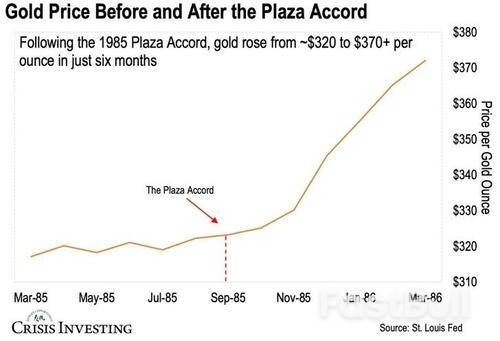
          It surged. Take a look at the chart below.

          After the Plaza Accord in 1985, gold jumped from about $320 per ounce to over $370 between September 1985 and March 1986. That’s in just six months.

          Adjusted for today’s prices, that would be like seeing gold leap to roughly $4,000 an ounce.

          But here’s the thing… If Trump’s Reset unfolds the way Matt and I believe it will, it won’t just be a repeat of the Plaza Accord—it’ll be that on steroids.

          In today’s globalized and overleveraged economy, the ripple effects could be enormous. I wouldn’t be surprised to see gold surge to $5,000–$8,000 per ounce as markets scramble to adapt.

          Stephen Miran’s arrival at the Fed isn’t just a policy shift—it’s confirmation that Trump’s Reset strategy is already moving from blueprint to reality. The implications for the dollar, gold, and your personal wealth are enormous. We’ve been tracking the signs of this coming shift for months—the hidden gold run out of London, the quiet buildup of reserves, and now the placement of Trump’s Reset architect inside the Federal Reserve itself. If you’ve been wondering what all this means for your money—and how to prepare before the Reset accelerates—I strongly urge you to read our latest deep-dive: Get Ready for Trump’s Monetary Reset. Inside, you’ll see why central banks are scrambling for gold, how Trump’s team plans to “monetize America’s balance sheet,” and why we believe this could unleash the biggest wealth revaluation in half a century. Most importantly, you’ll learn the practical steps you can take right now to protect your savings—and position yourself to potentially profit. Click here to get the full story before the Reset leaves you behind.

          Source: Zero Hedge

          To stay updated on all economic events of today, please check out our Economic calendar
          Risk Warnings and Disclaimers
          You understand and acknowledge that there is a high degree of risk involved in trading. Following any strategies or investment methods may lead to potential losses. The content on the site is provided by our contributors and analysts for information purposes only. You are solely responsible for determining whether any trading assets, securities, strategy, or any other product is suitable for investing based on your own investment objectives and financial situation.
          Add to Favorites
          Share

          Political Tensions Hit French Markets: CAC 40 Slumps, Yields at Five-Month High

          Adam

          Economic

          With all three major opposition parties vowing to oppose him, Bayrou’s minority government now appears at serious risk of collapse — a prospect that has rattled investors and driven stocks and bonds lower.
          CAC 40 Plunges, Bond Yields Soar as France Faces Confidence Vote
          French markets tumbled on Tuesday, extending Monday’s losses, as political tensions deepened ahead of a high-stakes confidence vote that could topple Prime Minister François Bayrou’s minority government. France now heads into an uncertain autumn marked by budget battles, street protests, and rising pressure from investors.
          Bayrou, appointed by President Emmanuel Macron after Michel Barnier’s government collapsed in a confidence vote last December, announced on Monday that he will seek parliamentary backing on 8 September. The decision reflects a political deadlock over the government’s proposed 2026 budget, which has become the focal point of the crisis. Adding to the turmoil, unions and activist groups are calling for a nationwide “total blockade” beginning on 10 September, threatening to paralyze economic activity.
          At the heart of the standoff is Bayrou’s fiscal consolidation plan, presented in July. The blueprint aims to shrink France’s deficit from a projected 5.4% of GDP in 2025 to 4.6% in 2026, and eventually to 2.8% by 2029. To meet its target, the government has outlined a plan for €43.8 billion in savings for 2026. The bulk of this (80%) will be achieved through spending reductions, such as slowing public sector hiring, freezing pension and tax adjustments, and getting rid of two public holidays. Bayrou warned that without action, France’s debt trajectory would deteriorate sharply, reaching 125% of GDP by 2029. His plan would instead cap it at around 117%.
          But the proposals have met fierce resistance across the political spectrum. From Marine Le Pen’s National Rally on the right to the Socialists, Greens, and France Unbowed on the left, opposition parties have rejected the plan outright, arguing it places the burden on households while lacking broad consensus. With the government facing almost unanimous hostility, Bayrou’s chances of survival look slim, fueling investor anxiety about both political stability and fiscal credibility.
          The likely fall of the government is weighing heavily on markets — and has already begun to reshape the outlook for France’s economy and debt sustainability. The uncertainty rattled investors, sending the CAC 40 (Fra40) down more than 3.3% since Monday, its sharpest decline in weeks. At the same time, bond markets flashed warning signs. France’s 10-year yield climbed above 3.50%, its highest level since March, as investors demanded greater compensation to hold French debt.
          The spread between French and German 10-year bonds widened to 77 basis points, compared with 69 basis points earlier this week. This widening gap reflects the increasing premium investors require for holding French OATs relative to German Bunds, which are considered the eurozone’s safest benchmark. While Germany benefits from a reputation for fiscal prudence and political stability, France is now seen as riskier, given its high debt levels, widening deficit, and mounting political uncertainty.
          The spread acts as a barometer of market confidence within the eurozone, and the recent jump highlights fears that France could face higher financing costs for longer if instability persists.
          Financial stocks bore the brunt of the selloff, with Société Générale plunging more than 10.5% over the past five sessions, while BNP Paribas slipped over 8%, AXA lost more than 9%, and Crédit Agricole fell nearly 8%. Banks and insurers are often the first to feel the impact of political instability and rising sovereign borrowing costs, as their balance sheets are heavily exposed to government bonds.
          When yields on French debt rise, the market value of these bonds declines, eroding the capital positions of lenders and insurers that hold them in large quantities. In addition, political uncertainty raises doubts about the government’s ability to implement reforms or maintain fiscal discipline, which in turn undermines confidence in the broader financial system. For banks in particular, higher sovereign yields also mean higher funding costs, tightening conditions just as credit demand is already weakening in a slower economy. Together, these pressures explain why the financial sector has been at the forefront of the selloff.
          Weekly CAC 40 Index Technical Outlook

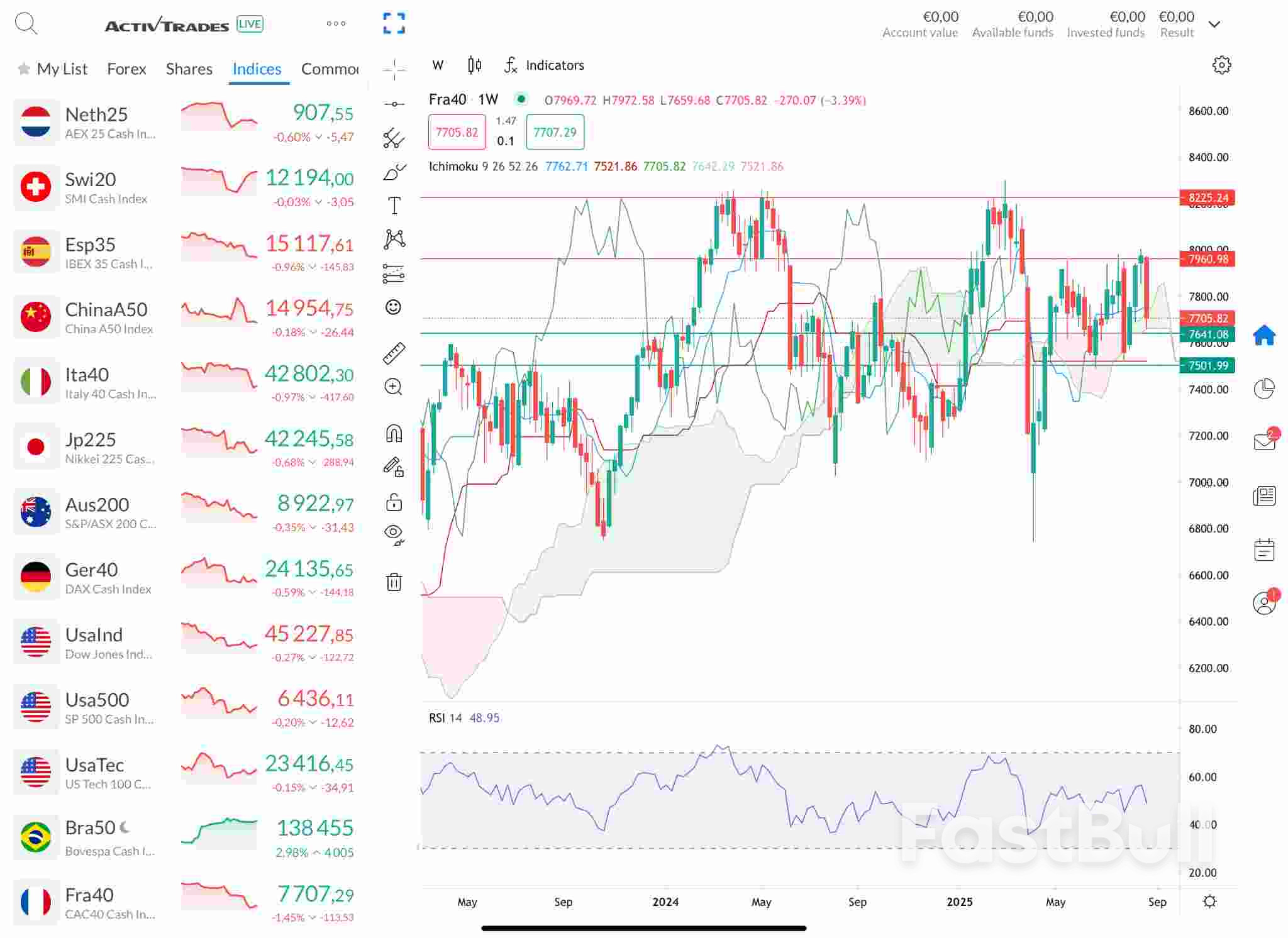
          Political Tensions Hit French Markets: CAC 40 Slumps, Yields at Five-Month High_1Weekly CAC 40 Chart

          The CAC 40 has come under heavy pressure, with the index falling back toward 7,700. This week’s 3.4% decline not only wiped out recent gains but also reinforced the market’s difficulty in breaking above the 7,960–8,225 resistance zone, which has repeatedly capped rallies since 2024.
          Prices have remained trapped in a wide consolidation range between roughly 7,500 and 8,200 since April, with each attempt to test the upper boundary followed by sharp pullbacks. The most recent rejection underscores investor hesitation amid tightening financial conditions and rising bond yields.
          The Ichimoku Cloud highlights this indecision: while the index is still hovering near the cloud’s upper edge, the inability to establish sustained momentum above resistance suggests that bullish conviction is fading. A decisive weekly close below 7,641, the baseline of the Ichimoku system, would increase the risk of a deeper retracement below the cloud toward the lower boundary of the range near 7,500. Beneath that level, the index could retest the previous yearly low below the 7,000 key level.
          The RSI has slipped to around 49, firmly in neutral territory and trending lower, suggesting fading buying pressure. Unless momentum stabilizes, sellers could remain in control in the near term.

          Source: fxempire

          To stay updated on all economic events of today, please check out our Economic calendar
          Risk Warnings and Disclaimers
          You understand and acknowledge that there is a high degree of risk involved in trading. Following any strategies or investment methods may lead to potential losses. The content on the site is provided by our contributors and analysts for information purposes only. You are solely responsible for determining whether any trading assets, securities, strategy, or any other product is suitable for investing based on your own investment objectives and financial situation.
          Add to Favorites
          Share

          Nvidia to report second quarter earnings, expecting $8 billion hit from China chip ban

          Adam

          Economic

          Nvidia (NVDA) will close out Big Tech's earnings season when it reports its second quarter results after the bell on Wednesday.
          The report comes after a flurry of moves between the company and the Trump administration, which saw Trump revoke his prior ban on the sale of Nvidia's chips to China but will now require the AI giant to pay the government a 15% cut of sales into the country.
          Trump initially banned the sale of chips to China in April and dropped the ban in July, adding the 15% fee in August. During its Q1 earnings call, Nvidia said it expects to take an $8 billion hit to its bottom line in Q2.
          Trump also announced he will place a 100% tariff on semiconductor shipments into the US unless companies commit to build in the country. Nvidia should be exempt from the tariff.
          Nvidia shares were up 35% year to date and 40% over the past 12 months as of Monday. In July, Nvidia became the first company to see its market capitalization top $4 trillion.
          Shares in Nvidia rose 0.3% before the bell on Tuesday.
          For the quarter, Nvidia is expected to report adjusted earnings per share (EPS) of $1.01 on revenue of $46.2 billion, according to Bloomberg analyst consensus estimates. The company saw adjusted EPS of $0.68 and revenue of $30 billion in the same quarter last year. That works out to 49% and 53% year over year EPS and revenue growth, respectively.
          The company saw 151% EPS and 122% revenue improvement in Q2 last year. Nvidia's EPS and revenue growth have moderated over the past few quarters following the massive growth spikes it saw during the onset of the AI craze.
          Evercore ISI analyst Mark Lipacis projects Nvidia's growth will bottom out at 50%, which could help "attract more momentum investors and translate to multiple expansion."
          Data center revenue for Q2 is expected to top out at $41.2 billion versus $26.2 billion in the prior year period. Gaming, Nvidia's second largest segment, is expected to hit $3.8 billion.
          Investors will be on the lookout for continued shipment scaling of Nvidia's GB200 super chip, the ramp of its upcoming Blackwell Ultra chip, AI spending, and commentary on China sales during the company's earnings call on Wednesday.
          "Given improving GB200 rack manufacturing yields at server [original design manufacturers], which we believe are approaching 85%, we believe rack shipments are on track to exit [calendar fourth quarter] at 15K-17K racks and believe full-year [Grace Blackwell] rack shipments are tracking closer to 30K, vs. our prior [estimate] of 25K," KeyBanc Capital Markets analyst John Vinh wrote in a note to investors.
          Vinh also, however, warned that he believes Q3 guidance will come in below consensus estimates if Nvidia decides not to include direct revenue from chip sales into China for the period.
          Baird senior research analyst Tristan Gerra offered a similarly sunny outlook for July quarter EPS and revenue estimates on strong GB200 sales. Wedbush analyst Matt Bryson, meanwhile, raised the firm's price target on Nvidia from $175 to $210 on solid feedback on the company's demand and shipments.
          "We continue to believe growth in announced hyperscale spend is largely going to build out AI capabilities and in particular ends up flowing to [Nvidia], which supplies a disproportionate amount of the AI server value," he wrote in a note to investors.
          Options traders expect Nvidia's market value to swing about $260 billion after its second quarter earnings, suggesting investors feel more certain about the company's perfromamnce
          Nvidia is also preparing a new chip for the Chinese market based on its Blackwell architecture, but the company would need to get Trump's approval to sell it in the region.
          The Chinese government has also come out in recent weeks to warn local companies against using Nvidia's chips, saying they could contain "backdoor" security risks.
          Nvidia has denied the charge and is working with the Chinese government to address the matter.

          Source: finance.yahoo

          To stay updated on all economic events of today, please check out our Economic calendar
          Risk Warnings and Disclaimers
          You understand and acknowledge that there is a high degree of risk involved in trading. Following any strategies or investment methods may lead to potential losses. The content on the site is provided by our contributors and analysts for information purposes only. You are solely responsible for determining whether any trading assets, securities, strategy, or any other product is suitable for investing based on your own investment objectives and financial situation.
          Add to Favorites
          Share

          Gold: Long-Term Consolidation Could Precede Major Breakout if $3,400 Holds

          Adam

          Commodity

          Gold ended last week 1% better off after Fed Chair Jerome Powell signalled on Friday that rate cuts could arrive as soon as September. After a brief pause on Monday, the yellow metal has pushed a little higher again, helped by political nerves in both the US and Europe.
          While equities have been unsettled a little by these developments, gold has quietly held firm – a sign that investors are willing to keep leaning bullish, even if the market is still caught in consolidation mode.
          It is worth watching the US dollar this week, as we will have more data to look forward. If the Fed edges further towards easing while political turmoil continues to gnaw at confidence in US policymaking, the US dollar is likely to remain under pressure – an environment that typically favours gold. The main caveat to the current bullish gold trend is if investor continue to pour money into the racier stock market, which could keep the appetite for haven demand low.
          Fed Independence Questioned: Cook’s Removal
          Markets were rattled in Asian trade when news broke that President Trump had dismissed Fed Governor Lisa Cook over alleged mortgage irregularities. Cook disputes his authority to fire her, meaning the courts will now decide whether she stays, or the Fed is left one member short.
          With Adriana Kugler having recently resigned and Stephen Miran brought in, the balance of the board already tilts more towards Trump’s stance. That raises concerns over Fed independence – a narrative investors dislike. For the US dollar, this is a clear negative; for gold, it’s another supportive tailwind. But is it enough to trigger a breakout above the key $3,400 resistance remains to be seen.
          Key Events: Data and Fed Speak
          This week’s calendar could also shape gold’s direction:
          Consumer confidence (today): Gauges whether household sentiment is sliding further.
          Q2 GDP revision (Thursday): Unlikely to shock markets unless the downward revision is significant.
          Fed Governor Christopher Waller’s speech (Thursday): One to watch, given he supported July’s cut and is a frontrunner to succeed Powell. Any dovish shift would carry weight.
          Core PCE inflation (Friday): The Fed’s preferred inflation measure, crucial for September’s policy call and therefore the direction for US dollar, and in turn, gold.
          These releases should keep gold traders busy. A softer data run or dovish rhetoric would only deepen dollar pressure, reinforcing the bullish gold story.
          Technical Analysis and Key Levels to Watch
          Gold: Long-Term Consolidation Could Precede Major Breakout if $3,400 Holds_1
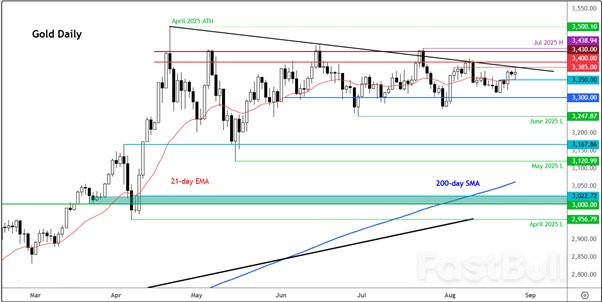
          From a chart perspective, gold has been consolidating for several weeks, winding up inside a wide range. The bulls may be frustrated by the lack of any further follow-through despite the renewed dollar weakness. But technically this type of price action often precedes a break out in the prevailing direction. Still, it is better to wait for more confirmation.
          For me, that would be in the form of a daily close above the bearish trend line that has been in place since gold topped in April. If this happens and ideally, we hold above $3,400 level, then this could pave the way for a potential continuation to re-test April’s ATH of $3,500 level. Interim resistance comes in at $3,385.
          On the downside, $3,350 is now the first level of support to watch, below which there is not much further support seen until $3,300, and then the June low of 3,247 will come into focus next.

          Source:investing

          Risk Warnings and Disclaimers
          You understand and acknowledge that there is a high degree of risk involved in trading. Following any strategies or investment methods may lead to potential losses. The content on the site is provided by our contributors and analysts for information purposes only. You are solely responsible for determining whether any trading assets, securities, strategy, or any other product is suitable for investing based on your own investment objectives and financial situation.
          Add to Favorites
          Share

          Can Trump Really Fire Fed Governor Cook? Here’s What The Law Says

          Devin

          Central Bank

          President Donald Trump has moved to fire Federal Reserve Governor Lisa Cook after she refused his demand to resign over a claim by a top administration official that she lied on mortgage applications. The escalation sets the stage for a lawsuit that will help determine the extent of White House control over the US central bank.

          Trump said in an Aug. 25 letter posted on Truth Social that he had “sufficient cause” to fire Cook, an acknowledgment by the president that he needs a valid reason to dismiss her under US law. Cook was accused of engaging in so-called mortgage occupancy fraud by falsely labeling a secondary home as her primary residence. No charges have been filed.

          The move to dismiss Cook could give Trump a chance to name someone to the Feb board as he pressures officials to lower interest rates. Trump has repeatedly attacked Fed Chair Jerome Powell, who has also resisted the president’s demands to resign.

          Cook’s high-profile defense attorney, Abbe Lowell, has pledged to file “a lawsuit challenging this illegal action.” Such a move would allow Cook to immediately ask for what’s known as a preliminary injunction, which would block her removal while the lawsuit moves forward.

          Both sides would file briefs outlining their arguments, giving the Trump administration a chance to provide more details of its allegations against Cook. The filings could give Cook a chance to argue that her firing was unjustified and politically motivated.

          The outcome could hinge on whether Cook can convince the judge that she — and the Fed — would suffer “irreparable harm” during the case if the status quo weren’t maintained. A decision on a preliminary injunction, which could be issued quickly, would be crucial because it may be months or longer before a judge rules on the actual merits of the case, including whether Cook was fired “for cause,” meaning for good reason.

          It’s far from clear that the Trump administration’s mortgage allegations against Cook are enough to meet the “for cause” bar. There hasn’t yet been a formal investigation and she hasn’t been charged with anything, let alone convicted. That means Trump’s allegations are just that — allegations.

          Cook could argue that unproven accusations are not enough to justify her termination. She could also argue that the allegations are irrelevant to her job, given that the alleged conduct took place a year before Cook’s appointment and had nothing to do with her duties as Fed governor.

          Cook, appointed by President Joe Biden in 2022 to a term that was set to expire in 2038, has already said Trump doesn’t have cause to fire her.

          “President Trump purported to fire me ‘for cause’ when no cause exists under the law, and he has no authority to do so,” Cook said in a statement released by her attorney. “I will not resign. I will continue to carry out my duties to help the American economy as I have been doing since 2022.”

          Section 10 of the Federal Reserve Act, the 1913 law that governs the central bank, says members of the Fed’s Board of Governors can be “removed for cause,” although the statute doesn’t specify exactly what “cause” means.

          Laws that do describe “for cause” generally define the term as encompassing three possibilities: inefficiency; neglect of duty; and malfeasance, meaning wrongdoing, in office. There’s no consensus on what those terms, which gained prominence in Congress more than a century ago, mean. A judge would have to decide whether Cook’s alleged mortgage fraud amounted to any of the three.

          Clear legal precedents would be few and far between. The Supreme Court has never considered whether a president had adequate grounds to dismiss an official for cause.

          Maybe not. Both sides could appeal an injunction ruling to a federal appeals court, which could be asked to expedite the case. A panel of three judges would issue a decision, possibly after holding a hearing.

          If Cook’s request for an injunction were denied and the ruling were upheld on appeal, her firing would remain in effect. If the injunction were granted and backed by an appeals court, Cook could remain in office while the case moves forward.

          The Supreme Court, where Trump has a 6-3 conservative majority, could have the final say. A decision by the nation’s highest court on an injunction in all likelihood would resolve the dispute long before any trial. Although the losing side could continue litigating the case, the chances of the justices effectively reversing themselves later on would be small.

          The biggest hint came in May, when the justices cleared the way for Trump to oust officials at two other government agencies without having to give a justification. In doing so, the court majority said the decision didn’t mean the president wielded similar authority at the Fed, indicating that Trump can’t simply fire Fed officials without any grounds. The court called the central bank a “uniquely structured, quasi-private entity.”

          At the time, Powell was in Trump’s cross-hairs. The ruling was interpreted as leaving open the possibility that Powell could be fired for cause. And Trump’s Supreme Court track record is likely to put him in a strong position should a case involving Powell — or Cook — land there.

          The court’s conservative supermajority has repeatedly declined to second-guess Trump’s judgments, granting a barrage of requests to let policies of his that are under legal challenge take effect this year.

          Federal Housing Finance Agency Director Bill Pulte, a staunch Trump ally, alleged on social media that Cook lied on loan applications for two properties — one in Michigan and one in Georgia — claiming she would use each property as her primary residence to secure more favorable loan terms. He said the applications were filed two weeks apart.

          In his letter, Trump said it was “inconceivable” that Cook was not aware of requirements in two separate mortgage applications taken out in the same year requiring her to maintain each property as her primary residence.

          “At minimum, the conduct at issue exhibits the sort of gross negligence in financial transactions that calls into question your experience and trustworthiness as a financial regulator,” Trump wrote.

          The Trump administration has made similar claims against two other high-profile critics of the president, California Senator Adam Schiff and New York Attorney General Letitia James. Both have denied wrongdoing.

          Source: Bloomberg Europe

          Risk Warnings and Disclaimers
          You understand and acknowledge that there is a high degree of risk involved in trading. Following any strategies or investment methods may lead to potential losses. The content on the site is provided by our contributors and analysts for information purposes only. You are solely responsible for determining whether any trading assets, securities, strategy, or any other product is suitable for investing based on your own investment objectives and financial situation.
          Add to Favorites
          Share

          Here's What Happened To Financial Markets After Nixon Pressured The Fed

          Thomas

          Central Bank

          Investors wondering what President Donald Trump's move to fire Federal Reserve Governor Lisa Cook might mean for financial markets today can look back half a century for some insight. President Richard Nixon, aiming to clinch a second term in the White House, pressured then-Fed Chair Arthur Burns to loosen monetary policy before the 1972 election. Tape recordings of Oval Office discussions show Nixon, who went on to resign in 1974 for abuses tied to the Watergate scandal, used both direct and indirect actions to coerce Burns . More than 50 years later, Nomura currency strategists led by Craig Chan said Trump's decision to fire Cook, the first African-American woman to sit on the Fed, may "refocus" investors on how the market reacted to Nixon's attempt to steer the central bank, using the earlier move as a possible guidepost for what to expect now. In the current case, Trump cited unproven allegations of false statements Cook made when applying for a mortgage. Cook said the president "has no authority" to fire her. To be sure, Chan said history "may not be a perfect match" given other variables and how markets have changed since the era of fixed exchange rates, the gold standard and the Bretton Woods post-war monetary system. Still, the Nomura analyst noted historical parallels between Trump's attempt to fire Cook on Monday and Nixon's push for less-restrictive monetary policy in the early 1970s. Here's a look back at how markets fared back in the Nixon years, according to Chan: Currency The ICE U.S. Dollar Index (DXY) , which measures the U.S. greenback against a basket of foreign currencies, saw a massive drop after the U.S. left the gold standard and suffered massive balance of payments deficits under Nixon. The index first rose 0.5% from Nov. 6, 1972 — the day before the election — to a peak in January of the following year, which coincided with a high in stocks. But the dollar index then turned south, tumbling 18% to a July 1973 low. Stocks Similarly, a rise in stocks gave way to an eye-popping slide. The Dow Jones Industrial Average added more than 6% between Nov. 6, 1972 and its peak in mid-January of 1973, right around the time of Nixon's second inauguration. But within a year of hitting that high, the blue-chip average plunged as much as 19%. Within two years of that Jan. 1973 peak, the 30-stock average at one point plummeted as much as 44%. Treasurys As inflation accelerated, the yield on the U.S. 10-year Treasury note surged. In total, the 10-year yield rose more than 130 basis points between Nov. 6, 1972 and a high on Aug. 7, 1973. At one point, the yield touched a high of 7.58% — more than three percentage points above today's level around 4.3%. Nomura's outlook for today The stock market on Tuesday morning appeared to shake off much of the impact of the attempt to fire Cook. So far this year, the stock market has looked past Trump's pressure on the Fed, despite rising concerns over the central bank losing its independence and the effect that might have on inflation. However, the U.S. dollar took a hit Tuesday with the ICE U.S. Dollar Index down 0.3% vs. a basket of other currencies, bringing its decline for the year to nearly 10%. Gold futures were jumping on concern what a politicized Fed would mean for its inflation-fighting credentials. Chan and team, informed by the Nixon parallel, sees "risks to a weaker USD if the market fears a loss to Fed independence."

          Source: CNBC

          Risk Warnings and Disclaimers
          You understand and acknowledge that there is a high degree of risk involved in trading. Following any strategies or investment methods may lead to potential losses. The content on the site is provided by our contributors and analysts for information purposes only. You are solely responsible for determining whether any trading assets, securities, strategy, or any other product is suitable for investing based on your own investment objectives and financial situation.
          Add to Favorites
          Share
          FastBull
          Copyright © 2025 FastBull Ltd

          728 RM B 7/F GEE LOK IND BLDG NO 34 HUNG TO RD KWUN TONG KLN HONG KONG

          TelegramInstagramTwitterfacebooklinkedin
          App Store Google Play Google Play
          Products
          Charts

          Chats

          Q&A with Experts
          Screeners
          Economic Calendar
          Data
          Tools
          Membership
          Features
          Function
          Markets
          Copy Trading
          Latest Signals
          Contests
          News
          Analysis
          24/7
          Columns
          Education
          Company
          Careers
          About Us
          Contact Us
          Advertising
          Help Center
          Feedback
          User Agreement
          Privacy Policy
          Business

          White Label

          Data API

          Web Plug-ins

          Poster Maker

          Affiliate Program

          Risk Disclosure

          The risk of loss in trading financial instruments such as stocks, FX, commodities, futures, bonds, ETFs and crypto can be substantial. You may sustain a total loss of the funds that you deposit with your broker. Therefore, you should carefully consider whether such trading is suitable for you in light of your circumstances and financial resources.

          No decision to invest should be made without thoroughly conducting due diligence by yourself or consulting with your financial advisors. Our web content might not suit you since we don't know your financial conditions and investment needs. Our financial information might have latency or contain inaccuracy, so you should be fully responsible for any of your trading and investment decisions. The company will not be responsible for your capital loss.

          Without getting permission from the website, you are not allowed to copy the website's graphics, texts, or trademarks. Intellectual property rights in the content or data incorporated into this website belong to its providers and exchange merchants.

          Not Logged In

          Log in to access more features

          FastBull Membership

          Not yet

          Purchase

          Become a signal provider
          Help Center
          Customer Service
          Dark Mode
          Price Up/Down Colors

          Log In

          Sign Up

          Position
          Layout
          Fullscreen
          Default to Chart
          The chart page opens by default when you visit fastbull.com