• Trade
  • Markets
  • Copy
  • Contests
  • News
  • 24/7
  • Calendar
  • Q&A
  • Chats
Trending
Screeners
SYMBOL
LAST
BID
ASK
HIGH
LOW
NET CHG.
%CHG.
SPREAD
SPX
S&P 500 Index
6800.25
6800.25
6800.25
6819.26
6759.73
-16.26
-0.24%
--
DJI
Dow Jones Industrial Average
48114.25
48114.25
48114.25
48452.17
47946.25
-302.30
-0.62%
--
IXIC
NASDAQ Composite Index
23111.45
23111.45
23111.45
23162.60
22920.66
+54.05
+ 0.23%
--
USDX
US Dollar Index
97.910
97.990
97.910
97.940
97.790
+0.010
+ 0.01%
--
EURUSD
Euro / US Dollar
1.17387
1.17394
1.17387
1.17520
1.17366
-0.00080
-0.07%
--
GBPUSD
Pound Sterling / US Dollar
1.34083
1.34093
1.34083
1.34265
1.34061
-0.00124
-0.09%
--
XAUUSD
Gold / US Dollar
4323.15
4323.53
4323.15
4327.70
4301.37
+20.86
+ 0.48%
--
WTI
Light Sweet Crude Oil
55.809
55.846
55.809
55.966
54.927
+0.870
+ 1.58%
--

Community Accounts

Signal Accounts
--
Profit Accounts
--
Loss Accounts
--
View More

Become a signal provider

Sell trading signals to earn additional income

View More

Guide to Copy Trading

Get started with ease and confidence

View More

Signal Accounts for Members

All Signal Accounts

Best Return
  • Best Return
  • Best P/L
  • Best MDD
Past 1W
  • Past 1W
  • Past 1M
  • Past 1Y

All Contests

  • All
  • Trump Updates
  • Recommend
  • Stocks
  • Cryptocurrencies
  • Central Banks
  • Featured News
Top News Only
Share

Indian Rupee Last Up 0.4% At 90.54

Share

India's Nifty Bank Futures Down 0.01% In Pre-Open Trade

Share

India's Nifty 50 Futures Down 0.06% In Pre-Open Trade

Share

India's Nifty 50 Index Up 0.16% In Pre-Open Trade

Share

Singapore Nov Petrochemical Exports Fall 26.6% Even With Nodx Surge

Share

[On Polymarket, The Probability Of "Bank Of Japan 25 Basis Point Rate Hike In December" Is Currently At 98%.] December 17Th, According To A Related Page, The Probability Of "Bank Of Japan 25 Basis Point Rate Hike In December" On Polymarket Is Currently Reported As 98%, While The Probability Of No Rate Change Is 2%.According To Publicly Available Information, The Bank Of Japan Plans To Announce Its Interest Rate Decision On December 19Th

Share

The USD/KRW Exchange Rate Rose Above 1480 For The First Time In Eight Months

Share

HK Budget Consultation Begins: Paul Chan Sees Expanding Economic Development, Creating Jobs As Key Tasks

Share

The Main Shanghai Silver Futures Contract Rose Nearly 5% To 15,475 Yuan/kg, Setting A New Historical High, And Has Risen More Than 106% Year-to-date

Share

New South Wales Premier Chris Minns: Looking At Reforms To Not Accept Applications For Protests After Terror Events

Share

New South Wales Premier Chris Minns: To Recall State Parliament To Discuss Urgent Legislation On Firearms

Share

Russia - China Far Eastern Gas Route Construction Progressing, China Ambassador To Russia Tells RIA

Share

Spot Silver Rose 3.00% On The Day, Currently Trading At $65.64 Per Ounce

Share

South Korean Won Falls As Much As 0.6% To 1482.10 Per USA Dollar, Lowest Since April 9

Share

South Korea Forex Authority: Resumes Currency Swap With Bank Of Korea

Share

Wsj's Timiraos: Latest US Employment Data May Not Prompt Further Rate Cuts By Fed Next Month

Share

Robinhood: Introduces Next Generation Of Robinhood Cortex, To Roll Out In Q1 Of Next Year To Robinhood Gold Subscribers

Share

Trump Blockade Is "Absolutely Irrational", Violates Free Commerce And Navigability-Venezuela Government

Share

India's Central Bank Governor Sanjay Malhotra Signals Rates To Stay Low For 'Long Period'

Share

India Central Bank Governor: Impact Of US Trade Deal Could Be As Much As About Half A Percentage Point

TIME
ACT
FCST
PREV
U.S. Average Hourly Wage MoM (SA) (Oct)

A:--

F: --

P: --

U.S. Average Hourly Wage YoY (Oct)

A:--

F: --

P: --

U.S. Retail Sales (Oct)

A:--

F: --

P: --

U.S. Core Retail Sales MoM (Oct)

A:--

F: --

P: --
U.S. Core Retail Sales (Oct)

A:--

F: --

P: --

U.S. Retail Sales MoM (Oct)

A:--

F: --

P: --
U.S. Private Nonfarm Payrolls (SA) (Oct)

A:--

F: --

P: --
U.S. Average Weekly Working Hours (SA) (Oct)

A:--

F: --

P: --

U.S. Labor Force Participation Rate (SA) (Nov)

A:--

F: --

P: --

U.S. Retail Sales YoY (Oct)

A:--

F: --

P: --

U.S. Manufacturing Employment (SA) (Oct)

A:--

F: --

P: --
U.S. Government Employment (Nov)

A:--

F: --

P: --

U.S. Weekly Redbook Index YoY

A:--

F: --

P: --

U.S. IHS Markit Manufacturing PMI Prelim (SA) (Dec)

A:--

F: --

P: --

U.S. IHS Markit Composite PMI Prelim (SA) (Dec)

A:--

F: --

P: --

U.S. IHS Markit Services PMI Prelim (SA) (Dec)

A:--

F: --

P: --

U.S. Commercial Inventory MoM (Sept)

A:--

F: --

P: --

BOC Gov Macklem Speaks
Argentina GDP YoY (Constant Prices) (Q3)

A:--

F: --

P: --

U.S. API Weekly Gasoline Stocks

A:--

F: --

P: --

U.S. API Weekly Cushing Crude Oil Stocks

A:--

F: --

P: --

U.S. API Weekly Refined Oil Stocks

A:--

F: --

P: --

U.S. API Weekly Crude Oil Stocks

A:--

F: --

P: --

Australia Westpac Leading Index MoM (Nov)

A:--

F: --

P: --
Japan Trade Balance (Not SA) (Nov)

A:--

F: --

P: --

Japan Goods Trade Balance (SA) (Nov)

A:--

F: --

P: --

Japan Imports YoY (Nov)

A:--

F: --

P: --

Japan Exports YoY (Nov)

A:--

F: --

P: --

Japan Core Machinery Orders YoY (Oct)

A:--

F: --

P: --

Japan Core Machinery Orders MoM (Oct)

A:--

F: --

P: --

U.K. Core CPI MoM (Nov)

--

F: --

P: --

U.K. Inflation Rate Expectations

--

F: --

P: --

U.K. Core Retail Prices Index YoY (Nov)

--

F: --

P: --

U.K. Core CPI YoY (Nov)

--

F: --

P: --

U.K. Output PPI MoM (Not SA) (Nov)

--

F: --

P: --

U.K. Output PPI YoY (Not SA) (Nov)

--

F: --

P: --

U.K. Input PPI YoY (Not SA) (Nov)

--

F: --

P: --

U.K. CPI YoY (Nov)

--

F: --

P: --

U.K. Retail Prices Index MoM (Nov)

--

F: --

P: --

U.K. CPI MoM (Nov)

--

F: --

P: --

U.K. Input PPI MoM (Not SA) (Nov)

--

F: --

P: --

U.K. Retail Prices Index YoY (Nov)

--

F: --

P: --

Indonesia 7-Day Reverse Repo Rate

--

F: --

P: --

Indonesia Deposit Facility Rate (Dec)

--

F: --

P: --

Indonesia Lending Facility Rate (Dec)

--

F: --

P: --

Indonesia Loan Growth YoY (Nov)

--

F: --

P: --

South Africa Core CPI YoY (Nov)

--

F: --

P: --

South Africa CPI YoY (Nov)

--

F: --

P: --

Germany Ifo Business Expectations Index (SA) (Dec)

--

F: --

P: --

Germany Ifo Current Business Situation Index (SA) (Dec)

--

F: --

P: --

Germany IFO Business Climate Index (SA) (Dec)

--

F: --

P: --

Euro Zone Core CPI Final MoM (Nov)

--

F: --

P: --

Euro Zone Labor Cost YoY (Q3)

--

F: --

P: --

Euro Zone Core HICP Final YoY (Nov)

--

F: --

P: --

Euro Zone Core HICP Final MoM (Nov)

A:--

F: --

P: --

Euro Zone Core CPI Final YoY (Nov)

--

F: --

P: --

Euro Zone HICP MoM (Excl. Food & Energy) (Nov)

--

F: --

P: --

Euro Zone CPI YoY (Excl. Tobacco) (Nov)

--

F: --

P: --

Euro Zone HICP Final YoY (Nov)

--

F: --

P: --

Euro Zone HICP Final MoM (Nov)

--

F: --

P: --

Q&A with Experts
    • All
    • Chatrooms
    • Groups
    • Friends
    Connecting
    .
    .
    .
    Type here...
    Add Symbol or Code

      No matching data

      All
      Trump Updates
      Recommend
      Stocks
      Cryptocurrencies
      Central Banks
      Featured News
      • All
      • Russia-Ukraine Conflict
      • Middle East Flashpoint
      • All
      • Russia-Ukraine Conflict
      • Middle East Flashpoint
      Search
      Products

      Charts Free Forever

      Chats Q&A with Experts
      Screeners Economic Calendar Data Tools
      Membership Features
      Data Warehouse Market Trends Institutional Data Policy Rates Macro

      Market Trends

      Market Sentiment Order Book Forex Correlations

      Top Indicators

      Charts Free Forever
      Markets

      News

      News Analysis 24/7 Columns Education
      From Institutions From Analysts
      Topics Columnists

      Latest Views

      Latest Views

      Trending Topics

      Top Columnists

      Latest Update

      Signals

      Copy Rankings Latest Signals Become a signal provider AI Rating
      Contests
      Brokers

      Overview Brokers Assessment Rankings Regulators News Claims
      Broker listing Forex Brokers Comparison Tool Live Spread Comparison Scam
      Q&A Complaint Scam Alert Videos Tips to Detect Scam
      More

      Business
      Events
      Careers About Us Advertising Help Center

      White Label

      Data API

      Web Plug-ins

      Affiliate Program

      Awards Institution Evaluation IB Seminar Salon Event Exhibition
      Vietnam Thailand Singapore Dubai
      Fans Party Investment Sharing Session
      FastBull Summit BrokersView Expo
      Recent Searches
        Top Searches
          Markets
          News
          Analysis
          User
          24/7
          Economic Calendar
          Education
          Data
          • Names
          • Latest
          • Prev

          View All

          No data

          Scan to Download

          Faster Charts, Chat Faster!

          Download App
          English
          • English
          • Español
          • العربية
          • Bahasa Indonesia
          • Bahasa Melayu
          • Tiếng Việt
          • ภาษาไทย
          • Français
          • Italiano
          • Türkçe
          • Русский язык
          • 简中
          • 繁中
          Open Account
          Search
          Products
          Charts Free Forever
          Markets
          News
          Signals

          Copy Rankings Latest Signals Become a signal provider AI Rating
          Contests
          Brokers

          Overview Brokers Assessment Rankings Regulators News Claims
          Broker listing Forex Brokers Comparison Tool Live Spread Comparison Scam
          Q&A Complaint Scam Alert Videos Tips to Detect Scam
          More

          Business
          Events
          Careers About Us Advertising Help Center

          White Label

          Data API

          Web Plug-ins

          Affiliate Program

          Awards Institution Evaluation IB Seminar Salon Event Exhibition
          Vietnam Thailand Singapore Dubai
          Fans Party Investment Sharing Session
          FastBull Summit BrokersView Expo

          Commodity wrap: gold, silver rally while oil drops on oversupply and peace talk hopes

          Adam

          Commodity

          Summary:

          Gold and silver rallied on weaker dollar, rate-cut expectations, and safe-haven demand, while oil prices fell amid oversupply fears and hopes that Russia-Ukraine peace talks could boost global supply.

          Gold prices were hovering below the $4,400-per-ounce mark as safe-haven buying increased, while the dollar slipped against major currencies.
          Silver prices on COMEX also rose more than 3% on Monday, with the metal shy of Friday’s record high.
          Meanwhile, oil prices were in the red as a potential peace deal between Russia and Ukraine weighed on sentiment.
          Gold climbs 1%
          The price of gold rose by 1% on Monday, settling near a seven-week peak as a weaker dollar, anticipation of interest rate reductions, and safe-haven investments fueled by current geopolitical instability buoyed the market.
          Gold priced in the greenback became more accessible to international purchasers as the dollar, which makes the precious metal more affordable for overseas buyers, remained near the two-month low it hit last week.
          Benchmark 10-year US Treasury yields also experienced a slight decline.
          Last week, the US Federal Reserve reduced its interest rate by 25 basis points, following a divided vote.
          Any additional easing of monetary policy will be contingent upon the future performance of the labour market and inflation levels.
          Markets are currently pricing in two US rate cuts next year, with investors eyeing this week’s US nonfarm payrolls report for further clues on monetary policy.
          “Gold demand looks likely to increase should the dollar come under further downside pressure,” said David Morrison, senior market analyst at Trade Nation.
          But gold could also turn lower should the dollar start to pick up again, particularly if the Dollar Index were to retest resistance around 100.00 on a cash basis.
          Meanwhile, silver’s price increased by 3.2%, reaching $63.955 per ounce.
          This follows a volatile session on Friday, where it hit a record high of $64.65 before dropping significantly by the close.
          Following a sharp retreat from fresh record highs on Friday, silver experienced a strong overnight rebound, surging approximately 2% and regaining its bullish momentum.
          “The price action highlights silver’s heightened sensitivity to positioning and sentiment, with sharp swings likely to persist after its recent explosive run,” Morrison said.
          Oil falls
          At the time of writing, the price of West Texas Intermediate crude oil was at $56.96 per barrel, down 0.5%, while Brent was at $60.87 per barrel, down 0.4%.
          A projected worldwide oil surplus in 2026 caused both contracts to drop over 4% last week.
          Venezuela’s oil exports have significantly declined following the US seizure of a tanker and the imposition of new sanctions on shipping companies and vessels involved in trade with the Latin American oil producer.
          The intensifying US pressure on President Nicolas Maduro, which includes reported plans by Reuters for America to intercept more ships carrying Venezuelan oil, is being closely monitored by the market for its potential impact on global oil supply.
          Talks between Ukrainian President Volodymyr Zelenskiy and US envoys in Berlin concluded after five hours on Sunday, with negotiations scheduled to resume on Monday.
          During the discussions, President Zelenskyy proposed abandoning Ukraine’s ambition to join the NATO military alliance.
          While US envoy Steve Witkoff stated that “a lot of progress was made,” no further details were released.
          A potential peace agreement resulting from these talks could lead to an increase in Russian oil supply, which is currently subject to sanctions by Western nations.
          According to JPMorgan Commodities Research in a Saturday note, oil surpluses are anticipated to broaden further through 2026 and 2027, following expected widening in 2025.
          This projection is based on global oil supply being forecast to increase at three times the rate of demand growth through 2026, thus outpacing it.
          “Oversupply fears continue to dominate the longer-term narrative while global demand growth continues to slow,” Morrison said.
          It’s worth pointing out that lower oil prices have the potential to wreck Russia’s economy.

          Source: invezz

          Risk Warnings and Disclaimers
          You understand and acknowledge that there is a high degree of risk involved in trading. Following any strategies or investment methods may lead to potential losses. The content on the site is provided by our contributors and analysts for information purposes only. You are solely responsible for determining whether any trading assets, securities, strategy, or any other product is suitable for investing based on your own investment objectives and financial situation.
          Add to Favorites
          Share

          President Trump Claims Inflation Is Neutralized

          Devin

          Economic

          President Trump Claims Inflation Is Neutralized

          On December 14, 2025, President Trump claimed that inflation is 'totally neutralized,' amid his administration's efforts to reduce inflation to an average of 2.7% during his second term.

          The claim highlights ongoing economic strategies, but lacks a direct correlation to cryptocurrency markets, although broader economic improvements can indirectly influence risk assets.

          President Donald Trump announced earlier today that inflation is "totally neutralized," according to a speech reported on December 14, 2025. Economic details in a recent White House statement show inflation has been reduced to 2.7% during his term. Donald J. Trump, President of the United States, remarked, "inflation has been cut by more than half" and is "working to bring it down further."

          Trump's statement was not directly attributed to any social media post. The White House article highlights Trump's economic strategy, mentioning spending cuts and tariff adjustments to tackle inflation challenges.

          The broader economic impact is significant, with wage growth approaching 4% and gas prices declining nationwide. These figures illustrate the potential benefits felt across various sectors and household budgets. Shelter inflation also reached a four-year low, according to White House data.

          Experts like Federal Reserve Governor Steven I. Miran recognize improved goods inflation prospects due to deregulation. In his Columbia University speech, Miran highlighted factors driving positive economic momentum, without directly addressing Trump's inflation neutralization claims.

          Current cryptocurrency markets have not shown any direct response to these announcements, with no on-chain data indicating shifts. Experts haven't linked changes in crypto assets such as ETH or BTC to inflation claims.

          The path forward for financial and regulatory outcomes may hinge on prolonged economic measures. Analysts believe inflation reductions could influence risk assets, though direct impacts on cryptocurrency remain speculative. Historical patterns and economic trends provide vital context for ongoing analysis.

          Source: CryptoSlate

          To stay updated on all economic events of today, please check out our Economic calendar
          Risk Warnings and Disclaimers
          You understand and acknowledge that there is a high degree of risk involved in trading. Following any strategies or investment methods may lead to potential losses. The content on the site is provided by our contributors and analysts for information purposes only. You are solely responsible for determining whether any trading assets, securities, strategy, or any other product is suitable for investing based on your own investment objectives and financial situation.
          Add to Favorites
          Share

          Market navigator: week of 15 December 2025

          Adam

          Economic

          What happened last week

          Third consecutive cut from Fed: The Federal Open Market Committee (FOMC) voted to reduce policy rates by 25 basis points (bps) with three dissenting voices. One member advocated for a 50bps reduction, while two voted to maintain rates unchanged. The dot plot median projection indicates only one cut next year as the committee anticipates improved growth prospects (from 1.8% to 2.4%) and inflation moderating more rapidly than expected. Risk assets rallied on enhanced policy clarity and resilient economy.
          China's deflation challenge persists: November's consumer price index (CPI) year-on-year (YoY) growth accelerated to 0.7% from October's 0.2%, driven by elevated food prices. However, producer price index (PPI) contracted for the 38th consecutive month, deepening to 2.2% YoY from 2.1% in October, indicating persistent deflation amid intense price competition and subdued domestic demand.
          Chinese policy priorities emerge: The Politburo designated domestic demand as the paramount priority for 2026, reducing dependence on exports. Monetary and fiscal policies will remain 'moderately loose' and 'proactive', though policy wordings suggest stimulus will not exceed this year's levels. Addressing involution represents another priority.
          RBA stays put: Australia's easing cycle may be coming to an end as the Reserve Bank of Australia (RBA) holds for the third consecutive meeting amid elevated inflation. While the new monthly CPI data series might have exaggerated the situation, the RBA believes there is an upside risk to inflation. The board did not consider rate cuts, instead focusing on factors that would warrant increases next year.

          Markets in focus

          AI bubble concerns drive US equity volatility
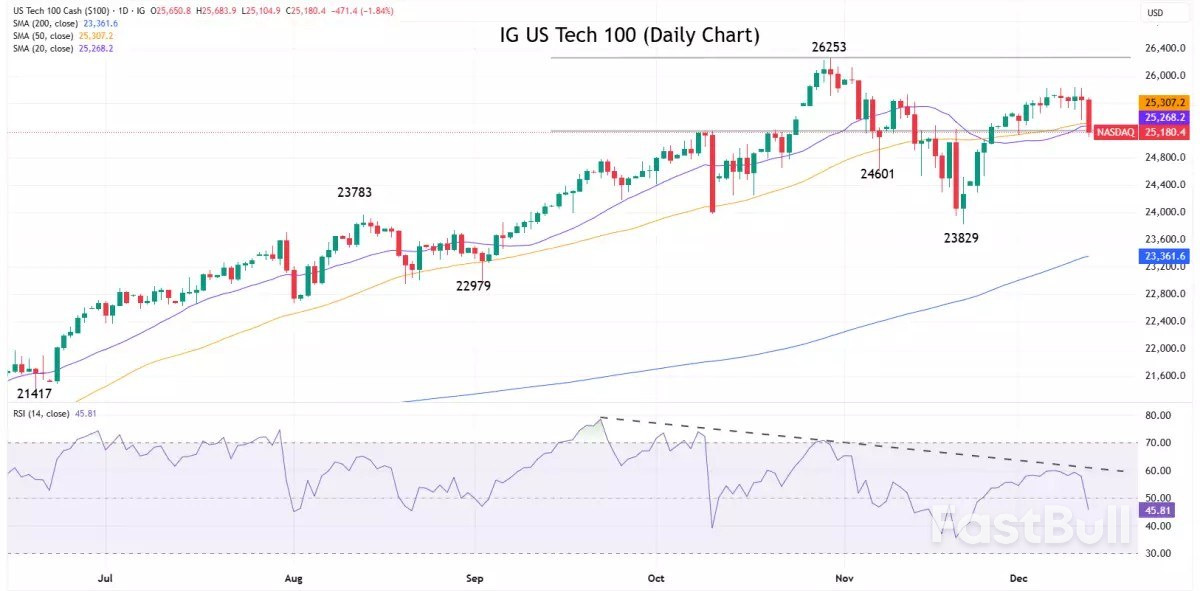
          The S&P 500 and Dow Jones indices established fresh all-time highs last Thursday following the Federal Reserve's (Fed) rate decision, before retreating on Friday amid renewed concerns over artificial intelligence (AI) sector valuations. The Nasdaq 100 bore the brunt of the selloff, declining 1.9% for the week, while the S&P 500 retreated 1.1%. The Dow Jones demonstrated relative resilience, advancing 1.0%.
          Oracle's fiscal second quarter results catalysed the latest wave of AI stock selling pressure. The AI cloud infrastructure provider missed revenue expectations and failed to alleviate investor concerns regarding its mounting debt burden. Capital expenditure projections for fiscal year 2026 surged 40% to $50 billion, triggering a 13% weekly decline in Oracle's share price. Broadcom encountered similar headwinds despite exceeding top and bottom-line expectations. Insufficient clarity regarding order backlog combined with warnings of gross margin compression prompted investors to liquidate positions, driving an 11% decline following a 75% year-to-date rally preceding quarterly results.
          Conversely, Warner Bros Discovery shares surged 15% after Paramount Sykdance submitted a $108.4 billion acquisition proposal, following Netflix's $83 billion merger agreement.
          Despite record highs across other major US indices, the US Tech 100 index continues to exhibit subdued momentum, evidenced by a descending relative strength index (RSI) trajectory. The benchmark currently trades at support established by prior resistance near 25,200. A rebound from this level would signal near-term bullish momentum towards 26,253, while failure to hold support could prompt testing of the next level near 24,250.
          Figure 1: US Tech 100 index (daily) price chart

          Market navigator: week of 15 December 2025_1as of 14 December 2025. Past performance is not a reliable indicator of future performance.

          Hang Seng Index trades sideways
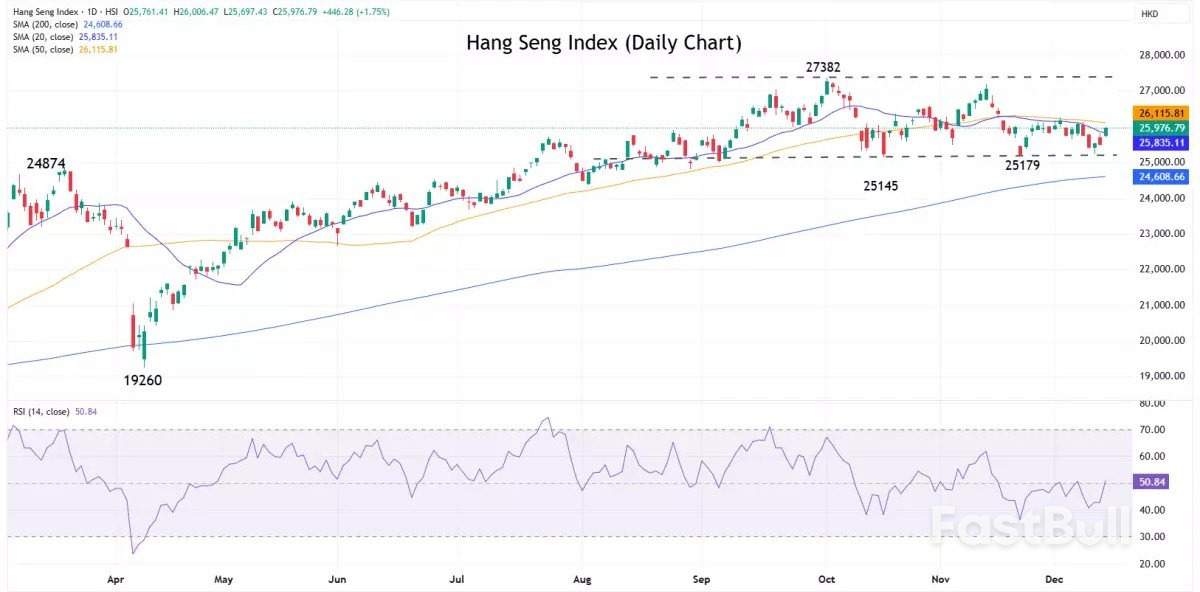
          The Hang Seng Index (HSI) maintained a sideways trajectory, delivering a modest decline of 0.4% last week. Trading volume on the Hong Kong Exchange main board continued to remain subdued despite enhanced clarity on 2026 global economic prospects from the FOMC. Investors continued to realise profits as the year draws to a close. Southbound net flows turned negative last week, a development not observed for at least six months.
          The FOMC's hawkish cut is generally supportive of global banking stocks performance. HSBC Holdings was the best performing Hang Seng Index constituent, surging 6% to a 17-year high last week. Meanwhile, Chinese insurers are benefiting from a steepening Chinese government bond yield curve and a structural transformation in society, as Chinese households diversify their deposit and investment allocation beyond traditional banking channels. Ping An Insurance was a notable outperforming stock last week, delivering 5% in returns.
          The 20-day moving average (MA) on the HSI daily chart continued to trend downward after failing to form a golden cross with the 50-day MA in mid-November, revealing sluggish momentum. The index appears positioned to trade within the 25,150 to 27,400 range in the near term. The short-term moving averages will likely present resistance around 26,100 while November's low establishes support near 25,180.
          Figure 2: Hang Seng Index (daily) price chart

          Market navigator: week of 15 December 2025_2as of 14 December 2025. Past performance is not a reliable indicator of future performance.

          Silver price breaks record high
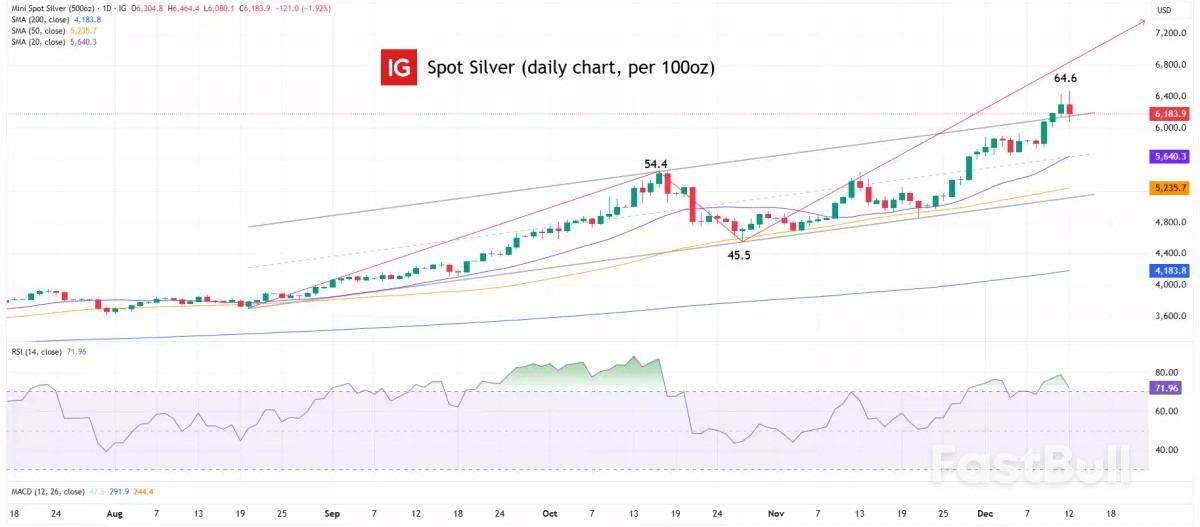
          Silver surged to a historic record above $64 per ounce last week, marking an extraordinary breakout that has captured renewed attention from both institutional and retail investors. Year-to-date, the white metal has delivered 115% in returns, significantly outpacing gold's performance, demonstrating its higher volatility characteristic and amplifying the precious metals rally.
          Multiple forces have converged to drive silver's exponential surge. The prospect of the Fed's loosening monetary policy following softer US economic data has weakened the dollar and compressed real yields, creating favourable conditions for non-yielding assets. Traditional safe-haven demand amid geopolitical uncertainties was also a key supporting factor of precious metal demand this year. Additionally, industrial consumption remains robust. Silver's unmatched conductivity makes it indispensable for solar panel production, electric vehicle components and AI infrastructure build-out. These overlapping industrial trends have created sustained demand that supply has struggled to match.
          The technical picture reveals strong bullish momentum, with spot silver prices surging above the upper boundary of the ascending channel since mid-August. However, RSI readings suggest overbought conditions, indicating potential near-term consolidation before the uptrend resumes. 4 December's low at $56.4 should provide immediate support for any pullback, while a 161.8% Fibonacci extension of the upward move from 20 August to 16 October provides a medium-term target of $73.6.
          Figure 3: Spot silver (daily) price chart

          Market navigator: week of 15 December 2025_3as of 14 December 2025. Past performance is not a reliable indicator of future performance.

          The week ahead

          China's economic momentum takes centre stage Monday with industrial production, housing prices, retail sales and fixed asset investment figures for November. Markets anticipate industrial production growth to accelerate to 5% YoY from 4.9%, while retail sales are expected to hold at 2.9%. These releases assume heightened significance following November's CPI report, with investors seeking confirmation that China's recovery from deflationary pressures represents a sustainable trend. Stronger-than-expected readings would validate recent equity market optimism, while disappointment could ignite concerns about Beijing's stance of refraining from ramping up stimulus measures.
          November's US labour market data arrives Tuesday with the non-farm payrolls report subdued following September's modest 119,000 gain. Markets expect the unemployment rate to hold at 4.4%. Thursday's November year-on-year inflation data is anticipated to remain roughly at current levels. These releases will influence the Fed's trajectory for 2026 and determine whether there will be a prolonged pause in the cutting cycle.
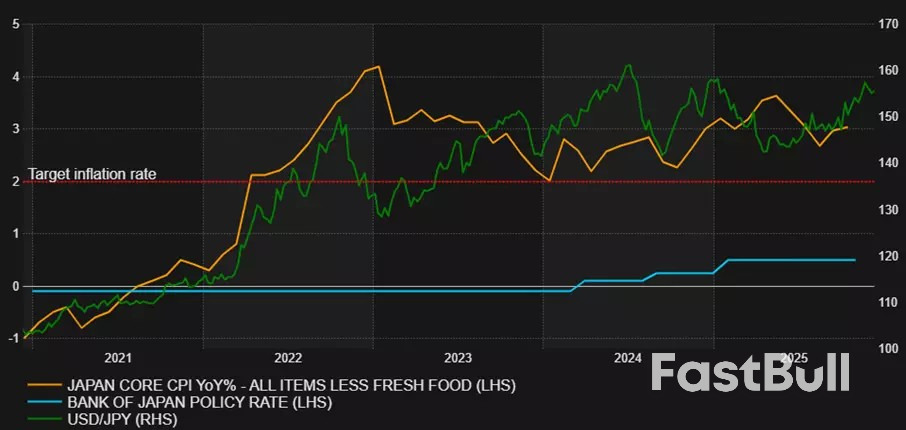
          Central bank meetings dominate the second half of the week, with the European Central Bank (ECB), Bank of England (BOE) and Bank of Japan (BOJ) all convening. The ECB is widely expected to keep its deposit facility rate at 2% on Thursday, while the BOE is likely to deliver a quarter-point cut to 3.75% unless Wednesday's inflation reading complicates matters. The BOJ's Friday decision commands particular attention. Markets are pricing in nearly 80% probability of a rate increase from 0.5% to 0.75%, marking the central bank's first move since January. The recent hawkish pivot partly reflects concerns over yen weakness, with USD/JPY almost reaching 158. Should Governor Ueda signal additional tightening ahead, the currency pair could retreat towards 154 levels, though this would likely pressure Japanese equities. The path forward remains highly uncertain, with BOJ communication critical for market positioning.
          Figure 4: Yen volatility and inflation pressure strengthens case for BOJ hike
          Market navigator: week of 15 December 2025_4

          Source: ig

          To stay updated on all economic events of today, please check out our Economic calendar
          Risk Warnings and Disclaimers
          You understand and acknowledge that there is a high degree of risk involved in trading. Following any strategies or investment methods may lead to potential losses. The content on the site is provided by our contributors and analysts for information purposes only. You are solely responsible for determining whether any trading assets, securities, strategy, or any other product is suitable for investing based on your own investment objectives and financial situation.
          Add to Favorites
          Share

          Mexico Sees Small Inflation Impact From Tariffs On Chinese Goods

          Daniel Carter

          Economic

          Mexico's government calculates that new tariffs on Asian goods will only impact inflation by 0.2 percentage points and won't significantly affect prices of cars imported from nations like China.
          Economy Minister Marcelo Ebrard provided the inflation estimate at a government press conference on Monday, adding that the tariffs are needed to protect some 350,000 jobs concentrated in Mexico's automotive, textile and metals sectors. They should only affect about 8% of the Latin American country's total trade, he added.
          President Claudia Sheinbaum's ruling party last week muscled through the new import duties in a break from years of favoring free trade policies, broadly matching the approach championed by the US, by far Mexico's top trading partner.
          Speaking at Sheinbaum's regular morning press conference, Ebrard stressed that the levies will reduce Mexico's lopsided trade deficit with Asian economies.
          "We import 10 times what we export to Asia," he said.
          After three months of often heated debate, lawmakers approved the tariffs on goods from Asian countries that don't have in place a trade deal with Mexico, including China, South Korea and India. The bill will impose tariffs of between 5% and 50% on more than 1,400 categories of products beginning in January.
          For her part, Sheinbaum insisted that the tariff policy is country-neutral.
          "We are taking measures that are not directed against any country, but rather aim to prevent further job losses," she said, pointing out that the levies should add around 30 billion pesos ($ 1.7 billion) per year to state coffers.
          Opponents of the measure, including from Sheinbaum's Morena party, expressed fears for inflation as well as a possible impact on trade relations with China, the world's second-biggest economy.
          Ebrard noted that private sector lobbying achieved changes to the original plan, including relaxing some levies on hard-to-substitute auto parts as well as selected steel and aluminum products.

          Source: Bloomberg Europe

          To stay updated on all economic events of today, please check out our Economic calendar
          Risk Warnings and Disclaimers
          You understand and acknowledge that there is a high degree of risk involved in trading. Following any strategies or investment methods may lead to potential losses. The content on the site is provided by our contributors and analysts for information purposes only. You are solely responsible for determining whether any trading assets, securities, strategy, or any other product is suitable for investing based on your own investment objectives and financial situation.
          Add to Favorites
          Share

          Sterling holds steady ahead of BoE decision this week

          Adam

          Forex

          The pound held steady on Monday ahead of a string of UK data that could help cement expectations for a Bank of England rate cut later in the week.
          Markets show traders are almost fully pricing in a rate cut on Thursday, when the BoE meets, and traders expect another cut by the middle of 2026, with a possibility of a second by year-end.
          Inflation is still running at nearly twice the BoE's 2% target rate, but the economy is slowing.
          Data last week showed that, on a monthly basis, Britain's gross domestic product was barely changed, or contracted, every month since June.
          In October, GDP shrank by 0.1% both in the August-October period and during the month alone, against forecasts for a flat reading and a 0.1% rise, respectively, as the economy lost momentum in the run-up to finance minister Rachel Reeves' budget in November.
          Sterling , which has risen 7% this year against the dollar, was at $1.3382, little changed on the day, while trading slightly weaker against the euro, which held at 87.755 pence .
          Investors are waiting for the delayed release of the U.S. November non-farm payrolls report on Tuesday to set the tone for the dollar.
          UK wage growth data is due on Tuesday and consumer price inflation (CPI) on Wednesday. Both will come under close scrutiny from investors. They are unlikely to change expectations for Thursday's BoE meeting, but could prove key in shaping the policy outlook for 2026, analysts said.
          "At last, even in these sleepy weeks before Christmas, there is still much to discuss," Caxton strategist David Stritch said.
          "Whilst the delayed U.S. non-farm payroll data releasing tomorrow may have the most worldwide traders glued to their desks, UK CPI, unemployment and the BoE decision will be the most crucial for the sterling 2026 outlook."
          Data on Monday from property website Rightmove showed asking prices for British homes have fallen by more than is usual for the time of year, in what could be a reflection of increased uncertainty in the property market ahead of last month's budget.

          Source: reuters

          Risk Warnings and Disclaimers
          You understand and acknowledge that there is a high degree of risk involved in trading. Following any strategies or investment methods may lead to potential losses. The content on the site is provided by our contributors and analysts for information purposes only. You are solely responsible for determining whether any trading assets, securities, strategy, or any other product is suitable for investing based on your own investment objectives and financial situation.
          Add to Favorites
          Share

          Average Mortgage For Uk First-Time Buyer Hits Record High Of £210,800

          Justin

          Political

          Economic

          First-time buyers are taking out larger mortgages than ever before as rising wages and looser affordability tests allow them to buy properties that were previously beyond their budget.

          The average first-time buyer borrowed £210,800 in the year to September, a record high, according to analysis by Savills, the property agent.

          First-time buyers accounted for 20% of all spending in the UK housing market in the 12-month period, which is the highest level since at least 2007, it added.

          This effect is even more pronounced in places such as London, with separate research from the estate agent Hamptons revealing that first-time buyers made more than half of all purchases in the capital this year.

          In total, Savills said mortgage lenders loaned a record £82.8bn to 390,000 first-time buyers in the period, a 30% increase on the previous year.

          The larger mortgages come as some first-time buyers skip the traditional first rung of the property ladder and buy a house rather than a flat. The average age of a first-time buyer is 34, according to the Mortgage Advice Bureau, while 31% have children by the time they get on the property ladder.

          Many first-time buyers also took advantage of the stamp duty holiday, which let them pay no tax on the first £425,000 of a property's value, to buy a larger home. This limit dropped back down to £300,000 in April. They also benefited from a "buyer's market", with prices falling in some parts of the country.

          Lucian Cook, the head of residential research at Savills, said a significant driving force behind the record borrowing had also been the "slightly more relaxed approach" of lenders.

          "Home ownership is more accessible now than at any point in the last three years, thanks to lower borrowing costs, lower real house prices, and more accessible mortgage debt," he said.

          Mortgage lenders typically do not lend more than 4.5 times a borrower's income and also consider whether someone could still afford repayments if interest rates soared, in a check known as "stress tests".

          However, in March the Financial Conduct Authority said that the way some lenders were conducting their stress testing "may be unduly restricting access to otherwise affordable mortgages". It reminded lenders that companies have "flexibility to design their test in a way that is appropriate" for their customers.

          Since then, most lenders have reduced the interest rate at which they stress test borrowers, with most first-time buyers now able to increase their borrowing by £20,000-£40,000.

          The relaxation of lending rules comes at a time when mortgage rates are easing , with an average two-year fix now at 4.91% and a five-year fix at 4.86%, according to Moneyfacts, a financial services provider. These are the lowest rates since before Liz Truss's disastrous mini-budget in September 2022.

          A separate analysis found that house hunters could typically snap up a property for about £2,000 less than a year ago and about £6,700 less than the average only a month ago, according to Rightmove.

          Across Britain, 2025 is ending with average asking prices at 0.6% (£2,059) less than late 2024. At £358,138, the average asking price in December is also 1.8%, or £6,695, lower than in November, according to the website.

          Annual growth in asking prices has been strongest in the north-west of England (2.6%), flat in London (0%) and most negative in the south-west and south-east (both at minus 2.7%). Rightmove said prices usually fall in December but this year's decrease is bigger than usual.

          However, a bigger than usual "Boxing Day bounce" is also expected by the website, as people who put their home moving plans on hold because of budget uncertainty start looking again after Christmas.

          Source: GUARDIAN

          To stay updated on all economic events of today, please check out our Economic calendar
          Risk Warnings and Disclaimers
          You understand and acknowledge that there is a high degree of risk involved in trading. Following any strategies or investment methods may lead to potential losses. The content on the site is provided by our contributors and analysts for information purposes only. You are solely responsible for determining whether any trading assets, securities, strategy, or any other product is suitable for investing based on your own investment objectives and financial situation.
          Add to Favorites
          Share

          BOE Expected to Cut as ECB Settles Into Its Good Place; U.S. Data in Focus

          Adam

          Economic

          Central Bank

          BOE Expected to Cut as ECB Settles Into Its Good Place; U.S. Data in Focus By Vicky Ge Huang
          Good morning. Closely watched this week will be delayed U.S. data on jobs and inflation, as well as central bank decisions at the Bank of Japan, the European Central Bank and the Bank of England.
          The U.S. likely lost jobs in October due to tens of thousands of workers coming off federal payrolls, but job growth in November should turn positive but remain subdued, according to economists.
          Top News BOE Expected to Cut as ECB Settles Into Its Good Place
          Five of Europe's central banks will announce policy decisions Thursday, but investors expect only one of them to mirror the Federal Reserve
          by lowering borrowing costs: the Bank of England.
          The European Central Bank hasn't changed its key rate since June, and believes itself to be in a "good place," with the eurozone economy having avoided a tariff-induced recession and inflation close to its target.
          But the BOE is not in a good place. As in the U.S., changes in government policy contributed to a pickup in inflation that was absent in the rest of Europe. Some on the nine-member Monetary Policy Committee remain cautious, and worry that the unexpected revival of inflation so soon after the 2022 surge will raise expectations of future price rises and wage demands.
          Fed Officials Spar Over Whether Rate Cuts Risk Credibility on Inflation
          Federal Reserve officials reinforced Friday why this week's rate cut was so contentious , with one arguing the central bank's credibility on inflation gives it room to keep easing if the labor market softens and another warning cuts could squander decades of hard-won gains in anchoring price expectations at a low level.
          The central bank voted 9-3 on Wednesday to cut its benchmark rate by a quarter point, to a range between 3.5% and 3.75%. Two favored no cut and one preferred a larger reduction. It was the first time since 2019 when three policymakers formally dissented.
          BOJ Report Signaling Wage Growth Adds More Rate-Hike Fuel
          Japanese companies seem keen to raise wages again next year, despite many bracing for a tariff hit to profits, a central bank report
          shows days ahead of its next policy meeting.
          The findings, which come alongside a separate Bank of Japan survey on Monday showing improved business sentiment, will likely reinforce expectations that the central bank will raise interest rates to 0.75% from 0.5% this week.
          The Fed's New Rate-Setting Officials for 2026: Three Hawks and a Dove
          Four of the 12 voting members of the Fed's policy committee will change in January, due to the annual rotation of voting seats among the regional reserve-bank presidents. Three of the four incomers have made hawkish comments in recent months, flagging concerns about cutting rates too much and finding inflation a bigger problem ahead. Here's what to know about the incomers .
          Week Ahead for FX, Bonds: U.S. Data, Rate Decisions in Japan, Eurozone, U.K. in Focus
          Key delayed U.S. data on jobs and inflation
          will be closely watched as investors gauge how much further the Federal Reserve is likely to cut interest rates.
          Also in focus will be central bank decisions from the Bank of Japan, the European Central Bank and the Bank of England. An interest-rate increase is expected in Japan, a rate cut in the U.K., while the eurozone's central bank could signal that rates are unlikely to fall any further.
          China's Economy Is Deteriorating on Several Fronts
          China's economic momentum slowed broadly in November , with a marked weakening in consumer spending, adding pressure on Beijing to stabilize household and business demand in the world's second-largest economy.
          U.S. Economy Why Everyone Got Trump's Tariffs Wrong
          In the days following "Liberation Day," the contrast between Trump's optimism and more dire predictions from trade experts and economists was stark.
          As businesses and consumers tried to make sense of the mixed messages, the president doubled down on promises he'd made during his 2024 presidential campaign. "The markets are going to boom, the stock [market] is going to boom, the country is going to boom," he said on April 3.
          Economists and business leaders dialed up predictions of a fallout. BlackRock's Larry Fink said "most CEOs I talk to would say we are probably in a recession right now." JPMorgan Chase said a global recession was even likely.
          An economic collapse hasn't materialized . Neither has an economic revival.
          What to Expect From the Double Jobs Report on Tuesday
          For months, a crucial question has been hanging over the economy: What is really going on in the labor market?
          On Tuesday, the country will finally start to get some answers .
          The Labor Department, after pausing its data collection for weeks during the government shutdown, will publish a report with not one but two months' worth of data on the health of the U.S. job market.
          The U.S. likely lost jobs in October due to tens of thousands of workers coming off federal payrolls, the result of a deferred-resignation program launched earlier in the year. Economists say that as that effect wears off, however, job growth in November should turn positive but remain subdued.
          The Fed Did Banks a Solid This Week. More Favors May Be Needed
          For banks and other players in the U.S. financial system, the Federal Reserve's next moves on the size of its balance sheet could matter as much or more
          than its decisions on rates, WSJ's Telis Demos writes in a Heard on the Street.
          Following the Fed's quarter-point rate-cut decision this past week, banks were among the market's strongest performers. The KBW Nasdaq Bank index was up over 3% for the week, while the S&P 500 was down.
          Banks undoubtedly benefit from what is being viewed as the Fed's "dovish" attitude toward its next rate move, with attention being paid to the strength of the labor market. When consumers are working, they are spending, saving and paying back their loans. All are critical for lenders, of course. A steeper yield curve, with falling short-term rates and steady-to-rising longer-term bond yields, also helps banks.
          But bank stocks' sharp outperformance was also helped by something else the Fed did on Wednesday: Its somewhat quieter decision to start expanding its balance sheet by buying $40 billion of short-term Treasury securities this month. That can be helpful to banks, by adding to the available pool of deposits for lenders as the Fed buys Treasurys from the market.
          Financial Regulation Trump Administration Approves First Round of Crypto-Focused Banks
          The Trump administration on Friday blessed plans
          to launch five new cryptocurrency-focused national banks, part of its push to give the industry broader access to the traditional financial system.
          Circle and Ripple were among the crypto upstarts that received approval on applications filed with the Office of the Comptroller of the Currency. The OCC, part of the Treasury Department, regulates national banks.
          JPMorgan Steps Further Into Crypto With Tokenized Money Fund
          JPMorgan Chase is joining the list of traditional financial firms seeking to bring blockchain technology to an investing staple : the money-market fund.
          The banking giant's $4 trillion asset-management arm is rolling out its first tokenized money-market fund on the Ethereum blockchain. JPMorgan will seed the fund with $100 million of its own capital, and then open it to outside investors on Tuesday.
          Forward Guidance Monday (all times ET)
          10 a.m.: NAHB Housing Market Index
          10:30 a.m.: FRB New York President John Williams speaks at New Jersey Bankers Association discussion on economic growth
          6 p.m.: G20 Sherpas, Finance and Central Bank Deputies Meetings
          Tuesday
          8:30 a.m.: U.S. Employment Report
          8:30 a.m.: Advance Monthly Sales for Retail & Food Services
          9:45 a.m.: US Flash Manufacturing PMI
          9:45 a.m.: US Flash Services PMI
          10 a.m.: Manufacturing & Trade: Inventories & Sales
          11 a.m.: ISM Semiannual Supply Chain Planning Forecast
          Research U.S. Jobs Data, ECB And BOJ Decisions Could Drive Dollar Lower
          The dollar could test new lows if interest-rate differentials move against the currency after upcoming U.S. jobs data and decisions from the European Central Bank and Bank of Japan this week, Morgan Stanley strategists say in a note. A potentially weak nonfarm payrolls report on Tuesday could amplify expectations for at least another Federal Reserve rate cut in the first quarter, they say. The ECB might leave the door open to a rate rise Thursday while the BOJ could raise rates and signal further rate increases on Friday. Overall, a convergence in rates between the U.S. and the rest of the world will "continue to play a key role in driving dollar lower." - Renae Dyer
          LME Copper Climbs to Record High on U.S. Rate Cuts, Supply Worries
          Copper prices shoot to a new record, boosted by the Federal Reserve's interest-rate cut and hopes for further easing next year. Prices have risen nearly 35% this year. "The combination of lower interest rates and stronger economic growth should boost copper demand," ANZ analysts say. The rally is also driven by persistent concerns over a supply squeeze due to heavy stockpiling in the U.S. and a series of mine disruptions this year. "The rally has unfolded despite continued economic softness in China, underlining that the current copper story is increasingly driven by supply constraints and demand tied to energy transition and AI-related infrastructure," Saxo analysts say. - Giulia Petroni

          Source: morningstar

          To stay updated on all economic events of today, please check out our Economic calendar
          Risk Warnings and Disclaimers
          You understand and acknowledge that there is a high degree of risk involved in trading. Following any strategies or investment methods may lead to potential losses. The content on the site is provided by our contributors and analysts for information purposes only. You are solely responsible for determining whether any trading assets, securities, strategy, or any other product is suitable for investing based on your own investment objectives and financial situation.
          Add to Favorites
          Share
          FastBull
          Copyright © 2025 FastBull Ltd

          728 RM B 7/F GEE LOK IND BLDG NO 34 HUNG TO RD KWUN TONG KLN HONG KONG

          TelegramInstagramTwitterfacebooklinkedin
          App Store Google Play Google Play
          Products
          Charts

          Chats

          Q&A with Experts
          Screeners
          Economic Calendar
          Data
          Tools
          Membership
          Features
          Function
          Markets
          Copy Trading
          Latest Signals
          Contests
          News
          Analysis
          24/7
          Columns
          Education
          Company
          Careers
          About Us
          Contact Us
          Advertising
          Help Center
          Feedback
          User Agreement
          Privacy Policy
          Personal Information Protection Statement
          Business

          White Label

          Data API

          Web Plug-ins

          Poster Maker

          Affiliate Program

          Risk Disclosure

          The risk of loss in trading financial instruments such as stocks, FX, commodities, futures, bonds, ETFs and crypto can be substantial. You may sustain a total loss of the funds that you deposit with your broker. Therefore, you should carefully consider whether such trading is suitable for you in light of your circumstances and financial resources.

          No decision to invest should be made without thoroughly conducting due diligence by yourself or consulting with your financial advisors. Our web content might not suit you since we don't know your financial conditions and investment needs. Our financial information might have latency or contain inaccuracy, so you should be fully responsible for any of your trading and investment decisions. The company will not be responsible for your capital loss.

          Without getting permission from the website, you are not allowed to copy the website's graphics, texts, or trademarks. Intellectual property rights in the content or data incorporated into this website belong to its providers and exchange merchants.

          Not Logged In

          Log in to access more features

          FastBull Membership

          Not yet

          Purchase

          Become a signal provider
          Help Center
          Customer Service
          Dark Mode
          Price Up/Down Colors

          Log In

          Sign Up

          Position
          Layout
          Fullscreen
          Default to Chart
          The chart page opens by default when you visit fastbull.com