• Trade
  • Markets
  • Copy
  • Contests
  • News
  • 24/7
  • Calendar
  • Q&A
  • Chats
Trending
Screeners
SYMBOL
LAST
BID
ASK
HIGH
LOW
NET CHG.
%CHG.
SPREAD
SPX
S&P 500 Index
6827.42
6827.42
6827.42
6899.86
6801.80
-73.58
-1.07%
--
DJI
Dow Jones Industrial Average
48458.04
48458.04
48458.04
48886.86
48334.10
-245.98
-0.51%
--
IXIC
NASDAQ Composite Index
23195.16
23195.16
23195.16
23554.89
23094.51
-398.69
-1.69%
--
USDX
US Dollar Index
97.950
98.030
97.950
98.500
97.950
-0.370
-0.38%
--
EURUSD
Euro / US Dollar
1.17394
1.17409
1.17394
1.17496
1.17192
+0.00011
+ 0.01%
--
GBPUSD
Pound Sterling / US Dollar
1.33707
1.33732
1.33707
1.33997
1.33419
-0.00148
-0.11%
--
XAUUSD
Gold / US Dollar
4299.39
4299.39
4299.39
4353.41
4257.10
+20.10
+ 0.47%
--
WTI
Light Sweet Crude Oil
57.233
57.485
57.233
58.011
56.969
-0.408
-0.71%
--

Community Accounts

Signal Accounts
--
Profit Accounts
--
Loss Accounts
--
View More

Become a signal provider

Sell trading signals to earn additional income

View More

Guide to Copy Trading

Get started with ease and confidence

View More

Signal Accounts for Members

All Signal Accounts

Best Return
  • Best Return
  • Best P/L
  • Best MDD
Past 1W
  • Past 1W
  • Past 1M
  • Past 1Y

All Contests

  • All
  • Trump Updates
  • Recommend
  • Stocks
  • Cryptocurrencies
  • Central Banks
  • Featured News
Top News Only
Share

Thai Leader Anutin: Landmine Blast That Killed Thai Soldiers 'Not A Roadside Accident'

Share

Thai Leader Anutin: Thailand To Continue Military Action Until 'We Feel No More Harm'

Share

Cambodian Prime Minister Hun Manet Says He Had Phone Calls With Trump And Malaysian Leader Anwar About Ceasefire

Share

Cambodia's Hun Manet Says USA, Malaysia Should Verify 'Which Side Fired First' In Latest Conflict

Share

Cambodia's Hun Manet: Cambodia Maintains Its Stance In Seeking Peaceful Resolution Of Disputes

Share

Nasdaq Companies: Allergan, Ferrovia, Insmed, Monolithic Power Systems, Seagate Technology, And Western Digital Will Be Added To The NASDAQ 100 Index. Biogen, CdW, GlobalFoundries, Lululemon, ON Semiconductor, And Tradedesk Will Be Removed From The NASDAQ 100 Index

Share

Witkoff Headed To Berlin This Weekend To Meet With Zelenskiy, European Leaders -Wsj Reporter On X

Share

Russia Attacks Two Ukrainian Ports, Damaging Three Turkish-Owned Vessels

Share

[Historic Flooding Occurs In At Least Four Rivers In Washington State Due To Days Of Torrential Rains] Multiple Areas In Washington State Have Been Hit By Severe Flooding Due To Days Of Torrential Rains, With At Least Four Rivers Experiencing Historic Flooding. Reporters Learned On The 12th That The Floods Caused By The Torrential Rains In Washington State Have Destroyed Homes And Closed Several Highways. Experts Warn That Even More Severe Flooding May Occur In The Future. A State Of Emergency Has Been Declared In Washington State

Share

Trump Says Proposed Free Economic Zone In Donbas Would Work

Share

Trump: I Think My Voice Should Be Heard

Share

Trump Says Will Be Choosing New Fed Chair In Near Future

Share

Trump Says Proposed Free Economic Zone In Donbas Complex But Would Work

Share

Trump Says Land Strikes In Venezuela Will Start Happening

Share

US President Trump: Thailand And Cambodia Are In A Good Situation

Share

State Media: North Korean Leader Kim Hails Troops Returning From Russia Mission

Share

The 10-year Treasury Yield Rose About 5 Basis Points During The "Fed Rate Cut Week," And The 2/10-year Yield Spread Widened By About 9 Basis Points. On Friday (December 12), In Late New York Trading, The Yield On The Benchmark 10-year US Treasury Note Rose 2.75 Basis Points To 4.1841%, A Cumulative Increase Of 4.90 Basis Points For The Week, Trading Within A Range Of 4.1002%-4.2074%. It Rose Steadily From Monday To Wednesday (before The Fed Announced Its Rate Cut And Treasury Bill Purchase Program), Subsequently Exhibiting A V-shaped Recovery. The 2-year Treasury Yield Fell 1.82 Basis Points To 3.5222%, A Cumulative Decrease Of 3.81 Basis Points For The Week, Trading Within A Range Of 3.6253%-3.4989%

Share

Trump: Lots Of Progress Being Made On Russia-Ukraine

Share

NOPA November US Soybean Crush Estimated At 220.285 Million Bushels

Share

SPDR Gold Trust Reports Holdings Up 0.22%, Or 2.28 Tonnes, To 1053.11 Tonnes By Dec 12

TIME
ACT
FCST
PREV
U.K. Trade Balance Non-EU (SA) (Oct)

A:--

F: --

P: --

U.K. Trade Balance (Oct)

A:--

F: --

P: --

U.K. Services Index MoM

A:--

F: --

P: --

U.K. Construction Output MoM (SA) (Oct)

A:--

F: --

P: --

U.K. Industrial Output YoY (Oct)

A:--

F: --

P: --

U.K. Trade Balance (SA) (Oct)

A:--

F: --

P: --

U.K. Trade Balance EU (SA) (Oct)

A:--

F: --

P: --

U.K. Manufacturing Output YoY (Oct)

A:--

F: --

P: --

U.K. GDP MoM (Oct)

A:--

F: --

P: --

U.K. GDP YoY (SA) (Oct)

A:--

F: --

P: --

U.K. Industrial Output MoM (Oct)

A:--

F: --

P: --

U.K. Construction Output YoY (Oct)

A:--

F: --

P: --

France HICP Final MoM (Nov)

A:--

F: --

P: --

China, Mainland Outstanding Loans Growth YoY (Nov)

A:--

F: --

P: --

China, Mainland M2 Money Supply YoY (Nov)

A:--

F: --

P: --

China, Mainland M0 Money Supply YoY (Nov)

A:--

F: --

P: --

China, Mainland M1 Money Supply YoY (Nov)

A:--

F: --

P: --

India CPI YoY (Nov)

A:--

F: --

P: --

India Deposit Gowth YoY

A:--

F: --

P: --

Brazil Services Growth YoY (Oct)

A:--

F: --

P: --

Mexico Industrial Output YoY (Oct)

A:--

F: --

P: --

Russia Trade Balance (Oct)

A:--

F: --

P: --

Philadelphia Fed President Henry Paulson delivers a speech
Canada Building Permits MoM (SA) (Oct)

A:--

F: --

P: --

Canada Wholesale Sales YoY (Oct)

A:--

F: --

P: --

Canada Wholesale Inventory MoM (Oct)

A:--

F: --

P: --

Canada Wholesale Inventory YoY (Oct)

A:--

F: --

P: --

Canada Wholesale Sales MoM (SA) (Oct)

A:--

F: --

P: --

Germany Current Account (Not SA) (Oct)

A:--

F: --

P: --

U.S. Weekly Total Rig Count

A:--

F: --

P: --

U.S. Weekly Total Oil Rig Count

A:--

F: --

P: --

Japan Tankan Large Non-Manufacturing Diffusion Index (Q4)

--

F: --

P: --

Japan Tankan Small Manufacturing Outlook Index (Q4)

--

F: --

P: --

Japan Tankan Large Non-Manufacturing Outlook Index (Q4)

--

F: --

P: --

Japan Tankan Large Manufacturing Outlook Index (Q4)

--

F: --

P: --

Japan Tankan Small Manufacturing Diffusion Index (Q4)

--

F: --

P: --

Japan Tankan Large Manufacturing Diffusion Index (Q4)

--

F: --

P: --

Japan Tankan Large-Enterprise Capital Expenditure YoY (Q4)

--

F: --

P: --

U.K. Rightmove House Price Index YoY (Dec)

--

F: --

P: --

China, Mainland Industrial Output YoY (YTD) (Nov)

--

F: --

P: --

China, Mainland Urban Area Unemployment Rate (Nov)

--

F: --

P: --

Saudi Arabia CPI YoY (Nov)

--

F: --

P: --

Euro Zone Industrial Output YoY (Oct)

--

F: --

P: --

Euro Zone Industrial Output MoM (Oct)

--

F: --

P: --

Canada Existing Home Sales MoM (Nov)

--

F: --

P: --

Euro Zone Total Reserve Assets (Nov)

--

F: --

P: --

U.K. Inflation Rate Expectations

--

F: --

P: --

Canada National Economic Confidence Index

--

F: --

P: --

Canada New Housing Starts (Nov)

--

F: --

P: --

U.S. NY Fed Manufacturing Employment Index (Dec)

--

F: --

P: --

U.S. NY Fed Manufacturing Index (Dec)

--

F: --

P: --

Canada Core CPI YoY (Nov)

--

F: --

P: --

Canada Manufacturing Unfilled Orders MoM (Oct)

--

F: --

P: --

Canada Manufacturing New Orders MoM (Oct)

--

F: --

P: --

Canada Core CPI MoM (Nov)

--

F: --

P: --

Canada Manufacturing Inventory MoM (Oct)

--

F: --

P: --

Canada CPI YoY (Nov)

--

F: --

P: --

Canada CPI MoM (Nov)

--

F: --

P: --

Canada CPI YoY (SA) (Nov)

--

F: --

P: --

Canada Core CPI MoM (SA) (Nov)

--

F: --

P: --

Q&A with Experts
    • All
    • Chatrooms
    • Groups
    • Friends
    Connecting
    .
    .
    .
    Type here...
    Add Symbol or Code

      No matching data

      All
      Trump Updates
      Recommend
      Stocks
      Cryptocurrencies
      Central Banks
      Featured News
      • All
      • Russia-Ukraine Conflict
      • Middle East Flashpoint
      • All
      • Russia-Ukraine Conflict
      • Middle East Flashpoint
      Search
      Products

      Charts Free Forever

      Chats Q&A with Experts
      Screeners Economic Calendar Data Tools
      Membership Features
      Data Warehouse Market Trends Institutional Data Policy Rates Macro

      Market Trends

      Market Sentiment Order Book Forex Correlations

      Top Indicators

      Charts Free Forever
      Markets

      News

      News Analysis 24/7 Columns Education
      From Institutions From Analysts
      Topics Columnists

      Latest Views

      Latest Views

      Trending Topics

      Top Columnists

      Latest Update

      Signals

      Copy Rankings Latest Signals Become a signal provider AI Rating
      Contests
      Brokers

      Overview Brokers Assessment Rankings Regulators News Claims
      Broker listing Forex Brokers Comparison Tool Live Spread Comparison Scam
      Q&A Complaint Scam Alert Videos Tips to Detect Scam
      More

      Business
      Events
      Careers About Us Advertising Help Center

      White Label

      Data API

      Web Plug-ins

      Affiliate Program

      Awards Institution Evaluation IB Seminar Salon Event Exhibition
      Vietnam Thailand Singapore Dubai
      Fans Party Investment Sharing Session
      FastBull Summit BrokersView Expo
      Recent Searches
        Top Searches
          Markets
          News
          Analysis
          User
          24/7
          Economic Calendar
          Education
          Data
          • Names
          • Latest
          • Prev

          View All

          No data

          Scan to Download

          Faster Charts, Chat Faster!

          Download App
          English
          • English
          • Español
          • العربية
          • Bahasa Indonesia
          • Bahasa Melayu
          • Tiếng Việt
          • ภาษาไทย
          • Français
          • Italiano
          • Türkçe
          • Русский язык
          • 简中
          • 繁中
          Open Account
          Search
          Products
          Charts Free Forever
          Markets
          News
          Signals

          Copy Rankings Latest Signals Become a signal provider AI Rating
          Contests
          Brokers

          Overview Brokers Assessment Rankings Regulators News Claims
          Broker listing Forex Brokers Comparison Tool Live Spread Comparison Scam
          Q&A Complaint Scam Alert Videos Tips to Detect Scam
          More

          Business
          Events
          Careers About Us Advertising Help Center

          White Label

          Data API

          Web Plug-ins

          Affiliate Program

          Awards Institution Evaluation IB Seminar Salon Event Exhibition
          Vietnam Thailand Singapore Dubai
          Fans Party Investment Sharing Session
          FastBull Summit BrokersView Expo

          Chinese Yuan Falls to Six-Month Low on Dollar Strength

          Warren Takunda

          Economic

          Summary:

          China's yuan weakens to a six-month low against the dollar as US interest rates stay high while China eases policy to boost its economy. This policy divergence puts downward pressure on the yuan.

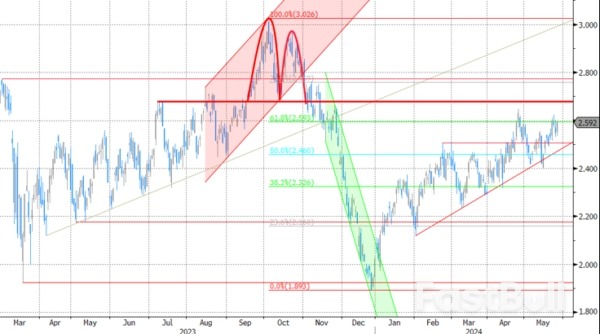
          The Chinese yuan traded on the mainland hit a six-month low against the dollar of 7.2488, highlighting the divergent monetary policies of the world's two biggest economies.
          High U.S. interest rates and efforts to stimulate the domestic economy pose a continuing challenge to the yuan despite the onshore exchange market trading within a band fixed by China's central bank.
          The onshore yuan weakened to 7.2488 against the dollar, falling past the 7.2472 level set on April 25 and hitting its lowest point since November last year. The People's Bank of China (PBOC) lowered its reference rate to 7.1106 per dollar on Wednesday morning, its lowest level since January 23, when the reference was set at 7.1117, allowing the yuan to weaken. The onshore yuan is held within a trading band of plus or minus 2% from the reference rate.
          The offshore yuan, which is not constrained by the trading band, also declined to 7.2667 against the dollar on Wednesday, a low since April 29.
          Analysts said the downward pressure on the yuan is driven by the dollar's strength, underscoring the contrasting monetary policies of the PBOC and the U.S. Federal Reserve. "There is a divergence between monetary policy biases in the U.S. versus China," said Ray Attrill, head of FX strategy at National Australia Bank.
          Chinese Yuan Falls to Six-Month Low on Dollar Strength_1
          The Fed has kept interest rates at their highest level in more than two decades, and sticky inflation has left forecasters divided on whether the central bank will start cutting rates by the end of the year. Federal Reserve Chair Jerome Powell said in May that inflation is falling more slowly than expected.
          The PBOC kept its benchmark interest rates, the one-year and five-year loan prime rates, unchanged in May. But it has taken measures aimed at reaching China's 5% economic growth target for 2024, while battling a decline in housing prices. In May, the PBOC scrapped minimum interest rates for mortgages, lowered minimum down payment ratios and set up a 300 billion yuan financing scheme to encourage local governments to buy up unsold homes.
          Some analysts expect more easing this year, such as a cut in the reserve requirement ratio, which determines the minimum ratio of deposits that banks must hold as reserves.
          "Unless the U.S. actually shows a more dovish stance, the depreciation pressure for the [yuan] will probably persist for a while," said Gary Ng, a senior economist at Natixis.

          Source: NikkeiAsia

          To stay updated on all economic events of today, please check out our Economic calendar
          Risk Warnings and Disclaimers
          You understand and acknowledge that there is a high degree of risk involved in trading. Following any strategies or investment methods may lead to potential losses. The content on the site is provided by our contributors and analysts for information purposes only. You are solely responsible for determining whether any trading assets, securities, strategy, or any other product is suitable for investing based on your own investment objectives and financial situation.
          Add to Favorites
          Share

          Dollar Tries to Extend Gains

          Thomas

          Economic

          Bond

          Forex

          Markets

          Global bonds trading took a slow start after a long weekend in the US and the UK. Yields initially lost a few basis points. However, US Treasuries were hit by a triple whammy as the US session preceded. Mid-morning in the US, Fed's Kashkari confirmed the more hawkish tone from last week's Fed Minutes. The odds for the Fed to raise rates currently are quite low, but not completely off the table. In any case, the Fed needs (much) evidence before becoming confident to start easing. More or less at the same time, US consumer confidence unexpectedly reaccelerated from 97.5 to 102.
          Consumers' assessment on the economy wasn't unequivocally positive, but expectations on income and spending remained positive. Inflation is hardly seen slowing. The consumer confidence report and the Kashkari comments triggered a first down-leg in US Treasuries. Later, 2-y and 5-y US bond auctions only met with mediocre buying interest, further propelling rates. In a broader perspective, the curve move was interesting.
          Despite poor auctions of shorter maturities, this time the long end of the curve underperformed (2-y +3 bps, 10-y +8.5 bps, 30-y + 9.6 bps). With money markets already discounting only 1 rate cut this year, investors apparently are caution to place additional bearish bets at the short end of the curve, turning the focus further out. Also keep an eye at the 10-y real yield, which jumped more than 6.5 bps yesterday. German yields also changed course later in the session. Initially, some more hawkish ECB members (Knot, Holzmann) sounded quite confident that th disinflation process is gaining traction.
          Still, the move in the US at the end of the day also raised German yields between 2 bps (2-y) and 4.5 bps (10-y). US equities hesitated, but in the end held strong (Nasdaq +0.59%, new record close). The rise in yields helped to dollar to hold above first support levels. Admittedly, gains could have been bigger (DXY 104.61, EUR/USD close 1.0857 after testing 1.0890 intraday).
          This morning, Asian equities suffer more from the sell-off in US Treasuries than was the case yesterday on WS. The broader rise in LT-yields also spreads to Japan (10-y yield 1.08%). The dollar tries to extend gains. The eco calendar is thin today, expect for the German CPI data. Monthly HICP is expected to rise a modest 0.2%, but unfavourable base effects might rise the Y/Y-measure to 2.7% from 2.4%. In case of an upward surprise, after yesterday's global bond move, we're keen to see the reaction at the long end of the curve. The German 10-y yield isn't far away from the 2.65% April top. The US Treasury will sell $44bn 7-y notes. EUR/USD is locked in the 1.08/1.09 range.

          News & Views

          Australia's monthly CPI unexpectedly gained traction in April. The yearly figure picked up from 3.5% in March to 3.6% compared to a 3.4% consensus. It is the second month in a row where annual inflation printed an increase, extending a potential bottoming out process that's been going on since December last year. It underscores the need for the central bank to remain vigilant on the matter, even as yesterday's retail sales suggest consumer fragility.
          Australia's Bureau of Statistics singled out housing (4.9%, with rents rising 7.5%), food (3.8%) and transport (4.2%) as some of the major contributors. Electricity prices rose 4.2% but the government's Energy Bill Relief Fund depresses the actual pressures. Without the rebates, prices would have risen 13.9%. Excluding categories including food & vegetables as well as holiday travel, core inflation in April rose by 4.1%, the same as in March. Core CPI in February hit a 2-yr low of 3.9% before creeping marginally higher. Australian swap rates rise between 3.6 and 4.7 bps. AUD/USD erased an earlier minor gain to trade more or less stable around 0.665.
          The IMF in a statement this morning lifted Chinese growth prospects for 2024 and 2025. A stronger-than-expected expansion in the first quarter of the year is reflected in an upward revision to the annual target from 4.6% to 5%. Next year's GDP growth would amount to 4.5% from 4.1% seen earlier. It nevertheless urged the country to address the ongoing housing slump that's weighing on domestic demand and confidence. Aside from fiscal support, China's low inflation also creates room for additional monetary support, it said.
          Authorities are wary to do so, however, fearing that increasing the monetary spread with the likes of the US may trigger capital outflows, pressure the yuan and create financial instability. The currency this morning already hits the lowest level since November at around USD/CNY 7.248. CNY hit a 17-yr low in September last year at USD/CNY 7.35.

          Graphs

          GE 10y yield
          ECB President Lagarde clearly hinted at a summer (June) rate cut which has broad backing. EMU disinflation continued in April and brought headline CPI closer to the 2% target.. A more bumpy inflation path in H2 2024, the EMU economy gradually regaining traction and the Fed's higher for longer US strategy make follow-up moves difficult. Markets have come to terms with that.
          Dollar Tries to Extend Gains_1
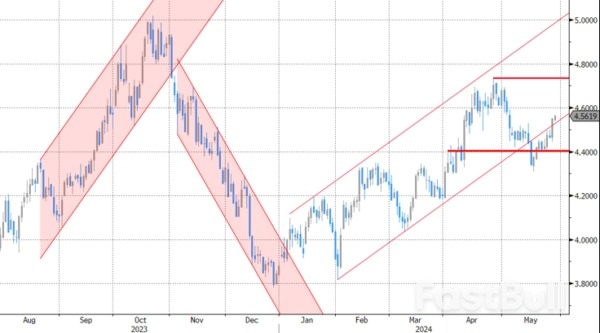
          US 10y yield
          The Fed in May acknowledged the lack of progress towards the 2% inflation objective, but Fed's Powell indicated that further tightening was unlikely. Soft US early month data triggering a correction off YTD peak levels. However, the Fed minutes still showed internal debate whether policy is restrictive enough. Sticky inflation suggests any rate cut will be a tough balancing act. 4.37% (38% retracement Dec/April) already proved strong support for the US 10-y yield.
          Dollar Tries to Extend Gains_2
          EUR/USD
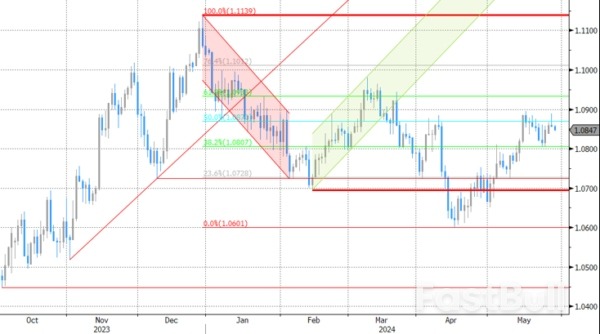
          Economic divergence, a likely desynchronized rate cut cycle with the ECB exceptionally taking the lead and higher than expected US CPI data pushed EUR/USD to the 1.06 area. From there, better EMU data gave the euro some breathing space. The dollar lost further momentum on softer than expected early May US data. Some further consolidation in the 1.07/1.09 are might be on the cards short-term.
          Dollar Tries to Extend Gains_3
          EUR/GBP
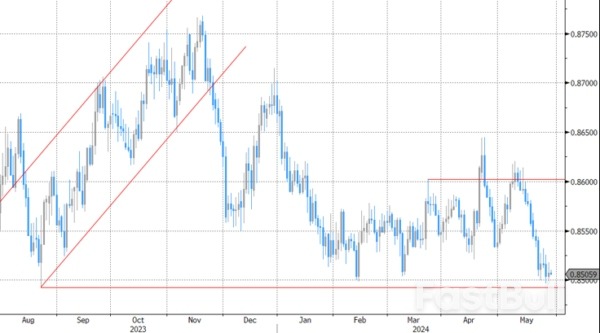
          Debate at the Bank of England is focused at the timing of rate cuts. Most BoE members align with the ECB rather than with Fed view but slower than expected April disinflation and a surprise general election on July 4 complicated matters. A June cut in line with the ECB looks improbable. Sterling extends a recent bull rally. A test of EUR/GBP's 2024 YtD low (0.8489) is possible. We expect this important support level to hold.
          Dollar Tries to Extend Gains_4

          Source: KBC Bank

          To stay updated on all economic events of today, please check out our Economic calendar
          Risk Warnings and Disclaimers
          You understand and acknowledge that there is a high degree of risk involved in trading. Following any strategies or investment methods may lead to potential losses. The content on the site is provided by our contributors and analysts for information purposes only. You are solely responsible for determining whether any trading assets, securities, strategy, or any other product is suitable for investing based on your own investment objectives and financial situation.
          Add to Favorites
          Share

          China’s Oil Demand Outlook Darkens as OPEC+ Prepares to Meet

          Alex

          Economic

          Commodity

          As OPEC+ prepares to review global oil markets, trouble is brewing in the group’s biggest customer.
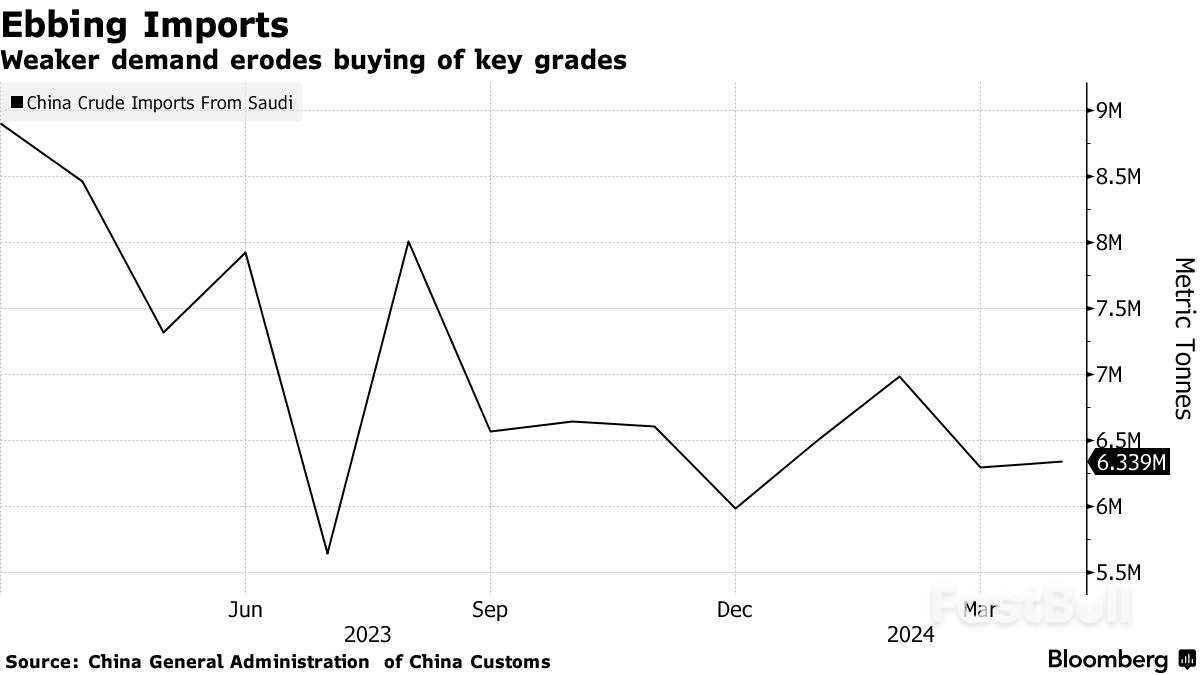
          Chinese oil refiners are cutting processing rates as flagging factory strength and a housing crash crimp demand for plastics and fuels used in construction. The Asian giant is reining in crude purchases from Saudi Arabia and a key grade from Russia. The duo lead the OPEC+ producer coalition, which meets this weekend.
          The group has curbed oil supplies to stave off a surplus and shore up prices, and is expected to continue the measures into the second half of the year. But a downturn in Asia’s biggest importer could derail its efforts.
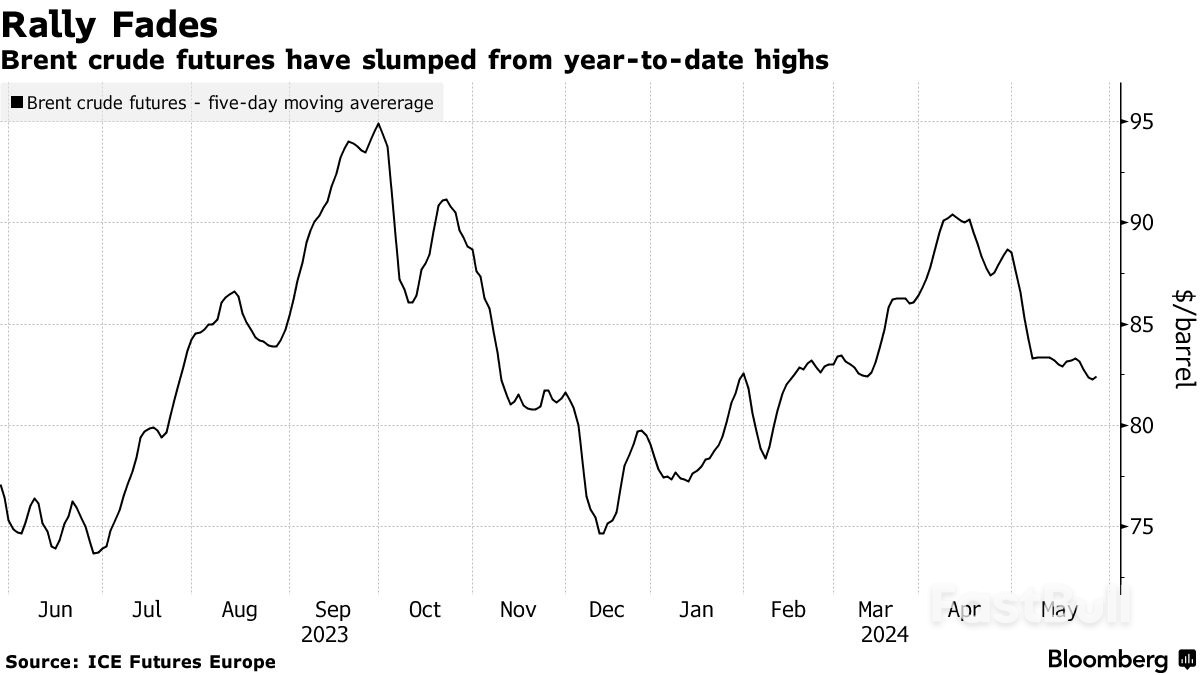
          Crude prices have retreated almost $10 a barrel in the past six weeks, as China’s darkening outlook adds downward pressure to a global market awash with plentiful supplies from the US and elsewhere.
          China’s Oil Demand Outlook Darkens as OPEC+ Prepares to Meet_1
          While the pullback offers relief for consumers and central banks grappling with persistent inflation, it threatens revenues for the Saudis and their OPEC+ partners. Riyadh needs prices close to $100 a barrel to fund the ambitious plans of Crown Prince Mohammed bin Salman, the International Monetary Fund estimates.
          “At the heart of weakening demand is China,” said Henning Gloystein, head of climate and resources at consultants Eurasia Group. “If these early indicators of an emerging imbalance in China last,” then “OPEC+ would feel pressured to roll over its supply cuts.”
          The Organization of Petroleum Exporting Countries and its allies will convene an online meeting on June 2, where officials expect they will agree to prolong about 2 million barrels a day of output cutbacks. A Chinese slowdown gives the producers all the more incentive to persevere.
          After faster-than expected economic growth in the first quarter, China’s strong start to 2024 soon began to fade, illustrating the challenges that confront President Xi Jinping as Beijing’s decades-long boom comes to an end.
          The producer price index — one gauge of factory strength — has remained negative for 19 months. An 11-month consecutive plunge in home sales has crimped consumption of plastics and weakened petrochemical product margins.
          It’s also limited demand for diesel used in outdoor construction, and as a transport fuel to ship industrial materials. According to one metric, Chinese apparent consumption of oil products fell year-on-year in April for the first time since December 2022.
          Consequently, refiners are dialing back operations.
          Refining rates fell to 14.36 million barrels a day in April, the slowest pace since December and 4% lower than same time last year, according to Bloomberg calculations based on government data.
          Smaller Chinese refiners concentrated in Shandong province — known as teapots — have reduced operating rates to around 55% of capacity, compared with 62% a year ago, according to Mysteel OilChem. Their purchases of a key Russian grade —— ESPO —— have fallen to the lowest in three years, data analytics firm Kpler estimates.
          Meanwhile, major state-run plants are reluctant to revive operations after returning from seasonal maintenance, according to consultant Energy Aspects Ltd. Throughput at Chinese refineries will rise by less than 100,000 barrels a day this year, the weakest increase in at least two decades, the company estimates.China’s Oil Demand Outlook Darkens as OPEC+ Prepares to Meet_2
          There’s been a visible impact in oil flows to the Asian giant. The number of supertankers headed to China fell to the lowest in seven weeks in the most recent tracking data compiled by Bloomberg. One refiner with a long-term contract with Saudi Arabia scaled back purchases for June.
          Bullish oil traders, having been burnt by last year’s surprise 10% price pullback, may remain wary on the commodity if Asia’s growth engine looks shaky.
          “Directionally the market will tighten,” said Gary Ross, a veteran oil consultant turned hedge fund manager at Black Gold Investors LLC. Still, “I have my doubts how much financial length will come back into the market because China looks relatively weak.”
          Still, OPEC+ officials privately remain confident about oil demand in China and other parts of Asia. Chinese oil consumption is on track to increase by 510,000 barrels a day this year — accounting for about half the global total — to 17 million barrels a day, and expand further in 2025, according to the International Energy Agency in Paris.
          Furthermore, the country’s oil intake may be buoyed as it takes advantage of low prices to replenish reserve stockpiles. China added more than 30 million barrels of crude to inventories in the month to mid-May, the fastest rate in a year, according to consultants Vortexa Ltd. These often comprise shipments from sanctioned nations like Iran, which trade at a discount to regional benchmarks.
          China has been “pretty consistent” since 2008 in its policy to top up reserves when prices are low, said Ed Morse, senior advisor at Hartree Partners. “The basic structure is to build inventory when you can,” he said.
          Nonetheless, it’s ominous for oil producers and bullish investors alike that China’s lull is emblematic of a global market that’s tipping from tightness into oversupply.
          In other parts of Asia, a sharp drop in returns from making diesel is prompting some refiners — such as Taiwan’s Formosa Petrochemical Corp. and another in South Korea — to make modest reductions in operating rates.
          From West African producers Nigeria to Azerbaijan and Kazakhstan, several OPEC+ exporters have struggled to sell cargoes at their usual speed amid competition from US exports, causing prices to weaken, traders say. A rebound in flows from the US Gulf to Europe has put pressure on key North Sea and Mediterranean markets.
          In the US — still the world’s biggest oil consumer — crude inventories at the storage hub in Cushing, Oklahoma, are at the highest levels since July. Gasoline demand, while set for a boost when Americans take to the roads for vacations this summer, remains below the same period last year, implied consumption figures show.
          “The physical market is still very sloppy,” said Brian Leisen, a commodity strategist at RBC Capital Markets LLC. “We find it hard to get more constructive until we see evidence that cargoes are starting to clear.”

          Source:Bloomberg

          To stay updated on all economic events of today, please check out our Economic calendar
          Risk Warnings and Disclaimers
          You understand and acknowledge that there is a high degree of risk involved in trading. Following any strategies or investment methods may lead to potential losses. The content on the site is provided by our contributors and analysts for information purposes only. You are solely responsible for determining whether any trading assets, securities, strategy, or any other product is suitable for investing based on your own investment objectives and financial situation.
          Add to Favorites
          Share

          Pound Sterling Volatility to Rise On a Conservative Comeback, Say Analysts

          Owen Li

          Economic

          Forex

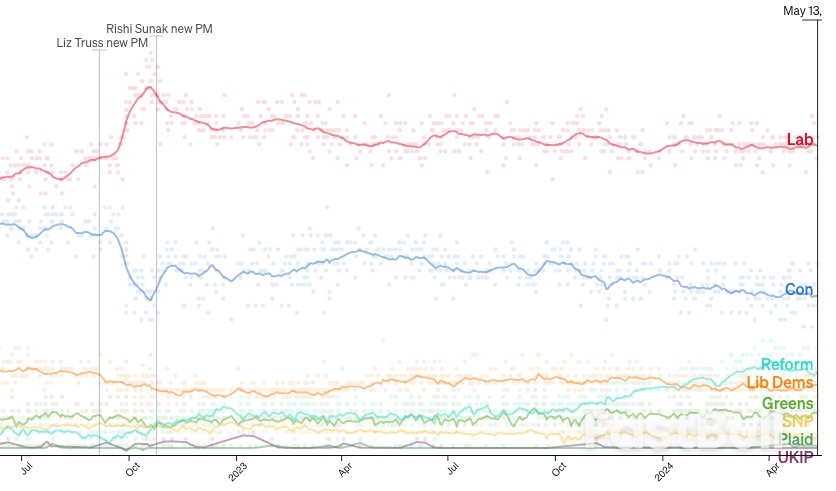
          Pound Sterling has taken news of a July 04 General Election in its stride, hitting multi-week highs against the Euro, but some analysts say the currency could wobble if Labour's sizeable advantage in the polls declines.
          The thinking behind this is simple: the Pound likes certainty, and right now, the solid Labour majority indicated by the polls offers that certainty.
          "A stable Labour majority could allow the pound to shed some of its risk premium," says Thomas Flury, Strategist, UBS Switzerland AG.
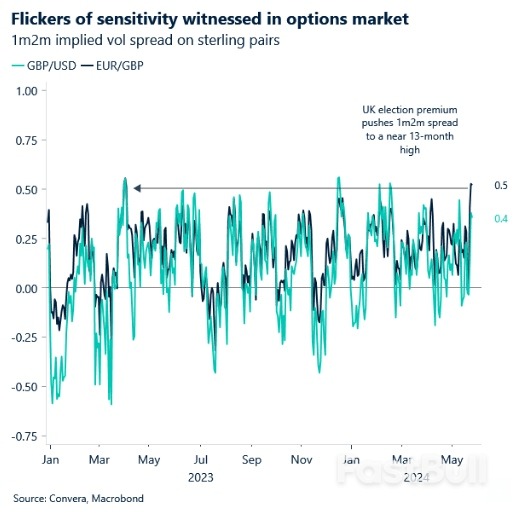
          Should the Conservative Party manage to whittle down Labour's lead, the outcome of the election becomes more uncertain and money markets show investors are prepared for some volatility in the Pound around July 04.
          "The election news hasn't had a negative impact on sterling so far, but noise could pick up if polls show the incumbent Conservatives narrowing the gap, thus increasing uncertainty," says George Vessey, Lead FX Strategist at Convera.
          Options markets reflect the anticipation of volatility picking up explains Vessey, with 2- and 3-month implied volatility, which captures the election date, spiking higher.
          Pound Sterling Volatility to Rise On a Conservative Comeback, Say Analysts_1
          The Conservatives are some 20 points behind Labour in the polls but this gap could shrink in the coming weeks as the parties lay out their stalls. Former Prime Minister Theresa May's fortunes in 2017 serves as a reminder that a large poll lead can evaporate in the course of the campaign period.
          "The Conservatives may be able to boost their support by winning over the unusually high proportion of their previous voters who don't yet know how they will vote," says Robert Wood, Chief UK Economist at Pantheon Macroeconomics.
          The most volatile scenario for Pound exchange rates would involve no party scoring the majority required to govern on its own. A 'hung parliament' would mean a period of negotiations between the parties is required, which can lead to some uncertainty in the future economic policy.
          "A smaller than anticipated majority for Labour is a downside risk," says Kenneth Broux, a strategist with Société Générale.
          But analysts are nevertheless in agreement that any jitters will likely be shortlived given how similar the leading parties are in their economic and fiscal outlooks.
          "Ultimately though, neither party is promising radical fiscal policy shifts, and neither party is going to want to spook financial markets like former PM Truss did back in October 2022. Therefore, it's possible that this election campaign will be much less volatile and the direction of UK assets, like the pound," says Vessey.
          Pound Sterling Volatility to Rise On a Conservative Comeback, Say Analysts_2
          Goldman Sachs says in a weekly currency note that it does not expect the UK general election to have a major influence on Sterling in the short term.
          It notes Labour leads in the polling averages by about 20ppts, and fiscal space will be relatively limited in the next Autumn Statement, so the space for policy uncertainty in the near term is relatively limited as well.
          "It would be difficult to argue that news of the forthcoming election is having a negative effect on the pound," says Jane Foley, Senior FX Strategist at Rabobank. "It remains our view that the pound will retain its very slow recovery that has been discernible since the start of last year over the medium-term. This assumes that prudent budget policies will be maintained irrespective of which party wins the UK election."

          Source: Pound Sterling

          To stay updated on all economic events of today, please check out our Economic calendar
          Risk Warnings and Disclaimers
          You understand and acknowledge that there is a high degree of risk involved in trading. Following any strategies or investment methods may lead to potential losses. The content on the site is provided by our contributors and analysts for information purposes only. You are solely responsible for determining whether any trading assets, securities, strategy, or any other product is suitable for investing based on your own investment objectives and financial situation.
          Add to Favorites
          Share

          Australia Inflation Quickens to Five-Month High, Sounding Rate Alarm

          Warren Takunda

          Economic

          Australian consumer price inflation unexpectedly picked up to a five-month high in April due in part to increases in petrol, health and holiday costs, bolstering expectations that interest rates would not be lowered any time soon.
          Data from the Australian Bureau of Statistics on Wednesday showed its monthly consumer price index (CPI) rose at an annual pace of 3.6% in April, up from 3.5% in March and above market forecasts of 3.4%.
          Moreover, a closely watched measure of core inflation, the trimmed mean, also accelerated to an annual 4.1%, from 4.0%. The CPI excluding volatile items and holiday travel stayed at an annual 4.1%.
          However, market reaction was rather muted. The Australian dollar rose just 0.1% to $0.6657 and the three-year bond futures fell another 2 ticks to 95.93, having already tumbled earlier in the day thanks to the overnight moves in Treasuries.
          Swaps slightly increased the chance of a quarter-point hike in September to 20% from 12%, while doubling down on their bets that any rate cut would not come until August or September next year, some 15 months away.
          Economists' consensus, however, is for the RBA to begin its easing cycle in the fourth quarter.
          "This was not just "one of those statistical flukes" caused by a big surge in one or two components due to seasonal distortions or supply interruptions," said Robert Carnell, regional head of research, Asia-Pacific, at ING.
          Carnell abandoned his call for one rate cut this year after the data.
          "What we do for 2025 remains an open question. For now, we will maintain the 50bp of easing we had been expecting. But we would be dishonest if we did not consider that the risks have shifted to the possibility of some further RBA tightening."
          Complicating matters for policymakers, the April report is heavily skewed towards goods in the first month of the quarter and do not capture price changes for a range of services, which tend to be sticky.

          HIGH BAR

          However, analysts say the bar to a hike remains high.
          The Reserve Bank of Australia has already expressed a willingness to avoid "excessively fine-tuning" policy even as the central bank judged the risks to inflation had risen somewhat recently after a surprisingly strong first quarter CPI report.
          The RBA expects headline inflation to pick up to 3.8% by June this year, but the hope is that the new relief from the government - including billions in electricity rebates and rent subsidies - would help ease the cost-of-living pressures in the second half.
          Still, the additional stimulus from the government could also risk adding to spending and inflation.
          "All that will ensure the RBA stays put for a little longer; its next move will be down — but we’ll have to wait a little longer," said Moody’s Analytics economist Harry Murphy Cruise, who is forecasting a 25-basis-point cut in December.
          For April alone, CPI rose 0.7% from the previous month, driven by a 4% jump in prices for clothing and footwear and a 2% increase in health costs.
          Holiday travel and accommodation prices rose 4.6%, the first monthly rise this year due to high demand for international travel over the Easter and school holiday periods.
          The RBA has raised interest rates by 425 basis points since May 2022 to a 12-year top of 4.35%, but steadied its hand for four straight meetings since its last hike in November as cautious consumers scaled back their spending and the economy slowed to a crawl.
          It has kept markets somewhat on edge, however, by not ruling in or out any changes in policy.

          Source: Reuters

          To stay updated on all economic events of today, please check out our Economic calendar
          Risk Warnings and Disclaimers
          You understand and acknowledge that there is a high degree of risk involved in trading. Following any strategies or investment methods may lead to potential losses. The content on the site is provided by our contributors and analysts for information purposes only. You are solely responsible for determining whether any trading assets, securities, strategy, or any other product is suitable for investing based on your own investment objectives and financial situation.
          Add to Favorites
          Share

          Australia: April Monthly CPI Indicator First Impressions

          Westpac

          Economic

          Stronger clothing prices, and a surprise inclusion of health insurance premium increases, offset the suppression of power bills by Tasmanian electricity rebates.
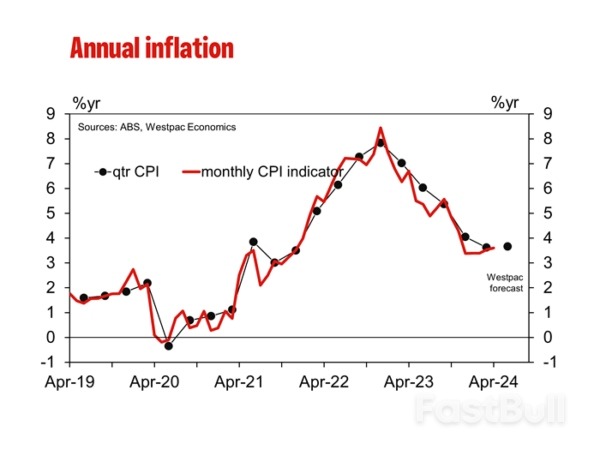
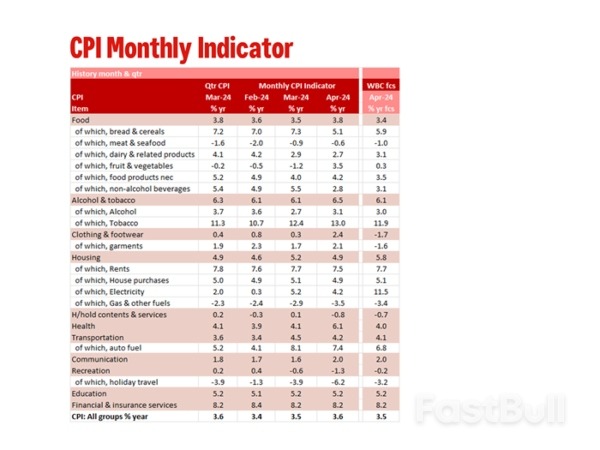
          The Monthly CPI Indicator gained 3.6% in the year to April compared to 3.5%yr in March and 3.4%yr in both February and January.
          The April print was slightly stronger than Westpac's forecast of 3.5%, the market median was 3.4%yr, but this variation appears to be due to rounding and revisions as the reported increase in the month was 0.7%, in line with Westpac's preview in our Weekly. However, it is worth noting a tension in the forecast which suggest an upside surprise in the underlying fundamentals for inflation.
          Australia: April Monthly CPI Indicator First Impressions_1
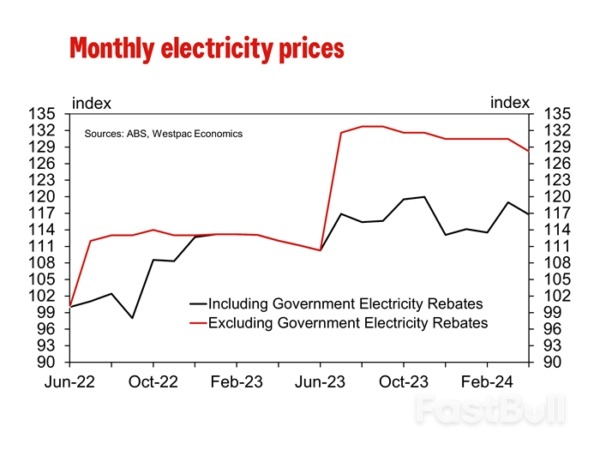
          Holding inflation back in the month was a 1.9% fall in electricity prices as there was the second instalment of the Energy Bill Relief Fund for concession and newly eligible households in TAS. We had expected prices to rise again following the 4.8% increase in March. The ABS is now reporting a 9% gap between the electricity bills being paid and the actual price of electricity before the rebate.
          In the recent budget the Federal Government introduced universal power bill rebates for the 2024/2025 year of $75 per quarter, on top of which the Queensland government announced a $1,000 lump sum rebate. However, neither will start until July so there is still room for a snap higher in electricity prices over the next few months as the gap between bills paid and the underlying price of electricity closes. It is also worth noting the electricity prices excluding rebates have fallen 3.4% since peaking in September 2023.
          Australia: April Monthly CPI Indicator First Impressions_2
          Offsetting the fall in electricity prices and holding up inflation in April was stronger than expected durable goods prices. Clothing & footwear rose 4.0% in the month (we had pencilled in -0.2%) and outside of garments for men & women, this group is surveyed in the first month of the quarter and so it will go straight into our quarterly estimate.
          There was also an unexpected 2% increase in medical & hospital services in April. We were aware of the announced increase in health insurance premium but as this series has historically been surveyed in the last month of the quarter, we had not expected it to appear until the June survey. As the increase in premium applied from April 1, the ABS decided to incorporate in the April survey. The ABS still notes that this series is a quarterly survey in the release.
          Taken at face value, as the April Monthly CPI Indicator came as broadly as expected you could assume that it would not have an impact on our June quarter CPI forecast. However, the quarterly CPI is not a simple average of the Monthly CPI Indicator and history has taught us that a simple ‘face value' estimate can be misleading.
          As noted earlier, the quarterly surveyed clothing & footwear prices were stronger than expected which will see an upwards revision to these components in our June quarter CPI forecast. Assuming all else is held constant, this would suggest an upward revision to our forecast. This risk can also be illustrated with the annual pace on the Monthly Indicator Tradables measure lifting from 0.5%yr to 1.1%yr, the fastest pace since November 2023.
          Australia: April Monthly CPI Indicator First Impressions_3
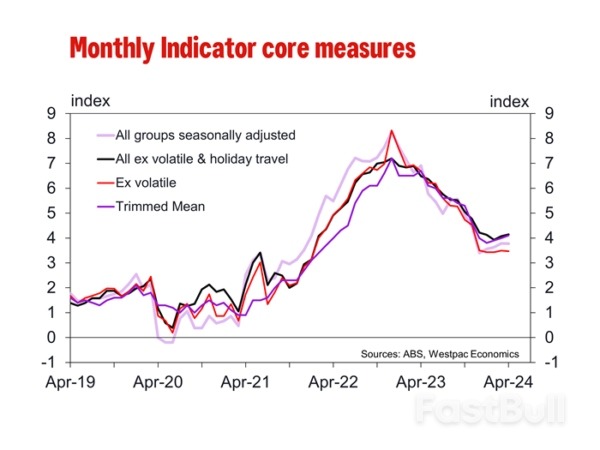
          For the various core measures, seasonally adjusted excluding volatile items & holiday travel lifted from 4.1%yr to 4.2%yr while the Trimmed Mean measure lifted from 4.0%yr to 4.1%yr, the fastest pace since the 4.6%yr reported in November 2023.
          In more detail the difference to our monthly forecast was:
          • Food was a touch softer at 0.5% compared to 0.1% forecast.
          • Alcohol & tobacco was on the stronger side, 0.6% vs. 0.2% forecast, due to a stronger-than-expected tobacco price increase.
          • Clothing & footwear was stronger at 4.0% vs. 0.2% forecast due to strong price gains for both male and female garments as well as the quarterly clothing & footwear surveys.
          • Housing was softer than expected at 0.1% vs. 0.9% forecast, due to Tasmanian rebates suppressing electricity prices. Rents were close to expectations (0.5% vs. 0.7% forecast) while dwellings came in softer lifting just 0.3% vs. 0.4% forecast. It is somewhat surprising we are still yet to see a meaningful lift in dwelling price inflation.
          • Household contents & services were close to expectations at 0.6% vs. 0.7% forecast.
          • Health was surprising lifting 2.0% vs. 0.0% forecast as we had not expected the increase in health insurance premiums till the June survey. Recreation was also on the softer side 2.0% vs. 3.1% forecast) with a smaller 4.6% rise in holiday travel (we had expected an 8% lift).
          Australia: April Monthly CPI Indicator First Impressions_4
          To stay updated on all economic events of today, please check out our Economic calendar
          Risk Warnings and Disclaimers
          You understand and acknowledge that there is a high degree of risk involved in trading. Following any strategies or investment methods may lead to potential losses. The content on the site is provided by our contributors and analysts for information purposes only. You are solely responsible for determining whether any trading assets, securities, strategy, or any other product is suitable for investing based on your own investment objectives and financial situation.
          Add to Favorites
          Share

          Euro Area Inflation Expectations Hit Lowest Since 2021: ECB Survey

          Alex

          Economic

          Inflation expectations across the euro area have declined to their lowest since September 2021, according to the April 2024 European Central Bank (ECB) Consumer Expectations Survey. The survey reported that the median inflation expectation for the coming 12 months edged down to 2.9 per cent from 3 per cent in March, while expectations for three years ahead also decreased slightly to 2.4 per cent from 2.5 per cent.
          Despite these reductions, the median rate of perceived inflation over the past 12 months remained unchanged at 5 per cent. This suggests that while inflation expectations are softening, they still lag behind the levels of perceived past inflation, which may influence consumer sentiment and spending behaviours, as per the survey.
          The survey also highlighted stability in income and consumption expectations, with consumer expectations for nominal income growth holding steady at 1.3 per cent. However, perceptions of nominal spending growth over the previous 12 months slightly decreased to 6.3 per cent from 6.4 per cent, a decline observed mainly among older respondents aged 35-70. Expectations for nominal spending growth over the next year remained stable at 3.6 per cent.
          On the labour market front, the outlook appears cautiously optimistic. Economic growth expectations for the next 12 months were less negative, improving to minus 0.8 per cent from minus 1.1 per cent in March. However, expectations for the unemployment rate over the next 12 months rose slightly to 10.9 per cent from 10.7 per cent, suggesting a broadly stable yet cautious labour market scenario. Notably, the probability of finding a job decreased among unemployed respondents, while the probability of job loss increased among employed individuals.
          The survey also observed that inflation perceptions and expectations were relatively aligned across different income groups, with slightly lower expectations among the highest income quintile. Younger respondents (aged 18-34) reported lower inflation expectations compared to older age groups, though there was a noted convergence in inflation perceptions across all ages.

          Source:fibre2fashion

          To stay updated on all economic events of today, please check out our Economic calendar
          Risk Warnings and Disclaimers
          You understand and acknowledge that there is a high degree of risk involved in trading. Following any strategies or investment methods may lead to potential losses. The content on the site is provided by our contributors and analysts for information purposes only. You are solely responsible for determining whether any trading assets, securities, strategy, or any other product is suitable for investing based on your own investment objectives and financial situation.
          Add to Favorites
          Share
          FastBull
          Copyright © 2025 FastBull Ltd

          728 RM B 7/F GEE LOK IND BLDG NO 34 HUNG TO RD KWUN TONG KLN HONG KONG

          TelegramInstagramTwitterfacebooklinkedin
          App Store Google Play Google Play
          Products
          Charts

          Chats

          Q&A with Experts
          Screeners
          Economic Calendar
          Data
          Tools
          Membership
          Features
          Function
          Markets
          Copy Trading
          Latest Signals
          Contests
          News
          Analysis
          24/7
          Columns
          Education
          Company
          Careers
          About Us
          Contact Us
          Advertising
          Help Center
          Feedback
          User Agreement
          Privacy Policy
          Business

          White Label

          Data API

          Web Plug-ins

          Poster Maker

          Affiliate Program

          Risk Disclosure

          The risk of loss in trading financial instruments such as stocks, FX, commodities, futures, bonds, ETFs and crypto can be substantial. You may sustain a total loss of the funds that you deposit with your broker. Therefore, you should carefully consider whether such trading is suitable for you in light of your circumstances and financial resources.

          No decision to invest should be made without thoroughly conducting due diligence by yourself or consulting with your financial advisors. Our web content might not suit you since we don't know your financial conditions and investment needs. Our financial information might have latency or contain inaccuracy, so you should be fully responsible for any of your trading and investment decisions. The company will not be responsible for your capital loss.

          Without getting permission from the website, you are not allowed to copy the website's graphics, texts, or trademarks. Intellectual property rights in the content or data incorporated into this website belong to its providers and exchange merchants.

          Not Logged In

          Log in to access more features

          FastBull Membership

          Not yet

          Purchase

          Become a signal provider
          Help Center
          Customer Service
          Dark Mode
          Price Up/Down Colors

          Log In

          Sign Up

          Position
          Layout
          Fullscreen
          Default to Chart
          The chart page opens by default when you visit fastbull.com