Markets
News
Analysis
User
24/7
Economic Calendar
Education
Data
- Names
- Latest
- Prev


Signal Accounts for Members
All Signal Accounts
All Contests


France Industrial Output MoM (SA) (Oct)A:--
F: --
France Trade Balance (SA) (Oct)A:--
F: --
Euro Zone Employment YoY (SA) (Q3)A:--
F: --
Canada Part-Time Employment (SA) (Nov)A:--
F: --
P: --
Canada Unemployment Rate (SA) (Nov)A:--
F: --
P: --
Canada Full-time Employment (SA) (Nov)A:--
F: --
P: --
Canada Labor Force Participation Rate (SA) (Nov)A:--
F: --
P: --
Canada Employment (SA) (Nov)A:--
F: --
P: --
U.S. PCE Price Index MoM (Sept)A:--
F: --
P: --
U.S. Personal Income MoM (Sept)A:--
F: --
P: --
U.S. Core PCE Price Index MoM (Sept)A:--
F: --
P: --
U.S. PCE Price Index YoY (SA) (Sept)A:--
F: --
P: --
U.S. Core PCE Price Index YoY (Sept)A:--
F: --
P: --
U.S. Personal Outlays MoM (SA) (Sept)A:--
F: --
U.S. 5-10 Year-Ahead Inflation Expectations (Dec)A:--
F: --
P: --
U.S. Real Personal Consumption Expenditures MoM (Sept)A:--
F: --
U.S. Weekly Total Rig CountA:--
F: --
P: --
U.S. Weekly Total Oil Rig CountA:--
F: --
P: --
U.S. Consumer Credit (SA) (Oct)A:--
F: --
China, Mainland Foreign Exchange Reserves (Nov)A:--
F: --
P: --
Japan Trade Balance (Oct)A:--
F: --
P: --
Japan Nominal GDP Revised QoQ (Q3)A:--
F: --
P: --
China, Mainland Imports YoY (CNH) (Nov)A:--
F: --
P: --
China, Mainland Exports (Nov)A:--
F: --
P: --
China, Mainland Imports (CNH) (Nov)A:--
F: --
P: --
China, Mainland Trade Balance (CNH) (Nov)A:--
F: --
P: --
China, Mainland Exports YoY (USD) (Nov)A:--
F: --
P: --
China, Mainland Imports YoY (USD) (Nov)A:--
F: --
P: --
Germany Industrial Output MoM (SA) (Oct)A:--
F: --
Euro Zone Sentix Investor Confidence Index (Dec)A:--
F: --
P: --
Canada National Economic Confidence Index--
F: --
P: --
U.K. BRC Like-For-Like Retail Sales YoY (Nov)--
F: --
P: --
U.K. BRC Overall Retail Sales YoY (Nov)--
F: --
P: --
Australia Overnight (Borrowing) Key Rate--
F: --
P: --
RBA Rate Statement
RBA Press Conference
Germany Exports MoM (SA) (Oct)--
F: --
P: --
U.S. NFIB Small Business Optimism Index (SA) (Nov)--
F: --
P: --
Mexico 12-Month Inflation (CPI) (Nov)--
F: --
P: --
Mexico Core CPI YoY (Nov)--
F: --
P: --
Mexico PPI YoY (Nov)--
F: --
P: --
U.S. Weekly Redbook Index YoY--
F: --
P: --
U.S. JOLTS Job Openings (SA) (Oct)--
F: --
P: --
China, Mainland M1 Money Supply YoY (Nov)--
F: --
P: --
China, Mainland M0 Money Supply YoY (Nov)--
F: --
P: --
China, Mainland M2 Money Supply YoY (Nov)--
F: --
P: --
U.S. EIA Short-Term Crude Production Forecast For The Year (Dec)--
F: --
P: --
U.S. EIA Natural Gas Production Forecast For The Next Year (Dec)--
F: --
P: --
U.S. EIA Short-Term Crude Production Forecast For The Next Year (Dec)--
F: --
P: --
EIA Monthly Short-Term Energy Outlook
U.S. API Weekly Gasoline Stocks--
F: --
P: --
U.S. API Weekly Cushing Crude Oil Stocks--
F: --
P: --
U.S. API Weekly Crude Oil Stocks--
F: --
P: --
U.S. API Weekly Refined Oil Stocks--
F: --
P: --
South Korea Unemployment Rate (SA) (Nov)--
F: --
P: --
Japan Reuters Tankan Non-Manufacturers Index (Dec)--
F: --
P: --
Japan Reuters Tankan Manufacturers Index (Dec)--
F: --
P: --
Japan Domestic Enterprise Commodity Price Index MoM (Nov)--
F: --
P: --
Japan Domestic Enterprise Commodity Price Index YoY (Nov)--
F: --
P: --
China, Mainland PPI YoY (Nov)--
F: --
P: --


No matching data
Latest Views
Latest Views
Trending Topics
Top Columnists
Latest Update
White Label
Data API
Web Plug-ins
Affiliate Program
View All

No data
China’s capital outflows hit an unprecedented $58.3 billion in July, fueled by domestic investors’ aggressive purchase of Hong Kong assets and expanded access to offshore debt, while foreign funds continued pulling back from Chinese bonds....

In June, eurozone exports dropped by 2.4% month-on-month and on the year were up by 0.4%. As imports increased by more than 3% MoM, the seasonally-adjusted trade surplus narrowed to €2.8bn, from €15.6bn in May. There is no data on bilateral trade for the eurozone, only for the EU. And the June data shows the expected collapse of European exports to the US (-10% YoY) but also China (-12% YoY). Tariffs and, more structurally, the loss in international competitiveness are highly affecting European exports. Despite talks about finding new trading partners to make up for the potential loss of trade with the US, European exports to India and Brazil, for example, were down by some 5% YoY in June.
More generally speaking, the first months of the year saw highly volatile industrial data in Europe. The up and down was mainly driven by frontloading of US exports ahead of looming tariffs and subsequent reversals. Today’s June data provides a first impression of what could be left of European exports after the first tariff wave. Don’t forget that in June, many European exporters had already been subject to 10% tariffs, automotive producers to 25% and steel and aluminium producers as much as 50%. The 15% tariffs agreed in July became effective on 1 August.
The strengthening of the euro since the start of the year, US tariffs, as well as broader uncertainty regarding the future of global trade and fierce competition for European exporters in general, are likely to weigh on European exports moving forward. Currently, it's hard to see how exports could soon return as a powerful engine of European growth.
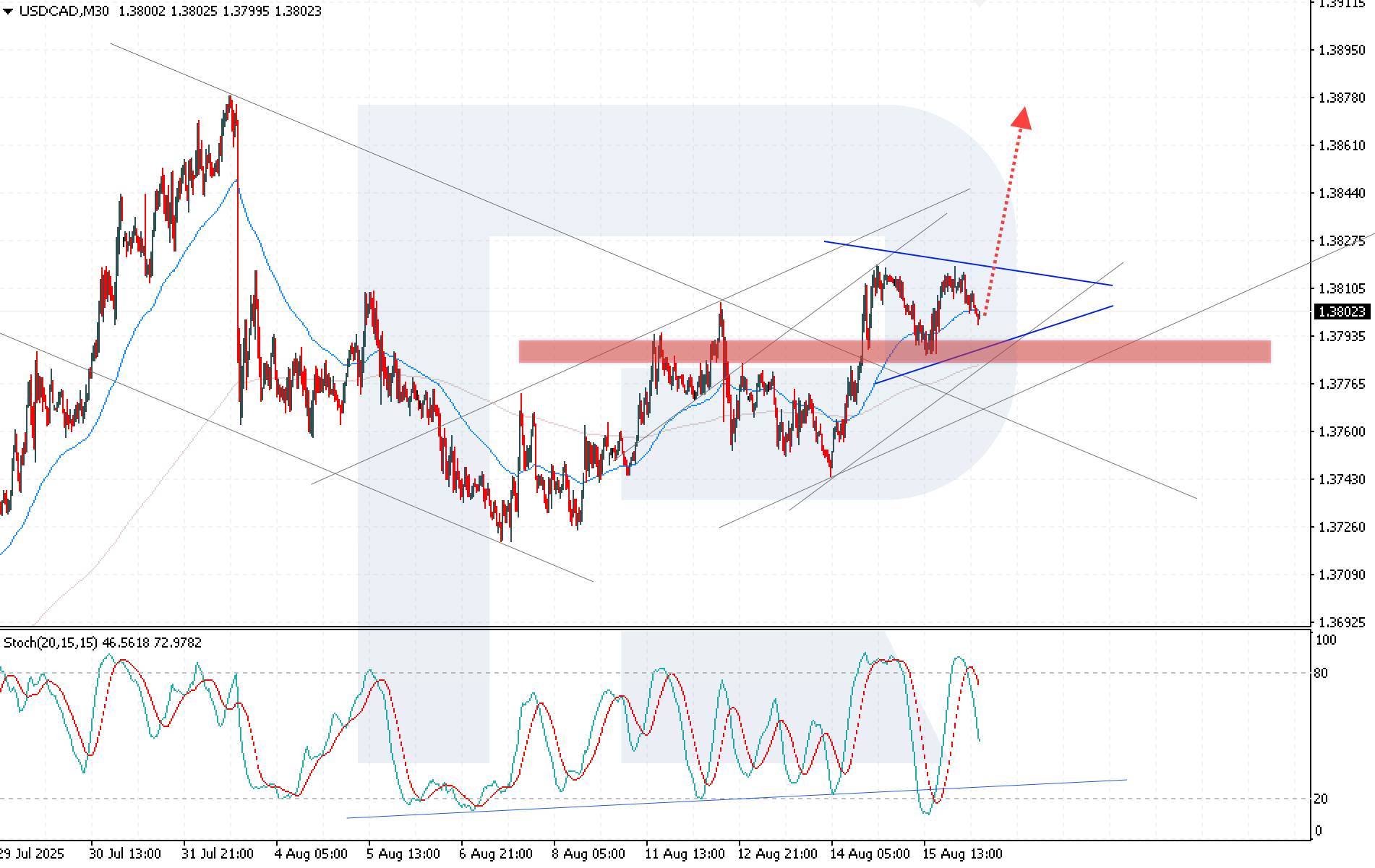
The USDCAD rate corrects amid positive economic data from Canada, currently standing at 1.3802.
USDCAD forecast: key trading points
The USDCAD rate is declining after rebounding from the 1.3820 resistance level. The US dollar remains under pressure as markets expect the Fed to cut interest rates by 25 basis points in September, with the probability of such a move currently priced at 84%. Investor attention shifts to Federal Reserve Chairman Jerome Powell’s upcoming speech at the Jackson Hole Economic Symposium, which may provide new clues about the future policy path.
Economic data from Canada supported the Canadian dollar. In June, manufacturing sales rose by 0.3%, driven by the oil, coal, and food sectors, while wholesale trade grew by 0.7%, reaching 84.7 billion CAD. These figures highlight the resilience of domestic activity and reduce the risks of a slowdown.Inflation in the country slowed but remains above target. The Bank of Canada’s preferred inflation gauge held steady at 3.0% in June, leaving little reason for accelerated rate cuts and tempering market expectations for more aggressive policy easing.
The USDCAD pair is trading within an ascending channel, forming a Triangle pattern. The price is hovering above the EMA-65, reflecting buyers’ local advantage. Consolidation within a narrowing range signals a likely acceleration of movement once one of the boundaries breaks.Today’s USDCAD forecast suggests a breakout above the Triangle’s upper boundary with growth towards 1.3880. The Stochastic Oscillator supports this recovery scenario, with its signal lines exiting the oversold zone, indicating decreased selling pressure.
Consolidation above the 1.3825 level would further confirm the bullish outlook.

The USDCAD rate remains under pressure, with solid Canadian economic data and persistent inflation supporting the local currency. USDCAD technical analysis points to a high probability of breaking above the Triangle’s upper boundary, with potential growth towards 1.3880.

A Russian drone attack on a residential area in Kharkiv killed seven people including a toddler and a 16-year-old boy overnight, Ukrainian authorities said on Monday, as the United States presses Kyiv to accept a quick deal to end the warthat Moscow started.Six children aged 6 to 17 were among 20 other people injured in the attack on Ukraine's second largest city, Oleh Synehubov, governor of the wider Kharkiv region, wrote on Telegram.
The attack came as Ukraine's Volodymyr Zelenskiy was preparing for talks with Donald Trump in Washington later on Monday amid European fears the U.S. president could try to pressure Kyiv into accepting a peace settlement favourable to Moscow.The air force said Russia launched 140 drones against Ukraine overnight, the largest total recorded in a single night since August 4.Kharkiv, which lies near northeastern Ukraine's border with Russia, has been the target of Russian drone and missile attacks throughout the war.
A ballistic missile attack shattered around 1,000 windows in various buildings in the city on Sunday, Synehubov said. Some residents had to be evacuated from their homes, officials said.Reuters witnesses saw medics attending to residents on a street and rescuers inspecting damage to residential buildings."Russia is a murderous war machine that Ukraine is holding back. And it must be stopped through transatlantic unity and pressure," Ukrainian Foreign Minister Andrii Sybiha wrote on X after the attack.He said Russia was continuing to kill civilians despite peace efforts.
Russia says it does not deliberately target civilians. Thousands have been killed since Moscow launched its full-scale invasion in February 2022.Russia fired four missiles overnight as well as the drones, the air force said. It said 88 drones were downed and reported impacts at 25 locations in six different regions.Seventeen people were injured in a morning missile attack that struck unspecified critical infrastructure in the southeastern city of Zaporizhzhia, officials said.
In the Black Sea region of Odesa, an attack caused a large fire at a fuel and energy infrastructure facility, requiring a major firefighting effort, the governor said.Two people were also injured in strikes in the northern region of Sumy, where at least a dozen homes and an educational institution were damaged, authorities said.
Reuters could not independently verify the weapons used by Russia. There was no immediate comment from Moscow.Trump, who hosted President Vladimir Putin in Alaska on Friday for talks aimed at ending the war, has urged Kyiv to make a deal with Moscow, stating, "Russia is a very big power, and they're not."
While digital assets might seem decoupled, the strength or weakness of the greenback profoundly influences investor sentiment, liquidity, and even the stability of stablecoins. As we approach a pivotal period marked by the Washington Summit and the much-anticipated Jackson Hole Symposium, understanding the US Dollar Forecast becomes paramount for anyone navigating the intricate dance between traditional finance and the burgeoning crypto economy. What does the current upward edge of the Dollar signal, and how might these high-stakes events reshape the financial landscape?
The US Dollar, often seen as the world’s reserve currency and a safe haven, has recently shown signs of renewed strength. This upward momentum is not arbitrary; it’s a complex interplay of various economic indicators and market expectations. Investors are closely monitoring inflation data, employment figures, and global economic stability to gauge the Dollar’s next move. A stronger Dollar can make US exports more expensive but also makes imports cheaper, impacting corporate earnings and consumer spending.
Several factors are contributing to the current US Dollar Forecast:
The Dollar’s recent ascent ahead of key events suggests market participants are bracing for potential shifts in policy or global sentiment that could reinforce its position.
The upcoming Washington Summit is more than just a political gathering; it’s a critical juncture for US fiscal policy that holds significant implications for the Dollar and broader markets. Discussions around the national debt, government spending, and potential tax reforms are on the agenda. Historically, impasses or resolutions in these areas have had immediate and profound effects on investor confidence and currency valuations.
A key focus will undoubtedly be the debt ceiling negotiations. While a default is widely considered unthinkable due to its catastrophic global economic consequences, the brinkmanship involved can create immense market volatility. A swift resolution tends to calm markets and can provide a temporary boost to the Dollar, as it removes a major source of uncertainty. Conversely, prolonged stalemates or unexpected outcomes could trigger risk aversion, potentially leading to a flight to safety within the Dollar itself, but also raising concerns about its long-term stability.
Consider the potential scenarios stemming from the Washington Summit:
| Summit Outcome | Potential Dollar Impact | Market Sentiment |
|---|---|---|
| Swift Debt Ceiling Resolution | Moderate strength (relief rally) | Positive, risk-on |
| Prolonged Stalemate/Partial Agreement | Initial weakness, then volatility | Uncertain, cautious |
| Major Fiscal Policy Shift (e.g., spending cuts) | Variable, depending on perceived economic impact | Mixed, dependent on details |
These discussions at the Washington Summit are crucial for shaping the narrative around US economic stability, directly influencing the Dollar’s appeal as an investment.
The Jackson Hole Symposium, hosted annually by the Federal Reserve Bank of Kansas City, is a highly anticipated event where central bankers, finance ministers, academics, and financial market participants from around the world gather. It’s often a platform for significant policy signals and economic insights from the Federal Reserve Chair and other influential figures.
For the Dollar, the Jackson Hole Symposium is a critical barometer of the future Monetary Policy Outlook. Market participants will be dissecting every word from Fed Chair Jerome Powell for clues on the future path of interest rates, the Fed’s stance on inflation, and its overall economic assessment. Will the Fed signal a pause in rate hikes, hint at further tightening, or perhaps discuss the conditions for potential rate cuts? The answers will have profound implications for global capital flows and currency valuations.
Key areas of focus at Jackson Hole Symposium include:
A hawkish tone from the Fed, signaling continued vigilance against inflation and potentially higher-for-longer rates, would likely bolster the Dollar. Conversely, a more dovish stance, indicating a readiness to ease policy, could lead to Dollar weakness. This event is pivotal for understanding the broader Monetary Policy Outlook for not just the US, but also its ripple effects globally.
While the Dollar takes center stage, a comprehensive Forex Market Analysis requires looking beyond the greenback to understand the broader currency landscape. Major currency pairs like EUR/USD, USD/JPY, and GBP/USD will react dynamically to the Dollar’s movements and the specific economic conditions in their respective regions. The interplay of these currencies reflects global economic health, trade balances, and investor confidence.
For instance, if the Dollar strengthens significantly due to safe-haven demand, it might put pressure on emerging market currencies. Conversely, a weaker Dollar could provide a tailwind for commodity-linked currencies and potentially reduce the debt burden for countries with Dollar-denominated loans. Understanding these cross-currency dynamics is essential for a holistic view of the Forex Market Analysis.
Key aspects of global currency dynamics include:
The interconnectedness of the global financial system means that developments in one major currency can have a domino effect, making a broad Forex Market Analysis indispensable.
Strategic Insights for Investors: Navigating Volatility and Opportunity
Given the confluence of the Washington Summit and the Jackson Hole Symposium, coupled with the evolving US Dollar Forecast, investors face both challenges and opportunities. The heightened volatility around these events demands a strategic approach to portfolio management, especially for those with exposure to both traditional and digital assets.
Challenges:
Opportunities and Actionable Insights:
Understanding the intricate relationship between the Dollar’s strength, global economic policies, and the broader Forex Market Analysis is vital for making informed decisions. The insights gained from the Jackson Hole Symposium and the outcomes of the Washington Summit will provide crucial clarity for the path ahead, shaping the Monetary Policy Outlook for months to come.
The coming period is set to be a transformative one for global financial markets. The US Dollar’s trajectory, influenced by the high-stakes Washington Summit and the policy signals from the Jackson Hole Symposium, will send powerful signals across the globe. For investors, particularly those attuned to the interconnectedness of traditional finance and the crypto world, staying informed on the US Dollar Forecast and the broader Monetary Policy Outlook is not just prudent, but essential.
These events underscore the intricate web of global economics. The decisions made and signals sent will shape not only currency markets but also influence risk appetite, liquidity, and investment flows into various asset classes, including cryptocurrencies. By carefully analyzing the outcomes of these pivotal gatherings and their implications for the Forex Market Analysis, investors can better position themselves to navigate the challenges and seize the opportunities that lie ahead. Vigilance and adaptability will be your greatest assets in this evolving landscape.
White Label
Data API
Web Plug-ins
Poster Maker
Affiliate Program
The risk of loss in trading financial instruments such as stocks, FX, commodities, futures, bonds, ETFs and crypto can be substantial. You may sustain a total loss of the funds that you deposit with your broker. Therefore, you should carefully consider whether such trading is suitable for you in light of your circumstances and financial resources.
No decision to invest should be made without thoroughly conducting due diligence by yourself or consulting with your financial advisors. Our web content might not suit you since we don't know your financial conditions and investment needs. Our financial information might have latency or contain inaccuracy, so you should be fully responsible for any of your trading and investment decisions. The company will not be responsible for your capital loss.
Without getting permission from the website, you are not allowed to copy the website's graphics, texts, or trademarks. Intellectual property rights in the content or data incorporated into this website belong to its providers and exchange merchants.
Not Logged In
Log in to access more features

FastBull Membership
Not yet
Purchase
Log In
Sign Up