• Trade
  • Markets
  • Copy
  • Contests
  • News
  • 24/7
  • Calendar
  • Q&A
  • Chats
Trending
Screeners
SYMBOL
LAST
BID
ASK
HIGH
LOW
NET CHG.
%CHG.
SPREAD
SPX
S&P 500 Index
6827.42
6827.42
6827.42
6899.86
6801.80
-73.58
-1.07%
--
DJI
Dow Jones Industrial Average
48458.04
48458.04
48458.04
48886.86
48334.10
-245.98
-0.51%
--
IXIC
NASDAQ Composite Index
23195.16
23195.16
23195.16
23554.89
23094.51
-398.69
-1.69%
--
USDX
US Dollar Index
97.950
98.030
97.950
98.500
97.950
-0.370
-0.38%
--
EURUSD
Euro / US Dollar
1.17394
1.17409
1.17394
1.17496
1.17192
+0.00011
+ 0.01%
--
GBPUSD
Pound Sterling / US Dollar
1.33707
1.33732
1.33707
1.33997
1.33419
-0.00148
-0.11%
--
XAUUSD
Gold / US Dollar
4299.39
4299.39
4299.39
4353.41
4257.10
+20.10
+ 0.47%
--
WTI
Light Sweet Crude Oil
57.233
57.485
57.233
58.011
56.969
-0.408
-0.71%
--

Community Accounts

Signal Accounts
--
Profit Accounts
--
Loss Accounts
--
View More

Become a signal provider

Sell trading signals to earn additional income

View More

Guide to Copy Trading

Get started with ease and confidence

View More

Signal Accounts for Members

All Signal Accounts

Best Return
  • Best Return
  • Best P/L
  • Best MDD
Past 1W
  • Past 1W
  • Past 1M
  • Past 1Y

All Contests

  • All
  • Trump Updates
  • Recommend
  • Stocks
  • Cryptocurrencies
  • Central Banks
  • Featured News
Top News Only
Share

Ukraine's Navy Says Russian Drone Attack Hit Civilian Turkish Vessel Carrying Sunflower Oil To Egypt On Saturday

Share

Israeli Military Says It Put Planned Strike On South Lebanon Site On Hold After Lebanese Army Requested Access

Share

Norwegian Nobel Committee: Calls On The Belarusian Authorities To Release All Political Prisoners

Share

Norwegian Nobel Committee: His Freedom Is A Deeply Welcome And Long-Awaited Moment

Share

Ukraine Says It Received 114 Prisoners From Belarus

Share

USA Embassy In Lithuania: Maria Kalesnikava Is Not Going To Vilnius

Share

USA Embassy In Lithuania: Other Prisoners Are Being Sent From Belarus To Ukraine

Share

Ukraine President Zelenskiy: Five Ukrainians Released By Belarus In US-Brokered Deal

Share

USA Vilnius Embassy: USA Stands Ready For "Additional Engagement With Belarus That Advances USA Interests"

Share

USA Vilnius Embassy: Belarus, USA, Other Citizens Among The Prisoners Released Into Lithuania

Share

USA Vilnius Embassy: USA Will Continue Diplomatic Efforts To Free The Remaining Political Prisoners In Belarus

Share

USA Vilnius Embassy: Belarus Releases 123 Prisoners Following Meeting Of President Trump's Envoy Coale And Belarus President Lukashenko

Share

USA Vilnius Embassy: Masatoshi Nakanishi, Aliaksandr Syrytsa Are Among The Prisoners Released By Belarus

Share

USA Vilnius Embassy: Maria Kalesnikava And Viktor Babaryka Are Among The Prisoners Released By Belarus

Share

USA Vilnius Embassy: Nobel Peace Prize Laureate Ales Bialiatski Is Among The Prisoners Released By Belarus

Share

Belarusian Presidential Administration Telegram Channel: Lukashenko Has Pardoned 123 Prisoners As Part Of Deal With US

Share

Two Local Syrian Officials: Joint US-Syrian Military Patrol In Central Syria Came Under Fire From Unknown Assailants

Share

Israeli Military Says It Targeted 'Key Hamas Terrorist' In Gaza City

Share

Rwanda's Actions In Eastern Drc Are A Clear Violation Of Washington Accords Signed By President Trump - Secretary Of State Rubio

Share

Israeli Military Issues Evacuation Warning In Southern Lebanon Village Ahead Of Strike - Spokesperson On X

TIME
ACT
FCST
PREV
U.K. Trade Balance Non-EU (SA) (Oct)

A:--

F: --

P: --

U.K. Trade Balance (Oct)

A:--

F: --

P: --

U.K. Services Index MoM

A:--

F: --

P: --

U.K. Construction Output MoM (SA) (Oct)

A:--

F: --

P: --

U.K. Industrial Output YoY (Oct)

A:--

F: --

P: --

U.K. Trade Balance (SA) (Oct)

A:--

F: --

P: --

U.K. Trade Balance EU (SA) (Oct)

A:--

F: --

P: --

U.K. Manufacturing Output YoY (Oct)

A:--

F: --

P: --

U.K. GDP MoM (Oct)

A:--

F: --

P: --

U.K. GDP YoY (SA) (Oct)

A:--

F: --

P: --

U.K. Industrial Output MoM (Oct)

A:--

F: --

P: --

U.K. Construction Output YoY (Oct)

A:--

F: --

P: --

France HICP Final MoM (Nov)

A:--

F: --

P: --

China, Mainland Outstanding Loans Growth YoY (Nov)

A:--

F: --

P: --

China, Mainland M2 Money Supply YoY (Nov)

A:--

F: --

P: --

China, Mainland M0 Money Supply YoY (Nov)

A:--

F: --

P: --

China, Mainland M1 Money Supply YoY (Nov)

A:--

F: --

P: --

India CPI YoY (Nov)

A:--

F: --

P: --

India Deposit Gowth YoY

A:--

F: --

P: --

Brazil Services Growth YoY (Oct)

A:--

F: --

P: --

Mexico Industrial Output YoY (Oct)

A:--

F: --

P: --

Russia Trade Balance (Oct)

A:--

F: --

P: --

Philadelphia Fed President Henry Paulson delivers a speech
Canada Building Permits MoM (SA) (Oct)

A:--

F: --

P: --

Canada Wholesale Sales YoY (Oct)

A:--

F: --

P: --

Canada Wholesale Inventory MoM (Oct)

A:--

F: --

P: --

Canada Wholesale Inventory YoY (Oct)

A:--

F: --

P: --

Canada Wholesale Sales MoM (SA) (Oct)

A:--

F: --

P: --

Germany Current Account (Not SA) (Oct)

A:--

F: --

P: --

U.S. Weekly Total Rig Count

A:--

F: --

P: --

U.S. Weekly Total Oil Rig Count

A:--

F: --

P: --

Japan Tankan Large Non-Manufacturing Diffusion Index (Q4)

--

F: --

P: --

Japan Tankan Small Manufacturing Outlook Index (Q4)

--

F: --

P: --

Japan Tankan Large Non-Manufacturing Outlook Index (Q4)

--

F: --

P: --

Japan Tankan Large Manufacturing Outlook Index (Q4)

--

F: --

P: --

Japan Tankan Small Manufacturing Diffusion Index (Q4)

--

F: --

P: --

Japan Tankan Large Manufacturing Diffusion Index (Q4)

--

F: --

P: --

Japan Tankan Large-Enterprise Capital Expenditure YoY (Q4)

--

F: --

P: --

U.K. Rightmove House Price Index YoY (Dec)

--

F: --

P: --

China, Mainland Industrial Output YoY (YTD) (Nov)

--

F: --

P: --

China, Mainland Urban Area Unemployment Rate (Nov)

--

F: --

P: --

Saudi Arabia CPI YoY (Nov)

--

F: --

P: --

Euro Zone Industrial Output YoY (Oct)

--

F: --

P: --

Euro Zone Industrial Output MoM (Oct)

--

F: --

P: --

Canada Existing Home Sales MoM (Nov)

--

F: --

P: --

Euro Zone Total Reserve Assets (Nov)

--

F: --

P: --

U.K. Inflation Rate Expectations

--

F: --

P: --

Canada National Economic Confidence Index

--

F: --

P: --

Canada New Housing Starts (Nov)

--

F: --

P: --

U.S. NY Fed Manufacturing Employment Index (Dec)

--

F: --

P: --

U.S. NY Fed Manufacturing Index (Dec)

--

F: --

P: --

Canada Core CPI YoY (Nov)

--

F: --

P: --

Canada Manufacturing Unfilled Orders MoM (Oct)

--

F: --

P: --

Canada Manufacturing New Orders MoM (Oct)

--

F: --

P: --

Canada Core CPI MoM (Nov)

--

F: --

P: --

Canada Manufacturing Inventory MoM (Oct)

--

F: --

P: --

Canada CPI YoY (Nov)

--

F: --

P: --

Canada CPI MoM (Nov)

--

F: --

P: --

Canada CPI YoY (SA) (Nov)

--

F: --

P: --

Canada Core CPI MoM (SA) (Nov)

--

F: --

P: --

Q&A with Experts
    • All
    • Chatrooms
    • Groups
    • Friends
    Connecting
    .
    .
    .
    Type here...
    Add Symbol or Code

      No matching data

      All
      Trump Updates
      Recommend
      Stocks
      Cryptocurrencies
      Central Banks
      Featured News
      • All
      • Russia-Ukraine Conflict
      • Middle East Flashpoint
      • All
      • Russia-Ukraine Conflict
      • Middle East Flashpoint
      Search
      Products

      Charts Free Forever

      Chats Q&A with Experts
      Screeners Economic Calendar Data Tools
      Membership Features
      Data Warehouse Market Trends Institutional Data Policy Rates Macro

      Market Trends

      Market Sentiment Order Book Forex Correlations

      Top Indicators

      Charts Free Forever
      Markets

      News

      News Analysis 24/7 Columns Education
      From Institutions From Analysts
      Topics Columnists

      Latest Views

      Latest Views

      Trending Topics

      Top Columnists

      Latest Update

      Signals

      Copy Rankings Latest Signals Become a signal provider AI Rating
      Contests
      Brokers

      Overview Brokers Assessment Rankings Regulators News Claims
      Broker listing Forex Brokers Comparison Tool Live Spread Comparison Scam
      Q&A Complaint Scam Alert Videos Tips to Detect Scam
      More

      Business
      Events
      Careers About Us Advertising Help Center

      White Label

      Data API

      Web Plug-ins

      Affiliate Program

      Awards Institution Evaluation IB Seminar Salon Event Exhibition
      Vietnam Thailand Singapore Dubai
      Fans Party Investment Sharing Session
      FastBull Summit BrokersView Expo
      Recent Searches
        Top Searches
          Markets
          News
          Analysis
          User
          24/7
          Economic Calendar
          Education
          Data
          • Names
          • Latest
          • Prev

          View All

          No data

          Scan to Download

          Faster Charts, Chat Faster!

          Download App
          English
          • English
          • Español
          • العربية
          • Bahasa Indonesia
          • Bahasa Melayu
          • Tiếng Việt
          • ภาษาไทย
          • Français
          • Italiano
          • Türkçe
          • Русский язык
          • 简中
          • 繁中
          Open Account
          Search
          Products
          Charts Free Forever
          Markets
          News
          Signals

          Copy Rankings Latest Signals Become a signal provider AI Rating
          Contests
          Brokers

          Overview Brokers Assessment Rankings Regulators News Claims
          Broker listing Forex Brokers Comparison Tool Live Spread Comparison Scam
          Q&A Complaint Scam Alert Videos Tips to Detect Scam
          More

          Business
          Events
          Careers About Us Advertising Help Center

          White Label

          Data API

          Web Plug-ins

          Affiliate Program

          Awards Institution Evaluation IB Seminar Salon Event Exhibition
          Vietnam Thailand Singapore Dubai
          Fans Party Investment Sharing Session
          FastBull Summit BrokersView Expo

          China's Q1 Fiscal Revenue Falls as Tax Cut Policies Weigh

          Warren Takunda

          Economic

          Forex

          Summary:

          China's Q1 tax revenue fell 4.9% due to tax cuts, but excluding those it grew 2.2%. Spending grew slower than expected at 2.9%. The government plans to support tech innovation and boost domestic demand to counter a weak economy.

          China's fiscal revenue in the first quarter fell 2.3% from a year earlier, as some special factors including previous tax cut policies weighed, the finance ministry said on Monday.
          The world's second-biggest economy grew faster than expected in the first quarter, data showed last week, offering some relief to officials, but March indicators showed domestic demand remains frail. The property downturn continues to hurt local governments' finance and fiscal capabilities, analysts said.
          China's tax revenue dropped 4.9% to 4.9 trillion yuan ($676.48 billion) in the first three months, but revenue from cultural, tourism and advanced manufacturing industries grew fast, Wang Dongwei, vice finance minister, told a press conference in Beijing on Monday.
          Excluding the influence of special factors such as a high base and tax cut policies of 2023, China's fiscal revenue grew about 2.2% in the first quarter, he added.
          Fiscal expenditures grew 2.9% on year to nearly 7 trillion yuan in the first three months, according to Wang, slowing significantly from 6.7% growth seen in the first two months.
          Responding to a question about the slow issuance of local government special bonds in January-March, Wang Jianfan, an official at the ministry said that issuance was related to funding needs of local projects, seasonal influence on construction conditions and interest rates in the bond market.
          In response to the impact of COVID previously, the ministry also stepped up such bond issuance volume at the beginning of each year, he said, indicating this had created a high base.
          The finance ministry will support technology-led industrial innovation with "full support" and shore up technology innovation and manufacturing development with tax and fee cut policies, Wang said.
          Amid tepid domestic demand and a property crisis, Beijing has turned to investing in high-tech manufacturing to lift the economy this year.
          "We will strengthen macro control, focus on expanding domestic demand, cultivate and develop new growth drivers and prevent and defuse risks" to improve the quality and efficiency of fiscal policies and enhance economic recovery, he said.
          Funds from the trillion yuan of sovereign bonds issued last year had been given to local governments by the end of February, the vice minister said. In particular, spending on disaster prevention and emergency management out of the funds grew by 53.4% in the first quarter.
          In recent days, floods have swamped a handful of cities in southern China's densely populated Pearl River Delta following record-breaking rains.
          ($1 = 7.2434 Chinese yuan)

          Source: Reuters

          To stay updated on all economic events of today, please check out our Economic calendar
          Risk Warnings and Disclaimers
          You understand and acknowledge that there is a high degree of risk involved in trading. Following any strategies or investment methods may lead to potential losses. The content on the site is provided by our contributors and analysts for information purposes only. You are solely responsible for determining whether any trading assets, securities, strategy, or any other product is suitable for investing based on your own investment objectives and financial situation.
          Add to Favorites
          Share

          Why the Stock Market Is Having 'Digestion Problems' This Earnings Season

          Samantha Luan

          Stocks

          Economic

          After an aggressive rally to all-time highs to start the year, the S&P 500 (^GSPC) has tumbled in April as rising bond yields and slimmed expectations for Federal Reserve interest rate cuts have put a damper on investors' enthusiasm.
          And given the significant rise in share price of some of the market rally's darlings, even strong earnings aren't moving the needle for stocks.
          "The broader market is having digestion problems in and around this earnings season," Julian Emanuel, who leads Evercore ISI's equity, derivatives, and quantitative strategy, told Yahoo Finance.
          This has broadly been seen across stock reactions in the day following the release of quarterly results for the 65 S&P 500 companies that have reported results so far this season. Stocks that top Wall Street's estimates have risen 0.8% in the next trading session, slightly lower than the 0.9% average seen over the last few years, per Emanuel's research.
          Meanwhile, companies that disappoint on both metrics are taking a bigger hit than normal, with the average stock falling 5.8% in the next trading action, compared to the usual 3.1% decline seen over the past five years.
          "Given these extended valuations [in the S&P 500], even good news may not be good news, particularly in these names that have run as far as they have," Emanuel said.
          Why the Stock Market Is Having 'Digestion Problems' This Earnings Season_1
          Emanuel highlighted the recent price action following JPMorgan's (JPM) results, which topped Wall Street's estimates for both revenue and earnings per share. But the stock — which had hit multiple record highs earlier this year — traded lower on the day of its earnings report as the company didn't boost its 2024 interest income guidance like analysts had hoped.
          Citi US equity strategist Scott Chronert echoed Emanuel's sentiment following the price action.
          "Markets have priced in a higher probability of the Goldilocks scenario playing out this year, introducing more downside risk to 'good but not good enough' news," Chronert wrote in a note to clients on the day JPMorgan reported earnings. "While very early, the first set of 1Q reports from the banks highlights this risk of guidance falling short of lofty implied growth expectations, even as the overall fundamental picture remains healthy."
          A similar narrative played out on Friday after Netflix (NFLX) topped Wall Street's earnings and revenue estimates, flexing earnings per share growth of more than 83% from the year prior. But investors appeared hung up on revenue guidance for the second quarter, which came in at $9.49 billion instead of $9.51 billion, among other factors. The stock, which had rallied more than 150% in the past 18 months, sold off more than 8% on Friday.
          Evercore ISI analyst Mark Mahaney's top reason the stock traded lower after the report was simply "expectations were high, and this wasn’t a beat & raise [guidance] quarter."
          This backdrop comes as one of the busiest weeks of S&P 500 financial releases in the quarter is set to greet investors. Meta (META), Microsoft (MSFT), and Alphabet (GOOGL, GOOG) will headline the week of earnings results, and all three face stiff comparisons. Meta is expected to grow earnings by more than 96%, per Bloomberg data. Meanwhile, analysts project Alphabet's earnings grew by more than 30% this quarter compared to last year. Microsoft is expected to see nearly 16% growth.
          All three are part of the top 10 stocks in the S&P 500 by market cap, which Goldman Sachs noted on April 5 are expected to drive earnings growth for the index this quarter. The top 10 stocks in the S&P 500 — primarily the "Magnificent Seven" — are expected to see earnings grow by 32% in the first quarter. Meanwhile, the other 490 stocks are projected to produce an earnings decline of 4%.
          Why the Stock Market Is Having 'Digestion Problems' This Earnings Season_2
          Given the market's recent jitteriness around rising yields and the lack of hope around Fed rate cuts, the performance of these companies will be "pivotal" for the market's direction moving forward, SoFi head of investment strategy Liz Young wrote on X, formerly Twitter, on Friday.

          Source: Yahoo Finance

          To stay updated on all economic events of today, please check out our Economic calendar
          Risk Warnings and Disclaimers
          You understand and acknowledge that there is a high degree of risk involved in trading. Following any strategies or investment methods may lead to potential losses. The content on the site is provided by our contributors and analysts for information purposes only. You are solely responsible for determining whether any trading assets, securities, strategy, or any other product is suitable for investing based on your own investment objectives and financial situation.
          Add to Favorites
          Share

          China's Demand for Gold Is Unstoppable As Consumers, Investors, And the Central Bank Fuel a Record-Breaking Price Surge

          Samantha Luan

          Commodity

          Economic

          Worsening geopolitical tensions, including war in the Middle East and Ukraine, and the prospect of lower US interest rates all burnish gold's billing as an investment. But juicing the rally is unrelenting Chinese demand, as retail shoppers, fund investors, futures traders and even the central bank look to bullion as a store of value in uncertain times.
          China and India have typically vied over the title of world's biggest buyer. But that shifted last year as Chinese consumption of jewelry, bars and coins swelled to record levels. China's gold jewelry demand rose 10% while India's fell 6%. Chinese bar and coin investments, meanwhile, surged 28%.
          And there's still room for demand to grow, said Philip Klapwijk, managing director of Hong Kong-based consultant Precious Metals Insights Ltd. Amid limited investment options in China, the protracted crisis in its property sector, volatile stock markets and a weakening yuan are all driving money to assets that are perceived to be safer.
          “The weight of money available under these circumstances for an asset like gold – and actually for new buyers to come in – is pretty considerable,” he said. “There isn't much alternative in China. With exchange controls and capital controls, you can't just look at other markets to put your money into.”
          Although China mines more gold than any other country, it still needs to import a lot and the quantities are getting larger. In the last two years, overseas purchases totaled over 2,800 tons — more than all of the metal that backs exchange-traded funds around the world, or about a third of the stockpiles held by the US Federal Reserve.
          Even so, the pace of shipments has accelerated lately. Imports surged in the run-up to China's Lunar New Year, a peak season for gifts, and over the first two months of the year are 53% higher than they were in 2023.
          The People's Bank of China has been on a buying spree for 17 straight months, its longest-ever run of purchases, as it looks to diversify its reserves away from the dollar and hedge against currency depreciation.
          It's the keenest buyer among a number central banks that are favoring gold. The official sector snapped up near-record levels of the precious metal last year and is expected to keep purchases elevated in 2024.
          It's indicative of gold's allure that Chinese demand remains so buoyant, despite record prices and a weaker yuan that robs buyers of purchasing power.
          As a major importer, gold buyers in China often have to pay a premium over international prices. That jumped to $89 an ounce at the start of the month. The average over the past year is $35 versus a historical average of just $7.
          For sure, sky-high prices are likely to temper some enthusiasm for bullion, but the market's proving to be unusually resilient. Chinese consumers have typically snapped up gold when prices drop, which has helped establish a floor for the market during times of weakness. Not so this time, as China's appetite is helping to prop up prices at much higher levels.
          That suggests the rally is sustainable and gold buyers everywhere should be comforted by China's booming demand, said Nikos Kavalis, managing director at consultancy Metals Focus Ltd.
          China's authorities, which can be quite hostile to market speculation, are less sanguine. State media have warned investors to be cautious in chasing the rally, while both the Shanghai Gold Exchange and Shanghai Futures Exchange have raised margin requirements on some contracts to snuff out excessive risk-taking. SHFE's move followed a surge in daily trading volumes to a five-year high.
          A less frenetic way to invest in gold is via exchange-traded funds. Money has flowed into gold ETFs in mainland China during almost every month since June, according to Bloomberg Intelligence. That compares with chunky outflows in gold funds in the rest of the world.
          The influx of money has totaled $1.3 billion so far this year, compared with $4 billion in outflows from funds overseas. Restrictions on investing in China are again a factor here, given the fewer options for Chinese beyond domestic property and stocks.
          Chinese demand could continue to rise as investors look to diversify their holdings with commodities, BI analyst Rebecca Sin said in a note.

          Source: Fortune

          To stay updated on all economic events of today, please check out our Economic calendar
          Risk Warnings and Disclaimers
          You understand and acknowledge that there is a high degree of risk involved in trading. Following any strategies or investment methods may lead to potential losses. The content on the site is provided by our contributors and analysts for information purposes only. You are solely responsible for determining whether any trading assets, securities, strategy, or any other product is suitable for investing based on your own investment objectives and financial situation.
          Add to Favorites
          Share

          Inflation Mindset Taking Root In Japan Boosts Case For BOJ Hikes

          Samantha Luan

          Economic

          Higher inflationary expectations and price tolerance are taking root in Japan, a development that supports the central bank’s moves to normalize policy and raise interest rates further.
          A recent survey by Tsutomu Watanabe, a leading inflation expert in the nation, found that Japanese consumers’ tolerance of price changes is holding up and is higher than levels seen among shoppers in some other major economies. The survey showed for the third-year running that more than half of respondents would continue to buy a product at the same supermarket even if prices rose by 10%.
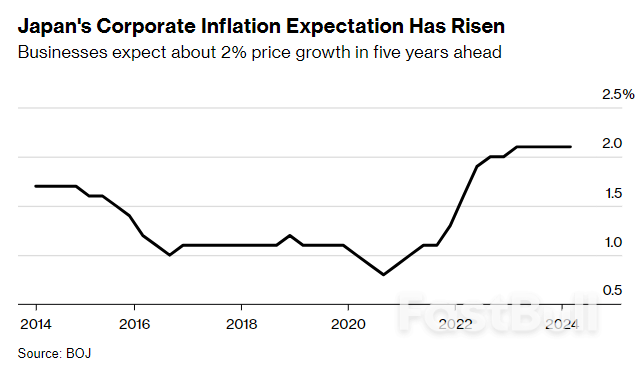
          The result is another indication that Japanese consumers are accepting inflation for the first time in decades and are shedding their reputation for being among the most price-sensitive consumers in the world. The survey, which has been cited by the Bank of Japan in the past, suggests Japanese are more resigned to price hikes than their peers in the UK, Germany and Canada.Inflation Mindset Taking Root In Japan Boosts Case For BOJ Hikes_1
          A government report last week showed a key price gauge rose by 2.6% in March, keeping price growth at or above the BOJ’s 2% price target for a full two years. It’s forecast to accelerate this summer.
          “This is a big shift for Japan’s economy,” said Tomo Kinoshita, global market strategist at Invesco Asset Management, commenting on the report. “Unless there is a huge policy mistake, Japan probably won’t go back to a deflationary mindset.”
          For now the risk for Japan’s price expectations is to the upside, with the prospect of elevated oil prices due to the escalating conflict in the Middle East, and with the yen trading around a 34-year low. Energy prices and the currency have historically been primary drivers of price swings in the nation, which relies heavily on imports for food and energy.
          An upward shift in inflation perceptions makes price growth stickier as the BOJ counts it as a key element to support price growth. The bank concludes a two-day policy gathering Friday after ending its massive monetary easing program last month. BOJ watchers expect authorities to stand pat Friday, with a focus on any shift in the assessment of upside risks for hints to the timing for an additional interest rate hike.
          Japanese households expect annual price growth of 5% over the next five years, marking the highest rate for eight straight quarters, the longest streak in data going back to 2006, according to a quarterly BOJ survey released on April 12.
          The central bank’s Tankan data this month revealed that Japanese businesses see the annual inflation rate at 2.1% five years ahead, staying at the highest level for five quarters in data going back to 2014.Inflation Mindset Taking Root In Japan Boosts Case For BOJ Hikes_2
          “Following decades of little to no inflation, there are signs that the recent inflation episode has led more firms to raise prices,” Louis Kuijs, S&P Global Ratings’ Asia-Pacific chief economist, wrote in a report on April 17. “The spike was kickstarted by higher commodity and energy prices and currency depreciation. Importantly, firms’ inflation expectations have risen.”
          The International Monetary Fund echoes that view, projecting Japan’s price growth will stay above 2% through 2025. Nada Choueiri, its mission chief to Japan, expects the BOJ to achieve its sustainable inflation target.
          “The usual consumer mindset for somebody who lives with inflation is starting to appear in the Japanese economy,” Choueiri told Bloomberg last week.
          Wage growth will be a key to anchoring expectations at around the BOJ’s 2% goal. Rengo, Japan’s biggest umbrella group for labor unions, has reported that this year’s wage negotiations resulted in the biggest pay increase in three decades, boosting expectations for real wages to turn positive sometime this year.
          “Inflation expectations have changed,” said Junki Iwahashi, economist at Sumitomo Mitsui Trust Bank. “Still it’s uncertain if they will be anchored at 2% as the BOJ aims for. Wage increases are very important.”

          Source:Bloomberg

          To stay updated on all economic events of today, please check out our Economic calendar
          Risk Warnings and Disclaimers
          You understand and acknowledge that there is a high degree of risk involved in trading. Following any strategies or investment methods may lead to potential losses. The content on the site is provided by our contributors and analysts for information purposes only. You are solely responsible for determining whether any trading assets, securities, strategy, or any other product is suitable for investing based on your own investment objectives and financial situation.
          Add to Favorites
          Share

          How Long Will Fed Rate Cuts Be Delayed?

          Damon

          Economic

          A series of higher-than-expected inflation data since the beginning of the year has completely reversed the market's policy expectations for the second half of this year. The number of interest rate cuts for this year has reduced to one or two by mid-April from six or more projected in January. Does this mean that we have returned to square one in terms of inflation and interest rates? The answer is no for inflation. However, for interest rates, it has indeed returned to a phase where the Fed needs to wait until it has sufficient confidence that inflation will persistently come down to its target level.
          Federal Reserve Chairman Powell has also made hawkish remarks, suggesting a delay in interest rate cuts. Rate cuts can be delayed for some time, but not as long as suggested by officials. June and July are still an appropriate time for initiating a rate-cut cycle. If the Fed fails to achieve its target of keeping inflation under control before July, considering the subsequent elections, it will be even more challenging to achieve "victory" over inflation in the second half of this year.

          Have we returned to square one in terms of inflation?

          The CPI data from January to March this year was stronger than expected. Some people believe that these data largely negate the substantial progress on inflation made last year.
          How Long Will Fed Rate Cuts Be Delayed?_1
          The deadline inflation has decreased, and not prices of all goods and services are rising. In the initial phase of disinflation, the decline was mainly driven by lower energy and commodity prices, so caution was exercised regarding the early decline in inflation. However, the situation has changed now. The decline in inflation is no longer limited to energy and commodity prices, especially in core PCE inflation (the Fed's primary inflation target), which has dropped from 4.8% in March 2023 to an estimated 2.8% in March 2024. Although measures of inflation breadth or stickiness have not fully returned to normal levels, significant progress has been made compared to six months ago.
          How Long Will Fed Rate Cuts Be Delayed?_2
          Although inflation is not universal, some specific industries still face serious inflation problems. Housing costs, auto insurance premiums, and repair services have been the main drivers in the recent higher-than-expected inflation. The inflation in these industries is mainly due to supply chain problems and delayed reactions to external shocks such as immigration, which is less sensitive to interest rates in the short term. Given that inflation expectations have stabilized, some time should be given for the market to digest these reactions. Additionally, while there are concerns that wage increases could lead to inflation, the wage growth in many service industries has significantly slowed down, and the risk of a wage-price spiral is actually small.How Long Will Fed Rate Cuts Be Delayed?_3
          Lastly, the overall economic resilience, particularly in the labor market, leads people to believe that the cost of delaying interest rate cuts is extremely low. However, does this argument still hold when considering the lag in policy transmission? If maintaining the current rates does not have a negative impact, how much negative impact would a 25 basis points rate cut bring?
          The labor market is actually much weaker than it appears. Although wage data indicates an increase in employment opportunities, many of the newly added jobs are low-quality part-time positions, indicating a weakening labor demand. The decline in average weekly working hours is also an unfavorable signal because this decline usually occurs only during economic recessions. The steady rise in labor force participation may not be the result of workers' choice but rather a response to the market situation.How Long Will Fed Rate Cuts Be Delayed?_4

          Timing of interest rate cuts

          We believe that June and July are still the appropriate time to start cutting rates despite the downward pressure on rate cut expectations. Among the two, July appears to be a more likely time for rate cuts, although June also has some advantages. Before the June FOMC meeting, there will be more economic data (inflation and employment reports) available for reference, and there will be one additional set of economic data available before the July meeting. There could be risks if decision-makers overly rely on the last set of data to decide whether to cut rates since the data may bring uncertainty. In other words, if the last set of data before July is worse than the previous data, It will also be more difficult to explain the rate-cut decision.
          Overall, we still expect a rate cut in the summer, with the possibility of three to four cuts throughout the year. While this viewpoint may not be widely supported or agreed upon at the moment, there may be many changes in the data in the two months leading up to the June meeting, and these changes may influence the Fed's decision.
          To stay updated on all economic events of today, please check out our Economic calendar
          Risk Warnings and Disclaimers
          You understand and acknowledge that there is a high degree of risk involved in trading. Following any strategies or investment methods may lead to potential losses. The content on the site is provided by our contributors and analysts for information purposes only. You are solely responsible for determining whether any trading assets, securities, strategy, or any other product is suitable for investing based on your own investment objectives and financial situation.
          Add to Favorites
          Share

          Copper Prices Recover as Base Metals Decline Below $10,000 per Ton

          Ukadike Micheal

          Economic

          Commodity

          Copper prices surged to a two-year high before experiencing a slight pullback, prompting investors to assess the future trajectory of metals amidst a robust performance in April. The broad gains in base metals, particularly copper, have been driven by positive signals in manufacturing activities in key economies such as the US and China, despite lingering geopolitical risks and uncertainties surrounding monetary policies.
          Analysts from a prominent financial institution emphasized that the direction of metal prices will be contingent on data and individual metal fundamentals. They expressed confidence in the copper market over the next three months, citing expectations of a tighter market and potential short covering. However, the outlook for other metals appears less favorable due to weaker physical fundamentals.
          Investors are also monitoring potential shifts in the Federal Reserve's approach to interest rates, with recent indications suggesting a slower pace of rate cuts than previously anticipated. While copper prices initially climbed early in the week before stabilizing, zinc and aluminum experienced marginal declines. Iron ore futures remained steady after registering consecutive weekly gains.
          From a technical standpoint, the fluctuations in metal prices can have ripple effects across various sectors of the market. Base metals like copper often serve as economic indicators, with rising prices signaling increased industrial activity and potential inflationary pressures. As investors navigate the complexities of the metal markets, understanding these dynamics can inform trading strategies and portfolio decisions across different asset classes.
          The performance of base metals like copper can impact not only the commodities market but also other sectors such as construction, manufacturing, and technology. For instance, copper is widely used in electrical wiring and plumbing, making it a crucial component in the construction industry. Therefore, fluctuations in copper prices can have a direct impact on construction costs and project feasibility.
          In the manufacturing sector, copper is a key material for various industrial processes, including the production of electronics, machinery, and transportation equipment. As such, changes in copper prices can influence production costs and ultimately affect the competitiveness of manufacturers in the global market.
          Moreover, the technology sector relies heavily on copper for the production of electronic devices, communication equipment, and renewable energy technologies. With the increasing demand for electric vehicles and renewable energy sources, the availability and cost of copper play a significant role in the development and adoption of these technologies.
          In the context of global trade tensions and geopolitical uncertainties, the performance of base metals like copper can also reflect broader market sentiment and investor confidence. As a barometer of economic health, copper prices can signal shifts in consumer demand, investor risk appetite, and overall market stability.
          The recent movements in metal prices underscore the intricate interplay between economic data, geopolitical developments, and monetary policy shifts. While the bullish outlook for copper reflects optimism in the market, uncertainties stemming from global trade tensions and central bank actions continue to pose challenges. By staying abreast of market trends, understanding the implications of metal price fluctuations, and maintaining a diversified investment approach, investors can navigate the evolving landscape of metal markets, capitalize on opportunities, and manage risks effectively.

          Source: Bloomberg

          To stay updated on all economic events of today, please check out our Economic calendar
          Risk Warnings and Disclaimers
          You understand and acknowledge that there is a high degree of risk involved in trading. Following any strategies or investment methods may lead to potential losses. The content on the site is provided by our contributors and analysts for information purposes only. You are solely responsible for determining whether any trading assets, securities, strategy, or any other product is suitable for investing based on your own investment objectives and financial situation.
          Add to Favorites
          Share

          Bitcoin Turns Bullish After the Halving - Will BNB, NEAR, MNT, and RNDR Follow?

          Warren Takunda

          Cryptocurrency

          Economic

          Bitcoin recovered sharply from the intra-week lows and is likely to close the halving week with a minor loss of roughly 1%. According to Farside Investors data, the spot Bitcoin exchange-traded funds witnessed an inflow of $30.4 million a day before the halving, halting the five successive days of outflows.
          The Grayscale Bitcoin Trust (GBTC) has seen the majority of outflows, while BlackRock’s iShares Bitcoin Trust (IBIT) has continually attracted investments. Bloomberg Intelligence ETF analyst Eric Balchunas said in a X post that the IBIT has seen “69 days of straight inflows.” Bitcoin Turns Bullish After the Halving - Will BNB, NEAR, MNT, and RNDR Follow?_1

          Crypto market data daily view. Source: Coin360

          The Bitcoin ETFs inflows are likely to grow from strength to strength in 2024. Bitwise CEO Hunter Horsley believes that several wealth management firms will own Bitcoin ETFs by the end of 2024. He highlighted that the firms were “long only” and will be “an amazing new constituent in the Bitcoin space.”
          Will Bitcoin and altcoins overcome their respective overhead resistance levels? Let’s study the top 5 cryptocurrencies that look strong on the charts and may do so.

          Bitcoin price analysis

          Bitcoin’s recovery has reached the 20-day exponential moving average ($65,850), an important level to keep an eye on. Bitcoin Turns Bullish After the Halving - Will BNB, NEAR, MNT, and RNDR Follow?_2

          BTC/USDT daily chart.

          If the price turns down sharply from the moving averages, it will signal that bears are selling on rallies. That could result in a retest of the $60,775 to $59,600 support zone. Buyers are expected to defend this zone with all their might because a breakdown could accelerate selling. The BTC/USDT pair may then plummet to the 61.8% Fibonacci retracement level of $54,298.
          Contrarily, if the price breaks above the moving averages, it will suggest that the pair may swing between $60,775 and $73,777 for some more time. The bulls will have to drive the price above the overhead resistance to open the doors for a rally to $84,000. Bitcoin Turns Bullish After the Halving - Will BNB, NEAR, MNT, and RNDR Follow?_3

          BTC/USDT 4-hour chart.

          The moving averages have completed a bullish crossover on the 4-hour chart, suggesting that the bulls have the edge in the near term. The pair could face resistance between $67,000 and $68,000, but if this zone is cleared, the next stop may be $71,000.
          This optimistic view will be negated if the price turns down and breaks below the moving averages. That could signal aggressive selling on rallies. The pair may slide to $63,000 and subsequently to $60,775.

          Binance Coin price analysis

          Binance Coin has been range-bound between $495 and $635 for the past few days, indicating a balance between supply and demand. Bitcoin Turns Bullish After the Halving - Will BNB, NEAR, MNT, and RNDR Follow?_4

          BNB/USDT daily chart.

          Buyers pushed the price above the moving averages on April 20, indicating that the selling pressure is reducing. The BNB/USDT pair could move toward the overhead resistance of $635, where the bears are likely to sell aggressively. If the price turns down sharply from $635, the range-bound action may continue for a while longer.
          The next trending move is likely to begin on a break above $635 or below $495. If the $635 level is taken out, the pair may start its journey toward $692. On the downside, a slide below $495 could sink the pair to $460. Bitcoin Turns Bullish After the Halving - Will BNB, NEAR, MNT, and RNDR Follow?_5

          BNB/USDT 4-hour chart.

          The 20-EMA has started to turn up on the 4-hour chart, and the RSI is in the positive territory, indicating that bulls are attempting a comeback. There is a minor resistance at $585, but if this level is crossed, the pair may reach $600 and then $635. The bears are likely to mount a strong defense near $635.
          The positive view will be invalidated in the near term if the price turns down and breaks below the moving averages. The pair may then slump to $540 and later to $510.

          Near Protocol price analysis

          Near Protocol has been falling inside a descending channel pattern, indicating that the trend favors the bears.
           Bitcoin Turns Bullish After the Halving - Will BNB, NEAR, MNT, and RNDR Follow?_6

          NEAR/USDT daily chart.

          However, the rise above the 20-day EMA ($6.15) suggests that the selling pressure may be reducing in the short term. The NEAR/USDT pair will attempt a rally to the resistance line, where the bears are likely to sell aggressively. If the price turns down sharply from the resistance line, it will signal that the pair may remain inside the channel.
          If buyers want to gain the upper hand, they will have to drive the pair above the channel. That will signal a short-term trend change, and the pair may rally to $8 and then to $9. Bitcoin Turns Bullish After the Halving - Will BNB, NEAR, MNT, and RNDR Follow?_7

          NEAR/USDT 4-hour chart.

          After a long struggle, the pair broke above the $5.90 level, indicating that bulls have a slight edge. The price may turn down and retest $5.90, but if bulls flip this level into support, the pair may reach the resistance line.
          Alternatively, if the price turns down sharply and breaks below the moving averages, it will suggest that the breakout above $5.90 may have been a bull trap. That could drag the price down to $5 and later to the support line of the channel.

          Mantle price analysis

          Mantle (MNT) broke out of the 20-day EMA ($1.18) on April 20 after staying between the moving averages for several days. This suggests that bulls are trying to take charge. Bitcoin Turns Bullish After the Halving - Will BNB, NEAR, MNT, and RNDR Follow?_8

          MNT/USDT daily chart.

          However, the long wick on the April 21 candlestick shows that the bears have not yet given up and are attempting to pull the price back below the 20-day EMA. If they do that, it may trap the aggressive bulls and yank the price down to the 50-day SMA ($1.09). A break below this level could sink the MNT/USDT pair to $1.
          On the contrary, if the price maintains above the 20-day EMA, it will suggest that the bulls are defending the level. The pair may then rise to the 61.8% Fibonacci retracement level of $1.32, and if this level is scaled, the next stop could be $1.51. Bitcoin Turns Bullish After the Halving - Will BNB, NEAR, MNT, and RNDR Follow?_9

          MNT/USDT 4-hour chart.

          The bulls have pushed the price above the symmetrical triangle pattern, indicating that the correction may have ended. If the price rebounds off the 20-EMA, it will increase the possibility of a rally above $1.25. The pair may then rise to $1.32.
          Meanwhile, the bears are likely to have other plans. They will try to tug the price back into the triangle. That may trap the bulls, and a break below the triangle will tilt the advantage in favor of the bears. The pair may then tumble to $1.

          Render price analysis

          Render (RNDR) has been in a corrective phase for several days, but the bulls are trying to make a comeback by pushing the price above the downtrend line. Bitcoin Turns Bullish After the Halving - Will BNB, NEAR, MNT, and RNDR Follow?_10

          RNDR/USDT daily chart.

          The 20-day EMA ($8.90) has flattened out, and the RSI has risen to the midpoint, suggesting that the bears are losing their grip. If the price maintains above the 20-day EMA, the RNDR/USDT pair is likely to rise to the 50-day SMA ($9.95) and then to $12.
          Instead, if the price turns down and sustains below the 20-day EMA, it will suggest that the breakout may have been a fake move. The bears will then try to pull the price to $7 and later to $6. Bitcoin Turns Bullish After the Halving - Will BNB, NEAR, MNT, and RNDR Follow?_11

          RNDR/USDT 4-hour chart.

          The moving averages have completed a bullish crossover, indicating advantage to buyers. However, the bears may pose a strong challenge at $9.50. If the price turns down from the overhead resistance but takes support at the 20-EMA, it will suggest a change in sentiment from selling on rallies to buying on dips. That will enhance the prospects of a rally to $10.50.
          Contrary to this assumption, a break and close below the moving averages will suggest that the recent breakout was a bull trap. The pair may then descend to $7.

          Source: Cointelegraph

          To stay updated on all economic events of today, please check out our Economic calendar
          Risk Warnings and Disclaimers
          You understand and acknowledge that there is a high degree of risk involved in trading. Following any strategies or investment methods may lead to potential losses. The content on the site is provided by our contributors and analysts for information purposes only. You are solely responsible for determining whether any trading assets, securities, strategy, or any other product is suitable for investing based on your own investment objectives and financial situation.
          Add to Favorites
          Share
          FastBull
          Copyright © 2025 FastBull Ltd

          728 RM B 7/F GEE LOK IND BLDG NO 34 HUNG TO RD KWUN TONG KLN HONG KONG

          TelegramInstagramTwitterfacebooklinkedin
          App Store Google Play Google Play
          Products
          Charts

          Chats

          Q&A with Experts
          Screeners
          Economic Calendar
          Data
          Tools
          Membership
          Features
          Function
          Markets
          Copy Trading
          Latest Signals
          Contests
          News
          Analysis
          24/7
          Columns
          Education
          Company
          Careers
          About Us
          Contact Us
          Advertising
          Help Center
          Feedback
          User Agreement
          Privacy Policy
          Business

          White Label

          Data API

          Web Plug-ins

          Poster Maker

          Affiliate Program

          Risk Disclosure

          The risk of loss in trading financial instruments such as stocks, FX, commodities, futures, bonds, ETFs and crypto can be substantial. You may sustain a total loss of the funds that you deposit with your broker. Therefore, you should carefully consider whether such trading is suitable for you in light of your circumstances and financial resources.

          No decision to invest should be made without thoroughly conducting due diligence by yourself or consulting with your financial advisors. Our web content might not suit you since we don't know your financial conditions and investment needs. Our financial information might have latency or contain inaccuracy, so you should be fully responsible for any of your trading and investment decisions. The company will not be responsible for your capital loss.

          Without getting permission from the website, you are not allowed to copy the website's graphics, texts, or trademarks. Intellectual property rights in the content or data incorporated into this website belong to its providers and exchange merchants.

          Not Logged In

          Log in to access more features

          FastBull Membership

          Not yet

          Purchase

          Become a signal provider
          Help Center
          Customer Service
          Dark Mode
          Price Up/Down Colors

          Log In

          Sign Up

          Position
          Layout
          Fullscreen
          Default to Chart
          The chart page opens by default when you visit fastbull.com