• Trade
  • Markets
  • Copy
  • Contests
  • News
  • 24/7
  • Calendar
  • Q&A
  • Chats
Trending
Screeners
SYMBOL
LAST
BID
ASK
HIGH
LOW
NET CHG.
%CHG.
SPREAD
SPX
S&P 500 Index
6857.13
6857.13
6857.13
6865.94
6827.13
+7.41
+ 0.11%
--
DJI
Dow Jones Industrial Average
47850.93
47850.93
47850.93
48049.72
47692.96
-31.96
-0.07%
--
IXIC
NASDAQ Composite Index
23505.13
23505.13
23505.13
23528.53
23372.33
+51.04
+ 0.22%
--
USDX
US Dollar Index
98.840
98.920
98.840
98.980
98.840
-0.140
-0.14%
--
EURUSD
Euro / US Dollar
1.16584
1.16592
1.16584
1.16590
1.16408
+0.00139
+ 0.12%
--
GBPUSD
Pound Sterling / US Dollar
1.33475
1.33484
1.33475
1.33475
1.33165
+0.00204
+ 0.15%
--
XAUUSD
Gold / US Dollar
4228.35
4228.78
4228.35
4229.22
4194.54
+21.18
+ 0.50%
--
WTI
Light Sweet Crude Oil
59.275
59.312
59.275
59.469
59.187
-0.108
-0.18%
--

Community Accounts

Signal Accounts
--
Profit Accounts
--
Loss Accounts
--
View More

Become a signal provider

Sell trading signals to earn additional income

View More

Guide to Copy Trading

Get started with ease and confidence

View More

Signal Accounts for Members

All Signal Accounts

Best Return
  • Best Return
  • Best P/L
  • Best MDD
Past 1W
  • Past 1W
  • Past 1M
  • Past 1Y

All Contests

  • All
  • Trump Updates
  • Recommend
  • Stocks
  • Cryptocurrencies
  • Central Banks
  • Featured News
Top News Only
Share

Reserve Bank Of India Chief Malhotra On Rupee: Allow Markets To Determine Levels On Currency

Share

Sri Lanka's CSE All Share Index Down 1.2%

Share

Iw Institute: German Economy Faces Tepid Growth In 2026 Due To Global Trade Slowdown

Share

Stats Office - Seychelles November Inflation At 0.02% Year-On-Year

Share

[Market Update] Spot Silver Prices Rose 2.00% Intraday, Currently Trading At $58.27 Per Ounce

Share

S.Africa's Gross Reserves At $72.068 Billion At End November - Central Bank

Share

[Market Update] Spot Silver Broke Through $58/ounce, Up 1.56% On The Day

Share

Dollar/Yen Down 0.33% To 154.61

Share

Kremlin Says No Plans For Putin-Trump Call For Now

Share

Kremlin Says Moscow Is Waiting For USA Reaction After Putin-Witkoff Meeting

Share

Cctv - China, France: Say Both Sides Support All Efforts For A Ceasefire, Restore Peace According To Intl Law

Share

[Chinese Ambassador To The US Xie Feng Hopes Chinese And American Business Communities Will Focus On Three Lists] On December 4, Chinese Ambassador To The US Xie Feng Delivered A Speech At The China-US Economic And Trade Cooperation Forum Jointly Hosted By The China Council For The Promotion Of International Trade And The Meridian International Center. Xie Feng Said That In November 2026, China Will Host The APEC Leaders' Informal Meeting For The Third Time In Shenzhen, Guangdong Province. In December 2026, The United States Will Also Host The G20 Meeting. Regarding How Chinese And American Business Communities Can Seize These Opportunities, He Suggested Focusing On Three Lists: First, Continue To Expand The Dialogue List; Second, Continuously Lengthen The Cooperation List; And Third, Constantly Reduce The Problem List

Share

India's Nifty Financial Services Index Extends Gains, Last Up 0.75%

Share

Eni : Jp Morgan Cuts To Underweight From Overweight

Share

Cctv - China, France: Signed Protocol On Sanitary, Phytosanitary Requirements For Export Of French Alfalfa Grass

Share

India's NIFTY IT Index Last Up 1.3%

Share

India's Nifty 50 Index Rises 0.35%

Share

Israel Sets 2026 Defence Budget At $34 Billion

Share

Russia Says Azov Sea's Port Of Temryuk Damaged In Ukrainian Attack

Share

Israel's Defense Budget For 2026 Will Be 112 Billion Israeli Shekels - Defense Minister Office

TIME
ACT
FCST
PREV
Turkey Trade Balance

A:--

F: --

P: --

Germany Construction PMI (SA) (Nov)

A:--

F: --

P: --

Euro Zone IHS Markit Construction PMI (Nov)

A:--

F: --

P: --

Italy IHS Markit Construction PMI (Nov)

A:--

F: --

P: --

U.K. Markit/CIPS Construction PMI (Nov)

A:--

F: --

P: --

France 10-Year OAT Auction Avg. Yield

A:--

F: --

P: --

Euro Zone Retail Sales MoM (Oct)

A:--

F: --

P: --

Euro Zone Retail Sales YoY (Oct)

A:--

F: --

P: --

Brazil GDP YoY (Q3)

A:--

F: --

P: --

U.S. Challenger Job Cuts (Nov)

A:--

F: --

P: --

U.S. Challenger Job Cuts MoM (Nov)

A:--

F: --

P: --

U.S. Challenger Job Cuts YoY (Nov)

A:--

F: --

P: --

U.S. Initial Jobless Claims 4-Week Avg. (SA)

A:--

F: --

P: --

U.S. Weekly Initial Jobless Claims (SA)

A:--

F: --

P: --

U.S. Weekly Continued Jobless Claims (SA)

A:--

F: --

P: --

Canada Ivey PMI (SA) (Nov)

A:--

F: --

P: --

Canada Ivey PMI (Not SA) (Nov)

A:--

F: --

P: --

U.S. Non-Defense Capital Durable Goods Orders Revised MoM (Excl. Aircraft) (SA) (Sept)

A:--

F: --

P: --
U.S. Factory Orders MoM (Excl. Transport) (Sept)

A:--

F: --

P: --

U.S. Factory Orders MoM (Sept)

A:--

F: --

P: --

U.S. Factory Orders MoM (Excl. Defense) (Sept)

A:--

F: --

P: --

U.S. EIA Weekly Natural Gas Stocks Change

A:--

F: --

P: --

Saudi Arabia Crude Oil Production

A:--

F: --

P: --

U.S. Weekly Treasuries Held by Foreign Central Banks

A:--

F: --

P: --

Japan Foreign Exchange Reserves (Nov)

A:--

F: --

P: --

India Repo Rate

A:--

F: --

P: --

India Benchmark Interest Rate

A:--

F: --

P: --

India Reverse Repo Rate

A:--

F: --

P: --

India Cash Reserve Ratio

A:--

F: --

P: --

Japan Leading Indicators Prelim (Oct)

A:--

F: --

P: --

U.K. Halifax House Price Index YoY (SA) (Nov)

--

F: --

P: --

U.K. Halifax House Price Index MoM (SA) (Nov)

--

F: --

P: --

France Current Account (Not SA) (Oct)

--

F: --

P: --

France Trade Balance (SA) (Oct)

--

F: --

P: --

France Industrial Output MoM (SA) (Oct)

--

F: --

P: --

Italy Retail Sales MoM (SA) (Oct)

--

F: --

P: --

Euro Zone Employment YoY (SA) (Q3)

--

F: --

P: --

Euro Zone GDP Final YoY (Q3)

--

F: --

P: --

Euro Zone GDP Final QoQ (Q3)

--

F: --

P: --

Euro Zone Employment Final QoQ (SA) (Q3)

--

F: --

P: --

Euro Zone Employment Final (SA) (Q3)

--

F: --

P: --
Brazil PPI MoM (Oct)

--

F: --

P: --

Mexico Consumer Confidence Index (Nov)

--

F: --

P: --

Canada Unemployment Rate (SA) (Nov)

--

F: --

P: --

Canada Labor Force Participation Rate (SA) (Nov)

--

F: --

P: --

Canada Employment (SA) (Nov)

--

F: --

P: --

Canada Part-Time Employment (SA) (Nov)

--

F: --

P: --

Canada Full-time Employment (SA) (Nov)

--

F: --

P: --

U.S. Dallas Fed PCE Price Index YoY (Sept)

--

F: --

P: --

U.S. PCE Price Index YoY (SA) (Sept)

--

F: --

P: --

U.S. PCE Price Index MoM (Sept)

--

F: --

P: --

U.S. Personal Outlays MoM (SA) (Sept)

--

F: --

P: --

U.S. Core PCE Price Index MoM (Sept)

--

F: --

P: --

U.S. UMich 5-Year-Ahead Inflation Expectations Prelim YoY (Dec)

--

F: --

P: --

U.S. Core PCE Price Index YoY (Sept)

--

F: --

P: --

U.S. 5-10 Year-Ahead Inflation Expectations (Dec)

--

F: --

P: --

U.S. UMich Current Economic Conditions Index Prelim (Dec)

--

F: --

P: --

U.S. UMich Consumer Sentiment Index Prelim (Dec)

--

F: --

P: --

U.S. UMich 1-Year-Ahead Inflation Expectations Prelim (Dec)

--

F: --

P: --

U.S. UMich Consumer Expectations Index Prelim (Dec)

--

F: --

P: --

Q&A with Experts
    • All
    • Chatrooms
    • Groups
    • Friends
    Connecting
    .
    .
    .
    Type here...
    Add Symbol or Code

      No matching data

      All
      Trump Updates
      Recommend
      Stocks
      Cryptocurrencies
      Central Banks
      Featured News
      • All
      • Russia-Ukraine Conflict
      • Middle East Flashpoint
      • All
      • Russia-Ukraine Conflict
      • Middle East Flashpoint
      Search
      Products

      Charts Free Forever

      Chats Q&A with Experts
      Screeners Economic Calendar Data Tools
      Membership Features
      Data Warehouse Market Trends Institutional Data Policy Rates Macro

      Market Trends

      Market Sentiment Order Book Forex Correlations

      Top Indicators

      Charts Free Forever
      Markets

      News

      News Analysis 24/7 Columns Education
      From Institutions From Analysts
      Topics Columnists

      Latest Views

      Latest Views

      Trending Topics

      Top Columnists

      Latest Update

      Signals

      Copy Rankings Latest Signals Become a signal provider AI Rating
      Contests
      Brokers

      Overview Brokers Assessment Rankings Regulators News Claims
      Broker listing Forex Brokers Comparison Tool Live Spread Comparison Scam
      Q&A Complaint Scam Alert Videos Tips to Detect Scam
      More

      Business
      Events
      Careers About Us Advertising Help Center

      White Label

      Data API

      Web Plug-ins

      Affiliate Program

      Awards Institution Evaluation IB Seminar Salon Event Exhibition
      Vietnam Thailand Singapore Dubai
      Fans Party Investment Sharing Session
      FastBull Summit BrokersView Expo
      Recent Searches
        Top Searches
          Markets
          News
          Analysis
          User
          24/7
          Economic Calendar
          Education
          Data
          • Names
          • Latest
          • Prev

          View All

          No data

          Scan to Download

          Faster Charts, Chat Faster!

          Download App
          English
          • English
          • Español
          • العربية
          • Bahasa Indonesia
          • Bahasa Melayu
          • Tiếng Việt
          • ภาษาไทย
          • Français
          • Italiano
          • Türkçe
          • Русский язык
          • 简中
          • 繁中
          Open Account
          Search
          Products
          Charts Free Forever
          Markets
          News
          Signals

          Copy Rankings Latest Signals Become a signal provider AI Rating
          Contests
          Brokers

          Overview Brokers Assessment Rankings Regulators News Claims
          Broker listing Forex Brokers Comparison Tool Live Spread Comparison Scam
          Q&A Complaint Scam Alert Videos Tips to Detect Scam
          More

          Business
          Events
          Careers About Us Advertising Help Center

          White Label

          Data API

          Web Plug-ins

          Affiliate Program

          Awards Institution Evaluation IB Seminar Salon Event Exhibition
          Vietnam Thailand Singapore Dubai
          Fans Party Investment Sharing Session
          FastBull Summit BrokersView Expo

          China Tells Lenders to Boost Financial Support for Consumption

          Alex

          Economic

          Summary:

          China's financial regulator urged institutions to boost support for consumption, promising in a statement on Friday to properly relax consumer credit quotas and loan terms as it offers long-term backing to make available large sums.

          China's financial regulator urged institutions to boost support for consumption, promising in a statement on Friday to properly relax consumer credit quotas and loan terms as it offers long-term backing to make available large sums.

          The National Financial Regulatory Administration (NFRA) added that it encouraged financial institutions to provide loan renewal support to eligible borrowers of personal consumption loans.

          Financial institutions should "help boost consumption, better meet financial needs in the consumer sector" to implement the work requirments from the central leadership, it said.

          Institutions should also increase credit supply to consumer service industries such as wholesale and retail, accommodation and catering, cultural and tourism, education, health and elderly care, the NFRA said.

          Spurring reluctant Chinese consumers to spend has been elevated to the top of Beijing's to-do list for 2025, as lawmakers look to rectify imbalances in the world's second-largest economy.

          Beijing last week promised greater efforts to boost consumption in the face of an escalating trade war with the US, but analysts expect deflationary pressures to drag on.

          Financial institutions should also expand the types of products and services to help residents' increase goods and services consumption, it said.

          Source: Theedgemarkets

          To stay updated on all economic events of today, please check out our Economic calendar
          Risk Warnings and Disclaimers
          You understand and acknowledge that there is a high degree of risk involved in trading. Following any strategies or investment methods may lead to potential losses. The content on the site is provided by our contributors and analysts for information purposes only. You are solely responsible for determining whether any trading assets, securities, strategy, or any other product is suitable for investing based on your own investment objectives and financial situation.
          Add to Favorites
          Share

          Donald Trump Makes Chinese Stocks Great Again

          Justin

          Economic

          Stocks

          As U.S. President Donald Trump's wide-ranging trade war rouses fears of recession, global investors have found an unlikely new sanctuary: Chinese equities.

          Hong Kong's benchmark Hang Seng Index - where many major Chinese companies are listed - is up 17% since Trump entered the White House in January.

          That compares to an about 9% drop in the S&P 500, which has also shed $4 trillion in market value from record highs last month.

          Trump's erratic pronouncement on tariffs and moves to slash federal government spending have challenged assumptions about the appeal of U.S. stocks, which have vastly outperformed most of their global counterparts since 2021.

          Investors have moved from believing in "TINA" - There is No Alternative to U.S. assets - to "TIARA" - There Is A Real Alternative - said Andy Wong, a senior Hong Kong-based executive at Pictet Asset Management.

          Much of the Chinese rally has been led by technology shares that have risen 29% so far in 2025, hitting their highest level in more than three years last week. Like many of the new China equities bulls, Wong said he sees opportunities in tech, defense and consumer-facing plays.

          Source: Theedgemarkets

          To stay updated on all economic events of today, please check out our Economic calendar
          Risk Warnings and Disclaimers
          You understand and acknowledge that there is a high degree of risk involved in trading. Following any strategies or investment methods may lead to potential losses. The content on the site is provided by our contributors and analysts for information purposes only. You are solely responsible for determining whether any trading assets, securities, strategy, or any other product is suitable for investing based on your own investment objectives and financial situation.
          Add to Favorites
          Share

          Whether US is Heading for Recession or Just 'detox,' Downturns are Costly

          Justin

          Economic

          U.S. Commerce Secretary Howard Lutnick says a recession would be "worth it" to get President Donald Trump's economic policies in place, while Treasury Secretary Scott Bessent has spoken of a coming period of "detox" and Trump himself says the economy is in "transition."

          However it plays out, history shows recessions - should it come to that - are costly affairs: The pain is never spread equally, and the outcome - from the length and depth of the downturn to the speed and breadth of recovery - is unpredictable.

          SHRINKING GDP

          In general terms a recession is when the total output of an economy, called gross domestic product, declines in a meaningful way. One common rule of thumb is that when GDP contracts for two consecutive quarters, the country is in recession.

          But that doesn't really capture it. The National Bureau of Economic Research's Business Cycle Dating Committee, which determines when recessions begin and end, looks beyond GDP at things like unemployment, personal income excluding government benefits, consumer spending and industrial production.

          Those might deteriorate just a bit for a long time. Or they might crash so hard that it is obviously recessionary, such as during the COVID-19 pandemic when activity fell fast but rebounded quickly to yield only a two-month recession, the shortest on record in the U.S.

          By contrast, a sluggish economy in 2016 never tilted into a declared recession.

          NBER never declares recessions in real time. That's left for others to ponder by looking at things like changes in the unemployment rate, where rises of a half percentage point or more within a year have in the past meant recession is underway.

          Nothing in hard data like unemployment, GDP or consumer spending currently suggests that is happening. The conversation is in the air because of recent surveys showing declining business and consumer sentiment, and because of memories of Trump's first term, when tariffs far smaller than those proposed now, and preceded by tax cuts, caused global economic growth to stall.

          WHAT CAUSES RECESSIONS?

          As of January, the risk of a U.S. recession was considered small. A low unemployment rate and rising wages meant consumers were continuing to spend, inflation was drifting down towards the Federal Reserve's 2% target, and the U.S. central bank had cut interest rates by a full percentage point since September. Fed officials considered it a stable foundation for continued growth, and many economists thought the central bank had nailed a "soft landing" from the high inflation of 2021 and 2022.

          That's a rare feat: Sometimes it is central bank policy that triggers a downturn, most famously in the early 1980s when then-Fed chief Paul Volcker sent the economy into a painful recession with crushing interest rate hikes to tame high inflation.

          This time, the volatility in sentiment, the declines in stock market wealth, and the worries of a coming drop in activity stemmed from Trump's move to rewire global trade with broad and steep tariffs on major U.S. trading partners.

          Such shocks are the other sources of downturns. The pandemic was another one, as was the combined shock in the early 2000s from the crash in tech stocks and the September 11, 2001, attacks on the U.S.

          WHO PAYS THE BILL?

          Recessions come with costs. Business profits fall, as do stock prices, which can then amplify the impact as investors reduce their own consumption. Incomes fall and government deficits rise as more people qualify for benefits meant to offset economic weakness, known as automatic stabilizers.

          One reason the pandemic shutdown gave way to a period of strong economic growth was the amount of government support under both the first Trump administration and former President Joe Biden. Both administrations left huge deficits in their wake, which some feel may limit the government's response this time if the economy does sink.

          But typically the most notable recession feature is rising unemployment, a fact that puts the heaviest burden of any downturn on those thrown out of work.

          Rising U.S. unemployment tends to fall disproportionately on Blacks and Hispanics, but each downturn is different.

          The 2007-2009 recession, for example, was both deep and long, emanating from a financial crisis that is among the most difficult types of downturns to resolve. Some have called it the "man-cession" because of large job losses in construction, manufacturing and finance - industries dominated by men. The pandemic downturn, by contrast, initially fell hard on women and Hispanics, with massive layoffs in the services sector.

          UPSIDE TO THE DOWNTURN

          If there is a bright side, it's that recessions lower inflation.

          There has been talk lately of stagflation, with growing concerns that economic growth will slow or even shrink while inflation rises on the back of the U.S. tariffs aimed at Canada, Mexico, China and other trading partners.

          But if a downturn is steep enough, inflation eventually slows as demand weakens, and prices can even drop, something Trump pledged would happen on his watch. In fact, it is unusual outside of recession for overall price levels to decline.

          The Fed also would likely cut rates to soften the blow of a recession, causing markets to adjust to new expectations about growth and demand.

          Drops in borrowing costs can benefit prospective home buyers in particular, with cheaper mortgage rates - which the Trump administration might also welcome - boosting housing markets and helping with the eventual recovery.

          Source: Theedgemarkets

          To stay updated on all economic events of today, please check out our Economic calendar
          Risk Warnings and Disclaimers
          You understand and acknowledge that there is a high degree of risk involved in trading. Following any strategies or investment methods may lead to potential losses. The content on the site is provided by our contributors and analysts for information purposes only. You are solely responsible for determining whether any trading assets, securities, strategy, or any other product is suitable for investing based on your own investment objectives and financial situation.
          Add to Favorites
          Share

          USD/JPY Upsides Capped—bulls Struggle to Break Through

          Owen Li

          Economic

          Key Highlights

          • USD/JPY extended losses and tested the 146.60 zone.
          • A major bearish trend line is forming with resistance at 148.80 on the 4-hour chart.
          • EUR/USD is consolidating gains above the 1.0800 resistance zone.
          • Bitcoin is facing many hurdles near the $85,000 resistance zone.

          USD/JPY Technical Analysis

          The US Dollar remained in a bearish zone below 148.80 against the Japanese Yen. USD/JPY extended losses below 147.50 before the bulls appeared.

          Looking at the 4-hour chart, the pair tested the 146.60 zone and settled below the 100 simple moving average (red, 4-hour) and the 200 simple moving average (green, 4-hour). The pair started a minor recovery wave above the 147.50 level.
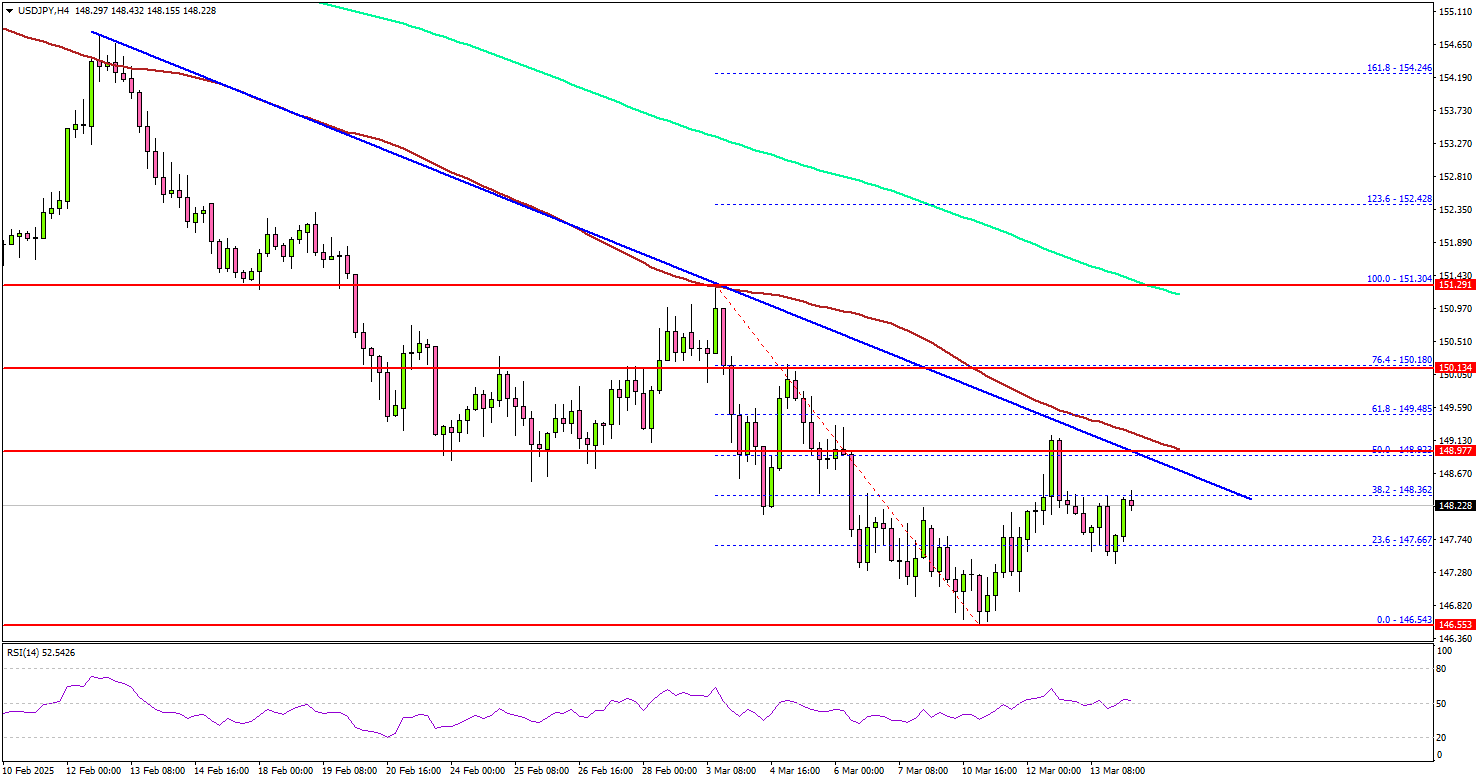
          There was a spike above 148.50 but the bears were active near the 50% Fib retracement level of the downward move from the 151.30 swing high to the 146.63 low.

          On the upside, the pair is facing resistance near the 148.80 level. There is also a major bearish trend line forming with resistance at 148.80 on the same chart. The next major resistance is near the 149.50 level and the 61.8% Fib retracement level of the downward move from the 151.30 swing high to the 146.63 low.

          The main resistance is now forming near the 150.20 zone. A close above the 150.20 level could set the tone for another increase. In the stated case, the pair could even clear the 152.00 resistance.

          On the downside, immediate support sits near the 147.50 level. The next key support sits near the 147.20 level. Any more losses could send the pair toward the 146.60 level. The main support could be 145.00.

          Looking at EUR/USD, the pair remained stable and might soon now aim for a move toward the 1.1000 resistance.

          Source: ACTIONFOREX

          To stay updated on all economic events of today, please check out our Economic calendar
          Risk Warnings and Disclaimers
          You understand and acknowledge that there is a high degree of risk involved in trading. Following any strategies or investment methods may lead to potential losses. The content on the site is provided by our contributors and analysts for information purposes only. You are solely responsible for determining whether any trading assets, securities, strategy, or any other product is suitable for investing based on your own investment objectives and financial situation.
          Add to Favorites
          Share

          Gold Mounts Record Summit, Eyes US$3,000 Peak

          Alex

          Economic

          Gold hit a record high on Friday, as uncertainty over US tariffs and fears of trade tensions propelled prices, along with increased expectations of monetary policy easing by the Federal Reserve.

          Spot gold eased 0.1% to US$2,983.78 (RM13,265.14) an ounce as of 0132 GMT, after hitting a record high of US$2,990.09 earlier in the session, within touching distance of the key US$3,000 milestone.

          Bullion is also poised to log a second straight weekly rise, with a 2.5% gain so far.

          US gold futures rose 0.2% to US$2,996.70.

          "The risk-off market stance reflects investors' expectations that trade tensions are likely to get worse before it cools, and are turning to safe-haven gold once again as a hedge against portfolio volatility," said IG market strategist Yeap Jun Rong.

          Latest in US President Donald Trump's multi-front trade war, the European Union responded to blanket US tariffs on steel and aluminium by imposing a 50% tax on American whiskey exports, prompting the president to threaten on Truth Social to charge a 200% tariff on imports of European wines and spirits.

          "The psychological US$3,000 level is now coming into view for gold prices, and as we approach the second quarter, where reciprocal tariffs could trigger another wave of market turbulence, gold remains a compelling safe-haven asset in an environment where alternatives are scarce," Rong added.

          Trump's tariffs are widely expected to stoke inflation and economic uncertainty, and have prompted gold to reach multiple record highs in 2025.

          Gold is seen as a hedge against political risks and inflation.

          Markets now await the Fed's monetary policy meeting next Wednesday. The central bank is expected to keep its benchmark overnight interest rate in the 4.25%-4.50% range.

          Non-yielding bullion thrives in a low interest rate environment.

          Meanwhile, Russian President Vladimir Putin said on Thursday Russia supported a US proposal for a ceasefire in Ukraine in principle, but sought a number of clarifications and conditions that appeared to rule out a quick end to the fighting.

          Spot silver eased 0.2% to US$33.72 an ounce, platinum firmed 0.1% to US$995.30, and palladium gained 0.7% to US$964.32.

          Source: Theedgemarkets

          To stay updated on all economic events of today, please check out our Economic calendar
          Risk Warnings and Disclaimers
          You understand and acknowledge that there is a high degree of risk involved in trading. Following any strategies or investment methods may lead to potential losses. The content on the site is provided by our contributors and analysts for information purposes only. You are solely responsible for determining whether any trading assets, securities, strategy, or any other product is suitable for investing based on your own investment objectives and financial situation.
          Add to Favorites
          Share

          March 14th Financial News

          FastBull Featured

          Daily News

          [Quick Facts]

          1. Russian President Putin backs conditional ceasefire in Ukraine conflict; Trump and Zelensky react.
          2. US to impose additional sanctions on Russia's oil, gas, and banking sectors.
          3. US department of government efficiency proposes near 20% staff cuts at IRS.
          4. Democrats abandon efforts to block GOP bill, averting government shutdown threat.
          5. US treasury secretary: All goods except metals and autos are eligible for tariff negotiations.

          [News Details]

          Russian President Putin backs conditional ceasefire in Ukraine conflict; Trump and Zelensky react
          Russian President Vladimir Putin expressed conditional support for a 30-day ceasefire proposal in the Ukraine conflict during a joint press conference with Belarusian President Alexander Lukashenko on March 13. Putin emphasized that Russia agrees with the ceasefire proposal, but many details remain to be negotiated. He stressed that the ceasefire must aim for long-term peace and address the root causes of the conflict. Putin also highlighted several key issues that need resolution, including establishing effective ceasefire monitoring mechanisms along the nearly 2,000-kilometer contact line and preventing Ukraine from using the ceasefire period for mobilization or receiving weapons.
          Regarding the situation in Kursk, Putin noted that Ukrainian forces are isolated and surrounded, and their withdrawal or surrender during the ceasefire would need to be clarified. He also indicated that he might discuss the ceasefire proposal directly with US President Donald Trump.
          US President Donald Trump responded positively to Putin's statement, describing it as "promising but incomplete." Trump emphasized his willingness to meet or speak with Putin and stressed the urgency of reaching a ceasefire agreement.
          Ukrainian President Volodymyr Zelensky, however, accused Russia of using the ceasefire proposal as a manipulative tactic. He claimed that Putin is preparing to reject the ceasefire but is unwilling to communicate this directly to Trump. Zelensky argued that Russia is setting preconditions to delay or sabotage the ceasefire process.
          US to impose additional sanctions on Russia's oil, gas, and banking sectors
          Informed sources have indicated that the Trump administration is taking steps to further restrict Russia's access to the US payment system. This move is aimed at imposing additional constraints on Russia's oil, gas, and banking sectors, tightening the economic pressure on Moscow. The US Treasury Department allowed a 60-day waiver, granted in January by the Biden administration, to expire on Wednesday. The waiver had permitted specific energy transactions involving sanctioned Russian banks to continue. With the waiver's expiration, these banks may no longer be able to use the US payment system.
          US department of government efficiency proposes near 20% staff cuts at IRS
          According to CNN, the Department of Government Efficiency, led by Elon Musk, has proposed a significant reduction in the workforce of the Internal Revenue Service (IRS). The plan suggests cutting nearly 20% of the IRS staff by May 15, one month after the US tax deadline. President Trump has ordered all federal agencies to submit "large-scale" layoff plans by Thursday. Details of the IRS proposal have reportedly been circulated via email within the Department of Government Efficiency and will be discussed at a leadership meeting on Thursday morning.
          The latest round of layoffs is expected to affect nearly 6,800 employees. Additionally, around 6,700 probationary employees have already been dismissed, along with 4,700 employees who accepted voluntary buyout offers from the Trump administration.
          Democrats abandon efforts to block GOP bill, averting government shutdown threat
          US Senate Democrats have abandoned their efforts to block a temporary funding bill proposed by Republicans, thereby averting the threat of a government shutdown. Senate Minority Leader Chuck Schumer announced that he would vote to advance the bill on Friday morning, citing the significant risks associated with a potential shutdown. This decision followed intense internal debate within the Democratic Party over how best to resist President Trump's efforts to rapidly streamline federal agencies.
          According to sources, Schumer had indicated in a closed-door lunch meeting that he would have enough Democratic support to help Republicans reach the 60-vote threshold required to pass the bill in the Senate. "I will vote to keep the government running rather than shutting it down," Schumer said on the Senate floor, adding that Democrats had no better alternatives.
          Schumer warned that if the government were to shut down, Trump might selectively reopen some departments while keeping others closed indefinitely. To avoid this scenario, Democrats ultimately chose to compromise.
          US treasury secretary: All goods except metals and autos are eligible for tariff negotiations
          On March 13, US Treasury Secretary Scott Bessent indicated that all goods, with the exception of metals and potentially automobiles, are open for tariff negotiations. Speaking on the ongoing trade disputes, Bessent noted that trade surplus countries would face the most significant impact if trade partners seek to accelerate negotiations.
          When asked about President Trump's threat to impose a 200% tariff on EU wine products, Bessent questioned why a few products from one or two trade blocs should be a major issue. Regarding the recent volatility in US stock markets, Bessent emphasized that the US is focused on overall market performance and long-term gains for Americans, adding that "detoxification" does not necessarily lead to a recession.
          On the weakening of the US dollar, Bessent remarked that many factors have already been priced in and that adjustments are "natural and expected". He also warned that a government shutdown would be highly disruptive. However, he noted that businesses broadly support reducing government spending and that Trump's tax bill is progressing as planned, with hopes for significant advancements in the coming weeks.

          [Today's Focus]

          UTC+8 15:00 UK January GDP MoM
          UTC+8 16:30 ECB Governing Council Member Escrivá's Speech
          UTC+8 20:30 Canada January Wholesale Sales MoM
          UTC+8 21:15 ECB Executive Board Member Chipollone's Speech
          UTC+8 22:00 US March Michigan Consumer Confidence Index Preliminary
          Risk Warnings and Disclaimers
          You understand and acknowledge that there is a high degree of risk involved in trading. Following any strategies or investment methods may lead to potential losses. The content on the site is provided by our contributors and analysts for information purposes only. You are solely responsible for determining whether any trading assets, securities, strategy, or any other product is suitable for investing based on your own investment objectives and financial situation.
          Add to Favorites
          Share

          Barclays Cuts U.S. Growth & Raises Inflation Forecast

          Warren Takunda

          Economic

          Barclays has revised down its U.S. economic growth forecast for 2025 while raising its inflation projections, citing escalating trade policy uncertainty and higher tariffs under the Trump administration.
          The bank now expects U.S. GDP growth to slow to 0.7% (Q4/Q4) in 2025, down 0.8 percentage points from its previous projection. At the same time, Barclays raised its core PCE inflation forecast for the year to 3.2% (Q4/Q4), a 40-basis-point increase, while core CPI inflation is seen reaching 3.6% (Q4/Q4), up 30 basis points.
          “President Trump has shown more appetite to impose widespread tariffs than we had previously anticipated,” Barclays economists wrote in a note. The firm now assumes a trade-weighted tariff rate of 15%, up from its prior estimate of 10%, as Washington moves ahead with steep duties on Chinese goods, aluminum, steel, automobiles, pharmaceuticals, and semiconductors.

          FOMC Policy Adjustments

          Despite the elevated inflation outlook, Barclays sees the Federal Reserve cutting rates twice in 2025, in June and September, as a weaker labor market forces the central bank’s hand. The bank had previously forecast only one 25-basis-point cut in June. The unemployment rate is now projected to rise to 4.2% by the end of 2025.
          “For 2026, we expect three additional 25bp rate cuts, in March, June, and September,” Barclays noted, bringing the Fed’s policy rate back to a neutral range of 3.00-3.25%.
          Trade Policy Uncertainty Weighs on Investment
          The report highlights the impact of heightened trade policy uncertainty, which Barclays believes is already dragging down business investment and consumer confidence.
          Surveys from the University of Michigan, the Conference Board, and ISM suggest that firms are delaying capital expenditures (capex) while households curb spending due to rising import costs and economic unpredictability.
          “Trade policy uncertainty has surged, and it is exerting a drag on consumption and business investment,” Barclays said.
          Market Implications
          The higher tariffs are expected to reduce purchasing power, increase production costs, and trigger retaliatory measures from trading partners, all of which could weigh on corporate earnings and financial markets.
          Equity markets have so far reacted cautiously to the trade developments, but Barclays warns that credit spreads and rate expectations could shift further if economic data weakens.
          Barclays' downward revision comes amid broader concerns over the trajectory of U.S. economic growth in a protectionist trade environment. Investors will be closely watching upcoming inflation prints and Fed communications for signs of how monetary policy might evolve in response.

          Source :Poundsterlinglive

          To stay updated on all economic events of today, please check out our Economic calendar
          Risk Warnings and Disclaimers
          You understand and acknowledge that there is a high degree of risk involved in trading. Following any strategies or investment methods may lead to potential losses. The content on the site is provided by our contributors and analysts for information purposes only. You are solely responsible for determining whether any trading assets, securities, strategy, or any other product is suitable for investing based on your own investment objectives and financial situation.
          Add to Favorites
          Share
          FastBull
          Copyright © 2025 FastBull Ltd

          728 RM B 7/F GEE LOK IND BLDG NO 34 HUNG TO RD KWUN TONG KLN HONG KONG

          TelegramInstagramTwitterfacebooklinkedin
          App Store Google Play Google Play
          Products
          Charts

          Chats

          Q&A with Experts
          Screeners
          Economic Calendar
          Data
          Tools
          Membership
          Features
          Function
          Markets
          Copy Trading
          Latest Signals
          Contests
          News
          Analysis
          24/7
          Columns
          Education
          Company
          Careers
          About Us
          Contact Us
          Advertising
          Help Center
          Feedback
          User Agreement
          Privacy Policy
          Business

          White Label

          Data API

          Web Plug-ins

          Poster Maker

          Affiliate Program

          Risk Disclosure

          The risk of loss in trading financial instruments such as stocks, FX, commodities, futures, bonds, ETFs and crypto can be substantial. You may sustain a total loss of the funds that you deposit with your broker. Therefore, you should carefully consider whether such trading is suitable for you in light of your circumstances and financial resources.

          No decision to invest should be made without thoroughly conducting due diligence by yourself or consulting with your financial advisors. Our web content might not suit you since we don't know your financial conditions and investment needs. Our financial information might have latency or contain inaccuracy, so you should be fully responsible for any of your trading and investment decisions. The company will not be responsible for your capital loss.

          Without getting permission from the website, you are not allowed to copy the website's graphics, texts, or trademarks. Intellectual property rights in the content or data incorporated into this website belong to its providers and exchange merchants.

          Not Logged In

          Log in to access more features

          FastBull Membership

          Not yet

          Purchase

          Become a signal provider
          Help Center
          Customer Service
          Dark Mode
          Price Up/Down Colors

          Log In

          Sign Up

          Position
          Layout
          Fullscreen
          Default to Chart
          The chart page opens by default when you visit fastbull.com
