• Trade
  • Markets
  • Copy
  • Contests
  • News
  • 24/7
  • Calendar
  • Q&A
  • Chats
Trending
Screeners
SYMBOL
LAST
BID
ASK
HIGH
LOW
NET CHG.
%CHG.
SPREAD
SPX
S&P 500 Index
6853.15
6853.15
6853.15
6878.28
6833.87
-17.25
-0.25%
--
DJI
Dow Jones Industrial Average
47783.64
47783.64
47783.64
47971.51
47695.55
-171.34
-0.36%
--
IXIC
NASDAQ Composite Index
23563.01
23563.01
23563.01
23698.93
23481.60
-15.11
-0.06%
--
USDX
US Dollar Index
99.000
99.080
99.000
99.160
98.730
+0.050
+ 0.05%
--
EURUSD
Euro / US Dollar
1.16389
1.16396
1.16389
1.16717
1.16162
-0.00037
-0.03%
--
GBPUSD
Pound Sterling / US Dollar
1.33237
1.33246
1.33237
1.33462
1.33053
-0.00075
-0.06%
--
XAUUSD
Gold / US Dollar
4195.24
4195.65
4195.24
4218.85
4175.92
-2.67
-0.06%
--
WTI
Light Sweet Crude Oil
58.886
58.916
58.886
60.084
58.817
-0.923
-1.54%
--

Community Accounts

Signal Accounts
--
Profit Accounts
--
Loss Accounts
--
View More

Become a signal provider

Sell trading signals to earn additional income

View More

Guide to Copy Trading

Get started with ease and confidence

View More

Signal Accounts for Members

All Signal Accounts

Best Return
  • Best Return
  • Best P/L
  • Best MDD
Past 1W
  • Past 1W
  • Past 1M
  • Past 1Y

All Contests

  • All
  • Trump Updates
  • Recommend
  • Stocks
  • Cryptocurrencies
  • Central Banks
  • Featured News
Top News Only
Share

USA Commerce To Open Up Exports Of Nvidia H200 Chips To China -Semafor

Share

Ukraine: Ukraine Is Seeking Security Guarantees That Have Been Approved By The U.S. Capitol

Share

UN Spokesperson - UN Secretary General Guterres Very Concerned About Latest Developments Between Thailand And Cambodia

Share

LME Copper Futures Closed Up $15 At $11,636 Per Tonne. LME Aluminum Futures Closed Down $10 At $2,888 Per Tonne. LME Zinc Futures Closed Up $23 At $3,121 Per Tonne

Share

USA Federal Communications Commission Says It May Bar Providers From Connecting Calls From Chinese Telecom Companies To USA Networks Over Robocall Prevention Efforts - Order

Share

Ukraine President Zelenskiy: Ukraine Cannot Give Up Land, USA Is Trying To Find Compromise On The Issue

Share

Ukraine President Zelenskiy: Ukraine-Europe Plan Proposals Should Be Ready By Tomorrow To Share With USA

Share

Ukraine President Zelenskiy: Talks In London Were Productive, There Is Small Progress Towards Peace

Share

EU's Foreign Chief: Giving Ukraine The Resources It Needs To Defend Itself Doesn't Prolong The War, It Can Help End It

Share

EU's Foreign Chief: Securing Multi-Year Funding For Ukraine In December Is Absolutely Essential

Share

[Bank For International Settlements: US Tariffs Drive Record Global FX Trading Volume] Data From The Bank For International Settlements (BIS) Shows That Global FX Trading Volume Surged To A Record High This Year, With An Average Daily Trading Volume Of $9.5 Trillion In April, Amid Market Turmoil Triggered By US President Trump's Tariff Policies. On December 8, The Bank Released Its Quarterly Assessment, Citing Data From Its Triennial Survey, Stating That The Impact Of Tariffs Was "substantial," Leading To An Unexpected Depreciation Of The US Dollar And Accounting For Over $1.5 Trillion In Average Daily OTC Trading Volume In April. The Report Shows That Overall FX Trading Volume Increased By More Than A Quarter Compared To The Last Survey In 2022, Surpassing The Estimated Peak During The Market Turmoil Caused By The COVID-19 Pandemic In March 2020. This Data Is An Update Based On Preliminary Survey Results Released In September

Share

UN Secretary General Guterres Strongly Condemns Unauthorized Entry By Israeli Authorities Into UNRWA Compound In East Jerusalem

Share

Bank Of America: A Dovish Federal Reserve Poses A Key Risk To High-grade U.S. Bonds In 2026

Share

Bank CEOs Will Meet With U.S. Senators To Discuss The (regulatory) Framework For The Cryptocurrency Market

Share

The U.S. Supreme Court Has Hinted That It Will Support President Trump's Decision To Remove Heads Of Federal Government Agencies

Share

[BlackRock: The Surge Of Funds Into AI Infrastructure Is Far From Peaking] Ben Powell, Chief Investment Strategist For Asia Pacific At BlackRock, Stated That The Capital Expenditure Spree In The Artificial Intelligence (AI) Infrastructure Sector Continues And Is Far From Reaching Its Peak. Powell Believes That As Tech Giants Race To Increase Their Investments In A "winner-takes-all" Competition, The "shovel Sellers" (such As Chipmakers, Energy Producers, And Copper Wire Manufacturers) Who Provide The Foundational Resources For The Sector Are The Clearest Investment Winners

Share

[Ray Dalio: The Middle East Is Rapidly Becoming One Of The World's Most Influential AI Hubs] Bridgewater Associates Founder Ray Dalio Stated That The Middle East (particularly The UAE And Saudi Arabia) Is Rapidly Emerging As A Powerful Global AI Hub, Comparable To Silicon Valley, Due To The Region's Combination Of Massive Capital And Global Talent. Dalio Believes The Gulf Region's Transformation Is The Result Of Well-thought-out National Strategies And Long-term Planning, Noting That The UAE's Outstanding Performance In Leadership, Stability, And Quality Of Life Has Made It A "Silicon Valley For Capitalists." While He Believes The AI ​​rebound Is In Bubble Territory, He Advises Investors Not To Rush Out But Rather To Look For Catalysts That Could Cause The Bubble To "burst," Such As Monetary Tightening Or Forced Wealth Selling

Share

French President Emmanuel Macron Met With The Croatian Prime Minister At The Élysée Palace

Share

In The Past 24 Hours, The Marketvector Digital Asset 100 Small Cap Index Rose 1.96%, Currently At 4135.44 Points. The Sydney Market Initially Exhibited An N-shaped Pattern, Hitting A Daily Low Of 3988.39 Points At 06:08 Beijing Time, Before Steadily Rising To A Daily High Of 4206.06 Points At 17:07, Subsequently Stabilizing At This High Level

Share

[Sovereign Bond Yields In France, Italy, Spain, And Greece Rose By More Than 7 Basis Points, Raising Concerns That The ECB's Interest Rate Outlook May Push Up Financing Costs] In Late European Trading On Monday (December 8), The Yield On French 10-year Bonds Rose 5.8 Basis Points To 3.581%. The Yield On Italian 10-year Bonds Rose 7.4 Basis Points To 3.559%. The Yield On Spanish 10-year Bonds Rose 7.0 Basis Points To 3.332%. The Yield On Greek 10-year Bonds Rose 7.1 Basis Points To 3.466%

TIME
ACT
FCST
PREV
France Trade Balance (SA) (Oct)

A:--

F: --

P: --
Euro Zone Employment YoY (SA) (Q3)

A:--

F: --

P: --
Canada Part-Time Employment (SA) (Nov)

A:--

F: --

P: --

Canada Unemployment Rate (SA) (Nov)

A:--

F: --

P: --

Canada Full-time Employment (SA) (Nov)

A:--

F: --

P: --

Canada Labor Force Participation Rate (SA) (Nov)

A:--

F: --

P: --

Canada Employment (SA) (Nov)

A:--

F: --

P: --

U.S. PCE Price Index MoM (Sept)

A:--

F: --

P: --

U.S. Personal Income MoM (Sept)

A:--

F: --

P: --

U.S. Core PCE Price Index MoM (Sept)

A:--

F: --

P: --

U.S. PCE Price Index YoY (SA) (Sept)

A:--

F: --

P: --

U.S. Core PCE Price Index YoY (Sept)

A:--

F: --

P: --

U.S. Personal Outlays MoM (SA) (Sept)

A:--

F: --

P: --
U.S. 5-10 Year-Ahead Inflation Expectations (Dec)

A:--

F: --

P: --

U.S. Real Personal Consumption Expenditures MoM (Sept)

A:--

F: --

P: --
U.S. Weekly Total Rig Count

A:--

F: --

P: --

U.S. Weekly Total Oil Rig Count

A:--

F: --

P: --

U.S. Consumer Credit (SA) (Oct)

A:--

F: --

P: --
China, Mainland Foreign Exchange Reserves (Nov)

A:--

F: --

P: --

Japan Trade Balance (Oct)

A:--

F: --

P: --

Japan Nominal GDP Revised QoQ (Q3)

A:--

F: --

P: --

China, Mainland Imports YoY (CNH) (Nov)

A:--

F: --

P: --

China, Mainland Exports (Nov)

A:--

F: --

P: --

China, Mainland Imports (CNH) (Nov)

A:--

F: --

P: --

China, Mainland Trade Balance (CNH) (Nov)

A:--

F: --

P: --

China, Mainland Exports YoY (USD) (Nov)

A:--

F: --

P: --

China, Mainland Imports YoY (USD) (Nov)

A:--

F: --

P: --

Germany Industrial Output MoM (SA) (Oct)

A:--

F: --

P: --
Euro Zone Sentix Investor Confidence Index (Dec)

A:--

F: --

P: --

Canada National Economic Confidence Index

A:--

F: --

P: --

U.K. BRC Like-For-Like Retail Sales YoY (Nov)

--

F: --

P: --

U.K. BRC Overall Retail Sales YoY (Nov)

--

F: --

P: --

Australia Overnight (Borrowing) Key Rate

--

F: --

P: --

RBA Rate Statement
RBA Press Conference
Germany Exports MoM (SA) (Oct)

--

F: --

P: --

U.S. NFIB Small Business Optimism Index (SA) (Nov)

--

F: --

P: --

Mexico 12-Month Inflation (CPI) (Nov)

--

F: --

P: --

Mexico Core CPI YoY (Nov)

--

F: --

P: --

Mexico PPI YoY (Nov)

--

F: --

P: --

U.S. Weekly Redbook Index YoY

--

F: --

P: --

U.S. JOLTS Job Openings (SA) (Oct)

--

F: --

P: --

China, Mainland M1 Money Supply YoY (Nov)

--

F: --

P: --

China, Mainland M0 Money Supply YoY (Nov)

--

F: --

P: --

China, Mainland M2 Money Supply YoY (Nov)

--

F: --

P: --

U.S. EIA Short-Term Crude Production Forecast For The Year (Dec)

--

F: --

P: --

U.S. EIA Natural Gas Production Forecast For The Next Year (Dec)

--

F: --

P: --

U.S. EIA Short-Term Crude Production Forecast For The Next Year (Dec)

--

F: --

P: --

EIA Monthly Short-Term Energy Outlook
U.S. API Weekly Gasoline Stocks

--

F: --

P: --

U.S. API Weekly Cushing Crude Oil Stocks

--

F: --

P: --

U.S. API Weekly Crude Oil Stocks

--

F: --

P: --

U.S. API Weekly Refined Oil Stocks

--

F: --

P: --

South Korea Unemployment Rate (SA) (Nov)

--

F: --

P: --

Japan Reuters Tankan Non-Manufacturers Index (Dec)

--

F: --

P: --

Japan Reuters Tankan Manufacturers Index (Dec)

--

F: --

P: --

Japan Domestic Enterprise Commodity Price Index MoM (Nov)

--

F: --

P: --

Japan Domestic Enterprise Commodity Price Index YoY (Nov)

--

F: --

P: --

China, Mainland PPI YoY (Nov)

--

F: --

P: --

China, Mainland CPI MoM (Nov)

--

F: --

P: --

Q&A with Experts
    • All
    • Chatrooms
    • Groups
    • Friends
    Connecting
    .
    .
    .
    Type here...
    Add Symbol or Code

      No matching data

      All
      Trump Updates
      Recommend
      Stocks
      Cryptocurrencies
      Central Banks
      Featured News
      • All
      • Russia-Ukraine Conflict
      • Middle East Flashpoint
      • All
      • Russia-Ukraine Conflict
      • Middle East Flashpoint
      Search
      Products

      Charts Free Forever

      Chats Q&A with Experts
      Screeners Economic Calendar Data Tools
      Membership Features
      Data Warehouse Market Trends Institutional Data Policy Rates Macro

      Market Trends

      Market Sentiment Order Book Forex Correlations

      Top Indicators

      Charts Free Forever
      Markets

      News

      News Analysis 24/7 Columns Education
      From Institutions From Analysts
      Topics Columnists

      Latest Views

      Latest Views

      Trending Topics

      Top Columnists

      Latest Update

      Signals

      Copy Rankings Latest Signals Become a signal provider AI Rating
      Contests
      Brokers

      Overview Brokers Assessment Rankings Regulators News Claims
      Broker listing Forex Brokers Comparison Tool Live Spread Comparison Scam
      Q&A Complaint Scam Alert Videos Tips to Detect Scam
      More

      Business
      Events
      Careers About Us Advertising Help Center

      White Label

      Data API

      Web Plug-ins

      Affiliate Program

      Awards Institution Evaluation IB Seminar Salon Event Exhibition
      Vietnam Thailand Singapore Dubai
      Fans Party Investment Sharing Session
      FastBull Summit BrokersView Expo
      Recent Searches
        Top Searches
          Markets
          News
          Analysis
          User
          24/7
          Economic Calendar
          Education
          Data
          • Names
          • Latest
          • Prev

          View All

          No data

          Scan to Download

          Faster Charts, Chat Faster!

          Download App
          English
          • English
          • Español
          • العربية
          • Bahasa Indonesia
          • Bahasa Melayu
          • Tiếng Việt
          • ภาษาไทย
          • Français
          • Italiano
          • Türkçe
          • Русский язык
          • 简中
          • 繁中
          Open Account
          Search
          Products
          Charts Free Forever
          Markets
          News
          Signals

          Copy Rankings Latest Signals Become a signal provider AI Rating
          Contests
          Brokers

          Overview Brokers Assessment Rankings Regulators News Claims
          Broker listing Forex Brokers Comparison Tool Live Spread Comparison Scam
          Q&A Complaint Scam Alert Videos Tips to Detect Scam
          More

          Business
          Events
          Careers About Us Advertising Help Center

          White Label

          Data API

          Web Plug-ins

          Affiliate Program

          Awards Institution Evaluation IB Seminar Salon Event Exhibition
          Vietnam Thailand Singapore Dubai
          Fans Party Investment Sharing Session
          FastBull Summit BrokersView Expo

          China Successfully Operates World's First Thorium Molten Salt Reactor

          Justin

          Commodity

          Stocks

          Summary:

          An experimental Chinese nuclear plant reportedly just crossed a historic threshold, successfully operating the world's first thorium-based molten salt reactor (TMSR).

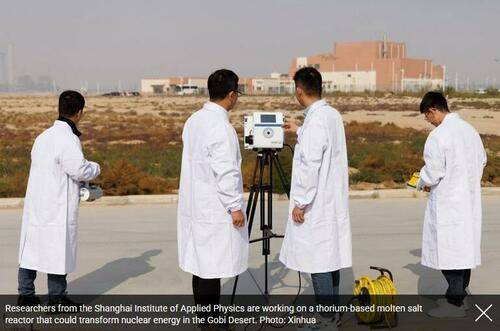
          An experimental Chinese nuclear plant reportedly just crossed a historic threshold, successfully operating the world's first thorium-based molten salt reactor (TMSR). The Chinese Academy of Sciences' Shanghai Institute of Applied Physics has broken a major scientific barrier by successfully converting thorium to uranium in a historic first.

          The Hong Kong-based South China Morning Post reports that the breakthrough, which took place at an experimental reactor out in the Gobi Desert, is "poised to reshape the future of clean sustainable nuclear energy."
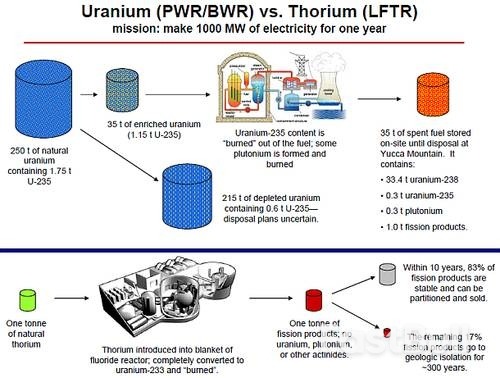
          The process works by using a "precise sequence of nuclear reactions" in which naturally occurring thorium-232 absorbs a neutron, becoming thorium-233. Through a decay process, that isotope breaks down into protactinium-233 and then finally into uranium-233, a potent form of nuclear fuel that can sustain chain reactions for nuclear fission.
          While this breakthrough was just publicized this month by a report by Science and Technology Daily, the TMSR has apparently been operational for years. Li Qingnuan, Communist Party secretary and deputy director at the Shanghai Institute of Applied Physics, told the outlet that "since achieving first criticality on October 11, 2023, the thorium molten salt reactor has been steadily generating heat through nuclear fission".

          If the reports are true, this breakthrough would signal an incredible leap forward in a nuclear technology race that China is already winning handily. Although the United States is still the world's biggest producer of nuclear energy, that status won't last much longer. In the same time period that the United States built the overdue and over-budget Plant Vogtle, China built 13 reactors of similar scale, and has 33 more on the way. Beijing is also making major forays into the nuclear sectors of emerging economies, with particularly concerted efforts in Africa.

          "The Chinese are moving very, very fast," Mark Hibbs, senior fellow at the Carnegie Endowment for International Peace and expert on the Chinese nuclear sector, told the New York Times. "They are very keen to show the world that their program is unstoppable."

          But while China has invested huge sums of money and manpower into becoming a global nuclear energy innovator and superpower, the nation lacks sufficient uranium to power its lofty goals. While nuclear power production growth is dominated by China, uranium supply chains are dominated by Russia, which is home to nearly half (approximately 44 percent) of all global uranium enrichment capacity.

          China has been buying up more and more of Russia's uranium, but reliance on exports is both risky and antithetical to China's ethos of domestic energy independence and international energy dominance. Russia's outsized presence in the nuclear fuel supply chain has resulted in some degree of risk and market volatility, as the Kremlin has shown that it is not afraid to use enriched uranium for political leverage.

          "The nuclear energy supply chain sits atop the clean technology risk pyramid," warned a recent article from the Carnegie Endowment for International Peace. "Beyond standard supply chain considerations, nuclear exports are subject to a suite of safety and security concerns, and overreliance on a single technology or fuel provider can create significant dependencies given the limited number of suppliers and distinct intellectual property (IP)."

          By sidestepping the uranium supply chain issue by using thorium instead, China is leaping over a critical hurdle and straight over the finish line for global nuclear power sector domination. Thorium is much more accessible and abundant than uranium, and could theoretically solve all of China's nuclear fuel problems. According to the South China Morning Post, just one mining site in Inner Mongolia " is estimated to hold enough of the element to power China entirely for more than 1,000 years."

          Source: Zero Hedge

          Risk Warnings and Disclaimers
          You understand and acknowledge that there is a high degree of risk involved in trading. Following any strategies or investment methods may lead to potential losses. The content on the site is provided by our contributors and analysts for information purposes only. You are solely responsible for determining whether any trading assets, securities, strategy, or any other product is suitable for investing based on your own investment objectives and financial situation.
          Add to Favorites
          Share

          Central bank body BIS raises concerns of gold and stocks double bubble

          Adam

          Economic

          The combination of gold and share prices soaring in unison is a phenomenon not seen in at least half a century and raises questions of a potential bubble in both, global central bank umbrella body, the Bank for International Settlements, says.
          While equity markets continue to be driven by AI and tech gains, gold's 60% surge this year is set to be its biggest since 1979, fuelling debate about whether its traditional role as a safe-haven asset has changed.
          "Gold has behaved very differently this year compared to its usual pattern," Hyun Song Shin, Economic Adviser and Head of the Monetary and Economic Department at the BIS said as it released its final report of the year on Monday.
          "The interesting phenomenon this time has been that gold has become much more like a speculative asset."
          Dubbed the central bank to the world's central banks, the BIS has given regular warnings about potential stock market bubbles in recent years, but its concern around the co-movement with gold is two-fold.
          Where would investors shelter if stocks and gold both crash. And what could it mean for central banks and other reserve managers given some have been heavy buyers of gold.
          The BIS' analysis concluded that this year has been the first time gold and the S&P 500 have jointly exhibited "explosive behaviour" in the last 50 years.
          Not only is gold up 60% this year, it is up more than 150% since 2022 when the post-COVID pandemic surge in inflation began to impact markets, alongside Russia's invasion of Ukraine and subsequent Western sanctions on Moscow.
          Another possible bubble warning sign is that retail investors have also been piling in.
          Gold exchange-traded fund (ETF) prices have been consistently trading at a premium relative to their net asset value (NAV) this year, signalling "strong buying pressure coupled with impediments to arbitrage," the BIS said.
          Central banks' purchases have "clearly set a very firm tone in the price of gold," Shin added.
          "Whenever you have prices actually doing quite well, you will see other investors jumping in, and certainly retail investors have also taken part (in the rally), and not just in gold".
          GROWING FRAGILITY
          The BIS gave a broader warning too about the "growing fragility" of the risk-on environment amid the concerns about artificial intelligence (AI) valuations and the recent 20% dives in cryptocurrencies like bitcoin.
          The European Central Bank and Bank of England have both raised their own AI bubble concerns in recent weeks and the risk of an abrupt burst if investors' rosy expectations are not met.
          Shin said the profits being made by the AI firms - now spending enormous amounts on data centers - was an important difference between now and the "dotcom bubble" of the early 2000s when firms weren't making money.
          The "fundamental question", however, is whether those expenditures will be seen as being justified in the long run, Shin said, adding that the other key determinant for markets will be how the global economy holds up next year.
          "So far, activity has been surprisingly resilient," Shin said.
          The BIS is also watching where the dollar goes from here. This year it is headed for its biggest annual drop since the Lehman Brothers collapse in 2007.
          "After the April episode (when U.S. President Donald Trump announced sweeping trade tariff plans), the dollar has been relatively stable," Shin said.
          "I think the hedging behaviour of non-U.S. investors is going to be a very, very important input into how markets will co-move from here."

          Source: reuters

          To stay updated on all economic events of today, please check out our Economic calendar
          Risk Warnings and Disclaimers
          You understand and acknowledge that there is a high degree of risk involved in trading. Following any strategies or investment methods may lead to potential losses. The content on the site is provided by our contributors and analysts for information purposes only. You are solely responsible for determining whether any trading assets, securities, strategy, or any other product is suitable for investing based on your own investment objectives and financial situation.
          Add to Favorites
          Share

          No Need To 'break' With US Over Security Policy, German Spy Chief Says

          James Whitman

          Political

          ● Spy chief speaks after U.S. strategy that is critical of Europe
          ● Says US strategy shows need to review alliances, boost Europe cooperation
          ● Europe must foster alternatives to U.S. tech like Palantir

          There is no need for a rupture between Europe and the U.S. over Washington's new Security Strategy warning of "civilizational erasure" in the Old World, Germany's spy chief said on Monday.

          In the new document, unveiled late last week, the Trump administration upends postwar assumptions about Europe's close relationship with the United States and takes European countries to task for continuing to rely heavily on the U.S. for their defence. Reuters reported on Friday that Washington wants Europe to take over the majority of NATO's conventional defence capabilities, from intelligence to missiles, by 2027.

          "I would not draw from such a strategy the conclusion that we should break with America," Sinan Selen said at an event in Berlin, "and I also do not believe that our partners will break with us."

          "But one important point is that we naturally have to continually review our alliances and further develop them, and that applies in particular to European networking."

          Europe needs to become more independent overall, including in its security architecture, Selen said, alluding to concern over reliance on U.S. technology.

          Europe "must be able to generate alternatives" for example to the crime-fighting software of CIA-backed Palantir Technologies (PLTR.O), opens new tab so it could then select the best solution, taking into account geostrategic considerations.

          "We have industries and companies that can do these things. Perhaps they simply need more support," he said.

          German security services also need expanded digital surveillance powers to better unmask people hiding behind fake profiles, map their online networks, and analyse their communications, before anything happens, said Selen.

          The government is already working on this, he said.

          "Other partners — I look specifically at France and the Netherlands — are far ahead of us in this regard," said Selen.

          Germany has traditionally maintained some of the strictest data-privacy protections in Europe, shaped by its history of two dictatorships in the 20th century.

          Source: Reuters

          Risk Warnings and Disclaimers
          You understand and acknowledge that there is a high degree of risk involved in trading. Following any strategies or investment methods may lead to potential losses. The content on the site is provided by our contributors and analysts for information purposes only. You are solely responsible for determining whether any trading assets, securities, strategy, or any other product is suitable for investing based on your own investment objectives and financial situation.
          Add to Favorites
          Share

          BlackRock bets on ‘pick and shovel’ trade, singling out clear winners in AI spending spree

          Adam

          Economic

          The wave of capital pouring into artificial intelligence infrastructure is far from peaking, said Ben Powell, chief investment strategist for APAC at BlackRock, arguing the sector’s “picks and shovels” suppliers — from chipmakers to energy producers and copper-wire manufacturers — remain the clearest winners as hyperscalers race to outspend one another.
          The surge in AI-related capital expenditure shows no sign of slowing as tech giants push aggressively to secure an edge in what they see as a winner-takes-all contest, Powell told CNBC Monday on the sidelines of the Abu Dhabi Finance Week.
          “The capex deluge continues. The money is very, very clear,” he said, adding that BlackRock is focused on what he called a “traditional picks and shovels capex super boom, which still feels like it’s got more to go.”
          AI infrastructure has been one of the biggest drivers of global investment this year, fueling a broader market rally, even as some investors question how long the boom can last.
          Nvidia, whose GPU chips are the backbone of the AI revolution, became the first company to briefly surpass $5 trillion in market capitalization amid a dizzying AI-fueled market rally that sparked talk of an AI bubble.
          Microsoft and OpenAI also reached a restructuring deal in October to support the ChatGPT developer’s fundraising efforts. OpenAI has reportedly been preparing for an initial public offering that could value the company at $1 trillion, according to Reuters.
          The build-out has set off long-term procurement efforts across the tech sector, from chip supply agreements to power commitments. Grid operators from the U.S. to the Middle East are racing to meet soaring electricity demand from new data centers. Companies, including Amazon and Meta, have budgeted tens of billions of dollars annually for AI-related investments.
          S&P Global estimates data-center power demand could nearly double by 2030, mostly driven by hyperscale, enterprise and leased facilities, along with crypto-mining sites.
          ‘Dipping toes into credit market’
          Powell also noted that leading tech firms have only begun to tap capital markets to fund the next phase of AI expansion, suggesting additional capital is on the way.
          “The big companies have only just started dipping their toes into the credit markets… feels like there’s a lot more they can do there,” he said.
          The “hyperscalers” are behaving as if coming second would effectively leave them out of the market, Powell said. That mindset, he added, has pushed firms to accelerate spending even at the risk of overshooting.
          Much of that capital, Powell noted, is likely to flow to the companies powering the AI build-out rather than model developers, reinforcing a growing view among global investors that the most durable gains from the AI boom may lie in the hardware, energy and infrastructure ecosystems behind the technology.
          “If we’re the recipients of that cash flow, I guess that’s a pretty good place to be, whether you’re making chips, whether you’re making energy all the way down to the copper wiring,” Powell noted, expecting “positive surprises driving those stocks in the year ahead.”

          Source: cnbc

          To stay updated on all economic events of today, please check out our Economic calendar
          Risk Warnings and Disclaimers
          You understand and acknowledge that there is a high degree of risk involved in trading. Following any strategies or investment methods may lead to potential losses. The content on the site is provided by our contributors and analysts for information purposes only. You are solely responsible for determining whether any trading assets, securities, strategy, or any other product is suitable for investing based on your own investment objectives and financial situation.
          Add to Favorites
          Share

          The Fed is likely to cut rates for a third time this year. What happens next year is less certain.

          Adam

          Economic

          After consternation about whether the Federal Reserve will cut interest rates for a third time this year, the consensus is that the central bank will likely go ahead with a 25-basis point cut on Wednesday — even if it's a split decision.
          “This is a hard call,” said Alan Blinder, former vice chair of the Fed and economics professor at Princeton. “[But] I do think it’s more likely they cut than not… It wouldn’t surprise me if this is a 'hawkish cut.'"
          That is to say, a rate cut this week could come with a caution to markets not to expect the Fed to keep cutting meeting after meeting. Blinder said he also thinks there could be dissenters on both sides of the interest rate decision, given existing divisions within the committee.
          Luke Tilley, chief economist for Wilmington Trust, who also thinks the Fed will cut rates Wednesday, predicted Fed Chair Jerome Powell will frame a rate cut the same way he did at the last press conference: by emphasizing differing opinions over further rate cuts and cautioning against assuming that the central bank will continue to cut.
          Ahead of this week’s meeting, a handful of Fed officials have made the case that there is not a strong need to cut rates given concerns about inflation, which remains a full percentage point above the Fed's 2% target. Those include Boston Fed president Susan Collins and Kansas City Fed president Jeff Schmid.
          Chicago Fed president Austan Goolsbee has also expressed hesitation about "frontloading" too many rate cuts, citing inflation. On the flipside, New York Fed president John Williams, vice chair of the Federal Open Market Committee and a member of Fed leadership, strongly signaled a few weeks ago that he could support a rate cut.
          “I still see room for a further adjustment in the near term to the target range for the federal funds rate, to move the stance of policy closer to the range of neutral,” Williams said on Nov. 21.
          To some Fed observers, that comment alone moved the odds.
          “The vice chair, John Williams, usually doesn't strongly signal that much in a speech unless he has the Fed chair's endorsement,” said Loretta Mester, former president of the Cleveland Federal Reserve. “So my view is they're going to go ahead with another 25-basis point cut in December.”
          While Mester says she thinks the Fed is not necessarily wrong to cut rates, she would not support it at this point and would want to see how the economy is faring at the beginning of next year, then course-correct if needed.
          “I don't really see a compelling case to cut this time, other than the fact that it was in the interest rate projections from September,” she said. “I think it's more expeditious than a good economic argument.”
          Blinder cautioned that if the central bank cuts rates again this week, policymakers risk making it harder to pull inflation down.
          Blinder says, “we may be” at risk of unleashing persistent inflation if the Fed continues to cut rates.
          “The question is whether we're there right now,” he said. “I think we may be.”
          What the available data says
          The release of inflation data continues to be delayed due to the government shutdown that ran for all of October and into November. The latest reading of the Personal Consumption Expenditures index, the Fed’s preferred inflation gauge, was released with a two-month lag. For September, on a “core” basis excluding food and energy prices, inflation increased 2.8% in September, down a tenth of a percentage point from August. Fed officials expect inflation to end the year at 3.1%.
          A stronger-than-expected — albeit stale — September jobs report showed payroll growth bounced back in September with 119,000 jobs added, compared with a loss of 4,000 for the month of August. That contributed to a volatile trend where job creation turned negative in June, increased in July, decreased again in August, and rebounded again in September.
          A more recent anecdotal reading on the job market from the Fed’s Beige Book showed that in the first two weeks of November, layoffs ticked up, employers were implementing hiring freezes, and adjusting workers' hours. A few firms noted that artificial intelligence replaced entry-level positions or made existing workers productive enough to curb new hiring.
          Fed officials will receive more real-time data releases the week after their meeting.
          Looking ahead to 2026
          Fed observers will be watching this week to see what officials signal about the future path of policy. Powell will hold his usual post-meeting press conference, and policymakers will unveil their latest quarterly projections for interest rates, which will include the outlook for 2026.
          “I'm hoping that he'll give sort of a narrative about really how they're thinking about the economy,” Mester said.
          She said she would take a cautious approach to further rate cuts because she sees inflation being driven not just by tariffs — which she considers one-time price increases — but also in the price of services.
          While the Fed is trying to cushion against deterioration in the job market, Mester said she believes much of the softening is due to longer-term changes the Fed can’t control, such as shifting immigration policy that’s resulting in a smaller pool of workers. At the same time, she acknowledged weakening due to uncertainty over tariffs and firms wanting to protect their profit margins from tariffs, as well as the cost of labor.
          “So you kind of have this sort of almost stasis in the labor market, and I'm not sure cutting interest rates does anything really to help that,” she said.
          Wilmington Trust’s Tilley, however, predicted three more cuts at the next three Fed policy meetings because he thinks the job market is weakening and expects it to weaken further.
          Tilley estimated that 154,000 government workers who took buyouts, dropping off payrolls in October, could boost the unemployment rate for November by nearly a tenth of a percentage point to 4.5%. He also noted that outside of healthcare jobs, private-sector job growth has been negative, according to BLS data.
          “There are the federal employees, and you've also got new entrants to the labor force who are having a hard time finding jobs,” Tilley said. “So, it all comes together to reflect a very weak labor market.”
          Aditya Bhave, senior US economist at Bank of America, projected two more cuts next June and July, not because the economy will need it, but because of a new chair of the Fed. That would leave rates in a range of 3.0 to 3.25%.
          “Our forecast of additional cuts next year is due to the change in leadership, not our read on the economy,” said Bhave. “In fact, by cutting rates next week, we think the Fed would increase the risk of pushing policy into accommodative territory, just as fiscal stimulus kicks in.”
          Amir Bagherpour, global managing director for Accenture, is predicting the Fed will cut rates one or two more times next year after cutting this week. That outlook assumes inflation as measured by core PCE will range from 2.5%-2.7% next year; GDP will be in the range of 1.5-1.8%; the unemployment rate will end next year in the range of 4.4-4.6%; and monthly jobs growth will average 75,000-125,000.
          Fed officials will release new projections for inflation, GDP, and unemployment on Wednesday.

          Source: finance.yahoo

          To stay updated on all economic events of today, please check out our Economic calendar
          Risk Warnings and Disclaimers
          You understand and acknowledge that there is a high degree of risk involved in trading. Following any strategies or investment methods may lead to potential losses. The content on the site is provided by our contributors and analysts for information purposes only. You are solely responsible for determining whether any trading assets, securities, strategy, or any other product is suitable for investing based on your own investment objectives and financial situation.
          Add to Favorites
          Share

          UK’s £2 Million-Plus Homes Risk Losing 5% In Value Next Year

          Winkelmann

          Political

          Economic

          UK homes worth more than £2 million ($2.7 million) could drop about 5% in value next year as the market adjusts to a so-called mansion tax, according to forecasts from Hamptons.

          The broker said it expected these homes — most of which are in London — to see a "one-off adjustment" in 2026 based on price reductions that factor in a new levy coming into force in April 2028. Chancellor of the Exchequer Rachel Reeves last month unveiled a tax on homes valued at more than £2 million, with a surcharge starting at £2,500 a year and rising to as much as £7,500.

          A 5% price correction would be the largest annual drop in values since 2009 for homes that have maintained a value of more than £2 million during those years, according to Hamptons' data. The broker said it expected London to be the only region in Britain to see house prices fall in 2025, predicting a 0.5% decline in the year compared to growth of as much as 5% in other regions.

          "It's hard to ignore the growing drag of taxation and politics," Aneisha Beveridge, head of research at Hamptons said in a report. London "is being held back by higher stamp duty and broader tax anxieties, locking some owners into their homes and others out of buying them."

          The housing market has endured disruption partly caused by hikes to stamp duty and the abolition of a system that allowed wealthy foreigners, or so-called non-doms, to avoid UK taxes on their overseas earnings. The changes have disproportionately impacted activity in London, where the market has also been affected by fiscal worries, as Labour raises revenue to pay for higher public spending.

          The new mansion tax targets less than 1% of all properties in England. However, most homes worth more than £2 million are in London, where property agents are warning the tax could amplify turbulence in the city's market.

          London's already weak house price growth is set to significantly trail the rest of Britain for at least the next two years. Hamptons predicts London will be the only region to not see house prices rise next year, and says it will lag behind other UK regions in growth by as much as roughly 16 percentage points between 2024 and 2028.

          The broker expects house prices to rise by 2.5% across Britain in 2026, followed by 2% growth in 2027 and a further 1.5% in 2028. It said political uncertainty will become a more prominent driver of property sentiment in 2028 — the year before the next planned general election.

          Based on market views on interest rates, the base rate could move further downwards next year and "settle" at about 3.25% at the end of 2026, Hamptons said. This should increase Britons' chances of securing mortgage deals below 4%, it added.

          "Inflation is easing, mortgage rates are falling, and affordability is improving," Hamptons' Beveridge said. "At the same time, the balance of power is shifting: the Midlands is forecast to have seen more price growth than London since prices bottomed out after the 2008 financial crash."

          Source: Bloomberg Europe

          To stay updated on all economic events of today, please check out our Economic calendar
          Risk Warnings and Disclaimers
          You understand and acknowledge that there is a high degree of risk involved in trading. Following any strategies or investment methods may lead to potential losses. The content on the site is provided by our contributors and analysts for information purposes only. You are solely responsible for determining whether any trading assets, securities, strategy, or any other product is suitable for investing based on your own investment objectives and financial situation.
          Add to Favorites
          Share

          Trump-brokered Truce Under Threat As Thailand-Cambodia Fighting Reignites

          Justin

          Political

          Thailand said its fighter jets struck Cambodia on Monday in an attempt to cripple its military capability, as a re-eruption of border hostilities derailed a fragile ceasefire brokered by U.S. President Donald Trump.

          Each side blamed the other for starting clashes that broke out during the night and intensified before dawn and spread to multiple locations, with one Thai soldier and four Cambodian civilians killed, according to officials.

          Cambodia accused Thailand of "inhumane and brutal acts" of aggression, stressing it had not retaliated, while Bangkok said it carried out air strikes on military targets after its neighbour mobilised heavy weaponry and repositioned combat units.

          "The objective of the army is to cripple Cambodia's military capability for a long time to come, for the safety of our children and grandchildren," Thai army chief of staff General Chaipruak Doungprapat said, according to the military.

          The fighting was the fiercest since a five-day exchange of rockets and heavy artillery in July that marked their heaviest clashes in recent history, when at least 48 people were killed and 300,000 displaced before Trump intervened to broker a ceasefire.

          'THERE WILL BE NO TALKS' SAYS THAI PM

          Tensions have simmered since Thailand last month suspended de-escalation measures that were agreed at a summit in Trump's presence, after a Thai soldier was maimed by a landmine that Bangkok said was newly laid by Cambodia.

          Some of the mines that have wounded seven Thai soldiers since July were likely newly laid, Reuters reported in October, based on expert analysis of material shared by Thailand's military.

          Cambodia has denied laying the mines and Thailand has said it will not implement the ceasefire terms until Cambodia apologises.

          Thai Prime Minister Anutin Charnvirakul on Monday said his government would do whatever necessary to protect its territorial integrity and would not engage in dialogue with Cambodia.

          "There will be no talks. If the fighting is to end, (Cambodia) must do what Thailand has set," he said, without elaborating.

          Cambodia's defence ministry said its forces came under sustained attack but were committed to the ceasefire and did not retaliate.

          "Cambodia calls on the international community to strongly condemn Thailand's violations ... as well as demands that Thailand take full responsibility for such brazen acts of aggression," it said in a statement.

          Thailand's army said Cambodia used drones to drop bombs on Thai bases and fired truck-mounted BM-21 rockets towards civilian areas.

          A Thai military official told Reuters targets of air strikes included long-range Chinese-made rockets.

          The U.S. embassy in Thailand did not immediately respond to a request for comment on the unrest. Malaysian Prime Minister Anwar Ibrahim, chair of the regional bloc ASEAN who helped Trump broker the truce, called for calm and for communication channels to stay open.

          "The renewed fighting risks unravelling the careful work that has gone into stabilising relations," Anwar said in an X post.

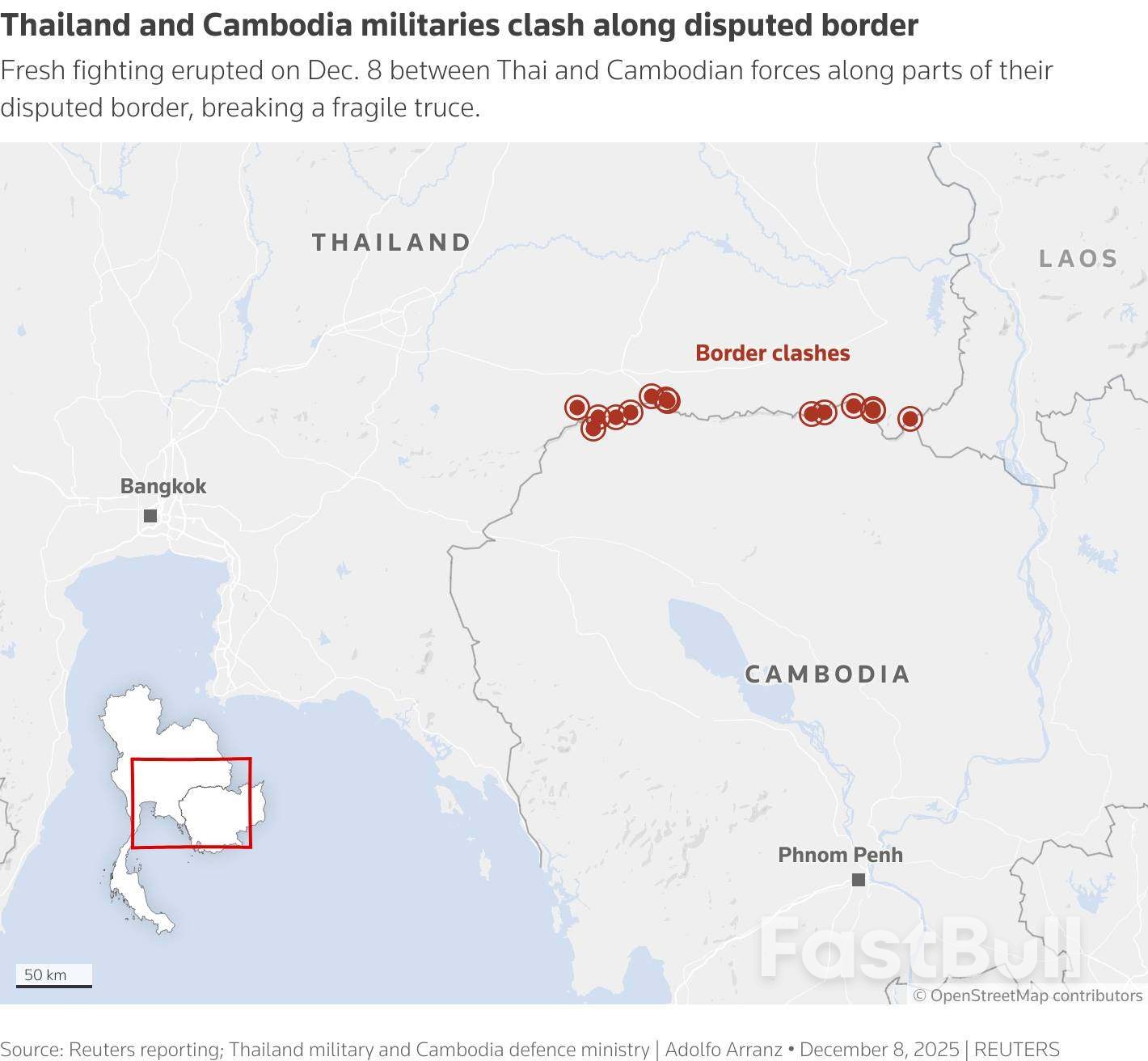
          This map shows locations of military clashes along the disputed border between Thailand and Cambodia.

          'EXPLOSIONS...BOOM BOOM'

          Cambodia's former longtime leader Hun Sen, the influential father of current premier Hun Manet, said Thailand's military was seeking to provoke a retaliatory response.

          "All frontline forces must remain patient because the aggressors have been firing all kinds of weapons," he said on Facebook.

          Thailand evacuated 438,000 civilians across five border provinces and authorities in Cambodia said hundreds of thousands of people had been moved to safety. Thailand's army said 18 soldiers were wounded and Cambodia's government reported nine civilians injured.

          In Cambodia, bottlenecks of trucks and cars formed on country roads and streams of motorcycles and farming vehicles were leaving border areas, local television showed. A verified eyewitness video showed a plume of smoke rising after a Thai airstrike.

          Thai television showed footage of people packed into evacuation camps and others sheltering in bunkers or large concrete water pipes, and the military released a video of what it said was exploding Cambodian artillery.

          Phichet Pholkoet, a resident of Thailand's Ban Kruat district bordering Cambodia, said he had heard gunfire since early morning.

          "It startled me. The explosions were very clear. Boom boom!" he said via telephone. "I could hear everything clearly. Some are heavy artillery, some are small arms."

          BITTER HISTORY

          The use of fighter jets demonstrates Thailand's military advantage over Cambodia, with an armed forces that dwarfs its neighbour in terms of personnel, budget and weaponry.

          Thailand and Cambodia have for more than a century contested sovereignty at undemarcated points along their 817-km (508-mile) land border, with disputes over ancient temples stirring nationalist fervour and occasional armed flare-ups, including a deadly week-long artillery exchange in 2011.

          Tensions rose in May following the killing of a Cambodian soldier during a skirmish, which led to a major troop buildup at the border and escalated into diplomatic breakdowns and armed clashes.

          Source: Reuters

          Risk Warnings and Disclaimers
          You understand and acknowledge that there is a high degree of risk involved in trading. Following any strategies or investment methods may lead to potential losses. The content on the site is provided by our contributors and analysts for information purposes only. You are solely responsible for determining whether any trading assets, securities, strategy, or any other product is suitable for investing based on your own investment objectives and financial situation.
          Add to Favorites
          Share
          FastBull
          Copyright © 2025 FastBull Ltd

          728 RM B 7/F GEE LOK IND BLDG NO 34 HUNG TO RD KWUN TONG KLN HONG KONG

          TelegramInstagramTwitterfacebooklinkedin
          App Store Google Play Google Play
          Products
          Charts

          Chats

          Q&A with Experts
          Screeners
          Economic Calendar
          Data
          Tools
          Membership
          Features
          Function
          Markets
          Copy Trading
          Latest Signals
          Contests
          News
          Analysis
          24/7
          Columns
          Education
          Company
          Careers
          About Us
          Contact Us
          Advertising
          Help Center
          Feedback
          User Agreement
          Privacy Policy
          Business

          White Label

          Data API

          Web Plug-ins

          Poster Maker

          Affiliate Program

          Risk Disclosure

          The risk of loss in trading financial instruments such as stocks, FX, commodities, futures, bonds, ETFs and crypto can be substantial. You may sustain a total loss of the funds that you deposit with your broker. Therefore, you should carefully consider whether such trading is suitable for you in light of your circumstances and financial resources.

          No decision to invest should be made without thoroughly conducting due diligence by yourself or consulting with your financial advisors. Our web content might not suit you since we don't know your financial conditions and investment needs. Our financial information might have latency or contain inaccuracy, so you should be fully responsible for any of your trading and investment decisions. The company will not be responsible for your capital loss.

          Without getting permission from the website, you are not allowed to copy the website's graphics, texts, or trademarks. Intellectual property rights in the content or data incorporated into this website belong to its providers and exchange merchants.

          Not Logged In

          Log in to access more features

          FastBull Membership

          Not yet

          Purchase

          Become a signal provider
          Help Center
          Customer Service
          Dark Mode
          Price Up/Down Colors

          Log In

          Sign Up

          Position
          Layout
          Fullscreen
          Default to Chart
          The chart page opens by default when you visit fastbull.com