

Markets
News
Analysis
User
24/7
Economic Calendar
Education
Data
- Names
- Latest
- Prev



Signal Accounts for Members
All Signal Accounts
All Contests
 U.K. Trade Balance Non-EU (SA) (Oct)
A:--
F: --
P: --
U.K. Trade Balance (Oct)A:--
F: --
P: --
U.K. Services Index MoMA:--
F: --
P: --
U.K. Construction Output MoM (SA) (Oct)A:--
F: --
P: --
U.K. Industrial Output YoY (Oct)A:--
F: --
P: --
U.K. Trade Balance (SA) (Oct)A:--
F: --
P: --
U.K. Trade Balance EU (SA) (Oct)A:--
F: --
P: --
U.K. Manufacturing Output YoY (Oct)A:--
F: --
P: --
U.K. GDP MoM (Oct)A:--
F: --
P: --
U.K. GDP YoY (SA) (Oct)A:--
F: --
P: --
U.K. Industrial Output MoM (Oct)A:--
F: --
P: --
U.K. Construction Output YoY (Oct)A:--
F: --
P: --
 France HICP Final MoM (Nov)
A:--
F: --
P: --
 China, Mainland Outstanding Loans Growth YoY (Nov)
A:--
F: --
P: --
China, Mainland M2 Money Supply YoY (Nov)A:--
F: --
P: --
China, Mainland M0 Money Supply YoY (Nov)A:--
F: --
P: --
China, Mainland M1 Money Supply YoY (Nov)A:--
F: --
P: --
 India CPI YoY (Nov)
A:--
F: --
P: --
India Deposit Gowth YoYA:--
F: --
P: --
 Brazil Services Growth YoY (Oct)
A:--
F: --
P: --
 Mexico Industrial Output YoY (Oct)
A:--
F: --
P: --
 Russia Trade Balance (Oct)
A:--
F: --
P: --
 Philadelphia Fed President Henry Paulson delivers a speech
 Canada Building Permits MoM (SA) (Oct)
A:--
F: --
P: --
Canada Wholesale Sales YoY (Oct)A:--
F: --
P: --
Canada Wholesale Inventory MoM (Oct)A:--
F: --
P: --
Canada Wholesale Inventory YoY (Oct)A:--
F: --
P: --
Canada Wholesale Sales MoM (SA) (Oct)A:--
F: --
P: --
 Germany Current Account (Not SA) (Oct)
A:--
F: --
P: --
U.S. Weekly Total Rig CountA:--
F: --
P: --
U.S. Weekly Total Oil Rig CountA:--
F: --
P: --
 Japan Tankan Large Non-Manufacturing Diffusion Index (Q4)
--
F: --
P: --
Japan Tankan Small Manufacturing Outlook Index (Q4)--
F: --
P: --
Japan Tankan Large Non-Manufacturing Outlook Index (Q4)--
F: --
P: --
Japan Tankan Large Manufacturing Outlook Index (Q4)--
F: --
P: --
Japan Tankan Small Manufacturing Diffusion Index (Q4)--
F: --
P: --
Japan Tankan Large Manufacturing Diffusion Index (Q4)--
F: --
P: --
Japan Tankan Large-Enterprise Capital Expenditure YoY (Q4)--
F: --
P: --
U.K. Rightmove House Price Index YoY (Dec)--
F: --
P: --
China, Mainland Industrial Output YoY (YTD) (Nov)--
F: --
P: --
China, Mainland Urban Area Unemployment Rate (Nov)--
F: --
P: --
 Saudi Arabia CPI YoY (Nov)
--
F: --
P: --
 Euro Zone Industrial Output YoY (Oct)
--
F: --
P: --
Euro Zone Industrial Output MoM (Oct)--
F: --
P: --
Canada Existing Home Sales MoM (Nov)--
F: --
P: --
Euro Zone Total Reserve Assets (Nov)--
F: --
P: --
U.K. Inflation Rate Expectations--
F: --
P: --
Canada National Economic Confidence Index--
F: --
P: --
Canada New Housing Starts (Nov)--
F: --
P: --
U.S. NY Fed Manufacturing Employment Index (Dec)--
F: --
P: --
U.S. NY Fed Manufacturing Index (Dec)--
F: --
P: --
Canada Core CPI YoY (Nov)--
F: --
P: --
Canada Manufacturing Unfilled Orders MoM (Oct)--
F: --
P: --
Canada Manufacturing New Orders MoM (Oct)--
F: --
P: --
Canada Core CPI MoM (Nov)--
F: --
P: --
Canada Manufacturing Inventory MoM (Oct)--
F: --
P: --
Canada CPI YoY (Nov)--
F: --
P: --
Canada CPI MoM (Nov)--
F: --
P: --
Canada CPI YoY (SA) (Nov)--
F: --
P: --
Canada Core CPI MoM (SA) (Nov)--
F: --
P: --


No matching data

Latest Views
Latest Views
Trending Topics
Top Columnists
Latest Update
White Label
Data API
Web Plug-ins
Affiliate Program
View All
No data
French retailer Carrefour has ceased all operations in Bahrain, following the closure of its stores in Oman in January and Jordan in November.
French retailer Carrefour has ceased all operations in Bahrain, following the closure of its stores in Oman in January and Jordan in November.Carrefour announced its closure in a brief post on Instagram on Sunday, saying operations ceased on September 14. No reason was provided.The closures come as Majid Al Futtaim, which operates Carrefour in the region, announced on Monday that it would launch its flagship grocery brand HyperMax at six locations across Bahrain.Dubai-based Majid Al Futtaim did not comment on Carrefour's decision but said its new HyperMax stores would help strengthen local supply chains.
Majid Al Futtaim is one of Dubai's biggest private sector companies and the Middle East's largest mall operator. It brought French-owned Carrefour to the region in 1995.
In May 2013, Majid Al Futtaim Holding bought a 25 per cent minority stake from Carrefour Group in its hypermarket business for €530 million. At the same time, the Dubai company extended its exclusive franchise partnership with Carrefour until 2025.Majid Al Futtaim Retail currently holds the exclusive rights to operate Carrefour across 12 markets in the Middle East, Africa, and Asia, with a network of more than 390 stores, according to its website.The company also operates Supeco, a low-cost hybrid grocery retail model that combines a traditional supermarket with a wholesale warehouse, across 17 locations in Egypt.
Majid Al Futtaim said HyperMax is partnering with more than 250 Bahraini farmers, producers and suppliers, and will operate with more than 1,600 employees.The retail sector across the Middle East and North Africa is expanding, especially in the Gulf, where sales are forecast to grow at a compound annual growth rate of 4.6 per cent to reach $386.9 billion in 2028, from $309.6 billion in 2023, Alpen Capital said in a report last year.The growth is expected to be supported by an increase in population, rise in per capita income and boost in tourism activities, Alpen added.
The Bank of Canada cut interest rates as the economy and labor market show damage from US tariffs, but kept tight-lipped on any future path for monetary easing.
Officials led by Governor Tiff Macklem cut the benchmark overnight rate by a quarter percentage point to 2.5% on Wednesday, the first reduction in borrowing costs since March and matching expectations of markets and the majority of economists in a Bloomberg survey.
“With a weaker economy and less upside risk to inflation, Governing Council judged that a reduction in the policy rate was appropriate to better balance the risks going forward,” Macklem said in prepared remarks. There was “clear consensus” for the cut, he said.
Officials pointed to mounting economic pressures, including a further softening of the country’s labor market. They also said Prime Minister Mark Carney’s removal of retaliatory tariffs on imports of some US goods had eliminated one potential source of inflation.
Still, the communications offered little in terms of forward guidance on rates, and the statement removed a reference for a possible need for further cuts that it had inserted at its July meeting.
Instead, officials said they would be “proceeding carefully,” adding that “the disruptive effects of shifts in trade will continue to add to costs even as they weigh on economic activity.”
Combined, the communications suggest that while the central bank has resumed monetary easing to add support to the ailing economy, they’re leery of cutting interest rates too quickly given the potential inflation risks posed by the surge in global protectionism and tariffs.
Officials noted the more than 106,000 jobs the economy shed in the months of July and August, saying they were “largely” concentrated in trade-sensitive sectors. They said they’re seeing evidence hiring has slowed in the rest of the economy too, and flagged the unemployment rate has risen to 7.1%.
Canada’s economy declined at a 1.6% annualized pace in the second quarter, which was roughly in line with the bank’s expectations. The contraction was driven by a drop in export activity and business investment, and the bank said US levies and trade uncertainty were “weighing heavily on economic activity.”
While the bank said consumption and housing grew “at a healthy pace,” it cautioned slow population growth and labor market weakness would likely weigh on household spending.
“Tariffs are having a profound effect on several key sectors, including the auto, steel and aluminum sector,” Macklem said in his statement.
Policymakers downplayed still-elevated core inflation pressures, saying the upward momentum in the bank’s preferred trim and median measures had “dissipated.” Those gauges are running near a 3% yearly clip, but the bank says it sees broader underlying pressures closer to 2.5%. Wage pressures have continued to ease, the bank said.
“Recent data suggest the upward pressures on underlying inflation have diminished,” Macklem said.
The central bank reiterated that it was focused on how exports evolve amid the US tariff threat, and how damage may spread into investment, employment and household spending.
Still, Macklem said the bank sees some stability in US tariffs in recent weeks, adding that “near-term uncertainty may have come down a bit,” though the upcoming renegotiation of the trade agreement between US, Canada and Mexico is becoming a focus.
Officials say they’re also watching how tariff disruptions and shifting supply chains will trickle through to consumers and their expectations of inflation.
In their communications, policymakers made no mention of the funding pressures in money markets, where the Canadian Overnight Repo Rate Average, or Corra, has settled about 5 basis points above the Bank of Canada’s overnight rate for most of September. Officials set the deposit rate at 2.45%, still 5 basis points below the policy rate.
Macklem and Senior Deputy Governor Carolyn Rogers will speak to reporters at 10:30 a.m Ottawa time.
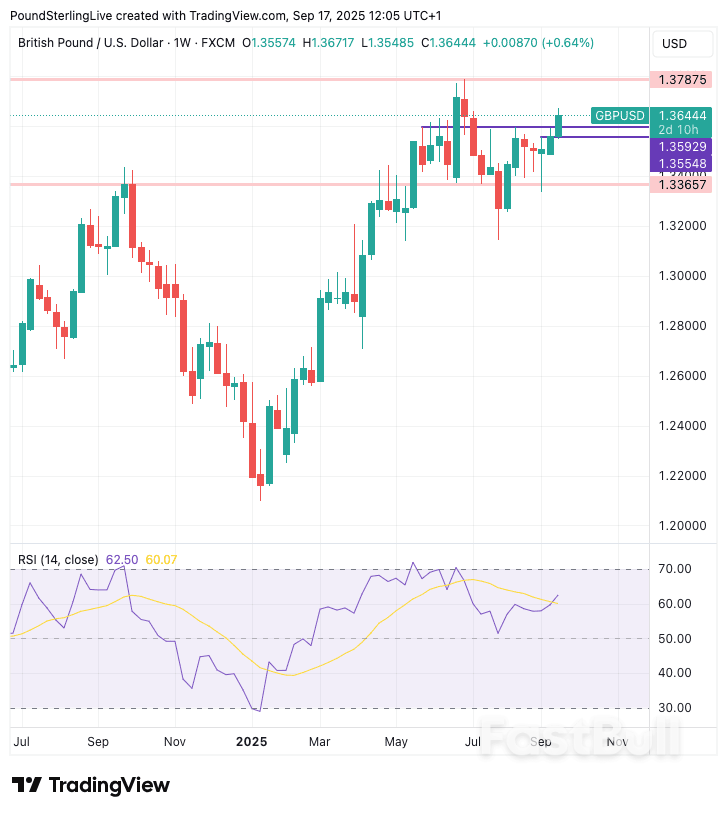
The U.S. dollar firmed against the euro but weakened versus the yen on Wednesday as investors waited to see whether Federal Reserve Chair Jerome Powell would confirm market expectations for a dovish policy path at a press conference later in the day.
The dollar fell to a four-year low against the common currency on Tuesday, as investors turned their attention to the Federal Reserve’s policy meeting, where a 25-basis-point rate cut is widely expected.Markets are pricing in 68 basis points of Fed easing moves by year-end and a total of 147 bps by the end of 2026.
The spotlight will also be on whether policymakers considered a bigger 50 bps cut at a time when President Donald Trump pushes ahead with efforts to overhaul a pillar of the U.S. economy, stoking concerns about the central bank's independence.
The euro eased by 0.29% to $1.1834, after hitting a four-year high of $1.18785 on Tuesday.
Sterling eased by 0.05% to $1.3640, still not far from 2-1/2-month highs after British inflation data matched expectations.
Fed Chair Powell "will offer balance. He'll highlight again the downside risk to employment growth, but refrain from signalling a long string of cuts after September," said Thierry Wizman, global forex and rates strategist at Macquarie Group."That could rally the dollar, hurt gold, and cause a tremor tomorrow in the tectonic drift higher in tech stocks," he added.
The dollar index , which measures the U.S. currency against six others, was up 0.18% at 96.81 after hitting 96.554 on Tuesday, its lowest since early July.
The index is down nearly 11% this year, with investors bracing for further losses after a recent pause.
"If the Fed were to sound a little more hawkish this week, that could lift the dollar. But I'd argue the effect would be temporary, as doubts would linger over whether the Fed may need to accelerate its rate-cutting cycle," said Paul Mackel, global head of forex research at HSBC.
"That's because some U.S. employment indicators have clearly been cooling," he added.
The Fed began a two-day meeting on Tuesday with a new governor on leave from the Trump administration, Stephen Miran, joining the deliberations, and a second policymaker at the table still facing efforts by Trump to oust her.
A federal appeals court on Monday blocked Fed Governor Lisa Cook's firing, paving the way for Cook, an appointee of former President Joe Biden, to participate fully in the policy meeting this week.
"How dovish Stephen Miran’s dot will be is likely to draw close attention from markets," HSBC's Mackel said.
The U.S. Senate recently confirmed Miran to the Fed's Board of Governors, expanding Trump's influence over the world's most important central bank.
The Japanese yen firmed to 146.205 per dollar, its strongest in eight weeks ahead of the Bank of Japan policy meeting, where the central bank on Friday is expected to stand pat on rates. The yen was last up 0.14% at 146.28.
The spotlight is on an October 4 vote where the ruling Liberal Democratic Party will elect a new leader to replace outgoing Prime Minister Shigeru Ishiba.
"This (a strong yen versus dollar) may be because the more moderate Shinjiro Koizumi is entering the LDP leadership race against Sanae Takaichi, who is seen as yen bearish for her views on loose monetary and fiscal policy," said Chris Turner, head of forex strategy at ING.
The Swiss franc eased 0.14% to 0.7870 against the U.S. dollar, near the decade high it touched in the previous session at 0.7857.
After rallying for three days, ICE Brent and NYMEX WTI were seen trading lower in the early trading session today, even as the American Petroleum Institute (API) reported large crude oil inventory withdrawals in the US. Latest data shows that those inventories decreased by 3.4m barrels over the last week, in contrast to the average market expectations of a build of 1.07m barrels. Changes in refined products were mixed, with gasoline inventories falling by 700k barrels, while distillate stocks increased by 1.9m barrels. The rise in distillate stocks provided mixed signals over energy consumption in the country. The more widely followed EIA weekly inventory report will be released later today.
Meanwhile, recent claims by Ukraine that it attacked the Saratov refinery in its latest strike on Russian energy facilities might help create a floor for oil prices at lower levels. The Saratov refinery (located in the Volga region) has a design processing capacity of about 140k barrels of crude a day. It is also one of the major suppliers of gasoline and diesel to the European part of Russia.
LME aluminium prices extended the upward rally for an eighth consecutive session, with prices closing well above US$2,700/t (the highest level since 20 February 2025) yesterday, driven by expectations of a US Federal Reserve rate cut this week and a weaker dollar index (the lowest level since 2022). The aluminium tom-next spread traded at a premium of US$13.25/t (the highest since August 2024) yesterday, after remaining in contango for several weeks, indicating rising physical demand and tightening LME inventories.
Recent LME data shows that aluminium exchange stocks fell by 1,500 tonnes to 483,375 tonnes, while on-warrant inventories continued to hover at lower levels and stood at 375,025 tonnes (the lowest since 7 July 2025) as of yesterday. Turning to the speculative bets, the latest COTR report shows that net bullish bets in aluminium rose by 4,562 lots for a fourth straight week to 131,922 lots for the week ending 12 September, the most bullish bets since the week ending on 7 June 2024.In other metals, money managers increased their net long position in copper by 2,597 lots for a third consecutive week to 56,390 lots at the end of last week. In contrast, speculators decreased their net long position in zinc by 1,654 lots to 33,066 lots as of last Friday.
The latest data from France’s Agriculture Ministry shows that soft-wheat production in the country could rise to 33.3mt for the 2025/26 harvest season, up 30% YoY and 4.7% above the five-year average. The increase is driven by expectations for a stronger harvest area. In contrast, corn production projections stood at 13.4mt for the period mentioned above, down from its previous estimate of 13.7mt, largely due to heat waves and drought conditions during the summer weighing on yields (-8% YoY). Meanwhile, durum wheat production forecast stood at 1.3mt, in line with earlier estimates.
With the creation of “special funds” and shadow budgets, the German government is evading fiscal transparency and undermining parliamentary control – a practice now sharply criticized by both the Bundesbank and the Federal Audit Office.France, meanwhile, offers a warning of where this path leads. Political chaos in Paris culminated in fiscal humiliation last week when Fitch Ratings downgraded French sovereign debt from AA– to A+. France has maneuvered itself into a debt spiral, fueled by unchecked government spending and a misguided attempt to paper over social fractures with cheap credit.
Germany, instead of avoiding France’s mistakes, appears determined to follow them. The fiscal discipline that characterized the postwar era is long gone. Across party lines, there is consensus in Berlin: with creative accounting tricks in the form of “special funds,” the debt brake can simply be ignored. The pinnacle of this new strategy is Chancellor Friedrich Merz’s trillion-euro debt package, which includes a €500 billion special fund.The official justification is noble: defense spending must not be constrained by the bond market, and Germany’s crumbling infrastructure must be modernized. Packaged nicely in the media, the German public is expected to accept this new mountain of debt. After all, it is supposedly “for the greater good.”
But the German Taxpayers’ Association has labeled these special funds exactly what they are: a colossal debt-shuffling scheme. In practice, spending that should be tax-financed is quietly offloaded into shadow budgets that rely on new borrowing.
The bond market itself has become little more than a derivative of monetary policy. Berlin, like its European neighbors, is clearly relying on the European Central Bank to keep the debt pile liquid and to step in whenever investors retreat.Together with Brussels’ interventionism, this has created a political framework that openly encourages state overreach. Parliamentary oversight has all but disappeared. More than half of Germany’s GDP already passes through state hands – a level of intervention unthinkable a generation ago.
Berlin’s strategic consensus is striking: the very state that manufactured the crisis – through suffocating regulation, a self-inflicted energy disaster, bloated public finances, and crushing taxation – now claims it will solve the crisis by doubling down on intervention. The logic is that of a kleptocratic alcoholic in a bar: he runs a tab, borrows from his neighbors, and when generosity runs out, steals directly from the counter. Ultimately, it is this debt binge, this addiction to central planning, that will bring Germany down as both a political and economic model.
There is little meaningful opposition. Whether in parliament or in the intellectual sphere, critics lack the resonance to form a powerful public phalanx against this destructive policy path.
Now, however, criticism has emerged from an unexpected source: the German Bundesbank. Rarely intervening in day-to-day politics, the central bank used its August monthly report to criticize the use of special funds. It warned bluntly that billions earmarked for local governments would likely be diverted to fill existing budget gaps rather than finance infrastructure and climate projects, as promised.The Bundesbank also pointed to the absence of effective structures for efficiency control. By outsourcing vast parts of the federal budget into special funds, Berlin is obscuring the country’s true fiscal position and undermining budget discipline.
Criticism of runaway statism is nothing new. What is striking, however, is that core state institutions such as the Bundesbank are now joining the chorus. The Bundesbank projects Germany’s deficit will climb to 4% of GDP over the next two years – and that is under the optimistic assumption that the economy does not deteriorate further.Its report leaves little doubt: the €100 billion in funds allocated to states and municipalities will likely be misused, rather than going into the infrastructure investments so loudly promised to the public.
Meanwhile, ordinary citizens – at least those still in the productive economy – waste their days in crumbling public transport, endless traffic jams on decaying highways, or waiting at the foot of collapsing bridges.Germany, according to the Bundesbank, is operating in “firefighting mode” – patching up budgetary gaps and social spending programs instead of addressing structural problems. Much of the new spending, it warns, risks being consumed by short-term consumption rather than long-term investment.
The central bank has therefore proposed reforms to strictly limit borrowing capacity and to enforce transparency. At best, it sees special funds with their own borrowing authority as a temporary solution – one that would still require strict parliamentary oversight.
The Bundesbank’s stance is reinforced by the Federal Audit Office, which for months has been calling for tighter, more targeted use of new credit funds. It has demanded that Berlin reserve the right to claw back funds that are misused – a measure based on bitter experience. Past budgets, from integration funds to inflated COVID-19 aid packages, were set high precisely so that excess money could later be diverted to plug welfare deficits.The trick is simple: new debt is hidden from the public, while the true costs are shifted into the future. A short-term stimulus effect may provide the ruling coalition with breathing space against rising opposition – but at the price of structural decline.
That Berlin is using shadow budgets to buy time is hardly surprising. There is bipartisan conviction in the capital that creative accounting and oversized state demand can somehow solve both the fiscal crisis and the economic malaise.But this is pure Keynesian delusion. The state as Leviathan, pretending to be omnipotent – and yet repeatedly colliding with reality. When central planning fails, the blame is always shifted onto the bond market, which stubbornly refuses to accept the illusion that debt-financed interventions can solve everything.
Regardless of how it is structured, the “special fund” is nothing but a monument to political failure. Responsibility lies squarely with Chancellor Friedrich Merz, who endorsed the scheme both for coalition reasons and out of personal conviction.The principle remains clear: every euro siphoned from private capital markets and funneled into the redistribution machine of the state is a lost euro. And every debt-financed state policy leaves behind nothing but new liabilities – to be paid later through taxes or inflation.
There is no free lunch. Only bad policy.
728 RM B 7/F GEE LOK IND BLDG NO 34 HUNG TO RD KWUN TONG KLN HONG KONG


White Label
Data API
Web Plug-ins
Poster Maker
Affiliate Program
The risk of loss in trading financial instruments such as stocks, FX, commodities, futures, bonds, ETFs and crypto can be substantial. You may sustain a total loss of the funds that you deposit with your broker. Therefore, you should carefully consider whether such trading is suitable for you in light of your circumstances and financial resources.
No decision to invest should be made without thoroughly conducting due diligence by yourself or consulting with your financial advisors. Our web content might not suit you since we don't know your financial conditions and investment needs. Our financial information might have latency or contain inaccuracy, so you should be fully responsible for any of your trading and investment decisions. The company will not be responsible for your capital loss.
Without getting permission from the website, you are not allowed to copy the website's graphics, texts, or trademarks. Intellectual property rights in the content or data incorporated into this website belong to its providers and exchange merchants.
Not Logged In
Log in to access more features

FastBull Membership
Not yet
Purchase


Log In
Sign Up


