• Trade
  • Markets
  • Copy
  • Contests
  • News
  • 24/7
  • Calendar
  • Q&A
  • Chats
Trending
Screeners
SYMBOL
LAST
BID
ASK
HIGH
LOW
NET CHG.
%CHG.
SPREAD
SPX
S&P 500 Index
6857.13
6857.13
6857.13
6865.94
6827.13
+7.41
+ 0.11%
--
DJI
Dow Jones Industrial Average
47850.93
47850.93
47850.93
48049.72
47692.96
-31.96
-0.07%
--
IXIC
NASDAQ Composite Index
23505.13
23505.13
23505.13
23528.53
23372.33
+51.04
+ 0.22%
--
USDX
US Dollar Index
98.840
98.920
98.840
98.980
98.740
-0.140
-0.14%
--
EURUSD
Euro / US Dollar
1.16584
1.16593
1.16584
1.16715
1.16408
+0.00139
+ 0.12%
--
GBPUSD
Pound Sterling / US Dollar
1.33555
1.33563
1.33555
1.33622
1.33165
+0.00284
+ 0.21%
--
XAUUSD
Gold / US Dollar
4223.66
4224.09
4223.66
4230.62
4194.54
+16.49
+ 0.39%
--
WTI
Light Sweet Crude Oil
59.305
59.335
59.305
59.469
59.187
-0.078
-0.13%
--

Community Accounts

Signal Accounts
--
Profit Accounts
--
Loss Accounts
--
View More

Become a signal provider

Sell trading signals to earn additional income

View More

Guide to Copy Trading

Get started with ease and confidence

View More

Signal Accounts for Members

All Signal Accounts

Best Return
  • Best Return
  • Best P/L
  • Best MDD
Past 1W
  • Past 1W
  • Past 1M
  • Past 1Y

All Contests

  • All
  • Trump Updates
  • Recommend
  • Stocks
  • Cryptocurrencies
  • Central Banks
  • Featured News
Top News Only
Share

Norway To Acquire 2 More Submarines, Long-Range Missiles, Daily Vg Reports

Share

Ucb Sa Shares Open Up 7.3% After 2025 Guidance Upgrade, Top Of Bel 20 Index

Share

Shares In Italy's Mediobanca Down 1.3% After Barclays Cuts To Underweight From Equal-Weight

Share

Stats Office - Austrian November Wholesale Prices +0.9% Year-On-Year

Share

Britain's FTSE 100 Up 0.15%

Share

Europe's STOXX 600 Up 0.1%

Share

Taiwan November PPI -2.8% Year-On-Year

Share

Stats Office - Austrian September Trade -230.8 Million EUR

Share

Swiss National Bank Forex Reserves Revised To Chf 724906 Million At End Of October - SNB

Share

Swiss National Bank Forex Reserves At Chf 727386 Million At End Of November - SNB

Share

Shanghai Warehouse Rubber Stocks Up 8.54% From Week Earlier

Share

Turkey's Main Banking Index Up 2%

Share

French October Trade Balance -3.92 Billion Euros Versus Revised -6.35 Billion Euros In September

Share

Kremlin Aide Says Russia Is Ready To Work Further With Current USA Team

Share

Kremlin Aide Says Russia And USA Are Moving Forward In Ukraine Talks

Share

Shanghai Rubber Warehouse Stocks Up 7336 Tons

Share

Shanghai Tin Warehouse Stocks Up 506 Tons

Share

Reserve Bank Of India Chief Malhotra: Goal Is To Have Inflation Be Around 4%

Share

Ukmto Says Master Has Confirmed That The Small Crafts Have Left The Scene, Vessel Is Proceeding To Its Next Port Of Call

Share

Shanghai Nickel Warehouse Stocks Up 1726 Tons

TIME
ACT
FCST
PREV
France 10-Year OAT Auction Avg. Yield

A:--

F: --

P: --

Euro Zone Retail Sales MoM (Oct)

A:--

F: --

P: --

Euro Zone Retail Sales YoY (Oct)

A:--

F: --

P: --

Brazil GDP YoY (Q3)

A:--

F: --

P: --

U.S. Challenger Job Cuts (Nov)

A:--

F: --

P: --

U.S. Challenger Job Cuts MoM (Nov)

A:--

F: --

P: --

U.S. Challenger Job Cuts YoY (Nov)

A:--

F: --

P: --

U.S. Initial Jobless Claims 4-Week Avg. (SA)

A:--

F: --

P: --

U.S. Weekly Initial Jobless Claims (SA)

A:--

F: --

P: --

U.S. Weekly Continued Jobless Claims (SA)

A:--

F: --

P: --

Canada Ivey PMI (SA) (Nov)

A:--

F: --

P: --

Canada Ivey PMI (Not SA) (Nov)

A:--

F: --

P: --

U.S. Non-Defense Capital Durable Goods Orders Revised MoM (Excl. Aircraft) (SA) (Sept)

A:--

F: --

P: --
U.S. Factory Orders MoM (Excl. Transport) (Sept)

A:--

F: --

P: --

U.S. Factory Orders MoM (Sept)

A:--

F: --

P: --

U.S. Factory Orders MoM (Excl. Defense) (Sept)

A:--

F: --

P: --

U.S. EIA Weekly Natural Gas Stocks Change

A:--

F: --

P: --

Saudi Arabia Crude Oil Production

A:--

F: --

P: --

U.S. Weekly Treasuries Held by Foreign Central Banks

A:--

F: --

P: --

Japan Foreign Exchange Reserves (Nov)

A:--

F: --

P: --

India Repo Rate

A:--

F: --

P: --

India Benchmark Interest Rate

A:--

F: --

P: --

India Reverse Repo Rate

A:--

F: --

P: --

India Cash Reserve Ratio

A:--

F: --

P: --

Japan Leading Indicators Prelim (Oct)

A:--

F: --

P: --

U.K. Halifax House Price Index YoY (SA) (Nov)

A:--

F: --

P: --

U.K. Halifax House Price Index MoM (SA) (Nov)

A:--

F: --

P: --

France Current Account (Not SA) (Oct)

A:--

F: --

P: --

France Trade Balance (SA) (Oct)

A:--

F: --

P: --

France Industrial Output MoM (SA) (Oct)

A:--

F: --

P: --

Italy Retail Sales MoM (SA) (Oct)

--

F: --

P: --

Euro Zone Employment YoY (SA) (Q3)

--

F: --

P: --

Euro Zone GDP Final YoY (Q3)

--

F: --

P: --

Euro Zone GDP Final QoQ (Q3)

--

F: --

P: --

Euro Zone Employment Final QoQ (SA) (Q3)

--

F: --

P: --

Euro Zone Employment Final (SA) (Q3)

--

F: --

P: --
Brazil PPI MoM (Oct)

--

F: --

P: --

Mexico Consumer Confidence Index (Nov)

--

F: --

P: --

Canada Unemployment Rate (SA) (Nov)

--

F: --

P: --

Canada Labor Force Participation Rate (SA) (Nov)

--

F: --

P: --

Canada Employment (SA) (Nov)

--

F: --

P: --

Canada Part-Time Employment (SA) (Nov)

--

F: --

P: --

Canada Full-time Employment (SA) (Nov)

--

F: --

P: --

U.S. Personal Income MoM (Sept)

--

F: --

P: --

U.S. Dallas Fed PCE Price Index YoY (Sept)

--

F: --

P: --

U.S. PCE Price Index YoY (SA) (Sept)

--

F: --

P: --

U.S. PCE Price Index MoM (Sept)

--

F: --

P: --

U.S. Personal Outlays MoM (SA) (Sept)

--

F: --

P: --

U.S. Core PCE Price Index MoM (Sept)

--

F: --

P: --

U.S. UMich 5-Year-Ahead Inflation Expectations Prelim YoY (Dec)

--

F: --

P: --

U.S. Core PCE Price Index YoY (Sept)

--

F: --

P: --

U.S. Real Personal Consumption Expenditures MoM (Sept)

--

F: --

P: --

U.S. 5-10 Year-Ahead Inflation Expectations (Dec)

--

F: --

P: --

U.S. UMich Current Economic Conditions Index Prelim (Dec)

--

F: --

P: --

U.S. UMich Consumer Sentiment Index Prelim (Dec)

--

F: --

P: --

U.S. UMich 1-Year-Ahead Inflation Expectations Prelim (Dec)

--

F: --

P: --

U.S. UMich Consumer Expectations Index Prelim (Dec)

--

F: --

P: --

U.S. Weekly Total Rig Count

--

F: --

P: --

U.S. Weekly Total Oil Rig Count

--

F: --

P: --

U.S. Consumer Credit (SA) (Oct)

--

F: --

P: --

Q&A with Experts
    • All
    • Chatrooms
    • Groups
    • Friends
    Connecting
    .
    .
    .
    Type here...
    Add Symbol or Code

      No matching data

      All
      Trump Updates
      Recommend
      Stocks
      Cryptocurrencies
      Central Banks
      Featured News
      • All
      • Russia-Ukraine Conflict
      • Middle East Flashpoint
      • All
      • Russia-Ukraine Conflict
      • Middle East Flashpoint
      Search
      Products

      Charts Free Forever

      Chats Q&A with Experts
      Screeners Economic Calendar Data Tools
      Membership Features
      Data Warehouse Market Trends Institutional Data Policy Rates Macro

      Market Trends

      Market Sentiment Order Book Forex Correlations

      Top Indicators

      Charts Free Forever
      Markets

      News

      News Analysis 24/7 Columns Education
      From Institutions From Analysts
      Topics Columnists

      Latest Views

      Latest Views

      Trending Topics

      Top Columnists

      Latest Update

      Signals

      Copy Rankings Latest Signals Become a signal provider AI Rating
      Contests
      Brokers

      Overview Brokers Assessment Rankings Regulators News Claims
      Broker listing Forex Brokers Comparison Tool Live Spread Comparison Scam
      Q&A Complaint Scam Alert Videos Tips to Detect Scam
      More

      Business
      Events
      Careers About Us Advertising Help Center

      White Label

      Data API

      Web Plug-ins

      Affiliate Program

      Awards Institution Evaluation IB Seminar Salon Event Exhibition
      Vietnam Thailand Singapore Dubai
      Fans Party Investment Sharing Session
      FastBull Summit BrokersView Expo
      Recent Searches
        Top Searches
          Markets
          News
          Analysis
          User
          24/7
          Economic Calendar
          Education
          Data
          • Names
          • Latest
          • Prev

          View All

          No data

          Scan to Download

          Faster Charts, Chat Faster!

          Download App
          English
          • English
          • Español
          • العربية
          • Bahasa Indonesia
          • Bahasa Melayu
          • Tiếng Việt
          • ภาษาไทย
          • Français
          • Italiano
          • Türkçe
          • Русский язык
          • 简中
          • 繁中
          Open Account
          Search
          Products
          Charts Free Forever
          Markets
          News
          Signals

          Copy Rankings Latest Signals Become a signal provider AI Rating
          Contests
          Brokers

          Overview Brokers Assessment Rankings Regulators News Claims
          Broker listing Forex Brokers Comparison Tool Live Spread Comparison Scam
          Q&A Complaint Scam Alert Videos Tips to Detect Scam
          More

          Business
          Events
          Careers About Us Advertising Help Center

          White Label

          Data API

          Web Plug-ins

          Affiliate Program

          Awards Institution Evaluation IB Seminar Salon Event Exhibition
          Vietnam Thailand Singapore Dubai
          Fans Party Investment Sharing Session
          FastBull Summit BrokersView Expo

          Canada Seeks to Ease China, India Tensions As Trump Digs in

          Julia Daniels

          Forex

          Economic

          Summary:

          Canada is pushing to strengthen ties with China and India, even as it remains in precarious trade talks with a US administration that has escalated its tariff war with Beijing.

          Canada is pushing to strengthen ties with China and India, even as it remains in precarious trade talks with a US administration that has escalated its tariff war with Beijing.
          Foreign Minister Anita Anand is travelling to New Delhi, Mumbai, Singapore and Hangzhou, China this week to meet with her counterparts and lay the groundwork for boosting trade and investment.
          Her task is hard and extremely delicate: Canada’s disputes with Asia’s two most populous countries are serious, and any steps to ease tensions with China will need to be taken carefully to avoid triggering a reprisal from US President Donald Trump.
          But Anand argues Canada is taking the same approach with every country — putting the interests of its workers and businesses first. It’s a clear shift under Prime Minister Mark Carney, who has prioritised the economy above all else, scrapping many of the tenets of Justin Trudeau’s foreign policy.
          “It goes back to being a sovereign country,” Anand said in an interview with Bloomberg News, when asked how Canada can balance its relationships with China and the US.
          Trump threatened an additional 100% tariff on Chinese products on Friday, causing equities markets to dive, though on Sunday the president signalled openness to a truce.
          “Having a stable relationship with a major global economic player is of exceeding importance in this geopolitical environment,” Anand added. “Canada is going to approach the relationship with China guided by one principle — acting in the best interest of Canadians.”
          Under Trudeau, Canada joined the Biden administration in erecting a tariff wall against Chinese electric vehicles, steel and aluminium, and Carney has maintained that policy.
          Carney’s negotiators are trying to strike a deal with the US that would offer some relief from Trump’s steel and aluminium tariffs, and a major part of their pitch is that a fortified North American supply chain in those industries is essential to countering China.
          China has hit Canada with hefty tariffs against canola, pork and seafood. But it extended a deadline for its latest probe into Canadian canola, also known as rapeseed, allowing more time for negotiations. Carney has faced calls from western Canada to drop the EV levies if it will mean tariff-free food exports.
          Canadian steel, aluminium and auto producers support their country’s tariffs on Chinese products. But the public’s view of the EV tariffs is shifting — just 44% of Canadians favour them, down from 63% last year, according to a poll by Nanos Research Group for Bloomberg News.
          Carney has said there’s potential for cooperation with China on energy, and he’s bullish on shipping more liquefied natural gas to Asia. The prime minister expects to eventually meet with President Xi Jinping, and the upcoming Asia-Pacific Economic Cooperation summit in South Korea will offer an opportunity.
          Anand also stressed that, despite their issues, Canada and China can collaborate on climate change and other areas of trade. “We have many Canadian businesses actively engaged in that market,” she said.
          As for India, talks on a limited trade agreement broke off in 2023 just before Trudeau made the explosive allegation that the Indian government orchestrated the murder of a Sikh separatist on Canadian soil. Prime Minister Narendra Modi denied the claim, but court cases in Canada and the US are proceeding, and some activists say they’re still in danger.
          Under Carney, Canada has moved to normalise diplomatic relations with India, with each country appointing new ambassadors and establishing a structure to share intelligence on cross-border crimes. Anand said she raised the issue of transnational repression with Indian External Affairs Minister Subrahmanyam Jaishankar in a meeting last month and will do so again.
          But even before the relationship imploded, Canada and India’s progress toward a trade deal was sluggish. Asked when those discussions might resume, Anand pointed out how much progress had already been made.
          “We were in a situation in 2023 where the high commissioners had been recalled and the diplomatic relationship was at a virtual standstill. Here we are in October of 2025, two years later, and we have high commissioners in place and I’m travelling to meet with Minister Jaishankar,” she said.
          “So we are taking a step-by-step approach on the diplomatic relationship and ensuring that we have a work plan to give to our respective leaders that they can agree on,” she said. “The discussions about trade will come after” that agreement has been reached.

          Source: Theedgemarkets

          To stay updated on all economic events of today, please check out our Economic calendar
          Risk Warnings and Disclaimers
          You understand and acknowledge that there is a high degree of risk involved in trading. Following any strategies or investment methods may lead to potential losses. The content on the site is provided by our contributors and analysts for information purposes only. You are solely responsible for determining whether any trading assets, securities, strategy, or any other product is suitable for investing based on your own investment objectives and financial situation.
          Add to Favorites
          Share

          Korea Says US Offered Alternative in US$350b Deal Talks

          Glendon

          Forex

          Economic

          South Korea is reviewing a new proposal from Washington linked to its US$350 billion (RM1.48 trillion) investment pledge in the US, whose implementation has become a key obstacle to finalising a trade deal reached in July.
          “The US brought a new alternative, and we’re now reviewing it,” Foreign Minister Cho Hyun told lawmakers at a parliamentary audit on Monday, signalling progress after months of stalled talks over tariffs.
          Cho said Seoul aims to make progress by the Asia-Pacific Economic Cooperation summit in late October, where President Lee Jae Myung is expected to hold talks with President Donald Trump.
          Talks to formalise the trade deal reached in July have remained deadlocked, with disputes centring on South Korea’s US$350 billion investment commitment. Seoul has requested the US for a currency swap, warning that without it, the plan could hurt financial stability because the proposed investment amounts to over 80% of the country’s foreign reserves.
          The original package included a mix of direct investment, loans, and loan guarantees, but Washington later demanded that the full amount be made through direct investment, Cho said. He didn’t elaborate on the details of the US’s revised proposal.
          “We’ve explained to the US that if the entire investment were made directly, it would immediately cause foreign exchange pressures and could have a serious impact on our economy,” Cho said, reiterating South Korea’s reservations about the US demand.
          The signs of flexibility come as the Trump administration has indicated openness to a possible deal with China to ease fresh trade tensions, while also criticising Beijing’s new export controls as a major hurdle.
          The investment package forms the core of a broader trade agreement between Seoul and Washington, under which the US agreed to impose a 15% tariff on South Korean imports — lower than the 25% rate threatened earlier this year — as part of sweeping trade measures that included tariffs on Korean autos.
          “We’ll do our utmost to reach a mutually beneficial deal — not one that favours only the US but one that creates win-win cooperation in areas such as shipbuilding,” Cho said. “That’s why we’re maintaining our position even if it delays the negotiations.”

          Source: Theedgemarkets

          To stay updated on all economic events of today, please check out our Economic calendar
          Risk Warnings and Disclaimers
          You understand and acknowledge that there is a high degree of risk involved in trading. Following any strategies or investment methods may lead to potential losses. The content on the site is provided by our contributors and analysts for information purposes only. You are solely responsible for determining whether any trading assets, securities, strategy, or any other product is suitable for investing based on your own investment objectives and financial situation.
          Add to Favorites
          Share

          $171M in Crypto Shorts Liquidated

          Justin

          Cryptocurrency

          $171M in shorts were liquidated in the past hour, causing significant market turbulence. Large liquidations often trigger rapid price movements in major assets like BTC and ETH, affecting derivatives and potentially leading to cascading effects in the market.

          Over $171 million in cryptocurrency shorts were liquidated today, impacting major trading platforms and affecting asset prices globally, according to secondary news reports.

          Market Impact

          Crypto markets witnessed a dramatic liquidation of $171 million in shorts, according to secondary sources. This event reflects the volatility within the trading space, leading to significant asset price movements. Short liquidations often result in sharp price adjustments. Key players such as cryptocurrency exchanges and investors have reportedly been impacted, though official confirmations from major exchanges remain unavailable. Such events usually involve derivatives markets, with BTC and ETH being the most prominently affected cryptocurrencies.

          Aftermath and Implications

          The immediate aftermath includes price fluctuations in the market, predominantly affecting BTC and ETH. Major exchanges may witness increased trading activity and volatility, impacting traders' strategies and risk assessments. This liquidation could prompt discussions among regulators regarding future market safeguarding measures. Furthermore, this event highlights the inherent risks in trading leveraged positions within the crypto space. Potential outcomes include intensified regulatory scrutiny and technological innovations to manage risk better. Historical events show such liquidations can precede market corrections or temporary destabilizations. To understand the broader context of such events, the CoinGecko Q2 2025 Crypto Industry Report provides insights into market trends.

          Source: CryptoSlate

          Risk Warnings and Disclaimers
          You understand and acknowledge that there is a high degree of risk involved in trading. Following any strategies or investment methods may lead to potential losses. The content on the site is provided by our contributors and analysts for information purposes only. You are solely responsible for determining whether any trading assets, securities, strategy, or any other product is suitable for investing based on your own investment objectives and financial situation.
          Add to Favorites
          Share

          Crypto Markets Rebound as Trump’s Softer Rhetoric Eases Trade Shock After Historic Selloff

          Gerik

          Economic

          Cryptocurrency

          Digital Assets Recover After Historic Weekend Wipeout

          Global cryptocurrency markets staged a strong rebound following a catastrophic weekend selloff that had erased nearly $19 billion in leveraged positions. According to CoinGecko data, the total crypto market capitalization rose more than 6% to surpass $4 trillion on Monday. Bitcoin climbed back above $115,000 after dropping below $105,000 on Friday, while Ether recovered to around $4,100 from weekend lows under $3,500.
          The recovery was directly tied to President Donald Trump’s and Vice President JD Vance’s weekend remarks suggesting a willingness to negotiate with China, which temporarily soothed investor anxiety. Their comments came after Trump’s surprise announcement of sweeping new tariffs on Chinese imports a move that had sparked panic selling across digital asset markets and intensified automated liquidations due to high leverage and low weekend liquidity.

          Short-Term Relief, Long-Term Fragility

          The rebound illustrates a clear causal link between political rhetoric and crypto price dynamics. Trump’s softer tone restored short-term confidence, but traders remain wary of headline-driven volatility. Richard Galvin, co-founder of hedge fund DACM, emphasized that most smaller tokens or “altcoins” remain well below their early October levels, adding that “headline risk remains high and the market is exposed to any further escalation.”
          This sensitivity underscores the correlation between macro policy shocks and the speculative structure of digital asset markets, which remain highly leveraged and sentiment-dependent.

          Mass Liquidations and Systemic Stress

          The weekend crash marked one of the most severe leverage resets in crypto’s history. Data from Coinglass revealed that over 1.6 million traders were liquidated, echoing cascading selloffs reminiscent of the 2022 FTX collapse. Open interest in Bitcoin and Ether derivatives halved to $33 billion and $19 billion respectively, reflecting a massive unwinding of speculative positions.
          The deleveraging also caused funding rates the interest paid by bullish traders to collapse to their lowest levels since late 2022. While painful for overexposed traders, the purge may ultimately strengthen market structure by flushing out excessive risk. As Galvin noted, “the reset will place a surer footing under pricing over the medium term,” suggesting that the market may emerge more stable once leverage normalizes.

          Ripple Effects Across the Crypto Ecosystem

          The selloff’s shockwaves were felt throughout the digital asset ecosystem. Ethena’s USDe, the world’s third-largest stablecoin, briefly lost its dollar peg, heightening concerns about liquidity reliability in moments of stress. Binance, the largest crypto exchange, suffered technical outages during peak volatility, further aggravating panic among retail traders.
          Despite these disruptions, no evidence of systemic collapse has yet emerged an encouraging contrast to previous crises such as the 2022 FTX implosion. Still, crypto executives remain on alert, monitoring for delayed effects or hidden insolvencies among leveraged funds and lending platforms.

          From Record Highs to Rapid Correction

          Bitcoin’s retreat from its October 6 record of $126,251 reflects the extreme sensitivity of digital assets to macroeconomic and policy shocks. While the asset remains up 23% year-to-date supported by Trump’s pro-crypto stance and ongoing institutional adoption the recent correction highlights the thin line between optimism and panic in a market dominated by leverage and speculative flows.
          The causal mechanism is clear: heightened trade uncertainty fuels global risk aversion, which cascades through high-beta assets like cryptocurrencies. Conversely, even a modest diplomatic signal, such as Trump’s conciliatory remark, can reverse momentum by alleviating systemic fear.

          Relief Rally Masks Structural Vulnerability

          The sharp rebound in crypto markets offers short-term relief but not full recovery. The weekend’s liquidation wave revealed deep structural fragilities in leverage, liquidity, and market infrastructure. While Trump’s softer rhetoric temporarily stabilized sentiment, the crypto complex remains highly exposed to geopolitical shocks and policy volatility.
          The broader lesson is that cryptocurrency, once heralded as an asset class detached from traditional geopolitics, now moves in close correlation with macroeconomic events. As the U.S.–China trade dispute unfolds, traders will continue navigating a market where political messaging not just blockchain fundamentals determines the price trajectory of digital assets.

          Source: Bloomberg

          To stay updated on all economic events of today, please check out our Economic calendar
          Risk Warnings and Disclaimers
          You understand and acknowledge that there is a high degree of risk involved in trading. Following any strategies or investment methods may lead to potential losses. The content on the site is provided by our contributors and analysts for information purposes only. You are solely responsible for determining whether any trading assets, securities, strategy, or any other product is suitable for investing based on your own investment objectives and financial situation.
          Add to Favorites
          Share

          Asian Stocks Slide After Wall Street’s Worst Day Since April Amid Escalating U.S.–China Trade Frictions

          Gerik

          Economic

          Stocks

          Trade War Escalation Sparks Broad Market Selloff

          Asian equities tumbled at the start of the week after President Donald Trump’s threat to impose higher tariffs on Chinese goods reignited fears of a prolonged trade conflict between the world’s two largest economies. The renewed hostilities erased months of relative calm in global markets and sent investors fleeing from risk assets.
          Hong Kong’s Hang Seng Index plunged 3.5% to 25,374.00, its steepest one-day loss in months, while the Shanghai Composite slipped 1.3% to 3,846.25. South Korea’s Kospi fell 1.7% to 3,550.32, and Australia’s S&P/ASX 200 declined 0.9% to 8,882.60. Taiwan’s Taiex also dropped 1.7%, and India’s Sensex lost 0.5%. Tokyo markets were closed for a public holiday, providing little regional stability.
          The market rout mirrors the steep declines seen in the United States on Friday, where the S&P 500 plunged 2.7% its worst day since April while the Dow Jones Industrial Average lost 1.9% and the Nasdaq Composite fell 3.6%. The selloff wiped out nearly $2 trillion in global market capitalization, signaling a renewed wave of risk aversion.

          China’s Exports Resilient Overall but U.S. Trade Weakens

          While markets recoiled from the tariff escalation, China’s latest trade data presented a complex picture. Overall exports rose 8.3% year-on-year in September the strongest growth in six months suggesting that Chinese manufacturers have successfully redirected sales away from the U.S. toward other global markets.
          However, exports to the United States fell by 27% compared with a year earlier, underscoring the direct causal impact of escalating trade barriers. This divergence reveals a decoupling trend: China’s global trade resilience may continue even as its U.S. trade relationship deteriorates.
          The decline in U.S.-bound exports also carries correlative implications for global supply chains, which have increasingly shifted production hubs and logistics routes to bypass U.S.–China tariffs, thereby reshaping long-term trade flows in the Asia-Pacific region.

          Wall Street’s Collapse Highlights Investor Fatigue and Overvaluation Fears

          The latest Wall Street downturn reflects more than just geopolitical anxiety it also exposes investor unease about valuations after a relentless 35% rally in the S&P 500 since April. Analysts warned that equity prices had surged far ahead of corporate earnings, especially within artificial intelligence–related sectors.
          Technology giants such as Nvidia and Apple led the declines, dragging down broader indices as investors questioned whether recent gains had created conditions reminiscent of the early 2000s dot-com bubble. Roughly six out of every seven S&P 500 stocks fell on Friday, showing widespread market participation in the selloff.
          Critics argue that for valuations to stabilize, either corporate earnings must grow significantly or share prices must contract further. The present correction, therefore, reflects a necessary recalibration rather than panic selling an adjustment that could restore market balance if profit fundamentals fail to catch up.

          Energy Prices React to Ceasefire and Trade Shock

          Oil markets were also caught in the turbulence. U.S. benchmark crude plunged 4.2% on Friday to $58.90 a barrel, while Brent crude fell 3.8% to $62.73. The losses were initially driven by news of a ceasefire between Israel and Hamas, which reduced fears of Middle East supply disruptions.
          However, the subsequent trade tension compounded the decline as markets priced in weaker global demand due to potential slowdowns in manufacturing and transport. Early Monday, oil prices saw a modest rebound Brent rising to $63.65 and WTI to $59.78 per barrel largely due to short covering and speculative repositioning rather than renewed optimism.
          The relationship between trade policy and energy demand remains causally intertwined: tariff escalations dampen industrial activity, reducing oil consumption forecasts and dragging prices lower.

          Bond and Currency Markets Reflect Flight to Safety

          Amid the equity turmoil, government bonds strengthened as investors sought safety. The yield on the 10-year U.S. Treasury fell to 4.05% from 4.14% late Thursday, reflecting heightened demand for safe-haven assets. Lower yields typically signal expectations of slower economic growth, reinforcing the view that trade uncertainty could weigh on both U.S. and global expansion.
          In currency markets, the U.S. dollar remained relatively stable, dipping slightly to 151.87 yen, while the euro edged up to $1.1627. The limited volatility suggests that while equities experienced acute stress, broader financial systems remained orderly a sign that markets still perceive the trade tensions as political rather than systemic at this stage.

          Fragile Market Confidence Under Trade Pressure

          The renewed U.S.–China trade confrontation has reignited global market volatility, ending a brief period of investor optimism. While China’s broader export strength offers some resilience, the sharp decline in shipments to the U.S. illustrates the direct damage of tariff warfare.
          Asian and global markets now face a dual risk: slowing demand from reduced trade flows and persistent investor skepticism over inflated valuations in key growth sectors. Until clearer diplomatic progress or economic stabilization emerges, regional equities are likely to remain under pressure, with volatility driven more by political signaling than fundamental recovery.

          Source: AP

          To stay updated on all economic events of today, please check out our Economic calendar
          Risk Warnings and Disclaimers
          You understand and acknowledge that there is a high degree of risk involved in trading. Following any strategies or investment methods may lead to potential losses. The content on the site is provided by our contributors and analysts for information purposes only. You are solely responsible for determining whether any trading assets, securities, strategy, or any other product is suitable for investing based on your own investment objectives and financial situation.
          Add to Favorites
          Share

          EUR/USD rebounds above 1.1600 as trade tensions intensify; Macron reappoints Lecornu

          Balogun Opeyemi

          Forex

          Fundamental Analysis

          The Euro (EUR) managed to rebound above the 1.1600 mark on Friday after four consecutive days of losses, buoyed by a broad retreat in the U.S. dollar and easing political uncertainty in France. French President Emmanuel Macron officially reappointed Sébastien Lecornu as Prime Minister, ending days of speculation that had fueled investor unease.
          Macron stated on X.com that the new government will focus on “stabilizing the nation’s budget by year-end and addressing the daily challenges of our citizens,” signaling a policy reset aimed at restoring confidence after weeks of political gridlock. This move helped calm fears of further volatility in French government bonds, which had seen mild pressure earlier in the week.
          Meanwhile, the U.S. dollar (USD) weakened sharply as renewed trade tensions between Washington and Beijing reignited risk aversion. President Trump’s latest remarks threatening a “massive increase in tariffs” on China, in retaliation for recent rare-earth export restrictions, weighed heavily on the greenback. Investors fear a fresh escalation in the trade conflict could dampen global growth prospects, prompting markets to scale back expectations of a prolonged U.S. economic outperformance.
          Adding to the bearish dollar tone, the University of Michigan (UoM) Consumer Sentiment Index for October came in broadly unchanged. Although optimism about inflation continued to improve, concerns surrounding the ongoing government shutdown and labor market softness kept consumers cautious. This mixed data reinforces expectations that the Federal Reserve may proceed with a rate cut cycle, further undermining USD demand across the board.

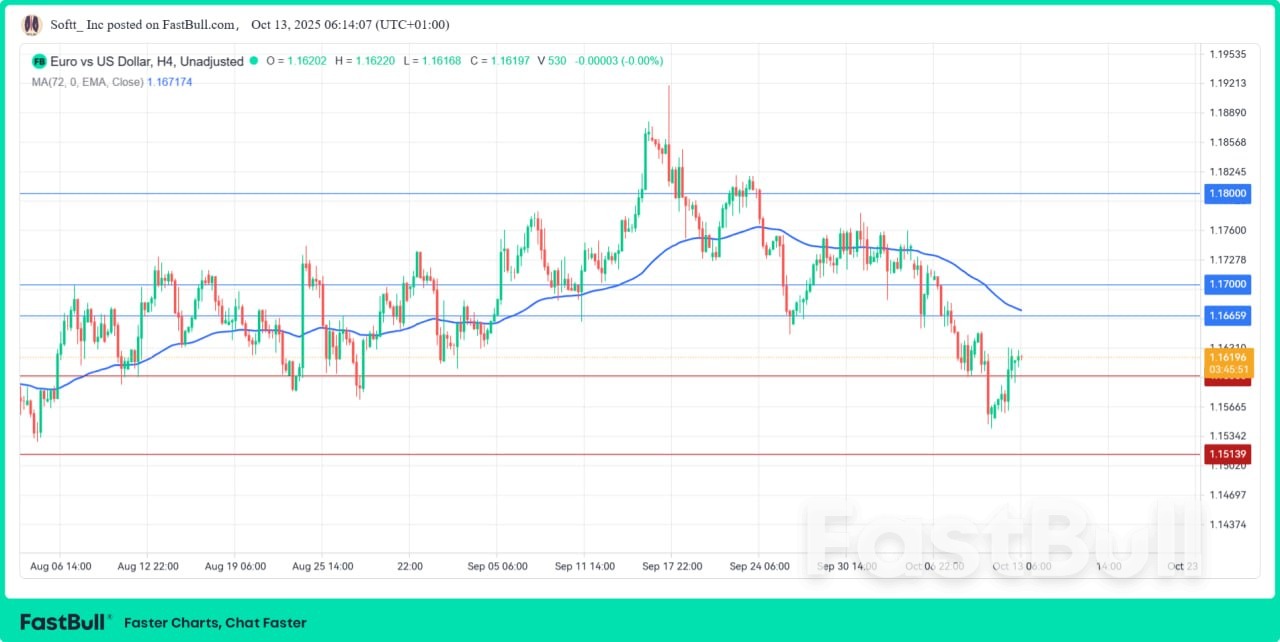
          Technical Outlook: EUR/USD Eyes Recovery Toward 1.1700

          EUR/USD rebounds above 1.1600 as trade tensions intensify; Macron reappoints Lecornu_1On the technical front, EUR/USD has staged a modest rebound but remains below the 72-day Exponential Moving Average (EMA), currently positioned at 1.1675 on the H4 chart, underscoring that the pair is still trading within a short-term bearish structure.
          A sustained break above the 1.1665 resistance zone (coinciding with the EMA and prior consolidation ceiling) would open the door for a move toward the 1.1700 psychological barrier, followed by 1.1760, where sellers are likely to re-emerge.
          On the downside, immediate support lies at 1.1600, a critical psychological and structural pivot. A decisive break below this level could expose the next major support at 1.1514, aligning with the late September swing low.
          Risk Warnings and Disclaimers
          You understand and acknowledge that there is a high degree of risk involved in trading. Following any strategies or investment methods may lead to potential losses. The content on the site is provided by our contributors and analysts for information purposes only. You are solely responsible for determining whether any trading assets, securities, strategy, or any other product is suitable for investing based on your own investment objectives and financial situation.
          Add to Favorites
          Share

          Silver Soars on Historic Short Squeeze as Gold Breaks Record in Haven-Fueled Rally

          Gerik

          Economic

          Commodity

          Silver Skyrockets Amid London Market Squeeze

          Silver prices surged on Monday, climbing as much as 3% to approach $52 per ounce levels unseen in more than four decades as a severe short squeeze in the London metals market intensified. The rally reflects both physical market tightness and speculative positioning, with traders scrambling to cover short bets amid limited available supply. The scarcity of freely tradable silver has driven an extraordinary premium for London benchmark prices over those in New York, prompting traders to airlift bars across the Atlantic an unusual and costly move typically reserved for gold.
          The rally pushed silver closer to the 1980 record of $52.50 per ounce, which was set during the Hunt brothers’ speculative buying frenzy. This episode underscores the same causal chain of events: reduced liquidity and a mismatch between physical availability and leveraged short exposure have fueled a rapid, self-reinforcing price surge.

          Gold Hits New Record on Haven Demand and Monetary Support

          Gold extended its exceptional year-to-date rally, rising 1.3% to $4,068.21 per ounce and marking its eighth consecutive weekly gain. The metal’s climb has been propelled by a confluence of factors: continued central bank accumulation, inflows into exchange-traded funds, and the Federal Reserve’s ongoing cycle of interest rate cuts. Lower rates reduce the opportunity cost of holding non-yielding assets like gold, while the weakening confidence in the U.S. dollar reinforces its appeal as a store of value.
          Investor behavior also reflects a strong correlation between geopolitical uncertainty and safe-haven accumulation. The latest flare-up in U.S.–China trade tensions, coupled with the threat of a U.S. government shutdown and political scrutiny of the Fed’s independence, has amplified risk aversion across global markets. This convergence of macro risks has renewed demand for gold, which now serves both as an inflation hedge and as insurance against systemic instability.

          Trade Tensions Reignite Safe-Haven Flows

          The metals rally came just as President Donald Trump’s administration appeared to soften its stance toward Beijing. Over the weekend, Trump suggested a willingness to resume talks, after earlier threats to impose 100% tariffs on Chinese goods. In response, China urged Washington to abandon “provocative” tariff threats and return to dialogue.
          Yet, as analyst Kyle Rodda from Capital.com observed, even when “trade volatility may go silent, it never disappears.” His comment encapsulates the persistent causal relationship between geopolitical instability and investor rotation into gold uncertainty acts as the consistent fuel sustaining the metal’s multi-month ascent.

          Liquidity Crunch Amplifies Silver’s Ascent

          Silver’s meteoric rise is also tied to worsening liquidity conditions in London. Market participants report that the availability of unencumbered silver stocks has fallen dramatically after months of heavy withdrawals. The resulting scarcity, combined with speculative short positions, triggered a feedback loop: as prices rise, short sellers rush to close positions, tightening supply further and pushing prices higher.
          The imbalance has widened the London–New York price spread to unprecedented levels, prompting traders to exploit arbitrage opportunities. The decision to fly physical silver bars across the Atlantic underscores the severity of the supply dislocation and the strength of profit incentives in this constrained environment.

          Section 232 Probe Adds Policy Risk to Precious Metals

          Adding to the volatility is the U.S. administration’s pending Section 232 investigation into critical minerals a review that includes silver, platinum, and palladium. Traders fear that any decision to impose new levies or trade barriers could constrict supply chains further. This policy uncertainty acts as an indirect causal accelerator for speculative buying, as market participants hedge against potential disruptions to cross-border flows of key metals.
          The bullish momentum extended across the entire precious metals spectrum. Platinum traded near $1,634 per ounce, up nearly 3%, while palladium rose as much as 3.6%. The Bloomberg Dollar Spot Index was little changed, reflecting that metals strength was driven more by market fundamentals and investor sentiment than by currency depreciation.
          The synchronized advance across metals reflects a structural shift in portfolio allocation toward tangible assets amid declining real yields, intensifying trade disputes, and persistent geopolitical instability. These dynamics form a reinforcing relationship: each new macro shock deepens investor appetite for physical assets, pushing prices higher and amplifying scarcity concerns.

          A Market Fueled by Fear, Liquidity, and Leverage

          The simultaneous surge in gold and silver marks one of the most dramatic chapters in the 2025 commodity cycle. Gold’s rise captures broad-based investor anxiety over macroeconomic fragility, while silver’s rally embodies the raw mechanics of leverage, liquidity constraints, and speculative momentum.
          Whether this momentum persists depends on the interplay between monetary policy, trade diplomacy, and physical supply availability. For now, the twin forces of economic uncertainty and market tightness have merged to propel precious metals into a rarefied zone where psychology, policy, and scarcity converge to rewrite historical price records.

          Source: Bloomberg

          To stay updated on all economic events of today, please check out our Economic calendar
          Risk Warnings and Disclaimers
          You understand and acknowledge that there is a high degree of risk involved in trading. Following any strategies or investment methods may lead to potential losses. The content on the site is provided by our contributors and analysts for information purposes only. You are solely responsible for determining whether any trading assets, securities, strategy, or any other product is suitable for investing based on your own investment objectives and financial situation.
          Add to Favorites
          Share
          FastBull
          Copyright © 2025 FastBull Ltd

          728 RM B 7/F GEE LOK IND BLDG NO 34 HUNG TO RD KWUN TONG KLN HONG KONG

          TelegramInstagramTwitterfacebooklinkedin
          App Store Google Play Google Play
          Products
          Charts

          Chats

          Q&A with Experts
          Screeners
          Economic Calendar
          Data
          Tools
          Membership
          Features
          Function
          Markets
          Copy Trading
          Latest Signals
          Contests
          News
          Analysis
          24/7
          Columns
          Education
          Company
          Careers
          About Us
          Contact Us
          Advertising
          Help Center
          Feedback
          User Agreement
          Privacy Policy
          Business

          White Label

          Data API

          Web Plug-ins

          Poster Maker

          Affiliate Program

          Risk Disclosure

          The risk of loss in trading financial instruments such as stocks, FX, commodities, futures, bonds, ETFs and crypto can be substantial. You may sustain a total loss of the funds that you deposit with your broker. Therefore, you should carefully consider whether such trading is suitable for you in light of your circumstances and financial resources.

          No decision to invest should be made without thoroughly conducting due diligence by yourself or consulting with your financial advisors. Our web content might not suit you since we don't know your financial conditions and investment needs. Our financial information might have latency or contain inaccuracy, so you should be fully responsible for any of your trading and investment decisions. The company will not be responsible for your capital loss.

          Without getting permission from the website, you are not allowed to copy the website's graphics, texts, or trademarks. Intellectual property rights in the content or data incorporated into this website belong to its providers and exchange merchants.

          Not Logged In

          Log in to access more features

          FastBull Membership

          Not yet

          Purchase

          Become a signal provider
          Help Center
          Customer Service
          Dark Mode
          Price Up/Down Colors

          Log In

          Sign Up

          Position
          Layout
          Fullscreen
          Default to Chart
          The chart page opens by default when you visit fastbull.com